MKT510 Customer Behaviour: Telstra's Marketing Strategy Analysis
VerifiedAdded on 2023/04/25
|14
|4695
|351
Report
AI Summary
This report examines customer behavior within Telstra Corporation Ltd. in Australia, focusing on the social and environmental factors impacting consumer decision-making and brand switching. It analyzes the influence of family, reference groups, roles, status, technology, culture, demographics, and political factors on consumer choices. The report also delves into individual differences, such as needs, personality, and motivation, and their effects on purchasing decisions. Furthermore, it provides recommendations for improving Telstra's marketing strategies to enhance customer loyalty and adapt to the evolving technological landscape and cultural values of Australian consumers. The analysis emphasizes the importance of understanding consumer perceptions and adapting to environmental concerns to maintain a competitive edge in the telecommunications industry. Desklib offers this and many other solved assignments for students.
Telstra 0
Customer Behaviour
Customer Behaviour

Paraphrase This Document
Need a fresh take? Get an instant paraphrase of this document with our AI Paraphraser
Telstra 1
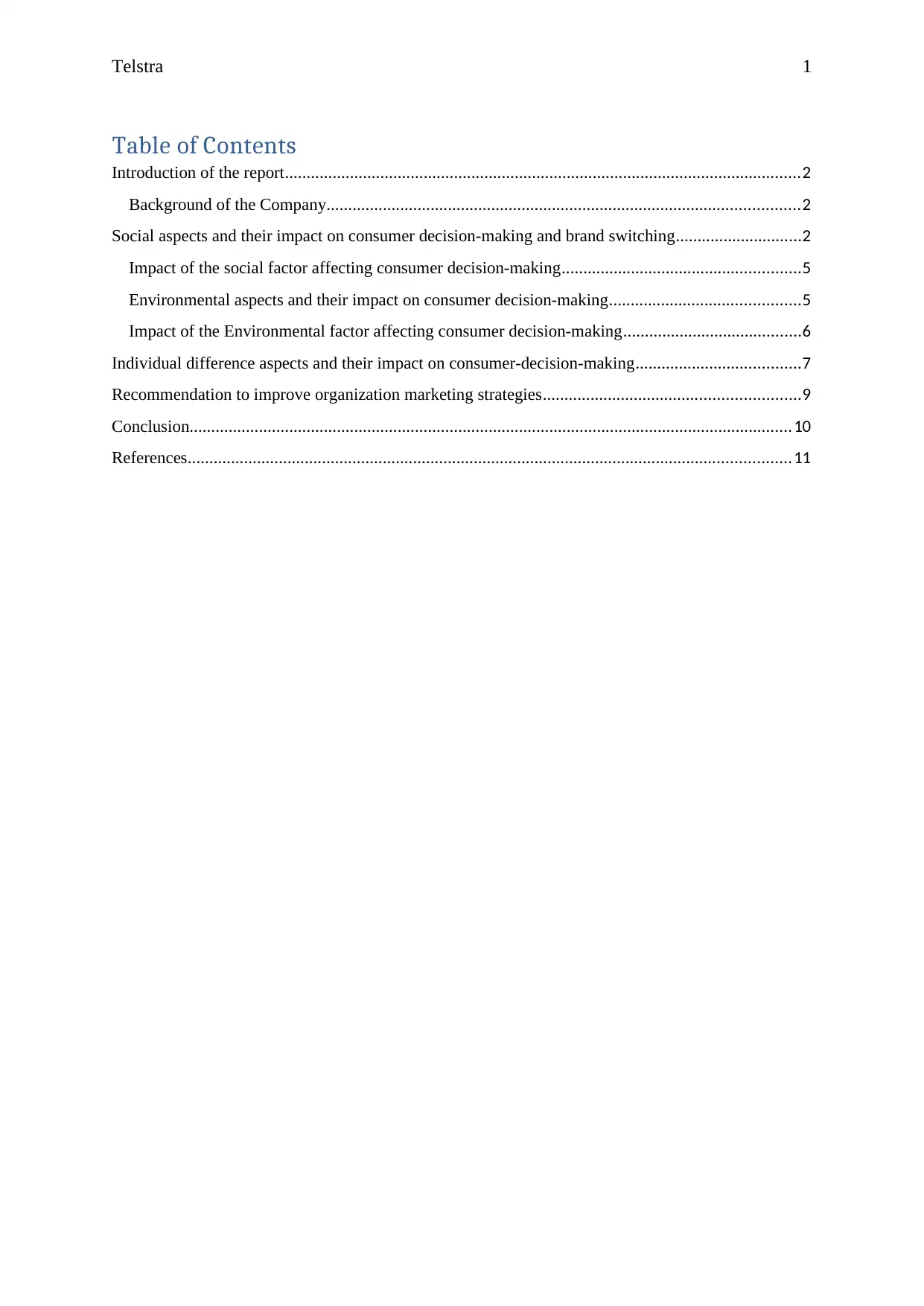
Table of Contents
Introduction of the report.......................................................................................................................2
Background of the Company.............................................................................................................2
Social aspects and their impact on consumer decision-making and brand switching.............................2
Impact of the social factor affecting consumer decision-making.......................................................5
Environmental aspects and their impact on consumer decision-making............................................5
Impact of the Environmental factor affecting consumer decision-making.........................................6
Individual difference aspects and their impact on consumer-decision-making......................................7
Recommendation to improve organization marketing strategies...........................................................9
Conclusion...........................................................................................................................................10
References...........................................................................................................................................11
Table of Contents
Introduction of the report.......................................................................................................................2
Background of the Company.............................................................................................................2
Social aspects and their impact on consumer decision-making and brand switching.............................2
Impact of the social factor affecting consumer decision-making.......................................................5
Environmental aspects and their impact on consumer decision-making............................................5
Impact of the Environmental factor affecting consumer decision-making.........................................6
Individual difference aspects and their impact on consumer-decision-making......................................7
Recommendation to improve organization marketing strategies...........................................................9
Conclusion...........................................................................................................................................10
References...........................................................................................................................................11
Telstra 2
Introduction of the report
Consumer Behaviour is determined as the study of individuals, groups, or
organization to buy, use, select goods and services to fulfill their wants and preferences.
Marketers expect that by understanding what drive the consumers to purchase goods and
services and the roles of the consumer in the decision-making process. Individual differences
are variation among diverse consumers with respect to specific characteristics (Corones &
Davis, 2017). This report discusses the social as well as environmental factors and their
impact on consumer decision making. In addition, it also discusses the individual influence
factors and recommendation to enhance the organization marketing strategies in Telstra
Corporation Ltd. in Australia.
Background of the Company
The Telstra Corporation Limited is Australia’s biggest telecommunication
organization, which develops and operates telecommunication markets and network involves
internet availability, voice, television, cell phone, and other products and services. It is the
prominent provider of broadband internet, home phones, and mobile phones. The main
objective is to develop technology solutions and content, which can be utilized by consumers
easily. They have a global presence in around more than countries and delivers 4.9 million
voice services, 3.6 million broadband services, and 17.7 million mobile services (Burgess,
Sellitto, Cox & Buultjens, 2015).
Social aspects and their impact on consumer decision-making and brand switching
Social factors are prevalent in the community, which affects the consumer decision-
making processes are family, reference groups, and roles & status.
Family- The family members play an important part in designing individual needs,
preferences, and behaviour. It is the most significant customer buying organization in
the community. The pattern might change because of societal change as the influence
of consumer behaviour is increasing (Liu, Li, Xu, Kostakos & Heikkilä, 2016). In
addition, it is the most significant primary reference group as buyer consists of two
families, which consists of-
The family of Procreation: It includes spouse/children, which impacts a buyer
depends upon the position:
Introduction of the report
Consumer Behaviour is determined as the study of individuals, groups, or
organization to buy, use, select goods and services to fulfill their wants and preferences.
Marketers expect that by understanding what drive the consumers to purchase goods and
services and the roles of the consumer in the decision-making process. Individual differences
are variation among diverse consumers with respect to specific characteristics (Corones &
Davis, 2017). This report discusses the social as well as environmental factors and their
impact on consumer decision making. In addition, it also discusses the individual influence
factors and recommendation to enhance the organization marketing strategies in Telstra
Corporation Ltd. in Australia.
Background of the Company
The Telstra Corporation Limited is Australia’s biggest telecommunication
organization, which develops and operates telecommunication markets and network involves
internet availability, voice, television, cell phone, and other products and services. It is the
prominent provider of broadband internet, home phones, and mobile phones. The main
objective is to develop technology solutions and content, which can be utilized by consumers
easily. They have a global presence in around more than countries and delivers 4.9 million
voice services, 3.6 million broadband services, and 17.7 million mobile services (Burgess,
Sellitto, Cox & Buultjens, 2015).
Social aspects and their impact on consumer decision-making and brand switching
Social factors are prevalent in the community, which affects the consumer decision-
making processes are family, reference groups, and roles & status.
Family- The family members play an important part in designing individual needs,
preferences, and behaviour. It is the most significant customer buying organization in
the community. The pattern might change because of societal change as the influence
of consumer behaviour is increasing (Liu, Li, Xu, Kostakos & Heikkilä, 2016). In
addition, it is the most significant primary reference group as buyer consists of two
families, which consists of-
The family of Procreation: It includes spouse/children, which impacts a buyer
depends upon the position:
⊘ This is a preview!⊘
Do you want full access?
Subscribe today to unlock all pages.

Trusted by 1+ million students worldwide
Telstra 3
1. Husband- It may lead decision making associated with
telecommunication/automobiles.
2. Wife-It may dominate or lead decision making associated with mobile
appliances.
3. Equal- It may support for decision associated with best mobile choice.
The family of Orientation: It includes parents and siblings, which gives an
individual-
1. Coordination towards politics/religious/economics
2. Source of self-worth/love/self-satisfaction
It offers a situation in which an individual grows; acquire values and principles, and
builds personality. It affects the decision making of people concerning the acquisition of
goods and services (Davvetas & Diamantopoulos, 2017).
Reference groups- An individual reference groups comprise of all the groups that
have a direct impact on the individual behaviour. They share common buying
behaviour and have a major impact on each other. It is divided into three groups-
Membership group- They are those groups, which are having a direct
influence on a consumer.
1. Primary: It involves Friends/Family/Co-workers/Neighbours/ with
whom that individual interacts constantly.
2. Secondary: It incorporates formal and less interaction such as trade
union/professional/ religious groups.
Dissociative group- They are those groups whose values and one rejects.
Aspirational group- They are those groups in which a person would like to
belong (Su, Jiang, Chen & DeWall, 2016).
1. Husband- It may lead decision making associated with
telecommunication/automobiles.
2. Wife-It may dominate or lead decision making associated with mobile
appliances.
3. Equal- It may support for decision associated with best mobile choice.
The family of Orientation: It includes parents and siblings, which gives an
individual-
1. Coordination towards politics/religious/economics
2. Source of self-worth/love/self-satisfaction
It offers a situation in which an individual grows; acquire values and principles, and
builds personality. It affects the decision making of people concerning the acquisition of
goods and services (Davvetas & Diamantopoulos, 2017).
Reference groups- An individual reference groups comprise of all the groups that
have a direct impact on the individual behaviour. They share common buying
behaviour and have a major impact on each other. It is divided into three groups-
Membership group- They are those groups, which are having a direct
influence on a consumer.
1. Primary: It involves Friends/Family/Co-workers/Neighbours/ with
whom that individual interacts constantly.
2. Secondary: It incorporates formal and less interaction such as trade
union/professional/ religious groups.
Dissociative group- They are those groups whose values and one rejects.
Aspirational group- They are those groups in which a person would like to
belong (Su, Jiang, Chen & DeWall, 2016).
Paraphrase This Document
Need a fresh take? Get an instant paraphrase of this document with our AI Paraphraser
Telstra 4
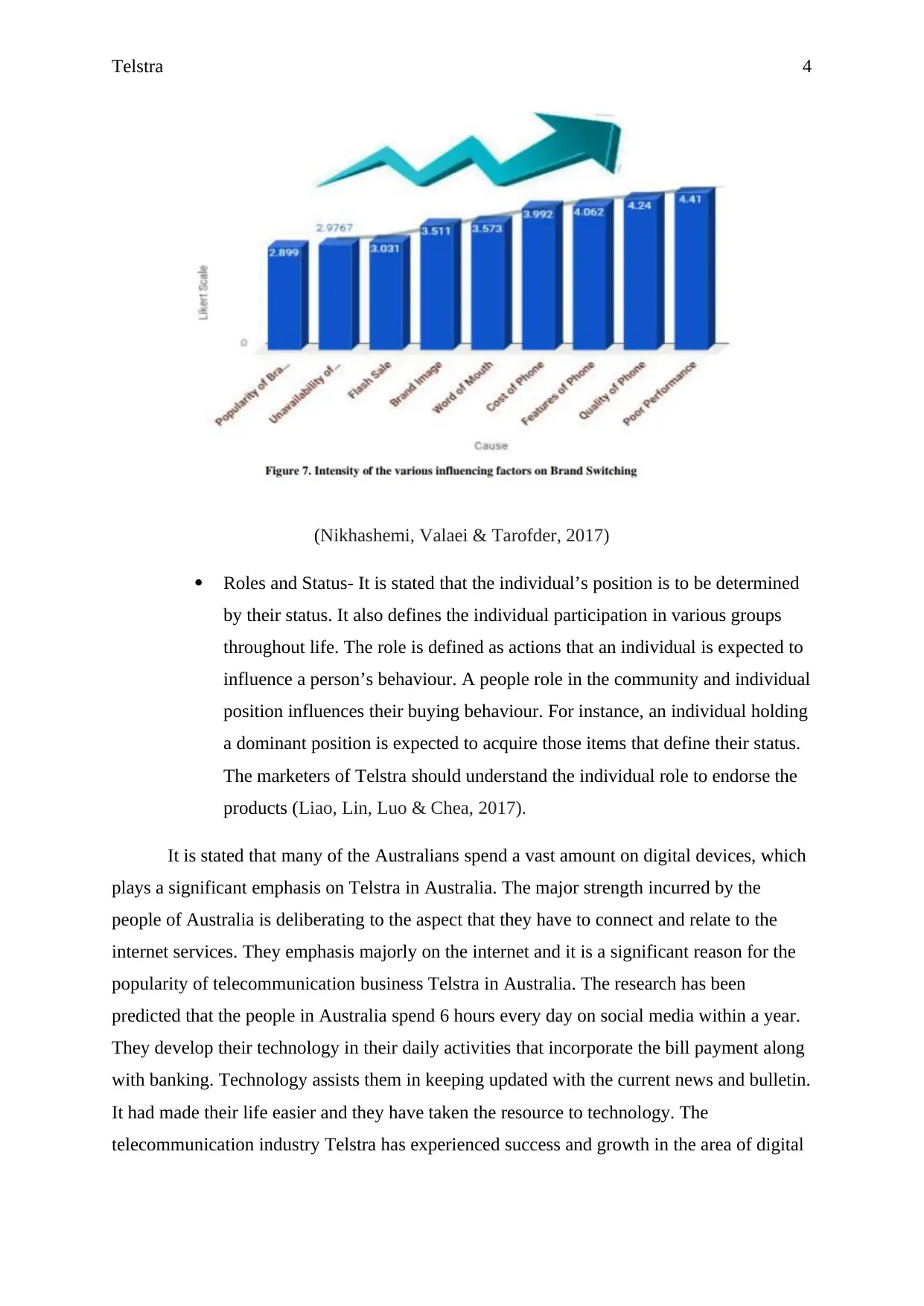
(Nikhashemi, Valaei & Tarofder, 2017)
Roles and Status- It is stated that the individual’s position is to be determined
by their status. It also defines the individual participation in various groups
throughout life. The role is defined as actions that an individual is expected to
influence a person’s behaviour. A people role in the community and individual
position influences their buying behaviour. For instance, an individual holding
a dominant position is expected to acquire those items that define their status.
The marketers of Telstra should understand the individual role to endorse the
products (Liao, Lin, Luo & Chea, 2017).
It is stated that many of the Australians spend a vast amount on digital devices, which
plays a significant emphasis on Telstra in Australia. The major strength incurred by the
people of Australia is deliberating to the aspect that they have to connect and relate to the
internet services. They emphasis majorly on the internet and it is a significant reason for the
popularity of telecommunication business Telstra in Australia. The research has been
predicted that the people in Australia spend 6 hours every day on social media within a year.
They develop their technology in their daily activities that incorporate the bill payment along
with banking. Technology assists them in keeping updated with the current news and bulletin.
It had made their life easier and they have taken the resource to technology. The
telecommunication industry Telstra has experienced success and growth in the area of digital
(Nikhashemi, Valaei & Tarofder, 2017)
Roles and Status- It is stated that the individual’s position is to be determined
by their status. It also defines the individual participation in various groups
throughout life. The role is defined as actions that an individual is expected to
influence a person’s behaviour. A people role in the community and individual
position influences their buying behaviour. For instance, an individual holding
a dominant position is expected to acquire those items that define their status.
The marketers of Telstra should understand the individual role to endorse the
products (Liao, Lin, Luo & Chea, 2017).
It is stated that many of the Australians spend a vast amount on digital devices, which
plays a significant emphasis on Telstra in Australia. The major strength incurred by the
people of Australia is deliberating to the aspect that they have to connect and relate to the
internet services. They emphasis majorly on the internet and it is a significant reason for the
popularity of telecommunication business Telstra in Australia. The research has been
predicted that the people in Australia spend 6 hours every day on social media within a year.
They develop their technology in their daily activities that incorporate the bill payment along
with banking. Technology assists them in keeping updated with the current news and bulletin.
It had made their life easier and they have taken the resource to technology. The
telecommunication industry Telstra has experienced success and growth in the area of digital
Telstra 5
communication, which has significantly transform the world of the consumers of Australia
(Parida, & Sahney, 2017).
Impact of the social factor affecting consumer decision-making
The social factors are the factors that majorly affect the consumer residing in the
society. It comprises of different individuals and different perception on brand switching and
decision-making. The elderly people living in Australia also easily adapt to innovative
technology and this makes a positive impact on the buying decision in Australia (Kumar,
Choi & Greene, 2017). They are very comfortable, which has moved the path for the
utilization of telecommunication industry Telstra in Australia. The individuals in Australia
have long families, which can maintain contact with people with the assistance of
telecommunication. They are so much busy in their daily life and not every time meets their
close ones, which develops a reason for the success and growth of Telstra (Shi, Lin, Liu &
Hui, 2018).
Environmental aspects and their impact on consumer decision-making
These factors are affected due to the progressive impact of consumer’s decision to
repurchase a phone and develop loyalty. The factors are demographic, technology, political,
and cultural.
Technology- It is the major factor that influenced the decision-making of Australians.
Telstra should majorly focus on maintaining brand loyalty so that consumers become
loyal and do not easily switch towards another brand. As many other companies in
telecommunication initiate other phones which are very attractive and so that
individual switch towards them. Intense competition and availability of alternative
options for consumers tend towards switching to other brands. Nowadays individuals
are more exposed to advanced technology such as mobile phones with an advanced
camera, 4G service, and fast availability of internet. This has led to an increase in the
expectation and demand of telecommunication service provider Telstra and high-tech
mobile service. It fulfills the customer needs and preferences on a great extent and
retains the prospective as well as new customers (Byun & Dass, 2015).
Culture- It is the major financial determinant of an individual needs and wants and it
is defined by perceptions, behaviour, value system, and preferences. It is manifest
through our approach to material comfort, efficiency, activity, humanitarianism,
progress, freedom, and success. It determines the way of shifting of customers from
communication, which has significantly transform the world of the consumers of Australia
(Parida, & Sahney, 2017).
Impact of the social factor affecting consumer decision-making
The social factors are the factors that majorly affect the consumer residing in the
society. It comprises of different individuals and different perception on brand switching and
decision-making. The elderly people living in Australia also easily adapt to innovative
technology and this makes a positive impact on the buying decision in Australia (Kumar,
Choi & Greene, 2017). They are very comfortable, which has moved the path for the
utilization of telecommunication industry Telstra in Australia. The individuals in Australia
have long families, which can maintain contact with people with the assistance of
telecommunication. They are so much busy in their daily life and not every time meets their
close ones, which develops a reason for the success and growth of Telstra (Shi, Lin, Liu &
Hui, 2018).
Environmental aspects and their impact on consumer decision-making
These factors are affected due to the progressive impact of consumer’s decision to
repurchase a phone and develop loyalty. The factors are demographic, technology, political,
and cultural.
Technology- It is the major factor that influenced the decision-making of Australians.
Telstra should majorly focus on maintaining brand loyalty so that consumers become
loyal and do not easily switch towards another brand. As many other companies in
telecommunication initiate other phones which are very attractive and so that
individual switch towards them. Intense competition and availability of alternative
options for consumers tend towards switching to other brands. Nowadays individuals
are more exposed to advanced technology such as mobile phones with an advanced
camera, 4G service, and fast availability of internet. This has led to an increase in the
expectation and demand of telecommunication service provider Telstra and high-tech
mobile service. It fulfills the customer needs and preferences on a great extent and
retains the prospective as well as new customers (Byun & Dass, 2015).
Culture- It is the major financial determinant of an individual needs and wants and it
is defined by perceptions, behaviour, value system, and preferences. It is manifest
through our approach to material comfort, efficiency, activity, humanitarianism,
progress, freedom, and success. It determines the way of shifting of customers from
⊘ This is a preview!⊘
Do you want full access?
Subscribe today to unlock all pages.
Trusted by 1+ million students worldwide
Telstra 6
one supplier to another. It can be defined as the predisposition of consumers to switch
from one product to another in the telecommunication industry. The societal culture
defines as the set of shared beliefs, assumptions, perceptions that guides and manages
the behaviour and attitudes in the community. The culture, which is defined by
Australian people, is also influenced by geographically. The socio-cultural factors in
Telstra determine as the lifestyle along with customs of people, which assists in
characterizing of a society. It comprises of groups or individuals that influence the
attitudes, opinion of the behaviour of every individual. They have noticed that 78%
of the individual are older people and make use of a platform such as internet and
social media. The elderly individuals in Australia are improving in an effective
manner of the modern digital age (Al-Kwifi & Ahmed, 2015).
Demographics- It differentiates the consumer groups in the market, which disclose
several market opportunities such as market niches with considerable potential to fit
with the profile. It has been divided among age, gender, income, and lifestyle to
develop the economic benefit, which examines the brand awareness in the existing
market. When deciding on the acquisition of several products that made consumers
made several efforts, as the decision to make it effective requires a strategic approach,
which is very specific and characterized incorporates major involvement in the
decision-making. The level is very significant in segmenting and targeting of the
market, which can be differentiated among high, medium, and low involvement. It
may generate a greater impact on the purchasing decision of the consumers (Sasmita
& Mohd Suki, 2015).
Political- It is stated that political instability generates an impact on customer buying
decision and brand switching. The telecommunication industry delivers value-added
services, which enable consumers to fulfill the requirement of this adaptive
technology. This tends to a frequent change of customer value-added services, which
change their current service. After the satisfaction of the price and political instability,
it has enabled features such as audibility, access cost, fast network, and customer
service (Keller, 2016).
Impact of the Environmental factor affecting consumer decision-making
It is stated that the culture, technology, and demographics factor also affect the Telstra
as their belief along with attitudes, which plays a significant part in consumer decision-
making and brand switching. They have spirit, motivation, and essence to adapt to the
one supplier to another. It can be defined as the predisposition of consumers to switch
from one product to another in the telecommunication industry. The societal culture
defines as the set of shared beliefs, assumptions, perceptions that guides and manages
the behaviour and attitudes in the community. The culture, which is defined by
Australian people, is also influenced by geographically. The socio-cultural factors in
Telstra determine as the lifestyle along with customs of people, which assists in
characterizing of a society. It comprises of groups or individuals that influence the
attitudes, opinion of the behaviour of every individual. They have noticed that 78%
of the individual are older people and make use of a platform such as internet and
social media. The elderly individuals in Australia are improving in an effective
manner of the modern digital age (Al-Kwifi & Ahmed, 2015).
Demographics- It differentiates the consumer groups in the market, which disclose
several market opportunities such as market niches with considerable potential to fit
with the profile. It has been divided among age, gender, income, and lifestyle to
develop the economic benefit, which examines the brand awareness in the existing
market. When deciding on the acquisition of several products that made consumers
made several efforts, as the decision to make it effective requires a strategic approach,
which is very specific and characterized incorporates major involvement in the
decision-making. The level is very significant in segmenting and targeting of the
market, which can be differentiated among high, medium, and low involvement. It
may generate a greater impact on the purchasing decision of the consumers (Sasmita
& Mohd Suki, 2015).
Political- It is stated that political instability generates an impact on customer buying
decision and brand switching. The telecommunication industry delivers value-added
services, which enable consumers to fulfill the requirement of this adaptive
technology. This tends to a frequent change of customer value-added services, which
change their current service. After the satisfaction of the price and political instability,
it has enabled features such as audibility, access cost, fast network, and customer
service (Keller, 2016).
Impact of the Environmental factor affecting consumer decision-making
It is stated that the culture, technology, and demographics factor also affect the Telstra
as their belief along with attitudes, which plays a significant part in consumer decision-
making and brand switching. They have spirit, motivation, and essence to adapt to the
Paraphrase This Document
Need a fresh take? Get an instant paraphrase of this document with our AI Paraphraser
Telstra 7
innovative things in a sustainable manner. They have committed to the way of growth and
success of Telstra in Australia. The people residing in Australia are very much focussed
about the environment, their culture, perception, and stability, which made a great emphasis
on buying decision of the customer. The Telstra organization plays a greater emphasis on
helping the consumer to deliver the best offers with effective deals and advance their
technology changes (Braimah, 2015). The Environmental strategy of Telstra ensures to utilize
the technology that can assist in addressing the challenges for serving the good environment.
The Telstra also plays a significant aspect in managing and maintaining the risks
associated with the environment. It also plays a significant role in maintaining the aspect of
environmental footprint, which stimulates them to advance their digital products and services.
They also deliver an environmental solution that assists in protecting in embracing the
environment. The National Environmental Law has made it a significant part for an
individual to take appropriate action that would have negative effects on the environment. It
concentrates in protecting the laws to maintain the environment in a sustainable manner.
Telstra also abides several environmental regulations, which have an impact on the
purchasing decision of the customers. This also made an impact on the brand switching
process (Royo-Vela & Hünermund, 2016).
Individual difference aspects and their impact on consumer-decision-making
Consumer decision-making is utilized for decision-making regarding the purchase of
products and services. It is probably utilized as the form of cost-benefit analysis in the
presence of choices. It is stated that decision-making is determined as a psychological
paradigm that states that cannot be seen but it is inferred from the observable behaviour,
which makes the decision. The customer decision-making process at every stage is influenced
by the individual differences. Individual differences are differentiated or separated from one
another. The alternatives of the consumers are defined based on individual difference factors.
The diversity of the consumers can be determined as the diversity in the nature of the
consumers’ needs and preferences and their characteristics. The perception of the consumers
for making purchases is influenced because of factors involving friends, personal and ethical
factors, technological factors, social structure, economic factors, and cultural values. The
individual factors that influenced consumer behaviour are needs, personality, involvement,
motivation, the perception of consumers, learning, and consumer attitudes (Yacout & Vitell,
2018).
innovative things in a sustainable manner. They have committed to the way of growth and
success of Telstra in Australia. The people residing in Australia are very much focussed
about the environment, their culture, perception, and stability, which made a great emphasis
on buying decision of the customer. The Telstra organization plays a greater emphasis on
helping the consumer to deliver the best offers with effective deals and advance their
technology changes (Braimah, 2015). The Environmental strategy of Telstra ensures to utilize
the technology that can assist in addressing the challenges for serving the good environment.
The Telstra also plays a significant aspect in managing and maintaining the risks
associated with the environment. It also plays a significant role in maintaining the aspect of
environmental footprint, which stimulates them to advance their digital products and services.
They also deliver an environmental solution that assists in protecting in embracing the
environment. The National Environmental Law has made it a significant part for an
individual to take appropriate action that would have negative effects on the environment. It
concentrates in protecting the laws to maintain the environment in a sustainable manner.
Telstra also abides several environmental regulations, which have an impact on the
purchasing decision of the customers. This also made an impact on the brand switching
process (Royo-Vela & Hünermund, 2016).
Individual difference aspects and their impact on consumer-decision-making
Consumer decision-making is utilized for decision-making regarding the purchase of
products and services. It is probably utilized as the form of cost-benefit analysis in the
presence of choices. It is stated that decision-making is determined as a psychological
paradigm that states that cannot be seen but it is inferred from the observable behaviour,
which makes the decision. The customer decision-making process at every stage is influenced
by the individual differences. Individual differences are differentiated or separated from one
another. The alternatives of the consumers are defined based on individual difference factors.
The diversity of the consumers can be determined as the diversity in the nature of the
consumers’ needs and preferences and their characteristics. The perception of the consumers
for making purchases is influenced because of factors involving friends, personal and ethical
factors, technological factors, social structure, economic factors, and cultural values. The
individual factors that influenced consumer behaviour are needs, personality, involvement,
motivation, the perception of consumers, learning, and consumer attitudes (Yacout & Vitell,
2018).
Telstra 8
Needs- It is stated that needs play an important role in shaping consumer behaviour is
also defined as a matter of deficiencies or imbalance, which can be satisfied in some
manner. It is divided into two categories i.e. needs of use and instrumental. The needs
are normally implied by the needs of the consumer to attain economic advantage
from the service, which can be functional or emotional.
With the tenure of time and the advancement of technology, Telstra has transformed
into a responsible digital service provider, which are appreciated and needed by the
consumers. The telecom service provider is probably referred to as the
communication service provider within the industry. It is expected that around 78%
of internet traffic to be delivered in the scope of entertainment, home security,
education, and e-health. The consumers’ needs are defined, as they want good and
effective plans for roaming, fastest internet services, and reasonable plans for
incoming and outgoing calls. Telstra should require satisfying the needs of the
consumers and getting the best out of the minimum prices in order to contend in the
market for a longer span of time (Huang & Benyoucef, 2017).
Personality- It is stated that brand personality affects the individual difference factors
and consumers’ personality in the market. There are several theorists, which have
suggested diverse theories concerning personality. The Psychoanalytic Theory of
Freud delivers behaviour of the people, which lies in the subconscious and involves
Ego, Id, and Superego. The Neo-Freudian Theory delivers that there are three sorts of
personality, which involves compliant, aggressive, and detached personalities. This is
the manner, which assists the consumer to recognize knowledge about the plans and
offers by the Telstra. The consumers are interested in acquiring the services offered
by the company, to focus on the ads of the brand as compared to those who are
neutral towards the brand. Telstra is a brand, which involves warm, innovative,
youthful, colourful, patriotic, inviting, enthusiastic, and simplistic, which leads to
generating a positive image or personality in the minds of the consumers (Bues,
Steiner, Stafflage & Krafft, 2017).
Involvement- It can be determined as an internal state of mind, which is encountered
by the consumers. The agencies are able to attract the involvement of the consumers.
It maintained the sources of the time, resources, effort as well as enjoyment, which is
regarded while choosing a product or service. It is divided among two type’s i.e. high
involvement and low involvement purchases. Telstra implies that consumers keep on
Needs- It is stated that needs play an important role in shaping consumer behaviour is
also defined as a matter of deficiencies or imbalance, which can be satisfied in some
manner. It is divided into two categories i.e. needs of use and instrumental. The needs
are normally implied by the needs of the consumer to attain economic advantage
from the service, which can be functional or emotional.
With the tenure of time and the advancement of technology, Telstra has transformed
into a responsible digital service provider, which are appreciated and needed by the
consumers. The telecom service provider is probably referred to as the
communication service provider within the industry. It is expected that around 78%
of internet traffic to be delivered in the scope of entertainment, home security,
education, and e-health. The consumers’ needs are defined, as they want good and
effective plans for roaming, fastest internet services, and reasonable plans for
incoming and outgoing calls. Telstra should require satisfying the needs of the
consumers and getting the best out of the minimum prices in order to contend in the
market for a longer span of time (Huang & Benyoucef, 2017).
Personality- It is stated that brand personality affects the individual difference factors
and consumers’ personality in the market. There are several theorists, which have
suggested diverse theories concerning personality. The Psychoanalytic Theory of
Freud delivers behaviour of the people, which lies in the subconscious and involves
Ego, Id, and Superego. The Neo-Freudian Theory delivers that there are three sorts of
personality, which involves compliant, aggressive, and detached personalities. This is
the manner, which assists the consumer to recognize knowledge about the plans and
offers by the Telstra. The consumers are interested in acquiring the services offered
by the company, to focus on the ads of the brand as compared to those who are
neutral towards the brand. Telstra is a brand, which involves warm, innovative,
youthful, colourful, patriotic, inviting, enthusiastic, and simplistic, which leads to
generating a positive image or personality in the minds of the consumers (Bues,
Steiner, Stafflage & Krafft, 2017).
Involvement- It can be determined as an internal state of mind, which is encountered
by the consumers. The agencies are able to attract the involvement of the consumers.
It maintained the sources of the time, resources, effort as well as enjoyment, which is
regarded while choosing a product or service. It is divided among two type’s i.e. high
involvement and low involvement purchases. Telstra implies that consumers keep on
⊘ This is a preview!⊘
Do you want full access?
Subscribe today to unlock all pages.
Trusted by 1+ million students worldwide
Telstra 9
switching the brand according to their likes and dislikes (Cano, Doyle & Zhang,
2018).
Motivation-It can be regarded as driving force among consumers, which induces
them to take immediate action. It can be internal also and external also. The theories,
which are defined as The Maslow’s Need Hierarchy theory signifies the significance
of fulfilling the lower level, need first and then rising up in the hierarchy. It can be
categorized as physiological needs, safety needs, social affiliation needs, esteem
needs, and self-actualization needs. The Hertzberg theory, which is divided among
two, factors i.e. Hygiene factors and Motivation factors. Telstra concentrates on
different consumers of age-group, gender, and income levels (Karimi, Papamichail &
Holland, 2015).
Perception of consumers- It is stated as the perception of consumers is determined as
in which manner the environment is perceived and sensed by the person. It can be
further determined as in which manner the stimuli are selected, organized, and
interpreted by the consumers. This has an immense impact on consumer behaviour as
well as decision-making (Lin, Featherman & Sarker, 2017).
Learning- Learning can be also determined as a method of attaining new skills,
knowledge, competencies, needs, preferences, values, and behaviour. It includes the
categories of behaviourism, constructivism, and cognitivism. The behaviourism
concentrates on that aspect of learning which is perceived objectively. The cognitive
theories concentrate on the purpose of brain-based learning. The constructivism
theory concentrates on developing new concepts and ideas. Telstra stated the concept
of learning in which people made the decision for the quality offered, price
structuring, and future purchases (Sipilä, Herold, Tarkiainen & Sundqvist, 2017).
Recommendation to improve organization marketing strategies
Telstra should utilize the concept of individual differences in the matter of consumer
decision-making process and brand switching to improve their marketing strategies. Their
prospective target market can be determined as the market, which should be regarded by
Telstra and are acquire the services as different to other market segments. They should do
cost-benefit analysis involving all the strategies for the matter of profitability for the
company (Soltani & Navimipour, 2016). They should cater to the major focus on drafting the
switching the brand according to their likes and dislikes (Cano, Doyle & Zhang,
2018).
Motivation-It can be regarded as driving force among consumers, which induces
them to take immediate action. It can be internal also and external also. The theories,
which are defined as The Maslow’s Need Hierarchy theory signifies the significance
of fulfilling the lower level, need first and then rising up in the hierarchy. It can be
categorized as physiological needs, safety needs, social affiliation needs, esteem
needs, and self-actualization needs. The Hertzberg theory, which is divided among
two, factors i.e. Hygiene factors and Motivation factors. Telstra concentrates on
different consumers of age-group, gender, and income levels (Karimi, Papamichail &
Holland, 2015).
Perception of consumers- It is stated as the perception of consumers is determined as
in which manner the environment is perceived and sensed by the person. It can be
further determined as in which manner the stimuli are selected, organized, and
interpreted by the consumers. This has an immense impact on consumer behaviour as
well as decision-making (Lin, Featherman & Sarker, 2017).
Learning- Learning can be also determined as a method of attaining new skills,
knowledge, competencies, needs, preferences, values, and behaviour. It includes the
categories of behaviourism, constructivism, and cognitivism. The behaviourism
concentrates on that aspect of learning which is perceived objectively. The cognitive
theories concentrate on the purpose of brain-based learning. The constructivism
theory concentrates on developing new concepts and ideas. Telstra stated the concept
of learning in which people made the decision for the quality offered, price
structuring, and future purchases (Sipilä, Herold, Tarkiainen & Sundqvist, 2017).
Recommendation to improve organization marketing strategies
Telstra should utilize the concept of individual differences in the matter of consumer
decision-making process and brand switching to improve their marketing strategies. Their
prospective target market can be determined as the market, which should be regarded by
Telstra and are acquire the services as different to other market segments. They should do
cost-benefit analysis involving all the strategies for the matter of profitability for the
company (Soltani & Navimipour, 2016). They should cater to the major focus on drafting the
Paraphrase This Document
Need a fresh take? Get an instant paraphrase of this document with our AI Paraphraser
Telstra 10
marketing strategies on the grounds on age, gender, and income. They should introduce
various plans as per the requirement and expectations of the diverse ages.
As per regards to the 4Ps of the company: -
Product- Telstra should concentrate on establishing 5G services for delivering a faster
and smoother involvement for their consumers. They should introduce the latest
generation of communication and its performance which is targeted towards massive
device connectivity, high data rate, energy saving, higher system capacity, and cost
reduction.
Price- The price should be economical for low-level consumers as it can be seen as
their prices are high as compared as regards to competitors such as Optus. They
should introduce plans, which are able to deliver effective value for the consumers.
This can be attained with the assistance of value-added services with the lowest
possible value (Yu, Ramanathan & Nath, 2017).
Place- It is stated that consumer prefers those networks, which are easily accessible so
that they do not need to struggle for attaining the proper connection. This can be
attained by ensuring that 5G is accessible in the market and stay ahead for initiating
6G throughout Australia.
Promotion- Telstra should attract new consumers to utilize the services and being
loyal to the brand as well as a company by delivering specified offers and deals
(Davcik & Sharma, 2016)
Conclusion
It can be concluded that Consumer decision-making and brand switching are widely
affected by social factors, environmental factors, and individual difference factors. It is the
study of groups and individuals in relation to purchasing of the product. Telstra offers
assistance in delivering telecommunication services within Australia. They can maintain the
rise to knowledge market that can assist the organization to focus on rapid change happen in
the Australian environment. It further stresses the social factors, environmental, and
individual factors that impact consumer decision-making. It also delivers the
recommendation for improving the marketing strategies of the organization.
marketing strategies on the grounds on age, gender, and income. They should introduce
various plans as per the requirement and expectations of the diverse ages.
As per regards to the 4Ps of the company: -
Product- Telstra should concentrate on establishing 5G services for delivering a faster
and smoother involvement for their consumers. They should introduce the latest
generation of communication and its performance which is targeted towards massive
device connectivity, high data rate, energy saving, higher system capacity, and cost
reduction.
Price- The price should be economical for low-level consumers as it can be seen as
their prices are high as compared as regards to competitors such as Optus. They
should introduce plans, which are able to deliver effective value for the consumers.
This can be attained with the assistance of value-added services with the lowest
possible value (Yu, Ramanathan & Nath, 2017).
Place- It is stated that consumer prefers those networks, which are easily accessible so
that they do not need to struggle for attaining the proper connection. This can be
attained by ensuring that 5G is accessible in the market and stay ahead for initiating
6G throughout Australia.
Promotion- Telstra should attract new consumers to utilize the services and being
loyal to the brand as well as a company by delivering specified offers and deals
(Davcik & Sharma, 2016)
Conclusion
It can be concluded that Consumer decision-making and brand switching are widely
affected by social factors, environmental factors, and individual difference factors. It is the
study of groups and individuals in relation to purchasing of the product. Telstra offers
assistance in delivering telecommunication services within Australia. They can maintain the
rise to knowledge market that can assist the organization to focus on rapid change happen in
the Australian environment. It further stresses the social factors, environmental, and
individual factors that impact consumer decision-making. It also delivers the
recommendation for improving the marketing strategies of the organization.
Telstra 11
References
Al-Kwifi, O. S., & Ahmed, Z. U. (2015). An intellectual journey into the historical evolution
of marketing research in brand switching behavior–past, present and future. Journal
of Management History, 21(2), 172-193
Braimah, M. (2015). Green brand awareness and customer purchase intention. Management
Science Letters, 5(10), 895-902
Bues, M., Steiner, M., Stafflage, M., & Krafft, M. (2017). How Mobile In‐Store Advertising
Influences Purchase Intention: Value Drivers and Mediating Effects from a Consumer
Perspective. Psychology & Marketing, 34(2), 157-174
Burgess, S., Sellitto, C., Cox, C., & Buultjens, J. (2015). Strategies for Adopting Consumer‐
generated Media in Small‐sized to Medium‐sized Tourism Enterprises. International
Journal of Tourism Research, 17(5), 432-441
Byun, K. A., & Dass, M. (2015). An investigation of the effects of product recalls on brand
commitment and purchase intention. Journal of Consumer Marketing, 32(1), 1-14
Cano, M. B., Doyle, S., & Zhang, Y. (2018). Do Fashion Blogs Influence Vintage Fashion
Consumption? An Analysis from the Perspective of the Chinese Market. In Vintage
Luxury Fashion, 77(6), 167-183
Corones, S., & Davis, J. (2017). Protecting Consumer Privacy and Data Security: Regulatory
Challenges and Potential Future Directions. Fed. L. Rev., 45(4), 65-87
Davcik, N. S., & Sharma, P. (2016). Marketing resources, performance, and competitive
advantage: A review and future research directions. Journal of Business
Research, 69(12), 5547-5552
Davvetas, V., & Diamantopoulos, A. (2017). “Regretting your brand-self?” The moderating
role of consumer-brand identification on consumer responses to purchase
regret. Journal of Business Research, 80, 218-227
Huang, Z., & Benyoucef, M. (2017). The effects of social commerce design on consumer
purchase decision-making: an empirical study. Electronic Commerce Research and
Applications, 25, 40-58
References
Al-Kwifi, O. S., & Ahmed, Z. U. (2015). An intellectual journey into the historical evolution
of marketing research in brand switching behavior–past, present and future. Journal
of Management History, 21(2), 172-193
Braimah, M. (2015). Green brand awareness and customer purchase intention. Management
Science Letters, 5(10), 895-902
Bues, M., Steiner, M., Stafflage, M., & Krafft, M. (2017). How Mobile In‐Store Advertising
Influences Purchase Intention: Value Drivers and Mediating Effects from a Consumer
Perspective. Psychology & Marketing, 34(2), 157-174
Burgess, S., Sellitto, C., Cox, C., & Buultjens, J. (2015). Strategies for Adopting Consumer‐
generated Media in Small‐sized to Medium‐sized Tourism Enterprises. International
Journal of Tourism Research, 17(5), 432-441
Byun, K. A., & Dass, M. (2015). An investigation of the effects of product recalls on brand
commitment and purchase intention. Journal of Consumer Marketing, 32(1), 1-14
Cano, M. B., Doyle, S., & Zhang, Y. (2018). Do Fashion Blogs Influence Vintage Fashion
Consumption? An Analysis from the Perspective of the Chinese Market. In Vintage
Luxury Fashion, 77(6), 167-183
Corones, S., & Davis, J. (2017). Protecting Consumer Privacy and Data Security: Regulatory
Challenges and Potential Future Directions. Fed. L. Rev., 45(4), 65-87
Davcik, N. S., & Sharma, P. (2016). Marketing resources, performance, and competitive
advantage: A review and future research directions. Journal of Business
Research, 69(12), 5547-5552
Davvetas, V., & Diamantopoulos, A. (2017). “Regretting your brand-self?” The moderating
role of consumer-brand identification on consumer responses to purchase
regret. Journal of Business Research, 80, 218-227
Huang, Z., & Benyoucef, M. (2017). The effects of social commerce design on consumer
purchase decision-making: an empirical study. Electronic Commerce Research and
Applications, 25, 40-58
⊘ This is a preview!⊘
Do you want full access?
Subscribe today to unlock all pages.
Trusted by 1+ million students worldwide

1 out of 14


Related Documents


Your All-in-One AI-Powered Toolkit for Academic Success.
+13062052269
info@desklib.com
Available 24*7 on WhatsApp / Email
![[object Object]](/_next/static/media/star-bottom.7253800d.svg)
Unlock your academic potential
Copyright © 2020–2026 A2Z Services. All Rights Reserved. Developed and managed by ZUCOL.