EG5115 - Tendering, Estimating & Cost Control: Valuation Report

Verified

Added on  2023/04/10

|21
|2980
|226
Report
AI Summary
This report provides a comprehensive overview of tendering, estimating, and cost control in contracts. It discusses the benefits of regular payments to contractors, the importance of retention money, and methods for valuing work for payments. An interim valuation certificate is prepared, considering retention and work percentages. The report also outlines the procedure for obtaining a quote, tendering, receiving goods, and making payments. Furthermore, it includes a depreciation analysis of a JCB plant using both the double-declining and straight-line methods. Finally, the report argues the importance of information documented in a Pre-Qualification Questionnaire (PQQ) and its impact on a contractor's chances of securing a tender. Desklib offers a wealth of resources, including similar reports and solved assignments, for students.
Document Page
1
Name:
Course
Professor’s name
University name
City, State
Date of submission
tabler-icon-diamond-filled.svg

Paraphrase This Document

Need a fresh take? Get an instant paraphrase of this document with our AI Paraphraser
Document Page
2
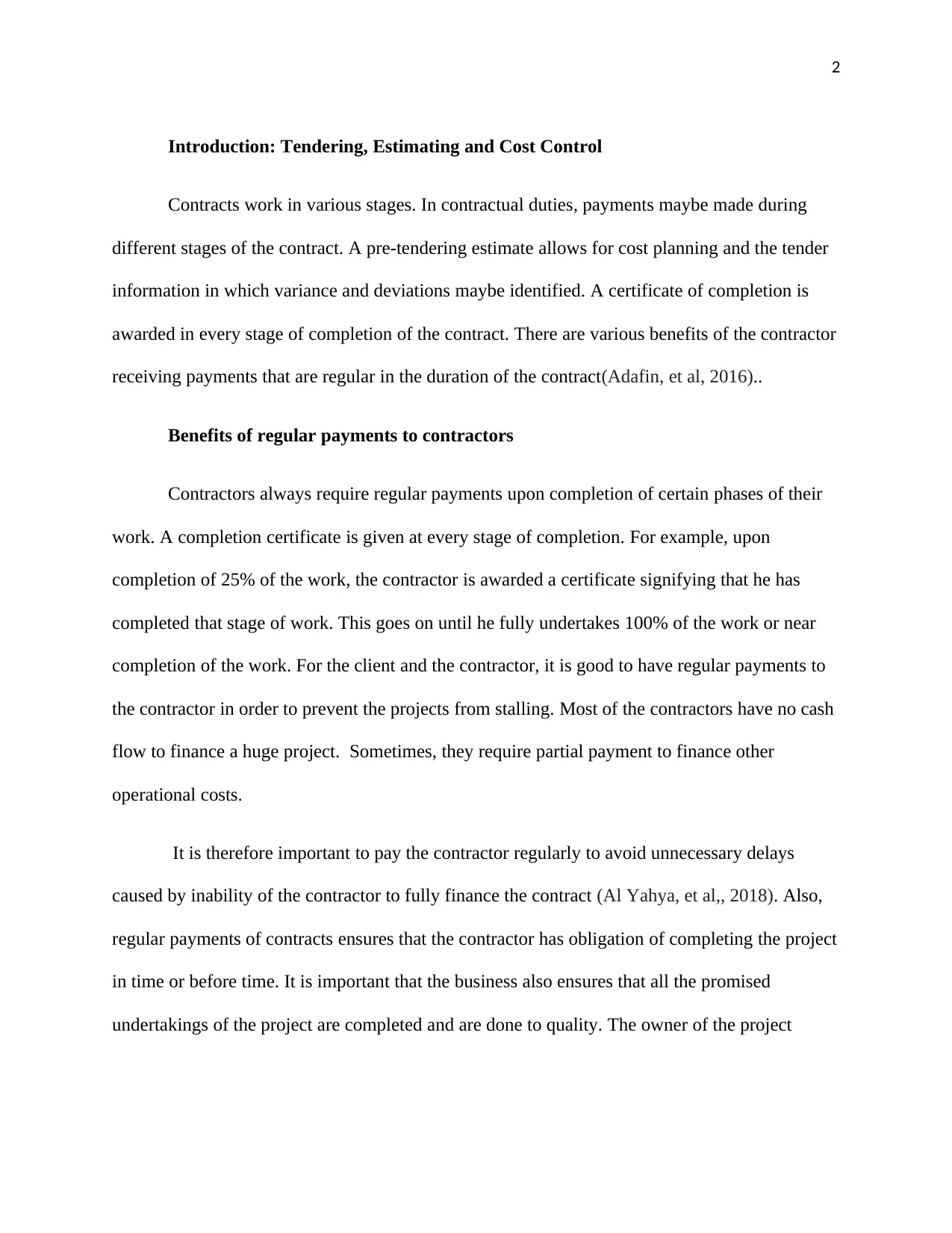
Introduction: Tendering, Estimating and Cost Control
Contracts work in various stages. In contractual duties, payments maybe made during
different stages of the contract. A pre-tendering estimate allows for cost planning and the tender
information in which variance and deviations maybe identified. A certificate of completion is
awarded in every stage of completion of the contract. There are various benefits of the contractor
receiving payments that are regular in the duration of the contract(Adafin, et al, 2016)..
Benefits of regular payments to contractors
Contractors always require regular payments upon completion of certain phases of their
work. A completion certificate is given at every stage of completion. For example, upon
completion of 25% of the work, the contractor is awarded a certificate signifying that he has
completed that stage of work. This goes on until he fully undertakes 100% of the work or near
completion of the work. For the client and the contractor, it is good to have regular payments to
the contractor in order to prevent the projects from stalling. Most of the contractors have no cash
flow to finance a huge project. Sometimes, they require partial payment to finance other
operational costs.
It is therefore important to pay the contractor regularly to avoid unnecessary delays
caused by inability of the contractor to fully finance the contract (Al Yahya, et al,, 2018). Also,
regular payments of contracts ensures that the contractor has obligation of completing the project
in time or before time. It is important that the business also ensures that all the promised
undertakings of the project are completed and are done to quality. The owner of the project
Document Page
3
should also ensure that the quality of work being undertaken is as per the required levels. Most of
the project are capital intensive.
A contractor may seek payments to ensure that if he runs out of his own cash flow, the
payments paid to the contractor will be able to handle the work. The contractor will also not have
an excuse of not finishing the work on time and upon delay may be removed as the site
contractor and also fined for non-completion of work (Ballesteros-Pérez, et al, 2016). Legal
redress can also be another channel to get a contractor who is not working within the time frame
and has been paid to get money from. However, there are extend or grace period for completion
of work and payment of the entire sums of money in a contract.
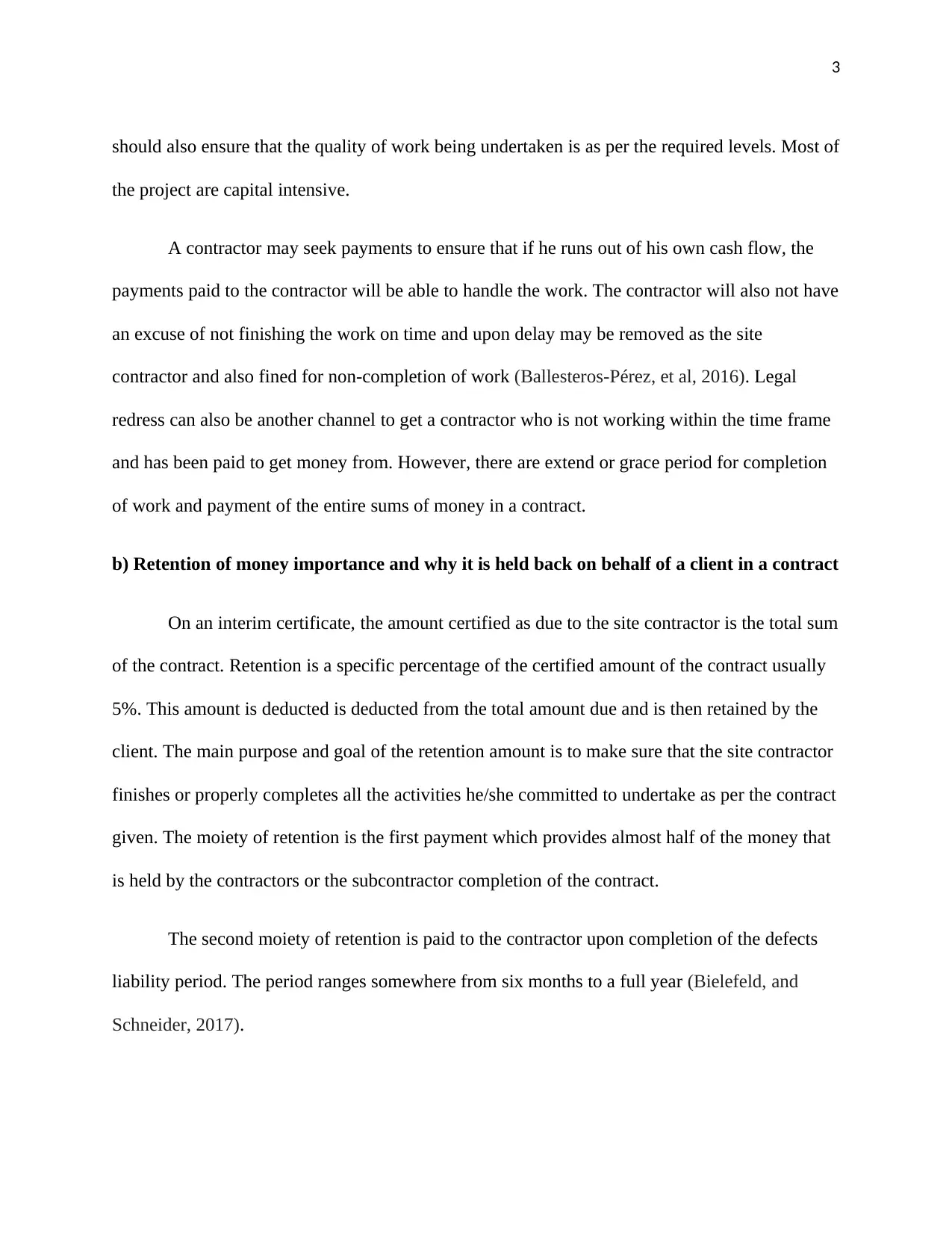
b) Retention of money importance and why it is held back on behalf of a client in a contract
On an interim certificate, the amount certified as due to the site contractor is the total sum
of the contract. Retention is a specific percentage of the certified amount of the contract usually
5%. This amount is deducted is deducted from the total amount due and is then retained by the
client. The main purpose and goal of the retention amount is to make sure that the site contractor
finishes or properly completes all the activities he/she committed to undertake as per the contract
given. The moiety of retention is the first payment which provides almost half of the money that
is held by the contractors or the subcontractor completion of the contract.
The second moiety of retention is paid to the contractor upon completion of the defects
liability period. The period ranges somewhere from six months to a full year (Bielefeld, and
Schneider, 2017).
Document Page
4
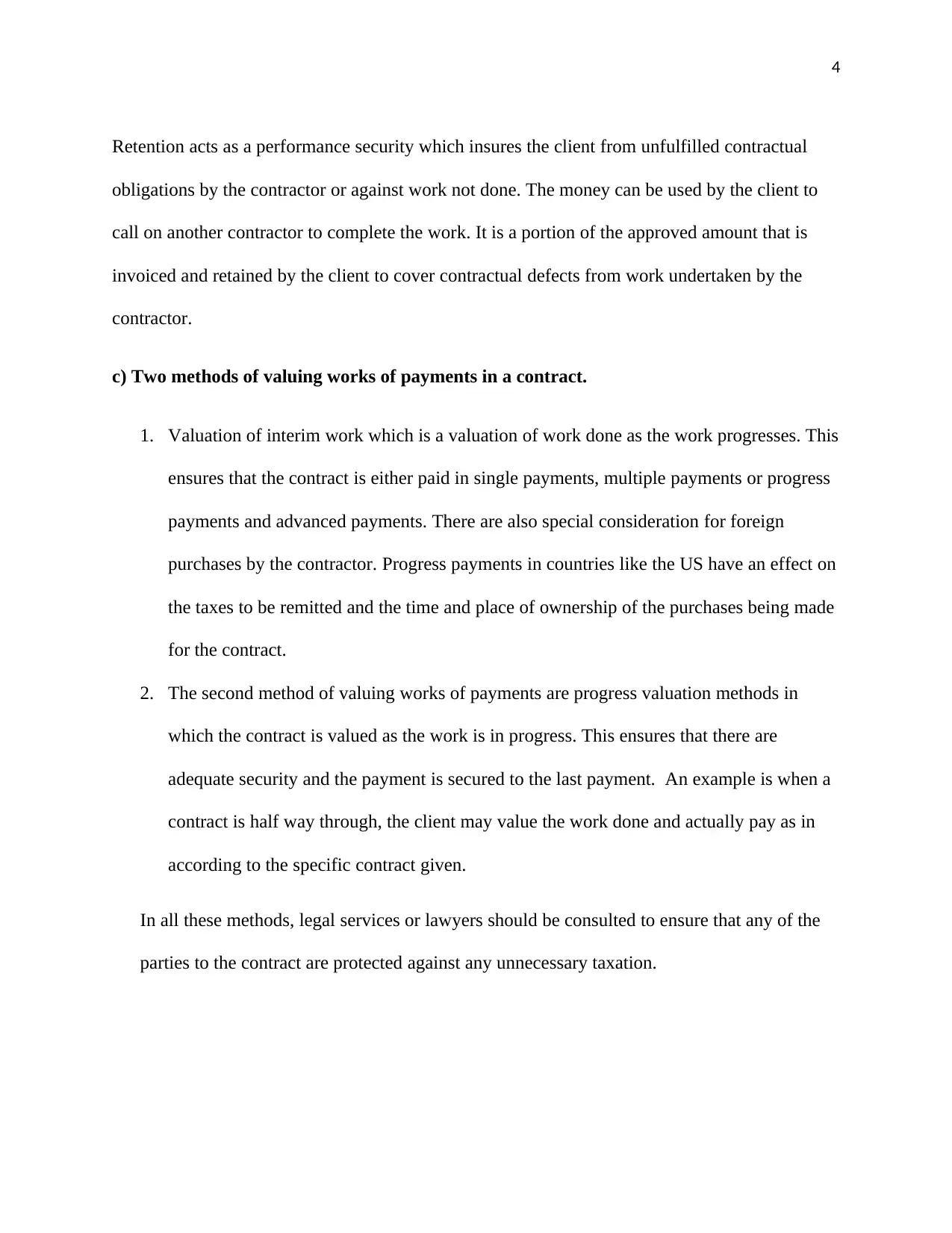
Retention acts as a performance security which insures the client from unfulfilled contractual
obligations by the contractor or against work not done. The money can be used by the client to
call on another contractor to complete the work. It is a portion of the approved amount that is
invoiced and retained by the client to cover contractual defects from work undertaken by the
contractor.
c) Two methods of valuing works of payments in a contract.
1. Valuation of interim work which is a valuation of work done as the work progresses. This
ensures that the contract is either paid in single payments, multiple payments or progress
payments and advanced payments. There are also special consideration for foreign
purchases by the contractor. Progress payments in countries like the US have an effect on
the taxes to be remitted and the time and place of ownership of the purchases being made
for the contract.
2. The second method of valuing works of payments are progress valuation methods in
which the contract is valued as the work is in progress. This ensures that there are
adequate security and the payment is secured to the last payment. An example is when a
contract is half way through, the client may value the work done and actually pay as in
according to the specific contract given.
In all these methods, legal services or lawyers should be consulted to ensure that any of the
parties to the contract are protected against any unnecessary taxation.
tabler-icon-diamond-filled.svg

Paraphrase This Document

Need a fresh take? Get an instant paraphrase of this document with our AI Paraphraser
Document Page
5
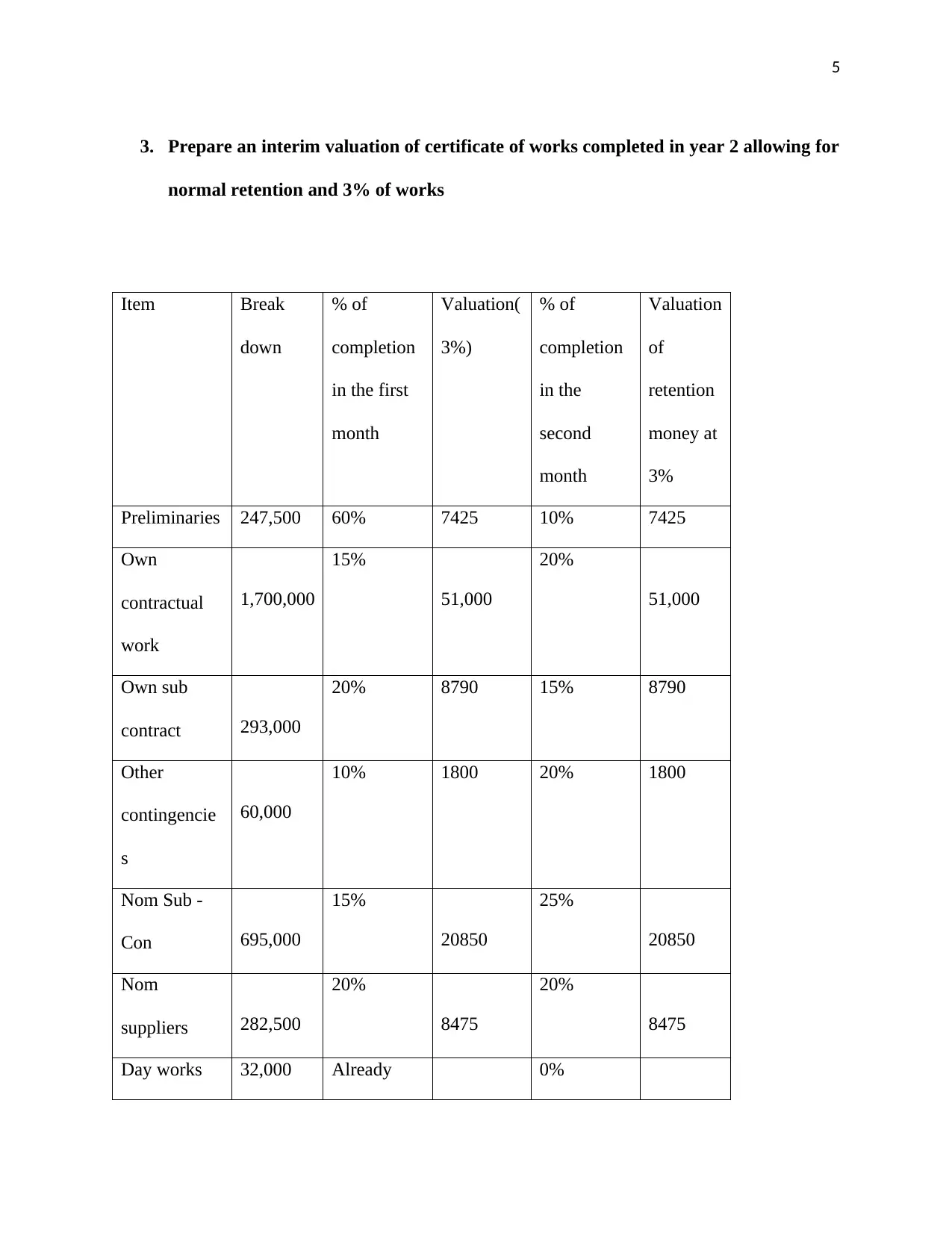
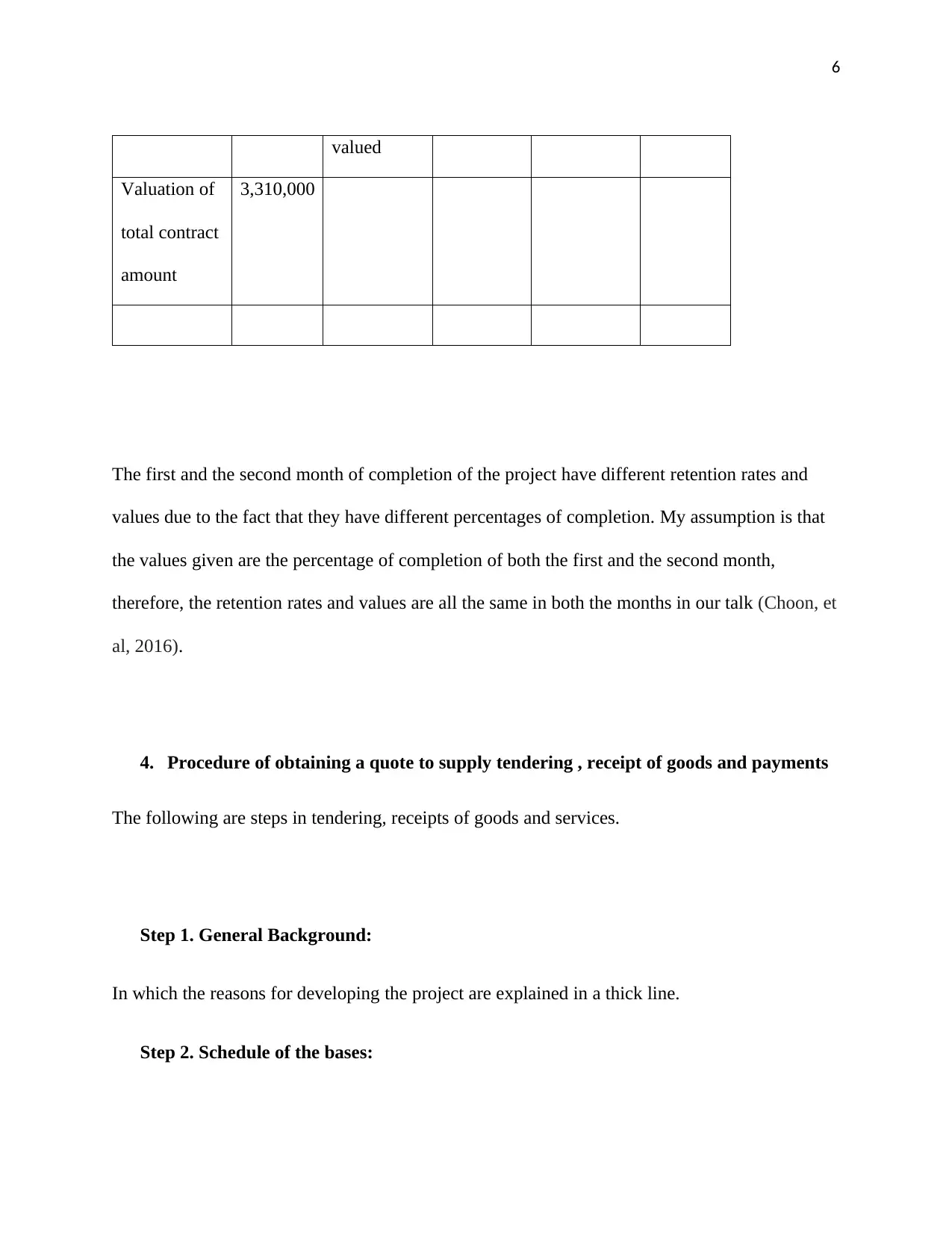
3. Prepare an interim valuation of certificate of works completed in year 2 allowing for
normal retention and 3% of works
Item Break
down
% of
completion
in the first
month
Valuation(
3%)
% of
completion
in the
second
month
Valuation
of
retention
money at
3%
Preliminaries 247,500 60% 7425 10% 7425
Own
contractual
work
1,700,000
15%
51,000
20%
51,000
Own sub
contract 293,000
20% 8790 15% 8790
Other
contingencie
s
60,000
10% 1800 20% 1800
Nom Sub -
Con 695,000
15%
20850
25%
20850
Nom
suppliers 282,500
20%
8475
20%
8475
Day works 32,000 Already 0%
Document Page
6
valued
Valuation of
total contract
amount
3,310,000
The first and the second month of completion of the project have different retention rates and
values due to the fact that they have different percentages of completion. My assumption is that
the values given are the percentage of completion of both the first and the second month,
therefore, the retention rates and values are all the same in both the months in our talk (Choon, et
al, 2016).
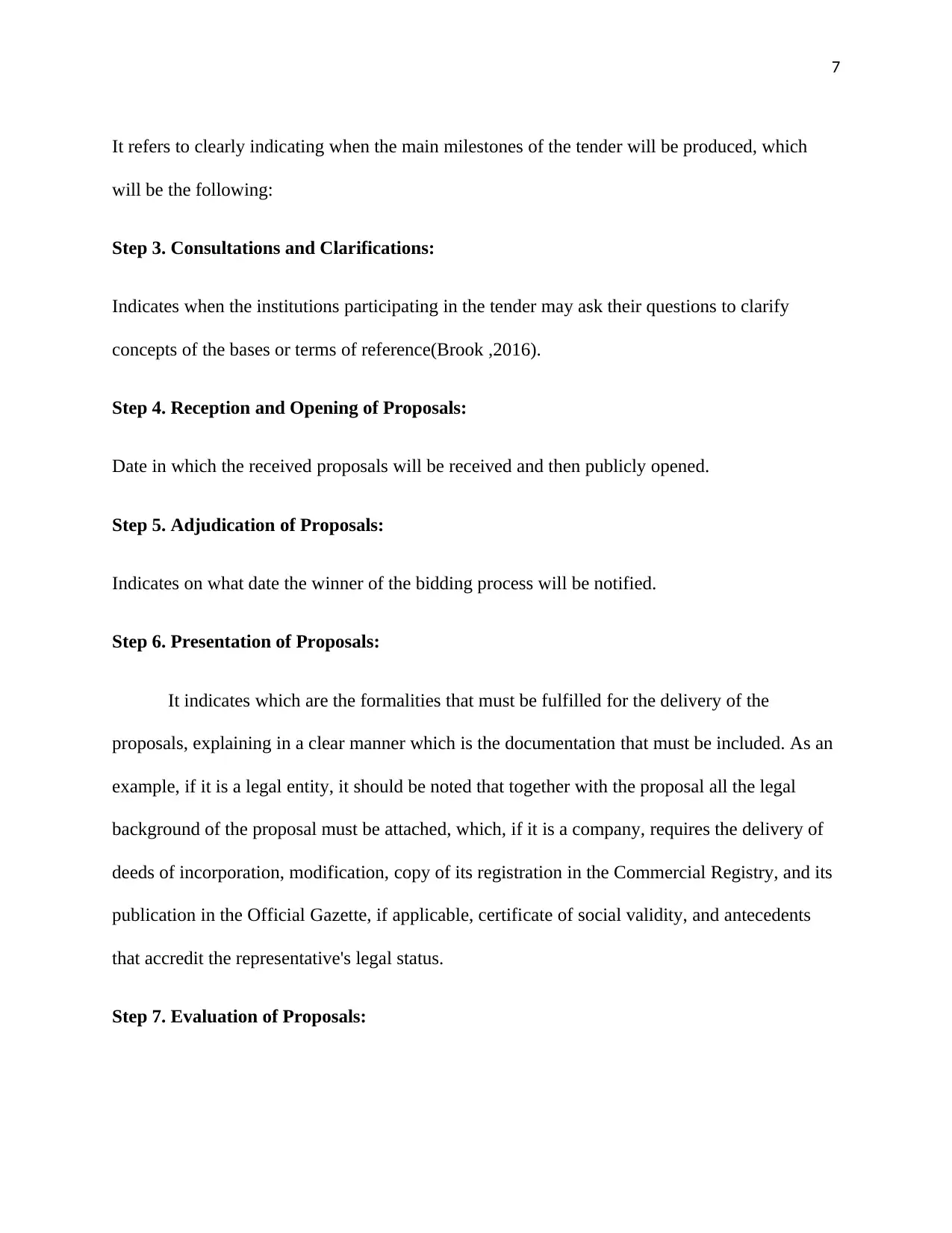
4. Procedure of obtaining a quote to supply tendering , receipt of goods and payments
The following are steps in tendering, receipts of goods and services.
Step 1. General Background:
In which the reasons for developing the project are explained in a thick line.
Step 2. Schedule of the bases:
Document Page
7
It refers to clearly indicating when the main milestones of the tender will be produced, which
will be the following:
Step 3. Consultations and Clarifications:
Indicates when the institutions participating in the tender may ask their questions to clarify
concepts of the bases or terms of reference(Brook ,2016).
Step 4. Reception and Opening of Proposals:
Date in which the received proposals will be received and then publicly opened.
Step 5. Adjudication of Proposals:
Indicates on what date the winner of the bidding process will be notified.
Step 6. Presentation of Proposals:
It indicates which are the formalities that must be fulfilled for the delivery of the
proposals, explaining in a clear manner which is the documentation that must be included. As an
example, if it is a legal entity, it should be noted that together with the proposal all the legal
background of the proposal must be attached, which, if it is a company, requires the delivery of
deeds of incorporation, modification, copy of its registration in the Commercial Registry, and its
publication in the Official Gazette, if applicable, certificate of social validity, and antecedents
that accredit the representative's legal status.
Step 7. Evaluation of Proposals:
tabler-icon-diamond-filled.svg

Paraphrase This Document

Need a fresh take? Get an instant paraphrase of this document with our AI Paraphraser
Document Page
8
It refers to the way in which the proposals made by the different bidders and the criteria
that will be used for it will be evaluated. It can be indicated that an Evaluation Commission will
be used and who will be its members.
Step8 .Adjudication of Proposals:
Explains how the acceptance of the proposal will be communicated and the steps that will
be taken after said acceptance.
Step 9.Deadlines
It refers to the deadlines that are indicated for the project to have been completed, giving
strict compliance to its characteristics, which should have been indicated in the Terms of
Reference or Technical Bases that accompany the bases.
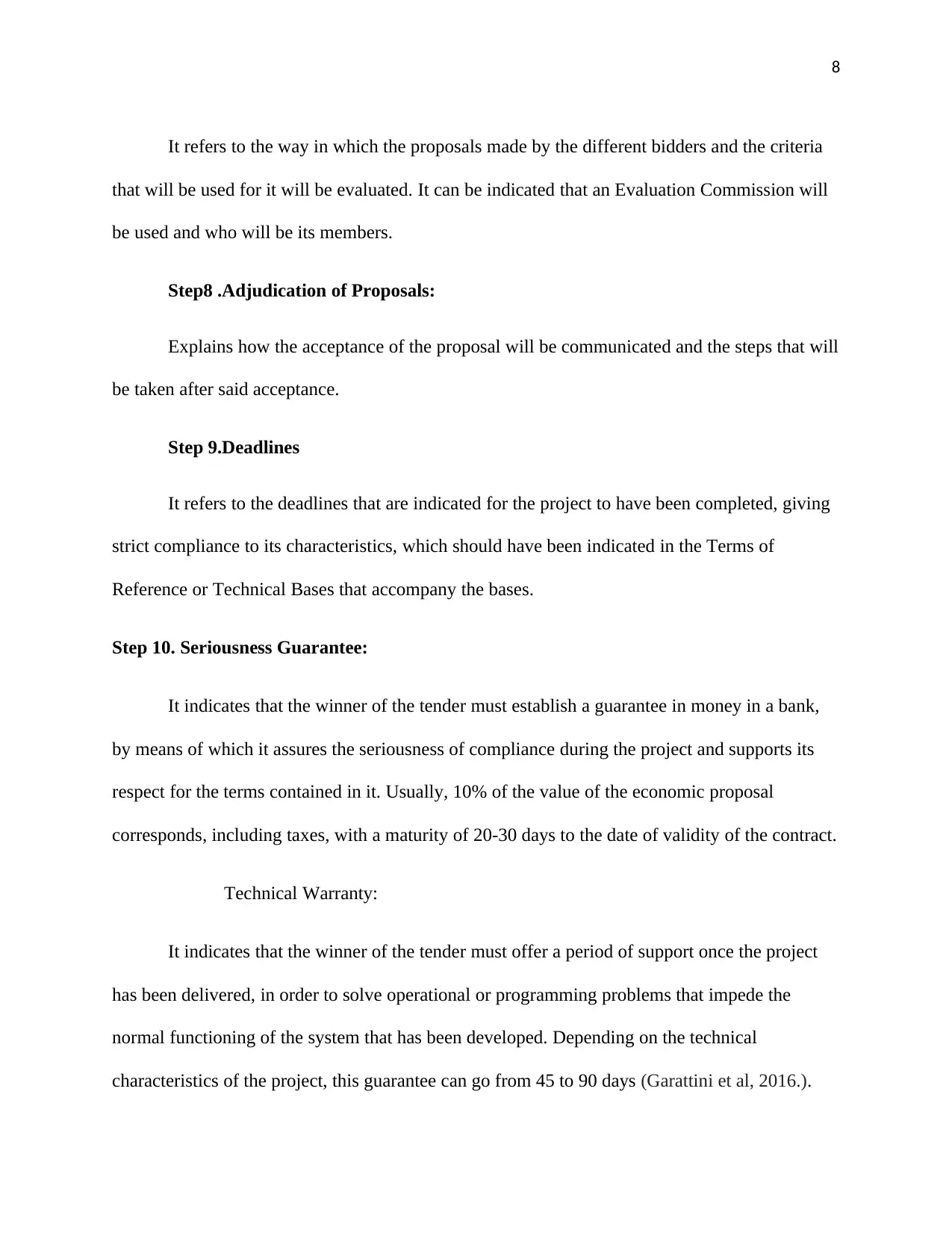
Step 10. Seriousness Guarantee:
It indicates that the winner of the tender must establish a guarantee in money in a bank,
by means of which it assures the seriousness of compliance during the project and supports its
respect for the terms contained in it. Usually, 10% of the value of the economic proposal
corresponds, including taxes, with a maturity of 20-30 days to the date of validity of the contract.
Technical Warranty:
It indicates that the winner of the tender must offer a period of support once the project
has been delivered, in order to solve operational or programming problems that impede the
normal functioning of the system that has been developed. Depending on the technical
characteristics of the project, this guarantee can go from 45 to 90 days (Garattini et al, 2016.).
Document Page
9
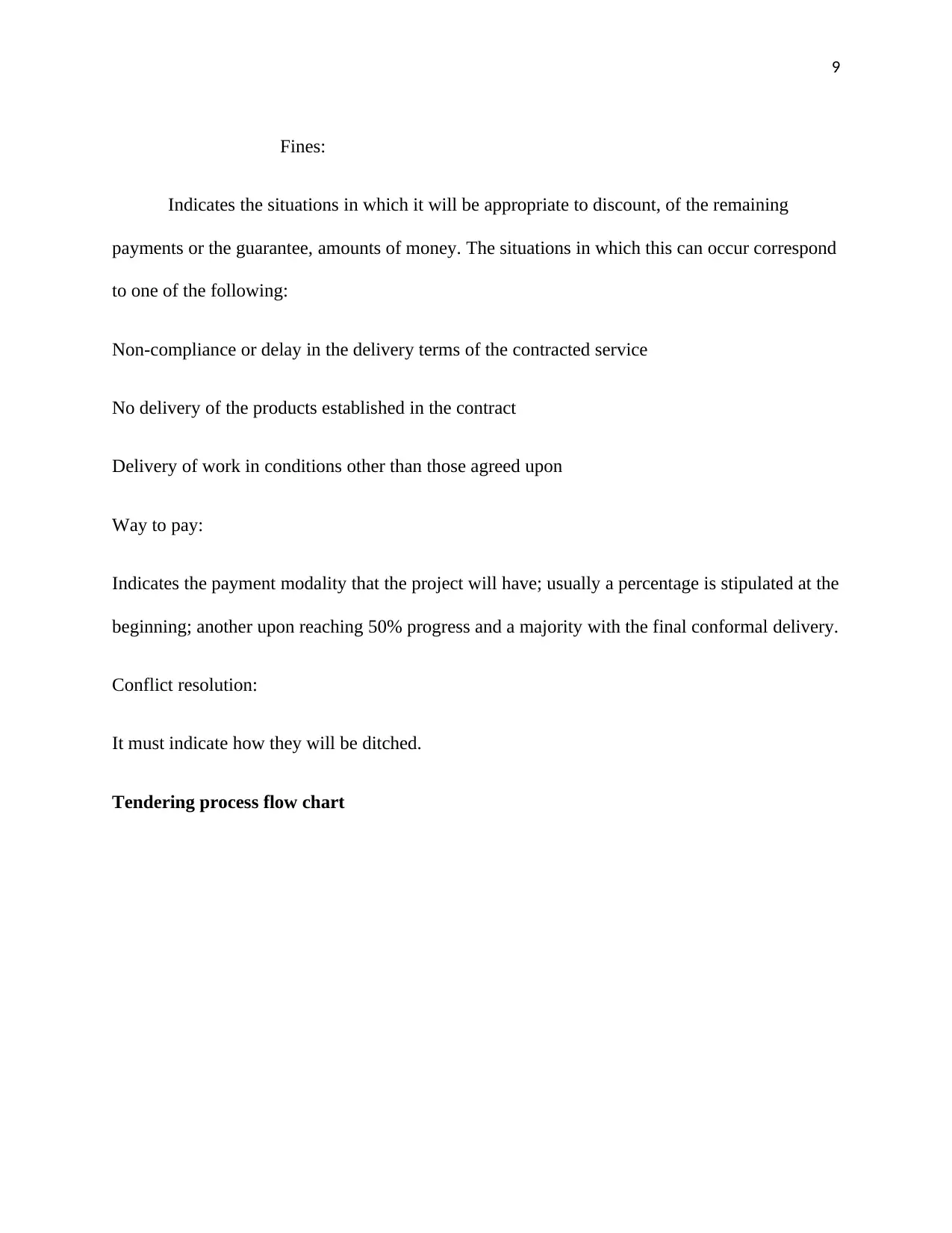
Fines:
Indicates the situations in which it will be appropriate to discount, of the remaining
payments or the guarantee, amounts of money. The situations in which this can occur correspond
to one of the following:
Non-compliance or delay in the delivery terms of the contracted service
No delivery of the products established in the contract
Delivery of work in conditions other than those agreed upon
Way to pay:
Indicates the payment modality that the project will have; usually a percentage is stipulated at the
beginning; another upon reaching 50% progress and a majority with the final conformal delivery.
Conflict resolution:
It must indicate how they will be ditched.
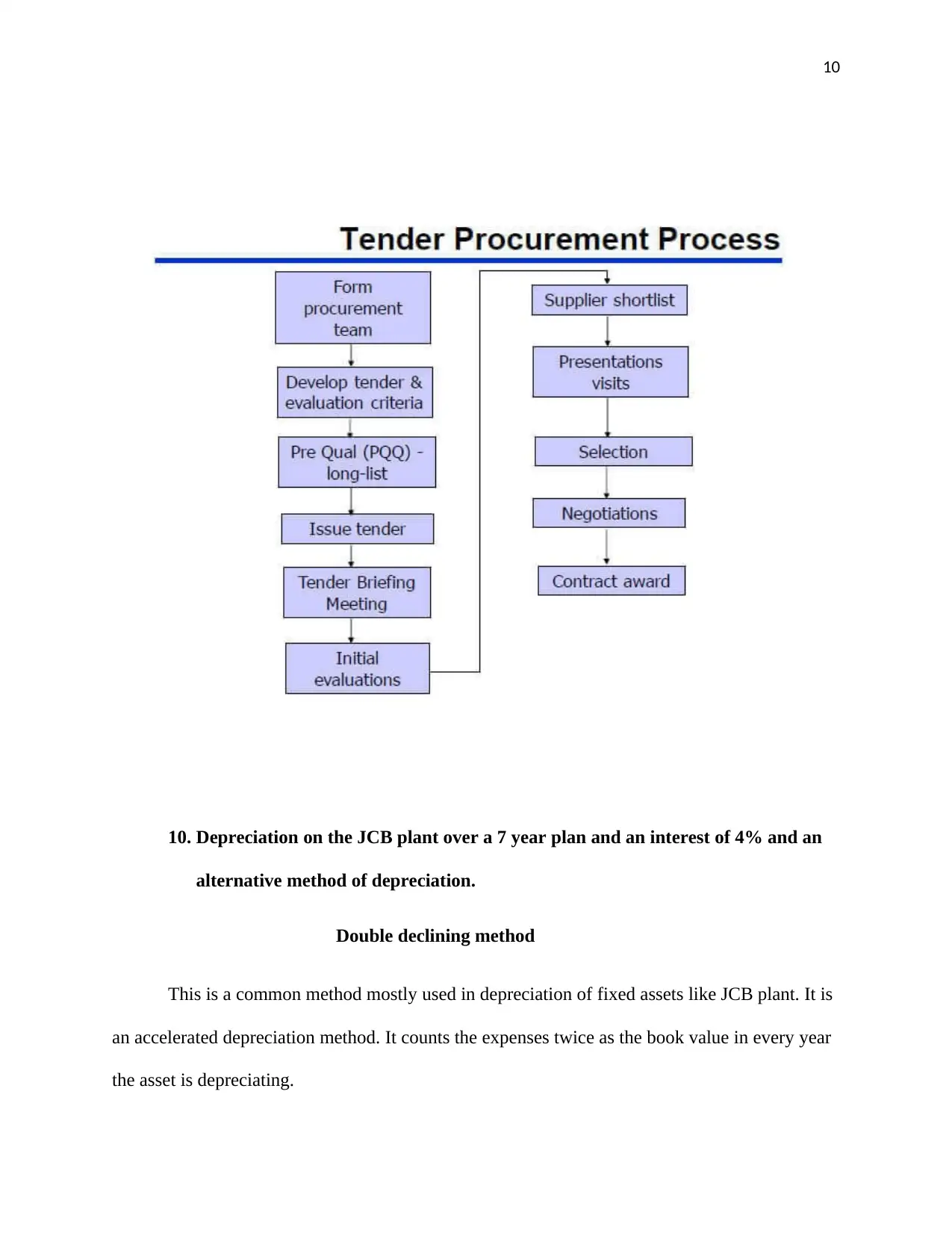
Tendering process flow chart
Document Page
10
10. Depreciation on the JCB plant over a 7 year plan and an interest of 4% and an
alternative method of depreciation.
Double declining method
This is a common method mostly used in depreciation of fixed assets like JCB plant. It is
an accelerated depreciation method. It counts the expenses twice as the book value in every year
the asset is depreciating.
tabler-icon-diamond-filled.svg

Paraphrase This Document

Need a fresh take? Get an instant paraphrase of this document with our AI Paraphraser
Document Page
11
The formula for double declining method is given as follows;
Depreciation= 2*straight line percentage of depreciation * the book value at the beginning of the
period or year
Book value= asset cost – depreciation accumulated.
For JCB, depreciation is 4% over a period of 7 years. The cost of the asset is 95,000 pounds.
In straight line deprecation the percentage would be 100/ 7 years= 14.28% per year
Depreciation rate in double depreciation would be = 14.28% * 2= 28.56%
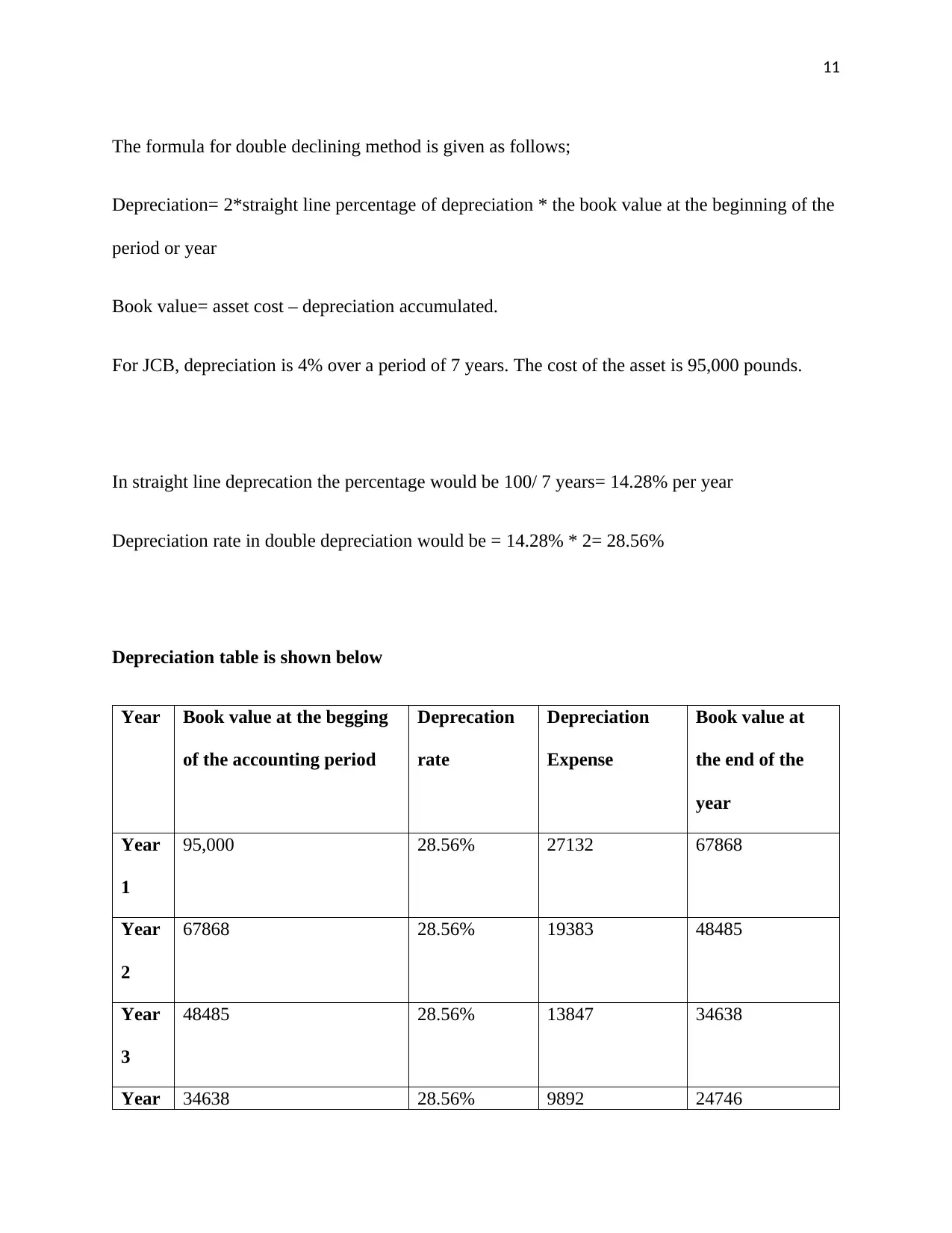
Depreciation table is shown below
Year Book value at the begging
of the accounting period
Deprecation
rate
Depreciation
Expense
Book value at
the end of the
year
Year
1
95,000 28.56% 27132 67868
Year
2
67868 28.56% 19383 48485
Year
3
48485 28.56% 13847 34638
Year 34638 28.56% 9892 24746
Document Page
12
4
Year
5
24746 28.56% 7067 17679
Year
6
17679 28.56% 5049 12630
Year
7
12630 28.56% 3607 9023
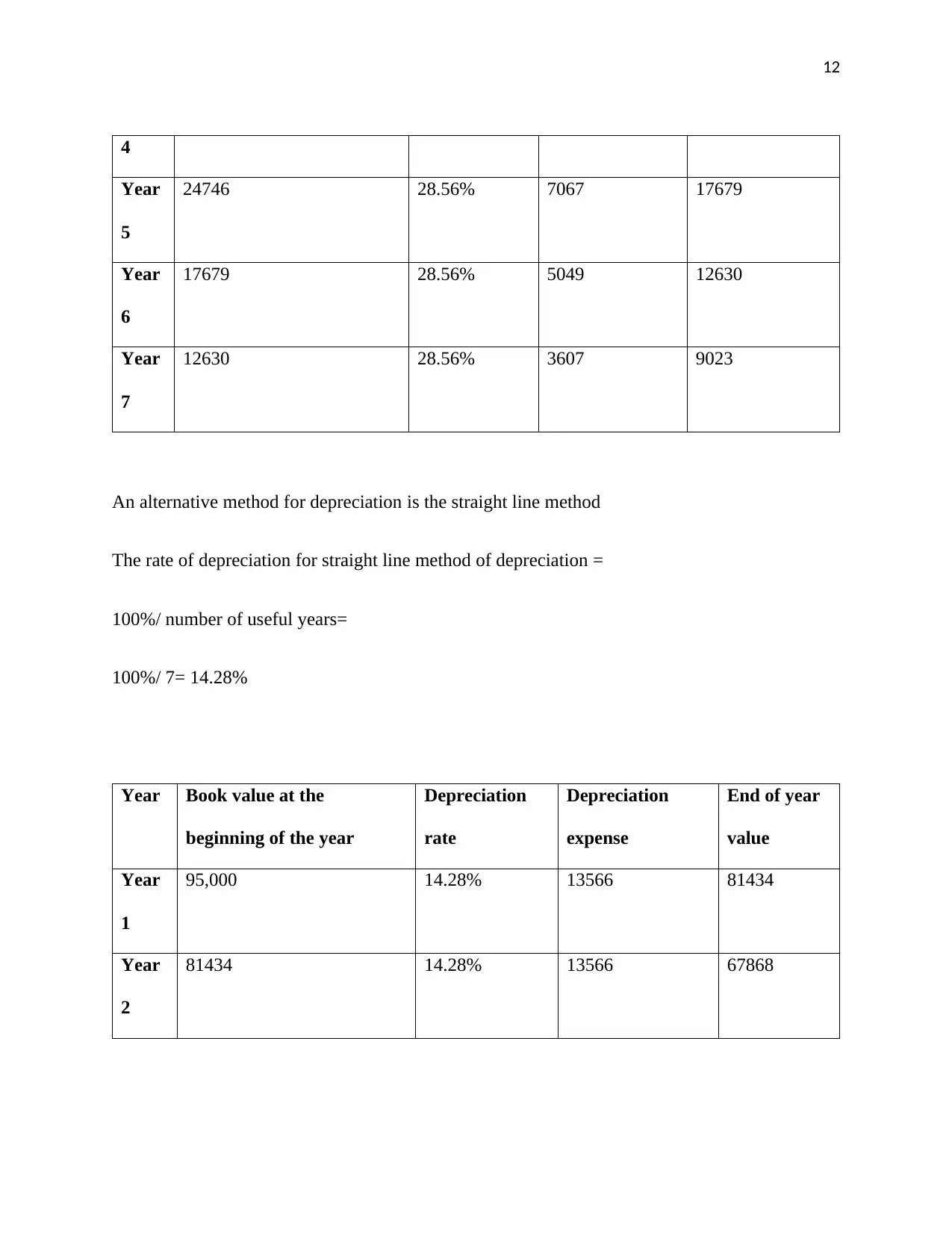
An alternative method for depreciation is the straight line method
The rate of depreciation for straight line method of depreciation =
100%/ number of useful years=
100%/ 7= 14.28%
Year Book value at the
beginning of the year
Depreciation
rate
Depreciation
expense
End of year
value
Year
1
95,000 14.28% 13566 81434
Year
2
81434 14.28% 13566 67868
chevron_up_icon
1 out of 21
circle_padding
hide_on_mobile
zoom_out_icon
[object Object]