Business and Business Environment Report for TESCO
VerifiedAdded on 2023/01/19
|14
|3833
|32
Report
AI Summary
This report provides a comprehensive analysis of TESCO's business environment. It begins with an introduction to the business environment and its impact on organizations, followed by an examination of TESCO's purpose, types, and legal structure as a private sector organization. The report then delves into the scope and size of TESCO, comparing it to public and voluntary sector organizations like the BBC and Oxfam. It discusses the relationships between various functions within TESCO, such as marketing, HR, and finance, and their link to the organizational structure, which is identified as a divisional structure. A PESTLE analysis is conducted to identify the positive and negative influences of external factors on TESCO's operations. Finally, the report includes an internal and external analysis, highlighting TESCO's strengths and weaknesses, and analyzing how these factors interact with the external environment. The conclusion summarizes the key findings of the analysis, providing a holistic view of TESCO's position in the business environment.
BUSINESS AND
BUSINESS
ENVIRONMENT
BUSINESS
ENVIRONMENT

Paraphrase This Document
Need a fresh take? Get an instant paraphrase of this document with our AI Paraphraser
Table of Contents
INTRODUCTION...........................................................................................................................1
TASK 1............................................................................................................................................1
P1 Various purpose and types of business organisations along with their legal structures. . .1
P2 Mention about the scope and size of various kinds of business firms..............................3
TASK 2 ........................................................................................................................................5
P3 Discuss the relationship between various functions of a company and their link with
organisational structure and objectives .................................................................................5
TASK 3............................................................................................................................................5
P4 Identify positive and negative influence of external environment on business operations of
selected organisation..............................................................................................................5
TASK 4............................................................................................................................................7
P5 Identify external and internal analysis of selected business organisation to acknowledge
their weakness and strength....................................................................................................7
P6 Analyse the manner in which weaknesses and strengths interrelates with external
environmental factors.............................................................................................................7
CONCLUSION................................................................................................................................8
INTRODUCTION...........................................................................................................................1
TASK 1............................................................................................................................................1
P1 Various purpose and types of business organisations along with their legal structures. . .1
P2 Mention about the scope and size of various kinds of business firms..............................3
TASK 2 ........................................................................................................................................5
P3 Discuss the relationship between various functions of a company and their link with
organisational structure and objectives .................................................................................5
TASK 3............................................................................................................................................5
P4 Identify positive and negative influence of external environment on business operations of
selected organisation..............................................................................................................5
TASK 4............................................................................................................................................7
P5 Identify external and internal analysis of selected business organisation to acknowledge
their weakness and strength....................................................................................................7
P6 Analyse the manner in which weaknesses and strengths interrelates with external
environmental factors.............................................................................................................7
CONCLUSION................................................................................................................................8

⊘ This is a preview!⊘
Do you want full access?
Subscribe today to unlock all pages.

Trusted by 1+ million students worldwide
INTRODUCTION
Business environment is defined as the collection of various external and internal factors
like customers needs, workforce of a company, demand and supply, suppliers, ownership of a
business firm, technological innovation etc. These factors posses direct and indirect impact on
the functionality of a business firm (Avramenko, 2012). With the help of business environment,
an organisation can identify existing opportunities, tap useful resources and improve their overall
performance. This assignment is based on TESCO which is a multinational retailer of general
merchandise and groceries, headquartered in England, UK. This company is successfully
operating in continents of Europe and Asia. This report will cover about distinct kind of
company along with their legal structure and working sector. Scope and size of different
companies is also discussed including relation in various functions of an organisation. Also,
impacts of macro and micro factors on an organisation is discussed and at last interrelation in
these external and internal factors is carried out.
TASK 1
P1 Various purpose and types of business organisations along with their legal structures
Business organisations operates in market and perform various functions so that their
expected goals can be attained in a proper manner. There are various kinds of business firms
which operates in either private, voluntary or public sector. These companies have varied aims
and targets due to which legal structure of these companies also varies. Information related with
these organisations are mentioned beneath:
Public sector organisation: These companies are owned and run by government and
their officials with the objective to offer high quality services or products to common people
without charging them high (Ballard and et. al., 2012). These companies contribute to the
economy of a nation and all the important decisions of these companies are taken after
acknowledging the opinion of government. For example, BBC.
Legal structure Central government: This trier of government operates at national level and all the
policies and regulations related with entire country is formulated by this government. State government: This government has limited jurisdiction on public businesses and
they manage and control the activities of business organisation at state level only.
1
Business environment is defined as the collection of various external and internal factors
like customers needs, workforce of a company, demand and supply, suppliers, ownership of a
business firm, technological innovation etc. These factors posses direct and indirect impact on
the functionality of a business firm (Avramenko, 2012). With the help of business environment,
an organisation can identify existing opportunities, tap useful resources and improve their overall
performance. This assignment is based on TESCO which is a multinational retailer of general
merchandise and groceries, headquartered in England, UK. This company is successfully
operating in continents of Europe and Asia. This report will cover about distinct kind of
company along with their legal structure and working sector. Scope and size of different
companies is also discussed including relation in various functions of an organisation. Also,
impacts of macro and micro factors on an organisation is discussed and at last interrelation in
these external and internal factors is carried out.
TASK 1
P1 Various purpose and types of business organisations along with their legal structures
Business organisations operates in market and perform various functions so that their
expected goals can be attained in a proper manner. There are various kinds of business firms
which operates in either private, voluntary or public sector. These companies have varied aims
and targets due to which legal structure of these companies also varies. Information related with
these organisations are mentioned beneath:
Public sector organisation: These companies are owned and run by government and
their officials with the objective to offer high quality services or products to common people
without charging them high (Ballard and et. al., 2012). These companies contribute to the
economy of a nation and all the important decisions of these companies are taken after
acknowledging the opinion of government. For example, BBC.
Legal structure Central government: This trier of government operates at national level and all the
policies and regulations related with entire country is formulated by this government. State government: This government has limited jurisdiction on public businesses and
they manage and control the activities of business organisation at state level only.
1
Paraphrase This Document
Need a fresh take? Get an instant paraphrase of this document with our AI Paraphraser
Local authorities: This government tier manage those public organisations which
operates within towns, villages and small cities (Berg and Kilambi, Siebel Systems Inc,
2014).
Private sector organisation: These companies are those enterprises which are managed
by an individual either in partnership or individually. These firms are managed by their
respective owners and government do not interfere in their working. Main target of these
companies is to earn maximised profits so that competitive advantage can be gained in
marketplace. For example, TESCO.
Legal structure Sole proprietorship: In this type of business organisation, all the activities and operations
are managed by single owner. All the risks and profits associated with business are bear
by this person only. As business is managed by a single individual, these businesses faces
less conflicts.
Partnership: In this legal structure, an organisation is run and managed by either two
people or more than two people. These businesses get investment via all the concerned
parties and risks or profits associated with these businesses are divided according to the
share of business partners (Bharadwaj and et. al., 2013).
Voluntary sector organisation: These business organisations are started and operated to
fight against a social cause. These firms do not have target to earn high profits and revenues.
Funds and finances of these companies are managed by government authorities due to which all
the risks are faced by government and earned profits are invested in the welfare of people. For
instance, Oxfam.
Legal structure Association: These organisations are formulated by agreement between a group of people
which came together to achieve a common goal which is not earning high profits. Main
aim of these firms to serve people of society and fulfil their needs in a proper manner.
Trust: Under this kind of business firms, there exist few people which funds them and all
the other people use that investment to fulfil the needs and requirements of needy people
(Colenso, 2012).
Growth in International Environment of Business
2
operates within towns, villages and small cities (Berg and Kilambi, Siebel Systems Inc,
2014).
Private sector organisation: These companies are those enterprises which are managed
by an individual either in partnership or individually. These firms are managed by their
respective owners and government do not interfere in their working. Main target of these
companies is to earn maximised profits so that competitive advantage can be gained in
marketplace. For example, TESCO.
Legal structure Sole proprietorship: In this type of business organisation, all the activities and operations
are managed by single owner. All the risks and profits associated with business are bear
by this person only. As business is managed by a single individual, these businesses faces
less conflicts.
Partnership: In this legal structure, an organisation is run and managed by either two
people or more than two people. These businesses get investment via all the concerned
parties and risks or profits associated with these businesses are divided according to the
share of business partners (Bharadwaj and et. al., 2013).
Voluntary sector organisation: These business organisations are started and operated to
fight against a social cause. These firms do not have target to earn high profits and revenues.
Funds and finances of these companies are managed by government authorities due to which all
the risks are faced by government and earned profits are invested in the welfare of people. For
instance, Oxfam.
Legal structure Association: These organisations are formulated by agreement between a group of people
which came together to achieve a common goal which is not earning high profits. Main
aim of these firms to serve people of society and fulfil their needs in a proper manner.
Trust: Under this kind of business firms, there exist few people which funds them and all
the other people use that investment to fulfil the needs and requirements of needy people
(Colenso, 2012).
Growth in International Environment of Business
2
As multiple companies are working in same sector and provides alternatives for a single
product, no company has monopoly in their market. This is the reason after some time, domestic
market became saturated and growth of a company stops there. In order to further grow and
expand their business, organisations starts operating in other regions and nations. Due to this,
business firms attains new set of customers which can be satisfied by the products of company.
This benefits a concerned organisation in attaining high sales and profits. This is the reason
growth in international business is increasing day by day (Ehret, Kashyap and Wirtz, 2013).
P2 Mention about the scope and size of various kinds of business firms
Size and scopes of different business firms operating in different sectors i.e. private,
voluntary and public organisations are mentioned below:
British broadcast company
Background: BBC is a public organisation which works under the authority and
supervision of government. This organisation is funded via licence fee that is paid by
households in UK. This company is established in 1922 and operates within & outside
UK. This firm provides nine television channels involving radio broadcasting stations.
Product or Services offered : Company has 9 national television channels under the
name of BBC news, BBC online, BBC one, BBC iPlayer etc.
Size and scope: At present company is employing more than 20,000 employees and net
income of company for the year of 2019 is 69 million pounds due to which size of
company is large. At present, this company is operating globally due to which its scope
is very wide.
Vision and mission: Vision of company is to became best service broadcaster in global
context and mission of the company is to act in the interest of public and serving people
by providing high quality and distinctive services (Hamilton and Webster, 2018).
Business Objectives: Main objective of the company is to offer specialised service
including content related with media and eduction in both within & outside UK. This will
helps them in popularising in worldwide context.
Stakeholders: In context with company, main stakeholders are BBC trust, Program
editors, Presenters, government, shareholders of BBC, local community etc.
TESCO
3
product, no company has monopoly in their market. This is the reason after some time, domestic
market became saturated and growth of a company stops there. In order to further grow and
expand their business, organisations starts operating in other regions and nations. Due to this,
business firms attains new set of customers which can be satisfied by the products of company.
This benefits a concerned organisation in attaining high sales and profits. This is the reason
growth in international business is increasing day by day (Ehret, Kashyap and Wirtz, 2013).
P2 Mention about the scope and size of various kinds of business firms
Size and scopes of different business firms operating in different sectors i.e. private,
voluntary and public organisations are mentioned below:
British broadcast company
Background: BBC is a public organisation which works under the authority and
supervision of government. This organisation is funded via licence fee that is paid by
households in UK. This company is established in 1922 and operates within & outside
UK. This firm provides nine television channels involving radio broadcasting stations.
Product or Services offered : Company has 9 national television channels under the
name of BBC news, BBC online, BBC one, BBC iPlayer etc.
Size and scope: At present company is employing more than 20,000 employees and net
income of company for the year of 2019 is 69 million pounds due to which size of
company is large. At present, this company is operating globally due to which its scope
is very wide.
Vision and mission: Vision of company is to became best service broadcaster in global
context and mission of the company is to act in the interest of public and serving people
by providing high quality and distinctive services (Hamilton and Webster, 2018).
Business Objectives: Main objective of the company is to offer specialised service
including content related with media and eduction in both within & outside UK. This will
helps them in popularising in worldwide context.
Stakeholders: In context with company, main stakeholders are BBC trust, Program
editors, Presenters, government, shareholders of BBC, local community etc.
TESCO
3
⊘ This is a preview!⊘
Do you want full access?
Subscribe today to unlock all pages.
Trusted by 1+ million students worldwide
Background: It is a private organisation which is founded in 1919. This company offers
groceries and other merchandise to people in genuine rates. All the commodities which
are needed to run a household are available at Tesco.
Product or Services offered : Product offered by TESCO are all the commodities which
are available at hypermarkets, supermarkets, convenience shop and superstore. Services
offered by company are delivering of Groceries and other merchandise to the addresses
of people as home delivery facility.
Size: At present, company is operating 6800 stores and employing around 4,50,000
employees in global context. This denote that size of company is large. As company is
performing activities worldwide , scope of TESO is very wide (Hilton and Platt, 2013).
Vision and Mission: Vision of the firm is to became a market leader in their field so that
maximised profits and revenues can be earned. Mission of firm is to provide standardised
service and good quality product to people in genuine price.
Business Objectives: Company has multiple objectives which have link with is success
but the main objective of TESCO is to offer healthy and fresh products to their customers
in discounted price so that they can earn maximised sales.
Stakeholders: For a business organisation like TESCO which operates in a global
context, main stakeholders are their employees, suppliers, customers, investors, trade
unions etc.
Oxfam
Background: Oxfam is a voluntary sector firm which operates in multiple nations to
reduce poverty among people so that each individual can spend a healthy life. This is a
non profit group which carry out activities to provide relief from disasters and eliminate
poverty or related issues from the life of people (Wheelen and et. al., 2017).
Product or Services offered : services offered by company are related with education,
natural disasters, livelihoods of people. Heath, fair trade etc.
Size and scope: Oxfam perform their voluntary activities in more than 90 countries
where thousands of local partners helps Oxfam in attaining their goals. More than 50,000
volunteers in global context are working under Oxfam. As company is successfully
operating their operations to provide a good life to people (Janita and Miranda, 2013).
Scope of this firm is very high.
4
groceries and other merchandise to people in genuine rates. All the commodities which
are needed to run a household are available at Tesco.
Product or Services offered : Product offered by TESCO are all the commodities which
are available at hypermarkets, supermarkets, convenience shop and superstore. Services
offered by company are delivering of Groceries and other merchandise to the addresses
of people as home delivery facility.
Size: At present, company is operating 6800 stores and employing around 4,50,000
employees in global context. This denote that size of company is large. As company is
performing activities worldwide , scope of TESO is very wide (Hilton and Platt, 2013).
Vision and Mission: Vision of the firm is to became a market leader in their field so that
maximised profits and revenues can be earned. Mission of firm is to provide standardised
service and good quality product to people in genuine price.
Business Objectives: Company has multiple objectives which have link with is success
but the main objective of TESCO is to offer healthy and fresh products to their customers
in discounted price so that they can earn maximised sales.
Stakeholders: For a business organisation like TESCO which operates in a global
context, main stakeholders are their employees, suppliers, customers, investors, trade
unions etc.
Oxfam
Background: Oxfam is a voluntary sector firm which operates in multiple nations to
reduce poverty among people so that each individual can spend a healthy life. This is a
non profit group which carry out activities to provide relief from disasters and eliminate
poverty or related issues from the life of people (Wheelen and et. al., 2017).
Product or Services offered : services offered by company are related with education,
natural disasters, livelihoods of people. Heath, fair trade etc.
Size and scope: Oxfam perform their voluntary activities in more than 90 countries
where thousands of local partners helps Oxfam in attaining their goals. More than 50,000
volunteers in global context are working under Oxfam. As company is successfully
operating their operations to provide a good life to people (Janita and Miranda, 2013).
Scope of this firm is very high.
4
Paraphrase This Document
Need a fresh take? Get an instant paraphrase of this document with our AI Paraphraser
Vision and mission: Vision of company is to eliminate poverty in global context so that
each individual can spend life by enjoying basic facilities. Mission of Oxfam is to
became biggest charity organisation so that they can earn high funds and invest them in
the welfare of common and needy people.
Business Objectives: Main objective of company is to deal with the root cause of
poverty so that a long lasting solution can be attained.
Stakeholders: Volunteers, common people, suppliers, staff, local communities and
trusties of Oxfam are their main stakeholders.
TASK 2
P3 Discuss the relationship between various functions of a company and their link with
organisational structure and objectives
It is very important for different departments of TESCO to operate in a cooperate and
systematic manner so that company can earn high advantages against rivals. Relationship in
various departments of TESCO are stated below:
Marketing and HR department: Marketing team in TESCO advertise about the
vacancies at company due to which HR department hires skilled employees and HR
department provide experienced employees to marketing department due to which they
are able to perform their respective work in efficient manner.
Finance and HR department: Main work of finance department in TESCO is to
allocate budget to departments like HR, marketing etc. so that they can perform their
work without shortage of money. HR department trains the employees of finance team
due to which they are able to capable their duties desirably (Prins and Cybercrime, 2011).
Finance and marketing department: Finance team of a company formulate budget and
gives required share to marketing team so that they can perform their activities whereas
marketing team finds investors and creditors which can invest in company and finance
team can manage funds for company.
Above mentioned points denotes the interdependences of different department of TESCO
on each other By working together complex work can be performed appropriately due to which
chances of gaining organisational objectives increases.
5
each individual can spend life by enjoying basic facilities. Mission of Oxfam is to
became biggest charity organisation so that they can earn high funds and invest them in
the welfare of common and needy people.
Business Objectives: Main objective of company is to deal with the root cause of
poverty so that a long lasting solution can be attained.
Stakeholders: Volunteers, common people, suppliers, staff, local communities and
trusties of Oxfam are their main stakeholders.
TASK 2
P3 Discuss the relationship between various functions of a company and their link with
organisational structure and objectives
It is very important for different departments of TESCO to operate in a cooperate and
systematic manner so that company can earn high advantages against rivals. Relationship in
various departments of TESCO are stated below:
Marketing and HR department: Marketing team in TESCO advertise about the
vacancies at company due to which HR department hires skilled employees and HR
department provide experienced employees to marketing department due to which they
are able to perform their respective work in efficient manner.
Finance and HR department: Main work of finance department in TESCO is to
allocate budget to departments like HR, marketing etc. so that they can perform their
work without shortage of money. HR department trains the employees of finance team
due to which they are able to capable their duties desirably (Prins and Cybercrime, 2011).
Finance and marketing department: Finance team of a company formulate budget and
gives required share to marketing team so that they can perform their activities whereas
marketing team finds investors and creditors which can invest in company and finance
team can manage funds for company.
Above mentioned points denotes the interdependences of different department of TESCO
on each other By working together complex work can be performed appropriately due to which
chances of gaining organisational objectives increases.
5
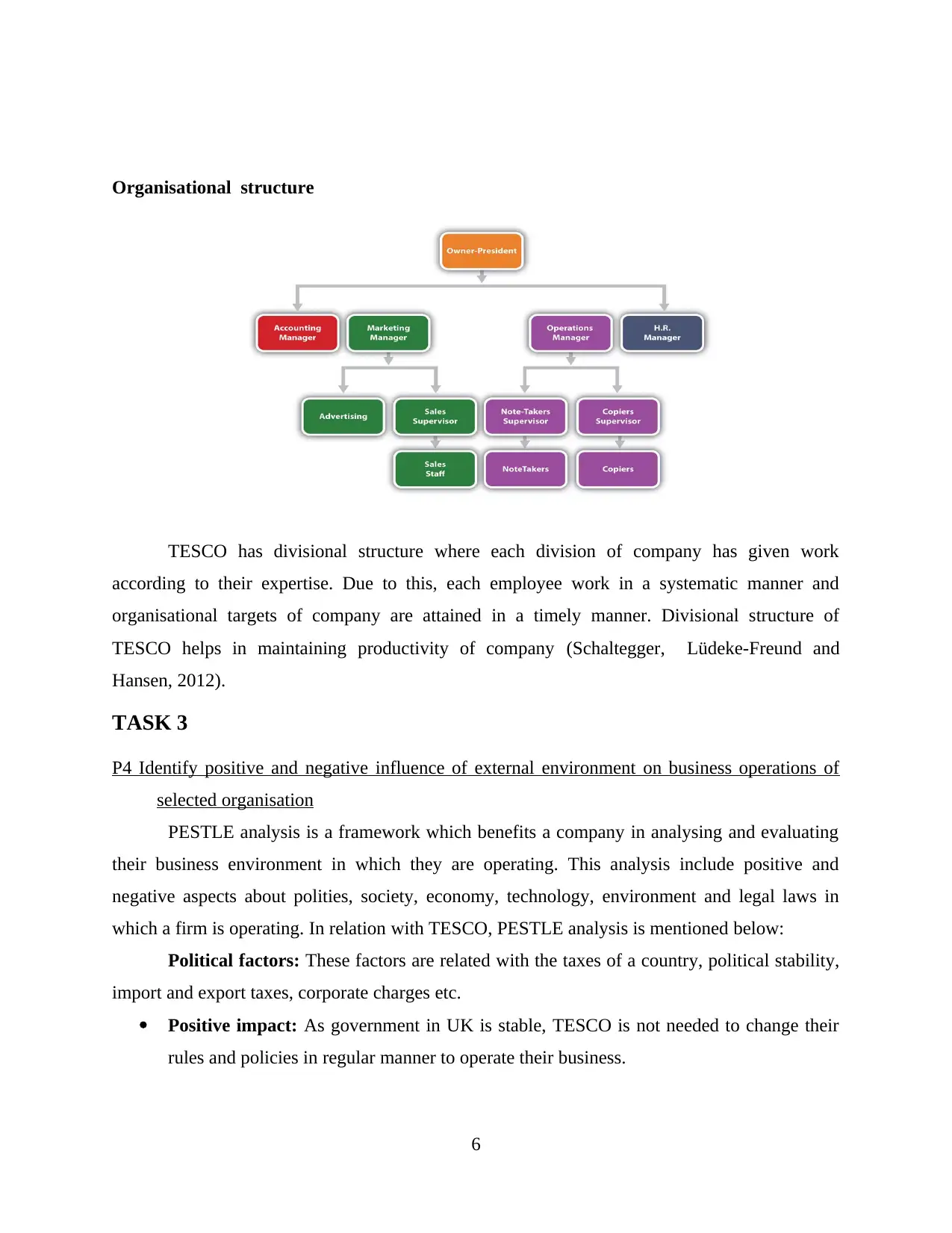
Organisational structure
TESCO has divisional structure where each division of company has given work
according to their expertise. Due to this, each employee work in a systematic manner and
organisational targets of company are attained in a timely manner. Divisional structure of
TESCO helps in maintaining productivity of company (Schaltegger, Lüdeke-Freund and
Hansen, 2012).
TASK 3
P4 Identify positive and negative influence of external environment on business operations of
selected organisation
PESTLE analysis is a framework which benefits a company in analysing and evaluating
their business environment in which they are operating. This analysis include positive and
negative aspects about polities, society, economy, technology, environment and legal laws in
which a firm is operating. In relation with TESCO, PESTLE analysis is mentioned below:
Political factors: These factors are related with the taxes of a country, political stability,
import and export taxes, corporate charges etc.
Positive impact: As government in UK is stable, TESCO is not needed to change their
rules and policies in regular manner to operate their business.
6
TESCO has divisional structure where each division of company has given work
according to their expertise. Due to this, each employee work in a systematic manner and
organisational targets of company are attained in a timely manner. Divisional structure of
TESCO helps in maintaining productivity of company (Schaltegger, Lüdeke-Freund and
Hansen, 2012).
TASK 3
P4 Identify positive and negative influence of external environment on business operations of
selected organisation
PESTLE analysis is a framework which benefits a company in analysing and evaluating
their business environment in which they are operating. This analysis include positive and
negative aspects about polities, society, economy, technology, environment and legal laws in
which a firm is operating. In relation with TESCO, PESTLE analysis is mentioned below:
Political factors: These factors are related with the taxes of a country, political stability,
import and export taxes, corporate charges etc.
Positive impact: As government in UK is stable, TESCO is not needed to change their
rules and policies in regular manner to operate their business.
6
⊘ This is a preview!⊘
Do you want full access?
Subscribe today to unlock all pages.
Trusted by 1+ million students worldwide
Negative impact: Due to Brexit, large organisations like TESCO has faced some
setbacks which can impact the performance of company in a negative manner.
Economic factor: These factors are related with the interest rate, inflation rate, exchange
rate and purchasing power of people in the region where company is operating its business and
associated activities.
Positive impact: People in UK earn high income due to which they are able to purchase
the commodities of TESCO without any financial worries. This denotes, economic
factors of UK are in favour of TESCO (Singh, 2012).
Negative impact: After great recession of 2018, inflation rates in UK are high which
impacts the purchasing power of people in negative manner. Due to this, revenues and
profits of TESCO can be impacted negatively.
Social factor: These factors are associated with the value, perception, culture, belief,
attitude and opinions of people where a business firm is operating.
Positive impact: People in UK are educated and wants to purchase only good quality
products. Products offered by TESCO are of high quality and their prices are less. This
will benefits TESCO to gain expected outcomes in UK.
Negative impact: Changing requirements of people can reduce the popularity of TESCO
products due to which sales of firm can reduce considerably.
Environmental factor: These factors are associated with preserving the environment and
ecology so that human existence on earth will not be compromised in any manner.
Positive impact: TESCO follows all the rules which are associated with environment due
to which they do not have to pay any penalty and fines to the government.
Negative impact: If TESCO will not follow these rules and regulations then reputation
of company will be reduced and sales of company will be impacted negatively (Wetherly,
2014).
Legal factor: In this context, UK government has formulated some rules and regulations
about employees, business firms and customers which must be followed by each company
operating in UK.
Positive impact: Following these rules will increase the satisfaction of people about
company due to which achieving organisational goals will be easier for company.
7
setbacks which can impact the performance of company in a negative manner.
Economic factor: These factors are related with the interest rate, inflation rate, exchange
rate and purchasing power of people in the region where company is operating its business and
associated activities.
Positive impact: People in UK earn high income due to which they are able to purchase
the commodities of TESCO without any financial worries. This denotes, economic
factors of UK are in favour of TESCO (Singh, 2012).
Negative impact: After great recession of 2018, inflation rates in UK are high which
impacts the purchasing power of people in negative manner. Due to this, revenues and
profits of TESCO can be impacted negatively.
Social factor: These factors are associated with the value, perception, culture, belief,
attitude and opinions of people where a business firm is operating.
Positive impact: People in UK are educated and wants to purchase only good quality
products. Products offered by TESCO are of high quality and their prices are less. This
will benefits TESCO to gain expected outcomes in UK.
Negative impact: Changing requirements of people can reduce the popularity of TESCO
products due to which sales of firm can reduce considerably.
Environmental factor: These factors are associated with preserving the environment and
ecology so that human existence on earth will not be compromised in any manner.
Positive impact: TESCO follows all the rules which are associated with environment due
to which they do not have to pay any penalty and fines to the government.
Negative impact: If TESCO will not follow these rules and regulations then reputation
of company will be reduced and sales of company will be impacted negatively (Wetherly,
2014).
Legal factor: In this context, UK government has formulated some rules and regulations
about employees, business firms and customers which must be followed by each company
operating in UK.
Positive impact: Following these rules will increase the satisfaction of people about
company due to which achieving organisational goals will be easier for company.
7
Paraphrase This Document
Need a fresh take? Get an instant paraphrase of this document with our AI Paraphraser
Negative impact: If these rules will not followed, victim individual can file a case
against company. This will reduce the popularity of company among people.
Technological factor: These factors are related to the technological advancement which
is incorporated by a company so that organisational efficiency can be increased.
Positive impact: TESCO believes in technological advancement due to which company
updates their technology on regular basis. This benefits the company in gaining attention
of large number of people (Vitale, 2011).
Negative impact: If company will not update their technology then people can shift their
preference to other company and their products.
TASK 4
P5 Identify external and internal analysis of selected business organisation to acknowledge their
weakness and strength
SWOT is a tool by which a company can acknowledge its strengths, weaknesses, threats
and opportunities so that they can modify their those activities which are not providing good
output to the company. SWOT for TESCO is mentioned below:
Strengths Weaknesses
Company has won multiple awards due
to their high customer service and
increased shopping experience.
Due to global recognition, brand equity
of company is very high. Due to this,
customer satisfaction rate of TESCO is
high (Weiss, 2014).
Competitive pressure among different
organisations has lead to price war due
to which profits of company are
compromised to retain customers for
longer time.
TESCO is high dependent on Europe
and UK for their sales and influence of
company in other regions is
comparatively less.
Opportunities Threats
Company can expand their business in
African and Asian continent which
promises millions of new customers so
Changing needs of people is a big
threat to the profits and revenues of
TESCO.
8
against company. This will reduce the popularity of company among people.
Technological factor: These factors are related to the technological advancement which
is incorporated by a company so that organisational efficiency can be increased.
Positive impact: TESCO believes in technological advancement due to which company
updates their technology on regular basis. This benefits the company in gaining attention
of large number of people (Vitale, 2011).
Negative impact: If company will not update their technology then people can shift their
preference to other company and their products.
TASK 4
P5 Identify external and internal analysis of selected business organisation to acknowledge their
weakness and strength
SWOT is a tool by which a company can acknowledge its strengths, weaknesses, threats
and opportunities so that they can modify their those activities which are not providing good
output to the company. SWOT for TESCO is mentioned below:
Strengths Weaknesses
Company has won multiple awards due
to their high customer service and
increased shopping experience.
Due to global recognition, brand equity
of company is very high. Due to this,
customer satisfaction rate of TESCO is
high (Weiss, 2014).
Competitive pressure among different
organisations has lead to price war due
to which profits of company are
compromised to retain customers for
longer time.
TESCO is high dependent on Europe
and UK for their sales and influence of
company in other regions is
comparatively less.
Opportunities Threats
Company can expand their business in
African and Asian continent which
promises millions of new customers so
Changing needs of people is a big
threat to the profits and revenues of
TESCO.
8
that high profits can be earned.
TESCO can increase their online
presence so that maximum number of
people can acknowledge their services.
Due to inflation, prices of products are
increasing which can reduce the
effectiveness of Offers and discounts
provided by company.
P6 Analyse the manner in which weaknesses and strengths interrelates with external
environmental factors
Political factor: Basically, this factor is concerned with the extent up to which
government of a region can intervene in the working of a company. Corporate tax in UK
is low and brand recognition of company is high due which is beneficial for company in
earning high revenues.
Economic factor: TESCO offers its products in discounted price due to which sales of
company are high. By increasing their presence in African and Asian continent, company
can earn maximised sales (Werbach and Hunter, 2012).
Social factor: Requirements of people change at a fast pace due to which products which
are provided by TESCO can became outdated. This will leads to loss of sales and
revenues for TESCO.
Technological factor: Rival companies such as ALDI, LIDL and other supermarkets are
giving tough competition of TESCO in terms of technology which can be a big
weaknesses to the smooth functioning of company. But high brand equity of company
distinguish itself from rival firms.
CONCLUSION
As per this given report, it can be summarised that to achieve high advantage and profits
in a proper manner, a company is need to operate in right working environment. There exist
different types of business firms like TESCO, Oxfam and BBC which are performing their
activities in different sectors. These companies have different size, objectives, mission, scope
and products due to which their growth rates also vary. Functions within an organisation must be
manage in a systematic manner so that organisational goals can be attained properly. With the
help of PESTLE and SWOT, internal and external environment of a business can be evaluated.
9
TESCO can increase their online
presence so that maximum number of
people can acknowledge their services.
Due to inflation, prices of products are
increasing which can reduce the
effectiveness of Offers and discounts
provided by company.
P6 Analyse the manner in which weaknesses and strengths interrelates with external
environmental factors
Political factor: Basically, this factor is concerned with the extent up to which
government of a region can intervene in the working of a company. Corporate tax in UK
is low and brand recognition of company is high due which is beneficial for company in
earning high revenues.
Economic factor: TESCO offers its products in discounted price due to which sales of
company are high. By increasing their presence in African and Asian continent, company
can earn maximised sales (Werbach and Hunter, 2012).
Social factor: Requirements of people change at a fast pace due to which products which
are provided by TESCO can became outdated. This will leads to loss of sales and
revenues for TESCO.
Technological factor: Rival companies such as ALDI, LIDL and other supermarkets are
giving tough competition of TESCO in terms of technology which can be a big
weaknesses to the smooth functioning of company. But high brand equity of company
distinguish itself from rival firms.
CONCLUSION
As per this given report, it can be summarised that to achieve high advantage and profits
in a proper manner, a company is need to operate in right working environment. There exist
different types of business firms like TESCO, Oxfam and BBC which are performing their
activities in different sectors. These companies have different size, objectives, mission, scope
and products due to which their growth rates also vary. Functions within an organisation must be
manage in a systematic manner so that organisational goals can be attained properly. With the
help of PESTLE and SWOT, internal and external environment of a business can be evaluated.
9
⊘ This is a preview!⊘
Do you want full access?
Subscribe today to unlock all pages.
Trusted by 1+ million students worldwide

1 out of 14


Related Documents


Your All-in-One AI-Powered Toolkit for Academic Success.
+13062052269
info@desklib.com
Available 24*7 on WhatsApp / Email
![[object Object]](/_next/static/media/star-bottom.7253800d.svg)
Unlock your academic potential
Copyright © 2020–2026 A2Z Services. All Rights Reserved. Developed and managed by ZUCOL.