MBA Managing Business Strategy: Tesco's Vision, Values & Strategies
VerifiedAdded on 2023/06/15
|13
|4833
|177
Case Study
AI Summary
This case study provides an analysis of Tesco's business strategies, vision, and values. It explores Tesco's evolution from a market stall to a global retailer, emphasizing its commitment to corporate social responsibility and community development. The study identifies Tesco's strengths, weaknesses, opportunities, and threats using a SWOT analysis. It also examines Tesco's strategies for growth, including focusing on its UK core, creating valuable brands, and expanding internationally. The analysis highlights the importance of monitoring and evaluation for performance improvement and emphasizes Tesco's dedication to customer satisfaction and innovation. This assignment, contributed by a student, showcases Tesco's strategic approach to maintaining a competitive edge in the global market.
Running head: TESCO CASE STUDY
Tesco Case Study
Name of the student:
Name of the university:
Author note
Tesco Case Study
Name of the student:
Name of the university:
Author note

Paraphrase This Document
Need a fresh take? Get an instant paraphrase of this document with our AI Paraphraser
1TESCO CASE STUDY
Answer 1
The term retailer refers to an identity who sells various kinds of goods and products to
serve the purpose of human needs and wants. They sell the goods directly to the consumers by
means of different forms of distribution channels with the intention of earning the maximum
amount of profit at the end. When the term responsible is added to retailers then there is no such
change or any extra burden added to those people. However a retailer should have an inherent
quality of working ethically and honestly with his customers (Ailawadi et al. 2014).
In this particular case study of Tesco it can be found that they are one among the largest
retailers in the world. This is well proved from the fact that they have expanded to 12 countries
other than UK such as Malaysia, Ireland, China and more. They also intend to enjoy a long- term
success in their business by keeping strict to the focus with a clear vision. That is the reason why
they consider CSR or corporate social responsibility at the core of their business. They plan to
work with the communities which make them stand out in the run of competition (Bene and
Salamon 2016). These intentions of the company are underpinned by what is known as ‘The
essentials’. Responsible retailer is well- relevant to this term because of the following factors that
it undertakes-
They trade with responsibility.
They work in such a so that it does not pose a negative impact on the environment.
They provide employment opportunity to people.
The local communities are supported by their working.
These are the factors that have helped Tesco always to stay ahead and different in the
competitive run in the market. There are five key factors which the Tesco takes into
consideration always and that are- wanted and needed around the world; a growing business
which has a lot of opportunities; new and modern, innovative and creative ideas; gaining local
acclaims while applying the international skills in the process of working; inspiring the
colleagues and communities and gaining the trust and loyalty from the customers on the other
hand. All the mission and vision of Tesco are related to each other and clearly explain the
Answer 1
The term retailer refers to an identity who sells various kinds of goods and products to
serve the purpose of human needs and wants. They sell the goods directly to the consumers by
means of different forms of distribution channels with the intention of earning the maximum
amount of profit at the end. When the term responsible is added to retailers then there is no such
change or any extra burden added to those people. However a retailer should have an inherent
quality of working ethically and honestly with his customers (Ailawadi et al. 2014).
In this particular case study of Tesco it can be found that they are one among the largest
retailers in the world. This is well proved from the fact that they have expanded to 12 countries
other than UK such as Malaysia, Ireland, China and more. They also intend to enjoy a long- term
success in their business by keeping strict to the focus with a clear vision. That is the reason why
they consider CSR or corporate social responsibility at the core of their business. They plan to
work with the communities which make them stand out in the run of competition (Bene and
Salamon 2016). These intentions of the company are underpinned by what is known as ‘The
essentials’. Responsible retailer is well- relevant to this term because of the following factors that
it undertakes-
They trade with responsibility.
They work in such a so that it does not pose a negative impact on the environment.
They provide employment opportunity to people.
The local communities are supported by their working.
These are the factors that have helped Tesco always to stay ahead and different in the
competitive run in the market. There are five key factors which the Tesco takes into
consideration always and that are- wanted and needed around the world; a growing business
which has a lot of opportunities; new and modern, innovative and creative ideas; gaining local
acclaims while applying the international skills in the process of working; inspiring the
colleagues and communities and gaining the trust and loyalty from the customers on the other
hand. All the mission and vision of Tesco are related to each other and clearly explain the
2TESCO CASE STUDY
objective of the organization and the necessary strategies to achieve those (Bilinska-Reformat
and Stefanska 2013).
The commitment of this organization to use good as the standard benchmark has been
termed as Tesco’s ‘Three Big Ambitions’ which are given below-
To pave the way for new opportunities for the young generation all over the world.
To improve the health conditions and keep a check on the global obesity crisis.
To take an initiative in reducing the waste of food at an international level (Chen et al.
2015).
All the factors that were mentioned above are an integral part of the organization being a
responsible retailer by considering ‘The Essentials’. With further reading it is found out that
Tesco is an international business which is focusing only on the development of the community.
The commitment of the company to work for the development of the company is referred to as
the ‘Tesco in Society’ (Dutta and Singh 2013). In this global run for competition in the market
the values of Tesco are considered as their secret mantra. The values are not only list of good
attitudes but also a path of their current success (Cheng, Ioannou and Serafeim 2014).
As per Philip Clarke, the commitment of the organization to survive these values can be
briefed as it is an environment created on the basis of trust and respect and if it happens that the
customers have found the things as per their choice then they will revisit and shop again from the
same company. On the other hand if the organization Tesco finds that the customers are showing
interest towards their good values then they will put all the more effort in helping their customers
(Hassan and Nareeman 2013). By means of surviving the values they give rise to a good place
for working where appropriate service is delivered. These are the perfect values which have
given a new way for Tesco to develop and make them separate from the competitors in the
market (Ethiraj, Gambardella and Helfat 2016). Thus it can be considered as the competitive
advantage of the company over its rivals.
Moreover Tesla should also keep in mind about the seven part strategy as a part of their
plan to achieve the business goals. The first part of the strategy is to focus on the growth of the
UK business which can be done by increasing the staff members, repairing the old stores and
making way for new promotions. This will be awarded as the key value in making the customers
objective of the organization and the necessary strategies to achieve those (Bilinska-Reformat
and Stefanska 2013).
The commitment of this organization to use good as the standard benchmark has been
termed as Tesco’s ‘Three Big Ambitions’ which are given below-
To pave the way for new opportunities for the young generation all over the world.
To improve the health conditions and keep a check on the global obesity crisis.
To take an initiative in reducing the waste of food at an international level (Chen et al.
2015).
All the factors that were mentioned above are an integral part of the organization being a
responsible retailer by considering ‘The Essentials’. With further reading it is found out that
Tesco is an international business which is focusing only on the development of the community.
The commitment of the company to work for the development of the company is referred to as
the ‘Tesco in Society’ (Dutta and Singh 2013). In this global run for competition in the market
the values of Tesco are considered as their secret mantra. The values are not only list of good
attitudes but also a path of their current success (Cheng, Ioannou and Serafeim 2014).
As per Philip Clarke, the commitment of the organization to survive these values can be
briefed as it is an environment created on the basis of trust and respect and if it happens that the
customers have found the things as per their choice then they will revisit and shop again from the
same company. On the other hand if the organization Tesco finds that the customers are showing
interest towards their good values then they will put all the more effort in helping their customers
(Hassan and Nareeman 2013). By means of surviving the values they give rise to a good place
for working where appropriate service is delivered. These are the perfect values which have
given a new way for Tesco to develop and make them separate from the competitors in the
market (Ethiraj, Gambardella and Helfat 2016). Thus it can be considered as the competitive
advantage of the company over its rivals.
Moreover Tesla should also keep in mind about the seven part strategy as a part of their
plan to achieve the business goals. The first part of the strategy is to focus on the growth of the
UK business which can be done by increasing the staff members, repairing the old stores and
making way for new promotions. This will be awarded as the key value in making the customers
⊘ This is a preview!⊘
Do you want full access?
Subscribe today to unlock all pages.

Trusted by 1+ million students worldwide
3TESCO CASE STUDY
a part of the organization as a part of their strategy (Wiese and Toporowski 2013). The other
strategies in line involve the creation of highly valuable brands, being a remarkable retailer both
in store and online at a global range, to enable retailing in all the market of the organization,
keeping the service of the community at the peak of their responsibilities, to be equally good in
all other products that they sell as similar to food and to build a strong and hard team so that it
becomes easy to put value (Hill Jones and Schilling 2014).
In order to make the strategies effective there are a number f tactics that need to be
initiated and nurtured. It begins with the development of own local brands such as Tesco Finest
and F & F clothing so that the customers can avail the best quality of products at the most
reasonable price. The organization has also been able to work on its corporate social
responsibility by generating a profit of 30% in the international market and it was possible
because of the introduction of 50 new F & F franchise stores in 5 years. Tesco bank has also
played a major role in contributing to their service toward the communities. The ‘three big
ambitions’ of Tesco clarifies the importance that it gives to the service towards the communities
amidst all other activities rather than just being a mere participant (Holienčinová, Sedliaková and
Nagyová 2015).
Answer 2
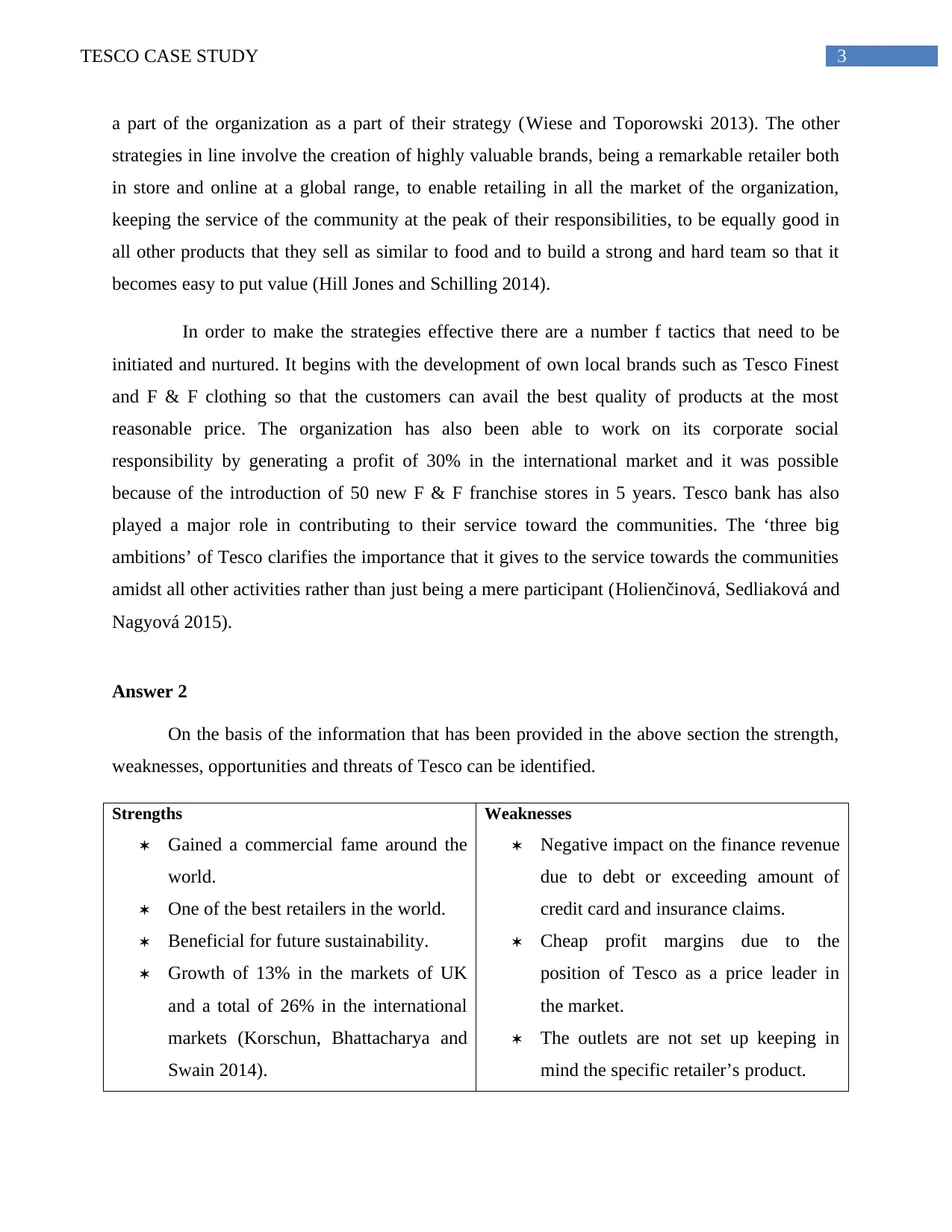
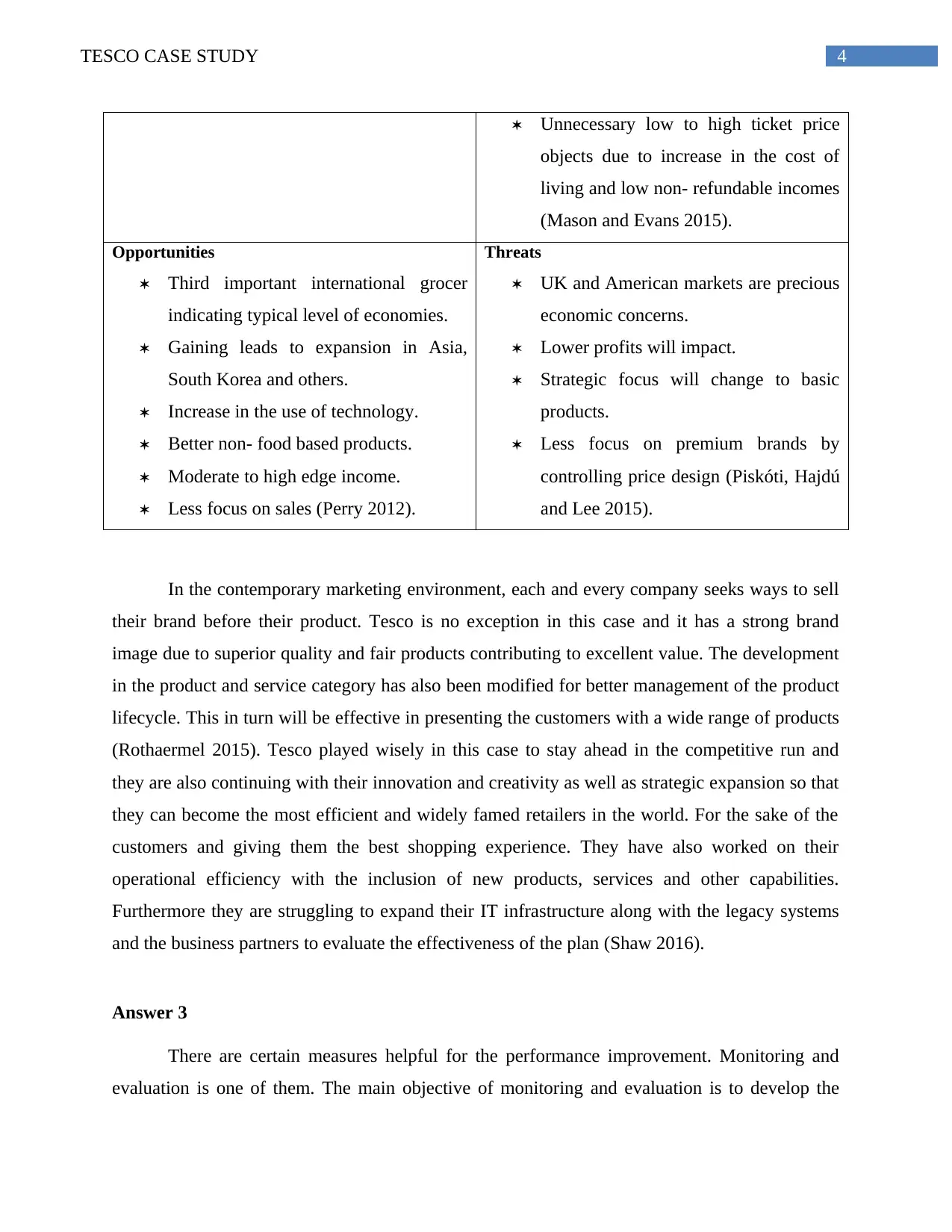
On the basis of the information that has been provided in the above section the strength,
weaknesses, opportunities and threats of Tesco can be identified.
Strengths
Gained a commercial fame around the
world.
One of the best retailers in the world.
Beneficial for future sustainability.
Growth of 13% in the markets of UK
and a total of 26% in the international
markets (Korschun, Bhattacharya and
Swain 2014).
Weaknesses
Negative impact on the finance revenue
due to debt or exceeding amount of
credit card and insurance claims.
Cheap profit margins due to the
position of Tesco as a price leader in
the market.
The outlets are not set up keeping in
mind the specific retailer’s product.
a part of the organization as a part of their strategy (Wiese and Toporowski 2013). The other
strategies in line involve the creation of highly valuable brands, being a remarkable retailer both
in store and online at a global range, to enable retailing in all the market of the organization,
keeping the service of the community at the peak of their responsibilities, to be equally good in
all other products that they sell as similar to food and to build a strong and hard team so that it
becomes easy to put value (Hill Jones and Schilling 2014).
In order to make the strategies effective there are a number f tactics that need to be
initiated and nurtured. It begins with the development of own local brands such as Tesco Finest
and F & F clothing so that the customers can avail the best quality of products at the most
reasonable price. The organization has also been able to work on its corporate social
responsibility by generating a profit of 30% in the international market and it was possible
because of the introduction of 50 new F & F franchise stores in 5 years. Tesco bank has also
played a major role in contributing to their service toward the communities. The ‘three big
ambitions’ of Tesco clarifies the importance that it gives to the service towards the communities
amidst all other activities rather than just being a mere participant (Holienčinová, Sedliaková and
Nagyová 2015).
Answer 2
On the basis of the information that has been provided in the above section the strength,
weaknesses, opportunities and threats of Tesco can be identified.
Strengths
Gained a commercial fame around the
world.
One of the best retailers in the world.
Beneficial for future sustainability.
Growth of 13% in the markets of UK
and a total of 26% in the international
markets (Korschun, Bhattacharya and
Swain 2014).
Weaknesses
Negative impact on the finance revenue
due to debt or exceeding amount of
credit card and insurance claims.
Cheap profit margins due to the
position of Tesco as a price leader in
the market.
The outlets are not set up keeping in
mind the specific retailer’s product.
Paraphrase This Document
Need a fresh take? Get an instant paraphrase of this document with our AI Paraphraser
4TESCO CASE STUDY
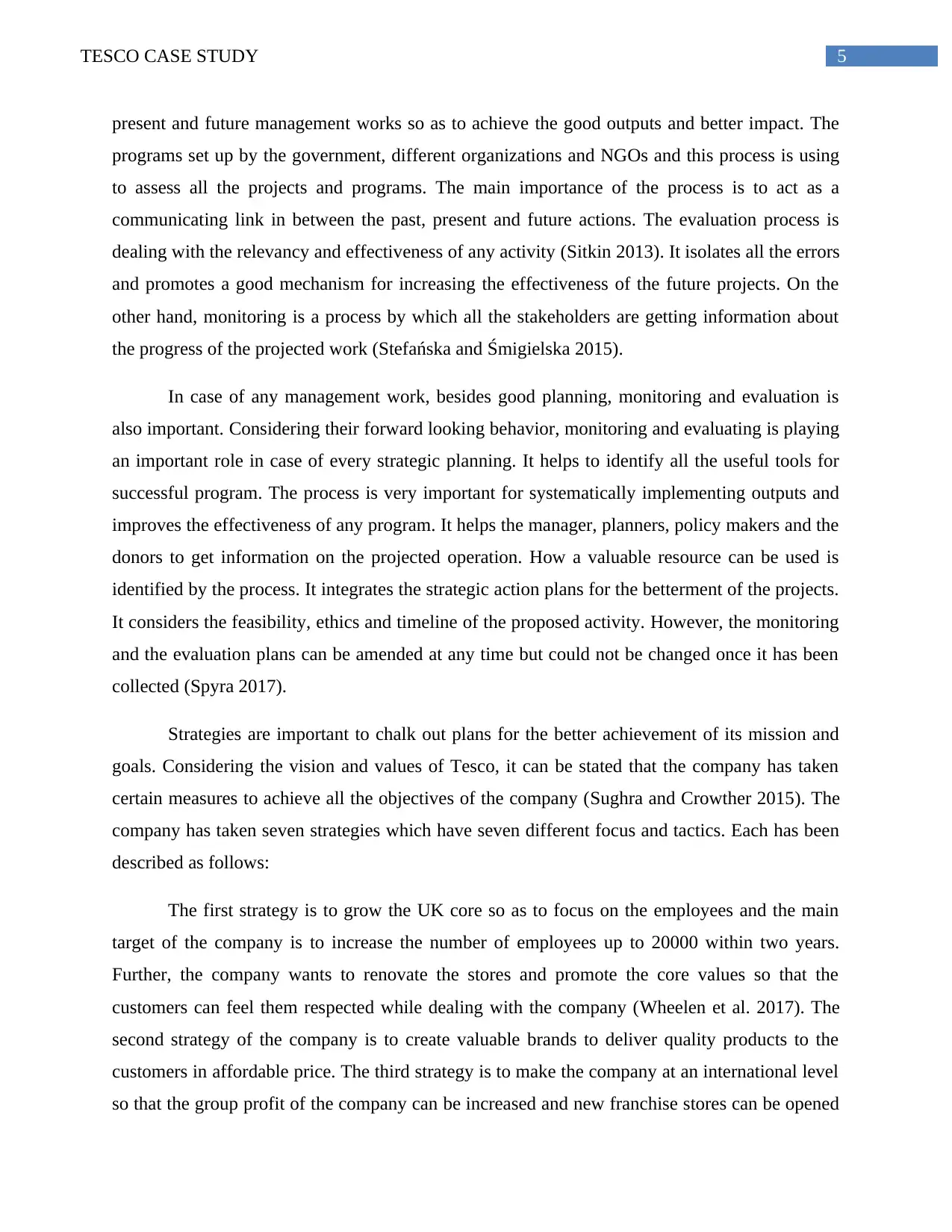
Unnecessary low to high ticket price
objects due to increase in the cost of
living and low non- refundable incomes
(Mason and Evans 2015).
Opportunities
Third important international grocer
indicating typical level of economies.
Gaining leads to expansion in Asia,
South Korea and others.
Increase in the use of technology.
Better non- food based products.
Moderate to high edge income.
Less focus on sales (Perry 2012).
Threats
UK and American markets are precious
economic concerns.
Lower profits will impact.
Strategic focus will change to basic
products.
Less focus on premium brands by
controlling price design (Piskóti, Hajdú
and Lee 2015).
In the contemporary marketing environment, each and every company seeks ways to sell
their brand before their product. Tesco is no exception in this case and it has a strong brand
image due to superior quality and fair products contributing to excellent value. The development
in the product and service category has also been modified for better management of the product
lifecycle. This in turn will be effective in presenting the customers with a wide range of products
(Rothaermel 2015). Tesco played wisely in this case to stay ahead in the competitive run and
they are also continuing with their innovation and creativity as well as strategic expansion so that
they can become the most efficient and widely famed retailers in the world. For the sake of the
customers and giving them the best shopping experience. They have also worked on their
operational efficiency with the inclusion of new products, services and other capabilities.
Furthermore they are struggling to expand their IT infrastructure along with the legacy systems
and the business partners to evaluate the effectiveness of the plan (Shaw 2016).
Answer 3
There are certain measures helpful for the performance improvement. Monitoring and
evaluation is one of them. The main objective of monitoring and evaluation is to develop the
Unnecessary low to high ticket price
objects due to increase in the cost of
living and low non- refundable incomes
(Mason and Evans 2015).
Opportunities
Third important international grocer
indicating typical level of economies.
Gaining leads to expansion in Asia,
South Korea and others.
Increase in the use of technology.
Better non- food based products.
Moderate to high edge income.
Less focus on sales (Perry 2012).
Threats
UK and American markets are precious
economic concerns.
Lower profits will impact.
Strategic focus will change to basic
products.
Less focus on premium brands by
controlling price design (Piskóti, Hajdú
and Lee 2015).
In the contemporary marketing environment, each and every company seeks ways to sell
their brand before their product. Tesco is no exception in this case and it has a strong brand
image due to superior quality and fair products contributing to excellent value. The development
in the product and service category has also been modified for better management of the product
lifecycle. This in turn will be effective in presenting the customers with a wide range of products
(Rothaermel 2015). Tesco played wisely in this case to stay ahead in the competitive run and
they are also continuing with their innovation and creativity as well as strategic expansion so that
they can become the most efficient and widely famed retailers in the world. For the sake of the
customers and giving them the best shopping experience. They have also worked on their
operational efficiency with the inclusion of new products, services and other capabilities.
Furthermore they are struggling to expand their IT infrastructure along with the legacy systems
and the business partners to evaluate the effectiveness of the plan (Shaw 2016).
Answer 3
There are certain measures helpful for the performance improvement. Monitoring and
evaluation is one of them. The main objective of monitoring and evaluation is to develop the
5TESCO CASE STUDY
present and future management works so as to achieve the good outputs and better impact. The
programs set up by the government, different organizations and NGOs and this process is using
to assess all the projects and programs. The main importance of the process is to act as a
communicating link in between the past, present and future actions. The evaluation process is
dealing with the relevancy and effectiveness of any activity (Sitkin 2013). It isolates all the errors
and promotes a good mechanism for increasing the effectiveness of the future projects. On the
other hand, monitoring is a process by which all the stakeholders are getting information about
the progress of the projected work (Stefańska and Śmigielska 2015).
In case of any management work, besides good planning, monitoring and evaluation is
also important. Considering their forward looking behavior, monitoring and evaluating is playing
an important role in case of every strategic planning. It helps to identify all the useful tools for
successful program. The process is very important for systematically implementing outputs and
improves the effectiveness of any program. It helps the manager, planners, policy makers and the
donors to get information on the projected operation. How a valuable resource can be used is
identified by the process. It integrates the strategic action plans for the betterment of the projects.
It considers the feasibility, ethics and timeline of the proposed activity. However, the monitoring
and the evaluation plans can be amended at any time but could not be changed once it has been
collected (Spyra 2017).
Strategies are important to chalk out plans for the better achievement of its mission and
goals. Considering the vision and values of Tesco, it can be stated that the company has taken
certain measures to achieve all the objectives of the company (Sughra and Crowther 2015). The
company has taken seven strategies which have seven different focus and tactics. Each has been
described as follows:
The first strategy is to grow the UK core so as to focus on the employees and the main
target of the company is to increase the number of employees up to 20000 within two years.
Further, the company wants to renovate the stores and promote the core values so that the
customers can feel them respected while dealing with the company (Wheelen et al. 2017). The
second strategy of the company is to create valuable brands to deliver quality products to the
customers in affordable price. The third strategy is to make the company at an international level
so that the group profit of the company can be increased and new franchise stores can be opened
present and future management works so as to achieve the good outputs and better impact. The
programs set up by the government, different organizations and NGOs and this process is using
to assess all the projects and programs. The main importance of the process is to act as a
communicating link in between the past, present and future actions. The evaluation process is
dealing with the relevancy and effectiveness of any activity (Sitkin 2013). It isolates all the errors
and promotes a good mechanism for increasing the effectiveness of the future projects. On the
other hand, monitoring is a process by which all the stakeholders are getting information about
the progress of the projected work (Stefańska and Śmigielska 2015).
In case of any management work, besides good planning, monitoring and evaluation is
also important. Considering their forward looking behavior, monitoring and evaluating is playing
an important role in case of every strategic planning. It helps to identify all the useful tools for
successful program. The process is very important for systematically implementing outputs and
improves the effectiveness of any program. It helps the manager, planners, policy makers and the
donors to get information on the projected operation. How a valuable resource can be used is
identified by the process. It integrates the strategic action plans for the betterment of the projects.
It considers the feasibility, ethics and timeline of the proposed activity. However, the monitoring
and the evaluation plans can be amended at any time but could not be changed once it has been
collected (Spyra 2017).
Strategies are important to chalk out plans for the better achievement of its mission and
goals. Considering the vision and values of Tesco, it can be stated that the company has taken
certain measures to achieve all the objectives of the company (Sughra and Crowther 2015). The
company has taken seven strategies which have seven different focus and tactics. Each has been
described as follows:
The first strategy is to grow the UK core so as to focus on the employees and the main
target of the company is to increase the number of employees up to 20000 within two years.
Further, the company wants to renovate the stores and promote the core values so that the
customers can feel them respected while dealing with the company (Wheelen et al. 2017). The
second strategy of the company is to create valuable brands to deliver quality products to the
customers in affordable price. The third strategy is to make the company at an international level
so that the group profit of the company can be increased and new franchise stores can be opened
⊘ This is a preview!⊘
Do you want full access?
Subscribe today to unlock all pages.
Trusted by 1+ million students worldwide
6TESCO CASE STUDY
in the Middle East (Tai and Chuang 2014). The fourth strategy is to develop the potentiality of
the Tesco bank in the retail service and the fifth strategy is to develop the corporate social
responsibility with an intention to achieve its ambitions. It has been stated by the authorities of
Tesco that the main concentrating part of the company is its people and therefore the sixth
strategy is to build an innovative team who will perform for the well being of the customers. The
last strategy is to make the food part of Tesco on strong base. Food is the heritage part of the
company and therefore, the company wants to develop its in-store services (Tench and Topić
2017).
These strategies are quite related to the vision and values of the company. Vision is a
vivid image that reveals the wish of the company and the possible future position of the
company. The vision of a company is based on two pillars that are goals and aspiration. It helps
to develop a clear focus for the company’s future movement and stops the authorities from
moving towards the wrong direction. The vision of Tesco is divided into five parts and the main
objective of these is to make the company with innovative ideas and obtain loyalty from the
customers by giving them opportunities. Therefore, it is obvious to state the strategies of the
company are quite inter-related to the vision of the company and to achieve the vision, the
strategies are important. However, it should be kept in mind, that without proper values, vision
of a company could not be achieved (Tingchi Liu et al. 2014).
Tesco has imposed best values to its customers and as per the statement of the CEO of
the company, Philip Clarke, the company is treating everyone with highest priority and it tries
harder for obtaining loyalty from the customers. Corporate social responsibility is positioned as
the central pivot of the company and it has been included under the fifth strategy of the company.
Further, the sixth and the seventh part of the strategies are dealing with the employees and
customers of the company and it is no doubt to state that they are also included under the vision
and value part of the company. Considering the above noted part, it can be stated that strategies
are planned to make the vision and values of the company into reality and therefore, strategies
are related to the vision and values of the company (Verghese 2016).
Tesco is an international retailer service provider and the success of the company is based
on skilled leadership and strong management program. The vision of the company is very clear
and responsible for the huge success of the company. All the strategies taken by the company
in the Middle East (Tai and Chuang 2014). The fourth strategy is to develop the potentiality of
the Tesco bank in the retail service and the fifth strategy is to develop the corporate social
responsibility with an intention to achieve its ambitions. It has been stated by the authorities of
Tesco that the main concentrating part of the company is its people and therefore the sixth
strategy is to build an innovative team who will perform for the well being of the customers. The
last strategy is to make the food part of Tesco on strong base. Food is the heritage part of the
company and therefore, the company wants to develop its in-store services (Tench and Topić
2017).
These strategies are quite related to the vision and values of the company. Vision is a
vivid image that reveals the wish of the company and the possible future position of the
company. The vision of a company is based on two pillars that are goals and aspiration. It helps
to develop a clear focus for the company’s future movement and stops the authorities from
moving towards the wrong direction. The vision of Tesco is divided into five parts and the main
objective of these is to make the company with innovative ideas and obtain loyalty from the
customers by giving them opportunities. Therefore, it is obvious to state the strategies of the
company are quite inter-related to the vision of the company and to achieve the vision, the
strategies are important. However, it should be kept in mind, that without proper values, vision
of a company could not be achieved (Tingchi Liu et al. 2014).
Tesco has imposed best values to its customers and as per the statement of the CEO of
the company, Philip Clarke, the company is treating everyone with highest priority and it tries
harder for obtaining loyalty from the customers. Corporate social responsibility is positioned as
the central pivot of the company and it has been included under the fifth strategy of the company.
Further, the sixth and the seventh part of the strategies are dealing with the employees and
customers of the company and it is no doubt to state that they are also included under the vision
and value part of the company. Considering the above noted part, it can be stated that strategies
are planned to make the vision and values of the company into reality and therefore, strategies
are related to the vision and values of the company (Verghese 2016).
Tesco is an international retailer service provider and the success of the company is based
on skilled leadership and strong management program. The vision of the company is very clear
and responsible for the huge success of the company. All the strategies taken by the company
Paraphrase This Document
Need a fresh take? Get an instant paraphrase of this document with our AI Paraphraser
7TESCO CASE STUDY
have created special impact and help the company to achieve its ultimate goal. In the year 2012,
the company has generated 1 billion pound revenue through its Tesco banking system. All the
decisions taken for the interest of the people and customers and for the satisfaction of the
customers, the company has provided branded service to them. All these are possible because of
the clear vision and good strategic plans taken by the company (Wanat and Stefańska 2015).
Answer 4
In order to understand the level of competition Tesco fasces, it is necessary to analyse its
strategy by comparing it with local retail food chains in the city. It is a well-known fact that
Tesco is one of the leading retail and store outlets in the UK. However, the company faces
competition from local markets mainly due to the prices of the products and the location of the
market. One such company that can be taken into consideration is Waitrose. Waitrose is a
supermarket chain located in Berkshire. The company is formed as a partnership deal with John
Lewis and is considered as the largest employee-owned retail market in the country. It has a
glowing reputation since its establishment in 1904, and much like Tesco, Waitrose leads the
market charts in its local region. Consequently, due to its popularity with the people, Waitrose
earns about $5,400.4 million (Waitrose.com 2018).
The analysis of the company can be done by keeping in mind the strategies of Waitrose
as also as the strategies adopted by Tesco. However, it can be said that the threat from the local
competitions is stronger than the threats received from other reputed companies. This is mainly
because the prices of these companies are more reasonable (Hill, Jones and Schilling 2014).
Waitrose faces this strategic advantage over Tesco, as the prices of Tesco are comparatively
high. Although both the companies provide quality and fresh ingredients, it is important to note
that Tesco provides discounts that attract the customers. However, despite the discounts; Tesco
fails to gain a competitive advantage over the price of its products. In this case, Waitrose
triumphs over Tesco and poses the threat of the local market factor as a challenge for the
company. This threat can be related to one of the factors of Porter's five-force analysis that puts
the threat from competition, particularly local competitors in perspective.
Another advantage that the local markets have over Tesco is its location. This can be
considered as another strategy that Tesco needs to be aware of. According to Wheelen et al.
have created special impact and help the company to achieve its ultimate goal. In the year 2012,
the company has generated 1 billion pound revenue through its Tesco banking system. All the
decisions taken for the interest of the people and customers and for the satisfaction of the
customers, the company has provided branded service to them. All these are possible because of
the clear vision and good strategic plans taken by the company (Wanat and Stefańska 2015).
Answer 4
In order to understand the level of competition Tesco fasces, it is necessary to analyse its
strategy by comparing it with local retail food chains in the city. It is a well-known fact that
Tesco is one of the leading retail and store outlets in the UK. However, the company faces
competition from local markets mainly due to the prices of the products and the location of the
market. One such company that can be taken into consideration is Waitrose. Waitrose is a
supermarket chain located in Berkshire. The company is formed as a partnership deal with John
Lewis and is considered as the largest employee-owned retail market in the country. It has a
glowing reputation since its establishment in 1904, and much like Tesco, Waitrose leads the
market charts in its local region. Consequently, due to its popularity with the people, Waitrose
earns about $5,400.4 million (Waitrose.com 2018).
The analysis of the company can be done by keeping in mind the strategies of Waitrose
as also as the strategies adopted by Tesco. However, it can be said that the threat from the local
competitions is stronger than the threats received from other reputed companies. This is mainly
because the prices of these companies are more reasonable (Hill, Jones and Schilling 2014).
Waitrose faces this strategic advantage over Tesco, as the prices of Tesco are comparatively
high. Although both the companies provide quality and fresh ingredients, it is important to note
that Tesco provides discounts that attract the customers. However, despite the discounts; Tesco
fails to gain a competitive advantage over the price of its products. In this case, Waitrose
triumphs over Tesco and poses the threat of the local market factor as a challenge for the
company. This threat can be related to one of the factors of Porter's five-force analysis that puts
the threat from competition, particularly local competitors in perspective.
Another advantage that the local markets have over Tesco is its location. This can be
considered as another strategy that Tesco needs to be aware of. According to Wheelen et al.
8TESCO CASE STUDY
(2017), the placement of a store is important, as most customers tend to visit the stores physically
while purchasing a product. For retail companies, such physical establishment of stores is must
as people tend to get analyse the products by hand. Moreover, travelling to a local store for an
emergency purpose is more convincing then travelling to distant lands. In this regard, the local
people can frequent Waitrose appeals to the local customers as the store. The opening of a
branch of Tesco may not be as effective as the main branch of Waitrose in the locality of the
store. Hence, Tesco has to undergo renovation so that it can attract the customers. It has been
seen that Tesco has also invested £1 billion of its capital for making the visits of the customers
more memorable (Cheng, Ioannou and Serafeim 2014).
However, it can be said that Waitrose does not have the employee strength as Tesco.
Despite the fact that the company is run by the employed people it has only 91,000 employees as
compared to the 476,000 employees of Tesco. Consequently, the ability to undertake decisions
that may provide strategic advantage can be advantageous for Tesco. One such strategy is to be
engaged with the customers via online as well as within the stores. This provides the retail store
with an opportunity to analyse the mindset of the customers (Rothaermel 2015). The responses
of the customers can be noted down and immediate action over its rectification can be arranged.
This includes maintaining a diversity of products in the market. In 2012, the international market
of Tesco generated about 12% of the profit of the company. In the case of Waitrose, the
company does not have the opportunity to interact with the customers in an effective manner.
This is mainly due to the undeveloped online system that the company has.
Thus, based on the analysis of Tesco and the effect it has on the local markets, it can be
said that Tesco needs to make certain rectifications in their strategic approach. As observed by
Ethiraj, Gambardella and Helfat (2016) one of the biggest strategic moves will be to ensure that
the customers be able to visit the stores. This can be considered as a huge improvement for the
company particularly given the fact that it has international standards. Place of an organisation is
one of the marketing mix strategies that every company need to get right. Hence, it is important
that Tesco make an immediate effort to promote its store by making it physically possible for
customers to visit the stores. In the words of Tai and Chuang (2014), Tesco can target the
customers and consequently renovate their stores for the better experience of these customers.
Another initiative that the company can undertake is the sustainability of the environment.
(2017), the placement of a store is important, as most customers tend to visit the stores physically
while purchasing a product. For retail companies, such physical establishment of stores is must
as people tend to get analyse the products by hand. Moreover, travelling to a local store for an
emergency purpose is more convincing then travelling to distant lands. In this regard, the local
people can frequent Waitrose appeals to the local customers as the store. The opening of a
branch of Tesco may not be as effective as the main branch of Waitrose in the locality of the
store. Hence, Tesco has to undergo renovation so that it can attract the customers. It has been
seen that Tesco has also invested £1 billion of its capital for making the visits of the customers
more memorable (Cheng, Ioannou and Serafeim 2014).
However, it can be said that Waitrose does not have the employee strength as Tesco.
Despite the fact that the company is run by the employed people it has only 91,000 employees as
compared to the 476,000 employees of Tesco. Consequently, the ability to undertake decisions
that may provide strategic advantage can be advantageous for Tesco. One such strategy is to be
engaged with the customers via online as well as within the stores. This provides the retail store
with an opportunity to analyse the mindset of the customers (Rothaermel 2015). The responses
of the customers can be noted down and immediate action over its rectification can be arranged.
This includes maintaining a diversity of products in the market. In 2012, the international market
of Tesco generated about 12% of the profit of the company. In the case of Waitrose, the
company does not have the opportunity to interact with the customers in an effective manner.
This is mainly due to the undeveloped online system that the company has.
Thus, based on the analysis of Tesco and the effect it has on the local markets, it can be
said that Tesco needs to make certain rectifications in their strategic approach. As observed by
Ethiraj, Gambardella and Helfat (2016) one of the biggest strategic moves will be to ensure that
the customers be able to visit the stores. This can be considered as a huge improvement for the
company particularly given the fact that it has international standards. Place of an organisation is
one of the marketing mix strategies that every company need to get right. Hence, it is important
that Tesco make an immediate effort to promote its store by making it physically possible for
customers to visit the stores. In the words of Tai and Chuang (2014), Tesco can target the
customers and consequently renovate their stores for the better experience of these customers.
Another initiative that the company can undertake is the sustainability of the environment.
⊘ This is a preview!⊘
Do you want full access?
Subscribe today to unlock all pages.
Trusted by 1+ million students worldwide
9TESCO CASE STUDY
According to Cheng, Ioannou and Serafeim (2014), Corporate Social Responsibility is
one of the most important aspects of a company. This includes taking care of the environment as
well as the society in which an organisation is established. In the case of a local market like
Waitrose, people can be sure about its responsibility towards the environment. This is mainly
because the employees are mostly local people that take care of the society in which they live in.
In the case of Tesco, this can be a doubtful factor for the local people. However, efforts are made
to maintain a sustainable environment of work within the society so that it can earn the trust of
the people. In this regard, Korschun, Bhattacharya and Swain (2014) pointed out that Tesco has
made efforts to continue its social responsibility. For example, the company donates 1% of its
profit to charities and good causes. Thus, it can be said that such strategies can be emulated
locally so that the company gain a competitive advantage and continue its dominance over the
local business stores.
According to Cheng, Ioannou and Serafeim (2014), Corporate Social Responsibility is
one of the most important aspects of a company. This includes taking care of the environment as
well as the society in which an organisation is established. In the case of a local market like
Waitrose, people can be sure about its responsibility towards the environment. This is mainly
because the employees are mostly local people that take care of the society in which they live in.
In the case of Tesco, this can be a doubtful factor for the local people. However, efforts are made
to maintain a sustainable environment of work within the society so that it can earn the trust of
the people. In this regard, Korschun, Bhattacharya and Swain (2014) pointed out that Tesco has
made efforts to continue its social responsibility. For example, the company donates 1% of its
profit to charities and good causes. Thus, it can be said that such strategies can be emulated
locally so that the company gain a competitive advantage and continue its dominance over the
local business stores.
Paraphrase This Document
Need a fresh take? Get an instant paraphrase of this document with our AI Paraphraser
10TESCO CASE STUDY
References
Ailawadi, K.L., Neslin, S.A., Luan, Y.J. and Taylor, G.A., 2014. Does retailer CSR enhance
behavioral loyalty? A case for benefit segmentation. International Journal of Research in
Marketing, 31(2), pp.156-167.
Bene, A. and Salamon, P., 2016. ’CSR Potential’. In The Publications of the MultiScience–
XXX. microCAD International Multidisciplinary Scientific Conference. University of Miskolc.
Bilinska-Reformat, К. and Stefanska, М., 2013. Cooperation of commercial chains with
suppliers in the context of CSR concept.
Chen, J., Huang, Q., Peng, H. and Zhong, H., 2015. CSR Development Index for the Retail
Industry (2012). In Research Report on Corporate Social Responsibility of China (pp. 201-213).
Springer, Berlin, Heidelberg.
Cheng, B., Ioannou, I. and Serafeim, G., 2014. Corporate social responsibility and access to
finance. Strategic Management Journal, 35(1), pp.1-23.
Dutta, K. and Singh, S., 2013. Customer perception of CSR and its impact on retailer evaluation
and purchase intention in India. Journal of Services Research, 13(1), p.111.
Ethiraj, S.K., Gambardella, A. and Helfat, C.E., 2016. Replication in strategic
management. Strategic Management Journal, 37(11), pp.2191-2192.
Hassan, Z. and Nareeman, A., 2013. Impact of CSR practices on customer satisfaction and
retention: an empirical study on foreign MNCs in Malaysia.
Hill, C.W., Jones, G.R. and Schilling, M.A., 2014. Strategic management: theory: an integrated
approach. Cengage Learning.
Holienčinová, M., Sedliaková, I. and Nagyová, Ľ., 2015. Application of the Concept of
Corporate Social Responsibility in Activities of Food Chains in Slovakia.
References
Ailawadi, K.L., Neslin, S.A., Luan, Y.J. and Taylor, G.A., 2014. Does retailer CSR enhance
behavioral loyalty? A case for benefit segmentation. International Journal of Research in
Marketing, 31(2), pp.156-167.
Bene, A. and Salamon, P., 2016. ’CSR Potential’. In The Publications of the MultiScience–
XXX. microCAD International Multidisciplinary Scientific Conference. University of Miskolc.
Bilinska-Reformat, К. and Stefanska, М., 2013. Cooperation of commercial chains with
suppliers in the context of CSR concept.
Chen, J., Huang, Q., Peng, H. and Zhong, H., 2015. CSR Development Index for the Retail
Industry (2012). In Research Report on Corporate Social Responsibility of China (pp. 201-213).
Springer, Berlin, Heidelberg.
Cheng, B., Ioannou, I. and Serafeim, G., 2014. Corporate social responsibility and access to
finance. Strategic Management Journal, 35(1), pp.1-23.
Dutta, K. and Singh, S., 2013. Customer perception of CSR and its impact on retailer evaluation
and purchase intention in India. Journal of Services Research, 13(1), p.111.
Ethiraj, S.K., Gambardella, A. and Helfat, C.E., 2016. Replication in strategic
management. Strategic Management Journal, 37(11), pp.2191-2192.
Hassan, Z. and Nareeman, A., 2013. Impact of CSR practices on customer satisfaction and
retention: an empirical study on foreign MNCs in Malaysia.
Hill, C.W., Jones, G.R. and Schilling, M.A., 2014. Strategic management: theory: an integrated
approach. Cengage Learning.
Holienčinová, M., Sedliaková, I. and Nagyová, Ľ., 2015. Application of the Concept of
Corporate Social Responsibility in Activities of Food Chains in Slovakia.
11TESCO CASE STUDY
Korschun, D., Bhattacharya, C.B. and Swain, S.D., 2014. Corporate social responsibility,
customer orientation, and the job performance of frontline employees. Journal of
Marketing, 78(3), pp.20-37.
Mason, R. and Evans, B., 2015. The lean supply chain: managing the challenge at Tesco. Kogan
Page Publishers.
Perry, P., 2012. Exploring the influence of national cultural context on CSR
implementation. Journal of Fashion Marketing and Management: An International
Journal, 16(2), pp.141-160.
Piskóti, I., Hajdú, N. and Lee, J., A., 2015. Benchmarking approach to the situation and topics in
CSR reports of Hungarian corporations.
Rothaermel, F.T., 2015. Strategic management. McGraw-Hill Education.
Shaw, H., 2016. The regulatory and legal framework of corporate governance. A handbook of
corporate governance and social responsibility. Aldershot: Gower Publishing Limited & Ashgate
Publishing Company.
Sitkin, A., 2013, December. Working for the local community: Substantively
broader/geographically narrower CSR accounting. In Accounting Forum (Vol. 37, No. 4, pp.
315-324). Elsevier.
Spyra, Z., 2017. Environmental aspects as an area of CSR and building the image of retailers’
private labels. Marketing Instytucji Naukowych i Badawczych, (4 (26)), pp.135-160.
Stefańska, M. and Śmigielska, G., 2015. Theoretical Foundations of CSR in Retailing. In Fair
Trade in CSR Strategy of Global Retailers (pp. 1-33). Palgrave Macmillan, New York.
Sughra, G. and Crowther, D., 2015. Do CSR determinants stimulate profits: Analysis of retail
companies in UK. In Sustainability After Rio (pp. 123-140). Emerald Group Publishing Limited.
Tai, F.M. and Chuang, S.H., 2014. Corporate social responsibility. Ibusiness, 6(03), p.117.
Tench, R. and Topić, M., 2017. 6 Evaluating CSR, Sustainability, and Sourcing Within the UK
Supermarket Industry. CSR, Sustainability, and Leadership, 5, p.100.
Korschun, D., Bhattacharya, C.B. and Swain, S.D., 2014. Corporate social responsibility,
customer orientation, and the job performance of frontline employees. Journal of
Marketing, 78(3), pp.20-37.
Mason, R. and Evans, B., 2015. The lean supply chain: managing the challenge at Tesco. Kogan
Page Publishers.
Perry, P., 2012. Exploring the influence of national cultural context on CSR
implementation. Journal of Fashion Marketing and Management: An International
Journal, 16(2), pp.141-160.
Piskóti, I., Hajdú, N. and Lee, J., A., 2015. Benchmarking approach to the situation and topics in
CSR reports of Hungarian corporations.
Rothaermel, F.T., 2015. Strategic management. McGraw-Hill Education.
Shaw, H., 2016. The regulatory and legal framework of corporate governance. A handbook of
corporate governance and social responsibility. Aldershot: Gower Publishing Limited & Ashgate
Publishing Company.
Sitkin, A., 2013, December. Working for the local community: Substantively
broader/geographically narrower CSR accounting. In Accounting Forum (Vol. 37, No. 4, pp.
315-324). Elsevier.
Spyra, Z., 2017. Environmental aspects as an area of CSR and building the image of retailers’
private labels. Marketing Instytucji Naukowych i Badawczych, (4 (26)), pp.135-160.
Stefańska, M. and Śmigielska, G., 2015. Theoretical Foundations of CSR in Retailing. In Fair
Trade in CSR Strategy of Global Retailers (pp. 1-33). Palgrave Macmillan, New York.
Sughra, G. and Crowther, D., 2015. Do CSR determinants stimulate profits: Analysis of retail
companies in UK. In Sustainability After Rio (pp. 123-140). Emerald Group Publishing Limited.
Tai, F.M. and Chuang, S.H., 2014. Corporate social responsibility. Ibusiness, 6(03), p.117.
Tench, R. and Topić, M., 2017. 6 Evaluating CSR, Sustainability, and Sourcing Within the UK
Supermarket Industry. CSR, Sustainability, and Leadership, 5, p.100.
⊘ This is a preview!⊘
Do you want full access?
Subscribe today to unlock all pages.
Trusted by 1+ million students worldwide

1 out of 13


Related Documents


Your All-in-One AI-Powered Toolkit for Academic Success.
+13062052269
info@desklib.com
Available 24*7 on WhatsApp / Email
![[object Object]](/_next/static/media/star-bottom.7253800d.svg)
Unlock your academic potential
Copyright © 2020–2025 A2Z Services. All Rights Reserved. Developed and managed by ZUCOL.