Contemporary Business Economics: Demand, Supply, and Tesco
VerifiedAdded on 2023/06/17
|18
|3802
|471
Report
AI Summary
This report examines the dynamic nature of business through the lens of changing customer demands, technological advancements, and policy shifts, focusing on their impact on the demand and supply of products and services. It explains the law of demand, movements along the demand curve, and factors causing shifts in the demand curve, specifically in the context of Tesco. Similarly, it explores the law of supply, movements along the supply curve, and factors influencing shifts in supply, again using Tesco as a case study. The report also compares and contrasts emerging economic theories and models of the 21st century with those of the 20th century, relating them to modern business practices, providing a comprehensive overview of how these economic principles affect Tesco's operational strategies.
CONTEMPORARY BUSINESS
ECONOMICS
ECONOMICS

Paraphrase This Document
Need a fresh take? Get an instant paraphrase of this document with our AI Paraphraser
EXECUTIVE SUMMARY
This assignment had focused upon changing dynamic nature of business by explaining
fluctuation in customers, needs, demands, policies, technologies etc. And ways in which it
affects demand of products and services of organization. In this assessment it has further been
identified that changing external environment, and competitive environment can affect supply of
a product and service. In this assessment further, explanation of law of demand and movement of
demand in demand curve has been explained. Ways in which change in demand curve affect
Tesco and demand of their products and service. In this, it has further explained that ways in
which change in supply curve can affect supply of products and services of Tesco. Further, in
this assessment, various theories and models explanation have been provided that can affect
modern business practices of business.
This assignment had focused upon changing dynamic nature of business by explaining
fluctuation in customers, needs, demands, policies, technologies etc. And ways in which it
affects demand of products and services of organization. In this assessment it has further been
identified that changing external environment, and competitive environment can affect supply of
a product and service. In this assessment further, explanation of law of demand and movement of
demand in demand curve has been explained. Ways in which change in demand curve affect
Tesco and demand of their products and service. In this, it has further explained that ways in
which change in supply curve can affect supply of products and services of Tesco. Further, in
this assessment, various theories and models explanation have been provided that can affect
modern business practices of business.
TABLE OF CONTENTS
INTRODUCTION...........................................................................................................................4
TASK 1............................................................................................................................................4
PART 1.1.........................................................................................................................................4
Demand........................................................................................................................................4
Law of demand............................................................................................................................4
Movement in demand curve........................................................................................................5
Movement in demand curve in context of Tesco.........................................................................5
Factor that causes shift in demand curve.....................................................................................6
Shift in demand curve..................................................................................................................7
PART 1.2.........................................................................................................................................9
Supply..........................................................................................................................................9
Law of supply..............................................................................................................................9
Movement in supply curve..........................................................................................................9
Movement in supply curve in context of Tesco...........................................................................9
Factor that causes shift in supply curve.....................................................................................10
Shift in supply curve in Tesco...................................................................................................11
TASK 2..........................................................................................................................................12
Compare and contrast emerging theories and models in 21 th century contemporary economics
of 20 th century and related to modern business practice..........................................................12
REFERENCES..............................................................................................................................15
INTRODUCTION...........................................................................................................................4
TASK 1............................................................................................................................................4
PART 1.1.........................................................................................................................................4
Demand........................................................................................................................................4
Law of demand............................................................................................................................4
Movement in demand curve........................................................................................................5
Movement in demand curve in context of Tesco.........................................................................5
Factor that causes shift in demand curve.....................................................................................6
Shift in demand curve..................................................................................................................7
PART 1.2.........................................................................................................................................9
Supply..........................................................................................................................................9
Law of supply..............................................................................................................................9
Movement in supply curve..........................................................................................................9
Movement in supply curve in context of Tesco...........................................................................9
Factor that causes shift in supply curve.....................................................................................10
Shift in supply curve in Tesco...................................................................................................11
TASK 2..........................................................................................................................................12
Compare and contrast emerging theories and models in 21 th century contemporary economics
of 20 th century and related to modern business practice..........................................................12
REFERENCES..............................................................................................................................15
⊘ This is a preview!⊘
Do you want full access?
Subscribe today to unlock all pages.

Trusted by 1+ million students worldwide
INTRODUCTION
Business environment is dynamic in nature as it is every changing, there are many
fluctuations in the customer’s demand, technology, policies of government and economic
condition of the country. Demand and supply of products and services keep on changing with
trends in external environment so company in order to grow and sustain in competitive
environment need to adapt to them. Tesco is British multinational groceries general merchandise
retailer having it headquarter in Welwyn Garden City. Company has been initially founded in
1919 by Jack Cohen, having approximately revenue of 6,476 crores. Furthermore, it deals in
range of products starting from food, clothing and financial services that are delivered to
customers for satisfaction of their respective requirement. This report has covered two parts in
which the first has key information pertaining to movement and law of demand and supply,
factors that has affected overall demand and supply of the firm. Second part is related to compare
and contrast between emerging theories and models used in 21th century contemporary
economy.
TASK 1
PART 1.1
Demand
Demand in economic terms can be defined as quantity of products and services that are
demanded by the customers in order to fulfil their respective requirements during an specific
time frame. Demand of particular products and services depends upon several factors such as
customers taste and preferences, price of products, availability of substitute of products and
availability of alternative options (Grawe, 2018). Therefore, in short it can be stated as thing that
consumers desired to make purchase by paying a specific amount of money in order to have the
same. it is extremely important for Tesco to identify demand of their products and services in a
particular time period so that they can identify whether their customers are interested in paying
current price of their goods and services.
Law of demand
It is fundamental economic principles that explain demand of products and services
majorly depend upon its price so it has inverse relationship with each other. Such as the
consumer at high price demand low quantity of products and services and vice versa. It is also
Business environment is dynamic in nature as it is every changing, there are many
fluctuations in the customer’s demand, technology, policies of government and economic
condition of the country. Demand and supply of products and services keep on changing with
trends in external environment so company in order to grow and sustain in competitive
environment need to adapt to them. Tesco is British multinational groceries general merchandise
retailer having it headquarter in Welwyn Garden City. Company has been initially founded in
1919 by Jack Cohen, having approximately revenue of 6,476 crores. Furthermore, it deals in
range of products starting from food, clothing and financial services that are delivered to
customers for satisfaction of their respective requirement. This report has covered two parts in
which the first has key information pertaining to movement and law of demand and supply,
factors that has affected overall demand and supply of the firm. Second part is related to compare
and contrast between emerging theories and models used in 21th century contemporary
economy.
TASK 1
PART 1.1
Demand
Demand in economic terms can be defined as quantity of products and services that are
demanded by the customers in order to fulfil their respective requirements during an specific
time frame. Demand of particular products and services depends upon several factors such as
customers taste and preferences, price of products, availability of substitute of products and
availability of alternative options (Grawe, 2018). Therefore, in short it can be stated as thing that
consumers desired to make purchase by paying a specific amount of money in order to have the
same. it is extremely important for Tesco to identify demand of their products and services in a
particular time period so that they can identify whether their customers are interested in paying
current price of their goods and services.
Law of demand
It is fundamental economic principles that explain demand of products and services
majorly depend upon its price so it has inverse relationship with each other. Such as the
consumer at high price demand low quantity of products and services and vice versa. It is also
Paraphrase This Document
Need a fresh take? Get an instant paraphrase of this document with our AI Paraphraser
based on law of diminishing marginal utility that means consumption of one commodity results
in reducing the capacity of individual to consumer more (Bailenson, 2018).
Demand curve
Demand curve is a graphical representation of relationship between goods and services
price and quantity demanded for a given time period. in this price appears on vertical axis and
quantity appears on horizontal axis.
Movement in demand curve
Movement in demand curve changes represent both changes that are happening in
quantity demanded as well as price at specific point of time. At the same time, all other things
remain constant such as availability of alternative option, changes in customers preferences and
many others. Furthermore, the movement in demand curve can be occur in two direction such as
Upward and downward movement (Bessen, 2018). Likewise, the upward movement represent
contraction in demand i.,e fall is demand because of increase in price of products and services.
On the contrary note, downward movement is because of expansion in demand that is price has
fall down and demand of products has been increased at tremendous manner. analyzing
movement in demand curve can directly help Tesco to understand whether change in demand of
products and services has occurred or not within a defied time period. this analysis further helps
them in taking appropriate decisions for bringing change within price of product.
Movement in demand curve in context of Tesco
in reducing the capacity of individual to consumer more (Bailenson, 2018).
Demand curve
Demand curve is a graphical representation of relationship between goods and services
price and quantity demanded for a given time period. in this price appears on vertical axis and
quantity appears on horizontal axis.
Movement in demand curve
Movement in demand curve changes represent both changes that are happening in
quantity demanded as well as price at specific point of time. At the same time, all other things
remain constant such as availability of alternative option, changes in customers preferences and
many others. Furthermore, the movement in demand curve can be occur in two direction such as
Upward and downward movement (Bessen, 2018). Likewise, the upward movement represent
contraction in demand i.,e fall is demand because of increase in price of products and services.
On the contrary note, downward movement is because of expansion in demand that is price has
fall down and demand of products has been increased at tremendous manner. analyzing
movement in demand curve can directly help Tesco to understand whether change in demand of
products and services has occurred or not within a defied time period. this analysis further helps
them in taking appropriate decisions for bringing change within price of product.
Movement in demand curve in context of Tesco
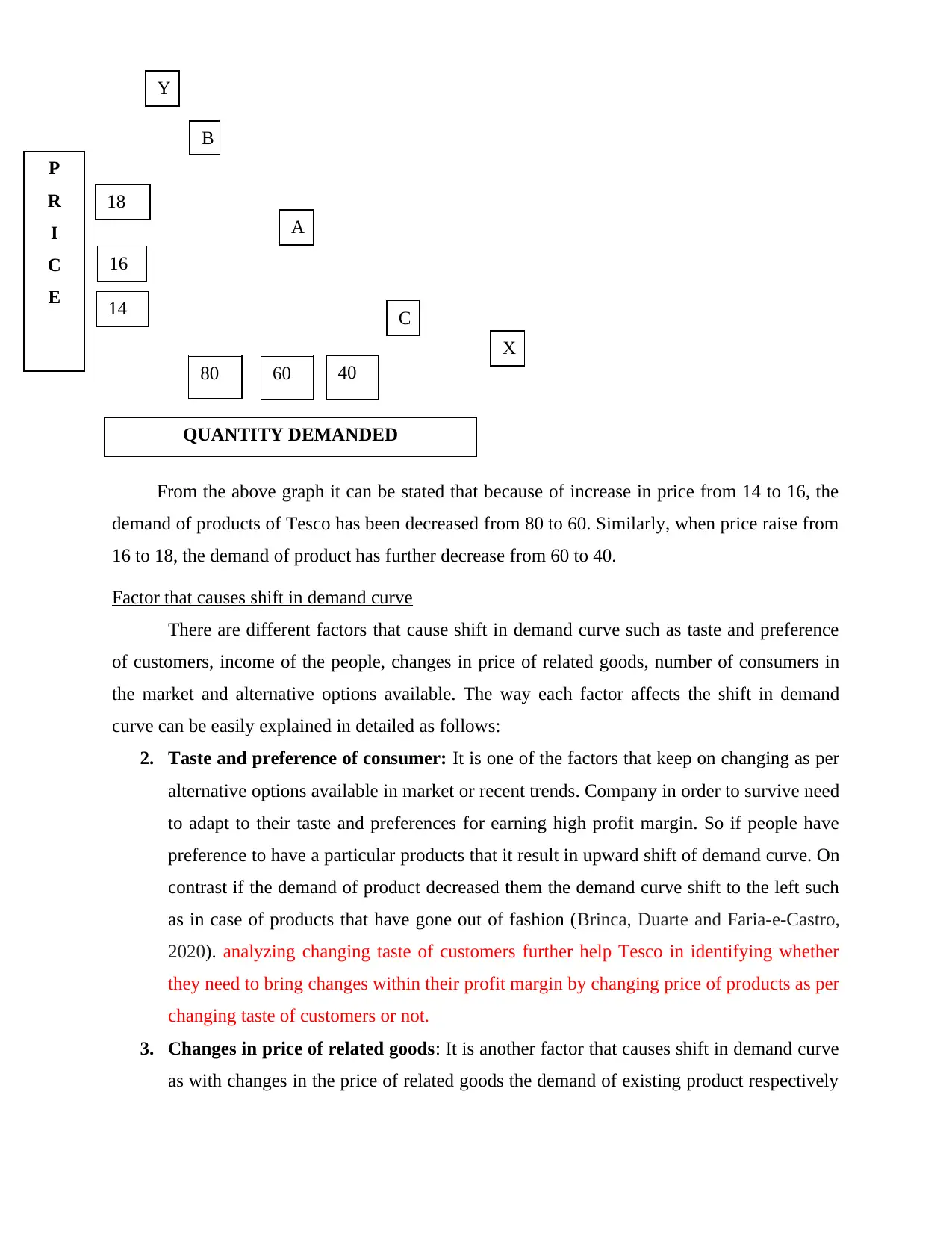
From the above graph it can be stated that because of increase in price from 14 to 16, the
demand of products of Tesco has been decreased from 80 to 60. Similarly, when price raise from
16 to 18, the demand of product has further decrease from 60 to 40.
Factor that causes shift in demand curve
There are different factors that cause shift in demand curve such as taste and preference
of customers, income of the people, changes in price of related goods, number of consumers in
the market and alternative options available. The way each factor affects the shift in demand
curve can be easily explained in detailed as follows:
2. Taste and preference of consumer: It is one of the factors that keep on changing as per
alternative options available in market or recent trends. Company in order to survive need
to adapt to their taste and preferences for earning high profit margin. So if people have
preference to have a particular products that it result in upward shift of demand curve. On
contrast if the demand of product decreased them the demand curve shift to the left such
as in case of products that have gone out of fashion (Brinca, Duarte and Faria-e-Castro,
2020). analyzing changing taste of customers further help Tesco in identifying whether
they need to bring changes within their profit margin by changing price of products as per
changing taste of customers or not.
3. Changes in price of related goods: It is another factor that causes shift in demand curve
as with changes in the price of related goods the demand of existing product respectively
A
C
B
80 60 40
18
16
14
QUANTITY DEMANDED
P
R
I
C
E
X
Y
demand of products of Tesco has been decreased from 80 to 60. Similarly, when price raise from
16 to 18, the demand of product has further decrease from 60 to 40.
Factor that causes shift in demand curve
There are different factors that cause shift in demand curve such as taste and preference
of customers, income of the people, changes in price of related goods, number of consumers in
the market and alternative options available. The way each factor affects the shift in demand
curve can be easily explained in detailed as follows:
2. Taste and preference of consumer: It is one of the factors that keep on changing as per
alternative options available in market or recent trends. Company in order to survive need
to adapt to their taste and preferences for earning high profit margin. So if people have
preference to have a particular products that it result in upward shift of demand curve. On
contrast if the demand of product decreased them the demand curve shift to the left such
as in case of products that have gone out of fashion (Brinca, Duarte and Faria-e-Castro,
2020). analyzing changing taste of customers further help Tesco in identifying whether
they need to bring changes within their profit margin by changing price of products as per
changing taste of customers or not.
3. Changes in price of related goods: It is another factor that causes shift in demand curve
as with changes in the price of related goods the demand of existing product respectively
A
C
B
80 60 40
18
16
14
QUANTITY DEMANDED
P
R
I
C
E
X
Y
⊘ This is a preview!⊘
Do you want full access?
Subscribe today to unlock all pages.
Trusted by 1+ million students worldwide
change. Substitute and complement are two type of related goods, such as substitute are
products whose price of one good result decrease in demand of another goods for
example tea and coffee. While complement are products whose price decrease cause
increase in demand of another goods such as car and petrol.
4. Income of people: This is also one of the factor that results in shift of demand curve that
generally depends upon different types of goods such as whether it is normal or inferior
goods. In case it is normal good that the demand of products increase with increase in
income and demand curve shift to the right (Orrell, 2020). Whereas in case of inferior
goods that demand of products decrease with overall increase in the income of people
living in the society. for example: in current Covid-19 pandemic income and disposable
income of people were affected or got reduced this directly affected demand of products
and services of Tesco because of which Tesco had to bring certain chances within their
goods for maintaining demand level of their products.
Shift in demand curve
products whose price of one good result decrease in demand of another goods for
example tea and coffee. While complement are products whose price decrease cause
increase in demand of another goods such as car and petrol.
4. Income of people: This is also one of the factor that results in shift of demand curve that
generally depends upon different types of goods such as whether it is normal or inferior
goods. In case it is normal good that the demand of products increase with increase in
income and demand curve shift to the right (Orrell, 2020). Whereas in case of inferior
goods that demand of products decrease with overall increase in the income of people
living in the society. for example: in current Covid-19 pandemic income and disposable
income of people were affected or got reduced this directly affected demand of products
and services of Tesco because of which Tesco had to bring certain chances within their
goods for maintaining demand level of their products.
Shift in demand curve
Paraphrase This Document
Need a fresh take? Get an instant paraphrase of this document with our AI Paraphraser
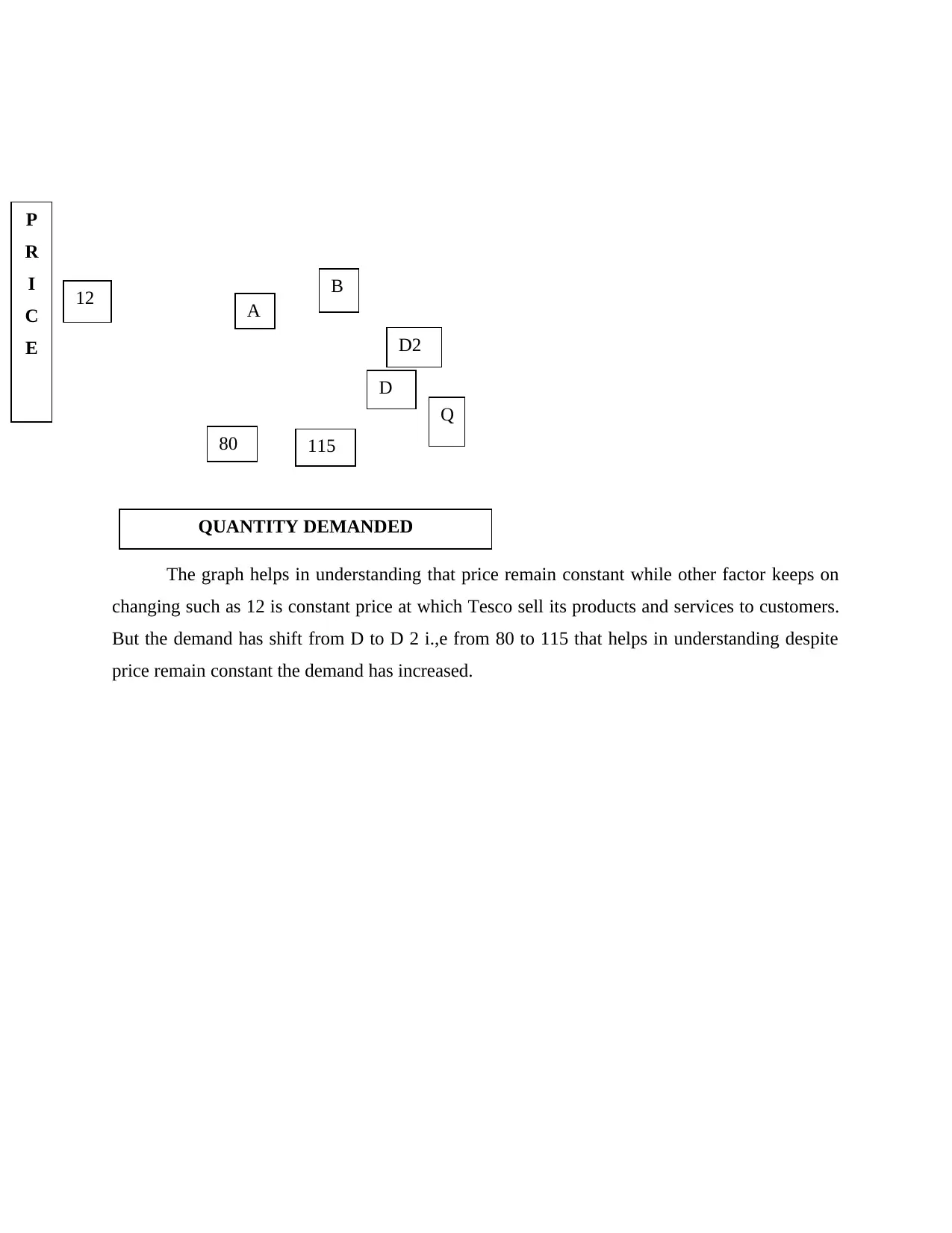
The graph helps in understanding that price remain constant while other factor keeps on
changing such as 12 is constant price at which Tesco sell its products and services to customers.
But the demand has shift from D to D 2 i.,e from 80 to 115 that helps in understanding despite
price remain constant the demand has increased.
B
A
D
Q
80 115
D2
12
QUANTITY DEMANDED
P
R
I
C
E
changing such as 12 is constant price at which Tesco sell its products and services to customers.
But the demand has shift from D to D 2 i.,e from 80 to 115 that helps in understanding despite
price remain constant the demand has increased.
B
A
D
Q
80 115
D2
12
QUANTITY DEMANDED
P
R
I
C
E
PART 1.2
Supply
Supply is fundamental economic concept that explain about the total number of good or
services that is available for customers in the market so that their desired wants can be easily
fulfilled. The price of products automatically goes down, when the supply of particular products
and services increase at rapid stage and vice versa happen. Company through maintaining strong
relationship with suppliers can easily get the products and services at minimum price possible in
order to meet customer’s expectancy.
Law of supply
The law of supply explains about the quantities of products that are sold to customers at specific
point of time and at particular rate. The slope of supply is upward that means higher the price,
then higher will be the quantity supplied so that suppliers can earn high profit margin
(Grunewald and Diakonova, 2018). Therefore, there is direct relationship with the price and
quality supplied as one increase then another automatically increases and the similar it decreases.
Supply curve
Supply curve is a graphical representation of relationship between correlation between
cost of goods and services and between quantity which is being supplied for given time period.
in this price appears on vertical axis and quantity supplied appears on horizontal axis.
Movement in supply curve
Movement in supply curve expression change in both quantities supplied and price from
one point to another on particular curve. Along with that in movement in supply curve, all the
factors are assumed to be constant, rather than price of the commodity. Therefore, in short,
quantity supplied of the commodity changes or fluctuate with increase or decrease in the price of
product and services in the market while other factor remained unchanged. this movement in
supply curve helps in providing a brief overview to Tesco for understanding whether supplied
quantity is higher then change within existing prices can be brought by Tesco.
Movement in supply curve in context of Tesco
Supply
Supply is fundamental economic concept that explain about the total number of good or
services that is available for customers in the market so that their desired wants can be easily
fulfilled. The price of products automatically goes down, when the supply of particular products
and services increase at rapid stage and vice versa happen. Company through maintaining strong
relationship with suppliers can easily get the products and services at minimum price possible in
order to meet customer’s expectancy.
Law of supply
The law of supply explains about the quantities of products that are sold to customers at specific
point of time and at particular rate. The slope of supply is upward that means higher the price,
then higher will be the quantity supplied so that suppliers can earn high profit margin
(Grunewald and Diakonova, 2018). Therefore, there is direct relationship with the price and
quality supplied as one increase then another automatically increases and the similar it decreases.
Supply curve
Supply curve is a graphical representation of relationship between correlation between
cost of goods and services and between quantity which is being supplied for given time period.
in this price appears on vertical axis and quantity supplied appears on horizontal axis.
Movement in supply curve
Movement in supply curve expression change in both quantities supplied and price from
one point to another on particular curve. Along with that in movement in supply curve, all the
factors are assumed to be constant, rather than price of the commodity. Therefore, in short,
quantity supplied of the commodity changes or fluctuate with increase or decrease in the price of
product and services in the market while other factor remained unchanged. this movement in
supply curve helps in providing a brief overview to Tesco for understanding whether supplied
quantity is higher then change within existing prices can be brought by Tesco.
Movement in supply curve in context of Tesco
⊘ This is a preview!⊘
Do you want full access?
Subscribe today to unlock all pages.
Trusted by 1+ million students worldwide
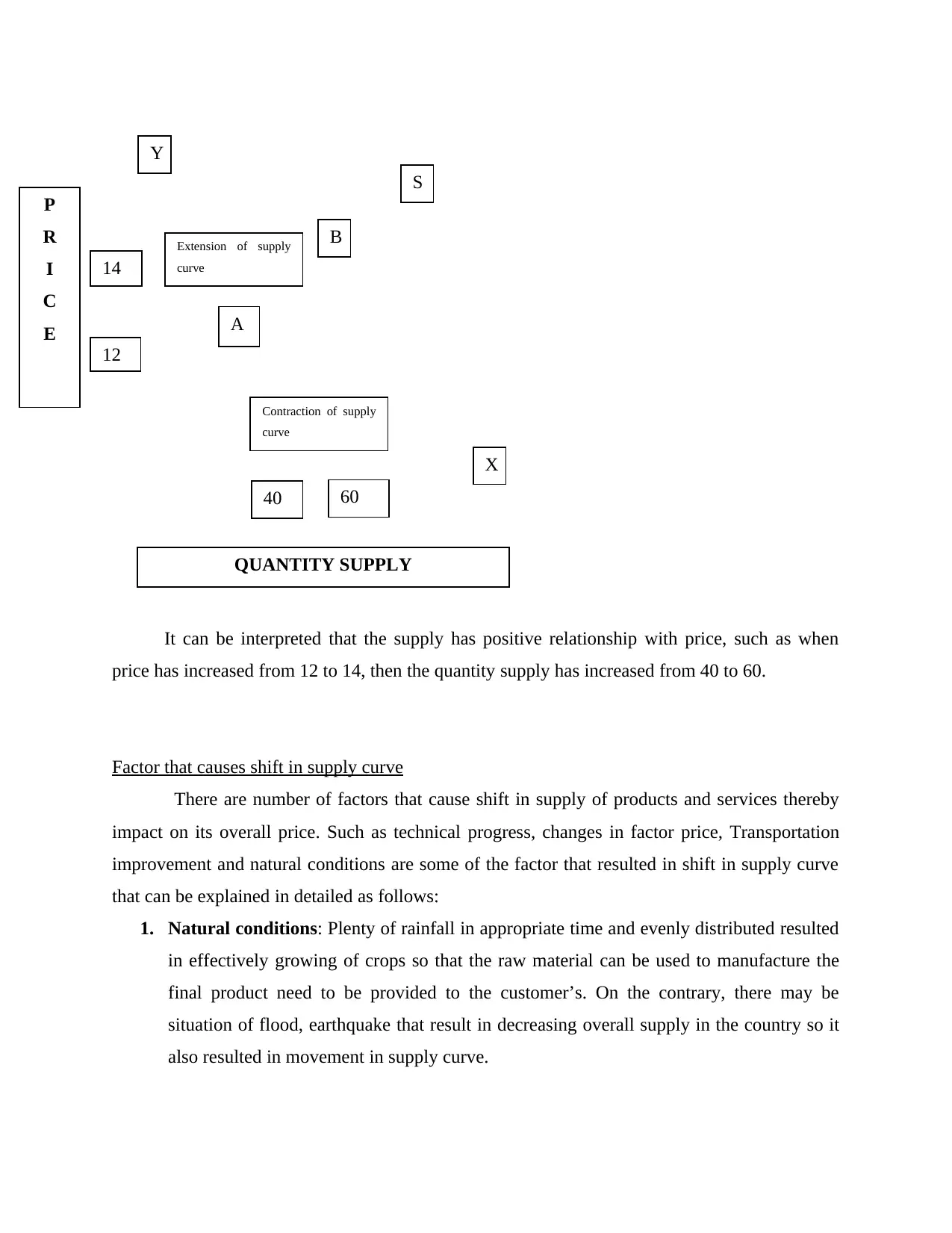
It can be interpreted that the supply has positive relationship with price, such as when
price has increased from 12 to 14, then the quantity supply has increased from 40 to 60.
Factor that causes shift in supply curve
There are number of factors that cause shift in supply of products and services thereby
impact on its overall price. Such as technical progress, changes in factor price, Transportation
improvement and natural conditions are some of the factor that resulted in shift in supply curve
that can be explained in detailed as follows:
1. Natural conditions: Plenty of rainfall in appropriate time and evenly distributed resulted
in effectively growing of crops so that the raw material can be used to manufacture the
final product need to be provided to the customer’s. On the contrary, there may be
situation of flood, earthquake that result in decreasing overall supply in the country so it
also resulted in movement in supply curve.
B
A
14
12
S
X
Y
6040
QUANTITY SUPPLY
P
R
I
C
E
Extension of supply
curve
Contraction of supply
curve
price has increased from 12 to 14, then the quantity supply has increased from 40 to 60.
Factor that causes shift in supply curve
There are number of factors that cause shift in supply of products and services thereby
impact on its overall price. Such as technical progress, changes in factor price, Transportation
improvement and natural conditions are some of the factor that resulted in shift in supply curve
that can be explained in detailed as follows:
1. Natural conditions: Plenty of rainfall in appropriate time and evenly distributed resulted
in effectively growing of crops so that the raw material can be used to manufacture the
final product need to be provided to the customer’s. On the contrary, there may be
situation of flood, earthquake that result in decreasing overall supply in the country so it
also resulted in movement in supply curve.
B
A
14
12
S
X
Y
6040
QUANTITY SUPPLY
P
R
I
C
E
Extension of supply
curve
Contraction of supply
curve
Paraphrase This Document
Need a fresh take? Get an instant paraphrase of this document with our AI Paraphraser
2. Technical progress: The production or supply of products and services is also depended
upon the techniques or machine that are used to manufacture the desired products. If the
machine is effective then it will contribute in production of more goods and services that
final lead in overall increase in supply of products and services that are required to
satisfied the wants of customer’s.
3. Change in factor price: There are various material that are required in order to
manufacture a products and services so they also bring changes in supply of the
commodity. Such as if the factor of production become cheaper than the supply of
products will be increased and vice versa happen when cost of production increases.
4. Transportation improvement: Furthermore, less cost incurred in order to transport the
products then supply of material easily increase to maximum extend thus it results in
movement in supply chain.
Shift in supply curve in Tesco
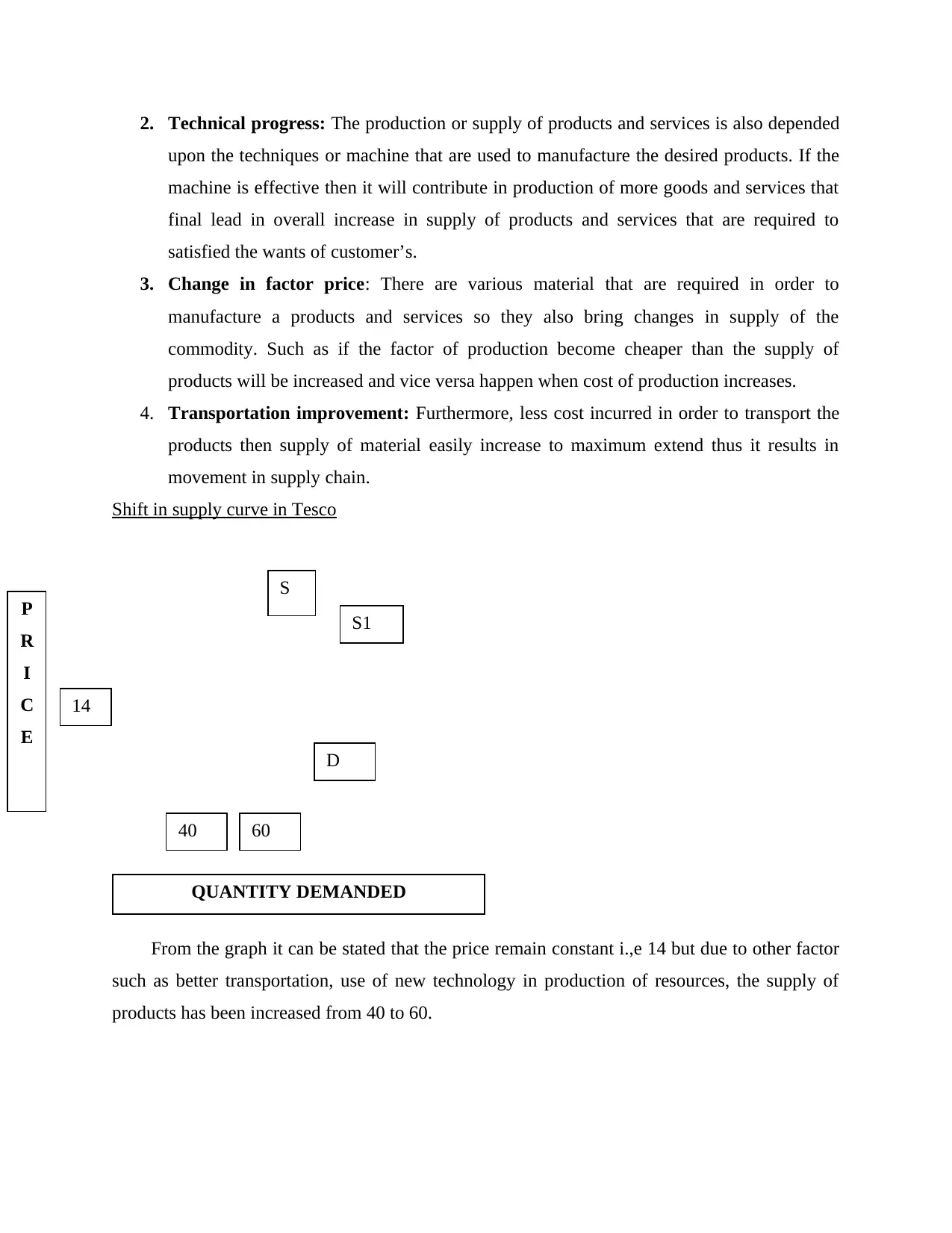
From the graph it can be stated that the price remain constant i.,e 14 but due to other factor
such as better transportation, use of new technology in production of resources, the supply of
products has been increased from 40 to 60.
S
D
6040
14
S1
P
R
I
C
E
QUANTITY DEMANDED
upon the techniques or machine that are used to manufacture the desired products. If the
machine is effective then it will contribute in production of more goods and services that
final lead in overall increase in supply of products and services that are required to
satisfied the wants of customer’s.
3. Change in factor price: There are various material that are required in order to
manufacture a products and services so they also bring changes in supply of the
commodity. Such as if the factor of production become cheaper than the supply of
products will be increased and vice versa happen when cost of production increases.
4. Transportation improvement: Furthermore, less cost incurred in order to transport the
products then supply of material easily increase to maximum extend thus it results in
movement in supply chain.
Shift in supply curve in Tesco
From the graph it can be stated that the price remain constant i.,e 14 but due to other factor
such as better transportation, use of new technology in production of resources, the supply of
products has been increased from 40 to 60.
S
D
6040
14
S1
P
R
I
C
E
QUANTITY DEMANDED
TASK 2
Compare and contrast emerging theories and models in 21 th century contemporary economics
of 20 th century and related to modern business practice
Business in order to grow and survive in competitive environment make use of different
practices such as focused on enhancing employee’s performance, productivity by providing them
appropriate guideline related to the way task need to be completed. Rewarding and recognizing
employees, making strong team and promoting healthy and safe culture are various practices that
are used by businesses in order to achieve the desired goals. The emerging theories and models
of 20 century theory are Adam Smith classical theory of free market, Neoclassiocal theory and
Karl Marl Theory Marxist known as capitalist theory. While for 21 century modern theories and
modern are Nudge theory and behaviors theory that related to business practices. Both of
emerging theories and model of 20th and 21 th centuries can be easily compared such as:
1. Adam Smith classical theory of free market: Adam Smith is 18 the century Scottish
economist, well-known philosophers that is being considered as father of modern
economics. It has emphasis on minimizing the role or intervention of government in
terms of taxation in free market. As per the free market theory each and every individual
in the market by looking out things can contribute in deciding the demand and supply in
the economy for better outcome (Easterly, 2021). Thus, people can easily sell whatever
they want to sell and the buyer has also opportunities to buy only those products and
services that are required by them in order to meet their respective requirements. So, if
the company are able to meet the wants of the customer’s then they are able to enjoy high
profit margin and sales volume. Therefore, as per Smith this types of system contribute in
generating wealth for enterprise as well as the whole nation (Drylie, 2021). this theory is
used by Tesco for selling their products and services at higher price which further helps
them in enhancing their overall revenue.
2. Neoclassical theory: It is another economy theory that emphasis the both production,
consumption as well as price are being driving forces such as supply and demand of
products and services in the country. Neoclassical theory, the economist has assumed that
cost of production is not important factor in determining the value of products rather than
it is utility by the consumer (Bell, 2018). It has also helped in understanding the term
Compare and contrast emerging theories and models in 21 th century contemporary economics
of 20 th century and related to modern business practice
Business in order to grow and survive in competitive environment make use of different
practices such as focused on enhancing employee’s performance, productivity by providing them
appropriate guideline related to the way task need to be completed. Rewarding and recognizing
employees, making strong team and promoting healthy and safe culture are various practices that
are used by businesses in order to achieve the desired goals. The emerging theories and models
of 20 century theory are Adam Smith classical theory of free market, Neoclassiocal theory and
Karl Marl Theory Marxist known as capitalist theory. While for 21 century modern theories and
modern are Nudge theory and behaviors theory that related to business practices. Both of
emerging theories and model of 20th and 21 th centuries can be easily compared such as:
1. Adam Smith classical theory of free market: Adam Smith is 18 the century Scottish
economist, well-known philosophers that is being considered as father of modern
economics. It has emphasis on minimizing the role or intervention of government in
terms of taxation in free market. As per the free market theory each and every individual
in the market by looking out things can contribute in deciding the demand and supply in
the economy for better outcome (Easterly, 2021). Thus, people can easily sell whatever
they want to sell and the buyer has also opportunities to buy only those products and
services that are required by them in order to meet their respective requirements. So, if
the company are able to meet the wants of the customer’s then they are able to enjoy high
profit margin and sales volume. Therefore, as per Smith this types of system contribute in
generating wealth for enterprise as well as the whole nation (Drylie, 2021). this theory is
used by Tesco for selling their products and services at higher price which further helps
them in enhancing their overall revenue.
2. Neoclassical theory: It is another economy theory that emphasis the both production,
consumption as well as price are being driving forces such as supply and demand of
products and services in the country. Neoclassical theory, the economist has assumed that
cost of production is not important factor in determining the value of products rather than
it is utility by the consumer (Bell, 2018). It has also helped in understanding the term
⊘ This is a preview!⊘
Do you want full access?
Subscribe today to unlock all pages.
Trusted by 1+ million students worldwide

1 out of 18


Related Documents


Your All-in-One AI-Powered Toolkit for Academic Success.
+13062052269
info@desklib.com
Available 24*7 on WhatsApp / Email
![[object Object]](/_next/static/media/star-bottom.7253800d.svg)
Unlock your academic potential
Copyright © 2020–2026 A2Z Services. All Rights Reserved. Developed and managed by ZUCOL.