Comprehensive Business Strategy Analysis of Tesco plc: A Deep Dive
VerifiedAdded on 2023/01/13
|13
|3407
|63
Report
AI Summary
This report provides a comprehensive analysis of Tesco's business strategy, examining the impact of the macro environment, including stakeholder analysis and benchmarking, on the company's operations. It delves into the internal environment, utilizing VRIO and SWOT analyses to assess Tesco's strengths, weaknesses, opportunities, and threats. The report also applies Porter's Five Forces model to evaluate the competitive landscape of the retail sector, considering factors such as the threat of new entrants, supplier power, buyer power, the threat of substitutes, and competitive rivalry. The analysis informs strategic management decisions, offering insights into Tesco's competitive position and potential strategies for sustained success in the dynamic retail market. The report concludes with an overview of Tesco's strategic planning and its application to the business.
Business Strategy

Paraphrase This Document
Need a fresh take? Get an instant paraphrase of this document with our AI Paraphraser
INTRODUCTION
Business strategy indicates to an organisation working strategies and plan of action for
accomplishing its vision, objectives and optimising fiscal performance with its business concern
model. It can be those plan of actions that can be used by the organisation for the effective
running of business actions and operations (Akter and et. al., 2016). Effective business strategies
are beneficial for the maturation and improvement of the company because they make
contribution in growth and success of it in term of maximising profit and productivity. This
written document is supported to Tesco plc which is a British transnational groceries
merchandise retailer and operate its business globally with the help of its number of products like
supermarket, hypermarket and others. This written document will discuss about effect and
determinant of macro environment and analysis of internal environment or capability of the firm.
Further, will explain about porter's five forces model and different conceptions to devise
strategic planning.
TASK 1
P1.Impact and influence of the macro environment on a company and its business strategy
Stakeholder matrix
It is an activity of collecting and monitoring qualitative data to find out whose interests
should be taken into account when improving and organising a policy program.
High power low interest- It indicates to those individuals who have high power and low
interest in organisation. In Tesco, stakeholder refers to customers, sponsor, regulator etc. but the
main stakeholders are customer because they have the power of devising the modifications in
plan of actions of firm. They have low interest because in the situation of not getting product as
per their requirement, they can switch to other company.
High power, high interest- It refer to those individuals who have high power and interest
in company. In context of Tesco, these people can be Board of directors, CEO, SME, BA,
investors etc. who have high power to make change in plan of actions and responsible to take
decisions. They have high interest because they formulate strategies for growth and development
of organisation.
1
Business strategy indicates to an organisation working strategies and plan of action for
accomplishing its vision, objectives and optimising fiscal performance with its business concern
model. It can be those plan of actions that can be used by the organisation for the effective
running of business actions and operations (Akter and et. al., 2016). Effective business strategies
are beneficial for the maturation and improvement of the company because they make
contribution in growth and success of it in term of maximising profit and productivity. This
written document is supported to Tesco plc which is a British transnational groceries
merchandise retailer and operate its business globally with the help of its number of products like
supermarket, hypermarket and others. This written document will discuss about effect and
determinant of macro environment and analysis of internal environment or capability of the firm.
Further, will explain about porter's five forces model and different conceptions to devise
strategic planning.
TASK 1
P1.Impact and influence of the macro environment on a company and its business strategy
Stakeholder matrix
It is an activity of collecting and monitoring qualitative data to find out whose interests
should be taken into account when improving and organising a policy program.
High power low interest- It indicates to those individuals who have high power and low
interest in organisation. In Tesco, stakeholder refers to customers, sponsor, regulator etc. but the
main stakeholders are customer because they have the power of devising the modifications in
plan of actions of firm. They have low interest because in the situation of not getting product as
per their requirement, they can switch to other company.
High power, high interest- It refer to those individuals who have high power and interest
in company. In context of Tesco, these people can be Board of directors, CEO, SME, BA,
investors etc. who have high power to make change in plan of actions and responsible to take
decisions. They have high interest because they formulate strategies for growth and development
of organisation.
1
⊘ This is a preview!⊘
Do you want full access?
Subscribe today to unlock all pages.

Trusted by 1+ million students worldwide
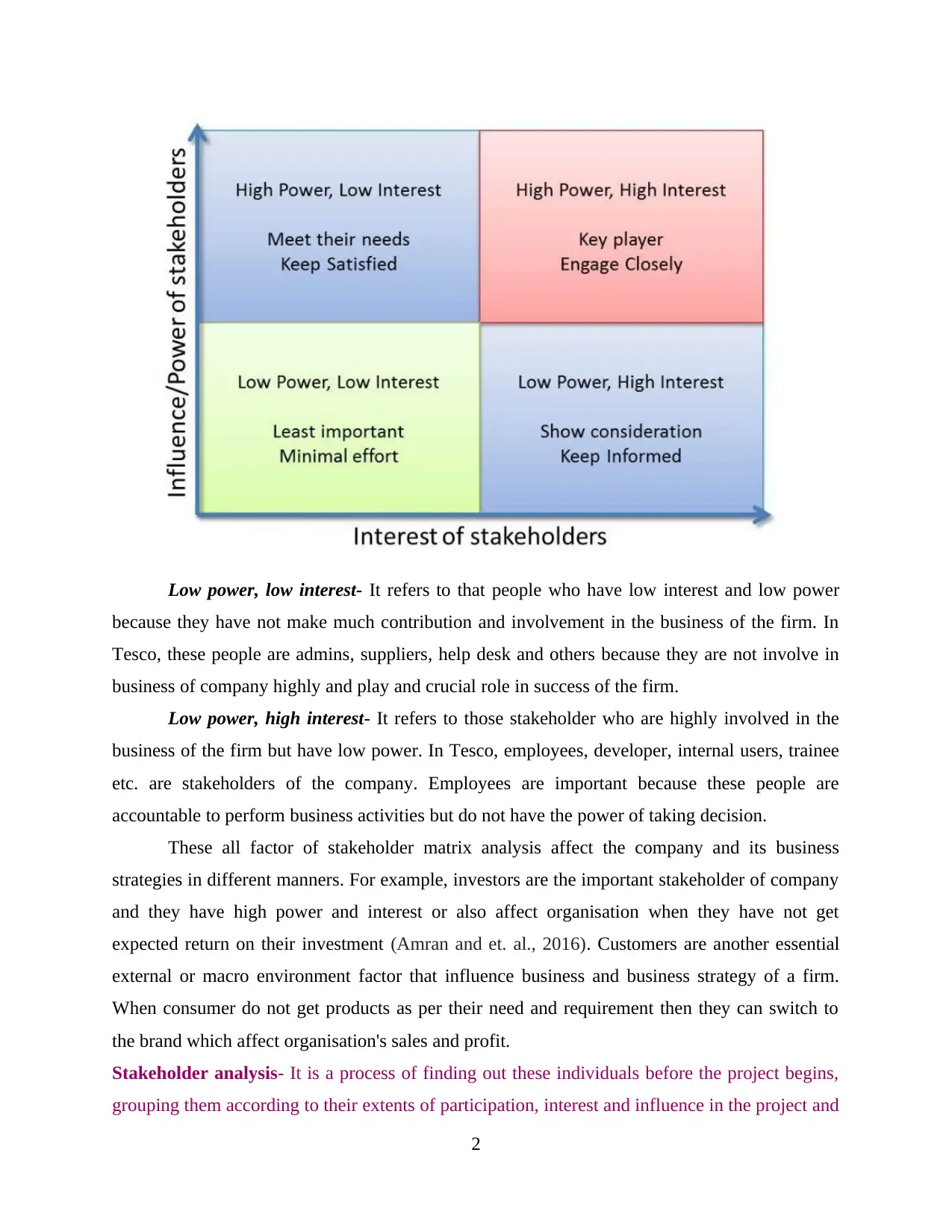
Low power, low interest- It refers to that people who have low interest and low power
because they have not make much contribution and involvement in the business of the firm. In
Tesco, these people are admins, suppliers, help desk and others because they are not involve in
business of company highly and play and crucial role in success of the firm.
Low power, high interest- It refers to those stakeholder who are highly involved in the
business of the firm but have low power. In Tesco, employees, developer, internal users, trainee
etc. are stakeholders of the company. Employees are important because these people are
accountable to perform business activities but do not have the power of taking decision.
These all factor of stakeholder matrix analysis affect the company and its business
strategies in different manners. For example, investors are the important stakeholder of company
and they have high power and interest or also affect organisation when they have not get
expected return on their investment (Amran and et. al., 2016). Customers are another essential
external or macro environment factor that influence business and business strategy of a firm.
When consumer do not get products as per their need and requirement then they can switch to
the brand which affect organisation's sales and profit.
Stakeholder analysis- It is a process of finding out these individuals before the project begins,
grouping them according to their extents of participation, interest and influence in the project and
2
because they have not make much contribution and involvement in the business of the firm. In
Tesco, these people are admins, suppliers, help desk and others because they are not involve in
business of company highly and play and crucial role in success of the firm.
Low power, high interest- It refers to those stakeholder who are highly involved in the
business of the firm but have low power. In Tesco, employees, developer, internal users, trainee
etc. are stakeholders of the company. Employees are important because these people are
accountable to perform business activities but do not have the power of taking decision.
These all factor of stakeholder matrix analysis affect the company and its business
strategies in different manners. For example, investors are the important stakeholder of company
and they have high power and interest or also affect organisation when they have not get
expected return on their investment (Amran and et. al., 2016). Customers are another essential
external or macro environment factor that influence business and business strategy of a firm.
When consumer do not get products as per their need and requirement then they can switch to
the brand which affect organisation's sales and profit.
Stakeholder analysis- It is a process of finding out these individuals before the project begins,
grouping them according to their extents of participation, interest and influence in the project and
2
Paraphrase This Document
Need a fresh take? Get an instant paraphrase of this document with our AI Paraphraser
determining how best to involve and communicate each of these stakeholder groups throughout.
There are three phases of stakeholder analysis and the description of them in context of Tesco is
as below:
Step 1: Identifying stakeholder-It its the first phase, in it the management of the company
Brainstorm about their stakeholder and those people who affect the business actions and
influenced by success and failure of the business. Chairperson, chief executive, chief financial
officer and number of non-executive directors are internal stakeholder of Tesco whereas
customers, suppliers, competitors, local committees and government are external stakeholder of
organisation.
Step 2: Prioritise stockholders- It is the next phase, in it, the administrator of Tesco prioritise
their stakeholder on the basis of their power and interest in the company like high power high
interest, low power low interest, high power low interest and low power high interest.
Step 3: Understand key stakeholder- In this step the management of TEsco prioritise their
stakeholder by analysing their financial and emotional interest. When the firm prioritise its
stakeholders and consider attitude regarding the project, organisation should also consider
creating a project management communication plan it will help in involving people and find out
their needs.
Benchmarking- It is an activity of evaluating the execution of an organisation's goods, services
and activities regarding those of another business considered to be the best in the industry. In
context of Tesco, the main purpose of benchmarking is discovering the best performance being
accomplished, by a competitor or by an entirety different sector. There are several steps in
benchmarking procedure like considerations, Plan, collect, analyse and adapt. In consideration,
before accomplish the full benefits of benchmarking, organisation must be clearly understood
and under control. In planning phase, the company should make plan to accomplish its desired
benefits. In collection step, the administration of respective organisation collect data directly
from partner organisation. After gathering information, administration analyse data to determine
gap. In Adaptation step, management develop goals, action plans and implement them.
M1. Analyse the macro environment to determine and inform strategic management decisions
Stakeholder analysis is beneficial to make improvement among individuals and finding
out most powerful stakeholder. This analysis is essential to find out the needs of individuals and
get information about the issues which are faced by the company due to changes in needs of
3
There are three phases of stakeholder analysis and the description of them in context of Tesco is
as below:
Step 1: Identifying stakeholder-It its the first phase, in it the management of the company
Brainstorm about their stakeholder and those people who affect the business actions and
influenced by success and failure of the business. Chairperson, chief executive, chief financial
officer and number of non-executive directors are internal stakeholder of Tesco whereas
customers, suppliers, competitors, local committees and government are external stakeholder of
organisation.
Step 2: Prioritise stockholders- It is the next phase, in it, the administrator of Tesco prioritise
their stakeholder on the basis of their power and interest in the company like high power high
interest, low power low interest, high power low interest and low power high interest.
Step 3: Understand key stakeholder- In this step the management of TEsco prioritise their
stakeholder by analysing their financial and emotional interest. When the firm prioritise its
stakeholders and consider attitude regarding the project, organisation should also consider
creating a project management communication plan it will help in involving people and find out
their needs.
Benchmarking- It is an activity of evaluating the execution of an organisation's goods, services
and activities regarding those of another business considered to be the best in the industry. In
context of Tesco, the main purpose of benchmarking is discovering the best performance being
accomplished, by a competitor or by an entirety different sector. There are several steps in
benchmarking procedure like considerations, Plan, collect, analyse and adapt. In consideration,
before accomplish the full benefits of benchmarking, organisation must be clearly understood
and under control. In planning phase, the company should make plan to accomplish its desired
benefits. In collection step, the administration of respective organisation collect data directly
from partner organisation. After gathering information, administration analyse data to determine
gap. In Adaptation step, management develop goals, action plans and implement them.
M1. Analyse the macro environment to determine and inform strategic management decisions
Stakeholder analysis is beneficial to make improvement among individuals and finding
out most powerful stakeholder. This analysis is essential to find out the needs of individuals and
get information about the issues which are faced by the company due to changes in needs of
3
stakeholders (Chen, Eshleman and Soileau, 2017). With the help of this analysis, the
management of the company can get information about the effect of macro environment factors
and take decisions according to them.
TASK 2
P2.Analyse the internal environment and capabilities of a company
VRIO Analysis
It is a strategic technique to find out the internal resources in the organisation and
capabilities that given long term competitive advantages. It can be consider four components i.e.
value, rarity, Imitability,organisation. TESCO use this model to analyse the internal resources
and identify whether these resources survived for long period in a competitive world.
Resources Valuable Rare Imitate Organised
Brand image Brand image - - - Competitive
disadvantage
Product
Portfolio
Product
portfolio
Product
portfolio
- - Temporary
parity
Technology
capability
Techno-
capability
Techno-
capability
Techno-
capability
- Unused parity
Financial
resource
Financial
resource
Financial
resource
Financial
resource
Financial
resource
Competitive
Sustainability
Valuable- The brand image of Tesco is very valuable in the competitive market because
it products and services are familiar to its customers. Product portfolio is highly valuable
because it is highly differentiated from the competitors. The technology that is used by
the company is valuable because it use innovative features to design their products and is
financial resource is valuable because it help in investing into extrinsic opportunities
(Eaton and Kilby, 2015). Rare- Products that is used by the Tesco company is not rare because it is easily available
in the market by competitor firms. The techniques that is used in design the products are
also not rare because many competitors used similar technique in the marketplace (Evans
4
management of the company can get information about the effect of macro environment factors
and take decisions according to them.
TASK 2
P2.Analyse the internal environment and capabilities of a company
VRIO Analysis
It is a strategic technique to find out the internal resources in the organisation and
capabilities that given long term competitive advantages. It can be consider four components i.e.
value, rarity, Imitability,organisation. TESCO use this model to analyse the internal resources
and identify whether these resources survived for long period in a competitive world.
Resources Valuable Rare Imitate Organised
Brand image Brand image - - - Competitive
disadvantage
Product
Portfolio
Product
portfolio
Product
portfolio
- - Temporary
parity
Technology
capability
Techno-
capability
Techno-
capability
Techno-
capability
- Unused parity
Financial
resource
Financial
resource
Financial
resource
Financial
resource
Financial
resource
Competitive
Sustainability
Valuable- The brand image of Tesco is very valuable in the competitive market because
it products and services are familiar to its customers. Product portfolio is highly valuable
because it is highly differentiated from the competitors. The technology that is used by
the company is valuable because it use innovative features to design their products and is
financial resource is valuable because it help in investing into extrinsic opportunities
(Eaton and Kilby, 2015). Rare- Products that is used by the Tesco company is not rare because it is easily available
in the market by competitor firms. The techniques that is used in design the products are
also not rare because many competitors used similar technique in the marketplace (Evans
4
⊘ This is a preview!⊘
Do you want full access?
Subscribe today to unlock all pages.
Trusted by 1+ million students worldwide
and et. al., 2017). But the financial resource is very rare because it has strong financial
resource and only few company can possessed it. Imitate- Tesco financial resource is highly costly i.e. difficult to imitate this will restrict
the new entrants and company acquire higher profits. Technology they used in designing
and promoting the products offerings are imitate because there are many other firms in a
same industry.
Organised- the financial resource of the organisation are organised to acquire the value
because company use resources strategically and invest on right place this will create
opportunity and reducing threats.
M2.Evaluate the internal environment to assess strengths and weaknesses of an organisation
SWOT Analysis
It is an strategic plan undertaken by a company to analyse and identify its strengths,
weaknesses, opportunities and threats. In context of TESCO, swot analysis can be demonstrated
below.
Strength Weaknesses
It is the biggest retail grocery store in
the UK and has high revenue and sales
in the supermarket chain store.
Company use best and innovative
technology in a very optimal way to
just to enhance consumers experience
while shopping.
The major weakness of TESCO, is that
it is the price leader because of this it
low-cost strategy can lead to reduced
profits (Ghemawat, 2016).
Due to credit card liability and
maximum debt company profits and
revenues will be affected.
Opportunities Threats
Tesco using online media and home
delivery services that will help
customers to easy availability of
products.
Because of planned partnership with
highly reputed companies, offers a
great opportunity to Tesco in earning
The major threats that occur in Tesco
industry is government rules and
regulations, legal laws and tax will
affect the efficiency and proficiency in
the stores of the organisation.
On social media TESCO faced some
controversy on its Christmas promo
5
resource and only few company can possessed it. Imitate- Tesco financial resource is highly costly i.e. difficult to imitate this will restrict
the new entrants and company acquire higher profits. Technology they used in designing
and promoting the products offerings are imitate because there are many other firms in a
same industry.
Organised- the financial resource of the organisation are organised to acquire the value
because company use resources strategically and invest on right place this will create
opportunity and reducing threats.
M2.Evaluate the internal environment to assess strengths and weaknesses of an organisation
SWOT Analysis
It is an strategic plan undertaken by a company to analyse and identify its strengths,
weaknesses, opportunities and threats. In context of TESCO, swot analysis can be demonstrated
below.
Strength Weaknesses
It is the biggest retail grocery store in
the UK and has high revenue and sales
in the supermarket chain store.
Company use best and innovative
technology in a very optimal way to
just to enhance consumers experience
while shopping.
The major weakness of TESCO, is that
it is the price leader because of this it
low-cost strategy can lead to reduced
profits (Ghemawat, 2016).
Due to credit card liability and
maximum debt company profits and
revenues will be affected.
Opportunities Threats
Tesco using online media and home
delivery services that will help
customers to easy availability of
products.
Because of planned partnership with
highly reputed companies, offers a
great opportunity to Tesco in earning
The major threats that occur in Tesco
industry is government rules and
regulations, legal laws and tax will
affect the efficiency and proficiency in
the stores of the organisation.
On social media TESCO faced some
controversy on its Christmas promo
5
Paraphrase This Document
Need a fresh take? Get an instant paraphrase of this document with our AI Paraphraser
large market share (Higgins, Omer and
Phillips, 2015).
launched where person boycotted
because of disrespectful behave on the
store against Christmas faith.
TASK 3
P3. Porter's five forces model evaluate the competitive force of a specific market sector
Porter's Five forces model
This analysis is implemented by an organisation to analyse the competitiveness in a
specific sector in which the firm operate its business. This concept is developed by Michael
Porter in 1979 to understand the five competitory forces that create their impact on an industry.
This analysis basically used by the company to identify an industry's structure to determine
corporate strategy. The description of this model in context of Tesco is mentioned as under:
Treats of new entreats- Tesco is a company which operate its business in retail industry
and to set up and operate business in this sector, companies require more capital and resources.
There are several rules and regulations that are framed by the national authorities to run their
business in this sector. So there is low threat to respective company because other factor is brand
image of the firm which is maintained by the company by offer quality products as per
consumers needs. Knowledge and experience about particular industry also create a barrier for
new entry.
Bargaining power of supplier- In context of Tesco, the treat of this force is low because
the company have numerous providers in retail sector (Holotiuk and Beimborn, 2017). Hence,
non-compliant suppliers can be replaced in easy manner with other providers that offers the
respective firm supermarket power to get goods from suppliers at the lowest possible prices to
develop their profitability which has led to losses on the sides of suppliers.
Bargaining power of buyer- In Tesco, the bargaining power of buyer's is relatively high
due to availability of other supermarket like ASDA, ALDI, Sainsbury's and others. These rivals
companies also offer similar products at related prices and it makes products to switch prices low
which offer the customers power to select products among varieties of goods in same price.
Consumers like high quality products at low cost and ALDI and Lidl which offer their products
form discount stores.
6
Phillips, 2015).
launched where person boycotted
because of disrespectful behave on the
store against Christmas faith.
TASK 3
P3. Porter's five forces model evaluate the competitive force of a specific market sector
Porter's Five forces model
This analysis is implemented by an organisation to analyse the competitiveness in a
specific sector in which the firm operate its business. This concept is developed by Michael
Porter in 1979 to understand the five competitory forces that create their impact on an industry.
This analysis basically used by the company to identify an industry's structure to determine
corporate strategy. The description of this model in context of Tesco is mentioned as under:
Treats of new entreats- Tesco is a company which operate its business in retail industry
and to set up and operate business in this sector, companies require more capital and resources.
There are several rules and regulations that are framed by the national authorities to run their
business in this sector. So there is low threat to respective company because other factor is brand
image of the firm which is maintained by the company by offer quality products as per
consumers needs. Knowledge and experience about particular industry also create a barrier for
new entry.
Bargaining power of supplier- In context of Tesco, the treat of this force is low because
the company have numerous providers in retail sector (Holotiuk and Beimborn, 2017). Hence,
non-compliant suppliers can be replaced in easy manner with other providers that offers the
respective firm supermarket power to get goods from suppliers at the lowest possible prices to
develop their profitability which has led to losses on the sides of suppliers.
Bargaining power of buyer- In Tesco, the bargaining power of buyer's is relatively high
due to availability of other supermarket like ASDA, ALDI, Sainsbury's and others. These rivals
companies also offer similar products at related prices and it makes products to switch prices low
which offer the customers power to select products among varieties of goods in same price.
Consumers like high quality products at low cost and ALDI and Lidl which offer their products
form discount stores.
6
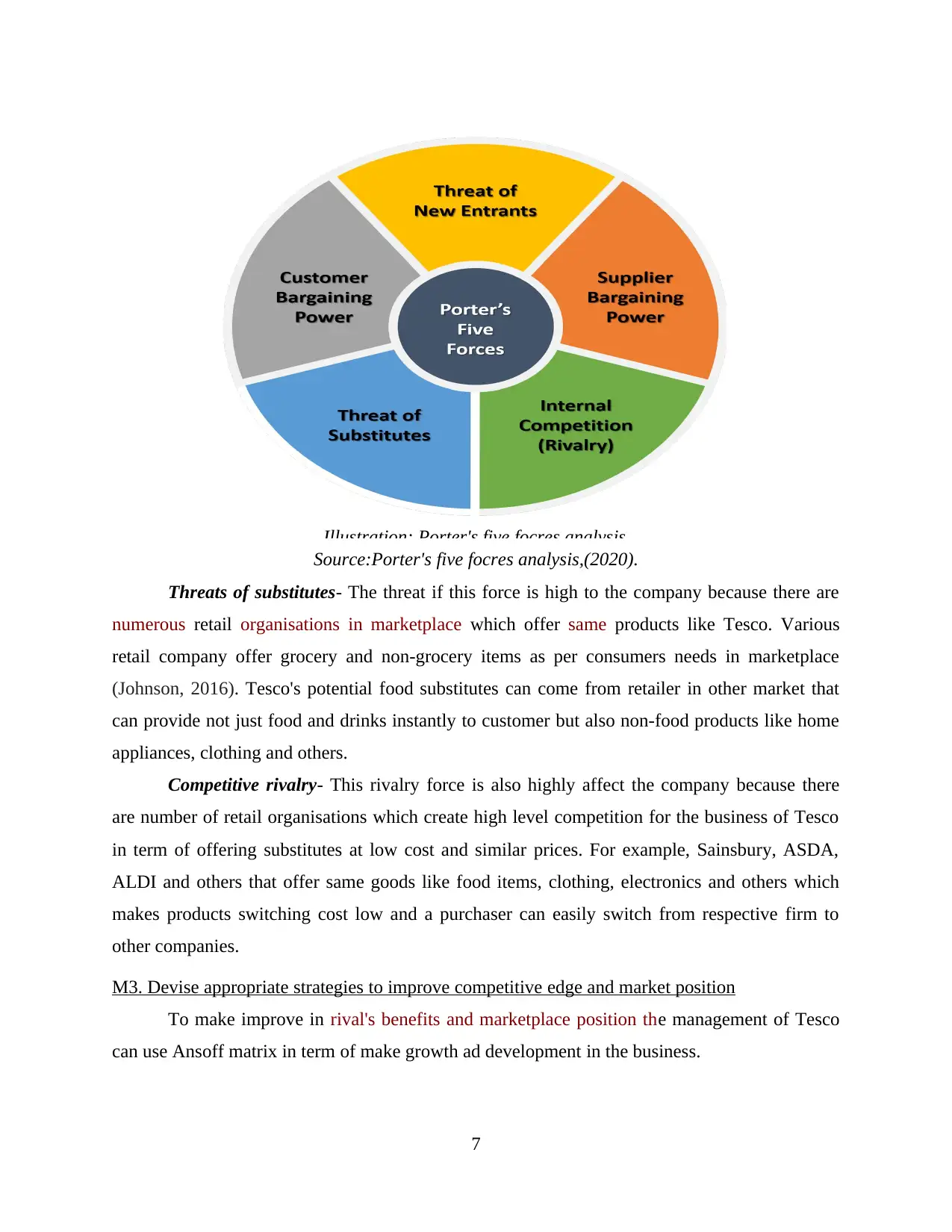
Source:Porter's five focres analysis,(2020).
Threats of substitutes- The threat if this force is high to the company because there are
numerous retail organisations in marketplace which offer same products like Tesco. Various
retail company offer grocery and non-grocery items as per consumers needs in marketplace
(Johnson, 2016). Tesco's potential food substitutes can come from retailer in other market that
can provide not just food and drinks instantly to customer but also non-food products like home
appliances, clothing and others.
Competitive rivalry- This rivalry force is also highly affect the company because there
are number of retail organisations which create high level competition for the business of Tesco
in term of offering substitutes at low cost and similar prices. For example, Sainsbury, ASDA,
ALDI and others that offer same goods like food items, clothing, electronics and others which
makes products switching cost low and a purchaser can easily switch from respective firm to
other companies.
M3. Devise appropriate strategies to improve competitive edge and market position
To make improve in rival's benefits and marketplace position the management of Tesco
can use Ansoff matrix in term of make growth ad development in the business.
7
Illustration: Porter's five focres analysis
Threats of substitutes- The threat if this force is high to the company because there are
numerous retail organisations in marketplace which offer same products like Tesco. Various
retail company offer grocery and non-grocery items as per consumers needs in marketplace
(Johnson, 2016). Tesco's potential food substitutes can come from retailer in other market that
can provide not just food and drinks instantly to customer but also non-food products like home
appliances, clothing and others.
Competitive rivalry- This rivalry force is also highly affect the company because there
are number of retail organisations which create high level competition for the business of Tesco
in term of offering substitutes at low cost and similar prices. For example, Sainsbury, ASDA,
ALDI and others that offer same goods like food items, clothing, electronics and others which
makes products switching cost low and a purchaser can easily switch from respective firm to
other companies.
M3. Devise appropriate strategies to improve competitive edge and market position
To make improve in rival's benefits and marketplace position the management of Tesco
can use Ansoff matrix in term of make growth ad development in the business.
7
Illustration: Porter's five focres analysis
⊘ This is a preview!⊘
Do you want full access?
Subscribe today to unlock all pages.
Trusted by 1+ million students worldwide
Ansoff Matrix- This concept is formulated by Igor Ansoff and used by companies as strategy
stage of marketing planning process. It is beneficial for the development of organisation in term
of making growth in their business. The brief explanation of this concept in term of Tesco is as
below:
Market penetration- It is the first plan of action of this model in which organisation offer
its existent goods in present market by making changes in their promotion channels and pricing
strategies. In context of Tesco, there is no risk because product is offered in current marketplace
and customers are aware with them.
Product development- In context of Tesco, if organisation adopt this plan of action then
there is less threat because in it, company offer new good in existing marketplace to make
development in their sales and profit (Martinez-Simarro, Devece and Llopis-Albert, 2015). The
firm offer new goods so it is not sure that the customer of existing market like product or not.
Market development- This growth strategy is risky more than product development
because if the management of Tesco implement it in nits business. Then, the firm offer its
existing product in new market so it is not clear that the consumer of new market liked these
products and services which are offered by company.
Diversification- If the administration of Tesco adopt this strategy then the administration
will offer its new products in new market (Mellat-Parast and et. al., 2015). There is high risk
because new product are launched in to new market and it will not be sure that these
commodities will be as per cutlure, needs and demands of customers of new marketplace.
TASK 4
Covered into PPT
CONCLUSION
This has been summarised that from the preceding mentioned information that business
concern plan of action is beneficial for the development and improvement of the company by
adopting different concepts, like Stakeholder matrix and SWOT analysis, the firm can analyse
the impact of external and internal environment. VRIO framework is effective to analyse
capability of the company and with the assistance of Porter's five forces it can monitor the
competition in market. Ansoff matrix and Bowman's clock strategy is beneficial for
8
stage of marketing planning process. It is beneficial for the development of organisation in term
of making growth in their business. The brief explanation of this concept in term of Tesco is as
below:
Market penetration- It is the first plan of action of this model in which organisation offer
its existent goods in present market by making changes in their promotion channels and pricing
strategies. In context of Tesco, there is no risk because product is offered in current marketplace
and customers are aware with them.
Product development- In context of Tesco, if organisation adopt this plan of action then
there is less threat because in it, company offer new good in existing marketplace to make
development in their sales and profit (Martinez-Simarro, Devece and Llopis-Albert, 2015). The
firm offer new goods so it is not sure that the customer of existing market like product or not.
Market development- This growth strategy is risky more than product development
because if the management of Tesco implement it in nits business. Then, the firm offer its
existing product in new market so it is not clear that the consumer of new market liked these
products and services which are offered by company.
Diversification- If the administration of Tesco adopt this strategy then the administration
will offer its new products in new market (Mellat-Parast and et. al., 2015). There is high risk
because new product are launched in to new market and it will not be sure that these
commodities will be as per cutlure, needs and demands of customers of new marketplace.
TASK 4
Covered into PPT
CONCLUSION
This has been summarised that from the preceding mentioned information that business
concern plan of action is beneficial for the development and improvement of the company by
adopting different concepts, like Stakeholder matrix and SWOT analysis, the firm can analyse
the impact of external and internal environment. VRIO framework is effective to analyse
capability of the company and with the assistance of Porter's five forces it can monitor the
competition in market. Ansoff matrix and Bowman's clock strategy is beneficial for
8
Paraphrase This Document
Need a fresh take? Get an instant paraphrase of this document with our AI Paraphraser
development and evolution of the business of a company. Strategic management plan is effective
for the future development and growth of the firm.
9
for the future development and growth of the firm.
9
REFERENCES
Books & Journals
Akter, S. and et. al., 2016. How to improve firm performance using big data analytics capability
and business strategy alignment?. International Journal of Production Economics. 182.
pp.113-131.
Amran, A. and et. al., 2016. Business strategy for climate change: An ASEAN
perspective. Corporate Social Responsibility and Environmental Management. 23(4).
pp.213-227.
Chen, Y., Eshleman, J.D. and Soileau, J.S., 2017. Business strategy and auditor
reporting. Auditing: A Journal of Practice & Theory. 36(2). pp.63-86.
Eaton, D. and Kilby, G., 2015. Does Your Organizational Culture Support Your Business
Strategy?. The Journal for Quality and Participation. 37(4). p.4.
Evans, S. and et. al., 2017. Business model innovation for sustainability: Towards a unified
perspective for creation of sustainable business models. Business Strategy and the
Environment. 26(5). pp.597-608.
Ghemawat, P., 2016. Evolving ideas about business strategy. Business History Review. 90(4).
pp.727-749.
Higgins, D., Omer, T.C. and Phillips, J.D., 2015. The influence of a firm's business strategy on
its tax aggressiveness. Contemporary Accounting Research. 32(2). pp.674-702.
Holotiuk, F. and Beimborn, D., 2017. Critical success factors of digital business strategy.
Johnson, G., 2016. Exploring strategy: text and cases. Pearson Education.
Martinez-Simarro, D., Devece, C. and Llopis-Albert, C., 2015. How information systems
strategy moderates the relationship between business strategy and performance. Journal
of Business Research. 68(7). pp.1592-1594.
Mellat-Parast, M. and et. al., 2015. Linking business strategy to service failures and financial
performance: Empirical evidence from the US domestic airline industry. Journal of
Operations Management. 38. pp.14-24.
Peng, M.W., 2017. Cultures, institutions, and strategic choices: Toward an institutional
perspective on business strategy. The Blackwell handbook of cross‐cultural
management, pp.52-66.
Sircar, S. and et. al., 2015. Assessment of business strategy: Implication for Indian
banks. Journal of Strategy and Management.
Soltanizadeh, S. and et. al., 2016. Business strategy, enterprise risk management and
organizational performance. Management Research Review.
Štefan, S. and Branislav, Z., 2016. Relationship between business strategy and business model
studied in a sample of service companies. Journal of Competitiveness. 8(4). pp.72-84.
Teh, D. and Corbitt, B., 2015. Building sustainability strategy in business. Journal of Business
Strategy.
Vlachos, I.P., 2016. Reverse logistics capabilities and firm performance: the mediating role of
business strategy. International Journal of Logistics Research and Applications. 19(5).
pp.424-442.
Yang, M.J., Kueng, L. and Hong, B., 2015. Business strategy and the management of firms (No.
w20846). National Bureau of Economic Research.
Yuliansyah, Y., Gurd, B. and Mohamed, N., 2017. The significant of business strategy in
improving organizational performance. Humanomics.
10
Books & Journals
Akter, S. and et. al., 2016. How to improve firm performance using big data analytics capability
and business strategy alignment?. International Journal of Production Economics. 182.
pp.113-131.
Amran, A. and et. al., 2016. Business strategy for climate change: An ASEAN
perspective. Corporate Social Responsibility and Environmental Management. 23(4).
pp.213-227.
Chen, Y., Eshleman, J.D. and Soileau, J.S., 2017. Business strategy and auditor
reporting. Auditing: A Journal of Practice & Theory. 36(2). pp.63-86.
Eaton, D. and Kilby, G., 2015. Does Your Organizational Culture Support Your Business
Strategy?. The Journal for Quality and Participation. 37(4). p.4.
Evans, S. and et. al., 2017. Business model innovation for sustainability: Towards a unified
perspective for creation of sustainable business models. Business Strategy and the
Environment. 26(5). pp.597-608.
Ghemawat, P., 2016. Evolving ideas about business strategy. Business History Review. 90(4).
pp.727-749.
Higgins, D., Omer, T.C. and Phillips, J.D., 2015. The influence of a firm's business strategy on
its tax aggressiveness. Contemporary Accounting Research. 32(2). pp.674-702.
Holotiuk, F. and Beimborn, D., 2017. Critical success factors of digital business strategy.
Johnson, G., 2016. Exploring strategy: text and cases. Pearson Education.
Martinez-Simarro, D., Devece, C. and Llopis-Albert, C., 2015. How information systems
strategy moderates the relationship between business strategy and performance. Journal
of Business Research. 68(7). pp.1592-1594.
Mellat-Parast, M. and et. al., 2015. Linking business strategy to service failures and financial
performance: Empirical evidence from the US domestic airline industry. Journal of
Operations Management. 38. pp.14-24.
Peng, M.W., 2017. Cultures, institutions, and strategic choices: Toward an institutional
perspective on business strategy. The Blackwell handbook of cross‐cultural
management, pp.52-66.
Sircar, S. and et. al., 2015. Assessment of business strategy: Implication for Indian
banks. Journal of Strategy and Management.
Soltanizadeh, S. and et. al., 2016. Business strategy, enterprise risk management and
organizational performance. Management Research Review.
Štefan, S. and Branislav, Z., 2016. Relationship between business strategy and business model
studied in a sample of service companies. Journal of Competitiveness. 8(4). pp.72-84.
Teh, D. and Corbitt, B., 2015. Building sustainability strategy in business. Journal of Business
Strategy.
Vlachos, I.P., 2016. Reverse logistics capabilities and firm performance: the mediating role of
business strategy. International Journal of Logistics Research and Applications. 19(5).
pp.424-442.
Yang, M.J., Kueng, L. and Hong, B., 2015. Business strategy and the management of firms (No.
w20846). National Bureau of Economic Research.
Yuliansyah, Y., Gurd, B. and Mohamed, N., 2017. The significant of business strategy in
improving organizational performance. Humanomics.
10
⊘ This is a preview!⊘
Do you want full access?
Subscribe today to unlock all pages.
Trusted by 1+ million students worldwide

1 out of 13


Related Documents


Your All-in-One AI-Powered Toolkit for Academic Success.
+13062052269
info@desklib.com
Available 24*7 on WhatsApp / Email
![[object Object]](/_next/static/media/star-bottom.7253800d.svg)
Unlock your academic potential
Copyright © 2020–2026 A2Z Services. All Rights Reserved. Developed and managed by ZUCOL.