Tesco Company: Business Environment, Functions, and Analysis Report
VerifiedAdded on 2021/02/17
|16
|5260
|66
Report
AI Summary
This report offers a comprehensive analysis of Tesco, a multinational UK-based retail company. It begins by defining the business environment and its impact on organizational decision-making, then delves into different types of organizations (public, private, and voluntary) and their growth in the international market, using Tesco as a key example. The report explores Tesco's background, including its size, scope, products, services, vision, mission, objectives, and legal structure. It examines the functions of various departments within Tesco, such as HR, marketing, operations, and finance, and their interrelationships. The analysis extends to PESTLE and SWOT analyses to assess the macro-environmental factors and Tesco's internal strengths and weaknesses. Finally, the report critically analyzes the key findings and their influence on the decision-making process within the company, providing valuable insights into Tesco's operations and strategic positioning in the global market. The report also explores the roles of public, private, and voluntary companies like NHS and Oxfam.
BUSINESS & BUSINESS
ENVIRONMENT
ENVIRONMENT

Paraphrase This Document
Need a fresh take? Get an instant paraphrase of this document with our AI Paraphraser
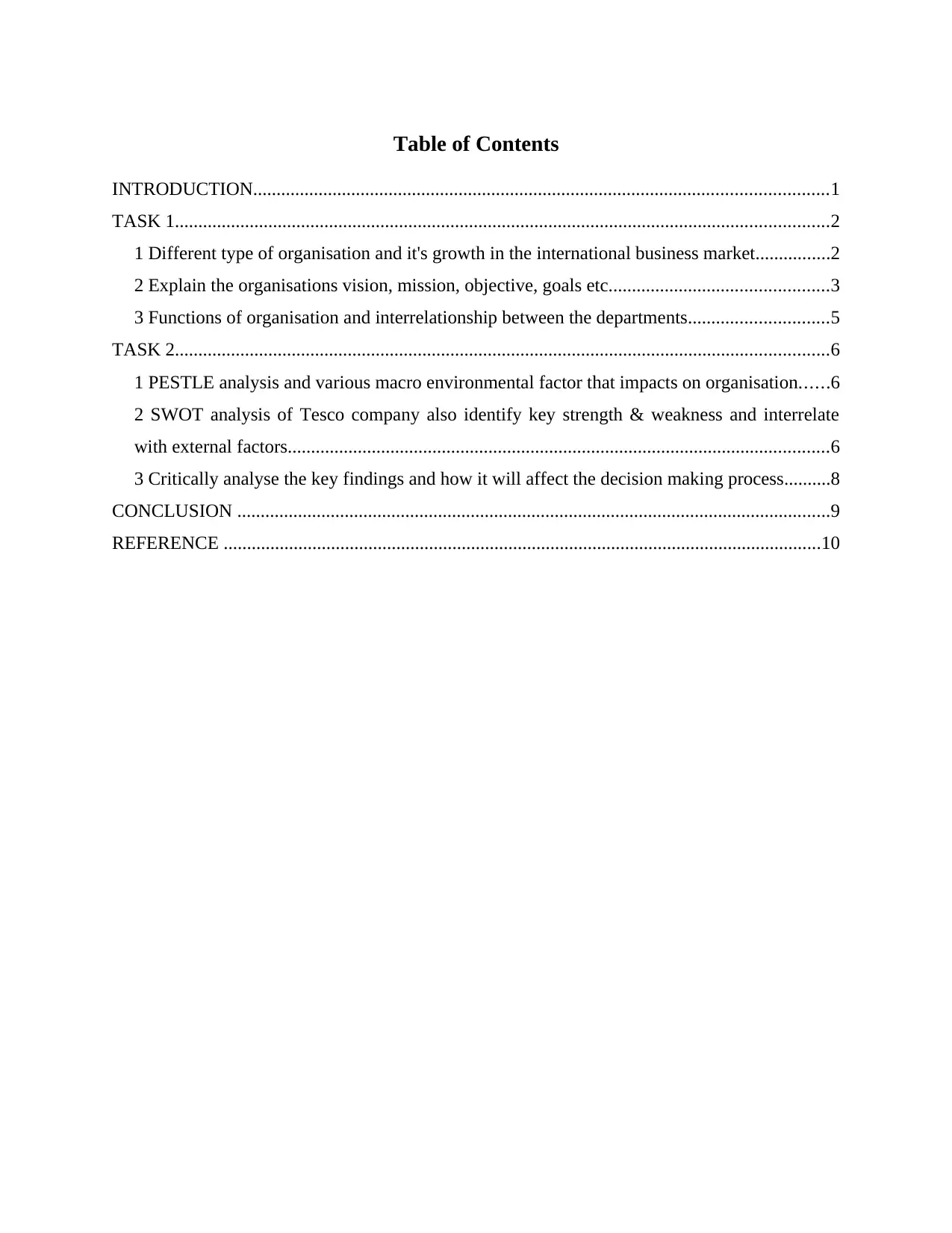
Table of Contents
INTRODUCTION...........................................................................................................................1
TASK 1............................................................................................................................................2
1 Different type of organisation and it's growth in the international business market................2
2 Explain the organisations vision, mission, objective, goals etc...............................................3
3 Functions of organisation and interrelationship between the departments..............................5
TASK 2............................................................................................................................................6
1 PESTLE analysis and various macro environmental factor that impacts on organisation......6
2 SWOT analysis of Tesco company also identify key strength & weakness and interrelate
with external factors....................................................................................................................6
3 Critically analyse the key findings and how it will affect the decision making process..........8
CONCLUSION ...............................................................................................................................9
REFERENCE ................................................................................................................................10
INTRODUCTION...........................................................................................................................1
TASK 1............................................................................................................................................2
1 Different type of organisation and it's growth in the international business market................2
2 Explain the organisations vision, mission, objective, goals etc...............................................3
3 Functions of organisation and interrelationship between the departments..............................5
TASK 2............................................................................................................................................6
1 PESTLE analysis and various macro environmental factor that impacts on organisation......6
2 SWOT analysis of Tesco company also identify key strength & weakness and interrelate
with external factors....................................................................................................................6
3 Critically analyse the key findings and how it will affect the decision making process..........8
CONCLUSION ...............................................................................................................................9
REFERENCE ................................................................................................................................10
INTRODUCTION
Business environment is the combination of internal as well as external factor which
influence the business and it's decision making process. These factors include demand and
supply of product, customers demand and preference, employees of the organisation, supplier,
market researcher etc. these factors affect the operational function of the business it can be
directly or indirectly. Organisation is a place where group of people works together in in order to
make profits and run business effctively. This report analyse the Tesco company's environment
and manger identify the potential area of work. Tesco is a multinational UK based company
which constitutes an organisation in written agreement that helps to show what Tesco is going to
do and how it will do to increase the productivity. Constitution of any organisation is important
because it focuses on employees to understand accurately and helps to work collectively.
Internal or external factor influence the business in term of business growth, profitability and
performance of employees. This report is all about different type of organisation available in the
market and it's growth in the international market. It also include the company's background, size
& scope, product & service, vision, mission, objective and legal structure of the organisation.
This report also explain the function of various department and how they influence or
interrelated to each other. Also analysis the impact of these functions on business structure. This
report also include the advantage and disadvantage of different department in the chosen
organisation.
Background of Tesco company:
Tesco is British multinational UK based company which deals in groceries and general
items in retail sector. It's headquarter in Welwyn Garden City, United Kingdom and Tesco
company is third largest retail store in the world. Company founded by Hackney in the year 1919
and it's founder is Jack Cohnen. Tesco expand their business in the year 1990 in the 11 countries
with operation. It is the leading retail store in the world with 440,000 Colleagues and they serve
million of customer in the weak through their offline and online store services. Tesco company
have 6800 stores in all over the world. They also provide service to the various countries and
company also deals in different business (Aldea and et.al., 2013). Company work in various
operations such as Tesco extra, Tesco superstores, Tesco metro, one stop, Tesco.com etc. Booker
group, Tesco bank, Telecom and Tesco tech support is the subsidiary company of TESCO.
Company listed in London Stock Exchange and it has market capitalization approx. £18.1
1
Business environment is the combination of internal as well as external factor which
influence the business and it's decision making process. These factors include demand and
supply of product, customers demand and preference, employees of the organisation, supplier,
market researcher etc. these factors affect the operational function of the business it can be
directly or indirectly. Organisation is a place where group of people works together in in order to
make profits and run business effctively. This report analyse the Tesco company's environment
and manger identify the potential area of work. Tesco is a multinational UK based company
which constitutes an organisation in written agreement that helps to show what Tesco is going to
do and how it will do to increase the productivity. Constitution of any organisation is important
because it focuses on employees to understand accurately and helps to work collectively.
Internal or external factor influence the business in term of business growth, profitability and
performance of employees. This report is all about different type of organisation available in the
market and it's growth in the international market. It also include the company's background, size
& scope, product & service, vision, mission, objective and legal structure of the organisation.
This report also explain the function of various department and how they influence or
interrelated to each other. Also analysis the impact of these functions on business structure. This
report also include the advantage and disadvantage of different department in the chosen
organisation.
Background of Tesco company:
Tesco is British multinational UK based company which deals in groceries and general
items in retail sector. It's headquarter in Welwyn Garden City, United Kingdom and Tesco
company is third largest retail store in the world. Company founded by Hackney in the year 1919
and it's founder is Jack Cohnen. Tesco expand their business in the year 1990 in the 11 countries
with operation. It is the leading retail store in the world with 440,000 Colleagues and they serve
million of customer in the weak through their offline and online store services. Tesco company
have 6800 stores in all over the world. They also provide service to the various countries and
company also deals in different business (Aldea and et.al., 2013). Company work in various
operations such as Tesco extra, Tesco superstores, Tesco metro, one stop, Tesco.com etc. Booker
group, Tesco bank, Telecom and Tesco tech support is the subsidiary company of TESCO.
Company listed in London Stock Exchange and it has market capitalization approx. £18.1
1
⊘ This is a preview!⊘
Do you want full access?
Subscribe today to unlock all pages.

Trusted by 1+ million students worldwide
billion. In the London Stock Exchange Tesco is in the list of 28th number. Company provide the
better customer services to their clients that why the growth of the company is increasing every
year and it's revenue is £55.9 billion in the year 2017.
TASK 1
1 Different type of organisation and it's growth in the international business market
Organisation is the corporate body which associated with the various rules and
regulation. Under the Companies Act, clearly define the types of organisation those are different
in nature and work. It's liability, ownership and responsibility is different in comparison to other
type of organisation. According to UK's Company Act 2006, it is divided in the three categories
such as public, private and voluntary organisation and these are explain below:
Public company: Public company issue their securities through the process of Initial
Public Offer (IPO) and listed in at least single stock exchange. Ownership of the company is
distributed among the general public where people can purchase or sell companies share through
share market. For example: - National Health Service (NHS) is the UK based public company
which provide the health care services to the general public. It is the largest health care service
provider in the world and they also provide emergency services.
Private company: Private company have their own ownership, there is no interference of
government in the private company. This company have less no of shareholders in comparison to
other public organisation and they does not offer their securities to the general public. Private
company can be limited or unlimited in terms of their liability. For example: - Tesco is the
largest UK based private sector multinational company. It provide the groceries and general
merchandise items to their customers in offline and online mode. It is the largest retail sector
company in the world which provide the variety of services to their consumers.
Voluntary company: Voluntary company is the group of people who meet and make a
group for the welfare of society but every individual have goal interest for the society. Because if
they have common interest than they can work for the society. It is also called non profit
organisation which have motive to improve or develop the society not to earn profit. For
example: - Oxfam is the UK based voluntary company which work for the poverty. It include 20
charitable organisation who focus on to remover poverty at global level (Burke, Trahant and
Koonce, 2012).
2
better customer services to their clients that why the growth of the company is increasing every
year and it's revenue is £55.9 billion in the year 2017.
TASK 1
1 Different type of organisation and it's growth in the international business market
Organisation is the corporate body which associated with the various rules and
regulation. Under the Companies Act, clearly define the types of organisation those are different
in nature and work. It's liability, ownership and responsibility is different in comparison to other
type of organisation. According to UK's Company Act 2006, it is divided in the three categories
such as public, private and voluntary organisation and these are explain below:
Public company: Public company issue their securities through the process of Initial
Public Offer (IPO) and listed in at least single stock exchange. Ownership of the company is
distributed among the general public where people can purchase or sell companies share through
share market. For example: - National Health Service (NHS) is the UK based public company
which provide the health care services to the general public. It is the largest health care service
provider in the world and they also provide emergency services.
Private company: Private company have their own ownership, there is no interference of
government in the private company. This company have less no of shareholders in comparison to
other public organisation and they does not offer their securities to the general public. Private
company can be limited or unlimited in terms of their liability. For example: - Tesco is the
largest UK based private sector multinational company. It provide the groceries and general
merchandise items to their customers in offline and online mode. It is the largest retail sector
company in the world which provide the variety of services to their consumers.
Voluntary company: Voluntary company is the group of people who meet and make a
group for the welfare of society but every individual have goal interest for the society. Because if
they have common interest than they can work for the society. It is also called non profit
organisation which have motive to improve or develop the society not to earn profit. For
example: - Oxfam is the UK based voluntary company which work for the poverty. It include 20
charitable organisation who focus on to remover poverty at global level (Burke, Trahant and
Koonce, 2012).
2
Paraphrase This Document
Need a fresh take? Get an instant paraphrase of this document with our AI Paraphraser
Growth in international business market (IBM):
It refer to the growth of the company in the international market but it is not easy because
external factors affect the organisation and it's growth. Company can international grow their
business if they work on their products & services and provide to the customer at minimum cost.
Marketing strategies help the companies to expand their business in foreign market and increase
their business profit.
Public company: NHS working in the healthcare sector which have aim to provide
health care services to the people who need it. NHS contain the growth factors which positively
affect by the external factors such as political, social, legal, geographical etc.
Private company: Tesco is multinational company which already grow in the
international business market. By using marketing strategies with the help of their product
popularity between the consumers.
Voluntary company: Oxfam is an international company which work for the society to
reduce poverty at global level and increase the living standard of people. By using tackle
techniques in the foreign country for the growth purpose and it also include the economic
development.
2 Explain the organisations vision, mission, objective, goals etc.
Public company: National Health Service (NHS)
Background: NHS is UK based company which provide health care services and company's
funding is done by the UK government. NHS established in the year 1948 by the Aneurin Bevan.
Product & Services: NHS organisation provide the emergency case services, dental and sexual
health services (Gillon, and et.al., 2012).
Size & Scope: NHS is large size public organisation which have scope to provide better health
care services to their patients by using new technology. It is an independent body which is
governed by the government to help the people by providing health services to worldwide.
Vision & Mission: Vision of the company is that people live healthier life after completing their
health services. Mission of the company is to provide good quality health services which used by
families.
Objectives: Objective of the company to provide quality service to their patient which minimise
the risk of their life (Hockerts, 2015)(Morgan, 2012).
Legal structure: -
3
It refer to the growth of the company in the international market but it is not easy because
external factors affect the organisation and it's growth. Company can international grow their
business if they work on their products & services and provide to the customer at minimum cost.
Marketing strategies help the companies to expand their business in foreign market and increase
their business profit.
Public company: NHS working in the healthcare sector which have aim to provide
health care services to the people who need it. NHS contain the growth factors which positively
affect by the external factors such as political, social, legal, geographical etc.
Private company: Tesco is multinational company which already grow in the
international business market. By using marketing strategies with the help of their product
popularity between the consumers.
Voluntary company: Oxfam is an international company which work for the society to
reduce poverty at global level and increase the living standard of people. By using tackle
techniques in the foreign country for the growth purpose and it also include the economic
development.
2 Explain the organisations vision, mission, objective, goals etc.
Public company: National Health Service (NHS)
Background: NHS is UK based company which provide health care services and company's
funding is done by the UK government. NHS established in the year 1948 by the Aneurin Bevan.
Product & Services: NHS organisation provide the emergency case services, dental and sexual
health services (Gillon, and et.al., 2012).
Size & Scope: NHS is large size public organisation which have scope to provide better health
care services to their patients by using new technology. It is an independent body which is
governed by the government to help the people by providing health services to worldwide.
Vision & Mission: Vision of the company is that people live healthier life after completing their
health services. Mission of the company is to provide good quality health services which used by
families.
Objectives: Objective of the company to provide quality service to their patient which minimise
the risk of their life (Hockerts, 2015)(Morgan, 2012).
Legal structure: -
3
State government: If company follow the State legal structure than it contain federal
government rules and it includes three branches such as legislation, executive & judicial.
Central government: There is independent mastery of central government who is responsible
for the economic development and responsible for the Health & safety of general public.
NHS organisation follow Central government legal structure for the effective work in the
organisation and it will help the company to develop themselves. With the sup[port of
government it provides health services to people and make them independent.
Stakeholders: Patients, insurance companies, pharmaceutical firms, staff members, physicians
and government sectors these are the stakeholders of the NHS company.
Private company: TESCO
Background: Tesco is UK based company which deals in groceries and general items in retail
sector and company founded by Hackney in 1919 and it's founder is Jack Cohnen.
Product & Services: Company provide the groceries items in their online as well as offline
stores (Moro Visconti, 2016).
Size & Scope: It is large size private sector company and it's scope is to become consumer's
preferable brand. It has approximately 7000 stores all over the world and planning to expand it
more. It also focuses to increase the range of products and market size.
Vision & Mission: Vision & mission of the company to become highly valued business firm due
to their loyal customer, commitment of their staff and by their shareholders. Build valuable
products for their consumers.
Objectives: To provide those product and services who satisfy consumer's need and wants.
Legal structure:
Sole trader: It include signal ownership in the business and this type of legal structure single
person is responsible for the all activities.
Partnership: Where two or more people run the business for the purpose of profit and they share
the ownership as well as liability of the organisation.
Limited liability: In this legal structure owner have limited liability so they bear the risk
according to it. Because entity have their own legal body so owner bear loss according to their
liability and rest will be bear by the entity.
4
government rules and it includes three branches such as legislation, executive & judicial.
Central government: There is independent mastery of central government who is responsible
for the economic development and responsible for the Health & safety of general public.
NHS organisation follow Central government legal structure for the effective work in the
organisation and it will help the company to develop themselves. With the sup[port of
government it provides health services to people and make them independent.
Stakeholders: Patients, insurance companies, pharmaceutical firms, staff members, physicians
and government sectors these are the stakeholders of the NHS company.
Private company: TESCO
Background: Tesco is UK based company which deals in groceries and general items in retail
sector and company founded by Hackney in 1919 and it's founder is Jack Cohnen.
Product & Services: Company provide the groceries items in their online as well as offline
stores (Moro Visconti, 2016).
Size & Scope: It is large size private sector company and it's scope is to become consumer's
preferable brand. It has approximately 7000 stores all over the world and planning to expand it
more. It also focuses to increase the range of products and market size.
Vision & Mission: Vision & mission of the company to become highly valued business firm due
to their loyal customer, commitment of their staff and by their shareholders. Build valuable
products for their consumers.
Objectives: To provide those product and services who satisfy consumer's need and wants.
Legal structure:
Sole trader: It include signal ownership in the business and this type of legal structure single
person is responsible for the all activities.
Partnership: Where two or more people run the business for the purpose of profit and they share
the ownership as well as liability of the organisation.
Limited liability: In this legal structure owner have limited liability so they bear the risk
according to it. Because entity have their own legal body so owner bear loss according to their
liability and rest will be bear by the entity.
4
⊘ This is a preview!⊘
Do you want full access?
Subscribe today to unlock all pages.
Trusted by 1+ million students worldwide
Tesco company follow the limited liability legal structure in their organisation and
internal work is done according to following standard. By following this structure employees are
responsible up to their sharing ratio that helps to increase the profits and profitable organisation.
Stakeholders: Tesco company have various stakeholders such as customers, their employees,
investors, government etc.
Voluntary company: Oxfam
Background: Oxfam is UK based company founded by Oxfam international in the year 1942
and it is work to reduce the poverty in the country.
Product & Services: Oxfam organisation work for the injustice, poverty, increase living
standard and remove inequality.
Size & Scope: It is large size voluntary organisation and it has scope to provide their service at
global level. It has 750 charity shops around UK and planning to increase this by reducing
poverty.
Vision & Mission: Vision or mission of the company to remove poverty in the country and
make it better place to live freely.
Objectives: Objective of Oxfam company to identify the problem from it's roots and tackle with
it by effective solution.
Legal structure: -
Trust: Trustee handle the organisation and their related work basically they all are responsible
for the statement and activities.
Association: In this structure group of people work for the social welfare not for the purpose of
profit making.
Oxfam follow the Trust legal structure in their organisation and it include 20 independent
charitable industry (Rachid and El Fadel, 2013). By following Trust legal structure Oxfam
focuses on removing poverty and increase social welfare that helps to increase the believe and
trust.
Stakeholders: Organisation have various stakeholders such as public, employees, government,
trustee etc.
5
internal work is done according to following standard. By following this structure employees are
responsible up to their sharing ratio that helps to increase the profits and profitable organisation.
Stakeholders: Tesco company have various stakeholders such as customers, their employees,
investors, government etc.
Voluntary company: Oxfam
Background: Oxfam is UK based company founded by Oxfam international in the year 1942
and it is work to reduce the poverty in the country.
Product & Services: Oxfam organisation work for the injustice, poverty, increase living
standard and remove inequality.
Size & Scope: It is large size voluntary organisation and it has scope to provide their service at
global level. It has 750 charity shops around UK and planning to increase this by reducing
poverty.
Vision & Mission: Vision or mission of the company to remove poverty in the country and
make it better place to live freely.
Objectives: Objective of Oxfam company to identify the problem from it's roots and tackle with
it by effective solution.
Legal structure: -
Trust: Trustee handle the organisation and their related work basically they all are responsible
for the statement and activities.
Association: In this structure group of people work for the social welfare not for the purpose of
profit making.
Oxfam follow the Trust legal structure in their organisation and it include 20 independent
charitable industry (Rachid and El Fadel, 2013). By following Trust legal structure Oxfam
focuses on removing poverty and increase social welfare that helps to increase the believe and
trust.
Stakeholders: Organisation have various stakeholders such as public, employees, government,
trustee etc.
5
Paraphrase This Document
Need a fresh take? Get an instant paraphrase of this document with our AI Paraphraser
3 Functions of organisation and interrelationship between the departments
An organisation contains business functions such as activities carried out by a company
in order to make profits and creating a value of business. For example, Tesco is a multinational
company,is dealing in groceries and other merchandise retailer products. It includes in its
function such as HR function, marketing, operation and finance functions. These functions plays
an important role in Tesco, and they are interrelated that is discussed below-
HR and marketing: HR and marketing both are essential department in any
organisation, HR helps to divide the job responsibilities and duties according to employees
qualification and motivate employees to increase in number of sale through marketing. Such as
in Tesco, HR manager hire qualified and experienced employees that helps to increase in number
of sale through marketing and advertisement (Salar and Salar, 2014).
Advantages: In Tesco, managers gets clean and clear information that makes easy to
divide job responsibilities of employees. HR department select best and qualified employees that
help in marketing and provide training and development to new and existing employees in order
to make profitable organisation.
Disadvantages: Manager of Tesco does not select experienced employees then it would
be in loss because of insufficiency of marketing employees.
Finance and marketing: In Tesco finance and marketing functions plays a crucial role such as
financial manager understand the needs and wants of marketing department, and they create a
mutual beneficial and profitable interrelation between each other department.
Advantages: Marketing helps to understand the needs of finance mindset hence,
marketing helps Tesco to acquire and keep profitable customer by increasing in number of
customer.
Disadvantages: The drawback of finance and marketing department is, there may be lack
of understanding because of miscommunication. Hence, Tecso can not render accurate budget as
per demand.
Operation and Finance: Operation and finance function both are interrelated such as operation
manager is responsible for finance function and team in order to maintain day to day activities.
In Tesco operation department provides strategic direction and financial information that helps to
review revenue policies and procedures.
6
An organisation contains business functions such as activities carried out by a company
in order to make profits and creating a value of business. For example, Tesco is a multinational
company,is dealing in groceries and other merchandise retailer products. It includes in its
function such as HR function, marketing, operation and finance functions. These functions plays
an important role in Tesco, and they are interrelated that is discussed below-
HR and marketing: HR and marketing both are essential department in any
organisation, HR helps to divide the job responsibilities and duties according to employees
qualification and motivate employees to increase in number of sale through marketing. Such as
in Tesco, HR manager hire qualified and experienced employees that helps to increase in number
of sale through marketing and advertisement (Salar and Salar, 2014).
Advantages: In Tesco, managers gets clean and clear information that makes easy to
divide job responsibilities of employees. HR department select best and qualified employees that
help in marketing and provide training and development to new and existing employees in order
to make profitable organisation.
Disadvantages: Manager of Tesco does not select experienced employees then it would
be in loss because of insufficiency of marketing employees.
Finance and marketing: In Tesco finance and marketing functions plays a crucial role such as
financial manager understand the needs and wants of marketing department, and they create a
mutual beneficial and profitable interrelation between each other department.
Advantages: Marketing helps to understand the needs of finance mindset hence,
marketing helps Tesco to acquire and keep profitable customer by increasing in number of
customer.
Disadvantages: The drawback of finance and marketing department is, there may be lack
of understanding because of miscommunication. Hence, Tecso can not render accurate budget as
per demand.
Operation and Finance: Operation and finance function both are interrelated such as operation
manager is responsible for finance function and team in order to maintain day to day activities.
In Tesco operation department provides strategic direction and financial information that helps to
review revenue policies and procedures.
6
Advantages: In Tesco, operation department is accountable and responsible for
profitable and smooth production and finance department keeps operational information that
helps to connect with operations department and also describes all functional areas.
Disadvantages: It has drawback also in Tesco such as operation department does not
provide high quality effective data that may be reason of loss and increased cost of organisation.
In Tesco all functions are important and mandatory to follow that helps to get higher
grade of business such as if marketing department wants to increase sales and production then it
will need to give advertisement. For advertisement marketing department will discuss to finance
and operation department to get finance and work done from employees. HR department will
hire qualified and experienced employees to increase the productivity and sales after analysis the
needs of marketing department. All these would have harnessed at a higher grade by performing
all responsibility and it will also helps to control the functions of department.
TASK 2
1 PESTLE analysis and various macro environmental factor that impacts on organisation
A PESTLE analysis is a tool or technique which is used by marketers to investigate and
monitor the macro environmental factors that affect an organisation. In Tesco, mangers used
PESTLE analysis to know the business position in order to accept the challenges. It includes
some factor such as political, economical, social, technological, legal and environmental that is
mentioned as below:
Political factor: Political factor means an activity or action relates to government
policies and tax policies that impacts on business and helps to take effective decision is known as
political factor. If import policy is changed by the government, it will impact on Tesco's business
such as products will be costly and it has to spend more expenses. In Tesco, managers focuses on
government rules and regulation, tax policies, competition regulation etc. that directly affect its
businesses.
Positive: In Tesco, government policies helps in to make stability and adopt challenges.
It is beneficial for employees as well as Tesco because it give confidence to consumers and
employees that nothing would be wrong with them.
7
profitable and smooth production and finance department keeps operational information that
helps to connect with operations department and also describes all functional areas.
Disadvantages: It has drawback also in Tesco such as operation department does not
provide high quality effective data that may be reason of loss and increased cost of organisation.
In Tesco all functions are important and mandatory to follow that helps to get higher
grade of business such as if marketing department wants to increase sales and production then it
will need to give advertisement. For advertisement marketing department will discuss to finance
and operation department to get finance and work done from employees. HR department will
hire qualified and experienced employees to increase the productivity and sales after analysis the
needs of marketing department. All these would have harnessed at a higher grade by performing
all responsibility and it will also helps to control the functions of department.
TASK 2
1 PESTLE analysis and various macro environmental factor that impacts on organisation
A PESTLE analysis is a tool or technique which is used by marketers to investigate and
monitor the macro environmental factors that affect an organisation. In Tesco, mangers used
PESTLE analysis to know the business position in order to accept the challenges. It includes
some factor such as political, economical, social, technological, legal and environmental that is
mentioned as below:
Political factor: Political factor means an activity or action relates to government
policies and tax policies that impacts on business and helps to take effective decision is known as
political factor. If import policy is changed by the government, it will impact on Tesco's business
such as products will be costly and it has to spend more expenses. In Tesco, managers focuses on
government rules and regulation, tax policies, competition regulation etc. that directly affect its
businesses.
Positive: In Tesco, government policies helps in to make stability and adopt challenges.
It is beneficial for employees as well as Tesco because it give confidence to consumers and
employees that nothing would be wrong with them.
7
⊘ This is a preview!⊘
Do you want full access?
Subscribe today to unlock all pages.
Trusted by 1+ million students worldwide
Negative: It is difficult for Tesco to adopt new tax policies and rates which are changing
rapidly. If tax rate will increase then material cost also would be increase and customer would
not be satisfied.
Economical factor: It includes growth rate, inflation rate, interest rate, exchange rate,
unemployment trends, fiscal policies and price fluctuation that directly impact on Tecso's
business.
Positive: In Tesco, managers makes effective policies that guide and make aware to
employees in order to adopt new exchange rate and fiscal policies.
Negative: it is the drawback for Tesco that employees can not get ready easily for new
exchange rate and fluctuation in prices they need proper direction and supports.
Social factors: Social factors means health consciousness, attitude towards imported and
exported goods,religion and beliefs, green and ecological products. In present trends are
changing rapidly so fashion of people are also changing that affect Tesco's business. To crack the
competition it need to care people's taste and fashion and should provide that kind of products.
In Tesco, managers focuses on education level, product quality and customer service, lifestyle,
population growth rate that helps to give information about customer taste and their preference.
Positive: The positive impact is Tesco can get information about changes in people taste
and their religion after analysing social factor and try to provide that kind of product and
services.
Negative: It affect the Tesco's bushiness in negative way such as marketers not gets full
information regarding lifestyle, and population growth rate that crate a difference between
demand and supply and customers get unsatisfied.
Technological factors: Technological factor means change in technological rate,
infrastructure level, technology incentive, assess to newest technology etc. Tesco is facing
challenges continuously because new technology and equipments. To understand new
technology and use of equipment it need to give training to employees that would helps to work
with new techniques. In Tesco, managers have great command on adopting new technology,
internet infrastructure and penetration that helps to adopt new technology and changes.
Positive: Tesco increase production level and new research by adopting new technology
and equipments and also helps in time saving.
8
rapidly. If tax rate will increase then material cost also would be increase and customer would
not be satisfied.
Economical factor: It includes growth rate, inflation rate, interest rate, exchange rate,
unemployment trends, fiscal policies and price fluctuation that directly impact on Tecso's
business.
Positive: In Tesco, managers makes effective policies that guide and make aware to
employees in order to adopt new exchange rate and fiscal policies.
Negative: it is the drawback for Tesco that employees can not get ready easily for new
exchange rate and fluctuation in prices they need proper direction and supports.
Social factors: Social factors means health consciousness, attitude towards imported and
exported goods,religion and beliefs, green and ecological products. In present trends are
changing rapidly so fashion of people are also changing that affect Tesco's business. To crack the
competition it need to care people's taste and fashion and should provide that kind of products.
In Tesco, managers focuses on education level, product quality and customer service, lifestyle,
population growth rate that helps to give information about customer taste and their preference.
Positive: The positive impact is Tesco can get information about changes in people taste
and their religion after analysing social factor and try to provide that kind of product and
services.
Negative: It affect the Tesco's bushiness in negative way such as marketers not gets full
information regarding lifestyle, and population growth rate that crate a difference between
demand and supply and customers get unsatisfied.
Technological factors: Technological factor means change in technological rate,
infrastructure level, technology incentive, assess to newest technology etc. Tesco is facing
challenges continuously because new technology and equipments. To understand new
technology and use of equipment it need to give training to employees that would helps to work
with new techniques. In Tesco, managers have great command on adopting new technology,
internet infrastructure and penetration that helps to adopt new technology and changes.
Positive: Tesco increase production level and new research by adopting new technology
and equipments and also helps in time saving.
8
Paraphrase This Document
Need a fresh take? Get an instant paraphrase of this document with our AI Paraphraser
Negative: It become difficult and lengthy for uneducated and inexperienced employees
to accept new technology because they works with old method and technology.
Legal factors: Legal factors means anti trust law, discrimination law, consumer
protection law, health and safety law. If Tesco is not following health and safety law then
employees will be disappointed and will not work properly. Hence, to get work done effectively
by staff managers need to focuses on health and safety of employees. In Tesco, managers
analysis these legal factor that helps to give benefits to consumers and employees.
Positive: Tesco takes trustworthy decision and reduce discrimination among employees
after analysing legal factor . It also helps to take healthy and safety decision for employees
benefits.
Negative: Tesco does not follow data protection law and minimum wages act hence,
employees get unsatisfied and switch the organisation.
Environmental factor means changes in climate, laws and regulation relating to
environmental pollution, waste management, recycling etc. such as Tesco focuses on weather,
support for renewable energy, waste management, ecological and environmental products.
Positive: By analysing environmental factor Tesco can get solution about waste
management and pollute environment.
Negative: It impact negatively on Tesco because sometimes it can not maintain attitude
towards and support renewable energy and become hard to adopt the climate change.
2 SWOT analysis of Tesco company also identify key strength & weakness and interrelate with
external factors
SWOT analysis is the strategic planing tools which help the individual or organisation to
identify their strength and weakness. It includes the Strength, Weakness, Opportunity and
Threats.
Strength: This analysis help the organisation to identify their strength which is beneficial for the
company. Company very much popular between the consumers because of their products quality
and their price range, Tesco won the various awards and it is the profitable & largest
supermarket retail company. It have number of securities in their portfolio and they all strength
of the organisation.
9
to accept new technology because they works with old method and technology.
Legal factors: Legal factors means anti trust law, discrimination law, consumer
protection law, health and safety law. If Tesco is not following health and safety law then
employees will be disappointed and will not work properly. Hence, to get work done effectively
by staff managers need to focuses on health and safety of employees. In Tesco, managers
analysis these legal factor that helps to give benefits to consumers and employees.
Positive: Tesco takes trustworthy decision and reduce discrimination among employees
after analysing legal factor . It also helps to take healthy and safety decision for employees
benefits.
Negative: Tesco does not follow data protection law and minimum wages act hence,
employees get unsatisfied and switch the organisation.
Environmental factor means changes in climate, laws and regulation relating to
environmental pollution, waste management, recycling etc. such as Tesco focuses on weather,
support for renewable energy, waste management, ecological and environmental products.
Positive: By analysing environmental factor Tesco can get solution about waste
management and pollute environment.
Negative: It impact negatively on Tesco because sometimes it can not maintain attitude
towards and support renewable energy and become hard to adopt the climate change.
2 SWOT analysis of Tesco company also identify key strength & weakness and interrelate with
external factors
SWOT analysis is the strategic planing tools which help the individual or organisation to
identify their strength and weakness. It includes the Strength, Weakness, Opportunity and
Threats.
Strength: This analysis help the organisation to identify their strength which is beneficial for the
company. Company very much popular between the consumers because of their products quality
and their price range, Tesco won the various awards and it is the profitable & largest
supermarket retail company. It have number of securities in their portfolio and they all strength
of the organisation.
9
Weakness: Swot analysis identify the companies weakness that will further improve by the
company by making effective strategies. Biggest weakness is the competitive pressure of price
and mostly revenue generate by the UK and Europe.
Opportunity: It help the organisation to identify potential opportunity that is used by the
manager to enhance their performance and productivity. Join venture strategies in the area where
Tesco underperform so it is a biggest opportunity for the company.
Threats: It include that factors which harm the company and it's profit making sources.
Economic recession, competitive threats, food price, cost of raw material and credit crunch is the
threat for the Tesco company (Shahid and et.al., 2012).
Internal as well as external factors affect the organisation in respect of their performance,
productivity and profitability. PESTEL analysis help he company to identify strength and
weakness of their macro environmental factor which influence the organisation.
Political factor: Tesco company operate all over the world so global political factor
influence the most and it include tax rates, legislation rules, stability of country etc. these
political factor affect the organisation.
Strength:Political stability is the strength of the company which help the Tesco to expand their
business and achieve their business objective.
Weakness:Trade and tax policies id different in every country and that is weakness of political
factor which influence the company.
Economic factor: Leverage cost, price, profit and demand these factors affect the Tesco
and it will influence the company due to change in economic policies, trade practices and
exchange rate.
Strength:Stability in the economic environment is the strength of Tesco company because it
impact on organisational growth.
Weakness: Tax policies and trade legislation change according to time and according to market
condition which is biggest weakness of Tesco company.
Social factor: Social factor include the consumers taste, preference, their life style and
the trends these factor influence the Tesco.
Strength:Biggest strength is to provide goods according to consumer's demand so it will help the
Tesco company to increase their demand as well as customer.
10
company by making effective strategies. Biggest weakness is the competitive pressure of price
and mostly revenue generate by the UK and Europe.
Opportunity: It help the organisation to identify potential opportunity that is used by the
manager to enhance their performance and productivity. Join venture strategies in the area where
Tesco underperform so it is a biggest opportunity for the company.
Threats: It include that factors which harm the company and it's profit making sources.
Economic recession, competitive threats, food price, cost of raw material and credit crunch is the
threat for the Tesco company (Shahid and et.al., 2012).
Internal as well as external factors affect the organisation in respect of their performance,
productivity and profitability. PESTEL analysis help he company to identify strength and
weakness of their macro environmental factor which influence the organisation.
Political factor: Tesco company operate all over the world so global political factor
influence the most and it include tax rates, legislation rules, stability of country etc. these
political factor affect the organisation.
Strength:Political stability is the strength of the company which help the Tesco to expand their
business and achieve their business objective.
Weakness:Trade and tax policies id different in every country and that is weakness of political
factor which influence the company.
Economic factor: Leverage cost, price, profit and demand these factors affect the Tesco
and it will influence the company due to change in economic policies, trade practices and
exchange rate.
Strength:Stability in the economic environment is the strength of Tesco company because it
impact on organisational growth.
Weakness: Tax policies and trade legislation change according to time and according to market
condition which is biggest weakness of Tesco company.
Social factor: Social factor include the consumers taste, preference, their life style and
the trends these factor influence the Tesco.
Strength:Biggest strength is to provide goods according to consumer's demand so it will help the
Tesco company to increase their demand as well as customer.
10
⊘ This is a preview!⊘
Do you want full access?
Subscribe today to unlock all pages.
Trusted by 1+ million students worldwide

1 out of 16


Related Documents


Your All-in-One AI-Powered Toolkit for Academic Success.
+13062052269
info@desklib.com
Available 24*7 on WhatsApp / Email
![[object Object]](/_next/static/media/star-bottom.7253800d.svg)
Unlock your academic potential
Copyright © 2020–2026 A2Z Services. All Rights Reserved. Developed and managed by ZUCOL.