Analysis of Tesco's CSR Activities: Strengths and Weaknesses
VerifiedAdded on 2021/10/03
|13
|3573
|80
Report
AI Summary
This report provides a comprehensive analysis of Tesco's Corporate Social Responsibility (CSR) activities. It begins with an executive summary highlighting the evolving role of businesses and the increasing importance of CSR. The report then delves into a literature review, exploring CSR concepts, theories like stakeholder theory and social contract theory, and frameworks. The body of the report outlines Tesco's CSR activities, including initiatives in education, environment, and social work. It analyzes these activities, evaluating their effectiveness and impact. The report also compares Tesco's CSR practices with those of competitors like Sainsbury's and ASDA. Furthermore, the report identifies ethical concerns, such as low wages for farmers, and discusses Tesco's reputation issues. The report concludes with recommendations for future CSR activities, aiming to improve the company's ethical standing and stakeholder relationships. References are provided to support the analysis. This is a report submitted by a student to Desklib.
Running head: ACADEMIC AND PROFESSIONAL EXCELLENCE
Academic and Professional Excellence
Name of the Student:
Name of the University:
Author note:
Academic and Professional Excellence
Name of the Student:
Name of the University:
Author note:

Paraphrase This Document
Need a fresh take? Get an instant paraphrase of this document with our AI Paraphraser
1ACADEMIC AND PROFESSIONAL EXCELLENCE
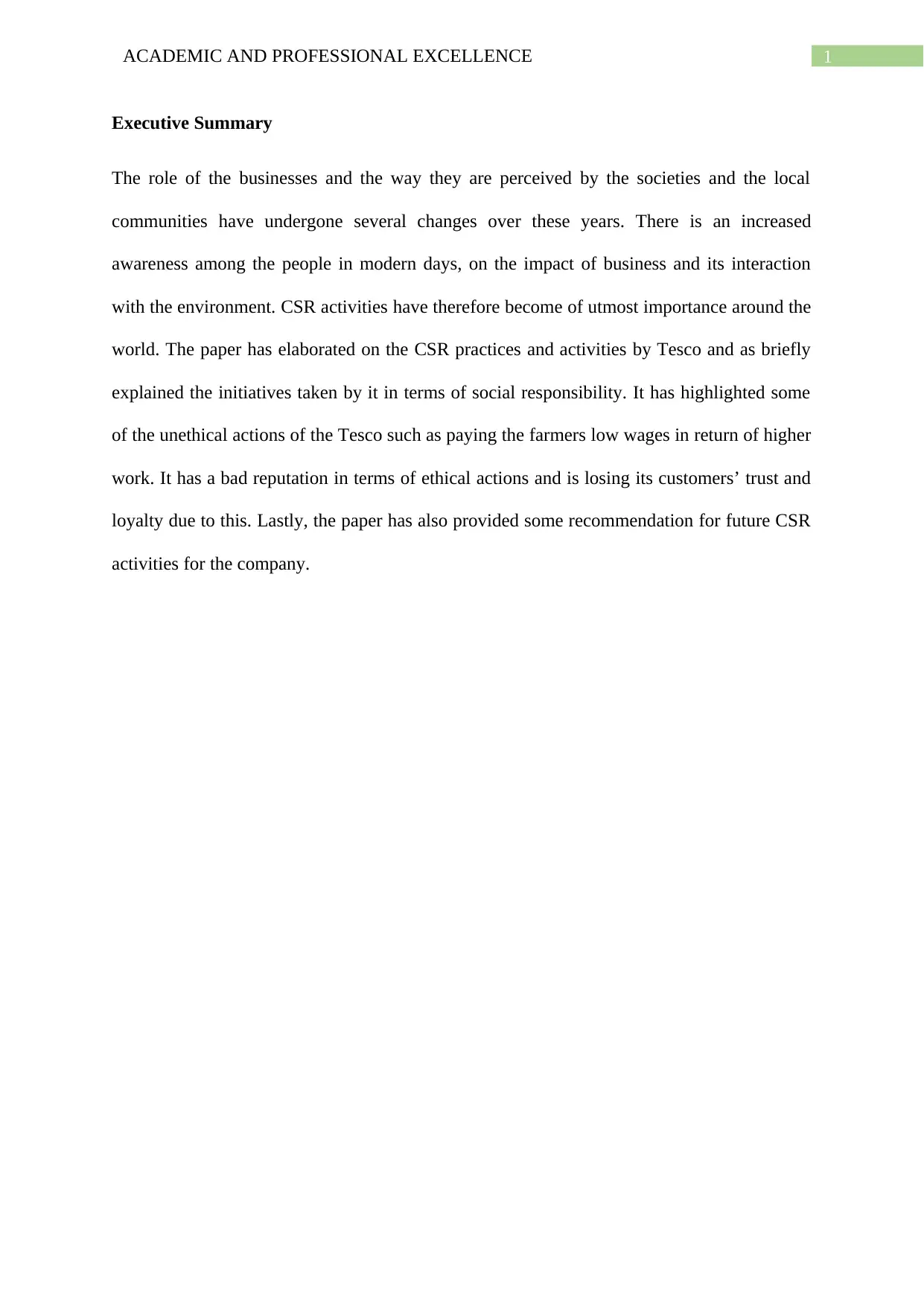
Executive Summary
The role of the businesses and the way they are perceived by the societies and the local
communities have undergone several changes over these years. There is an increased
awareness among the people in modern days, on the impact of business and its interaction
with the environment. CSR activities have therefore become of utmost importance around the
world. The paper has elaborated on the CSR practices and activities by Tesco and as briefly
explained the initiatives taken by it in terms of social responsibility. It has highlighted some
of the unethical actions of the Tesco such as paying the farmers low wages in return of higher
work. It has a bad reputation in terms of ethical actions and is losing its customers’ trust and
loyalty due to this. Lastly, the paper has also provided some recommendation for future CSR
activities for the company.
Executive Summary
The role of the businesses and the way they are perceived by the societies and the local
communities have undergone several changes over these years. There is an increased
awareness among the people in modern days, on the impact of business and its interaction
with the environment. CSR activities have therefore become of utmost importance around the
world. The paper has elaborated on the CSR practices and activities by Tesco and as briefly
explained the initiatives taken by it in terms of social responsibility. It has highlighted some
of the unethical actions of the Tesco such as paying the farmers low wages in return of higher
work. It has a bad reputation in terms of ethical actions and is losing its customers’ trust and
loyalty due to this. Lastly, the paper has also provided some recommendation for future CSR
activities for the company.
2ACADEMIC AND PROFESSIONAL EXCELLENCE
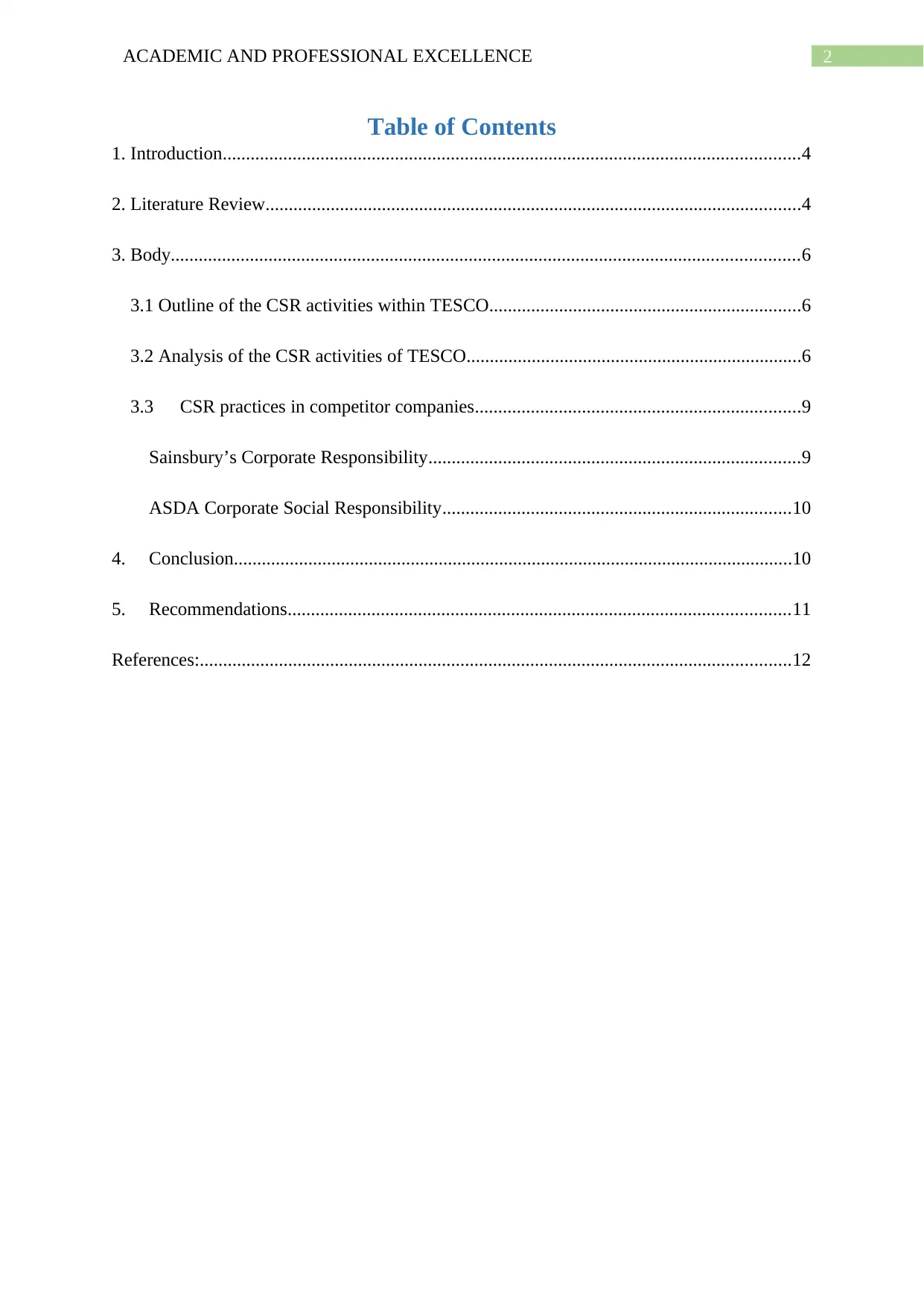
Table of Contents
1. Introduction............................................................................................................................4
2. Literature Review...................................................................................................................4
3. Body.......................................................................................................................................6
3.1 Outline of the CSR activities within TESCO...................................................................6
3.2 Analysis of the CSR activities of TESCO........................................................................6
3.3 CSR practices in competitor companies......................................................................9
Sainsbury’s Corporate Responsibility................................................................................9
ASDA Corporate Social Responsibility...........................................................................10
4. Conclusion........................................................................................................................10
5. Recommendations............................................................................................................11
References:...............................................................................................................................12
Table of Contents
1. Introduction............................................................................................................................4
2. Literature Review...................................................................................................................4
3. Body.......................................................................................................................................6
3.1 Outline of the CSR activities within TESCO...................................................................6
3.2 Analysis of the CSR activities of TESCO........................................................................6
3.3 CSR practices in competitor companies......................................................................9
Sainsbury’s Corporate Responsibility................................................................................9
ASDA Corporate Social Responsibility...........................................................................10
4. Conclusion........................................................................................................................10
5. Recommendations............................................................................................................11
References:...............................................................................................................................12
⊘ This is a preview!⊘
Do you want full access?
Subscribe today to unlock all pages.

Trusted by 1+ million students worldwide
3ACADEMIC AND PROFESSIONAL EXCELLENCE
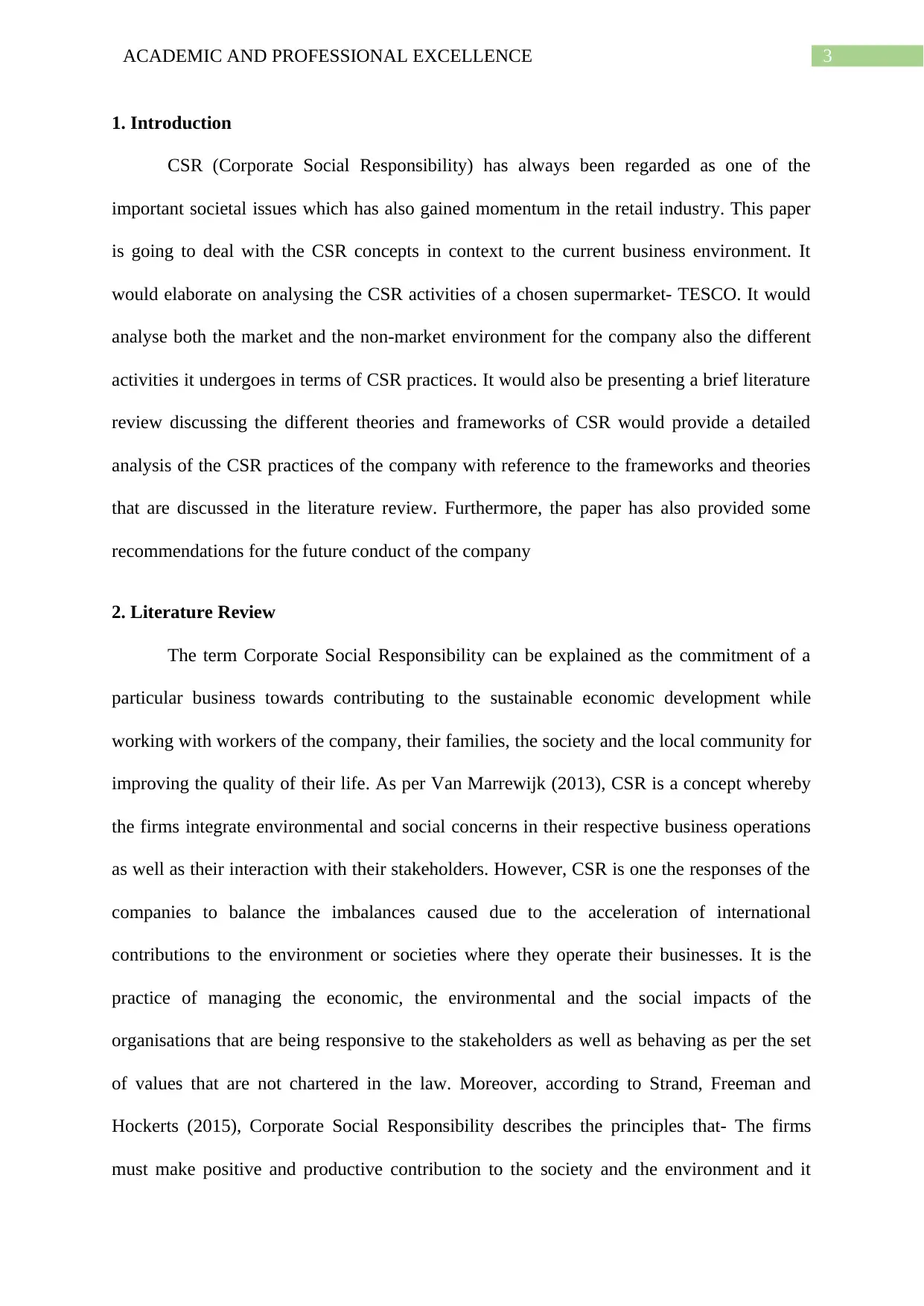
1. Introduction
CSR (Corporate Social Responsibility) has always been regarded as one of the
important societal issues which has also gained momentum in the retail industry. This paper
is going to deal with the CSR concepts in context to the current business environment. It
would elaborate on analysing the CSR activities of a chosen supermarket- TESCO. It would
analyse both the market and the non-market environment for the company also the different
activities it undergoes in terms of CSR practices. It would also be presenting a brief literature
review discussing the different theories and frameworks of CSR would provide a detailed
analysis of the CSR practices of the company with reference to the frameworks and theories
that are discussed in the literature review. Furthermore, the paper has also provided some
recommendations for the future conduct of the company
2. Literature Review
The term Corporate Social Responsibility can be explained as the commitment of a
particular business towards contributing to the sustainable economic development while
working with workers of the company, their families, the society and the local community for
improving the quality of their life. As per Van Marrewijk (2013), CSR is a concept whereby
the firms integrate environmental and social concerns in their respective business operations
as well as their interaction with their stakeholders. However, CSR is one the responses of the
companies to balance the imbalances caused due to the acceleration of international
contributions to the environment or societies where they operate their businesses. It is the
practice of managing the economic, the environmental and the social impacts of the
organisations that are being responsive to the stakeholders as well as behaving as per the set
of values that are not chartered in the law. Moreover, according to Strand, Freeman and
Hockerts (2015), Corporate Social Responsibility describes the principles that- The firms
must make positive and productive contribution to the society and the environment and it
1. Introduction
CSR (Corporate Social Responsibility) has always been regarded as one of the
important societal issues which has also gained momentum in the retail industry. This paper
is going to deal with the CSR concepts in context to the current business environment. It
would elaborate on analysing the CSR activities of a chosen supermarket- TESCO. It would
analyse both the market and the non-market environment for the company also the different
activities it undergoes in terms of CSR practices. It would also be presenting a brief literature
review discussing the different theories and frameworks of CSR would provide a detailed
analysis of the CSR practices of the company with reference to the frameworks and theories
that are discussed in the literature review. Furthermore, the paper has also provided some
recommendations for the future conduct of the company
2. Literature Review
The term Corporate Social Responsibility can be explained as the commitment of a
particular business towards contributing to the sustainable economic development while
working with workers of the company, their families, the society and the local community for
improving the quality of their life. As per Van Marrewijk (2013), CSR is a concept whereby
the firms integrate environmental and social concerns in their respective business operations
as well as their interaction with their stakeholders. However, CSR is one the responses of the
companies to balance the imbalances caused due to the acceleration of international
contributions to the environment or societies where they operate their businesses. It is the
practice of managing the economic, the environmental and the social impacts of the
organisations that are being responsive to the stakeholders as well as behaving as per the set
of values that are not chartered in the law. Moreover, according to Strand, Freeman and
Hockerts (2015), Corporate Social Responsibility describes the principles that- The firms
must make positive and productive contribution to the society and the environment and it
Paraphrase This Document
Need a fresh take? Get an instant paraphrase of this document with our AI Paraphraser
4ACADEMIC AND PROFESSIONAL EXCELLENCE
may differ from a wide range of social practices like donating to charity, taking actions to
reducing carbon footprint, sponsoring awards, employment diversity business ethics or
increasing environmental awareness.
It is also to note that CSR involves the maintenance of the stakeholders and
employees of the company. Proving them with some minimum facilities, even on a
contractual basis would fulfil a part of organisation’s social responsibility. However, it is to
note that there are a total of two theories that are generally taken into consideration for
explaining CSR and they are Social Contract Theory and Stakeholder Theory. As per
Agudo-Valiente, Graces-Ayerbe and Salvador-Figueras (2015), “A stakeholder theory of the
firm is used as a basis to analyse those groups to whom the firm should be responsible”. In
this context Ait Sidhoum and Serra (2018) have suggested that an organisation could be
defined as a wide range of networks of different stakeholders, whom the manager of the very
organisation seek to satisfy. Bryson (2018) have defined stakeholders as “any group or
individual who can affect or is affected by the achievement of the organization’s objectives”.
However, stakeholders of a firm could be divided into two groups- Primary stakeholders and
Secondary stakeholders. Primary stakeholders are the ones without whose continuous
participation the firm could not survive in the business environment and failure to retention of
these groups lead to failure of entire corporate system. For example- the shareholders,
customers, suppliers and employees. On the other hand, the Secondary stakeholder groups are
defined as the ones whose “influence or affect, or are influenced/affected by the corporation,
but they are not engaged in transactions with the corporation and are not essential for its
survival”. Media is one of the examples of such secondary stakeholders.
Furthermore, the social contract theory is dependent on the social contracts of the
traditional concepts. As per Dunfee and Donaldson (2017) this theory is of higher level than
that of the Stakeholder theory because it portrays the complexity specific to the context of the
may differ from a wide range of social practices like donating to charity, taking actions to
reducing carbon footprint, sponsoring awards, employment diversity business ethics or
increasing environmental awareness.
It is also to note that CSR involves the maintenance of the stakeholders and
employees of the company. Proving them with some minimum facilities, even on a
contractual basis would fulfil a part of organisation’s social responsibility. However, it is to
note that there are a total of two theories that are generally taken into consideration for
explaining CSR and they are Social Contract Theory and Stakeholder Theory. As per
Agudo-Valiente, Graces-Ayerbe and Salvador-Figueras (2015), “A stakeholder theory of the
firm is used as a basis to analyse those groups to whom the firm should be responsible”. In
this context Ait Sidhoum and Serra (2018) have suggested that an organisation could be
defined as a wide range of networks of different stakeholders, whom the manager of the very
organisation seek to satisfy. Bryson (2018) have defined stakeholders as “any group or
individual who can affect or is affected by the achievement of the organization’s objectives”.
However, stakeholders of a firm could be divided into two groups- Primary stakeholders and
Secondary stakeholders. Primary stakeholders are the ones without whose continuous
participation the firm could not survive in the business environment and failure to retention of
these groups lead to failure of entire corporate system. For example- the shareholders,
customers, suppliers and employees. On the other hand, the Secondary stakeholder groups are
defined as the ones whose “influence or affect, or are influenced/affected by the corporation,
but they are not engaged in transactions with the corporation and are not essential for its
survival”. Media is one of the examples of such secondary stakeholders.
Furthermore, the social contract theory is dependent on the social contracts of the
traditional concepts. As per Dunfee and Donaldson (2017) this theory is of higher level than
that of the Stakeholder theory because it portrays the complexity specific to the context of the
5ACADEMIC AND PROFESSIONAL EXCELLENCE
business situations. With the same, they have also proposed that social contract enables the
empirical and the normative factors to harmonise, which is a problem that the stakeholder
theory has failed to address. The social contract theory for the business ethics would be based
on the context that is deriving the responsibilities of the business. The obligations of the
business on ethical issues towards the individual members of the community are obtained
from the agreements. Hence, this theory theorizes the implicit contract among the business
and its members where the specified benefits prevails. Furthermore, ethics and culture of a
company is regarded to be the most important aspects of the financial performance. This is
due to the fact that the financial performance of an organisation tend to increase with the
increase in the cultural values because the employees the get the necessary motivation in
order to enhance their productivity.
3. Body
3.1 Outline of the CSR activities within TESCO
TESCO supports fair trade and taking staffs, customers, suppliers and customers into
consideration along with the environment and local community. It has made significant
contribution in the field of education, environment and social work.
Education Environment Social Work
1. Partnership with “I
CAN”.
2. Gives support to the
children through
educational programmes
3. Provides computers in
different schools through
“Computers for Schools”
programme.
1. Integrated its CSR in its
environmental
management comprising
of resources, emissions,
and wastes and recycling
2. “Wildlife choice”
initiative
3. Collects fees and
encourages reuse of
plastic bags.
1. It has established a
charity trust named
“TESCO Charity Trust”
2. Each year it chooses a
community charity
3. It supports charities and
staff fundraising
business situations. With the same, they have also proposed that social contract enables the
empirical and the normative factors to harmonise, which is a problem that the stakeholder
theory has failed to address. The social contract theory for the business ethics would be based
on the context that is deriving the responsibilities of the business. The obligations of the
business on ethical issues towards the individual members of the community are obtained
from the agreements. Hence, this theory theorizes the implicit contract among the business
and its members where the specified benefits prevails. Furthermore, ethics and culture of a
company is regarded to be the most important aspects of the financial performance. This is
due to the fact that the financial performance of an organisation tend to increase with the
increase in the cultural values because the employees the get the necessary motivation in
order to enhance their productivity.
3. Body
3.1 Outline of the CSR activities within TESCO
TESCO supports fair trade and taking staffs, customers, suppliers and customers into
consideration along with the environment and local community. It has made significant
contribution in the field of education, environment and social work.
Education Environment Social Work
1. Partnership with “I
CAN”.
2. Gives support to the
children through
educational programmes
3. Provides computers in
different schools through
“Computers for Schools”
programme.
1. Integrated its CSR in its
environmental
management comprising
of resources, emissions,
and wastes and recycling
2. “Wildlife choice”
initiative
3. Collects fees and
encourages reuse of
plastic bags.
1. It has established a
charity trust named
“TESCO Charity Trust”
2. Each year it chooses a
community charity
3. It supports charities and
staff fundraising
⊘ This is a preview!⊘
Do you want full access?
Subscribe today to unlock all pages.
Trusted by 1+ million students worldwide
6ACADEMIC AND PROFESSIONAL EXCELLENCE
3.2 Analysis of the CSR activities of TESCO
a) Education- It creates special support for the children on the basis of educational
programmes and projects for creating peaceful environment for its business operation.
It has undergone partnership with a charity that assists children community with
language difficulties named “I CAN” (Rogala et al., 2015). It offers them scholarships
and has established several cultural community centres. One of the educational
programs include the “Computers for Schools” programme that is aimed at school.
Through this it provides computers to the schools in different countries and also
supports them with new technologies.
b) Environment- The organisation has integrated its corporate responsibility in its
environmental management comprising of the topics like resources, emissions, and
wastes and recycling. With the same, there are also other issues that are covered like
animal welfare, vehicle efficiency, organic food and green transport. It promotes
environmental issues by means of training package (Cheg et al., 2015). It is also to
note that “Wildlife choice” is one of the example of the initiatives taken by TESCO
towards environment related issues. This initiative requires farmers to take wildlife
into consideration on their firms. It works very closely with its product suppliers as
well as the farmers in order to keep an eye and protect wildlife. Also, it helps in
collecting fees and in encouraging the reuse of plastic bags.
c) Social Work- It has established a charity trust named “TESCO Charity Trust” in the
year 1987 for supporting the local as well as the national communities in making
grants to the charities within the UK region (Caraher & Furey, 2018). Furthermore, it
contributes 1% of its profits gained by pre-tax for good causes and also, it supports
charities and staff fundraising. Moreover, each year it chooses a community charity
3.2 Analysis of the CSR activities of TESCO
a) Education- It creates special support for the children on the basis of educational
programmes and projects for creating peaceful environment for its business operation.
It has undergone partnership with a charity that assists children community with
language difficulties named “I CAN” (Rogala et al., 2015). It offers them scholarships
and has established several cultural community centres. One of the educational
programs include the “Computers for Schools” programme that is aimed at school.
Through this it provides computers to the schools in different countries and also
supports them with new technologies.
b) Environment- The organisation has integrated its corporate responsibility in its
environmental management comprising of the topics like resources, emissions, and
wastes and recycling. With the same, there are also other issues that are covered like
animal welfare, vehicle efficiency, organic food and green transport. It promotes
environmental issues by means of training package (Cheg et al., 2015). It is also to
note that “Wildlife choice” is one of the example of the initiatives taken by TESCO
towards environment related issues. This initiative requires farmers to take wildlife
into consideration on their firms. It works very closely with its product suppliers as
well as the farmers in order to keep an eye and protect wildlife. Also, it helps in
collecting fees and in encouraging the reuse of plastic bags.
c) Social Work- It has established a charity trust named “TESCO Charity Trust” in the
year 1987 for supporting the local as well as the national communities in making
grants to the charities within the UK region (Caraher & Furey, 2018). Furthermore, it
contributes 1% of its profits gained by pre-tax for good causes and also, it supports
charities and staff fundraising. Moreover, each year it chooses a community charity
Paraphrase This Document
Need a fresh take? Get an instant paraphrase of this document with our AI Paraphraser
7ACADEMIC AND PROFESSIONAL EXCELLENCE
that is close to the hearts of its customers and staffs and this becomes the focal point
for its staff fundraising.
CSR has been regarded as one of the new exhortation but it is not a concept which is
completely new to TESCO. It is to note that the term “Corporate Social Responsibility” has
been recognised in the middle of 1920s and since then, it has taken an identifiable shape
within these years. Therefore, to act and build trust among the shareholders, the business
representatives and the executives have searched for corporate directors in the company. It
could be applied for both the stockholders and the social claimants as well. There are several
objectives for the strained demands of the framework of CSR. Below mentioned are the five
key drivers of the TESCO’s CSR framework.
Establishment of the knowledge economy.
Globalisation of the markets of TESCO.
Employment of the communications technology world-wide.
Federate the power for achieving corporate responsibility during comparing it
to the less number of international and global companies.
It is to note that although Tesco enforces its stakeholders to follow international
standards in the supply of the goods and services to the firm that portrays a significant
influence on them for concentrating on the supply and the production quality, it has failed to
follow some CSR policies. It does not provide its stakeholders and employees with some
significant ethical features. Tesco does not maintain its business performance. Instead, it
focused on its financial aspect (Khan & Korac Kakabadse, 2014). With the same, Tesco does
not give priority to the stake holders and it focuses only on the financial aspects of the
business. If Tesco could have considered all the stakeholders as well as its stock holders then
it would have increased its performance. As per the stakeholder theory the management of
that is close to the hearts of its customers and staffs and this becomes the focal point
for its staff fundraising.
CSR has been regarded as one of the new exhortation but it is not a concept which is
completely new to TESCO. It is to note that the term “Corporate Social Responsibility” has
been recognised in the middle of 1920s and since then, it has taken an identifiable shape
within these years. Therefore, to act and build trust among the shareholders, the business
representatives and the executives have searched for corporate directors in the company. It
could be applied for both the stockholders and the social claimants as well. There are several
objectives for the strained demands of the framework of CSR. Below mentioned are the five
key drivers of the TESCO’s CSR framework.
Establishment of the knowledge economy.
Globalisation of the markets of TESCO.
Employment of the communications technology world-wide.
Federate the power for achieving corporate responsibility during comparing it
to the less number of international and global companies.
It is to note that although Tesco enforces its stakeholders to follow international
standards in the supply of the goods and services to the firm that portrays a significant
influence on them for concentrating on the supply and the production quality, it has failed to
follow some CSR policies. It does not provide its stakeholders and employees with some
significant ethical features. Tesco does not maintain its business performance. Instead, it
focused on its financial aspect (Khan & Korac Kakabadse, 2014). With the same, Tesco does
not give priority to the stake holders and it focuses only on the financial aspects of the
business. If Tesco could have considered all the stakeholders as well as its stock holders then
it would have increased its performance. As per the stakeholder theory the management of
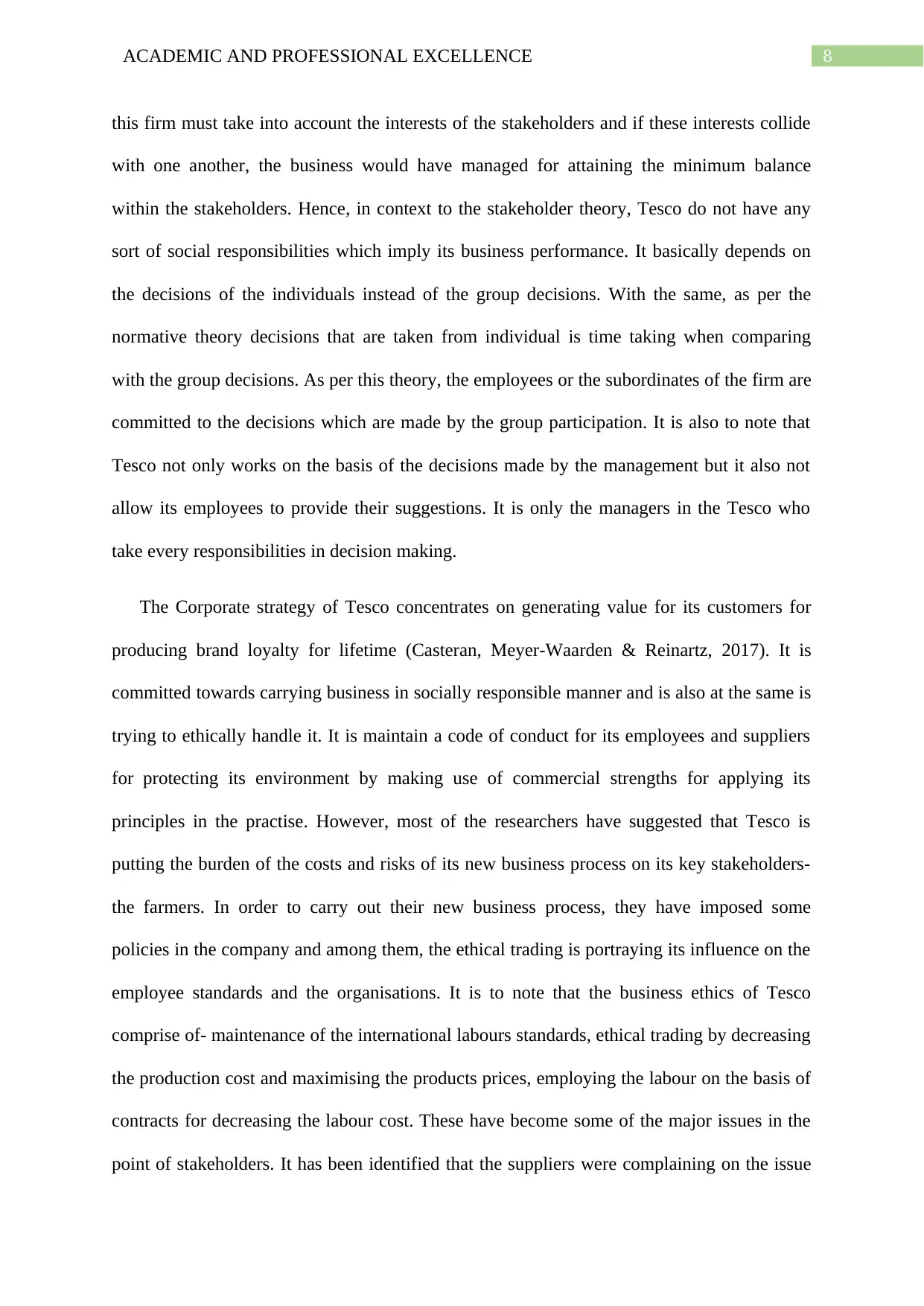
8ACADEMIC AND PROFESSIONAL EXCELLENCE
this firm must take into account the interests of the stakeholders and if these interests collide
with one another, the business would have managed for attaining the minimum balance
within the stakeholders. Hence, in context to the stakeholder theory, Tesco do not have any
sort of social responsibilities which imply its business performance. It basically depends on
the decisions of the individuals instead of the group decisions. With the same, as per the
normative theory decisions that are taken from individual is time taking when comparing
with the group decisions. As per this theory, the employees or the subordinates of the firm are
committed to the decisions which are made by the group participation. It is also to note that
Tesco not only works on the basis of the decisions made by the management but it also not
allow its employees to provide their suggestions. It is only the managers in the Tesco who
take every responsibilities in decision making.
The Corporate strategy of Tesco concentrates on generating value for its customers for
producing brand loyalty for lifetime (Casteran, Meyer-Waarden & Reinartz, 2017). It is
committed towards carrying business in socially responsible manner and is also at the same is
trying to ethically handle it. It is maintain a code of conduct for its employees and suppliers
for protecting its environment by making use of commercial strengths for applying its
principles in the practise. However, most of the researchers have suggested that Tesco is
putting the burden of the costs and risks of its new business process on its key stakeholders-
the farmers. In order to carry out their new business process, they have imposed some
policies in the company and among them, the ethical trading is portraying its influence on the
employee standards and the organisations. It is to note that the business ethics of Tesco
comprise of- maintenance of the international labours standards, ethical trading by decreasing
the production cost and maximising the products prices, employing the labour on the basis of
contracts for decreasing the labour cost. These have become some of the major issues in the
point of stakeholders. It has been identified that the suppliers were complaining on the issue
this firm must take into account the interests of the stakeholders and if these interests collide
with one another, the business would have managed for attaining the minimum balance
within the stakeholders. Hence, in context to the stakeholder theory, Tesco do not have any
sort of social responsibilities which imply its business performance. It basically depends on
the decisions of the individuals instead of the group decisions. With the same, as per the
normative theory decisions that are taken from individual is time taking when comparing
with the group decisions. As per this theory, the employees or the subordinates of the firm are
committed to the decisions which are made by the group participation. It is also to note that
Tesco not only works on the basis of the decisions made by the management but it also not
allow its employees to provide their suggestions. It is only the managers in the Tesco who
take every responsibilities in decision making.
The Corporate strategy of Tesco concentrates on generating value for its customers for
producing brand loyalty for lifetime (Casteran, Meyer-Waarden & Reinartz, 2017). It is
committed towards carrying business in socially responsible manner and is also at the same is
trying to ethically handle it. It is maintain a code of conduct for its employees and suppliers
for protecting its environment by making use of commercial strengths for applying its
principles in the practise. However, most of the researchers have suggested that Tesco is
putting the burden of the costs and risks of its new business process on its key stakeholders-
the farmers. In order to carry out their new business process, they have imposed some
policies in the company and among them, the ethical trading is portraying its influence on the
employee standards and the organisations. It is to note that the business ethics of Tesco
comprise of- maintenance of the international labours standards, ethical trading by decreasing
the production cost and maximising the products prices, employing the labour on the basis of
contracts for decreasing the labour cost. These have become some of the major issues in the
point of stakeholders. It has been identified that the suppliers were complaining on the issue
⊘ This is a preview!⊘
Do you want full access?
Subscribe today to unlock all pages.
Trusted by 1+ million students worldwide
9ACADEMIC AND PROFESSIONAL EXCELLENCE
that they were paid less than they should be for their supplies. Where else, the company is
earning a good amount on those products.
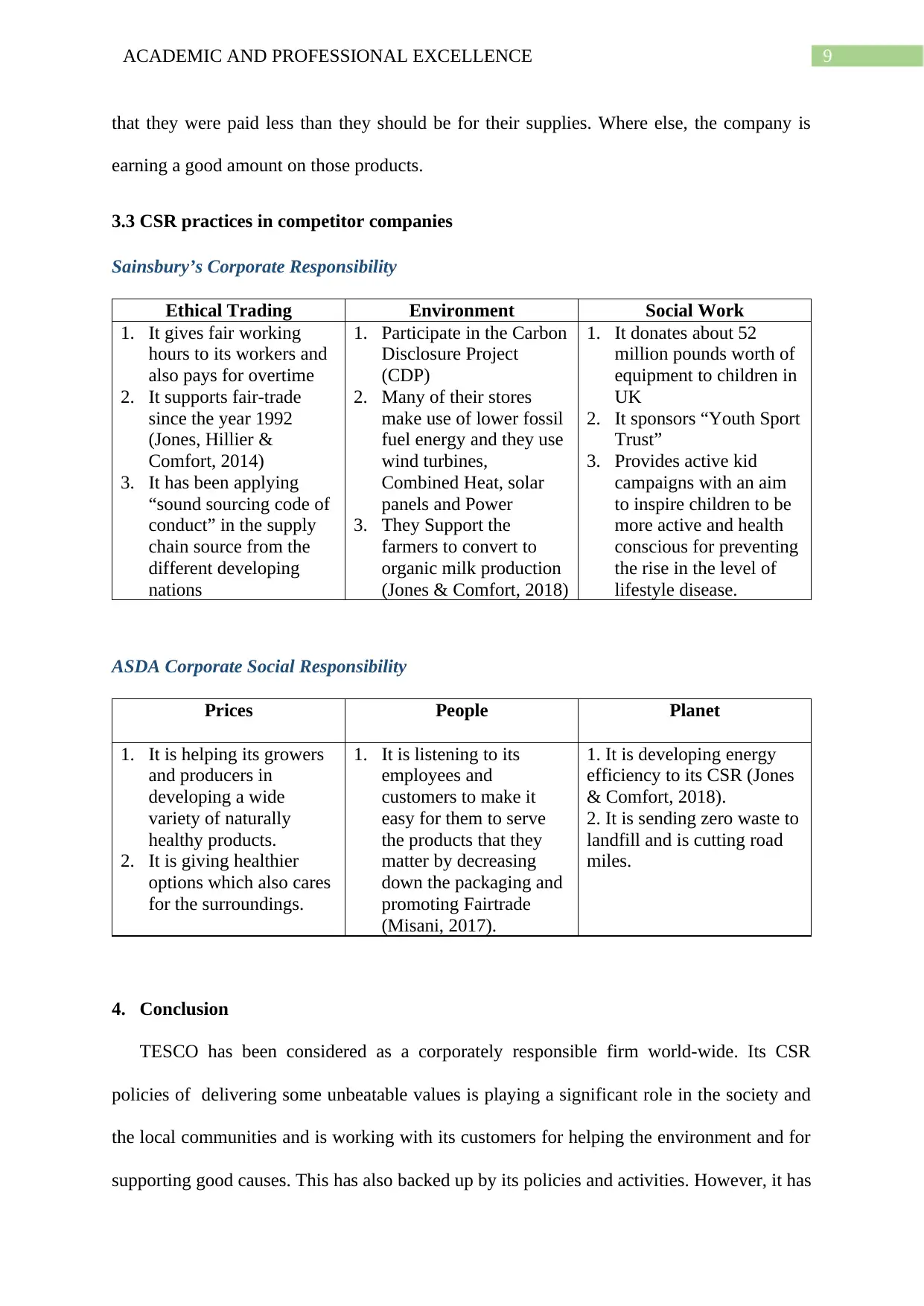
3.3 CSR practices in competitor companies
Sainsbury’s Corporate Responsibility
Ethical Trading Environment Social Work
1. It gives fair working
hours to its workers and
also pays for overtime
2. It supports fair-trade
since the year 1992
(Jones, Hillier &
Comfort, 2014)
3. It has been applying
“sound sourcing code of
conduct” in the supply
chain source from the
different developing
nations
1. Participate in the Carbon
Disclosure Project
(CDP)
2. Many of their stores
make use of lower fossil
fuel energy and they use
wind turbines,
Combined Heat, solar
panels and Power
3. They Support the
farmers to convert to
organic milk production
(Jones & Comfort, 2018)
1. It donates about 52
million pounds worth of
equipment to children in
UK
2. It sponsors “Youth Sport
Trust”
3. Provides active kid
campaigns with an aim
to inspire children to be
more active and health
conscious for preventing
the rise in the level of
lifestyle disease.
ASDA Corporate Social Responsibility
Prices People Planet
1. It is helping its growers
and producers in
developing a wide
variety of naturally
healthy products.
2. It is giving healthier
options which also cares
for the surroundings.
1. It is listening to its
employees and
customers to make it
easy for them to serve
the products that they
matter by decreasing
down the packaging and
promoting Fairtrade
(Misani, 2017).
1. It is developing energy
efficiency to its CSR (Jones
& Comfort, 2018).
2. It is sending zero waste to
landfill and is cutting road
miles.
4. Conclusion
TESCO has been considered as a corporately responsible firm world-wide. Its CSR
policies of delivering some unbeatable values is playing a significant role in the society and
the local communities and is working with its customers for helping the environment and for
supporting good causes. This has also backed up by its policies and activities. However, it has
that they were paid less than they should be for their supplies. Where else, the company is
earning a good amount on those products.
3.3 CSR practices in competitor companies
Sainsbury’s Corporate Responsibility
Ethical Trading Environment Social Work
1. It gives fair working
hours to its workers and
also pays for overtime
2. It supports fair-trade
since the year 1992
(Jones, Hillier &
Comfort, 2014)
3. It has been applying
“sound sourcing code of
conduct” in the supply
chain source from the
different developing
nations
1. Participate in the Carbon
Disclosure Project
(CDP)
2. Many of their stores
make use of lower fossil
fuel energy and they use
wind turbines,
Combined Heat, solar
panels and Power
3. They Support the
farmers to convert to
organic milk production
(Jones & Comfort, 2018)
1. It donates about 52
million pounds worth of
equipment to children in
UK
2. It sponsors “Youth Sport
Trust”
3. Provides active kid
campaigns with an aim
to inspire children to be
more active and health
conscious for preventing
the rise in the level of
lifestyle disease.
ASDA Corporate Social Responsibility
Prices People Planet
1. It is helping its growers
and producers in
developing a wide
variety of naturally
healthy products.
2. It is giving healthier
options which also cares
for the surroundings.
1. It is listening to its
employees and
customers to make it
easy for them to serve
the products that they
matter by decreasing
down the packaging and
promoting Fairtrade
(Misani, 2017).
1. It is developing energy
efficiency to its CSR (Jones
& Comfort, 2018).
2. It is sending zero waste to
landfill and is cutting road
miles.
4. Conclusion
TESCO has been considered as a corporately responsible firm world-wide. Its CSR
policies of delivering some unbeatable values is playing a significant role in the society and
the local communities and is working with its customers for helping the environment and for
supporting good causes. This has also backed up by its policies and activities. However, it has
Paraphrase This Document
Need a fresh take? Get an instant paraphrase of this document with our AI Paraphraser
10ACADEMIC AND PROFESSIONAL EXCELLENCE
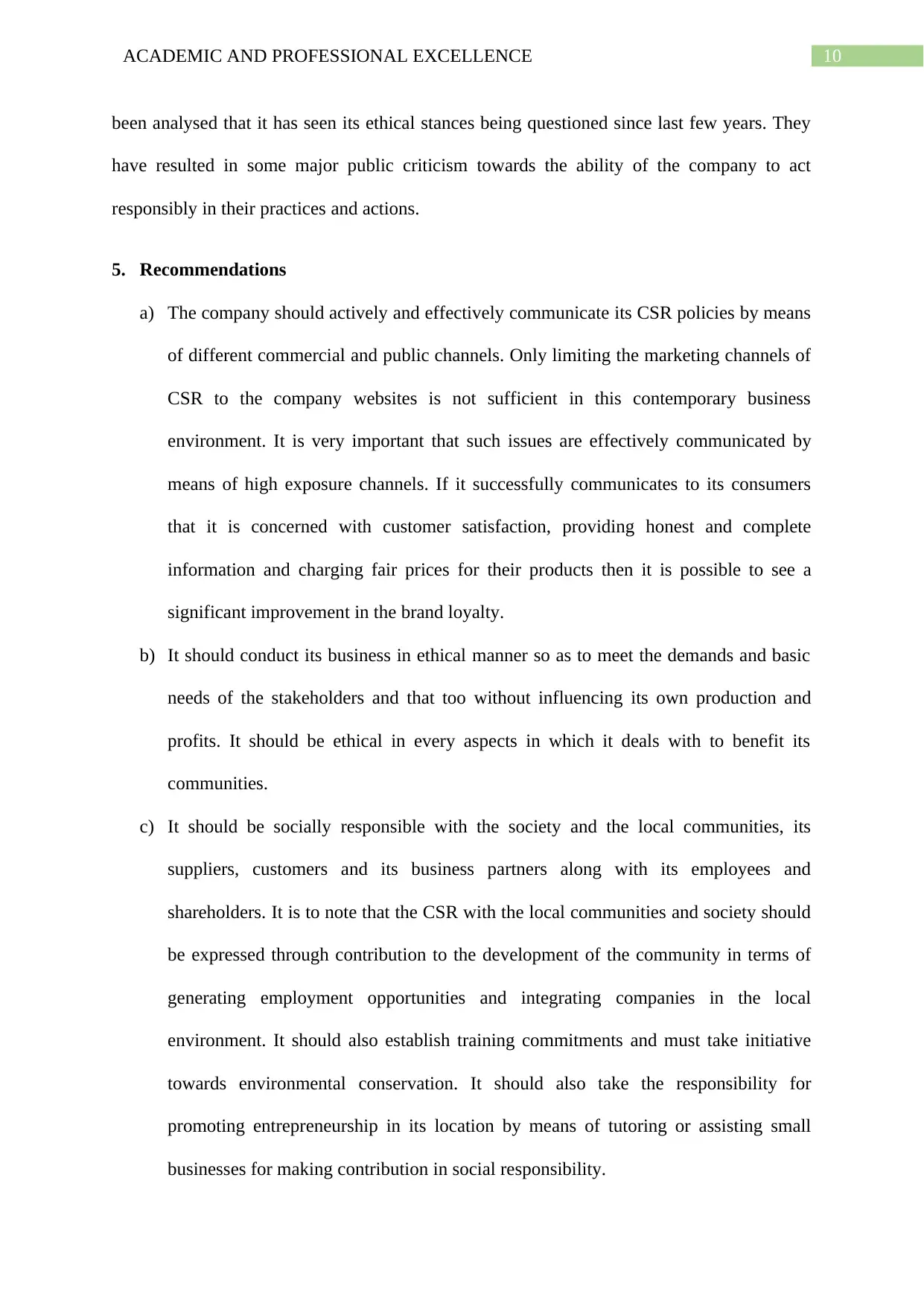
been analysed that it has seen its ethical stances being questioned since last few years. They
have resulted in some major public criticism towards the ability of the company to act
responsibly in their practices and actions.
5. Recommendations
a) The company should actively and effectively communicate its CSR policies by means
of different commercial and public channels. Only limiting the marketing channels of
CSR to the company websites is not sufficient in this contemporary business
environment. It is very important that such issues are effectively communicated by
means of high exposure channels. If it successfully communicates to its consumers
that it is concerned with customer satisfaction, providing honest and complete
information and charging fair prices for their products then it is possible to see a
significant improvement in the brand loyalty.
b) It should conduct its business in ethical manner so as to meet the demands and basic
needs of the stakeholders and that too without influencing its own production and
profits. It should be ethical in every aspects in which it deals with to benefit its
communities.
c) It should be socially responsible with the society and the local communities, its
suppliers, customers and its business partners along with its employees and
shareholders. It is to note that the CSR with the local communities and society should
be expressed through contribution to the development of the community in terms of
generating employment opportunities and integrating companies in the local
environment. It should also establish training commitments and must take initiative
towards environmental conservation. It should also take the responsibility for
promoting entrepreneurship in its location by means of tutoring or assisting small
businesses for making contribution in social responsibility.
been analysed that it has seen its ethical stances being questioned since last few years. They
have resulted in some major public criticism towards the ability of the company to act
responsibly in their practices and actions.
5. Recommendations
a) The company should actively and effectively communicate its CSR policies by means
of different commercial and public channels. Only limiting the marketing channels of
CSR to the company websites is not sufficient in this contemporary business
environment. It is very important that such issues are effectively communicated by
means of high exposure channels. If it successfully communicates to its consumers
that it is concerned with customer satisfaction, providing honest and complete
information and charging fair prices for their products then it is possible to see a
significant improvement in the brand loyalty.
b) It should conduct its business in ethical manner so as to meet the demands and basic
needs of the stakeholders and that too without influencing its own production and
profits. It should be ethical in every aspects in which it deals with to benefit its
communities.
c) It should be socially responsible with the society and the local communities, its
suppliers, customers and its business partners along with its employees and
shareholders. It is to note that the CSR with the local communities and society should
be expressed through contribution to the development of the community in terms of
generating employment opportunities and integrating companies in the local
environment. It should also establish training commitments and must take initiative
towards environmental conservation. It should also take the responsibility for
promoting entrepreneurship in its location by means of tutoring or assisting small
businesses for making contribution in social responsibility.
11ACADEMIC AND PROFESSIONAL EXCELLENCE
References:
Agudo‐Valiente, J. M., Garcés‐Ayerbe, C., & Salvador‐Figueras, M. (2015). Corporate social
performance and stakeholder dialogue management. Corporate Social Responsibility
and Environmental Management, 22(1), 13-31.
Ait Sidhoum, A., & Serra, T. (2018). Corporate Sustainable Development. Revisiting the
Relationship between Corporate Social Responsibility Dimensions. Sustainable
Development, 26(4), 365-378.
Bryson, J. M. (2018). Strategic planning for public and nonprofit organizations: A guide to
strengthening and sustaining organizational achievement. John Wiley & Sons.
Caraher, M., & Furey, S. (2018). The Growing Problems of Food Poverty and Insecurity.
In The Economics of Emergency Food Aid Provision (pp. 1-24). Palgrave Pivot,
Cham.
Castéran, H., Meyer-Waarden, L., & Reinartz, W. (2017). Modeling customer lifetime value,
retention, and churn. In Handbook of Market Research (pp. 1-33). Springer
International Publishing.
Chen, J., Huang, Q., Peng, H., & Zhong, H. (2015). CSR Development Index for the Retail
Industry (2012). In Research Report on Corporate Social Responsibility of China (pp.
201-213). Springer, Berlin, Heidelberg.
Dunfee, T. W., & Donaldson, T. J. (2017). Untangling the corruption knot: global bribery
viewed through the lens of integrative social contract theory. The Blackwell guide to
business ethics, 61-76.
Jones, P., & Comfort, D. (2018). Storytelling and corporate social responsibility reporting: A
case study commentary on UK. food retailers. Journal of Public Affairs, e1834.
References:
Agudo‐Valiente, J. M., Garcés‐Ayerbe, C., & Salvador‐Figueras, M. (2015). Corporate social
performance and stakeholder dialogue management. Corporate Social Responsibility
and Environmental Management, 22(1), 13-31.
Ait Sidhoum, A., & Serra, T. (2018). Corporate Sustainable Development. Revisiting the
Relationship between Corporate Social Responsibility Dimensions. Sustainable
Development, 26(4), 365-378.
Bryson, J. M. (2018). Strategic planning for public and nonprofit organizations: A guide to
strengthening and sustaining organizational achievement. John Wiley & Sons.
Caraher, M., & Furey, S. (2018). The Growing Problems of Food Poverty and Insecurity.
In The Economics of Emergency Food Aid Provision (pp. 1-24). Palgrave Pivot,
Cham.
Castéran, H., Meyer-Waarden, L., & Reinartz, W. (2017). Modeling customer lifetime value,
retention, and churn. In Handbook of Market Research (pp. 1-33). Springer
International Publishing.
Chen, J., Huang, Q., Peng, H., & Zhong, H. (2015). CSR Development Index for the Retail
Industry (2012). In Research Report on Corporate Social Responsibility of China (pp.
201-213). Springer, Berlin, Heidelberg.
Dunfee, T. W., & Donaldson, T. J. (2017). Untangling the corruption knot: global bribery
viewed through the lens of integrative social contract theory. The Blackwell guide to
business ethics, 61-76.
Jones, P., & Comfort, D. (2018). Storytelling and corporate social responsibility reporting: A
case study commentary on UK. food retailers. Journal of Public Affairs, e1834.
⊘ This is a preview!⊘
Do you want full access?
Subscribe today to unlock all pages.
Trusted by 1+ million students worldwide

1 out of 13


Related Documents


Your All-in-One AI-Powered Toolkit for Academic Success.
+13062052269
info@desklib.com
Available 24*7 on WhatsApp / Email
![[object Object]](/_next/static/media/star-bottom.7253800d.svg)
Unlock your academic potential
Copyright © 2020–2026 A2Z Services. All Rights Reserved. Developed and managed by ZUCOL.