Analyzing Tesco's CSR Activities for Sustainable Objectives
VerifiedAdded on 2020/02/05
|13
|4275
|102
Report
AI Summary
This report provides an in-depth analysis of Tesco's corporate social responsibility (CSR) activities and their alignment with sustainable objectives. It begins with an introduction to the importance of CSR for businesses, particularly within the context of corporate governance and societal needs. The project definition outlines the aim to ascertain the role of CSR in meeting sustainable objectives, focusing on Tesco as a case study. The report explores the meaning of CSR, various CSR activities of Tesco, the challenges associated with them, and the linkage between these activities and sustainable objectives. The project strategy section discusses how Tesco can approach CSR as a strategic project to achieve its goals. The report then defines different types of CSR, including economic, legal, ethical, and philanthropic responsibilities. The project objectives are defined in terms of performance, cost, and time, with a detailed project scope statement outlining included and excluded scopes. The implementation plan involves a work breakdown structure and a schedule, with a communication plan. The report concludes by highlighting the importance of CSR in meeting sustainable goals and providing recommendations for further development. The report also addresses the problem statement, success criteria, and project assumptions, providing a comprehensive overview of the subject.
MANAGING SMALL
BUSINESS MANAGEMENT
BUSINESS MANAGEMENT

Paraphrase This Document
Need a fresh take? Get an instant paraphrase of this document with our AI Paraphraser
Table of Contents
MANAGING SMALL BUSINESS MANAGEMENT........................................................................1
INTRODUCTION................................................................................................................................3
PROJECT DEFINITION......................................................................................................................3
PROBLEM STATEMENT...................................................................................................................3
PROJECT STRATEGY........................................................................................................................3
PROJECT OBJECTIVES ....................................................................................................................5
Performance, cost and time objectives ...........................................................................................5
PROJECT SCOPE STATEMENT .......................................................................................................6
Included scope ................................................................................................................................6
SUCCESS CRITERIA.........................................................................................................................7
PROJECT ASSUMPTION...................................................................................................................7
2. IMPLEMENTATION PLAN............................................................................................................8
Work Break down structure.............................................................................................................8
Scheduled (Gantt Chart)................................................................................................................10
3. PROJECT PROCESS ....................................................................................................................10
COMMUNICATION PLAN..............................................................................................................10
CONCLUSION...................................................................................................................................11
REFERENCES...................................................................................................................................12
MANAGING SMALL BUSINESS MANAGEMENT........................................................................1
INTRODUCTION................................................................................................................................3
PROJECT DEFINITION......................................................................................................................3
PROBLEM STATEMENT...................................................................................................................3
PROJECT STRATEGY........................................................................................................................3
PROJECT OBJECTIVES ....................................................................................................................5
Performance, cost and time objectives ...........................................................................................5
PROJECT SCOPE STATEMENT .......................................................................................................6
Included scope ................................................................................................................................6
SUCCESS CRITERIA.........................................................................................................................7
PROJECT ASSUMPTION...................................................................................................................7
2. IMPLEMENTATION PLAN............................................................................................................8
Work Break down structure.............................................................................................................8
Scheduled (Gantt Chart)................................................................................................................10
3. PROJECT PROCESS ....................................................................................................................10
COMMUNICATION PLAN..............................................................................................................10
CONCLUSION...................................................................................................................................11
REFERENCES...................................................................................................................................12
INTRODUCTION
It is essential for business to have sound CSR activities in order to meet with the sustainable
objectives. It is required to meet with the needs of society as part of corporate governance.
Company possess varied set of roles towards the society and government as it is actually working in
it and hence such roles can be fulfilled with the help of CSR activities (Bhattacharya, Korschun and
Sen, 2009). In this context, present report is prepared that been focused to ascertain the role of CSR
activities in meeting the sustainable objectives. In this regard, Tesco is been considered which is one
of the biggest retail chain company of UK. It focuses on CSR in order to meet with its sustainable
needs.
PROJECT DEFINITION
This project is developed within the context of Tesco which is focused towards CSR
activities in different manner. Through this study, focus is to acknowledge whether business is able
to meet with the sustainable objectives through CSR or not. In this respect, following are the aim
and objectives:
Aim: to ascertain the role of CSR activities in meeting the sustainable objectives: A case study of
Tesco.
Objectives:
1. To comprehend the meaning of CSR activities and ways to do it.
2. To identify various CSR activity of Tesco and challenges associated to it.
3. To determine the linkage between CSR activities of Tesco with that of sustainable
objectives.
4. To recommend the ways through which CSR activities can be further developed to meet
with direct need of company.
PROBLEM STATEMENT
It is evident that CSR activity incurs huge cost and efforts which affect the profitability of
organisation as well. Moreover, companies also focus on CSR as it need to complies with corporate
governance. Further, pressure from government bodies to cope with the needs of society is another
challenge that been faced by the company (Seok Sohn, Han and Lee, 2012). Due to this, company
finds restrictive to obey the norms of government. Hence, present study is developed in order to
acknowledge whether CSR activities assist in meeting with the sustainable objectives or not.
PROJECT STRATEGY
A project strategy is based on a particular project which help to the company to attain their
objectives. It is essential for the Tesco to take CSR activities as a project by which they can make
It is essential for business to have sound CSR activities in order to meet with the sustainable
objectives. It is required to meet with the needs of society as part of corporate governance.
Company possess varied set of roles towards the society and government as it is actually working in
it and hence such roles can be fulfilled with the help of CSR activities (Bhattacharya, Korschun and
Sen, 2009). In this context, present report is prepared that been focused to ascertain the role of CSR
activities in meeting the sustainable objectives. In this regard, Tesco is been considered which is one
of the biggest retail chain company of UK. It focuses on CSR in order to meet with its sustainable
needs.
PROJECT DEFINITION
This project is developed within the context of Tesco which is focused towards CSR
activities in different manner. Through this study, focus is to acknowledge whether business is able
to meet with the sustainable objectives through CSR or not. In this respect, following are the aim
and objectives:
Aim: to ascertain the role of CSR activities in meeting the sustainable objectives: A case study of
Tesco.
Objectives:
1. To comprehend the meaning of CSR activities and ways to do it.
2. To identify various CSR activity of Tesco and challenges associated to it.
3. To determine the linkage between CSR activities of Tesco with that of sustainable
objectives.
4. To recommend the ways through which CSR activities can be further developed to meet
with direct need of company.
PROBLEM STATEMENT
It is evident that CSR activity incurs huge cost and efforts which affect the profitability of
organisation as well. Moreover, companies also focus on CSR as it need to complies with corporate
governance. Further, pressure from government bodies to cope with the needs of society is another
challenge that been faced by the company (Seok Sohn, Han and Lee, 2012). Due to this, company
finds restrictive to obey the norms of government. Hence, present study is developed in order to
acknowledge whether CSR activities assist in meeting with the sustainable objectives or not.
PROJECT STRATEGY
A project strategy is based on a particular project which help to the company to attain their
objectives. It is essential for the Tesco to take CSR activities as a project by which they can make
⊘ This is a preview!⊘
Do you want full access?
Subscribe today to unlock all pages.

Trusted by 1+ million students worldwide
better strategies. It refers to a single project by which a company can make a focus on it and they
can make better steps to achieve their project objectives. A project strategy can be defined as a plan
of action or the tactics through which the long-term goal of the project being selected can be
achieved. The project strategy considers the goals and objectives of the project as the aim to be
fulfilled. Strategic project management is basically is way through which the idea of how to deal
with the different aspects of business in the long run.
CORPORATE SOCIAL RESPONSIBILITY: CSR is a mechanism of self-regulating business
activities in regards with the ethics, the norms and the code of conduct as done in TESCO (Turner,
Ledwith and Kelly, 2010). These responsibilities can be understood as the responsibilities of any
corporation whereby it has to keep in mind the social, economic and environmental factors in
addition to the expectations of the business norms and requirements.
Types of CSR: Basically there are four types of corporate social responsibilities as follows:
Economic Responsibility
Legal Responsibility
Ethical Responsibility Philanthropic Responsibility
Economic Responsibility: The first and foremost aim of a company is to earn a profit and if the
company does not make money for itself it wont be able to survive in the long run. Also it will
affect adversely the life of the employees working over there as they will lose their jobs and it will
result in the drawback that these employees wont be able to be socially responsible .Hence it is
mandatory for a company that first of all it should look at its profit.
Legal Responsibility: The legal responsibility indicates that the corporation should be responsible
to the rules, regulation and laws framed by the government (Terziovski, 2010). In addition to
ensuring the profitability, it should also ensure the full responsibility towards the legal aspect of the
country.
Ethical Responsibility: Ethics are basically the code of conduct which means to do the things which
are right not according to set of certain rules of some society but with the genuine.
Philanthropic Responsibility: These responsibilities are not just related to the requirement of the
company but it is far more than that. They include concern about society's well being and benefit .
TESCO as a top supermarket is fulfilling all the above mentioned responsibilities which include
environmental consequence and various community issues. TESCO is well maintaining all these
aspects.
can make better steps to achieve their project objectives. A project strategy can be defined as a plan
of action or the tactics through which the long-term goal of the project being selected can be
achieved. The project strategy considers the goals and objectives of the project as the aim to be
fulfilled. Strategic project management is basically is way through which the idea of how to deal
with the different aspects of business in the long run.
CORPORATE SOCIAL RESPONSIBILITY: CSR is a mechanism of self-regulating business
activities in regards with the ethics, the norms and the code of conduct as done in TESCO (Turner,
Ledwith and Kelly, 2010). These responsibilities can be understood as the responsibilities of any
corporation whereby it has to keep in mind the social, economic and environmental factors in
addition to the expectations of the business norms and requirements.
Types of CSR: Basically there are four types of corporate social responsibilities as follows:
Economic Responsibility
Legal Responsibility
Ethical Responsibility Philanthropic Responsibility
Economic Responsibility: The first and foremost aim of a company is to earn a profit and if the
company does not make money for itself it wont be able to survive in the long run. Also it will
affect adversely the life of the employees working over there as they will lose their jobs and it will
result in the drawback that these employees wont be able to be socially responsible .Hence it is
mandatory for a company that first of all it should look at its profit.
Legal Responsibility: The legal responsibility indicates that the corporation should be responsible
to the rules, regulation and laws framed by the government (Terziovski, 2010). In addition to
ensuring the profitability, it should also ensure the full responsibility towards the legal aspect of the
country.
Ethical Responsibility: Ethics are basically the code of conduct which means to do the things which
are right not according to set of certain rules of some society but with the genuine.
Philanthropic Responsibility: These responsibilities are not just related to the requirement of the
company but it is far more than that. They include concern about society's well being and benefit .
TESCO as a top supermarket is fulfilling all the above mentioned responsibilities which include
environmental consequence and various community issues. TESCO is well maintaining all these
aspects.
Paraphrase This Document
Need a fresh take? Get an instant paraphrase of this document with our AI Paraphraser
PROJECT OBJECTIVES
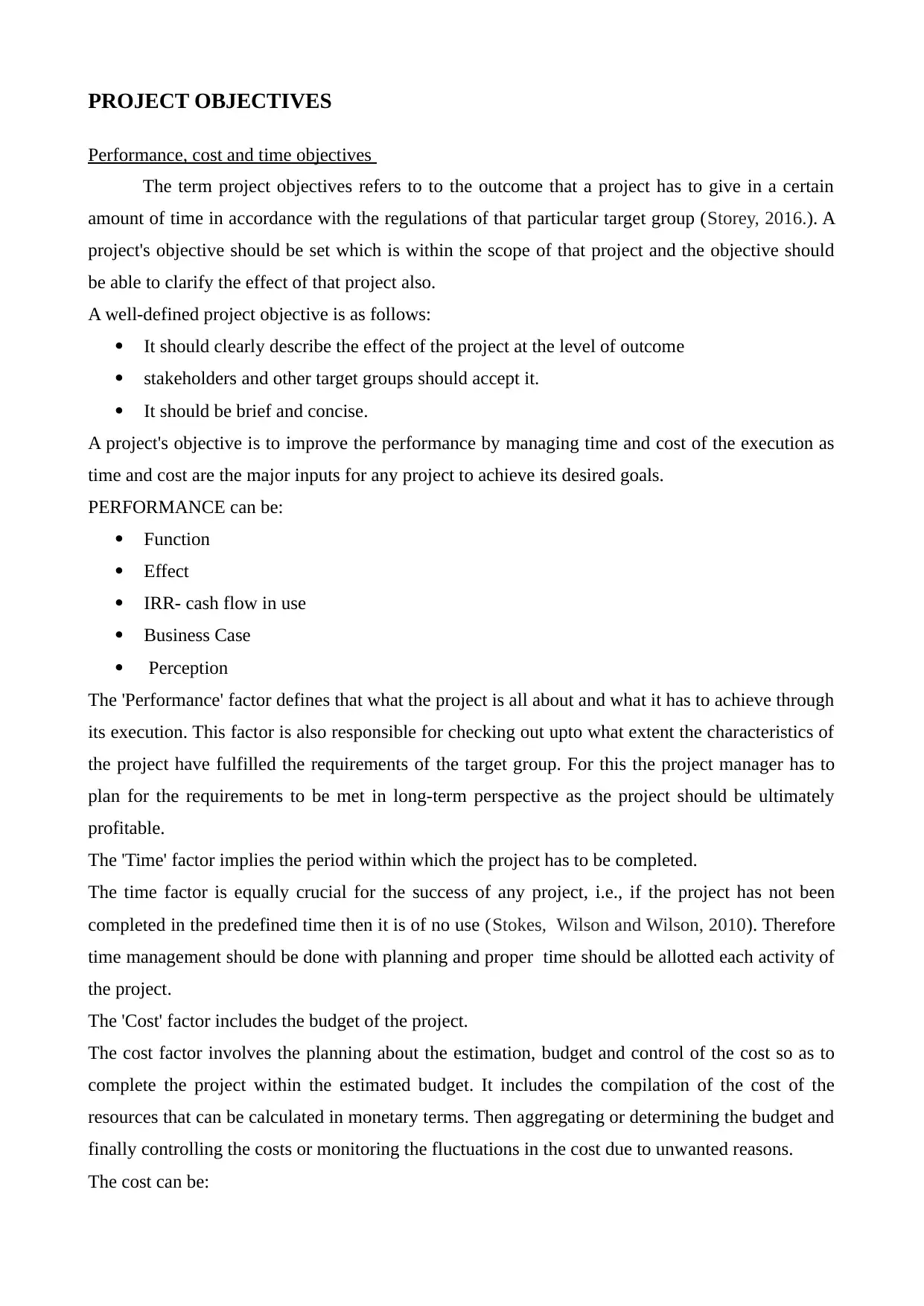
Performance, cost and time objectives
The term project objectives refers to to the outcome that a project has to give in a certain
amount of time in accordance with the regulations of that particular target group (Storey, 2016.). A
project's objective should be set which is within the scope of that project and the objective should
be able to clarify the effect of that project also.
A well-defined project objective is as follows:
It should clearly describe the effect of the project at the level of outcome
stakeholders and other target groups should accept it.
It should be brief and concise.
A project's objective is to improve the performance by managing time and cost of the execution as
time and cost are the major inputs for any project to achieve its desired goals.
PERFORMANCE can be:
Function
Effect
IRR- cash flow in use
Business Case
Perception
The 'Performance' factor defines that what the project is all about and what it has to achieve through
its execution. This factor is also responsible for checking out upto what extent the characteristics of
the project have fulfilled the requirements of the target group. For this the project manager has to
plan for the requirements to be met in long-term perspective as the project should be ultimately
profitable.
The 'Time' factor implies the period within which the project has to be completed.
The time factor is equally crucial for the success of any project, i.e., if the project has not been
completed in the predefined time then it is of no use (Stokes, Wilson and Wilson, 2010). Therefore
time management should be done with planning and proper time should be allotted each activity of
the project.
The 'Cost' factor includes the budget of the project.
The cost factor involves the planning about the estimation, budget and control of the cost so as to
complete the project within the estimated budget. It includes the compilation of the cost of the
resources that can be calculated in monetary terms. Then aggregating or determining the budget and
finally controlling the costs or monitoring the fluctuations in the cost due to unwanted reasons.
The cost can be:
Performance, cost and time objectives
The term project objectives refers to to the outcome that a project has to give in a certain
amount of time in accordance with the regulations of that particular target group (Storey, 2016.). A
project's objective should be set which is within the scope of that project and the objective should
be able to clarify the effect of that project also.
A well-defined project objective is as follows:
It should clearly describe the effect of the project at the level of outcome
stakeholders and other target groups should accept it.
It should be brief and concise.
A project's objective is to improve the performance by managing time and cost of the execution as
time and cost are the major inputs for any project to achieve its desired goals.
PERFORMANCE can be:
Function
Effect
IRR- cash flow in use
Business Case
Perception
The 'Performance' factor defines that what the project is all about and what it has to achieve through
its execution. This factor is also responsible for checking out upto what extent the characteristics of
the project have fulfilled the requirements of the target group. For this the project manager has to
plan for the requirements to be met in long-term perspective as the project should be ultimately
profitable.
The 'Time' factor implies the period within which the project has to be completed.
The time factor is equally crucial for the success of any project, i.e., if the project has not been
completed in the predefined time then it is of no use (Stokes, Wilson and Wilson, 2010). Therefore
time management should be done with planning and proper time should be allotted each activity of
the project.
The 'Cost' factor includes the budget of the project.
The cost factor involves the planning about the estimation, budget and control of the cost so as to
complete the project within the estimated budget. It includes the compilation of the cost of the
resources that can be calculated in monetary terms. Then aggregating or determining the budget and
finally controlling the costs or monitoring the fluctuations in the cost due to unwanted reasons.
The cost can be:
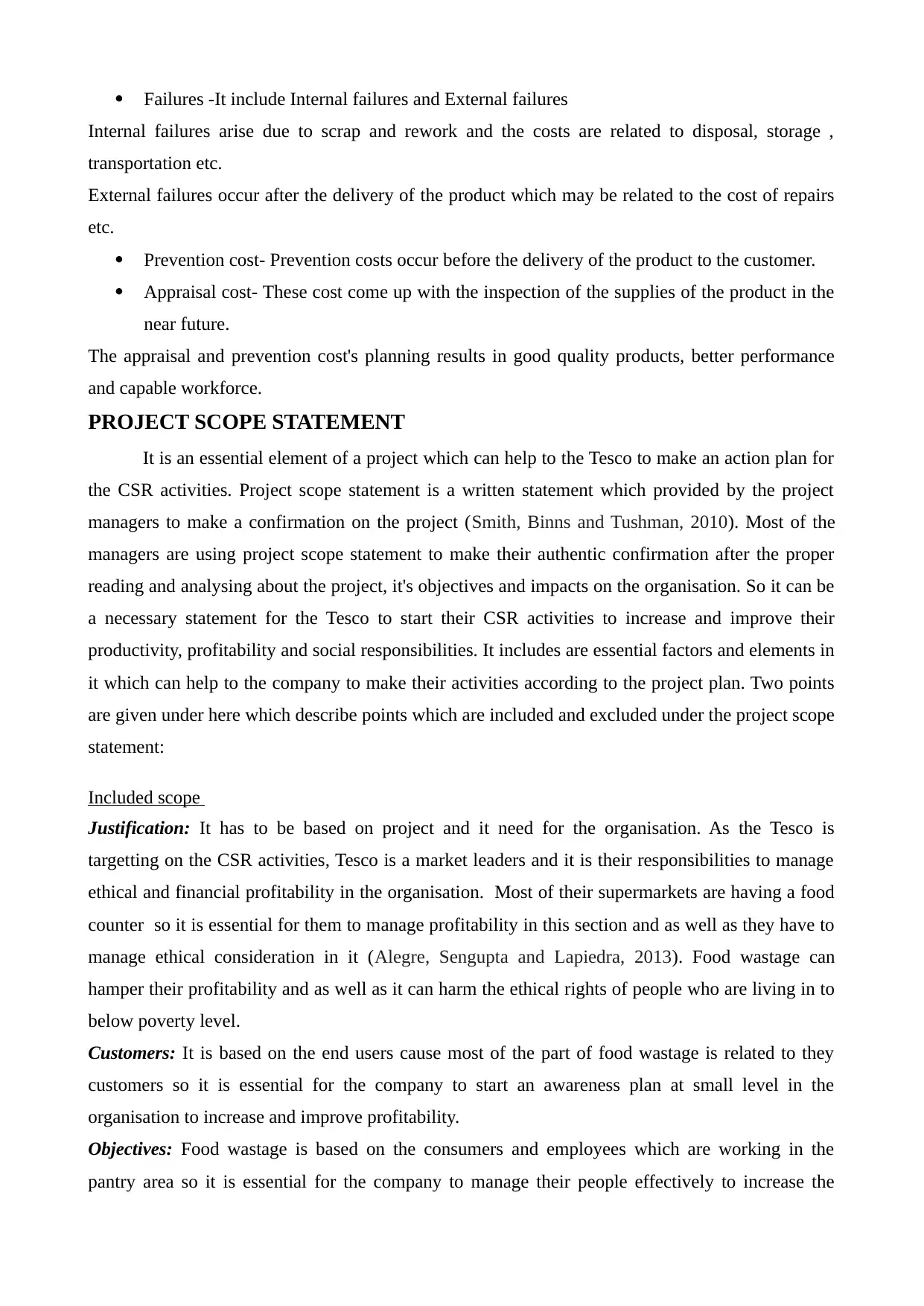
Failures -It include Internal failures and External failures
Internal failures arise due to scrap and rework and the costs are related to disposal, storage ,
transportation etc.
External failures occur after the delivery of the product which may be related to the cost of repairs
etc.
Prevention cost- Prevention costs occur before the delivery of the product to the customer.
Appraisal cost- These cost come up with the inspection of the supplies of the product in the
near future.
The appraisal and prevention cost's planning results in good quality products, better performance
and capable workforce.
PROJECT SCOPE STATEMENT
It is an essential element of a project which can help to the Tesco to make an action plan for
the CSR activities. Project scope statement is a written statement which provided by the project
managers to make a confirmation on the project (Smith, Binns and Tushman, 2010). Most of the
managers are using project scope statement to make their authentic confirmation after the proper
reading and analysing about the project, it's objectives and impacts on the organisation. So it can be
a necessary statement for the Tesco to start their CSR activities to increase and improve their
productivity, profitability and social responsibilities. It includes are essential factors and elements in
it which can help to the company to make their activities according to the project plan. Two points
are given under here which describe points which are included and excluded under the project scope
statement:
Included scope
Justification: It has to be based on project and it need for the organisation. As the Tesco is
targetting on the CSR activities, Tesco is a market leaders and it is their responsibilities to manage
ethical and financial profitability in the organisation. Most of their supermarkets are having a food
counter so it is essential for them to manage profitability in this section and as well as they have to
manage ethical consideration in it (Alegre, Sengupta and Lapiedra, 2013). Food wastage can
hamper their profitability and as well as it can harm the ethical rights of people who are living in to
below poverty level.
Customers: It is based on the end users cause most of the part of food wastage is related to they
customers so it is essential for the company to start an awareness plan at small level in the
organisation to increase and improve profitability.
Objectives: Food wastage is based on the consumers and employees which are working in the
pantry area so it is essential for the company to manage their people effectively to increase the
Internal failures arise due to scrap and rework and the costs are related to disposal, storage ,
transportation etc.
External failures occur after the delivery of the product which may be related to the cost of repairs
etc.
Prevention cost- Prevention costs occur before the delivery of the product to the customer.
Appraisal cost- These cost come up with the inspection of the supplies of the product in the
near future.
The appraisal and prevention cost's planning results in good quality products, better performance
and capable workforce.
PROJECT SCOPE STATEMENT
It is an essential element of a project which can help to the Tesco to make an action plan for
the CSR activities. Project scope statement is a written statement which provided by the project
managers to make a confirmation on the project (Smith, Binns and Tushman, 2010). Most of the
managers are using project scope statement to make their authentic confirmation after the proper
reading and analysing about the project, it's objectives and impacts on the organisation. So it can be
a necessary statement for the Tesco to start their CSR activities to increase and improve their
productivity, profitability and social responsibilities. It includes are essential factors and elements in
it which can help to the company to make their activities according to the project plan. Two points
are given under here which describe points which are included and excluded under the project scope
statement:
Included scope
Justification: It has to be based on project and it need for the organisation. As the Tesco is
targetting on the CSR activities, Tesco is a market leaders and it is their responsibilities to manage
ethical and financial profitability in the organisation. Most of their supermarkets are having a food
counter so it is essential for them to manage profitability in this section and as well as they have to
manage ethical consideration in it (Alegre, Sengupta and Lapiedra, 2013). Food wastage can
hamper their profitability and as well as it can harm the ethical rights of people who are living in to
below poverty level.
Customers: It is based on the end users cause most of the part of food wastage is related to they
customers so it is essential for the company to start an awareness plan at small level in the
organisation to increase and improve profitability.
Objectives: Food wastage is based on the consumers and employees which are working in the
pantry area so it is essential for the company to manage their people effectively to increase the
⊘ This is a preview!⊘
Do you want full access?
Subscribe today to unlock all pages.
Trusted by 1+ million students worldwide
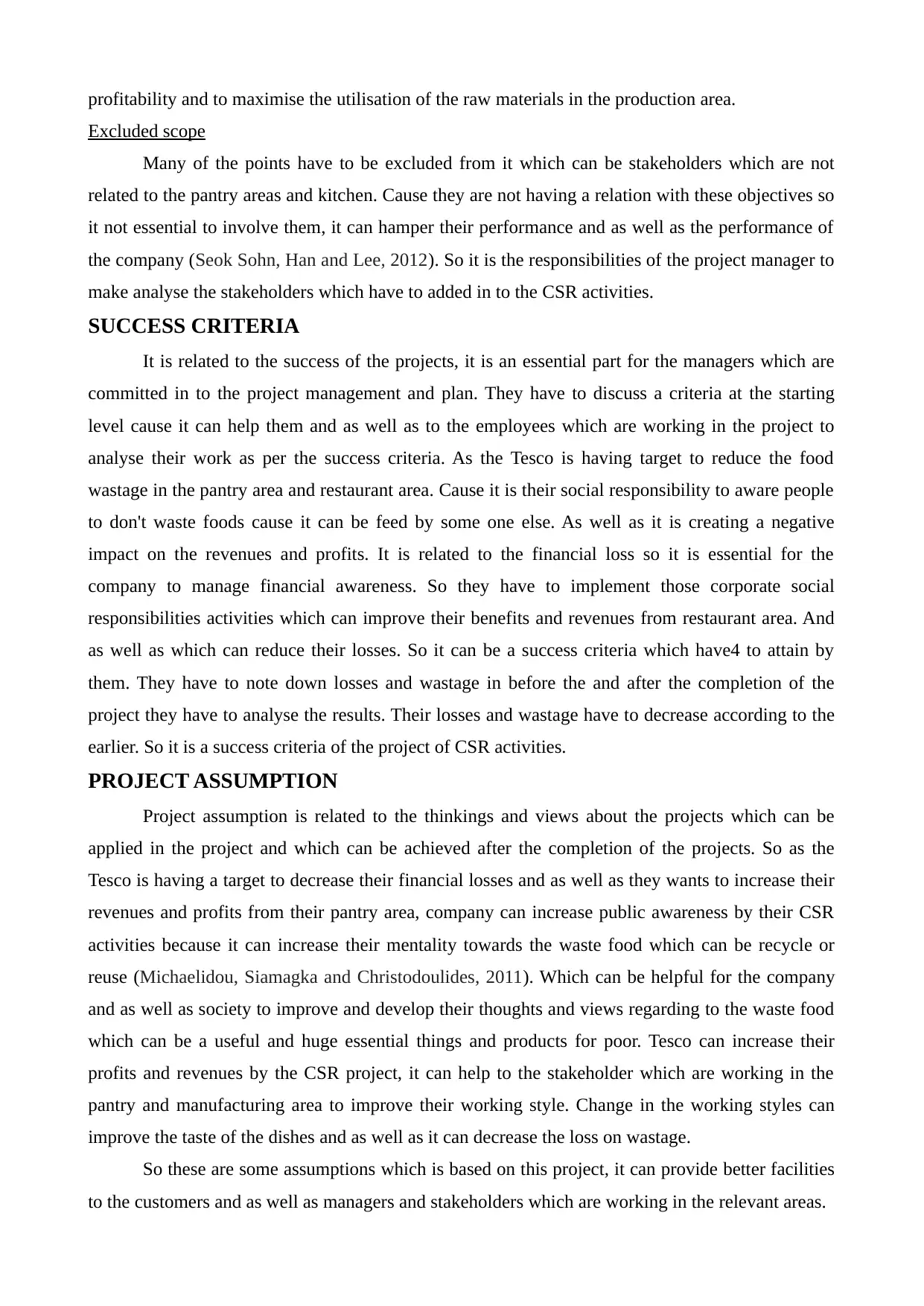
profitability and to maximise the utilisation of the raw materials in the production area.
Excluded scope
Many of the points have to be excluded from it which can be stakeholders which are not
related to the pantry areas and kitchen. Cause they are not having a relation with these objectives so
it not essential to involve them, it can hamper their performance and as well as the performance of
the company (Seok Sohn, Han and Lee, 2012). So it is the responsibilities of the project manager to
make analyse the stakeholders which have to added in to the CSR activities.
SUCCESS CRITERIA
It is related to the success of the projects, it is an essential part for the managers which are
committed in to the project management and plan. They have to discuss a criteria at the starting
level cause it can help them and as well as to the employees which are working in the project to
analyse their work as per the success criteria. As the Tesco is having target to reduce the food
wastage in the pantry area and restaurant area. Cause it is their social responsibility to aware people
to don't waste foods cause it can be feed by some one else. As well as it is creating a negative
impact on the revenues and profits. It is related to the financial loss so it is essential for the
company to manage financial awareness. So they have to implement those corporate social
responsibilities activities which can improve their benefits and revenues from restaurant area. And
as well as which can reduce their losses. So it can be a success criteria which have4 to attain by
them. They have to note down losses and wastage in before the and after the completion of the
project they have to analyse the results. Their losses and wastage have to decrease according to the
earlier. So it is a success criteria of the project of CSR activities.
PROJECT ASSUMPTION
Project assumption is related to the thinkings and views about the projects which can be
applied in the project and which can be achieved after the completion of the projects. So as the
Tesco is having a target to decrease their financial losses and as well as they wants to increase their
revenues and profits from their pantry area, company can increase public awareness by their CSR
activities because it can increase their mentality towards the waste food which can be recycle or
reuse (Michaelidou, Siamagka and Christodoulides, 2011). Which can be helpful for the company
and as well as society to improve and develop their thoughts and views regarding to the waste food
which can be a useful and huge essential things and products for poor. Tesco can increase their
profits and revenues by the CSR project, it can help to the stakeholder which are working in the
pantry and manufacturing area to improve their working style. Change in the working styles can
improve the taste of the dishes and as well as it can decrease the loss on wastage.
So these are some assumptions which is based on this project, it can provide better facilities
to the customers and as well as managers and stakeholders which are working in the relevant areas.
Excluded scope
Many of the points have to be excluded from it which can be stakeholders which are not
related to the pantry areas and kitchen. Cause they are not having a relation with these objectives so
it not essential to involve them, it can hamper their performance and as well as the performance of
the company (Seok Sohn, Han and Lee, 2012). So it is the responsibilities of the project manager to
make analyse the stakeholders which have to added in to the CSR activities.
SUCCESS CRITERIA
It is related to the success of the projects, it is an essential part for the managers which are
committed in to the project management and plan. They have to discuss a criteria at the starting
level cause it can help them and as well as to the employees which are working in the project to
analyse their work as per the success criteria. As the Tesco is having target to reduce the food
wastage in the pantry area and restaurant area. Cause it is their social responsibility to aware people
to don't waste foods cause it can be feed by some one else. As well as it is creating a negative
impact on the revenues and profits. It is related to the financial loss so it is essential for the
company to manage financial awareness. So they have to implement those corporate social
responsibilities activities which can improve their benefits and revenues from restaurant area. And
as well as which can reduce their losses. So it can be a success criteria which have4 to attain by
them. They have to note down losses and wastage in before the and after the completion of the
project they have to analyse the results. Their losses and wastage have to decrease according to the
earlier. So it is a success criteria of the project of CSR activities.
PROJECT ASSUMPTION
Project assumption is related to the thinkings and views about the projects which can be
applied in the project and which can be achieved after the completion of the projects. So as the
Tesco is having a target to decrease their financial losses and as well as they wants to increase their
revenues and profits from their pantry area, company can increase public awareness by their CSR
activities because it can increase their mentality towards the waste food which can be recycle or
reuse (Michaelidou, Siamagka and Christodoulides, 2011). Which can be helpful for the company
and as well as society to improve and develop their thoughts and views regarding to the waste food
which can be a useful and huge essential things and products for poor. Tesco can increase their
profits and revenues by the CSR project, it can help to the stakeholder which are working in the
pantry and manufacturing area to improve their working style. Change in the working styles can
improve the taste of the dishes and as well as it can decrease the loss on wastage.
So these are some assumptions which is based on this project, it can provide better facilities
to the customers and as well as managers and stakeholders which are working in the relevant areas.
Paraphrase This Document
Need a fresh take? Get an instant paraphrase of this document with our AI Paraphraser
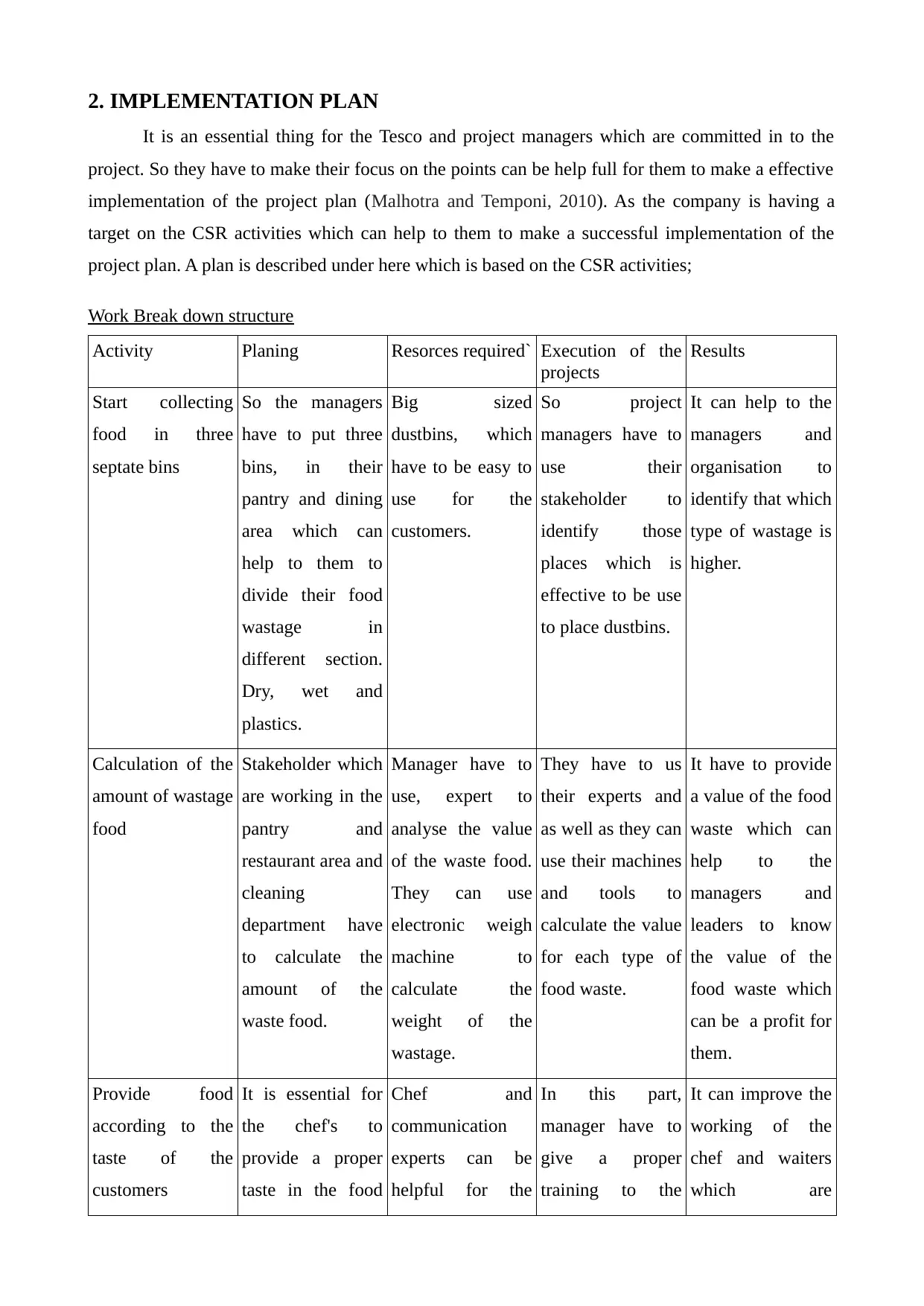
2. IMPLEMENTATION PLAN
It is an essential thing for the Tesco and project managers which are committed in to the
project. So they have to make their focus on the points can be help full for them to make a effective
implementation of the project plan (Malhotra and Temponi, 2010). As the company is having a
target on the CSR activities which can help to them to make a successful implementation of the
project plan. A plan is described under here which is based on the CSR activities;
Work Break down structure
Activity Planing Resorces required` Execution of the
projects
Results
Start collecting
food in three
septate bins
So the managers
have to put three
bins, in their
pantry and dining
area which can
help to them to
divide their food
wastage in
different section.
Dry, wet and
plastics.
Big sized
dustbins, which
have to be easy to
use for the
customers.
So project
managers have to
use their
stakeholder to
identify those
places which is
effective to be use
to place dustbins.
It can help to the
managers and
organisation to
identify that which
type of wastage is
higher.
Calculation of the
amount of wastage
food
Stakeholder which
are working in the
pantry and
restaurant area and
cleaning
department have
to calculate the
amount of the
waste food.
Manager have to
use, expert to
analyse the value
of the waste food.
They can use
electronic weigh
machine to
calculate the
weight of the
wastage.
They have to us
their experts and
as well as they can
use their machines
and tools to
calculate the value
for each type of
food waste.
It have to provide
a value of the food
waste which can
help to the
managers and
leaders to know
the value of the
food waste which
can be a profit for
them.
Provide food
according to the
taste of the
customers
It is essential for
the chef's to
provide a proper
taste in the food
Chef and
communication
experts can be
helpful for the
In this part,
manager have to
give a proper
training to the
It can improve the
working of the
chef and waiters
which are
It is an essential thing for the Tesco and project managers which are committed in to the
project. So they have to make their focus on the points can be help full for them to make a effective
implementation of the project plan (Malhotra and Temponi, 2010). As the company is having a
target on the CSR activities which can help to them to make a successful implementation of the
project plan. A plan is described under here which is based on the CSR activities;
Work Break down structure
Activity Planing Resorces required` Execution of the
projects
Results
Start collecting
food in three
septate bins
So the managers
have to put three
bins, in their
pantry and dining
area which can
help to them to
divide their food
wastage in
different section.
Dry, wet and
plastics.
Big sized
dustbins, which
have to be easy to
use for the
customers.
So project
managers have to
use their
stakeholder to
identify those
places which is
effective to be use
to place dustbins.
It can help to the
managers and
organisation to
identify that which
type of wastage is
higher.
Calculation of the
amount of wastage
food
Stakeholder which
are working in the
pantry and
restaurant area and
cleaning
department have
to calculate the
amount of the
waste food.
Manager have to
use, expert to
analyse the value
of the waste food.
They can use
electronic weigh
machine to
calculate the
weight of the
wastage.
They have to us
their experts and
as well as they can
use their machines
and tools to
calculate the value
for each type of
food waste.
It have to provide
a value of the food
waste which can
help to the
managers and
leaders to know
the value of the
food waste which
can be a profit for
them.
Provide food
according to the
taste of the
customers
It is essential for
the chef's to
provide a proper
taste in the food
Chef and
communication
experts can be
helpful for the
In this part,
manager have to
give a proper
training to the
It can improve the
working of the
chef and waiters
which are
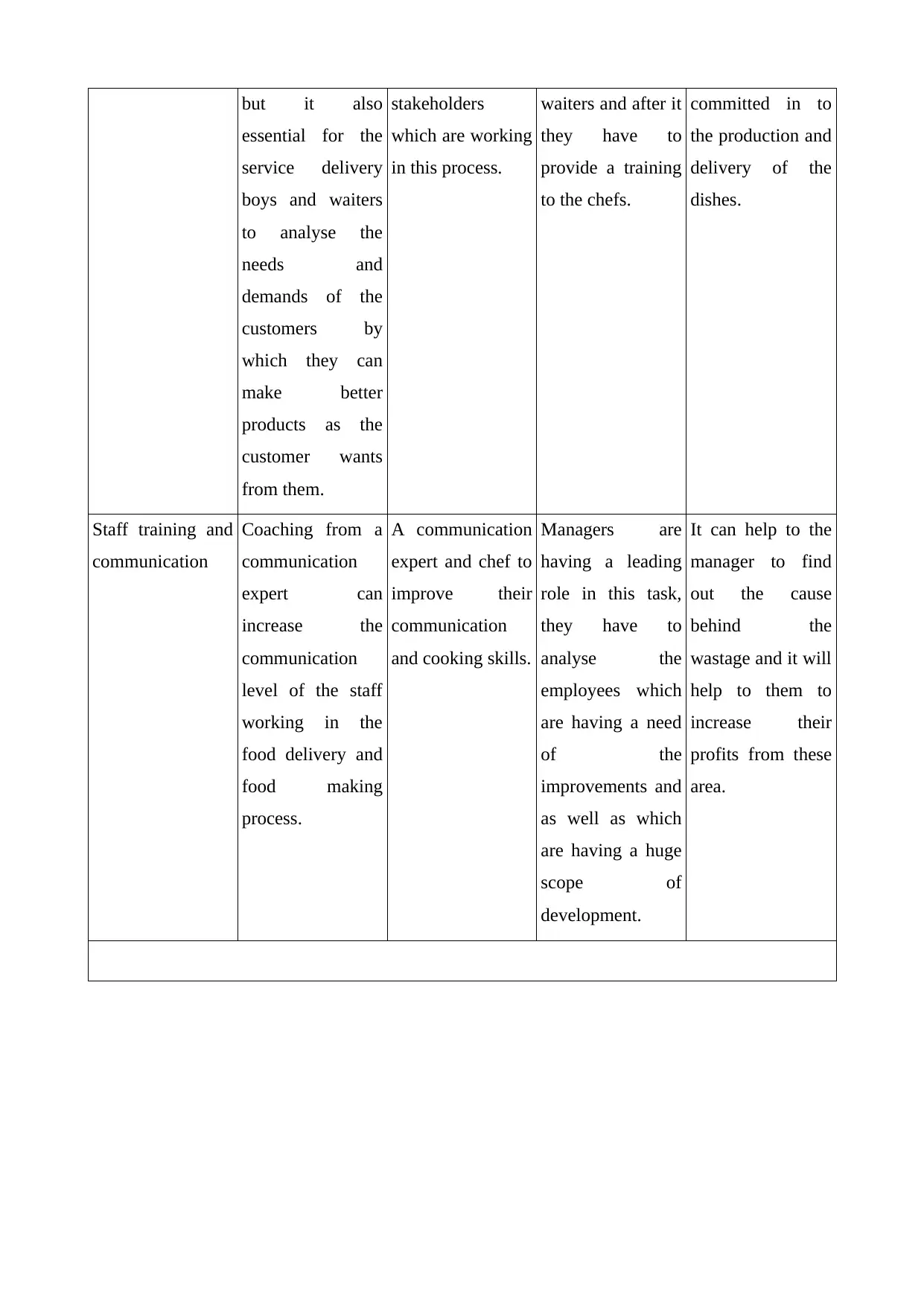
but it also
essential for the
service delivery
boys and waiters
to analyse the
needs and
demands of the
customers by
which they can
make better
products as the
customer wants
from them.
stakeholders
which are working
in this process.
waiters and after it
they have to
provide a training
to the chefs.
committed in to
the production and
delivery of the
dishes.
Staff training and
communication
Coaching from a
communication
expert can
increase the
communication
level of the staff
working in the
food delivery and
food making
process.
A communication
expert and chef to
improve their
communication
and cooking skills.
Managers are
having a leading
role in this task,
they have to
analyse the
employees which
are having a need
of the
improvements and
as well as which
are having a huge
scope of
development.
It can help to the
manager to find
out the cause
behind the
wastage and it will
help to them to
increase their
profits from these
area.
essential for the
service delivery
boys and waiters
to analyse the
needs and
demands of the
customers by
which they can
make better
products as the
customer wants
from them.
stakeholders
which are working
in this process.
waiters and after it
they have to
provide a training
to the chefs.
committed in to
the production and
delivery of the
dishes.
Staff training and
communication
Coaching from a
communication
expert can
increase the
communication
level of the staff
working in the
food delivery and
food making
process.
A communication
expert and chef to
improve their
communication
and cooking skills.
Managers are
having a leading
role in this task,
they have to
analyse the
employees which
are having a need
of the
improvements and
as well as which
are having a huge
scope of
development.
It can help to the
manager to find
out the cause
behind the
wastage and it will
help to them to
increase their
profits from these
area.
⊘ This is a preview!⊘
Do you want full access?
Subscribe today to unlock all pages.
Trusted by 1+ million students worldwide
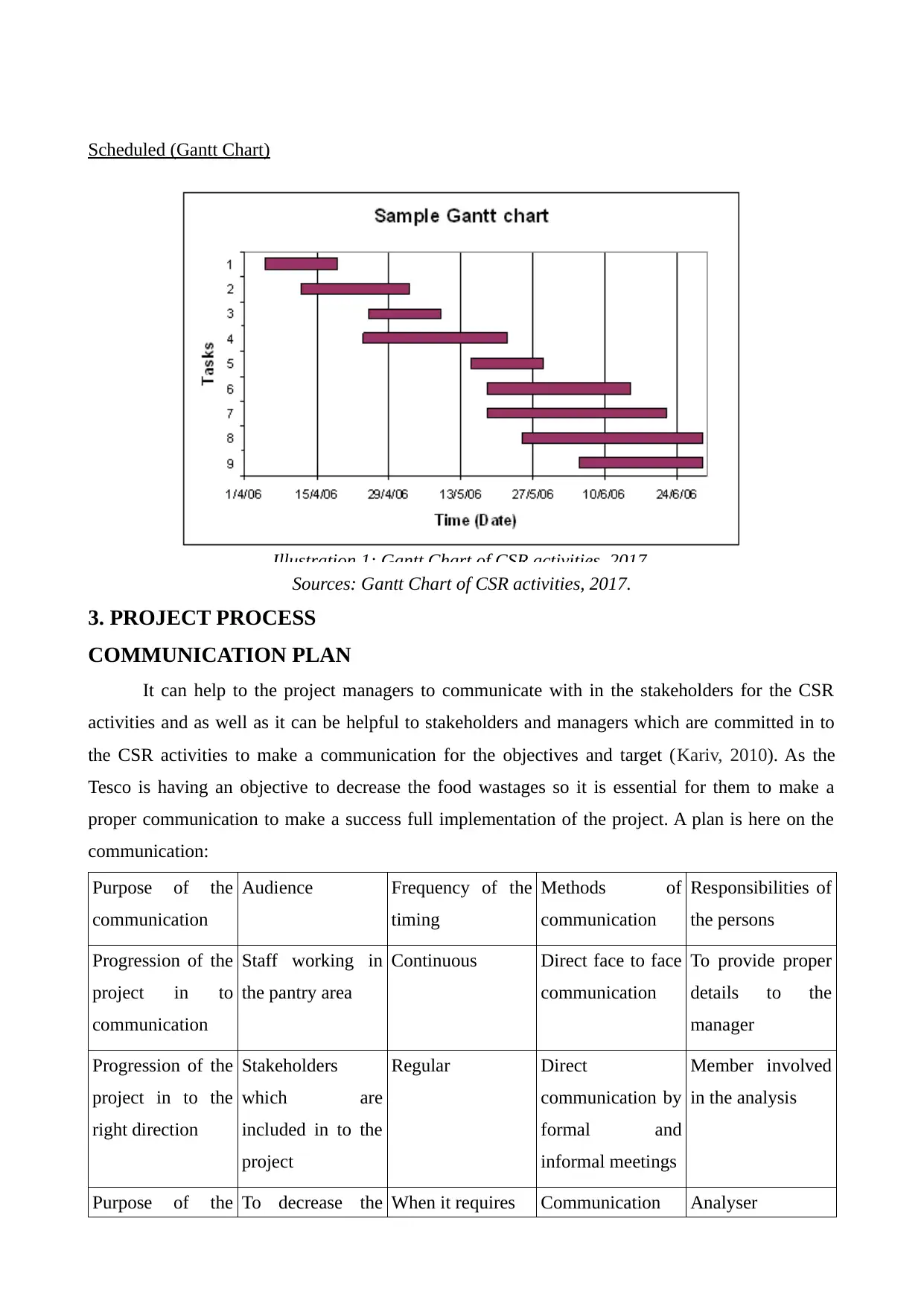
Scheduled (Gantt Chart)
Sources: Gantt Chart of CSR activities, 2017.
3. PROJECT PROCESS
COMMUNICATION PLAN
It can help to the project managers to communicate with in the stakeholders for the CSR
activities and as well as it can be helpful to stakeholders and managers which are committed in to
the CSR activities to make a communication for the objectives and target (Kariv, 2010). As the
Tesco is having an objective to decrease the food wastages so it is essential for them to make a
proper communication to make a success full implementation of the project. A plan is here on the
communication:
Purpose of the
communication
Audience Frequency of the
timing
Methods of
communication
Responsibilities of
the persons
Progression of the
project in to
communication
Staff working in
the pantry area
Continuous Direct face to face
communication
To provide proper
details to the
manager
Progression of the
project in to the
right direction
Stakeholders
which are
included in to the
project
Regular Direct
communication by
formal and
informal meetings
Member involved
in the analysis
Purpose of the To decrease the When it requires Communication Analyser
Illustration 1: Gantt Chart of CSR activities, 2017.
Sources: Gantt Chart of CSR activities, 2017.
3. PROJECT PROCESS
COMMUNICATION PLAN
It can help to the project managers to communicate with in the stakeholders for the CSR
activities and as well as it can be helpful to stakeholders and managers which are committed in to
the CSR activities to make a communication for the objectives and target (Kariv, 2010). As the
Tesco is having an objective to decrease the food wastages so it is essential for them to make a
proper communication to make a success full implementation of the project. A plan is here on the
communication:
Purpose of the
communication
Audience Frequency of the
timing
Methods of
communication
Responsibilities of
the persons
Progression of the
project in to
communication
Staff working in
the pantry area
Continuous Direct face to face
communication
To provide proper
details to the
manager
Progression of the
project in to the
right direction
Stakeholders
which are
included in to the
project
Regular Direct
communication by
formal and
informal meetings
Member involved
in the analysis
Purpose of the To decrease the When it requires Communication Analyser
Illustration 1: Gantt Chart of CSR activities, 2017.
Paraphrase This Document
Need a fresh take? Get an instant paraphrase of this document with our AI Paraphraser
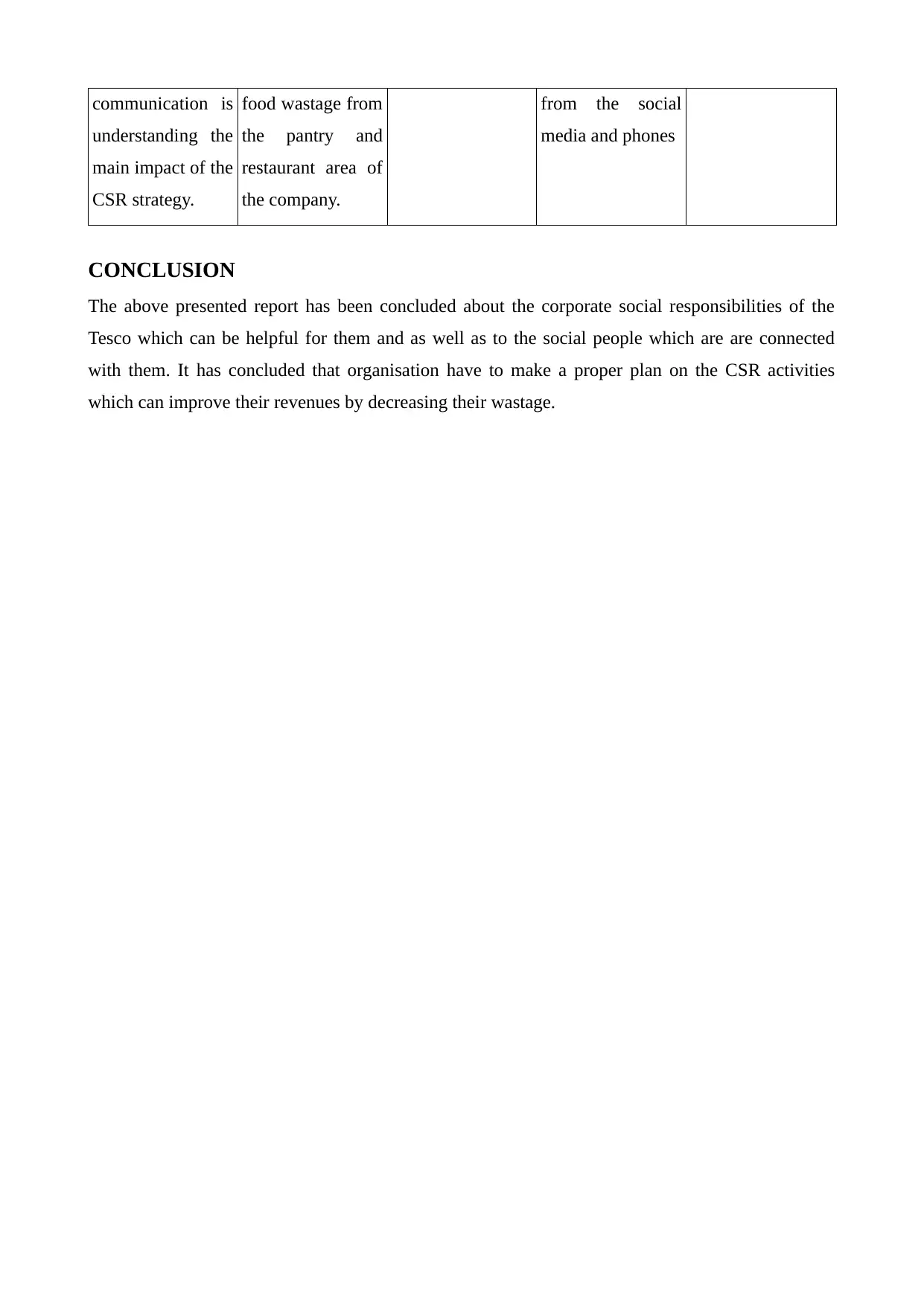
communication is
understanding the
main impact of the
CSR strategy.
food wastage from
the pantry and
restaurant area of
the company.
from the social
media and phones
CONCLUSION
The above presented report has been concluded about the corporate social responsibilities of the
Tesco which can be helpful for them and as well as to the social people which are are connected
with them. It has concluded that organisation have to make a proper plan on the CSR activities
which can improve their revenues by decreasing their wastage.
understanding the
main impact of the
CSR strategy.
food wastage from
the pantry and
restaurant area of
the company.
from the social
media and phones
CONCLUSION
The above presented report has been concluded about the corporate social responsibilities of the
Tesco which can be helpful for them and as well as to the social people which are are connected
with them. It has concluded that organisation have to make a proper plan on the CSR activities
which can improve their revenues by decreasing their wastage.
REFERENCES
Books and Journals
Alegre, J., Sengupta, K. and Lapiedra, R., 2013. Knowledge management and innovation
performance in a high-tech SMEs industry. International Small Business Journal. 31(4).
pp.454-470.
Bhattacharya, C. B., Korschun, D. and Sen, S., 2009. Strengthening stakeholder–company
relationships through mutually beneficial corporate social responsibility initiatives. Journal
of Business Ethics. 85. pp.257-272.
Brammer, S., Hoejmose, S. and Marchant, K., 2012. Environmental management in SMEs in the
UK: practices, pressures and perceived benefits. Business Strategy and the Environment.
21(7). pp.423-434.
Bridge, S. and O'Neill, K., 2012. Understanding enterprise: entrepreneurship and small business.
Palgrave Macmillan.
Brinckmann, J., Grichnik, D. and Kapsa, D., 2010. Should entrepreneurs plan or just storm the
castle? A meta-analysis on contextual factors impacting the business planning–
performance relationship in small firms. Journal of Business Venturing. 25(1). pp.24-40.
Burns, P., 2010. Entrepreneurship and Small Business: Start-up. Growth and Maturity. Palgrave
Macmillan.
Fassin, Y., Van Rossem, A. and Buelens, M., 2011. Small-business owner-managers’ perceptions of
business ethics and CSR-related concepts. Journal of Business ethics. 98(3). pp.425-453.
Frey, N. and George, R., 2010. Responsible tourism management: The missing link between
business owners' attitudes and behaviour in the Cape Town tourism industry. Tourism
management. 31(5). pp.621-628.
Heller Baird, C. and Parasnis, G., 2011. From social media to social customer relationship
management. Strategy & leadership. 39(5). pp.30-37.
Herbane, B., 2010. Small business research: Time for a crisis-based view. International Small
Business Journal. 28(1). pp.43-64.
Hotho, S. and Champion, K., 2011. Small businesses in the new creative industries: innovation as a
people management challenge. Management Decision. 49(1). pp.29-54.
Hu, Q., Dinev, T., Hart, P. and Cooke, D., 2012. Managing employee compliance with information
security policies: The critical role of top management and organizational culture. Decision
Sciences. 43(4). pp.615-660.
Kariv, D., 2010. The role of management strategies in business performance: men and women
entrepreneurs managing creativity and innovation. International Journal of
Entrepreneurship and Small Business. 9(3). pp.243-263.
Malhotra, R. and Temponi, C., 2010. Critical decisions for ERP integration: Small business issues.
International Journal of Information Management. 30(1). pp.28-37.
Michaelidou, N., Siamagka, N. T. and Christodoulides, G., 2011. Usage, barriers and measurement
of social media marketing: An exploratory investigation of small and medium B2B brands.
Industrial marketing management. 40(7). pp.1153-1159.
Seok Sohn, Y., Han, J. K. and Lee, S. H., 2012. Communication strategies for enhancing perceived
fit in the CSR sponsorship context. International Journal of Advertising. 31(1). pp.133-
146.
Smith, W. K., Binns, A. and Tushman, M. L., 2010. Complex business models: Managing strategic
paradoxes simultaneously. Long range planning. 43(2). pp.448-461.
Stokes, D., Wilson, N. and Wilson, N., 2010. Small business management and entrepreneurship.
Cengage Learning EMEA.
Storey, D. J., 2016. Understanding the small business sector. Routledge.
Terziovski, M., 2010. Innovation practice and its performance implications in small and medium
enterprises (SMEs) in the manufacturing sector: a resource‐based view. Strategic
Management Journal. 31(8). pp.892-902.
Books and Journals
Alegre, J., Sengupta, K. and Lapiedra, R., 2013. Knowledge management and innovation
performance in a high-tech SMEs industry. International Small Business Journal. 31(4).
pp.454-470.
Bhattacharya, C. B., Korschun, D. and Sen, S., 2009. Strengthening stakeholder–company
relationships through mutually beneficial corporate social responsibility initiatives. Journal
of Business Ethics. 85. pp.257-272.
Brammer, S., Hoejmose, S. and Marchant, K., 2012. Environmental management in SMEs in the
UK: practices, pressures and perceived benefits. Business Strategy and the Environment.
21(7). pp.423-434.
Bridge, S. and O'Neill, K., 2012. Understanding enterprise: entrepreneurship and small business.
Palgrave Macmillan.
Brinckmann, J., Grichnik, D. and Kapsa, D., 2010. Should entrepreneurs plan or just storm the
castle? A meta-analysis on contextual factors impacting the business planning–
performance relationship in small firms. Journal of Business Venturing. 25(1). pp.24-40.
Burns, P., 2010. Entrepreneurship and Small Business: Start-up. Growth and Maturity. Palgrave
Macmillan.
Fassin, Y., Van Rossem, A. and Buelens, M., 2011. Small-business owner-managers’ perceptions of
business ethics and CSR-related concepts. Journal of Business ethics. 98(3). pp.425-453.
Frey, N. and George, R., 2010. Responsible tourism management: The missing link between
business owners' attitudes and behaviour in the Cape Town tourism industry. Tourism
management. 31(5). pp.621-628.
Heller Baird, C. and Parasnis, G., 2011. From social media to social customer relationship
management. Strategy & leadership. 39(5). pp.30-37.
Herbane, B., 2010. Small business research: Time for a crisis-based view. International Small
Business Journal. 28(1). pp.43-64.
Hotho, S. and Champion, K., 2011. Small businesses in the new creative industries: innovation as a
people management challenge. Management Decision. 49(1). pp.29-54.
Hu, Q., Dinev, T., Hart, P. and Cooke, D., 2012. Managing employee compliance with information
security policies: The critical role of top management and organizational culture. Decision
Sciences. 43(4). pp.615-660.
Kariv, D., 2010. The role of management strategies in business performance: men and women
entrepreneurs managing creativity and innovation. International Journal of
Entrepreneurship and Small Business. 9(3). pp.243-263.
Malhotra, R. and Temponi, C., 2010. Critical decisions for ERP integration: Small business issues.
International Journal of Information Management. 30(1). pp.28-37.
Michaelidou, N., Siamagka, N. T. and Christodoulides, G., 2011. Usage, barriers and measurement
of social media marketing: An exploratory investigation of small and medium B2B brands.
Industrial marketing management. 40(7). pp.1153-1159.
Seok Sohn, Y., Han, J. K. and Lee, S. H., 2012. Communication strategies for enhancing perceived
fit in the CSR sponsorship context. International Journal of Advertising. 31(1). pp.133-
146.
Smith, W. K., Binns, A. and Tushman, M. L., 2010. Complex business models: Managing strategic
paradoxes simultaneously. Long range planning. 43(2). pp.448-461.
Stokes, D., Wilson, N. and Wilson, N., 2010. Small business management and entrepreneurship.
Cengage Learning EMEA.
Storey, D. J., 2016. Understanding the small business sector. Routledge.
Terziovski, M., 2010. Innovation practice and its performance implications in small and medium
enterprises (SMEs) in the manufacturing sector: a resource‐based view. Strategic
Management Journal. 31(8). pp.892-902.
⊘ This is a preview!⊘
Do you want full access?
Subscribe today to unlock all pages.
Trusted by 1+ million students worldwide

1 out of 13


Related Documents


Your All-in-One AI-Powered Toolkit for Academic Success.
+13062052269
info@desklib.com
Available 24*7 on WhatsApp / Email
![[object Object]](/_next/static/media/star-bottom.7253800d.svg)
Unlock your academic potential
Copyright © 2020–2026 A2Z Services. All Rights Reserved. Developed and managed by ZUCOL.