Consultancy Report: Tesco's Cultural Change Implementation
VerifiedAdded on 2019/12/04
|20
|7051
|481
Report
AI Summary
This consultancy report provides an in-depth analysis of Tesco's cultural change initiatives. It begins with an introduction highlighting the importance of change management in the retail sector and specifically focuses on Tesco's need for cultural transformation. The report identifies challenges related to cultural diversity and its impact on employee satisfaction and customer service. Part A examines Tesco's current situation, including its declining sales and the need for increased transparency. It outlines a proposed cultural change process, detailing eight key stages, and highlights the significance of employee involvement. Part B justifies the use of the Schein cultural triangle model for implementing change and evaluates other relevant tools. The report concludes by emphasizing the benefits of cultural change for Tesco, including improved employee relations, customer satisfaction, and overall business performance. The report utilizes figures and references to support its analysis.
CONSULTANCY REPORT

Paraphrase This Document
Need a fresh take? Get an instant paraphrase of this document with our AI Paraphraser
TABLE OF CONTENTS
Introduction..........................................................................................................................................
Part A....................................................................................................................................................
Selection of company which has available data..........................................................................1
Change management scenario.....................................................................................................2
Cultural change process...............................................................................................................3
Functions of culture within Tesco...............................................................................................7
Cultural challenges and problems of Tesco.................................................................................8
Tesco failing for cultural change process....................................................................................9
End results..................................................................................................................................10
Part B..................................................................................................................................................
Justification of Schein Cultural triangle model for implementing the change process in Tesco
...................................................................................................................................................11
Evaluation of other tools and showing how the work has supported........................................12
Conclusion..........................................................................................................................................
References..........................................................................................................................................
Introduction..........................................................................................................................................
Part A....................................................................................................................................................
Selection of company which has available data..........................................................................1
Change management scenario.....................................................................................................2
Cultural change process...............................................................................................................3
Functions of culture within Tesco...............................................................................................7
Cultural challenges and problems of Tesco.................................................................................8
Tesco failing for cultural change process....................................................................................9
End results..................................................................................................................................10
Part B..................................................................................................................................................
Justification of Schein Cultural triangle model for implementing the change process in Tesco
...................................................................................................................................................11
Evaluation of other tools and showing how the work has supported........................................12
Conclusion..........................................................................................................................................
References..........................................................................................................................................
LIST OF FIGURES
Figure 1: The cultural change process.............................................................................................4
Figure 1: The cultural change process.............................................................................................4
⊘ This is a preview!⊘
Do you want full access?
Subscribe today to unlock all pages.

Trusted by 1+ million students worldwide
INTRODUCTION
In the present scenario, changes at regular intervals has become very important for
businesses. Further, it can be stated that management of change is not an easy tasks for managers
and they are required to deal with lots of issues and challenges (Ng and et.al, 2012). The present
consultancy report is based on Tesco which is one of the leading retail supermarket chain having
it’s headquarter in UK. It can be stated that people from different cultural and social background
are employed in the organization. The present study depicts a cultural change scenario which is
related to Tesco. Along with this, it also highlights the entire process of transformation that will
be used in retail supermarket chain. The suggested changes will help in developing a culture
which promotes harmony and equality at workplace. Further, study entails about the Schein
model of culture which consist of three different layers about the cultural aspects of a business
enterprise. On the basis of this model, researcher aims at making in-depth analysis about the
cultural prospect of Tesco which is failing to address the needs and wants of company in terms of
satisfying the customers as well employees needs and wants.
PART A
Selection of company which has available data
Tesco is a renowned brand in retail supermarket chain of UK and at present it is operating
with a workforce of more than 500000 employees. It can be expressed that the brand was started
by a mission to lead the market by becoming a champion for all its customers. Along with this,
Tesco always seeks for developing and offering products which can enhance quality of life of
people. The retailer and its employees has put lots of efforts in developing Tesco as a leading
brand in entire marketplace. In the year 2015, the group sales was accounted to £69.7bn and its
trading profit was £1.4bn (Annual Report and Financial Statements, 2015). The total number of
Tesco stores all across the world is 7817. However, it can be argued that in last few years, the
sales and profitability of Tesco has witnessed constant declining. At present the brand is focusing
on resolving the key issues or challenges which it is facing. On the other side of this, it is seeking
for the ways through it can lower down its debt of £(22)bn. In order to improve its sales and
existing market position, the retailer is also looking forward to develop more transparency and
trust among its customers. Further, Tesco has well taken care of environment and society at the
time of carrying out its operations in the global business environment.
1
In the present scenario, changes at regular intervals has become very important for
businesses. Further, it can be stated that management of change is not an easy tasks for managers
and they are required to deal with lots of issues and challenges (Ng and et.al, 2012). The present
consultancy report is based on Tesco which is one of the leading retail supermarket chain having
it’s headquarter in UK. It can be stated that people from different cultural and social background
are employed in the organization. The present study depicts a cultural change scenario which is
related to Tesco. Along with this, it also highlights the entire process of transformation that will
be used in retail supermarket chain. The suggested changes will help in developing a culture
which promotes harmony and equality at workplace. Further, study entails about the Schein
model of culture which consist of three different layers about the cultural aspects of a business
enterprise. On the basis of this model, researcher aims at making in-depth analysis about the
cultural prospect of Tesco which is failing to address the needs and wants of company in terms of
satisfying the customers as well employees needs and wants.
PART A
Selection of company which has available data
Tesco is a renowned brand in retail supermarket chain of UK and at present it is operating
with a workforce of more than 500000 employees. It can be expressed that the brand was started
by a mission to lead the market by becoming a champion for all its customers. Along with this,
Tesco always seeks for developing and offering products which can enhance quality of life of
people. The retailer and its employees has put lots of efforts in developing Tesco as a leading
brand in entire marketplace. In the year 2015, the group sales was accounted to £69.7bn and its
trading profit was £1.4bn (Annual Report and Financial Statements, 2015). The total number of
Tesco stores all across the world is 7817. However, it can be argued that in last few years, the
sales and profitability of Tesco has witnessed constant declining. At present the brand is focusing
on resolving the key issues or challenges which it is facing. On the other side of this, it is seeking
for the ways through it can lower down its debt of £(22)bn. In order to improve its sales and
existing market position, the retailer is also looking forward to develop more transparency and
trust among its customers. Further, Tesco has well taken care of environment and society at the
time of carrying out its operations in the global business environment.
1
Paraphrase This Document
Need a fresh take? Get an instant paraphrase of this document with our AI Paraphraser
Change management scenario
Looking at the current environment of retail sector, change is considered as the integral
part of business enterprises. There are several firms that are operating in this sector and making
valiant efforts to cope up with the market conditions to maintain its presence. In particular to
large enterprise of retail sector of UK i.e. Tesco, Sainsbury, Nectar etc. always focus on bringing
change within the approach to address the needs of market in better way (Langley and et.al,
2013). Herein, cultural change is one of the major issues that affects the course of companies to a
great extent. However, dealing in such a large market which target wide range of people of
different cultural prospects thus, requires for the organisation to mold its functioning
accordingly. Tesco operating in different parts of the world have to deal with people from
different ethnic background. The employees of the company are from different societies which
makes their nature, thinking and other demographic characteristics different from others.
Managing cultural differences is one of the biggest problem that Tesco often come across. In this
senior authority of Tesco emphasis on bringing change within the cultural process so that firm
can deal with the needs and expectations of internal and external stakeholders in adequate
manner (Kuipers and et.al, 2014).
In the competitive environment, companies have to change themselves as per the
requirement of market. While doing so certain problems and issues that impedes the functioning
of business. But change is considered as necessary in the current working environment because it
assist the course of companies like Tesco, Sainsbury etc. to maintain their level of satisfaction
among the target market as well as influence more people to become consumers of the company.
However, wide range of outlets in different parts of the world, cultural obstruction is one the
biggest problems from which Tesco is negatively affected. Looking at the sales and profit
performance of recent past it can be said that the strategies or tactics employed by the senior
managers are incapable in generating desired level of outcome due to which it negatively
affecting the overall functioning (Pasqual and de Weck, 2012). In this regard, culture can be a
major point of concern for the management as they would be facing varied issues and problems
in dealing with people of different social life which indeed leads to unsatisfied either customer or
employees. Considering this scenario, it is important for the senior authority of Tesco to make
sure that they think of cultural change process as it will assist them in addressing the problems
and issues related to ethnicity and understanding of customer’s needs and wants. Furthermore,
2
Looking at the current environment of retail sector, change is considered as the integral
part of business enterprises. There are several firms that are operating in this sector and making
valiant efforts to cope up with the market conditions to maintain its presence. In particular to
large enterprise of retail sector of UK i.e. Tesco, Sainsbury, Nectar etc. always focus on bringing
change within the approach to address the needs of market in better way (Langley and et.al,
2013). Herein, cultural change is one of the major issues that affects the course of companies to a
great extent. However, dealing in such a large market which target wide range of people of
different cultural prospects thus, requires for the organisation to mold its functioning
accordingly. Tesco operating in different parts of the world have to deal with people from
different ethnic background. The employees of the company are from different societies which
makes their nature, thinking and other demographic characteristics different from others.
Managing cultural differences is one of the biggest problem that Tesco often come across. In this
senior authority of Tesco emphasis on bringing change within the cultural process so that firm
can deal with the needs and expectations of internal and external stakeholders in adequate
manner (Kuipers and et.al, 2014).
In the competitive environment, companies have to change themselves as per the
requirement of market. While doing so certain problems and issues that impedes the functioning
of business. But change is considered as necessary in the current working environment because it
assist the course of companies like Tesco, Sainsbury etc. to maintain their level of satisfaction
among the target market as well as influence more people to become consumers of the company.
However, wide range of outlets in different parts of the world, cultural obstruction is one the
biggest problems from which Tesco is negatively affected. Looking at the sales and profit
performance of recent past it can be said that the strategies or tactics employed by the senior
managers are incapable in generating desired level of outcome due to which it negatively
affecting the overall functioning (Pasqual and de Weck, 2012). In this regard, culture can be a
major point of concern for the management as they would be facing varied issues and problems
in dealing with people of different social life which indeed leads to unsatisfied either customer or
employees. Considering this scenario, it is important for the senior authority of Tesco to make
sure that they think of cultural change process as it will assist them in addressing the problems
and issues related to ethnicity and understanding of customer’s needs and wants. Furthermore,
2

implementation cultural change process would assist the senior authority in motivating the
employees to work hard and long. Along with this, enhance their level of ability to understand
the expectations of customers and accordingly dealing with them to provide utmost level of
satisfaction (Clement, 2012).
Cultural change process
It can be stated that the implementation of cultural change process will not be an easy
task for managers of Tesco. It is a well-known fact that culture of a business enterprise shapes
response of its employee and staff members. Along with this, it can be expressed that culture also
play very important role in attracting customers and increasing sales. Nowadays, people do not
prefer to visit and buy products from supermarket where disrespect and conflicts between
employees is very common phenomenon (Diener and et.al, 2014). In order to change its current
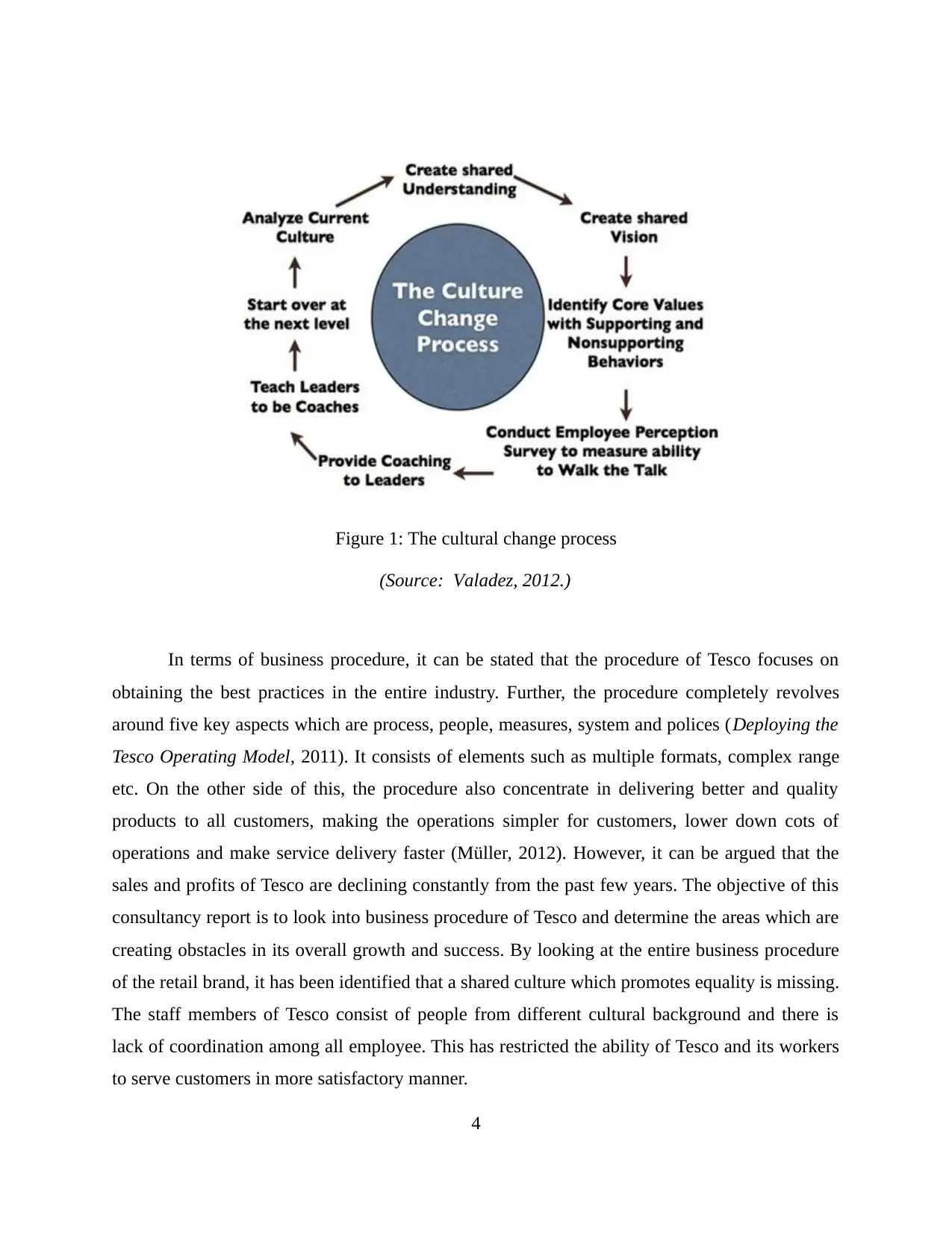
culture, Tesco will be required to adopt a proper cultural change process which consists of eight
major stages. In the first stage the brand will need to develop a share understanding between all
its workers which belong to different cultural backgrounds. The second stage is the one in which
vision regarding cultural change will be developed and shared among staff members. Tesco is
going to determine its core values that will support the entire process of change. In the fourth
stage, the brand will need to carry out employee survey identify the reaction of people towards
purposed cultural change (Raghavan and Khaligh, 2012). In the entire change process, providing
coaching to leaders in order to manage changes will be an important stage.
3
employees to work hard and long. Along with this, enhance their level of ability to understand
the expectations of customers and accordingly dealing with them to provide utmost level of
satisfaction (Clement, 2012).
Cultural change process
It can be stated that the implementation of cultural change process will not be an easy
task for managers of Tesco. It is a well-known fact that culture of a business enterprise shapes
response of its employee and staff members. Along with this, it can be expressed that culture also
play very important role in attracting customers and increasing sales. Nowadays, people do not
prefer to visit and buy products from supermarket where disrespect and conflicts between
employees is very common phenomenon (Diener and et.al, 2014). In order to change its current
culture, Tesco will be required to adopt a proper cultural change process which consists of eight
major stages. In the first stage the brand will need to develop a share understanding between all
its workers which belong to different cultural backgrounds. The second stage is the one in which
vision regarding cultural change will be developed and shared among staff members. Tesco is
going to determine its core values that will support the entire process of change. In the fourth
stage, the brand will need to carry out employee survey identify the reaction of people towards
purposed cultural change (Raghavan and Khaligh, 2012). In the entire change process, providing
coaching to leaders in order to manage changes will be an important stage.
3
⊘ This is a preview!⊘
Do you want full access?
Subscribe today to unlock all pages.
Trusted by 1+ million students worldwide
In terms of business procedure, it can be stated that the procedure of Tesco focuses on
obtaining the best practices in the entire industry. Further, the procedure completely revolves
around five key aspects which are process, people, measures, system and polices (Deploying the
Tesco Operating Model, 2011). It consists of elements such as multiple formats, complex range
etc. On the other side of this, the procedure also concentrate in delivering better and quality
products to all customers, making the operations simpler for customers, lower down cots of
operations and make service delivery faster (Müller, 2012). However, it can be argued that the
sales and profits of Tesco are declining constantly from the past few years. The objective of this
consultancy report is to look into business procedure of Tesco and determine the areas which are
creating obstacles in its overall growth and success. By looking at the entire business procedure
of the retail brand, it has been identified that a shared culture which promotes equality is missing.
The staff members of Tesco consist of people from different cultural background and there is
lack of coordination among all employee. This has restricted the ability of Tesco and its workers
to serve customers in more satisfactory manner.
4
Figure 1: The cultural change process
(Source: Valadez, 2012.)
obtaining the best practices in the entire industry. Further, the procedure completely revolves
around five key aspects which are process, people, measures, system and polices (Deploying the
Tesco Operating Model, 2011). It consists of elements such as multiple formats, complex range
etc. On the other side of this, the procedure also concentrate in delivering better and quality
products to all customers, making the operations simpler for customers, lower down cots of
operations and make service delivery faster (Müller, 2012). However, it can be argued that the
sales and profits of Tesco are declining constantly from the past few years. The objective of this
consultancy report is to look into business procedure of Tesco and determine the areas which are
creating obstacles in its overall growth and success. By looking at the entire business procedure
of the retail brand, it has been identified that a shared culture which promotes equality is missing.
The staff members of Tesco consist of people from different cultural background and there is
lack of coordination among all employee. This has restricted the ability of Tesco and its workers
to serve customers in more satisfactory manner.
4
Figure 1: The cultural change process
(Source: Valadez, 2012.)
Paraphrase This Document
Need a fresh take? Get an instant paraphrase of this document with our AI Paraphraser

The rationale behind purposed cultural change is that it will help the brand to develop a
strong culture which encourages respect and equality among all staff members. The competition
among retail supermarket has become so intense that it is very challenging task for businesses to
enhance their market share and retain their customers. In order to gain competitive advantage
over other market players, the brand is required to have a team of highly skilled and productive
employees. The initiation of cultural change will result in lowering down issues such as
discrimination and inequality among employees. It will also enhance the ability of Tesco to serve
its customers with more accurate and satisfactory products and services. The results of this is
going to be increase in sales and profits as the organization will have large customer base of
satisfied employees. At the time of carrying out the entire process of change views and opinions
of employees will be taken into consideration. Furthermore, they will be encouraged to take
active participation in the cultural change process. This is going to develop a strong bond among
employees of retail supermarkets and a long term relation between them. Thus, it can be
expressed that the initiation of cultural change process is going to be very beneficial for Tesco.
The key stages involved in cultural change process are mentioned below as:
Stage 1: It is defined as the first stage in the process of cultural change and herein
business are required to carry out evaluation of its current culture and performance
(Jewell, Moore and Goldstein, 2013). After carrying out the evaluation of Tesco, it has
been observed that the rate of customer satisfaction has declined along with fall in sales
and profits. The organizational culture also encourages inequality and discrimination
among staff members.
Stage 2: In this stage of cultural change process, companies are required to formulate
vision behind carrying out entire change. In terms of Tesco, it can be stated that the
entire vision will seek for improvement in areas such as customer satisfaction rate, sales
and profits. In addition to this, the brand will be also required to communicate the fact
that how the areas which are lacking are going to be improved by combine efforts of all
employees.
Stage 3: This stage is related to clarifying values of change and getting aware about the
expected behavior of all employees (Miles and Sullivan, 2012). In terms of Tesco, it can
be expressed that it might be possible that some workers behave in negative sense
towards the entire change management process. The brand will also need to develop
5
strong culture which encourages respect and equality among all staff members. The competition
among retail supermarket has become so intense that it is very challenging task for businesses to
enhance their market share and retain their customers. In order to gain competitive advantage
over other market players, the brand is required to have a team of highly skilled and productive
employees. The initiation of cultural change will result in lowering down issues such as
discrimination and inequality among employees. It will also enhance the ability of Tesco to serve
its customers with more accurate and satisfactory products and services. The results of this is
going to be increase in sales and profits as the organization will have large customer base of
satisfied employees. At the time of carrying out the entire process of change views and opinions
of employees will be taken into consideration. Furthermore, they will be encouraged to take
active participation in the cultural change process. This is going to develop a strong bond among
employees of retail supermarkets and a long term relation between them. Thus, it can be
expressed that the initiation of cultural change process is going to be very beneficial for Tesco.
The key stages involved in cultural change process are mentioned below as:
Stage 1: It is defined as the first stage in the process of cultural change and herein
business are required to carry out evaluation of its current culture and performance
(Jewell, Moore and Goldstein, 2013). After carrying out the evaluation of Tesco, it has
been observed that the rate of customer satisfaction has declined along with fall in sales
and profits. The organizational culture also encourages inequality and discrimination
among staff members.
Stage 2: In this stage of cultural change process, companies are required to formulate
vision behind carrying out entire change. In terms of Tesco, it can be stated that the
entire vision will seek for improvement in areas such as customer satisfaction rate, sales
and profits. In addition to this, the brand will be also required to communicate the fact
that how the areas which are lacking are going to be improved by combine efforts of all
employees.
Stage 3: This stage is related to clarifying values of change and getting aware about the
expected behavior of all employees (Miles and Sullivan, 2012). In terms of Tesco, it can
be expressed that it might be possible that some workers behave in negative sense
towards the entire change management process. The brand will also need to develop
5
appropriate strategies in order to influence behavior of people in positive sense.
Stage 4: Organizations in this stage are required to clarify their strategic priorities in
terms of entire cultural change management process. Tesco is required to enhance its
existing performance which is constantly declining from last few years.
Stage 5: It is the stage where businesses needs to engage its team members in formulation
of objectives which are SMART. In this stage, Tesco needs to encourage employee to take
part in the process of formulating strategy and developing objectives to enhance its
existing performance. Further, SMART objectives can be increasing sales by 5% in next
6 months, opening 10 new stores in different locations of the country etc.
Stage 6: In this stage, businesses are required to deal with elements such as clarifying and
tracking of key measures to be taken. Tesco can developed effective systems to track
performance and develop an appropriate metric which should be unifying in nature.
Stage 7: It is the stage which deals with developing and managing a system which always
seeks for achieving priorities and goals of the organizations. Tesco will be required to
make sure that
Stage 8: It is the second last stage of change management process, Tesco needs to
develop effective process of communication in order to obtain suitable results of change.
This stage will also play very important role in addressing the doubts, concern and
queries of employees.
Stage 9: It is the last stage in the entire process of cultural change management where the
brand will be required to focus on motivating employees to get the best possible
outcomes of changes made. Along with this, it will also assist employees in coping up
with change.
Above defined are the 9 significant stage of culture change process that top level
management of Tesco needs to undertake while bringing the so as to make sure that changes are
implemented in reliable and suitable manner as well as positive results are derived from it.
Furthermore, need of change is inevitable and company like Tesco who is operating in one of the
most competitive sector of the world thus, requires to bring change within the functioning with
emerging trends. In doing so company will be able to maintain the satisfaction level of customers
as well as influence them to buy the products and services of Tesco for generating higher
revenues and profits.
6
Stage 4: Organizations in this stage are required to clarify their strategic priorities in
terms of entire cultural change management process. Tesco is required to enhance its
existing performance which is constantly declining from last few years.
Stage 5: It is the stage where businesses needs to engage its team members in formulation
of objectives which are SMART. In this stage, Tesco needs to encourage employee to take
part in the process of formulating strategy and developing objectives to enhance its
existing performance. Further, SMART objectives can be increasing sales by 5% in next
6 months, opening 10 new stores in different locations of the country etc.
Stage 6: In this stage, businesses are required to deal with elements such as clarifying and
tracking of key measures to be taken. Tesco can developed effective systems to track
performance and develop an appropriate metric which should be unifying in nature.
Stage 7: It is the stage which deals with developing and managing a system which always
seeks for achieving priorities and goals of the organizations. Tesco will be required to
make sure that
Stage 8: It is the second last stage of change management process, Tesco needs to
develop effective process of communication in order to obtain suitable results of change.
This stage will also play very important role in addressing the doubts, concern and
queries of employees.
Stage 9: It is the last stage in the entire process of cultural change management where the
brand will be required to focus on motivating employees to get the best possible
outcomes of changes made. Along with this, it will also assist employees in coping up
with change.
Above defined are the 9 significant stage of culture change process that top level
management of Tesco needs to undertake while bringing the so as to make sure that changes are
implemented in reliable and suitable manner as well as positive results are derived from it.
Furthermore, need of change is inevitable and company like Tesco who is operating in one of the
most competitive sector of the world thus, requires to bring change within the functioning with
emerging trends. In doing so company will be able to maintain the satisfaction level of customers
as well as influence them to buy the products and services of Tesco for generating higher
revenues and profits.
6
⊘ This is a preview!⊘
Do you want full access?
Subscribe today to unlock all pages.
Trusted by 1+ million students worldwide
Functions of culture within Tesco
At the initiation of Tesco, it has the culture of being a company that offers cheap
affordable wide range products under one roof. The main reason behind this was Sir Jack Cohen
(the founder of Tesco) always like buy products in bulk thus, makes the vision of selling the
products of superior quality at affordable prices (Fullan, 2014). According to this though, vision
of the company was “pile it high and sell it cheap”. But with the change in time and level of
business operations of Tesco, management has been focusing on offering quality of products to
all type customers from low income to high with penetrating to premium pricing strategy. It is
important for the Tesco to transform its approach because it will help it to maintain its position
within the environment like UK for long period.
Looking at the issues and problems that Tesco is facing it has become essential for the
firm to bring change within its approach so as to justify the defined core values and achieve them
with more integration of rights tactics. For changing the organisational culture or employing the
cultural change process within the Tesco is not as huge tasks as the level of enterprise is. It is
because of the fact that since it consist of multicultural and diversified labor force operating in
numerous branches all across the United Kingdom (Alvesson and Sveningsson, 2015). Looking
at the current organisational culture of Tesco it can be identified that, it matches the style and
comfort zone of its founder. The way employees and other associated people carry out their work
clearly demonstrate the style of management that is practiced by the Tesco’s top level brains. On
the basis of cultural prospects, Tesco hiring process is defined which mainly concentrate on
employing only those people who have the flexibility to adjust.
According to the Schein’s cultural triangle, espoused values are the public statements
about what the organisational values are all about. However, Tesco have stated different types of
core values which act as the espoused valuables and on the basis of which cited firm operates its
business (Van Wijk and et.al, 2013). In this regard, Tesco aim to play significant part in
addressing the global environmental and social concerns by the means of making partnership
with local governments and organisation. In addition to it, espoused value of Tesco is to maintain
the highest standards of corporate behavior towards everyone it works with, the communities it
touches and the environment that it impacts upon.
As per the cited model of culture, these values of Tesco are highlighted as the public
statements to showcase the contribution of the company towards its stakeholders. In context to
7
At the initiation of Tesco, it has the culture of being a company that offers cheap
affordable wide range products under one roof. The main reason behind this was Sir Jack Cohen
(the founder of Tesco) always like buy products in bulk thus, makes the vision of selling the
products of superior quality at affordable prices (Fullan, 2014). According to this though, vision
of the company was “pile it high and sell it cheap”. But with the change in time and level of
business operations of Tesco, management has been focusing on offering quality of products to
all type customers from low income to high with penetrating to premium pricing strategy. It is
important for the Tesco to transform its approach because it will help it to maintain its position
within the environment like UK for long period.
Looking at the issues and problems that Tesco is facing it has become essential for the
firm to bring change within its approach so as to justify the defined core values and achieve them
with more integration of rights tactics. For changing the organisational culture or employing the
cultural change process within the Tesco is not as huge tasks as the level of enterprise is. It is
because of the fact that since it consist of multicultural and diversified labor force operating in
numerous branches all across the United Kingdom (Alvesson and Sveningsson, 2015). Looking
at the current organisational culture of Tesco it can be identified that, it matches the style and
comfort zone of its founder. The way employees and other associated people carry out their work
clearly demonstrate the style of management that is practiced by the Tesco’s top level brains. On
the basis of cultural prospects, Tesco hiring process is defined which mainly concentrate on
employing only those people who have the flexibility to adjust.
According to the Schein’s cultural triangle, espoused values are the public statements
about what the organisational values are all about. However, Tesco have stated different types of
core values which act as the espoused valuables and on the basis of which cited firm operates its
business (Van Wijk and et.al, 2013). In this regard, Tesco aim to play significant part in
addressing the global environmental and social concerns by the means of making partnership
with local governments and organisation. In addition to it, espoused value of Tesco is to maintain
the highest standards of corporate behavior towards everyone it works with, the communities it
touches and the environment that it impacts upon.
As per the cited model of culture, these values of Tesco are highlighted as the public
statements to showcase the contribution of the company towards its stakeholders. In context to
7
Paraphrase This Document
Need a fresh take? Get an instant paraphrase of this document with our AI Paraphraser
do so, Tesco always integrate while working, as store conducts operations with high degree of
integrity and respect for the people, organisation and environment that it is associated with and it
considers this as a corporate responsibility (Cameron and Green, 2015). In addition to it,
constantly focusing on maintaining the culture which promotes growth and prosperity for the
employees make positive impact on the ways through the which it brand its products,
commercialize its operations and maintain relations with different partners across the UK.
Cultural challenges and problems of Tesco
Organisational culture reflects the working conditions, behavior of workers and their
thought process. However, it is important for Tesco to maintain its culture as it is becoming one
of the prominent issue in affecting the course of company’s entire functioning. At present, firm’s
culture is very welcoming and supporting in terms of approach to its staff members as well as to
those who are externally associated with the company like customers (Cummings and Worley,
2014). There are several challenges that related to culture that obstructing the course of Tesco in
satisfying needs and wants of both employees and customers.
According to the Schein model of organisational culture, artifacts component assist in
illustrating the factors that can become threat or challenge if not executed well by the
management of a company. In context to Tesco, being a multicultural organisation artifacts can
possess certain challenges for the managerial level people to deal with. Further, negative attitude
of and ego are considered as the two biggest threats to the Tesco’s culture which are associated
to artifacts (Oberfield, 2010). Employing almost millions of people around the globe makes life
difficult for the Board of Directors to understand the nature of people and satisfy them
accordingly.
On the other hand of this, biasness or favoritism is another big threat to work culture.
However, it is because of the fact that, problems start arising when store manager of Tesco gives
special treatment of favors few employees. These leads to increase level of demotivation within
the remaining employees and spoils the work culture. There are employees who are serving the
company from long ago needs to be given prior attention as well as motivation at regular
intervals by appreciating their efforts. Tesco employees people from different ethnic background
which create language barrier and leads to communication gap (Senge, 2014). It is important for
the management of Tesco to develop better communication platform through the means of which
employees at each level can easily interact. However, lack of communication can arise major
8
integrity and respect for the people, organisation and environment that it is associated with and it
considers this as a corporate responsibility (Cameron and Green, 2015). In addition to it,
constantly focusing on maintaining the culture which promotes growth and prosperity for the
employees make positive impact on the ways through the which it brand its products,
commercialize its operations and maintain relations with different partners across the UK.
Cultural challenges and problems of Tesco
Organisational culture reflects the working conditions, behavior of workers and their
thought process. However, it is important for Tesco to maintain its culture as it is becoming one
of the prominent issue in affecting the course of company’s entire functioning. At present, firm’s
culture is very welcoming and supporting in terms of approach to its staff members as well as to
those who are externally associated with the company like customers (Cummings and Worley,
2014). There are several challenges that related to culture that obstructing the course of Tesco in
satisfying needs and wants of both employees and customers.
According to the Schein model of organisational culture, artifacts component assist in
illustrating the factors that can become threat or challenge if not executed well by the
management of a company. In context to Tesco, being a multicultural organisation artifacts can
possess certain challenges for the managerial level people to deal with. Further, negative attitude
of and ego are considered as the two biggest threats to the Tesco’s culture which are associated
to artifacts (Oberfield, 2010). Employing almost millions of people around the globe makes life
difficult for the Board of Directors to understand the nature of people and satisfy them
accordingly.
On the other hand of this, biasness or favoritism is another big threat to work culture.
However, it is because of the fact that, problems start arising when store manager of Tesco gives
special treatment of favors few employees. These leads to increase level of demotivation within
the remaining employees and spoils the work culture. There are employees who are serving the
company from long ago needs to be given prior attention as well as motivation at regular
intervals by appreciating their efforts. Tesco employees people from different ethnic background
which create language barrier and leads to communication gap (Senge, 2014). It is important for
the management of Tesco to develop better communication platform through the means of which
employees at each level can easily interact. However, lack of communication can arise major
8
issues and hindrance towards work culture of Tesco. Furthermore, barriers in interacting to each
other effects on the functioning of each individual as they may face more problems or could take
time to resolve the issue alone. Unsatisfied employee will not be able to satisfy the customers
which directly impacts on the sales and profitability of the business and for Tesco it is the
scenario as its financial value is decreasing to a great extent in recent years (Burke, 2013).
For supermarkets, the different in cultural taste and preferences of customers poses as a
problem this is because of the reason that in UK, multi-cultural societies have expanded to a
great extent. For instance, Tesco in order to overcome this issue have started supplying halal
meat for cultures like Muslim. Growth of multi-cultural society is issue of Tesco because the
target customer’s different society are more in number as compared to British culture.
Considering the core values of Tesco, company is committed to satisfy the demand of customers
by offering multi-cultural products as per the taste and preferences (Jones, 2010).
These are some of the major challenges that Tesco plc is facing in regards to its cultural
dimension. By the means of these problems company is unable to enhance its financial position
within the market as well as facing great deal of problems in maintaining its market share within
competitive market of UK.
Tesco failing for cultural change process
Cultural change process is important to an organisation and looking the current position
of Tesco it can be easily evaluated that declining customer satisfaction and financial position
inculcate ineffectiveness of its work culture. However, only focusing on providing goods at
affordable prices is not helping the course of Tesco to maintain its position as management have
to think 360 degree for overall improvement from cultural to strategic functioning (Hayes, 2014).
On the basis of Schein cultural triangle model, the artifacts of Tesco are highlighted clearly but
on the floors not justified with the efforts employed by the workers. On the basis of issues and
challenges identified in the artifacts cultural prospects of the Tesco it is very difficult for the
senior authority to implement cultural change process which is highly integrated and complex in
terms of enhancing the functioning of business enterprise. On the other hand, another major
reason behind failing of Tesco in bring cultural change is its level of operations. Operating in
different parts of the world it is difficult to mold the functioning of each employees associated
with the firm and at times biasness and favoritism among the employees by employer’s leads to
demotivation among the remaining employees (Deploying the Tesco Operating Model. 2011).
9
other effects on the functioning of each individual as they may face more problems or could take
time to resolve the issue alone. Unsatisfied employee will not be able to satisfy the customers
which directly impacts on the sales and profitability of the business and for Tesco it is the
scenario as its financial value is decreasing to a great extent in recent years (Burke, 2013).
For supermarkets, the different in cultural taste and preferences of customers poses as a
problem this is because of the reason that in UK, multi-cultural societies have expanded to a
great extent. For instance, Tesco in order to overcome this issue have started supplying halal
meat for cultures like Muslim. Growth of multi-cultural society is issue of Tesco because the
target customer’s different society are more in number as compared to British culture.
Considering the core values of Tesco, company is committed to satisfy the demand of customers
by offering multi-cultural products as per the taste and preferences (Jones, 2010).
These are some of the major challenges that Tesco plc is facing in regards to its cultural
dimension. By the means of these problems company is unable to enhance its financial position
within the market as well as facing great deal of problems in maintaining its market share within
competitive market of UK.
Tesco failing for cultural change process
Cultural change process is important to an organisation and looking the current position
of Tesco it can be easily evaluated that declining customer satisfaction and financial position
inculcate ineffectiveness of its work culture. However, only focusing on providing goods at
affordable prices is not helping the course of Tesco to maintain its position as management have
to think 360 degree for overall improvement from cultural to strategic functioning (Hayes, 2014).
On the basis of Schein cultural triangle model, the artifacts of Tesco are highlighted clearly but
on the floors not justified with the efforts employed by the workers. On the basis of issues and
challenges identified in the artifacts cultural prospects of the Tesco it is very difficult for the
senior authority to implement cultural change process which is highly integrated and complex in
terms of enhancing the functioning of business enterprise. On the other hand, another major
reason behind failing of Tesco in bring cultural change is its level of operations. Operating in
different parts of the world it is difficult to mold the functioning of each employees associated
with the firm and at times biasness and favoritism among the employees by employer’s leads to
demotivation among the remaining employees (Deploying the Tesco Operating Model. 2011).
9
⊘ This is a preview!⊘
Do you want full access?
Subscribe today to unlock all pages.
Trusted by 1+ million students worldwide

1 out of 20


Related Documents


Your All-in-One AI-Powered Toolkit for Academic Success.
+13062052269
info@desklib.com
Available 24*7 on WhatsApp / Email
![[object Object]](/_next/static/media/star-bottom.7253800d.svg)
Unlock your academic potential
Copyright © 2020–2026 A2Z Services. All Rights Reserved. Developed and managed by ZUCOL.