Unit 12: Organizational Behavior Report on Tesco PLC
VerifiedAdded on 2021/06/08
|13
|5235
|48
Report
AI Summary
This report provides an in-depth analysis of Tesco's organizational behavior, exploring how the company's culture, politics, and power dynamics influence individual and team performance. The introduction offers a brief overview of Tesco's history, organizational structure, and its functional structure. The main body delves into the analysis of Tesco's organizational culture, referencing Charles Handy's culture theory, and how the company's values and reward systems impact employee behavior and motivation. The report also examines the influence of power within Tesco, including different power bases as defined by French and Raven, and how Tesco utilizes reward and referent power to drive employee performance. Furthermore, the report discusses the role of organizational politics, including the use of image building and compromise as political tactics. The report then critically analyzes these aspects, concluding with a discussion on the importance of organizational culture for performance. The report is contributed by a student and published on Desklib, a platform providing AI-based study tools.
Unit 12: Organizational Behavior
By Aurora Oleinik and Claudia McCarter
NOVEMBER 23, 2020
SOUTH GLOUCESTERSHIRE AND STROUD COLLEGE
By Aurora Oleinik and Claudia McCarter
NOVEMBER 23, 2020
SOUTH GLOUCESTERSHIRE AND STROUD COLLEGE

Paraphrase This Document
Need a fresh take? Get an instant paraphrase of this document with our AI Paraphraser
Unit 12: Organisational Behaviour
Aurora Oleinik and Claudia McCarter
Contents
Unit 12: Organizational Behavior 0
Introduction 2
Main Body 4
Recommendations 6
Conclusion 6
References 7
Aurora Oleinik and Claudia McCarter
Contents
Unit 12: Organizational Behavior 0
Introduction 2
Main Body 4
Recommendations 6
Conclusion 6
References 7
Unit 12: Organisational Behaviour
Aurora Oleinik and Claudia McCarter
Introduction
Tesco was set up in 1924 by Jack Cohen selling groceries from a handmade stall based in the
East end of Brixton, London. Now they are an internationally recognised company with over
450,000 employees in over 6,800 stores across the world, including Europe and China.
(Tesco Our History, 2020)
Tesco is an international supermarket which sells goods and services to meet the needs of
their customers. Tesco offers its customers a range of different goods and services which
includes food, clothing, electronics and financial services. To meet the changing demands of
customers they have also expanded their purchase options for their grocery products to
online delivery and click and collect. Tesco is a Public Limited Company (PLC) in the private
sector, this means that the business has
limited liability, with the debts being limited
to the business, it is owned by private
individuals called shareholders and Tesco’s
shares are traded on the stock exchange.
This states that their values, mission and
visions are more orientated to shape their
whole company and to meet their key
stakeholder needs. “We make what matters better, together .”, this is a catchphrase they
use. Their aims are providing a wide range of services and products by maintaining their
position as the market leader through their different departments within their stores such
as; Marketing, Finance, Human Resources and Operations. Also, by selling their products at
a low price so they can compete against their competitors such as Asda, Morrisons, etc.
Tesco earns profit by maintaining good quality products to attract customers, by keeping
their prices low this can help increase their sales revenue time by time and have a vast
number of loyal customers through their marketing skills. Tesco currently has 26.9% of
market share based by statistica. (Business Case Studies, 2020) (Statista, 2020)
Tesco has a functional organisational structure; this is where the structure is used to
organise workers as they are grouped based on their specific skills and knowledge. It is
vertically structured by each department with different roles; from president to finance and
sales departments, to customer service and to employees assigned to one product or
service.
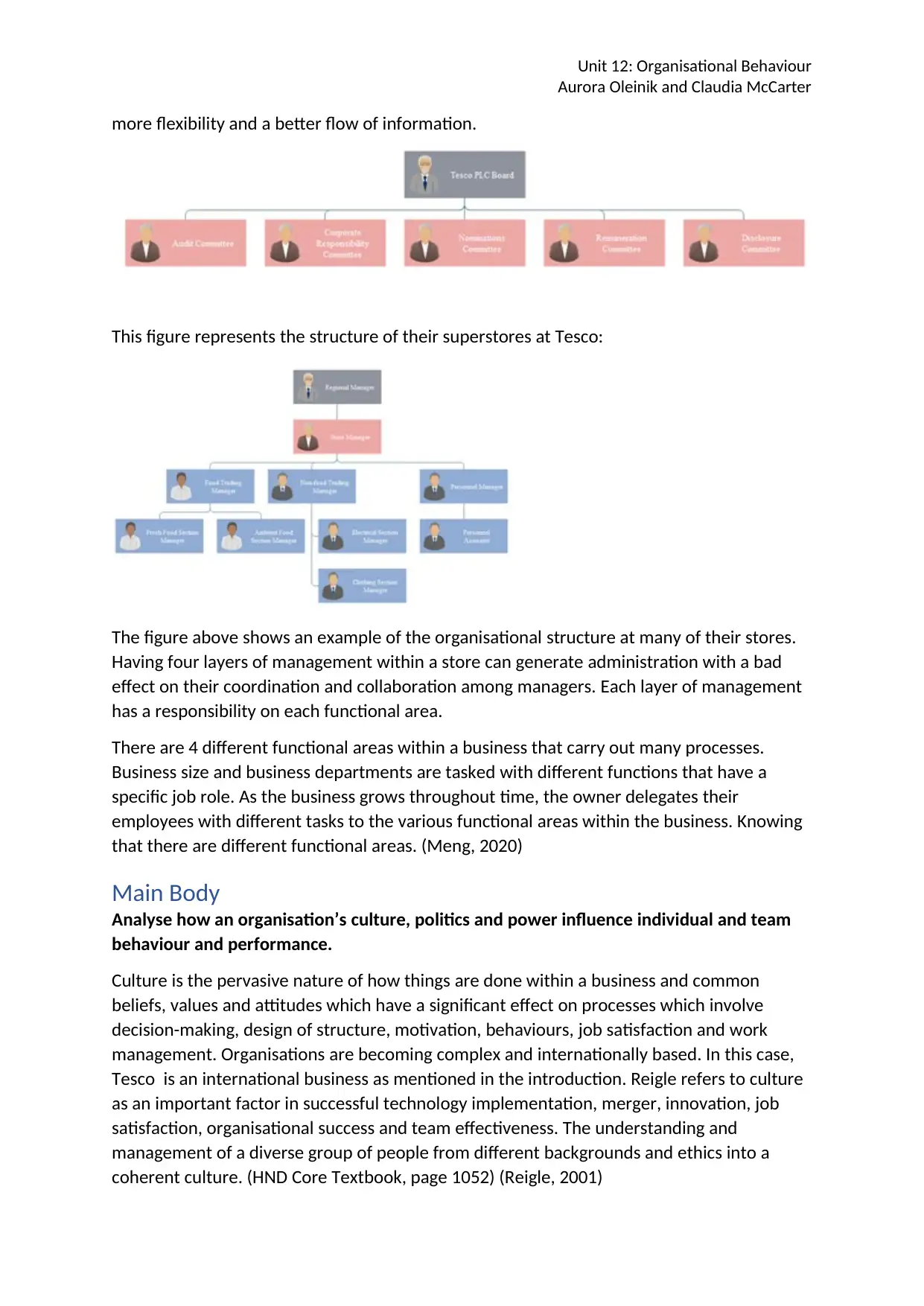
This figure represents Tesco’s PLC Board:
This pyramid shows the different authorities and responsibilities Tesco’s organisational
structure, is made with 5 different committees which report any issues to the PLC Board. As
there are 11 members within the Tesco’s Executive committee, they are led by the Chief
Executive. This organisational structure is highly showing its wide business scope. It is
suggested that reducing certain layers of management within a structure there would be
Aurora Oleinik and Claudia McCarter
Introduction
Tesco was set up in 1924 by Jack Cohen selling groceries from a handmade stall based in the
East end of Brixton, London. Now they are an internationally recognised company with over
450,000 employees in over 6,800 stores across the world, including Europe and China.
(Tesco Our History, 2020)
Tesco is an international supermarket which sells goods and services to meet the needs of
their customers. Tesco offers its customers a range of different goods and services which
includes food, clothing, electronics and financial services. To meet the changing demands of
customers they have also expanded their purchase options for their grocery products to
online delivery and click and collect. Tesco is a Public Limited Company (PLC) in the private
sector, this means that the business has
limited liability, with the debts being limited
to the business, it is owned by private
individuals called shareholders and Tesco’s
shares are traded on the stock exchange.
This states that their values, mission and
visions are more orientated to shape their
whole company and to meet their key
stakeholder needs. “We make what matters better, together .”, this is a catchphrase they
use. Their aims are providing a wide range of services and products by maintaining their
position as the market leader through their different departments within their stores such
as; Marketing, Finance, Human Resources and Operations. Also, by selling their products at
a low price so they can compete against their competitors such as Asda, Morrisons, etc.
Tesco earns profit by maintaining good quality products to attract customers, by keeping
their prices low this can help increase their sales revenue time by time and have a vast
number of loyal customers through their marketing skills. Tesco currently has 26.9% of
market share based by statistica. (Business Case Studies, 2020) (Statista, 2020)
Tesco has a functional organisational structure; this is where the structure is used to
organise workers as they are grouped based on their specific skills and knowledge. It is
vertically structured by each department with different roles; from president to finance and
sales departments, to customer service and to employees assigned to one product or
service.
This figure represents Tesco’s PLC Board:
This pyramid shows the different authorities and responsibilities Tesco’s organisational
structure, is made with 5 different committees which report any issues to the PLC Board. As
there are 11 members within the Tesco’s Executive committee, they are led by the Chief
Executive. This organisational structure is highly showing its wide business scope. It is
suggested that reducing certain layers of management within a structure there would be
⊘ This is a preview!⊘
Do you want full access?
Subscribe today to unlock all pages.

Trusted by 1+ million students worldwide
Unit 12: Organisational Behaviour
Aurora Oleinik and Claudia McCarter
more flexibility and a better flow of information.
This figure represents the structure of their superstores at Tesco:
The figure above shows an example of the organisational structure at many of their stores.
Having four layers of management within a store can generate administration with a bad
effect on their coordination and collaboration among managers. Each layer of management
has a responsibility on each functional area.
There are 4 different functional areas within a business that carry out many processes.
Business size and business departments are tasked with different functions that have a
specific job role. As the business grows throughout time, the owner delegates their
employees with different tasks to the various functional areas within the business. Knowing
that there are different functional areas. (Meng, 2020)
Main Body
Analyse how an organisation’s culture, politics and power influence individual and team
behaviour and performance.
Culture is the pervasive nature of how things are done within a business and common
beliefs, values and attitudes which have a significant effect on processes which involve
decision-making, design of structure, motivation, behaviours, job satisfaction and work
management. Organisations are becoming complex and internationally based. In this case,
Tesco is an international business as mentioned in the introduction. Reigle refers to culture
as an important factor in successful technology implementation, merger, innovation, job
satisfaction, organisational success and team effectiveness. The understanding and
management of a diverse group of people from different backgrounds and ethics into a
coherent culture. (HND Core Textbook, page 1052) (Reigle, 2001)
Aurora Oleinik and Claudia McCarter
more flexibility and a better flow of information.
This figure represents the structure of their superstores at Tesco:
The figure above shows an example of the organisational structure at many of their stores.
Having four layers of management within a store can generate administration with a bad
effect on their coordination and collaboration among managers. Each layer of management
has a responsibility on each functional area.
There are 4 different functional areas within a business that carry out many processes.
Business size and business departments are tasked with different functions that have a
specific job role. As the business grows throughout time, the owner delegates their
employees with different tasks to the various functional areas within the business. Knowing
that there are different functional areas. (Meng, 2020)
Main Body
Analyse how an organisation’s culture, politics and power influence individual and team
behaviour and performance.
Culture is the pervasive nature of how things are done within a business and common
beliefs, values and attitudes which have a significant effect on processes which involve
decision-making, design of structure, motivation, behaviours, job satisfaction and work
management. Organisations are becoming complex and internationally based. In this case,
Tesco is an international business as mentioned in the introduction. Reigle refers to culture
as an important factor in successful technology implementation, merger, innovation, job
satisfaction, organisational success and team effectiveness. The understanding and
management of a diverse group of people from different backgrounds and ethics into a
coherent culture. (HND Core Textbook, page 1052) (Reigle, 2001)
Paraphrase This Document
Need a fresh take? Get an instant paraphrase of this document with our AI Paraphraser
Unit 12: Organisational Behaviour
Aurora Oleinik and Claudia McCarter
Tesco’s culture values their business and helping to understand how to put their core
purposes into practise. They have introduced their values a decade ago which have been a
central part of their culture making sure employees at Tesco understand what is important
in order to work together as a team for their customers as they are the centre of what Tesco
are focused on. Based on Charles Handy culture theory, Tesco has a task culture, task
culture is where the teams within an organisation are created to solve problems and
progress projects. With the right skills, leadership and personalities can create a creative
and productive workforce within Tesco. (tutor2u, 2020)
Their values are to support communities across the UK to understand what more they can
do to serve their customers a little better. Tesco treats their employers and employees how
they want to be treated by looking after their colleagues in a culture of trust and respect,
which is an essential part of success at Tesco. Colleagues feel recognised and rewarded by
receiving great opportunities to get on where they are supported within their development
where they use those skills and knowledge to serve their customers with care. This increases
employee performance by recognising their needs and helping them achieve their goals to
meet business objectives. Leading them to have positive behaviour when meeting objectives
as they are responsible for their tasks. (Tesco-careers.com, 2020)
Power is the capacity of individuals to overcome resistance on the part of others to extend
their will and produce results consistently with their own interests and objectives. The
influence of power is where a leader behaves towards an employee to find out how
effectively they work as a result where they can both depend on the source of their power.
(Buchanan, D. and Huczynski, A., 2019)
In this case, Tesco is based on rewarding their employees to help them get to where they
want to be. Tesco believes that it's not what they do but how their employees do it, which it
counts as an important asset. All their employees have mutual clear objectives that directly
link their performance within their job role and living Tesco’s values through the employee’s
behaviours, by later rewarding them once they have achieved their targets. Tesco reviews
these tasks on a regular basis to make sure the right support is available to help and achieve
the employee’s goals. For example, their rewards include a bonus scheme where each year
Tesco confirms arrangements for annual bonus plans for their employees. Tesco also
provides flexible benefits where they recognise each individual working for the business
needs a variation of depending their circumstances. The flexible benefit programme allows
them to choose what’s important for them as it is all up to them and these benefits are
provided through salary sacrifice to maximise the value to their employees. Based on social
psychologists John French and Bertram Raven in the 1950's and 60’s. They have stated there
are six different types of power bases such as legitimate, reward, coercive, expert, referent
and informational. (John R P French and Raven, 1959)
Tesco uses the reward power base where results from one person’s ability is to compensate
another for compliance, this is where they rely on the ability to provide ‘rewards’ in order to
receive something back. For example, a manager has set a task for an employee to meet the
business objectives, once that task has been completed the employee will be rewarded if
they work hard, leading them with an increase of their performance and behaviour in a
Aurora Oleinik and Claudia McCarter
Tesco’s culture values their business and helping to understand how to put their core
purposes into practise. They have introduced their values a decade ago which have been a
central part of their culture making sure employees at Tesco understand what is important
in order to work together as a team for their customers as they are the centre of what Tesco
are focused on. Based on Charles Handy culture theory, Tesco has a task culture, task
culture is where the teams within an organisation are created to solve problems and
progress projects. With the right skills, leadership and personalities can create a creative
and productive workforce within Tesco. (tutor2u, 2020)
Their values are to support communities across the UK to understand what more they can
do to serve their customers a little better. Tesco treats their employers and employees how
they want to be treated by looking after their colleagues in a culture of trust and respect,
which is an essential part of success at Tesco. Colleagues feel recognised and rewarded by
receiving great opportunities to get on where they are supported within their development
where they use those skills and knowledge to serve their customers with care. This increases
employee performance by recognising their needs and helping them achieve their goals to
meet business objectives. Leading them to have positive behaviour when meeting objectives
as they are responsible for their tasks. (Tesco-careers.com, 2020)
Power is the capacity of individuals to overcome resistance on the part of others to extend
their will and produce results consistently with their own interests and objectives. The
influence of power is where a leader behaves towards an employee to find out how
effectively they work as a result where they can both depend on the source of their power.
(Buchanan, D. and Huczynski, A., 2019)
In this case, Tesco is based on rewarding their employees to help them get to where they
want to be. Tesco believes that it's not what they do but how their employees do it, which it
counts as an important asset. All their employees have mutual clear objectives that directly
link their performance within their job role and living Tesco’s values through the employee’s
behaviours, by later rewarding them once they have achieved their targets. Tesco reviews
these tasks on a regular basis to make sure the right support is available to help and achieve
the employee’s goals. For example, their rewards include a bonus scheme where each year
Tesco confirms arrangements for annual bonus plans for their employees. Tesco also
provides flexible benefits where they recognise each individual working for the business
needs a variation of depending their circumstances. The flexible benefit programme allows
them to choose what’s important for them as it is all up to them and these benefits are
provided through salary sacrifice to maximise the value to their employees. Based on social
psychologists John French and Bertram Raven in the 1950's and 60’s. They have stated there
are six different types of power bases such as legitimate, reward, coercive, expert, referent
and informational. (John R P French and Raven, 1959)
Tesco uses the reward power base where results from one person’s ability is to compensate
another for compliance, this is where they rely on the ability to provide ‘rewards’ in order to
receive something back. For example, a manager has set a task for an employee to meet the
business objectives, once that task has been completed the employee will be rewarded if
they work hard, leading them with an increase of their performance and behaviour in a
Unit 12: Organisational Behaviour
Aurora Oleinik and Claudia McCarter
positive way leading Tesco being successful at employing candidates for their personal
development. Tesco is a large international business; they have enough referent power to
employ newer candidates if the existing ones weren’t meeting their personal and business
objectives. Tesco as a business aims on helping individuals to meet their goals, instead of
being a strict business. Referent power is where leaders would adopt their employees with
the quality of relationships with others and how those relationships are built. This type of
power depends on personal traits and values, integrity, honesty and trustworthiness. There
are a lot of tasks that can be achieved through positive influence, people with high referent
power can highly influence others who admire and respect them. (Giang, 2013) Tesco has
power but they wouldn’t allow high employee turnover if the employees made one mistake,
in this case, Tesco focuses on their employee’s weaknesses to help them overcome their
‘flaws’ to change them into strengths providing them opportunities. (Tesco Underwriting,
n.d.)
Politics within an organisation is the ability to understand individuals at work, using that
knowledge to influence other employees to act in ways to enhance their personal and
organisational objectives . (Buchanan, D. and Huczynski, A., 2019.p.778 )
These types of internal politics can be negative as; damaging or unsavoury related as back-
stabbing and ‘dirty tricks. Some research has revealed the positive impacts are constructive
and ‘pro-social’ uses of political tactics for the individual’s development. A political skill is
where social intelligence is related to demonstrate situational appropriate behaviour in a
charming and engaging manner that tends to inspire trust, confidence and genuineness.
There are eleven political tactics within a business practise. Buchanam and Badham (2008)
main categories of political tactics are; imagine building, information games, structure
games, scapegoating, alliances, networking, compromise, rule games, positioning, issue
selling and dirty tricks . There are four types of factors within the drivers of political tactics
such as personal drivers, decisional drivers, structural drivers and organisational change
drivers. Tesco is a structural driver, based on the individual I have interviewed which he
previously worked at Tesco, they were a flexible business towards him where they have
offered opportunities such as bonus packs. A structural driver is where they are dependent
on the goals, priorities and perspectives of the different department functions within a
business, for example, maximising revenue such as sales, cutting costs within the finance
department, maximising outputs such as in production and improving customer satisfaction
by providing quality services and products. The individual I have interviewed has mentioned
that the business internal politics have involved image building and compromise . Image
building is where a business wants to improve their brand image by doing tasks related to
image building by pursuing public relations. Compromise is a situation where people are
involved in an argument and they try to reduce their demands in order to reach an
agreement in order to solve the problem and achieve the task. He has mentioned there was
a time a manager has set a task on ‘image building’ where he (individual I am interviewing)
had to complete the task of increasing the sales on a certain product, if he has achieved the
number of sales he had to make he would receive a reward. He didn’t achieve the sales
target so he and his manager had a meeting where they compromised on a deal, if he had
more time he could try again. He received the extra time and managed to get a larger
Aurora Oleinik and Claudia McCarter
positive way leading Tesco being successful at employing candidates for their personal
development. Tesco is a large international business; they have enough referent power to
employ newer candidates if the existing ones weren’t meeting their personal and business
objectives. Tesco as a business aims on helping individuals to meet their goals, instead of
being a strict business. Referent power is where leaders would adopt their employees with
the quality of relationships with others and how those relationships are built. This type of
power depends on personal traits and values, integrity, honesty and trustworthiness. There
are a lot of tasks that can be achieved through positive influence, people with high referent
power can highly influence others who admire and respect them. (Giang, 2013) Tesco has
power but they wouldn’t allow high employee turnover if the employees made one mistake,
in this case, Tesco focuses on their employee’s weaknesses to help them overcome their
‘flaws’ to change them into strengths providing them opportunities. (Tesco Underwriting,
n.d.)
Politics within an organisation is the ability to understand individuals at work, using that
knowledge to influence other employees to act in ways to enhance their personal and
organisational objectives . (Buchanan, D. and Huczynski, A., 2019.p.778 )
These types of internal politics can be negative as; damaging or unsavoury related as back-
stabbing and ‘dirty tricks. Some research has revealed the positive impacts are constructive
and ‘pro-social’ uses of political tactics for the individual’s development. A political skill is
where social intelligence is related to demonstrate situational appropriate behaviour in a
charming and engaging manner that tends to inspire trust, confidence and genuineness.
There are eleven political tactics within a business practise. Buchanam and Badham (2008)
main categories of political tactics are; imagine building, information games, structure
games, scapegoating, alliances, networking, compromise, rule games, positioning, issue
selling and dirty tricks . There are four types of factors within the drivers of political tactics
such as personal drivers, decisional drivers, structural drivers and organisational change
drivers. Tesco is a structural driver, based on the individual I have interviewed which he
previously worked at Tesco, they were a flexible business towards him where they have
offered opportunities such as bonus packs. A structural driver is where they are dependent
on the goals, priorities and perspectives of the different department functions within a
business, for example, maximising revenue such as sales, cutting costs within the finance
department, maximising outputs such as in production and improving customer satisfaction
by providing quality services and products. The individual I have interviewed has mentioned
that the business internal politics have involved image building and compromise . Image
building is where a business wants to improve their brand image by doing tasks related to
image building by pursuing public relations. Compromise is a situation where people are
involved in an argument and they try to reduce their demands in order to reach an
agreement in order to solve the problem and achieve the task. He has mentioned there was
a time a manager has set a task on ‘image building’ where he (individual I am interviewing)
had to complete the task of increasing the sales on a certain product, if he has achieved the
number of sales he had to make he would receive a reward. He didn’t achieve the sales
target so he and his manager had a meeting where they compromised on a deal, if he had
more time he could try again. He received the extra time and managed to get a larger
⊘ This is a preview!⊘
Do you want full access?
Subscribe today to unlock all pages.
Trusted by 1+ million students worldwide
Unit 12: Organisational Behaviour
Aurora Oleinik and Claudia McCarter
number of sales going over the target. He received a reward which motivated him to get
things done quicker without an extension. Because the manager compromised with him for
an extension, this has made him feel recognised and felt moved to carry out the task and
complete it before the deadline.
Critically analyse how the culture, politics and power of an organisation can influence
individual and team behaviour and performance.
Culture within a business, such as Tesco, is important as it is an effective ingredient for
organisational performance. Stanford suggests that culture is an intangible asset that is
distinctive to the business and adds value to it or diminishes it. Ten characteristics that form
a typical organisation culture such as stories, purpose, as set of values, attitudes towards
people, relationship network, global mindset, digital presence and customer reputation.
Stanford maintains that even if a business is strong and has a healthy culture, a business
cannot have a flawed business model as it can affect employee motivation, performance
and behaviour. If a workforce is acknowledged as happy and engaged, they can outperform
one where negativity and politics thrive. ‘Business leaders should re-evaluate the
importance of culture when embarking on any change management programme focused on
performance improvement’. (Stanford, 2010 )
If Tesco follows procedures which involves looking after their employees, it can lead to a
positive impact on their performance by meeting business and personal objectives to thrive
as a stable business. If Tesco’s management system, for example risk management is where
a process is getting identified and assessed to control any threats within an organisations
revenue. If Tesco neglects the importance of culture and treats the business as a mechanical
operation it will lead to an incompatible business, when the outcome of Tesco culture
procedures should be fundamentally focused on the way people behave and interact. This
could be a disadvantage for the employees at Tesco if they didn’t feel recognised and
accepted as an equal if managers don’t regularly check on their employees if they have met
their tasks. (Clifton. K, 2012)
Power within Tesco is structured in a functional way. Tesco’s type of use of power is
reward, and is a positive way to create engagement within the workforce to meet business
objectives such as meeting customer demands. Employees at Tesco complete tasks and
receive tangible or intangible rewards which creates a higher scale of motivation , a theory
to link to motivation within Tesco can be Maslow’s hierarchy of needs. This is where the
theory pursues on meeting needs that are fulfilled. (KnowledgeHut, 2019)
If employees were not rewarded by achieving business objectives this could lead to a less
innovative workforce leading them to not meet any business objectives. If tasks weren’t
completed as mentioned above, the responsibility of the employees will decrease leading
them by taking their job role seriously. Managers have the authority to delegate, allocate
resources, punish, reward and give orders to their subordinates, during a crisis if a
subordinate is hesitating the outcome could be disastrous. The boss gives an order and
expects compliance. If employees weren’t enjoying their job role by not being rewarded,
there is a chance of Tesco failing at employee retention. Employees will feel isolated and
this will reduce interdepartmental communication and cooperation as mentioned above.
Aurora Oleinik and Claudia McCarter
number of sales going over the target. He received a reward which motivated him to get
things done quicker without an extension. Because the manager compromised with him for
an extension, this has made him feel recognised and felt moved to carry out the task and
complete it before the deadline.
Critically analyse how the culture, politics and power of an organisation can influence
individual and team behaviour and performance.
Culture within a business, such as Tesco, is important as it is an effective ingredient for
organisational performance. Stanford suggests that culture is an intangible asset that is
distinctive to the business and adds value to it or diminishes it. Ten characteristics that form
a typical organisation culture such as stories, purpose, as set of values, attitudes towards
people, relationship network, global mindset, digital presence and customer reputation.
Stanford maintains that even if a business is strong and has a healthy culture, a business
cannot have a flawed business model as it can affect employee motivation, performance
and behaviour. If a workforce is acknowledged as happy and engaged, they can outperform
one where negativity and politics thrive. ‘Business leaders should re-evaluate the
importance of culture when embarking on any change management programme focused on
performance improvement’. (Stanford, 2010 )
If Tesco follows procedures which involves looking after their employees, it can lead to a
positive impact on their performance by meeting business and personal objectives to thrive
as a stable business. If Tesco’s management system, for example risk management is where
a process is getting identified and assessed to control any threats within an organisations
revenue. If Tesco neglects the importance of culture and treats the business as a mechanical
operation it will lead to an incompatible business, when the outcome of Tesco culture
procedures should be fundamentally focused on the way people behave and interact. This
could be a disadvantage for the employees at Tesco if they didn’t feel recognised and
accepted as an equal if managers don’t regularly check on their employees if they have met
their tasks. (Clifton. K, 2012)
Power within Tesco is structured in a functional way. Tesco’s type of use of power is
reward, and is a positive way to create engagement within the workforce to meet business
objectives such as meeting customer demands. Employees at Tesco complete tasks and
receive tangible or intangible rewards which creates a higher scale of motivation , a theory
to link to motivation within Tesco can be Maslow’s hierarchy of needs. This is where the
theory pursues on meeting needs that are fulfilled. (KnowledgeHut, 2019)
If employees were not rewarded by achieving business objectives this could lead to a less
innovative workforce leading them to not meet any business objectives. If tasks weren’t
completed as mentioned above, the responsibility of the employees will decrease leading
them by taking their job role seriously. Managers have the authority to delegate, allocate
resources, punish, reward and give orders to their subordinates, during a crisis if a
subordinate is hesitating the outcome could be disastrous. The boss gives an order and
expects compliance. If employees weren’t enjoying their job role by not being rewarded,
there is a chance of Tesco failing at employee retention. Employees will feel isolated and
this will reduce interdepartmental communication and cooperation as mentioned above.
Paraphrase This Document
Need a fresh take? Get an instant paraphrase of this document with our AI Paraphraser
Unit 12: Organisational Behaviour
Aurora Oleinik and Claudia McCarter
Each department within Tesco can become indifferent on the concerns developing tunnel
vision. Employees should put their own agendas ahead of company goals consequently that
may occur if they are not engaged in the organisation. Without feeling recognised and
provided training to carry out their job role there is a chance for the business not meeting
their objectives. To avoid any workers leaving the business, Tesco will have to recognise
their employee’s efforts and achievements by giving them rewards, this will make them feel
as an important asset to the business by meeting customer demands and business goals.
(Johnson, 2019)
Politics within a business can provide certain advantages and disadvantages. For example, as
Tesco has structural drivers where they aim on improving customer satisfaction and
increasing sales . For example, workers within Tesco work to make sure the business is
working efficiently and are meeting business objectives, by behaving well and pursuing
practises with great conduct. These objectives are met by the employees who provide these
services for the business. For example, the individual i have interviewed has received the
benefits of second chances and rewards. Depending on the functional organisation, team
members from each department within Tesco, who work with other people within the
workplace allows them to share their thoughts and knowledge to make others learn new
skills such as sharing information which might be important. Staff have the chance to get
promoted within their functional areas which can be a reason for them to stay long term.
The company is getting the advantages of their expertise and knowledge, because of
people’s expertise, the workers with specialised skills can perform their tasks quickly and
efficiently with more confidence, while reducing work-related mistakes, this can help lead
the business to operate effectively. A weakness for such a political area, there would be lack
of area coordination. This means that the functional areas can be performed in a higher
level of efficiency. There could be individuals working well with each other where there is
cooperation and compromises. Some employees may be territorial where they aren’t skilled
to cooperate, these types of unhealthy coordination can lead to delays, reduced
commitments, interests being competed, lack of time management, and getting late in
meeting the deadline of a project. This could lead to the workforce with disputes and losing
time and money. As Tesco is an international company, if a manager wasn’t taking care of
their employees within task completion, then there would be conflicts with sales,
customers, brand image and a lack of task completion. (Nathan, 2018)
Recommendations
Motivation is beneficial to Tesco as it provides personal development, increases productivity
and helps individuals within the business, work and strive towards the organisation’s
objectives and aims they are looking to achieve. There are many advantages to motivation,
however, there are also disadvantages that could have a negative impact on the
organisation. The main being, as sourced and set out by (Articles Junction Blog, July 2013),
the threats of strikes, disciplinary and strict rules can create problems in staff members and
overall for Human Resources (HR) and management. This can turn opposite to intended and
Aurora Oleinik and Claudia McCarter
Each department within Tesco can become indifferent on the concerns developing tunnel
vision. Employees should put their own agendas ahead of company goals consequently that
may occur if they are not engaged in the organisation. Without feeling recognised and
provided training to carry out their job role there is a chance for the business not meeting
their objectives. To avoid any workers leaving the business, Tesco will have to recognise
their employee’s efforts and achievements by giving them rewards, this will make them feel
as an important asset to the business by meeting customer demands and business goals.
(Johnson, 2019)
Politics within a business can provide certain advantages and disadvantages. For example, as
Tesco has structural drivers where they aim on improving customer satisfaction and
increasing sales . For example, workers within Tesco work to make sure the business is
working efficiently and are meeting business objectives, by behaving well and pursuing
practises with great conduct. These objectives are met by the employees who provide these
services for the business. For example, the individual i have interviewed has received the
benefits of second chances and rewards. Depending on the functional organisation, team
members from each department within Tesco, who work with other people within the
workplace allows them to share their thoughts and knowledge to make others learn new
skills such as sharing information which might be important. Staff have the chance to get
promoted within their functional areas which can be a reason for them to stay long term.
The company is getting the advantages of their expertise and knowledge, because of
people’s expertise, the workers with specialised skills can perform their tasks quickly and
efficiently with more confidence, while reducing work-related mistakes, this can help lead
the business to operate effectively. A weakness for such a political area, there would be lack
of area coordination. This means that the functional areas can be performed in a higher
level of efficiency. There could be individuals working well with each other where there is
cooperation and compromises. Some employees may be territorial where they aren’t skilled
to cooperate, these types of unhealthy coordination can lead to delays, reduced
commitments, interests being competed, lack of time management, and getting late in
meeting the deadline of a project. This could lead to the workforce with disputes and losing
time and money. As Tesco is an international company, if a manager wasn’t taking care of
their employees within task completion, then there would be conflicts with sales,
customers, brand image and a lack of task completion. (Nathan, 2018)
Recommendations
Motivation is beneficial to Tesco as it provides personal development, increases productivity
and helps individuals within the business, work and strive towards the organisation’s
objectives and aims they are looking to achieve. There are many advantages to motivation,
however, there are also disadvantages that could have a negative impact on the
organisation. The main being, as sourced and set out by (Articles Junction Blog, July 2013),
the threats of strikes, disciplinary and strict rules can create problems in staff members and
overall for Human Resources (HR) and management. This can turn opposite to intended and
Unit 12: Organisational Behaviour
Aurora Oleinik and Claudia McCarter
can cause demotivation amongst staff members and therefore could drastically lead to high
staff turnover, and could also lead to the business failing to meet its set objectives.
There are two motivational forces- positive and negative. They are repelled from the
negative and attracted to the positive. These forces can be both extrinsic and intrinsic.
Extrinsic is something or someone that/who is pushing you- external; and the other is a
desire, want or need pulling you- often being internal. Extrinsic motivators is the ‘brain’ and
is the outcome you get by doing the task- this can be in the form of bonuses, promotions,
benefits- monetary and tangible- pay rises. All of this can lead to increased employee
motivation as it is a driving force and a purpose for the employee. It can also cause a higher
level of productivity which in turn will allow the organisation to achieve its business aims
and objectives- increasing the success of the business. Intrinsic motivators is the interest
and enjoyment in the actual task itself. These can include such things as; A hobby, the
purpose of completing the task, passion and growth that comes with achievement.
There are multiple ways that a business is able to successfully motivate its employees. Tesco
does this through the use of conducting an employee training scheme, allowing all members
of staff to keep track of their training status and also keeping up-to-date with all training
courses. This can motivate employees because it can increase their feeling of being valued
and in turn they will want to do more for the business. Reassurance is another way of
motivating employees. By providing feedback to individuals, they will know how they can
best improve their work performance to keep track on the business objectives all members
of staff are working towards. Lastly, alongside monetary rewards, as discussed above,
increasing an employees responsibility can also be a benefit to the organisation because
this, again, increases the feeling of being valued. It is important to note that not every
motivational method is successful in motivating everybody; this is because everyone is
different and may all require different methods in increasing their productivity and
motivational levels.
There are a number of theories that individual theorists have invented in relation to
motivation and how it can be applied to an organisational context, Tesco could also consider
these and apply to how they motivate their staff members. These are ‘Hertzberg’ and
‘Adams’.
Hertzberg created a ‘Two factor’ theory. He argues that ‘there are two factors that an
organisation can adjust to influence motivation in the workplace’ (E-Book). These are
‘Motivators’ and ‘Hygiene Factors’. Motivators can encourage employees to work harder
and include things such as; Recognition, Sense of achievement and personal growth and
development. Hygiene factors will not encourage employees to work harder and can cause
demotivation. These include; Job security, relationship with colleagues and company policy
Aurora Oleinik and Claudia McCarter
can cause demotivation amongst staff members and therefore could drastically lead to high
staff turnover, and could also lead to the business failing to meet its set objectives.
There are two motivational forces- positive and negative. They are repelled from the
negative and attracted to the positive. These forces can be both extrinsic and intrinsic.
Extrinsic is something or someone that/who is pushing you- external; and the other is a
desire, want or need pulling you- often being internal. Extrinsic motivators is the ‘brain’ and
is the outcome you get by doing the task- this can be in the form of bonuses, promotions,
benefits- monetary and tangible- pay rises. All of this can lead to increased employee
motivation as it is a driving force and a purpose for the employee. It can also cause a higher
level of productivity which in turn will allow the organisation to achieve its business aims
and objectives- increasing the success of the business. Intrinsic motivators is the interest
and enjoyment in the actual task itself. These can include such things as; A hobby, the
purpose of completing the task, passion and growth that comes with achievement.
There are multiple ways that a business is able to successfully motivate its employees. Tesco
does this through the use of conducting an employee training scheme, allowing all members
of staff to keep track of their training status and also keeping up-to-date with all training
courses. This can motivate employees because it can increase their feeling of being valued
and in turn they will want to do more for the business. Reassurance is another way of
motivating employees. By providing feedback to individuals, they will know how they can
best improve their work performance to keep track on the business objectives all members
of staff are working towards. Lastly, alongside monetary rewards, as discussed above,
increasing an employees responsibility can also be a benefit to the organisation because
this, again, increases the feeling of being valued. It is important to note that not every
motivational method is successful in motivating everybody; this is because everyone is
different and may all require different methods in increasing their productivity and
motivational levels.
There are a number of theories that individual theorists have invented in relation to
motivation and how it can be applied to an organisational context, Tesco could also consider
these and apply to how they motivate their staff members. These are ‘Hertzberg’ and
‘Adams’.
Hertzberg created a ‘Two factor’ theory. He argues that ‘there are two factors that an
organisation can adjust to influence motivation in the workplace’ (E-Book). These are
‘Motivators’ and ‘Hygiene Factors’. Motivators can encourage employees to work harder
and include things such as; Recognition, Sense of achievement and personal growth and
development. Hygiene factors will not encourage employees to work harder and can cause
demotivation. These include; Job security, relationship with colleagues and company policy
⊘ This is a preview!⊘
Do you want full access?
Subscribe today to unlock all pages.
Trusted by 1+ million students worldwide
Unit 12: Organisational Behaviour
Aurora Oleinik and Claudia McCarter
and administration. These factors are not physical and are not necessarily a visible driving
force for employees, but is a mental and psychological purpose for them.
Adams created an Equity theory which is one of the motivation process theories. His theory
is based on the prospect of balancing employee inputs with their outputs. Adams’ theory
‘acknowledges that subtle and variable factors affect an employee’s assessment and
perception of their relationship with their work and their employer.’ (Mind Tools.com) The
theory was developed on the belief of employees becoming demotivated and the factors
that are affecting this could be because of their job and their employer. If they feel their
inputs are bigger and are outwaying their outputs then they will become unwilling to work
for that organisation and will find a workplace that is going to value their hardwork and
determination.
Conclusion
Critically evaluate the relationship between, culture, politics, power and motivation that
enables teams and organisations to succeed providing justified recommendations.
Tesco’s culture, power and politics is autocratic and flexible at the same time. This enables
their organisation and team workers to succeed on their motivation. When power is well
executed it helps employees to perform well which creates an uplifting feeling within the
name of the organisation. Each team member should be united and recognised as part of
the organisation. An organisation such as Tesco should have a functional culture in order to
inspire other candidates to work progressively. For example, if a manager behaves in a
professional way with their subordinates and does indulge any of the political activities
within the workforce, such as image building, networking and compromise, the organisation
is bound to become successful and innovative. Balancing culture, power, politics and
motivation will create a positive effect in the day to day functioning which helps to create a
motivational ambience within the workplace. Team members within Tesco hold an
important place within their professional and personal lives, An effective team can perform
effectively if it follows the six factors such as right individuals, purpose, focused coaching,
organisational support and have a transparent knowledge of the norms of the conduct. In
order to become an effectives team, the group must have an established goal and objectives
to reflect as a competent team to ensure they have the knowledge, training, skills and
education. (Senge, 2014) (Wheelan, 2014)
Tesco has developed an Autocratic, progressive culture. This type of culture means they
follow a very strict, traditional approach within their organisation’s operations. This can be a
benefit to their staff members as they have set rules and procedures set in place in order to
benefit them and help achieve the business’ aims and objectives in order to progress and
grow within the market. A Lot of the time having this cultural approach, will help the
business succeed as there is very little room for mistakes and errors, and any foreseen risks
can be eliminated before they have a chance to arise. Tesco values every staff member
within their organisation- this is globally and covers all franchises of the major chain- and
allows them to feel this in the way they are treated. They are given the chance to voice their
Aurora Oleinik and Claudia McCarter
and administration. These factors are not physical and are not necessarily a visible driving
force for employees, but is a mental and psychological purpose for them.
Adams created an Equity theory which is one of the motivation process theories. His theory
is based on the prospect of balancing employee inputs with their outputs. Adams’ theory
‘acknowledges that subtle and variable factors affect an employee’s assessment and
perception of their relationship with their work and their employer.’ (Mind Tools.com) The
theory was developed on the belief of employees becoming demotivated and the factors
that are affecting this could be because of their job and their employer. If they feel their
inputs are bigger and are outwaying their outputs then they will become unwilling to work
for that organisation and will find a workplace that is going to value their hardwork and
determination.
Conclusion
Critically evaluate the relationship between, culture, politics, power and motivation that
enables teams and organisations to succeed providing justified recommendations.
Tesco’s culture, power and politics is autocratic and flexible at the same time. This enables
their organisation and team workers to succeed on their motivation. When power is well
executed it helps employees to perform well which creates an uplifting feeling within the
name of the organisation. Each team member should be united and recognised as part of
the organisation. An organisation such as Tesco should have a functional culture in order to
inspire other candidates to work progressively. For example, if a manager behaves in a
professional way with their subordinates and does indulge any of the political activities
within the workforce, such as image building, networking and compromise, the organisation
is bound to become successful and innovative. Balancing culture, power, politics and
motivation will create a positive effect in the day to day functioning which helps to create a
motivational ambience within the workplace. Team members within Tesco hold an
important place within their professional and personal lives, An effective team can perform
effectively if it follows the six factors such as right individuals, purpose, focused coaching,
organisational support and have a transparent knowledge of the norms of the conduct. In
order to become an effectives team, the group must have an established goal and objectives
to reflect as a competent team to ensure they have the knowledge, training, skills and
education. (Senge, 2014) (Wheelan, 2014)
Tesco has developed an Autocratic, progressive culture. This type of culture means they
follow a very strict, traditional approach within their organisation’s operations. This can be a
benefit to their staff members as they have set rules and procedures set in place in order to
benefit them and help achieve the business’ aims and objectives in order to progress and
grow within the market. A Lot of the time having this cultural approach, will help the
business succeed as there is very little room for mistakes and errors, and any foreseen risks
can be eliminated before they have a chance to arise. Tesco values every staff member
within their organisation- this is globally and covers all franchises of the major chain- and
allows them to feel this in the way they are treated. They are given the chance to voice their
Paraphrase This Document
Need a fresh take? Get an instant paraphrase of this document with our AI Paraphraser
Unit 12: Organisational Behaviour
Aurora Oleinik and Claudia McCarter
opinions and ideas to better and improve the business and can also discuss what they think
is helping the business- existing approaches. This builds a power relationship within the
business, Tesco, as this can hugely positively impact them. By building the relationship
between an employee and a higher, more senior leader can work both ways and power
does not intervene in this, if developed substantially.
The main recommendation for Tesco as an overall organisation is to culturally involve all
global, worldwide stores in their decision-making process. Currently, I believe that Tesco
makes decisions franchise by franchise rather than including every store as a whole, at the
moment this can create a divide in Tesco’s positive culture and by improving on this, could
benefit them and reunite them- as they do for their employees, they should do likewise for
stores. The benefit of taking this recommendation and acting upon it means that all Tesco
franchises would be union and all will be working together, which could in turn create an
increased profit and revenue for the organisation. Also, making them better established
within the market.
Aurora Oleinik and Claudia McCarter
opinions and ideas to better and improve the business and can also discuss what they think
is helping the business- existing approaches. This builds a power relationship within the
business, Tesco, as this can hugely positively impact them. By building the relationship
between an employee and a higher, more senior leader can work both ways and power
does not intervene in this, if developed substantially.
The main recommendation for Tesco as an overall organisation is to culturally involve all
global, worldwide stores in their decision-making process. Currently, I believe that Tesco
makes decisions franchise by franchise rather than including every store as a whole, at the
moment this can create a divide in Tesco’s positive culture and by improving on this, could
benefit them and reunite them- as they do for their employees, they should do likewise for
stores. The benefit of taking this recommendation and acting upon it means that all Tesco
franchises would be union and all will be working together, which could in turn create an
increased profit and revenue for the organisation. Also, making them better established
within the market.
Unit 12: Organisational Behaviour
Aurora Oleinik and Claudia McCarter
References
Articles Junction Blog, (2013), Advantages and Disadvantages in an Organisation [Online]
Available at: https://www.verywellmind.com/what-is-motivation-2795378 [Accessed 22nd
November 2020]
Buchanan, D. and Huczynski, A., 2019. Organizational Behaviour. 10th ed. Harlow: Pearson.
(p.778)
Buchanan, D. and Huczynski, A., 2019. Organizational Behaviour. 10th ed. Harlow: Pearson.
pp.760
Clifton, K. ‘Values Added’, Manager, Autumn 2012, p.14
D.Geoghegan, The successful leader Part 1 [E-Book] Available at:
https://expertprogrammanagement.com/2018/04/herzbergs-two-factor-theory/ [Accessed
27th November 2020]
Giang, V. (2013). 7 Powers Leaders Can Use for Good or Evil. [online] Business Trends and
Insights. Available at: https://www.americanexpress.com/en-us/business/trends-and-
insights/articles/7-powers-leaders-can-use-for-good-or-evil/
John R P French and Raven, B. (1959). The Bases of Social Power. [online] Available at:
http://www.communicationcache.com/uploads/1/0/8/8/10887248/the_bases_of_social_po
wer_-_chapter_20_-_1959.pdf
Johnson, Sophie (2019). What Are the Advantages & Disadvantages of Hierarchical
Structure? [online] Chron.com. Available at: https://smallbusiness.chron.com/advantages-
disadvantages-hierarchical-structure-66002.html
KnowledgeHut (2019). Motivation Theories - 5 Famous Motivation Theories | KnowledgeHut.
[online] KnowledgeHut Tutorial. Available at:
https://www.knowledgehut.com/tutorials/project-management/motivation-theories
K.Cherry,(2020), What is motivation? [Online] Available at: http://articles-
junction.blogspot.com/2013/07/advantages-and-disadvantages-of.html [Accessed 20th
November 2020]
Meng, M., 2020. Tesco Company Organisational Structure Chart Example | Org Charting.
[online] Orgcharting.com. Available at: http://www.orgcharting.com/tesco-company-
organisational-structure-chart-example/ [Accessed 25 November 2020].
Aurora Oleinik and Claudia McCarter
References
Articles Junction Blog, (2013), Advantages and Disadvantages in an Organisation [Online]
Available at: https://www.verywellmind.com/what-is-motivation-2795378 [Accessed 22nd
November 2020]
Buchanan, D. and Huczynski, A., 2019. Organizational Behaviour. 10th ed. Harlow: Pearson.
(p.778)
Buchanan, D. and Huczynski, A., 2019. Organizational Behaviour. 10th ed. Harlow: Pearson.
pp.760
Clifton, K. ‘Values Added’, Manager, Autumn 2012, p.14
D.Geoghegan, The successful leader Part 1 [E-Book] Available at:
https://expertprogrammanagement.com/2018/04/herzbergs-two-factor-theory/ [Accessed
27th November 2020]
Giang, V. (2013). 7 Powers Leaders Can Use for Good or Evil. [online] Business Trends and
Insights. Available at: https://www.americanexpress.com/en-us/business/trends-and-
insights/articles/7-powers-leaders-can-use-for-good-or-evil/
John R P French and Raven, B. (1959). The Bases of Social Power. [online] Available at:
http://www.communicationcache.com/uploads/1/0/8/8/10887248/the_bases_of_social_po
wer_-_chapter_20_-_1959.pdf
Johnson, Sophie (2019). What Are the Advantages & Disadvantages of Hierarchical
Structure? [online] Chron.com. Available at: https://smallbusiness.chron.com/advantages-
disadvantages-hierarchical-structure-66002.html
KnowledgeHut (2019). Motivation Theories - 5 Famous Motivation Theories | KnowledgeHut.
[online] KnowledgeHut Tutorial. Available at:
https://www.knowledgehut.com/tutorials/project-management/motivation-theories
K.Cherry,(2020), What is motivation? [Online] Available at: http://articles-
junction.blogspot.com/2013/07/advantages-and-disadvantages-of.html [Accessed 20th
November 2020]
Meng, M., 2020. Tesco Company Organisational Structure Chart Example | Org Charting.
[online] Orgcharting.com. Available at: http://www.orgcharting.com/tesco-company-
organisational-structure-chart-example/ [Accessed 25 November 2020].
⊘ This is a preview!⊘
Do you want full access?
Subscribe today to unlock all pages.
Trusted by 1+ million students worldwide

1 out of 13


Related Documents


Your All-in-One AI-Powered Toolkit for Academic Success.
+13062052269
info@desklib.com
Available 24*7 on WhatsApp / Email
![[object Object]](/_next/static/media/star-bottom.7253800d.svg)
Unlock your academic potential
Copyright © 2020–2026 A2Z Services. All Rights Reserved. Developed and managed by ZUCOL.