Business and Business Environment Analysis Report: Tesco's Strategies
VerifiedAdded on 2021/02/17
|14
|3927
|14
Report
AI Summary
This report provides a comprehensive analysis of Tesco's business environment, delving into its organizational structure, including profit, non-profit, and voluntary sectors. It explores the size and scope of organizations, categorizing them as micro, small, medium, and large enterprises, and examines the relationships between different organizational functions such as finance, marketing, and production. The report then assesses the impact of the macro environment on Tesco using PESTLE analysis and internal factors using SWOT analysis. Furthermore, it applies Porter's Five Forces to understand the competitive landscape and their influence on Tesco's decision-making. The analysis covers various aspects, including political, economic, social, technological, legal, and environmental factors influencing Tesco's operations, providing insights into its strategic positioning and operational challenges.
Business and Business
Environment
Environment

Paraphrase This Document
Need a fresh take? Get an instant paraphrase of this document with our AI Paraphraser
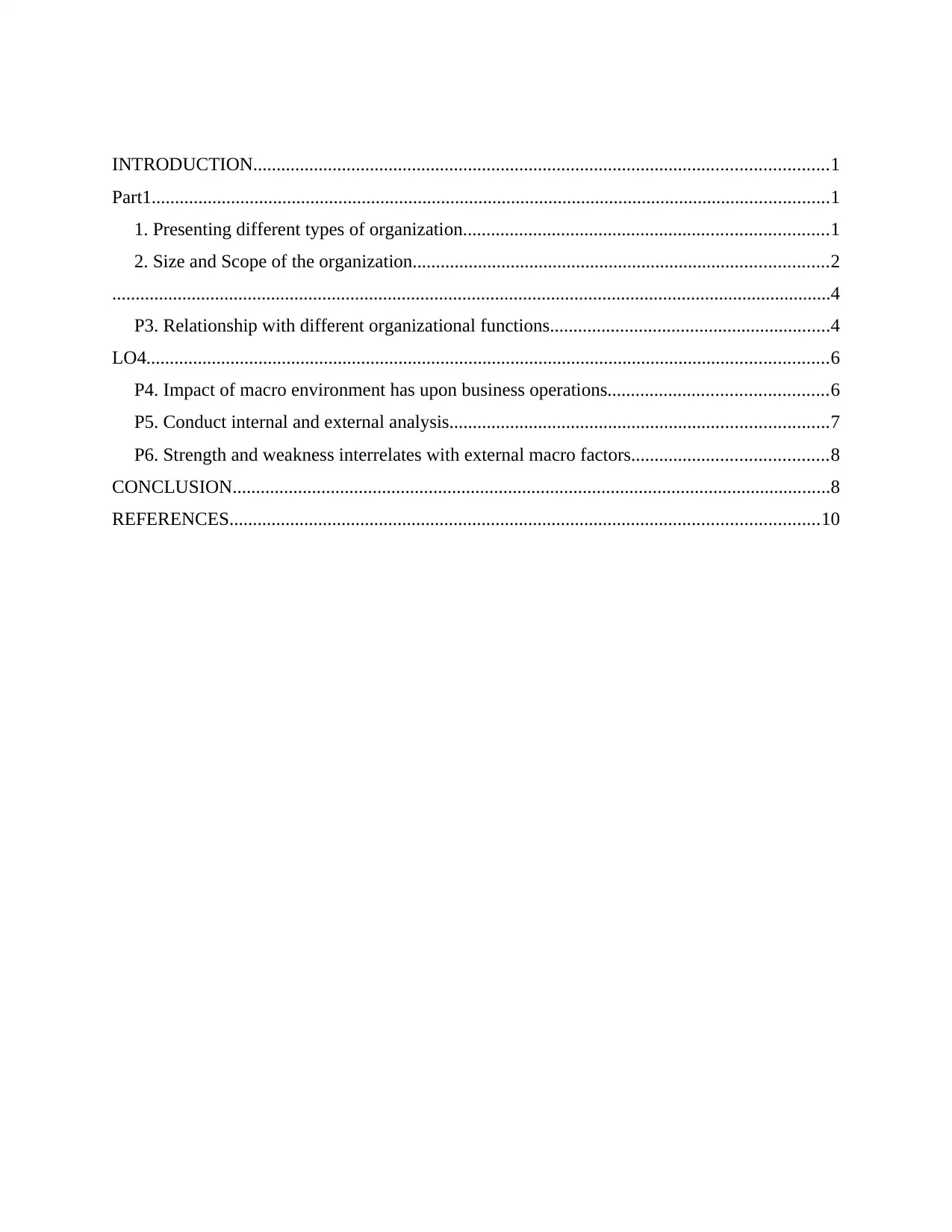
INTRODUCTION...........................................................................................................................1
Part1.................................................................................................................................................1
1. Presenting different types of organization..............................................................................1
2. Size and Scope of the organization.........................................................................................2
..........................................................................................................................................................4
P3. Relationship with different organizational functions............................................................4
LO4..................................................................................................................................................6
P4. Impact of macro environment has upon business operations...............................................6
P5. Conduct internal and external analysis.................................................................................7
P6. Strength and weakness interrelates with external macro factors..........................................8
CONCLUSION................................................................................................................................8
REFERENCES..............................................................................................................................10
Part1.................................................................................................................................................1
1. Presenting different types of organization..............................................................................1
2. Size and Scope of the organization.........................................................................................2
..........................................................................................................................................................4
P3. Relationship with different organizational functions............................................................4
LO4..................................................................................................................................................6
P4. Impact of macro environment has upon business operations...............................................6
P5. Conduct internal and external analysis.................................................................................7
P6. Strength and weakness interrelates with external macro factors..........................................8
CONCLUSION................................................................................................................................8
REFERENCES..............................................................................................................................10
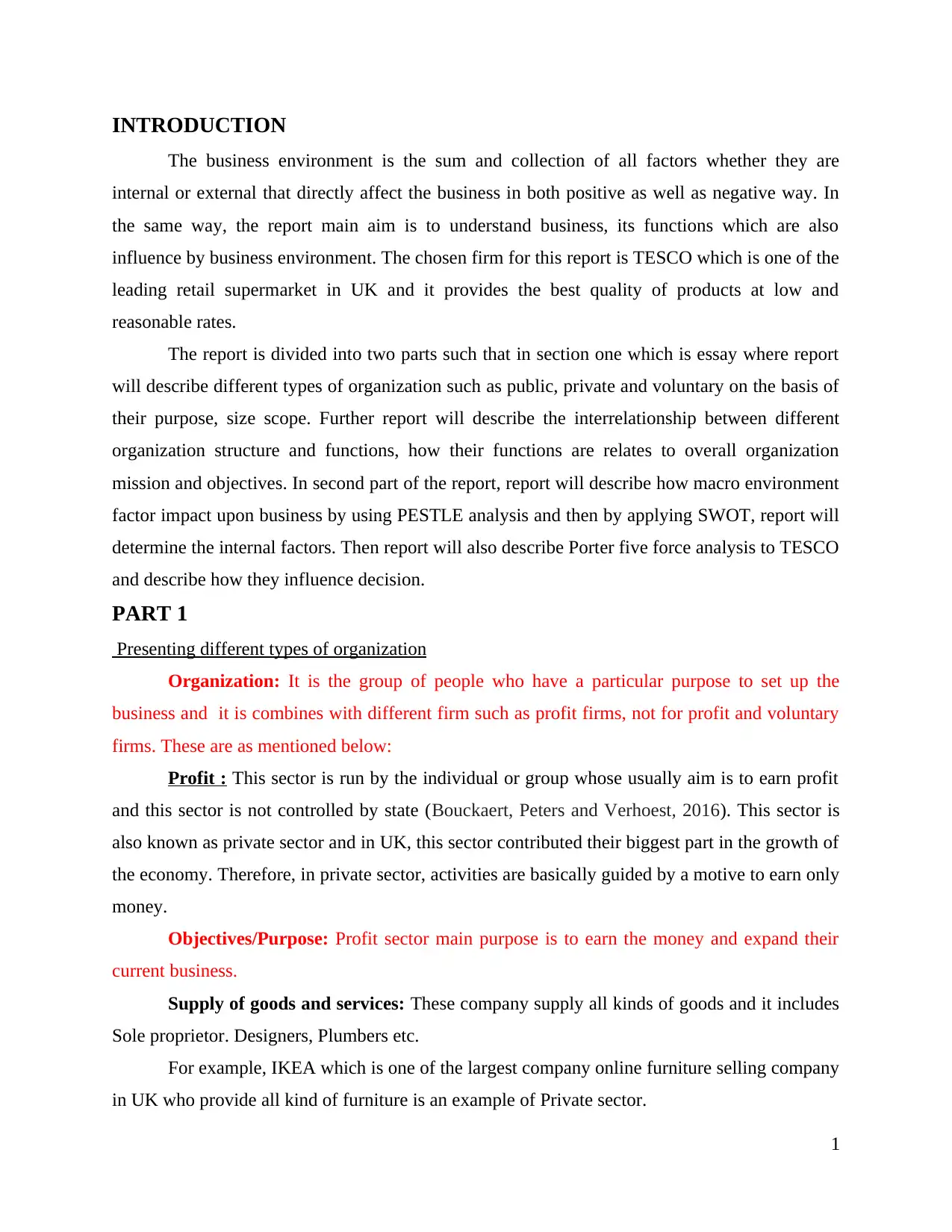
INTRODUCTION
The business environment is the sum and collection of all factors whether they are
internal or external that directly affect the business in both positive as well as negative way. In
the same way, the report main aim is to understand business, its functions which are also
influence by business environment. The chosen firm for this report is TESCO which is one of the
leading retail supermarket in UK and it provides the best quality of products at low and
reasonable rates.
The report is divided into two parts such that in section one which is essay where report
will describe different types of organization such as public, private and voluntary on the basis of
their purpose, size scope. Further report will describe the interrelationship between different
organization structure and functions, how their functions are relates to overall organization
mission and objectives. In second part of the report, report will describe how macro environment
factor impact upon business by using PESTLE analysis and then by applying SWOT, report will
determine the internal factors. Then report will also describe Porter five force analysis to TESCO
and describe how they influence decision.
PART 1
Presenting different types of organization
Organization: It is the group of people who have a particular purpose to set up the
business and it is combines with different firm such as profit firms, not for profit and voluntary
firms. These are as mentioned below:
Profit : This sector is run by the individual or group whose usually aim is to earn profit
and this sector is not controlled by state (Bouckaert, Peters and Verhoest, 2016). This sector is
also known as private sector and in UK, this sector contributed their biggest part in the growth of
the economy. Therefore, in private sector, activities are basically guided by a motive to earn only
money.
Objectives/Purpose: Profit sector main purpose is to earn the money and expand their
current business.
Supply of goods and services: These company supply all kinds of goods and it includes
Sole proprietor. Designers, Plumbers etc.
For example, IKEA which is one of the largest company online furniture selling company
in UK who provide all kind of furniture is an example of Private sector.
1
The business environment is the sum and collection of all factors whether they are
internal or external that directly affect the business in both positive as well as negative way. In
the same way, the report main aim is to understand business, its functions which are also
influence by business environment. The chosen firm for this report is TESCO which is one of the
leading retail supermarket in UK and it provides the best quality of products at low and
reasonable rates.
The report is divided into two parts such that in section one which is essay where report
will describe different types of organization such as public, private and voluntary on the basis of
their purpose, size scope. Further report will describe the interrelationship between different
organization structure and functions, how their functions are relates to overall organization
mission and objectives. In second part of the report, report will describe how macro environment
factor impact upon business by using PESTLE analysis and then by applying SWOT, report will
determine the internal factors. Then report will also describe Porter five force analysis to TESCO
and describe how they influence decision.
PART 1
Presenting different types of organization
Organization: It is the group of people who have a particular purpose to set up the
business and it is combines with different firm such as profit firms, not for profit and voluntary
firms. These are as mentioned below:
Profit : This sector is run by the individual or group whose usually aim is to earn profit
and this sector is not controlled by state (Bouckaert, Peters and Verhoest, 2016). This sector is
also known as private sector and in UK, this sector contributed their biggest part in the growth of
the economy. Therefore, in private sector, activities are basically guided by a motive to earn only
money.
Objectives/Purpose: Profit sector main purpose is to earn the money and expand their
current business.
Supply of goods and services: These company supply all kinds of goods and it includes
Sole proprietor. Designers, Plumbers etc.
For example, IKEA which is one of the largest company online furniture selling company
in UK who provide all kind of furniture is an example of Private sector.
1
⊘ This is a preview!⊘
Do you want full access?
Subscribe today to unlock all pages.

Trusted by 1+ million students worldwide
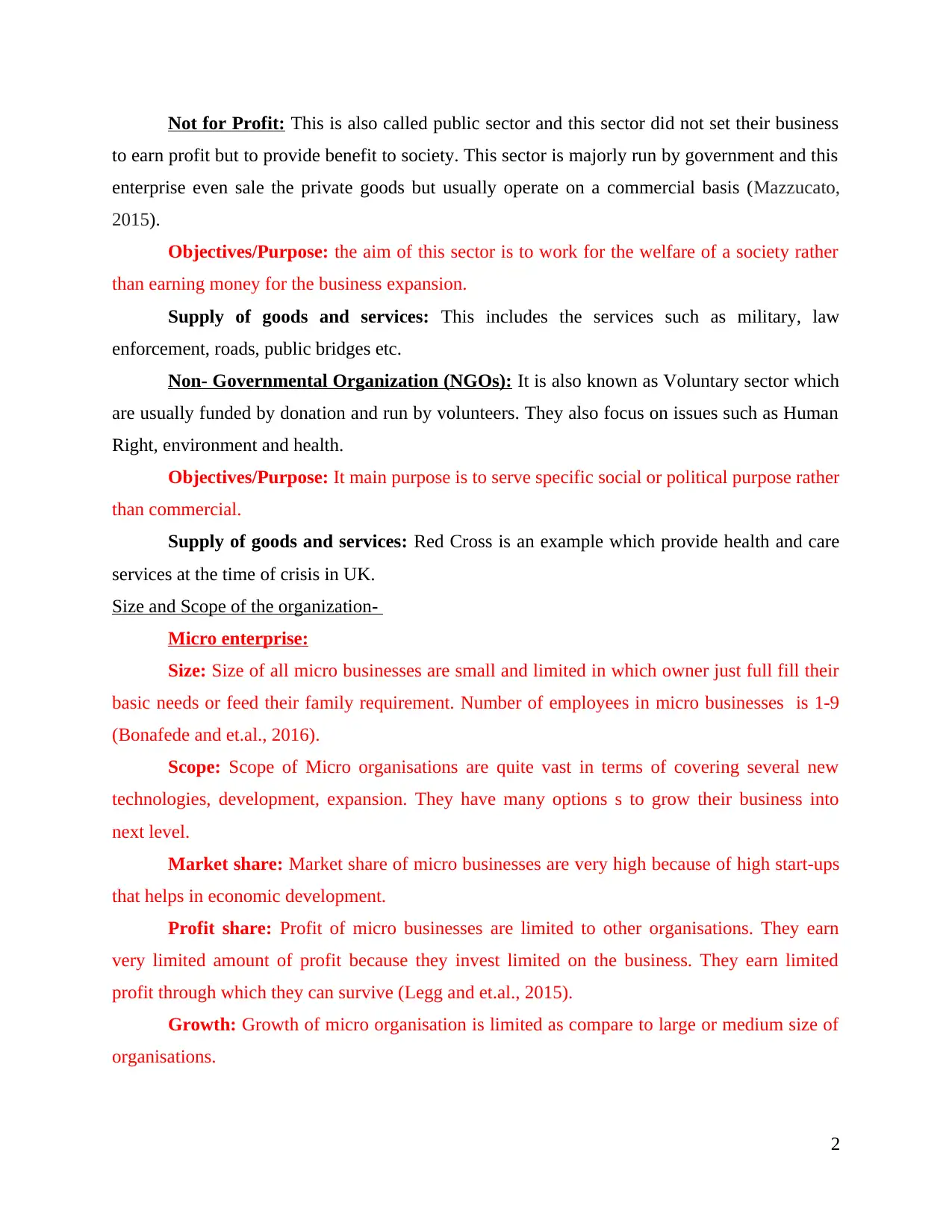
Not for Profit: This is also called public sector and this sector did not set their business
to earn profit but to provide benefit to society. This sector is majorly run by government and this
enterprise even sale the private goods but usually operate on a commercial basis (Mazzucato,
2015).
Objectives/Purpose: the aim of this sector is to work for the welfare of a society rather
than earning money for the business expansion.
Supply of goods and services: This includes the services such as military, law
enforcement, roads, public bridges etc.
Non- Governmental Organization (NGOs): It is also known as Voluntary sector which
are usually funded by donation and run by volunteers. They also focus on issues such as Human
Right, environment and health.
Objectives/Purpose: It main purpose is to serve specific social or political purpose rather
than commercial.
Supply of goods and services: Red Cross is an example which provide health and care
services at the time of crisis in UK.
Size and Scope of the organization-
Micro enterprise:
Size: Size of all micro businesses are small and limited in which owner just full fill their
basic needs or feed their family requirement. Number of employees in micro businesses is 1-9
(Bonafede and et.al., 2016).
Scope: Scope of Micro organisations are quite vast in terms of covering several new
technologies, development, expansion. They have many options s to grow their business into
next level.
Market share: Market share of micro businesses are very high because of high start-ups
that helps in economic development.
Profit share: Profit of micro businesses are limited to other organisations. They earn
very limited amount of profit because they invest limited on the business. They earn limited
profit through which they can survive (Legg and et.al., 2015).
Growth: Growth of micro organisation is limited as compare to large or medium size of
organisations.
2
to earn profit but to provide benefit to society. This sector is majorly run by government and this
enterprise even sale the private goods but usually operate on a commercial basis (Mazzucato,
2015).
Objectives/Purpose: the aim of this sector is to work for the welfare of a society rather
than earning money for the business expansion.
Supply of goods and services: This includes the services such as military, law
enforcement, roads, public bridges etc.
Non- Governmental Organization (NGOs): It is also known as Voluntary sector which
are usually funded by donation and run by volunteers. They also focus on issues such as Human
Right, environment and health.
Objectives/Purpose: It main purpose is to serve specific social or political purpose rather
than commercial.
Supply of goods and services: Red Cross is an example which provide health and care
services at the time of crisis in UK.
Size and Scope of the organization-
Micro enterprise:
Size: Size of all micro businesses are small and limited in which owner just full fill their
basic needs or feed their family requirement. Number of employees in micro businesses is 1-9
(Bonafede and et.al., 2016).
Scope: Scope of Micro organisations are quite vast in terms of covering several new
technologies, development, expansion. They have many options s to grow their business into
next level.
Market share: Market share of micro businesses are very high because of high start-ups
that helps in economic development.
Profit share: Profit of micro businesses are limited to other organisations. They earn
very limited amount of profit because they invest limited on the business. They earn limited
profit through which they can survive (Legg and et.al., 2015).
Growth: Growth of micro organisation is limited as compare to large or medium size of
organisations.
2
Paraphrase This Document
Need a fresh take? Get an instant paraphrase of this document with our AI Paraphraser
Sustainability: Sustainability of micro businesses are less. If the not earn satisfactory
amount they close the business immediately (Legg and et.al., 2015).
Small enterprise:
Size: Small businesses size is greater than micro businesses and lesser than medium and
large organisations. Generally small businesses having 10-49 number of staff members.
Scope: Small businesses have larger scope to grow their business in different manner.
Geographical context is also very much useful to grow the small scale businesses.
Market share: Small enterprises having good market share in order to provides the good
services products.
Profit share: Small Medium enterprises earn both positive and negative profit outcomes
it's totally depends upon the business because it involves the threat of competition.
Growth: Growth of small businesses is low as compare to medium and big organisations
because of limited resources and capital.
Sustainability: Medium scale businesses are unstable and highly depends on capital or
resources.
Medium size enterprise:
Size: Medium organisation size is larger than small and lesser than big organisation. The
number of employees working in medium organisation are 50-249.
Scope: Medium organisation having large scope due to high demand of the customer.
Customer more prefer to purchase product or services from medium scale organisation because
of good quality at reasonable price.
Market share: Market share of medium size customer are high in UK because they
contribute in national economy
Large organisation having a good sustainability because of popularity and high
market growth. Profit share: Medium Size business profit share is limited or lesser than large
organisations because of limited resources and fund for further investment.
Growth: Medium Size organisations' growth are low comparatively as compare to big
organisation.
Sustainability: Medium Size businesses' sustainability is also unstable comparative to
large organisations.
Large enterprise:
3
amount they close the business immediately (Legg and et.al., 2015).
Small enterprise:
Size: Small businesses size is greater than micro businesses and lesser than medium and
large organisations. Generally small businesses having 10-49 number of staff members.
Scope: Small businesses have larger scope to grow their business in different manner.
Geographical context is also very much useful to grow the small scale businesses.
Market share: Small enterprises having good market share in order to provides the good
services products.
Profit share: Small Medium enterprises earn both positive and negative profit outcomes
it's totally depends upon the business because it involves the threat of competition.
Growth: Growth of small businesses is low as compare to medium and big organisations
because of limited resources and capital.
Sustainability: Medium scale businesses are unstable and highly depends on capital or
resources.
Medium size enterprise:
Size: Medium organisation size is larger than small and lesser than big organisation. The
number of employees working in medium organisation are 50-249.
Scope: Medium organisation having large scope due to high demand of the customer.
Customer more prefer to purchase product or services from medium scale organisation because
of good quality at reasonable price.
Market share: Market share of medium size customer are high in UK because they
contribute in national economy
Large organisation having a good sustainability because of popularity and high
market growth. Profit share: Medium Size business profit share is limited or lesser than large
organisations because of limited resources and fund for further investment.
Growth: Medium Size organisations' growth are low comparatively as compare to big
organisation.
Sustainability: Medium Size businesses' sustainability is also unstable comparative to
large organisations.
Large enterprise:
3
Size: In terms of large organization. It has limited scope to grow because they already
operate its functions at big level where they get all things. Number of employees working in big
companies are 250+.
Scope: Scope of Large organisations are very high as compare to others in order to meet
out the company aims and objectives (Koe 2016). Company also need to expand the business at
different geographical manner in order to attract the customer satisfaction and more attract the
new target customers.
Market share: In UK share of big organisations are high or limited.
Profit share: Profit Share of the large organisations are due to providing the high quality
services by investing huge amount promotional activities to get the attention of customers.
Growth: Large organisation has a large growth due to unlimited resources and capital for
investment.
Sustainability: Large organization having a good sustainability because of popularity
and high market growth.
Relationship with different organizational functions
Finance and Marketing
Marketing is a set of activities of different process and services such as identification of
product, identify the demand and need of the customers, setting price and selection of
distribution channels to deliver the product and services to the market to reach end users.
Money is the basic factor to operate any process and for the smooth running of the
company. Finance department of Tesco helps and support the Marketing department by
providing and allocating fund and budget to them. As the finance department not only allocate
the fund to the marketing department but also prepare the budget for the whole Tesco
organisation and make sure to smooth operation of the company. As the Tesco is largest retail
company which need to maintain its image and product range in the stores, finance department
helps the marketing to provide fund that the marketing manager use it to promoting and
advertisement of the company and its products and services. Marketing manager also does all its
buying and selling activity with the help of the finance department (Sexton, 2016). This increase
the sells and demand of the product of Tesco in the UK market and in the global market as well.
4
operate its functions at big level where they get all things. Number of employees working in big
companies are 250+.
Scope: Scope of Large organisations are very high as compare to others in order to meet
out the company aims and objectives (Koe 2016). Company also need to expand the business at
different geographical manner in order to attract the customer satisfaction and more attract the
new target customers.
Market share: In UK share of big organisations are high or limited.
Profit share: Profit Share of the large organisations are due to providing the high quality
services by investing huge amount promotional activities to get the attention of customers.
Growth: Large organisation has a large growth due to unlimited resources and capital for
investment.
Sustainability: Large organization having a good sustainability because of popularity
and high market growth.
Relationship with different organizational functions
Finance and Marketing
Marketing is a set of activities of different process and services such as identification of
product, identify the demand and need of the customers, setting price and selection of
distribution channels to deliver the product and services to the market to reach end users.
Money is the basic factor to operate any process and for the smooth running of the
company. Finance department of Tesco helps and support the Marketing department by
providing and allocating fund and budget to them. As the finance department not only allocate
the fund to the marketing department but also prepare the budget for the whole Tesco
organisation and make sure to smooth operation of the company. As the Tesco is largest retail
company which need to maintain its image and product range in the stores, finance department
helps the marketing to provide fund that the marketing manager use it to promoting and
advertisement of the company and its products and services. Marketing manager also does all its
buying and selling activity with the help of the finance department (Sexton, 2016). This increase
the sells and demand of the product of Tesco in the UK market and in the global market as well.
4
⊘ This is a preview!⊘
Do you want full access?
Subscribe today to unlock all pages.
Trusted by 1+ million students worldwide
Finance is also connected with the marketing department of the Tesco in away that the
marketing manger gives the details of all the activity which they did like promoting and
advertisement and buying and selling of the products. Marketing management have the details
and report the about the market and customers need and also about the all the profit and loss in
the market and purchasing. This data is provided to the finance department and then the whole
year's revenue and gross profit is to calculated and also make budget to allocate the fund for the
next time. This help the Tesco company to maintain balance of inflow and out flow in the
organisation (Sexton, 2016).
Marketing and Production
Production is a method to transform the raw materials to the final goods that the
customers can use those products and services and fulfill their needs.
Marketing department of Tesco is also connected with the production department of
Tesco. As marketing department always gather information about the market situation and
demand and need of the customers and always establish a survey about the quality of people and
their choice and expenses. This report of the survey given to the production department of Tesco
and production department produce such a products and services which can satisfy the customers
need and at low price which customers can willing pay for it (Golovanova and et.al., 2016). This
will help the Tesco company to take care of the customers need and satisfying their need and
gain the trust of the customers. This increase the image of the Tesco in the m,market and helps to
increase the gross profit an d revenue of the Tesco company.
Research and production
Research and development refers to those activities that company undertake to innovate
introduce new product and ensuring the smooth operation in the company.
Research and production department of the Tesco is also be interconnected with each
other. As the research and development department produce a analysis on the market condition
and environment, demand, nature of the consumers, their attitude and other factors and then
make research report on of these data to the production department. -production department
make plan and strategies how many products and services is to be produced and manufactured on
the basis of the demand analysis and make changes in the existing products as according to the
customers demand in the market. Research also help production department to produce new
products and services as according to the social and attitude of the customers and in a low price
5
marketing manger gives the details of all the activity which they did like promoting and
advertisement and buying and selling of the products. Marketing management have the details
and report the about the market and customers need and also about the all the profit and loss in
the market and purchasing. This data is provided to the finance department and then the whole
year's revenue and gross profit is to calculated and also make budget to allocate the fund for the
next time. This help the Tesco company to maintain balance of inflow and out flow in the
organisation (Sexton, 2016).
Marketing and Production
Production is a method to transform the raw materials to the final goods that the
customers can use those products and services and fulfill their needs.
Marketing department of Tesco is also connected with the production department of
Tesco. As marketing department always gather information about the market situation and
demand and need of the customers and always establish a survey about the quality of people and
their choice and expenses. This report of the survey given to the production department of Tesco
and production department produce such a products and services which can satisfy the customers
need and at low price which customers can willing pay for it (Golovanova and et.al., 2016). This
will help the Tesco company to take care of the customers need and satisfying their need and
gain the trust of the customers. This increase the image of the Tesco in the m,market and helps to
increase the gross profit an d revenue of the Tesco company.
Research and production
Research and development refers to those activities that company undertake to innovate
introduce new product and ensuring the smooth operation in the company.
Research and production department of the Tesco is also be interconnected with each
other. As the research and development department produce a analysis on the market condition
and environment, demand, nature of the consumers, their attitude and other factors and then
make research report on of these data to the production department. -production department
make plan and strategies how many products and services is to be produced and manufactured on
the basis of the demand analysis and make changes in the existing products as according to the
customers demand in the market. Research also help production department to produce new
products and services as according to the social and attitude of the customers and in a low price
5
Paraphrase This Document
Need a fresh take? Get an instant paraphrase of this document with our AI Paraphraser
that can fulfill the demand of the customers and this will help the Tesco to increase its sale as to
produce as according to customers which give best quality products at minimum price (Geels and
et.al., 2015).
Impact of macro environment has upon business operations.
Macro environment refers to those factors and forces that are outside the organization and they
cannot be directly controlled by the company.
The impact of macro environment on business operations of Tesco can be analyzed with the help
of PESTLE analysis.
Political- Tesco has its operations in various countries and it has to follow rules, regulations and
legislation of the Government of these countries that impacts the business operations of the
company. Government encourages retail companies for providing job opportunities and World
Trade Organization is also promoting trade by Tesco. Tesco imports raw materials from other
countries on which it has to pay import duty that impact the profitability of company.
Economic- There are various economic factors that affects the business operations of Tesco such
as annual wage bill in U.K. has increase the wage rate of labour that leads to increase in the cost
and reduction in the revenue of Tesco.
Social- There are various social factors that may impact Tesco in positive or negative manner.
For example- Consumers are becoming more and more conscious towards the issue like obesity.
Therefore, Tesco should consider the demand of consumers for organic products.
Technological- There are various issues faced by Tesco in past such as horse-meat scandal etc.
Tesco is considering various options for improving the trust of consumers on company. It has
introduced advanced technology like technology of RFID so that, the shopping experience of
existing as well a new customer can be improved. Tesco also developed PayQwid app for
improving the loyalty of the customers.
Legal- In year 2016, Tesco has faced a legal action from workers due to discrimination by the
company on the basis of gender. Company has to perform its operations according with the
regulations of Food Retailing Commission.
Environment- Tesco has launch tesco. com so that, unwanted wastage can be reduced.
Company uses renewable sources for generating electricity.
6
produce as according to customers which give best quality products at minimum price (Geels and
et.al., 2015).
Impact of macro environment has upon business operations.
Macro environment refers to those factors and forces that are outside the organization and they
cannot be directly controlled by the company.
The impact of macro environment on business operations of Tesco can be analyzed with the help
of PESTLE analysis.
Political- Tesco has its operations in various countries and it has to follow rules, regulations and
legislation of the Government of these countries that impacts the business operations of the
company. Government encourages retail companies for providing job opportunities and World
Trade Organization is also promoting trade by Tesco. Tesco imports raw materials from other
countries on which it has to pay import duty that impact the profitability of company.
Economic- There are various economic factors that affects the business operations of Tesco such
as annual wage bill in U.K. has increase the wage rate of labour that leads to increase in the cost
and reduction in the revenue of Tesco.
Social- There are various social factors that may impact Tesco in positive or negative manner.
For example- Consumers are becoming more and more conscious towards the issue like obesity.
Therefore, Tesco should consider the demand of consumers for organic products.
Technological- There are various issues faced by Tesco in past such as horse-meat scandal etc.
Tesco is considering various options for improving the trust of consumers on company. It has
introduced advanced technology like technology of RFID so that, the shopping experience of
existing as well a new customer can be improved. Tesco also developed PayQwid app for
improving the loyalty of the customers.
Legal- In year 2016, Tesco has faced a legal action from workers due to discrimination by the
company on the basis of gender. Company has to perform its operations according with the
regulations of Food Retailing Commission.
Environment- Tesco has launch tesco. com so that, unwanted wastage can be reduced.
Company uses renewable sources for generating electricity.
6
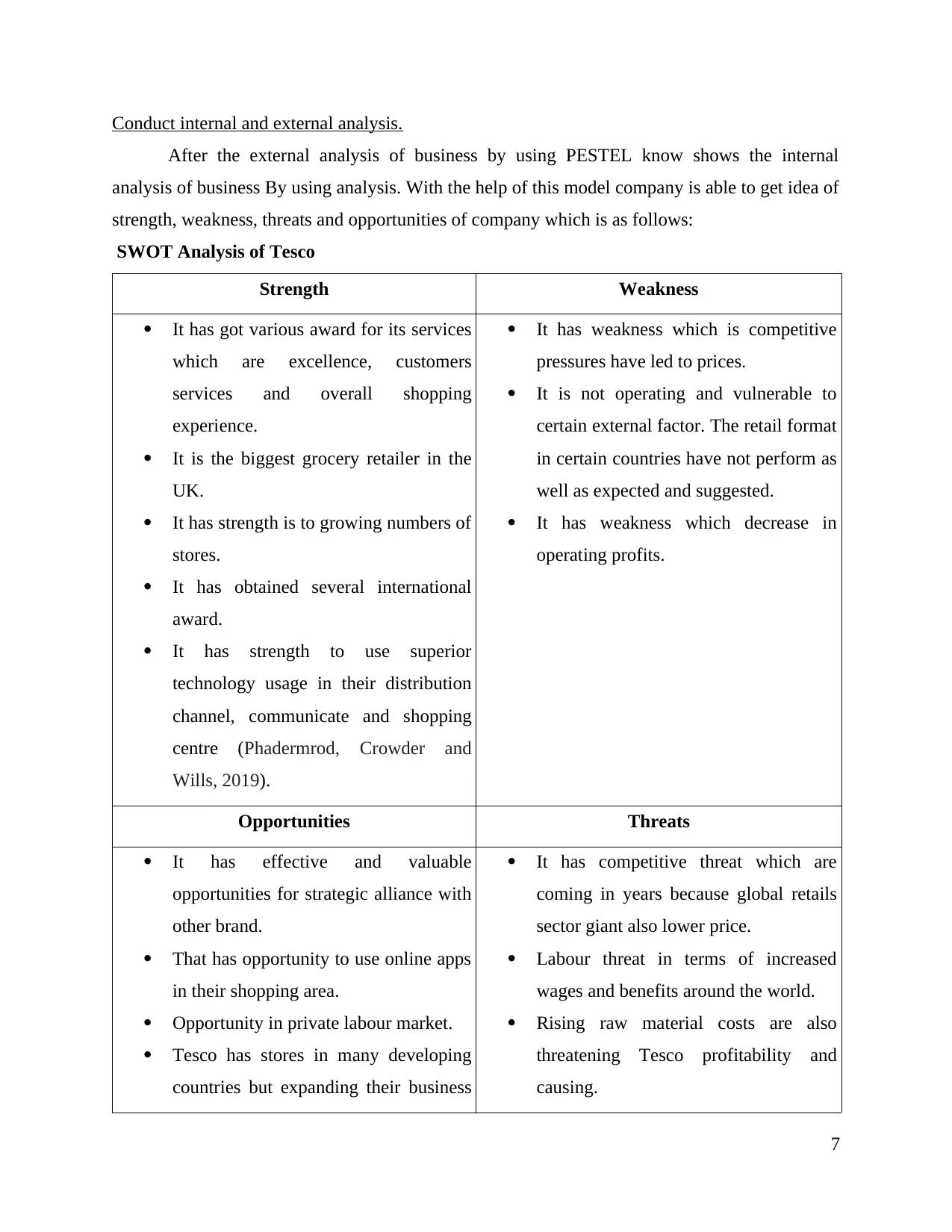
Conduct internal and external analysis.
After the external analysis of business by using PESTEL know shows the internal
analysis of business By using analysis. With the help of this model company is able to get idea of
strength, weakness, threats and opportunities of company which is as follows:
SWOT Analysis of Tesco
Strength Weakness
It has got various award for its services
which are excellence, customers
services and overall shopping
experience.
It is the biggest grocery retailer in the
UK.
It has strength is to growing numbers of
stores.
It has obtained several international
award.
It has strength to use superior
technology usage in their distribution
channel, communicate and shopping
centre (Phadermrod, Crowder and
Wills, 2019).
It has weakness which is competitive
pressures have led to prices.
It is not operating and vulnerable to
certain external factor. The retail format
in certain countries have not perform as
well as expected and suggested.
It has weakness which decrease in
operating profits.
Opportunities Threats
It has effective and valuable
opportunities for strategic alliance with
other brand.
That has opportunity to use online apps
in their shopping area.
Opportunity in private labour market.
Tesco has stores in many developing
countries but expanding their business
It has competitive threat which are
coming in years because global retails
sector giant also lower price.
Labour threat in terms of increased
wages and benefits around the world.
Rising raw material costs are also
threatening Tesco profitability and
causing.
7
After the external analysis of business by using PESTEL know shows the internal
analysis of business By using analysis. With the help of this model company is able to get idea of
strength, weakness, threats and opportunities of company which is as follows:
SWOT Analysis of Tesco
Strength Weakness
It has got various award for its services
which are excellence, customers
services and overall shopping
experience.
It is the biggest grocery retailer in the
UK.
It has strength is to growing numbers of
stores.
It has obtained several international
award.
It has strength to use superior
technology usage in their distribution
channel, communicate and shopping
centre (Phadermrod, Crowder and
Wills, 2019).
It has weakness which is competitive
pressures have led to prices.
It is not operating and vulnerable to
certain external factor. The retail format
in certain countries have not perform as
well as expected and suggested.
It has weakness which decrease in
operating profits.
Opportunities Threats
It has effective and valuable
opportunities for strategic alliance with
other brand.
That has opportunity to use online apps
in their shopping area.
Opportunity in private labour market.
Tesco has stores in many developing
countries but expanding their business
It has competitive threat which are
coming in years because global retails
sector giant also lower price.
Labour threat in terms of increased
wages and benefits around the world.
Rising raw material costs are also
threatening Tesco profitability and
causing.
7
⊘ This is a preview!⊘
Do you want full access?
Subscribe today to unlock all pages.
Trusted by 1+ million students worldwide
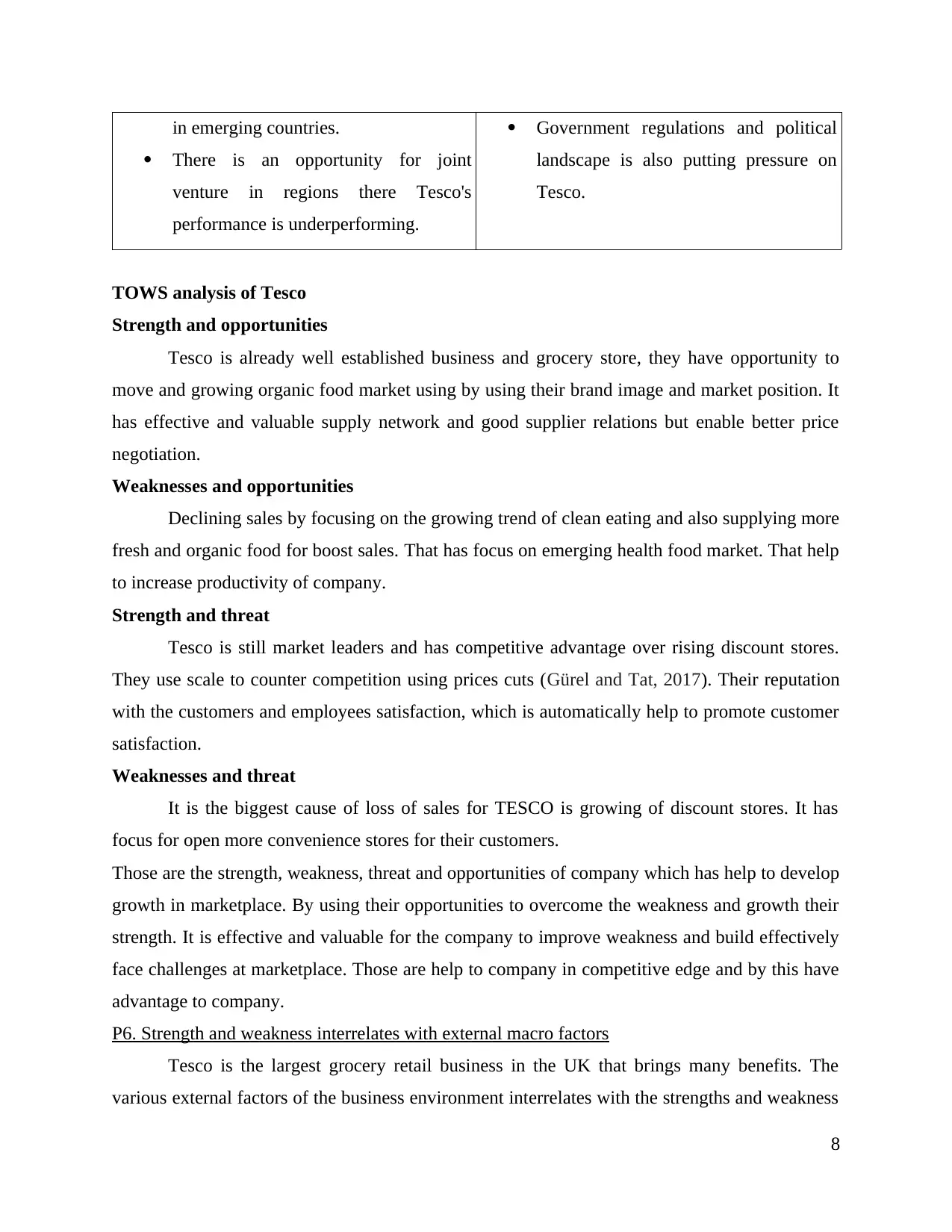
in emerging countries.
There is an opportunity for joint
venture in regions there Tesco's
performance is underperforming.
Government regulations and political
landscape is also putting pressure on
Tesco.
TOWS analysis of Tesco
Strength and opportunities
Tesco is already well established business and grocery store, they have opportunity to
move and growing organic food market using by using their brand image and market position. It
has effective and valuable supply network and good supplier relations but enable better price
negotiation.
Weaknesses and opportunities
Declining sales by focusing on the growing trend of clean eating and also supplying more
fresh and organic food for boost sales. That has focus on emerging health food market. That help
to increase productivity of company.
Strength and threat
Tesco is still market leaders and has competitive advantage over rising discount stores.
They use scale to counter competition using prices cuts (Gürel and Tat, 2017). Their reputation
with the customers and employees satisfaction, which is automatically help to promote customer
satisfaction.
Weaknesses and threat
It is the biggest cause of loss of sales for TESCO is growing of discount stores. It has
focus for open more convenience stores for their customers.
Those are the strength, weakness, threat and opportunities of company which has help to develop
growth in marketplace. By using their opportunities to overcome the weakness and growth their
strength. It is effective and valuable for the company to improve weakness and build effectively
face challenges at marketplace. Those are help to company in competitive edge and by this have
advantage to company.
P6. Strength and weakness interrelates with external macro factors
Tesco is the largest grocery retail business in the UK that brings many benefits. The
various external factors of the business environment interrelates with the strengths and weakness
8
There is an opportunity for joint
venture in regions there Tesco's
performance is underperforming.
Government regulations and political
landscape is also putting pressure on
Tesco.
TOWS analysis of Tesco
Strength and opportunities
Tesco is already well established business and grocery store, they have opportunity to
move and growing organic food market using by using their brand image and market position. It
has effective and valuable supply network and good supplier relations but enable better price
negotiation.
Weaknesses and opportunities
Declining sales by focusing on the growing trend of clean eating and also supplying more
fresh and organic food for boost sales. That has focus on emerging health food market. That help
to increase productivity of company.
Strength and threat
Tesco is still market leaders and has competitive advantage over rising discount stores.
They use scale to counter competition using prices cuts (Gürel and Tat, 2017). Their reputation
with the customers and employees satisfaction, which is automatically help to promote customer
satisfaction.
Weaknesses and threat
It is the biggest cause of loss of sales for TESCO is growing of discount stores. It has
focus for open more convenience stores for their customers.
Those are the strength, weakness, threat and opportunities of company which has help to develop
growth in marketplace. By using their opportunities to overcome the weakness and growth their
strength. It is effective and valuable for the company to improve weakness and build effectively
face challenges at marketplace. Those are help to company in competitive edge and by this have
advantage to company.
P6. Strength and weakness interrelates with external macro factors
Tesco is the largest grocery retail business in the UK that brings many benefits. The
various external factors of the business environment interrelates with the strengths and weakness
8
Paraphrase This Document
Need a fresh take? Get an instant paraphrase of this document with our AI Paraphraser
of the company. For example, political factors lays down various health and safety policies on
business organizations that are followed by the Tesco (Owuor, Githii and Mwangi, 2018). This
allows company to gain various benefits by satisfying employees. Political support is required by
Tesco for developing its business and market share in desired areas. Social factors include recent
and emerging trends in the society, religious beliefs, habits of target customers, etc. This factors
leads to bring great impacts and influences on the internal factors of the company. For example,
business strategies and products and developed in such a way that it meets needs and demands of
target customers. The strategies are framed in response with lifestyle and taste of customers and
result in increasing the profitability for Tesco. If Tesco fails to comply with various social
factors, it can act as a weakness. Tesco can effectively make use of its strength for gaining the
opportunities through the various advances and developments in the technological factors. The
advancements in the mobile or online applications can be used by company for increasing the
market share. Employees of Tesco are motivated and encouraged, who willingly focus on putting
their best efforts for the company and this can be utilized by company for gaining advantage of
various external macro factors.
Without the cooperation and help of political factors, Tesco can not utilize the
effectiveness and benefits of its various internal strength and external opportunities. Thus,
political support can act as a strong strength for the Tesco and also becomes the weakness. The
restrictions, trade regulation, trade barriers of political factors acts as a weakness for company
(Karabulut and Sen, 2018). External factors like political and economical conditions restricts
Tesco for expanding its business in many parts of the world, which acts as a weakness for
company. Tesco has the opportunity for growing its business in private labour markets and also
having joint venture business which comes up with different economic and political laws,
regulations and conditions, that leads to restrict the benefits. Social factors may also acts as a
weakness for Tesco as this brings great influences on the internal environment of the business.
Tesco has to effectively analyses the external macro factors of the business as it bring great
influences and impacts on the internal environment of the company. #
CONCLUSION
Different types of business organizations are explained in brief including their purposes.
Different types of businesses are public, private and voluntary organization. Legal structure, size
9
business organizations that are followed by the Tesco (Owuor, Githii and Mwangi, 2018). This
allows company to gain various benefits by satisfying employees. Political support is required by
Tesco for developing its business and market share in desired areas. Social factors include recent
and emerging trends in the society, religious beliefs, habits of target customers, etc. This factors
leads to bring great impacts and influences on the internal factors of the company. For example,
business strategies and products and developed in such a way that it meets needs and demands of
target customers. The strategies are framed in response with lifestyle and taste of customers and
result in increasing the profitability for Tesco. If Tesco fails to comply with various social
factors, it can act as a weakness. Tesco can effectively make use of its strength for gaining the
opportunities through the various advances and developments in the technological factors. The
advancements in the mobile or online applications can be used by company for increasing the
market share. Employees of Tesco are motivated and encouraged, who willingly focus on putting
their best efforts for the company and this can be utilized by company for gaining advantage of
various external macro factors.
Without the cooperation and help of political factors, Tesco can not utilize the
effectiveness and benefits of its various internal strength and external opportunities. Thus,
political support can act as a strong strength for the Tesco and also becomes the weakness. The
restrictions, trade regulation, trade barriers of political factors acts as a weakness for company
(Karabulut and Sen, 2018). External factors like political and economical conditions restricts
Tesco for expanding its business in many parts of the world, which acts as a weakness for
company. Tesco has the opportunity for growing its business in private labour markets and also
having joint venture business which comes up with different economic and political laws,
regulations and conditions, that leads to restrict the benefits. Social factors may also acts as a
weakness for Tesco as this brings great influences on the internal environment of the business.
Tesco has to effectively analyses the external macro factors of the business as it bring great
influences and impacts on the internal environment of the company. #
CONCLUSION
Different types of business organizations are explained in brief including their purposes.
Different types of businesses are public, private and voluntary organization. Legal structure, size
9
and scope of different businesses are described in detail. Further the relationship between
functions of organization and how it links with the structure and objectives of company is shown.
Business organization gets affected due to various factors available in the business environment
such as internal and external. PESTLE and SWOT analysis are used by every business
organization for analyzing the internal and external factors of the environment. SWOT analysis
can be used for analyzing and identifying the strength and weakness of the company and also to
identify the opportunities and threats.
10
functions of organization and how it links with the structure and objectives of company is shown.
Business organization gets affected due to various factors available in the business environment
such as internal and external. PESTLE and SWOT analysis are used by every business
organization for analyzing the internal and external factors of the environment. SWOT analysis
can be used for analyzing and identifying the strength and weakness of the company and also to
identify the opportunities and threats.
10
⊘ This is a preview!⊘
Do you want full access?
Subscribe today to unlock all pages.
Trusted by 1+ million students worldwide

1 out of 14


Related Documents


Your All-in-One AI-Powered Toolkit for Academic Success.
+13062052269
info@desklib.com
Available 24*7 on WhatsApp / Email
![[object Object]](/_next/static/media/star-bottom.7253800d.svg)
Unlock your academic potential
Copyright © 2020–2026 A2Z Services. All Rights Reserved. Developed and managed by ZUCOL.