Business and Business Environment: Detailed Analysis of Tesco
VerifiedAdded on 2023/01/17
|10
|1681
|99
Report
AI Summary
This report provides a detailed analysis of Tesco, a multinational retail chain. It begins with an introduction to Tesco, including its history and current standing. The main body of the report explores key business concepts, including the differences between profit, non-profit, and non-governmental organizations, as well as the distinctions among micro, small, and medium enterprises. The report then delves into a VRIO (Value, Rarity, Imitability, Organization) analysis of Tesco, evaluating its internal resources and capabilities. Following this, a TWOS (Threats, Weaknesses, Opportunities, Strengths) analysis is conducted to assess Tesco's strategic position within its external environment. The analysis considers factors such as inbound and outbound logistics, marketing, and customer service. The report concludes with a list of references used in the analysis. This comprehensive overview offers valuable insights into Tesco's business strategies and its position in the competitive market.
BUSINESS AND BUSINESS
ENVIRONMENT
ENVIRONMENT
Paraphrase This Document
Need a fresh take? Get an instant paraphrase of this document with our AI Paraphraser

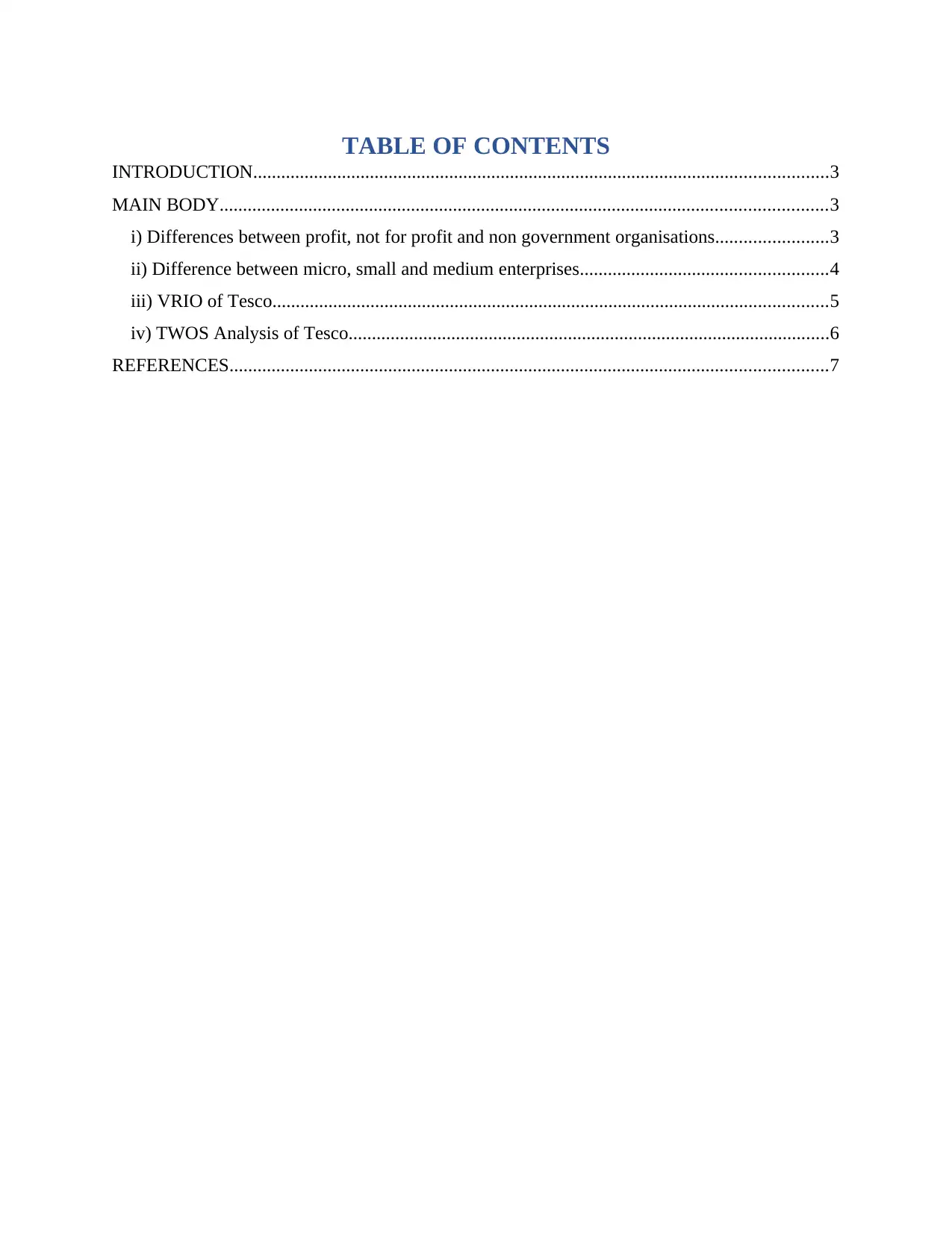
TABLE OF CONTENTS
INTRODUCTION...........................................................................................................................3
MAIN BODY..................................................................................................................................3
i) Differences between profit, not for profit and non government organisations........................3
ii) Difference between micro, small and medium enterprises.....................................................4
iii) VRIO of Tesco.......................................................................................................................5
iv) TWOS Analysis of Tesco.......................................................................................................6
REFERENCES................................................................................................................................7
INTRODUCTION...........................................................................................................................3
MAIN BODY..................................................................................................................................3
i) Differences between profit, not for profit and non government organisations........................3
ii) Difference between micro, small and medium enterprises.....................................................4
iii) VRIO of Tesco.......................................................................................................................5
iv) TWOS Analysis of Tesco.......................................................................................................6
REFERENCES................................................................................................................................7

INTRODUCTION
Tesco, the multinational retail chain of groceries and other general merchandise is the third
largest retail brand in the UK and the ninth largest one in the entire world and was set up in 1919
(Tesco, 2019). The CEO of the company is Dave Lewis and it has its headquarters in
Hertfordshire and the revenue of the company is £ 63911 million.
MAIN BODY
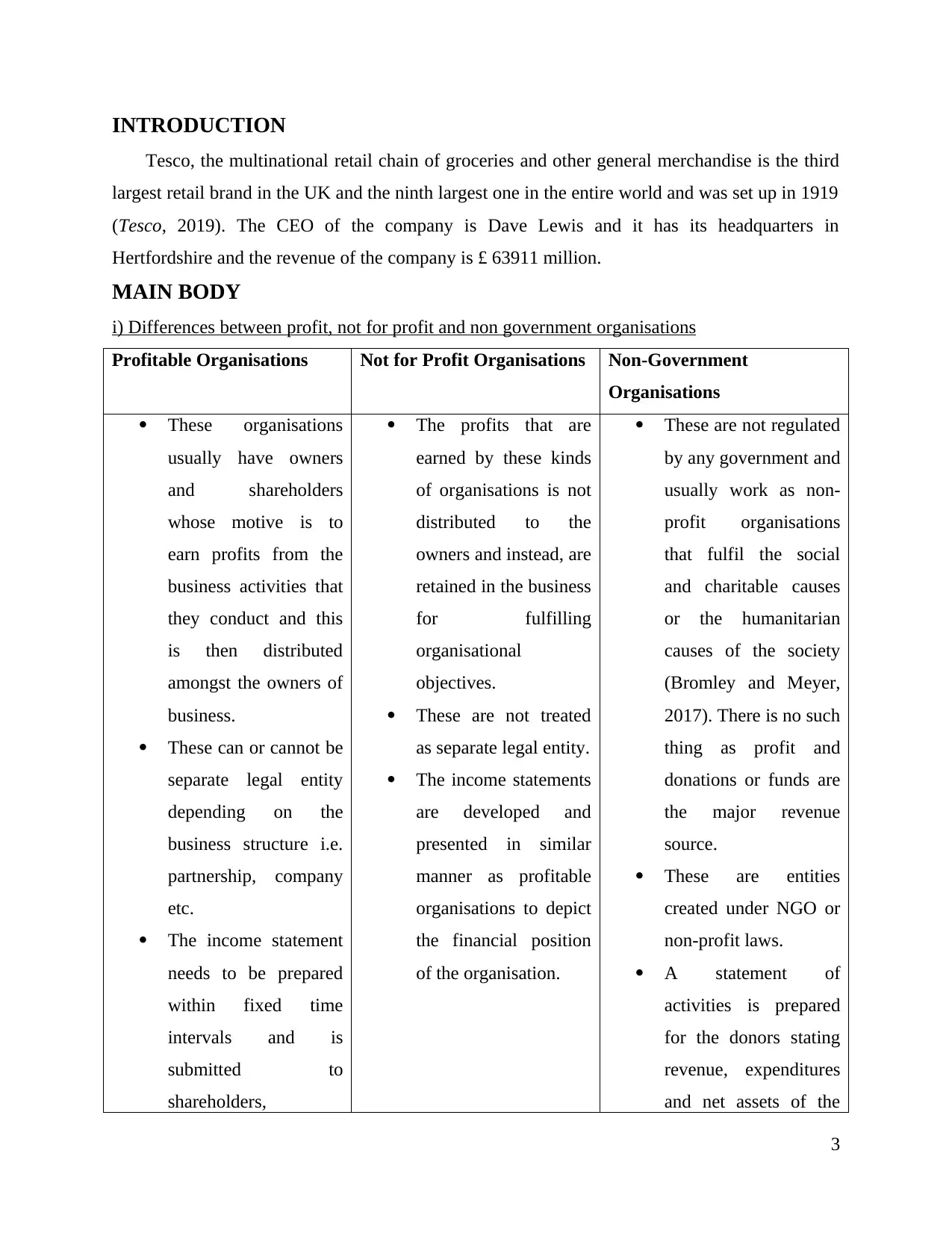
i) Differences between profit, not for profit and non government organisations
Profitable Organisations Not for Profit Organisations Non-Government
Organisations
These organisations
usually have owners
and shareholders
whose motive is to
earn profits from the
business activities that
they conduct and this
is then distributed
amongst the owners of
business.
These can or cannot be
separate legal entity
depending on the
business structure i.e.
partnership, company
etc.
The income statement
needs to be prepared
within fixed time
intervals and is
submitted to
shareholders,
The profits that are
earned by these kinds
of organisations is not
distributed to the
owners and instead, are
retained in the business
for fulfilling
organisational
objectives.
These are not treated
as separate legal entity.
The income statements
are developed and
presented in similar
manner as profitable
organisations to depict
the financial position
of the organisation.
These are not regulated
by any government and
usually work as non-
profit organisations
that fulfil the social
and charitable causes
or the humanitarian
causes of the society
(Bromley and Meyer,
2017). There is no such
thing as profit and
donations or funds are
the major revenue
source.
These are entities
created under NGO or
non-profit laws.
A statement of
activities is prepared
for the donors stating
revenue, expenditures
and net assets of the
3
Tesco, the multinational retail chain of groceries and other general merchandise is the third
largest retail brand in the UK and the ninth largest one in the entire world and was set up in 1919
(Tesco, 2019). The CEO of the company is Dave Lewis and it has its headquarters in
Hertfordshire and the revenue of the company is £ 63911 million.
MAIN BODY
i) Differences between profit, not for profit and non government organisations
Profitable Organisations Not for Profit Organisations Non-Government
Organisations
These organisations
usually have owners
and shareholders
whose motive is to
earn profits from the
business activities that
they conduct and this
is then distributed
amongst the owners of
business.
These can or cannot be
separate legal entity
depending on the
business structure i.e.
partnership, company
etc.
The income statement
needs to be prepared
within fixed time
intervals and is
submitted to
shareholders,
The profits that are
earned by these kinds
of organisations is not
distributed to the
owners and instead, are
retained in the business
for fulfilling
organisational
objectives.
These are not treated
as separate legal entity.
The income statements
are developed and
presented in similar
manner as profitable
organisations to depict
the financial position
of the organisation.
These are not regulated
by any government and
usually work as non-
profit organisations
that fulfil the social
and charitable causes
or the humanitarian
causes of the society
(Bromley and Meyer,
2017). There is no such
thing as profit and
donations or funds are
the major revenue
source.
These are entities
created under NGO or
non-profit laws.
A statement of
activities is prepared
for the donors stating
revenue, expenditures
and net assets of the
3
⊘ This is a preview!⊘
Do you want full access?
Subscribe today to unlock all pages.

Trusted by 1+ million students worldwide

government and other
regulatory bodies.
owner.
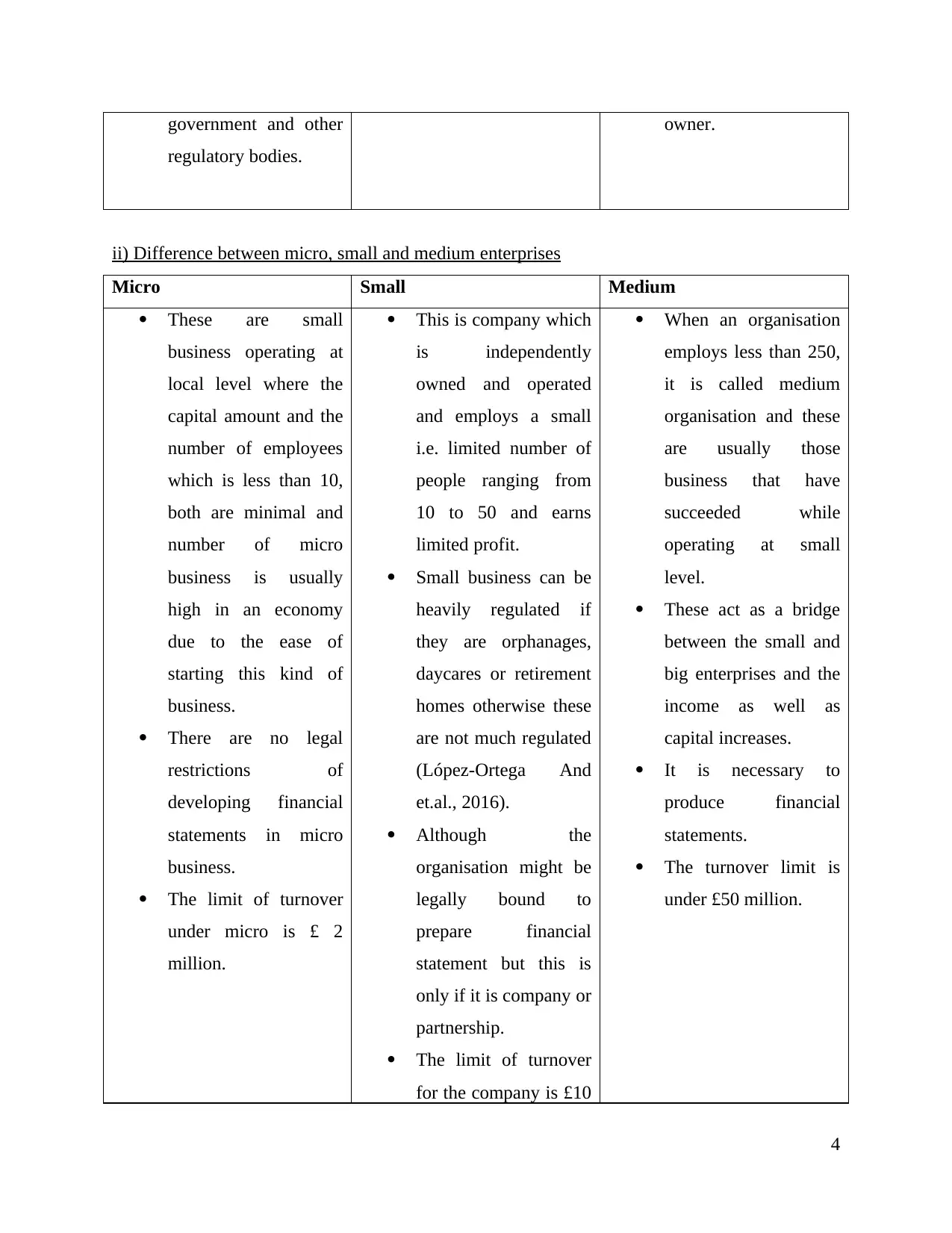
ii) Difference between micro, small and medium enterprises
Micro Small Medium
These are small
business operating at
local level where the
capital amount and the
number of employees
which is less than 10,
both are minimal and
number of micro
business is usually
high in an economy
due to the ease of
starting this kind of
business.
There are no legal
restrictions of
developing financial
statements in micro
business.
The limit of turnover
under micro is £ 2
million.
This is company which
is independently
owned and operated
and employs a small
i.e. limited number of
people ranging from
10 to 50 and earns
limited profit.
Small business can be
heavily regulated if
they are orphanages,
daycares or retirement
homes otherwise these
are not much regulated
(López-Ortega And
et.al., 2016).
Although the
organisation might be
legally bound to
prepare financial
statement but this is
only if it is company or
partnership.
The limit of turnover
for the company is £10
When an organisation
employs less than 250,
it is called medium
organisation and these
are usually those
business that have
succeeded while
operating at small
level.
These act as a bridge
between the small and
big enterprises and the
income as well as
capital increases.
It is necessary to
produce financial
statements.
The turnover limit is
under £50 million.
4
regulatory bodies.
owner.
ii) Difference between micro, small and medium enterprises
Micro Small Medium
These are small
business operating at
local level where the
capital amount and the
number of employees
which is less than 10,
both are minimal and
number of micro
business is usually
high in an economy
due to the ease of
starting this kind of
business.
There are no legal
restrictions of
developing financial
statements in micro
business.
The limit of turnover
under micro is £ 2
million.
This is company which
is independently
owned and operated
and employs a small
i.e. limited number of
people ranging from
10 to 50 and earns
limited profit.
Small business can be
heavily regulated if
they are orphanages,
daycares or retirement
homes otherwise these
are not much regulated
(López-Ortega And
et.al., 2016).
Although the
organisation might be
legally bound to
prepare financial
statement but this is
only if it is company or
partnership.
The limit of turnover
for the company is £10
When an organisation
employs less than 250,
it is called medium
organisation and these
are usually those
business that have
succeeded while
operating at small
level.
These act as a bridge
between the small and
big enterprises and the
income as well as
capital increases.
It is necessary to
produce financial
statements.
The turnover limit is
under £50 million.
4
Paraphrase This Document
Need a fresh take? Get an instant paraphrase of this document with our AI Paraphraser

million.
iii) Value chain analysis and VRIO of Tesco
Value chain analysis
Primary activity
Inbound logistic of the Tesco is very complex and involves the hundred of the product
categories to sell the product of the company in 7817 stores of the company. As Tesco is having
good financial position they used to make good investment to improve their capacity of the
logistic in the organization. Tesco business is divided into three different segment:
Retail: This is the core business of the organization in which they used to sell the product
of different company in their store.
Manufacturing: It is the segment in which the organization used to manufacture the own
product in the name of the company to be sold in the market with the help of the store.
Banking: Tesco also used to provide the services of the banking to the customer.
Outbound logistic of the Tesco includes flexibility and cost-effectiveness of deliveries are the
main sources of value for Tesco outbound logistics.
Marketing and sales: It is the service in which the organization used to promote the
product of the company in the market in such a way that all the customer are aware about
company product. “Every little Helps” is the marketing strategies of Tesco. Service: Customer loyalty based of the Tesco has declined by 2.5 percent during the
course of 2015. As Tesco uses the cost leadership skill in the organization it get difficult
for the organization to provide high quality leadership.
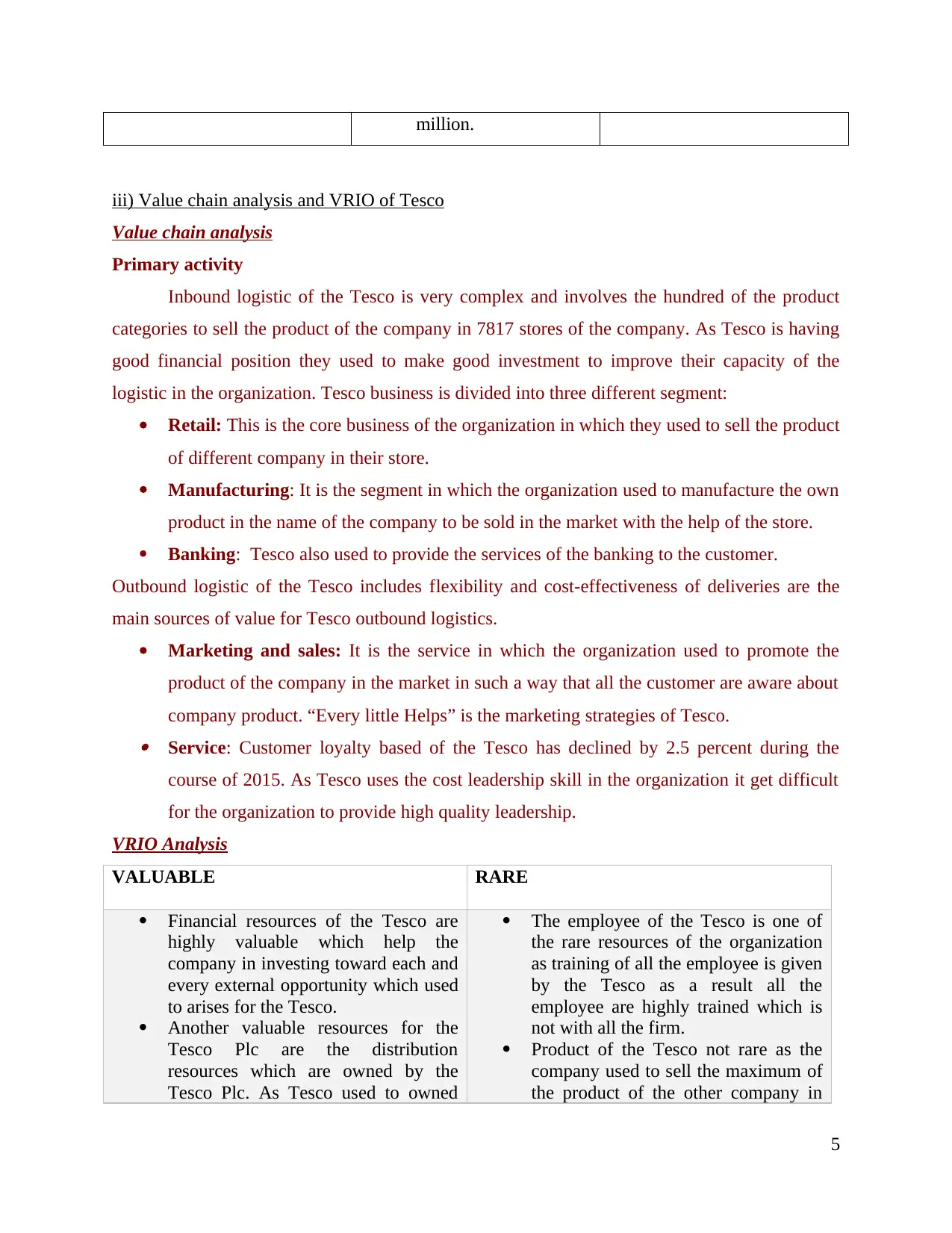
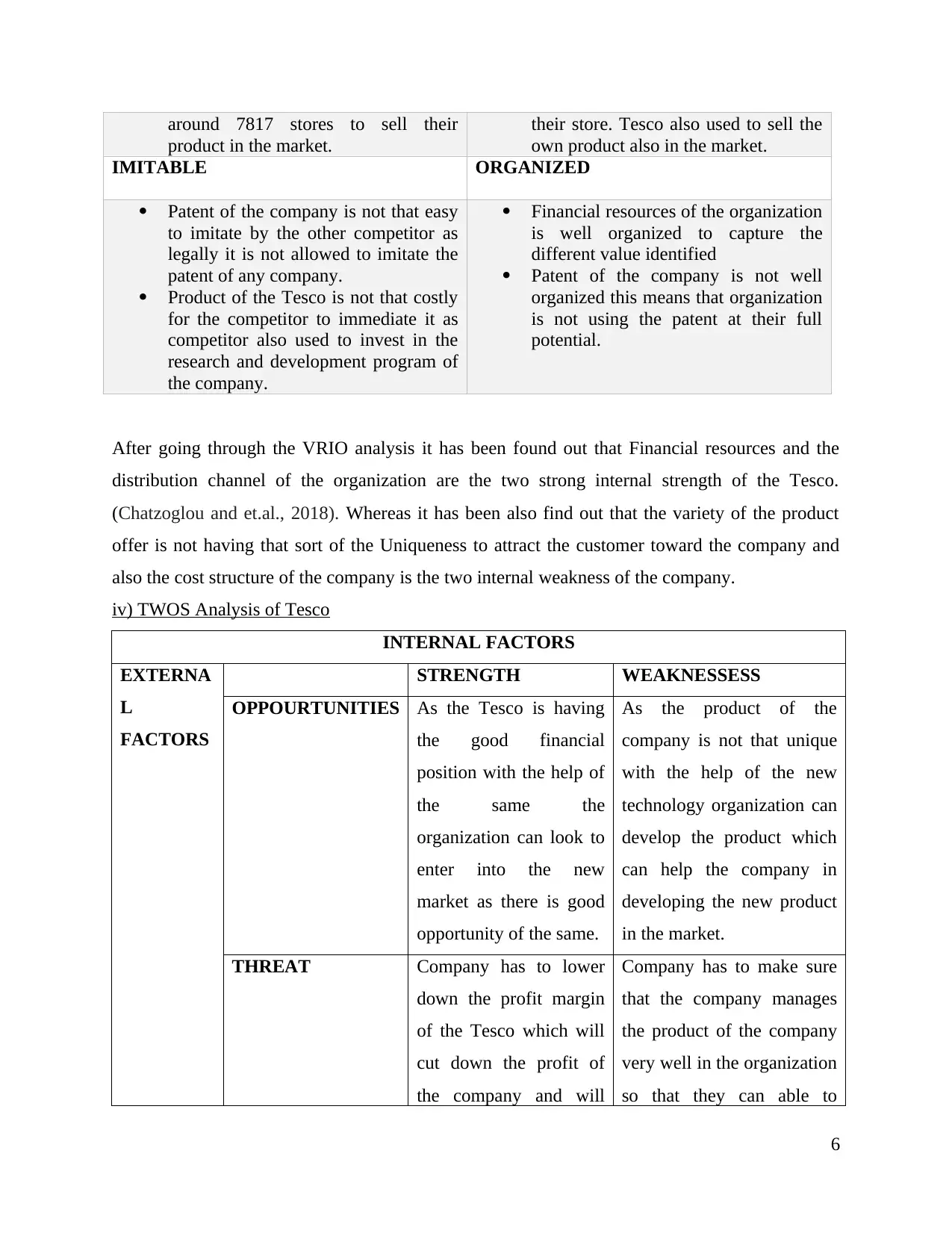
VRIO Analysis
VALUABLE RARE
Financial resources of the Tesco are
highly valuable which help the
company in investing toward each and
every external opportunity which used
to arises for the Tesco.
Another valuable resources for the
Tesco Plc are the distribution
resources which are owned by the
Tesco Plc. As Tesco used to owned
The employee of the Tesco is one of
the rare resources of the organization
as training of all the employee is given
by the Tesco as a result all the
employee are highly trained which is
not with all the firm.
Product of the Tesco not rare as the
company used to sell the maximum of
the product of the other company in
5
iii) Value chain analysis and VRIO of Tesco
Value chain analysis
Primary activity
Inbound logistic of the Tesco is very complex and involves the hundred of the product
categories to sell the product of the company in 7817 stores of the company. As Tesco is having
good financial position they used to make good investment to improve their capacity of the
logistic in the organization. Tesco business is divided into three different segment:
Retail: This is the core business of the organization in which they used to sell the product
of different company in their store.
Manufacturing: It is the segment in which the organization used to manufacture the own
product in the name of the company to be sold in the market with the help of the store.
Banking: Tesco also used to provide the services of the banking to the customer.
Outbound logistic of the Tesco includes flexibility and cost-effectiveness of deliveries are the
main sources of value for Tesco outbound logistics.
Marketing and sales: It is the service in which the organization used to promote the
product of the company in the market in such a way that all the customer are aware about
company product. “Every little Helps” is the marketing strategies of Tesco. Service: Customer loyalty based of the Tesco has declined by 2.5 percent during the
course of 2015. As Tesco uses the cost leadership skill in the organization it get difficult
for the organization to provide high quality leadership.
VRIO Analysis
VALUABLE RARE
Financial resources of the Tesco are
highly valuable which help the
company in investing toward each and
every external opportunity which used
to arises for the Tesco.
Another valuable resources for the
Tesco Plc are the distribution
resources which are owned by the
Tesco Plc. As Tesco used to owned
The employee of the Tesco is one of
the rare resources of the organization
as training of all the employee is given
by the Tesco as a result all the
employee are highly trained which is
not with all the firm.
Product of the Tesco not rare as the
company used to sell the maximum of
the product of the other company in
5

around 7817 stores to sell their
product in the market.
their store. Tesco also used to sell the
own product also in the market.
IMITABLE ORGANIZED
Patent of the company is not that easy
to imitate by the other competitor as
legally it is not allowed to imitate the
patent of any company.
Product of the Tesco is not that costly
for the competitor to immediate it as
competitor also used to invest in the
research and development program of
the company.
Financial resources of the organization
is well organized to capture the
different value identified
Patent of the company is not well
organized this means that organization
is not using the patent at their full
potential.
After going through the VRIO analysis it has been found out that Financial resources and the
distribution channel of the organization are the two strong internal strength of the Tesco.
(Chatzoglou and et.al., 2018). Whereas it has been also find out that the variety of the product
offer is not having that sort of the Uniqueness to attract the customer toward the company and
also the cost structure of the company is the two internal weakness of the company.
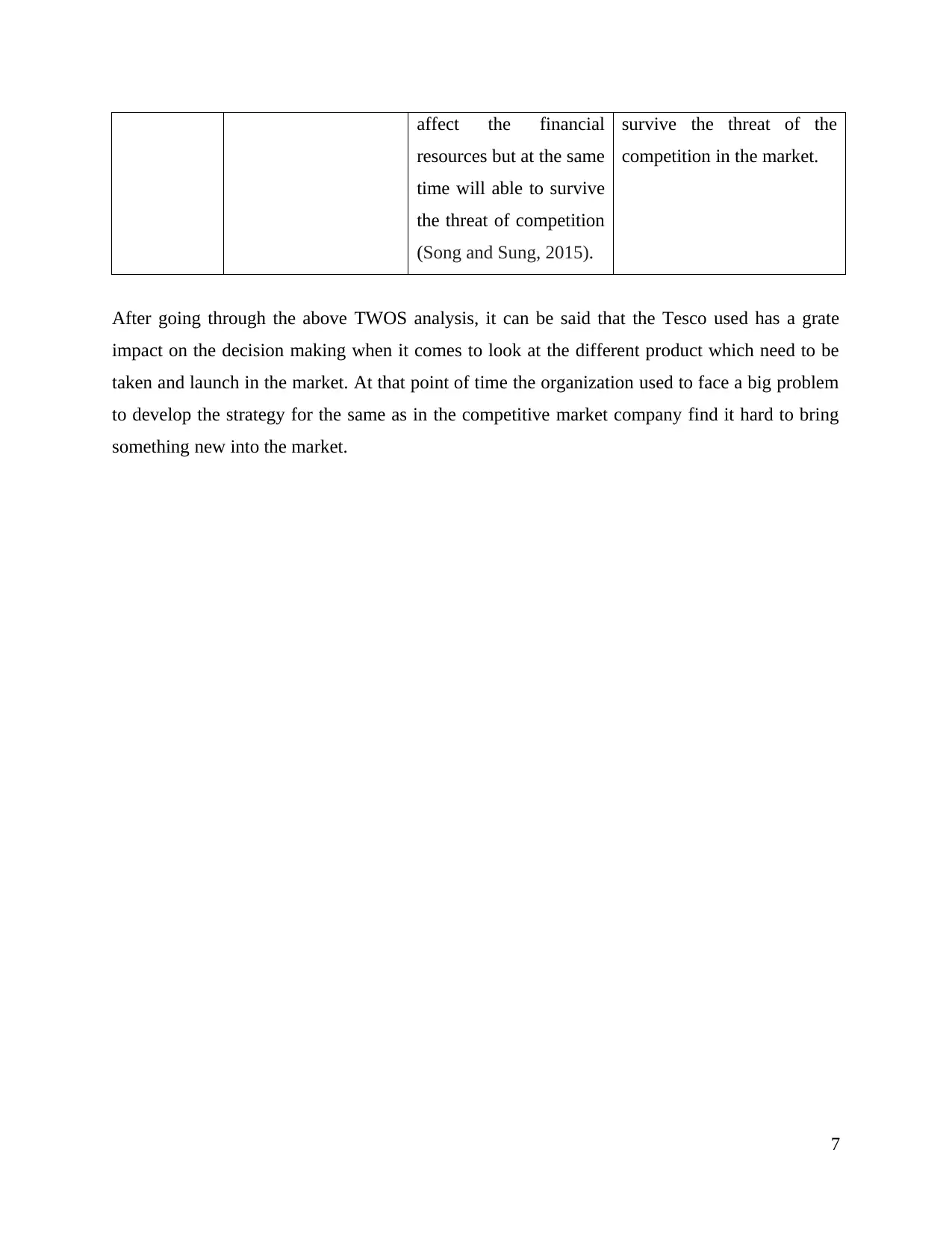
iv) TWOS Analysis of Tesco
INTERNAL FACTORS
EXTERNA
L
FACTORS
STRENGTH WEAKNESSESS
OPPOURTUNITIES As the Tesco is having
the good financial
position with the help of
the same the
organization can look to
enter into the new
market as there is good
opportunity of the same.
As the product of the
company is not that unique
with the help of the new
technology organization can
develop the product which
can help the company in
developing the new product
in the market.
THREAT Company has to lower
down the profit margin
of the Tesco which will
cut down the profit of
the company and will
Company has to make sure
that the company manages
the product of the company
very well in the organization
so that they can able to
6
product in the market.
their store. Tesco also used to sell the
own product also in the market.
IMITABLE ORGANIZED
Patent of the company is not that easy
to imitate by the other competitor as
legally it is not allowed to imitate the
patent of any company.
Product of the Tesco is not that costly
for the competitor to immediate it as
competitor also used to invest in the
research and development program of
the company.
Financial resources of the organization
is well organized to capture the
different value identified
Patent of the company is not well
organized this means that organization
is not using the patent at their full
potential.
After going through the VRIO analysis it has been found out that Financial resources and the
distribution channel of the organization are the two strong internal strength of the Tesco.
(Chatzoglou and et.al., 2018). Whereas it has been also find out that the variety of the product
offer is not having that sort of the Uniqueness to attract the customer toward the company and
also the cost structure of the company is the two internal weakness of the company.
iv) TWOS Analysis of Tesco
INTERNAL FACTORS
EXTERNA
L
FACTORS
STRENGTH WEAKNESSESS
OPPOURTUNITIES As the Tesco is having
the good financial
position with the help of
the same the
organization can look to
enter into the new
market as there is good
opportunity of the same.
As the product of the
company is not that unique
with the help of the new
technology organization can
develop the product which
can help the company in
developing the new product
in the market.
THREAT Company has to lower
down the profit margin
of the Tesco which will
cut down the profit of
the company and will
Company has to make sure
that the company manages
the product of the company
very well in the organization
so that they can able to
6
⊘ This is a preview!⊘
Do you want full access?
Subscribe today to unlock all pages.

Trusted by 1+ million students worldwide

affect the financial
resources but at the same
time will able to survive
the threat of competition
(Song and Sung, 2015).
survive the threat of the
competition in the market.
After going through the above TWOS analysis, it can be said that the Tesco used has a grate
impact on the decision making when it comes to look at the different product which need to be
taken and launch in the market. At that point of time the organization used to face a big problem
to develop the strategy for the same as in the competitive market company find it hard to bring
something new into the market.
7
resources but at the same
time will able to survive
the threat of competition
(Song and Sung, 2015).
survive the threat of the
competition in the market.
After going through the above TWOS analysis, it can be said that the Tesco used has a grate
impact on the decision making when it comes to look at the different product which need to be
taken and launch in the market. At that point of time the organization used to face a big problem
to develop the strategy for the same as in the competitive market company find it hard to bring
something new into the market.
7
Paraphrase This Document
Need a fresh take? Get an instant paraphrase of this document with our AI Paraphraser

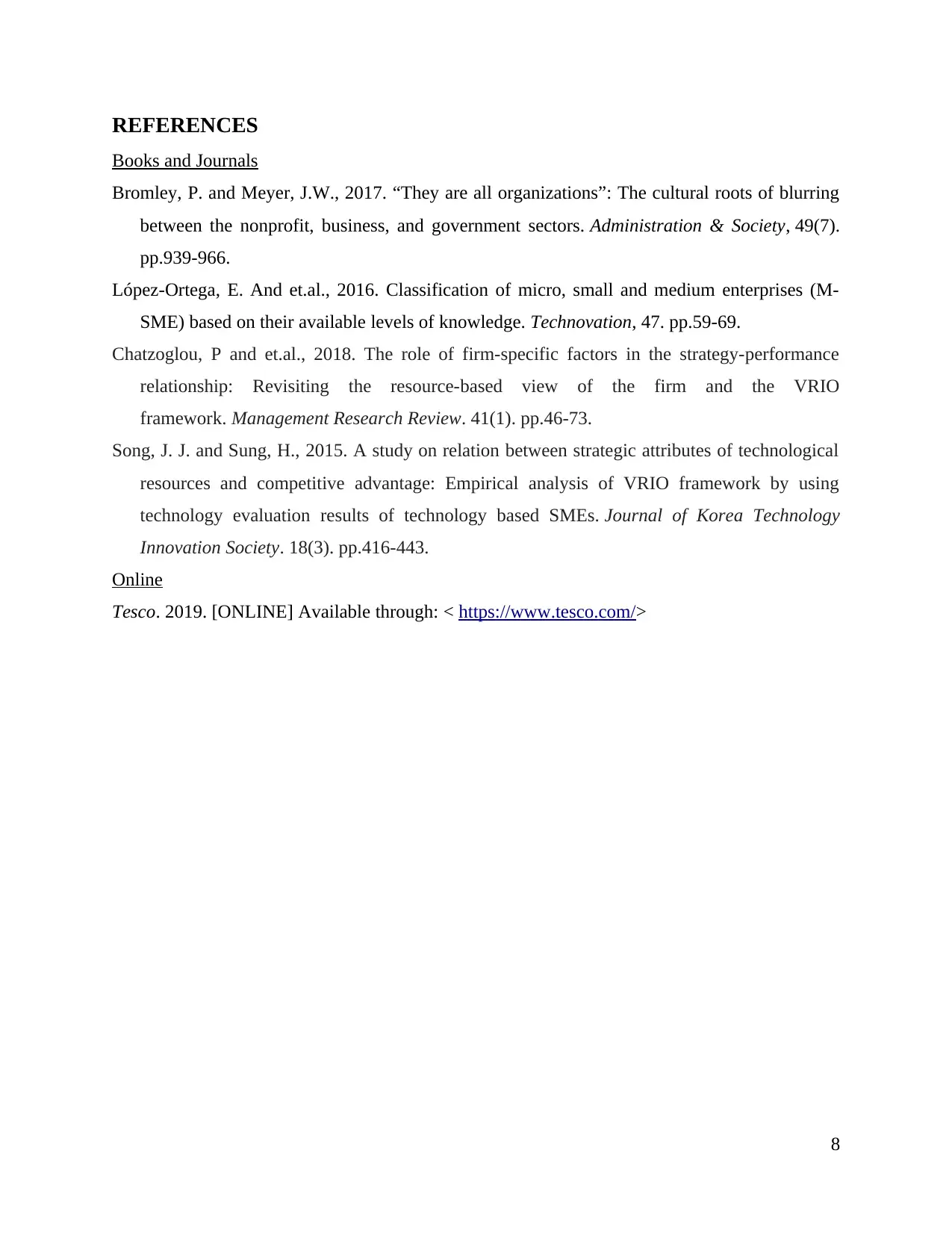
REFERENCES
Books and Journals
Bromley, P. and Meyer, J.W., 2017. “They are all organizations”: The cultural roots of blurring
between the nonprofit, business, and government sectors. Administration & Society, 49(7).
pp.939-966.
López-Ortega, E. And et.al., 2016. Classification of micro, small and medium enterprises (M-
SME) based on their available levels of knowledge. Technovation, 47. pp.59-69.
Chatzoglou, P and et.al., 2018. The role of firm-specific factors in the strategy-performance
relationship: Revisiting the resource-based view of the firm and the VRIO
framework. Management Research Review. 41(1). pp.46-73.
Song, J. J. and Sung, H., 2015. A study on relation between strategic attributes of technological
resources and competitive advantage: Empirical analysis of VRIO framework by using
technology evaluation results of technology based SMEs. Journal of Korea Technology
Innovation Society. 18(3). pp.416-443.
Online
Tesco. 2019. [ONLINE] Available through: < https://www.tesco.com/>
8
Books and Journals
Bromley, P. and Meyer, J.W., 2017. “They are all organizations”: The cultural roots of blurring
between the nonprofit, business, and government sectors. Administration & Society, 49(7).
pp.939-966.
López-Ortega, E. And et.al., 2016. Classification of micro, small and medium enterprises (M-
SME) based on their available levels of knowledge. Technovation, 47. pp.59-69.
Chatzoglou, P and et.al., 2018. The role of firm-specific factors in the strategy-performance
relationship: Revisiting the resource-based view of the firm and the VRIO
framework. Management Research Review. 41(1). pp.46-73.
Song, J. J. and Sung, H., 2015. A study on relation between strategic attributes of technological
resources and competitive advantage: Empirical analysis of VRIO framework by using
technology evaluation results of technology based SMEs. Journal of Korea Technology
Innovation Society. 18(3). pp.416-443.
Online
Tesco. 2019. [ONLINE] Available through: < https://www.tesco.com/>
8

9
⊘ This is a preview!⊘
Do you want full access?
Subscribe today to unlock all pages.

Trusted by 1+ million students worldwide

10
1 out of 10
Related Documents
Your All-in-One AI-Powered Toolkit for Academic Success.
+13062052269
info@desklib.com
Available 24*7 on WhatsApp / Email
Unlock your academic potential
Copyright © 2020–2026 A2Z Services. All Rights Reserved. Developed and managed by ZUCOL.