Analysis of Tesco's International Expansion through Joint Ventures
VerifiedAdded on 2021/02/22
|12
|1035
|348
Project
AI Summary
This project presents a comprehensive analysis of Tesco's international expansion strategy, specifically focusing on its joint venture with China Resource Enterprise (CRE). The project begins with an introduction outlining the aim, objectives, background, rationale, and scope, setting the stage for an in-depth investigation. A thorough literature review explores existing research on internationalization, joint ventures, and the associated risks and benefits. The research methodology section details the use of qualitative data collection through questionnaires administered to Tesco employees, employing non-probabilistic random sampling. The project plan includes resource and cost considerations, a detailed timeframe spanning 13 months, and a Gantt chart for project management. A risk register identifies potential challenges, categorized by severity. The project concludes with a list of references, providing sources for the research. The project aims to assess the potential benefits and risks of international market expansion through joint ventures, offering valuable insights for businesses seeking global growth.

PROJECT PLAN
Paraphrase This Document
Need a fresh take? Get an instant paraphrase of this document with our AI Paraphraser

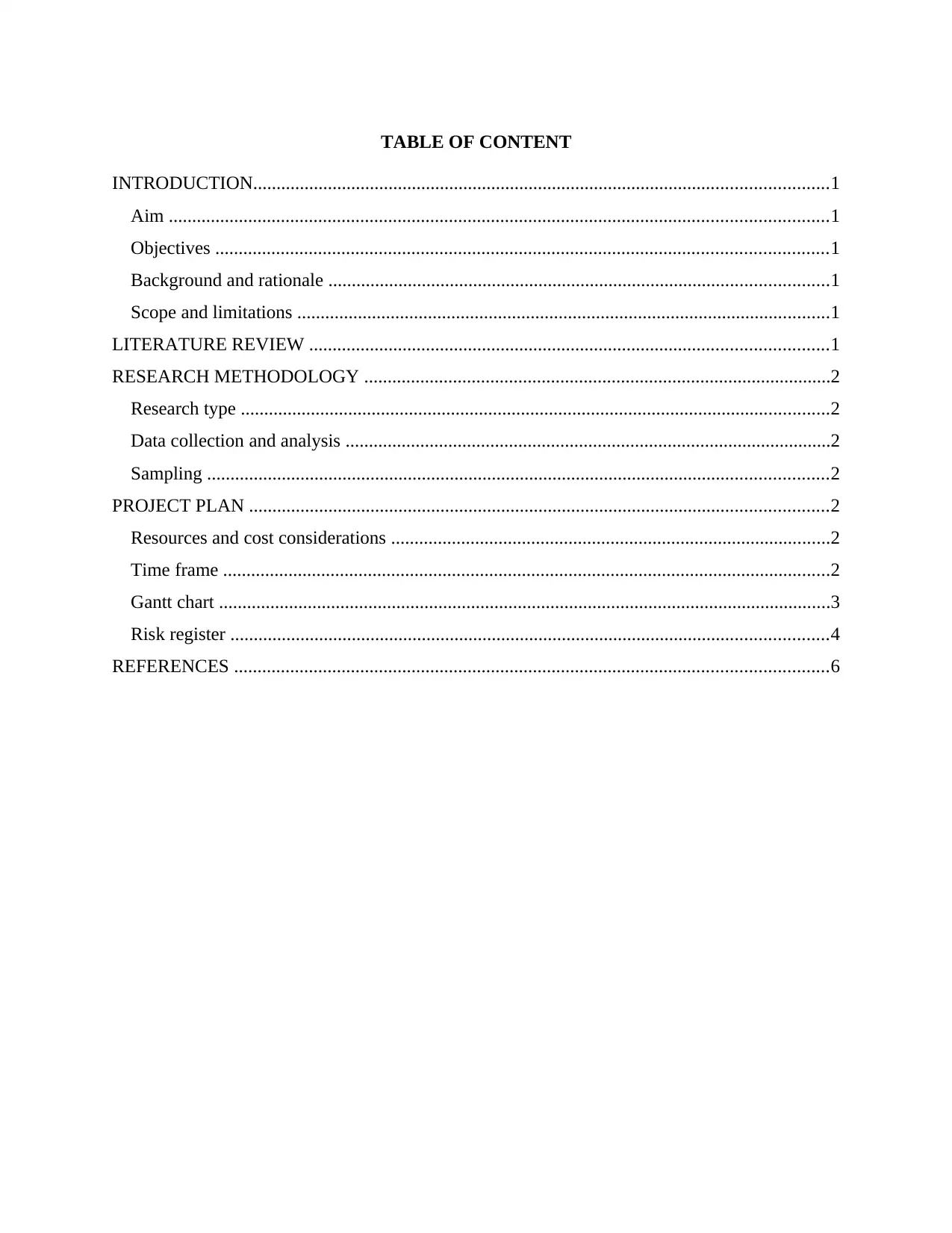
TABLE OF CONTENT
INTRODUCTION...........................................................................................................................1
Aim .............................................................................................................................................1
Objectives ...................................................................................................................................1
Background and rationale ...........................................................................................................1
Scope and limitations ..................................................................................................................1
LITERATURE REVIEW ...............................................................................................................1
RESEARCH METHODOLOGY ....................................................................................................2
Research type ..............................................................................................................................2
Data collection and analysis ........................................................................................................2
Sampling .....................................................................................................................................2
PROJECT PLAN ............................................................................................................................2
Resources and cost considerations ..............................................................................................2
Time frame ..................................................................................................................................2
Gantt chart ...................................................................................................................................3
Risk register ................................................................................................................................4
REFERENCES ...............................................................................................................................6
INTRODUCTION...........................................................................................................................1
Aim .............................................................................................................................................1
Objectives ...................................................................................................................................1
Background and rationale ...........................................................................................................1
Scope and limitations ..................................................................................................................1
LITERATURE REVIEW ...............................................................................................................1
RESEARCH METHODOLOGY ....................................................................................................2
Research type ..............................................................................................................................2
Data collection and analysis ........................................................................................................2
Sampling .....................................................................................................................................2
PROJECT PLAN ............................................................................................................................2
Resources and cost considerations ..............................................................................................2
Time frame ..................................................................................................................................2
Gantt chart ...................................................................................................................................3
Risk register ................................................................................................................................4
REFERENCES ...............................................................................................................................6

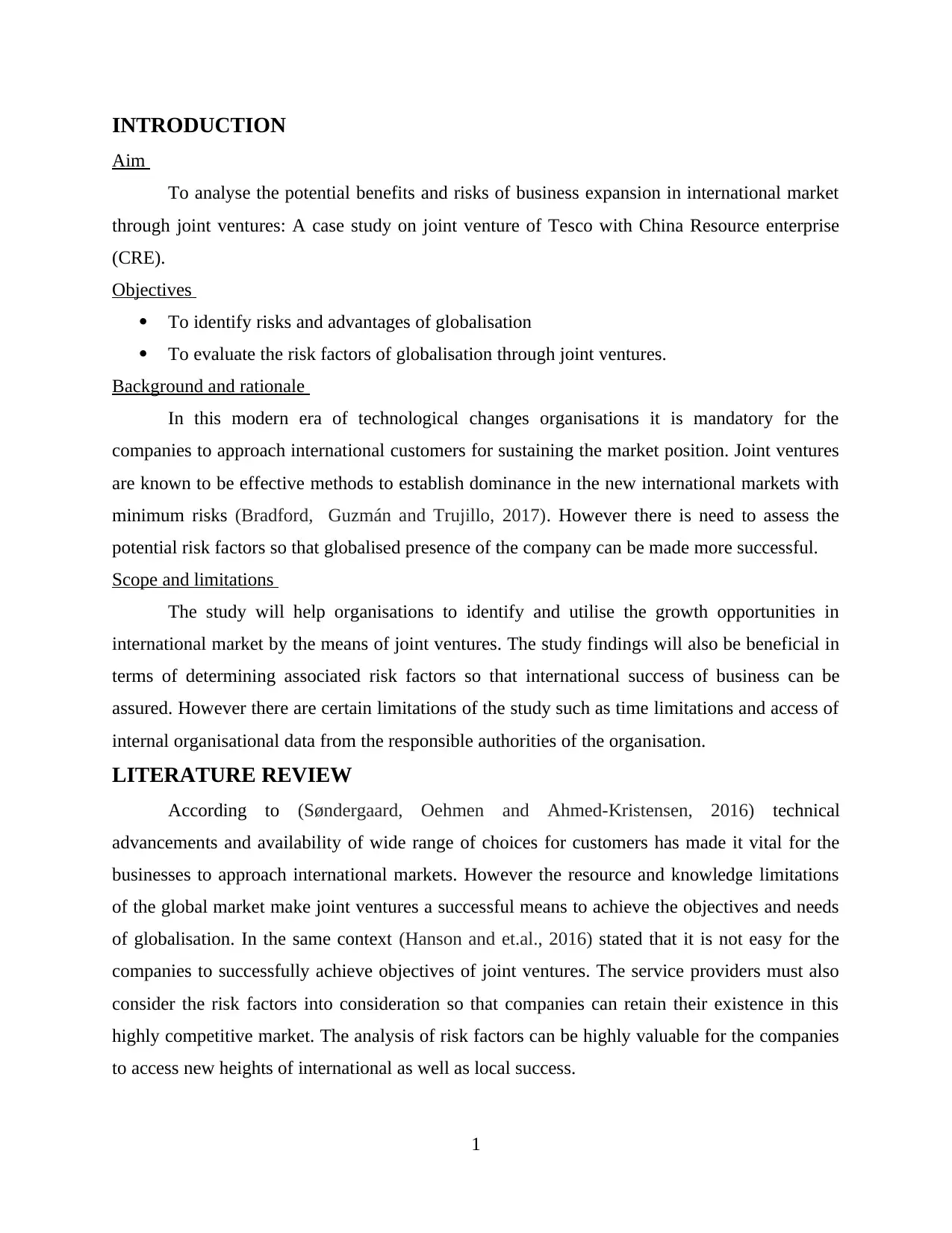
INTRODUCTION
Aim
To analyse the potential benefits and risks of business expansion in international market
through joint ventures: A case study on joint venture of Tesco with China Resource enterprise
(CRE).
Objectives
To identify risks and advantages of globalisation
To evaluate the risk factors of globalisation through joint ventures.
Background and rationale
In this modern era of technological changes organisations it is mandatory for the
companies to approach international customers for sustaining the market position. Joint ventures
are known to be effective methods to establish dominance in the new international markets with
minimum risks (Bradford, Guzmán and Trujillo, 2017). However there is need to assess the
potential risk factors so that globalised presence of the company can be made more successful.
Scope and limitations
The study will help organisations to identify and utilise the growth opportunities in
international market by the means of joint ventures. The study findings will also be beneficial in
terms of determining associated risk factors so that international success of business can be
assured. However there are certain limitations of the study such as time limitations and access of
internal organisational data from the responsible authorities of the organisation.
LITERATURE REVIEW
According to (Søndergaard, Oehmen and Ahmed-Kristensen, 2016) technical
advancements and availability of wide range of choices for customers has made it vital for the
businesses to approach international markets. However the resource and knowledge limitations
of the global market make joint ventures a successful means to achieve the objectives and needs
of globalisation. In the same context (Hanson and et.al., 2016) stated that it is not easy for the
companies to successfully achieve objectives of joint ventures. The service providers must also
consider the risk factors into consideration so that companies can retain their existence in this
highly competitive market. The analysis of risk factors can be highly valuable for the companies
to access new heights of international as well as local success.
1
Aim
To analyse the potential benefits and risks of business expansion in international market
through joint ventures: A case study on joint venture of Tesco with China Resource enterprise
(CRE).
Objectives
To identify risks and advantages of globalisation
To evaluate the risk factors of globalisation through joint ventures.
Background and rationale
In this modern era of technological changes organisations it is mandatory for the
companies to approach international customers for sustaining the market position. Joint ventures
are known to be effective methods to establish dominance in the new international markets with
minimum risks (Bradford, Guzmán and Trujillo, 2017). However there is need to assess the
potential risk factors so that globalised presence of the company can be made more successful.
Scope and limitations
The study will help organisations to identify and utilise the growth opportunities in
international market by the means of joint ventures. The study findings will also be beneficial in
terms of determining associated risk factors so that international success of business can be
assured. However there are certain limitations of the study such as time limitations and access of
internal organisational data from the responsible authorities of the organisation.
LITERATURE REVIEW
According to (Søndergaard, Oehmen and Ahmed-Kristensen, 2016) technical
advancements and availability of wide range of choices for customers has made it vital for the
businesses to approach international markets. However the resource and knowledge limitations
of the global market make joint ventures a successful means to achieve the objectives and needs
of globalisation. In the same context (Hanson and et.al., 2016) stated that it is not easy for the
companies to successfully achieve objectives of joint ventures. The service providers must also
consider the risk factors into consideration so that companies can retain their existence in this
highly competitive market. The analysis of risk factors can be highly valuable for the companies
to access new heights of international as well as local success.
1
⊘ This is a preview!⊘
Do you want full access?
Subscribe today to unlock all pages.

Trusted by 1+ million students worldwide

RESEARCH METHODOLOGY
Research type
The proposed research will use qualitative data instead of quantitative data. One of the
benefit of using qualitative data is that it allow researchers to make findings more generalised by
using existing theories and business trends.
Data collection and analysis
The study is primary research in which data is collected by using a questionnaire so that
perspective of organisation can be understood and more specific conclusions can be drawn
(Nicholas and Steyn, 2017) . The collected data will be analysed by using various themes.
Sampling
For the collection of data non-probabilistic random sampling will be used and 50
employees of Tesco, UK will be provided a questionnaire. On the basis of collected data
thematic analysis is performed.
PROJECT PLAN
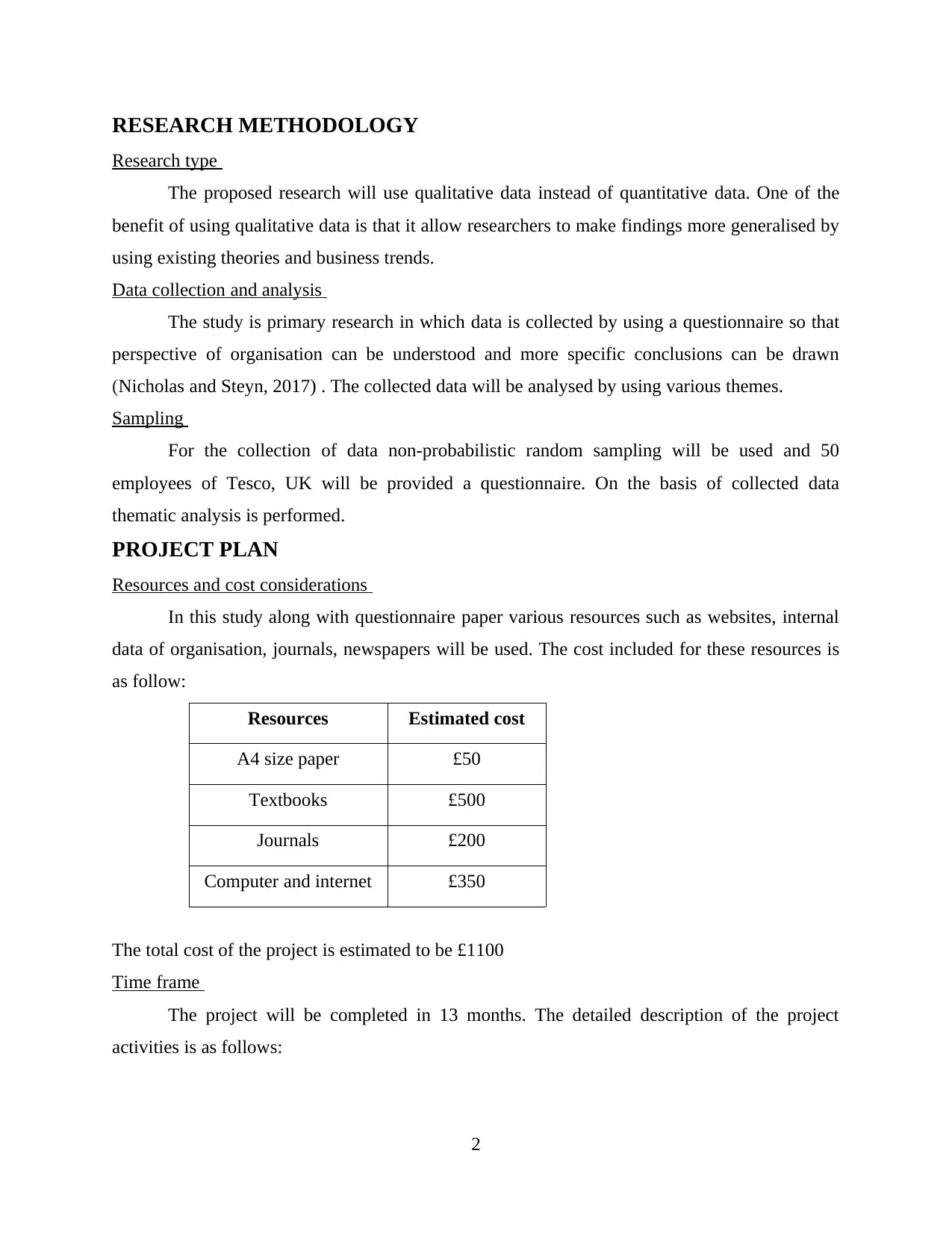
Resources and cost considerations
In this study along with questionnaire paper various resources such as websites, internal
data of organisation, journals, newspapers will be used. The cost included for these resources is
as follow:
Resources Estimated cost
A4 size paper £50
Textbooks £500
Journals £200
Computer and internet £350
The total cost of the project is estimated to be £1100
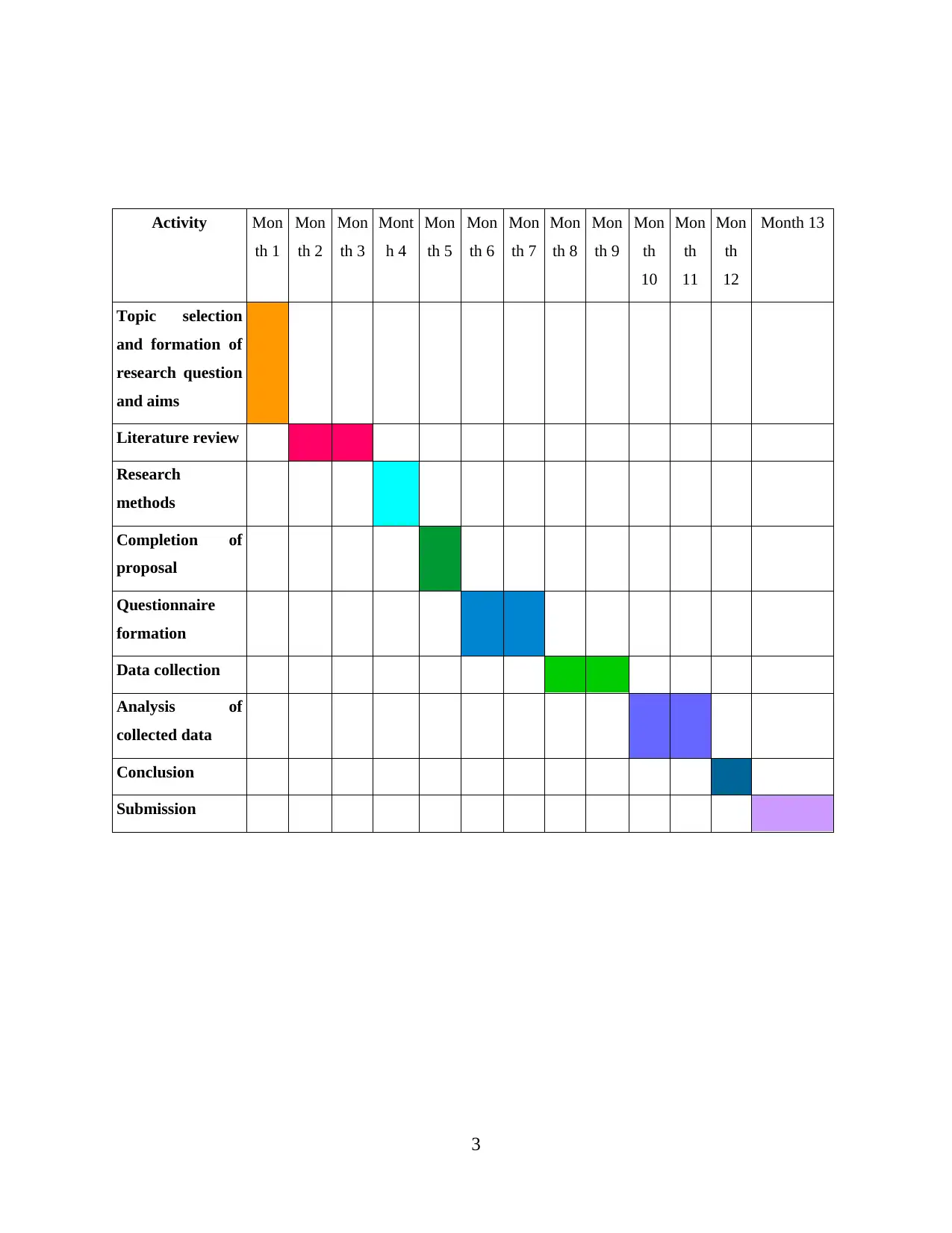
Time frame
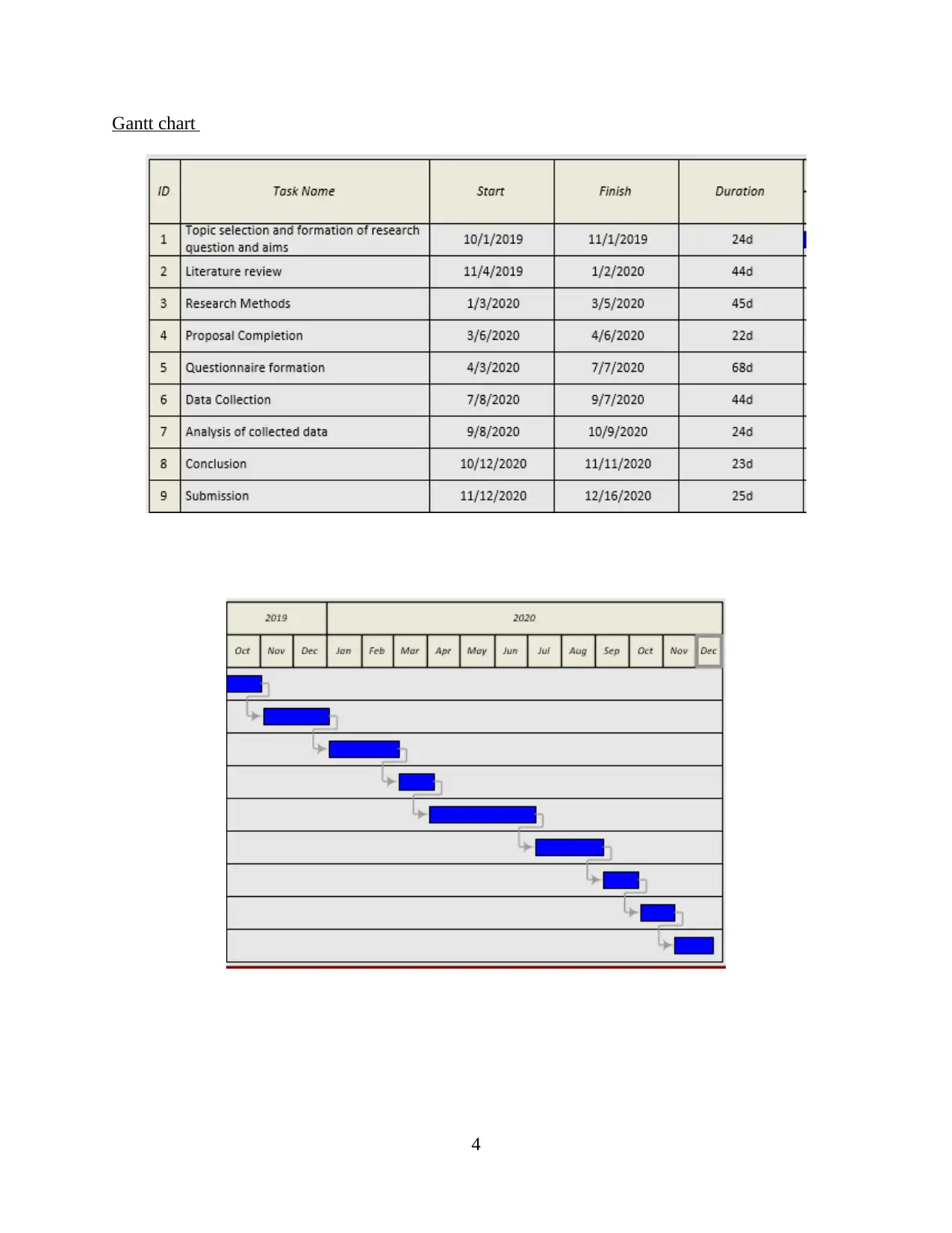
The project will be completed in 13 months. The detailed description of the project
activities is as follows:
2
Research type
The proposed research will use qualitative data instead of quantitative data. One of the
benefit of using qualitative data is that it allow researchers to make findings more generalised by
using existing theories and business trends.
Data collection and analysis
The study is primary research in which data is collected by using a questionnaire so that
perspective of organisation can be understood and more specific conclusions can be drawn
(Nicholas and Steyn, 2017) . The collected data will be analysed by using various themes.
Sampling
For the collection of data non-probabilistic random sampling will be used and 50
employees of Tesco, UK will be provided a questionnaire. On the basis of collected data
thematic analysis is performed.
PROJECT PLAN
Resources and cost considerations
In this study along with questionnaire paper various resources such as websites, internal
data of organisation, journals, newspapers will be used. The cost included for these resources is
as follow:
Resources Estimated cost
A4 size paper £50
Textbooks £500
Journals £200
Computer and internet £350
The total cost of the project is estimated to be £1100
Time frame
The project will be completed in 13 months. The detailed description of the project
activities is as follows:
2
Paraphrase This Document
Need a fresh take? Get an instant paraphrase of this document with our AI Paraphraser

Activity Mon
th 1
Mon
th 2
Mon
th 3
Mont
h 4
Mon
th 5
Mon
th 6
Mon
th 7
Mon
th 8
Mon
th 9
Mon
th
10
Mon
th
11
Mon
th
12
Month 13
Topic selection
and formation of
research question
and aims
Literature review
Research
methods
Completion of
proposal
Questionnaire
formation
Data collection
Analysis of
collected data
Conclusion
Submission
3
th 1
Mon
th 2
Mon
th 3
Mont
h 4
Mon
th 5
Mon
th 6
Mon
th 7
Mon
th 8
Mon
th 9
Mon
th
10
Mon
th
11
Mon
th
12
Month 13
Topic selection
and formation of
research question
and aims
Literature review
Research
methods
Completion of
proposal
Questionnaire
formation
Data collection
Analysis of
collected data
Conclusion
Submission
3

Gantt chart
4
4
⊘ This is a preview!⊘
Do you want full access?
Subscribe today to unlock all pages.

Trusted by 1+ million students worldwide

Risk register
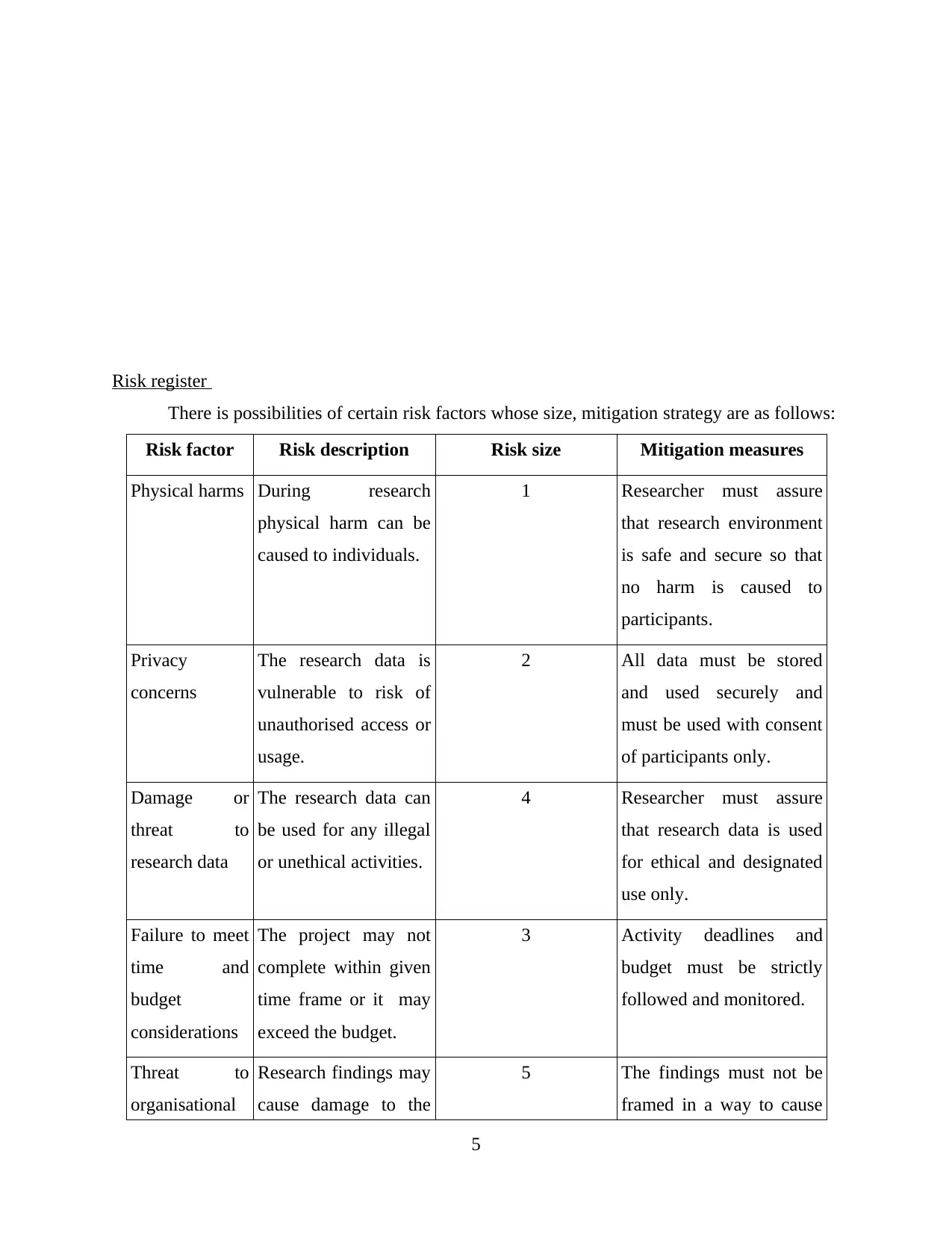
There is possibilities of certain risk factors whose size, mitigation strategy are as follows:
Risk factor Risk description Risk size Mitigation measures
Physical harms During research
physical harm can be
caused to individuals.
1 Researcher must assure
that research environment
is safe and secure so that
no harm is caused to
participants.
Privacy
concerns
The research data is
vulnerable to risk of
unauthorised access or
usage.
2 All data must be stored
and used securely and
must be used with consent
of participants only.
Damage or
threat to
research data
The research data can
be used for any illegal
or unethical activities.
4 Researcher must assure
that research data is used
for ethical and designated
use only.
Failure to meet
time and
budget
considerations
The project may not
complete within given
time frame or it may
exceed the budget.
3 Activity deadlines and
budget must be strictly
followed and monitored.
Threat to
organisational
Research findings may
cause damage to the
5 The findings must not be
framed in a way to cause
5
There is possibilities of certain risk factors whose size, mitigation strategy are as follows:
Risk factor Risk description Risk size Mitigation measures
Physical harms During research
physical harm can be
caused to individuals.
1 Researcher must assure
that research environment
is safe and secure so that
no harm is caused to
participants.
Privacy
concerns
The research data is
vulnerable to risk of
unauthorised access or
usage.
2 All data must be stored
and used securely and
must be used with consent
of participants only.
Damage or
threat to
research data
The research data can
be used for any illegal
or unethical activities.
4 Researcher must assure
that research data is used
for ethical and designated
use only.
Failure to meet
time and
budget
considerations
The project may not
complete within given
time frame or it may
exceed the budget.
3 Activity deadlines and
budget must be strictly
followed and monitored.
Threat to
organisational
Research findings may
cause damage to the
5 The findings must not be
framed in a way to cause
5
Paraphrase This Document
Need a fresh take? Get an instant paraphrase of this document with our AI Paraphraser

data and image brand image of
organisation chosen
for the case study.
any social damage to the
organisation.
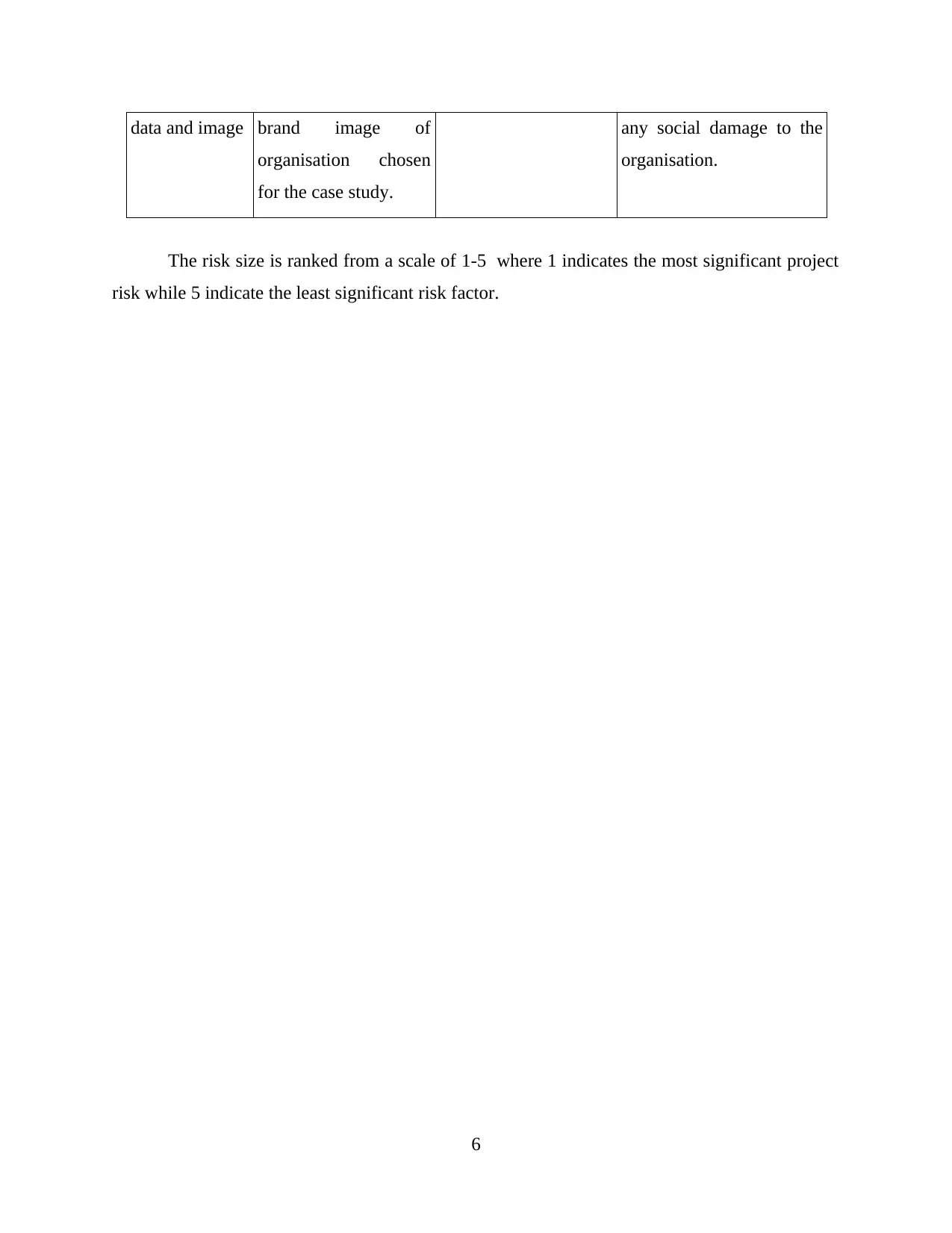
The risk size is ranked from a scale of 1-5 where 1 indicates the most significant project
risk while 5 indicate the least significant risk factor.
6
organisation chosen
for the case study.
any social damage to the
organisation.
The risk size is ranked from a scale of 1-5 where 1 indicates the most significant project
risk while 5 indicate the least significant risk factor.
6

REFERENCES
Books and Journals
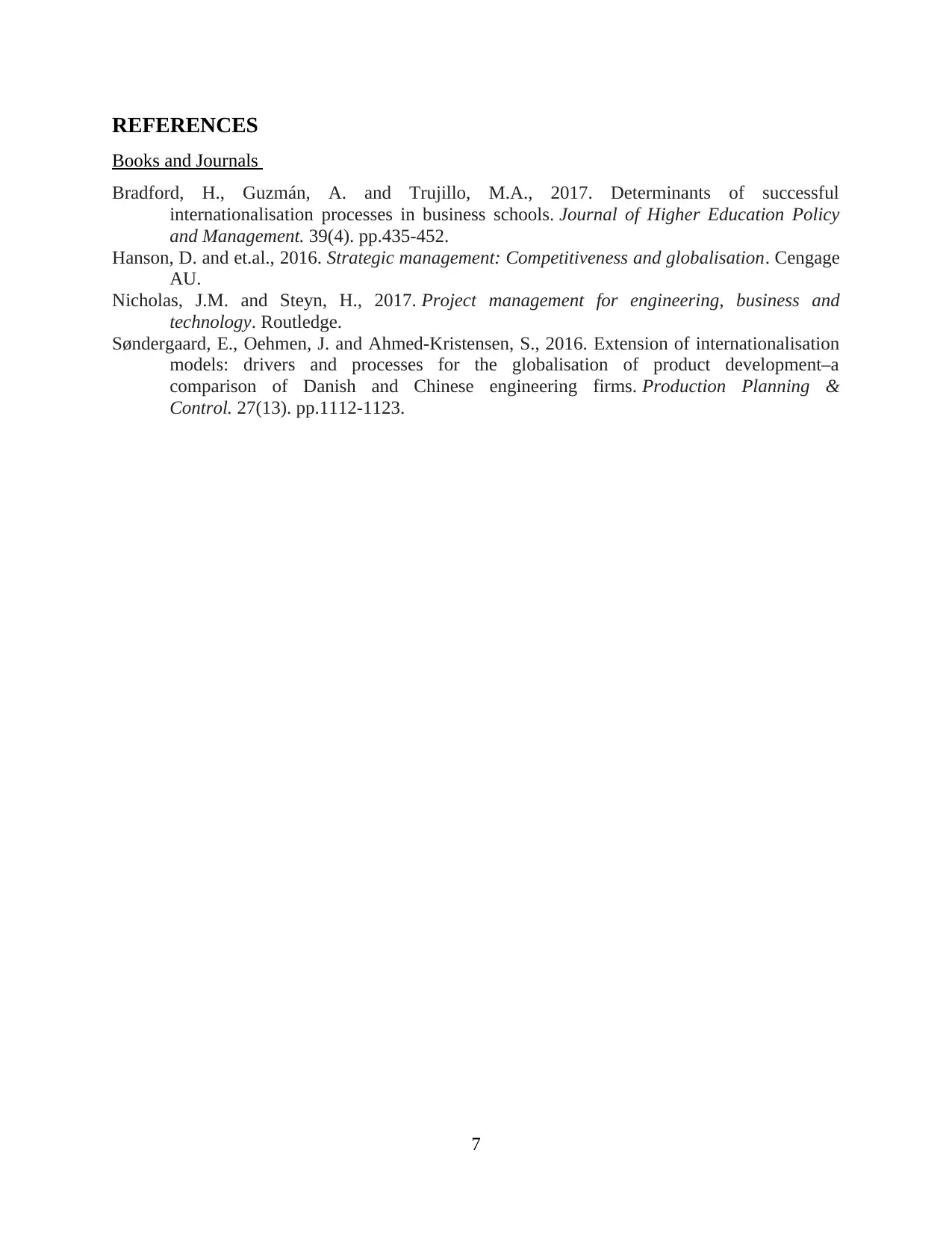
Bradford, H., Guzmán, A. and Trujillo, M.A., 2017. Determinants of successful
internationalisation processes in business schools. Journal of Higher Education Policy
and Management. 39(4). pp.435-452.
Hanson, D. and et.al., 2016. Strategic management: Competitiveness and globalisation. Cengage
AU.
Nicholas, J.M. and Steyn, H., 2017. Project management for engineering, business and
technology. Routledge.
Søndergaard, E., Oehmen, J. and Ahmed-Kristensen, S., 2016. Extension of internationalisation
models: drivers and processes for the globalisation of product development–a
comparison of Danish and Chinese engineering firms. Production Planning &
Control. 27(13). pp.1112-1123.
7
Books and Journals
Bradford, H., Guzmán, A. and Trujillo, M.A., 2017. Determinants of successful
internationalisation processes in business schools. Journal of Higher Education Policy
and Management. 39(4). pp.435-452.
Hanson, D. and et.al., 2016. Strategic management: Competitiveness and globalisation. Cengage
AU.
Nicholas, J.M. and Steyn, H., 2017. Project management for engineering, business and
technology. Routledge.
Søndergaard, E., Oehmen, J. and Ahmed-Kristensen, S., 2016. Extension of internationalisation
models: drivers and processes for the globalisation of product development–a
comparison of Danish and Chinese engineering firms. Production Planning &
Control. 27(13). pp.1112-1123.
7
⊘ This is a preview!⊘
Do you want full access?
Subscribe today to unlock all pages.

Trusted by 1+ million students worldwide

8
Paraphrase This Document
Need a fresh take? Get an instant paraphrase of this document with our AI Paraphraser

9

10
⊘ This is a preview!⊘
Do you want full access?
Subscribe today to unlock all pages.

Trusted by 1+ million students worldwide
1 out of 12
Related Documents
Your All-in-One AI-Powered Toolkit for Academic Success.
+13062052269
info@desklib.com
Available 24*7 on WhatsApp / Email
Unlock your academic potential
Copyright © 2020–2026 A2Z Services. All Rights Reserved. Developed and managed by ZUCOL.