Advanced Management Accounting: Tesco PLC Financial Analysis Report
VerifiedAdded on 2023/01/19
|13
|3426
|43
Report
AI Summary
This report provides a detailed analysis of Tesco PLC, examining its financial and non-financial performance using advanced management accounting techniques. The executive summary highlights the importance of assessing financial and non-financial aspects for effective decision-making. The company overview introduces Tesco PLC, its market position, and key competitors. The report identifies key opportunities, such as online sales expansion and joint ventures, and threats, including high competition and economic recession. A SWOT analysis reveals the company's strengths, including financial resources and customer loyalty programs, and weaknesses, such as past financial scandals and operational challenges. Financial analysis includes ratio analysis of profitability, liquidity, gearing, and investor ratios, with an assessment of the company's financial position. The conclusion and recommendations suggest strategies to address challenges and improve financial performance, emphasizing the importance of strategic decision-making for future success. The report underscores the significance of advanced management accounting in tracking internal activities and formulating effective business strategies.
ADVANCED
MANAGEMENT
ACCOUNTING
MANAGEMENT
ACCOUNTING

Paraphrase This Document
Need a fresh take? Get an instant paraphrase of this document with our AI Paraphraser
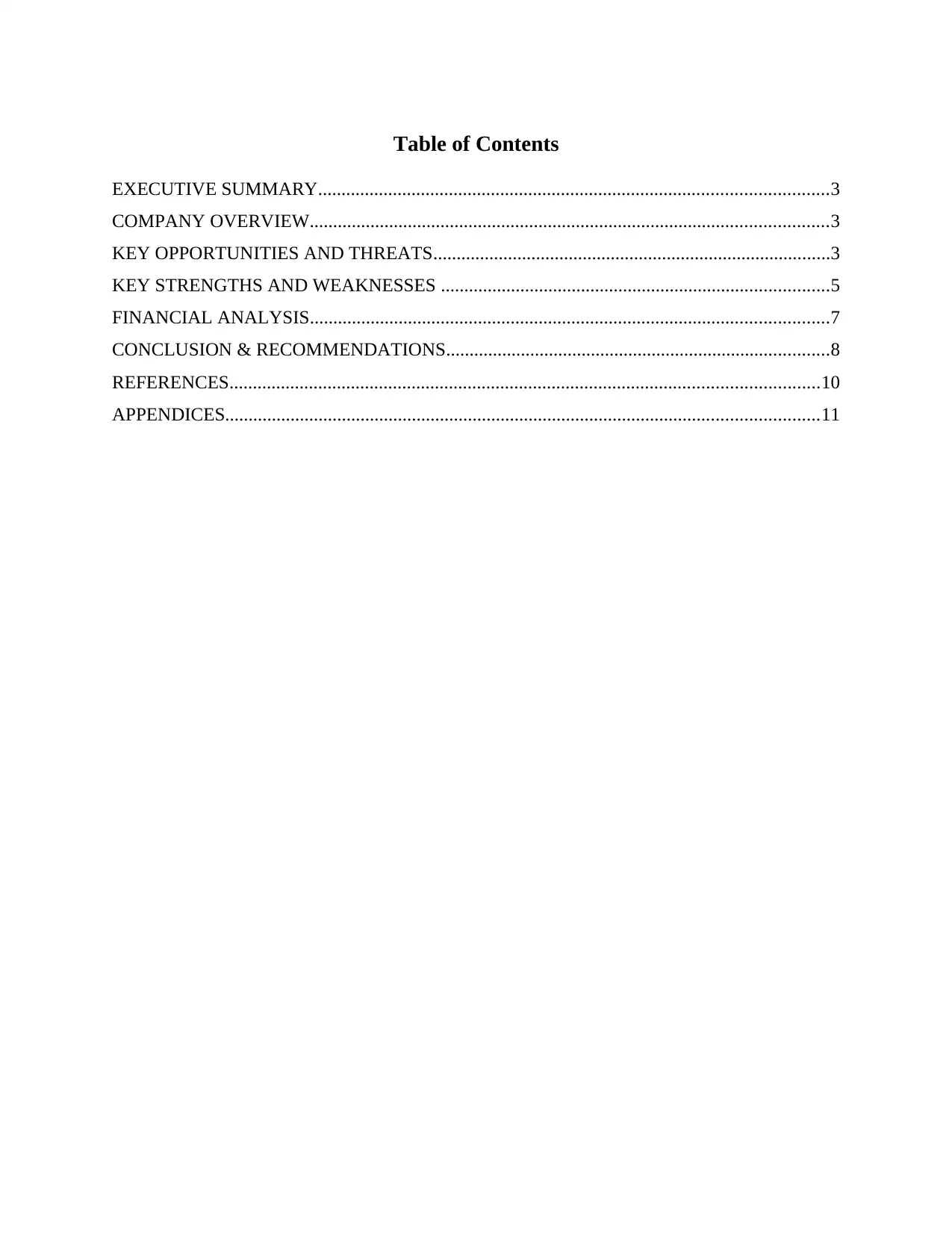
Table of Contents
EXECUTIVE SUMMARY.............................................................................................................3
COMPANY OVERVIEW...............................................................................................................3
KEY OPPORTUNITIES AND THREATS.....................................................................................3
KEY STRENGTHS AND WEAKNESSES ...................................................................................5
FINANCIAL ANALYSIS...............................................................................................................7
CONCLUSION & RECOMMENDATIONS..................................................................................8
REFERENCES..............................................................................................................................10
APPENDICES...............................................................................................................................11
EXECUTIVE SUMMARY.............................................................................................................3
COMPANY OVERVIEW...............................................................................................................3
KEY OPPORTUNITIES AND THREATS.....................................................................................3
KEY STRENGTHS AND WEAKNESSES ...................................................................................5
FINANCIAL ANALYSIS...............................................................................................................7
CONCLUSION & RECOMMENDATIONS..................................................................................8
REFERENCES..............................................................................................................................10
APPENDICES...............................................................................................................................11
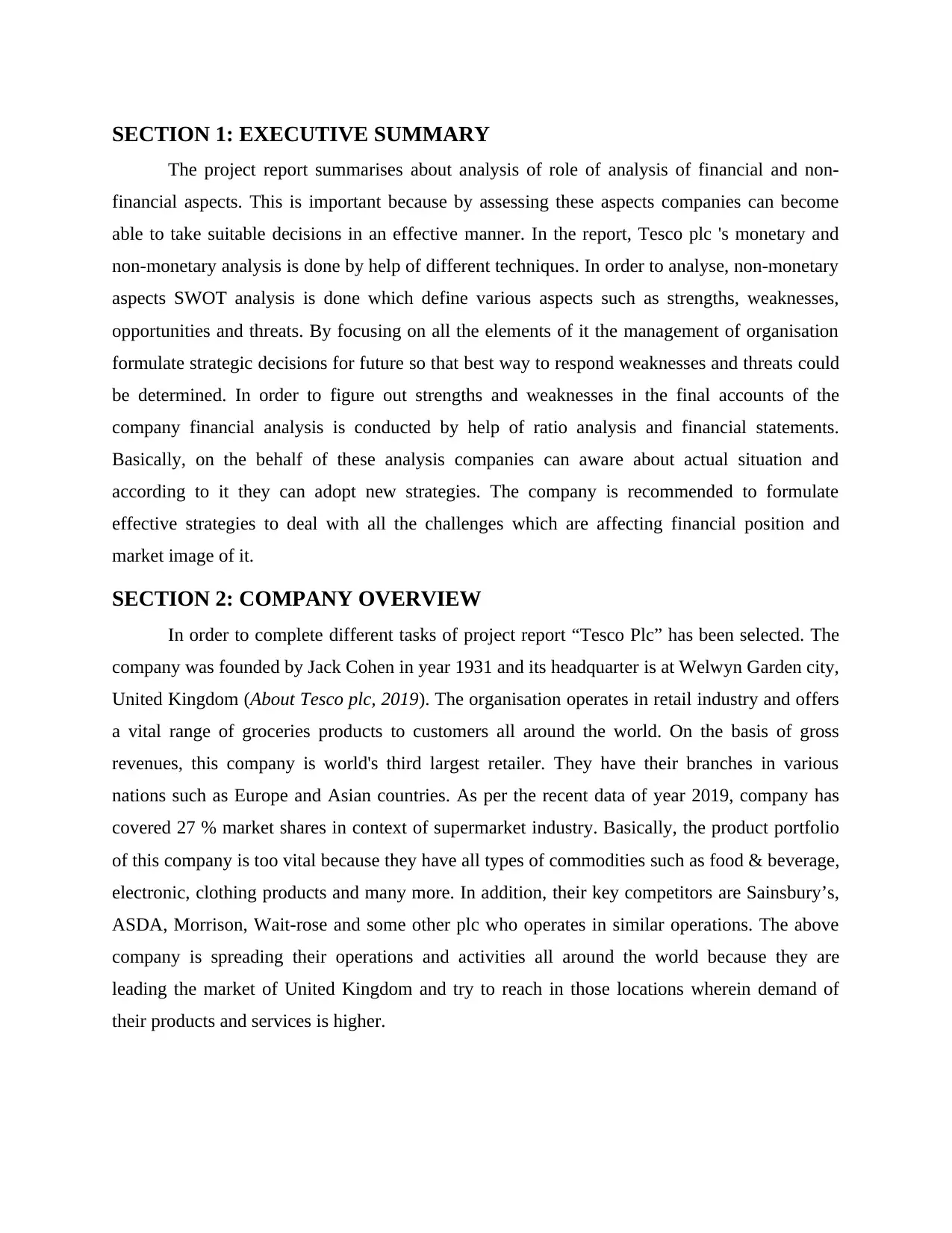
SECTION 1: EXECUTIVE SUMMARY
The project report summarises about analysis of role of analysis of financial and non-
financial aspects. This is important because by assessing these aspects companies can become
able to take suitable decisions in an effective manner. In the report, Tesco plc 's monetary and
non-monetary analysis is done by help of different techniques. In order to analyse, non-monetary
aspects SWOT analysis is done which define various aspects such as strengths, weaknesses,
opportunities and threats. By focusing on all the elements of it the management of organisation
formulate strategic decisions for future so that best way to respond weaknesses and threats could
be determined. In order to figure out strengths and weaknesses in the final accounts of the
company financial analysis is conducted by help of ratio analysis and financial statements.
Basically, on the behalf of these analysis companies can aware about actual situation and
according to it they can adopt new strategies. The company is recommended to formulate
effective strategies to deal with all the challenges which are affecting financial position and
market image of it.
SECTION 2: COMPANY OVERVIEW
In order to complete different tasks of project report “Tesco Plc” has been selected. The
company was founded by Jack Cohen in year 1931 and its headquarter is at Welwyn Garden city,
United Kingdom (About Tesco plc, 2019). The organisation operates in retail industry and offers
a vital range of groceries products to customers all around the world. On the basis of gross
revenues, this company is world's third largest retailer. They have their branches in various
nations such as Europe and Asian countries. As per the recent data of year 2019, company has
covered 27 % market shares in context of supermarket industry. Basically, the product portfolio
of this company is too vital because they have all types of commodities such as food & beverage,
electronic, clothing products and many more. In addition, their key competitors are Sainsbury’s,
ASDA, Morrison, Wait-rose and some other plc who operates in similar operations. The above
company is spreading their operations and activities all around the world because they are
leading the market of United Kingdom and try to reach in those locations wherein demand of
their products and services is higher.
The project report summarises about analysis of role of analysis of financial and non-
financial aspects. This is important because by assessing these aspects companies can become
able to take suitable decisions in an effective manner. In the report, Tesco plc 's monetary and
non-monetary analysis is done by help of different techniques. In order to analyse, non-monetary
aspects SWOT analysis is done which define various aspects such as strengths, weaknesses,
opportunities and threats. By focusing on all the elements of it the management of organisation
formulate strategic decisions for future so that best way to respond weaknesses and threats could
be determined. In order to figure out strengths and weaknesses in the final accounts of the
company financial analysis is conducted by help of ratio analysis and financial statements.
Basically, on the behalf of these analysis companies can aware about actual situation and
according to it they can adopt new strategies. The company is recommended to formulate
effective strategies to deal with all the challenges which are affecting financial position and
market image of it.
SECTION 2: COMPANY OVERVIEW
In order to complete different tasks of project report “Tesco Plc” has been selected. The
company was founded by Jack Cohen in year 1931 and its headquarter is at Welwyn Garden city,
United Kingdom (About Tesco plc, 2019). The organisation operates in retail industry and offers
a vital range of groceries products to customers all around the world. On the basis of gross
revenues, this company is world's third largest retailer. They have their branches in various
nations such as Europe and Asian countries. As per the recent data of year 2019, company has
covered 27 % market shares in context of supermarket industry. Basically, the product portfolio
of this company is too vital because they have all types of commodities such as food & beverage,
electronic, clothing products and many more. In addition, their key competitors are Sainsbury’s,
ASDA, Morrison, Wait-rose and some other plc who operates in similar operations. The above
company is spreading their operations and activities all around the world because they are
leading the market of United Kingdom and try to reach in those locations wherein demand of
their products and services is higher.
⊘ This is a preview!⊘
Do you want full access?
Subscribe today to unlock all pages.

Trusted by 1+ million students worldwide
SECTION 3: KEY OPPORTUNITIES AND THREATS
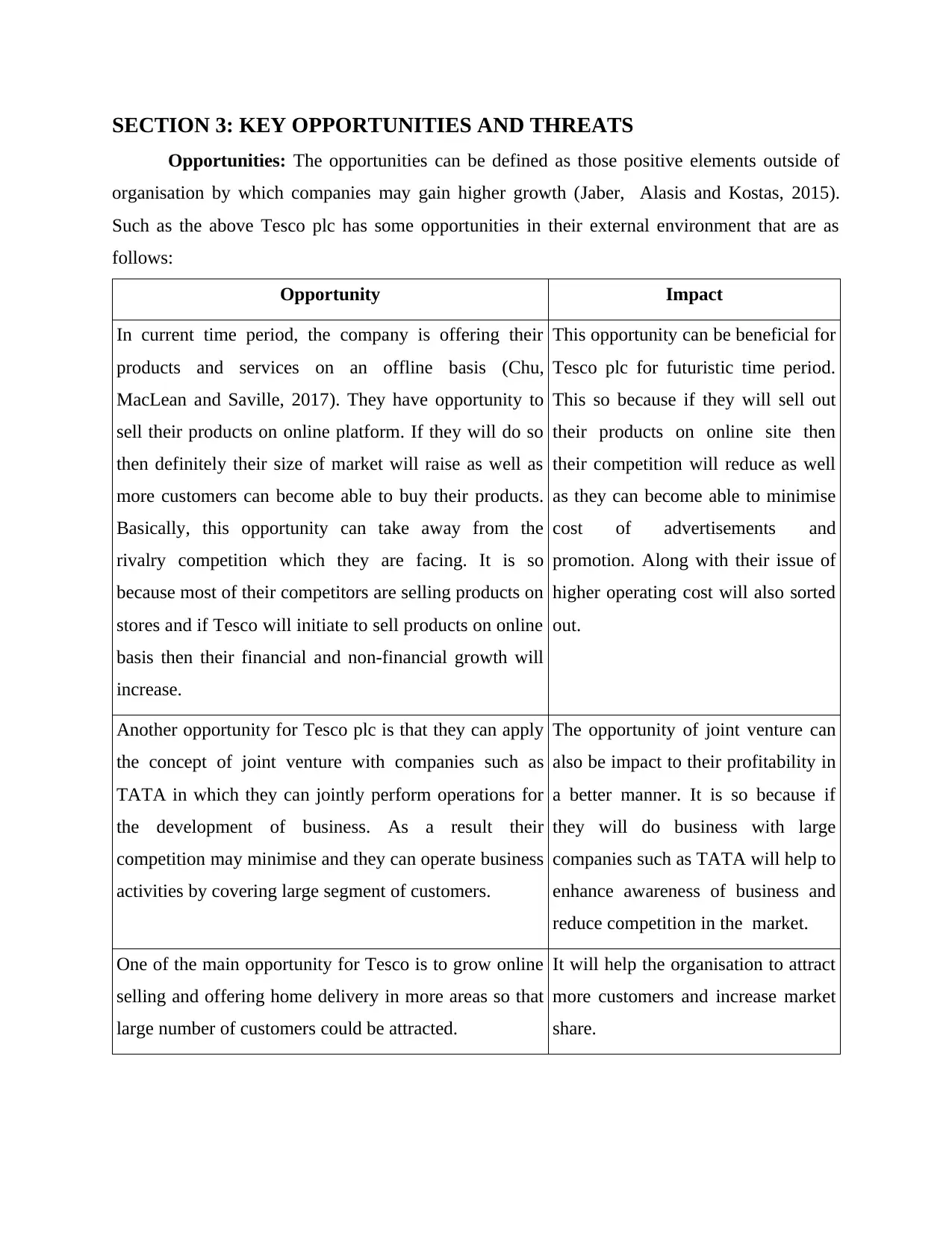
Opportunities: The opportunities can be defined as those positive elements outside of
organisation by which companies may gain higher growth (Jaber, Alasis and Kostas, 2015).
Such as the above Tesco plc has some opportunities in their external environment that are as
follows:
Opportunity Impact
In current time period, the company is offering their
products and services on an offline basis (Chu,
MacLean and Saville, 2017). They have opportunity to
sell their products on online platform. If they will do so
then definitely their size of market will raise as well as
more customers can become able to buy their products.
Basically, this opportunity can take away from the
rivalry competition which they are facing. It is so
because most of their competitors are selling products on
stores and if Tesco will initiate to sell products on online
basis then their financial and non-financial growth will
increase.
This opportunity can be beneficial for
Tesco plc for futuristic time period.
This so because if they will sell out
their products on online site then
their competition will reduce as well
as they can become able to minimise
cost of advertisements and
promotion. Along with their issue of
higher operating cost will also sorted
out.
Another opportunity for Tesco plc is that they can apply
the concept of joint venture with companies such as
TATA in which they can jointly perform operations for
the development of business. As a result their
competition may minimise and they can operate business
activities by covering large segment of customers.
The opportunity of joint venture can
also be impact to their profitability in
a better manner. It is so because if
they will do business with large
companies such as TATA will help to
enhance awareness of business and
reduce competition in the market.
One of the main opportunity for Tesco is to grow online
selling and offering home delivery in more areas so that
large number of customers could be attracted.
It will help the organisation to attract
more customers and increase market
share.
Opportunities: The opportunities can be defined as those positive elements outside of
organisation by which companies may gain higher growth (Jaber, Alasis and Kostas, 2015).
Such as the above Tesco plc has some opportunities in their external environment that are as
follows:
Opportunity Impact
In current time period, the company is offering their
products and services on an offline basis (Chu,
MacLean and Saville, 2017). They have opportunity to
sell their products on online platform. If they will do so
then definitely their size of market will raise as well as
more customers can become able to buy their products.
Basically, this opportunity can take away from the
rivalry competition which they are facing. It is so
because most of their competitors are selling products on
stores and if Tesco will initiate to sell products on online
basis then their financial and non-financial growth will
increase.
This opportunity can be beneficial for
Tesco plc for futuristic time period.
This so because if they will sell out
their products on online site then
their competition will reduce as well
as they can become able to minimise
cost of advertisements and
promotion. Along with their issue of
higher operating cost will also sorted
out.
Another opportunity for Tesco plc is that they can apply
the concept of joint venture with companies such as
TATA in which they can jointly perform operations for
the development of business. As a result their
competition may minimise and they can operate business
activities by covering large segment of customers.
The opportunity of joint venture can
also be impact to their profitability in
a better manner. It is so because if
they will do business with large
companies such as TATA will help to
enhance awareness of business and
reduce competition in the market.
One of the main opportunity for Tesco is to grow online
selling and offering home delivery in more areas so that
large number of customers could be attracted.
It will help the organisation to attract
more customers and increase market
share.
Paraphrase This Document
Need a fresh take? Get an instant paraphrase of this document with our AI Paraphraser
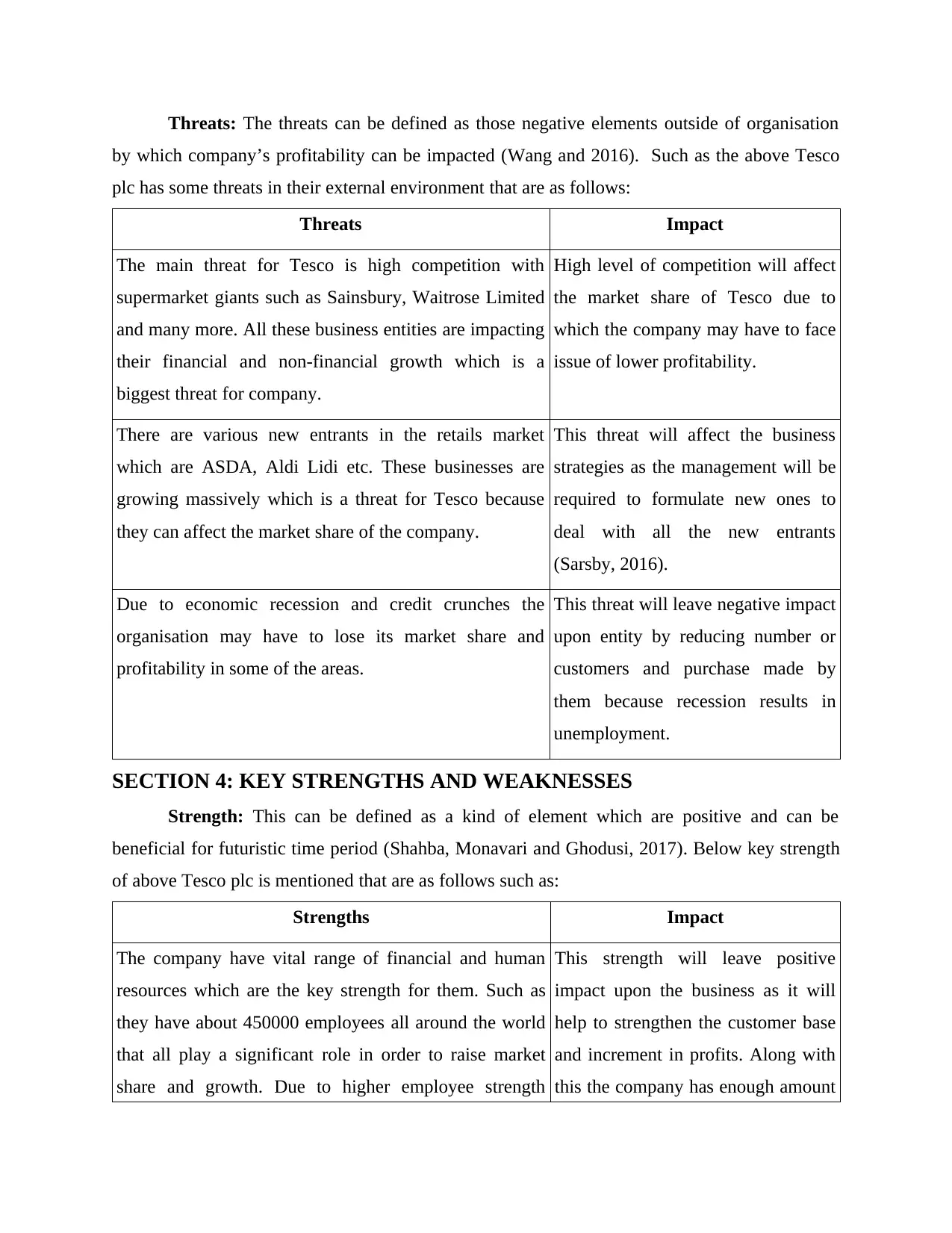
Threats: The threats can be defined as those negative elements outside of organisation
by which company’s profitability can be impacted (Wang and 2016). Such as the above Tesco
plc has some threats in their external environment that are as follows:
Threats Impact
The main threat for Tesco is high competition with
supermarket giants such as Sainsbury, Waitrose Limited
and many more. All these business entities are impacting
their financial and non-financial growth which is a
biggest threat for company.
High level of competition will affect
the market share of Tesco due to
which the company may have to face
issue of lower profitability.
There are various new entrants in the retails market
which are ASDA, Aldi Lidi etc. These businesses are
growing massively which is a threat for Tesco because
they can affect the market share of the company.
This threat will affect the business
strategies as the management will be
required to formulate new ones to
deal with all the new entrants
(Sarsby, 2016).
Due to economic recession and credit crunches the
organisation may have to lose its market share and
profitability in some of the areas.
This threat will leave negative impact
upon entity by reducing number or
customers and purchase made by
them because recession results in
unemployment.
SECTION 4: KEY STRENGTHS AND WEAKNESSES
Strength: This can be defined as a kind of element which are positive and can be
beneficial for futuristic time period (Shahba, Monavari and Ghodusi, 2017). Below key strength
of above Tesco plc is mentioned that are as follows such as:
Strengths Impact
The company have vital range of financial and human
resources which are the key strength for them. Such as
they have about 450000 employees all around the world
that all play a significant role in order to raise market
share and growth. Due to higher employee strength
This strength will leave positive
impact upon the business as it will
help to strengthen the customer base
and increment in profits. Along with
this the company has enough amount
by which company’s profitability can be impacted (Wang and 2016). Such as the above Tesco
plc has some threats in their external environment that are as follows:
Threats Impact
The main threat for Tesco is high competition with
supermarket giants such as Sainsbury, Waitrose Limited
and many more. All these business entities are impacting
their financial and non-financial growth which is a
biggest threat for company.
High level of competition will affect
the market share of Tesco due to
which the company may have to face
issue of lower profitability.
There are various new entrants in the retails market
which are ASDA, Aldi Lidi etc. These businesses are
growing massively which is a threat for Tesco because
they can affect the market share of the company.
This threat will affect the business
strategies as the management will be
required to formulate new ones to
deal with all the new entrants
(Sarsby, 2016).
Due to economic recession and credit crunches the
organisation may have to lose its market share and
profitability in some of the areas.
This threat will leave negative impact
upon entity by reducing number or
customers and purchase made by
them because recession results in
unemployment.
SECTION 4: KEY STRENGTHS AND WEAKNESSES
Strength: This can be defined as a kind of element which are positive and can be
beneficial for futuristic time period (Shahba, Monavari and Ghodusi, 2017). Below key strength
of above Tesco plc is mentioned that are as follows such as:
Strengths Impact
The company have vital range of financial and human
resources which are the key strength for them. Such as
they have about 450000 employees all around the world
that all play a significant role in order to raise market
share and growth. Due to higher employee strength
This strength will leave positive
impact upon the business as it will
help to strengthen the customer base
and increment in profits. Along with
this the company has enough amount
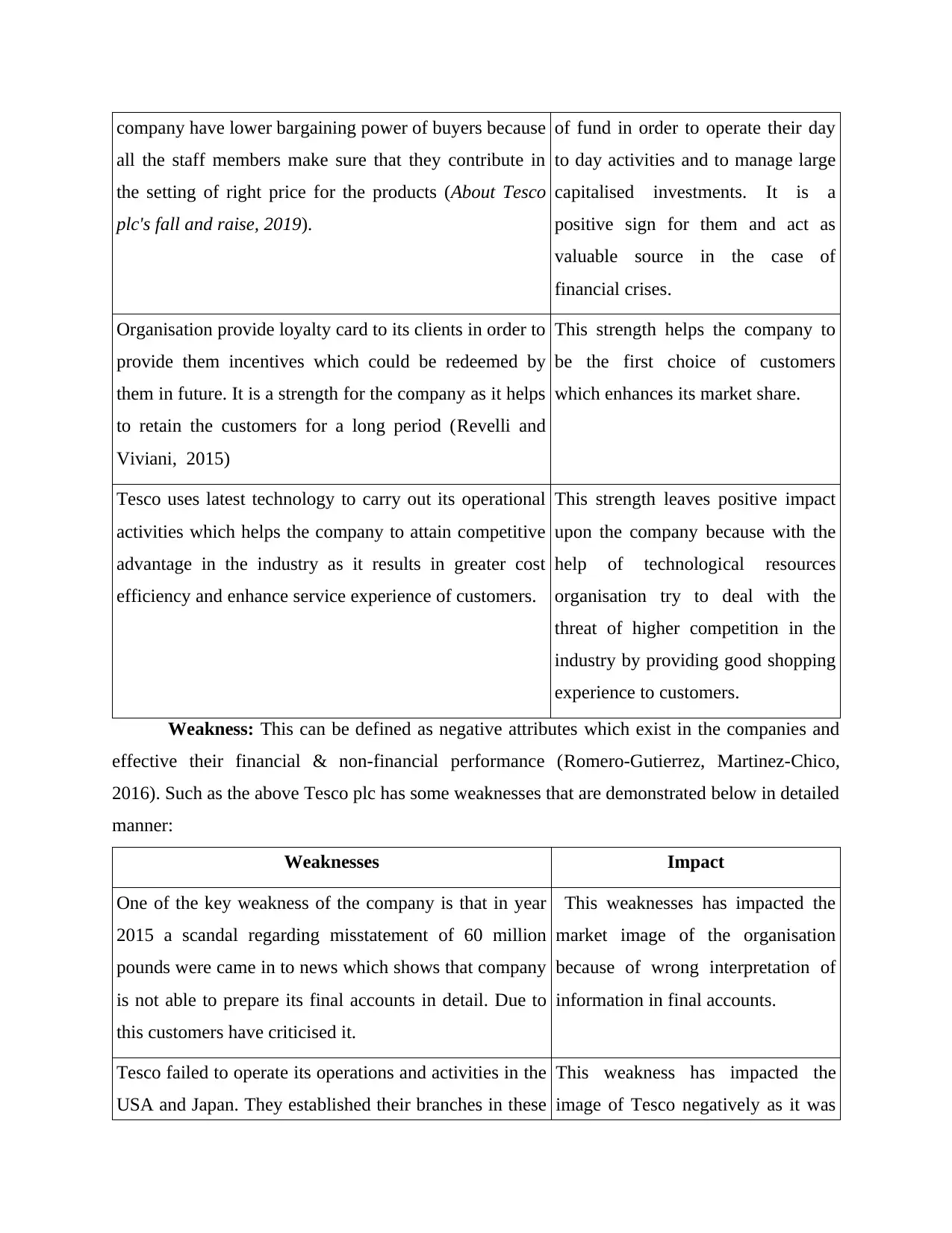
company have lower bargaining power of buyers because
all the staff members make sure that they contribute in
the setting of right price for the products (About Tesco
plc's fall and raise, 2019).
of fund in order to operate their day
to day activities and to manage large
capitalised investments. It is a
positive sign for them and act as
valuable source in the case of
financial crises.
Organisation provide loyalty card to its clients in order to
provide them incentives which could be redeemed by
them in future. It is a strength for the company as it helps
to retain the customers for a long period (Revelli and
Viviani, 2015)
This strength helps the company to
be the first choice of customers
which enhances its market share.
Tesco uses latest technology to carry out its operational
activities which helps the company to attain competitive
advantage in the industry as it results in greater cost
efficiency and enhance service experience of customers.
This strength leaves positive impact
upon the company because with the
help of technological resources
organisation try to deal with the
threat of higher competition in the
industry by providing good shopping
experience to customers.
Weakness: This can be defined as negative attributes which exist in the companies and
effective their financial & non-financial performance (Romero-Gutierrez, Martinez-Chico,
2016). Such as the above Tesco plc has some weaknesses that are demonstrated below in detailed
manner:
Weaknesses Impact
One of the key weakness of the company is that in year
2015 a scandal regarding misstatement of 60 million
pounds were came in to news which shows that company
is not able to prepare its final accounts in detail. Due to
this customers have criticised it.
This weaknesses has impacted the
market image of the organisation
because of wrong interpretation of
information in final accounts.
Tesco failed to operate its operations and activities in the
USA and Japan. They established their branches in these
This weakness has impacted the
image of Tesco negatively as it was
all the staff members make sure that they contribute in
the setting of right price for the products (About Tesco
plc's fall and raise, 2019).
of fund in order to operate their day
to day activities and to manage large
capitalised investments. It is a
positive sign for them and act as
valuable source in the case of
financial crises.
Organisation provide loyalty card to its clients in order to
provide them incentives which could be redeemed by
them in future. It is a strength for the company as it helps
to retain the customers for a long period (Revelli and
Viviani, 2015)
This strength helps the company to
be the first choice of customers
which enhances its market share.
Tesco uses latest technology to carry out its operational
activities which helps the company to attain competitive
advantage in the industry as it results in greater cost
efficiency and enhance service experience of customers.
This strength leaves positive impact
upon the company because with the
help of technological resources
organisation try to deal with the
threat of higher competition in the
industry by providing good shopping
experience to customers.
Weakness: This can be defined as negative attributes which exist in the companies and
effective their financial & non-financial performance (Romero-Gutierrez, Martinez-Chico,
2016). Such as the above Tesco plc has some weaknesses that are demonstrated below in detailed
manner:
Weaknesses Impact
One of the key weakness of the company is that in year
2015 a scandal regarding misstatement of 60 million
pounds were came in to news which shows that company
is not able to prepare its final accounts in detail. Due to
this customers have criticised it.
This weaknesses has impacted the
market image of the organisation
because of wrong interpretation of
information in final accounts.
Tesco failed to operate its operations and activities in the
USA and Japan. They established their branches in these
This weakness has impacted the
image of Tesco negatively as it was
⊘ This is a preview!⊘
Do you want full access?
Subscribe today to unlock all pages.
Trusted by 1+ million students worldwide
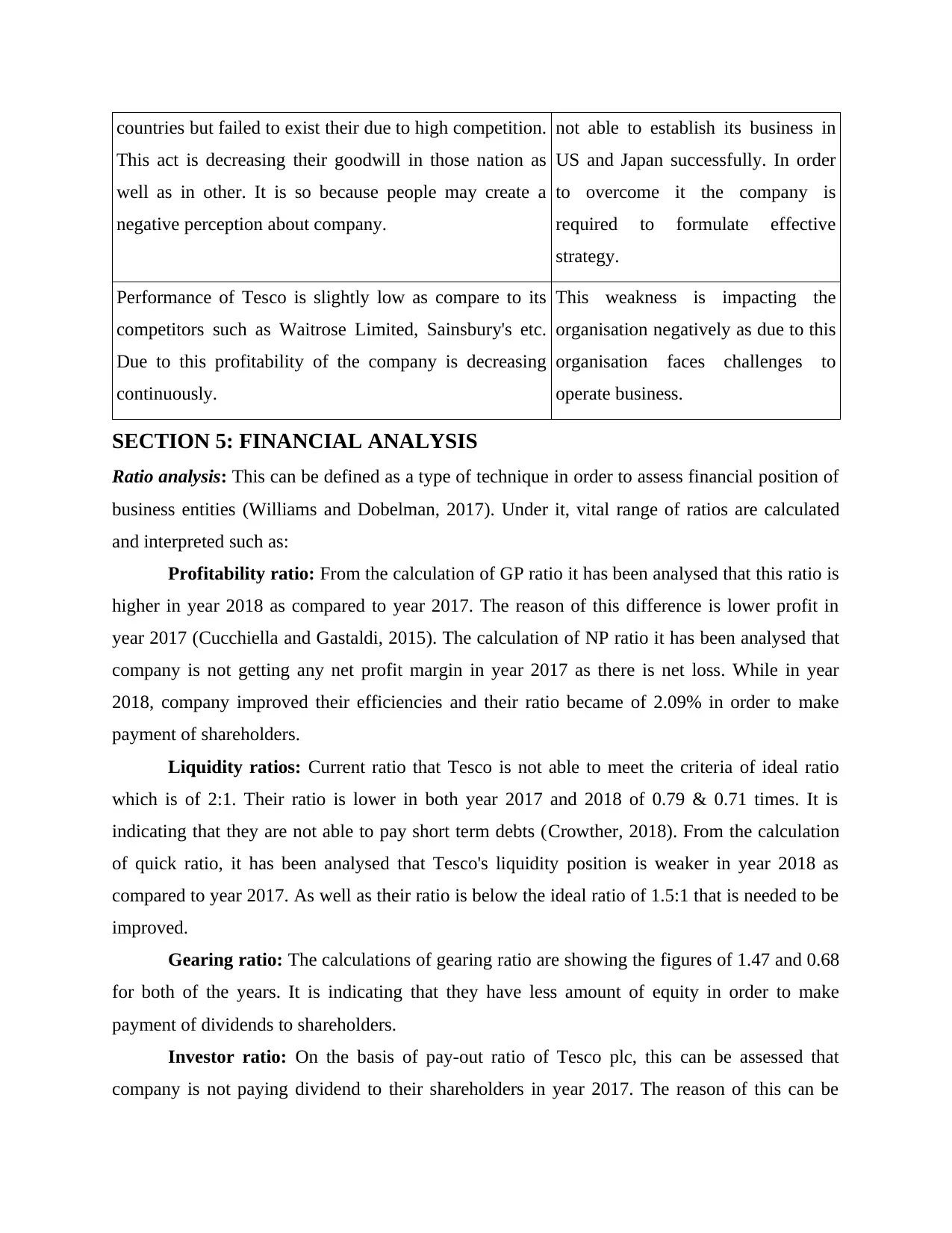
countries but failed to exist their due to high competition.
This act is decreasing their goodwill in those nation as
well as in other. It is so because people may create a
negative perception about company.
not able to establish its business in
US and Japan successfully. In order
to overcome it the company is
required to formulate effective
strategy.
Performance of Tesco is slightly low as compare to its
competitors such as Waitrose Limited, Sainsbury's etc.
Due to this profitability of the company is decreasing
continuously.
This weakness is impacting the
organisation negatively as due to this
organisation faces challenges to
operate business.
SECTION 5: FINANCIAL ANALYSIS
Ratio analysis: This can be defined as a type of technique in order to assess financial position of
business entities (Williams and Dobelman, 2017). Under it, vital range of ratios are calculated
and interpreted such as:
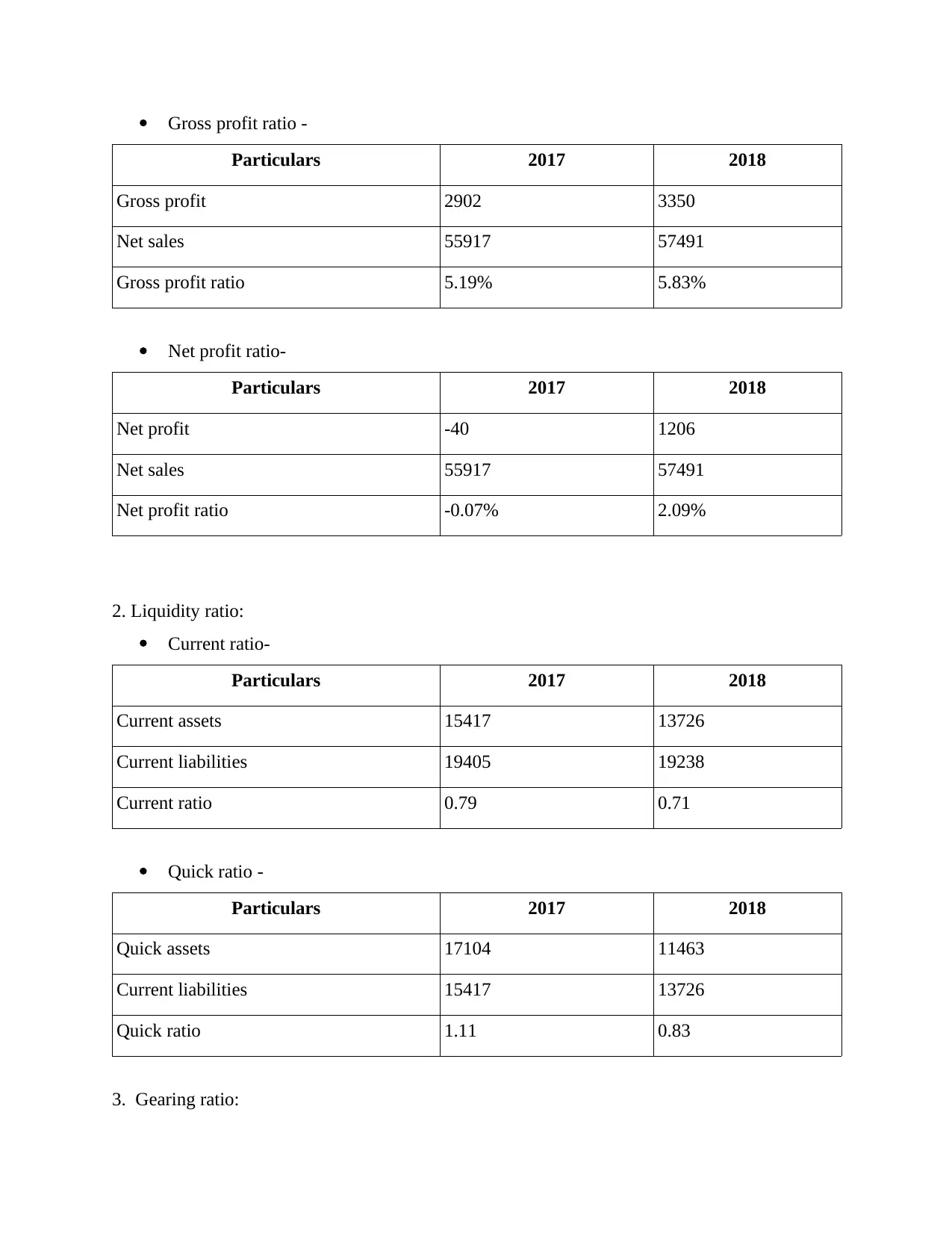
Profitability ratio: From the calculation of GP ratio it has been analysed that this ratio is
higher in year 2018 as compared to year 2017. The reason of this difference is lower profit in
year 2017 (Cucchiella and Gastaldi, 2015). The calculation of NP ratio it has been analysed that
company is not getting any net profit margin in year 2017 as there is net loss. While in year
2018, company improved their efficiencies and their ratio became of 2.09% in order to make
payment of shareholders.
Liquidity ratios: Current ratio that Tesco is not able to meet the criteria of ideal ratio
which is of 2:1. Their ratio is lower in both year 2017 and 2018 of 0.79 & 0.71 times. It is
indicating that they are not able to pay short term debts (Crowther, 2018). From the calculation
of quick ratio, it has been analysed that Tesco's liquidity position is weaker in year 2018 as
compared to year 2017. As well as their ratio is below the ideal ratio of 1.5:1 that is needed to be
improved.
Gearing ratio: The calculations of gearing ratio are showing the figures of 1.47 and 0.68
for both of the years. It is indicating that they have less amount of equity in order to make
payment of dividends to shareholders.
Investor ratio: On the basis of pay-out ratio of Tesco plc, this can be assessed that
company is not paying dividend to their shareholders in year 2017. The reason of this can be
This act is decreasing their goodwill in those nation as
well as in other. It is so because people may create a
negative perception about company.
not able to establish its business in
US and Japan successfully. In order
to overcome it the company is
required to formulate effective
strategy.
Performance of Tesco is slightly low as compare to its
competitors such as Waitrose Limited, Sainsbury's etc.
Due to this profitability of the company is decreasing
continuously.
This weakness is impacting the
organisation negatively as due to this
organisation faces challenges to
operate business.
SECTION 5: FINANCIAL ANALYSIS
Ratio analysis: This can be defined as a type of technique in order to assess financial position of
business entities (Williams and Dobelman, 2017). Under it, vital range of ratios are calculated
and interpreted such as:
Profitability ratio: From the calculation of GP ratio it has been analysed that this ratio is
higher in year 2018 as compared to year 2017. The reason of this difference is lower profit in
year 2017 (Cucchiella and Gastaldi, 2015). The calculation of NP ratio it has been analysed that
company is not getting any net profit margin in year 2017 as there is net loss. While in year
2018, company improved their efficiencies and their ratio became of 2.09% in order to make
payment of shareholders.
Liquidity ratios: Current ratio that Tesco is not able to meet the criteria of ideal ratio
which is of 2:1. Their ratio is lower in both year 2017 and 2018 of 0.79 & 0.71 times. It is
indicating that they are not able to pay short term debts (Crowther, 2018). From the calculation
of quick ratio, it has been analysed that Tesco's liquidity position is weaker in year 2018 as
compared to year 2017. As well as their ratio is below the ideal ratio of 1.5:1 that is needed to be
improved.
Gearing ratio: The calculations of gearing ratio are showing the figures of 1.47 and 0.68
for both of the years. It is indicating that they have less amount of equity in order to make
payment of dividends to shareholders.
Investor ratio: On the basis of pay-out ratio of Tesco plc, this can be assessed that
company is not paying dividend to their shareholders in year 2017. The reason of this can be
Paraphrase This Document
Need a fresh take? Get an instant paraphrase of this document with our AI Paraphraser
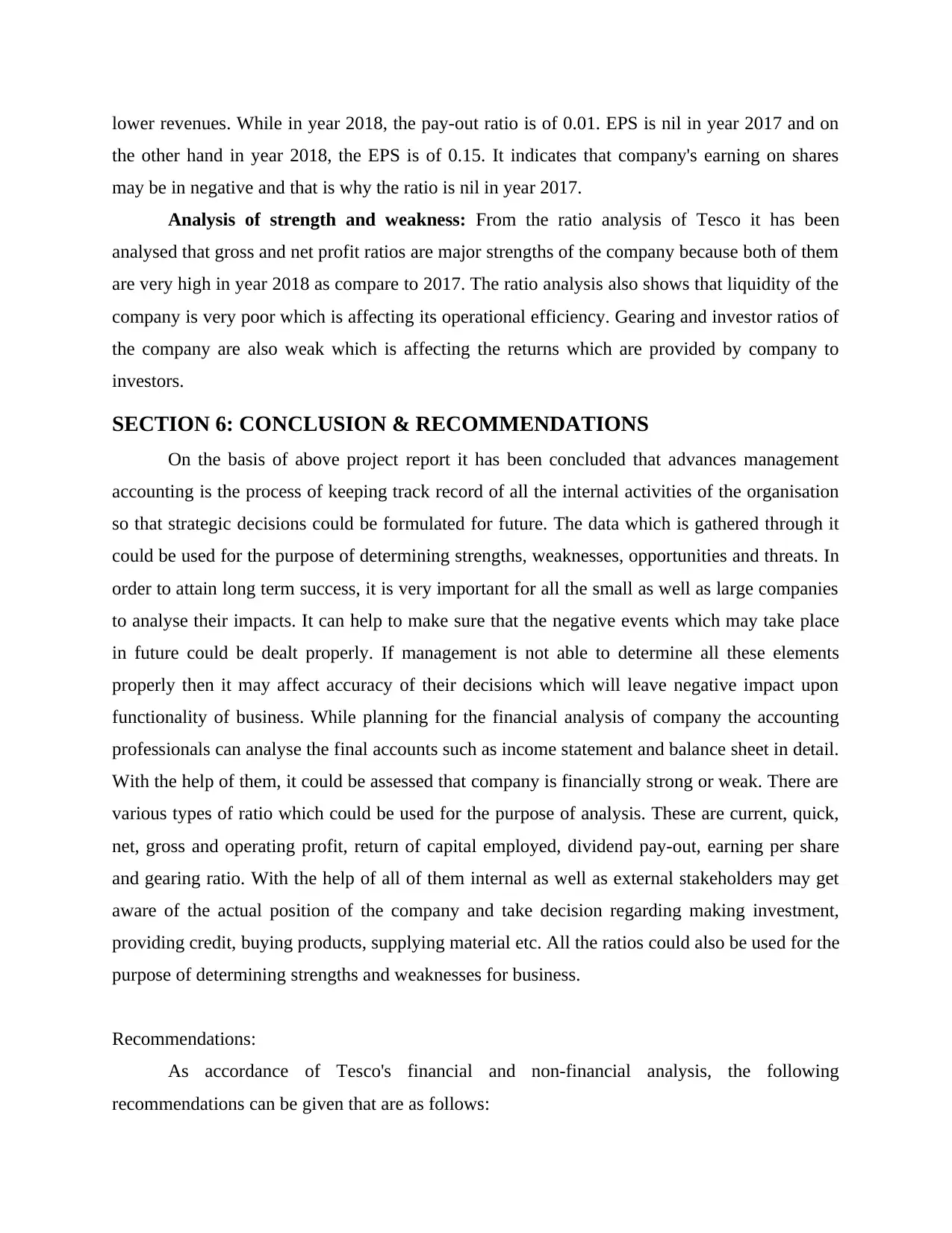
lower revenues. While in year 2018, the pay-out ratio is of 0.01. EPS is nil in year 2017 and on
the other hand in year 2018, the EPS is of 0.15. It indicates that company's earning on shares
may be in negative and that is why the ratio is nil in year 2017.
Analysis of strength and weakness: From the ratio analysis of Tesco it has been
analysed that gross and net profit ratios are major strengths of the company because both of them
are very high in year 2018 as compare to 2017. The ratio analysis also shows that liquidity of the
company is very poor which is affecting its operational efficiency. Gearing and investor ratios of
the company are also weak which is affecting the returns which are provided by company to
investors.
SECTION 6: CONCLUSION & RECOMMENDATIONS
On the basis of above project report it has been concluded that advances management
accounting is the process of keeping track record of all the internal activities of the organisation
so that strategic decisions could be formulated for future. The data which is gathered through it
could be used for the purpose of determining strengths, weaknesses, opportunities and threats. In
order to attain long term success, it is very important for all the small as well as large companies
to analyse their impacts. It can help to make sure that the negative events which may take place
in future could be dealt properly. If management is not able to determine all these elements
properly then it may affect accuracy of their decisions which will leave negative impact upon
functionality of business. While planning for the financial analysis of company the accounting
professionals can analyse the final accounts such as income statement and balance sheet in detail.
With the help of them, it could be assessed that company is financially strong or weak. There are
various types of ratio which could be used for the purpose of analysis. These are current, quick,
net, gross and operating profit, return of capital employed, dividend pay-out, earning per share
and gearing ratio. With the help of all of them internal as well as external stakeholders may get
aware of the actual position of the company and take decision regarding making investment,
providing credit, buying products, supplying material etc. All the ratios could also be used for the
purpose of determining strengths and weaknesses for business.
Recommendations:
As accordance of Tesco's financial and non-financial analysis, the following
recommendations can be given that are as follows:
the other hand in year 2018, the EPS is of 0.15. It indicates that company's earning on shares
may be in negative and that is why the ratio is nil in year 2017.
Analysis of strength and weakness: From the ratio analysis of Tesco it has been
analysed that gross and net profit ratios are major strengths of the company because both of them
are very high in year 2018 as compare to 2017. The ratio analysis also shows that liquidity of the
company is very poor which is affecting its operational efficiency. Gearing and investor ratios of
the company are also weak which is affecting the returns which are provided by company to
investors.
SECTION 6: CONCLUSION & RECOMMENDATIONS
On the basis of above project report it has been concluded that advances management
accounting is the process of keeping track record of all the internal activities of the organisation
so that strategic decisions could be formulated for future. The data which is gathered through it
could be used for the purpose of determining strengths, weaknesses, opportunities and threats. In
order to attain long term success, it is very important for all the small as well as large companies
to analyse their impacts. It can help to make sure that the negative events which may take place
in future could be dealt properly. If management is not able to determine all these elements
properly then it may affect accuracy of their decisions which will leave negative impact upon
functionality of business. While planning for the financial analysis of company the accounting
professionals can analyse the final accounts such as income statement and balance sheet in detail.
With the help of them, it could be assessed that company is financially strong or weak. There are
various types of ratio which could be used for the purpose of analysis. These are current, quick,
net, gross and operating profit, return of capital employed, dividend pay-out, earning per share
and gearing ratio. With the help of all of them internal as well as external stakeholders may get
aware of the actual position of the company and take decision regarding making investment,
providing credit, buying products, supplying material etc. All the ratios could also be used for the
purpose of determining strengths and weaknesses for business.
Recommendations:
As accordance of Tesco's financial and non-financial analysis, the following
recommendations can be given that are as follows:
Managers of Tesco are required to develop effective strategies and policies so that they
can become able to beat their competitors. This is important for them because if they will
implement new strategies then it can become able to solve the issues which they are
facing.
In order to overcome from different kind of weaknesses which they are facing such as
lack of lower profitability etc. they should try to find out cause of these weaknesses. As
well as focusing on key aspects also can be beneficial for them to solve the problem of
lower profitability.
The company should try to focus on their opportunities so that they can achieve higher
growth and market size. It can become possible by focusing more on online selling of
their products and services. This is so because it is best way of raising total profitability
in less amount of cost.
As well as the managers of above company try to keep their employees away from the
threats which they have. It is so because if their employees will think more on threats
then their efficiency will decrease.
As there is a threat of new entrants for Tesco so the management is required to pay
attention towards the market situations and then formulate effective decisions for future
so that it can deal with the new entries such as ASDA, Aldi and Lidi properly.
Tesco should plan to offering home deliver in more areas this opportunity can help it to
increase the number of customers and attain growth for business.
can become able to beat their competitors. This is important for them because if they will
implement new strategies then it can become able to solve the issues which they are
facing.
In order to overcome from different kind of weaknesses which they are facing such as
lack of lower profitability etc. they should try to find out cause of these weaknesses. As
well as focusing on key aspects also can be beneficial for them to solve the problem of
lower profitability.
The company should try to focus on their opportunities so that they can achieve higher
growth and market size. It can become possible by focusing more on online selling of
their products and services. This is so because it is best way of raising total profitability
in less amount of cost.
As well as the managers of above company try to keep their employees away from the
threats which they have. It is so because if their employees will think more on threats
then their efficiency will decrease.
As there is a threat of new entrants for Tesco so the management is required to pay
attention towards the market situations and then formulate effective decisions for future
so that it can deal with the new entries such as ASDA, Aldi and Lidi properly.
Tesco should plan to offering home deliver in more areas this opportunity can help it to
increase the number of customers and attain growth for business.
⊘ This is a preview!⊘
Do you want full access?
Subscribe today to unlock all pages.
Trusted by 1+ million students worldwide
REFERENCES
Books and journals :
Jaber, J .O., Elkarmi, F., Alasis, E. and Kostas, A., 2015. Employment of renewable energy in
Jordan: Current status, SWOT and problem analysis. Renewable and Sustainable
Energy Reviews. 49. pp.490-499.
Wang, Q. and Li, R., 2016. Impact of cheaper oil on economic system and climate change: A
SWOT analysis. Renewable and Sustainable Energy Reviews. 54. pp.925-931.
Sarsby, A., 2016. SWOT analysis. Lulu. Com.
Shahba, S., Arjmandi, R., Monavari, M. and Ghodusi, J., 2017. Application of multi-attribute
decision-making methods in SWOT analysis of mine waste management (case study:
Sirjan's Golgohar iron mine, Iran). Resources Policy. 51. pp.67-76.
Romero-Gutierrez, M., Jimenez-Liso, M.R. and Martinez-Chico, M., 2016. SWOT analysis to
evaluate the programme of a joint online/onsite master's degree in environmental
education through the students’ perceptions. Evaluation and program planning. 54.
pp.41-49.
Williams, E. E. and Dobelman, J .A., 2017. Financial statement analysis. World Scientific Book
Chapters, pp.109-169.
Cucchiella, F., D’Adamo, I. and Gastaldi, M., 2015. Financial analysis for investment and policy
decisions in the renewable energy sector. Clean Technologies and Environmental
Policy. 17(4). pp.887-904.
Crowther, D., 2018. A Social Critique of Corporate Reporting: A Semiotic Analysis of Corporate
Financial and Environmental Reporting: A Semiotic Analysis of Corporate Financial
and Environmental Reporting. Routledge.
Revelli, C. and Viviani, J .L., 2015. Financial performance of socially responsible investing
(SRI): what have we learned? A meta‐analysis. Business Ethics: A European Review.
24(2). pp.158-185.
Chu, P. L., Vanderghem, C., MacLean, H .L. and Saville, B .A., 2017. Financial analysis and
risk assessment of hydroprocessed renewable jet fuel production from camelina,
carinata and used cooking oil. Applied energy. 198. pp.401-409.
Online :
About Tesco plc, 2019. [online]. Available through: <https://bstrategyhub.com/tesco-swot-
analysis-2019swot-analysis-of-tesco/>
About Tesco plc's fall and raise, 2019. [online]. Available through:
<https://www.theguardian.com/business/2014/dec/09/tesco-timeline-the-retail-giants-
rise-and-fall>
Books and journals :
Jaber, J .O., Elkarmi, F., Alasis, E. and Kostas, A., 2015. Employment of renewable energy in
Jordan: Current status, SWOT and problem analysis. Renewable and Sustainable
Energy Reviews. 49. pp.490-499.
Wang, Q. and Li, R., 2016. Impact of cheaper oil on economic system and climate change: A
SWOT analysis. Renewable and Sustainable Energy Reviews. 54. pp.925-931.
Sarsby, A., 2016. SWOT analysis. Lulu. Com.
Shahba, S., Arjmandi, R., Monavari, M. and Ghodusi, J., 2017. Application of multi-attribute
decision-making methods in SWOT analysis of mine waste management (case study:
Sirjan's Golgohar iron mine, Iran). Resources Policy. 51. pp.67-76.
Romero-Gutierrez, M., Jimenez-Liso, M.R. and Martinez-Chico, M., 2016. SWOT analysis to
evaluate the programme of a joint online/onsite master's degree in environmental
education through the students’ perceptions. Evaluation and program planning. 54.
pp.41-49.
Williams, E. E. and Dobelman, J .A., 2017. Financial statement analysis. World Scientific Book
Chapters, pp.109-169.
Cucchiella, F., D’Adamo, I. and Gastaldi, M., 2015. Financial analysis for investment and policy
decisions in the renewable energy sector. Clean Technologies and Environmental
Policy. 17(4). pp.887-904.
Crowther, D., 2018. A Social Critique of Corporate Reporting: A Semiotic Analysis of Corporate
Financial and Environmental Reporting: A Semiotic Analysis of Corporate Financial
and Environmental Reporting. Routledge.
Revelli, C. and Viviani, J .L., 2015. Financial performance of socially responsible investing
(SRI): what have we learned? A meta‐analysis. Business Ethics: A European Review.
24(2). pp.158-185.
Chu, P. L., Vanderghem, C., MacLean, H .L. and Saville, B .A., 2017. Financial analysis and
risk assessment of hydroprocessed renewable jet fuel production from camelina,
carinata and used cooking oil. Applied energy. 198. pp.401-409.
Online :
About Tesco plc, 2019. [online]. Available through: <https://bstrategyhub.com/tesco-swot-
analysis-2019swot-analysis-of-tesco/>
About Tesco plc's fall and raise, 2019. [online]. Available through:
<https://www.theguardian.com/business/2014/dec/09/tesco-timeline-the-retail-giants-
rise-and-fall>
Paraphrase This Document
Need a fresh take? Get an instant paraphrase of this document with our AI Paraphraser
APPENDICES
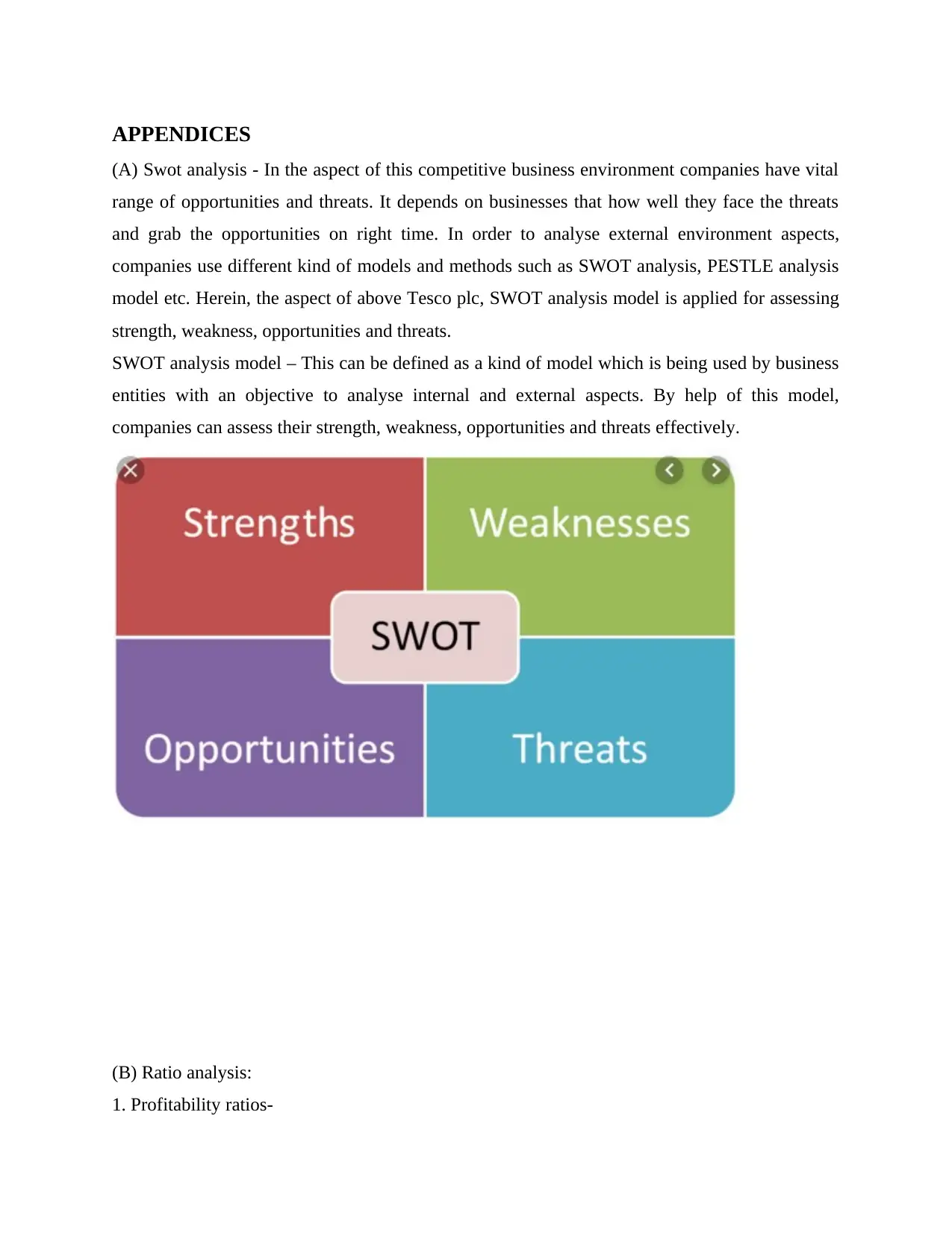
(A) Swot analysis - In the aspect of this competitive business environment companies have vital
range of opportunities and threats. It depends on businesses that how well they face the threats
and grab the opportunities on right time. In order to analyse external environment aspects,
companies use different kind of models and methods such as SWOT analysis, PESTLE analysis
model etc. Herein, the aspect of above Tesco plc, SWOT analysis model is applied for assessing
strength, weakness, opportunities and threats.
SWOT analysis model – This can be defined as a kind of model which is being used by business
entities with an objective to analyse internal and external aspects. By help of this model,
companies can assess their strength, weakness, opportunities and threats effectively.
(B) Ratio analysis:
1. Profitability ratios-
(A) Swot analysis - In the aspect of this competitive business environment companies have vital
range of opportunities and threats. It depends on businesses that how well they face the threats
and grab the opportunities on right time. In order to analyse external environment aspects,
companies use different kind of models and methods such as SWOT analysis, PESTLE analysis
model etc. Herein, the aspect of above Tesco plc, SWOT analysis model is applied for assessing
strength, weakness, opportunities and threats.
SWOT analysis model – This can be defined as a kind of model which is being used by business
entities with an objective to analyse internal and external aspects. By help of this model,
companies can assess their strength, weakness, opportunities and threats effectively.
(B) Ratio analysis:
1. Profitability ratios-
Gross profit ratio -
Particulars 2017 2018
Gross profit 2902 3350
Net sales 55917 57491
Gross profit ratio 5.19% 5.83%
Net profit ratio-
Particulars 2017 2018
Net profit -40 1206
Net sales 55917 57491
Net profit ratio -0.07% 2.09%
2. Liquidity ratio:
Current ratio-
Particulars 2017 2018
Current assets 15417 13726
Current liabilities 19405 19238
Current ratio 0.79 0.71
Quick ratio -
Particulars 2017 2018
Quick assets 17104 11463
Current liabilities 15417 13726
Quick ratio 1.11 0.83
3. Gearing ratio:
Particulars 2017 2018
Gross profit 2902 3350
Net sales 55917 57491
Gross profit ratio 5.19% 5.83%
Net profit ratio-
Particulars 2017 2018
Net profit -40 1206
Net sales 55917 57491
Net profit ratio -0.07% 2.09%
2. Liquidity ratio:
Current ratio-
Particulars 2017 2018
Current assets 15417 13726
Current liabilities 19405 19238
Current ratio 0.79 0.71
Quick ratio -
Particulars 2017 2018
Quick assets 17104 11463
Current liabilities 15417 13726
Quick ratio 1.11 0.83
3. Gearing ratio:
⊘ This is a preview!⊘
Do you want full access?
Subscribe today to unlock all pages.
Trusted by 1+ million students worldwide

1 out of 13


Related Documents


Your All-in-One AI-Powered Toolkit for Academic Success.
+13062052269
info@desklib.com
Available 24*7 on WhatsApp / Email
![[object Object]](/_next/static/media/star-bottom.7253800d.svg)
Unlock your academic potential
Copyright © 2020–2026 A2Z Services. All Rights Reserved. Developed and managed by ZUCOL.