Comprehensive Financial Ratio Analysis: A Tesco PLC Case Study
VerifiedAdded on 2023/06/18
|7
|1982
|302
Report
AI Summary
This report offers a detailed financial ratio analysis of Tesco PLC, covering the period from 2017 to 2020. It examines key performance indicators such as Return on Investors' Financing, Return on Capital Employed, Return on Total Assets, Net Profit Margins, Gross Profitability Ratio, Net Asset Turnover, Fixed Assets Turnover, Interest Coverage Proportion, Stock Turnover, Debtors Turnover, Debtor Collection Period, Creditor Payment Days, Current Proportion, Liquidity Proportion, Asset Cover and Gearing. The analysis reveals that while Tesco showed consistent positive development in 2018-19 and 2017-18, there was a slight decline in some ratios in 2019-2020 due to the COVID-19 pandemic. Overall, the company's financial performance remains strong, with improved efficiency in converting inventory into revenues and managing debts, indicating a competitive edge in the industry.

Financial accounting
Paraphrase This Document
Need a fresh take? Get an instant paraphrase of this document with our AI Paraphraser

Contents
Contents...........................................................................................................................................2
INTRODUCTION...........................................................................................................................1
MAIN BODY..................................................................................................................................1
INTERPRETATION OF RATIOS..............................................................................................1
CONCLUSION................................................................................................................................4
REFERENCES................................................................................................................................5
Contents...........................................................................................................................................2
INTRODUCTION...........................................................................................................................1
MAIN BODY..................................................................................................................................1
INTERPRETATION OF RATIOS..............................................................................................1
CONCLUSION................................................................................................................................4
REFERENCES................................................................................................................................5

INTRODUCTION
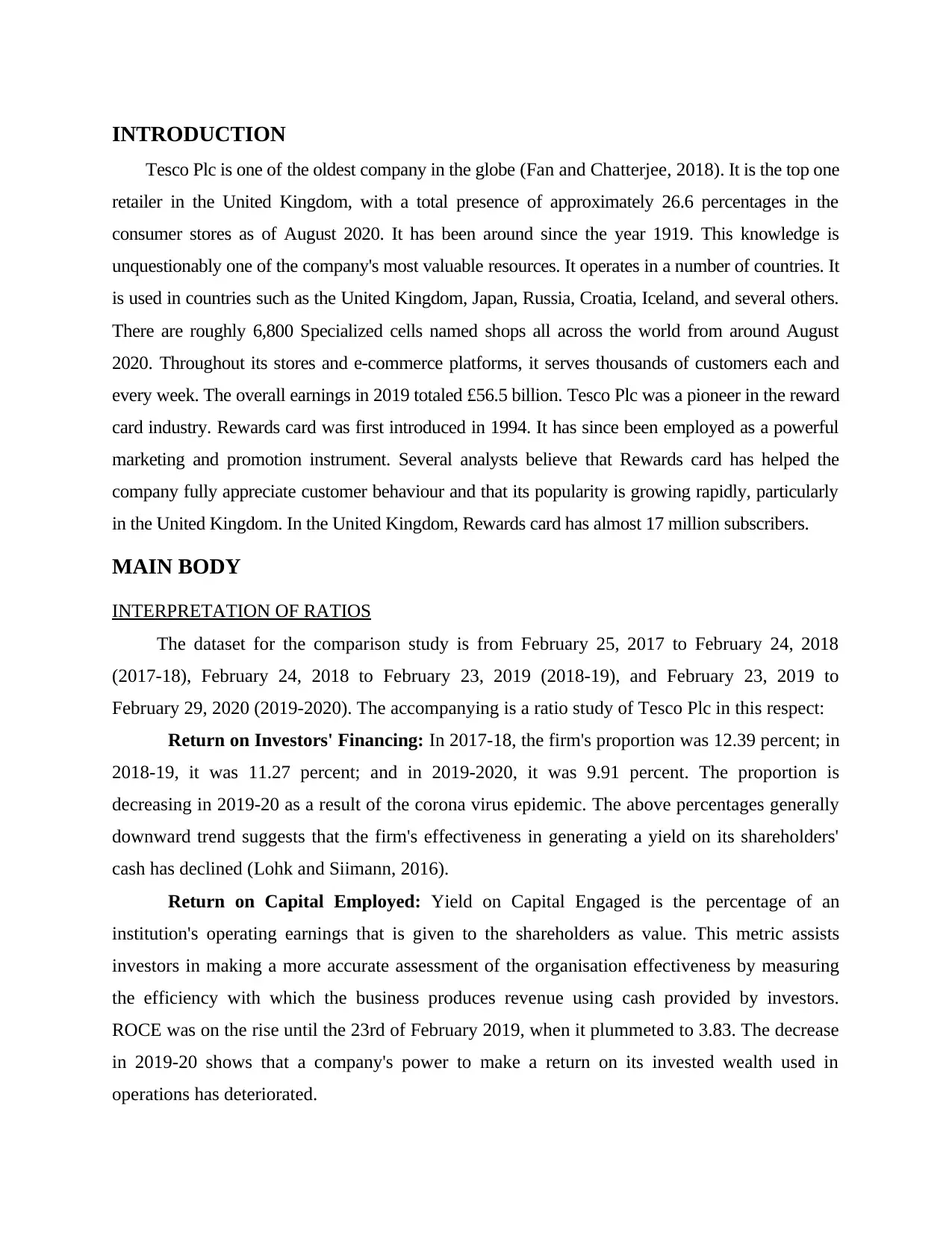
Tesco Plc is one of the oldest company in the globe (Fan and Chatterjee, 2018). It is the top one
retailer in the United Kingdom, with a total presence of approximately 26.6 percentages in the
consumer stores as of August 2020. It has been around since the year 1919. This knowledge is
unquestionably one of the company's most valuable resources. It operates in a number of countries. It
is used in countries such as the United Kingdom, Japan, Russia, Croatia, Iceland, and several others.
There are roughly 6,800 Specialized cells named shops all across the world from around August
2020. Throughout its stores and e-commerce platforms, it serves thousands of customers each and
every week. The overall earnings in 2019 totaled £56.5 billion. Tesco Plc was a pioneer in the reward
card industry. Rewards card was first introduced in 1994. It has since been employed as a powerful
marketing and promotion instrument. Several analysts believe that Rewards card has helped the
company fully appreciate customer behaviour and that its popularity is growing rapidly, particularly
in the United Kingdom. In the United Kingdom, Rewards card has almost 17 million subscribers.
MAIN BODY
INTERPRETATION OF RATIOS
The dataset for the comparison study is from February 25, 2017 to February 24, 2018
(2017-18), February 24, 2018 to February 23, 2019 (2018-19), and February 23, 2019 to
February 29, 2020 (2019-2020). The accompanying is a ratio study of Tesco Plc in this respect:
Return on Investors' Financing: In 2017-18, the firm's proportion was 12.39 percent; in
2018-19, it was 11.27 percent; and in 2019-2020, it was 9.91 percent. The proportion is
decreasing in 2019-20 as a result of the corona virus epidemic. The above percentages generally
downward trend suggests that the firm's effectiveness in generating a yield on its shareholders'
cash has declined (Lohk and Siimann, 2016).
Return on Capital Employed: Yield on Capital Engaged is the percentage of an
institution's operating earnings that is given to the shareholders as value. This metric assists
investors in making a more accurate assessment of the organisation effectiveness by measuring
the efficiency with which the business produces revenue using cash provided by investors.
ROCE was on the rise until the 23rd of February 2019, when it plummeted to 3.83. The decrease
in 2019-20 shows that a company's power to make a return on its invested wealth used in
operations has deteriorated.
Tesco Plc is one of the oldest company in the globe (Fan and Chatterjee, 2018). It is the top one
retailer in the United Kingdom, with a total presence of approximately 26.6 percentages in the
consumer stores as of August 2020. It has been around since the year 1919. This knowledge is
unquestionably one of the company's most valuable resources. It operates in a number of countries. It
is used in countries such as the United Kingdom, Japan, Russia, Croatia, Iceland, and several others.
There are roughly 6,800 Specialized cells named shops all across the world from around August
2020. Throughout its stores and e-commerce platforms, it serves thousands of customers each and
every week. The overall earnings in 2019 totaled £56.5 billion. Tesco Plc was a pioneer in the reward
card industry. Rewards card was first introduced in 1994. It has since been employed as a powerful
marketing and promotion instrument. Several analysts believe that Rewards card has helped the
company fully appreciate customer behaviour and that its popularity is growing rapidly, particularly
in the United Kingdom. In the United Kingdom, Rewards card has almost 17 million subscribers.
MAIN BODY
INTERPRETATION OF RATIOS
The dataset for the comparison study is from February 25, 2017 to February 24, 2018
(2017-18), February 24, 2018 to February 23, 2019 (2018-19), and February 23, 2019 to
February 29, 2020 (2019-2020). The accompanying is a ratio study of Tesco Plc in this respect:
Return on Investors' Financing: In 2017-18, the firm's proportion was 12.39 percent; in
2018-19, it was 11.27 percent; and in 2019-2020, it was 9.91 percent. The proportion is
decreasing in 2019-20 as a result of the corona virus epidemic. The above percentages generally
downward trend suggests that the firm's effectiveness in generating a yield on its shareholders'
cash has declined (Lohk and Siimann, 2016).
Return on Capital Employed: Yield on Capital Engaged is the percentage of an
institution's operating earnings that is given to the shareholders as value. This metric assists
investors in making a more accurate assessment of the organisation effectiveness by measuring
the efficiency with which the business produces revenue using cash provided by investors.
ROCE was on the rise until the 23rd of February 2019, when it plummeted to 3.83. The decrease
in 2019-20 shows that a company's power to make a return on its invested wealth used in
operations has deteriorated.
⊘ This is a preview!⊘
Do you want full access?
Subscribe today to unlock all pages.

Trusted by 1+ million students worldwide

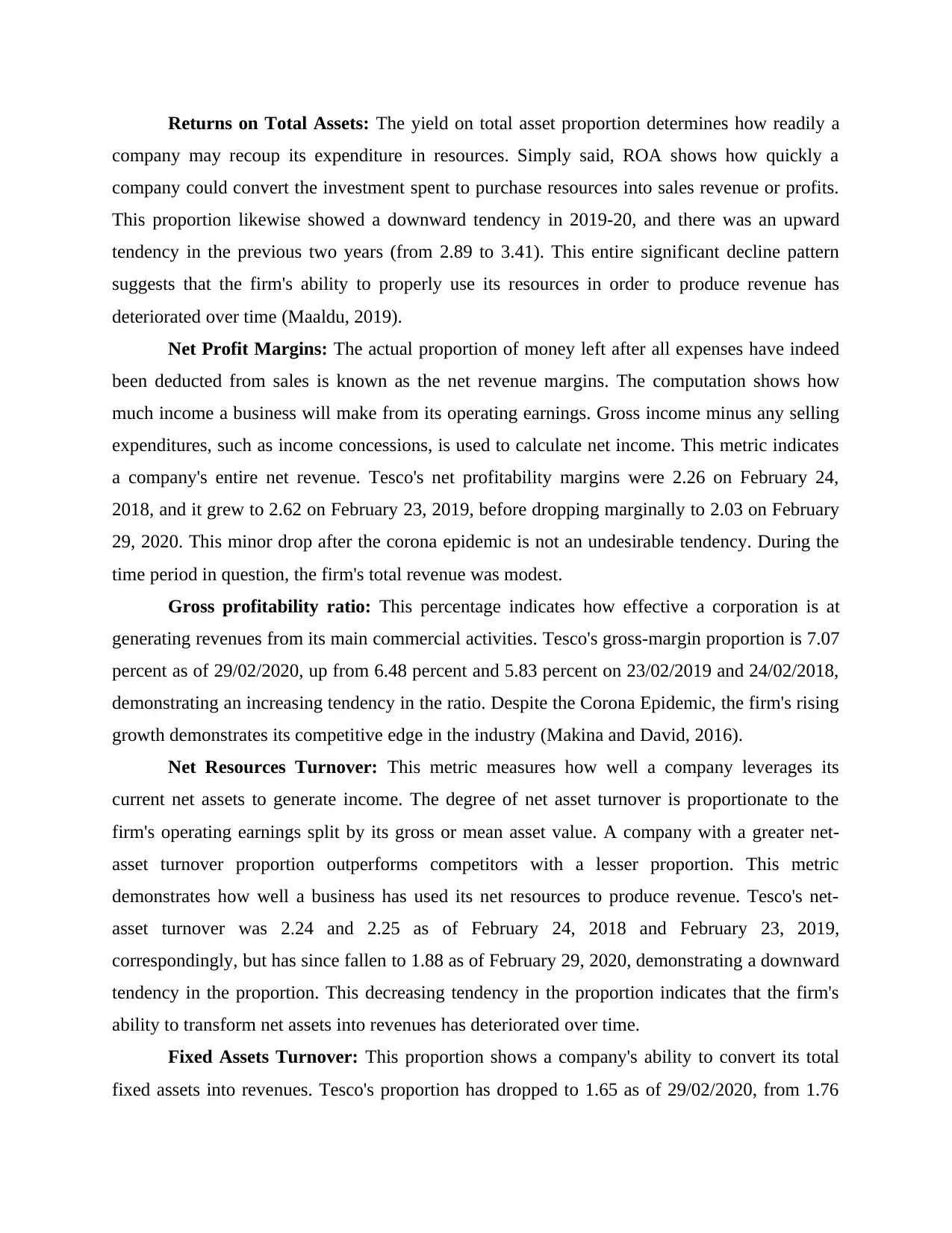
Returns on Total Assets: The yield on total asset proportion determines how readily a
company may recoup its expenditure in resources. Simply said, ROA shows how quickly a
company could convert the investment spent to purchase resources into sales revenue or profits.
This proportion likewise showed a downward tendency in 2019-20, and there was an upward
tendency in the previous two years (from 2.89 to 3.41). This entire significant decline pattern
suggests that the firm's ability to properly use its resources in order to produce revenue has
deteriorated over time (Maaldu, 2019).
Net Profit Margins: The actual proportion of money left after all expenses have indeed
been deducted from sales is known as the net revenue margins. The computation shows how
much income a business will make from its operating earnings. Gross income minus any selling
expenditures, such as income concessions, is used to calculate net income. This metric indicates
a company's entire net revenue. Tesco's net profitability margins were 2.26 on February 24,
2018, and it grew to 2.62 on February 23, 2019, before dropping marginally to 2.03 on February
29, 2020. This minor drop after the corona epidemic is not an undesirable tendency. During the
time period in question, the firm's total revenue was modest.
Gross profitability ratio: This percentage indicates how effective a corporation is at
generating revenues from its main commercial activities. Tesco's gross-margin proportion is 7.07
percent as of 29/02/2020, up from 6.48 percent and 5.83 percent on 23/02/2019 and 24/02/2018,
demonstrating an increasing tendency in the ratio. Despite the Corona Epidemic, the firm's rising
growth demonstrates its competitive edge in the industry (Makina and David, 2016).
Net Resources Turnover: This metric measures how well a company leverages its
current net assets to generate income. The degree of net asset turnover is proportionate to the
firm's operating earnings split by its gross or mean asset value. A company with a greater net-
asset turnover proportion outperforms competitors with a lesser proportion. This metric
demonstrates how well a business has used its net resources to produce revenue. Tesco's net-
asset turnover was 2.24 and 2.25 as of February 24, 2018 and February 23, 2019,
correspondingly, but has since fallen to 1.88 as of February 29, 2020, demonstrating a downward
tendency in the proportion. This decreasing tendency in the proportion indicates that the firm's
ability to transform net assets into revenues has deteriorated over time.
Fixed Assets Turnover: This proportion shows a company's ability to convert its total
fixed assets into revenues. Tesco's proportion has dropped to 1.65 as of 29/02/2020, from 1.76
company may recoup its expenditure in resources. Simply said, ROA shows how quickly a
company could convert the investment spent to purchase resources into sales revenue or profits.
This proportion likewise showed a downward tendency in 2019-20, and there was an upward
tendency in the previous two years (from 2.89 to 3.41). This entire significant decline pattern
suggests that the firm's ability to properly use its resources in order to produce revenue has
deteriorated over time (Maaldu, 2019).
Net Profit Margins: The actual proportion of money left after all expenses have indeed
been deducted from sales is known as the net revenue margins. The computation shows how
much income a business will make from its operating earnings. Gross income minus any selling
expenditures, such as income concessions, is used to calculate net income. This metric indicates
a company's entire net revenue. Tesco's net profitability margins were 2.26 on February 24,
2018, and it grew to 2.62 on February 23, 2019, before dropping marginally to 2.03 on February
29, 2020. This minor drop after the corona epidemic is not an undesirable tendency. During the
time period in question, the firm's total revenue was modest.
Gross profitability ratio: This percentage indicates how effective a corporation is at
generating revenues from its main commercial activities. Tesco's gross-margin proportion is 7.07
percent as of 29/02/2020, up from 6.48 percent and 5.83 percent on 23/02/2019 and 24/02/2018,
demonstrating an increasing tendency in the ratio. Despite the Corona Epidemic, the firm's rising
growth demonstrates its competitive edge in the industry (Makina and David, 2016).
Net Resources Turnover: This metric measures how well a company leverages its
current net assets to generate income. The degree of net asset turnover is proportionate to the
firm's operating earnings split by its gross or mean asset value. A company with a greater net-
asset turnover proportion outperforms competitors with a lesser proportion. This metric
demonstrates how well a business has used its net resources to produce revenue. Tesco's net-
asset turnover was 2.24 and 2.25 as of February 24, 2018 and February 23, 2019,
correspondingly, but has since fallen to 1.88 as of February 29, 2020, demonstrating a downward
tendency in the proportion. This decreasing tendency in the proportion indicates that the firm's
ability to transform net assets into revenues has deteriorated over time.
Fixed Assets Turnover: This proportion shows a company's ability to convert its total
fixed assets into revenues. Tesco's proportion has dropped to 1.65 as of 29/02/2020, from 1.76
Paraphrase This Document
Need a fresh take? Get an instant paraphrase of this document with our AI Paraphraser

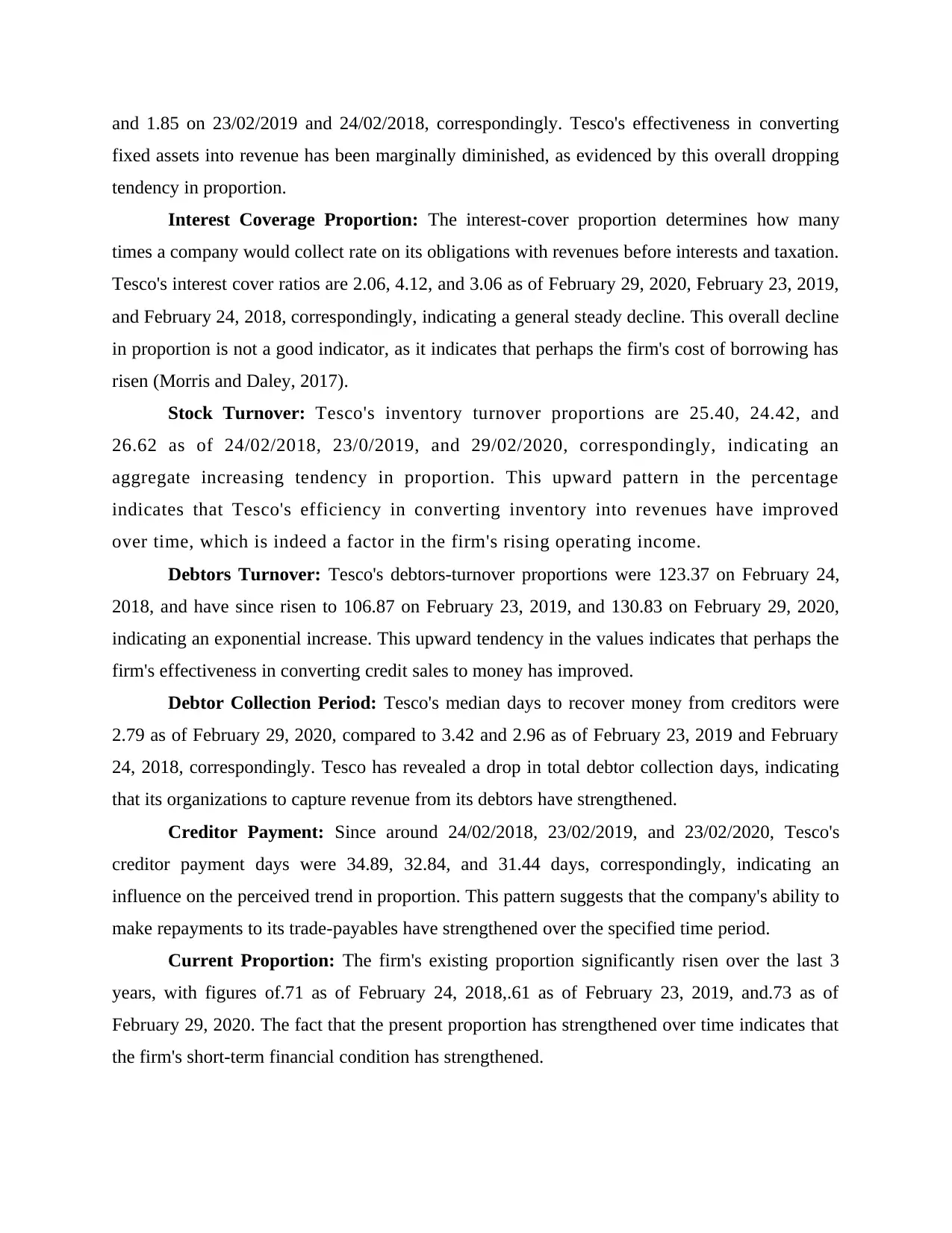
and 1.85 on 23/02/2019 and 24/02/2018, correspondingly. Tesco's effectiveness in converting
fixed assets into revenue has been marginally diminished, as evidenced by this overall dropping
tendency in proportion.
Interest Coverage Proportion: The interest-cover proportion determines how many
times a company would collect rate on its obligations with revenues before interests and taxation.
Tesco's interest cover ratios are 2.06, 4.12, and 3.06 as of February 29, 2020, February 23, 2019,
and February 24, 2018, correspondingly, indicating a general steady decline. This overall decline
in proportion is not a good indicator, as it indicates that perhaps the firm's cost of borrowing has
risen (Morris and Daley, 2017).
Stock Turnover: Tesco's inventory turnover proportions are 25.40, 24.42, and
26.62 as of 24/02/2018, 23/0/2019, and 29/02/2020, correspondingly, indicating an
aggregate increasing tendency in proportion. This upward pattern in the percentage
indicates that Tesco's efficiency in converting inventory into revenues have improved
over time, which is indeed a factor in the firm's rising operating income.
Debtors Turnover: Tesco's debtors-turnover proportions were 123.37 on February 24,
2018, and have since risen to 106.87 on February 23, 2019, and 130.83 on February 29, 2020,
indicating an exponential increase. This upward tendency in the values indicates that perhaps the
firm's effectiveness in converting credit sales to money has improved.
Debtor Collection Period: Tesco's median days to recover money from creditors were
2.79 as of February 29, 2020, compared to 3.42 and 2.96 as of February 23, 2019 and February
24, 2018, correspondingly. Tesco has revealed a drop in total debtor collection days, indicating
that its organizations to capture revenue from its debtors have strengthened.
Creditor Payment: Since around 24/02/2018, 23/02/2019, and 23/02/2020, Tesco's
creditor payment days were 34.89, 32.84, and 31.44 days, correspondingly, indicating an
influence on the perceived trend in proportion. This pattern suggests that the company's ability to
make repayments to its trade-payables have strengthened over the specified time period.
Current Proportion: The firm's existing proportion significantly risen over the last 3
years, with figures of.71 as of February 24, 2018,.61 as of February 23, 2019, and.73 as of
February 29, 2020. The fact that the present proportion has strengthened over time indicates that
the firm's short-term financial condition has strengthened.
fixed assets into revenue has been marginally diminished, as evidenced by this overall dropping
tendency in proportion.
Interest Coverage Proportion: The interest-cover proportion determines how many
times a company would collect rate on its obligations with revenues before interests and taxation.
Tesco's interest cover ratios are 2.06, 4.12, and 3.06 as of February 29, 2020, February 23, 2019,
and February 24, 2018, correspondingly, indicating a general steady decline. This overall decline
in proportion is not a good indicator, as it indicates that perhaps the firm's cost of borrowing has
risen (Morris and Daley, 2017).
Stock Turnover: Tesco's inventory turnover proportions are 25.40, 24.42, and
26.62 as of 24/02/2018, 23/0/2019, and 29/02/2020, correspondingly, indicating an
aggregate increasing tendency in proportion. This upward pattern in the percentage
indicates that Tesco's efficiency in converting inventory into revenues have improved
over time, which is indeed a factor in the firm's rising operating income.
Debtors Turnover: Tesco's debtors-turnover proportions were 123.37 on February 24,
2018, and have since risen to 106.87 on February 23, 2019, and 130.83 on February 29, 2020,
indicating an exponential increase. This upward tendency in the values indicates that perhaps the
firm's effectiveness in converting credit sales to money has improved.
Debtor Collection Period: Tesco's median days to recover money from creditors were
2.79 as of February 29, 2020, compared to 3.42 and 2.96 as of February 23, 2019 and February
24, 2018, correspondingly. Tesco has revealed a drop in total debtor collection days, indicating
that its organizations to capture revenue from its debtors have strengthened.
Creditor Payment: Since around 24/02/2018, 23/02/2019, and 23/02/2020, Tesco's
creditor payment days were 34.89, 32.84, and 31.44 days, correspondingly, indicating an
influence on the perceived trend in proportion. This pattern suggests that the company's ability to
make repayments to its trade-payables have strengthened over the specified time period.
Current Proportion: The firm's existing proportion significantly risen over the last 3
years, with figures of.71 as of February 24, 2018,.61 as of February 23, 2019, and.73 as of
February 29, 2020. The fact that the present proportion has strengthened over time indicates that
the firm's short-term financial condition has strengthened.

Liquidity Proportion: This is also known as the debt-to-equity ratio, and it indicates the
corporation's total liquidity condition. Tesco's liquidity ratio was 0.60 on February 24, 2018, 0.49
on February 23, 2019, and 0.60 on February 29, 2020. Even though there is no ideal pattern in
the ratios, the firm's liquidity situation has remained stable over the past 3 years.
Asset Cover: Tesco's asset cover proportion was 4.44 and 5.47 as of
24/02/2018 and 23/02/2019, correspondingly, but has since dropped to 3.11 as of
29/02/2020, indicating that it already needs less time to manage its obligations.
Gearing: The gearing ratio is an indicator of a company's financial
vulnerability. Whenever a company seems to have a large amount of debt, it may
face fiscal difficulties. The greater the gearing proportion, the greater the debt-to-
equity proportion, and also the lesser the gearing proportion, the cheaper the debt-
to-equity proportion. As of 29/02/2020, 23/02/2019, and 24/02/2018, the company's
gearing ratios were 222.91, 161.26, and 233.35, correspondingly, indicating a
steady decline.
Consequently, the firm's productivity slowly declined because to the slowing economy
caused by the corona epidemic in 2019-20, but the business exhibited constant positive
development in all metrics in 2018-19 and 2017-18, indicating that the business would maintain
its previous success increase (Njeru, 2016).
CONCLUSION
According to the result of the research, Tesco's achievement over the last three years has
indeed been pretty excellent, while there has been a minor fall in proportion owing to the corona
epidemic in 2019-2020, but this is just transitory. The firm's prior success record indicates that
doing so would maintain a competitive leadership while also improving its effectiveness. All of
the firm's metrics have shown a positive trend in the years 2018-2019, indicating that the
business is helpful in enhancing its profitability.
corporation's total liquidity condition. Tesco's liquidity ratio was 0.60 on February 24, 2018, 0.49
on February 23, 2019, and 0.60 on February 29, 2020. Even though there is no ideal pattern in
the ratios, the firm's liquidity situation has remained stable over the past 3 years.
Asset Cover: Tesco's asset cover proportion was 4.44 and 5.47 as of
24/02/2018 and 23/02/2019, correspondingly, but has since dropped to 3.11 as of
29/02/2020, indicating that it already needs less time to manage its obligations.
Gearing: The gearing ratio is an indicator of a company's financial
vulnerability. Whenever a company seems to have a large amount of debt, it may
face fiscal difficulties. The greater the gearing proportion, the greater the debt-to-
equity proportion, and also the lesser the gearing proportion, the cheaper the debt-
to-equity proportion. As of 29/02/2020, 23/02/2019, and 24/02/2018, the company's
gearing ratios were 222.91, 161.26, and 233.35, correspondingly, indicating a
steady decline.
Consequently, the firm's productivity slowly declined because to the slowing economy
caused by the corona epidemic in 2019-20, but the business exhibited constant positive
development in all metrics in 2018-19 and 2017-18, indicating that the business would maintain
its previous success increase (Njeru, 2016).
CONCLUSION
According to the result of the research, Tesco's achievement over the last three years has
indeed been pretty excellent, while there has been a minor fall in proportion owing to the corona
epidemic in 2019-2020, but this is just transitory. The firm's prior success record indicates that
doing so would maintain a competitive leadership while also improving its effectiveness. All of
the firm's metrics have shown a positive trend in the years 2018-2019, indicating that the
business is helpful in enhancing its profitability.
⊘ This is a preview!⊘
Do you want full access?
Subscribe today to unlock all pages.

Trusted by 1+ million students worldwide

REFERENCES
Books and journals
Fan, L. and Chatterjee, S., 2018. Application of situational stimuli for examining the
effectiveness of financial education: A behavioral finance perspective. Journal of
Behavioral and Experimental Finance. 17. pp.68-75.
Lohk, P. and Siimann, P., 2016, December. Predicting the risk of encountering financial
difficulties by the example of Estonian municipalities. In 5th International Conference
on Accounting, Auditing, and Taxation (ICAAT 2016) (pp. 297-306). Atlantis Press.
Maaldu, E.B., 2019. FINANCIAL MANAGEMENT PRACTICES AND FINANCIAL
SUSTAINABILITY OF LOCAL NON-GOVERNMENTAL ORGANIZATIONS (Doctoral
dissertation).
Makina, C. and David, M., 2016. Public Financial Accountability: A pre-requisite to the
management of Development Assistance in Mozambique beyond 2015. Africa’s Public
Service Delivery and Performance Review, 4(4), pp.554-572.
Morris, J.R. and Daley, J.P., 2017. Introduction to financial models for management and
planning. CRC press.
Njeru, M.D., 2016. Effect of Liquidity Management on financial performance of Deposit Taking
Saving and credit co-operative society in Kenya (Doctoral dissertation, Business
Administration (Finance), JKUAT).
Books and journals
Fan, L. and Chatterjee, S., 2018. Application of situational stimuli for examining the
effectiveness of financial education: A behavioral finance perspective. Journal of
Behavioral and Experimental Finance. 17. pp.68-75.
Lohk, P. and Siimann, P., 2016, December. Predicting the risk of encountering financial
difficulties by the example of Estonian municipalities. In 5th International Conference
on Accounting, Auditing, and Taxation (ICAAT 2016) (pp. 297-306). Atlantis Press.
Maaldu, E.B., 2019. FINANCIAL MANAGEMENT PRACTICES AND FINANCIAL
SUSTAINABILITY OF LOCAL NON-GOVERNMENTAL ORGANIZATIONS (Doctoral
dissertation).
Makina, C. and David, M., 2016. Public Financial Accountability: A pre-requisite to the
management of Development Assistance in Mozambique beyond 2015. Africa’s Public
Service Delivery and Performance Review, 4(4), pp.554-572.
Morris, J.R. and Daley, J.P., 2017. Introduction to financial models for management and
planning. CRC press.
Njeru, M.D., 2016. Effect of Liquidity Management on financial performance of Deposit Taking
Saving and credit co-operative society in Kenya (Doctoral dissertation, Business
Administration (Finance), JKUAT).
1 out of 7
Related Documents
Your All-in-One AI-Powered Toolkit for Academic Success.
+13062052269
info@desklib.com
Available 24*7 on WhatsApp / Email
Unlock your academic potential
Copyright © 2020–2025 A2Z Services. All Rights Reserved. Developed and managed by ZUCOL.