Tesco: HR Activities, Structure and Macro Factors Analysis
VerifiedAdded on 2020/01/07
|12
|4082
|174
Report
AI Summary
This report provides a comprehensive analysis of Tesco's human resource management, organizational structure, and the impact of macroeconomic factors. It begins with an introduction to the role of HR in achieving organizational goals, followed by an overview of Tesco's purpose, goals, products, services, and customer base. The report then delves into the effects of macro factors, such as political, economic, social, and technological influences, on Tesco's business activities. It further examines Tesco's organizational structure, highlighting different functional areas like finance, HR, marketing, and customer relations, and explains how these functions contribute to the company's overall performance. Finally, the report explores how HR activities support Tesco's strategy and the role of HR managers in supporting line managers and staff, culminating in a detailed conclusion and references.
Understanding
Organisations and The Role
of Human Resources
Organisations and The Role
of Human Resources

Paraphrase This Document
Need a fresh take? Get an instant paraphrase of this document with our AI Paraphraser
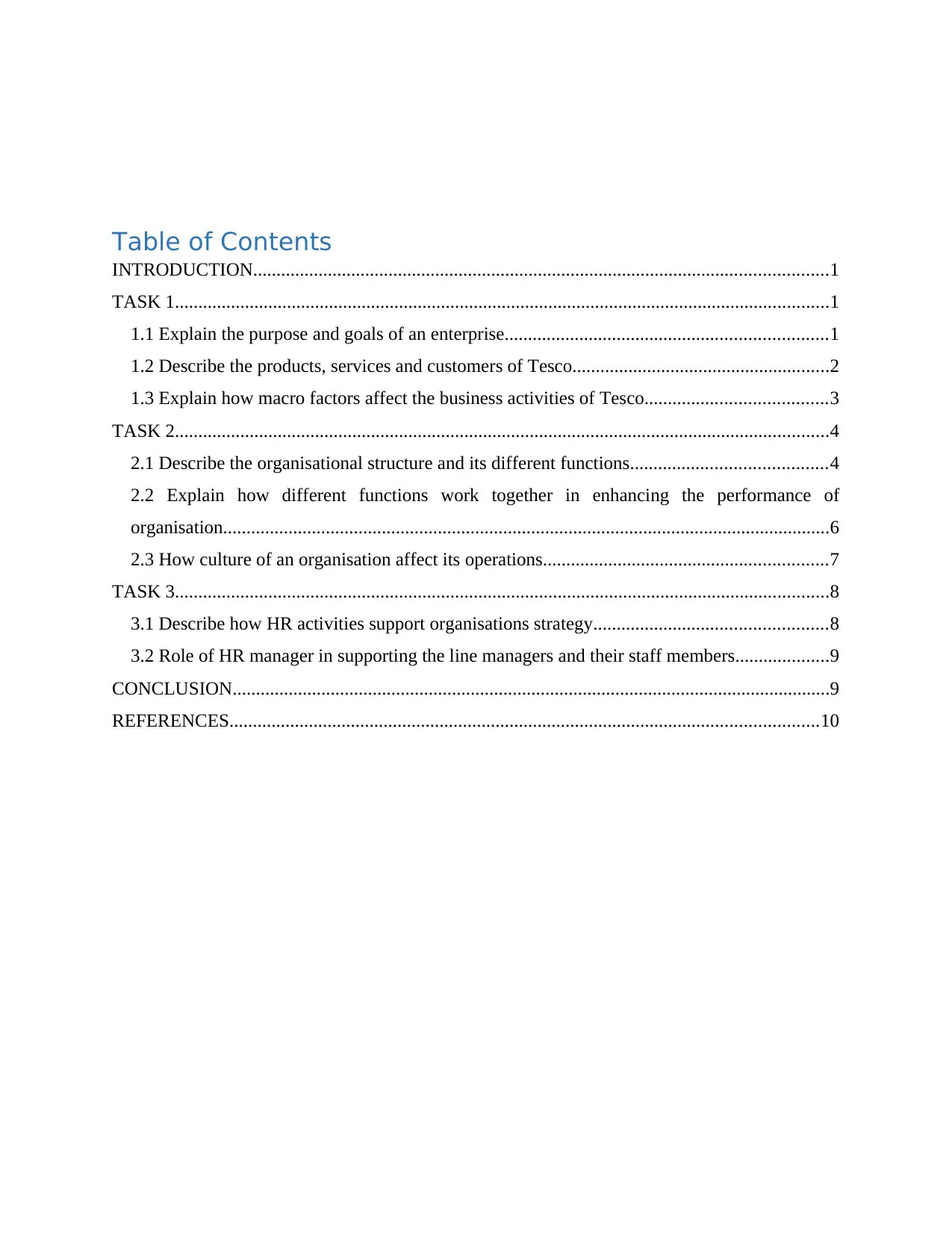
Table of Contents
INTRODUCTION...........................................................................................................................1
TASK 1............................................................................................................................................1
1.1 Explain the purpose and goals of an enterprise.....................................................................1
1.2 Describe the products, services and customers of Tesco.......................................................2
1.3 Explain how macro factors affect the business activities of Tesco.......................................3
TASK 2............................................................................................................................................4
2.1 Describe the organisational structure and its different functions..........................................4
2.2 Explain how different functions work together in enhancing the performance of
organisation..................................................................................................................................6
2.3 How culture of an organisation affect its operations.............................................................7
TASK 3............................................................................................................................................8
3.1 Describe how HR activities support organisations strategy..................................................8
3.2 Role of HR manager in supporting the line managers and their staff members....................9
CONCLUSION................................................................................................................................9
REFERENCES..............................................................................................................................10
INTRODUCTION...........................................................................................................................1
TASK 1............................................................................................................................................1
1.1 Explain the purpose and goals of an enterprise.....................................................................1
1.2 Describe the products, services and customers of Tesco.......................................................2
1.3 Explain how macro factors affect the business activities of Tesco.......................................3
TASK 2............................................................................................................................................4
2.1 Describe the organisational structure and its different functions..........................................4
2.2 Explain how different functions work together in enhancing the performance of
organisation..................................................................................................................................6
2.3 How culture of an organisation affect its operations.............................................................7
TASK 3............................................................................................................................................8
3.1 Describe how HR activities support organisations strategy..................................................8
3.2 Role of HR manager in supporting the line managers and their staff members....................9
CONCLUSION................................................................................................................................9
REFERENCES..............................................................................................................................10
INTRODUCTION
Human resources are the asset of organisation as they help in achieving the objectives
and goals. This deals with all the issues that are faced by an enterprise at the time of managing
all people. There are some actions which are performed by HR manager such as recruitment,
selection, employee relation, training and so on (Boxall and Purcell, 2011). The present report is
based on Tesco which perform their operations in retail sector. They are managing their all staff
members by identifying the issues that are faced by them at the workplace. In this context, it
explains the purpose, goals, customers and services that are offered by an entity. Along with this,
it focuses on different functional areas that how they perform in an efficient manner.
TASK 1
1.1 Explain the purpose and goals of an enterprise
Tesco is an organisation which perform their operations in United Kingdom and it was
established in 1919. It is public Ltd company which is listed on London Stock exchange and it is
a constituent of FTSE 100 Index. Tesco is a multinational company as it is operating in 11
countries. It is operating in the retail market and performing good at the global level so that they
will be able to earn their profits and increase their market share. The basic aim behind forming a
PLC is state that the company is operational for earning profits and its shares will be available
for general public. Common individual can invest in organisation which will aid it in increasing
its investment and assist the investor in earning huge sum of profit. There are approx 460,000
employees (as per the financial report, 2017) are working in the firm which makes Tesco the
biggest employer in retail sector. It provides their products to Asia, Europe, Ireland, Malaysia
and so on (Bratton and Gold, 2012). So, in this manner their overall brand image is good than
their competitors. The vision, mission and objectives of Tesco:
Vision: In the vision statement of Tesco, they are focusing on some elements such as to
serve quality services to the customers, community, loyal employees and shareholders.
Mission: The mission statement of the retail industry is “we make what matters better,
together. This is the core purpose of company and on the basis of this they will be able to
enhance their performance.
Business objectives: There are some business objectives and aim of the company and
some of these are as follows:
1
Human resources are the asset of organisation as they help in achieving the objectives
and goals. This deals with all the issues that are faced by an enterprise at the time of managing
all people. There are some actions which are performed by HR manager such as recruitment,
selection, employee relation, training and so on (Boxall and Purcell, 2011). The present report is
based on Tesco which perform their operations in retail sector. They are managing their all staff
members by identifying the issues that are faced by them at the workplace. In this context, it
explains the purpose, goals, customers and services that are offered by an entity. Along with this,
it focuses on different functional areas that how they perform in an efficient manner.
TASK 1
1.1 Explain the purpose and goals of an enterprise
Tesco is an organisation which perform their operations in United Kingdom and it was
established in 1919. It is public Ltd company which is listed on London Stock exchange and it is
a constituent of FTSE 100 Index. Tesco is a multinational company as it is operating in 11
countries. It is operating in the retail market and performing good at the global level so that they
will be able to earn their profits and increase their market share. The basic aim behind forming a
PLC is state that the company is operational for earning profits and its shares will be available
for general public. Common individual can invest in organisation which will aid it in increasing
its investment and assist the investor in earning huge sum of profit. There are approx 460,000
employees (as per the financial report, 2017) are working in the firm which makes Tesco the
biggest employer in retail sector. It provides their products to Asia, Europe, Ireland, Malaysia
and so on (Bratton and Gold, 2012). So, in this manner their overall brand image is good than
their competitors. The vision, mission and objectives of Tesco:
Vision: In the vision statement of Tesco, they are focusing on some elements such as to
serve quality services to the customers, community, loyal employees and shareholders.
Mission: The mission statement of the retail industry is “we make what matters better,
together. This is the core purpose of company and on the basis of this they will be able to
enhance their performance.
Business objectives: There are some business objectives and aim of the company and
some of these are as follows:
1
⊘ This is a preview!⊘
Do you want full access?
Subscribe today to unlock all pages.

Trusted by 1+ million students worldwide
To offer the quality services to customers so that a strong base of consumers can be
created.
To achieve the competitiveness in market as compare to other competitors so that overall
brand image can be improved.
To provide a peaceful environment to the staff members so that they feel satisfied while
performing their operations.
To increase the market, share and achieve the profitability.
The main objective of a private company is to earn huge profits and generate revenue.
This will enable organisation in growing its capabilities at higher speed, also it will be able to
give right ratio of profits to its shareholders.
1.2 Describe the products, services and customers of Tesco
There are many products and services which are offered by the company to their
customers so that they can fulfil their demand in an efficient manner. Tesco offer their products
into different areas such as clothing, books, furniture, electronics. But the core products of the
company are Food and drinks. Along with this, they offer some telecommunication services to
their consumers so that the firm can attract number of people towards their services (Jiang and et.
al., 2012). The retail company also offers services to their end users via online store so that
people can save their time at the time of purchasing. Basically all other product ranges grew
alonside with the Tesco core offering which was food and drinks.
Tesco also uses segmentation approach in order to divide the market as per their choices.
Through this, the firm can target their audiences and offer them services so that they can fulfil
their demand. Demographic and geographical segmentations are used by the company. In
demographic, the firm divide the market on the basis of age, gender and in geographical the
market is divided on the basis of area or location. So, in this manner an entity can increase the
satisfaction level of their different users. Tesco basically targets households. The age mark which
it uses is between 15-70 years and the income group is low, medium and high. With geographical
changes the company has to adjust its plans and policies. It impacts the company finances.
Tesco perform their activities or operations in a manner so that it can satisfy the needs of
customers. Its prime mode of operations is business to customers. This helps the company in
earning higher profits and revenues. Basically the company business is spilt or segmented in
2
created.
To achieve the competitiveness in market as compare to other competitors so that overall
brand image can be improved.
To provide a peaceful environment to the staff members so that they feel satisfied while
performing their operations.
To increase the market, share and achieve the profitability.
The main objective of a private company is to earn huge profits and generate revenue.
This will enable organisation in growing its capabilities at higher speed, also it will be able to
give right ratio of profits to its shareholders.
1.2 Describe the products, services and customers of Tesco
There are many products and services which are offered by the company to their
customers so that they can fulfil their demand in an efficient manner. Tesco offer their products
into different areas such as clothing, books, furniture, electronics. But the core products of the
company are Food and drinks. Along with this, they offer some telecommunication services to
their consumers so that the firm can attract number of people towards their services (Jiang and et.
al., 2012). The retail company also offers services to their end users via online store so that
people can save their time at the time of purchasing. Basically all other product ranges grew
alonside with the Tesco core offering which was food and drinks.
Tesco also uses segmentation approach in order to divide the market as per their choices.
Through this, the firm can target their audiences and offer them services so that they can fulfil
their demand. Demographic and geographical segmentations are used by the company. In
demographic, the firm divide the market on the basis of age, gender and in geographical the
market is divided on the basis of area or location. So, in this manner an entity can increase the
satisfaction level of their different users. Tesco basically targets households. The age mark which
it uses is between 15-70 years and the income group is low, medium and high. With geographical
changes the company has to adjust its plans and policies. It impacts the company finances.
Tesco perform their activities or operations in a manner so that it can satisfy the needs of
customers. Its prime mode of operations is business to customers. This helps the company in
earning higher profits and revenues. Basically the company business is spilt or segmented in
2
Paraphrase This Document
Need a fresh take? Get an instant paraphrase of this document with our AI Paraphraser
three parts that is Tesco bank, UK unit and International market. These segments contributes to
the company in different way:
Segments Contribution(in amount)
Tesco bank, (3% contribution) GBP 803 million
UK ROI (57% contribution) GBP320 million
International (12.5 % contribution) GBP 157 million
1.3 Explain how macro factors affect the business activities of Tesco
There are some external factors which can impact the performance of an enterprise.
These factors are uncontrollable so company needs to manage their operations as to achieve
competitive advantage in the market (Armstrong, and Taylor, 2014). For this, Tesco can conduct
PEST analysis so that they can identify their strategic position. These factors are:
Political: When an enterprise performs their operations at global level then these factors
can affect their performance. Some of these factors are related to tax rate, political stability,
legislations, foreign trade and so on. When VAT rate is increased then this may negatively
impact the Tesco and due to which overall customers spending level is reduced. In the budget of
2015, the living wage will be increased gradually per year till 2020. It is 7 pound per hour in
2015 and by 2020 it will be 9 pound per hour. It will be additional cost for the company. Tesco
also have to manage the impact of Brexit which has triggered a economic slow down in the
country. The company is facing one of the worst impact as pound value is falling against euro
and dollar and they require additional funds to manage their activities abroad. They have updated
their code of conduct policies for ensuring that there is no unruly behaviour in organisation.
Economical: These are related to the interest rate, inflation, employment and so on.
When overall economic growth of country increases then it leads to better growth of companies
gets improved. When recession occurred then due to this unemployment rate is increased and
this highly affect the profitability of Tesco. Due to Brexit company as well as whole country is
facing a slowdown. The value of pound is falling, inflation is on rise which is a threat to the
people and company. Tesco is known for providing lower cost high quality product and due to
the fall in currency value and rise in commodities price it will be difficult for organisation to
continue services in same way.
3
the company in different way:
Segments Contribution(in amount)
Tesco bank, (3% contribution) GBP 803 million
UK ROI (57% contribution) GBP320 million
International (12.5 % contribution) GBP 157 million
1.3 Explain how macro factors affect the business activities of Tesco
There are some external factors which can impact the performance of an enterprise.
These factors are uncontrollable so company needs to manage their operations as to achieve
competitive advantage in the market (Armstrong, and Taylor, 2014). For this, Tesco can conduct
PEST analysis so that they can identify their strategic position. These factors are:
Political: When an enterprise performs their operations at global level then these factors
can affect their performance. Some of these factors are related to tax rate, political stability,
legislations, foreign trade and so on. When VAT rate is increased then this may negatively
impact the Tesco and due to which overall customers spending level is reduced. In the budget of
2015, the living wage will be increased gradually per year till 2020. It is 7 pound per hour in
2015 and by 2020 it will be 9 pound per hour. It will be additional cost for the company. Tesco
also have to manage the impact of Brexit which has triggered a economic slow down in the
country. The company is facing one of the worst impact as pound value is falling against euro
and dollar and they require additional funds to manage their activities abroad. They have updated
their code of conduct policies for ensuring that there is no unruly behaviour in organisation.
Economical: These are related to the interest rate, inflation, employment and so on.
When overall economic growth of country increases then it leads to better growth of companies
gets improved. When recession occurred then due to this unemployment rate is increased and
this highly affect the profitability of Tesco. Due to Brexit company as well as whole country is
facing a slowdown. The value of pound is falling, inflation is on rise which is a threat to the
people and company. Tesco is known for providing lower cost high quality product and due to
the fall in currency value and rise in commodities price it will be difficult for organisation to
continue services in same way.
3
Social: These are related to the choice, interest, demands of the people. Company have to
look upon the changing behaviour of their end users so that their satisfaction level can be
increased. Now, People are more health conscious which will change their choice food. To
overcome this situation Tesco need to provide range of healthy foods to the people (Edvardsson,
Tronvoll and Gruber, 2011). The social factors such as customer preference for online shopping
has changed the scenario. As reported in financial statement of Tesco for the year 2017, online
shopping is growing with a speed of 7-9% per years. Also country is growing older which means
there will be more older citizien and company have to adapt to their requirements.
Technological: These are related to the advancement in technology and innovation in the
products. By adopting the technological change, Tesco can enhance their performance in the
market as compare to their competitors. For example, service users can purchase the products
from companies online store and through this they will be able to get the services at their home.
Tesco is also cutting down on carbon emission produced by stores and transportation services.
They are creating distribution centres which will cut down the cost of fuel used in vehicles. Also
company is planning for testing out driverless trucks which will reduce the chances of any
accidents.
TASK 2
2.1 Describe the organisational structure and its different functions
Every business organisation perform their operations in more efficient manner so that
they can achieve their objectives. For this, they are using an organisational structure so that
overall roles and responsibilities can be fulfilled. Here, Tesco uses tall hierarchical structure in
which number of levels are more in between top executives and employees. This can be
considered as a hybrid structure as the flow of communication is smooth but the flow of orders is
still in a hierarchy manner. This structure have qualities of tall and matrix , as its hierachy is well
established with different department working as a project. Manager has to perform their role in
an effective manner so that their overall understanding among the people can be increased. There
are some advantages of this structure as communication and relationship gets improved between
the different people at different level (Jackson and et. al., 2011). The flow of communication is
improved as the employees are able to transfer information to the top level managers. Through
this, effective decisions can be made that are helpful for an enterprise in achieving their goals.
4
look upon the changing behaviour of their end users so that their satisfaction level can be
increased. Now, People are more health conscious which will change their choice food. To
overcome this situation Tesco need to provide range of healthy foods to the people (Edvardsson,
Tronvoll and Gruber, 2011). The social factors such as customer preference for online shopping
has changed the scenario. As reported in financial statement of Tesco for the year 2017, online
shopping is growing with a speed of 7-9% per years. Also country is growing older which means
there will be more older citizien and company have to adapt to their requirements.
Technological: These are related to the advancement in technology and innovation in the
products. By adopting the technological change, Tesco can enhance their performance in the
market as compare to their competitors. For example, service users can purchase the products
from companies online store and through this they will be able to get the services at their home.
Tesco is also cutting down on carbon emission produced by stores and transportation services.
They are creating distribution centres which will cut down the cost of fuel used in vehicles. Also
company is planning for testing out driverless trucks which will reduce the chances of any
accidents.
TASK 2
2.1 Describe the organisational structure and its different functions
Every business organisation perform their operations in more efficient manner so that
they can achieve their objectives. For this, they are using an organisational structure so that
overall roles and responsibilities can be fulfilled. Here, Tesco uses tall hierarchical structure in
which number of levels are more in between top executives and employees. This can be
considered as a hybrid structure as the flow of communication is smooth but the flow of orders is
still in a hierarchy manner. This structure have qualities of tall and matrix , as its hierachy is well
established with different department working as a project. Manager has to perform their role in
an effective manner so that their overall understanding among the people can be increased. There
are some advantages of this structure as communication and relationship gets improved between
the different people at different level (Jackson and et. al., 2011). The flow of communication is
improved as the employees are able to transfer information to the top level managers. Through
this, effective decisions can be made that are helpful for an enterprise in achieving their goals.
4
⊘ This is a preview!⊘
Do you want full access?
Subscribe today to unlock all pages.
Trusted by 1+ million students worldwide
The decision making in the company has improved. When the managers have right information
at right time they can take decision in a short period of time.
There are some functional areas of Tesco such as finance, human resource, marketing and
production. On the basis of these, overall performance of retail industry can be improved at the
global level. These are;
Finance: This department deals with accounting, organising, auditing and managing the
companies finance. An accountant has to make the balance statement, profits and loss account so
that overall financial growth can be enhanced. In Tesco, finance department takes care of the
salary and wages given to the employees. Also it has to keep track of the expenses and income of
the company.
Human resource: This functional area is responsible to manage all people who are
working at the workplace. HR manager is responsible to recruit the right person for the job,
manage their salary and leaves. The HR department main role is to maintain and strengthen the
human resource capabilities in Tesco, so that the company is able to achieve its goals and
objectives.
Marketing: This department is responsible for performing some of the marketing
activities so that overall brand awareness can be increased in the market. By performing the
promotional and advertisements, a two communication can be established between two
customers and enterprise (Jing and Avery, 2011). The marketing department ensures that they
are able to promote various products and services of the Tesco in the market.
Customer relationship: This is a function which has been established as a sub part of
marketing. It assist in establishing better company-customer relationship.
5
at right time they can take decision in a short period of time.
There are some functional areas of Tesco such as finance, human resource, marketing and
production. On the basis of these, overall performance of retail industry can be improved at the
global level. These are;
Finance: This department deals with accounting, organising, auditing and managing the
companies finance. An accountant has to make the balance statement, profits and loss account so
that overall financial growth can be enhanced. In Tesco, finance department takes care of the
salary and wages given to the employees. Also it has to keep track of the expenses and income of
the company.
Human resource: This functional area is responsible to manage all people who are
working at the workplace. HR manager is responsible to recruit the right person for the job,
manage their salary and leaves. The HR department main role is to maintain and strengthen the
human resource capabilities in Tesco, so that the company is able to achieve its goals and
objectives.
Marketing: This department is responsible for performing some of the marketing
activities so that overall brand awareness can be increased in the market. By performing the
promotional and advertisements, a two communication can be established between two
customers and enterprise (Jing and Avery, 2011). The marketing department ensures that they
are able to promote various products and services of the Tesco in the market.
Customer relationship: This is a function which has been established as a sub part of
marketing. It assist in establishing better company-customer relationship.
5
Paraphrase This Document
Need a fresh take? Get an instant paraphrase of this document with our AI Paraphraser
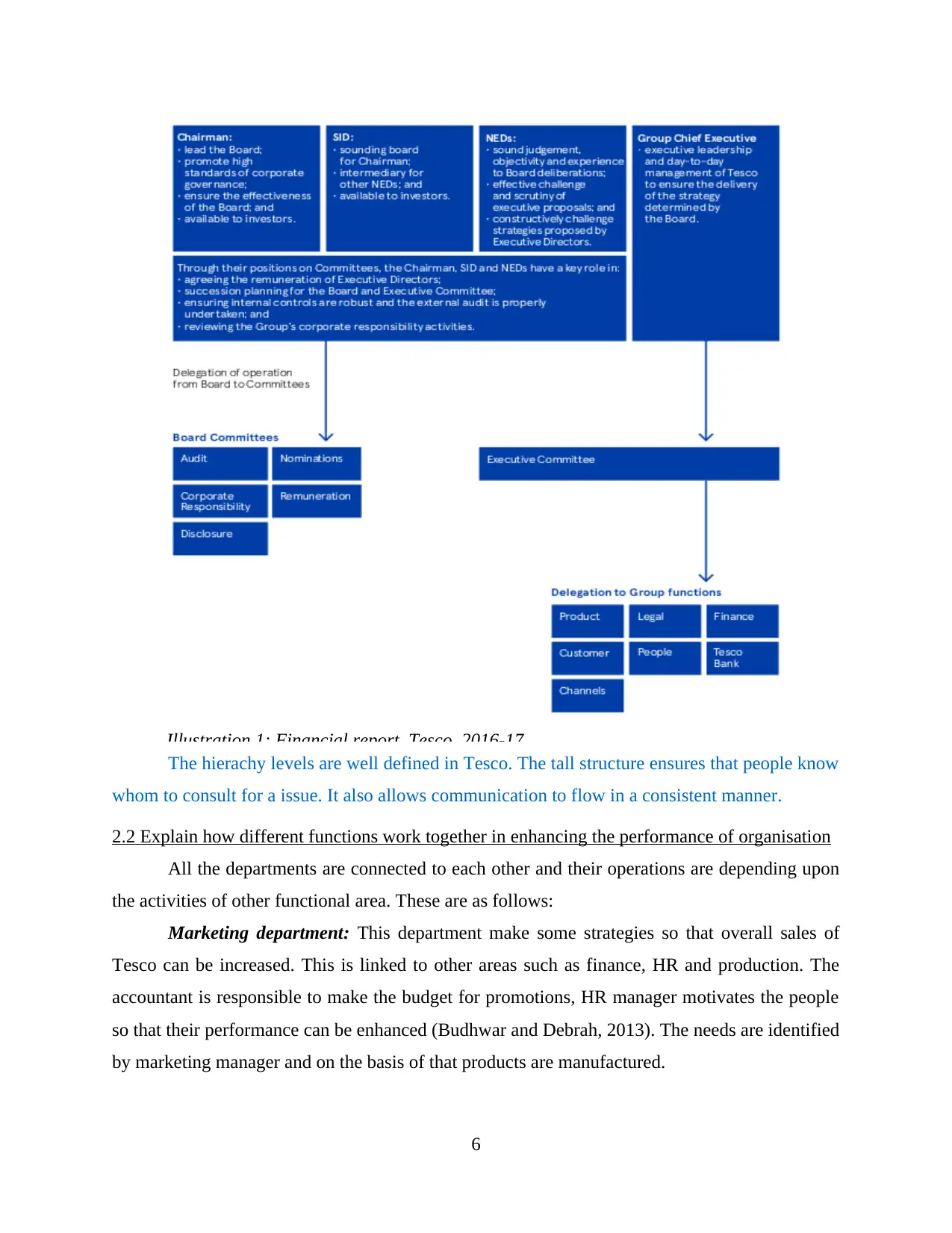
The hierachy levels are well defined in Tesco. The tall structure ensures that people know
whom to consult for a issue. It also allows communication to flow in a consistent manner.
2.2 Explain how different functions work together in enhancing the performance of organisation
All the departments are connected to each other and their operations are depending upon
the activities of other functional area. These are as follows:
Marketing department: This department make some strategies so that overall sales of
Tesco can be increased. This is linked to other areas such as finance, HR and production. The
accountant is responsible to make the budget for promotions, HR manager motivates the people
so that their performance can be enhanced (Budhwar and Debrah, 2013). The needs are identified
by marketing manager and on the basis of that products are manufactured.
6
Illustration 1: Financial report, Tesco, 2016-17
whom to consult for a issue. It also allows communication to flow in a consistent manner.
2.2 Explain how different functions work together in enhancing the performance of organisation
All the departments are connected to each other and their operations are depending upon
the activities of other functional area. These are as follows:
Marketing department: This department make some strategies so that overall sales of
Tesco can be increased. This is linked to other areas such as finance, HR and production. The
accountant is responsible to make the budget for promotions, HR manager motivates the people
so that their performance can be enhanced (Budhwar and Debrah, 2013). The needs are identified
by marketing manager and on the basis of that products are manufactured.
6
Illustration 1: Financial report, Tesco, 2016-17
HR department: This functional area is responsible to provide training to their staff
members and manage the salary structure of each individual. Through, marketing activities new
talent can be attracted and finance department have to offer salary on time so that their overall
satisfaction level can be increased.
Customer relationship: This is a department which ensures that customers complaints
and issues are addressed in a proper manner so that their satisfaction remains high. The
customers are one factor who can hamper organisation sales that is why this department has been
established to solve there issues and create programs which fulfil social responsibilities to. It aids
marketing department and HR for developing better strategies to handle people.
Finance: On the basis of survey, current trends in the market can be identified so
investment decisions can be made. Along with this, the budget of particular project can be set so
that spending level can be controlled (Jing and Avery, 2011). This department provides funds to
other departments on the basis of strategic and their individual plans. It ensures that all activities
are well funded and there is no scarcity of resources.
2.3 How culture of an organisation affect its operations
Organisational culture is based on the values, beliefs of people which explain that how
they have to behave. There are some dimensions which play a vital role in order to form a culture
such as innovation, outcomes, teamwork, aggressiveness and so on. It is the combination of
different factors such as power, people, task and role (Boon and et. al., 2011). Cultural factors
impact the employee morale to a great extent. It is a decisive factor which sets up a person
attitude and perception. Culture is very different from organisation structure, it is about the
values and ethics which are followed by an individual. Through these factors, the overall
performance of Tesco can be improved at the marketplace. There are few core values and
purpose stated on company's website, that is:
For consumers
Serving UK consumers a little better every day
Understand consumer
Meet their needs
Act responsibly to issues
Culture inside organisation:
Work as a team
7
members and manage the salary structure of each individual. Through, marketing activities new
talent can be attracted and finance department have to offer salary on time so that their overall
satisfaction level can be increased.
Customer relationship: This is a department which ensures that customers complaints
and issues are addressed in a proper manner so that their satisfaction remains high. The
customers are one factor who can hamper organisation sales that is why this department has been
established to solve there issues and create programs which fulfil social responsibilities to. It aids
marketing department and HR for developing better strategies to handle people.
Finance: On the basis of survey, current trends in the market can be identified so
investment decisions can be made. Along with this, the budget of particular project can be set so
that spending level can be controlled (Jing and Avery, 2011). This department provides funds to
other departments on the basis of strategic and their individual plans. It ensures that all activities
are well funded and there is no scarcity of resources.
2.3 How culture of an organisation affect its operations
Organisational culture is based on the values, beliefs of people which explain that how
they have to behave. There are some dimensions which play a vital role in order to form a culture
such as innovation, outcomes, teamwork, aggressiveness and so on. It is the combination of
different factors such as power, people, task and role (Boon and et. al., 2011). Cultural factors
impact the employee morale to a great extent. It is a decisive factor which sets up a person
attitude and perception. Culture is very different from organisation structure, it is about the
values and ethics which are followed by an individual. Through these factors, the overall
performance of Tesco can be improved at the marketplace. There are few core values and
purpose stated on company's website, that is:
For consumers
Serving UK consumers a little better every day
Understand consumer
Meet their needs
Act responsibly to issues
Culture inside organisation:
Work as a team
7
⊘ This is a preview!⊘
Do you want full access?
Subscribe today to unlock all pages.
Trusted by 1+ million students worldwide
trust and respect all
Listen, support and don't forget to say thank you
Sharing knowledge and experience with all.
When an enterprise follow an appropriate culture then through this, employees
motivation and their satisfaction level can be increased. When this get increased then manager
can retain their staff members so turnover and absenteeism can be reduced. Through this, overall
productivity can be increased and that will lead towards the high market share and revenues. By
adopting effective pricing strategies so that customers are get attracted towards the services in
more efficient manner. Also the employee turnover rate will drop as the workers will be
motivated to do the job and stay loyal to the organisation.
TASK 3
3.1 Describe how HR activities support organisations strategy
There are some human resource activities that are performed by Tesco at their workplace
as through this the overall performance of the company can be improved in more effective
manner. These activities are like: Training and development: By providing the training to their staff members, they will be
able to enhance their skills, knowledge and experience. Through this, they can offer
quality services to their customers in more effective manner. Furthermore, all people will
be able to get the peaceful environment so that organisational goal can be achieved. Employee relations: This is an important activity of an HR department. It helps in
ensuring that the relationship between employee and management. The relationship
among all the workers should be improved so that overall growth of the firm can be
enhanced (Jackson and et. al., 2011). For this, leaders can give the tasks to the people in a
group so that communication gap can be reduced.
Performance and reward: The incentives and rewards system in Tesco is based on the
performance of the employees. The HR manager has to record each and every
achievement of the employee as to ensure that they are rewarded in a proper way. Along
with this, wages should be given to them as per their performance so that overall growth
can be enhanced and objectives can be achieved.
8
Listen, support and don't forget to say thank you
Sharing knowledge and experience with all.
When an enterprise follow an appropriate culture then through this, employees
motivation and their satisfaction level can be increased. When this get increased then manager
can retain their staff members so turnover and absenteeism can be reduced. Through this, overall
productivity can be increased and that will lead towards the high market share and revenues. By
adopting effective pricing strategies so that customers are get attracted towards the services in
more efficient manner. Also the employee turnover rate will drop as the workers will be
motivated to do the job and stay loyal to the organisation.
TASK 3
3.1 Describe how HR activities support organisations strategy
There are some human resource activities that are performed by Tesco at their workplace
as through this the overall performance of the company can be improved in more effective
manner. These activities are like: Training and development: By providing the training to their staff members, they will be
able to enhance their skills, knowledge and experience. Through this, they can offer
quality services to their customers in more effective manner. Furthermore, all people will
be able to get the peaceful environment so that organisational goal can be achieved. Employee relations: This is an important activity of an HR department. It helps in
ensuring that the relationship between employee and management. The relationship
among all the workers should be improved so that overall growth of the firm can be
enhanced (Jackson and et. al., 2011). For this, leaders can give the tasks to the people in a
group so that communication gap can be reduced.
Performance and reward: The incentives and rewards system in Tesco is based on the
performance of the employees. The HR manager has to record each and every
achievement of the employee as to ensure that they are rewarded in a proper way. Along
with this, wages should be given to them as per their performance so that overall growth
can be enhanced and objectives can be achieved.
8
Paraphrase This Document
Need a fresh take? Get an instant paraphrase of this document with our AI Paraphraser
3.2 Role of HR manager in supporting the line managers and their staff members
The HR manager of Tesco has to perform some of their roles so that overall human
resources can be managed in more effective manner. Some of these roles are as follows: Communicate the information: It is the responsibility of manager to communicate the
accurate information to the employees so that their overall understanding can be
increased (Armstrong and Taylor, 2014). Through this, they will be able to performance
their operations and activities in more efficient manner. The HR manager assist the line
manager by providing proper authority and mechanism to get the desired information
from employee's. Employee engagement: The HR assist the line manager in engaging with employee's.
Line manager is the one who have to communicate with the workers while supervising
them. He is backed up by HR manager by authority, policies and framework. Proper
employee engagement reduces the chances of conflicts and disputes.
Advice: The HR manager can also give the advice to the people that how they can
perform their operations in more effective manner. Through this, staff members will be
able to know that how they can achieve specified goals.
CONCLUSION
From the above carried out analysis it has been concluded that human resources are very
vital resource for the company. It is the most dynamic force which can help the organisation in
achieving goals and objectives in the most efficient manner. So, it is the responsibility of
manager to manage overall activities that are conducted at the workplace. Every firm established
their business on the basis of particular objectives and goals. HR manager of Tesco uses some of
the strategies such as training, rewards so that their overall satisfaction among the people can be
increased.
9
The HR manager of Tesco has to perform some of their roles so that overall human
resources can be managed in more effective manner. Some of these roles are as follows: Communicate the information: It is the responsibility of manager to communicate the
accurate information to the employees so that their overall understanding can be
increased (Armstrong and Taylor, 2014). Through this, they will be able to performance
their operations and activities in more efficient manner. The HR manager assist the line
manager by providing proper authority and mechanism to get the desired information
from employee's. Employee engagement: The HR assist the line manager in engaging with employee's.
Line manager is the one who have to communicate with the workers while supervising
them. He is backed up by HR manager by authority, policies and framework. Proper
employee engagement reduces the chances of conflicts and disputes.
Advice: The HR manager can also give the advice to the people that how they can
perform their operations in more effective manner. Through this, staff members will be
able to know that how they can achieve specified goals.
CONCLUSION
From the above carried out analysis it has been concluded that human resources are very
vital resource for the company. It is the most dynamic force which can help the organisation in
achieving goals and objectives in the most efficient manner. So, it is the responsibility of
manager to manage overall activities that are conducted at the workplace. Every firm established
their business on the basis of particular objectives and goals. HR manager of Tesco uses some of
the strategies such as training, rewards so that their overall satisfaction among the people can be
increased.
9
REFERENCES
Books and Journal
Armstrong, M. and Taylor, S., 2014. Armstrong's handbook of human resource management
practice. Kogan Page Publishers.
Boon, C and et. al., 2011. The relationship between perceptions of HR practices and employee
outcomes: examining the role of person–organisation and person–job fit. The
International Journal of Human Resource Management. 22(01). pp.138-162.
Boxall, P. and Purcell, J., 2011. Strategy and human resource management. Palgrave Macmillan.
Bratton, J. and Gold, J., 2012. Human resource management: theory and practice. Palgrave
Macmillan.
Budhwar, P.S. and Debrah, Y.A. eds., 2013. Human resource management in developing
countries. Routledge.
Edvardsson, B., Tronvoll, B. and Gruber, T., 2011. Expanding understanding of service
exchange and value co-creation: a social construction approach. Journal of the Academy
of Marketing Science. 39(2). pp.327-339.
Jackson, S.E and et. al., 2011. State-of-the-art and future directions for green human resource
management: Introduction to the special issue. German Journal of Human Resource
Management, 25(2). pp.99-116.
Jiang, K and et. al., 2012. How does human resource management influence organizational
outcomes? A meta-analytic investigation of mediating mechanisms. Academy of
management Journal. 55(6). pp.1264-1294.
Jing, F.F. and Avery, G.C., 2011. Missing links in understanding the relationship between
leadership and organizational performance. International Business & Economics
Research Journal (IBER). 7(5).
Scott, W.R. and Davis, G.F., 2015. Organizations and organizing: Rational, natural and open
systems perspectives. Routledge.
Walumbwa, F.O. and Hartnell, C.A., 2011. Understanding transformational leadership–employee
performance links: The role of relational identification and self‐efficacy. Journal of
Occupational and Organizational Psychology. 84(1). pp.153-172.
Wright, P.M. and McMahan, G.C., 2011. Exploring human capital: putting ‘human’back into
strategic human resource management. Human resource management journal. 21(2).
pp.93-104.
Online
Functional areas of business. 2017. [Online]. Available
through:<http://foundersguide.com/functional-areas-of-a-business/>. [Accessed on 19th
May 2017].
Organisational structure. 2016. [Online]. Available
through:<https://www.nibusinessinfo.co.uk/content/flat-and-hierarchical-organisational-
structures>. [Accessed on 19th May 2017].
10
Books and Journal
Armstrong, M. and Taylor, S., 2014. Armstrong's handbook of human resource management
practice. Kogan Page Publishers.
Boon, C and et. al., 2011. The relationship between perceptions of HR practices and employee
outcomes: examining the role of person–organisation and person–job fit. The
International Journal of Human Resource Management. 22(01). pp.138-162.
Boxall, P. and Purcell, J., 2011. Strategy and human resource management. Palgrave Macmillan.
Bratton, J. and Gold, J., 2012. Human resource management: theory and practice. Palgrave
Macmillan.
Budhwar, P.S. and Debrah, Y.A. eds., 2013. Human resource management in developing
countries. Routledge.
Edvardsson, B., Tronvoll, B. and Gruber, T., 2011. Expanding understanding of service
exchange and value co-creation: a social construction approach. Journal of the Academy
of Marketing Science. 39(2). pp.327-339.
Jackson, S.E and et. al., 2011. State-of-the-art and future directions for green human resource
management: Introduction to the special issue. German Journal of Human Resource
Management, 25(2). pp.99-116.
Jiang, K and et. al., 2012. How does human resource management influence organizational
outcomes? A meta-analytic investigation of mediating mechanisms. Academy of
management Journal. 55(6). pp.1264-1294.
Jing, F.F. and Avery, G.C., 2011. Missing links in understanding the relationship between
leadership and organizational performance. International Business & Economics
Research Journal (IBER). 7(5).
Scott, W.R. and Davis, G.F., 2015. Organizations and organizing: Rational, natural and open
systems perspectives. Routledge.
Walumbwa, F.O. and Hartnell, C.A., 2011. Understanding transformational leadership–employee
performance links: The role of relational identification and self‐efficacy. Journal of
Occupational and Organizational Psychology. 84(1). pp.153-172.
Wright, P.M. and McMahan, G.C., 2011. Exploring human capital: putting ‘human’back into
strategic human resource management. Human resource management journal. 21(2).
pp.93-104.
Online
Functional areas of business. 2017. [Online]. Available
through:<http://foundersguide.com/functional-areas-of-a-business/>. [Accessed on 19th
May 2017].
Organisational structure. 2016. [Online]. Available
through:<https://www.nibusinessinfo.co.uk/content/flat-and-hierarchical-organisational-
structures>. [Accessed on 19th May 2017].
10
⊘ This is a preview!⊘
Do you want full access?
Subscribe today to unlock all pages.
Trusted by 1+ million students worldwide

1 out of 12


Related Documents


Your All-in-One AI-Powered Toolkit for Academic Success.
+13062052269
info@desklib.com
Available 24*7 on WhatsApp / Email
![[object Object]](/_next/static/media/star-bottom.7253800d.svg)
Unlock your academic potential
Copyright © 2020–2026 A2Z Services. All Rights Reserved. Developed and managed by ZUCOL.