Tesco HRM: Recruitment, Employee Relations, and Legal Compliance
VerifiedAdded on 2023/01/06
|18
|4383
|20
Report
AI Summary
This report provides a comprehensive analysis of Human Resource Management (HRM) practices at Tesco, a leading UK supermarket chain. It begins by outlining the purpose and functions of HRM, including workforce planning, recruitment, selection, and compensation planning, and then delves into the strengths and weaknesses of different approaches to recruitment and selection, such as internal and external recruitment methods. The report further examines the benefits of various HRM practices, such as compensation, training, performance management, and reward management, for both employers and employees, highlighting how these practices contribute to employee motivation, skill development, and overall organizational performance. It also assesses the effectiveness of these HRM practices in raising organizational profit and productivity, with a focus on maximizing employee potential through training and development programs. The report emphasizes the importance of employee relations in influencing HRM decision-making and discusses key elements of employment legislation and their impact on HRM. Finally, it provides a detailed application of HRM practices in a work-related context, analyzing how Tesco implements these practices to achieve its organizational goals.

HUMAN RESOURCE
MANAGEMENT
MANAGEMENT

Paraphrase This Document
Need a fresh take? Get an instant paraphrase of this document with our AI Paraphraser
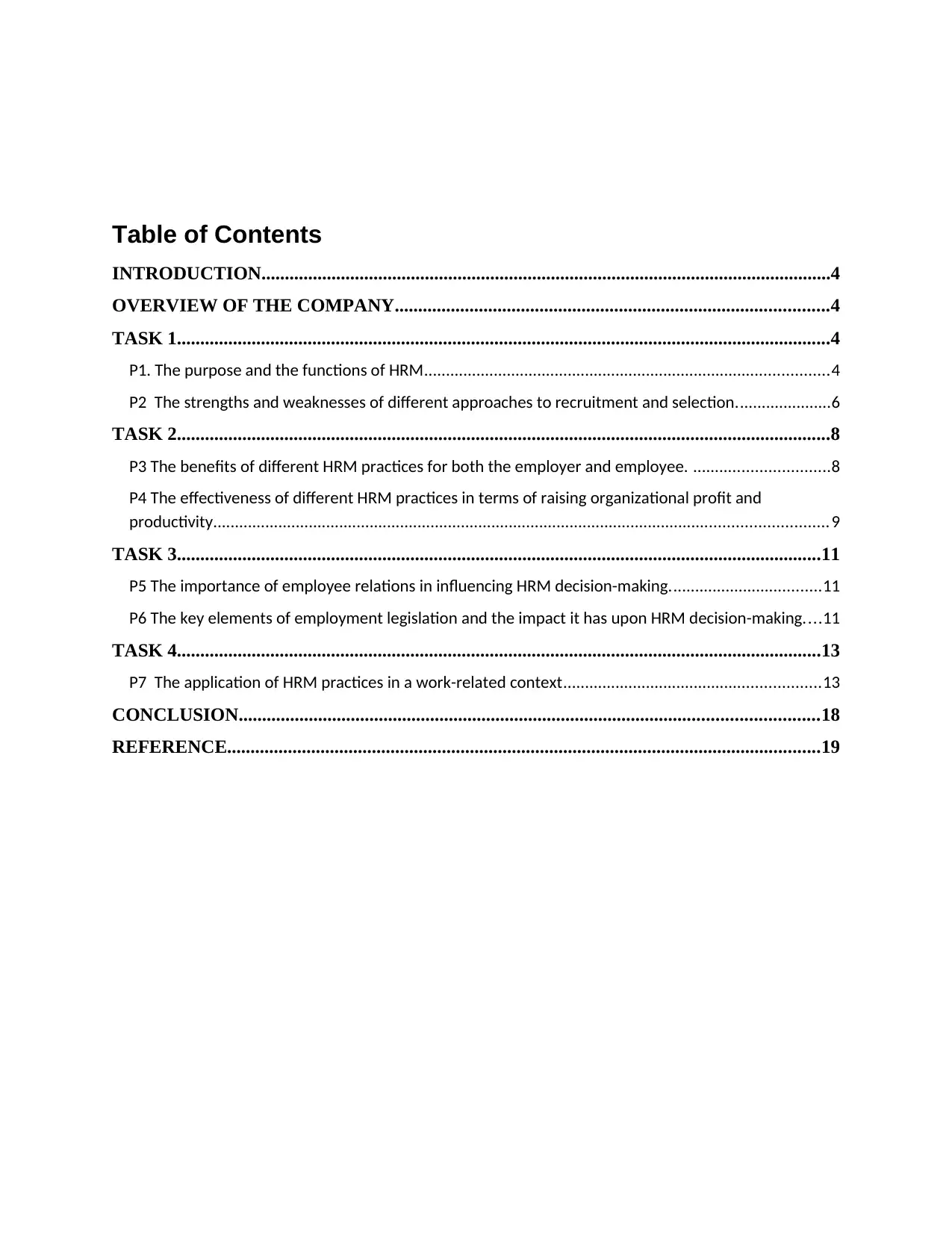
Table of Contents
INTRODUCTION..........................................................................................................................4
OVERVIEW OF THE COMPANY.............................................................................................4
TASK 1............................................................................................................................................4
P1. The purpose and the functions of HRM.............................................................................................4
P2 The strengths and weaknesses of different approaches to recruitment and selection......................6
TASK 2............................................................................................................................................8
P3 The benefits of different HRM practices for both the employer and employee. ...............................8
P4 The effectiveness of different HRM practices in terms of raising organizational profit and
productivity.............................................................................................................................................9
TASK 3..........................................................................................................................................11
P5 The importance of employee relations in influencing HRM decision-making...................................11
P6 The key elements of employment legislation and the impact it has upon HRM decision-making....11
TASK 4..........................................................................................................................................13
P7 The application of HRM practices in a work-related context...........................................................13
CONCLUSION............................................................................................................................18
REFERENCE...............................................................................................................................19
INTRODUCTION..........................................................................................................................4
OVERVIEW OF THE COMPANY.............................................................................................4
TASK 1............................................................................................................................................4
P1. The purpose and the functions of HRM.............................................................................................4
P2 The strengths and weaknesses of different approaches to recruitment and selection......................6
TASK 2............................................................................................................................................8
P3 The benefits of different HRM practices for both the employer and employee. ...............................8
P4 The effectiveness of different HRM practices in terms of raising organizational profit and
productivity.............................................................................................................................................9
TASK 3..........................................................................................................................................11
P5 The importance of employee relations in influencing HRM decision-making...................................11
P6 The key elements of employment legislation and the impact it has upon HRM decision-making....11
TASK 4..........................................................................................................................................13
P7 The application of HRM practices in a work-related context...........................................................13
CONCLUSION............................................................................................................................18
REFERENCE...............................................................................................................................19
INTRODUCTION
Human Resource Management is the process of selecting, training, recruiting the
employees and making strategies to help them in an organisation. They are responsible for
deciding the compensation for employees and provide them facilities so that they can achieve
organisational goal. The human resource management is responsible to manage the external
environment which can impact the employees and the internal environment. They are responsible
for proper utilization of the human resource in an organisation (Noe and et.al., 2018). The
planning of Human resource is important to increase the profits of an organisation. The
organisation chosen for this report is TESCO. It was founded in 1919 in UK. They are the largest
supermarket of UK and have stores worldwide. The report includes the purpose and function of
HRM, recruitment and selection, performance and rewards, external factors that affects the
human resource management.
OVERVIEW OF THE COMPANY
TESCO is a supermarket of UK which was formed in 1919 and is the third largest
supermarket of the world. They have 2318 stores and more than 3 lakh employees are working in
their stores. The HRM of Tesco is effective as they recruit 150 employees for their stores and for
their strategic work. They have facilities to attract the customers as they have good management.
TASK 1
P1. The purpose and the functions of HRM
Human resource management focuses on planning, organizing, directing and recruiting
the employees in an organization. It is the process which helps in maintaining the relationship of
employees with an organization (DeCenzo, Robbins and Verhuls, 2016). It is used to motivate
the employees in an organization and provides them training so that they can achieve the
organizational goal. It measures the performance of employees by analyzing their work, making
effective strategies for the achieving the work, providing the safety of employees, etc.
The purpose of HRM workforce planning and resourcing an organization
Human Resource Management is the process of selecting, training, recruiting the
employees and making strategies to help them in an organisation. They are responsible for
deciding the compensation for employees and provide them facilities so that they can achieve
organisational goal. The human resource management is responsible to manage the external
environment which can impact the employees and the internal environment. They are responsible
for proper utilization of the human resource in an organisation (Noe and et.al., 2018). The
planning of Human resource is important to increase the profits of an organisation. The
organisation chosen for this report is TESCO. It was founded in 1919 in UK. They are the largest
supermarket of UK and have stores worldwide. The report includes the purpose and function of
HRM, recruitment and selection, performance and rewards, external factors that affects the
human resource management.
OVERVIEW OF THE COMPANY
TESCO is a supermarket of UK which was formed in 1919 and is the third largest
supermarket of the world. They have 2318 stores and more than 3 lakh employees are working in
their stores. The HRM of Tesco is effective as they recruit 150 employees for their stores and for
their strategic work. They have facilities to attract the customers as they have good management.
TASK 1
P1. The purpose and the functions of HRM
Human resource management focuses on planning, organizing, directing and recruiting
the employees in an organization. It is the process which helps in maintaining the relationship of
employees with an organization (DeCenzo, Robbins and Verhuls, 2016). It is used to motivate
the employees in an organization and provides them training so that they can achieve the
organizational goal. It measures the performance of employees by analyzing their work, making
effective strategies for the achieving the work, providing the safety of employees, etc.
The purpose of HRM workforce planning and resourcing an organization
⊘ This is a preview!⊘
Do you want full access?
Subscribe today to unlock all pages.

Trusted by 1+ million students worldwide
Recruitment and selection- The HRM department is responsible for hiring of employees
in an organization. They analyze the job and post it on social media to attract the
employees (Tung, 2016). They select them on the basis of selection tests and it helps the
organizations to hire the best employee. In the context of Tesco, they hire 80-150
employees from campus for their stores and workplace and the staff is hired directly.
They have referral system.
Compensation Planning- The HRM is responsible for compensation planning in an
organization. They should consider the average compensation of industry and provide it
according to that so they can attract employees. In the context of Tesco, they focus on
compensation planning by analyzing the performance of employees.
The function of HRM workforce planning and resourcing an organization
The functions of HRM in an organization are based on managerial functions and operative
function.
Managerial function- These are the process of functions in an organization which have
focus on the management activities.
Planning- Planning is the process which determines the activities in an organization to
achieve the organizational goal. The bridges the gap between where we are and want the
organization wants to achieve. The HRM department in an organization makes plan for
human resource.
Organizing- It is the process of allotment of resources in an organization (Srivastava and
Dhar, 2016). The human resources are organized by allotment of roles and
responsibilities. They are required to perform in an organization and manage the work.
The HRM of Tesco is responsible to help the employees in completing their work
effectively.
Directing- The HRM department in an organization directs the work of employees to
help them perform. In the context of Tesco, the managers direct the employees to
improve their performance.
in an organization. They analyze the job and post it on social media to attract the
employees (Tung, 2016). They select them on the basis of selection tests and it helps the
organizations to hire the best employee. In the context of Tesco, they hire 80-150
employees from campus for their stores and workplace and the staff is hired directly.
They have referral system.
Compensation Planning- The HRM is responsible for compensation planning in an
organization. They should consider the average compensation of industry and provide it
according to that so they can attract employees. In the context of Tesco, they focus on
compensation planning by analyzing the performance of employees.
The function of HRM workforce planning and resourcing an organization
The functions of HRM in an organization are based on managerial functions and operative
function.
Managerial function- These are the process of functions in an organization which have
focus on the management activities.
Planning- Planning is the process which determines the activities in an organization to
achieve the organizational goal. The bridges the gap between where we are and want the
organization wants to achieve. The HRM department in an organization makes plan for
human resource.
Organizing- It is the process of allotment of resources in an organization (Srivastava and
Dhar, 2016). The human resources are organized by allotment of roles and
responsibilities. They are required to perform in an organization and manage the work.
The HRM of Tesco is responsible to help the employees in completing their work
effectively.
Directing- The HRM department in an organization directs the work of employees to
help them perform. In the context of Tesco, the managers direct the employees to
improve their performance.
Paraphrase This Document
Need a fresh take? Get an instant paraphrase of this document with our AI Paraphraser
Monitoring and control- The work of the employees are monitored by the HRM
department and it should be according to the plans made by them.
Operating Functions- These are the functions of HRM which are responsible for the
activities to help the employees. They are different for the organizations.
Performance appraisal- There is different performance appraisal schemes in an
organization. It is directly related to the work of the employees and their performance.
Tesco increases the compensation on employees depending on the performance of the
employees.
Training- There are training programs organize by HRM in an organization to improve
the productivity of the employees. They motivate the employees and help in maintaining
relations with them.
P2 The strengths and weaknesses of different approaches to recruitment and selection.
Recruitment and selection are important functions of the HRM department and they help
in increasing the profits as selecting the best employee will help in the success of the
organization.
Recruitment- It is the process of identifying employees for the organization. The
identification is based on the analysis of the job and they want to analyze the best employee so
they find them on different portals. The people will apply for the positions in organization (Beer,
Boselie and Brewster, 2015). This is a process to attract the employees who wants to work with
the organization.
Types of Recruitment
`Internal recruitment- The internal recruitment in an organization helps the HRM
department to fill the positions from the employees of the organization. It helps them to place the
right employee whose performance can be measured. Tesco recruits the employees internally as
it reduces the cost and helps the company when they want to motivate its employees. The
important internal recruitment for Tesco is Promotions and transfers which increases the
compensation of employees and maintains relations with them.
department and it should be according to the plans made by them.
Operating Functions- These are the functions of HRM which are responsible for the
activities to help the employees. They are different for the organizations.
Performance appraisal- There is different performance appraisal schemes in an
organization. It is directly related to the work of the employees and their performance.
Tesco increases the compensation on employees depending on the performance of the
employees.
Training- There are training programs organize by HRM in an organization to improve
the productivity of the employees. They motivate the employees and help in maintaining
relations with them.
P2 The strengths and weaknesses of different approaches to recruitment and selection.
Recruitment and selection are important functions of the HRM department and they help
in increasing the profits as selecting the best employee will help in the success of the
organization.
Recruitment- It is the process of identifying employees for the organization. The
identification is based on the analysis of the job and they want to analyze the best employee so
they find them on different portals. The people will apply for the positions in organization (Beer,
Boselie and Brewster, 2015). This is a process to attract the employees who wants to work with
the organization.
Types of Recruitment
`Internal recruitment- The internal recruitment in an organization helps the HRM
department to fill the positions from the employees of the organization. It helps them to place the
right employee whose performance can be measured. Tesco recruits the employees internally as
it reduces the cost and helps the company when they want to motivate its employees. The
important internal recruitment for Tesco is Promotions and transfers which increases the
compensation of employees and maintains relations with them.
Strength- It is an effective recruitment as it helps the employees and organizations. They
do not have to search for options and will reduce the cost for the organization. Tesco
recruits employees to give them benefits so that they perform and it helps the
organization to be successful.
Weakness- It creates competition in the employees and affects their performance as they
focus on getting the position. The relationship of employees is determined on the bases of
their role in the organization.
External recruitment- The organization looks for employees outside and they make
strategies to attract the employees. The hiring process involves job analyses and planning of
employees. The organizations use this strategy when they want to have diversified employees.
Strength- The organizations get the employees who are interested and they can provide
them training to understand the work of an organization. Tesco recruits employees from
sources like website, walk-in, etc. as they want good talent.
Weakness- The employees have to be trained and it involves cost in it so the
organizations should manage the employees and find the best fit.
Selection- It is a process of selecting the best fit for an organization from the employees
recruited. The selection involves identifying the employee and the knowledge he has which can
be helpful to the success of the organization.
Types of Selection
Aptitude tests and discussions- It is a written test which are conducted by the
organizations. It involves understanding of the subjects, industry and knowledge of the
employee. The discussions involve giving the opinion about the topic by discussing it with
others.
Strength- This is a selection process where employees have to show what they know and
employees select the best candidate from it. Tesco conducts this selection process as it
helps them in selecting the employees which fits best.
do not have to search for options and will reduce the cost for the organization. Tesco
recruits employees to give them benefits so that they perform and it helps the
organization to be successful.
Weakness- It creates competition in the employees and affects their performance as they
focus on getting the position. The relationship of employees is determined on the bases of
their role in the organization.
External recruitment- The organization looks for employees outside and they make
strategies to attract the employees. The hiring process involves job analyses and planning of
employees. The organizations use this strategy when they want to have diversified employees.
Strength- The organizations get the employees who are interested and they can provide
them training to understand the work of an organization. Tesco recruits employees from
sources like website, walk-in, etc. as they want good talent.
Weakness- The employees have to be trained and it involves cost in it so the
organizations should manage the employees and find the best fit.
Selection- It is a process of selecting the best fit for an organization from the employees
recruited. The selection involves identifying the employee and the knowledge he has which can
be helpful to the success of the organization.
Types of Selection
Aptitude tests and discussions- It is a written test which are conducted by the
organizations. It involves understanding of the subjects, industry and knowledge of the
employee. The discussions involve giving the opinion about the topic by discussing it with
others.
Strength- This is a selection process where employees have to show what they know and
employees select the best candidate from it. Tesco conducts this selection process as it
helps them in selecting the employees which fits best.
⊘ This is a preview!⊘
Do you want full access?
Subscribe today to unlock all pages.
Trusted by 1+ million students worldwide
Weakness- The employees who are introverts cannot discuss on the topic and the
organizations do not consider that. They skills of the employees are determined by
knowledge which is not effective.
TASK 2
P3 The benefits of different HRM practices for both the employer and employee.
The HRM practices in an organization is important to employer and employees in
maintaining long term relations with them and helps in increasing their profits (Chadwick, Super,
and Kwon, 2015).
Compensation- The compensation policy of an organization motivate the employees and
affects their productivity directly. They should get the compensation according to industry
average because it will help the organisations to attract the best employees. The organisation
should be fair with its employees in their compensation.
Benefits to the employer- The employers will attract the qualified employees when they
have an attractive compensation policy. Tesco has different compensation for its
employees with are based of their job role and it is better than its competition.
Benefits to the employees- The compensation motivates employees to measure their
growth as the incentives on their performance will help them in understanding their
position. Tesco's compensation is made to benefit its employees (Thornton, 2015).
Training- It is provided to the employees and employers by the organisation to make
them feel that they are important to organization and it motivates them to perform better and
develop their skills.
Benefits to the employer- Tesco provides different training to different roles in an
organisation. It improves the defectiveness of employees and help them to give better
quality.
Benefits to the employees- The employees can be motivated by providing them training
to increase their productivity. The activities should help them in developing their
knowledge and skills to improve their performance in an organisation.
organizations do not consider that. They skills of the employees are determined by
knowledge which is not effective.
TASK 2
P3 The benefits of different HRM practices for both the employer and employee.
The HRM practices in an organization is important to employer and employees in
maintaining long term relations with them and helps in increasing their profits (Chadwick, Super,
and Kwon, 2015).
Compensation- The compensation policy of an organization motivate the employees and
affects their productivity directly. They should get the compensation according to industry
average because it will help the organisations to attract the best employees. The organisation
should be fair with its employees in their compensation.
Benefits to the employer- The employers will attract the qualified employees when they
have an attractive compensation policy. Tesco has different compensation for its
employees with are based of their job role and it is better than its competition.
Benefits to the employees- The compensation motivates employees to measure their
growth as the incentives on their performance will help them in understanding their
position. Tesco's compensation is made to benefit its employees (Thornton, 2015).
Training- It is provided to the employees and employers by the organisation to make
them feel that they are important to organization and it motivates them to perform better and
develop their skills.
Benefits to the employer- Tesco provides different training to different roles in an
organisation. It improves the defectiveness of employees and help them to give better
quality.
Benefits to the employees- The employees can be motivated by providing them training
to increase their productivity. The activities should help them in developing their
knowledge and skills to improve their performance in an organisation.
Paraphrase This Document
Need a fresh take? Get an instant paraphrase of this document with our AI Paraphraser
Performance management- It is important for HRM department to evaluate the
performance of employees. They should monitor them so that they should meet the
organizational goal along with meeting individual goal.
Benefits to the employer- The employers should make the plan for employees and set
the parameters for measuring their success. They should evaluate the performance and
deviation should be improved.
Benefits to the employees- Tesco's employees are benefited as they know their
productivity in the organisation. Employees should be determined as they will be given
incentives to increase the performance.
Reward Management- It is the process of increasing motivation of employees in an
organisation as it includes benefits other than compensation. Extrinsic are tangible rewards given
to employees like bonus, commission, etc. Intrinsic rewards are motivates the employees and are
based on recognition like promotion, transfer, etc.
Benefits to the employer- The employer make reward plans to the employees to
motivate them to give better performance. Tesco's employer motivates the employees by
giving them extrinsic and intrinsic rewards.
Benefits to the employees- The employees in an organisation are motivated when they
get rewards. Tesco manages rewards by making them attractive so that employees
increases their productivity.
P4 The effectiveness of different HRM practices in terms of raising organizational profit and
productivity.
The practices of HRM helps in increasing the performance of employees and they are
made for their welfare. The HRM make plans and evaluate the performance, job analysis,
compensation, training, recruitment, etc. The HRM department focuses achieving organizational
goal and making the employees satisfied in an organisation. The management of Human
Resource involves planning, organizing, directing and controlling activities of employees in an
organisation (Mitchell, 2018).
Training practices of Tesco in raising organizational profits and productivity
performance of employees. They should monitor them so that they should meet the
organizational goal along with meeting individual goal.
Benefits to the employer- The employers should make the plan for employees and set
the parameters for measuring their success. They should evaluate the performance and
deviation should be improved.
Benefits to the employees- Tesco's employees are benefited as they know their
productivity in the organisation. Employees should be determined as they will be given
incentives to increase the performance.
Reward Management- It is the process of increasing motivation of employees in an
organisation as it includes benefits other than compensation. Extrinsic are tangible rewards given
to employees like bonus, commission, etc. Intrinsic rewards are motivates the employees and are
based on recognition like promotion, transfer, etc.
Benefits to the employer- The employer make reward plans to the employees to
motivate them to give better performance. Tesco's employer motivates the employees by
giving them extrinsic and intrinsic rewards.
Benefits to the employees- The employees in an organisation are motivated when they
get rewards. Tesco manages rewards by making them attractive so that employees
increases their productivity.
P4 The effectiveness of different HRM practices in terms of raising organizational profit and
productivity.
The practices of HRM helps in increasing the performance of employees and they are
made for their welfare. The HRM make plans and evaluate the performance, job analysis,
compensation, training, recruitment, etc. The HRM department focuses achieving organizational
goal and making the employees satisfied in an organisation. The management of Human
Resource involves planning, organizing, directing and controlling activities of employees in an
organisation (Mitchell, 2018).
Training practices of Tesco in raising organizational profits and productivity
Maximizing Potentials- The organisations should make strategies for maximizing the
potentials of employees. The employees are motivated in organisations to maximize their
potential and helps them in making decisions for increasing profits and productivity. It
enhances the decision-making skills of the employees (Nieves and Segarra-Ciprés, 2015).
The employees of Tesco are satisfied and their productivity is increased as they are
involved in making decisions. They conduct cross-functional training programs to meet
the cultural needs of employees. They respect diversity and includes difference in
opinions. The needs of the employees are identified so that employer can make plans to
increase their productivity which will maximizes their potential.
Commitment from employees- Employees are the important resources of an
organisation so their commitment helps them to get the competitive advantage. It
involves cost in recruitment and training of employees so the culture should be provided
to them which increases their commitment. Tesco gets the commitment from employees
by giving them compensation better than industry and benefits which are in labor laws.
The treatment of employees in an organisation is fair and company invests in their
success. They have Save As You Earn (SAYE) policy where they can buy Tesco's share
as better prices.
Recruiting and selecting- The recruitment and selection in an organisation is dependent
on the job role in an organisation. The employees are required to have the experience and
skills sets according to the profile they are applying and should be willing to do the job.
They apply through sources which are available to them and the important is referrals
which help the organisations in recruiting the employees as they are given by existing
employees (Кибанов and et.al., 2016). The internal advertisement is posted as “internal
talent plan” and the employees can be recruited within the organisation. They can apply
on their website for external recruitment. They conduct screenings where they select the
best fit for the job like interview.
potentials of employees. The employees are motivated in organisations to maximize their
potential and helps them in making decisions for increasing profits and productivity. It
enhances the decision-making skills of the employees (Nieves and Segarra-Ciprés, 2015).
The employees of Tesco are satisfied and their productivity is increased as they are
involved in making decisions. They conduct cross-functional training programs to meet
the cultural needs of employees. They respect diversity and includes difference in
opinions. The needs of the employees are identified so that employer can make plans to
increase their productivity which will maximizes their potential.
Commitment from employees- Employees are the important resources of an
organisation so their commitment helps them to get the competitive advantage. It
involves cost in recruitment and training of employees so the culture should be provided
to them which increases their commitment. Tesco gets the commitment from employees
by giving them compensation better than industry and benefits which are in labor laws.
The treatment of employees in an organisation is fair and company invests in their
success. They have Save As You Earn (SAYE) policy where they can buy Tesco's share
as better prices.
Recruiting and selecting- The recruitment and selection in an organisation is dependent
on the job role in an organisation. The employees are required to have the experience and
skills sets according to the profile they are applying and should be willing to do the job.
They apply through sources which are available to them and the important is referrals
which help the organisations in recruiting the employees as they are given by existing
employees (Кибанов and et.al., 2016). The internal advertisement is posted as “internal
talent plan” and the employees can be recruited within the organisation. They can apply
on their website for external recruitment. They conduct screenings where they select the
best fit for the job like interview.
⊘ This is a preview!⊘
Do you want full access?
Subscribe today to unlock all pages.
Trusted by 1+ million students worldwide
TASK 3
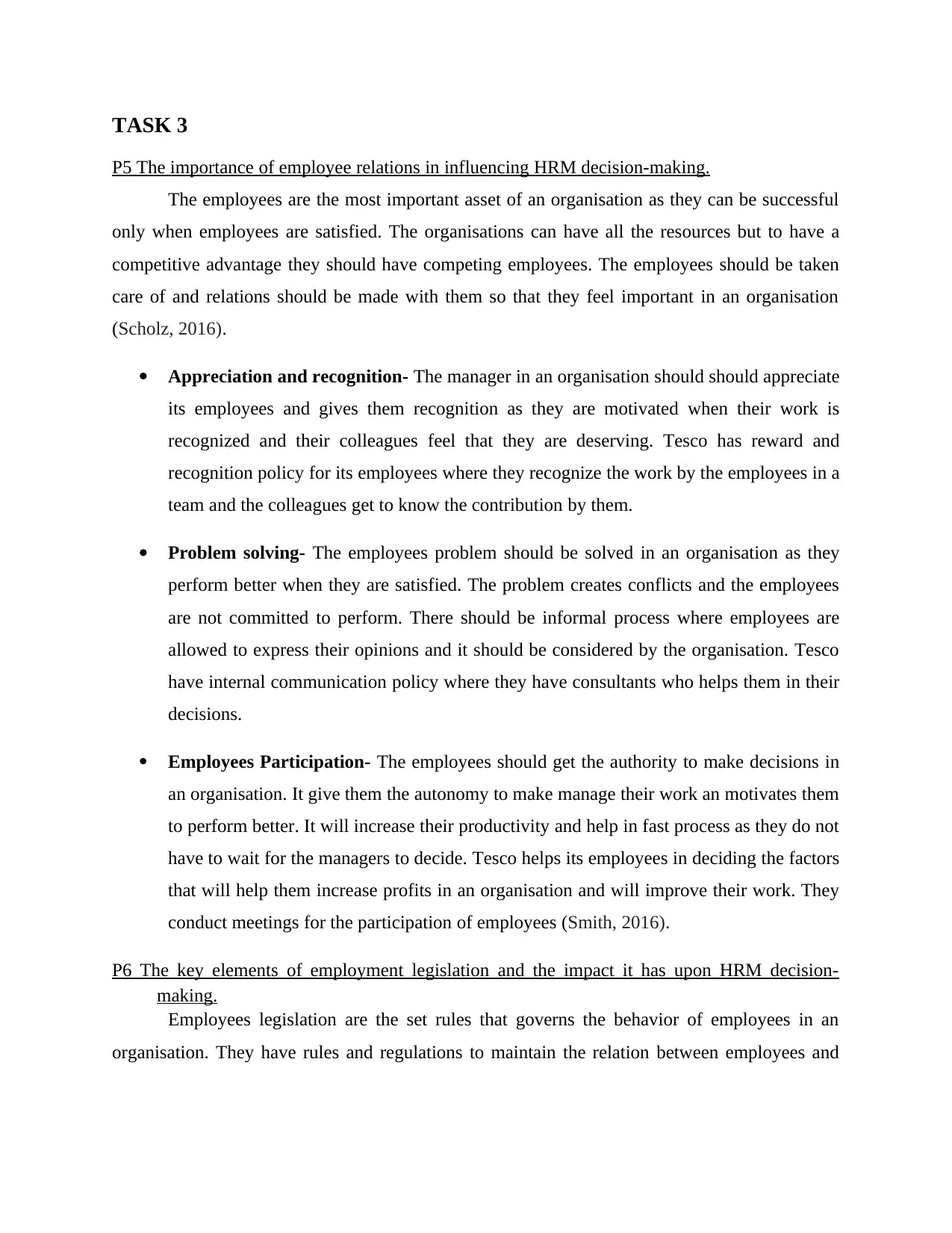
P5 The importance of employee relations in influencing HRM decision-making.
The employees are the most important asset of an organisation as they can be successful
only when employees are satisfied. The organisations can have all the resources but to have a
competitive advantage they should have competing employees. The employees should be taken
care of and relations should be made with them so that they feel important in an organisation
(Scholz, 2016).
Appreciation and recognition- The manager in an organisation should should appreciate
its employees and gives them recognition as they are motivated when their work is
recognized and their colleagues feel that they are deserving. Tesco has reward and
recognition policy for its employees where they recognize the work by the employees in a
team and the colleagues get to know the contribution by them.
Problem solving- The employees problem should be solved in an organisation as they
perform better when they are satisfied. The problem creates conflicts and the employees
are not committed to perform. There should be informal process where employees are
allowed to express their opinions and it should be considered by the organisation. Tesco
have internal communication policy where they have consultants who helps them in their
decisions.
Employees Participation- The employees should get the authority to make decisions in
an organisation. It give them the autonomy to make manage their work an motivates them
to perform better. It will increase their productivity and help in fast process as they do not
have to wait for the managers to decide. Tesco helps its employees in deciding the factors
that will help them increase profits in an organisation and will improve their work. They
conduct meetings for the participation of employees (Smith, 2016).
P6 The key elements of employment legislation and the impact it has upon HRM decision-
making.
Employees legislation are the set rules that governs the behavior of employees in an
organisation. They have rules and regulations to maintain the relation between employees and
P5 The importance of employee relations in influencing HRM decision-making.
The employees are the most important asset of an organisation as they can be successful
only when employees are satisfied. The organisations can have all the resources but to have a
competitive advantage they should have competing employees. The employees should be taken
care of and relations should be made with them so that they feel important in an organisation
(Scholz, 2016).
Appreciation and recognition- The manager in an organisation should should appreciate
its employees and gives them recognition as they are motivated when their work is
recognized and their colleagues feel that they are deserving. Tesco has reward and
recognition policy for its employees where they recognize the work by the employees in a
team and the colleagues get to know the contribution by them.
Problem solving- The employees problem should be solved in an organisation as they
perform better when they are satisfied. The problem creates conflicts and the employees
are not committed to perform. There should be informal process where employees are
allowed to express their opinions and it should be considered by the organisation. Tesco
have internal communication policy where they have consultants who helps them in their
decisions.
Employees Participation- The employees should get the authority to make decisions in
an organisation. It give them the autonomy to make manage their work an motivates them
to perform better. It will increase their productivity and help in fast process as they do not
have to wait for the managers to decide. Tesco helps its employees in deciding the factors
that will help them increase profits in an organisation and will improve their work. They
conduct meetings for the participation of employees (Smith, 2016).
P6 The key elements of employment legislation and the impact it has upon HRM decision-
making.
Employees legislation are the set rules that governs the behavior of employees in an
organisation. They have rules and regulations to maintain the relation between employees and
Paraphrase This Document
Need a fresh take? Get an instant paraphrase of this document with our AI Paraphraser
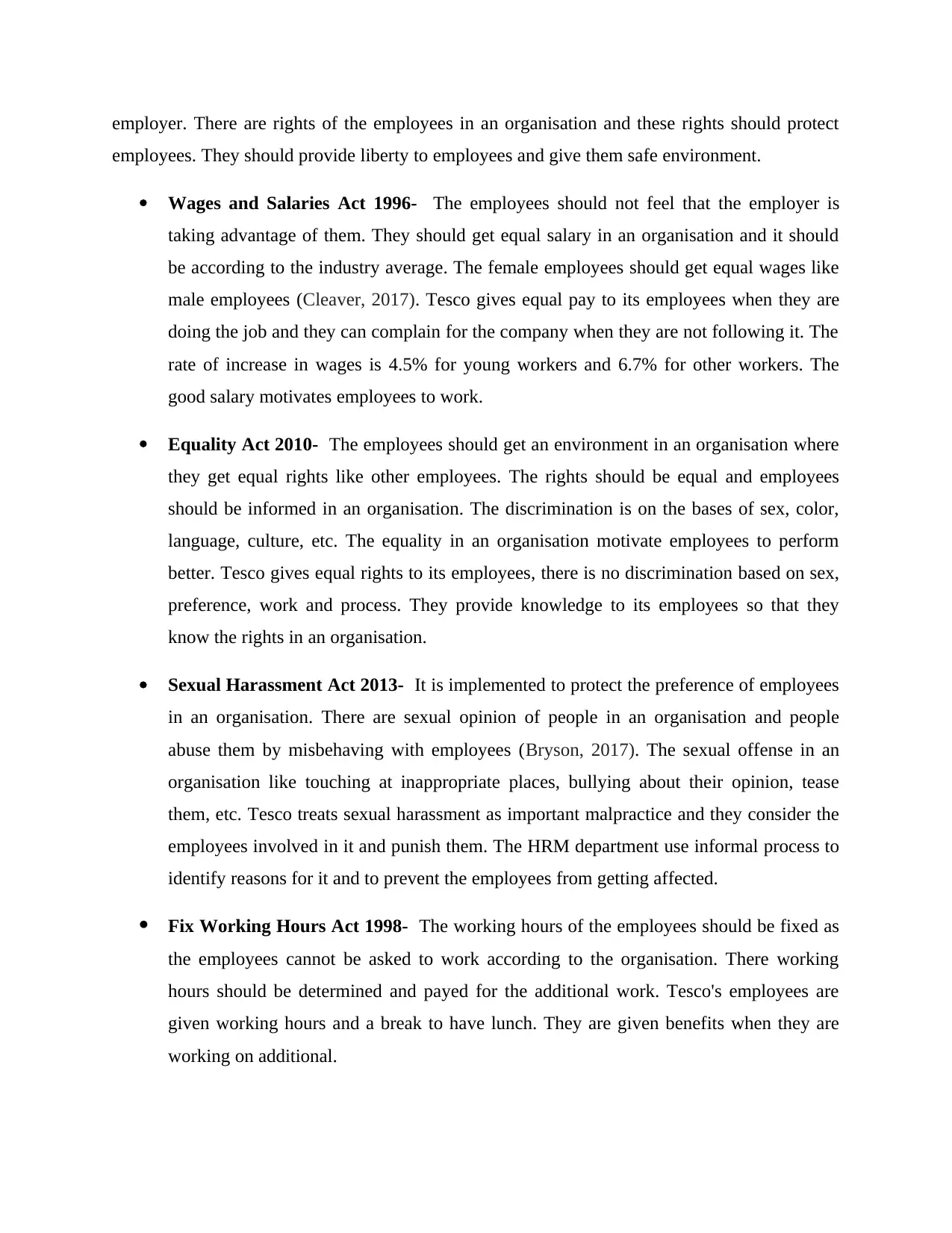
employer. There are rights of the employees in an organisation and these rights should protect
employees. They should provide liberty to employees and give them safe environment.
Wages and Salaries Act 1996- The employees should not feel that the employer is
taking advantage of them. They should get equal salary in an organisation and it should
be according to the industry average. The female employees should get equal wages like
male employees (Cleaver, 2017). Tesco gives equal pay to its employees when they are
doing the job and they can complain for the company when they are not following it. The
rate of increase in wages is 4.5% for young workers and 6.7% for other workers. The
good salary motivates employees to work.
Equality Act 2010- The employees should get an environment in an organisation where
they get equal rights like other employees. The rights should be equal and employees
should be informed in an organisation. The discrimination is on the bases of sex, color,
language, culture, etc. The equality in an organisation motivate employees to perform
better. Tesco gives equal rights to its employees, there is no discrimination based on sex,
preference, work and process. They provide knowledge to its employees so that they
know the rights in an organisation.
Sexual Harassment Act 2013- It is implemented to protect the preference of employees
in an organisation. There are sexual opinion of people in an organisation and people
abuse them by misbehaving with employees (Bryson, 2017). The sexual offense in an
organisation like touching at inappropriate places, bullying about their opinion, tease
them, etc. Tesco treats sexual harassment as important malpractice and they consider the
employees involved in it and punish them. The HRM department use informal process to
identify reasons for it and to prevent the employees from getting affected.
Fix Working Hours Act 1998- The working hours of the employees should be fixed as
the employees cannot be asked to work according to the organisation. There working
hours should be determined and payed for the additional work. Tesco's employees are
given working hours and a break to have lunch. They are given benefits when they are
working on additional.
employees. They should provide liberty to employees and give them safe environment.
Wages and Salaries Act 1996- The employees should not feel that the employer is
taking advantage of them. They should get equal salary in an organisation and it should
be according to the industry average. The female employees should get equal wages like
male employees (Cleaver, 2017). Tesco gives equal pay to its employees when they are
doing the job and they can complain for the company when they are not following it. The
rate of increase in wages is 4.5% for young workers and 6.7% for other workers. The
good salary motivates employees to work.
Equality Act 2010- The employees should get an environment in an organisation where
they get equal rights like other employees. The rights should be equal and employees
should be informed in an organisation. The discrimination is on the bases of sex, color,
language, culture, etc. The equality in an organisation motivate employees to perform
better. Tesco gives equal rights to its employees, there is no discrimination based on sex,
preference, work and process. They provide knowledge to its employees so that they
know the rights in an organisation.
Sexual Harassment Act 2013- It is implemented to protect the preference of employees
in an organisation. There are sexual opinion of people in an organisation and people
abuse them by misbehaving with employees (Bryson, 2017). The sexual offense in an
organisation like touching at inappropriate places, bullying about their opinion, tease
them, etc. Tesco treats sexual harassment as important malpractice and they consider the
employees involved in it and punish them. The HRM department use informal process to
identify reasons for it and to prevent the employees from getting affected.
Fix Working Hours Act 1998- The working hours of the employees should be fixed as
the employees cannot be asked to work according to the organisation. There working
hours should be determined and payed for the additional work. Tesco's employees are
given working hours and a break to have lunch. They are given benefits when they are
working on additional.
TASK 4
P7 The application of HRM practices in a work-related context
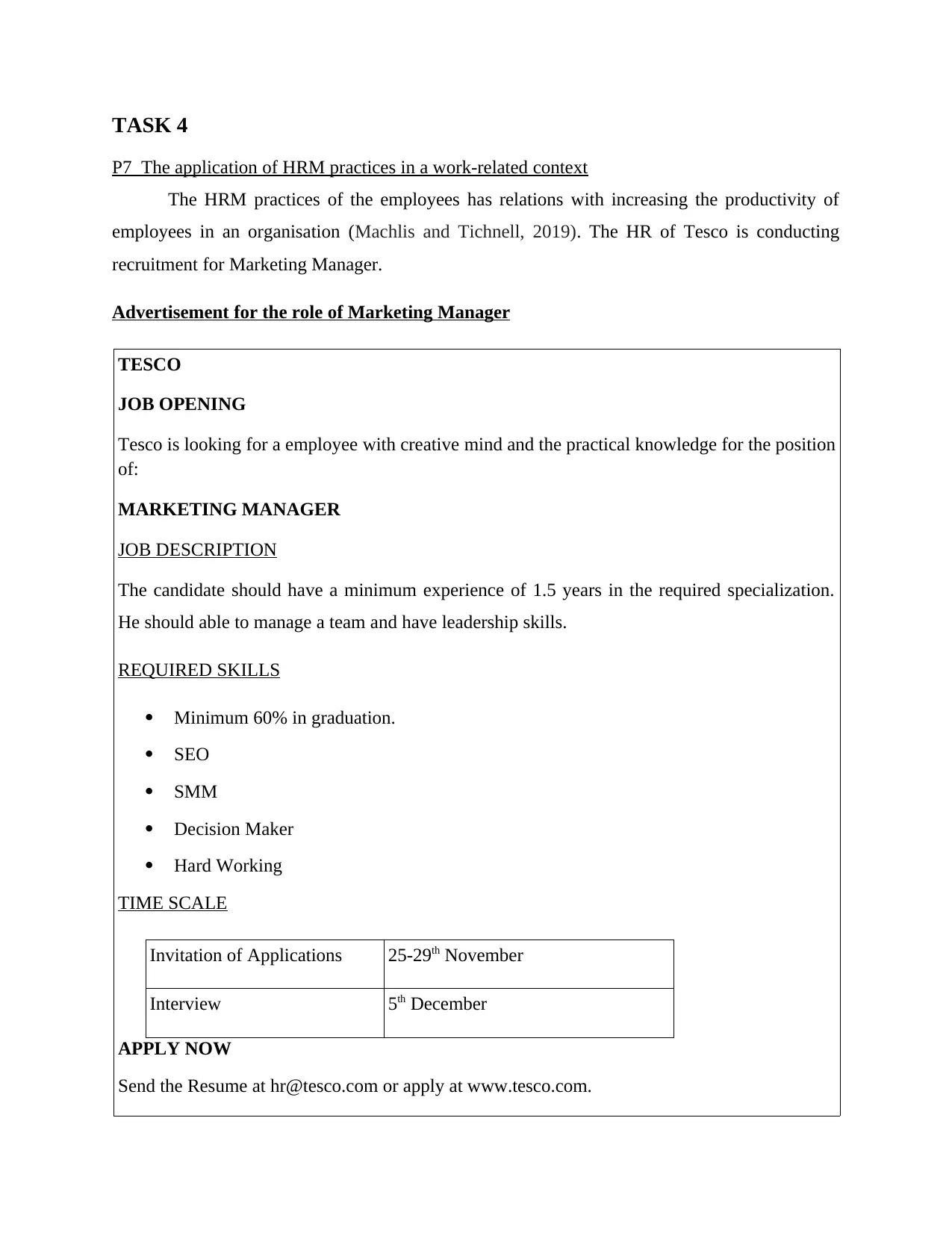
The HRM practices of the employees has relations with increasing the productivity of
employees in an organisation (Machlis and Tichnell, 2019). The HR of Tesco is conducting
recruitment for Marketing Manager.
Advertisement for the role of Marketing Manager
TESCO
JOB OPENING
Tesco is looking for a employee with creative mind and the practical knowledge for the position
of:
MARKETING MANAGER
JOB DESCRIPTION
The candidate should have a minimum experience of 1.5 years in the required specialization.
He should able to manage a team and have leadership skills.
REQUIRED SKILLS
Minimum 60% in graduation.
SEO
SMM
Decision Maker
Hard Working
TIME SCALE
Invitation of Applications 25-29th November
Interview 5th December
APPLY NOW
Send the Resume at hr@tesco.com or apply at www.tesco.com.
P7 The application of HRM practices in a work-related context
The HRM practices of the employees has relations with increasing the productivity of
employees in an organisation (Machlis and Tichnell, 2019). The HR of Tesco is conducting
recruitment for Marketing Manager.
Advertisement for the role of Marketing Manager
TESCO
JOB OPENING
Tesco is looking for a employee with creative mind and the practical knowledge for the position
of:
MARKETING MANAGER
JOB DESCRIPTION
The candidate should have a minimum experience of 1.5 years in the required specialization.
He should able to manage a team and have leadership skills.
REQUIRED SKILLS
Minimum 60% in graduation.
SEO
SMM
Decision Maker
Hard Working
TIME SCALE
Invitation of Applications 25-29th November
Interview 5th December
APPLY NOW
Send the Resume at hr@tesco.com or apply at www.tesco.com.
⊘ This is a preview!⊘
Do you want full access?
Subscribe today to unlock all pages.
Trusted by 1+ million students worldwide

1 out of 18


Related Documents


Your All-in-One AI-Powered Toolkit for Academic Success.
+13062052269
info@desklib.com
Available 24*7 on WhatsApp / Email
![[object Object]](/_next/static/media/star-bottom.7253800d.svg)
Unlock your academic potential
Copyright © 2020–2026 A2Z Services. All Rights Reserved. Developed and managed by ZUCOL.