Analyzing Tesco's Recruitment, Selection, and Motivation in HRM
VerifiedAdded on 2023/06/08
|12
|4917
|177
Project
AI Summary
This Human Resource Management (HRM) project focuses on Tesco PLC, analyzing its recruitment strategies, selection processes, and employee motivation models. The project begins by outlining Tesco's existing recruitment strategy, detailing steps such as advertising job vacancies, checking applicants, conducting telephone interviews, and holding final store interviews. It then examines Tesco's selection procedures, including initial screening, application form completion, employment tests, job interviews, conditional job offers, background investigations, physical/medical examinations, and permanent job offers. Furthermore, the project explores Tesco's motivation models, specifically Maslow's Hierarchy of Needs, to understand how the company motivates its employees through fulfilling physiological, safety, social, esteem, and self-actualization needs. The project also identifies challenges faced by Tesco in recruitment, selection, and motivation, and provides recommendations for improvement, addressing both internal and external factors impacting HRM processes. This detailed analysis provides insights into how Tesco manages its human resources to achieve organizational goals.
HUMAN RESOURCES MANAGEMENT Project Template
Cover Page
Human Resource
Management
Abstract
This project can be summarised as (HRM) Human Resource Management helps the
organisation to work smoothly and efficiently. This helps the company Tesco in selection,
recruitment and Motivating the employees. The HRM process motivates workers and staff
so employees can be for long run in the firm. This project can also be summed up by
analysing the recruitment stages and selection process for applicants like job interview which
includes, face-to-face interview, telephonic interview etc. the selection process is very
important and effective for the company as it verify the skills, experience , health and
physical check-up and background of the applicant etc. The Tesco organisation motivating
strategies like Herzberg two type factors of motivation and Maslow's Hierarchy of needs
model is used by the enterprise for employees who are working within the organisation and
during these all process and model company face various challenges like external and internal
factors, this can be overcome by providing justification recommendations for the company.
Cover Page
Human Resource
Management
Abstract
This project can be summarised as (HRM) Human Resource Management helps the
organisation to work smoothly and efficiently. This helps the company Tesco in selection,
recruitment and Motivating the employees. The HRM process motivates workers and staff
so employees can be for long run in the firm. This project can also be summed up by
analysing the recruitment stages and selection process for applicants like job interview which
includes, face-to-face interview, telephonic interview etc. the selection process is very
important and effective for the company as it verify the skills, experience , health and
physical check-up and background of the applicant etc. The Tesco organisation motivating
strategies like Herzberg two type factors of motivation and Maslow's Hierarchy of needs
model is used by the enterprise for employees who are working within the organisation and
during these all process and model company face various challenges like external and internal
factors, this can be overcome by providing justification recommendations for the company.

Paraphrase This Document
Need a fresh take? Get an instant paraphrase of this document with our AI Paraphraser
Table of Contents
Abstract......................................................................................................................................2
INTRODUCTION......................................................................................................................4
MAIN BODY.............................................................................................................................5
Discuss and Analysis of the company’s Existing Recruitment Strategy...............................5
Illustrating the organisation’s Selection Process for the employees.....................................6
Explaining the organisation Existing motivation model for the employees..........................8
Explaining the challenges faced by the company within the process of Recruitment,
selection and Motivation Strategies.....................................................................................10
Abstract......................................................................................................................................2
INTRODUCTION......................................................................................................................4
MAIN BODY.............................................................................................................................5
Discuss and Analysis of the company’s Existing Recruitment Strategy...............................5
Illustrating the organisation’s Selection Process for the employees.....................................6
Explaining the organisation Existing motivation model for the employees..........................8
Explaining the challenges faced by the company within the process of Recruitment,
selection and Motivation Strategies.....................................................................................10
Recommendation for improvement and providing justification on the challenges faced by
the company.........................................................................................................................12
Conclusion:...............................................................................................................................13
REFERENCES.........................................................................................................................14
1. Introduction
Human Resource Management (HRM) is the process in which company recruit, hire,
manages and deploy the employees for the firm itself. HRM is also referred to simply as
(HR) human resources. An enterprise’s HR department is more likely responsible for putting,
creating into effect and overseeing the relationship of the company with their workers and
policies governing employees. The term HR was implemented in early time 1900s, and more
widely used in 1960s by the businesses. Human Resource Management is the workers
management which emphasis on the employees who are assets to the
organisation(Stone,Gavin and at.al., 2020). Tesco PLC is the multinational British general
merchandise retailer and groceries, this company’s headquarters are in England, Welwyn
Garden City. In the year 2011, Tesco was the third largest firm in retailer world this was
measured by gross revenues and measured by revenue ninth largest across the
globe(Boonand, Lepak and et,al., 2019). This company has shops five countries Europe and
this is the leader firm of groceries in United States. This company was founded by Jack
Cohen in 1919, in London as being a group stalls in market at Hackney. This project states
the influence of Human Resource Management in the company Tesco, this will analysis and
recruitment and stages of the company’s existing strategy, then the selection process of the
organisation with the existing motivation elements for the employees and this project will
also show how the company will identify the challenges faced by the firm during the
recruitment, selection and motivational strategies for the workers within the organisation and
at the last recommend how to improve and overcome these challenges.
2. Discussion and Analysis
2.1. Company’s Existing Recruitment Strategy
Recruitment is the procedure which is actively seek out, hire and find the candidates for a
specific job or position. The recruitment can be defined that includes the entire hiring
process, which is integrated by the organisation to recruit an individual(Strohmeier, 2020).
Recruitment involves the right standard of attraction of workers as being applicants on the
availability of job vacancy.
Tesco firstly look at the internal talent plan within the company to fill the vacancy. This
procedure lists the recent workers who are looking for the moving either for promotion or
being at the same level. Tesco if do not get any suitable person then the Talent Plan or the
internal management development programme has options, there are shown below-
Advertising the Job Vacancy- The company Tesco identify the empty positions of
the different departments in whole organisation and the firm makes the list of the
required workers. After that Tesco finds out the possible skills and qualifications
the company.........................................................................................................................12
Conclusion:...............................................................................................................................13
REFERENCES.........................................................................................................................14
1. Introduction
Human Resource Management (HRM) is the process in which company recruit, hire,
manages and deploy the employees for the firm itself. HRM is also referred to simply as
(HR) human resources. An enterprise’s HR department is more likely responsible for putting,
creating into effect and overseeing the relationship of the company with their workers and
policies governing employees. The term HR was implemented in early time 1900s, and more
widely used in 1960s by the businesses. Human Resource Management is the workers
management which emphasis on the employees who are assets to the
organisation(Stone,Gavin and at.al., 2020). Tesco PLC is the multinational British general
merchandise retailer and groceries, this company’s headquarters are in England, Welwyn
Garden City. In the year 2011, Tesco was the third largest firm in retailer world this was
measured by gross revenues and measured by revenue ninth largest across the
globe(Boonand, Lepak and et,al., 2019). This company has shops five countries Europe and
this is the leader firm of groceries in United States. This company was founded by Jack
Cohen in 1919, in London as being a group stalls in market at Hackney. This project states
the influence of Human Resource Management in the company Tesco, this will analysis and
recruitment and stages of the company’s existing strategy, then the selection process of the
organisation with the existing motivation elements for the employees and this project will
also show how the company will identify the challenges faced by the firm during the
recruitment, selection and motivational strategies for the workers within the organisation and
at the last recommend how to improve and overcome these challenges.
2. Discussion and Analysis
2.1. Company’s Existing Recruitment Strategy
Recruitment is the procedure which is actively seek out, hire and find the candidates for a
specific job or position. The recruitment can be defined that includes the entire hiring
process, which is integrated by the organisation to recruit an individual(Strohmeier, 2020).
Recruitment involves the right standard of attraction of workers as being applicants on the
availability of job vacancy.
Tesco firstly look at the internal talent plan within the company to fill the vacancy. This
procedure lists the recent workers who are looking for the moving either for promotion or
being at the same level. Tesco if do not get any suitable person then the Talent Plan or the
internal management development programme has options, there are shown below-
Advertising the Job Vacancy- The company Tesco identify the empty positions of
the different departments in whole organisation and the firm makes the list of the
required workers. After that Tesco finds out the possible skills and qualifications
⊘ This is a preview!⊘
Do you want full access?
Subscribe today to unlock all pages.

Trusted by 1+ million students worldwide
which needs for the empty positions are posted separately(Carnevale and Hatak,
2020). The company gathers all the information, that is published on the job
advertisement through television, newspaper, internet, magazine and as well on the
official site of the firm.
Check the applicants- After implementing the job advertisement and then its seen
by the interested people to apply through the website of Tesco and also send the CV
of their own via email to the HR manager. HR department will now check all the
applicant’s application after the deadline is over and make a shortlist of people who
applied on the basis of their skills and application.
Telephone Interview- HR personnel manager takes the interview on telephone from
the shortlist applicant. This process is done on telephone only so it takes 10 to 15
minutes and then the manager will ask the applicant about all the achievement and
experience and skills like educational qualification etc. the UK job rights are also
mentioned in this job interview and so on.
Final Store Interview- Based on the last stage the telephonic interview, the HR
personnel manager then selects some of the applicants whose interview were
excellent over the telephone then they called for the face-to-face interview within the
company(Mousa and Othman, 2020). The final interview takes place when
interviewer ask questions regarding the consumer services that is the skills,
qualifications, work experience, knowledge, work right, nationality and so on.
After this process job applicants are offered by the HR manager to join the company
and also the manager specifies the date on which the applicants will join the company
and HR managers also call the new employees of the company to collect the joining.
2.2. Company’s Selection Procedures
Selection is the procedure in which organisation chooses the group of applicants, those
people who are best suited for the particular company’s position. David and Robbins said,
“Selection process is that in which a managerial decision-making process take place to
predict that which applicants will be hired successfully for the job”(Awadari and Kanwal,
2019). Typically, the selection process is which consist of following steps, while performing
this process job applicants are hired successfully.
2020). The company gathers all the information, that is published on the job
advertisement through television, newspaper, internet, magazine and as well on the
official site of the firm.
Check the applicants- After implementing the job advertisement and then its seen
by the interested people to apply through the website of Tesco and also send the CV
of their own via email to the HR manager. HR department will now check all the
applicant’s application after the deadline is over and make a shortlist of people who
applied on the basis of their skills and application.
Telephone Interview- HR personnel manager takes the interview on telephone from
the shortlist applicant. This process is done on telephone only so it takes 10 to 15
minutes and then the manager will ask the applicant about all the achievement and
experience and skills like educational qualification etc. the UK job rights are also
mentioned in this job interview and so on.
Final Store Interview- Based on the last stage the telephonic interview, the HR
personnel manager then selects some of the applicants whose interview were
excellent over the telephone then they called for the face-to-face interview within the
company(Mousa and Othman, 2020). The final interview takes place when
interviewer ask questions regarding the consumer services that is the skills,
qualifications, work experience, knowledge, work right, nationality and so on.
After this process job applicants are offered by the HR manager to join the company
and also the manager specifies the date on which the applicants will join the company
and HR managers also call the new employees of the company to collect the joining.
2.2. Company’s Selection Procedures
Selection is the procedure in which organisation chooses the group of applicants, those
people who are best suited for the particular company’s position. David and Robbins said,
“Selection process is that in which a managerial decision-making process take place to
predict that which applicants will be hired successfully for the job”(Awadari and Kanwal,
2019). Typically, the selection process is which consist of following steps, while performing
this process job applicants are hired successfully.
Paraphrase This Document
Need a fresh take? Get an instant paraphrase of this document with our AI Paraphraser
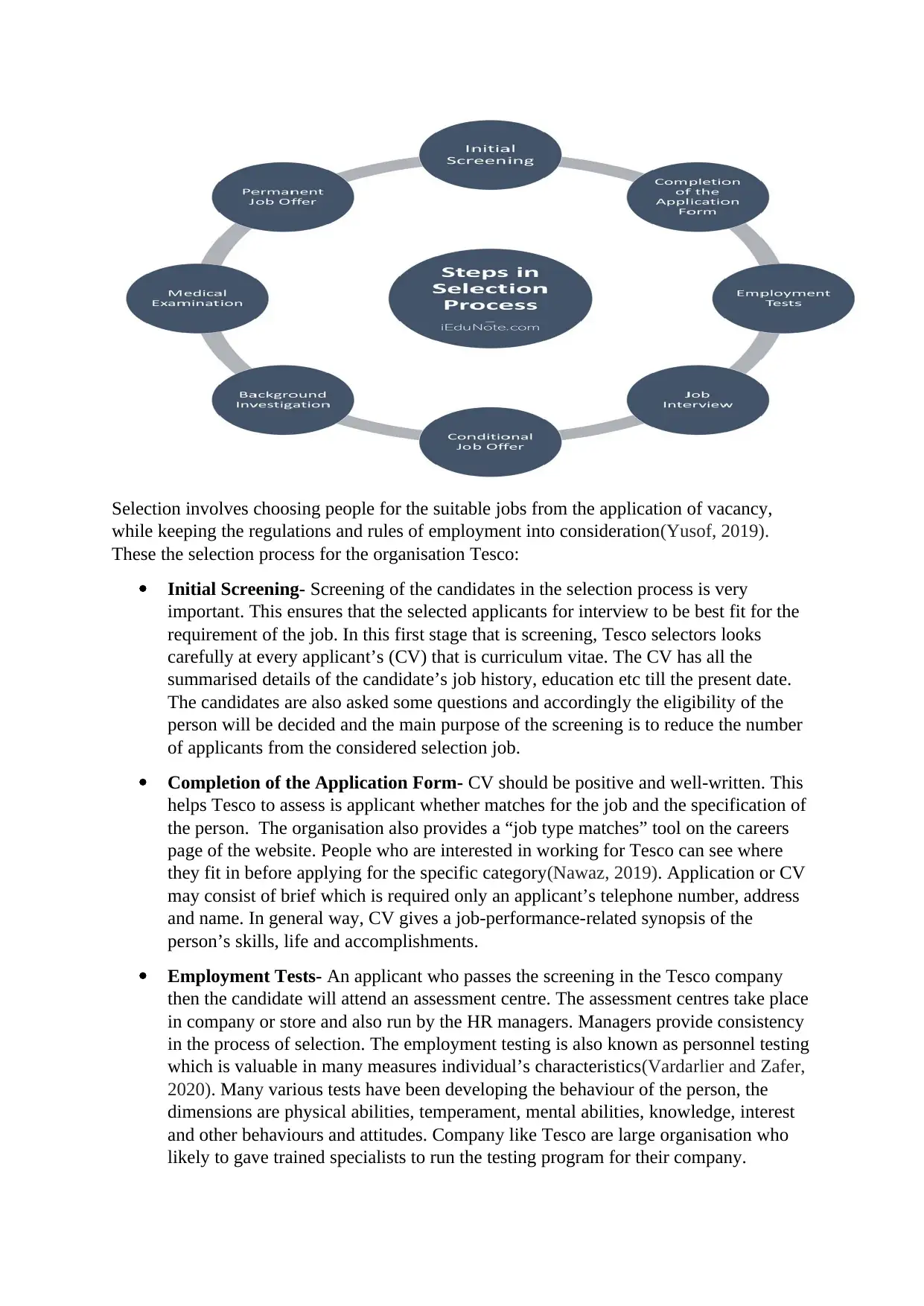
Selection involves choosing people for the suitable jobs from the application of vacancy,
while keeping the regulations and rules of employment into consideration(Yusof, 2019).
These the selection process for the organisation Tesco:
Initial Screening- Screening of the candidates in the selection process is very
important. This ensures that the selected applicants for interview to be best fit for the
requirement of the job. In this first stage that is screening, Tesco selectors looks
carefully at every applicant’s (CV) that is curriculum vitae. The CV has all the
summarised details of the candidate’s job history, education etc till the present date.
The candidates are also asked some questions and accordingly the eligibility of the
person will be decided and the main purpose of the screening is to reduce the number
of applicants from the considered selection job.
Completion of the Application Form- CV should be positive and well-written. This
helps Tesco to assess is applicant whether matches for the job and the specification of
the person. The organisation also provides a “job type matches” tool on the careers
page of the website. People who are interested in working for Tesco can see where
they fit in before applying for the specific category(Nawaz, 2019). Application or CV
may consist of brief which is required only an applicant’s telephone number, address
and name. In general way, CV gives a job-performance-related synopsis of the
person’s skills, life and accomplishments.
Employment Tests- An applicant who passes the screening in the Tesco company
then the candidate will attend an assessment centre. The assessment centres take place
in company or store and also run by the HR managers. Managers provide consistency
in the process of selection. The employment testing is also known as personnel testing
which is valuable in many measures individual’s characteristics(Vardarlier and Zafer,
2020). Many various tests have been developing the behaviour of the person, the
dimensions are physical abilities, temperament, mental abilities, knowledge, interest
and other behaviours and attitudes. Company like Tesco are large organisation who
likely to gave trained specialists to run the testing program for their company.
while keeping the regulations and rules of employment into consideration(Yusof, 2019).
These the selection process for the organisation Tesco:
Initial Screening- Screening of the candidates in the selection process is very
important. This ensures that the selected applicants for interview to be best fit for the
requirement of the job. In this first stage that is screening, Tesco selectors looks
carefully at every applicant’s (CV) that is curriculum vitae. The CV has all the
summarised details of the candidate’s job history, education etc till the present date.
The candidates are also asked some questions and accordingly the eligibility of the
person will be decided and the main purpose of the screening is to reduce the number
of applicants from the considered selection job.
Completion of the Application Form- CV should be positive and well-written. This
helps Tesco to assess is applicant whether matches for the job and the specification of
the person. The organisation also provides a “job type matches” tool on the careers
page of the website. People who are interested in working for Tesco can see where
they fit in before applying for the specific category(Nawaz, 2019). Application or CV
may consist of brief which is required only an applicant’s telephone number, address
and name. In general way, CV gives a job-performance-related synopsis of the
person’s skills, life and accomplishments.
Employment Tests- An applicant who passes the screening in the Tesco company
then the candidate will attend an assessment centre. The assessment centres take place
in company or store and also run by the HR managers. Managers provide consistency
in the process of selection. The employment testing is also known as personnel testing
which is valuable in many measures individual’s characteristics(Vardarlier and Zafer,
2020). Many various tests have been developing the behaviour of the person, the
dimensions are physical abilities, temperament, mental abilities, knowledge, interest
and other behaviours and attitudes. Company like Tesco are large organisation who
likely to gave trained specialists to run the testing program for their company.
Job Interview- An interview takes place between interviewer and then candidate
exchange information. This is a goal-oriented conversation which includes to identify
if the applicants have various exercises like problem-solving exercises, team-working
activities, if the candidate can deal with the work and the pressure which comes with a
large firm like Tesco. Job like Line Managers also a interview takes place to make
sure that the applicant fits for the job correctly.
Condition Job Offer- This term means tentative job offer that has become permanent
after some certain conditions are met. When the applicant passed every step on the
selection process then a conditional offer is made to the applicant(Van-Esch, Ferolie
and et,al., 2019). This offer implies check outs like passing physical test, certain
medical test and substance abuse test etc. after this conditional nature will be removed
of the job and offer becomes permanent.
Background Investigation- This step is used to check all background and verify the
information on the applicant’s form, this information should be accurate and correct.
The information like legal status to work, education, criminal record and credit history
are also made. This also checks past behaviour of the candidate, as it is said that past
behaviour is best predictor for the future behaviour. This helps to understand the
future behaviour of the candidate.
Physical/ Medical Examination- The decision made for the extend job offer, the
next step of the selection process which involves the completion of medical and
physical examination. This examination determines if the applicant is fit for the job
performance or not and job is only offered when the physical test is passed.
Permanent Job Offer- This is the last step of the selection process, when applicants
pass all the step and is considered to be eligible to receive the offer for being
company’s employee(Alansaari Ismai amd et,al., 2019). The actual hiring decision in
Tesco is made by the Manager of the department where candidate applied and where
is the vacancy existed.
2.3. Company’s Existing motivation
Motivation is the process which is used to make employees boost up and dedicated their
mindset towards work by using HRM that is Human Resource Management. This is the one
of most important functions of managers. If the employees are motivated it is possible to
increase the betterment of the company and increase the overall performance and
outcome(Spychała Graczyk- Kucharska and at,al., 2019) . This helps to achieve goals of the
firm by improving the service standards.
The theories used by Tesco company are:
1. Maslow’s Hierarchy of needs-
This theory is traditional and well-known motivational theory. This is used by Tesco
company also to motivate the employees.
Physiological Needs- These needs are the requirement which are very
basic in nature like shelter, cloths, food and treatments. The employees
who are not able to provide and fulfil these needs Tesco try to provide
exchange information. This is a goal-oriented conversation which includes to identify
if the applicants have various exercises like problem-solving exercises, team-working
activities, if the candidate can deal with the work and the pressure which comes with a
large firm like Tesco. Job like Line Managers also a interview takes place to make
sure that the applicant fits for the job correctly.
Condition Job Offer- This term means tentative job offer that has become permanent
after some certain conditions are met. When the applicant passed every step on the
selection process then a conditional offer is made to the applicant(Van-Esch, Ferolie
and et,al., 2019). This offer implies check outs like passing physical test, certain
medical test and substance abuse test etc. after this conditional nature will be removed
of the job and offer becomes permanent.
Background Investigation- This step is used to check all background and verify the
information on the applicant’s form, this information should be accurate and correct.
The information like legal status to work, education, criminal record and credit history
are also made. This also checks past behaviour of the candidate, as it is said that past
behaviour is best predictor for the future behaviour. This helps to understand the
future behaviour of the candidate.
Physical/ Medical Examination- The decision made for the extend job offer, the
next step of the selection process which involves the completion of medical and
physical examination. This examination determines if the applicant is fit for the job
performance or not and job is only offered when the physical test is passed.
Permanent Job Offer- This is the last step of the selection process, when applicants
pass all the step and is considered to be eligible to receive the offer for being
company’s employee(Alansaari Ismai amd et,al., 2019). The actual hiring decision in
Tesco is made by the Manager of the department where candidate applied and where
is the vacancy existed.
2.3. Company’s Existing motivation
Motivation is the process which is used to make employees boost up and dedicated their
mindset towards work by using HRM that is Human Resource Management. This is the one
of most important functions of managers. If the employees are motivated it is possible to
increase the betterment of the company and increase the overall performance and
outcome(Spychała Graczyk- Kucharska and at,al., 2019) . This helps to achieve goals of the
firm by improving the service standards.
The theories used by Tesco company are:
1. Maslow’s Hierarchy of needs-
This theory is traditional and well-known motivational theory. This is used by Tesco
company also to motivate the employees.
Physiological Needs- These needs are the requirement which are very
basic in nature like shelter, cloths, food and treatments. The employees
who are not able to provide and fulfil these needs Tesco try to provide
⊘ This is a preview!⊘
Do you want full access?
Subscribe today to unlock all pages.
Trusted by 1+ million students worldwide
them to ensure and work their needs with providing salary and more other
incentives.
Safety Needs- In this stage, individuals search for safety, job security and
a better way of living. Here Tesco ensures the security of job and provides
them comfortable zone to perform well to ensure their security with the
performance.
Social Needs- After safety and physiological need social recognition and
acceptance becomes crucial for workers. So, providing them
reorganization and appreciation their works that is possible to ensure the
social needs.
Esteem Needs- These needs have one of the highest levels of needs which
helps to fulfil their desire and dreams for having expensive cars, big house,
friends and many people are satisfied their esteem.
Self-actualization needs- The final and highest stage of employees’ needs
which is self-actualization needs. Individuals can achieve some kind of
need to fulfil with work of them for the people or country(Gill, 2021). So,
they concentrate on memorable for every person to create an example.
Tesco company always tries to provide every employee with a better yearly bonus and better
salary on the improved performance and the Tesco also provides safety needs and
physiological needs for employee. The Tesco organisation focuses on providing work-life
balance, better working environment that promotes safety and health of the work and also the
health. The Tesco company provides permanent job security after a certain time and for the
esteem and self-actualization need which provides informal and formal support in various
ways Tesco’s point if achievement.
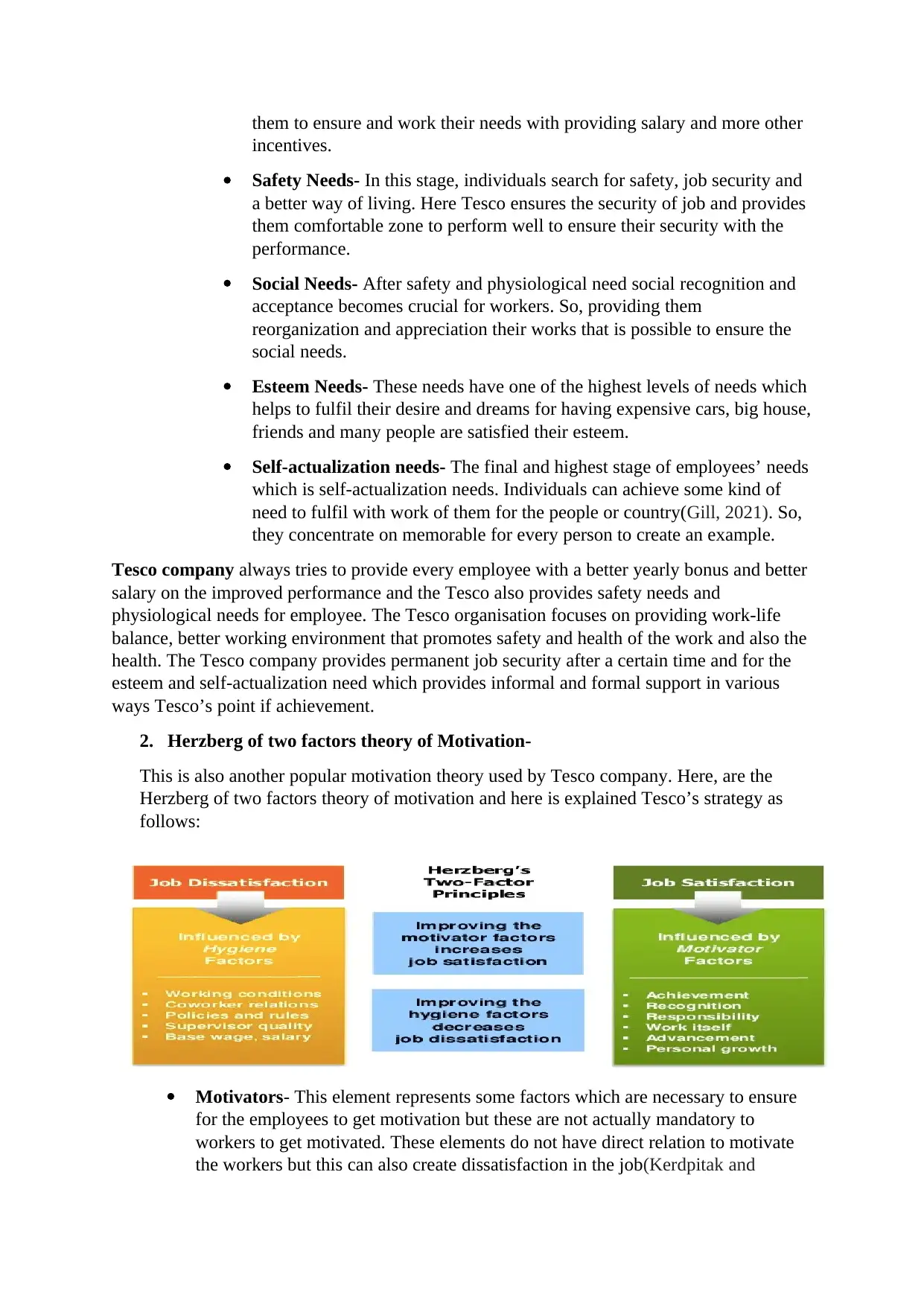
2. Herzberg of two factors theory of Motivation-
This is also another popular motivation theory used by Tesco company. Here, are the
Herzberg of two factors theory of motivation and here is explained Tesco’s strategy as
follows:
Motivators- This element represents some factors which are necessary to ensure
for the employees to get motivation but these are not actually mandatory to
workers to get motivated. These elements do not have direct relation to motivate
the workers but this can also create dissatisfaction in the job(Kerdpitak and
incentives.
Safety Needs- In this stage, individuals search for safety, job security and
a better way of living. Here Tesco ensures the security of job and provides
them comfortable zone to perform well to ensure their security with the
performance.
Social Needs- After safety and physiological need social recognition and
acceptance becomes crucial for workers. So, providing them
reorganization and appreciation their works that is possible to ensure the
social needs.
Esteem Needs- These needs have one of the highest levels of needs which
helps to fulfil their desire and dreams for having expensive cars, big house,
friends and many people are satisfied their esteem.
Self-actualization needs- The final and highest stage of employees’ needs
which is self-actualization needs. Individuals can achieve some kind of
need to fulfil with work of them for the people or country(Gill, 2021). So,
they concentrate on memorable for every person to create an example.
Tesco company always tries to provide every employee with a better yearly bonus and better
salary on the improved performance and the Tesco also provides safety needs and
physiological needs for employee. The Tesco organisation focuses on providing work-life
balance, better working environment that promotes safety and health of the work and also the
health. The Tesco company provides permanent job security after a certain time and for the
esteem and self-actualization need which provides informal and formal support in various
ways Tesco’s point if achievement.
2. Herzberg of two factors theory of Motivation-
This is also another popular motivation theory used by Tesco company. Here, are the
Herzberg of two factors theory of motivation and here is explained Tesco’s strategy as
follows:
Motivators- This element represents some factors which are necessary to ensure
for the employees to get motivation but these are not actually mandatory to
workers to get motivated. These elements do not have direct relation to motivate
the workers but this can also create dissatisfaction in the job(Kerdpitak and
Paraphrase This Document
Need a fresh take? Get an instant paraphrase of this document with our AI Paraphraser
Jermsittiparsert, 2020). So, to offer employees Tesco increases the job satisfaction
level and also ensures their commitment and dedication for the company.
Hygiene Factors- The Hygiene elements are important to ensure the employee’s
motivation and also helps to boost up their energy and their absence will lead to
workers unable perform well in the future and long run(Gigauri, 2020).. Friendly
environment, salary and supportive teammates are the various important elements
of hygiene factors(Rawashdeh, 2018). The unavailability of the factor can also
lead to very serious damage in the environment of working for the workers overall
mindset.
So, Tesco more likely tries to offer both motivators and hygiene factors to enable the workers
with the perfect workplace support and also tries to get the excellent outcomes from them
whenever it is necessary.
2.4. Challenges Identified Within the Recruitment, Selection and
Motivation Strategies
The challenges faced by Tesco company during the process of Recruitment, selection and
Motivation process(Heckhausen, Schulz and et,al., 2019). These challenges are divided into
internal and External Factors which follows below-
The internal factors are also known as endogenous factors which is referred to attributes that
more likely present into the company and they affect the recruitment, selection and
motivation process. These are elaborated below:
The size of the organisation- This indicates the size of the organisation often
determines the success and quality of the processes(Cui, Han and et,al., 2021). If the
firm is bigger in size, it is likely to have fewer problems while motivating the
employees with high salary and promotions and also hiring the employees.
Recruiting, Selection and Motivating Policy- The policy adopted by the firm to hire
new people for company within the firm or external sources also affects the
motivation process and the recruitment and selection process(Fallatah, Syed and et,al.,
2018). In the company like Tesco PLC, the enterprise hires firstly within the
organisation through internal talent plan. If appropriate employees are not available
then the firm have vacancy for outside people. They company more likely motivate
the employees by giving assurance about the job security and health and safety norms
within the organisation.
Image of the company- The image and goodwill of the organisation in the
marketplace serves the detrimental factors in the recruitment process. If the company
image is not good and positive and do not fulfil the rendering public services and
social obligations then company faces the challenges in seeking the attention of the
applicants to apply for the vacancy of the firm(Prasad-Kotni and Karumuri, .2018).
However, Tesco PLC do not face this kind not challenges as this firm is very large in
nature and society and employee centric that focuses on rendering the services for the
public and motivates the employees to be in the company for a long run.
level and also ensures their commitment and dedication for the company.
Hygiene Factors- The Hygiene elements are important to ensure the employee’s
motivation and also helps to boost up their energy and their absence will lead to
workers unable perform well in the future and long run(Gigauri, 2020).. Friendly
environment, salary and supportive teammates are the various important elements
of hygiene factors(Rawashdeh, 2018). The unavailability of the factor can also
lead to very serious damage in the environment of working for the workers overall
mindset.
So, Tesco more likely tries to offer both motivators and hygiene factors to enable the workers
with the perfect workplace support and also tries to get the excellent outcomes from them
whenever it is necessary.
2.4. Challenges Identified Within the Recruitment, Selection and
Motivation Strategies
The challenges faced by Tesco company during the process of Recruitment, selection and
Motivation process(Heckhausen, Schulz and et,al., 2019). These challenges are divided into
internal and External Factors which follows below-
The internal factors are also known as endogenous factors which is referred to attributes that
more likely present into the company and they affect the recruitment, selection and
motivation process. These are elaborated below:
The size of the organisation- This indicates the size of the organisation often
determines the success and quality of the processes(Cui, Han and et,al., 2021). If the
firm is bigger in size, it is likely to have fewer problems while motivating the
employees with high salary and promotions and also hiring the employees.
Recruiting, Selection and Motivating Policy- The policy adopted by the firm to hire
new people for company within the firm or external sources also affects the
motivation process and the recruitment and selection process(Fallatah, Syed and et,al.,
2018). In the company like Tesco PLC, the enterprise hires firstly within the
organisation through internal talent plan. If appropriate employees are not available
then the firm have vacancy for outside people. They company more likely motivate
the employees by giving assurance about the job security and health and safety norms
within the organisation.
Image of the company- The image and goodwill of the organisation in the
marketplace serves the detrimental factors in the recruitment process. If the company
image is not good and positive and do not fulfil the rendering public services and
social obligations then company faces the challenges in seeking the attention of the
applicants to apply for the vacancy of the firm(Prasad-Kotni and Karumuri, .2018).
However, Tesco PLC do not face this kind not challenges as this firm is very large in
nature and society and employee centric that focuses on rendering the services for the
public and motivates the employees to be in the company for a long run.
The external Factors are beyond the control of the company and directly impacts the
recruitment, selection and motivation strategies. These factors are as follows:
Demographic Factors- These factors are related and effects the Human Resources
recruitment, selection and motivation process. These factors include economic factors,
sex, age, literacy level and more other factors(Thi-Hnag, Hong-Nhung and et,al.,
2021) . In the current scenario the majority of youth people are more who are willing
to join the company as it is on the booming stage and because it is a big firm it keeps
their employee satisfied with all the facilities and security elements.
Labour Market Conditions- The consumer demand and supply also affect the
selection, recruitment and motivation process. For example, if the demand is high for
the skilled labour in the firm where as supply is less, then he Tesco organisation exert
more efforts to attract the workers towards and the job of the company and they also
motivate employees to stick to the company for long period of time.
Labour Laws and Legal Considerations- Tesco PLC has its operations in many
countries and each country has its own legal and laws regulations for employees
which organisation is required to fulfil(Odei, Fabian and et,al., 2021). These
conditions in regard of safety and health conditions, working hours and working
environment and can be also compensation. This is necessary for the companies HR
manager to take care of such practices in every location. So, that people willing want
to work for the company Tesco and existing employee can stick to the firm for a long
period of time.
2.5. Recommended Improvements and Justifications
If the organisation intends to minimize the impact and overcome the challenges faced
during the recruitment, selection and motivation process, this is recommended that
planning and development of different strategies for the same.
In order to deal with internal challenges such as goodwill and brand image of
the company(Doneley, Sim and et,al., 2018). The company can adapt the
branding strategy for reinforcing the positive image of the firm Tesco in the
mind of existing employee which can motivate them to work efficiently for the
company and more potential candidates applies for the firm. By making
goodwill of the company this can enhance productivity overall and profit and
sales margin of the firm.
The demographic challenges can be dealt by the company Tesco by
developing strategy that aims at the development and training until the career
ends for the workers so that employees can work for long-term and their job
and skills can be safeguard.
The major concern of (HR) Human Resources managers is to reduce the
recruitment and selection cost. For reducing this type of cost can be adopted
by creative recruiting and selecting. This is the step where technology comes
in picture, the technology should be leveraged so that cost can be
recruitment, selection and motivation strategies. These factors are as follows:
Demographic Factors- These factors are related and effects the Human Resources
recruitment, selection and motivation process. These factors include economic factors,
sex, age, literacy level and more other factors(Thi-Hnag, Hong-Nhung and et,al.,
2021) . In the current scenario the majority of youth people are more who are willing
to join the company as it is on the booming stage and because it is a big firm it keeps
their employee satisfied with all the facilities and security elements.
Labour Market Conditions- The consumer demand and supply also affect the
selection, recruitment and motivation process. For example, if the demand is high for
the skilled labour in the firm where as supply is less, then he Tesco organisation exert
more efforts to attract the workers towards and the job of the company and they also
motivate employees to stick to the company for long period of time.
Labour Laws and Legal Considerations- Tesco PLC has its operations in many
countries and each country has its own legal and laws regulations for employees
which organisation is required to fulfil(Odei, Fabian and et,al., 2021). These
conditions in regard of safety and health conditions, working hours and working
environment and can be also compensation. This is necessary for the companies HR
manager to take care of such practices in every location. So, that people willing want
to work for the company Tesco and existing employee can stick to the firm for a long
period of time.
2.5. Recommended Improvements and Justifications
If the organisation intends to minimize the impact and overcome the challenges faced
during the recruitment, selection and motivation process, this is recommended that
planning and development of different strategies for the same.
In order to deal with internal challenges such as goodwill and brand image of
the company(Doneley, Sim and et,al., 2018). The company can adapt the
branding strategy for reinforcing the positive image of the firm Tesco in the
mind of existing employee which can motivate them to work efficiently for the
company and more potential candidates applies for the firm. By making
goodwill of the company this can enhance productivity overall and profit and
sales margin of the firm.
The demographic challenges can be dealt by the company Tesco by
developing strategy that aims at the development and training until the career
ends for the workers so that employees can work for long-term and their job
and skills can be safeguard.
The major concern of (HR) Human Resources managers is to reduce the
recruitment and selection cost. For reducing this type of cost can be adopted
by creative recruiting and selecting. This is the step where technology comes
in picture, the technology should be leveraged so that cost can be
⊘ This is a preview!⊘
Do you want full access?
Subscribe today to unlock all pages.
Trusted by 1+ million students worldwide
reduced(Bartlett, Croucher and et,al., 2019)This can be done through video
conferencing instead of the traditional interview procedure that is face-to-face
interviews, inviting the social media applications, collaboration with
associations, governments and colleges.
3. Conclusion
This project can be concluded as the company uses the HRM, the Human Resource
Management for recruitment and selection and hiring of the employees. The HRM process
also helps to motivate employees to be in the firm for the long period of time. This project
also helps firm to analyse the recruitment and selection stages, there is a whole process to
select and recruit the applicants for example, job interview includes telephone interview,
face-to-face-interview etc and the selection process is very effective and vital in nature like
verification and background check of the candidate, job offer, health and physical check-up
etc. for the Tesco company and motivating strategies like Maslow’s Hierarchy of needs
model and Herzberg two types factors of Motivation model are used by the company for
existing workers of the organisation and during these processes company faces many
challenges like internal factors and external factors so to overcome those challenges some
recommendations and justifications are discussed.
4. References
Stone, R.J., Cox, A. and Gavin, M., 2020. Human resource management. John Wiley &
Sons.
Boon, C., Den Hartog, D.N. and Lepak, D.P., 2019. A systematic review of human resource
management systems and their measurement. Journal of management, 45(6), pp.2498-2537.
Strohmeier, S., 2020. Digital human resource management: A conceptual
clarification. German Journal of Human Resource Management, 34(3), pp.345-365.
Carnevale, J.B. and Hatak, I., 2020. Employee adjustment and well-being in the era of
COVID-19: Implications for human resource management. Journal of business
research, 116, pp.183-187.
Mousa, S.K. and Othman, M., 2020. The impact of green human resource management
practices on sustainable performance in healthcare organisations: A conceptual
framework. Journal of Cleaner Production, 243, p.118595.
Awadari, A.C. and Kanwal, S., 2019. Employee participation in organizational change: A
case of Tesco PLC. International Journal of Financial, Accounting, and Management, 1(2),
pp.91-99.
Yusof, A., 2019. Tesco Plc likely to exit Asia business, focus on home country, EU. New
Straits Times, pp.1-1.
Tesco Plc, U.K., Impact of Social media marketing on consumer Perception: A Case Study
on.
Nawaz, N., 2019. How far have we come with the study of artificial intelligence for
recruitment process. Int. J. Sci. Technol. Res, 8(07), pp.488-493.
conferencing instead of the traditional interview procedure that is face-to-face
interviews, inviting the social media applications, collaboration with
associations, governments and colleges.
3. Conclusion
This project can be concluded as the company uses the HRM, the Human Resource
Management for recruitment and selection and hiring of the employees. The HRM process
also helps to motivate employees to be in the firm for the long period of time. This project
also helps firm to analyse the recruitment and selection stages, there is a whole process to
select and recruit the applicants for example, job interview includes telephone interview,
face-to-face-interview etc and the selection process is very effective and vital in nature like
verification and background check of the candidate, job offer, health and physical check-up
etc. for the Tesco company and motivating strategies like Maslow’s Hierarchy of needs
model and Herzberg two types factors of Motivation model are used by the company for
existing workers of the organisation and during these processes company faces many
challenges like internal factors and external factors so to overcome those challenges some
recommendations and justifications are discussed.
4. References
Stone, R.J., Cox, A. and Gavin, M., 2020. Human resource management. John Wiley &
Sons.
Boon, C., Den Hartog, D.N. and Lepak, D.P., 2019. A systematic review of human resource
management systems and their measurement. Journal of management, 45(6), pp.2498-2537.
Strohmeier, S., 2020. Digital human resource management: A conceptual
clarification. German Journal of Human Resource Management, 34(3), pp.345-365.
Carnevale, J.B. and Hatak, I., 2020. Employee adjustment and well-being in the era of
COVID-19: Implications for human resource management. Journal of business
research, 116, pp.183-187.
Mousa, S.K. and Othman, M., 2020. The impact of green human resource management
practices on sustainable performance in healthcare organisations: A conceptual
framework. Journal of Cleaner Production, 243, p.118595.
Awadari, A.C. and Kanwal, S., 2019. Employee participation in organizational change: A
case of Tesco PLC. International Journal of Financial, Accounting, and Management, 1(2),
pp.91-99.
Yusof, A., 2019. Tesco Plc likely to exit Asia business, focus on home country, EU. New
Straits Times, pp.1-1.
Tesco Plc, U.K., Impact of Social media marketing on consumer Perception: A Case Study
on.
Nawaz, N., 2019. How far have we come with the study of artificial intelligence for
recruitment process. Int. J. Sci. Technol. Res, 8(07), pp.488-493.
Paraphrase This Document
Need a fresh take? Get an instant paraphrase of this document with our AI Paraphraser
Vardarlier, P. and Zafer, C., 2020. Use of artificial intelligence as business strategy in
recruitment process and social perspective. In Digital Business Strategies in Blockchain
Ecosystems (pp. 355-373). Springer, Cham.
Van Esch, P., Black, J.S. and Ferolie, J., 2019. Marketing AI recruitment: The next phase in
job application and selection. Computers in Human Behavior, 90, pp.215-222.
Alansaari, O., Yusoff, R.B.M.D. and Ismail, F., 2019. The mediating effect of employee
commitment on recruitment process towards organizational performance in UAE
organizations. Management Science Letters, 9(1), pp.169-182.
Spychała, M., Goliński, M., Szafrański, M. and Graczyk-Kucharska, M., 2019, May.
Competency models as modern tools in the recruitment process of employees. In European
Conference on Intangibles and Intellectual Capital (pp. 282-XIV). Academic Conferences
International Limited.
Gill, N.S., 2021. Recruitment and Selection Procedures in Human Resource
Management. International Journal of Computer Science and Mobile Computing, 10(2),
pp.45-49.
Kerdpitak, C. and Jermsittiparsert, K., 2020. The impact of human resource management
practices on competitive advantage: Mediating role of employee engagement in
Thailand. Systematic Reviews in Pharmacy, 11(1), pp.443-452.
Rawashdeh, A., 2018. The impact of green human resource management on organizational
environmental performance in Jordanian health service organizations. Management Science
Letters, 8(10), pp.1049-1058.
Cui, L., Wang, Y., Chen, W., Wen, W. and Han, M.S., 2021. Predicting determinants of
consumers' purchase motivation for electric vehicles: An application of Maslow's hierarchy
of needs model. Energy Policy, 151, p.112167.
Fallatah, R.H.M. and Syed, J., 2018. A critical review of Maslow’s hierarchy of
needs. Employee Motivation in Saudi Arabia, pp.19-59.
Prasad Kotni, V.V. and Karumuri, V., 2018. Application of Herzberg Two-Factor Theory
Model for Motivating Retail Salesforce. IUP Journal of Organizational Behavior, 17(1).
Odei, B., Holliday, E.B., Jagsi, R., Chino, F., Schulmire, C., Kudrimoti, M., Chen, A.M.,
Raval, R. and Fabian, D., 2021. Recruitment challenges and opportunities for radiation
oncology residency programs during the 2020-2021 virtual residency match. International
journal of radiation oncology, biology, physics, 109(2), pp.637-638.
Doneley, L., Jervis-Tracey, P. and Sim, C., 2018. Principal succession and recruitment:
Trends and challenges. Leading and Managing, 24(1), pp.59-72.
Bartlett, R., Milne, R. and Croucher, R., 2019. Strategies to improve recruitment of people
with dementia to research studies. Dementia, 18(7-8), pp.2494-2504.
Thi Hang, N., Thi Tinh, D., Ngoc Huy, D.T. and Hong Nhung, P.T., 2021. Educating and
training labor force Under Covid 19; impacts to meet market demand in Vietnam during
globalization and integration era.
Heckhausen, J., Wrosch, C. and Schulz, R., 2019. Agency and motivation in adulthood and
old age. Annual Review of Psychology, 70, pp.191-217.
recruitment process and social perspective. In Digital Business Strategies in Blockchain
Ecosystems (pp. 355-373). Springer, Cham.
Van Esch, P., Black, J.S. and Ferolie, J., 2019. Marketing AI recruitment: The next phase in
job application and selection. Computers in Human Behavior, 90, pp.215-222.
Alansaari, O., Yusoff, R.B.M.D. and Ismail, F., 2019. The mediating effect of employee
commitment on recruitment process towards organizational performance in UAE
organizations. Management Science Letters, 9(1), pp.169-182.
Spychała, M., Goliński, M., Szafrański, M. and Graczyk-Kucharska, M., 2019, May.
Competency models as modern tools in the recruitment process of employees. In European
Conference on Intangibles and Intellectual Capital (pp. 282-XIV). Academic Conferences
International Limited.
Gill, N.S., 2021. Recruitment and Selection Procedures in Human Resource
Management. International Journal of Computer Science and Mobile Computing, 10(2),
pp.45-49.
Kerdpitak, C. and Jermsittiparsert, K., 2020. The impact of human resource management
practices on competitive advantage: Mediating role of employee engagement in
Thailand. Systematic Reviews in Pharmacy, 11(1), pp.443-452.
Rawashdeh, A., 2018. The impact of green human resource management on organizational
environmental performance in Jordanian health service organizations. Management Science
Letters, 8(10), pp.1049-1058.
Cui, L., Wang, Y., Chen, W., Wen, W. and Han, M.S., 2021. Predicting determinants of
consumers' purchase motivation for electric vehicles: An application of Maslow's hierarchy
of needs model. Energy Policy, 151, p.112167.
Fallatah, R.H.M. and Syed, J., 2018. A critical review of Maslow’s hierarchy of
needs. Employee Motivation in Saudi Arabia, pp.19-59.
Prasad Kotni, V.V. and Karumuri, V., 2018. Application of Herzberg Two-Factor Theory
Model for Motivating Retail Salesforce. IUP Journal of Organizational Behavior, 17(1).
Odei, B., Holliday, E.B., Jagsi, R., Chino, F., Schulmire, C., Kudrimoti, M., Chen, A.M.,
Raval, R. and Fabian, D., 2021. Recruitment challenges and opportunities for radiation
oncology residency programs during the 2020-2021 virtual residency match. International
journal of radiation oncology, biology, physics, 109(2), pp.637-638.
Doneley, L., Jervis-Tracey, P. and Sim, C., 2018. Principal succession and recruitment:
Trends and challenges. Leading and Managing, 24(1), pp.59-72.
Bartlett, R., Milne, R. and Croucher, R., 2019. Strategies to improve recruitment of people
with dementia to research studies. Dementia, 18(7-8), pp.2494-2504.
Thi Hang, N., Thi Tinh, D., Ngoc Huy, D.T. and Hong Nhung, P.T., 2021. Educating and
training labor force Under Covid 19; impacts to meet market demand in Vietnam during
globalization and integration era.
Heckhausen, J., Wrosch, C. and Schulz, R., 2019. Agency and motivation in adulthood and
old age. Annual Review of Psychology, 70, pp.191-217.
Gigauri, I., 2020. Organizational support to HRM in times of the COVID-19 pandemic
crisis. European Journal of Marketing and Economics, 3(3), pp.36-48.
(Stone,Gavin and at.al., 2020)(Boonand, Lepak and et,al., 2019)(Strohmeier, 2020)
(Carnevale and Hatak, 2020)(Mousa and Othman, 2020)(Awadari and Kanwal, 2019)(Yusof,
2019)(Nawaz, 2019)(Vardarlier and Zafer, 2020)(Van-Esch, Ferolie and et,al., 2019)
(Alansaari Ismai amd et,al., 2019)(Spychała Graczyk- Kucharska and at,al., 2019) Gill,
2021)(Kerdpitak and Jermsittiparsert, 2020)(Rawashdeh, 2018)(Cui, Han and et,al., 2021)
(Fallatah, Syed and et,al., 2018)(Prasad-Kotni and Karumuri, .2018)(Odei, Fabian and et,al.,
2021)(Doneley, Sim and et,al., 2018)(Bartlett, Croucher and et,al., 2019)(Thi-Hnag, Hong-
Nhung and et,al., 2021)(Heckhausen, Schulz and et,al., 2019)(Gigauri, 2020)
crisis. European Journal of Marketing and Economics, 3(3), pp.36-48.
(Stone,Gavin and at.al., 2020)(Boonand, Lepak and et,al., 2019)(Strohmeier, 2020)
(Carnevale and Hatak, 2020)(Mousa and Othman, 2020)(Awadari and Kanwal, 2019)(Yusof,
2019)(Nawaz, 2019)(Vardarlier and Zafer, 2020)(Van-Esch, Ferolie and et,al., 2019)
(Alansaari Ismai amd et,al., 2019)(Spychała Graczyk- Kucharska and at,al., 2019) Gill,
2021)(Kerdpitak and Jermsittiparsert, 2020)(Rawashdeh, 2018)(Cui, Han and et,al., 2021)
(Fallatah, Syed and et,al., 2018)(Prasad-Kotni and Karumuri, .2018)(Odei, Fabian and et,al.,
2021)(Doneley, Sim and et,al., 2018)(Bartlett, Croucher and et,al., 2019)(Thi-Hnag, Hong-
Nhung and et,al., 2021)(Heckhausen, Schulz and et,al., 2019)(Gigauri, 2020)
⊘ This is a preview!⊘
Do you want full access?
Subscribe today to unlock all pages.
Trusted by 1+ million students worldwide

1 out of 12


Related Documents


Your All-in-One AI-Powered Toolkit for Academic Success.
+13062052269
info@desklib.com
Available 24*7 on WhatsApp / Email
![[object Object]](/_next/static/media/star-bottom.7253800d.svg)
Unlock your academic potential
Copyright © 2020–2026 A2Z Services. All Rights Reserved. Developed and managed by ZUCOL.