Human Resource Management Report: Tesco Case Study and HRM Practices
VerifiedAdded on 2023/04/04
|10
|2355
|237
Report
AI Summary
This report provides a comprehensive overview of Human Resource Management (HRM), focusing on recruitment processes, employee relations, and HRM practices. It explores the functions and purposes of HRM in recruitment, analyzing the strengths and weaknesses of various recruitment approaches. The report also highlights the benefits of HRM practices for both employees and employers, examining how these practices can increase organizational profit and productivity. Furthermore, it delves into the significance of employee relations in HRM decision-making, the impact of key elements of legislation on HRM decisions, and the application of HRM practices within a work-related context, using Tesco as a case study to illustrate real-world applications. The report concludes with a summary of the key findings and provides a reference list of sources.

HUMAN RESOURCE MANAGEMENT
1
1

Paraphrase This Document
Need a fresh take? Get an instant paraphrase of this document with our AI Paraphraser
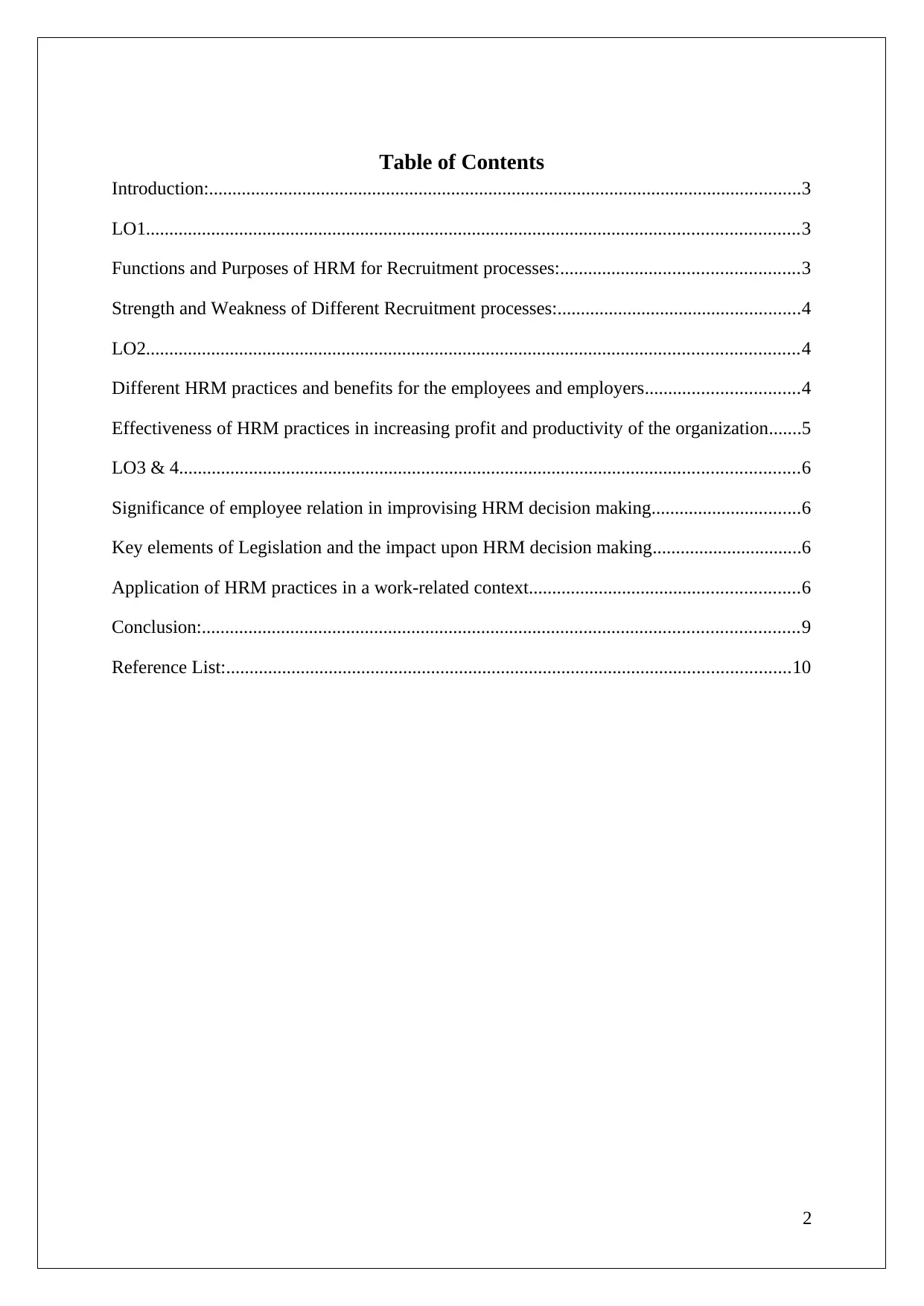
Table of Contents
Introduction:...............................................................................................................................3
LO1............................................................................................................................................3
Functions and Purposes of HRM for Recruitment processes:...................................................3
Strength and Weakness of Different Recruitment processes:....................................................4
LO2............................................................................................................................................4
Different HRM practices and benefits for the employees and employers.................................4
Effectiveness of HRM practices in increasing profit and productivity of the organization.......5
LO3 & 4.....................................................................................................................................6
Significance of employee relation in improvising HRM decision making................................6
Key elements of Legislation and the impact upon HRM decision making................................6
Application of HRM practices in a work-related context..........................................................6
Conclusion:................................................................................................................................9
Reference List:.........................................................................................................................10
2
Introduction:...............................................................................................................................3
LO1............................................................................................................................................3
Functions and Purposes of HRM for Recruitment processes:...................................................3
Strength and Weakness of Different Recruitment processes:....................................................4
LO2............................................................................................................................................4
Different HRM practices and benefits for the employees and employers.................................4
Effectiveness of HRM practices in increasing profit and productivity of the organization.......5
LO3 & 4.....................................................................................................................................6
Significance of employee relation in improvising HRM decision making................................6
Key elements of Legislation and the impact upon HRM decision making................................6
Application of HRM practices in a work-related context..........................................................6
Conclusion:................................................................................................................................9
Reference List:.........................................................................................................................10
2
Introduction:
Here in this assignment, different purposes and function of Human Resource Management
(HRM) related to recruitment and selection will be discussed. The strengths and weaknesses
of different recruitment approaches will also be identified. The later part of the assignment
will highlight the benefits of HRM practices both for the organization and its employees. It
will also shed lights on different factors being HRM decision making and The HRM practices
of a real life organization (Tesco) will also be illuminated.
LO1
Functions and Purposes of HRM for Recruitment processes:
Resourcing some talents for organisation by some processes are called recruitment. The one
of the most important job for an HRM is recruitment which added some value to HRM
functions. Human resources provide satisfaction to the managers by the quality of recruitment
process.
HRM plays the vital role in the recruitment process which is part of operational process they
set the strategies for the recruitment process. The HRM has to got the good future vision
which will help to recruit the best talents from the market and the purposes of the recruitment
process are for this reasons which is mostly important one is to achieve the future goals of the
company and also this will help for more further future grow (Boselie et al. 2005).
HRM follows different strategies for workflow planning in the ongoing market like
Recruiting on Boom years. This is the one the most critical processes for uneven demand and
supply in the market during ongoing years like for H1B workers in US many companies meet
critical shortage of employees. Thus for this the hiring become challenging for the HRM.
In the recession years the HRM downs the recruitment process so that they do not need to fire
some employees for this and they also staff some different sectors to the employees to avoid
the firing (Dar et al. 2014).
3
Here in this assignment, different purposes and function of Human Resource Management
(HRM) related to recruitment and selection will be discussed. The strengths and weaknesses
of different recruitment approaches will also be identified. The later part of the assignment
will highlight the benefits of HRM practices both for the organization and its employees. It
will also shed lights on different factors being HRM decision making and The HRM practices
of a real life organization (Tesco) will also be illuminated.
LO1
Functions and Purposes of HRM for Recruitment processes:
Resourcing some talents for organisation by some processes are called recruitment. The one
of the most important job for an HRM is recruitment which added some value to HRM
functions. Human resources provide satisfaction to the managers by the quality of recruitment
process.
HRM plays the vital role in the recruitment process which is part of operational process they
set the strategies for the recruitment process. The HRM has to got the good future vision
which will help to recruit the best talents from the market and the purposes of the recruitment
process are for this reasons which is mostly important one is to achieve the future goals of the
company and also this will help for more further future grow (Boselie et al. 2005).
HRM follows different strategies for workflow planning in the ongoing market like
Recruiting on Boom years. This is the one the most critical processes for uneven demand and
supply in the market during ongoing years like for H1B workers in US many companies meet
critical shortage of employees. Thus for this the hiring become challenging for the HRM.
In the recession years the HRM downs the recruitment process so that they do not need to fire
some employees for this and they also staff some different sectors to the employees to avoid
the firing (Dar et al. 2014).
3
⊘ This is a preview!⊘
Do you want full access?
Subscribe today to unlock all pages.

Trusted by 1+ million students worldwide
Strength and Weakness of Different Recruitment processes:
There are many recruitment strategies which follow the HRM. The strategy should be
selecting the right person for the organisation who can adjust with the environment of the
company.
There are many different approaches like hiring which is Internal and by through External by
the Agencies, Government job portals, social media and by the advertising through the own
websites (Baum and Kabst, 2014).
The internal recruitment process is kind of process where the current employees of the
company are noticed for the recent vacancies of the company and the candidates come by
their reference for interviews and the other processes. This recruitment process is reduces
some cost for marketing which is good and this also promotes the employees but this
recruitment process has some cons like this recruiting process has to be stick for all
candidates and this recruiting process has no scope for marketing.
The External recruiting process includes adding through social media and the company's
website for current job vacancies. The recruiting through advertising has wider range in terms
of marketing which promotes the company and also this process brings more probability to
bring good talented future candidates. The probability of bring new ideas by External
recruitment has greater chances than internal. Comparatively higher talented candidates can
be found from external recruitment processes. However, there has some problems in external
recruitment like more chances of fake candidates, it’s so much time consuming process the
candidates have to go through different elimination and selection processes and moreover.
This process needs good amount of bucks for marketing (Armstrong and Taylor, 2014).
LO2
Different HRM practices and benefits for the employees and employers
Different HRM practices are important and beneficial as they help in hiring and training. It is
the job of HRM to come out with a new hiring strategy to select the people for the
organization and this practice also helps the employers for better training and development
plans for the organization. The practice of motivating the workers is also beneficial for the
employers. The power to define the role to an individual depends on the HRM. This practice
4
There are many recruitment strategies which follow the HRM. The strategy should be
selecting the right person for the organisation who can adjust with the environment of the
company.
There are many different approaches like hiring which is Internal and by through External by
the Agencies, Government job portals, social media and by the advertising through the own
websites (Baum and Kabst, 2014).
The internal recruitment process is kind of process where the current employees of the
company are noticed for the recent vacancies of the company and the candidates come by
their reference for interviews and the other processes. This recruitment process is reduces
some cost for marketing which is good and this also promotes the employees but this
recruitment process has some cons like this recruiting process has to be stick for all
candidates and this recruiting process has no scope for marketing.
The External recruiting process includes adding through social media and the company's
website for current job vacancies. The recruiting through advertising has wider range in terms
of marketing which promotes the company and also this process brings more probability to
bring good talented future candidates. The probability of bring new ideas by External
recruitment has greater chances than internal. Comparatively higher talented candidates can
be found from external recruitment processes. However, there has some problems in external
recruitment like more chances of fake candidates, it’s so much time consuming process the
candidates have to go through different elimination and selection processes and moreover.
This process needs good amount of bucks for marketing (Armstrong and Taylor, 2014).
LO2
Different HRM practices and benefits for the employees and employers
Different HRM practices are important and beneficial as they help in hiring and training. It is
the job of HRM to come out with a new hiring strategy to select the people for the
organization and this practice also helps the employers for better training and development
plans for the organization. The practice of motivating the workers is also beneficial for the
employers. The power to define the role to an individual depends on the HRM. This practice
4
Paraphrase This Document
Need a fresh take? Get an instant paraphrase of this document with our AI Paraphraser
also helps the employees improving their skills. It is very much helpful to achieve the goal
for the organization (Baum and Kabst, 2014). The practice of maintaining good relationship
is also very much beneficial for the organization and it is one of the top priorities for the
HRM. Holding seminars and meetings are also the responsibilities of the HRM and that
should be done on the behalf of the management. Every successful organization wants to
create working environment that spreads the positivity among the workers (Delaney and
Huselid, 1996). Building flexible workplace and flexible work environment is also very much
important practice for the workers.
Effectiveness of HRM practices in increasing profit and productivity of the
organization
One of the most important and critical goals of the business is to increase the productivity. It
is an important factor of the workforce is to hire and retain the workers and employees on the
basis of their qualities. Agile employees and high performing workers can be attracted by the
HRM and manager if they can work together. If the HRM cannot give the proper direction
and supports the best employees cannot perform properly. A competitive strategy by the
HRM can improve the job environment. A clear and proper strategy can maintain the interest
among the employers and it is also help them to keep in focus. Nowadays the global
competition has created a huge uproar among the companies to use new skills and new
technologies. The role of the HRM comes into play on the learning process of the employees
and spreading the knowledge among the employees is also important (Armstrong and Taylor,
2014). HRM should always provide the proper feedback on the works of the employees.
Without proper feedbacks the errors can be increased and as a result lower productivity can
happen.
On the other hand, insufficient budget will produce lower level productivity in spite of having
great managers and skillful employers. Clear priorities help to ensure the allocation of time
and resources. High and low priorities, process, tasks, customers should be the main
awareness of the employees. It has been seen in many cases that monetary reward affects
positively to achieve the goals for employees. Team monetary rewards or Individual rewards
play a major role to ensure the focus of the employees and that is very much helpful to raise
the organizational productivity.
5
for the organization (Baum and Kabst, 2014). The practice of maintaining good relationship
is also very much beneficial for the organization and it is one of the top priorities for the
HRM. Holding seminars and meetings are also the responsibilities of the HRM and that
should be done on the behalf of the management. Every successful organization wants to
create working environment that spreads the positivity among the workers (Delaney and
Huselid, 1996). Building flexible workplace and flexible work environment is also very much
important practice for the workers.
Effectiveness of HRM practices in increasing profit and productivity of the
organization
One of the most important and critical goals of the business is to increase the productivity. It
is an important factor of the workforce is to hire and retain the workers and employees on the
basis of their qualities. Agile employees and high performing workers can be attracted by the
HRM and manager if they can work together. If the HRM cannot give the proper direction
and supports the best employees cannot perform properly. A competitive strategy by the
HRM can improve the job environment. A clear and proper strategy can maintain the interest
among the employers and it is also help them to keep in focus. Nowadays the global
competition has created a huge uproar among the companies to use new skills and new
technologies. The role of the HRM comes into play on the learning process of the employees
and spreading the knowledge among the employees is also important (Armstrong and Taylor,
2014). HRM should always provide the proper feedback on the works of the employees.
Without proper feedbacks the errors can be increased and as a result lower productivity can
happen.
On the other hand, insufficient budget will produce lower level productivity in spite of having
great managers and skillful employers. Clear priorities help to ensure the allocation of time
and resources. High and low priorities, process, tasks, customers should be the main
awareness of the employees. It has been seen in many cases that monetary reward affects
positively to achieve the goals for employees. Team monetary rewards or Individual rewards
play a major role to ensure the focus of the employees and that is very much helpful to raise
the organizational productivity.
5
It has been seen very often that even with the existence of the positive productivity factors,
the productivity rate may be decreased by the real or imaginary barriers. Problems like
corporate politics, personal jealousies can be the bearer of success. It is the duty of HRM to
prevent this to get better productivity rate.
LO3 & 4
Significance of employee relation in improvising HRM decision making
Employee relations speak of an interconnected organizational network where there is a
perfect harmony and a sense of camaraderie evident amongst the employees. Now, it is
necessary understand how employee relation can help in HRM decision making. Firstly, there
are certain HRM related issues evident in an organization for which individual decisions
cannot be made. For solving this kind of issue, a brainstorming session of the employees is
required. Secondly, making HRM decision is nothing but an organizational task (Baum and
Kabst, 2014). Sharing of a task amongst employees can make it simpler and this sharing can
only be done where there remain healthy employee relations. It is also proved to be helpful in
mitigating organizational conflicts and thus in a way helps in making HRM decisions.
Key elements of Legislation and the impact upon HRM decision making
HRM legislation which affects the most of the functional areas is the “National Minimum
Wage Act 1998”. This law specifies minimum criteria of employment. Employees have to be
school leaving age to get National Minimum Wage or National Living Wage (Kehoe and
Wright, 2013). If employees are hired for part-time or casual labour like that someone hired
for one day or a contract based job they are also have to entitled to the correct minimum wage
as well as trainee workers foreign workers, disabled workers all are should be entitled in the
same process. But the self employed people, voluntary workers, members of the armed
forces, company directors those are the type who are not entitled to the minimum age.
Application of HRM practices in a work-related context
In order to function properly, certain human resource practises are to be employed in an
organization. They motivate and guide the “life-blood force” of the company in a particular
direction thus acquiring better results. Practices can vary and the application of such practices
6
the productivity rate may be decreased by the real or imaginary barriers. Problems like
corporate politics, personal jealousies can be the bearer of success. It is the duty of HRM to
prevent this to get better productivity rate.
LO3 & 4
Significance of employee relation in improvising HRM decision making
Employee relations speak of an interconnected organizational network where there is a
perfect harmony and a sense of camaraderie evident amongst the employees. Now, it is
necessary understand how employee relation can help in HRM decision making. Firstly, there
are certain HRM related issues evident in an organization for which individual decisions
cannot be made. For solving this kind of issue, a brainstorming session of the employees is
required. Secondly, making HRM decision is nothing but an organizational task (Baum and
Kabst, 2014). Sharing of a task amongst employees can make it simpler and this sharing can
only be done where there remain healthy employee relations. It is also proved to be helpful in
mitigating organizational conflicts and thus in a way helps in making HRM decisions.
Key elements of Legislation and the impact upon HRM decision making
HRM legislation which affects the most of the functional areas is the “National Minimum
Wage Act 1998”. This law specifies minimum criteria of employment. Employees have to be
school leaving age to get National Minimum Wage or National Living Wage (Kehoe and
Wright, 2013). If employees are hired for part-time or casual labour like that someone hired
for one day or a contract based job they are also have to entitled to the correct minimum wage
as well as trainee workers foreign workers, disabled workers all are should be entitled in the
same process. But the self employed people, voluntary workers, members of the armed
forces, company directors those are the type who are not entitled to the minimum age.
Application of HRM practices in a work-related context
In order to function properly, certain human resource practises are to be employed in an
organization. They motivate and guide the “life-blood force” of the company in a particular
direction thus acquiring better results. Practices can vary and the application of such practices
6
⊘ This is a preview!⊘
Do you want full access?
Subscribe today to unlock all pages.
Trusted by 1+ million students worldwide
can be dynamic. Certain practices have some specified application which can be thoroughly
examined to understand the productiveness and profitability of the organization. Now a fixed
look can be rendered into the Human Resource Management (HRM) policy of a company in
UK for example Tesco.
The basic structure of the human resource management is directed towards the determination
of the business strategy and ascertaining the goals and objectives that can be achieved. The
reports of 2014 of Tesco indicated that the company operates in more than 12 countries
globally and employs approximately 500000 employees throughout the world (Tesco-
careers.com., 2017). The organization has certain HRM practices model which can refer to
understand the proper application of the HRM practises.
The table below shows the following practises and attributes of the organization:
PracticesAttributes
Proper selection of the employeeWhether the person is apt for the job, whether
the person is apt for the organization where he
will serve and his future prospects.
Proper management of the employee that
includes both time and productivity
Acquainting with the process and procedures
of the company, setting up certain work
standards, monitoring his efforts and handling
peer and work pressure.
Motivating the employeeIt includes creating a friendly environment for
the work force, proving interesting and useful
projects to work on, and compensation for any
ailments and rewarding for some superior
performance.
Now all the above practices when combined and directed properly towards the employee
form an integral part of proper alignment of the work forces which in turn evaluates Tesco’s
performance.
7
examined to understand the productiveness and profitability of the organization. Now a fixed
look can be rendered into the Human Resource Management (HRM) policy of a company in
UK for example Tesco.
The basic structure of the human resource management is directed towards the determination
of the business strategy and ascertaining the goals and objectives that can be achieved. The
reports of 2014 of Tesco indicated that the company operates in more than 12 countries
globally and employs approximately 500000 employees throughout the world (Tesco-
careers.com., 2017). The organization has certain HRM practices model which can refer to
understand the proper application of the HRM practises.
The table below shows the following practises and attributes of the organization:
PracticesAttributes
Proper selection of the employeeWhether the person is apt for the job, whether
the person is apt for the organization where he
will serve and his future prospects.
Proper management of the employee that
includes both time and productivity
Acquainting with the process and procedures
of the company, setting up certain work
standards, monitoring his efforts and handling
peer and work pressure.
Motivating the employeeIt includes creating a friendly environment for
the work force, proving interesting and useful
projects to work on, and compensation for any
ailments and rewarding for some superior
performance.
Now all the above practices when combined and directed properly towards the employee
form an integral part of proper alignment of the work forces which in turn evaluates Tesco’s
performance.
7
Paraphrase This Document
Need a fresh take? Get an instant paraphrase of this document with our AI Paraphraser
The integral part of Tesco’s HRM evolves when the human resource management comes up
as to how a selection of a particular worker can help in the progress of the company. In order
to determine that one has to include people based on their area of expertise and how well they
are developed with their skills. While many would look not only for the level of expertise but
also their future prospects in the company and whether they are deemed fit for the
organization.
Tesco has its own ways of conducting affairs, the workforce which is recruited recently
should be made aware of the processes and procedures on which the functions of the
company thrives (Tesco-careers.com., 2017). The worker after getting acquainted with the
procedures there would be certain work standards which the worker is supposed to meet in
order to ensure productivity. Surveillance of the performance of the employee is another
important practise that ensures better results. While these integral aspects are looked after in
Tesco, there are certain innate abilities of the worker such as the ability to control peer
pressure from the colleagues is one such thing which can also be termed as a factor which
promises better application of the practises.
Lastly, social environment of the employee are assessed. This accounts mainly for the
projects where the worker may find interest thus ensuring more productivity. Compensation
for the ailments and recognition for excellence can also compel the worker towards better
results.
Thus, in order to properly ensure the betterment of the organisation through its workforce and
the practices to employ such workforce for proper HRM, the managers of the company try to
deal with the following points:
1) The main asset of the organization is people. The managers should not forget about them.
2) When an employee is hired, the managers should always see the prospects which the
person holds for future.
3) All the processes of the company should be made acquainted with the employees.
4) The social environment of the workers is also important since it has a huge contribution
towards development.
8
as to how a selection of a particular worker can help in the progress of the company. In order
to determine that one has to include people based on their area of expertise and how well they
are developed with their skills. While many would look not only for the level of expertise but
also their future prospects in the company and whether they are deemed fit for the
organization.
Tesco has its own ways of conducting affairs, the workforce which is recruited recently
should be made aware of the processes and procedures on which the functions of the
company thrives (Tesco-careers.com., 2017). The worker after getting acquainted with the
procedures there would be certain work standards which the worker is supposed to meet in
order to ensure productivity. Surveillance of the performance of the employee is another
important practise that ensures better results. While these integral aspects are looked after in
Tesco, there are certain innate abilities of the worker such as the ability to control peer
pressure from the colleagues is one such thing which can also be termed as a factor which
promises better application of the practises.
Lastly, social environment of the employee are assessed. This accounts mainly for the
projects where the worker may find interest thus ensuring more productivity. Compensation
for the ailments and recognition for excellence can also compel the worker towards better
results.
Thus, in order to properly ensure the betterment of the organisation through its workforce and
the practices to employ such workforce for proper HRM, the managers of the company try to
deal with the following points:
1) The main asset of the organization is people. The managers should not forget about them.
2) When an employee is hired, the managers should always see the prospects which the
person holds for future.
3) All the processes of the company should be made acquainted with the employees.
4) The social environment of the workers is also important since it has a huge contribution
towards development.
8
Conclusion:
The assignment identifies specific strengths and weaknesses of internal and external
processes of recruitment. The benefits of HRM practices are observed both for the employees
and employers in the form of increased employee retention rate, reduced workplace conflict
and increased productivity. The assignment also reviews the existing HRM practices of Tesco
and finds out the key attributes of its HRM practices.
9
The assignment identifies specific strengths and weaknesses of internal and external
processes of recruitment. The benefits of HRM practices are observed both for the employees
and employers in the form of increased employee retention rate, reduced workplace conflict
and increased productivity. The assignment also reviews the existing HRM practices of Tesco
and finds out the key attributes of its HRM practices.
9
⊘ This is a preview!⊘
Do you want full access?
Subscribe today to unlock all pages.
Trusted by 1+ million students worldwide
Reference List:
Armstrong M. and Taylor S., (2014). Armstrong's handbook of human resource management
practice. London: Kogan Page Publishers.
Baum M. and Kabst R., (2014). The effectiveness of recruitment advertisements and
recruitment websites: Indirect and interactive effects on applicant attraction. Human
Resource Management, 53(3), pp.353-378.
Boselie, P., Dietz, G. and Boon, C., (2005). Commonalities and contradictions in HRM and
performance research. Human resource management journal, 15(3), pp.67-94.
Dar A.T., Bashir M., Ghazanfar F. and Abrar M., (2014). Mediating role of employee
motivation in relationship to post-selection HRM practices and organizational performance.
International Review of Management and Marketing, 4(3), p.224.
Delaney, J.T. and Huselid, M.A., (1996). The impact of human resource management
practices on perceptions of organizational performance. Academy of Management
journal, 39(4), pp.949-969.
Kehoe, R.R. and Wright, P.M., (2013). The impact of high-performance human resource
practices on employees’ attitudes and behaviors. Journal of management, 39(2), pp.366-391.
Tesco-careers.com. (2017). Inside Tesco | Tesco Careers. [online] Available at:
https://www.tesco-careers.com/Inside-Tesco.aspx [Accessed 2 May 2017].
10
Armstrong M. and Taylor S., (2014). Armstrong's handbook of human resource management
practice. London: Kogan Page Publishers.
Baum M. and Kabst R., (2014). The effectiveness of recruitment advertisements and
recruitment websites: Indirect and interactive effects on applicant attraction. Human
Resource Management, 53(3), pp.353-378.
Boselie, P., Dietz, G. and Boon, C., (2005). Commonalities and contradictions in HRM and
performance research. Human resource management journal, 15(3), pp.67-94.
Dar A.T., Bashir M., Ghazanfar F. and Abrar M., (2014). Mediating role of employee
motivation in relationship to post-selection HRM practices and organizational performance.
International Review of Management and Marketing, 4(3), p.224.
Delaney, J.T. and Huselid, M.A., (1996). The impact of human resource management
practices on perceptions of organizational performance. Academy of Management
journal, 39(4), pp.949-969.
Kehoe, R.R. and Wright, P.M., (2013). The impact of high-performance human resource
practices on employees’ attitudes and behaviors. Journal of management, 39(2), pp.366-391.
Tesco-careers.com. (2017). Inside Tesco | Tesco Careers. [online] Available at:
https://www.tesco-careers.com/Inside-Tesco.aspx [Accessed 2 May 2017].
10

1 out of 10


Related Documents


Your All-in-One AI-Powered Toolkit for Academic Success.
+13062052269
info@desklib.com
Available 24*7 on WhatsApp / Email
![[object Object]](/_next/static/media/star-bottom.7253800d.svg)
Unlock your academic potential
Copyright © 2020–2026 A2Z Services. All Rights Reserved. Developed and managed by ZUCOL.