Human Resource Management Report for TESCO: Practices and Impact
VerifiedAdded on 2020/07/22
|17
|4654
|31
Report
AI Summary
This report provides a comprehensive analysis of Human Resource Management (HRM) practices at TESCO, a global retail chain. It begins with an introduction to HRM and its functions, including recruitment, selection, orientation, and employee relations. The report then explores the strengths and weaknesses of different recruitment and selection approaches, such as internal, external, and third-party sourcing. It further examines the benefits of HRM practices for both employees and employers, highlighting the impact on employee motivation, productivity, and workplace flexibility. The report also assesses the effectiveness of HRM practices in terms of organizational profit and productivity, discussing strategies like structured governance, workforce development, and clear task allocation. The importance of employee relations in influencing HRM decision-making is emphasized, along with the impact of employee legislation. Finally, the report concludes by summarizing the application of HRM practices and their overall significance for TESCO's success. The report provides a detailed examination of the various aspects of HRM, providing a thorough understanding of the topic.

HUMAN-RESOURCE-
MANAGEMENT
MANAGEMENT

Paraphrase This Document
Need a fresh take? Get an instant paraphrase of this document with our AI Paraphraser
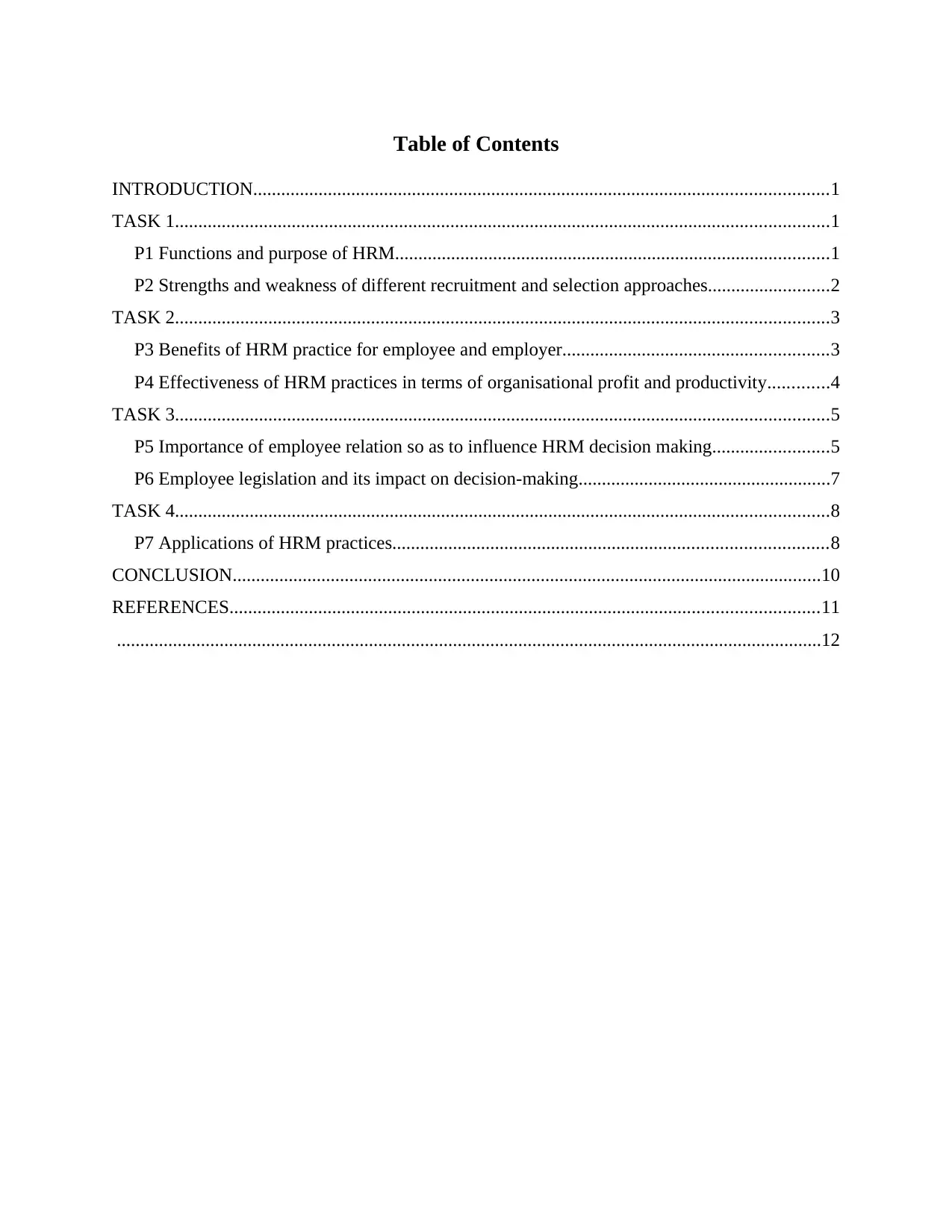
Table of Contents
INTRODUCTION...........................................................................................................................1
TASK 1............................................................................................................................................1
P1 Functions and purpose of HRM.............................................................................................1
P2 Strengths and weakness of different recruitment and selection approaches..........................2
TASK 2............................................................................................................................................3
P3 Benefits of HRM practice for employee and employer.........................................................3
P4 Effectiveness of HRM practices in terms of organisational profit and productivity.............4
TASK 3............................................................................................................................................5
P5 Importance of employee relation so as to influence HRM decision making.........................5
P6 Employee legislation and its impact on decision-making......................................................7
TASK 4............................................................................................................................................8
P7 Applications of HRM practices.............................................................................................8
CONCLUSION..............................................................................................................................10
REFERENCES..............................................................................................................................11
.......................................................................................................................................................12
INTRODUCTION...........................................................................................................................1
TASK 1............................................................................................................................................1
P1 Functions and purpose of HRM.............................................................................................1
P2 Strengths and weakness of different recruitment and selection approaches..........................2
TASK 2............................................................................................................................................3
P3 Benefits of HRM practice for employee and employer.........................................................3
P4 Effectiveness of HRM practices in terms of organisational profit and productivity.............4
TASK 3............................................................................................................................................5
P5 Importance of employee relation so as to influence HRM decision making.........................5
P6 Employee legislation and its impact on decision-making......................................................7
TASK 4............................................................................................................................................8
P7 Applications of HRM practices.............................................................................................8
CONCLUSION..............................................................................................................................10
REFERENCES..............................................................................................................................11
.......................................................................................................................................................12

⊘ This is a preview!⊘
Do you want full access?
Subscribe today to unlock all pages.

Trusted by 1+ million students worldwide
INTRODUCTION
Each and every field has gained various advancements so as to meet the need in regards
with time. Management now a days has become an art by including systematic methodologies.
An innovative and creative type of management which is prevailing and spreading its wings in
an organisation is defined as Human resource management (Werner and DeSimone, 2011). This
report is based on TESCO which is general merchandising retail chain and British international
grocery. It is has its headquarters in UK and is having its geographical presence in Asia, eastern
Europe and north America. HRM is basically termed as administration of workforce and
different activities which are there in an organisation. In this various functions, benefits and
strengths and weakness of various HRM practices will be analysed. Importance of employee
relation, elements of employment legislations and application of several human resource
management practices will also be determined in this report. Management of human resources is
significantly necessary for the growth of different managerial skills.
TASK 1
P1 Functions and purpose of HRM
Production of every service or product there is a contribution of a human mind, man
hours and efforts (Albrech, 2011). No service or product can be produced without the
involvement of human being. Management of human resource can be defined as the process of
selection and recruitment of employees, induction and providing orientation, employee
assessment, training and development, benefits and compensation, maintenance of employee
safety, health measure and welfare in coordination with labour laws. In TESCO there are various
purpose and functions of HRM which needs to be done in order to have proper management.
Several purpose can be defined as:
Societal purpose: To have social responsibility towards challenges and needs of society
while decreasing negative effects of such demands on organisation.
Organisational purpose: To make recognition regarding existence of HRM so as to make
contribution for organisational effectiveness.
Personal purpose: To support employees so that they can achieve personal goals, as these
goals enhance contribution of an individual in the organisation.
There are five major functions of HRM which can be explained as follows:
1
Each and every field has gained various advancements so as to meet the need in regards
with time. Management now a days has become an art by including systematic methodologies.
An innovative and creative type of management which is prevailing and spreading its wings in
an organisation is defined as Human resource management (Werner and DeSimone, 2011). This
report is based on TESCO which is general merchandising retail chain and British international
grocery. It is has its headquarters in UK and is having its geographical presence in Asia, eastern
Europe and north America. HRM is basically termed as administration of workforce and
different activities which are there in an organisation. In this various functions, benefits and
strengths and weakness of various HRM practices will be analysed. Importance of employee
relation, elements of employment legislations and application of several human resource
management practices will also be determined in this report. Management of human resources is
significantly necessary for the growth of different managerial skills.
TASK 1
P1 Functions and purpose of HRM
Production of every service or product there is a contribution of a human mind, man
hours and efforts (Albrech, 2011). No service or product can be produced without the
involvement of human being. Management of human resource can be defined as the process of
selection and recruitment of employees, induction and providing orientation, employee
assessment, training and development, benefits and compensation, maintenance of employee
safety, health measure and welfare in coordination with labour laws. In TESCO there are various
purpose and functions of HRM which needs to be done in order to have proper management.
Several purpose can be defined as:
Societal purpose: To have social responsibility towards challenges and needs of society
while decreasing negative effects of such demands on organisation.
Organisational purpose: To make recognition regarding existence of HRM so as to make
contribution for organisational effectiveness.
Personal purpose: To support employees so that they can achieve personal goals, as these
goals enhance contribution of an individual in the organisation.
There are five major functions of HRM which can be explained as follows:
1
Paraphrase This Document
Need a fresh take? Get an instant paraphrase of this document with our AI Paraphraser
Selection and recruitment: Recruitment is the process of screening, captivating and
selecting qualified and potential candidates on the basis of objective criteria for a specific
job (Anderson, 2013). Before starting recruitment process, proper staffing plan must be
executed by company which they will be requiring. All these activities include
involvement of HRM so as to conduct proper recruitment and selection process. Orientation: There are several organisations who are not providing thorough orientation
to its new employees (Ployhart and Moliterno, 2011). Human resource management has
the responsibility conduct such programs which should include goals and objectives of an
organisation and how employees can assist in achieving short as well as long term goals.
Program should also help employees to know about their duties and responsibilities. Maintaining good condition of work: It is the duty of human resource management to
provide good conditions of working to employees so as to make suitable work
environment and workplace. HRM should come up with necessary systems which are
needed to give non-financial and financial benefits. Management of employee relation: Employees are the main pillars of any organisation.
Relationship among employees is a broad concept and it is an important function of
HRM. It will also support in fostering employee relation. Organisation of several
activities should be done by management which will assist in knowing employees at
professional as well as personal level.
Training and development: Development and training are the significant functions of
HRM. It is the step to improve future and current performance of an employee by
increasing their ability through proper education and training.
P2 Strengths and weakness of different recruitment and selection approaches
TESCO states that are different types of recruitment and selection method which are
used by the department of HRM in an organisation (Armstrong, 2011). In human resource,
advertising and recruiting new employee is termed as sourcing which means use of various
sources or approaches to find desired candidate. These approaches which are used for
recruitment and selection contains several strengths and weakness which can be explained as
follows: Internal Sourcing: It is the way to advertise a recently vacated or new position in a
company for its existing employees. It is the method to recruit employee laterally or
2
selecting qualified and potential candidates on the basis of objective criteria for a specific
job (Anderson, 2013). Before starting recruitment process, proper staffing plan must be
executed by company which they will be requiring. All these activities include
involvement of HRM so as to conduct proper recruitment and selection process. Orientation: There are several organisations who are not providing thorough orientation
to its new employees (Ployhart and Moliterno, 2011). Human resource management has
the responsibility conduct such programs which should include goals and objectives of an
organisation and how employees can assist in achieving short as well as long term goals.
Program should also help employees to know about their duties and responsibilities. Maintaining good condition of work: It is the duty of human resource management to
provide good conditions of working to employees so as to make suitable work
environment and workplace. HRM should come up with necessary systems which are
needed to give non-financial and financial benefits. Management of employee relation: Employees are the main pillars of any organisation.
Relationship among employees is a broad concept and it is an important function of
HRM. It will also support in fostering employee relation. Organisation of several
activities should be done by management which will assist in knowing employees at
professional as well as personal level.
Training and development: Development and training are the significant functions of
HRM. It is the step to improve future and current performance of an employee by
increasing their ability through proper education and training.
P2 Strengths and weakness of different recruitment and selection approaches
TESCO states that are different types of recruitment and selection method which are
used by the department of HRM in an organisation (Armstrong, 2011). In human resource,
advertising and recruiting new employee is termed as sourcing which means use of various
sources or approaches to find desired candidate. These approaches which are used for
recruitment and selection contains several strengths and weakness which can be explained as
follows: Internal Sourcing: It is the way to advertise a recently vacated or new position in a
company for its existing employees. It is the method to recruit employee laterally or
2
upward in a company as there will be no or little need of training. This method also foster
parity and loyalty among members of team, and this things are considered as the
strengths. As this process is done internally, there is no scope of getting new ideas and
skills in employees (Bamberger, Biron and Meshoulam, 2014). This method limits the
flow of new ideas in an organisation which will help in development and growth. External sourcing: It is the recruitment method that conducts a search of employee with
the help of external tools of recruitment like trade publication announcement, job boards,
newspapers etc. This type of method is also used when vacant position is not filled by
existing employees because of speciality and technicality of position. On the other hand,
this source of recruitment is expensive as it needs extra cost for announcing vacancy,
arranging employees etc. When employees get recruited with the help of external
recruitment, existing employees will feel dissatisfied. It includes long process as there is
an involvement of various activities.
Third party sourcing: This kind of sourcing involves headhunters or placement agencies
for finding qualified candidates for jobs. This sources make use of different tools and
techniques to find appropriate applicants for job, such as more flexible package regarding
benefits, extending offers for improved salary. This type of sourcing may include high
cost and sometime will not be effective in recruiting candidates.
TASK 2
P3 Benefits of HRM practice for employee and employer
Human resource management makes involvement of different practices which are used
by HR workers, automated systems and managers to manage people in an organisation.
Examples of such practices includes training, payroll, firing, hiring etc (Bloom and Van Reenen,
2011). These HRM practices provide many benefits to both employee as well as employer.
A successful organisation like TESCO helps in creating positive environment of work
and give favourable benefits to employees with the help of HRM practices, keeping employees
productive and happy. Practices of HRM reward and reinforce behaviour of desired employees.
These practices encourage and satisfy employees and motivates them to make their contribution
in intellectual assets of company. Skills and knowledge of workers may increase competitive
advantage of business. Effective organisations focus on positive impact of HRM by assisting
3
parity and loyalty among members of team, and this things are considered as the
strengths. As this process is done internally, there is no scope of getting new ideas and
skills in employees (Bamberger, Biron and Meshoulam, 2014). This method limits the
flow of new ideas in an organisation which will help in development and growth. External sourcing: It is the recruitment method that conducts a search of employee with
the help of external tools of recruitment like trade publication announcement, job boards,
newspapers etc. This type of method is also used when vacant position is not filled by
existing employees because of speciality and technicality of position. On the other hand,
this source of recruitment is expensive as it needs extra cost for announcing vacancy,
arranging employees etc. When employees get recruited with the help of external
recruitment, existing employees will feel dissatisfied. It includes long process as there is
an involvement of various activities.
Third party sourcing: This kind of sourcing involves headhunters or placement agencies
for finding qualified candidates for jobs. This sources make use of different tools and
techniques to find appropriate applicants for job, such as more flexible package regarding
benefits, extending offers for improved salary. This type of sourcing may include high
cost and sometime will not be effective in recruiting candidates.
TASK 2
P3 Benefits of HRM practice for employee and employer
Human resource management makes involvement of different practices which are used
by HR workers, automated systems and managers to manage people in an organisation.
Examples of such practices includes training, payroll, firing, hiring etc (Bloom and Van Reenen,
2011). These HRM practices provide many benefits to both employee as well as employer.
A successful organisation like TESCO helps in creating positive environment of work
and give favourable benefits to employees with the help of HRM practices, keeping employees
productive and happy. Practices of HRM reward and reinforce behaviour of desired employees.
These practices encourage and satisfy employees and motivates them to make their contribution
in intellectual assets of company. Skills and knowledge of workers may increase competitive
advantage of business. Effective organisations focus on positive impact of HRM by assisting
3
⊘ This is a preview!⊘
Do you want full access?
Subscribe today to unlock all pages.
Trusted by 1+ million students worldwide
employees in improvement (Mossholder, Richardson and Settoon, 2011). TESCO provide
different resource for the training and education of employees with the support of HRM
practices.
These practices shows shift of demographics at the workplace. Workers in an
organisation are of diverse nature, effects of HRM practices on such diverse workplaces are in
relation with employer flexibility. As company's always want to retain employees, therefore they
provide workplace with flexibility which includes flexible design of work schedules, assignment,
locations, environment, formats of communication and accountability methods. If there will be a
flexible workplace, aspects of job can be customized by employees so as to make suitable for
their lifestyle.
Performance of employees also gets maximized with the help of effective HRM
practices. That's why employers promote and hire managers who can manage work and workers
effectively. Successful managers make implementation of distinct HRM practices and helps
people in increasing feelings of competition in position and give positive impact on an
organisation (CHUANG and Liao, 2010). Employees who work under skilled and positive
managers feels motivated. With the assistance of these practices , managers can develop proper
knowledge of policies, plans and corporate culture. Employers in an organisation can also act as
consultant or change agent and initiates several changes and act as facilitator and expert.
Employers can also evolve and identify several HRD strategies in coordination with overall
strategy of business. They also facilitate development of different organisational teams and their
working with individuals and other teams.
P4 Effectiveness of HRM practices in terms of organisational profit and productivity
Practices of human resource management contains various things which are helpful for
TESCO in its success and growth. These practices or factors are of great importance as they
support in overall management or administration of employees (Farndale, Scullion and Sparrow,
2010). In order to increase profit and productivity of a company, human resource managers need
to make adoption of different strategies so that they can provide best results. Distinct HRM
practices which will assist in increasing productivity and profit can be defined as follows: Structured Governance: In order to make development of business, it is very necessary
for HR to ensure effective relation between different levels of an organisation so as to
4
different resource for the training and education of employees with the support of HRM
practices.
These practices shows shift of demographics at the workplace. Workers in an
organisation are of diverse nature, effects of HRM practices on such diverse workplaces are in
relation with employer flexibility. As company's always want to retain employees, therefore they
provide workplace with flexibility which includes flexible design of work schedules, assignment,
locations, environment, formats of communication and accountability methods. If there will be a
flexible workplace, aspects of job can be customized by employees so as to make suitable for
their lifestyle.
Performance of employees also gets maximized with the help of effective HRM
practices. That's why employers promote and hire managers who can manage work and workers
effectively. Successful managers make implementation of distinct HRM practices and helps
people in increasing feelings of competition in position and give positive impact on an
organisation (CHUANG and Liao, 2010). Employees who work under skilled and positive
managers feels motivated. With the assistance of these practices , managers can develop proper
knowledge of policies, plans and corporate culture. Employers in an organisation can also act as
consultant or change agent and initiates several changes and act as facilitator and expert.
Employers can also evolve and identify several HRD strategies in coordination with overall
strategy of business. They also facilitate development of different organisational teams and their
working with individuals and other teams.
P4 Effectiveness of HRM practices in terms of organisational profit and productivity
Practices of human resource management contains various things which are helpful for
TESCO in its success and growth. These practices or factors are of great importance as they
support in overall management or administration of employees (Farndale, Scullion and Sparrow,
2010). In order to increase profit and productivity of a company, human resource managers need
to make adoption of different strategies so that they can provide best results. Distinct HRM
practices which will assist in increasing productivity and profit can be defined as follows: Structured Governance: In order to make development of business, it is very necessary
for HR to ensure effective relation between different levels of an organisation so as to
4
Paraphrase This Document
Need a fresh take? Get an instant paraphrase of this document with our AI Paraphraser
place an effective communication without any disturbance or barrier. It can be done with
the involvement of leaders in the planning process. Development of advanced work force: Effective human resource and workforce is
ensured in an organisation if they will be capable for incorporating sophisticated team,
which will be capable in providing more effective results with given resources. Effective
workforce will also help in increasing profit and productivity in an organisation. Implementation of right HR philosophies: Human resource management commits in
creating such working environment which is capable in more production. If there will be
an implementation of appropriate HR philosophies, then organisation will be able to
focus on changes and will be capable to create best work place. Reducing work of administration for HR business partners: Role of HRM practices
involve wide range of functions, it should be of possessing capacity so that it will be able
to give necessary suggestions to senior business leaders (Flamholtz, 2012). It will also
assist top management in the process of work development, which will further support
management in taking decisions regarding management of human resource. Implementation of flexible organisational design: Organisational structure or design
plays an important role in generating profit. Organisation structure should be of flexible
nature so that company can compete in the dynamic environment. HR practices should be
of such nature who will be capable in producing effective workforce in order to increase
productivity.
Clear allotment of task: In order to reduce confusion it is necessary to communicate job
clearly to an individual who is working in organisation. HR should make sure that all
employees in an organisation must be aware of their duties so that they can work
effectively on concerned job and can increase profit as well as productivity.
TASK 3
P5 Importance of employee relation so as to influence HRM decision making
Every individual who is working at the workplace shares some relationship with his
teammates and fellow workers. Human beings are not termed as machines who can start working
by just pressing a button (Hendry, 2012). They need people with whom they can communicate,
discuss ideas and share their sorrows and happiness. Solid foundation of any company who is
5
the involvement of leaders in the planning process. Development of advanced work force: Effective human resource and workforce is
ensured in an organisation if they will be capable for incorporating sophisticated team,
which will be capable in providing more effective results with given resources. Effective
workforce will also help in increasing profit and productivity in an organisation. Implementation of right HR philosophies: Human resource management commits in
creating such working environment which is capable in more production. If there will be
an implementation of appropriate HR philosophies, then organisation will be able to
focus on changes and will be capable to create best work place. Reducing work of administration for HR business partners: Role of HRM practices
involve wide range of functions, it should be of possessing capacity so that it will be able
to give necessary suggestions to senior business leaders (Flamholtz, 2012). It will also
assist top management in the process of work development, which will further support
management in taking decisions regarding management of human resource. Implementation of flexible organisational design: Organisational structure or design
plays an important role in generating profit. Organisation structure should be of flexible
nature so that company can compete in the dynamic environment. HR practices should be
of such nature who will be capable in producing effective workforce in order to increase
productivity.
Clear allotment of task: In order to reduce confusion it is necessary to communicate job
clearly to an individual who is working in organisation. HR should make sure that all
employees in an organisation must be aware of their duties so that they can work
effectively on concerned job and can increase profit as well as productivity.
TASK 3
P5 Importance of employee relation so as to influence HRM decision making
Every individual who is working at the workplace shares some relationship with his
teammates and fellow workers. Human beings are not termed as machines who can start working
by just pressing a button (Hendry, 2012). They need people with whom they can communicate,
discuss ideas and share their sorrows and happiness. Solid foundation of any company who is
5
having good success is due to its employee's. Employees make representation of different ideas
and sources, but many a times such resources are untapped. Involvement of employees in the
process of decision making not only encourages them in giving contribution to success, but also
save money and time of a company, in reducing outsourcing and increasing productivity. There
are various things which shows the importance of employee relation in HRM decision making,
and this can be described as follows: Productivity: When there is an involvement of employees in decision making, they gain
personal and professional stake in organisation and its success. This commitment helps in
increasing productivity as well as involvement of employees in different aspects of
company helps in overall decision making. Improving morale: Active engagement of workers in the process of decision-making
increase overall morale of a company. Employee engagement lower down the gap,
generate communication lines among employees and supervisors. As a functioning
member in process of decision-making, employees understand that their ideas are
important for an organisation and provides them with the power so as to influence
outcome of work, increase job satisfaction etc. Internal Resources: If employees will be used in the process of decision making rather
than in outsourcing, then it will save time, money and will provide company with long
term reliable assistance from those who are well known to corporation. Hiring of
consultants from outside will be expensive and may take valuable resources in terms of
fees (Kehoe and Wright, 2013). However, employees are aware of such processes and
understood overall company's policies.
Teamwork: Participation of employees in HRM decision-making provides opportunity to
employees to give opinions and share knowledge with others. This will also improves
relationship among managers and employees, and encourages strong sense of teamwork
between workers. It is also a best way in gathering information about employees working
in a team environment.
P6 Employee legislation and its impact on decision-making
In addition to federal legislation, every state has various employment law regulations,
which affects topics like criminal record check of employees, labor relations, record retentions
6
and sources, but many a times such resources are untapped. Involvement of employees in the
process of decision making not only encourages them in giving contribution to success, but also
save money and time of a company, in reducing outsourcing and increasing productivity. There
are various things which shows the importance of employee relation in HRM decision making,
and this can be described as follows: Productivity: When there is an involvement of employees in decision making, they gain
personal and professional stake in organisation and its success. This commitment helps in
increasing productivity as well as involvement of employees in different aspects of
company helps in overall decision making. Improving morale: Active engagement of workers in the process of decision-making
increase overall morale of a company. Employee engagement lower down the gap,
generate communication lines among employees and supervisors. As a functioning
member in process of decision-making, employees understand that their ideas are
important for an organisation and provides them with the power so as to influence
outcome of work, increase job satisfaction etc. Internal Resources: If employees will be used in the process of decision making rather
than in outsourcing, then it will save time, money and will provide company with long
term reliable assistance from those who are well known to corporation. Hiring of
consultants from outside will be expensive and may take valuable resources in terms of
fees (Kehoe and Wright, 2013). However, employees are aware of such processes and
understood overall company's policies.
Teamwork: Participation of employees in HRM decision-making provides opportunity to
employees to give opinions and share knowledge with others. This will also improves
relationship among managers and employees, and encourages strong sense of teamwork
between workers. It is also a best way in gathering information about employees working
in a team environment.
P6 Employee legislation and its impact on decision-making
In addition to federal legislation, every state has various employment law regulations,
which affects topics like criminal record check of employees, labor relations, record retentions
6
⊘ This is a preview!⊘
Do you want full access?
Subscribe today to unlock all pages.
Trusted by 1+ million students worldwide
etc. Different federal laws affects HRM on national level. Employee legislation also affects
decision-making process in an organisation, which can be explained as follows: Anti-discrimination: Title VII in civil rights act, 1964 prohibits discrimination of
employees in an organisation on the basis of religion, sex, colour, race, national origin
etc. This regulation is applied in TESCO as it is having more then 15 employees.
Employers in an organisation cannot refuse in hiring employees, dismiss them from
employment etc. If there will be no discrimination in regards with employees of a
company, then there will be effective working as well as process of decision-making. Wage and Hour: The Fair Labor Standards Act, establish the amount in regards with
federal minimum wage, which should get revised on periodic basis. It is the duty of HR
professionals to verify accuracy of amounts which is paid to employees. Individuals who
are working in an organisation should get appropriate wage and should work as per the
proper working hours. Equal pay act: This act sought in eradicating discrimination in the contract which is
made for employees in terms of finance which is given to each gender (Kusluvan and
et.al., 2010). Equal pay act, 1970 states that each and every employee in an organisation
should get equal pay regardless of their age, sex, race etc. Employment relation act: The employment relation act 2004 is concerned with trade
union rights and collective labour laws. It makes implementation of the findings from
employment relation act, 1999. It sates that relation between organisation and employees
should be sound so that there will be no disputes and conflicts which will affect on
development and growth of company.
Employment rights act, 1996: The major aim in applying this act is to get rid from
problems which are in relation with the human resources like different time off rights
such as proper notice before dismissal, unfair dismissal etc. Married working women
should also get maternity leaves when needed by them in an service industry. By
considering these kinds of laws, HR manager of TESCO can solve various disputes and
conflicts among employees as well as issues which are related with job dissatisfaction.
7
decision-making process in an organisation, which can be explained as follows: Anti-discrimination: Title VII in civil rights act, 1964 prohibits discrimination of
employees in an organisation on the basis of religion, sex, colour, race, national origin
etc. This regulation is applied in TESCO as it is having more then 15 employees.
Employers in an organisation cannot refuse in hiring employees, dismiss them from
employment etc. If there will be no discrimination in regards with employees of a
company, then there will be effective working as well as process of decision-making. Wage and Hour: The Fair Labor Standards Act, establish the amount in regards with
federal minimum wage, which should get revised on periodic basis. It is the duty of HR
professionals to verify accuracy of amounts which is paid to employees. Individuals who
are working in an organisation should get appropriate wage and should work as per the
proper working hours. Equal pay act: This act sought in eradicating discrimination in the contract which is
made for employees in terms of finance which is given to each gender (Kusluvan and
et.al., 2010). Equal pay act, 1970 states that each and every employee in an organisation
should get equal pay regardless of their age, sex, race etc. Employment relation act: The employment relation act 2004 is concerned with trade
union rights and collective labour laws. It makes implementation of the findings from
employment relation act, 1999. It sates that relation between organisation and employees
should be sound so that there will be no disputes and conflicts which will affect on
development and growth of company.
Employment rights act, 1996: The major aim in applying this act is to get rid from
problems which are in relation with the human resources like different time off rights
such as proper notice before dismissal, unfair dismissal etc. Married working women
should also get maternity leaves when needed by them in an service industry. By
considering these kinds of laws, HR manager of TESCO can solve various disputes and
conflicts among employees as well as issues which are related with job dissatisfaction.
7
Paraphrase This Document
Need a fresh take? Get an instant paraphrase of this document with our AI Paraphraser
TASK 4
P7 Applications of HRM practices
Practises of human resource management is very useful for an organisation in several
ways as it will assist in organisation and management of employees, selection and recruitment,
training and development, orientation, planning, staffing, organising and controlling (Lengnick-
Hall, Beck and Lengnick-Hall, 2011). Employees are the key part of an organisation who
provide their contribution in growth and success and eventually contributes in generation of
revenues and profit. As a human resource manager of TESCO, process and recruitment and
selection is being done for the post of receptionist with the team of 3 members which will
include HR managers, department head and director.
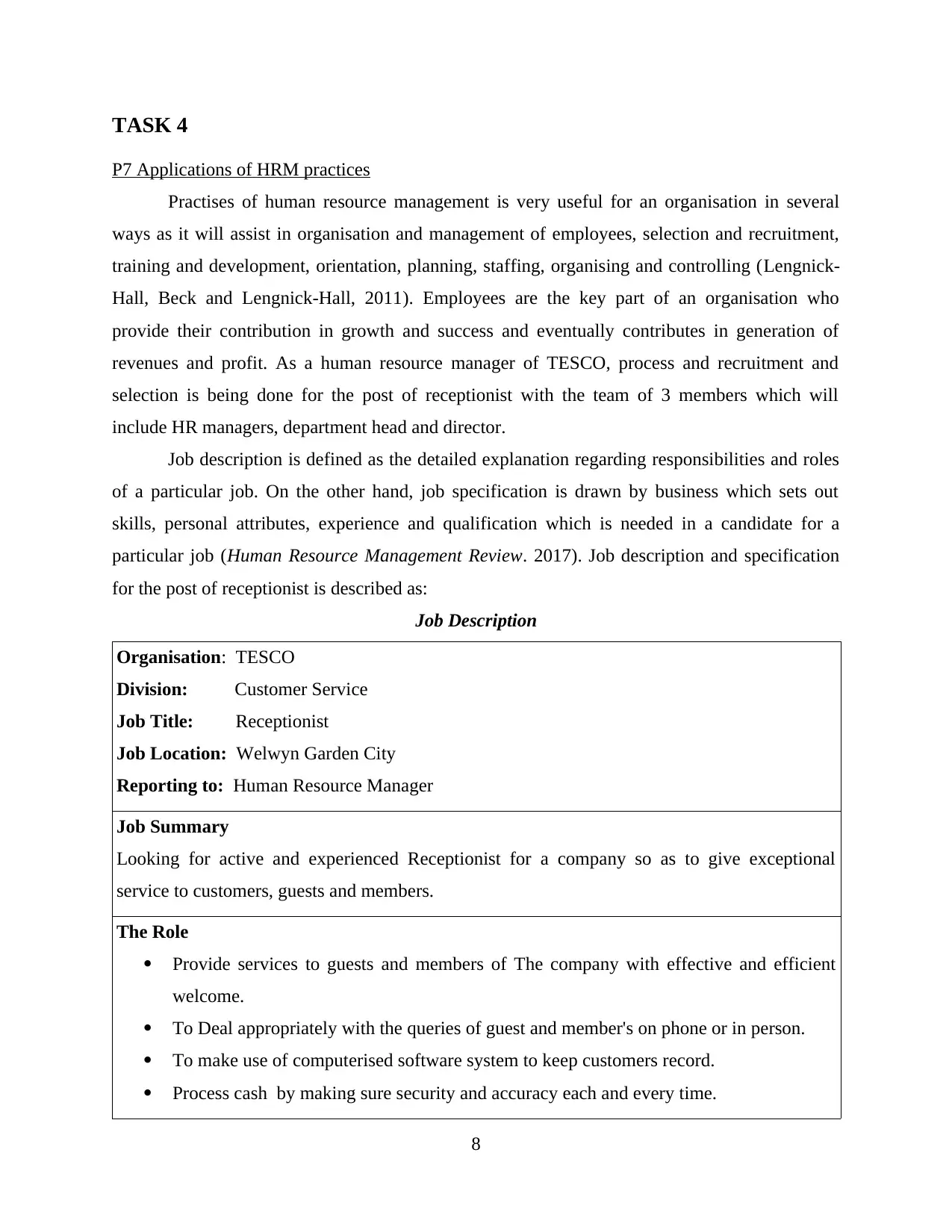
Job description is defined as the detailed explanation regarding responsibilities and roles
of a particular job. On the other hand, job specification is drawn by business which sets out
skills, personal attributes, experience and qualification which is needed in a candidate for a
particular job (Human Resource Management Review. 2017). Job description and specification
for the post of receptionist is described as:
Job Description
Organisation: TESCO
Division: Customer Service
Job Title: Receptionist
Job Location: Welwyn Garden City
Reporting to: Human Resource Manager
Job Summary
Looking for active and experienced Receptionist for a company so as to give exceptional
service to customers, guests and members.
The Role
Provide services to guests and members of The company with effective and efficient
welcome.
To Deal appropriately with the queries of guest and member's on phone or in person.
To make use of computerised software system to keep customers record.
Process cash by making sure security and accuracy each and every time.
8
P7 Applications of HRM practices
Practises of human resource management is very useful for an organisation in several
ways as it will assist in organisation and management of employees, selection and recruitment,
training and development, orientation, planning, staffing, organising and controlling (Lengnick-
Hall, Beck and Lengnick-Hall, 2011). Employees are the key part of an organisation who
provide their contribution in growth and success and eventually contributes in generation of
revenues and profit. As a human resource manager of TESCO, process and recruitment and
selection is being done for the post of receptionist with the team of 3 members which will
include HR managers, department head and director.
Job description is defined as the detailed explanation regarding responsibilities and roles
of a particular job. On the other hand, job specification is drawn by business which sets out
skills, personal attributes, experience and qualification which is needed in a candidate for a
particular job (Human Resource Management Review. 2017). Job description and specification
for the post of receptionist is described as:
Job Description
Organisation: TESCO
Division: Customer Service
Job Title: Receptionist
Job Location: Welwyn Garden City
Reporting to: Human Resource Manager
Job Summary
Looking for active and experienced Receptionist for a company so as to give exceptional
service to customers, guests and members.
The Role
Provide services to guests and members of The company with effective and efficient
welcome.
To Deal appropriately with the queries of guest and member's on phone or in person.
To make use of computerised software system to keep customers record.
Process cash by making sure security and accuracy each and every time.
8
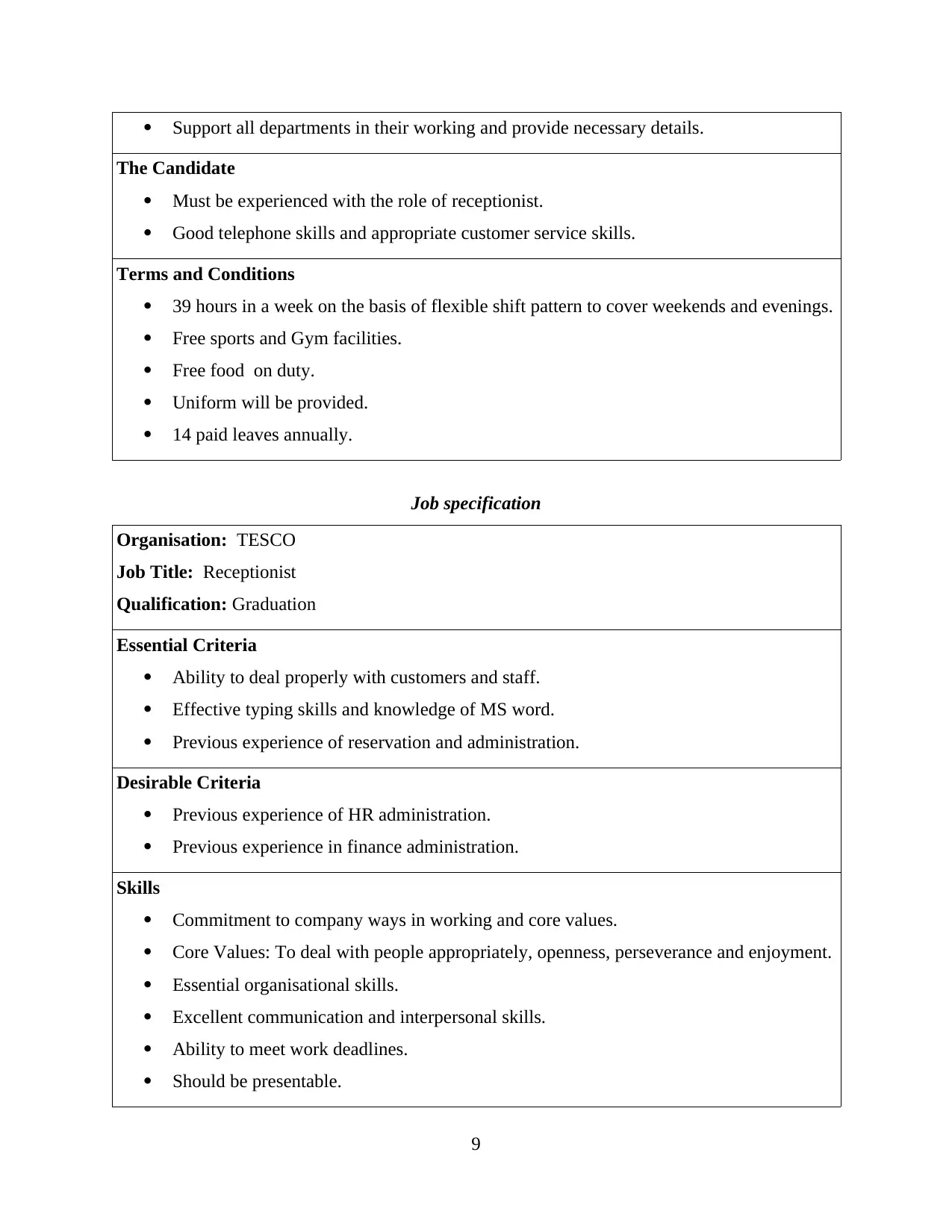
Support all departments in their working and provide necessary details.
The Candidate
Must be experienced with the role of receptionist.
Good telephone skills and appropriate customer service skills.
Terms and Conditions
39 hours in a week on the basis of flexible shift pattern to cover weekends and evenings.
Free sports and Gym facilities.
Free food on duty.
Uniform will be provided.
14 paid leaves annually.
Job specification
Organisation: TESCO
Job Title: Receptionist
Qualification: Graduation
Essential Criteria
Ability to deal properly with customers and staff.
Effective typing skills and knowledge of MS word.
Previous experience of reservation and administration.
Desirable Criteria
Previous experience of HR administration.
Previous experience in finance administration.
Skills
Commitment to company ways in working and core values.
Core Values: To deal with people appropriately, openness, perseverance and enjoyment.
Essential organisational skills.
Excellent communication and interpersonal skills.
Ability to meet work deadlines.
Should be presentable.
9
The Candidate
Must be experienced with the role of receptionist.
Good telephone skills and appropriate customer service skills.
Terms and Conditions
39 hours in a week on the basis of flexible shift pattern to cover weekends and evenings.
Free sports and Gym facilities.
Free food on duty.
Uniform will be provided.
14 paid leaves annually.
Job specification
Organisation: TESCO
Job Title: Receptionist
Qualification: Graduation
Essential Criteria
Ability to deal properly with customers and staff.
Effective typing skills and knowledge of MS word.
Previous experience of reservation and administration.
Desirable Criteria
Previous experience of HR administration.
Previous experience in finance administration.
Skills
Commitment to company ways in working and core values.
Core Values: To deal with people appropriately, openness, perseverance and enjoyment.
Essential organisational skills.
Excellent communication and interpersonal skills.
Ability to meet work deadlines.
Should be presentable.
9
⊘ This is a preview!⊘
Do you want full access?
Subscribe today to unlock all pages.
Trusted by 1+ million students worldwide

1 out of 17


Related Documents


Your All-in-One AI-Powered Toolkit for Academic Success.
+13062052269
info@desklib.com
Available 24*7 on WhatsApp / Email
![[object Object]](/_next/static/media/star-bottom.7253800d.svg)
Unlock your academic potential
Copyright © 2020–2026 A2Z Services. All Rights Reserved. Developed and managed by ZUCOL.