MAN4POM - People & Org. Management: Tesco Motivation & Change
VerifiedAdded on 2023/04/23
|13
|3625
|74
Report
AI Summary
This report provides an analysis of people and organizational management within Tesco, conducted from the perspective of an external leadership and management consultancy firm. The report begins by exploring two key motivation theories: Maslow's hierarchy of needs and McClelland's achievement theory, assessing their effectiveness within the Tesco context. It then examines factors that promote and inhibit teamwork, followed by a discussion of change management models, including Lewin's 3-phase process and Kotter's change model, with specific examples of change management initiatives at Tesco. The report also identifies external and internal forces driving change within the organization. Finally, the report concludes with recommendations aimed at improving Tesco's people management processes, enhancing employee motivation, fostering effective teamwork, and facilitating successful change implementation. This report is a valuable resource for students studying organizational management, leadership, and human resources, and similar solved assignments can be found on Desklib.

People and organizational management

Paraphrase This Document
Need a fresh take? Get an instant paraphrase of this document with our AI Paraphraser
People and management
Executive summary
Motivation and change management is considered as the important factor as it helps to give
direction to the employees to consider the right step in the workplace. So, in this paper the
discussion will be made on Tesco Company. In relation to this company, the review of people
management process will be done as an external leadership and management consultancy firm.
The report will highlight the different factors such as motivation, team working and change
management. In the last phase of the report, the recommendation will be given, that will help the
company to make improvement in the entire process of the company.
2
Executive summary
Motivation and change management is considered as the important factor as it helps to give
direction to the employees to consider the right step in the workplace. So, in this paper the
discussion will be made on Tesco Company. In relation to this company, the review of people
management process will be done as an external leadership and management consultancy firm.
The report will highlight the different factors such as motivation, team working and change
management. In the last phase of the report, the recommendation will be given, that will help the
company to make improvement in the entire process of the company.
2
People and management
Table of Contents
Executive summary.....................................................................................................................................2
Introduction.................................................................................................................................................2
Two theories of motivation..........................................................................................................................2
Maslow hierarchy of needs theory...................................................................................................2
Mc Clellands’s achievements theory...............................................................................................3
1. Effectiveness of these motivation theories in Tesco............................................................................3
2. Factors that promote team work..........................................................................................................5
3. Factors that inhibit team work.............................................................................................................6
4. Change management model.................................................................................................................6
Lewin 3 phase process.....................................................................................................................6
Kotter change model.......................................................................................................................7
5. Change management in Tesco.............................................................................................................7
External and internal forces of change.....................................................................................................7
Recommendation.........................................................................................................................................8
References.................................................................................................................................................10
3
Table of Contents
Executive summary.....................................................................................................................................2
Introduction.................................................................................................................................................2
Two theories of motivation..........................................................................................................................2
Maslow hierarchy of needs theory...................................................................................................2
Mc Clellands’s achievements theory...............................................................................................3
1. Effectiveness of these motivation theories in Tesco............................................................................3
2. Factors that promote team work..........................................................................................................5
3. Factors that inhibit team work.............................................................................................................6
4. Change management model.................................................................................................................6
Lewin 3 phase process.....................................................................................................................6
Kotter change model.......................................................................................................................7
5. Change management in Tesco.............................................................................................................7
External and internal forces of change.....................................................................................................7
Recommendation.........................................................................................................................................8
References.................................................................................................................................................10
3
⊘ This is a preview!⊘
Do you want full access?
Subscribe today to unlock all pages.

Trusted by 1+ million students worldwide
People and management
Introduction
It can be observed that people management in the workplace is considered as one of the essential
aspect that should be there so that the activities can be managed smoothly. There are many
factors that can help the company to maintain the management of the people. The factors like
motivation, leadership, effective team work and also change management should be considered
so that it can be easy to achieve the positive outcome in relation to operational conducted in the
workplace. In this paper the discussion will also be on the different model related to motivation
and change.
Two theories of motivation
The two motivational theories are Maslow hierarchy of needs and Mc Clellands’s achievements
motivational theory. These are the theories which are important to be considered by the
companies so that the employees can be motivated in the workplace.
Maslow hierarchy of needs theory
This theory focuses on the basic needs that should be fulfilled as it can help in maintaining the
overall performance of the employees. Maslow hierarchy of needs theory emphasizes on the five
stages: Physiological need, safety and security needs, belongingness needs, self esteem and at
last self actualization need. The first stage reflects the physiological needs that are also
considered as the basic needs for the humans to survive. For example: food, water, shelter and
sleep can be known as the basic requirements. If all these needs are fulfilled then employees will
be able to give their best towards the organizational activities (D'Souza and Gurin, 2016).
The next stage is safety and security need in which the focus is given on the factors related to
financial security and health and well being. These needs are essential as it helps to maintain the
security of the employees in the workplace. Love and belongingness needs are also one of the
essential needs that should be fulfilled in the workplace as it helps to boost motivation level of
the employees. In this the factors like friendship, intimacy and trust is included. For example: If
trust is not given to the employees then it would be difficult for the employees to maintain
coordination in the activities (Fallatah and Syed, 2018).
Fourth need is esteem need in which the two categories are considered. The first category is
esteem for oneself and the second one is giving respect to others. Maslow stated that respect
4
Introduction
It can be observed that people management in the workplace is considered as one of the essential
aspect that should be there so that the activities can be managed smoothly. There are many
factors that can help the company to maintain the management of the people. The factors like
motivation, leadership, effective team work and also change management should be considered
so that it can be easy to achieve the positive outcome in relation to operational conducted in the
workplace. In this paper the discussion will also be on the different model related to motivation
and change.
Two theories of motivation
The two motivational theories are Maslow hierarchy of needs and Mc Clellands’s achievements
motivational theory. These are the theories which are important to be considered by the
companies so that the employees can be motivated in the workplace.
Maslow hierarchy of needs theory
This theory focuses on the basic needs that should be fulfilled as it can help in maintaining the
overall performance of the employees. Maslow hierarchy of needs theory emphasizes on the five
stages: Physiological need, safety and security needs, belongingness needs, self esteem and at
last self actualization need. The first stage reflects the physiological needs that are also
considered as the basic needs for the humans to survive. For example: food, water, shelter and
sleep can be known as the basic requirements. If all these needs are fulfilled then employees will
be able to give their best towards the organizational activities (D'Souza and Gurin, 2016).
The next stage is safety and security need in which the focus is given on the factors related to
financial security and health and well being. These needs are essential as it helps to maintain the
security of the employees in the workplace. Love and belongingness needs are also one of the
essential needs that should be fulfilled in the workplace as it helps to boost motivation level of
the employees. In this the factors like friendship, intimacy and trust is included. For example: If
trust is not given to the employees then it would be difficult for the employees to maintain
coordination in the activities (Fallatah and Syed, 2018).
Fourth need is esteem need in which the two categories are considered. The first category is
esteem for oneself and the second one is giving respect to others. Maslow stated that respect
4
Paraphrase This Document
Need a fresh take? Get an instant paraphrase of this document with our AI Paraphraser
People and management
should be given to the employees so that they can feel positive in the workplace. The last is a self
actualization need which is important as it reflects on the overall personal growth and experience
of the employees. Therefore, it can be stated that this theory is one of the best theory that should
be considered by the management as it can help in enhancing the satisfaction level of the
employees (Stoyanov, 2017).
Mc Clellands’s achievements theory
This theory differs from the Maslow hierarchy of needs. In this theory the emphasis is given on
satisfying the basic needs rather than developing the needs. This theory is also considered as the
“learned needs theory”. In this theory there are three motivators: achievement, affiliation and
power. The motivator related to achievement focuses on the internal drivers related to intrinsic
and extrinsic motivation (Miner, 2015). The next is affiliation motivator which emphasizes on
the requirement of love, belonging and relatedness. In this it is important for the people to have
the strong friendships and social group so that they can maintain interpersonal relations in the
workplace. The last aspect is power motivation, in which it is important to have control over the
work. This factor focuses on enhancing the personal status and also the prestige of the employees
in the workplace. McClellan stated that the male managers in the workplace with the high need
of power can boost the overall growth of the company (Miner, 2015).
1. Effectiveness of these motivation theories in Tesco
It is examined that company focuses on these two motivational theories, so that the basic needs
of the employees could be boosted. Maslow hierarchy of needs theory will be effective as the
company focuses on different aspects to boost the satisfaction level of the employees. IN relation
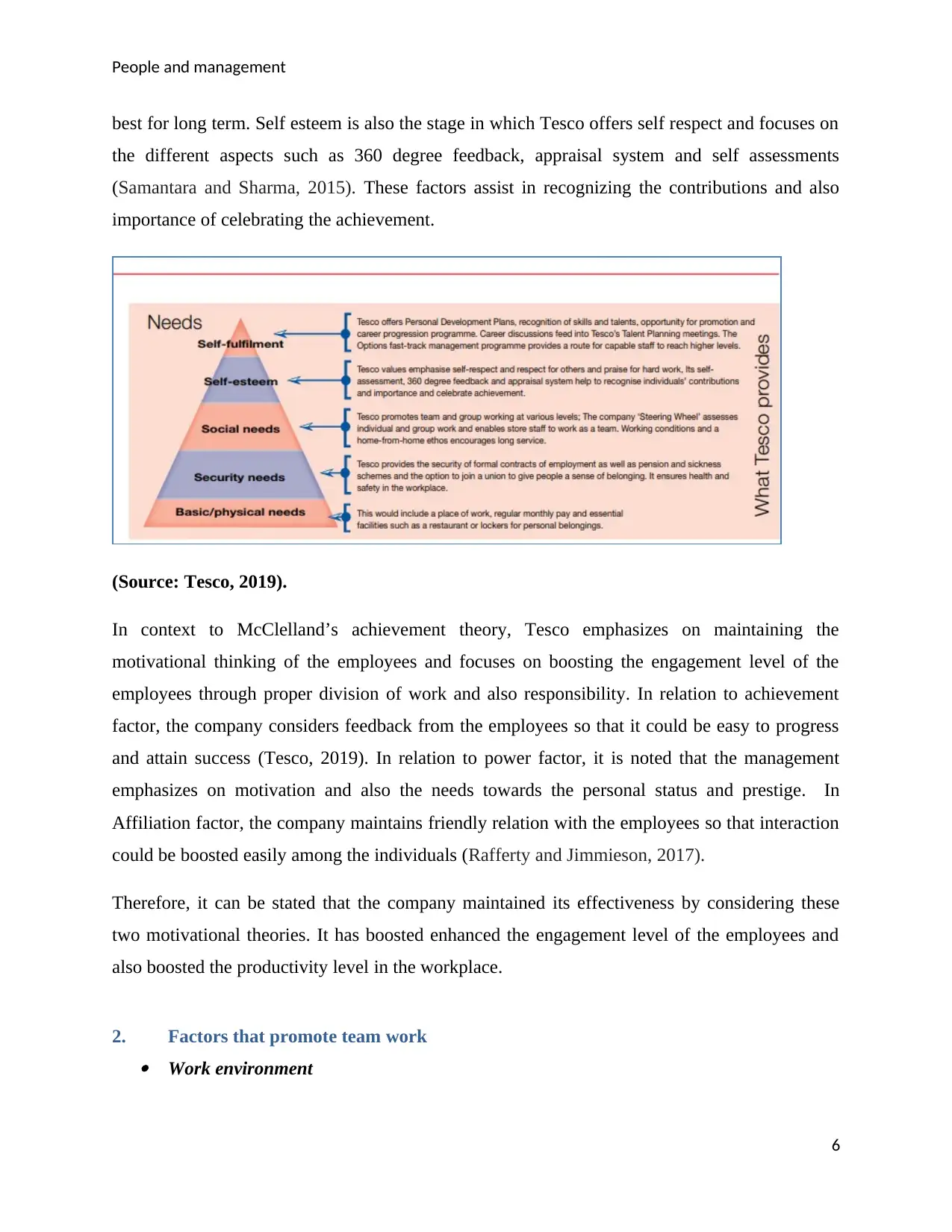
to the physiological needs of the employees, it has been observed that Tesco focuses on
regularity of monthly pay and also essential facilities are offered such as lockers for personal
belongingness. In security needs, Tesco offers a formal contracts of employment in which there
are pension and sickness schemes that helps to offer a people a sense of belonging. It assists in
ensuring the healthy and safety in the workplace (Tesco, 2019). The next stage is social needs, in
which the company emphasizes on boosting the team and group working at different levels. The
steering wheel of the company evaluates the work of the individual and team. In this the main
aim of the company is to maintain the working conditions, so that the employees can give their
5
should be given to the employees so that they can feel positive in the workplace. The last is a self
actualization need which is important as it reflects on the overall personal growth and experience
of the employees. Therefore, it can be stated that this theory is one of the best theory that should
be considered by the management as it can help in enhancing the satisfaction level of the
employees (Stoyanov, 2017).
Mc Clellands’s achievements theory
This theory differs from the Maslow hierarchy of needs. In this theory the emphasis is given on
satisfying the basic needs rather than developing the needs. This theory is also considered as the
“learned needs theory”. In this theory there are three motivators: achievement, affiliation and
power. The motivator related to achievement focuses on the internal drivers related to intrinsic
and extrinsic motivation (Miner, 2015). The next is affiliation motivator which emphasizes on
the requirement of love, belonging and relatedness. In this it is important for the people to have
the strong friendships and social group so that they can maintain interpersonal relations in the
workplace. The last aspect is power motivation, in which it is important to have control over the
work. This factor focuses on enhancing the personal status and also the prestige of the employees
in the workplace. McClellan stated that the male managers in the workplace with the high need
of power can boost the overall growth of the company (Miner, 2015).
1. Effectiveness of these motivation theories in Tesco
It is examined that company focuses on these two motivational theories, so that the basic needs
of the employees could be boosted. Maslow hierarchy of needs theory will be effective as the
company focuses on different aspects to boost the satisfaction level of the employees. IN relation
to the physiological needs of the employees, it has been observed that Tesco focuses on
regularity of monthly pay and also essential facilities are offered such as lockers for personal
belongingness. In security needs, Tesco offers a formal contracts of employment in which there
are pension and sickness schemes that helps to offer a people a sense of belonging. It assists in
ensuring the healthy and safety in the workplace (Tesco, 2019). The next stage is social needs, in
which the company emphasizes on boosting the team and group working at different levels. The
steering wheel of the company evaluates the work of the individual and team. In this the main
aim of the company is to maintain the working conditions, so that the employees can give their
5
People and management
best for long term. Self esteem is also the stage in which Tesco offers self respect and focuses on
the different aspects such as 360 degree feedback, appraisal system and self assessments
(Samantara and Sharma, 2015). These factors assist in recognizing the contributions and also
importance of celebrating the achievement.
(Source: Tesco, 2019).
In context to McClelland’s achievement theory, Tesco emphasizes on maintaining the
motivational thinking of the employees and focuses on boosting the engagement level of the
employees through proper division of work and also responsibility. In relation to achievement
factor, the company considers feedback from the employees so that it could be easy to progress
and attain success (Tesco, 2019). In relation to power factor, it is noted that the management
emphasizes on motivation and also the needs towards the personal status and prestige. In
Affiliation factor, the company maintains friendly relation with the employees so that interaction
could be boosted easily among the individuals (Rafferty and Jimmieson, 2017).
Therefore, it can be stated that the company maintained its effectiveness by considering these
two motivational theories. It has boosted enhanced the engagement level of the employees and
also boosted the productivity level in the workplace.
2. Factors that promote team work Work environment
6
best for long term. Self esteem is also the stage in which Tesco offers self respect and focuses on
the different aspects such as 360 degree feedback, appraisal system and self assessments
(Samantara and Sharma, 2015). These factors assist in recognizing the contributions and also
importance of celebrating the achievement.
(Source: Tesco, 2019).
In context to McClelland’s achievement theory, Tesco emphasizes on maintaining the
motivational thinking of the employees and focuses on boosting the engagement level of the
employees through proper division of work and also responsibility. In relation to achievement
factor, the company considers feedback from the employees so that it could be easy to progress
and attain success (Tesco, 2019). In relation to power factor, it is noted that the management
emphasizes on motivation and also the needs towards the personal status and prestige. In
Affiliation factor, the company maintains friendly relation with the employees so that interaction
could be boosted easily among the individuals (Rafferty and Jimmieson, 2017).
Therefore, it can be stated that the company maintained its effectiveness by considering these
two motivational theories. It has boosted enhanced the engagement level of the employees and
also boosted the productivity level in the workplace.
2. Factors that promote team work Work environment
6
⊘ This is a preview!⊘
Do you want full access?
Subscribe today to unlock all pages.
Trusted by 1+ million students worldwide
People and management
The working culture of the company is maintained with the positive behavior of the employees.
It has been noted that Tesco, was built with a mission “to be one of the champion for the
customers by assisting them to offer better quality products for life”. The values are considered
by the business so that the employees can work together to accomplish their set targets. Also,
“Little help plans” are created for the employees so that it could be easy to teach the employees
about the environmental challenges which are faced by them in the competitive market. The
tasks in the workplace are distributed according to the qualification and experience of the
employees as it will help the employees to give their best towards the set goals (Peeroo, Samy
and Jones, 2016).
Communication
To boost the team work, Tesco also emphasizes on maintaining the channel of communication. It
is noted that there are more than 295,000 workers in the company. So, to boost the team work,
the company emphasizes on maintaining effective channel of communication so that growth can
be attained. The problems or the issues of the employees are also resolved by focusing on the
three approaches. The first approach is to listen, in which the management listens the query of
the employees and customers. The next step is understand, in which they evaluate the factors that
are important to tackle these issues. The last is take action, in which it is important to maintain
the assessment of the clear guidance of the actions that can help in creating positivity in the
workplace. Also, group thinking is considered by taking the different views of the employees in
context to some particular issue. It is done so that it can be simple to attain positive outcome.
3. Factors that inhibit team work Maintaining trust
There are various factors that are likely to inhibit the development of effective team work in
Tesco. The first factor is related with maintaining the trust in the workplace. It is important for
the company to boost trust of the employees in the workplace, as it is seen that if trust is not
there then it can impact the overall team work. The management should emphasize on creating
mutual understanding and trust between the employees.
Leadership
7
The working culture of the company is maintained with the positive behavior of the employees.
It has been noted that Tesco, was built with a mission “to be one of the champion for the
customers by assisting them to offer better quality products for life”. The values are considered
by the business so that the employees can work together to accomplish their set targets. Also,
“Little help plans” are created for the employees so that it could be easy to teach the employees
about the environmental challenges which are faced by them in the competitive market. The
tasks in the workplace are distributed according to the qualification and experience of the
employees as it will help the employees to give their best towards the set goals (Peeroo, Samy
and Jones, 2016).
Communication
To boost the team work, Tesco also emphasizes on maintaining the channel of communication. It
is noted that there are more than 295,000 workers in the company. So, to boost the team work,
the company emphasizes on maintaining effective channel of communication so that growth can
be attained. The problems or the issues of the employees are also resolved by focusing on the
three approaches. The first approach is to listen, in which the management listens the query of
the employees and customers. The next step is understand, in which they evaluate the factors that
are important to tackle these issues. The last is take action, in which it is important to maintain
the assessment of the clear guidance of the actions that can help in creating positivity in the
workplace. Also, group thinking is considered by taking the different views of the employees in
context to some particular issue. It is done so that it can be simple to attain positive outcome.
3. Factors that inhibit team work Maintaining trust
There are various factors that are likely to inhibit the development of effective team work in
Tesco. The first factor is related with maintaining the trust in the workplace. It is important for
the company to boost trust of the employees in the workplace, as it is seen that if trust is not
there then it can impact the overall team work. The management should emphasize on creating
mutual understanding and trust between the employees.
Leadership
7
Paraphrase This Document
Need a fresh take? Get an instant paraphrase of this document with our AI Paraphraser
People and management
Leadership is also one of the factors that can inhibit the development of effective teamwork. It is
evaluated that the new leadership at Tesco is considered in which the focus is given on
maintaining responsibility and opportunity to the use the history of the company. The emphasis
is given by the leaders to renew the purpose of the company and to revitalize its brand. It is
important for the leaders to give training to the employees so that it could be easy to boost the
knowledge of the employees in relation to the overall activities of the company (Wood, Wrigley
and Coe, 2016). In the recent cases, Tesco has maintained its commitment to bring
improvisation in training and development of its workforce by offering apprenticeship program
to the employees. Also, the leaders focuses on giving on the job training to the employees, as it
helps to maintain the knowledge of the workers towards the work. It has helped to boost the team
work and also focuses on boosting the overall productivity level of the employees in the highly
competitive market.
4. Change management model
Lewin 3 phase process
This is one of the famous theories in relation to the change in the workplace. It is noted that
there are 3 phases in this model that can help in managing the change. The first stage is
unfreezing stage in which the focus is given on improving the readiness and willingness of the
people to manage the change (Hussain et al., 2018). It boosts the awareness of the people in
relation to the change and improves motivation for accepting the new changes in the workplace.
This stage is related with actual implementation of change. It focuses on engaging the acceptance
of the new ways and also in this stage the actual change is implemented. The last stage is freeze
stage in which the people focus on the change to maintain stability (Lines et al., 2015). The
employees in the workplace accept the new ways of working. These three are the stages in
relation to the change model given by Lewis.
Kotter change model
There are 8 steps in relation to this model. It is noted that in this the first step is “creating
urgency”, in which the emphasis is on identifying and highlighting the threats and it also
evaluate the opportunities through effective interventions. The next step is forming the powerful
guiding coalitions; in which the focus is given on analyzing the effective change leaders in the
8
Leadership is also one of the factors that can inhibit the development of effective teamwork. It is
evaluated that the new leadership at Tesco is considered in which the focus is given on
maintaining responsibility and opportunity to the use the history of the company. The emphasis
is given by the leaders to renew the purpose of the company and to revitalize its brand. It is
important for the leaders to give training to the employees so that it could be easy to boost the
knowledge of the employees in relation to the overall activities of the company (Wood, Wrigley
and Coe, 2016). In the recent cases, Tesco has maintained its commitment to bring
improvisation in training and development of its workforce by offering apprenticeship program
to the employees. Also, the leaders focuses on giving on the job training to the employees, as it
helps to maintain the knowledge of the workers towards the work. It has helped to boost the team
work and also focuses on boosting the overall productivity level of the employees in the highly
competitive market.
4. Change management model
Lewin 3 phase process
This is one of the famous theories in relation to the change in the workplace. It is noted that
there are 3 phases in this model that can help in managing the change. The first stage is
unfreezing stage in which the focus is given on improving the readiness and willingness of the
people to manage the change (Hussain et al., 2018). It boosts the awareness of the people in
relation to the change and improves motivation for accepting the new changes in the workplace.
This stage is related with actual implementation of change. It focuses on engaging the acceptance
of the new ways and also in this stage the actual change is implemented. The last stage is freeze
stage in which the people focus on the change to maintain stability (Lines et al., 2015). The
employees in the workplace accept the new ways of working. These three are the stages in
relation to the change model given by Lewis.
Kotter change model
There are 8 steps in relation to this model. It is noted that in this the first step is “creating
urgency”, in which the emphasis is on identifying and highlighting the threats and it also
evaluate the opportunities through effective interventions. The next step is forming the powerful
guiding coalitions; in which the focus is given on analyzing the effective change leaders in the
8
People and management
workplace and also to identify the weak areas. Third step is to develop a vision and a strategy, in
which the core values are determined and also the focus is given on maintaining the vision. The
next stage is communicating the vision, in which the issues of the people are considered (Small
et al., 2016). Removing obstacle is also the stage in which the people are rewarded for endorsing
the change in the workplace. The sixth step is to create a short term wins, in which the short term
targeted, are created instead of focusing on the long term goals. The next step is consolidating
the gains that emphasizes on achieving the continuous achievement by evaluating the success
stories. The last step is anchoring the change in relation to corporate culture. It helps to focus on
discussing the successful stories related to the change initiatives (Jost, 2015).
5. Change management in Tesco
External and internal forces of change Economic conditions
It is one of the external changes that impact the overall activities of the company. It has been
seen that to manage the change in context to the economic conditions, Tesco emphasizes on
considering the needs and wants of the customers so that it could be easy to consider the change
in the external environment. In relation to the model that could be applied to the company is
related with “identification of the change in Tesco”. In relation to these models, it is important
for the company to consider the transformational leadership so that resistance to change in the
workplace can be minimized. The leaders should have the responsibility to motivate the
employees to attain the positive results. The Lewin model is considered by the managers in
which the three stages are considered to make accurate decisions. By considering these three
stages, the company focuses on managing the change and also boosts the employee engagement
level towards the activities (Salman and Broten, 2017). Technological developments
It is one of the internal changes that are considered by the company to manage the change and to
reduce resistance to change. In this, Tesco focuses on providing effective customer service with
the use of latest technology. To manage the resistance to change, Tesco is emphasizing on using
the latest technology, in which the workload of the employees will be reduced. The company is
focusing on the concept of “leverage card data”. This concept will help in promotional targeting
9
workplace and also to identify the weak areas. Third step is to develop a vision and a strategy, in
which the core values are determined and also the focus is given on maintaining the vision. The
next stage is communicating the vision, in which the issues of the people are considered (Small
et al., 2016). Removing obstacle is also the stage in which the people are rewarded for endorsing
the change in the workplace. The sixth step is to create a short term wins, in which the short term
targeted, are created instead of focusing on the long term goals. The next step is consolidating
the gains that emphasizes on achieving the continuous achievement by evaluating the success
stories. The last step is anchoring the change in relation to corporate culture. It helps to focus on
discussing the successful stories related to the change initiatives (Jost, 2015).
5. Change management in Tesco
External and internal forces of change Economic conditions
It is one of the external changes that impact the overall activities of the company. It has been
seen that to manage the change in context to the economic conditions, Tesco emphasizes on
considering the needs and wants of the customers so that it could be easy to consider the change
in the external environment. In relation to the model that could be applied to the company is
related with “identification of the change in Tesco”. In relation to these models, it is important
for the company to consider the transformational leadership so that resistance to change in the
workplace can be minimized. The leaders should have the responsibility to motivate the
employees to attain the positive results. The Lewin model is considered by the managers in
which the three stages are considered to make accurate decisions. By considering these three
stages, the company focuses on managing the change and also boosts the employee engagement
level towards the activities (Salman and Broten, 2017). Technological developments
It is one of the internal changes that are considered by the company to manage the change and to
reduce resistance to change. In this, Tesco focuses on providing effective customer service with
the use of latest technology. To manage the resistance to change, Tesco is emphasizing on using
the latest technology, in which the workload of the employees will be reduced. The company is
focusing on the concept of “leverage card data”. This concept will help in promotional targeting
9
⊘ This is a preview!⊘
Do you want full access?
Subscribe today to unlock all pages.
Trusted by 1+ million students worldwide
People and management
of the shoppers. The company is considering the “HOME grown continuous replenishment
program” in which it will help to generate finely turned orders for every stores. This system will
assist the supply chain practices like frequent store deliveries (Sadler-Smith et al., 2017).
Also to reduce the resistance to change the company is emphasizing on the factors that can help
in making the change successful in the workplace. The focus is given on different factors such as
top management sponsorship, employee engagement and also the emphasis is on maintaining the
internal culture. These factors could help the company to attain positive outcome and also
motivate the employees to give their best towards the assigned work.
Recommendation
By analyzing the different factors, it is recommended that the company should focus on these
factors. The company should make improvement in these factors to focus on the concept of
people management.
Incentive scheme
It is recommended that Tesco should focus on bringing improvement in its incentive policy. The
changes should be made in the incentive policy schemes. Such as, the incentives should be
offered to the employees by analyzing their performance on the monthly basis. This change
could help to boost the engagement level of the employees and will directly generate interest of
the employees towards their work.
Training
The company should set the policy of giving training for 2 months. This will help to boost the
knowledge of the employees and also they can have proper understanding of managing the work.
When proper training is given to them, then it will also reduce resistance to change in the
workplace. Therefore, it can be said that these two are factors on which the company should
emphasize so that it can be easy to boost the motivation and also to attain positive outcome in the
highly competitive market.
10
of the shoppers. The company is considering the “HOME grown continuous replenishment
program” in which it will help to generate finely turned orders for every stores. This system will
assist the supply chain practices like frequent store deliveries (Sadler-Smith et al., 2017).
Also to reduce the resistance to change the company is emphasizing on the factors that can help
in making the change successful in the workplace. The focus is given on different factors such as
top management sponsorship, employee engagement and also the emphasis is on maintaining the
internal culture. These factors could help the company to attain positive outcome and also
motivate the employees to give their best towards the assigned work.
Recommendation
By analyzing the different factors, it is recommended that the company should focus on these
factors. The company should make improvement in these factors to focus on the concept of
people management.
Incentive scheme
It is recommended that Tesco should focus on bringing improvement in its incentive policy. The
changes should be made in the incentive policy schemes. Such as, the incentives should be
offered to the employees by analyzing their performance on the monthly basis. This change
could help to boost the engagement level of the employees and will directly generate interest of
the employees towards their work.
Training
The company should set the policy of giving training for 2 months. This will help to boost the
knowledge of the employees and also they can have proper understanding of managing the work.
When proper training is given to them, then it will also reduce resistance to change in the
workplace. Therefore, it can be said that these two are factors on which the company should
emphasize so that it can be easy to boost the motivation and also to attain positive outcome in the
highly competitive market.
10
Paraphrase This Document
Need a fresh take? Get an instant paraphrase of this document with our AI Paraphraser
People and management
References
.
D'Souza, J. and Gurin, M., 2016. The universal significance of Maslow’s concept of self-
actualization. The Humanistic Psychologist, 44(2), p.210.
Fallatah, R.H.M. and Syed, J., 2018. A Critical Review of Maslow’s Hierarchy of Needs.
In Employee Motivation in Saudi Arabia (pp. 19-59). Palgrave Macmillan, Cham.
11
References
.
D'Souza, J. and Gurin, M., 2016. The universal significance of Maslow’s concept of self-
actualization. The Humanistic Psychologist, 44(2), p.210.
Fallatah, R.H.M. and Syed, J., 2018. A Critical Review of Maslow’s Hierarchy of Needs.
In Employee Motivation in Saudi Arabia (pp. 19-59). Palgrave Macmillan, Cham.
11
People and management
Hussain, S.T., Lei, S., Akram, T., Haider, M.J., Hussain, S.H. and Ali, M., 2018. Kurt Lewin's
change model: A critical review of the role of leadership and employee involvement in
organizational change. Journal of Innovation & Knowledge, 3(3), pp.123-127.
Jost, J.T., 2015. Resistance to change: A social psychological perspective. Social Research: An
International Quarterly, 82(3), pp.607-636.
Lines, B.C., Sullivan, K.T., Smithwick, J.B. and Mischung, J., 2015. Overcoming resistance to
change in engineering and construction: Change management factors for owner
organizations. International Journal of Project Management, 33(5), pp.1170-1179.
Miner, J.B., 2015. Achievement Motivation Theory: David McClelland. In Organizational
Behavior 1 (pp. 62-76). Routledge.
Miner, J.B., 2015. Organizational behavior 1: Essential theories of motivation and leadership.
Routledge.
Peeroo, S., Samy, M. and Jones, B., 2016, September. Generating Customer Engagement and
Customer Enragement on Facebook Pages of Tesco and Walmart. In Conference on e-Business,
e-Services and e-Society (pp. 146-156). Springer International Publishing.
Rafferty, A.E. and Jimmieson, N.L., 2017. Subjective perceptions of organizational change and
employee resistance to change: direct and mediated relationships with employee well‐
being. British Journal of Management, 28(2), pp.248-264.
Sadler-Smith, E., Akstinaite, V., Robinson, G. and Wray, T., 2017. Hubristic leadership: A
review. Leadership, 13(5), pp.525-548.
Salman, Y. and Broten, N., 2017. Leading Change. Macat Library.
Samantara, R. and Sharma, N., 2015. Talent Management at Tesco: A Case Study. Parikalpana:
KIIT Journal of Management, 11(2), p.95.
Small, A., Gist, D., Souza, D., Dalton, J., Magny-Normilus, C. and David, D., 2016. Using
Kotter's change model for implementing bedside handoff: a quality improvement
project. Journal of nursing care quality, 31(4), pp.304-309.
12
Hussain, S.T., Lei, S., Akram, T., Haider, M.J., Hussain, S.H. and Ali, M., 2018. Kurt Lewin's
change model: A critical review of the role of leadership and employee involvement in
organizational change. Journal of Innovation & Knowledge, 3(3), pp.123-127.
Jost, J.T., 2015. Resistance to change: A social psychological perspective. Social Research: An
International Quarterly, 82(3), pp.607-636.
Lines, B.C., Sullivan, K.T., Smithwick, J.B. and Mischung, J., 2015. Overcoming resistance to
change in engineering and construction: Change management factors for owner
organizations. International Journal of Project Management, 33(5), pp.1170-1179.
Miner, J.B., 2015. Achievement Motivation Theory: David McClelland. In Organizational
Behavior 1 (pp. 62-76). Routledge.
Miner, J.B., 2015. Organizational behavior 1: Essential theories of motivation and leadership.
Routledge.
Peeroo, S., Samy, M. and Jones, B., 2016, September. Generating Customer Engagement and
Customer Enragement on Facebook Pages of Tesco and Walmart. In Conference on e-Business,
e-Services and e-Society (pp. 146-156). Springer International Publishing.
Rafferty, A.E. and Jimmieson, N.L., 2017. Subjective perceptions of organizational change and
employee resistance to change: direct and mediated relationships with employee well‐
being. British Journal of Management, 28(2), pp.248-264.
Sadler-Smith, E., Akstinaite, V., Robinson, G. and Wray, T., 2017. Hubristic leadership: A
review. Leadership, 13(5), pp.525-548.
Salman, Y. and Broten, N., 2017. Leading Change. Macat Library.
Samantara, R. and Sharma, N., 2015. Talent Management at Tesco: A Case Study. Parikalpana:
KIIT Journal of Management, 11(2), p.95.
Small, A., Gist, D., Souza, D., Dalton, J., Magny-Normilus, C. and David, D., 2016. Using
Kotter's change model for implementing bedside handoff: a quality improvement
project. Journal of nursing care quality, 31(4), pp.304-309.
12
⊘ This is a preview!⊘
Do you want full access?
Subscribe today to unlock all pages.
Trusted by 1+ million students worldwide

1 out of 13


Related Documents


Your All-in-One AI-Powered Toolkit for Academic Success.
+13062052269
info@desklib.com
Available 24*7 on WhatsApp / Email
![[object Object]](/_next/static/media/star-bottom.7253800d.svg)
Unlock your academic potential
Copyright © 2020–2026 A2Z Services. All Rights Reserved. Developed and managed by ZUCOL.