Tesco: Motivation and Communication in Organizational Behaviour
VerifiedAdded on 2023/06/07
|13
|3573
|145
Report
AI Summary
This report provides an analysis of organizational behaviour within Tesco plc, focusing on the critical aspects of motivation and communication. It explores various organizational behaviour management (OBM) practices employed by Tesco and their impact on the workplace environment. The report delves into relevant organizational theories, identifies problems related to motivation and communication, and offers potential solutions through comparative analysis. Primary research findings are included, along with a discussion of the impact of motivational and communication theories on organizations. The report concludes with justified recommendations for improving organizational behaviour at Tesco, emphasizing the interconnectedness of motivation and communication in fostering a healthy and productive work environment.
ORGANIZATIONAL
BEHAVIOUR
BEHAVIOUR

Paraphrase This Document
Need a fresh take? Get an instant paraphrase of this document with our AI Paraphraser
EXECUTIVE SUMMARY:
The following report is on organizational behaviour in the context of one the United
Kingdom's biggest food retailer companies named Tesco plc in which is used for the purpose of
defining and describing the chosen topics of motivation and communication. It will contain a
comprehensive description of the selected Tesco organization in conjunction with what kinds of
organizational behavioural management (OBM) practices it follows and how it constitutes a
significant element in the workplace environment. The reader will come to know about certain
organizational theories, problem identification with solutions, and a critical evaluation of both
the topics in relation to and opposite from each other through comparing and contrasting. The
research study will discuss how the motivational and communication theories impact
organizations. The report will also include a primary research along with defining its tools,
selection process, implementation methods, and analytical findings. It will conclude with
justified recommendations.
The following report is on organizational behaviour in the context of one the United
Kingdom's biggest food retailer companies named Tesco plc in which is used for the purpose of
defining and describing the chosen topics of motivation and communication. It will contain a
comprehensive description of the selected Tesco organization in conjunction with what kinds of
organizational behavioural management (OBM) practices it follows and how it constitutes a
significant element in the workplace environment. The reader will come to know about certain
organizational theories, problem identification with solutions, and a critical evaluation of both
the topics in relation to and opposite from each other through comparing and contrasting. The
research study will discuss how the motivational and communication theories impact
organizations. The report will also include a primary research along with defining its tools,
selection process, implementation methods, and analytical findings. It will conclude with
justified recommendations.
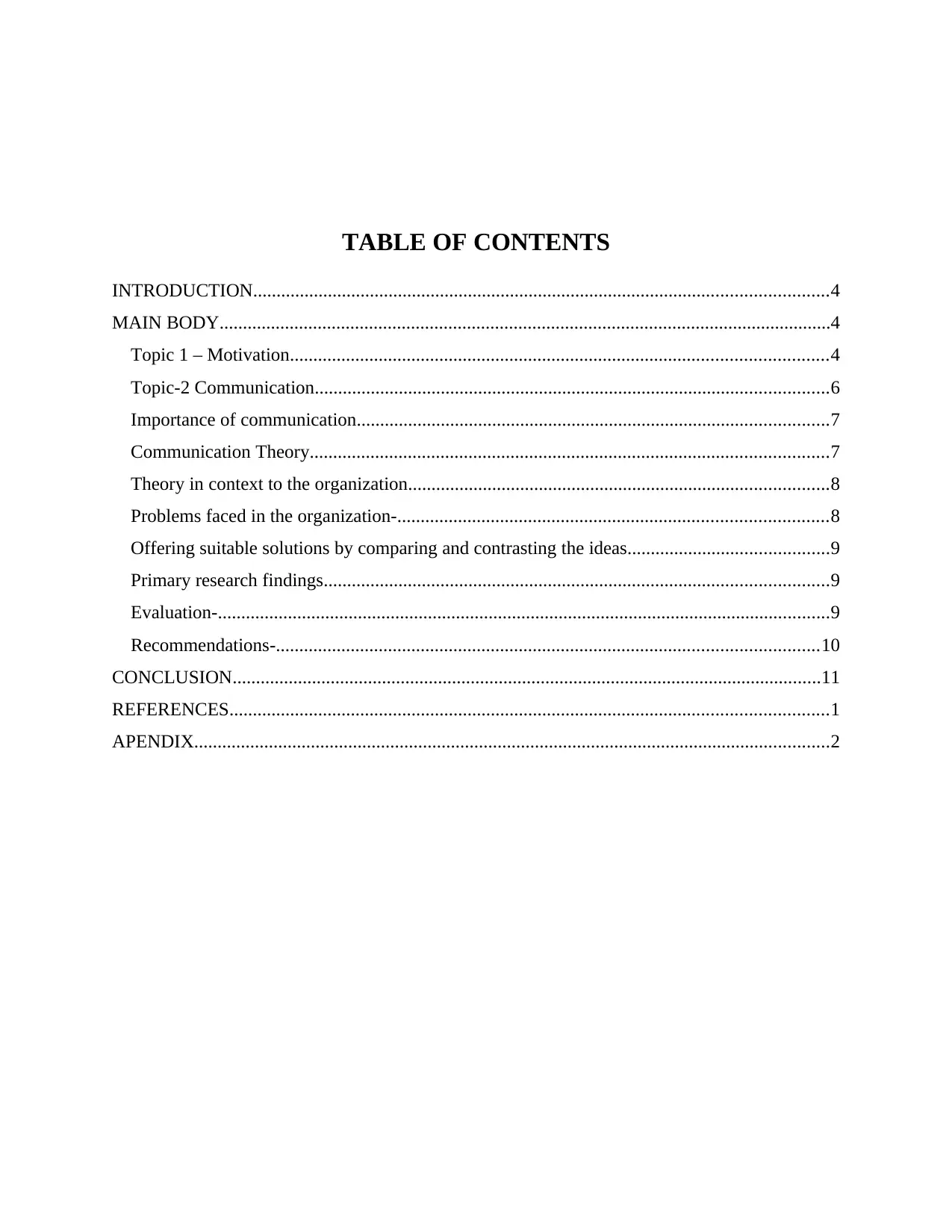
TABLE OF CONTENTS
INTRODUCTION...........................................................................................................................4
MAIN BODY...................................................................................................................................4
Topic 1 – Motivation...................................................................................................................4
Topic-2 Communication..............................................................................................................6
Importance of communication.....................................................................................................7
Communication Theory...............................................................................................................7
Theory in context to the organization..........................................................................................8
Problems faced in the organization-............................................................................................8
Offering suitable solutions by comparing and contrasting the ideas...........................................9
Primary research findings............................................................................................................9
Evaluation-...................................................................................................................................9
Recommendations-....................................................................................................................10
CONCLUSION..............................................................................................................................11
REFERENCES................................................................................................................................1
APENDIX........................................................................................................................................2
INTRODUCTION...........................................................................................................................4
MAIN BODY...................................................................................................................................4
Topic 1 – Motivation...................................................................................................................4
Topic-2 Communication..............................................................................................................6
Importance of communication.....................................................................................................7
Communication Theory...............................................................................................................7
Theory in context to the organization..........................................................................................8
Problems faced in the organization-............................................................................................8
Offering suitable solutions by comparing and contrasting the ideas...........................................9
Primary research findings............................................................................................................9
Evaluation-...................................................................................................................................9
Recommendations-....................................................................................................................10
CONCLUSION..............................................................................................................................11
REFERENCES................................................................................................................................1
APENDIX........................................................................................................................................2
⊘ This is a preview!⊘
Do you want full access?
Subscribe today to unlock all pages.

Trusted by 1+ million students worldwide
INTRODUCTION
Organizational behaviour refers to the way of how people working in an organization
should interact with one another. It is basically a study of the human behaviour which aims to
meliorate the theory of organization (Buchanan, and Huczynski, 2019). Organizational behaviour
becomes an important factor as it develops an understanding between the employees at a work
place and help them in developing better relationships. There are also two most important factors
under the organizational behaviour namely: Motivation and Communication, that contributes the
most in making an environment of an organization healthy (Wilson, 2018). Where,
Communication is sharing of important and mandatory information to one another in the
workplace and is the key of success in an organization, motivation on other hand, is the factor
that contributes to the communication as it is the act of encouraging the people at a workplace to
achieve the goals efficiently and effectively (Nuckcheddy, 2018). Both these factors work hand
in hand and play an important role in the organizational behaviour. Tesco is an international
British brand, which deals in general merchandise and groceries. The brand is the 9th largest
retailing brand when it comes to the highest revenue generation. This report will comprise the
concepts such a motivation and communication related to the organizational behaviour, an
understanding of the theories, identification of the problems in the organization and, derivations
and evaluations of the solutions for the cause. Lastly the report also provides an executive
summary.
MAIN BODY
Topic 1 – Motivation
The term motivation can be defined as a behavioural virtue or trait that plays an integral
role in almost every field. In the workplace scenario of business organizations motivation is
considered as a key element in upholding and maintaining the professional standard requirement
of the company by keeping its working staff and employees happy, satisfied and committed.
Motivation means the encouragement of individuals in both intrinsic and extrinsic manners in
order to boost their morale to work and give their best outputs to themselves and to the
respective company as well. Through this people get a reason to give in their best efforts.
Importance of motivation
Motivation as an organizational virtue is extremely important as it helps in an allover
development of both the individuals and their skills that result in less employee turnover, better
Organizational behaviour refers to the way of how people working in an organization
should interact with one another. It is basically a study of the human behaviour which aims to
meliorate the theory of organization (Buchanan, and Huczynski, 2019). Organizational behaviour
becomes an important factor as it develops an understanding between the employees at a work
place and help them in developing better relationships. There are also two most important factors
under the organizational behaviour namely: Motivation and Communication, that contributes the
most in making an environment of an organization healthy (Wilson, 2018). Where,
Communication is sharing of important and mandatory information to one another in the
workplace and is the key of success in an organization, motivation on other hand, is the factor
that contributes to the communication as it is the act of encouraging the people at a workplace to
achieve the goals efficiently and effectively (Nuckcheddy, 2018). Both these factors work hand
in hand and play an important role in the organizational behaviour. Tesco is an international
British brand, which deals in general merchandise and groceries. The brand is the 9th largest
retailing brand when it comes to the highest revenue generation. This report will comprise the
concepts such a motivation and communication related to the organizational behaviour, an
understanding of the theories, identification of the problems in the organization and, derivations
and evaluations of the solutions for the cause. Lastly the report also provides an executive
summary.
MAIN BODY
Topic 1 – Motivation
The term motivation can be defined as a behavioural virtue or trait that plays an integral
role in almost every field. In the workplace scenario of business organizations motivation is
considered as a key element in upholding and maintaining the professional standard requirement
of the company by keeping its working staff and employees happy, satisfied and committed.
Motivation means the encouragement of individuals in both intrinsic and extrinsic manners in
order to boost their morale to work and give their best outputs to themselves and to the
respective company as well. Through this people get a reason to give in their best efforts.
Importance of motivation
Motivation as an organizational virtue is extremely important as it helps in an allover
development of both the individuals and their skills that result in less employee turnover, better
Paraphrase This Document
Need a fresh take? Get an instant paraphrase of this document with our AI Paraphraser
productivity, consumer satisfaction and a healty brand image. The importance of motivation in
workplace environments can be easily observed in the form of high work performance
efficiency, good interpersonal relationships, and augmented sales and market share. The
performance index of the staff members rises with good motivational policies. They will work
harder, smarter, faster, and better than before. Time to time encouragement of employees by the
supervising manager leads to a friendly environment (Paais and Pattiruhu, 2020).
Theories of motivation
Motivational theories are refered to as the efficiency and productivity management tools
that an organization implements for the managerial teams to determine the best way to achieve
business work related goals and objectives and to make the employees work toward a desired
outcome. Some popularly used motivational theories are the Incentive theory that focus on
providing bonus, praise, opportunity, promotion, paid vacations, and salar increments to the
employees (Acquah and et.al., 2021). Another theory is that of Mcllelands Need theory of
affiliation, avhievement and power recogniton. One of the most famous ones is that of Maslow's
Hierarchy motivational theory emphasizing the fulfiment of survival, esteem and self-
actualization of the staff.
Motivation concept in the context of Tesco organization –
The leading food retailing organization of UK, the Tesco firm aims at achieving one of
the best employee motivation scenario in its organizational workflow structure so that factors
related to hygienic activities remain fulfilled. The firm's own definition of motivation is a
concept which includes time-to-time appreciation of hard work, deadline acheivement
recognition, empowering sense of responsible employees, and creating a vibe of an entertaining
and challenging professional zone. Tesco rewards its employees with provisional offers of gym
memberships, workout discounts, investment options in company share, and high-end salaries
that make the staff feel valued and helps facilitate their motivation (Awadari and Kanwal, 2019).
Problem identification and solutions –
Although the food retailer organization with all its 12 stores around the world
undoubtedly focuses on its organizational employee encouragement factor, there are still some
hurdles that the company faces such as the losing interest of its workers in such policies. For
instance, as per an academic report it has been found that the firm uses a lot of motivational
theories one of which is Abraham Maslow's motivational theory of hierarchical needs factor that
workplace environments can be easily observed in the form of high work performance
efficiency, good interpersonal relationships, and augmented sales and market share. The
performance index of the staff members rises with good motivational policies. They will work
harder, smarter, faster, and better than before. Time to time encouragement of employees by the
supervising manager leads to a friendly environment (Paais and Pattiruhu, 2020).
Theories of motivation
Motivational theories are refered to as the efficiency and productivity management tools
that an organization implements for the managerial teams to determine the best way to achieve
business work related goals and objectives and to make the employees work toward a desired
outcome. Some popularly used motivational theories are the Incentive theory that focus on
providing bonus, praise, opportunity, promotion, paid vacations, and salar increments to the
employees (Acquah and et.al., 2021). Another theory is that of Mcllelands Need theory of
affiliation, avhievement and power recogniton. One of the most famous ones is that of Maslow's
Hierarchy motivational theory emphasizing the fulfiment of survival, esteem and self-
actualization of the staff.
Motivation concept in the context of Tesco organization –
The leading food retailing organization of UK, the Tesco firm aims at achieving one of
the best employee motivation scenario in its organizational workflow structure so that factors
related to hygienic activities remain fulfilled. The firm's own definition of motivation is a
concept which includes time-to-time appreciation of hard work, deadline acheivement
recognition, empowering sense of responsible employees, and creating a vibe of an entertaining
and challenging professional zone. Tesco rewards its employees with provisional offers of gym
memberships, workout discounts, investment options in company share, and high-end salaries
that make the staff feel valued and helps facilitate their motivation (Awadari and Kanwal, 2019).
Problem identification and solutions –
Although the food retailer organization with all its 12 stores around the world
undoubtedly focuses on its organizational employee encouragement factor, there are still some
hurdles that the company faces such as the losing interest of its workers in such policies. For
instance, as per an academic report it has been found that the firm uses a lot of motivational
theories one of which is Abraham Maslow's motivational theory of hierarchical needs factor that
the senior management team uses in its work culture. It has been reported that there were certain
drawbacks that got converted into problems that Tesco company faces regarding this topic. It
includes uneven outcomes of the motivational factor as it varies as per differing individuals. It
means that it is difficult to ascertain whether esteem could be built for all in the same way or not.
The above mentioned problem can be solved through the application of critical thinking
and a further analysis of the offered solutions. In order to proceed further with this first it needs
to be understood that Maslow's theory of motivational hierarchy is based on a lot of
physiological and psychological aspects. The former can still be fulfilled through basic needs
completion but the latter feature appeals differently to different people. The problem that Tesco
faces regarding this can be dealt with by comprehending the differences among employees and
attending to their needs in varied manners such as through board room conferences, general
meets, and group discussions (Fadeyi, 2020).
Comparison and Evaluation of motivation and communication virtues –
Many business organizations use the motivational aspect at the workplace for inducing
the employees to become better working individuals. This can only be done with the help of
proper organizational communication in place. In many corporate cultural environments there
exists either faulty communication or miscommunication through which it becomes improbable
to convey clear and distinct messages to the company personnel (Men and Yue, 2019). This is
one of the main reasons as to why motivating factors sometimes do not work because of lack of a
positive communicative environment. Also, there is the fact that a conducive communicative
nature among employees and senior management invariably leads to the the establishment of
friendly and amiable relations between the management and workers. When the management
introduces a good motivational plan for its empoyees and executes the same by considering the
staff's feelings and requirements, the entire organization gains a stable ground. The workforce
efficiency gets increased which further leads to the procurement of better quality goods and
services.
Topic-2 Communication
Communication is a term engaged with the exchanging or imparting of the information
either by writing or by speaking. It is typically a receiving, giving and sharing of informations by
the act of talking, listening, reading or writing to one another.
drawbacks that got converted into problems that Tesco company faces regarding this topic. It
includes uneven outcomes of the motivational factor as it varies as per differing individuals. It
means that it is difficult to ascertain whether esteem could be built for all in the same way or not.
The above mentioned problem can be solved through the application of critical thinking
and a further analysis of the offered solutions. In order to proceed further with this first it needs
to be understood that Maslow's theory of motivational hierarchy is based on a lot of
physiological and psychological aspects. The former can still be fulfilled through basic needs
completion but the latter feature appeals differently to different people. The problem that Tesco
faces regarding this can be dealt with by comprehending the differences among employees and
attending to their needs in varied manners such as through board room conferences, general
meets, and group discussions (Fadeyi, 2020).
Comparison and Evaluation of motivation and communication virtues –
Many business organizations use the motivational aspect at the workplace for inducing
the employees to become better working individuals. This can only be done with the help of
proper organizational communication in place. In many corporate cultural environments there
exists either faulty communication or miscommunication through which it becomes improbable
to convey clear and distinct messages to the company personnel (Men and Yue, 2019). This is
one of the main reasons as to why motivating factors sometimes do not work because of lack of a
positive communicative environment. Also, there is the fact that a conducive communicative
nature among employees and senior management invariably leads to the the establishment of
friendly and amiable relations between the management and workers. When the management
introduces a good motivational plan for its empoyees and executes the same by considering the
staff's feelings and requirements, the entire organization gains a stable ground. The workforce
efficiency gets increased which further leads to the procurement of better quality goods and
services.
Topic-2 Communication
Communication is a term engaged with the exchanging or imparting of the information
either by writing or by speaking. It is typically a receiving, giving and sharing of informations by
the act of talking, listening, reading or writing to one another.
⊘ This is a preview!⊘
Do you want full access?
Subscribe today to unlock all pages.
Trusted by 1+ million students worldwide
Importance of communication
Communication is an important factor in an organization as it helps in passing of the important
informations which regulates the whole flow of work. A good communication in a work place
leaves no confusions behind in the minds of the people which also let the individuals perform
effectively and efficiently in an organization. Communication helps in building better
relationships at the workplace by allowing individuals to share their experiences, needs, and also
helps them to connect with one another (Radovic Markovic and Salamzadeh, 2018). There is a
reason why it is said that communication is the key of success, it enables the authorities to
develop great morale of the employees which helps them to maintain their commitment and
increase the productivity. I also helps in creating a healthy environment in an organization which
makes working fun and easy and eventually leads to near future success of an organization.
Hence, the communication is a very important factor in an organization and in the organizational
theory.
Communication Theory
Classical Rhetoric
Classical Rhetorical theory is developed on a thought of how the language actually works
on people. This theory was identified when slowly it came into notice that is some or the other
kind of influence on the listener while someone speaks to them (Borchers, and Hundley, 2018).
The theory does not hold any universality but is an effective theory as it focus on three main
elements namely;
1. SPEAKER
2. MESSAGE
3. AUDIENCE
But later Rhetoricians also laid emphasis on the message part and added two more contextual
concerns namely: Purpose and Place
Speaker- According to Aristotle, here the role of the speaker is an important role as the audience
tend to consider and discredit all what is delivered during the speech. This theory emphasizes the
speaker on being effective enough, trustworthy enough and polite enough to hold a good
impression on the audience and influence them.
Message- The theory demands message to reflect disposition of speaker and to be appropriate
when it comes to the right audience, right purpose and right place. Basically the message should
Communication is an important factor in an organization as it helps in passing of the important
informations which regulates the whole flow of work. A good communication in a work place
leaves no confusions behind in the minds of the people which also let the individuals perform
effectively and efficiently in an organization. Communication helps in building better
relationships at the workplace by allowing individuals to share their experiences, needs, and also
helps them to connect with one another (Radovic Markovic and Salamzadeh, 2018). There is a
reason why it is said that communication is the key of success, it enables the authorities to
develop great morale of the employees which helps them to maintain their commitment and
increase the productivity. I also helps in creating a healthy environment in an organization which
makes working fun and easy and eventually leads to near future success of an organization.
Hence, the communication is a very important factor in an organization and in the organizational
theory.
Communication Theory
Classical Rhetoric
Classical Rhetorical theory is developed on a thought of how the language actually works
on people. This theory was identified when slowly it came into notice that is some or the other
kind of influence on the listener while someone speaks to them (Borchers, and Hundley, 2018).
The theory does not hold any universality but is an effective theory as it focus on three main
elements namely;
1. SPEAKER
2. MESSAGE
3. AUDIENCE
But later Rhetoricians also laid emphasis on the message part and added two more contextual
concerns namely: Purpose and Place
Speaker- According to Aristotle, here the role of the speaker is an important role as the audience
tend to consider and discredit all what is delivered during the speech. This theory emphasizes the
speaker on being effective enough, trustworthy enough and polite enough to hold a good
impression on the audience and influence them.
Message- The theory demands message to reflect disposition of speaker and to be appropriate
when it comes to the right audience, right purpose and right place. Basically the message should
Paraphrase This Document
Need a fresh take? Get an instant paraphrase of this document with our AI Paraphraser
be delivered by presenting all the characteristics and of the purpose using facial expressions,
gestures that can hold a good value in front of the audience eyes and make the delivery of words
effective.
Audience- According to the classical authorities all the communication should be effective and
must tailor the message to its shape, size, tastes, political interests, moral, cultural circumstances
and intelligence of the audience.
Place- This refers to the determination of a place where the communication is going to take
place. For example speaker should be concerned about the things such as meeting room, sound
amplification, visual effects etc. and the writer should concern about where the message has to
be read by the audience is it the newspaper, the magazine, bulletin board etc.
Purpose- This theory focus on the speakers to have a clear purpose behind delivering the
message. The message should be definite and should deliver the purpose behind it. Its is also said
that the speaker should have a clear, practical and definite purpose in their mind first, so that
there is no loss of sight during the time when the message is conveyed.
Theory in context to the organization
With the help of this communication theory in Tesco, the place is going to have an
excellent understanding between the authorities and the employees. As this Classical Rhetoric
focus on the better and effective communication by emphasizing on the delivery of the message
and disposition of the speaker. The theory demands the speaker and the message to be effective
enough to serve the actual purpose and hold a good impression on the audience. Here in Tesco,
Classical Rhetoric is going to help in maintaining a healthy work-culture in the organization as
first, it will have the managers to develop a thought of what and how the audience will interpret
the message and after thinking through it, they can deliver the message in a much and far better
way in terms of clarity, effectiveness, politeness etc.
Problems faced in the organization-
Tesco is a huge organization and has a wide spread network of the operations, the
customers, the suppliers etc. As the organization is involved in serving large number of
customers, this implies that the organization also has a great workforce of the employees. The
company is doing a great job but when shortage of some products observed in the stores of the
company it reflected a major problem of the lack of communication. It came into notice that the
company's communication networks were not so strong and were also causing confusions and
gestures that can hold a good value in front of the audience eyes and make the delivery of words
effective.
Audience- According to the classical authorities all the communication should be effective and
must tailor the message to its shape, size, tastes, political interests, moral, cultural circumstances
and intelligence of the audience.
Place- This refers to the determination of a place where the communication is going to take
place. For example speaker should be concerned about the things such as meeting room, sound
amplification, visual effects etc. and the writer should concern about where the message has to
be read by the audience is it the newspaper, the magazine, bulletin board etc.
Purpose- This theory focus on the speakers to have a clear purpose behind delivering the
message. The message should be definite and should deliver the purpose behind it. Its is also said
that the speaker should have a clear, practical and definite purpose in their mind first, so that
there is no loss of sight during the time when the message is conveyed.
Theory in context to the organization
With the help of this communication theory in Tesco, the place is going to have an
excellent understanding between the authorities and the employees. As this Classical Rhetoric
focus on the better and effective communication by emphasizing on the delivery of the message
and disposition of the speaker. The theory demands the speaker and the message to be effective
enough to serve the actual purpose and hold a good impression on the audience. Here in Tesco,
Classical Rhetoric is going to help in maintaining a healthy work-culture in the organization as
first, it will have the managers to develop a thought of what and how the audience will interpret
the message and after thinking through it, they can deliver the message in a much and far better
way in terms of clarity, effectiveness, politeness etc.
Problems faced in the organization-
Tesco is a huge organization and has a wide spread network of the operations, the
customers, the suppliers etc. As the organization is involved in serving large number of
customers, this implies that the organization also has a great workforce of the employees. The
company is doing a great job but when shortage of some products observed in the stores of the
company it reflected a major problem of the lack of communication. It came into notice that the
company's communication networks were not so strong and were also causing confusions and
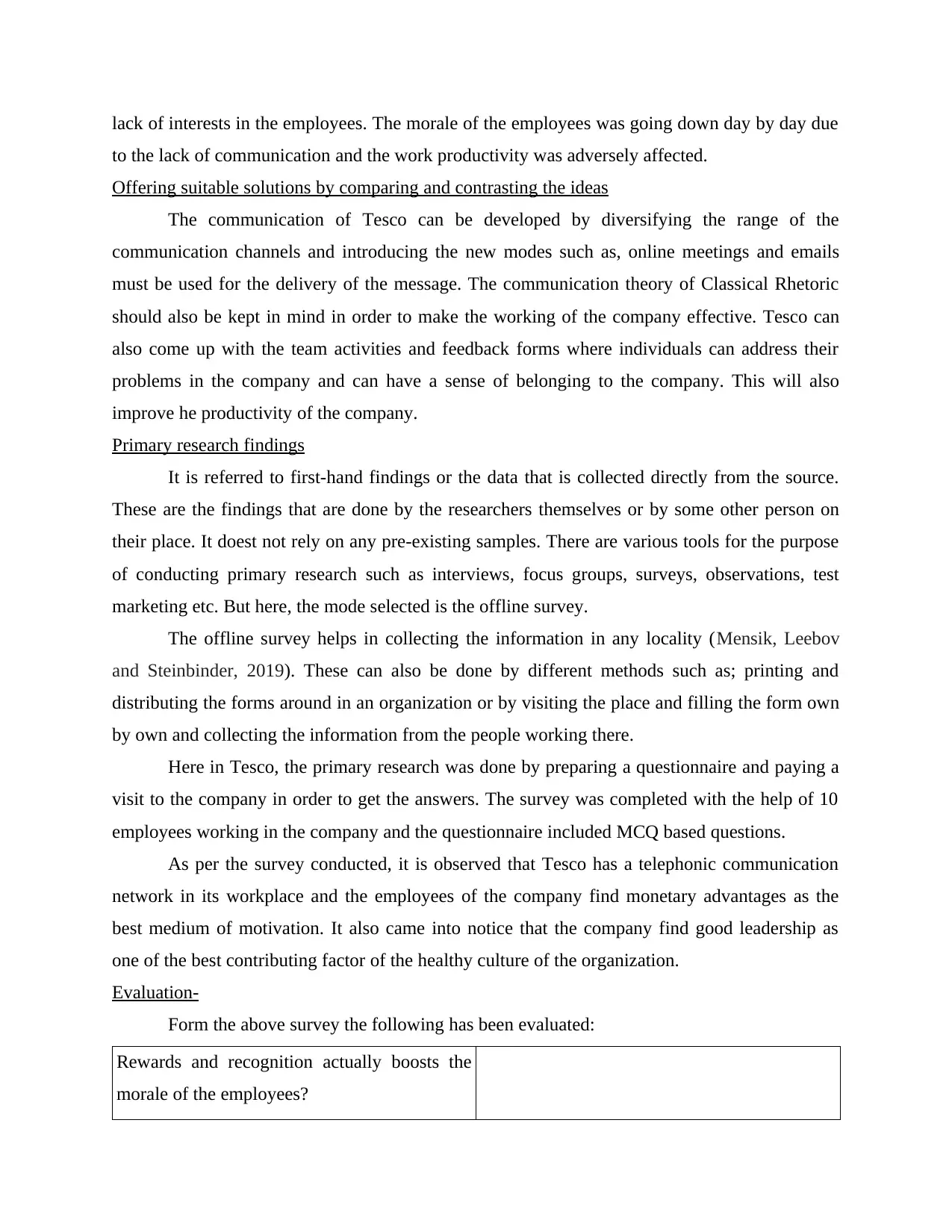
lack of interests in the employees. The morale of the employees was going down day by day due
to the lack of communication and the work productivity was adversely affected.
Offering suitable solutions by comparing and contrasting the ideas
The communication of Tesco can be developed by diversifying the range of the
communication channels and introducing the new modes such as, online meetings and emails
must be used for the delivery of the message. The communication theory of Classical Rhetoric
should also be kept in mind in order to make the working of the company effective. Tesco can
also come up with the team activities and feedback forms where individuals can address their
problems in the company and can have a sense of belonging to the company. This will also
improve he productivity of the company.
Primary research findings
It is referred to first-hand findings or the data that is collected directly from the source.
These are the findings that are done by the researchers themselves or by some other person on
their place. It doest not rely on any pre-existing samples. There are various tools for the purpose
of conducting primary research such as interviews, focus groups, surveys, observations, test
marketing etc. But here, the mode selected is the offline survey.
The offline survey helps in collecting the information in any locality (Mensik, Leebov
and Steinbinder, 2019). These can also be done by different methods such as; printing and
distributing the forms around in an organization or by visiting the place and filling the form own
by own and collecting the information from the people working there.
Here in Tesco, the primary research was done by preparing a questionnaire and paying a
visit to the company in order to get the answers. The survey was completed with the help of 10
employees working in the company and the questionnaire included MCQ based questions.
As per the survey conducted, it is observed that Tesco has a telephonic communication
network in its workplace and the employees of the company find monetary advantages as the
best medium of motivation. It also came into notice that the company find good leadership as
one of the best contributing factor of the healthy culture of the organization.
Evaluation-
Form the above survey the following has been evaluated:
Rewards and recognition actually boosts the
morale of the employees?
to the lack of communication and the work productivity was adversely affected.
Offering suitable solutions by comparing and contrasting the ideas
The communication of Tesco can be developed by diversifying the range of the
communication channels and introducing the new modes such as, online meetings and emails
must be used for the delivery of the message. The communication theory of Classical Rhetoric
should also be kept in mind in order to make the working of the company effective. Tesco can
also come up with the team activities and feedback forms where individuals can address their
problems in the company and can have a sense of belonging to the company. This will also
improve he productivity of the company.
Primary research findings
It is referred to first-hand findings or the data that is collected directly from the source.
These are the findings that are done by the researchers themselves or by some other person on
their place. It doest not rely on any pre-existing samples. There are various tools for the purpose
of conducting primary research such as interviews, focus groups, surveys, observations, test
marketing etc. But here, the mode selected is the offline survey.
The offline survey helps in collecting the information in any locality (Mensik, Leebov
and Steinbinder, 2019). These can also be done by different methods such as; printing and
distributing the forms around in an organization or by visiting the place and filling the form own
by own and collecting the information from the people working there.
Here in Tesco, the primary research was done by preparing a questionnaire and paying a
visit to the company in order to get the answers. The survey was completed with the help of 10
employees working in the company and the questionnaire included MCQ based questions.
As per the survey conducted, it is observed that Tesco has a telephonic communication
network in its workplace and the employees of the company find monetary advantages as the
best medium of motivation. It also came into notice that the company find good leadership as
one of the best contributing factor of the healthy culture of the organization.
Evaluation-
Form the above survey the following has been evaluated:
Rewards and recognition actually boosts the
morale of the employees?
⊘ This is a preview!⊘
Do you want full access?
Subscribe today to unlock all pages.
Trusted by 1+ million students worldwide
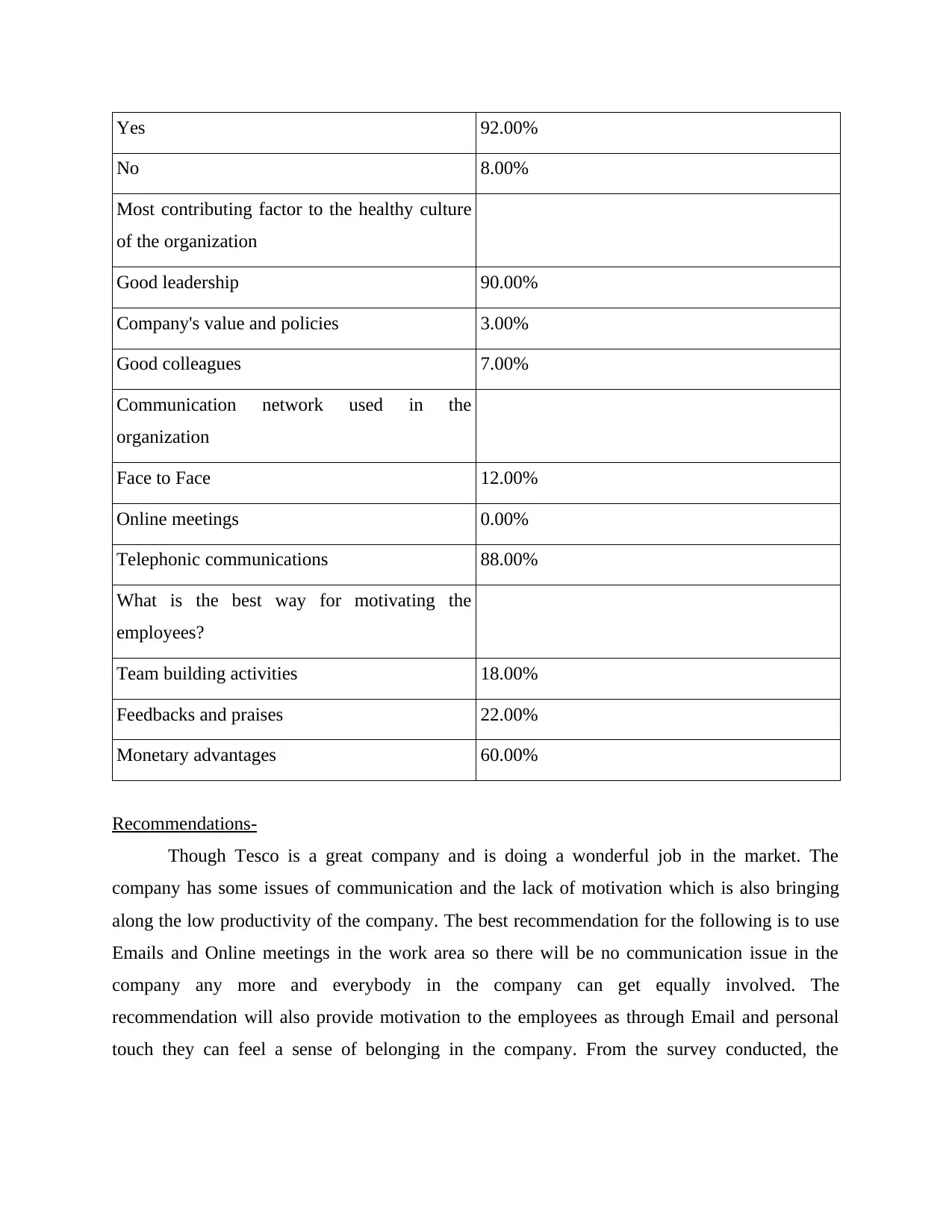
Yes 92.00%
No 8.00%
Most contributing factor to the healthy culture
of the organization
Good leadership 90.00%
Company's value and policies 3.00%
Good colleagues 7.00%
Communication network used in the
organization
Face to Face 12.00%
Online meetings 0.00%
Telephonic communications 88.00%
What is the best way for motivating the
employees?
Team building activities 18.00%
Feedbacks and praises 22.00%
Monetary advantages 60.00%
Recommendations-
Though Tesco is a great company and is doing a wonderful job in the market. The
company has some issues of communication and the lack of motivation which is also bringing
along the low productivity of the company. The best recommendation for the following is to use
Emails and Online meetings in the work area so there will be no communication issue in the
company any more and everybody in the company can get equally involved. The
recommendation will also provide motivation to the employees as through Email and personal
touch they can feel a sense of belonging in the company. From the survey conducted, the
No 8.00%
Most contributing factor to the healthy culture
of the organization
Good leadership 90.00%
Company's value and policies 3.00%
Good colleagues 7.00%
Communication network used in the
organization
Face to Face 12.00%
Online meetings 0.00%
Telephonic communications 88.00%
What is the best way for motivating the
employees?
Team building activities 18.00%
Feedbacks and praises 22.00%
Monetary advantages 60.00%
Recommendations-
Though Tesco is a great company and is doing a wonderful job in the market. The
company has some issues of communication and the lack of motivation which is also bringing
along the low productivity of the company. The best recommendation for the following is to use
Emails and Online meetings in the work area so there will be no communication issue in the
company any more and everybody in the company can get equally involved. The
recommendation will also provide motivation to the employees as through Email and personal
touch they can feel a sense of belonging in the company. From the survey conducted, the
Paraphrase This Document
Need a fresh take? Get an instant paraphrase of this document with our AI Paraphraser
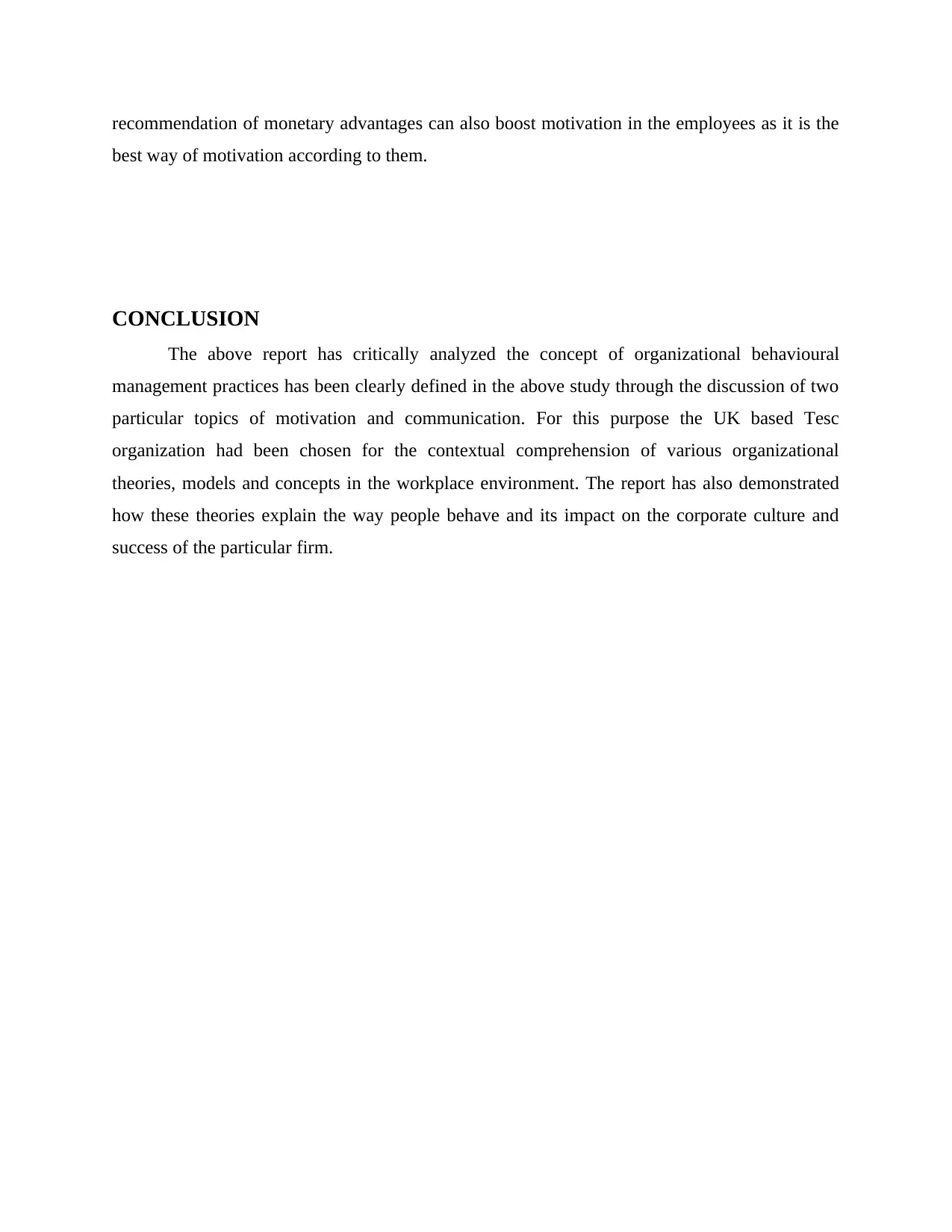
recommendation of monetary advantages can also boost motivation in the employees as it is the
best way of motivation according to them.
CONCLUSION
The above report has critically analyzed the concept of organizational behavioural
management practices has been clearly defined in the above study through the discussion of two
particular topics of motivation and communication. For this purpose the UK based Tesc
organization had been chosen for the contextual comprehension of various organizational
theories, models and concepts in the workplace environment. The report has also demonstrated
how these theories explain the way people behave and its impact on the corporate culture and
success of the particular firm.
best way of motivation according to them.
CONCLUSION
The above report has critically analyzed the concept of organizational behavioural
management practices has been clearly defined in the above study through the discussion of two
particular topics of motivation and communication. For this purpose the UK based Tesc
organization had been chosen for the contextual comprehension of various organizational
theories, models and concepts in the workplace environment. The report has also demonstrated
how these theories explain the way people behave and its impact on the corporate culture and
success of the particular firm.
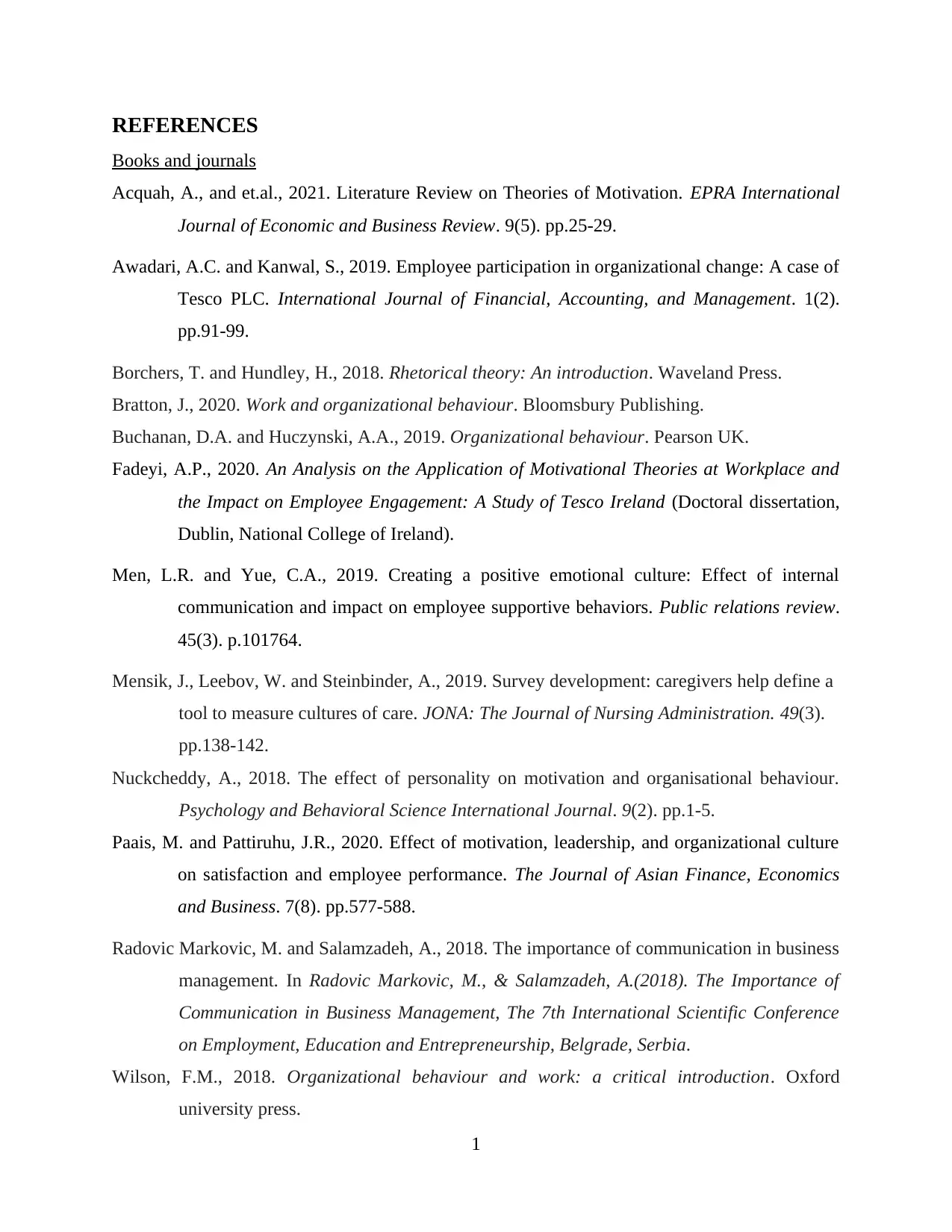
REFERENCES
Books and journals
Acquah, A., and et.al., 2021. Literature Review on Theories of Motivation. EPRA International
Journal of Economic and Business Review. 9(5). pp.25-29.
Awadari, A.C. and Kanwal, S., 2019. Employee participation in organizational change: A case of
Tesco PLC. International Journal of Financial, Accounting, and Management. 1(2).
pp.91-99.
Borchers, T. and Hundley, H., 2018. Rhetorical theory: An introduction. Waveland Press.
Bratton, J., 2020. Work and organizational behaviour. Bloomsbury Publishing.
Buchanan, D.A. and Huczynski, A.A., 2019. Organizational behaviour. Pearson UK.
Fadeyi, A.P., 2020. An Analysis on the Application of Motivational Theories at Workplace and
the Impact on Employee Engagement: A Study of Tesco Ireland (Doctoral dissertation,
Dublin, National College of Ireland).
Men, L.R. and Yue, C.A., 2019. Creating a positive emotional culture: Effect of internal
communication and impact on employee supportive behaviors. Public relations review.
45(3). p.101764.
Mensik, J., Leebov, W. and Steinbinder, A., 2019. Survey development: caregivers help define a
tool to measure cultures of care. JONA: The Journal of Nursing Administration. 49(3).
pp.138-142.
Nuckcheddy, A., 2018. The effect of personality on motivation and organisational behaviour.
Psychology and Behavioral Science International Journal. 9(2). pp.1-5.
Paais, M. and Pattiruhu, J.R., 2020. Effect of motivation, leadership, and organizational culture
on satisfaction and employee performance. The Journal of Asian Finance, Economics
and Business. 7(8). pp.577-588.
Radovic Markovic, M. and Salamzadeh, A., 2018. The importance of communication in business
management. In Radovic Markovic, M., & Salamzadeh, A.(2018). The Importance of
Communication in Business Management, The 7th International Scientific Conference
on Employment, Education and Entrepreneurship, Belgrade, Serbia.
Wilson, F.M., 2018. Organizational behaviour and work: a critical introduction. Oxford
university press.
1
Books and journals
Acquah, A., and et.al., 2021. Literature Review on Theories of Motivation. EPRA International
Journal of Economic and Business Review. 9(5). pp.25-29.
Awadari, A.C. and Kanwal, S., 2019. Employee participation in organizational change: A case of
Tesco PLC. International Journal of Financial, Accounting, and Management. 1(2).
pp.91-99.
Borchers, T. and Hundley, H., 2018. Rhetorical theory: An introduction. Waveland Press.
Bratton, J., 2020. Work and organizational behaviour. Bloomsbury Publishing.
Buchanan, D.A. and Huczynski, A.A., 2019. Organizational behaviour. Pearson UK.
Fadeyi, A.P., 2020. An Analysis on the Application of Motivational Theories at Workplace and
the Impact on Employee Engagement: A Study of Tesco Ireland (Doctoral dissertation,
Dublin, National College of Ireland).
Men, L.R. and Yue, C.A., 2019. Creating a positive emotional culture: Effect of internal
communication and impact on employee supportive behaviors. Public relations review.
45(3). p.101764.
Mensik, J., Leebov, W. and Steinbinder, A., 2019. Survey development: caregivers help define a
tool to measure cultures of care. JONA: The Journal of Nursing Administration. 49(3).
pp.138-142.
Nuckcheddy, A., 2018. The effect of personality on motivation and organisational behaviour.
Psychology and Behavioral Science International Journal. 9(2). pp.1-5.
Paais, M. and Pattiruhu, J.R., 2020. Effect of motivation, leadership, and organizational culture
on satisfaction and employee performance. The Journal of Asian Finance, Economics
and Business. 7(8). pp.577-588.
Radovic Markovic, M. and Salamzadeh, A., 2018. The importance of communication in business
management. In Radovic Markovic, M., & Salamzadeh, A.(2018). The Importance of
Communication in Business Management, The 7th International Scientific Conference
on Employment, Education and Entrepreneurship, Belgrade, Serbia.
Wilson, F.M., 2018. Organizational behaviour and work: a critical introduction. Oxford
university press.
1
⊘ This is a preview!⊘
Do you want full access?
Subscribe today to unlock all pages.
Trusted by 1+ million students worldwide

1 out of 13


Related Documents


Your All-in-One AI-Powered Toolkit for Academic Success.
+13062052269
info@desklib.com
Available 24*7 on WhatsApp / Email
![[object Object]](/_next/static/media/star-bottom.7253800d.svg)
Unlock your academic potential
Copyright © 2020–2026 A2Z Services. All Rights Reserved. Developed and managed by ZUCOL.