BM563 - Operations and Service Management: A Report on Tesco
VerifiedAdded on 2023/06/17
|10
|3019
|239
Report
AI Summary
This report provides a detailed examination of Tesco's operational and system administration practices, including its use of lean and six sigma methodologies. It assesses the impact of these practices on the organization, focusing on customer relationship management, asset conservation, and cost reduction. The report also explores Tesco's use of technology in its supply chain administration, such as omnichannel user satisfaction, interactive purchasing portals, and customer incentive programs. Furthermore, it identifies supportive activities that contribute to the firm's success, including human resources, marketing, and scientific investigations. The analysis highlights areas for improvement, such as adapting to changes in the market economy and incorporating business procedure change programs. Desklib offers a platform to access this assignment solution and many other resources for students.
Operations and service
management
management

Paraphrase This Document
Need a fresh take? Get an instant paraphrase of this document with our AI Paraphraser
Contents
Contents...........................................................................................................................................2
INTRODUCTION...........................................................................................................................1
MAIN BODY..................................................................................................................................1
1. Practices of Operations Administration in the Chosen Organization......................................1
2. Operational Administration's Consequences...........................................................................2
3. Tesco's Usage of Technologies in Operational Administration..............................................4
4. Activities which contribute in the firm's success and also which supports that......................5
CONCLUSION................................................................................................................................6
REFERENCES................................................................................................................................7
Contents...........................................................................................................................................2
INTRODUCTION...........................................................................................................................1
MAIN BODY..................................................................................................................................1
1. Practices of Operations Administration in the Chosen Organization......................................1
2. Operational Administration's Consequences...........................................................................2
3. Tesco's Usage of Technologies in Operational Administration..............................................4
4. Activities which contribute in the firm's success and also which supports that......................5
CONCLUSION................................................................................................................................6
REFERENCES................................................................................................................................7

⊘ This is a preview!⊘
Do you want full access?
Subscribe today to unlock all pages.

Trusted by 1+ million students worldwide
INTRODUCTION
The objective of this report is to have a detailed examination of Tesco Companies'
operational and system administration (Chiarini and Vagnoni, 2017). The firm is a Multinational
supermarket chain with headquarters in London. It is the largest wholesaler in the London, with
approximately 27% of the market. It was founded in 1919 and became the inaugural business to
go open in the Great Britain when it was listed on the British Securities Market in 1947. It now
operates in more than ten countries throughout the world, making it the world’s third biggest
store. It introduced internet supermarket outlets in Germany to better its operational efficiency,
which were eventually extended to other Tesco operational sites. Tesco has changed its branding
throughout time to making it more attractive to customers. This paper aims to identify Tesco's
operational administration practises and assess its impact on the organisation. The evaluation
would look how it uses technologies in its supply chain administration and how alignment with
the overall are intertwined with the firm's governance. Eventually, the study would introduce
suggestions for how the corporation's procedures and administration might be improved.
MAIN BODY
1. Practices of Operations Administration in the Chosen Organization
The business activity in charge of organizing and monitoring the transport of products and
services to consumers, comprising operations, products, logistics providers, and procedures, is
known as operational control. The type of business management approach utilised in an
organization relies about whether it's a manufacturing or an industrial company. In a retail
venture, operations management comprises making the goods and distributing it to clients. In
companies like Tesco, organizational plan is in charge of creating real commodities and
distributing them to consumers. Product supply requires acquiring products from manufacturers,
transporting them to Tesco's shops, and rendering it accessible to clients at sale places since
Tesco is a merchant instead of a manufacturer. The company currently sells industrial goods,
clothes, gastronomy, commodities, electronics, and furniture. Several things are available at the
company's stores (Dogru and Keskin, 2020). Buyers could also purchase the firm's goods via the
firm's webpage. Companies' items are purchased for reselling. Tesco Food Production
Specifications strategy is designed to agricultural goods in order to manufacture high-quality
foodstuffs in its supermarkets. The cuisine is subsequently delivered to consumers in shops or
The objective of this report is to have a detailed examination of Tesco Companies'
operational and system administration (Chiarini and Vagnoni, 2017). The firm is a Multinational
supermarket chain with headquarters in London. It is the largest wholesaler in the London, with
approximately 27% of the market. It was founded in 1919 and became the inaugural business to
go open in the Great Britain when it was listed on the British Securities Market in 1947. It now
operates in more than ten countries throughout the world, making it the world’s third biggest
store. It introduced internet supermarket outlets in Germany to better its operational efficiency,
which were eventually extended to other Tesco operational sites. Tesco has changed its branding
throughout time to making it more attractive to customers. This paper aims to identify Tesco's
operational administration practises and assess its impact on the organisation. The evaluation
would look how it uses technologies in its supply chain administration and how alignment with
the overall are intertwined with the firm's governance. Eventually, the study would introduce
suggestions for how the corporation's procedures and administration might be improved.
MAIN BODY
1. Practices of Operations Administration in the Chosen Organization
The business activity in charge of organizing and monitoring the transport of products and
services to consumers, comprising operations, products, logistics providers, and procedures, is
known as operational control. The type of business management approach utilised in an
organization relies about whether it's a manufacturing or an industrial company. In a retail
venture, operations management comprises making the goods and distributing it to clients. In
companies like Tesco, organizational plan is in charge of creating real commodities and
distributing them to consumers. Product supply requires acquiring products from manufacturers,
transporting them to Tesco's shops, and rendering it accessible to clients at sale places since
Tesco is a merchant instead of a manufacturer. The company currently sells industrial goods,
clothes, gastronomy, commodities, electronics, and furniture. Several things are available at the
company's stores (Dogru and Keskin, 2020). Buyers could also purchase the firm's goods via the
firm's webpage. Companies' items are purchased for reselling. Tesco Food Production
Specifications strategy is designed to agricultural goods in order to manufacture high-quality
foodstuffs in its supermarkets. The cuisine is subsequently delivered to consumers in shops or
Paraphrase This Document
Need a fresh take? Get an instant paraphrase of this document with our AI Paraphraser
purchased by them digitally. Tesco employs a variety of strategies, including lean and six sigma
methods, to increase the research group's efficiency and to be more customer-focused. It aims at
providing solutions which are appropriate to specific consumer segments. Tesco's operational
administration is also concerned with advertising combination factors. Price and marketing
approach are instances of this. Market planning is utilized to compare commodities and
accomplish a commercial benefit over rivals. Tesco's marketing technologies boost bargaining
potential whilst including it with a membership program framework to give clients a good
purchasing market. The important elements which enable the corporation's activities are transport
vehicles, corporation personnel, store shops, and technologies.
Individuals and procedures which provide goods to the consumer are involved in procedure
considerations. Tesco administers its processes utilising lean and six sigma techniques. The lean
methodology relies on the effort spent in each stage of the product delivery process and the
evaluation of resource and services delivery stages. Tesco makes a systematic methodology to
warehouse management, taking conscious steps on minimising stock warehouse conditions to
save capacity and prevent deterioration. Several of the products are delivered straight to the best
features by the makers. Tesco has a six-sigma strategy to decrease mistakes in product and
customer provision. This is a data-driven methodology which seeks to keep Tesco's failure rate
below 3.4 per thousand interactions. Tesco uses this method in conjunction with the lean
technique to enhance customer quality by reducing variability. The customer and the support
staff are at the heart of the company's lean technique. This applies to customer connection
speeds, stock clearing and purchasing, and the level of help offered by the service provider.
Tesco improves its resources and procedures in these sectors by employing enough marketing
agents for both physical and new operations (Ferro, Ordóñez and Anholon, 2017).
2. Operational Administration's Consequences
Tesco's operational administration techniques have a variety of consequences for the
organisation. For starters, business administration aids in relationship planning and contentment.
Tesco's organization accounting is notable for its customer-centric approach. Utilizing the six
sigma technique, the organisation assures that information on activities is taken and flaws in
products and system performance are minimised. This enables the organisation to provide
high-quality solutions to its clients. It assures that there have been no contract management
defaults. This framework of systems integration aids in client retention. Tesco's lean strategy
methods, to increase the research group's efficiency and to be more customer-focused. It aims at
providing solutions which are appropriate to specific consumer segments. Tesco's operational
administration is also concerned with advertising combination factors. Price and marketing
approach are instances of this. Market planning is utilized to compare commodities and
accomplish a commercial benefit over rivals. Tesco's marketing technologies boost bargaining
potential whilst including it with a membership program framework to give clients a good
purchasing market. The important elements which enable the corporation's activities are transport
vehicles, corporation personnel, store shops, and technologies.
Individuals and procedures which provide goods to the consumer are involved in procedure
considerations. Tesco administers its processes utilising lean and six sigma techniques. The lean
methodology relies on the effort spent in each stage of the product delivery process and the
evaluation of resource and services delivery stages. Tesco makes a systematic methodology to
warehouse management, taking conscious steps on minimising stock warehouse conditions to
save capacity and prevent deterioration. Several of the products are delivered straight to the best
features by the makers. Tesco has a six-sigma strategy to decrease mistakes in product and
customer provision. This is a data-driven methodology which seeks to keep Tesco's failure rate
below 3.4 per thousand interactions. Tesco uses this method in conjunction with the lean
technique to enhance customer quality by reducing variability. The customer and the support
staff are at the heart of the company's lean technique. This applies to customer connection
speeds, stock clearing and purchasing, and the level of help offered by the service provider.
Tesco improves its resources and procedures in these sectors by employing enough marketing
agents for both physical and new operations (Ferro, Ordóñez and Anholon, 2017).
2. Operational Administration's Consequences
Tesco's operational administration techniques have a variety of consequences for the
organisation. For starters, business administration aids in relationship planning and contentment.
Tesco's organization accounting is notable for its customer-centric approach. Utilizing the six
sigma technique, the organisation assures that information on activities is taken and flaws in
products and system performance are minimised. This enables the organisation to provide
high-quality solutions to its clients. It assures that there have been no contract management
defaults. This framework of systems integration aids in client retention. Tesco's lean strategy
guarantees consumer pleasure. Its core concepts assure that the method fully resolves client
issues. The lean strategy aims to reduce waste and meeting the requirements of the customers.
Tesco recognises client requirements and employs the appropriate approaches in its operational
and product administration to achieve those goals. Tesco, for example, established Tesco
electronically in the age of increasing internet sales and a change in consumers' preferences
favouring digital purchases. Tesco digitally satisfy the requirements of clients by offering goods
through the internet that they require (Jogaratnam, 2017). Furthermore, Tesco's leadership style
aids the organisation in conserving assets and lowering expenses. As a result of the lean
philosophy, certain inventory is immediately offered to the pos system. It reduces the business
warehousing area and assures that the organisation somehow doesn't spend a lot of money on
keeping facilities. This boosts the firm's operating margins. Furthermore, it eliminates the
expenditures of processing or warehousing of commodities. Tesco, for example, established
Tesco electronically in the age of increasing internet sales and a change in consumers'
preferences favouring digital purchases. Tesco digitally satisfy the requirements of clients by
offering goods through the internet that they require. Furthermore, Tesco's leadership style aids
the organisation in conserving assets and lowering expenses. As a result of the lean philosophy,
certain inventory is immediately offered to the pos system. It reduces the business warehousing
area and assures that the organisation somehow doesn't spend a lot of money on keeping
facilities. This boosts the firm's operating margins. Furthermore, it eliminates the expenditures of
processing or warehousing of commodities.
Tesco's business methods, on either side, have indeed been criticized of becoming slow to
adjust to changes in the market economy. They are opposed to a complete overhaul of company's
business in order to reduce inefficiencies and preserve cash. The company does not even have a
business procedure change program in place. This strategy assists firms in completely revamping
their present processes and procedures in order to suit the needs of their customers and the
working environment. As a consequence, Tesco did fail in a multitude of areas and then had to
close a few places in the Great Britain. In the United States, for instance, Tesco has been unable
to fulfil customer needs for online products. It compelled the company to cease operations in the
United States. Moreover, Tesco was closed down a lot of locations due to the UK company's
switch to online expenditure. The failure of the firm's organisational procedure of transformation
is a critical function in such situation. The firm might well have utilized a variety of managerial
issues. The lean strategy aims to reduce waste and meeting the requirements of the customers.
Tesco recognises client requirements and employs the appropriate approaches in its operational
and product administration to achieve those goals. Tesco, for example, established Tesco
electronically in the age of increasing internet sales and a change in consumers' preferences
favouring digital purchases. Tesco digitally satisfy the requirements of clients by offering goods
through the internet that they require (Jogaratnam, 2017). Furthermore, Tesco's leadership style
aids the organisation in conserving assets and lowering expenses. As a result of the lean
philosophy, certain inventory is immediately offered to the pos system. It reduces the business
warehousing area and assures that the organisation somehow doesn't spend a lot of money on
keeping facilities. This boosts the firm's operating margins. Furthermore, it eliminates the
expenditures of processing or warehousing of commodities. Tesco, for example, established
Tesco electronically in the age of increasing internet sales and a change in consumers'
preferences favouring digital purchases. Tesco digitally satisfy the requirements of clients by
offering goods through the internet that they require. Furthermore, Tesco's leadership style aids
the organisation in conserving assets and lowering expenses. As a result of the lean philosophy,
certain inventory is immediately offered to the pos system. It reduces the business warehousing
area and assures that the organisation somehow doesn't spend a lot of money on keeping
facilities. This boosts the firm's operating margins. Furthermore, it eliminates the expenditures of
processing or warehousing of commodities.
Tesco's business methods, on either side, have indeed been criticized of becoming slow to
adjust to changes in the market economy. They are opposed to a complete overhaul of company's
business in order to reduce inefficiencies and preserve cash. The company does not even have a
business procedure change program in place. This strategy assists firms in completely revamping
their present processes and procedures in order to suit the needs of their customers and the
working environment. As a consequence, Tesco did fail in a multitude of areas and then had to
close a few places in the Great Britain. In the United States, for instance, Tesco has been unable
to fulfil customer needs for online products. It compelled the company to cease operations in the
United States. Moreover, Tesco was closed down a lot of locations due to the UK company's
switch to online expenditure. The failure of the firm's organisational procedure of transformation
is a critical function in such situation. The firm might well have utilized a variety of managerial
⊘ This is a preview!⊘
Do you want full access?
Subscribe today to unlock all pages.
Trusted by 1+ million students worldwide
approaches to handle these issues. Furthermore, the corporation is losing industry position to
businesses like Amazon and Ryanair, who operate in an unique manner. Tesco's operational
procedures do not fully accommodate online enterprises, while newcomers like Amazon and
Ryanair are more customer-friendly. A few of the firm's operational and customer improvement
initiatives need procedure improvement transformation (Müller and Birkel, 2020).
3. Tesco's Usage of Technologies in Operational Administration
Technologies are employed in operational administration in a variety of opportunities to
strengthen product delivery effectiveness, cut prices, and satisfy customers. Moreover, in modern
online corporate world, substantial information gathering and processing are required to better
operational administration executives' decision-making processes. Retailers use digital insights
technology to gather and evaluate large amounts of material. Several firms use operational
administration data methods to support executives in making knowledgeable choices and increasing
corporate operational efficiencies. Tesco's operational administration employs a number of different
technologies. In the firm, innovation has enabled an omnichannel user satisfaction. Tesco built an
interactive purchasing portal using modern media. Owing to a significant development of electronic
technologies and a large demographic, web buying had been on the rise in the United Kingdom at
the turn of the century (Otieno and Achuora, 2018). Tesco.com was launched to strengthen the
activities of the firm strategic plan by allowing users to request products and take things up at
convenient locations. Despite the reality that such a technique is expensive for the organisation, it
promotes consumer happiness. Substantial expenditure seems to have been a hurdle in this
technique. Tesco spent a lot of money within every location to engage in Tesco.com. Leading to a
shortage of statistical information, the expenditure in residential distribution technologies
necessitated the hiring of additional staff, and purchasing issues arose initially.
Tesco supermarkets additionally offer a digitalisation in-store service, whereby customer are
given a transformed equipment which enables people to identify products whilst customers buy sans
interacting corporate workers. Client rewards program information is utilised to estimate client
requirements in certain areas. Consumers could use gadgets to see their entire purchasing bill, verify
a company's identification, and delete items from their purchasing cart. In terms of process
management, this approach lowers expenditure by needing fewer employees to perform in-store
duties. Monitoring are also offered in-store to greatly lower deceit. There are indeed electronic
shelve-edge labels that measure real-time price variations. Tesco's operations management also
businesses like Amazon and Ryanair, who operate in an unique manner. Tesco's operational
procedures do not fully accommodate online enterprises, while newcomers like Amazon and
Ryanair are more customer-friendly. A few of the firm's operational and customer improvement
initiatives need procedure improvement transformation (Müller and Birkel, 2020).
3. Tesco's Usage of Technologies in Operational Administration
Technologies are employed in operational administration in a variety of opportunities to
strengthen product delivery effectiveness, cut prices, and satisfy customers. Moreover, in modern
online corporate world, substantial information gathering and processing are required to better
operational administration executives' decision-making processes. Retailers use digital insights
technology to gather and evaluate large amounts of material. Several firms use operational
administration data methods to support executives in making knowledgeable choices and increasing
corporate operational efficiencies. Tesco's operational administration employs a number of different
technologies. In the firm, innovation has enabled an omnichannel user satisfaction. Tesco built an
interactive purchasing portal using modern media. Owing to a significant development of electronic
technologies and a large demographic, web buying had been on the rise in the United Kingdom at
the turn of the century (Otieno and Achuora, 2018). Tesco.com was launched to strengthen the
activities of the firm strategic plan by allowing users to request products and take things up at
convenient locations. Despite the reality that such a technique is expensive for the organisation, it
promotes consumer happiness. Substantial expenditure seems to have been a hurdle in this
technique. Tesco spent a lot of money within every location to engage in Tesco.com. Leading to a
shortage of statistical information, the expenditure in residential distribution technologies
necessitated the hiring of additional staff, and purchasing issues arose initially.
Tesco supermarkets additionally offer a digitalisation in-store service, whereby customer are
given a transformed equipment which enables people to identify products whilst customers buy sans
interacting corporate workers. Client rewards program information is utilised to estimate client
requirements in certain areas. Consumers could use gadgets to see their entire purchasing bill, verify
a company's identification, and delete items from their purchasing cart. In terms of process
management, this approach lowers expenditure by needing fewer employees to perform in-store
duties. Monitoring are also offered in-store to greatly lower deceit. There are indeed electronic
shelve-edge labels that measure real-time price variations. Tesco's operations management also
Paraphrase This Document
Need a fresh take? Get an instant paraphrase of this document with our AI Paraphraser
includes a customer incentive programs based on information that includes the Tesco Rewards card.
The rewards program generates a unique id Number after each purchase. Utilizing large
and advanced analytics, the company may adjust product accessibility; predict purchase patterns,
and give customized online and offline shopping discounts. Predicting demands of clients from the
perspective of organisational structure enables consumers make informed decisions about how to
refresh inventory and the amount of storage facilities occur in a particular area. Tesco's Rewards
program technology also opened up a lot of opportunities for the company's commercial plan, as the
cards is often utilized by over 16 million people (Pärn, Edwards and Sing, 2017).
4. Activities which contribute in the firm's success and also which supports that
Supportive activities are essential for operational administration to operate. Tesco's variety
of corporate divisions operate to satisfy the firm's goals. Individuals are essential elements of the
activities of the firm's managerial position. Without the firm's operations, this responsibility
would be inadequate. All of the personnel who operate for the operational administration
department are recruited by the personnel relations division. The HR division ensures that
marketing elements are mostly operational in the market. Such marketing associates assist
overworked clerks by helping them in their work as a subordinate (Polonsky and Waller, 2018).
HR additionally guarantees that sufficient staff is available for digital activities and residential
distribution services. The advertising division and the operational section should operate
effectively. The operational division puts the selling and advertising findings into operation.
Whenever the advertising team for instance, cooperate with the operations management
department to update price tags when it releases special and reduced goods to attract customers.
The marketing section also conducts financial research in attempt to determine purchase
behaviour and the degree of competition. It gives such results to the operations central office,
who utilizes them to implement the company's objectives in compliance with company trends.
Another helpful function is that of the company's scientific investigations. This division has the
responsibility of developing Tesco's operations and client administrative technologies. An online
purchasing system, a Tesco Implementation, and a Tesco Rewards card were developed by the
company's IT department. All technological activities, such as web upgrades, are handled by the
innovations department, which also provides all knowledge base for management and customer
surveillance (Slack and Brandon-Jones, 2018).
The rewards program generates a unique id Number after each purchase. Utilizing large
and advanced analytics, the company may adjust product accessibility; predict purchase patterns,
and give customized online and offline shopping discounts. Predicting demands of clients from the
perspective of organisational structure enables consumers make informed decisions about how to
refresh inventory and the amount of storage facilities occur in a particular area. Tesco's Rewards
program technology also opened up a lot of opportunities for the company's commercial plan, as the
cards is often utilized by over 16 million people (Pärn, Edwards and Sing, 2017).
4. Activities which contribute in the firm's success and also which supports that
Supportive activities are essential for operational administration to operate. Tesco's variety
of corporate divisions operate to satisfy the firm's goals. Individuals are essential elements of the
activities of the firm's managerial position. Without the firm's operations, this responsibility
would be inadequate. All of the personnel who operate for the operational administration
department are recruited by the personnel relations division. The HR division ensures that
marketing elements are mostly operational in the market. Such marketing associates assist
overworked clerks by helping them in their work as a subordinate (Polonsky and Waller, 2018).
HR additionally guarantees that sufficient staff is available for digital activities and residential
distribution services. The advertising division and the operational section should operate
effectively. The operational division puts the selling and advertising findings into operation.
Whenever the advertising team for instance, cooperate with the operations management
department to update price tags when it releases special and reduced goods to attract customers.
The marketing section also conducts financial research in attempt to determine purchase
behaviour and the degree of competition. It gives such results to the operations central office,
who utilizes them to implement the company's objectives in compliance with company trends.
Another helpful function is that of the company's scientific investigations. This division has the
responsibility of developing Tesco's operations and client administrative technologies. An online
purchasing system, a Tesco Implementation, and a Tesco Rewards card were developed by the
company's IT department. All technological activities, such as web upgrades, are handled by the
innovations department, which also provides all knowledge base for management and customer
surveillance (Slack and Brandon-Jones, 2018).
The financial division is in charge of financing and evaluating the viability of the processes
of an organization. Tesco's financial manager approves funding to assist operational
improvement programmes. The financial manager sponsors initiatives like imaging technologies
to make the corporation's activities operate in a more feasible manner. It then evaluates the effort
to see if it is beneficial for the company. I propose the following to improve Tesco's operations
and sales support roles. Owing to its business procedures reform programme to business
methodology, Tesco's operations were interrupted in a variety of destinations, including the
United States, and the firm closed several stores in the Great Britain. Tesco's operations
management needs to be strengthened via corporate procedure transformation. Since handset
adoption is increasing amongst users, Tesco must integrate mobile technologies in its operational
administration. For instance, the Tesco App may be updated to include aspects involved,
minimising the necessity of costly transportable scanning equipment in Tesco's stores. In
addition, the Tesco Programme might be expanded to take digital payments, enabling customers
to avoid purchasing with cash in stores. To compete with low-cost merchants like Amazon and
Ryanair, Tesco's online purchase experience might be improved by the inclusion of an online
discount section (Ugurlu and Kumral, 2020).
CONCLUSION
Import and outgoing transportation, warehousing, and delivering items to the pos system
most of these things are under Tesco's operations management duties. The company offers its
products both online and in retail stores. Tesco makes use of management approaches like lean
and six sigma. Tesco's operations management procedures help the company serve customers,
motivate employees, improve business and management efficiency, and make the most use of
resources like space and time. Tesco's management control is information based reward cards,
internet purchasing tools, and a mobile system which allows users to check while buying sans
contacting employees in the firm. Advertising, financial, and personnel administration are
examples of supportive activities which collaborate with the operational managerial component.
of an organization. Tesco's financial manager approves funding to assist operational
improvement programmes. The financial manager sponsors initiatives like imaging technologies
to make the corporation's activities operate in a more feasible manner. It then evaluates the effort
to see if it is beneficial for the company. I propose the following to improve Tesco's operations
and sales support roles. Owing to its business procedures reform programme to business
methodology, Tesco's operations were interrupted in a variety of destinations, including the
United States, and the firm closed several stores in the Great Britain. Tesco's operations
management needs to be strengthened via corporate procedure transformation. Since handset
adoption is increasing amongst users, Tesco must integrate mobile technologies in its operational
administration. For instance, the Tesco App may be updated to include aspects involved,
minimising the necessity of costly transportable scanning equipment in Tesco's stores. In
addition, the Tesco Programme might be expanded to take digital payments, enabling customers
to avoid purchasing with cash in stores. To compete with low-cost merchants like Amazon and
Ryanair, Tesco's online purchase experience might be improved by the inclusion of an online
discount section (Ugurlu and Kumral, 2020).
CONCLUSION
Import and outgoing transportation, warehousing, and delivering items to the pos system
most of these things are under Tesco's operations management duties. The company offers its
products both online and in retail stores. Tesco makes use of management approaches like lean
and six sigma. Tesco's operations management procedures help the company serve customers,
motivate employees, improve business and management efficiency, and make the most use of
resources like space and time. Tesco's management control is information based reward cards,
internet purchasing tools, and a mobile system which allows users to check while buying sans
contacting employees in the firm. Advertising, financial, and personnel administration are
examples of supportive activities which collaborate with the operational managerial component.
⊘ This is a preview!⊘
Do you want full access?
Subscribe today to unlock all pages.
Trusted by 1+ million students worldwide
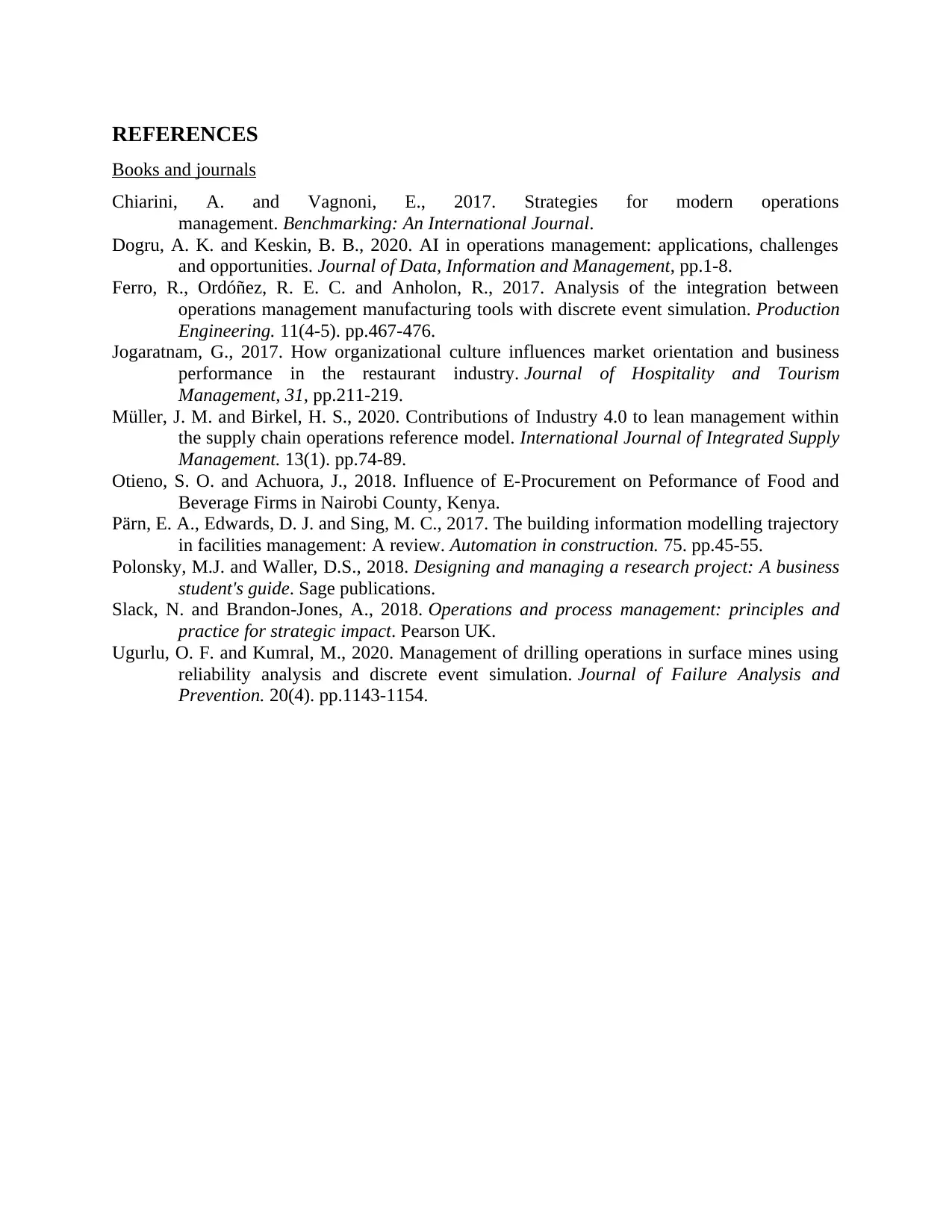
REFERENCES
Books and journals
Chiarini, A. and Vagnoni, E., 2017. Strategies for modern operations
management. Benchmarking: An International Journal.
Dogru, A. K. and Keskin, B. B., 2020. AI in operations management: applications, challenges
and opportunities. Journal of Data, Information and Management, pp.1-8.
Ferro, R., Ordóñez, R. E. C. and Anholon, R., 2017. Analysis of the integration between
operations management manufacturing tools with discrete event simulation. Production
Engineering. 11(4-5). pp.467-476.
Jogaratnam, G., 2017. How organizational culture influences market orientation and business
performance in the restaurant industry. Journal of Hospitality and Tourism
Management, 31, pp.211-219.
Müller, J. M. and Birkel, H. S., 2020. Contributions of Industry 4.0 to lean management within
the supply chain operations reference model. International Journal of Integrated Supply
Management. 13(1). pp.74-89.
Otieno, S. O. and Achuora, J., 2018. Influence of E-Procurement on Peformance of Food and
Beverage Firms in Nairobi County, Kenya.
Pärn, E. A., Edwards, D. J. and Sing, M. C., 2017. The building information modelling trajectory
in facilities management: A review. Automation in construction. 75. pp.45-55.
Polonsky, M.J. and Waller, D.S., 2018. Designing and managing a research project: A business
student's guide. Sage publications.
Slack, N. and Brandon-Jones, A., 2018. Operations and process management: principles and
practice for strategic impact. Pearson UK.
Ugurlu, O. F. and Kumral, M., 2020. Management of drilling operations in surface mines using
reliability analysis and discrete event simulation. Journal of Failure Analysis and
Prevention. 20(4). pp.1143-1154.
Books and journals
Chiarini, A. and Vagnoni, E., 2017. Strategies for modern operations
management. Benchmarking: An International Journal.
Dogru, A. K. and Keskin, B. B., 2020. AI in operations management: applications, challenges
and opportunities. Journal of Data, Information and Management, pp.1-8.
Ferro, R., Ordóñez, R. E. C. and Anholon, R., 2017. Analysis of the integration between
operations management manufacturing tools with discrete event simulation. Production
Engineering. 11(4-5). pp.467-476.
Jogaratnam, G., 2017. How organizational culture influences market orientation and business
performance in the restaurant industry. Journal of Hospitality and Tourism
Management, 31, pp.211-219.
Müller, J. M. and Birkel, H. S., 2020. Contributions of Industry 4.0 to lean management within
the supply chain operations reference model. International Journal of Integrated Supply
Management. 13(1). pp.74-89.
Otieno, S. O. and Achuora, J., 2018. Influence of E-Procurement on Peformance of Food and
Beverage Firms in Nairobi County, Kenya.
Pärn, E. A., Edwards, D. J. and Sing, M. C., 2017. The building information modelling trajectory
in facilities management: A review. Automation in construction. 75. pp.45-55.
Polonsky, M.J. and Waller, D.S., 2018. Designing and managing a research project: A business
student's guide. Sage publications.
Slack, N. and Brandon-Jones, A., 2018. Operations and process management: principles and
practice for strategic impact. Pearson UK.
Ugurlu, O. F. and Kumral, M., 2020. Management of drilling operations in surface mines using
reliability analysis and discrete event simulation. Journal of Failure Analysis and
Prevention. 20(4). pp.1143-1154.

1 out of 10


Related Documents


Your All-in-One AI-Powered Toolkit for Academic Success.
+13062052269
info@desklib.com
Available 24*7 on WhatsApp / Email
![[object Object]](/_next/static/media/star-bottom.7253800d.svg)
Unlock your academic potential
Copyright © 2020–2026 A2Z Services. All Rights Reserved. Developed and managed by ZUCOL.