TESCO Organisational Strategy: A Detailed Case Study Analysis
VerifiedAdded on 2023/06/09
|12
|3068
|255
Case Study
AI Summary
This case study report provides an in-depth analysis of TESCO's organisational strategy, covering its current strategic situation and future strategic options. The report begins with an examination of macro environmental factors using PESTLE analysis, assessing political, economic, social, technological, environmental, and legal influences. It then evaluates TESCO's industry position, internal capabilities, and stakeholder perspectives, including suppliers, customers, and local communities. The study explores individual and collaborative future options for TESCO, such as new product development, mergers, partnerships and takeovers, including collaboration with other businesses like the British Red Cross, focusing on strategies for growth, brand building, and achieving a net-zero carbon target by 2035.
Organisational Strategy
Case Study Report
Project 1
Case Study Report
Project 1

Paraphrase This Document
Need a fresh take? Get an instant paraphrase of this document with our AI Paraphraser
Table of Contents
INTRODUCTION ..........................................................................................................................4
MAIN BODY ..................................................................................................................................4
Macro environment factors ........................................................................................................4
Industry position .........................................................................................................................6
Internal capabilities and and stakeholder perspectives ..............................................................7
Individual future options.............................................................................................................8
Collaborative future options linking with other businesses .......................................................8
CONCLUSION ...............................................................................................................................9
REFERENCES..............................................................................................................................11
INTRODUCTION ..........................................................................................................................4
MAIN BODY ..................................................................................................................................4
Macro environment factors ........................................................................................................4
Industry position .........................................................................................................................6
Internal capabilities and and stakeholder perspectives ..............................................................7
Individual future options.............................................................................................................8
Collaborative future options linking with other businesses .......................................................8
CONCLUSION ...............................................................................................................................9
REFERENCES..............................................................................................................................11
INTRODUCTION
The strategy of organisation refers to the plan into long term manner which allocates that
in which manner the organisation makes plans for using the resources into effective terms for
supporting the business activities. It basically act as the road map that in which manner
organisation can achieve their objectives. TESCO is taken into consideration, in the present
report(Asfahani., 2021). TESCO is a retailer which is multinational merchandise that has their
own headquarter in the Garden City of Welwyn, England. The present report will cover
discussion about the current strategic situation of the business and also about the certain strategic
situation of the business along with strategic options for the business. The report basically
consist of the macro environmental factors and also about the position of industry as well.
Moreover the report will cover discussion about the individual capabilities and also about the
stakeholder perspectives as well.
MAIN BODY
Macro environment factors
The factors at macro level basically comprises of the different factors at external level
which include physical, demographic, economic, natural, legal, technological and socio cultural
conditions as well. These factors can be evaluated with support of PESTLE analysis which has
been defined into the following manner: A PESTLE analysis is basically the study of factors at
external level which include economic, political, technological, sociological, environmental and
legal as well which influences the organisation either into positive or negative form(Zumitzavan.,
2022). It can be used into different scenarios and can also guide the professionals and senior
manager into strategic decision making. That's why pestle analysis s very important to conduct
in order to grow the organisation into positive and result oriented form.
Political Factors: As the retailer operates on the worldwide basis then the factors at
political level influences TESCO performance on the higher scale. It includes the tax
rates, act of legislation and country's stability where it operates in. When there is
continuous financial instability on the worldwide basis then there are different
governments who contribute into the context of encouragement of retailers for creating
jobs for the population at domestic level (de Azevedo and et.al., 2020). As TESCO is the
The strategy of organisation refers to the plan into long term manner which allocates that
in which manner the organisation makes plans for using the resources into effective terms for
supporting the business activities. It basically act as the road map that in which manner
organisation can achieve their objectives. TESCO is taken into consideration, in the present
report(Asfahani., 2021). TESCO is a retailer which is multinational merchandise that has their
own headquarter in the Garden City of Welwyn, England. The present report will cover
discussion about the current strategic situation of the business and also about the certain strategic
situation of the business along with strategic options for the business. The report basically
consist of the macro environmental factors and also about the position of industry as well.
Moreover the report will cover discussion about the individual capabilities and also about the
stakeholder perspectives as well.
MAIN BODY
Macro environment factors
The factors at macro level basically comprises of the different factors at external level
which include physical, demographic, economic, natural, legal, technological and socio cultural
conditions as well. These factors can be evaluated with support of PESTLE analysis which has
been defined into the following manner: A PESTLE analysis is basically the study of factors at
external level which include economic, political, technological, sociological, environmental and
legal as well which influences the organisation either into positive or negative form(Zumitzavan.,
2022). It can be used into different scenarios and can also guide the professionals and senior
manager into strategic decision making. That's why pestle analysis s very important to conduct
in order to grow the organisation into positive and result oriented form.
Political Factors: As the retailer operates on the worldwide basis then the factors at
political level influences TESCO performance on the higher scale. It includes the tax
rates, act of legislation and country's stability where it operates in. When there is
continuous financial instability on the worldwide basis then there are different
governments who contribute into the context of encouragement of retailers for creating
jobs for the population at domestic level (de Azevedo and et.al., 2020). As TESCO is the
⊘ This is a preview!⊘
Do you want full access?
Subscribe today to unlock all pages.

Trusted by 1+ million students worldwide
company who plays an important role in creating the opportunities of employment which
enhances the demand for products and also there is diversification of work force as well.
Factors at economic level: Economic factors which has good concern with TESCO
company as they most likely to leverage the costs, demand, prices and profits as well. It
has been observed that organisation is dependent on the UK market when the business is
growing where it has market share of around 30% (Dey and et.al., 2019).There are two
main strategies which includes diversification and internationalisation which has been
considered by the company from several years and considers the main reason for success.
When there is decline in household incomes and disposable income levels then the
company has shifted their main focus towards value brands advertisement rather than the
luxurious brands.
Factors at social level: According to the trends, it has been indicated that UK customers
has shifted themselves towards the bulk shopping and one stop shopping as well. It has
been observed that the kind of services and goods which has been demanded by their
customers has mostly influenced by beliefs and attitudes which in turn influences the
conditioning at social level(Andriani and et.al., 2019). When people have more
awareness about their issues of health then their steps towards food has been changing on
the constant basis and the company is adopting the amendments by accommodating the
organic products demand.
Factors at technological level: The advancement within the technology has brought
dissimilar opportunities for company of TESCO. First is that the initiation of shopping on
the online basis introduction of online shopping along with facilities for purpose of home
delivery. The second is that points of self service checkouts have provided the ease and
convenience for the customers which ultimately reduces the costs of labour (Hanelt and
et.al., 2021). TESCO is the company who has also invested large scale of efficiency
projects of energy efficiency projects for fulfilling the objective into long term manner
for minimizing the carbon foot print.
Environmental Factors: There is large pressure on the organisation for addressing the
environment issues and also adopt the ways of operations which benefits the society.
TESCO is the company who is also committed to reduce its carbon foot print by fifty
enhances the demand for products and also there is diversification of work force as well.
Factors at economic level: Economic factors which has good concern with TESCO
company as they most likely to leverage the costs, demand, prices and profits as well. It
has been observed that organisation is dependent on the UK market when the business is
growing where it has market share of around 30% (Dey and et.al., 2019).There are two
main strategies which includes diversification and internationalisation which has been
considered by the company from several years and considers the main reason for success.
When there is decline in household incomes and disposable income levels then the
company has shifted their main focus towards value brands advertisement rather than the
luxurious brands.
Factors at social level: According to the trends, it has been indicated that UK customers
has shifted themselves towards the bulk shopping and one stop shopping as well. It has
been observed that the kind of services and goods which has been demanded by their
customers has mostly influenced by beliefs and attitudes which in turn influences the
conditioning at social level(Andriani and et.al., 2019). When people have more
awareness about their issues of health then their steps towards food has been changing on
the constant basis and the company is adopting the amendments by accommodating the
organic products demand.
Factors at technological level: The advancement within the technology has brought
dissimilar opportunities for company of TESCO. First is that the initiation of shopping on
the online basis introduction of online shopping along with facilities for purpose of home
delivery. The second is that points of self service checkouts have provided the ease and
convenience for the customers which ultimately reduces the costs of labour (Hanelt and
et.al., 2021). TESCO is the company who has also invested large scale of efficiency
projects of energy efficiency projects for fulfilling the objective into long term manner
for minimizing the carbon foot print.
Environmental Factors: There is large pressure on the organisation for addressing the
environment issues and also adopt the ways of operations which benefits the society.
TESCO is the company who is also committed to reduce its carbon foot print by fifty
Paraphrase This Document
Need a fresh take? Get an instant paraphrase of this document with our AI Paraphraser
percent. Through enhancing the conscience at social level then company is reducing the
waste produced in their stores.
Legal Factors: The TESCO company performance has been directly impacted by the
government policies and legislations as well(Nienaber and Martins., 2020). TESCO has
taken initiative towards in order to provide its customer price reduction on the fuel which
they has purchased with reference to the amount which has been spent in their grocery
stores. It has been observed that there are different promotional offers where lower prices
are there.
These are the Macro environmental factors which played a very significant role in terms of
taking decisions of the company from the perspective of future into positive manner. So PESTLE
analysis is very important so that company can analyse themselves from the perspective of every
factor so that they can continuously grow themselves into result oriented form.
Industry position
The industry of retail plays a very significant part of an economy which basically
comprised of 5.2% of GDP of UK in 2020 year and 9.3% of all the employees of UK in 2019
year. In the UK, the retail industry basically consist of over 300,000 separate businesses (Joseph
and Kibera., 2019). It basically employed over three million people which represents the UK
jobs of over 8%. They also give consumers with significant goods and services which meet the
aspirations and needs as well. In the year of 2019, it has been observed that the sales of retail in
the UK were worth of £ 439 billion. For every pound sent there is around 39 pence was spent on
the shops of food and 12 pence was spent in clothing shops. In addition to this, the 9 pence was
spent on fuel which are based on the automotive and eight pence was spent on the household
goods shops.
The remaining was spent on the range of other kinds of in non-store retail and shops.
According to the reports, it has been observed that the online retail accounting of over twenty
percent of retail sales and the share have been increased on the market basis which particularly as
the result of pandemic situation (Carvalho and Madeira., 2020). At the international level, the
position of industry is on the higher scale due to which this industry grows on a higher scale and
the retail sector basically include the department stores, shops, market stalls, super markets,
internet retailers and door to door sales as well. So the position of industry is at very good stage
waste produced in their stores.
Legal Factors: The TESCO company performance has been directly impacted by the
government policies and legislations as well(Nienaber and Martins., 2020). TESCO has
taken initiative towards in order to provide its customer price reduction on the fuel which
they has purchased with reference to the amount which has been spent in their grocery
stores. It has been observed that there are different promotional offers where lower prices
are there.
These are the Macro environmental factors which played a very significant role in terms of
taking decisions of the company from the perspective of future into positive manner. So PESTLE
analysis is very important so that company can analyse themselves from the perspective of every
factor so that they can continuously grow themselves into result oriented form.
Industry position
The industry of retail plays a very significant part of an economy which basically
comprised of 5.2% of GDP of UK in 2020 year and 9.3% of all the employees of UK in 2019
year. In the UK, the retail industry basically consist of over 300,000 separate businesses (Joseph
and Kibera., 2019). It basically employed over three million people which represents the UK
jobs of over 8%. They also give consumers with significant goods and services which meet the
aspirations and needs as well. In the year of 2019, it has been observed that the sales of retail in
the UK were worth of £ 439 billion. For every pound sent there is around 39 pence was spent on
the shops of food and 12 pence was spent in clothing shops. In addition to this, the 9 pence was
spent on fuel which are based on the automotive and eight pence was spent on the household
goods shops.
The remaining was spent on the range of other kinds of in non-store retail and shops.
According to the reports, it has been observed that the online retail accounting of over twenty
percent of retail sales and the share have been increased on the market basis which particularly as
the result of pandemic situation (Carvalho and Madeira., 2020). At the international level, the
position of industry is on the higher scale due to which this industry grows on a higher scale and
the retail sector basically include the department stores, shops, market stalls, super markets,
internet retailers and door to door sales as well. So the position of industry is at very good stage
due to which they grow on a very fast pace manner at the organisational level and from the point
of view of growth as well.
Internal capabilities and and stakeholder perspectives
Internal capabilities: It basically refers to the procedure or task which an organisation's
in house teams which are able to effectively accomplish(Kitchener., 2019).The assessment of
internal capabilities gives the permission to the individual to find their strengths and weaknesses
as well (Nakano and Lau., 2020). The internal capabilities of an organisation basically include
the organisational culture, leadership performance, innovation, strategic unity, agility, talent and
customer connectivity as well. In context to TESCO company, the environment at internal level
is one of the factor which contribute towards the the success of an organisation. The internal
factors basically include corporate culture, corporate governance and resources. For estimating
the potential, it is necessary that to consider the strengths and weaknesses of an organisation
(Mohamed and et.al., 2019).Tesco is the company who has high capabilities in terms of
technology, design, training, research and development as well. It is the company who has the
major presence in the area of manufacturing.
Stakeholder perspectives: It is basically refers to the perspective which has the
consideration for parties which are affected in their decisions. It has been observed that
organisation add problems to decisions and when stakeholder interests compete then the options
of decision open to executive narrow and also reduces profits to shareholders as well.
Stakeholder perspective is important because it places people at the centre of the project and
project management as well(Mühlbacher and Böbel., 2019). It basically provides the project
management community a innovative, helpful, stakeholder centred approach in order to increase
projects delivered value and success rate as well.
In context to TESCO company, they have certain main stakeholders which include
suppliers, customers, creditors, competitors, local communities, pressure groups, government
and local communities as well. It has been observed that TESCO company has served the
customers in million numbers on the weekly basis. These stakeholders are very important for the
organisational future decisions and future as well. So in the overall manner, for working an
organisation into strategic manner, it is very important that to have the stakeholders perspectives
and internal capabilities as well.
of view of growth as well.
Internal capabilities and and stakeholder perspectives
Internal capabilities: It basically refers to the procedure or task which an organisation's
in house teams which are able to effectively accomplish(Kitchener., 2019).The assessment of
internal capabilities gives the permission to the individual to find their strengths and weaknesses
as well (Nakano and Lau., 2020). The internal capabilities of an organisation basically include
the organisational culture, leadership performance, innovation, strategic unity, agility, talent and
customer connectivity as well. In context to TESCO company, the environment at internal level
is one of the factor which contribute towards the the success of an organisation. The internal
factors basically include corporate culture, corporate governance and resources. For estimating
the potential, it is necessary that to consider the strengths and weaknesses of an organisation
(Mohamed and et.al., 2019).Tesco is the company who has high capabilities in terms of
technology, design, training, research and development as well. It is the company who has the
major presence in the area of manufacturing.
Stakeholder perspectives: It is basically refers to the perspective which has the
consideration for parties which are affected in their decisions. It has been observed that
organisation add problems to decisions and when stakeholder interests compete then the options
of decision open to executive narrow and also reduces profits to shareholders as well.
Stakeholder perspective is important because it places people at the centre of the project and
project management as well(Mühlbacher and Böbel., 2019). It basically provides the project
management community a innovative, helpful, stakeholder centred approach in order to increase
projects delivered value and success rate as well.
In context to TESCO company, they have certain main stakeholders which include
suppliers, customers, creditors, competitors, local communities, pressure groups, government
and local communities as well. It has been observed that TESCO company has served the
customers in million numbers on the weekly basis. These stakeholders are very important for the
organisational future decisions and future as well. So in the overall manner, for working an
organisation into strategic manner, it is very important that to have the stakeholders perspectives
and internal capabilities as well.
⊘ This is a preview!⊘
Do you want full access?
Subscribe today to unlock all pages.
Trusted by 1+ million students worldwide
Individual future options
At the organisational level, a company can grow on the individual basis whether it is at
the internal level or at external level . At the internal level, company can adopt certain strategies
which focuses on the development of new products, hiring the right people, increasing efficiency
and better marketing as well (Redlbacher., 2020).The growth strategy at internal level can takes
place either through diversification, expansion and modernisation. In context to TESCO
company, they have to adopt those strategies which works under the favour of brighter growth
and development of the organisation. At the external level, company can grow through mergers
or takeovers. Merger occurs when two businesses join to form a new business. In the case of
takeover it exists when the existing business expands through buying more than half the shares
of another business (Silvius and Marnewick., 2022). In context to TESCO company, they can
takeover particular business who is not performing well into the market at international level so
its very important that the company has to take care about it and take appropriate actions towards
it into positive manner. So in this manner, the TESCO organisation can grow themselves into
positive manner from the future perspective so that they can attract large number of customers
for themselves.
Collaborative future options linking with other businesses
Collaborative future options: These are the options which act as into the collaborative
form with other businesses which help them to grow into positive manner in their professional
field and at societal level as well(Taylor and et.al., 2021). In context to TESCO company, it has
been observed that they have worked with the British red cross since the year of 1997 and it has
been observed that with the collaboration of colleagues and customers they have donated over £
20 million in order to support the vulnerable people which has been affected by the crises which
includes the pandemic situation.
At the organisational level, as it is a leading supermarket in the UK so it has been
observed that they can collaborate with other businesses in order to have sponsorship so that they
can grow themselves into more stronger form and build their brand image into more stronger
form(Ruck., 2019). They can also done partnership with other businesses so that they can give
something unique into the market with their attractive offers and can also grow themselves into
fast pace manner. From the future perspective they have also made some plans regarding their
At the organisational level, a company can grow on the individual basis whether it is at
the internal level or at external level . At the internal level, company can adopt certain strategies
which focuses on the development of new products, hiring the right people, increasing efficiency
and better marketing as well (Redlbacher., 2020).The growth strategy at internal level can takes
place either through diversification, expansion and modernisation. In context to TESCO
company, they have to adopt those strategies which works under the favour of brighter growth
and development of the organisation. At the external level, company can grow through mergers
or takeovers. Merger occurs when two businesses join to form a new business. In the case of
takeover it exists when the existing business expands through buying more than half the shares
of another business (Silvius and Marnewick., 2022). In context to TESCO company, they can
takeover particular business who is not performing well into the market at international level so
its very important that the company has to take care about it and take appropriate actions towards
it into positive manner. So in this manner, the TESCO organisation can grow themselves into
positive manner from the future perspective so that they can attract large number of customers
for themselves.
Collaborative future options linking with other businesses
Collaborative future options: These are the options which act as into the collaborative
form with other businesses which help them to grow into positive manner in their professional
field and at societal level as well(Taylor and et.al., 2021). In context to TESCO company, it has
been observed that they have worked with the British red cross since the year of 1997 and it has
been observed that with the collaboration of colleagues and customers they have donated over £
20 million in order to support the vulnerable people which has been affected by the crises which
includes the pandemic situation.
At the organisational level, as it is a leading supermarket in the UK so it has been
observed that they can collaborate with other businesses in order to have sponsorship so that they
can grow themselves into more stronger form and build their brand image into more stronger
form(Ruck., 2019). They can also done partnership with other businesses so that they can give
something unique into the market with their attractive offers and can also grow themselves into
fast pace manner. From the future perspective they have also made some plans regarding their
Paraphrase This Document
Need a fresh take? Get an instant paraphrase of this document with our AI Paraphraser
operations to hit a net zero carbon target by the year of 2035 by the support of renewable energy,
cutting plastic and encouraging the sustainable diets as well (Williams and Glisson., 2020).With
this kind of approach they can attract different businesses for purpose of partnership so that they
can increase their future options into the market at the business level. In this manner, TESCO
company can increase their future options into collaborative manner. When company links with
other businesses then they have options to innovate themselves and grow themselves into
positive direction of growth and development as well.
CONCLUSION
It has been concluded that organisational strategy plays a very significant role in terms of
executing the objectives and tasks of an organisation into result oriented form. It has been
concluded that for identifying the macro environmental factors it is very important to conduct
pestle analysis so that further decisions can be taken into appropriate manner for company's
brighter future. It has been determined that it is very important to have in to the good position at
industrial level so that they can grow themselves into fast pace manner. It has been observed that
there are certain internal capabilities of an organisation which needs to be evaluated into proper
manner. At the organisational level, stakeholder perspectives are very important so that further
actions and steps can be taken into the benefits of organisational growth and development. At the
individual level, there are certain future options which needs to be considered into right manner.
There are different collaborative future options which links with other businesses that needs to be
considered with the right kind of approach.
cutting plastic and encouraging the sustainable diets as well (Williams and Glisson., 2020).With
this kind of approach they can attract different businesses for purpose of partnership so that they
can increase their future options into the market at the business level. In this manner, TESCO
company can increase their future options into collaborative manner. When company links with
other businesses then they have options to innovate themselves and grow themselves into
positive direction of growth and development as well.
CONCLUSION
It has been concluded that organisational strategy plays a very significant role in terms of
executing the objectives and tasks of an organisation into result oriented form. It has been
concluded that for identifying the macro environmental factors it is very important to conduct
pestle analysis so that further decisions can be taken into appropriate manner for company's
brighter future. It has been determined that it is very important to have in to the good position at
industrial level so that they can grow themselves into fast pace manner. It has been observed that
there are certain internal capabilities of an organisation which needs to be evaluated into proper
manner. At the organisational level, stakeholder perspectives are very important so that further
actions and steps can be taken into the benefits of organisational growth and development. At the
individual level, there are certain future options which needs to be considered into right manner.
There are different collaborative future options which links with other businesses that needs to be
considered with the right kind of approach.
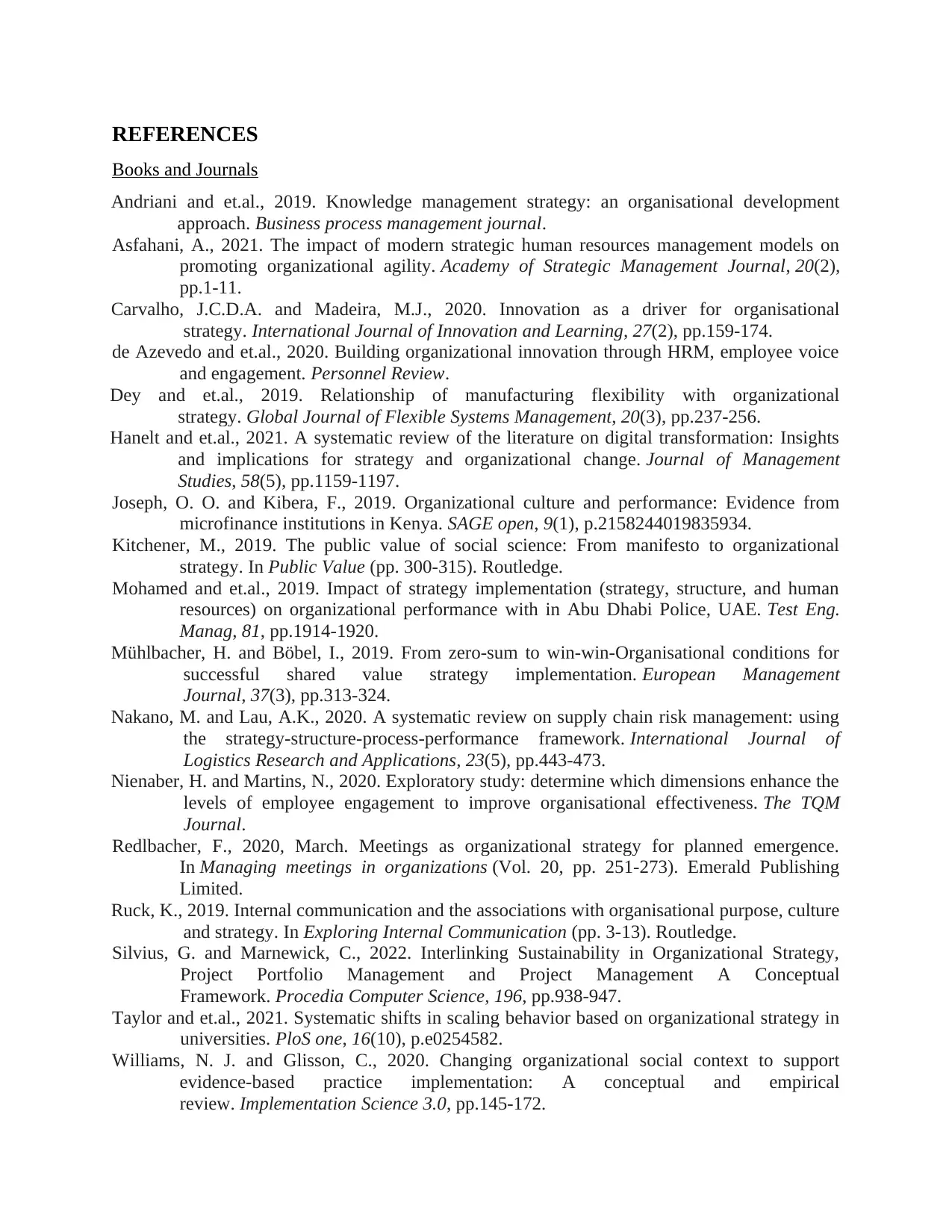
REFERENCES
Books and Journals
Andriani and et.al., 2019. Knowledge management strategy: an organisational development
approach. Business process management journal.
Asfahani, A., 2021. The impact of modern strategic human resources management models on
promoting organizational agility. Academy of Strategic Management Journal, 20(2),
pp.1-11.
Carvalho, J.C.D.A. and Madeira, M.J., 2020. Innovation as a driver for organisational
strategy. International Journal of Innovation and Learning, 27(2), pp.159-174.
de Azevedo and et.al., 2020. Building organizational innovation through HRM, employee voice
and engagement. Personnel Review.
Dey and et.al., 2019. Relationship of manufacturing flexibility with organizational
strategy. Global Journal of Flexible Systems Management, 20(3), pp.237-256.
Hanelt and et.al., 2021. A systematic review of the literature on digital transformation: Insights
and implications for strategy and organizational change. Journal of Management
Studies, 58(5), pp.1159-1197.
Joseph, O. O. and Kibera, F., 2019. Organizational culture and performance: Evidence from
microfinance institutions in Kenya. SAGE open, 9(1), p.2158244019835934.
Kitchener, M., 2019. The public value of social science: From manifesto to organizational
strategy. In Public Value (pp. 300-315). Routledge.
Mohamed and et.al., 2019. Impact of strategy implementation (strategy, structure, and human
resources) on organizational performance with in Abu Dhabi Police, UAE. Test Eng.
Manag, 81, pp.1914-1920.
Mühlbacher, H. and Böbel, I., 2019. From zero-sum to win-win-Organisational conditions for
successful shared value strategy implementation. European Management
Journal, 37(3), pp.313-324.
Nakano, M. and Lau, A.K., 2020. A systematic review on supply chain risk management: using
the strategy-structure-process-performance framework. International Journal of
Logistics Research and Applications, 23(5), pp.443-473.
Nienaber, H. and Martins, N., 2020. Exploratory study: determine which dimensions enhance the
levels of employee engagement to improve organisational effectiveness. The TQM
Journal.
Redlbacher, F., 2020, March. Meetings as organizational strategy for planned emergence.
In Managing meetings in organizations (Vol. 20, pp. 251-273). Emerald Publishing
Limited.
Ruck, K., 2019. Internal communication and the associations with organisational purpose, culture
and strategy. In Exploring Internal Communication (pp. 3-13). Routledge.
Silvius, G. and Marnewick, C., 2022. Interlinking Sustainability in Organizational Strategy,
Project Portfolio Management and Project Management A Conceptual
Framework. Procedia Computer Science, 196, pp.938-947.
Taylor and et.al., 2021. Systematic shifts in scaling behavior based on organizational strategy in
universities. PloS one, 16(10), p.e0254582.
Williams, N. J. and Glisson, C., 2020. Changing organizational social context to support
evidence-based practice implementation: A conceptual and empirical
review. Implementation Science 3.0, pp.145-172.
Books and Journals
Andriani and et.al., 2019. Knowledge management strategy: an organisational development
approach. Business process management journal.
Asfahani, A., 2021. The impact of modern strategic human resources management models on
promoting organizational agility. Academy of Strategic Management Journal, 20(2),
pp.1-11.
Carvalho, J.C.D.A. and Madeira, M.J., 2020. Innovation as a driver for organisational
strategy. International Journal of Innovation and Learning, 27(2), pp.159-174.
de Azevedo and et.al., 2020. Building organizational innovation through HRM, employee voice
and engagement. Personnel Review.
Dey and et.al., 2019. Relationship of manufacturing flexibility with organizational
strategy. Global Journal of Flexible Systems Management, 20(3), pp.237-256.
Hanelt and et.al., 2021. A systematic review of the literature on digital transformation: Insights
and implications for strategy and organizational change. Journal of Management
Studies, 58(5), pp.1159-1197.
Joseph, O. O. and Kibera, F., 2019. Organizational culture and performance: Evidence from
microfinance institutions in Kenya. SAGE open, 9(1), p.2158244019835934.
Kitchener, M., 2019. The public value of social science: From manifesto to organizational
strategy. In Public Value (pp. 300-315). Routledge.
Mohamed and et.al., 2019. Impact of strategy implementation (strategy, structure, and human
resources) on organizational performance with in Abu Dhabi Police, UAE. Test Eng.
Manag, 81, pp.1914-1920.
Mühlbacher, H. and Böbel, I., 2019. From zero-sum to win-win-Organisational conditions for
successful shared value strategy implementation. European Management
Journal, 37(3), pp.313-324.
Nakano, M. and Lau, A.K., 2020. A systematic review on supply chain risk management: using
the strategy-structure-process-performance framework. International Journal of
Logistics Research and Applications, 23(5), pp.443-473.
Nienaber, H. and Martins, N., 2020. Exploratory study: determine which dimensions enhance the
levels of employee engagement to improve organisational effectiveness. The TQM
Journal.
Redlbacher, F., 2020, March. Meetings as organizational strategy for planned emergence.
In Managing meetings in organizations (Vol. 20, pp. 251-273). Emerald Publishing
Limited.
Ruck, K., 2019. Internal communication and the associations with organisational purpose, culture
and strategy. In Exploring Internal Communication (pp. 3-13). Routledge.
Silvius, G. and Marnewick, C., 2022. Interlinking Sustainability in Organizational Strategy,
Project Portfolio Management and Project Management A Conceptual
Framework. Procedia Computer Science, 196, pp.938-947.
Taylor and et.al., 2021. Systematic shifts in scaling behavior based on organizational strategy in
universities. PloS one, 16(10), p.e0254582.
Williams, N. J. and Glisson, C., 2020. Changing organizational social context to support
evidence-based practice implementation: A conceptual and empirical
review. Implementation Science 3.0, pp.145-172.
⊘ This is a preview!⊘
Do you want full access?
Subscribe today to unlock all pages.
Trusted by 1+ million students worldwide
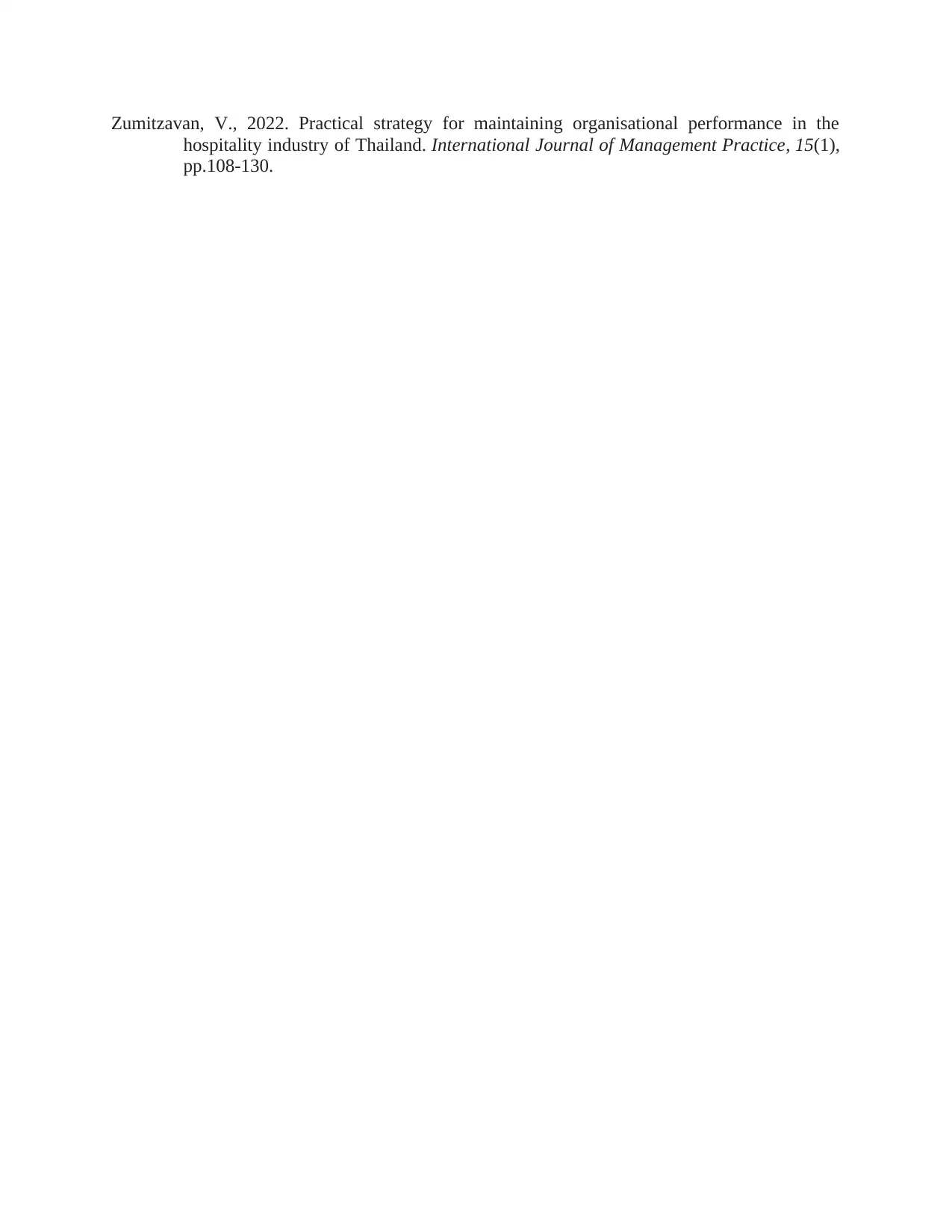
Zumitzavan, V., 2022. Practical strategy for maintaining organisational performance in the
hospitality industry of Thailand. International Journal of Management Practice, 15(1),
pp.108-130.
hospitality industry of Thailand. International Journal of Management Practice, 15(1),
pp.108-130.
Paraphrase This Document
Need a fresh take? Get an instant paraphrase of this document with our AI Paraphraser


⊘ This is a preview!⊘
Do you want full access?
Subscribe today to unlock all pages.
Trusted by 1+ million students worldwide

1 out of 12


Related Documents


Your All-in-One AI-Powered Toolkit for Academic Success.
+13062052269
info@desklib.com
Available 24*7 on WhatsApp / Email
![[object Object]](/_next/static/media/star-bottom.7253800d.svg)
Unlock your academic potential
Copyright © 2020–2026 A2Z Services. All Rights Reserved. Developed and managed by ZUCOL.