HND Business Environment Report: Tesco's Functions and Structure
VerifiedAdded on 2020/06/06
|20
|5461
|73
Report
AI Summary
This report provides an in-depth analysis of the business environment, focusing on Tesco as a case study. It begins with an introduction to the business environment and then examines different types of organizations, including private and public sectors, and their legal structures. The report explores the scope and size of organizations, emphasizing the link between organizational size, scope, and structure to objectives, products, and services. It also delves into the interrelationships between various organizational functions, such as marketing, sales, human resources, finance, and operations, and their influence on organizational structure. Furthermore, the report discusses the merits and demerits of interlinks between organizational functions and analyzes the complexities of different business structures, culminating in a conclusion summarizing the key findings.
BUSINESS ENVIRONMENT
PART-1
PART-1

Paraphrase This Document
Need a fresh take? Get an instant paraphrase of this document with our AI Paraphraser
Contents
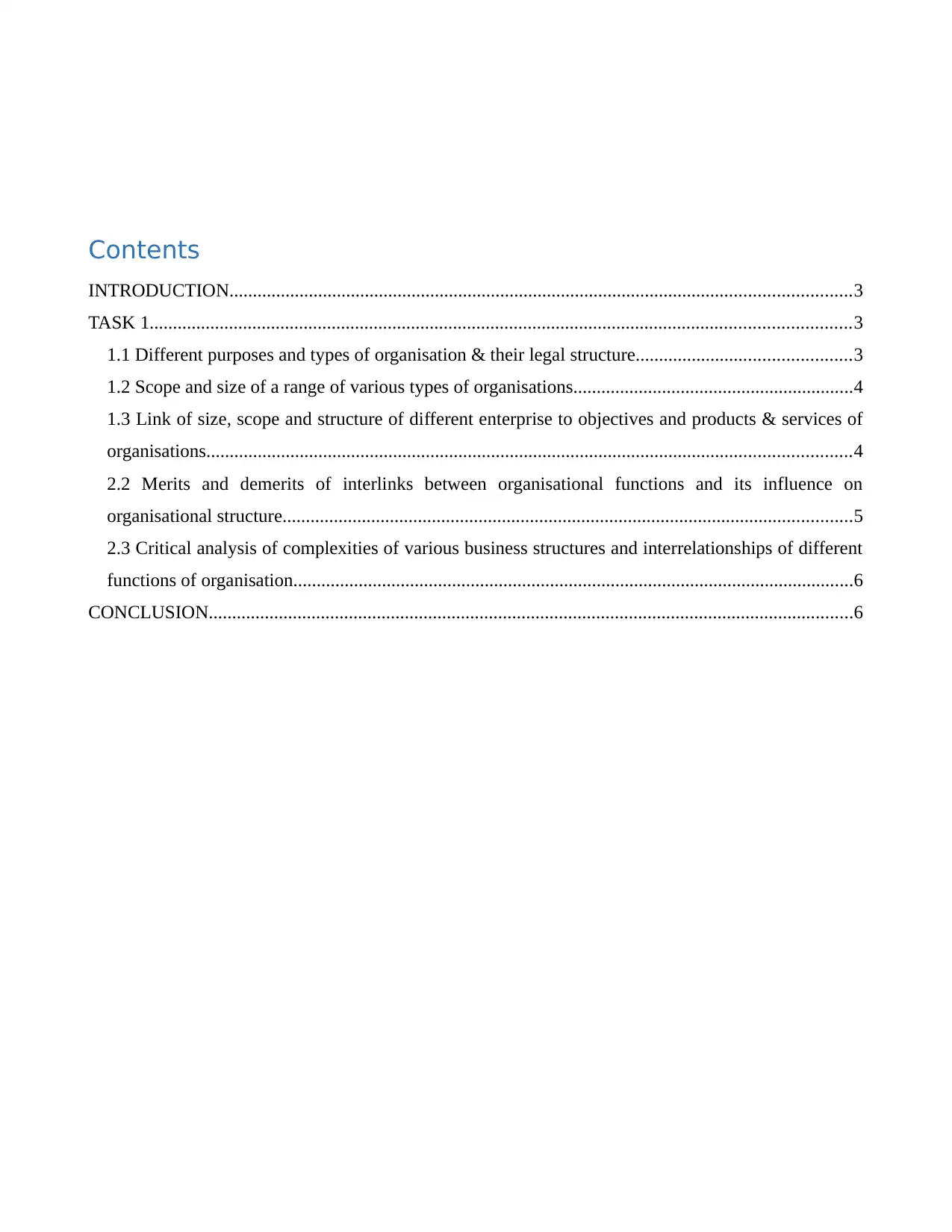
INTRODUCTION.....................................................................................................................................3
TASK 1......................................................................................................................................................3
1.1 Different purposes and types of organisation & their legal structure..............................................3
1.2 Scope and size of a range of various types of organisations............................................................4
1.3 Link of size, scope and structure of different enterprise to objectives and products & services of
organisations..........................................................................................................................................4
2.2 Merits and demerits of interlinks between organisational functions and its influence on
organisational structure..........................................................................................................................5
2.3 Critical analysis of complexities of various business structures and interrelationships of different
functions of organisation........................................................................................................................6
CONCLUSION..........................................................................................................................................6
INTRODUCTION.....................................................................................................................................3
TASK 1......................................................................................................................................................3
1.1 Different purposes and types of organisation & their legal structure..............................................3
1.2 Scope and size of a range of various types of organisations............................................................4
1.3 Link of size, scope and structure of different enterprise to objectives and products & services of
organisations..........................................................................................................................................4
2.2 Merits and demerits of interlinks between organisational functions and its influence on
organisational structure..........................................................................................................................5
2.3 Critical analysis of complexities of various business structures and interrelationships of different
functions of organisation........................................................................................................................6
CONCLUSION..........................................................................................................................................6
INTRODUCTION
Business environment refers to all the internal & external forces that influence the functions of
the company including management, customers, supply & demand, employees and business
regulations. It also consists of competitors, suppliers, government, social, legal, political and
technological factors. The changes take place in business environment are unpredictable and are
dynamic in nature (Chavis and et. al., 2011). It assists in determining the strengths and opportunities of
the of the organisation and provide direction for growth. In the present assignment, the chosen
company is TESCO which is a British multinational company. It deals in clothing, grocery, furniture,
electronics, petrol, toys and software. The assignment covers the different types and aims of
organisation as well as its size and scope. It also identifies the link of organisation size, structure and
scope to objectives and products & services offered by the business. Apart from this, interrelationship
of different functions within the firm and their link with organisational structure are also defined.
TASK 1
1.1 Different purposes and types of organisation & their legal structure
The main purpose of every organisation is to generate high income by satisfying the needs and
wants of the customers with their quality goods and services. Different departments of the firm are
performing different activities. Organisations are of different types and every type of enterprise have
different purposes. These are:
Private sector organisation
The businesses which are not owned and operated by the legal authority, those are termed as
private sector organisations. These organisations are run by single individuals or a group of people who
seek to gain profit and return back that earnings to its owners. The main aim of private sector
organisations is to earn profit, increase market share, growth and maximize sales. The companies
include in this sector are generally free from the ownership and control of government. Skoda is the
example of private sector firm. The main types of organisation include in private sector are sole traders,
franchises and partnership
Legal structure of the Private sector:
Business environment refers to all the internal & external forces that influence the functions of
the company including management, customers, supply & demand, employees and business
regulations. It also consists of competitors, suppliers, government, social, legal, political and
technological factors. The changes take place in business environment are unpredictable and are
dynamic in nature (Chavis and et. al., 2011). It assists in determining the strengths and opportunities of
the of the organisation and provide direction for growth. In the present assignment, the chosen
company is TESCO which is a British multinational company. It deals in clothing, grocery, furniture,
electronics, petrol, toys and software. The assignment covers the different types and aims of
organisation as well as its size and scope. It also identifies the link of organisation size, structure and
scope to objectives and products & services offered by the business. Apart from this, interrelationship
of different functions within the firm and their link with organisational structure are also defined.
TASK 1
1.1 Different purposes and types of organisation & their legal structure
The main purpose of every organisation is to generate high income by satisfying the needs and
wants of the customers with their quality goods and services. Different departments of the firm are
performing different activities. Organisations are of different types and every type of enterprise have
different purposes. These are:
Private sector organisation
The businesses which are not owned and operated by the legal authority, those are termed as
private sector organisations. These organisations are run by single individuals or a group of people who
seek to gain profit and return back that earnings to its owners. The main aim of private sector
organisations is to earn profit, increase market share, growth and maximize sales. The companies
include in this sector are generally free from the ownership and control of government. Skoda is the
example of private sector firm. The main types of organisation include in private sector are sole traders,
franchises and partnership
Legal structure of the Private sector:
⊘ This is a preview!⊘
Do you want full access?
Subscribe today to unlock all pages.

Trusted by 1+ million students worldwide
Partnership: In this type of ownership, the business is owned and operated by two or more than
two individuals. A partnership deed is signed between the partners and all the profits and losses of the
business will be shared among them. A partnership firm can be run by maximum 20 partners.
Sole traders: It is very common form of ownership and is seen at broad range of activities. In
this, single individual is responsible to run the whole business and no paperwork is needed to establish
sole trader company. The main advantages of these types of businesses are that all the profits go to the
only individual who is the owner of the firm and he is able to make quick decisions and can keep close
contact with employees and customers.
Franchises: This is become more popular day by day. In this, franchise take permission to the
franchisor to sell product in a particular area. Franchisor grants rights to the dealer use its brand for a
specific period of time and in turn, franchise pay some amount of money(Craig and Campbell, 2012).
Public sector organisation
Those firms which are operated and owned by government & exists to administer services to the
society and citizens of the country. These sectors are not run to generate profits but the main aim of the
firm is to serve public. The funds are generally raised through different ways such as fees, taxes and
financial transfers and use to finance public sector. The main purpose of public sector organisation is to
administer necessary public services and optimum utilization of resources for the welfare of the society.
TESCO is a public sector organisation which takes approval of its stakeholders before taking any major
decision. The important parts of state are:
Legal Structure of the Public sector:
Local government: All the issues of a particular zone or area are controlled and regulated by
local government. It has less authority in comparison of central and state government.
Central government: It is defined as an apex body that has authority to control every major
issues of the nation. Tax collection and currency printing are the main activities of central
government.
State government: It handles all the affairs of particular state.
Voluntary sector:
Those organisations which are formed for the purpose of welfare of society or development of
society. These firms are referred as voluntary sector organisations. Main purpose of these firms is to
serve society and satisfy their basic needs so that their living standard can improve. OXFAM is the
two individuals. A partnership deed is signed between the partners and all the profits and losses of the
business will be shared among them. A partnership firm can be run by maximum 20 partners.
Sole traders: It is very common form of ownership and is seen at broad range of activities. In
this, single individual is responsible to run the whole business and no paperwork is needed to establish
sole trader company. The main advantages of these types of businesses are that all the profits go to the
only individual who is the owner of the firm and he is able to make quick decisions and can keep close
contact with employees and customers.
Franchises: This is become more popular day by day. In this, franchise take permission to the
franchisor to sell product in a particular area. Franchisor grants rights to the dealer use its brand for a
specific period of time and in turn, franchise pay some amount of money(Craig and Campbell, 2012).
Public sector organisation
Those firms which are operated and owned by government & exists to administer services to the
society and citizens of the country. These sectors are not run to generate profits but the main aim of the
firm is to serve public. The funds are generally raised through different ways such as fees, taxes and
financial transfers and use to finance public sector. The main purpose of public sector organisation is to
administer necessary public services and optimum utilization of resources for the welfare of the society.
TESCO is a public sector organisation which takes approval of its stakeholders before taking any major
decision. The important parts of state are:
Legal Structure of the Public sector:
Local government: All the issues of a particular zone or area are controlled and regulated by
local government. It has less authority in comparison of central and state government.
Central government: It is defined as an apex body that has authority to control every major
issues of the nation. Tax collection and currency printing are the main activities of central
government.
State government: It handles all the affairs of particular state.
Voluntary sector:
Those organisations which are formed for the purpose of welfare of society or development of
society. These firms are referred as voluntary sector organisations. Main purpose of these firms is to
serve society and satisfy their basic needs so that their living standard can improve. OXFAM is the
Paraphrase This Document
Need a fresh take? Get an instant paraphrase of this document with our AI Paraphraser
example of this sector (Ebert and et. al., 2014). Main objectives of voluntary sector is to provide
different services to the customers in an effective and efficient manner. They mainly emphasis on
providing health related facility to the audience.
1.2 Scope and size of a range of various types of organisations
The size of TESCO is built with high no. of employees and shareholder. Size and scope affect the
overall performance of an organisation. SCOPE of TESCO is collectively combine their need and
objective and make product that satisfies customers in an effective way. The size of any company can
be determine through its employees as they are considered as the significant part of company who puts
their best in order to accomplish the overall objectives of the firm. Normally the size of Public
enterprises is quite large as compared to both Private and Voluntary. The main reason behind this is
because Public company allow large number shareholder to owns their ownership whereas Private
allows only few and selected investors. Voluntary is generally compromises with small number of
people as they work together for the welfare of society and environment.
1.3 Link of size, scope and structure of different enterprise to objectives and products & services of
organisations
Structure, scope and size of any firm are related with the goals and objectives of the organisation.
When the company has good organisational structure, it sets its targets as its objectives. If there are few
people in the organisational structure and they don’t have knowledge about their roles and
responsibilities & subordinates, then they are not able to achieve the target. Due to unclear roles, it is
not possible to accomplish these goals. The objectives of the business organisation are set according to
its size. The firms set high targets as their objectives, if the size of the company is large & invest huge
capital in it. Nevertheless, every firm has some common purpose, i.e., to serve customers and earn
higher profits. The level of profit differs with the organisation size. TESCO set big targets as its
objective.
Companies review their scope in order to establish its business objectives. These are set as per the
scope of the organisation. For example, if the scope of the firm is to administer national customers,
then the business objectives will be set accordingly. The structure, scope and size of the organisation
are set as per the products and services. If any entity observes that, their goods does not need enormous
organisational structure; then they don’t set scope, size and objectives. On other side, if the scope of
any good or service of the business is vast, then only an organisation develops large size and generates
a scope, contrarily, they develop small sized enterprise.
different services to the customers in an effective and efficient manner. They mainly emphasis on
providing health related facility to the audience.
1.2 Scope and size of a range of various types of organisations
The size of TESCO is built with high no. of employees and shareholder. Size and scope affect the
overall performance of an organisation. SCOPE of TESCO is collectively combine their need and
objective and make product that satisfies customers in an effective way. The size of any company can
be determine through its employees as they are considered as the significant part of company who puts
their best in order to accomplish the overall objectives of the firm. Normally the size of Public
enterprises is quite large as compared to both Private and Voluntary. The main reason behind this is
because Public company allow large number shareholder to owns their ownership whereas Private
allows only few and selected investors. Voluntary is generally compromises with small number of
people as they work together for the welfare of society and environment.
1.3 Link of size, scope and structure of different enterprise to objectives and products & services of
organisations
Structure, scope and size of any firm are related with the goals and objectives of the organisation.
When the company has good organisational structure, it sets its targets as its objectives. If there are few
people in the organisational structure and they don’t have knowledge about their roles and
responsibilities & subordinates, then they are not able to achieve the target. Due to unclear roles, it is
not possible to accomplish these goals. The objectives of the business organisation are set according to
its size. The firms set high targets as their objectives, if the size of the company is large & invest huge
capital in it. Nevertheless, every firm has some common purpose, i.e., to serve customers and earn
higher profits. The level of profit differs with the organisation size. TESCO set big targets as its
objective.
Companies review their scope in order to establish its business objectives. These are set as per the
scope of the organisation. For example, if the scope of the firm is to administer national customers,
then the business objectives will be set accordingly. The structure, scope and size of the organisation
are set as per the products and services. If any entity observes that, their goods does not need enormous
organisational structure; then they don’t set scope, size and objectives. On other side, if the scope of
any good or service of the business is vast, then only an organisation develops large size and generates
a scope, contrarily, they develop small sized enterprise.
TASK 2
2.1 Relationship between various organisational functions and their link to its objectives and structure
The functions of an organisations are different of the enterprise such as marketing, sales, human
resource, finance, production and operations etc. The relationship between these functions is
organisational structure. The function of the organisation influence structure of the firm because these
functions divide the work into groups and it is must for each individual group to achieve their duties or
the whole firm will suffer. The structure are the ways of the company in which various departments are
communicate & work together. If the functions are not accomplished by one department, then due to
this, whole business will suffer because all the departments are depending on each other. The link
between organisational functions to its objectives and structure are as follows:
Human resource function: Organisation choose its structure as per to the attributes of its
workforce and nature of the relationship of employment. TESCO prefer high skilled human resource so
that the tasks are perform together in teams or groups. The firm developed its structure as per the latest
technology & and develop a longer and better relationship with its workforce and provide them
freedom in order to make crucial decisions.
Sales and marketing function: Some features of the market such as buyer behaviour,
geographic dispersion, competition and income class etc. should be needed to consider in order to
organizing the market team. TESCO distributes its product all over the world so, they require to create
an effective structure of an organisation. They emphasize on the channels of distribution such as
wholesalers, retailers and middleman in order to reach its potential customers.
Production and operations function: Structure and size of an organisation is based on the
scope of goods and services. The structure of TESCO is affected by the customer, demands of
consumer and segment of their goods & product trends, manufacturing process, innovation and
technological advantages. TESCO analyse product of the company, its history, strengths & weaknesses
in favour of competitor’s products. All these factors impact the structure of an organisation so TESCO
evaluate them time to time on continuous basis.
Finance function: TESCO produce its products at global level so they require to put high
investments in their organisation structure. The structural framework of TESCO is affected by several
financial factors such as buying behaviour, income of customers, understanding of different
shareholders and the economy of different countries.
2.1 Relationship between various organisational functions and their link to its objectives and structure
The functions of an organisations are different of the enterprise such as marketing, sales, human
resource, finance, production and operations etc. The relationship between these functions is
organisational structure. The function of the organisation influence structure of the firm because these
functions divide the work into groups and it is must for each individual group to achieve their duties or
the whole firm will suffer. The structure are the ways of the company in which various departments are
communicate & work together. If the functions are not accomplished by one department, then due to
this, whole business will suffer because all the departments are depending on each other. The link
between organisational functions to its objectives and structure are as follows:
Human resource function: Organisation choose its structure as per to the attributes of its
workforce and nature of the relationship of employment. TESCO prefer high skilled human resource so
that the tasks are perform together in teams or groups. The firm developed its structure as per the latest
technology & and develop a longer and better relationship with its workforce and provide them
freedom in order to make crucial decisions.
Sales and marketing function: Some features of the market such as buyer behaviour,
geographic dispersion, competition and income class etc. should be needed to consider in order to
organizing the market team. TESCO distributes its product all over the world so, they require to create
an effective structure of an organisation. They emphasize on the channels of distribution such as
wholesalers, retailers and middleman in order to reach its potential customers.
Production and operations function: Structure and size of an organisation is based on the
scope of goods and services. The structure of TESCO is affected by the customer, demands of
consumer and segment of their goods & product trends, manufacturing process, innovation and
technological advantages. TESCO analyse product of the company, its history, strengths & weaknesses
in favour of competitor’s products. All these factors impact the structure of an organisation so TESCO
evaluate them time to time on continuous basis.
Finance function: TESCO produce its products at global level so they require to put high
investments in their organisation structure. The structural framework of TESCO is affected by several
financial factors such as buying behaviour, income of customers, understanding of different
shareholders and the economy of different countries.
⊘ This is a preview!⊘
Do you want full access?
Subscribe today to unlock all pages.
Trusted by 1+ million students worldwide
So, in this way, each function impacts the structure of TESCO and they are creating their framework as
per the changes of the market (Griffin and Pustay, 2012).
2.2 Merits and demerits of interlinks between organisational functions and its influence on
organisational structure
There are some advantages and disadvantages of functional organisation in which departments are
grouped on the basis of specialization or functions so that related issues are dealt by that particular
department. For better understanding, some points are explained below:
Merits:
Efficiency: As the workforce perform limited number of activities of their particular department only,
their working efficiency is increased.
Specialization: It ensures proper division of workers and enable the business entity to take benefits of
specialization function.
Expansion: It provides greater expansion scope to an organisation. The knowledge of experts
encourages better supervision and control (Halbert and Ingulli, 2011).
Demerits:
Lack of coordination: As the work is grouped into parts & sub parts, managers face problems in
coordinating working of different parts and in making decisions.
2.3 Critical analysis of complexities of various business structures and interrelationships of different
functions of organisation
According to Routhledge, 2015 complexity of business starts with both micro and macro factor that
affect the performance of business enterprise. It can be in the form of supplier, customer. Competitor,
government, shareholder etc. They all possess major share or hold on the functions of any business
entity.
On the other Grentark, 2016 says that complexity in an organisation structure takes place when their
employees and employer have different point of view towards similar thing. It is very important for
smooth running of business that they should include both manager and worker in their decision making,
thus reducing the chance of conflict.
per the changes of the market (Griffin and Pustay, 2012).
2.2 Merits and demerits of interlinks between organisational functions and its influence on
organisational structure
There are some advantages and disadvantages of functional organisation in which departments are
grouped on the basis of specialization or functions so that related issues are dealt by that particular
department. For better understanding, some points are explained below:
Merits:
Efficiency: As the workforce perform limited number of activities of their particular department only,
their working efficiency is increased.
Specialization: It ensures proper division of workers and enable the business entity to take benefits of
specialization function.
Expansion: It provides greater expansion scope to an organisation. The knowledge of experts
encourages better supervision and control (Halbert and Ingulli, 2011).
Demerits:
Lack of coordination: As the work is grouped into parts & sub parts, managers face problems in
coordinating working of different parts and in making decisions.
2.3 Critical analysis of complexities of various business structures and interrelationships of different
functions of organisation
According to Routhledge, 2015 complexity of business starts with both micro and macro factor that
affect the performance of business enterprise. It can be in the form of supplier, customer. Competitor,
government, shareholder etc. They all possess major share or hold on the functions of any business
entity.
On the other Grentark, 2016 says that complexity in an organisation structure takes place when their
employees and employer have different point of view towards similar thing. It is very important for
smooth running of business that they should include both manager and worker in their decision making,
thus reducing the chance of conflict.
Paraphrase This Document
Need a fresh take? Get an instant paraphrase of this document with our AI Paraphraser
CONCLUSION
As per the above mentioned report, it has been concluded that various changes that takes place in
both society and workplace may affect the overall performance of business enterprise. These
factors are mainly in terms of micro and macro and categorise as supplier, customer, shareholder,
government, competitor etc. Organisations are required to have balanced relationship between both
employee and employer who helps in attaining their both long &short term goal effectively. Along
with this there is contribution of other department such as HR, Marketing, IT who systematically
manage their work which results in achieving specified target of the company within a given time
frame.
As per the above mentioned report, it has been concluded that various changes that takes place in
both society and workplace may affect the overall performance of business enterprise. These
factors are mainly in terms of micro and macro and categorise as supplier, customer, shareholder,
government, competitor etc. Organisations are required to have balanced relationship between both
employee and employer who helps in attaining their both long &short term goal effectively. Along
with this there is contribution of other department such as HR, Marketing, IT who systematically
manage their work which results in achieving specified target of the company within a given time
frame.
REFERENCES
Books and Journal
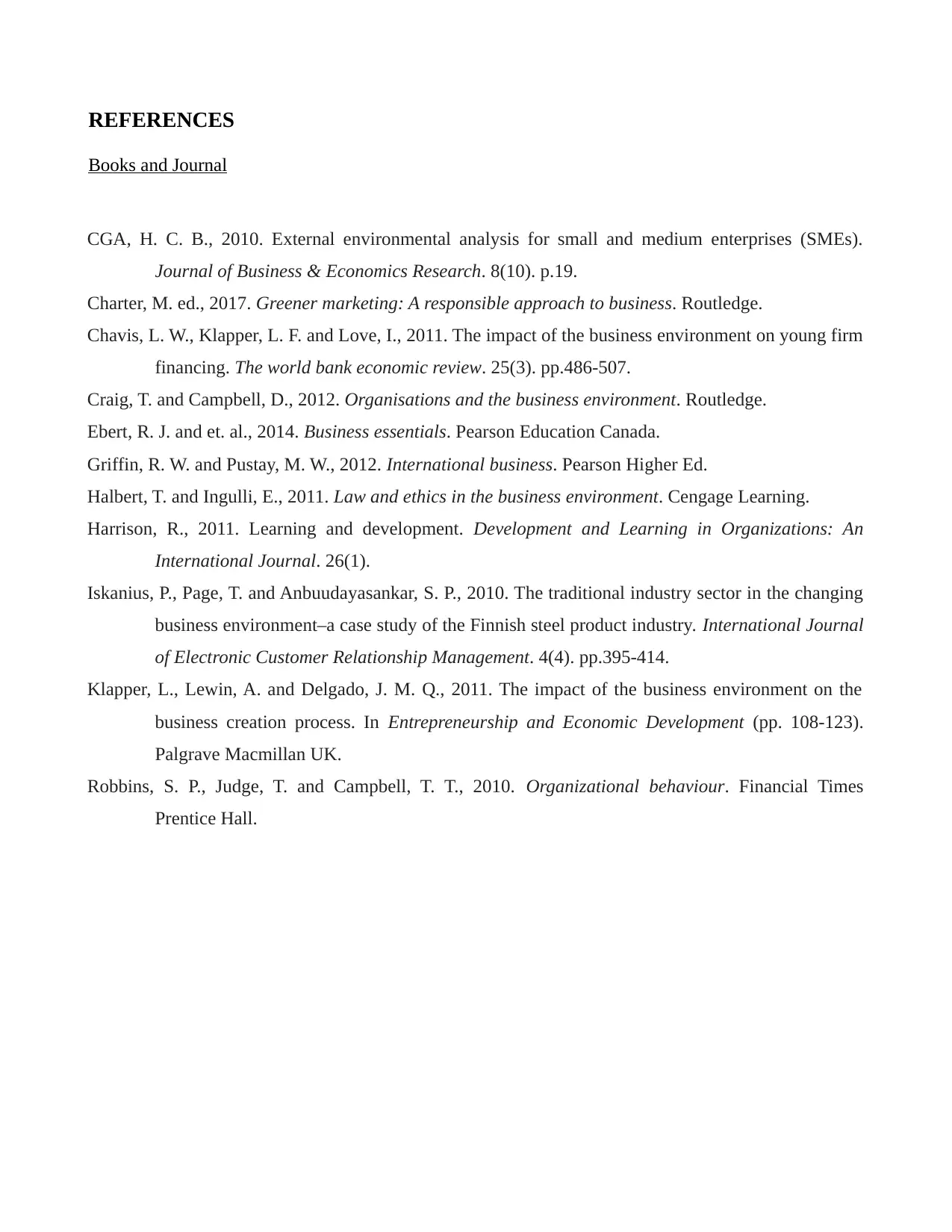
CGA, H. C. B., 2010. External environmental analysis for small and medium enterprises (SMEs).
Journal of Business & Economics Research. 8(10). p.19.
Charter, M. ed., 2017. Greener marketing: A responsible approach to business. Routledge.
Chavis, L. W., Klapper, L. F. and Love, I., 2011. The impact of the business environment on young firm
financing. The world bank economic review. 25(3). pp.486-507.
Craig, T. and Campbell, D., 2012. Organisations and the business environment. Routledge.
Ebert, R. J. and et. al., 2014. Business essentials. Pearson Education Canada.
Griffin, R. W. and Pustay, M. W., 2012. International business. Pearson Higher Ed.
Halbert, T. and Ingulli, E., 2011. Law and ethics in the business environment. Cengage Learning.
Harrison, R., 2011. Learning and development. Development and Learning in Organizations: An
International Journal. 26(1).
Iskanius, P., Page, T. and Anbuudayasankar, S. P., 2010. The traditional industry sector in the changing
business environment–a case study of the Finnish steel product industry. International Journal
of Electronic Customer Relationship Management. 4(4). pp.395-414.
Klapper, L., Lewin, A. and Delgado, J. M. Q., 2011. The impact of the business environment on the
business creation process. In Entrepreneurship and Economic Development (pp. 108-123).
Palgrave Macmillan UK.
Robbins, S. P., Judge, T. and Campbell, T. T., 2010. Organizational behaviour. Financial Times
Prentice Hall.
Books and Journal
CGA, H. C. B., 2010. External environmental analysis for small and medium enterprises (SMEs).
Journal of Business & Economics Research. 8(10). p.19.
Charter, M. ed., 2017. Greener marketing: A responsible approach to business. Routledge.
Chavis, L. W., Klapper, L. F. and Love, I., 2011. The impact of the business environment on young firm
financing. The world bank economic review. 25(3). pp.486-507.
Craig, T. and Campbell, D., 2012. Organisations and the business environment. Routledge.
Ebert, R. J. and et. al., 2014. Business essentials. Pearson Education Canada.
Griffin, R. W. and Pustay, M. W., 2012. International business. Pearson Higher Ed.
Halbert, T. and Ingulli, E., 2011. Law and ethics in the business environment. Cengage Learning.
Harrison, R., 2011. Learning and development. Development and Learning in Organizations: An
International Journal. 26(1).
Iskanius, P., Page, T. and Anbuudayasankar, S. P., 2010. The traditional industry sector in the changing
business environment–a case study of the Finnish steel product industry. International Journal
of Electronic Customer Relationship Management. 4(4). pp.395-414.
Klapper, L., Lewin, A. and Delgado, J. M. Q., 2011. The impact of the business environment on the
business creation process. In Entrepreneurship and Economic Development (pp. 108-123).
Palgrave Macmillan UK.
Robbins, S. P., Judge, T. and Campbell, T. T., 2010. Organizational behaviour. Financial Times
Prentice Hall.
⊘ This is a preview!⊘
Do you want full access?
Subscribe today to unlock all pages.
Trusted by 1+ million students worldwide
BUSINESS ENVIRONMENT
PART 2
PART 2
Paraphrase This Document
Need a fresh take? Get an instant paraphrase of this document with our AI Paraphraser
Contents
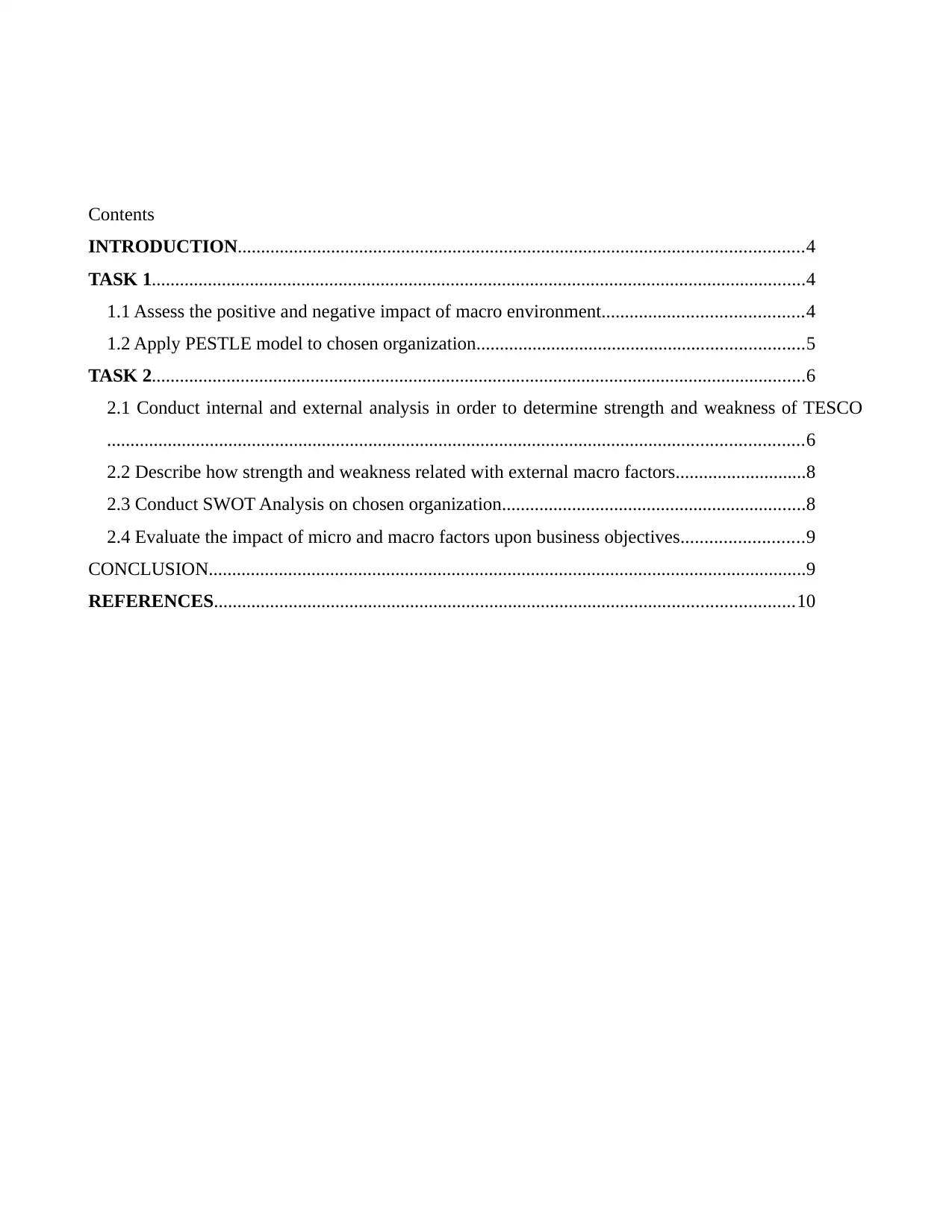
INTRODUCTION.........................................................................................................................4
TASK 1............................................................................................................................................4
1.1 Assess the positive and negative impact of macro environment...........................................4
1.2 Apply PESTLE model to chosen organization......................................................................5
TASK 2............................................................................................................................................6
2.1 Conduct internal and external analysis in order to determine strength and weakness of TESCO
.....................................................................................................................................................6
2.2 Describe how strength and weakness related with external macro factors............................8
2.3 Conduct SWOT Analysis on chosen organization.................................................................8
2.4 Evaluate the impact of micro and macro factors upon business objectives..........................9
CONCLUSION................................................................................................................................9
REFERENCES............................................................................................................................10
INTRODUCTION.........................................................................................................................4
TASK 1............................................................................................................................................4
1.1 Assess the positive and negative impact of macro environment...........................................4
1.2 Apply PESTLE model to chosen organization......................................................................5
TASK 2............................................................................................................................................6
2.1 Conduct internal and external analysis in order to determine strength and weakness of TESCO
.....................................................................................................................................................6
2.2 Describe how strength and weakness related with external macro factors............................8
2.3 Conduct SWOT Analysis on chosen organization.................................................................8
2.4 Evaluate the impact of micro and macro factors upon business objectives..........................9
CONCLUSION................................................................................................................................9
REFERENCES............................................................................................................................10
INTRODUCTION
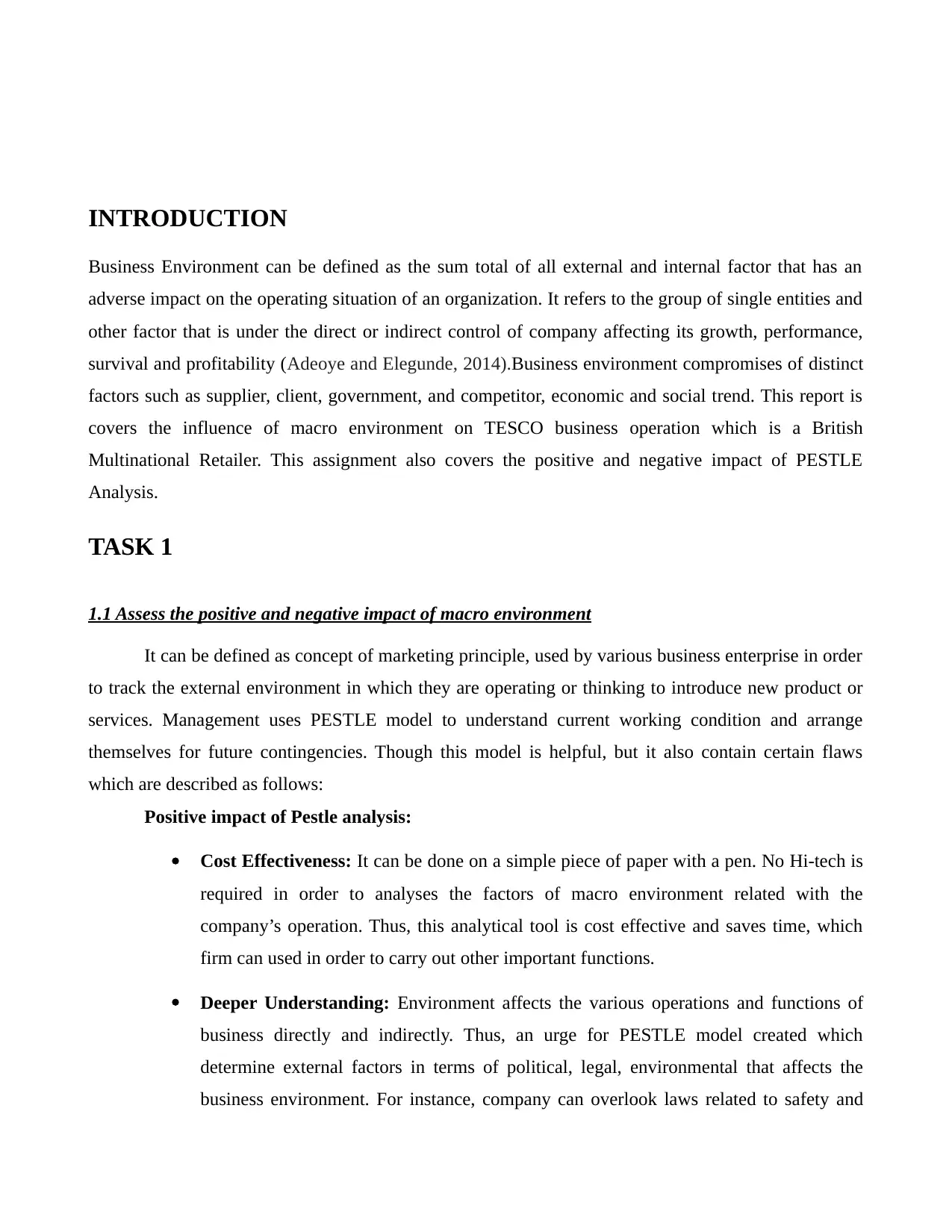
Business Environment can be defined as the sum total of all external and internal factor that has an
adverse impact on the operating situation of an organization. It refers to the group of single entities and
other factor that is under the direct or indirect control of company affecting its growth, performance,
survival and profitability (Adeoye and Elegunde, 2014).Business environment compromises of distinct
factors such as supplier, client, government, and competitor, economic and social trend. This report is
covers the influence of macro environment on TESCO business operation which is a British
Multinational Retailer. This assignment also covers the positive and negative impact of PESTLE
Analysis.
TASK 1
1.1 Assess the positive and negative impact of macro environment
It can be defined as concept of marketing principle, used by various business enterprise in order
to track the external environment in which they are operating or thinking to introduce new product or
services. Management uses PESTLE model to understand current working condition and arrange
themselves for future contingencies. Though this model is helpful, but it also contain certain flaws
which are described as follows:
Positive impact of Pestle analysis:
Cost Effectiveness: It can be done on a simple piece of paper with a pen. No Hi-tech is
required in order to analyses the factors of macro environment related with the
company’s operation. Thus, this analytical tool is cost effective and saves time, which
firm can used in order to carry out other important functions.
Deeper Understanding: Environment affects the various operations and functions of
business directly and indirectly. Thus, an urge for PESTLE model created which
determine external factors in terms of political, legal, environmental that affects the
business environment. For instance, company can overlook laws related to safety and
Business Environment can be defined as the sum total of all external and internal factor that has an
adverse impact on the operating situation of an organization. It refers to the group of single entities and
other factor that is under the direct or indirect control of company affecting its growth, performance,
survival and profitability (Adeoye and Elegunde, 2014).Business environment compromises of distinct
factors such as supplier, client, government, and competitor, economic and social trend. This report is
covers the influence of macro environment on TESCO business operation which is a British
Multinational Retailer. This assignment also covers the positive and negative impact of PESTLE
Analysis.
TASK 1
1.1 Assess the positive and negative impact of macro environment
It can be defined as concept of marketing principle, used by various business enterprise in order
to track the external environment in which they are operating or thinking to introduce new product or
services. Management uses PESTLE model to understand current working condition and arrange
themselves for future contingencies. Though this model is helpful, but it also contain certain flaws
which are described as follows:
Positive impact of Pestle analysis:
Cost Effectiveness: It can be done on a simple piece of paper with a pen. No Hi-tech is
required in order to analyses the factors of macro environment related with the
company’s operation. Thus, this analytical tool is cost effective and saves time, which
firm can used in order to carry out other important functions.
Deeper Understanding: Environment affects the various operations and functions of
business directly and indirectly. Thus, an urge for PESTLE model created which
determine external factors in terms of political, legal, environmental that affects the
business environment. For instance, company can overlook laws related to safety and
⊘ This is a preview!⊘
Do you want full access?
Subscribe today to unlock all pages.
Trusted by 1+ million students worldwide

1 out of 20


Related Documents
![Business and the Business Environment: Report for [University Name]](/_next/image/?url=https%3A%2F%2Fdesklib.com%2Fmedia%2Fimages%2Fbe%2F38fa8050ce8f491d8760aff1b89116bc.jpg&w=256&q=75)


Your All-in-One AI-Powered Toolkit for Academic Success.
+13062052269
info@desklib.com
Available 24*7 on WhatsApp / Email
![[object Object]](/_next/static/media/star-bottom.7253800d.svg)
Unlock your academic potential
Copyright © 2020–2026 A2Z Services. All Rights Reserved. Developed and managed by ZUCOL.