Business Environment Analysis: Tesco, Stakeholders, and Globalisation
VerifiedAdded on 2023/03/23
|17
|4297
|40
Report
AI Summary
This report provides a comprehensive analysis of the business environment, focusing on Tesco PLC as a case study. It begins by outlining Tesco's legal structure as a public limited company (PLC) and compares it to a private limited company. The report identifies the oligopoly market structure in which Tesco operates, discussing its competitive advantages. It delves into stakeholder theory, identifying and evaluating Tesco's main stakeholders (management, workforce, customers, and investors) using the Power/Interest matrix, and addresses potential conflicts and resolutions. Furthermore, the report examines the national economic system, its advantages and disadvantages, and the impact of macroeconomic objectives on Tesco. Finally, it investigates the roles of the IMF and the World Bank in promoting globalisation and limiting protectionism.
UNDERSTANDING THE BUSINESS ENVIRONMENT

Paraphrase This Document
Need a fresh take? Get an instant paraphrase of this document with our AI Paraphraser
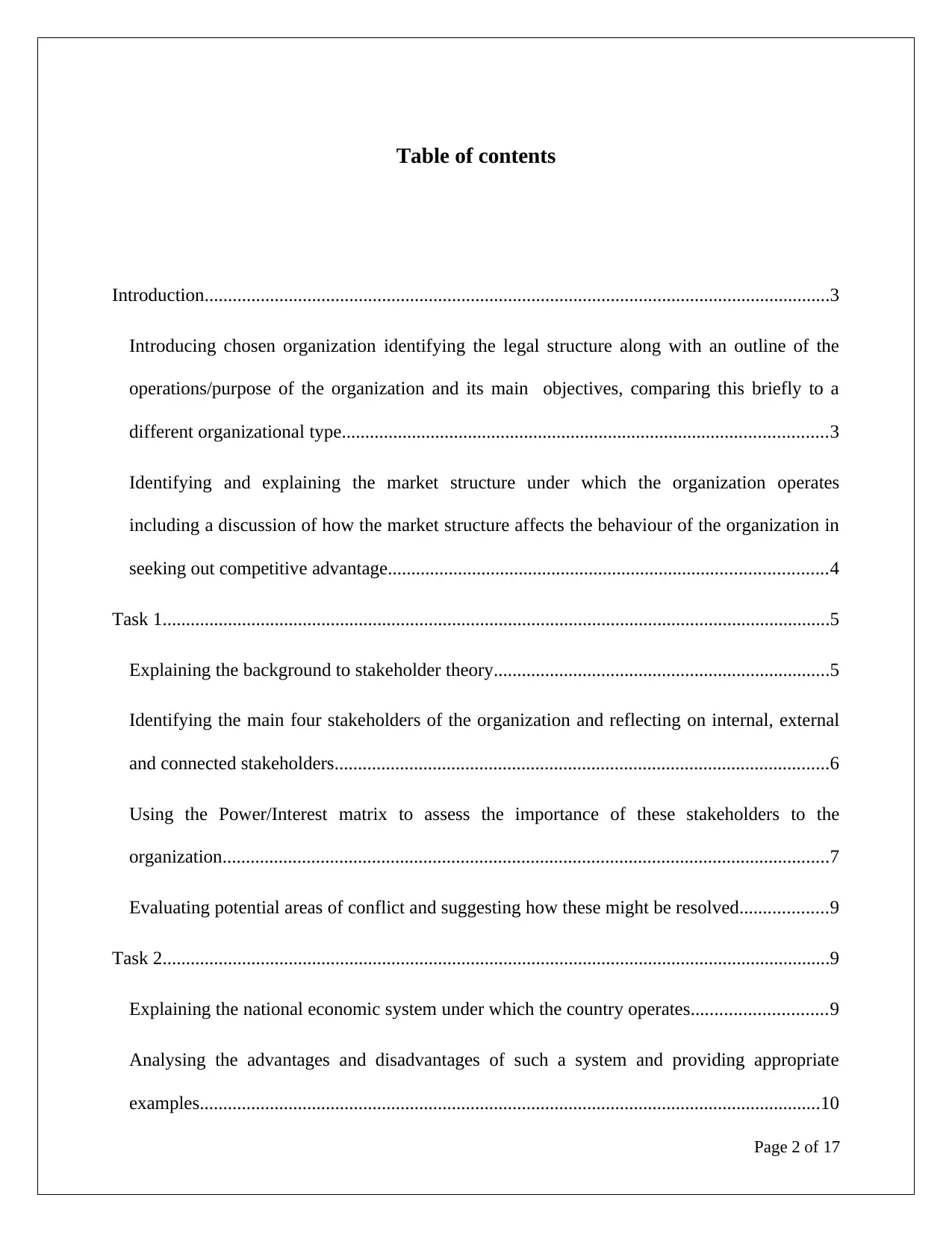
Table of contents
Introduction......................................................................................................................................3
Introducing chosen organization identifying the legal structure along with an outline of the
operations/purpose of the organization and its main objectives, comparing this briefly to a
different organizational type........................................................................................................3
Identifying and explaining the market structure under which the organization operates
including a discussion of how the market structure affects the behaviour of the organization in
seeking out competitive advantage..............................................................................................4
Task 1...............................................................................................................................................5
Explaining the background to stakeholder theory........................................................................5
Identifying the main four stakeholders of the organization and reflecting on internal, external
and connected stakeholders..........................................................................................................6
Using the Power/Interest matrix to assess the importance of these stakeholders to the
organization..................................................................................................................................7
Evaluating potential areas of conflict and suggesting how these might be resolved...................9
Task 2...............................................................................................................................................9
Explaining the national economic system under which the country operates.............................9
Analysing the advantages and disadvantages of such a system and providing appropriate
examples.....................................................................................................................................10
Page 2 of 17
Introduction......................................................................................................................................3
Introducing chosen organization identifying the legal structure along with an outline of the
operations/purpose of the organization and its main objectives, comparing this briefly to a
different organizational type........................................................................................................3
Identifying and explaining the market structure under which the organization operates
including a discussion of how the market structure affects the behaviour of the organization in
seeking out competitive advantage..............................................................................................4
Task 1...............................................................................................................................................5
Explaining the background to stakeholder theory........................................................................5
Identifying the main four stakeholders of the organization and reflecting on internal, external
and connected stakeholders..........................................................................................................6
Using the Power/Interest matrix to assess the importance of these stakeholders to the
organization..................................................................................................................................7
Evaluating potential areas of conflict and suggesting how these might be resolved...................9
Task 2...............................................................................................................................................9
Explaining the national economic system under which the country operates.............................9
Analysing the advantages and disadvantages of such a system and providing appropriate
examples.....................................................................................................................................10
Page 2 of 17
identifying and discussing how the pursuit of at least one macroeconomic objective by the
Government impacts a chosen organization..................................................................................11
Task 3.............................................................................................................................................12
Investigating the role of the IMF and the World Bank in promoting globalisation and helping
to limit protectionism around the world and does the literature suggest that they are effective in
this..............................................................................................................................................12
References......................................................................................................................................14
Page 3 of 17
Government impacts a chosen organization..................................................................................11
Task 3.............................................................................................................................................12
Investigating the role of the IMF and the World Bank in promoting globalisation and helping
to limit protectionism around the world and does the literature suggest that they are effective in
this..............................................................................................................................................12
References......................................................................................................................................14
Page 3 of 17
⊘ This is a preview!⊘
Do you want full access?
Subscribe today to unlock all pages.

Trusted by 1+ million students worldwide
Introduction
Introducing chosen organization identifying the legal structure along with an outline of the
operations/purpose of the organization and its main objectives, comparing this briefly to a
different organizational type
Tesco is the chosen organization for the current evaluation the firm is an multinational grocery
and merchandise retailer and is based in the United Kingdom. The company is a Public limited
company and has legal existence as a PLC in the market. The company is listed on the London
Stock exchange where it's put out its shares to the acquire capital from the investors. Public
limited company is a type of public company recognized by the United Kingdom Company law.
The public limited company is a limited liability company (Schell, 2018). The shares of the
company are free to be traded within the stock market to the public and the company has a
minimum share capital of 50,000. The letter PLC is added as an Suffix to the name of the firm.
Tesco PLC is a public limited company which has market share capital of at least 30%. Now
this shows that the firm is big PLC organization within the market. A plc Company can be
listed or can be unlisted in the market although in case of Tesco the firm is listed on different
stock exchange markets (Lawton, 2017). The company under such legal structure is operated by
the directors of the company. PLC also has a separate legal identity which means it is
representing its operational activities. The company under PLC status can issues shares within
the market which can be ordinary shares, preference shares, cumulative preference shares and
Redeemable shares. A public company is formed by the usage of registration documents such
as Memorandum of association, articles of association, organization 1 and Form 12 (Ragulina,
Stroiteleva and Miller, 2015). The public limited firms have to pay annual dividend to the
Page 4 of 17
Introducing chosen organization identifying the legal structure along with an outline of the
operations/purpose of the organization and its main objectives, comparing this briefly to a
different organizational type
Tesco is the chosen organization for the current evaluation the firm is an multinational grocery
and merchandise retailer and is based in the United Kingdom. The company is a Public limited
company and has legal existence as a PLC in the market. The company is listed on the London
Stock exchange where it's put out its shares to the acquire capital from the investors. Public
limited company is a type of public company recognized by the United Kingdom Company law.
The public limited company is a limited liability company (Schell, 2018). The shares of the
company are free to be traded within the stock market to the public and the company has a
minimum share capital of 50,000. The letter PLC is added as an Suffix to the name of the firm.
Tesco PLC is a public limited company which has market share capital of at least 30%. Now
this shows that the firm is big PLC organization within the market. A plc Company can be
listed or can be unlisted in the market although in case of Tesco the firm is listed on different
stock exchange markets (Lawton, 2017). The company under such legal structure is operated by
the directors of the company. PLC also has a separate legal identity which means it is
representing its operational activities. The company under PLC status can issues shares within
the market which can be ordinary shares, preference shares, cumulative preference shares and
Redeemable shares. A public company is formed by the usage of registration documents such
as Memorandum of association, articles of association, organization 1 and Form 12 (Ragulina,
Stroiteleva and Miller, 2015). The public limited firms have to pay annual dividend to the
Page 4 of 17
Paraphrase This Document
Need a fresh take? Get an instant paraphrase of this document with our AI Paraphraser
shareholder on basis of the profits although in case of preference share the company is liable to
pay dividend even if the company incurs a loss in accordance to the preferential rights. Tesco is
also a PLC hence the main purpose of its being a PLC is to gain a market from which it can gain
investment and capital for its future operational activities. In this way the company could gain
financial resources in case they need to carry out any major operations. Now public limited
firms are different than that of Private limited organizations. In accordance to the legal
structure minimum number of member required for public limited companies are 7 whereas for
private they are 2 members only, the minimum number of director required in public company is
3 where as in private there is only 2. Now the maximum number of member for PLC is unlimited
whereas for Private limited it is 200. Public limited companies can issues and trade their shares
within public through stock markets whereas this is not possible in case of private limited
companies. PLC companies hold statutory meeting in annual years whereas there are no such
meeting required in Pvt. Ltd companies. Hence it can be said that PLC is a bigger business
structure in comparison to the that of Private limited firms.
Identifying and explaining the market structure under which the organization operates
including a discussion of how the market structure affects the behaviour of the
organization in seeking out competitive advantage
There is an Oligopoly market structure within the market in which the company is operating. In
the Oligopoly market structure the market is dominated by some organizations which are
operating within the market. The market structure is in which every company is looking to
increase profit, there are barrier to entry in the market, oligopolies dominate the market and the
product are either different or homogeneous in nature. In case of Tesco it is the largest grocery
and merchandise company within the UK market and mainly dominates the market where there
Page 5 of 17
pay dividend even if the company incurs a loss in accordance to the preferential rights. Tesco is
also a PLC hence the main purpose of its being a PLC is to gain a market from which it can gain
investment and capital for its future operational activities. In this way the company could gain
financial resources in case they need to carry out any major operations. Now public limited
firms are different than that of Private limited organizations. In accordance to the legal
structure minimum number of member required for public limited companies are 7 whereas for
private they are 2 members only, the minimum number of director required in public company is
3 where as in private there is only 2. Now the maximum number of member for PLC is unlimited
whereas for Private limited it is 200. Public limited companies can issues and trade their shares
within public through stock markets whereas this is not possible in case of private limited
companies. PLC companies hold statutory meeting in annual years whereas there are no such
meeting required in Pvt. Ltd companies. Hence it can be said that PLC is a bigger business
structure in comparison to the that of Private limited firms.
Identifying and explaining the market structure under which the organization operates
including a discussion of how the market structure affects the behaviour of the
organization in seeking out competitive advantage
There is an Oligopoly market structure within the market in which the company is operating. In
the Oligopoly market structure the market is dominated by some organizations which are
operating within the market. The market structure is in which every company is looking to
increase profit, there are barrier to entry in the market, oligopolies dominate the market and the
product are either different or homogeneous in nature. In case of Tesco it is the largest grocery
and merchandise company within the UK market and mainly dominates the market where there
Page 5 of 17
are other companies like Sainsbury which give competition to the organization in an evident
manner. Although there is no major competition to the financial and market size of the
organization currently in the market. This helps the company in thriving within the market and
increase financial stability. The company is a market leader which means it can set trends and
prices of the products giving it an competitive advantage over other companies in the market.
The company is dominating the market in terms of customer base and market share. The
company has effective customer base in this oligopoly market structure this means that the firm
is dominating the market and has low competition in terms customers. Product differentiation is
low within this market in which other competitors in the market have the more or less the same
product which Tesco is selling to the customers. Hence it can be said that there is good amount
advantage which the company has in the market and Tesco is dominating the market which gives
it an efficient market advantage over other firms (Noe et al. 2017).
Task 1
Explaining the background to stakeholder theory
In accordance to the stakeholders theory a company should look forward in such view of
capitalism that it should focus on creating an interconnected relationship between suppliers,
customers, communities and others. Basically the stakeholder theory emphasizes on creation of
value for all stakeholders of the firm. The company should focus on development of
relationship between all the stakeholders of the company and that all the stakeholders associated
with the business entity should be benefited with the operational activities of the business entity.
The theory argues that shareholders should not be the only beneficiary of the business entity's
Page 6 of 17
manner. Although there is no major competition to the financial and market size of the
organization currently in the market. This helps the company in thriving within the market and
increase financial stability. The company is a market leader which means it can set trends and
prices of the products giving it an competitive advantage over other companies in the market.
The company is dominating the market in terms of customer base and market share. The
company has effective customer base in this oligopoly market structure this means that the firm
is dominating the market and has low competition in terms customers. Product differentiation is
low within this market in which other competitors in the market have the more or less the same
product which Tesco is selling to the customers. Hence it can be said that there is good amount
advantage which the company has in the market and Tesco is dominating the market which gives
it an efficient market advantage over other firms (Noe et al. 2017).
Task 1
Explaining the background to stakeholder theory
In accordance to the stakeholders theory a company should look forward in such view of
capitalism that it should focus on creating an interconnected relationship between suppliers,
customers, communities and others. Basically the stakeholder theory emphasizes on creation of
value for all stakeholders of the firm. The company should focus on development of
relationship between all the stakeholders of the company and that all the stakeholders associated
with the business entity should be benefited with the operational activities of the business entity.
The theory argues that shareholders should not be the only beneficiary of the business entity's
Page 6 of 17
⊘ This is a preview!⊘
Do you want full access?
Subscribe today to unlock all pages.
Trusted by 1+ million students worldwide
performance but all of the stakeholder must be benefited if the business entity's does well in their
operations. Basically the theory is about developing business approaches which focuses on value
creation for each stakeholder which is associated with the firm this may include any group of
stakeholders. In this way the firm will be able to morally give back to the stakeholders which
associated with the organization’s operational activities and give it a platform to operate in an
successful manner (Ward and Rhodes, 2014). The stakeholder theory suggest that every
stakeholder plays an important role in the operation of the company hence the organization
should also think of giving benefits to all of the stakeholder which will be fair to them.
Identifying the main four stakeholders of the organization and reflecting on internal,
external and connected stakeholders
The main Four stakeholders of the company are as follows:
Management: The management of Tesco is an internal stakeholder of the company which is
associated with the decision making and planning for the company's operation to derive profit
and value for the organization. The management of the firm is very important to the firm's
operation as they give prominent direction in which the organization should operate in.
Workforce: The workforce of the firm is the only way through which the company will operate
in in they are the internal stakeholders of the company and carry out the operations of the firm.
Workforce is highly associated with the organization as they carry out operation for the
company and help the company in rendering goods and services to the customers of the
organization (Davis and Walsh, 2016).
Customers: The customers of the firm are external stakeholders of the firm they are stakeholders
which buy the products and service of the company and for which the company operate its
Page 7 of 17
operations. Basically the theory is about developing business approaches which focuses on value
creation for each stakeholder which is associated with the firm this may include any group of
stakeholders. In this way the firm will be able to morally give back to the stakeholders which
associated with the organization’s operational activities and give it a platform to operate in an
successful manner (Ward and Rhodes, 2014). The stakeholder theory suggest that every
stakeholder plays an important role in the operation of the company hence the organization
should also think of giving benefits to all of the stakeholder which will be fair to them.
Identifying the main four stakeholders of the organization and reflecting on internal,
external and connected stakeholders
The main Four stakeholders of the company are as follows:
Management: The management of Tesco is an internal stakeholder of the company which is
associated with the decision making and planning for the company's operation to derive profit
and value for the organization. The management of the firm is very important to the firm's
operation as they give prominent direction in which the organization should operate in.
Workforce: The workforce of the firm is the only way through which the company will operate
in in they are the internal stakeholders of the company and carry out the operations of the firm.
Workforce is highly associated with the organization as they carry out operation for the
company and help the company in rendering goods and services to the customers of the
organization (Davis and Walsh, 2016).
Customers: The customers of the firm are external stakeholders of the firm they are stakeholders
which buy the products and service of the company and for which the company operate its
Page 7 of 17
Paraphrase This Document
Need a fresh take? Get an instant paraphrase of this document with our AI Paraphraser
services. The company collects revenue from rendering goods and service to there customer
within the market.
Investors: Investor of the company are the shareholder of Tesco which invest in the operational
activities of the company and through which the company collects resources for there final
operations. In this way the company ensures that they have evident amount of resources for
carrying out there operational activities (Fethi and Katircioglu, 2015).
All of these stakeholders are interrelated to each other and help the organizations in there
operational activities. Investor invest in the operations of the business entity which the
management uses to operate the business entity , the workforce carries out the operation and
helps the business entity in rendering good and services of the firm. The customer buys these
product through which the company earn revenue and profit which is then distributed among the
investors of the firm. In this way all of the stakeholders within the firm are interrelated to each
other.
Using the Power/Interest matrix to assess the importance of these stakeholders to the
organization
Power and interest matrix is a process and approach of determining stakeholder power and
interest in the context of the business entity's operations. The importance of each stakeholder is
assessed on the basis of this matrix.
Page 8 of 17
within the market.
Investors: Investor of the company are the shareholder of Tesco which invest in the operational
activities of the company and through which the company collects resources for there final
operations. In this way the company ensures that they have evident amount of resources for
carrying out there operational activities (Fethi and Katircioglu, 2015).
All of these stakeholders are interrelated to each other and help the organizations in there
operational activities. Investor invest in the operations of the business entity which the
management uses to operate the business entity , the workforce carries out the operation and
helps the business entity in rendering good and services of the firm. The customer buys these
product through which the company earn revenue and profit which is then distributed among the
investors of the firm. In this way all of the stakeholders within the firm are interrelated to each
other.
Using the Power/Interest matrix to assess the importance of these stakeholders to the
organization
Power and interest matrix is a process and approach of determining stakeholder power and
interest in the context of the business entity's operations. The importance of each stakeholder is
assessed on the basis of this matrix.
Page 8 of 17
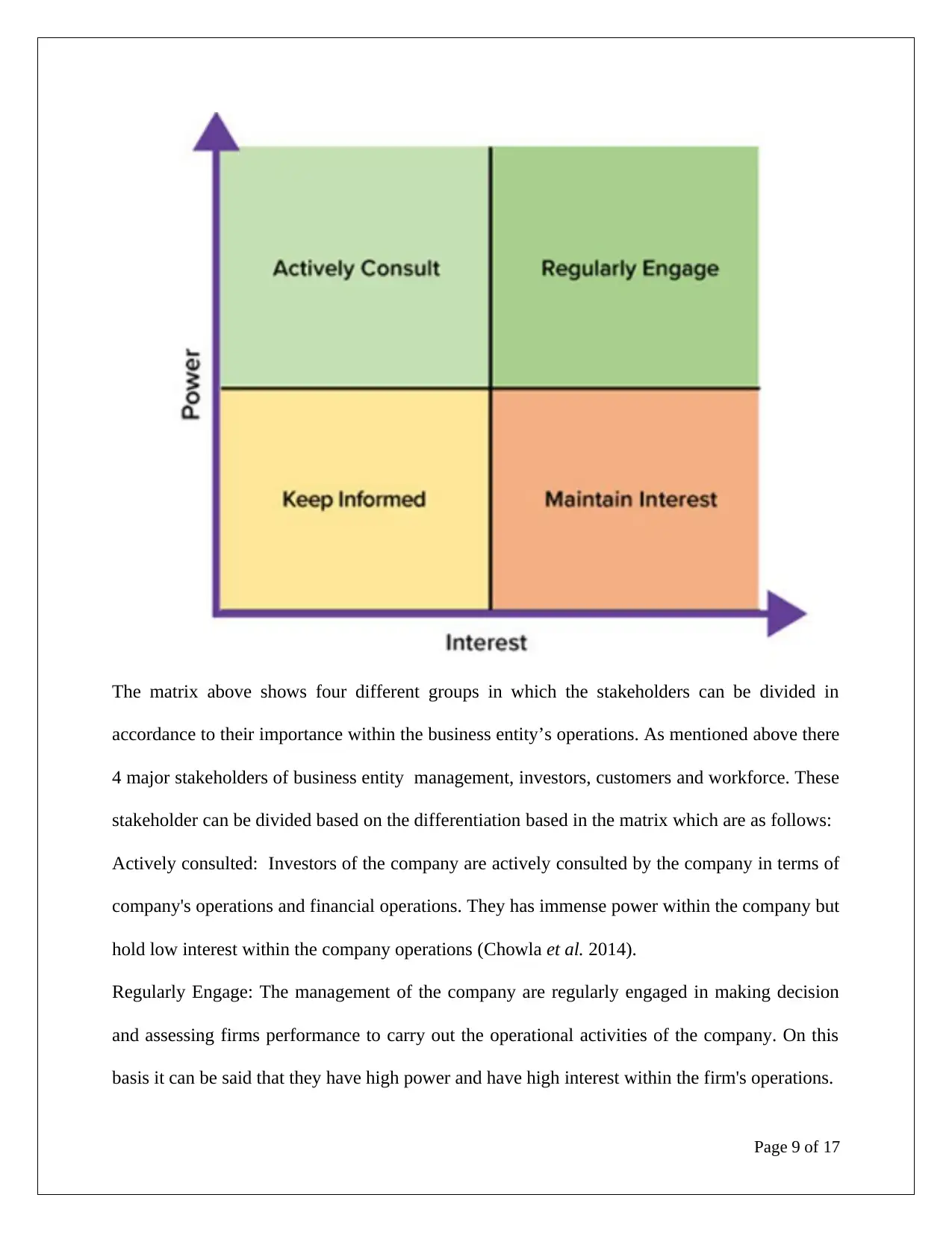
The matrix above shows four different groups in which the stakeholders can be divided in
accordance to their importance within the business entity’s operations. As mentioned above there
4 major stakeholders of business entity management, investors, customers and workforce. These
stakeholder can be divided based on the differentiation based in the matrix which are as follows:
Actively consulted: Investors of the company are actively consulted by the company in terms of
company's operations and financial operations. They has immense power within the company but
hold low interest within the company operations (Chowla et al. 2014).
Regularly Engage: The management of the company are regularly engaged in making decision
and assessing firms performance to carry out the operational activities of the company. On this
basis it can be said that they have high power and have high interest within the firm's operations.
Page 9 of 17
accordance to their importance within the business entity’s operations. As mentioned above there
4 major stakeholders of business entity management, investors, customers and workforce. These
stakeholder can be divided based on the differentiation based in the matrix which are as follows:
Actively consulted: Investors of the company are actively consulted by the company in terms of
company's operations and financial operations. They has immense power within the company but
hold low interest within the company operations (Chowla et al. 2014).
Regularly Engage: The management of the company are regularly engaged in making decision
and assessing firms performance to carry out the operational activities of the company. On this
basis it can be said that they have high power and have high interest within the firm's operations.
Page 9 of 17
⊘ This is a preview!⊘
Do you want full access?
Subscribe today to unlock all pages.
Trusted by 1+ million students worldwide
Keep Informed: Workforce of the firm have low power and high interest within the operational
activities of the firm. This is because they carry out the firm operations but are directed by the
management which decreases the power within the organization operation.
Maintain Interest: The customer have low interest in company's operations and have no
decision making powers for the firm. Hence the company has to maintain interest of the
customers towards these stakeholder to keep them engaged with the firm's operational activities
(Stokes et al. 2014).
Evaluating potential areas of conflict and suggesting how these might be resolved
The potential area of conflict can be in areas between shareholder or inventors with management
of the firm or between management of firm and workforce. This is because there is requirement
of high communication between these groups and stakeholders for ease of operations.
Communicational gap may increase the risk of dispute within the firm’s operational activities.
Hence a proper communication channel should be established within the firm. This will help in
proper flow of information which will help the firm in resolving conflict and mitigate the
situation of conflict which may arise in the process of operations within the organization (Van
Reenen, 2016).
Task 2
Explaining the national economic system under which the country operates
United Kingdom is a highly developed economy in Europe it is considered as the fifth largest
economy in the world as measured by the use of nominal gross domestic product. The economy
is said to be a market oriented economy and the economic system which is there within the
Page 10 of 17
activities of the firm. This is because they carry out the firm operations but are directed by the
management which decreases the power within the organization operation.
Maintain Interest: The customer have low interest in company's operations and have no
decision making powers for the firm. Hence the company has to maintain interest of the
customers towards these stakeholder to keep them engaged with the firm's operational activities
(Stokes et al. 2014).
Evaluating potential areas of conflict and suggesting how these might be resolved
The potential area of conflict can be in areas between shareholder or inventors with management
of the firm or between management of firm and workforce. This is because there is requirement
of high communication between these groups and stakeholders for ease of operations.
Communicational gap may increase the risk of dispute within the firm’s operational activities.
Hence a proper communication channel should be established within the firm. This will help in
proper flow of information which will help the firm in resolving conflict and mitigate the
situation of conflict which may arise in the process of operations within the organization (Van
Reenen, 2016).
Task 2
Explaining the national economic system under which the country operates
United Kingdom is a highly developed economy in Europe it is considered as the fifth largest
economy in the world as measured by the use of nominal gross domestic product. The economy
is said to be a market oriented economy and the economic system which is there within the
Page 10 of 17
Paraphrase This Document
Need a fresh take? Get an instant paraphrase of this document with our AI Paraphraser
country is an advanced capitalist structure which is very open and is known to be a mix of
socially oriented and market oriented economy. The economy is considered to be largely
occupied by private companies although there are some sectors such as health and education
which are not privatized. Now it is to be mentioned that the economic system within the UK is
largely derived from capitalism economic system which means majority of capital goods which
are produced within the country is owned by individuals or business and the supply and demand
within the market is the consequence of supply and demand within the general market created by
the customers. It is to be mentioned that all of the firms within the the countries operate under
the same economic system and create more privatized sector within the country. Social and
market orientation of the economy derives companies which are more likely to respond to social
and market elements within the country's economy. The economic system within the firm is
developed and stable which is a positive indications to the country's economic system (Powell,
2019).
Analysing the advantages and disadvantages of such a system and providing appropriate
examples
The advantages of economies customer are as follows:
1. Economic freedom: In this type of capitalistic economy there is economic freedom
which companies within this economic structure can exercise to operate within the
market. Privatization of company’s operation is easy which gives authority to the
company’s giving them more freedom to operate on their own measures.
2. Variety of goods and services: There are variety of good and service which are available
in such open market as the company’s within this economic structure get to produce and
render their choice of products and services. This is because economy is unplanned and
Page 11 of 17
socially oriented and market oriented economy. The economy is considered to be largely
occupied by private companies although there are some sectors such as health and education
which are not privatized. Now it is to be mentioned that the economic system within the UK is
largely derived from capitalism economic system which means majority of capital goods which
are produced within the country is owned by individuals or business and the supply and demand
within the market is the consequence of supply and demand within the general market created by
the customers. It is to be mentioned that all of the firms within the the countries operate under
the same economic system and create more privatized sector within the country. Social and
market orientation of the economy derives companies which are more likely to respond to social
and market elements within the country's economy. The economic system within the firm is
developed and stable which is a positive indications to the country's economic system (Powell,
2019).
Analysing the advantages and disadvantages of such a system and providing appropriate
examples
The advantages of economies customer are as follows:
1. Economic freedom: In this type of capitalistic economy there is economic freedom
which companies within this economic structure can exercise to operate within the
market. Privatization of company’s operation is easy which gives authority to the
company’s giving them more freedom to operate on their own measures.
2. Variety of goods and services: There are variety of good and service which are available
in such open market as the company’s within this economic structure get to produce and
render their choice of products and services. This is because economy is unplanned and
Page 11 of 17
there is no certain set of products and service which the economy is looking to grow in
(McLeay, Radia and Thomas, 2014).
3. Optimum use of resources: As every company under this economic system is looking to
increase profit the use of resources reaches to its optimum level reducing wastes which is
an advantage which company's under this economy have.
The disadvantages of this economic system are as follows:
1. Threat of overproduction: Every company wants to achieve competitive advantage over
the other in such market hence there is a threat of over production of good and services
which could affect the demand, supply and rice levels of the product within this market
which is a disadvantage of the companies in this market. For example if company
producing clothes produces excess cloth and increase supply the demand and price level
of the cloth will decrease within the market (Gregson et al. 2015).
2. Labor exploitations: Under this economic structure full use of labor resources are
conduct which exploit labor s within the market. For example In the UK wages rate is
less that the marginal productivity of economy.
3. No welfare activities: As there is high competition and intrinsic business operations
which go on within the economy the welfare activities within such market are low which
causes low social and environmental interactions of the firm (Dhingra et al. 2016).
identifying and discussing how the pursuit of at least one macroeconomic
objective by the Government impacts a chosen organization
In relation to Tesco which is a big company in the UK economy the pursuit of one
macroeconomic objective by the government will directly impact the firm's operations. A
Page 12 of 17
(McLeay, Radia and Thomas, 2014).
3. Optimum use of resources: As every company under this economic system is looking to
increase profit the use of resources reaches to its optimum level reducing wastes which is
an advantage which company's under this economy have.
The disadvantages of this economic system are as follows:
1. Threat of overproduction: Every company wants to achieve competitive advantage over
the other in such market hence there is a threat of over production of good and services
which could affect the demand, supply and rice levels of the product within this market
which is a disadvantage of the companies in this market. For example if company
producing clothes produces excess cloth and increase supply the demand and price level
of the cloth will decrease within the market (Gregson et al. 2015).
2. Labor exploitations: Under this economic structure full use of labor resources are
conduct which exploit labor s within the market. For example In the UK wages rate is
less that the marginal productivity of economy.
3. No welfare activities: As there is high competition and intrinsic business operations
which go on within the economy the welfare activities within such market are low which
causes low social and environmental interactions of the firm (Dhingra et al. 2016).
identifying and discussing how the pursuit of at least one macroeconomic
objective by the Government impacts a chosen organization
In relation to Tesco which is a big company in the UK economy the pursuit of one
macroeconomic objective by the government will directly impact the firm's operations. A
Page 12 of 17
⊘ This is a preview!⊘
Do you want full access?
Subscribe today to unlock all pages.
Trusted by 1+ million students worldwide

1 out of 17


Related Documents


Your All-in-One AI-Powered Toolkit for Academic Success.
+13062052269
info@desklib.com
Available 24*7 on WhatsApp / Email
![[object Object]](/_next/static/media/star-bottom.7253800d.svg)
Unlock your academic potential
Copyright © 2020–2026 A2Z Services. All Rights Reserved. Developed and managed by ZUCOL.