Tesco Strategic Plan: Evaluating Strategy & Environmental Factors
VerifiedAdded on 2023/06/17
|9
|3090
|319
Report
AI Summary
This report provides a comprehensive analysis of Tesco's strategic management, focusing on the process of strategy determination and the impact of internal and external environmental factors. It evaluates the steps involved in formulating strategies, including setting objectives, environmental analysis, setting quantitative targets, aligning with divisional plans, performance analysis, and strategy choice. The report also assesses the influence of internal factors like human resources, organizational culture, structure, management, and assets, as well as external factors such as economic conditions, market competition, technology, climate change, and political policies. Furthermore, it examines Tesco's strategic plan in the context of change management, emphasizing the importance of adapting to evolving customer needs and technological advancements to ensure long-term sustainability and competitive advantage. The role of leaders and managers in driving change and fostering a positive work environment is also highlighted.

6002

Paraphrase This Document
Need a fresh take? Get an instant paraphrase of this document with our AI Paraphraser
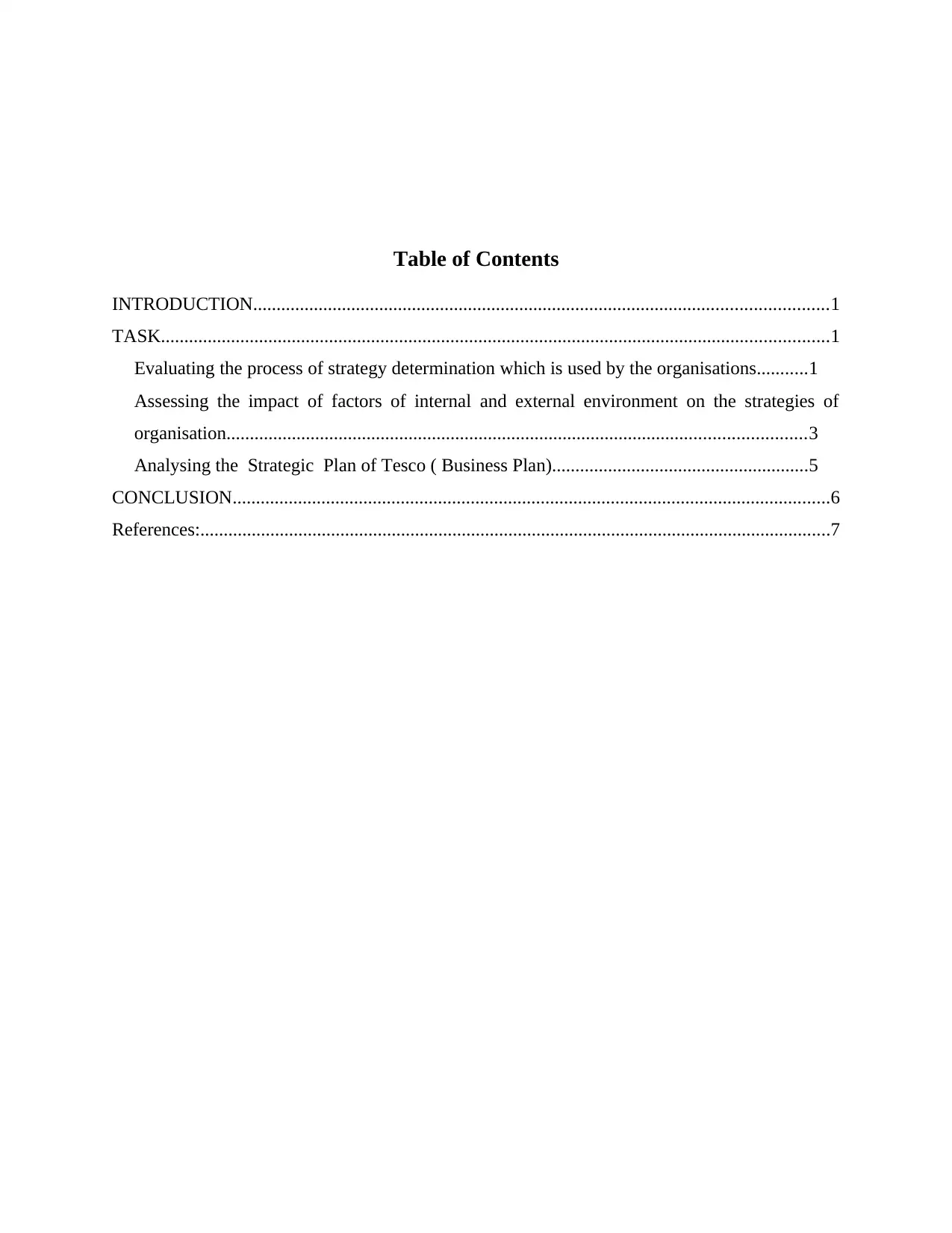
Table of Contents
INTRODUCTION...........................................................................................................................1
TASK...............................................................................................................................................1
Evaluating the process of strategy determination which is used by the organisations...........1
Assessing the impact of factors of internal and external environment on the strategies of
organisation............................................................................................................................3
Analysing the Strategic Plan of Tesco ( Business Plan).......................................................5
CONCLUSION................................................................................................................................6
References:.......................................................................................................................................7
INTRODUCTION...........................................................................................................................1
TASK...............................................................................................................................................1
Evaluating the process of strategy determination which is used by the organisations...........1
Assessing the impact of factors of internal and external environment on the strategies of
organisation............................................................................................................................3
Analysing the Strategic Plan of Tesco ( Business Plan).......................................................5
CONCLUSION................................................................................................................................6
References:.......................................................................................................................................7
INTRODUCTION
Strategic management is defined as a continuous process of planning, motivating,
inspection and evaluation of all the resources which an organisation require with the motive of
achieving it's goals and objectives. It has been found that the business environment get changes
constantly. Hence, it is necessary for the organisation to continuously assess their strategies for
getting success. It also provide various benefits to the organisation such as competitive benefit,
achieving goals, sustainable growth, increasing managerial awareness and many more. The
chosen organisation for this report is Tesco which is a British multinational groceries and
general merchandise retailer having headquarter in Welwyn Garden City, Hertfordshire,
England, United Kingdom. It was founded by Jack Cohen in 1919. This report deals with the
process which has been used by the organisations for the purpose of determining strategies,
impact of internal and external environmental factors on the strategies of organisation.
Furthermore, it also covers the strategic and action plan of the organisation on the behalf of
changes in the internal or external environment.
TASK
Evaluating the process of strategy determination which is used by the organisations
Strategic planning refers to the skills of creating business strategies, implementing at the
work place and evaluating the results of executing the plan in order to achieve the goals and
objectives of organisation (Kerzner 2019). Formation of strategy is defined as the process of
selecting the correct course of action for meeting the organisational goals and objectives. Below
mentioned are the several steps of determining the strategy: Setting objectives of organisation: The main objective of developing strategies is to
achieve the organisational goals and objectives and these strategies are considered as the
medium to reach at the desired position. Objectives focus on the state of being there
whereas the strategy is related to the process of reaching there. Strategy involve the both
developing goals along with the medium which is being used by the organisation for
achieving those objectives (Malekpour and et. al., 2017). There are several factors
which effect the decision making of an organisation. Strategy is consider as a wider
term which focus on the distribution of resources for the purpose of achieving the
1
Strategic management is defined as a continuous process of planning, motivating,
inspection and evaluation of all the resources which an organisation require with the motive of
achieving it's goals and objectives. It has been found that the business environment get changes
constantly. Hence, it is necessary for the organisation to continuously assess their strategies for
getting success. It also provide various benefits to the organisation such as competitive benefit,
achieving goals, sustainable growth, increasing managerial awareness and many more. The
chosen organisation for this report is Tesco which is a British multinational groceries and
general merchandise retailer having headquarter in Welwyn Garden City, Hertfordshire,
England, United Kingdom. It was founded by Jack Cohen in 1919. This report deals with the
process which has been used by the organisations for the purpose of determining strategies,
impact of internal and external environmental factors on the strategies of organisation.
Furthermore, it also covers the strategic and action plan of the organisation on the behalf of
changes in the internal or external environment.
TASK
Evaluating the process of strategy determination which is used by the organisations
Strategic planning refers to the skills of creating business strategies, implementing at the
work place and evaluating the results of executing the plan in order to achieve the goals and
objectives of organisation (Kerzner 2019). Formation of strategy is defined as the process of
selecting the correct course of action for meeting the organisational goals and objectives. Below
mentioned are the several steps of determining the strategy: Setting objectives of organisation: The main objective of developing strategies is to
achieve the organisational goals and objectives and these strategies are considered as the
medium to reach at the desired position. Objectives focus on the state of being there
whereas the strategy is related to the process of reaching there. Strategy involve the both
developing goals along with the medium which is being used by the organisation for
achieving those objectives (Malekpour and et. al., 2017). There are several factors
which effect the decision making of an organisation. Strategy is consider as a wider
term which focus on the distribution of resources for the purpose of achieving the
1
⊘ This is a preview!⊘
Do you want full access?
Subscribe today to unlock all pages.

Trusted by 1+ million students worldwide
organisational goals and objectives. It is necessary for the organisation to do complete
analysis of the factors which influence the decision of selection of objectives. Evaluating the environment of organisation: After setting the objectives, the
organisation is required to analyse the general, economic and industrial environment
under which an organisation is operating (Kemp 2018). A qualitative and quantitative
review of existing products is an important task. Under this step, management of
organisation can get to know about their own as well as their competitor's strength and
weaknesses. The management have to keep an eye on their competitors so that they can
discover the new chances of warnings to its market or supply origin. Setting Quantitative Targets: At this level, the organisation is required to make
quantitative target values. The purpose of setting quantitative targets is to make long
term customers. It is necessary for the organisation to add some values to their
quantitative targets. It will result in higher the efficiency and effectiveness of strategies
at work place. Aiming in context with the divisional plan: Identification of contribution of each and
every department or division of organisation has been done under this step which help in
performing the business strategies accordingly (Huxley 2020). A careful analysis of
macroeconomic trends has been done. At this step, the strategies are developed
according to the divisions so that the organisation can divide the work and
responsibilities to the several functional areas as it will result in effective and efficient
manner. Performance Analysis: It refers to the process under which the difference between the
actual performance and desired performance has been analysed. The management
perform the function of analysing the past, present and future conditions should be done
by the organisation. This evaluation help the organisation to know about the degree of
gap which lies between the actual reality and long term aspirations of the organisation.
Organisation perform the some actions for the purpose of estimating its probable future
condition if the current trends persist.
Choice of Strategy: It is the last and final step in the process of strategy formation
(Pierce and et. al., 2018). At this level, the best course of action is actually chosen after
2
analysis of the factors which influence the decision of selection of objectives. Evaluating the environment of organisation: After setting the objectives, the
organisation is required to analyse the general, economic and industrial environment
under which an organisation is operating (Kemp 2018). A qualitative and quantitative
review of existing products is an important task. Under this step, management of
organisation can get to know about their own as well as their competitor's strength and
weaknesses. The management have to keep an eye on their competitors so that they can
discover the new chances of warnings to its market or supply origin. Setting Quantitative Targets: At this level, the organisation is required to make
quantitative target values. The purpose of setting quantitative targets is to make long
term customers. It is necessary for the organisation to add some values to their
quantitative targets. It will result in higher the efficiency and effectiveness of strategies
at work place. Aiming in context with the divisional plan: Identification of contribution of each and
every department or division of organisation has been done under this step which help in
performing the business strategies accordingly (Huxley 2020). A careful analysis of
macroeconomic trends has been done. At this step, the strategies are developed
according to the divisions so that the organisation can divide the work and
responsibilities to the several functional areas as it will result in effective and efficient
manner. Performance Analysis: It refers to the process under which the difference between the
actual performance and desired performance has been analysed. The management
perform the function of analysing the past, present and future conditions should be done
by the organisation. This evaluation help the organisation to know about the degree of
gap which lies between the actual reality and long term aspirations of the organisation.
Organisation perform the some actions for the purpose of estimating its probable future
condition if the current trends persist.
Choice of Strategy: It is the last and final step in the process of strategy formation
(Pierce and et. al., 2018). At this level, the best course of action is actually chosen after
2
Paraphrase This Document
Need a fresh take? Get an instant paraphrase of this document with our AI Paraphraser
making the organisational goals, organisational strengths, potential and limitation along
with the external opportunities.
Above mentioned are the several steps of the process of determining strategies at work
place. The same process have been followed by the management of Tesco. Firstly they set the
objectives, analysing the several environmental factors, quantitative targets are also established
by the organisation in order to improving the performance (Gratton 2018). After that they divide
the work to the several departments, analysing the performance of organisation, management
taker the decision if making and developing the strategies by choosing the best one.
Assessing the impact of factors of internal and external environment on the strategies of
organisation
All the business organisations have internal and external environment. Internal
environment is related to the human capital of the organisation as how thy are working in an
organisation in order to achieve the organisational goals and objectives. These factors lies within
the organisation (Van Den Berg and et. al., 2017). Hence the management can control or change
it by performing planning and changing the management processes. External factors of
environment can't be controlled by the management of organisation.
Internal Environment Factors Human Resource: The success of an organisation is depend on the experience, capability
and knowledge. For the same purpose, the HR department is required to hire skilled
employees for their organisation. They focus on the process of recruitment of staff along
with the training of staff and volunteers. it has been found that the training is an
important aspect of business management. Organisational Cultures: The attitude of volunteers, staffs and their ability is directly
related to the success. It create the organisational value system. Culture of an
organisation is responsible for reflection of HR policies and practices (Gkoltsiou and et.
al., 2021). Negative attitude separately impact on the capabilities in order to improving
the strategies for the development of organisation. Positive working environment at work
place not only make the management task easy but it also appreciate the customers
towards the business organisation. Organisation structure: The use of technology result in becoming the organisational
structure. Any organisation which include small number of employees and managers.
3
with the external opportunities.
Above mentioned are the several steps of the process of determining strategies at work
place. The same process have been followed by the management of Tesco. Firstly they set the
objectives, analysing the several environmental factors, quantitative targets are also established
by the organisation in order to improving the performance (Gratton 2018). After that they divide
the work to the several departments, analysing the performance of organisation, management
taker the decision if making and developing the strategies by choosing the best one.
Assessing the impact of factors of internal and external environment on the strategies of
organisation
All the business organisations have internal and external environment. Internal
environment is related to the human capital of the organisation as how thy are working in an
organisation in order to achieve the organisational goals and objectives. These factors lies within
the organisation (Van Den Berg and et. al., 2017). Hence the management can control or change
it by performing planning and changing the management processes. External factors of
environment can't be controlled by the management of organisation.
Internal Environment Factors Human Resource: The success of an organisation is depend on the experience, capability
and knowledge. For the same purpose, the HR department is required to hire skilled
employees for their organisation. They focus on the process of recruitment of staff along
with the training of staff and volunteers. it has been found that the training is an
important aspect of business management. Organisational Cultures: The attitude of volunteers, staffs and their ability is directly
related to the success. It create the organisational value system. Culture of an
organisation is responsible for reflection of HR policies and practices (Gkoltsiou and et.
al., 2021). Negative attitude separately impact on the capabilities in order to improving
the strategies for the development of organisation. Positive working environment at work
place not only make the management task easy but it also appreciate the customers
towards the business organisation. Organisation structure: The use of technology result in becoming the organisational
structure. Any organisation which include small number of employees and managers.
3
Organisation structure is generally the way under which the work is needed to carry out
the mission of the organisation which is divided among all the employees. Management: The leadership styles and the abilities of management team implies a
major impact on the morale of staff and the culture of organisation. Most modern form
of management involve the workers of organisation in decision making processes with a
view that the employees and managers have different point of view (Ehrenstein and et.
al., 2019). The management can earn high profit by working together for the purpose of
achieving the organisational goals and objectives.
Assets: The assets of an organisation make the internal environment of organisation
richer or prior. The premises of the organisation can be pleasant and uplifting or
depressing (Raikov 2017). The presence of equipment is the another assets which implies
impact on the internal environmental factors of a business organisation. If the equipment
is in the short supply or not of the expected standard , then the staff may be hindered in
the performance of their duties, or if the equipments are used by the customers then the
satisfaction of customers will fail.
External Environment Factors Economic Condition: Winning condition of economy of the country effects the spending
or purchasing power of customers. Rise in the interest rate or higher unemployment rate
result in the decrease in the consumption of non essential goods and services. Market: Constant change in the factor of external business environment and it can be
consider as the strength of business competition (Cho and et. al., 2019). On the entry or
exit of competitors, they will change the marketing strategies, prices and product lines. It
is necessary for the managers of organisation to keep an eye on competitors so that they
can aware about the actions performed by their competitors. Technology: From the last 50 years, technology is growing day by day and it is the only
external factor which gives pressure on the business or organisation. If the business
organisation do not adopt the advance technology on time, it will result in the losing
market share. Technological changes at work place not only change the design of
products but also the delivery of service can change.
4
the mission of the organisation which is divided among all the employees. Management: The leadership styles and the abilities of management team implies a
major impact on the morale of staff and the culture of organisation. Most modern form
of management involve the workers of organisation in decision making processes with a
view that the employees and managers have different point of view (Ehrenstein and et.
al., 2019). The management can earn high profit by working together for the purpose of
achieving the organisational goals and objectives.
Assets: The assets of an organisation make the internal environment of organisation
richer or prior. The premises of the organisation can be pleasant and uplifting or
depressing (Raikov 2017). The presence of equipment is the another assets which implies
impact on the internal environmental factors of a business organisation. If the equipment
is in the short supply or not of the expected standard , then the staff may be hindered in
the performance of their duties, or if the equipments are used by the customers then the
satisfaction of customers will fail.
External Environment Factors Economic Condition: Winning condition of economy of the country effects the spending
or purchasing power of customers. Rise in the interest rate or higher unemployment rate
result in the decrease in the consumption of non essential goods and services. Market: Constant change in the factor of external business environment and it can be
consider as the strength of business competition (Cho and et. al., 2019). On the entry or
exit of competitors, they will change the marketing strategies, prices and product lines. It
is necessary for the managers of organisation to keep an eye on competitors so that they
can aware about the actions performed by their competitors. Technology: From the last 50 years, technology is growing day by day and it is the only
external factor which gives pressure on the business or organisation. If the business
organisation do not adopt the advance technology on time, it will result in the losing
market share. Technological changes at work place not only change the design of
products but also the delivery of service can change.
4
⊘ This is a preview!⊘
Do you want full access?
Subscribe today to unlock all pages.
Trusted by 1+ million students worldwide
Climate Change: It is a cunning threat because of the step of change may be
recognisable only if considered on a decade by decade. The change in the climate will not
affect all the business organisations in the same manner.
Political: Change in the government policies if the nation result in the changes in the
business organisation. It has been found that several of business organisations are depend
on the government financial assistance (Chambers and et. al., 2019). If any of change in
the government take place, these funding assistance can disappear in a short space of
time.
Analysing the Strategic Plan of Tesco ( Business Plan)
Business environment refers to the sum total of all those factors which change
continuously such as change in demand of customers, technology, rules and regulations of
government and many more. For the purpose of successfully assuring the long term sustainability
in this fast placed business environment, it is important to work on their size and scope to change
in an effective and efficient manner (Soulard and et. al., 2018). It is an essential for Tesco to
understand the concept of change management and implementing the changes in the
organisation. This action not only provide the competitive benefit to the organisation but it also
leads to the improvement in the abilities and performance for performing the roles and
responsibilities in the current business environment. In order to implement the new technologies,
the change management plays an important role (Bryson 2018). It has been found that the needs
and requirements of customers are constantly changing and it is necessary for the organisation to
analyse the demand of customers so that they can provide the products and services according to
them which result in higher profitability and productivity. If the Tesco do not provide attention to
this factor,k it result in the several looses faced by the organisation.
Leaders and mangers of organisation has a vital role while implementing the changes at
the work place. The leaders and managers of Tesco are working effectively as they motivate their
subordinates to adopt the new and advance technology in an effective and efficient manner so
that they can increase the profitability of organisation. Through this act, it has been analysed that
the mangers and leaders of Tesco are providing positive and motivating working environment to
their employees and provide proper guidance in an open minded manner for the purpose of
adopting changes (Susanty and et. al., 2018). Leaders of Tesco are constantly making
understandable the meaning of change management to their employees as they believe that
5
recognisable only if considered on a decade by decade. The change in the climate will not
affect all the business organisations in the same manner.
Political: Change in the government policies if the nation result in the changes in the
business organisation. It has been found that several of business organisations are depend
on the government financial assistance (Chambers and et. al., 2019). If any of change in
the government take place, these funding assistance can disappear in a short space of
time.
Analysing the Strategic Plan of Tesco ( Business Plan)
Business environment refers to the sum total of all those factors which change
continuously such as change in demand of customers, technology, rules and regulations of
government and many more. For the purpose of successfully assuring the long term sustainability
in this fast placed business environment, it is important to work on their size and scope to change
in an effective and efficient manner (Soulard and et. al., 2018). It is an essential for Tesco to
understand the concept of change management and implementing the changes in the
organisation. This action not only provide the competitive benefit to the organisation but it also
leads to the improvement in the abilities and performance for performing the roles and
responsibilities in the current business environment. In order to implement the new technologies,
the change management plays an important role (Bryson 2018). It has been found that the needs
and requirements of customers are constantly changing and it is necessary for the organisation to
analyse the demand of customers so that they can provide the products and services according to
them which result in higher profitability and productivity. If the Tesco do not provide attention to
this factor,k it result in the several looses faced by the organisation.
Leaders and mangers of organisation has a vital role while implementing the changes at
the work place. The leaders and managers of Tesco are working effectively as they motivate their
subordinates to adopt the new and advance technology in an effective and efficient manner so
that they can increase the profitability of organisation. Through this act, it has been analysed that
the mangers and leaders of Tesco are providing positive and motivating working environment to
their employees and provide proper guidance in an open minded manner for the purpose of
adopting changes (Susanty and et. al., 2018). Leaders of Tesco are constantly making
understandable the meaning of change management to their employees as they believe that
5
Paraphrase This Document
Need a fresh take? Get an instant paraphrase of this document with our AI Paraphraser
providing all the informations to their employees as it makes the adoption of new technology
smoother (Austin 2018). The managers are also focusing on the participation of their employees
in the decision making process. Along with this, they provide continuous feedbacks and
suggestions from them which leads to the encouragement and enhancement of loyalty in
employees towards the organisation. In thus way, Tesco can adopt the changes in an appropriate
manner as compared to the any other company. Tesco is also able to take he decisions as they
had enhanced the trust of their employees which is also a benefit for them.
From the entire analysis, it has been found that the process of change management
allows the organisation for managing the complexity of transformation process result in the
overcoming from the risks like as change in trend and mindset of customers along with bthe long
term sustainability (Abdi Tabari 2020). In order to finding the potential areas of resistance for
further implementing the strategies, change management has a vital role. With the help of this
model, organisation can make sure that the investment in new project leads to the effective
management not in the loss. Furthermore it has been evaluated that large organisations like
TESCO with the help of change management model can have a shared approach to manage
change activities and align resources in a well defined and effective manner.
CONCLUSION
From the above report, it has been concluded that the strategic management has an
important role in a business organisation as it leads to the gaining more competitive advantage.
Strategic management also provide the guidance to the employees so that they can easily
dominance in the respective market. For the purpose of making decisions in the organisation, it is
necessary for them to analyse the impact of external and internal factors on the organisation.
Business environment include several of factors which is not an easy task to predict them.
Hence, they highly influence the business organisation in a number of ways. By implementing
the appropriate strategies, Tesco can overcome from the challenges which they face by adopting
any changes in business operations and it also result in the growth and development of
organisation.
6
smoother (Austin 2018). The managers are also focusing on the participation of their employees
in the decision making process. Along with this, they provide continuous feedbacks and
suggestions from them which leads to the encouragement and enhancement of loyalty in
employees towards the organisation. In thus way, Tesco can adopt the changes in an appropriate
manner as compared to the any other company. Tesco is also able to take he decisions as they
had enhanced the trust of their employees which is also a benefit for them.
From the entire analysis, it has been found that the process of change management
allows the organisation for managing the complexity of transformation process result in the
overcoming from the risks like as change in trend and mindset of customers along with bthe long
term sustainability (Abdi Tabari 2020). In order to finding the potential areas of resistance for
further implementing the strategies, change management has a vital role. With the help of this
model, organisation can make sure that the investment in new project leads to the effective
management not in the loss. Furthermore it has been evaluated that large organisations like
TESCO with the help of change management model can have a shared approach to manage
change activities and align resources in a well defined and effective manner.
CONCLUSION
From the above report, it has been concluded that the strategic management has an
important role in a business organisation as it leads to the gaining more competitive advantage.
Strategic management also provide the guidance to the employees so that they can easily
dominance in the respective market. For the purpose of making decisions in the organisation, it is
necessary for them to analyse the impact of external and internal factors on the organisation.
Business environment include several of factors which is not an easy task to predict them.
Hence, they highly influence the business organisation in a number of ways. By implementing
the appropriate strategies, Tesco can overcome from the challenges which they face by adopting
any changes in business operations and it also result in the growth and development of
organisation.
6
References:
Books and Journals
Abdi Tabari, M., 2020. Differential effects of strategic planning and task structure on L2 writing
outcomes. Reading & Writing Quarterly, 36(4), pp.320-338.
Austin, N., 2018. Strategic planning. In The clinical directorate (pp. 77-100). CRC Press.
Bryson, J.M., 2018. Strategic planning for public and nonprofit organizations: A guide to
strengthening and sustaining organizational achievement. John Wiley & Sons.
Chambers, L.D. and Taylor, M.A., 2019. Strategic planning: Processes, tools and outcomes.
Routledge.
Cho, S. and Kim, J., 2019. Multi-site and multi-period optimization model for strategic planning
of a renewable hydrogen energy network from biomass waste and energy
crops. Energy, 185, pp.527-540.
Ehrenstein, M., Wang, C.H. and Guillén-Gosálbez, G., 2019. Strategic planning of supply chains
considering extreme events: Novel heuristic and application to the petrochemical
industry. Computers & Chemical Engineering, 125, pp.306-323.
Gkoltsiou, A. and Mougiakou, E., 2021. The use of Islandscape character assessment and
participatory spatial SWOT analysis to the strategic planning and sustainable
development of small islands. The case of Gavdos. Land Use Policy, 103, p.105277.
Gratton, P.C., 2018. Organization Development and Strategic Planning for Non-Profit
Organizations. Organization Development Journal, 36(2).
Huxley, M., 2020. Administrative coordination, urban management and strategic planning in the
1970s. In The Australian Metropolis (pp. 131-148). Routledge.
Kemp, R.L., 2018. Strategic planning in local government. Routledge.
Kerzner, H., 2019. Using the project management maturity model: strategic planning for project
management. John Wiley & Sons.
Malekpour, S., Brown, R.R., de Haan, F.J. and Wong, T.H., 2017. Preparing for disruptions: A
diagnostic strategic planning intervention for sustainable development. Cities, 63,
pp.58-69.
Pierce, E.M. and Goldstein, J., 2018. ERM and strategic planning: A change in
paradigm. International Journal of Disclosure and Governance, 15(1), pp.51-59.
Raikov, A.N., 2017, June. Strategic planning of science city socioeconomic development.
In International Conference on Digital Transformation and Global Society (pp. 295-
306). Springer, Cham.
Soulard, J., Knollenberg, W., Boley, B.B., Perdue, R.R. and McGehee, N.G., 2018. Social
capital and destination strategic planning. Tourism Management, 69, pp.189-200.
Susanty, A., Bakhtiar, A., Puspitasari, N.B. and Mustika, D., 2018. Performance analysis and
strategic planning of dairy supply chain in Indonesia: A comparative
study. International Journal of Productivity and Performance Management.
Van Den Berg, L. and Russo, A., 2017. The student city: strategic planning for student
communities in EU cities. Routledge.
7
Books and Journals
Abdi Tabari, M., 2020. Differential effects of strategic planning and task structure on L2 writing
outcomes. Reading & Writing Quarterly, 36(4), pp.320-338.
Austin, N., 2018. Strategic planning. In The clinical directorate (pp. 77-100). CRC Press.
Bryson, J.M., 2018. Strategic planning for public and nonprofit organizations: A guide to
strengthening and sustaining organizational achievement. John Wiley & Sons.
Chambers, L.D. and Taylor, M.A., 2019. Strategic planning: Processes, tools and outcomes.
Routledge.
Cho, S. and Kim, J., 2019. Multi-site and multi-period optimization model for strategic planning
of a renewable hydrogen energy network from biomass waste and energy
crops. Energy, 185, pp.527-540.
Ehrenstein, M., Wang, C.H. and Guillén-Gosálbez, G., 2019. Strategic planning of supply chains
considering extreme events: Novel heuristic and application to the petrochemical
industry. Computers & Chemical Engineering, 125, pp.306-323.
Gkoltsiou, A. and Mougiakou, E., 2021. The use of Islandscape character assessment and
participatory spatial SWOT analysis to the strategic planning and sustainable
development of small islands. The case of Gavdos. Land Use Policy, 103, p.105277.
Gratton, P.C., 2018. Organization Development and Strategic Planning for Non-Profit
Organizations. Organization Development Journal, 36(2).
Huxley, M., 2020. Administrative coordination, urban management and strategic planning in the
1970s. In The Australian Metropolis (pp. 131-148). Routledge.
Kemp, R.L., 2018. Strategic planning in local government. Routledge.
Kerzner, H., 2019. Using the project management maturity model: strategic planning for project
management. John Wiley & Sons.
Malekpour, S., Brown, R.R., de Haan, F.J. and Wong, T.H., 2017. Preparing for disruptions: A
diagnostic strategic planning intervention for sustainable development. Cities, 63,
pp.58-69.
Pierce, E.M. and Goldstein, J., 2018. ERM and strategic planning: A change in
paradigm. International Journal of Disclosure and Governance, 15(1), pp.51-59.
Raikov, A.N., 2017, June. Strategic planning of science city socioeconomic development.
In International Conference on Digital Transformation and Global Society (pp. 295-
306). Springer, Cham.
Soulard, J., Knollenberg, W., Boley, B.B., Perdue, R.R. and McGehee, N.G., 2018. Social
capital and destination strategic planning. Tourism Management, 69, pp.189-200.
Susanty, A., Bakhtiar, A., Puspitasari, N.B. and Mustika, D., 2018. Performance analysis and
strategic planning of dairy supply chain in Indonesia: A comparative
study. International Journal of Productivity and Performance Management.
Van Den Berg, L. and Russo, A., 2017. The student city: strategic planning for student
communities in EU cities. Routledge.
7
⊘ This is a preview!⊘
Do you want full access?
Subscribe today to unlock all pages.
Trusted by 1+ million students worldwide

1 out of 9


Related Documents


Your All-in-One AI-Powered Toolkit for Academic Success.
+13062052269
info@desklib.com
Available 24*7 on WhatsApp / Email
![[object Object]](/_next/static/media/star-bottom.7253800d.svg)
Unlock your academic potential
Copyright © 2020–2025 A2Z Services. All Rights Reserved. Developed and managed by ZUCOL.