Introduction to Marketing: Tesco and Vodafone Case Study Report
VerifiedAdded on 2020/06/04
|9
|2904
|285
Report
AI Summary
This report provides an in-depth analysis of the marketing strategies employed by Tesco PLC and Vodafone. It begins with an introduction to marketing planning and decision-making within business firms, setting the stage for a comparative study of the two companies. The report delves into Task 1, examining marketing techniques such as the Ansoff Matrix and their application in market penetration, product development, market development, and diversification for both Tesco and Vodafone. Task 2 explores the limitations and constraints of marketing, focusing on relevant laws and legislation like the Goods Act 1979 and the Consumer Protection from Unfair Trading Regulations 2008. Task 3 highlights the significance of marketing research in developing marketing plans, differentiating between primary and secondary research methods, and providing examples of their application. Task 4 emphasizes the role of market research in marketing planning, including customer and competitor profiling, and strategy development. Furthermore, Task 5 discusses market segmentation strategies for Tesco, including demographic and geographic segmentation. Finally, Task 6 develops a coherent marketing mix for Tesco, focusing on product, price, and place strategies. The report concludes with a summary of the key findings and insights gained from the analysis.
Introduction to Marketing

Paraphrase This Document
Need a fresh take? Get an instant paraphrase of this document with our AI Paraphraser
Table of Contents
Introduction...........................................................................................................................................3
Task 1.....................................................................................................................................................3
P1 Marketing techniques are used to market products in two organisations..................................3
P2 The limitations and constraints of marketing..............................................................................4
Task 2.....................................................................................................................................................5
P3 Uses marketing research to contribute to the development of its marketing plans....................5
P4 Use marketing research for marketing planning..........................................................................6
Task 3.....................................................................................................................................................6
P5 Groups of customers are targeted for selected products............................................................6
Task 4.....................................................................................................................................................7
P6 Develop a coherent marketing mix for a new product or service................................................7
Conclusion ............................................................................................................................................8
REFERENCES..........................................................................................................................................9
Introduction...........................................................................................................................................3
Task 1.....................................................................................................................................................3
P1 Marketing techniques are used to market products in two organisations..................................3
P2 The limitations and constraints of marketing..............................................................................4
Task 2.....................................................................................................................................................5
P3 Uses marketing research to contribute to the development of its marketing plans....................5
P4 Use marketing research for marketing planning..........................................................................6
Task 3.....................................................................................................................................................6
P5 Groups of customers are targeted for selected products............................................................6
Task 4.....................................................................................................................................................7
P6 Develop a coherent marketing mix for a new product or service................................................7
Conclusion ............................................................................................................................................8
REFERENCES..........................................................................................................................................9
Introduction
A business firm has to make various marketing decisions. These decisions actually emerge
from the complex interaction of a large number of persons carrying out diverse
responsibilities in the marketing organisation. Being part and parcel of the over-all
management, the marketing executives are deeply involved in the process of planning.
Marketing planning defines the role and responsibilities of marketing executives in such a
way as to achieve the goals of the firm (Armstrong and et. al., 2012). The current report
based on Tesco PLC and Vodafone which are two leading firm in the United Kingdom. The
main aim of this report is to use of marketing techniques, limitation, marketing research and
its use in planning. Apart from that the report also discussed about marking elements which
provide competitive advantage to their business.
Task 1
P1 Marketing techniques are used to market products in two organisations
A marketing strategy is an overall marketing plan designed to meet the needs and
requirements of customers. The plan should be based on clear objectives (Burns and Bush,
2010). A number of techniques will then be employed to make sure that the marketing plan is
effectively delivered. There are following tools and techniques can be both organizations:
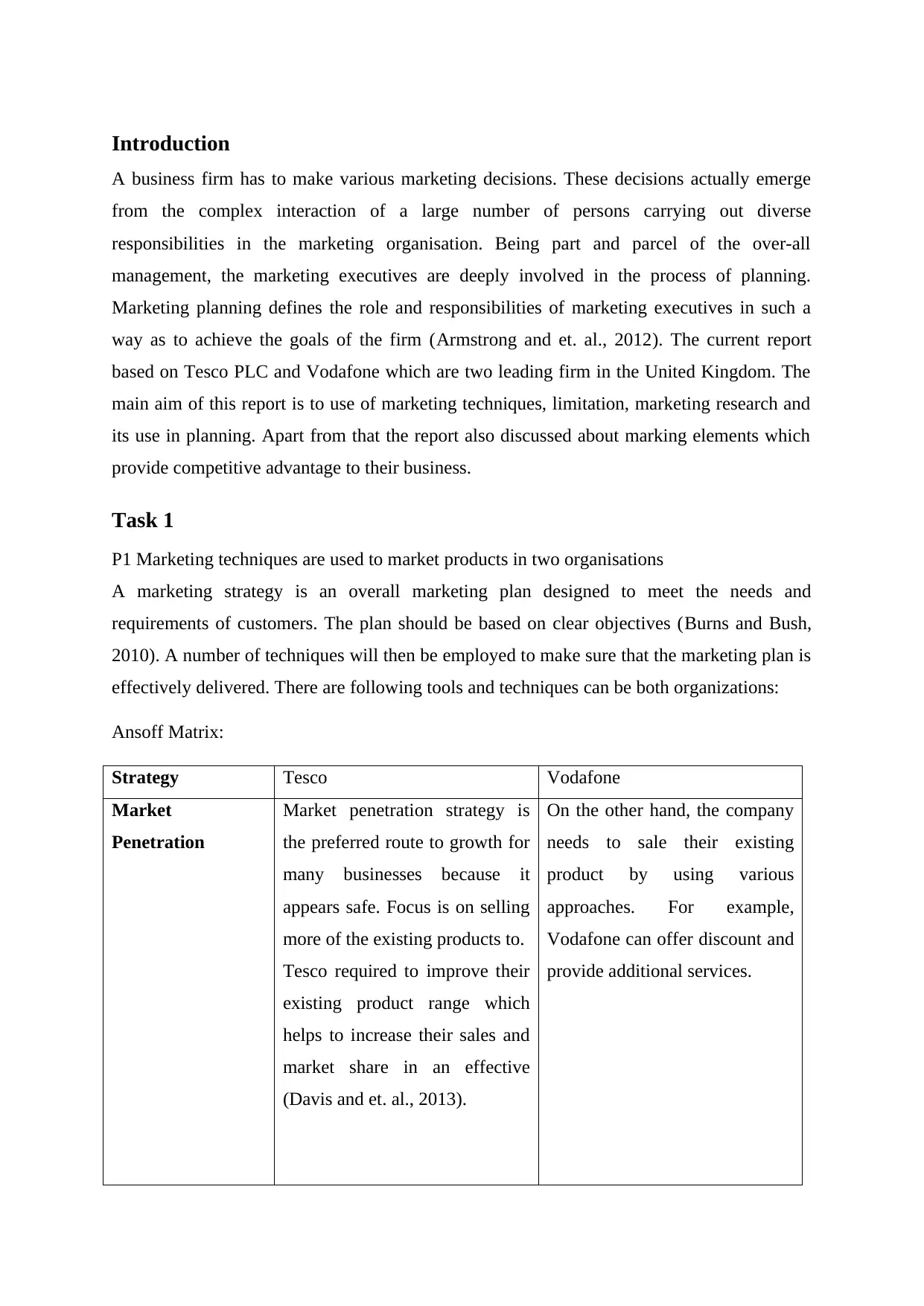
Ansoff Matrix:
Strategy Tesco Vodafone
Market
Penetration
Market penetration strategy is
the preferred route to growth for
many businesses because it
appears safe. Focus is on selling
more of the existing products to.
Tesco required to improve their
existing product range which
helps to increase their sales and
market share in an effective
(Davis and et. al., 2013).
On the other hand, the company
needs to sale their existing
product by using various
approaches. For example,
Vodafone can offer discount and
provide additional services.
A business firm has to make various marketing decisions. These decisions actually emerge
from the complex interaction of a large number of persons carrying out diverse
responsibilities in the marketing organisation. Being part and parcel of the over-all
management, the marketing executives are deeply involved in the process of planning.
Marketing planning defines the role and responsibilities of marketing executives in such a
way as to achieve the goals of the firm (Armstrong and et. al., 2012). The current report
based on Tesco PLC and Vodafone which are two leading firm in the United Kingdom. The
main aim of this report is to use of marketing techniques, limitation, marketing research and
its use in planning. Apart from that the report also discussed about marking elements which
provide competitive advantage to their business.
Task 1
P1 Marketing techniques are used to market products in two organisations
A marketing strategy is an overall marketing plan designed to meet the needs and
requirements of customers. The plan should be based on clear objectives (Burns and Bush,
2010). A number of techniques will then be employed to make sure that the marketing plan is
effectively delivered. There are following tools and techniques can be both organizations:
Ansoff Matrix:
Strategy Tesco Vodafone
Market
Penetration
Market penetration strategy is
the preferred route to growth for
many businesses because it
appears safe. Focus is on selling
more of the existing products to.
Tesco required to improve their
existing product range which
helps to increase their sales and
market share in an effective
(Davis and et. al., 2013).
On the other hand, the company
needs to sale their existing
product by using various
approaches. For example,
Vodafone can offer discount and
provide additional services.
⊘ This is a preview!⊘
Do you want full access?
Subscribe today to unlock all pages.

Trusted by 1+ million students worldwide
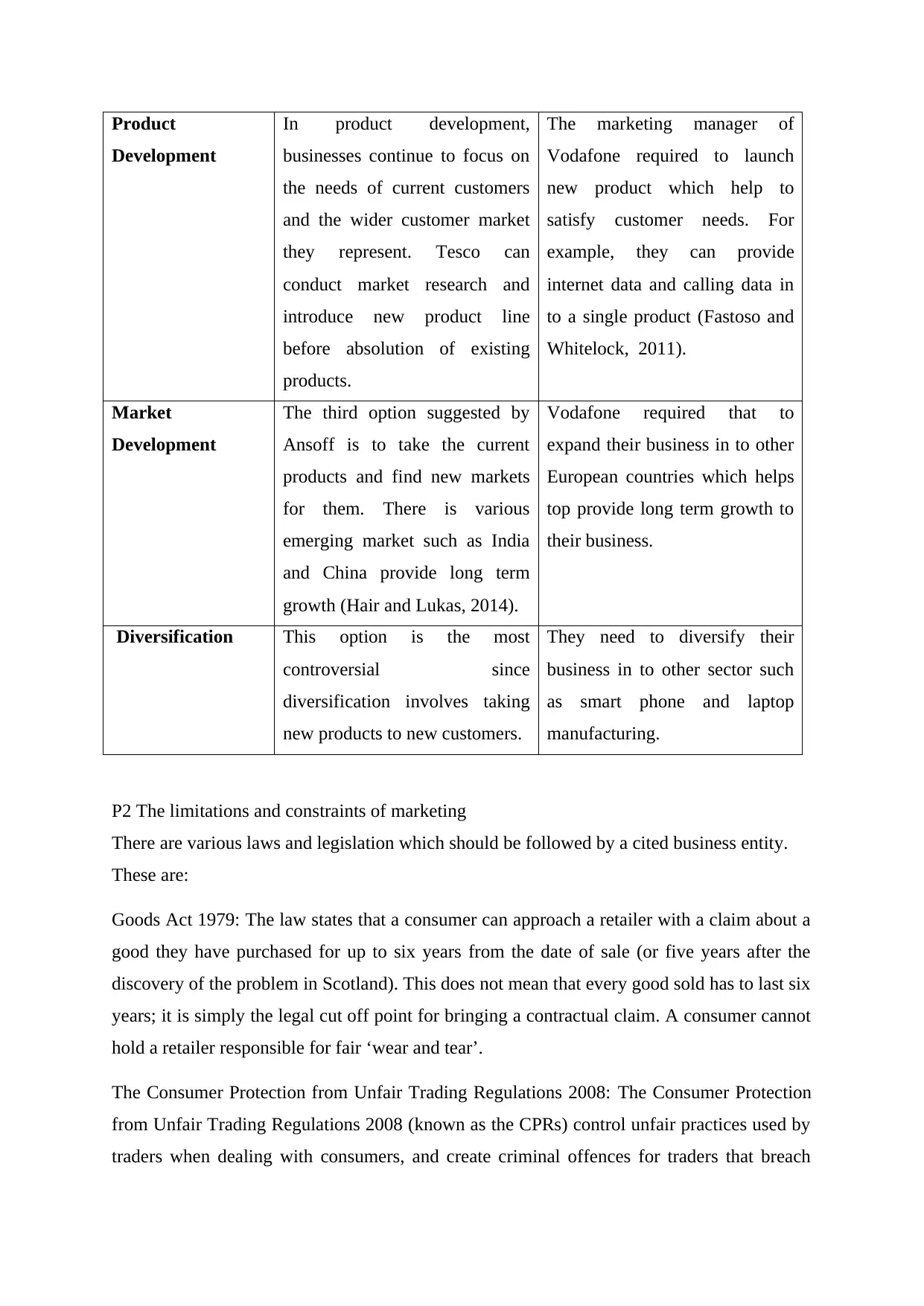
Product
Development
In product development,
businesses continue to focus on
the needs of current customers
and the wider customer market
they represent. Tesco can
conduct market research and
introduce new product line
before absolution of existing
products.
The marketing manager of
Vodafone required to launch
new product which help to
satisfy customer needs. For
example, they can provide
internet data and calling data in
to a single product (Fastoso and
Whitelock, 2011).
Market
Development
The third option suggested by
Ansoff is to take the current
products and find new markets
for them. There is various
emerging market such as India
and China provide long term
growth (Hair and Lukas, 2014).
Vodafone required that to
expand their business in to other
European countries which helps
top provide long term growth to
their business.
Diversification This option is the most
controversial since
diversification involves taking
new products to new customers.
They need to diversify their
business in to other sector such
as smart phone and laptop
manufacturing.
P2 The limitations and constraints of marketing
There are various laws and legislation which should be followed by a cited business entity.
These are:
Goods Act 1979: The law states that a consumer can approach a retailer with a claim about a
good they have purchased for up to six years from the date of sale (or five years after the
discovery of the problem in Scotland). This does not mean that every good sold has to last six
years; it is simply the legal cut off point for bringing a contractual claim. A consumer cannot
hold a retailer responsible for fair ‘wear and tear’.
The Consumer Protection from Unfair Trading Regulations 2008: The Consumer Protection
from Unfair Trading Regulations 2008 (known as the CPRs) control unfair practices used by
traders when dealing with consumers, and create criminal offences for traders that breach
Development
In product development,
businesses continue to focus on
the needs of current customers
and the wider customer market
they represent. Tesco can
conduct market research and
introduce new product line
before absolution of existing
products.
The marketing manager of
Vodafone required to launch
new product which help to
satisfy customer needs. For
example, they can provide
internet data and calling data in
to a single product (Fastoso and
Whitelock, 2011).
Market
Development
The third option suggested by
Ansoff is to take the current
products and find new markets
for them. There is various
emerging market such as India
and China provide long term
growth (Hair and Lukas, 2014).
Vodafone required that to
expand their business in to other
European countries which helps
top provide long term growth to
their business.
Diversification This option is the most
controversial since
diversification involves taking
new products to new customers.
They need to diversify their
business in to other sector such
as smart phone and laptop
manufacturing.
P2 The limitations and constraints of marketing
There are various laws and legislation which should be followed by a cited business entity.
These are:
Goods Act 1979: The law states that a consumer can approach a retailer with a claim about a
good they have purchased for up to six years from the date of sale (or five years after the
discovery of the problem in Scotland). This does not mean that every good sold has to last six
years; it is simply the legal cut off point for bringing a contractual claim. A consumer cannot
hold a retailer responsible for fair ‘wear and tear’.
The Consumer Protection from Unfair Trading Regulations 2008: The Consumer Protection
from Unfair Trading Regulations 2008 (known as the CPRs) control unfair practices used by
traders when dealing with consumers, and create criminal offences for traders that breach
Paraphrase This Document
Need a fresh take? Get an instant paraphrase of this document with our AI Paraphraser
them. The Regulations prohibit 31 specific practices that are always considered to be unfair
and create further offences for aggressive practices. They prohibit 'misleading actions' and
'misleading omissions' that cause, or are likely to cause, the average consumer to take a
'transactional decision' he would not have taken otherwise. They apply to commercial
practices relating to products (which includes goods, services and digital content) before,
during and after a contract is made. It helps to consumer and protect their right regarding its
goods and services (Hair and et. al., 2012).
Task 2
P3 Uses marketing research to contribute to the development of its marketing plans
It is significant for a business organization is to conduct market research in order to identify
customer needs and make their products accordingly. Research which includes all forms of
market, opinion and social research and data analytics, is the systematic gathering and
interpretation of information about individuals and organisations. It uses the statistical and
analytical methods and techniques of the applied social, behavioural and data sciences to
generate insights and support decision-making by providers of goods and services,
governments, non-profit organisations and the general public.
Primary research: This is information you collect first hand through surveys, interviews, and
talking to customers and businesses. This kind of direct research can help you discover what
your customers' needs are, how your business can improve, what you excel at and what
practices other businesses are using (Harrison and Reilly, 2011). Tesco can use questionnaire
survey approach in order to conduct market research.
Secondary research: Business unit can also research your market by using information that
has already been gathered, such as government statistics and trade publications.
Savvy entrepreneurs do secondary research first and then conduct primary research. For
example, the owner of a cupcake shop would want to know all about a neighbourhood before
opening a new store there. Using information gleaned from secondary sources, the owner can
uncover all kinds of demographic information, including detailed income data and spending
patterns. The owner can then send out a questionnaire to a sampling of households to find out
how often they’re likely to buy cupcakes and how much they’re willing to spend.
With the help above information Tesco make an appropriate marketing plan which can
provide competitive advantage in the market.
and create further offences for aggressive practices. They prohibit 'misleading actions' and
'misleading omissions' that cause, or are likely to cause, the average consumer to take a
'transactional decision' he would not have taken otherwise. They apply to commercial
practices relating to products (which includes goods, services and digital content) before,
during and after a contract is made. It helps to consumer and protect their right regarding its
goods and services (Hair and et. al., 2012).
Task 2
P3 Uses marketing research to contribute to the development of its marketing plans
It is significant for a business organization is to conduct market research in order to identify
customer needs and make their products accordingly. Research which includes all forms of
market, opinion and social research and data analytics, is the systematic gathering and
interpretation of information about individuals and organisations. It uses the statistical and
analytical methods and techniques of the applied social, behavioural and data sciences to
generate insights and support decision-making by providers of goods and services,
governments, non-profit organisations and the general public.
Primary research: This is information you collect first hand through surveys, interviews, and
talking to customers and businesses. This kind of direct research can help you discover what
your customers' needs are, how your business can improve, what you excel at and what
practices other businesses are using (Harrison and Reilly, 2011). Tesco can use questionnaire
survey approach in order to conduct market research.
Secondary research: Business unit can also research your market by using information that
has already been gathered, such as government statistics and trade publications.
Savvy entrepreneurs do secondary research first and then conduct primary research. For
example, the owner of a cupcake shop would want to know all about a neighbourhood before
opening a new store there. Using information gleaned from secondary sources, the owner can
uncover all kinds of demographic information, including detailed income data and spending
patterns. The owner can then send out a questionnaire to a sampling of households to find out
how often they’re likely to buy cupcakes and how much they’re willing to spend.
With the help above information Tesco make an appropriate marketing plan which can
provide competitive advantage in the market.
P4 Use marketing research for marketing planning
For marketers, research is not only used for the purpose of learning, it is also a critical
component needed to make good decisions. Market research does this by giving marketers a
picture of what is occurring (or likely to occur) and, when done well, offers alternative
choices that can be made (Jobber and Ellis-Chadwick, 2012). For instance, good research
may suggest multiple options for introducing new products or entering new markets. In most
cases marketing decisions prove less risky (though they are never risk free) when the
marketer can select from more than one option.
Profile potential customers: Use market research to develop a profile of the customers you
are targeting and identify their needs. The profile will reveal their buying patterns, including
how they buy, where they buy and what they buy. Again, regularly review trends so you don't
miss out on new opportunities or become irrelevant with your marketing message.
Profile competitors: Use this to identify Tesco competitive advantage- what sets your
business apart from your competitors. Marketing manager may also want to identify
the strengths and weaknesses of your own internal processes to help improve your
performance compared with your competition.
Develop strategies to support marketing goals: List target markets and devise a set of
strategies to attract and retain them. An example goal could be to increase young people's
awareness of your products. Your corresponding strategies could be to increase your online
social media presenceby posting regular updates about your product on Twitter and
Facebook.
Test company’s ideas: In deciding tactics, do some online research, test some ideas and
approaches on your customers and your staff, and review what works. A business
organization will need to choose a number of tactics in order to meet your customers' needs,
reach the customers within target market and improve sales results and business performance
(Kotler and Armstrong, 2010).
Task 3
P5 Groups of customers are targeted for selected products
Market segmentation is one of the oldest marketing trick in the books. With the customer
population and preferences becoming more wider, and the competitive options becoming
more available, market segmentation has become critical in any business or marketing plan.
For marketers, research is not only used for the purpose of learning, it is also a critical
component needed to make good decisions. Market research does this by giving marketers a
picture of what is occurring (or likely to occur) and, when done well, offers alternative
choices that can be made (Jobber and Ellis-Chadwick, 2012). For instance, good research
may suggest multiple options for introducing new products or entering new markets. In most
cases marketing decisions prove less risky (though they are never risk free) when the
marketer can select from more than one option.
Profile potential customers: Use market research to develop a profile of the customers you
are targeting and identify their needs. The profile will reveal their buying patterns, including
how they buy, where they buy and what they buy. Again, regularly review trends so you don't
miss out on new opportunities or become irrelevant with your marketing message.
Profile competitors: Use this to identify Tesco competitive advantage- what sets your
business apart from your competitors. Marketing manager may also want to identify
the strengths and weaknesses of your own internal processes to help improve your
performance compared with your competition.
Develop strategies to support marketing goals: List target markets and devise a set of
strategies to attract and retain them. An example goal could be to increase young people's
awareness of your products. Your corresponding strategies could be to increase your online
social media presenceby posting regular updates about your product on Twitter and
Facebook.
Test company’s ideas: In deciding tactics, do some online research, test some ideas and
approaches on your customers and your staff, and review what works. A business
organization will need to choose a number of tactics in order to meet your customers' needs,
reach the customers within target market and improve sales results and business performance
(Kotler and Armstrong, 2010).
Task 3
P5 Groups of customers are targeted for selected products
Market segmentation is one of the oldest marketing trick in the books. With the customer
population and preferences becoming more wider, and the competitive options becoming
more available, market segmentation has become critical in any business or marketing plan.
⊘ This is a preview!⊘
Do you want full access?
Subscribe today to unlock all pages.
Trusted by 1+ million students worldwide
In fact, people launch products keeping the market segmentation in mind. Tesco can divide
their target market in to following parts for their new fashionable clothing products:
Demographic segmentation: It is one of the simplest and widest type of market segmentation
used. Most companies use it to get the right population in using their products. Segmentation
generally divides a population based on variables. Thus demographic segmentation too has its
own variables such as Age, gender, family size, income, occupation, religion, race and
nationality. To read more, click on this link for demographic segmentation. For example,
Tesco can launch their customer in to premium segment and economic segment.
Geographic segmentation: This type of market segmentation divides people on the basis of
geography. Business unit and its potential customers will have different needs based on the
geography they are located in. In the article on geographic segmentation. This type of
segmentation is the easiest but it was actually used in the last decade where the industries
were new and the reach was less (Leonidou, and et. al.2010). Today, the reach is high but
still geographic segmentation principles are used when you are expanding the business in
more local areas as well as international territories. In the context of Tesco, marketing
manager required that to divide UK market in to small market such as Wales, England,
Scotland etc. and offer their products and services accordingly.
Task 4
P6 Develop a coherent marketing mix for a new product or service
Tesco PLC is the leading brand of Supermarkets in Britain. It has managed to garner so much
consumer popularity that its stores have crossed the boundaries of the United Kingdom and
reached twelve other countries across Europe and Asia! Founded by Jack Cohen, Tesco
started out as a mean bunch of market stalls. From there it has grown into one of the leading
supermarket chains of the world with the help of one’s man dream and ardour to fulfil those
dreams.
Product: For Tesco, as discussed previously, one of the key success factors is the company’s
ability to enlarge the products portfolio offered by the firm to the consumers. Today, Tesco
had already successfully transformed itself into a diversified international business, whereby
consumers can purchase many types of items ranging from food, non-food, electrical,
electronics, office equipment, gardening equipment’s, apparel, and etc. from Tesco (Moussa
and Touzani, 2010).
their target market in to following parts for their new fashionable clothing products:
Demographic segmentation: It is one of the simplest and widest type of market segmentation
used. Most companies use it to get the right population in using their products. Segmentation
generally divides a population based on variables. Thus demographic segmentation too has its
own variables such as Age, gender, family size, income, occupation, religion, race and
nationality. To read more, click on this link for demographic segmentation. For example,
Tesco can launch their customer in to premium segment and economic segment.
Geographic segmentation: This type of market segmentation divides people on the basis of
geography. Business unit and its potential customers will have different needs based on the
geography they are located in. In the article on geographic segmentation. This type of
segmentation is the easiest but it was actually used in the last decade where the industries
were new and the reach was less (Leonidou, and et. al.2010). Today, the reach is high but
still geographic segmentation principles are used when you are expanding the business in
more local areas as well as international territories. In the context of Tesco, marketing
manager required that to divide UK market in to small market such as Wales, England,
Scotland etc. and offer their products and services accordingly.
Task 4
P6 Develop a coherent marketing mix for a new product or service
Tesco PLC is the leading brand of Supermarkets in Britain. It has managed to garner so much
consumer popularity that its stores have crossed the boundaries of the United Kingdom and
reached twelve other countries across Europe and Asia! Founded by Jack Cohen, Tesco
started out as a mean bunch of market stalls. From there it has grown into one of the leading
supermarket chains of the world with the help of one’s man dream and ardour to fulfil those
dreams.
Product: For Tesco, as discussed previously, one of the key success factors is the company’s
ability to enlarge the products portfolio offered by the firm to the consumers. Today, Tesco
had already successfully transformed itself into a diversified international business, whereby
consumers can purchase many types of items ranging from food, non-food, electrical,
electronics, office equipment, gardening equipment’s, apparel, and etc. from Tesco (Moussa
and Touzani, 2010).
Paraphrase This Document
Need a fresh take? Get an instant paraphrase of this document with our AI Paraphraser
Price: Pricing is also one of the key competitive advantage of Tesco, whereby except larger
retailers such as Wal-Mart and Carrefour, very few competitors able to match the price
offered by Tesco to consumers. The money which a buyer pays for a product is called as
price of the product (Piekkari, Plakoyiannaki,and Welch, 2010). The price of a product is
indirectly proportional to its availability in the market. Lesser its availability, more would be
its price and vice a versa.
Place: In this dimensions, Tesco is enjoying a large distribution network and a lot of retail
stores around the world. Many of the stores are strategically located, after considering the
convenience they bring to consumers and the rental costs associated to the location. Besides,
this effectively further enhances the brand name of Tesco.
Promotion: One of the most successful promotional activates launched by Tesco is the
introduction of loyalty card, namely the ‘Clubcard’ to customers. For this, loyal customers
are often rewarded with points or a variety of discounts offered by Tesco (Peter, J and
Donnelly, 2011). Very often, special offers are available to the repeat customers, which are
designed to help the consumers to save more money.
Conclusion
As per the above mentioned report it has been concluded that the role of marketing plan is to
significant for every business unit. The report is discussed about different marketing
techniques and its use in two different organizations. The report also explained regrading
limitations of marketing through laws and legislation, marketing research and its rile in
marketing plan. Apart from that the report also described the marketing element in the
context of Tesco, so that they can attain its long term goals and objectives in an effective
manner.
retailers such as Wal-Mart and Carrefour, very few competitors able to match the price
offered by Tesco to consumers. The money which a buyer pays for a product is called as
price of the product (Piekkari, Plakoyiannaki,and Welch, 2010). The price of a product is
indirectly proportional to its availability in the market. Lesser its availability, more would be
its price and vice a versa.
Place: In this dimensions, Tesco is enjoying a large distribution network and a lot of retail
stores around the world. Many of the stores are strategically located, after considering the
convenience they bring to consumers and the rental costs associated to the location. Besides,
this effectively further enhances the brand name of Tesco.
Promotion: One of the most successful promotional activates launched by Tesco is the
introduction of loyalty card, namely the ‘Clubcard’ to customers. For this, loyal customers
are often rewarded with points or a variety of discounts offered by Tesco (Peter, J and
Donnelly, 2011). Very often, special offers are available to the repeat customers, which are
designed to help the consumers to save more money.
Conclusion
As per the above mentioned report it has been concluded that the role of marketing plan is to
significant for every business unit. The report is discussed about different marketing
techniques and its use in two different organizations. The report also explained regrading
limitations of marketing through laws and legislation, marketing research and its rile in
marketing plan. Apart from that the report also described the marketing element in the
context of Tesco, so that they can attain its long term goals and objectives in an effective
manner.
REFERENCES
Books and Journals
Armstrong, G. and et. al., 2012. Marketing: an introduction. Pearson Prentice-Hall, London.
Burns, A.C. and Bush, R.F., 2010. Marketing research. Upper Saddle River. New Jersey.
Davis, D.F. and et. al., 2013. Does marketing research suffer from methods myopia?. Journal
of Business Research. 66(9). pp.1245-1250.
Fastoso, F. and Whitelock, J., 2011. Why is so little marketing research on Latin America
published in high quality journals and what can we do about it? Lessons from a
Delphi study of authors who have succeeded. International Marketing Review.
28(4). pp.435-449.
Hair Jr, J.F. and Lukas, B., 2014. Marketing research. McGraw-Hill Education Australia.
Hair, J.F. and et. al., 2012. An assessment of the use of partial least squares structural
equation modeling in marketing research. Journal of the academy of marketing
science. 40(3). pp.414-433.
Harrison, R.L. and Reilly, T.M., 2011. Mixed methods designs in marketing research.
Qualitative Market Research: An International Journal. 14(1). pp.7-26.
Jobber, D. and Ellis-Chadwick, F., 2012. Principles and practice of marketing (No. 7th).
McGraw-Hill Higher Education.
Kotler, P. and Armstrong, G., 2010. Principles of marketing. pearson education.
Leonidou, L.C. and et. al., 2010. Assessing the contribution of leading mainstream marketing
journals to the international marketing discipline. International Marketing Review.
27(5). pp.491-518.
Moussa, S. and Touzani, M., 2010. Ranking marketing journals using the Google Scholar-
based hg-index. Journal of Informetrics. 4(1). pp.107-117.
Peter, J.P. and Donnelly, J.H., 2011. Marketing management: knowledge and skills: text,
analysis, cases, plans. Plano: Business pub., INC.
Piekkari, R., Plakoyiannaki, E. and Welch, C., 2010. ‘Good’case research in industrial
marketing: Insights from research practice. Industrial Marketing Management. 39(1).
pp.109-117.
Online
Top 5 Modern Marketing Concepts. 2016. [Online]. Available Through:
<http://www.yourarticlelibrary.com/marketing/top-5-modern-marketing-concepts/
53164/>. [Accessed on 17 July 2017].
Books and Journals
Armstrong, G. and et. al., 2012. Marketing: an introduction. Pearson Prentice-Hall, London.
Burns, A.C. and Bush, R.F., 2010. Marketing research. Upper Saddle River. New Jersey.
Davis, D.F. and et. al., 2013. Does marketing research suffer from methods myopia?. Journal
of Business Research. 66(9). pp.1245-1250.
Fastoso, F. and Whitelock, J., 2011. Why is so little marketing research on Latin America
published in high quality journals and what can we do about it? Lessons from a
Delphi study of authors who have succeeded. International Marketing Review.
28(4). pp.435-449.
Hair Jr, J.F. and Lukas, B., 2014. Marketing research. McGraw-Hill Education Australia.
Hair, J.F. and et. al., 2012. An assessment of the use of partial least squares structural
equation modeling in marketing research. Journal of the academy of marketing
science. 40(3). pp.414-433.
Harrison, R.L. and Reilly, T.M., 2011. Mixed methods designs in marketing research.
Qualitative Market Research: An International Journal. 14(1). pp.7-26.
Jobber, D. and Ellis-Chadwick, F., 2012. Principles and practice of marketing (No. 7th).
McGraw-Hill Higher Education.
Kotler, P. and Armstrong, G., 2010. Principles of marketing. pearson education.
Leonidou, L.C. and et. al., 2010. Assessing the contribution of leading mainstream marketing
journals to the international marketing discipline. International Marketing Review.
27(5). pp.491-518.
Moussa, S. and Touzani, M., 2010. Ranking marketing journals using the Google Scholar-
based hg-index. Journal of Informetrics. 4(1). pp.107-117.
Peter, J.P. and Donnelly, J.H., 2011. Marketing management: knowledge and skills: text,
analysis, cases, plans. Plano: Business pub., INC.
Piekkari, R., Plakoyiannaki, E. and Welch, C., 2010. ‘Good’case research in industrial
marketing: Insights from research practice. Industrial Marketing Management. 39(1).
pp.109-117.
Online
Top 5 Modern Marketing Concepts. 2016. [Online]. Available Through:
<http://www.yourarticlelibrary.com/marketing/top-5-modern-marketing-concepts/
53164/>. [Accessed on 17 July 2017].
⊘ This is a preview!⊘
Do you want full access?
Subscribe today to unlock all pages.
Trusted by 1+ million students worldwide

1 out of 9


Related Documents


Your All-in-One AI-Powered Toolkit for Academic Success.
+13062052269
info@desklib.com
Available 24*7 on WhatsApp / Email
![[object Object]](/_next/static/media/star-bottom.7253800d.svg)
Unlock your academic potential
Copyright © 2020–2026 A2Z Services. All Rights Reserved. Developed and managed by ZUCOL.