Comparative Retail Strategy Report: Tesco and Waitrose UK Market

Verified

Added on  2019/09/18

|7
|2059
|626
Report
AI Summary
This report provides a comprehensive comparative analysis of the retail strategies and implementations of Tesco and Waitrose, two major retailers operating in the UK market. The report begins with a situation analysis, evaluating the sector in which the retailers operate, utilizing tools like PESTLE, Porter’s Five Forces, and SWOT analysis to assess the competitive environment and emerging opportunities and threats. It then contrasts the objectives, strategic positioning, and target markets of both retailers, including an evaluation of their respective images and visual merchandising strategies based on store visits and desk research. A detailed examination of the retail mix follows, comparing merchandise, pricing, communications, location, store design, and customer service. The report concludes with an assessment of the retailers' success in strategy selection and implementation, offering clear recommendations and drawing upon at least six academic references to support its analysis.
Document Page
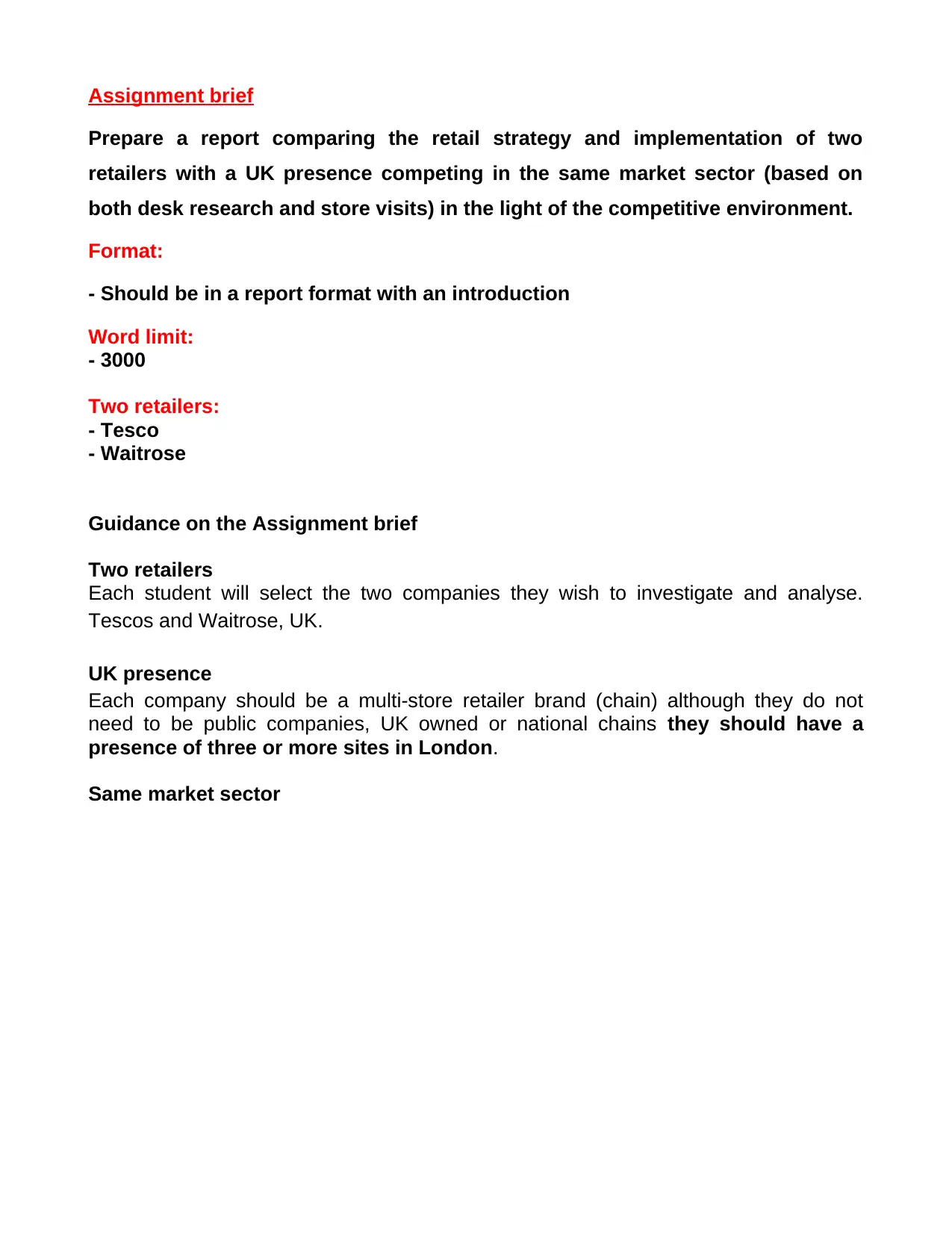
Assignment brief
Prepare a report comparing the retail strategy and implementation of two
retailers with a UK presence competing in the same market sector (based on
both desk research and store visits) in the light of the competitive environment.
Format:
- Should be in a report format with an introduction
Word limit:
- 3000
Two retailers:
- Tesco
- Waitrose
Guidance on the Assignment brief
Two retailers
Each student will select the two companies they wish to investigate and analyse.
Tescos and Waitrose, UK.
UK presence
Each company should be a multi-store retailer brand (chain) although they do not
need to be public companies, UK owned or national chains they should have a
presence of three or more sites in London.
Same market sector
tabler-icon-diamond-filled.svg

Paraphrase This Document

Need a fresh take? Get an instant paraphrase of this document with our AI Paraphraser
Document Page
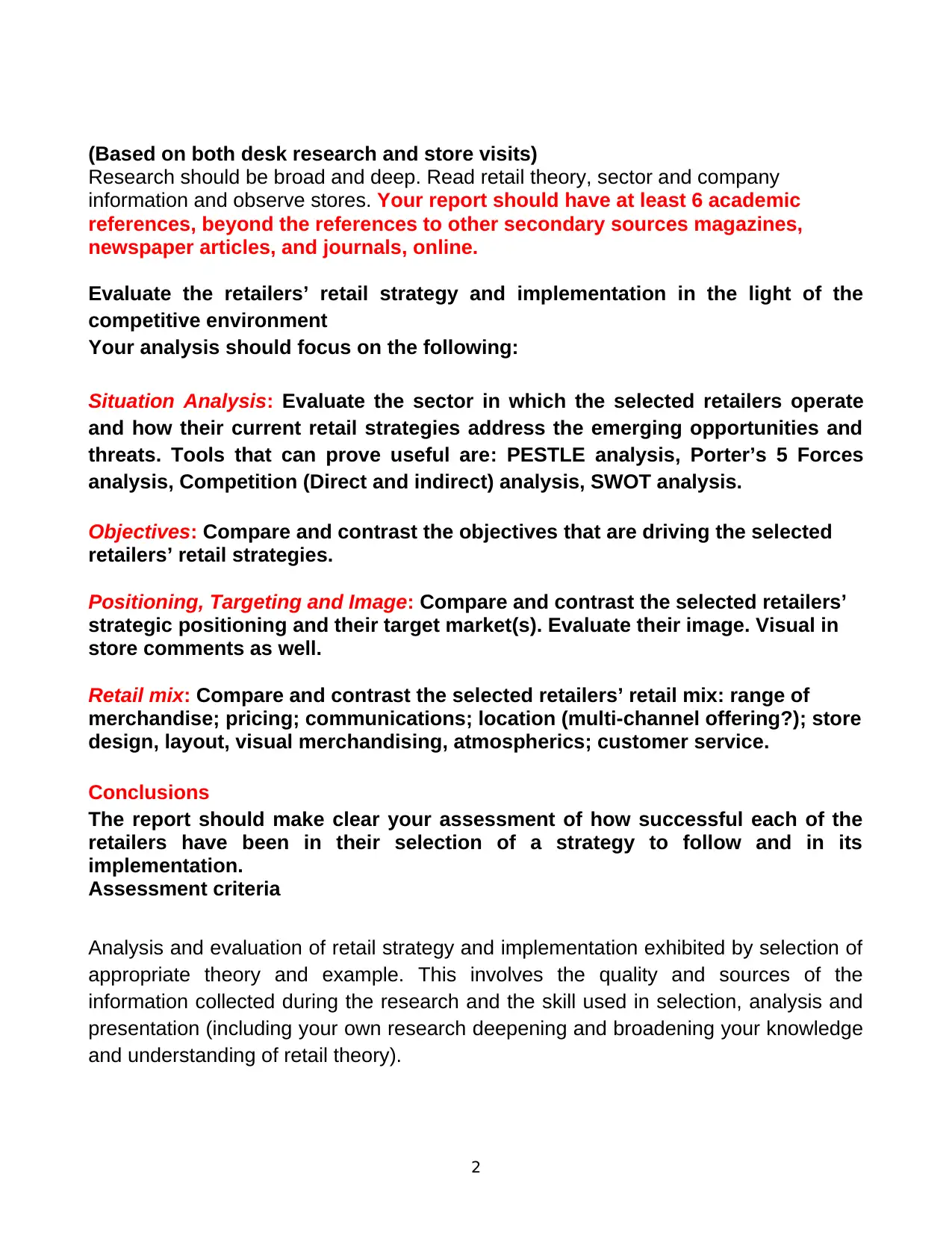
(Based on both desk research and store visits)
Research should be broad and deep. Read retail theory, sector and company
information and observe stores. Your report should have at least 6 academic
references, beyond the references to other secondary sources magazines,
newspaper articles, and journals, online.
Evaluate the retailers’ retail strategy and implementation in the light of the
competitive environment
Your analysis should focus on the following:
Situation Analysis: Evaluate the sector in which the selected retailers operate
and how their current retail strategies address the emerging opportunities and
threats. Tools that can prove useful are: PESTLE analysis, Porters 5 Forces
analysis, Competition (Direct and indirect) analysis, SWOT analysis.
Objectives: Compare and contrast the objectives that are driving the selected
retailers retail strategies.
Positioning, Targeting and Image: Compare and contrast the selected retailers
strategic positioning and their target market(s). Evaluate their image. Visual in
store comments as well.
Retail mix: Compare and contrast the selected retailers retail mix: range of
merchandise; pricing; communications; location (multi-channel offering?); store
design, layout, visual merchandising, atmospherics; customer service.
Conclusions
The report should make clear your assessment of how successful each of the
retailers have been in their selection of a strategy to follow and in its
implementation.
Assessment criteria
Analysis and evaluation of retail strategy and implementation exhibited by selection of
appropriate theory and example. This involves the quality and sources of the
information collected during the research and the skill used in selection, analysis and
presentation (including your own research deepening and broadening your knowledge
and understanding of retail theory).
2
Document Page
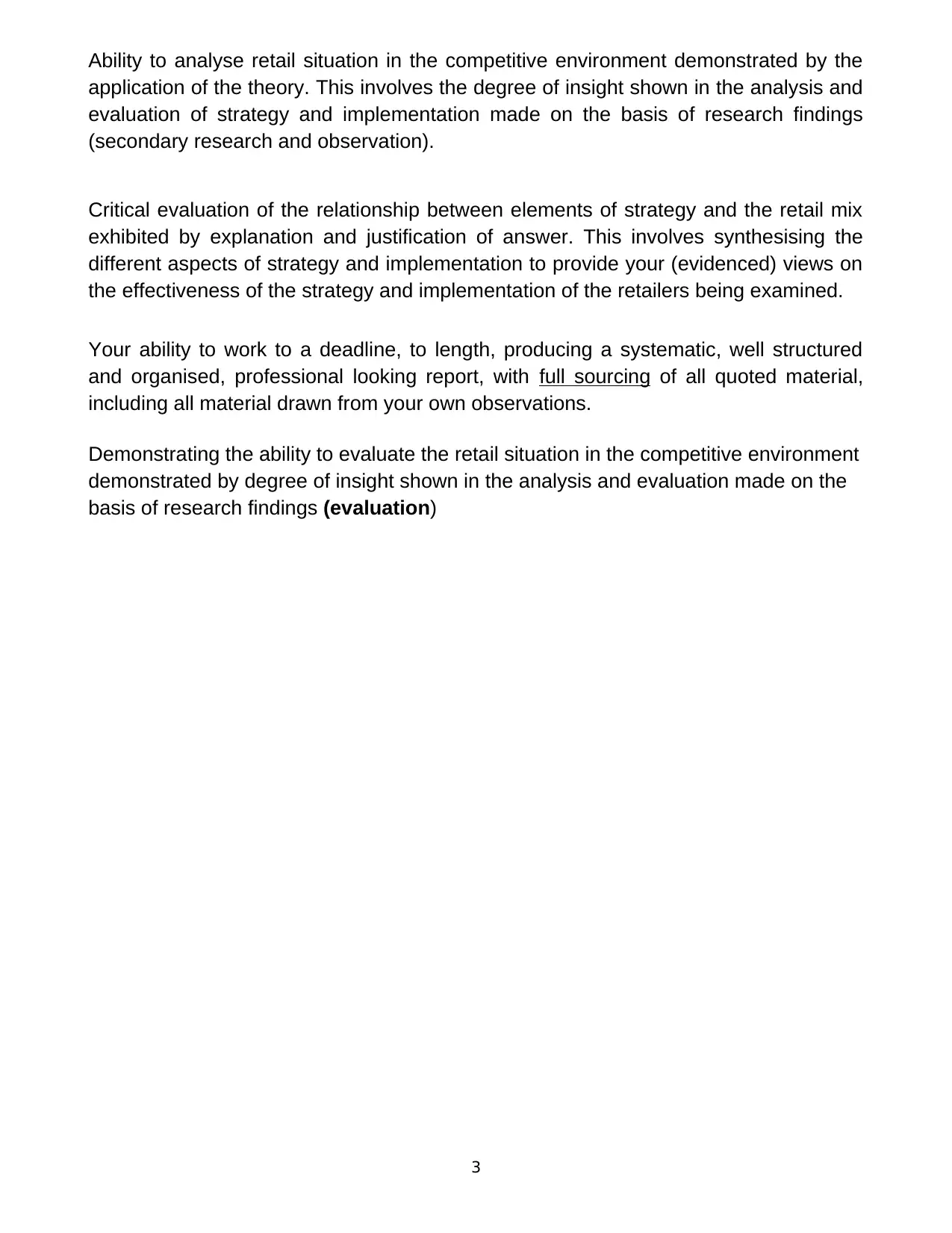
Ability to analyse retail situation in the competitive environment demonstrated by the
application of the theory. This involves the degree of insight shown in the analysis and
evaluation of strategy and implementation made on the basis of research findings
(secondary research and observation).
Critical evaluation of the relationship between elements of strategy and the retail mix
exhibited by explanation and justification of answer. This involves synthesising the
different aspects of strategy and implementation to provide your (evidenced) views on
the effectiveness of the strategy and implementation of the retailers being examined.
Your ability to work to a deadline, to length, producing a systematic, well structured
and organised, professional looking report, with full sourcing of all quoted material,
including all material drawn from your own observations.
Demonstrating the ability to evaluate the retail situation in the competitive environment
demonstrated by degree of insight shown in the analysis and evaluation made on the
basis of research findings (evaluation)
3
Document Page
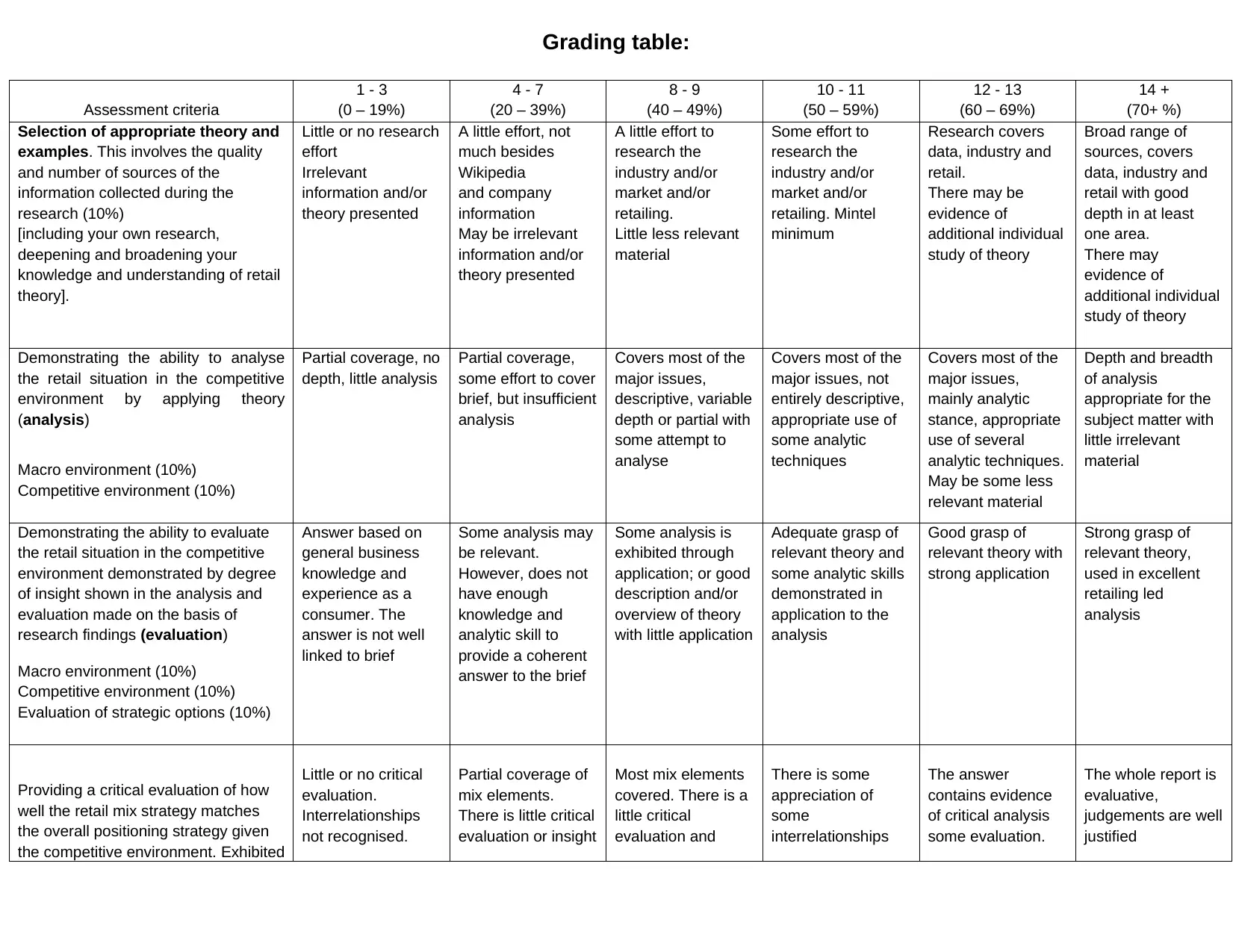
Grading table:
Assessment criteria
1 - 3
(0 – 19%)
4 - 7
(20 – 39%)
8 - 9
(40 – 49%)
10 - 11
(50 – 59%)
12 - 13
(60 – 69%)
14 +
(70+ %)
Selection of appropriate theory and
examples. This involves the quality
and number of sources of the
information collected during the
research (10%)
[including your own research,
deepening and broadening your
knowledge and understanding of retail
theory].
Little or no research
effort
Irrelevant
information and/or
theory presented
A little effort, not
much besides
Wikipedia
and company
information
May be irrelevant
information and/or
theory presented
A little effort to
research the
industry and/or
market and/or
retailing.
Little less relevant
material
Some effort to
research the
industry and/or
market and/or
retailing. Mintel
minimum
Research covers
data, industry and
retail.
There may be
evidence of
additional individual
study of theory
Broad range of
sources, covers
data, industry and
retail with good
depth in at least
one area.
There may
evidence of
additional individual
study of theory
Demonstrating the ability to analyse
the retail situation in the competitive
environment by applying theory
(analysis)
Macro environment (10%)
Competitive environment (10%)
Partial coverage, no
depth, little analysis
Partial coverage,
some effort to cover
brief, but insufficient
analysis
Covers most of the
major issues,
descriptive, variable
depth or partial with
some attempt to
analyse
Covers most of the
major issues, not
entirely descriptive,
appropriate use of
some analytic
techniques
Covers most of the
major issues,
mainly analytic
stance, appropriate
use of several
analytic techniques.
May be some less
relevant material
Depth and breadth
of analysis
appropriate for the
subject matter with
little irrelevant
material
Demonstrating the ability to evaluate
the retail situation in the competitive
environment demonstrated by degree
of insight shown in the analysis and
evaluation made on the basis of
research findings (evaluation)
Macro environment (10%)
Competitive environment (10%)
Evaluation of strategic options (10%)
Answer based on
general business
knowledge and
experience as a
consumer. The
answer is not well
linked to brief
Some analysis may
be relevant.
However, does not
have enough
knowledge and
analytic skill to
provide a coherent
answer to the brief
Some analysis is
exhibited through
application; or good
description and/or
overview of theory
with little application
Adequate grasp of
relevant theory and
some analytic skills
demonstrated in
application to the
analysis
Good grasp of
relevant theory with
strong application
Strong grasp of
relevant theory,
used in excellent
retailing led
analysis
Providing a critical evaluation of how
well the retail mix strategy matches
the overall positioning strategy given
the competitive environment. Exhibited
Little or no critical
evaluation.
Interrelationships
not recognised.
Partial coverage of
mix elements.
There is little critical
evaluation or insight
Most mix elements
covered. There is a
little critical
evaluation and
There is some
appreciation of
some
interrelationships
The answer
contains evidence
of critical analysis
some evaluation.
The whole report is
evaluative,
judgements are well
justified
tabler-icon-diamond-filled.svg

Paraphrase This Document

Need a fresh take? Get an instant paraphrase of this document with our AI Paraphraser
Document Page
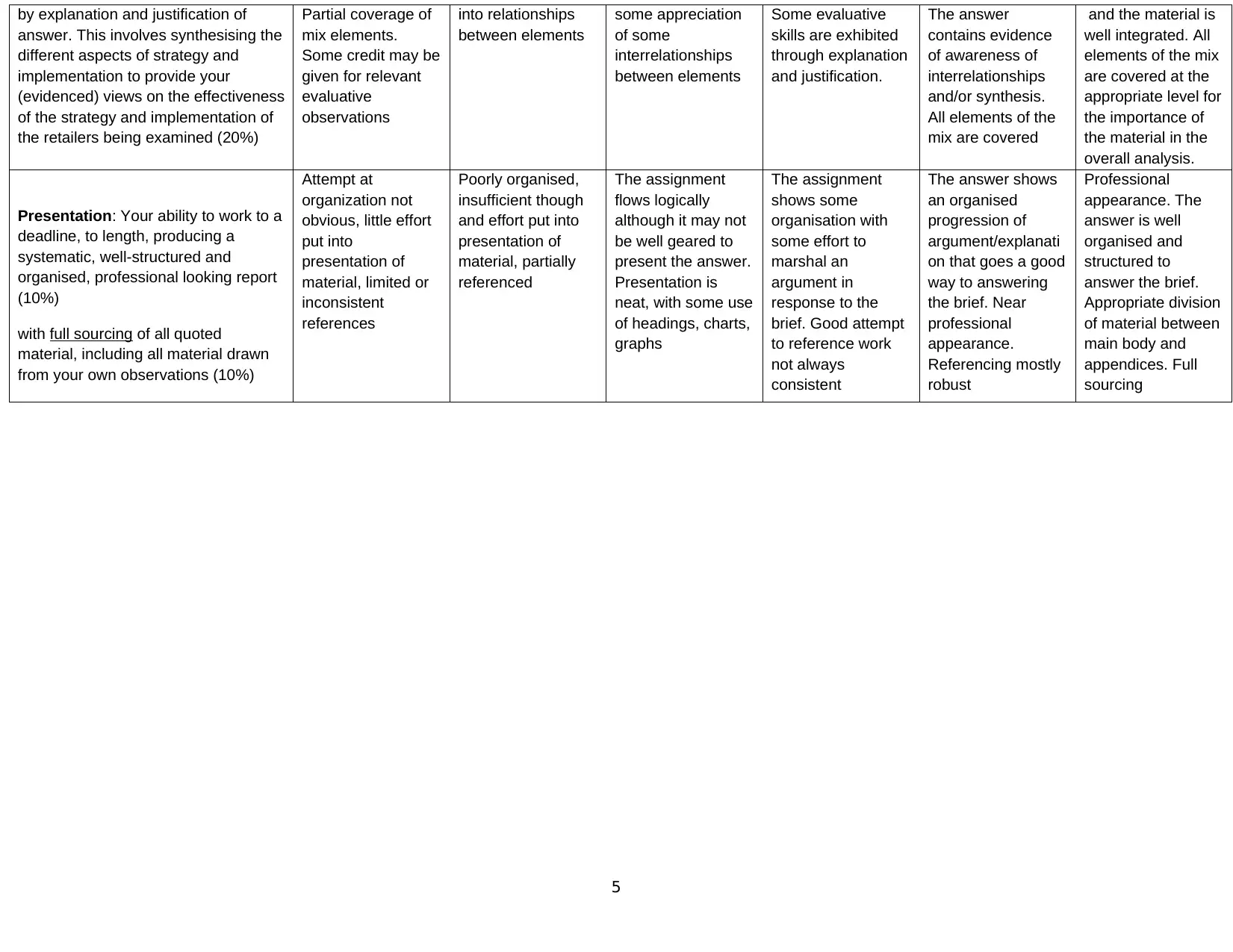
by explanation and justification of
answer. This involves synthesising the
different aspects of strategy and
implementation to provide your
(evidenced) views on the effectiveness
of the strategy and implementation of
the retailers being examined (20%)
Partial coverage of
mix elements.
Some credit may be
given for relevant
evaluative
observations
into relationships
between elements
some appreciation
of some
interrelationships
between elements
Some evaluative
skills are exhibited
through explanation
and justification.
The answer
contains evidence
of awareness of
interrelationships
and/or synthesis.
All elements of the
mix are covered
and the material is
well integrated. All
elements of the mix
are covered at the
appropriate level for
the importance of
the material in the
overall analysis.
Presentation: Your ability to work to a
deadline, to length, producing a
systematic, well-structured and
organised, professional looking report
(10%)
with full sourcing of all quoted
material, including all material drawn
from your own observations (10%)
Attempt at
organization not
obvious, little effort
put into
presentation of
material, limited or
inconsistent
references
Poorly organised,
insufficient though
and effort put into
presentation of
material, partially
referenced
The assignment
flows logically
although it may not
be well geared to
present the answer.
Presentation is
neat, with some use
of headings, charts,
graphs
The assignment
shows some
organisation with
some effort to
marshal an
argument in
response to the
brief. Good attempt
to reference work
not always
consistent
The answer shows
an organised
progression of
argument/explanati
on that goes a good
way to answering
the brief. Near
professional
appearance.
Referencing mostly
robust
Professional
appearance. The
answer is well
organised and
structured to
answer the brief.
Appropriate division
of material between
main body and
appendices. Full
sourcing
5
Document Page
Assignment help
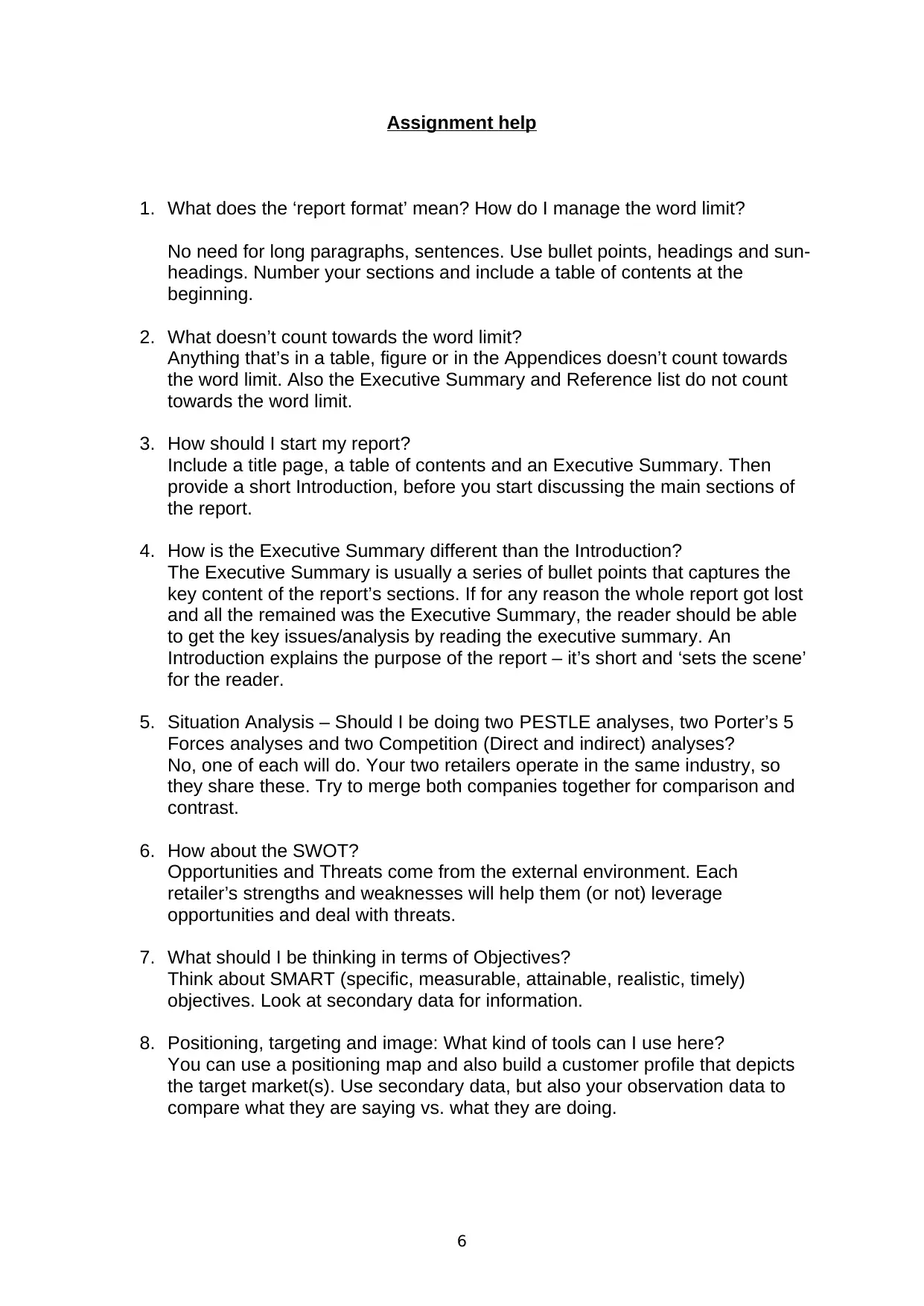
1. What does the ‘report format’ mean? How do I manage the word limit?
No need for long paragraphs, sentences. Use bullet points, headings and sun-
headings. Number your sections and include a table of contents at the
beginning.
2. What doesn’t count towards the word limit?
Anything that’s in a table, figure or in the Appendices doesn’t count towards
the word limit. Also the Executive Summary and Reference list do not count
towards the word limit.
3. How should I start my report?
Include a title page, a table of contents and an Executive Summary. Then
provide a short Introduction, before you start discussing the main sections of
the report.
4. How is the Executive Summary different than the Introduction?
The Executive Summary is usually a series of bullet points that captures the
key content of the report’s sections. If for any reason the whole report got lost
and all the remained was the Executive Summary, the reader should be able
to get the key issues/analysis by reading the executive summary. An
Introduction explains the purpose of the report – it’s short and ‘sets the scene’
for the reader.
5. Situation Analysis – Should I be doing two PESTLE analyses, two Porters 5
Forces analyses and two Competition (Direct and indirect) analyses?
No, one of each will do. Your two retailers operate in the same industry, so
they share these. Try to merge both companies together for comparison and
contrast.
6. How about the SWOT?
Opportunities and Threats come from the external environment. Each
retailer’s strengths and weaknesses will help them (or not) leverage
opportunities and deal with threats.
7. What should I be thinking in terms of Objectives?
Think about SMART (specific, measurable, attainable, realistic, timely)
objectives. Look at secondary data for information.
8. Positioning, targeting and image: What kind of tools can I use here?
You can use a positioning map and also build a customer profile that depicts
the target market(s). Use secondary data, but also your observation data to
compare what they are saying vs. what they are doing.
6
Document Page
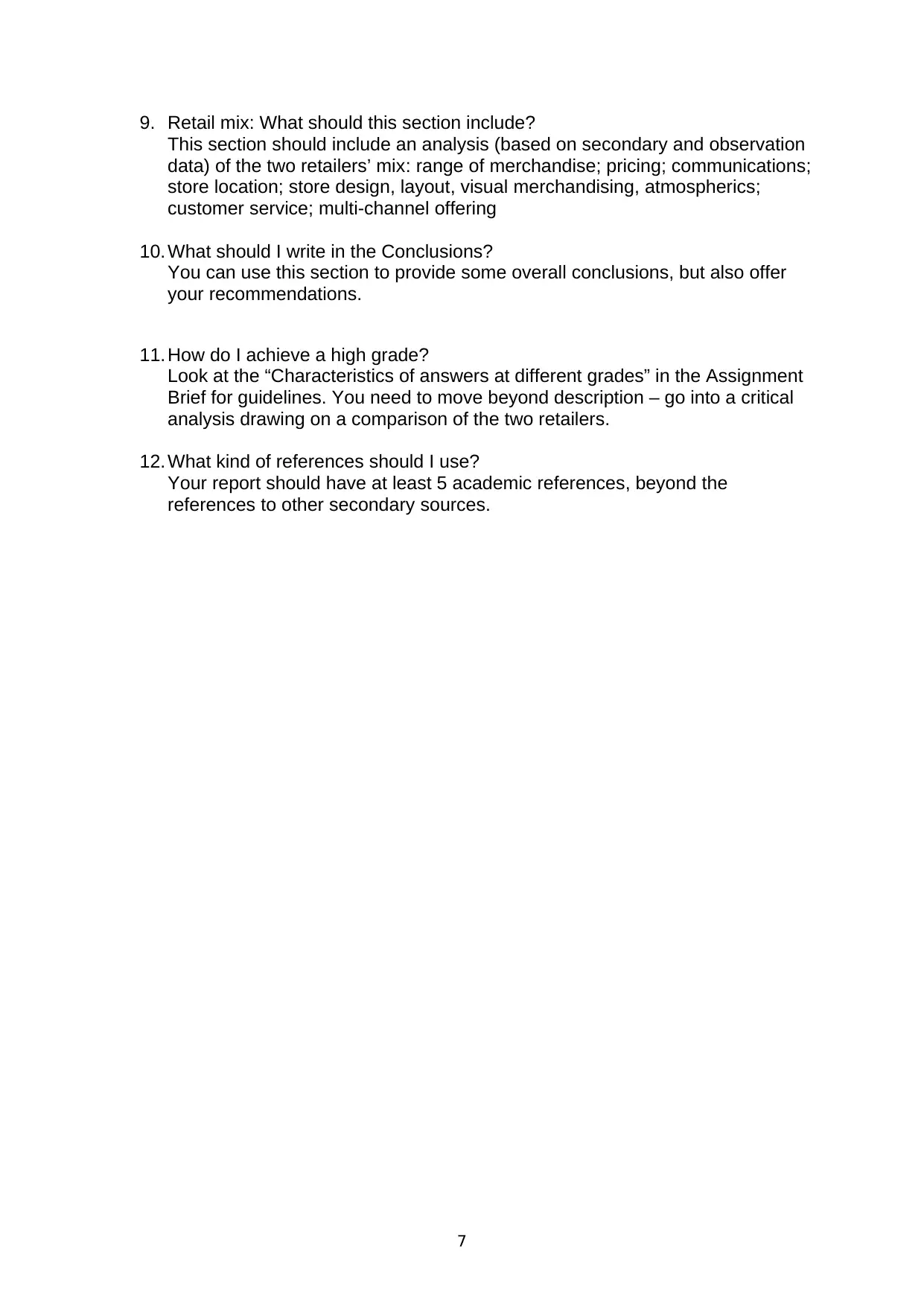
9. Retail mix: What should this section include?
This section should include an analysis (based on secondary and observation
data) of the two retailers’ mix: range of merchandise; pricing; communications;
store location; store design, layout, visual merchandising, atmospherics;
customer service; multi-channel offering
10. What should I write in the Conclusions?
You can use this section to provide some overall conclusions, but also offer
your recommendations.
11. How do I achieve a high grade?
Look at the “Characteristics of answers at different grades” in the Assignment
Brief for guidelines. You need to move beyond description – go into a critical
analysis drawing on a comparison of the two retailers.
12. What kind of references should I use?
Your report should have at least 5 academic references, beyond the
references to other secondary sources.
7
chevron_up_icon
1 out of 7
circle_padding
hide_on_mobile
zoom_out_icon
[object Object]