A Comprehensive Analysis of the Texas City BP Refinery Explosion
VerifiedAdded on 2022/12/15
|17
|4165
|162
Report
AI Summary
This report provides a detailed analysis of the 2005 Texas City BP Refinery explosion, which resulted in multiple fatalities and significant injuries due to a hydrocarbon vapor cloud ignition. The study investigates the incident, identifying the root causes, including occupational safety negligence, human errors, and systemic failures within the refinery. The report utilizes the Heinrich Domino Theory to examine the social environment, individual faults, unsafe acts and conditions, the accident itself, and the resulting injuries. It highlights the importance of leadership, employee involvement, and proactive safety measures. The analysis covers the failures in maintenance, leadership, and safety protocols that contributed to the disaster, emphasizing the need for comprehensive safety management systems to prevent similar incidents in the future. The report concludes with a discussion of the impact of the explosion and the steps taken to prevent similar incidents, including Marathon Petroleum Corporation's acquisition and subsequent safety improvements.

Running head: ANALYSIS OF TEXAS CITY BP REFINERY EXPLOSION

Paraphrase This Document
Need a fresh take? Get an instant paraphrase of this document with our AI Paraphraser
1ANALYSIS OF TEXAS CITY BP REFINERY EXPLOSION
Analysis of Texas City BP Refinery Explosion
Name of the Student
Name of the University
Author Note
Analysis of Texas City BP Refinery Explosion
Name of the Student
Name of the University
Author Note
2ANALYSIS OF TEXAS CITY BP REFINERY EXPLOSION
Table of Contents
Introduction......................................................................................................................................3
1. Background to the Problem......................................................................................................3
2. Analyzing the Explosion at the Texas City BP Refinery using the Heinrich Domino
Accident Causation Model..............................................................................................................4
2.1. About the Heinrich Domino Accident Causation Model..................................................4
2.2. Step by Step Examination of the Texas City BP Refinery Explosion using the Heinrich
5 Factor Domino Accident Causation Model..............................................................................5
2.2.1. Social Environment.......................................................................................................5
2.2.2. Fault of the Person.........................................................................................................7
2.2.3. Unsafe Acts, Physical and Mechanical Hazards...........................................................8
2.2.4. Accident.......................................................................................................................10
2.2.5. Injury...........................................................................................................................11
Conclusion.....................................................................................................................................11
References......................................................................................................................................12
Table of Contents
Introduction......................................................................................................................................3
1. Background to the Problem......................................................................................................3
2. Analyzing the Explosion at the Texas City BP Refinery using the Heinrich Domino
Accident Causation Model..............................................................................................................4
2.1. About the Heinrich Domino Accident Causation Model..................................................4
2.2. Step by Step Examination of the Texas City BP Refinery Explosion using the Heinrich
5 Factor Domino Accident Causation Model..............................................................................5
2.2.1. Social Environment.......................................................................................................5
2.2.2. Fault of the Person.........................................................................................................7
2.2.3. Unsafe Acts, Physical and Mechanical Hazards...........................................................8
2.2.4. Accident.......................................................................................................................10
2.2.5. Injury...........................................................................................................................11
Conclusion.....................................................................................................................................11
References......................................................................................................................................12
⊘ This is a preview!⊘
Do you want full access?
Subscribe today to unlock all pages.

Trusted by 1+ million students worldwide
3ANALYSIS OF TEXAS CITY BP REFINERY EXPLOSION
Introduction
The Texas City BP Refinery Explosion was an unfortunate incident that took place in the
year of 2005 as a result of a hydrocarbon vapor cloud being ignited and which consequently
burst, killing in the process as many as fifteen people and injuring around hundred and eighty
people. The refinery was also severely injured as a result of the explosion, especially the ISOM
isomerization process unit which constituted the main site of the explosion. Upon in depth
analysis it was found that the explosion that occurred at the Texas City BP Refinery was one that
had been triggered due to occupational safety negligence and ignorance. This report will talk
about the human errors and psychological factors that were responsible for the explosion, as well
as the plant, equipment, organizational, systemic and workplace design issues that had a crucial
role to play in triggering the incident (Abilio et al. 2017). The report makes use of an appropriate
accident causation model, namely a simple linear model of accident causation known as
Heinrich’s Domino Theory, in order to appraise the particular situation.
1. Background to the Problem
On the 23rd of March in the year of 2005, an explosion occurred at the Texas City BP
Refinery, as a consequence of which fifteen people lost their lives and close to two hundred
people were severely injured in the accident. The cause of the accident it was believed was due
to the explosion of hydrocarbon vapors, which are heavier than air and which combusted easily
as they came into contact with the source of ignition, which in this event happened to be the
running of a vehicle engine (Yemen et al. 2017). The BP Refinery in Texas City also witnessed
massive destruction and decay with regard to the plant infrastructure with much of the refinery
Introduction
The Texas City BP Refinery Explosion was an unfortunate incident that took place in the
year of 2005 as a result of a hydrocarbon vapor cloud being ignited and which consequently
burst, killing in the process as many as fifteen people and injuring around hundred and eighty
people. The refinery was also severely injured as a result of the explosion, especially the ISOM
isomerization process unit which constituted the main site of the explosion. Upon in depth
analysis it was found that the explosion that occurred at the Texas City BP Refinery was one that
had been triggered due to occupational safety negligence and ignorance. This report will talk
about the human errors and psychological factors that were responsible for the explosion, as well
as the plant, equipment, organizational, systemic and workplace design issues that had a crucial
role to play in triggering the incident (Abilio et al. 2017). The report makes use of an appropriate
accident causation model, namely a simple linear model of accident causation known as
Heinrich’s Domino Theory, in order to appraise the particular situation.
1. Background to the Problem
On the 23rd of March in the year of 2005, an explosion occurred at the Texas City BP
Refinery, as a consequence of which fifteen people lost their lives and close to two hundred
people were severely injured in the accident. The cause of the accident it was believed was due
to the explosion of hydrocarbon vapors, which are heavier than air and which combusted easily
as they came into contact with the source of ignition, which in this event happened to be the
running of a vehicle engine (Yemen et al. 2017). The BP Refinery in Texas City also witnessed
massive destruction and decay with regard to the plant infrastructure with much of the refinery
Paraphrase This Document
Need a fresh take? Get an instant paraphrase of this document with our AI Paraphraser
4ANALYSIS OF TEXAS CITY BP REFINERY EXPLOSION
having been severely damaged as a result of this explosion. In the year of 2011, it was
announced by the Texas City BP Refinery that the refinery would be sold off in order to acquire
the money that was needed in order to pay for the compensation claims that were being made as
well as the various other remedial measures that had to be undertaken by the refinery in order to
ensure that it avoided legal action owing to the damage and loss of lives that had been caused by
the explosion in the refinery in 2005. Marathon Petroleum Corporation ended up buying the
refinery in 2013 for a price of 2.5 billion dollars after which the refinery was revamped by the
new management and adequate safety measures taken in order to ensure that the people who
were working there were well protected from all types of safety risks and hazards (Amponsah-
Tawiah, K. and Mensah, J., 2016).
2. Analyzing the Explosion at the Texas City BP Refinery using the
Heinrich Domino Accident Causation Model
2.1. About the Heinrich Domino Accident Causation Model
The Heinrich Domino Theory is a sequential accident causation model which is also
known as Domino Theory or Domino effect and it is widely made use of for analyzing accident
scenarios around the world. According to this particular model there are certain accident factors
which can be perceived as lining up in a sequential manner just like dominos with these accident
factors being five in number. The five factors proposed by Heinrich Domino are the social
environment or ancestry, the fault of an individual person, physical and mechanical hazards and
unsafe acts, accident and injury. Based on the metaphor of a domino, it is argued by Heinrich
that an accident will take place when one of the dominos or the accident factors is seen to fall
and which has what may be termed as ongoing knock-down effect which ultimately results in the
having been severely damaged as a result of this explosion. In the year of 2011, it was
announced by the Texas City BP Refinery that the refinery would be sold off in order to acquire
the money that was needed in order to pay for the compensation claims that were being made as
well as the various other remedial measures that had to be undertaken by the refinery in order to
ensure that it avoided legal action owing to the damage and loss of lives that had been caused by
the explosion in the refinery in 2005. Marathon Petroleum Corporation ended up buying the
refinery in 2013 for a price of 2.5 billion dollars after which the refinery was revamped by the
new management and adequate safety measures taken in order to ensure that the people who
were working there were well protected from all types of safety risks and hazards (Amponsah-
Tawiah, K. and Mensah, J., 2016).
2. Analyzing the Explosion at the Texas City BP Refinery using the
Heinrich Domino Accident Causation Model
2.1. About the Heinrich Domino Accident Causation Model
The Heinrich Domino Theory is a sequential accident causation model which is also
known as Domino Theory or Domino effect and it is widely made use of for analyzing accident
scenarios around the world. According to this particular model there are certain accident factors
which can be perceived as lining up in a sequential manner just like dominos with these accident
factors being five in number. The five factors proposed by Heinrich Domino are the social
environment or ancestry, the fault of an individual person, physical and mechanical hazards and
unsafe acts, accident and injury. Based on the metaphor of a domino, it is argued by Heinrich
that an accident will take place when one of the dominos or the accident factors is seen to fall
and which has what may be termed as ongoing knock-down effect which ultimately results in the
5ANALYSIS OF TEXAS CITY BP REFINERY EXPLOSION
occurrence of the accident. If the domino model is anything to go by, accidents can always be
prevented if one or more of the accident factors are removed, as this will interrupt the
knockdown effect. It was argued by Heinrich further, that mechanical hazards and unsafe acts
constitute a central factor in accident sequence and it is the complete and full removal of this
central factor that ends up making all of the factors that have preceded this, entirely irrelevant.
Some of the unsafe acts that can be committed by an individual based on this particular model
are working or operating at an unsafe speed, operating without clearance and failing to secure or
to warn, making safety devices completely inoperative, unsafe mixing, placing, loading,
combining etc, taking an unsafe posture or position, moving or working on dangerous
equipment, abusing, teasing, distracting or startling a person, and failing to use personal
protection devices or safety attire at the time of performing risky, dangerous or hazardous work.
Some of the unsafe physical conditions or mechanical conditions that can give rise to an accident
on the basis of Heinrich’s Domino Theory are unsafely designed tools and machines, sources of
glare that are not lighted adequately enough, unsafely guarded tools and machines, unsafe
clothing such as the use of high heels or the absence of gloves or masks at the time of working
etc. (Cunningham, T.R. and Sinclair, R., 2015).
2.2. Step by Step Examination of the Texas City BP Refinery Explosion using
the Heinrich 5 Factor Domino Accident Causation Model
2.2.1. Social Environment
The social environment of the Texas City BP Refinery was one that most certainly
contributed to the explosion taking place as has been discovered through the investigation carried
out by TELOS, a consulting firm that was hired to look into the matter. The social environment
of the Texas City BP Refinery was characterized by autocratic business leadership with the
occurrence of the accident. If the domino model is anything to go by, accidents can always be
prevented if one or more of the accident factors are removed, as this will interrupt the
knockdown effect. It was argued by Heinrich further, that mechanical hazards and unsafe acts
constitute a central factor in accident sequence and it is the complete and full removal of this
central factor that ends up making all of the factors that have preceded this, entirely irrelevant.
Some of the unsafe acts that can be committed by an individual based on this particular model
are working or operating at an unsafe speed, operating without clearance and failing to secure or
to warn, making safety devices completely inoperative, unsafe mixing, placing, loading,
combining etc, taking an unsafe posture or position, moving or working on dangerous
equipment, abusing, teasing, distracting or startling a person, and failing to use personal
protection devices or safety attire at the time of performing risky, dangerous or hazardous work.
Some of the unsafe physical conditions or mechanical conditions that can give rise to an accident
on the basis of Heinrich’s Domino Theory are unsafely designed tools and machines, sources of
glare that are not lighted adequately enough, unsafely guarded tools and machines, unsafe
clothing such as the use of high heels or the absence of gloves or masks at the time of working
etc. (Cunningham, T.R. and Sinclair, R., 2015).
2.2. Step by Step Examination of the Texas City BP Refinery Explosion using
the Heinrich 5 Factor Domino Accident Causation Model
2.2.1. Social Environment
The social environment of the Texas City BP Refinery was one that most certainly
contributed to the explosion taking place as has been discovered through the investigation carried
out by TELOS, a consulting firm that was hired to look into the matter. The social environment
of the Texas City BP Refinery was characterized by autocratic business leadership with the
⊘ This is a preview!⊘
Do you want full access?
Subscribe today to unlock all pages.
Trusted by 1+ million students worldwide
6ANALYSIS OF TEXAS CITY BP REFINERY EXPLOSION
company having had only five managers over the many years for which it had been in operation.
It was difficult to get run the place in a democratic with individual managers being in a position
of power here over long periods of time and who in turn made it a point to use their own
discretion in the running of the place. It was clear that not much consent could be acquired from
the managers or people holding a leadership position on the installation of safety precautions that
were needed to ensure that the chemicals that were used in the operations of the refinery did not
combust with one another and that the people who were involved in the operations of the refinery
were properly clothed or attired so as to avoid any type of harm or injury at the time of work
(Demeritt et al. 2015). What is made evident from the consulting work that has been done by
Telos in this scenario is that there were single leaders in positions of power who take all
important decisions with regards to the running of the refinery and that the employees at the
refinery had little or no say in how the administration of the refinery was going to run. The
autocratic leadership that was found to be in place at the refinery for so many years of its
existence implied that managers or leaders would take decisions which they themselves felt were
best for the growth and development and progress of the refinery but which may not have been
ideal for the refinery. What the managers of the Texas City BP Refinery should have done is to
take the opinion and suggestions of employees and junior supervisors into consideration at the
time of implementing safety precautions and measures as this would have gone a long way in
helping the management at the refinery implement safety mechanisms that were adequate and
full proof (Yazdani et al. 2017). Employees who have been working at the refinery for a long
period of time or who were engaged in handling hazardous substances in the course of the work
that they were doing were in the right position to advise the senior management of the refinery
about the safety mechanisms that ought to be in place in order for them to be able to do their jobs
company having had only five managers over the many years for which it had been in operation.
It was difficult to get run the place in a democratic with individual managers being in a position
of power here over long periods of time and who in turn made it a point to use their own
discretion in the running of the place. It was clear that not much consent could be acquired from
the managers or people holding a leadership position on the installation of safety precautions that
were needed to ensure that the chemicals that were used in the operations of the refinery did not
combust with one another and that the people who were involved in the operations of the refinery
were properly clothed or attired so as to avoid any type of harm or injury at the time of work
(Demeritt et al. 2015). What is made evident from the consulting work that has been done by
Telos in this scenario is that there were single leaders in positions of power who take all
important decisions with regards to the running of the refinery and that the employees at the
refinery had little or no say in how the administration of the refinery was going to run. The
autocratic leadership that was found to be in place at the refinery for so many years of its
existence implied that managers or leaders would take decisions which they themselves felt were
best for the growth and development and progress of the refinery but which may not have been
ideal for the refinery. What the managers of the Texas City BP Refinery should have done is to
take the opinion and suggestions of employees and junior supervisors into consideration at the
time of implementing safety precautions and measures as this would have gone a long way in
helping the management at the refinery implement safety mechanisms that were adequate and
full proof (Yazdani et al. 2017). Employees who have been working at the refinery for a long
period of time or who were engaged in handling hazardous substances in the course of the work
that they were doing were in the right position to advise the senior management of the refinery
about the safety mechanisms that ought to be in place in order for them to be able to do their jobs
Paraphrase This Document
Need a fresh take? Get an instant paraphrase of this document with our AI Paraphraser
7ANALYSIS OF TEXAS CITY BP REFINERY EXPLOSION
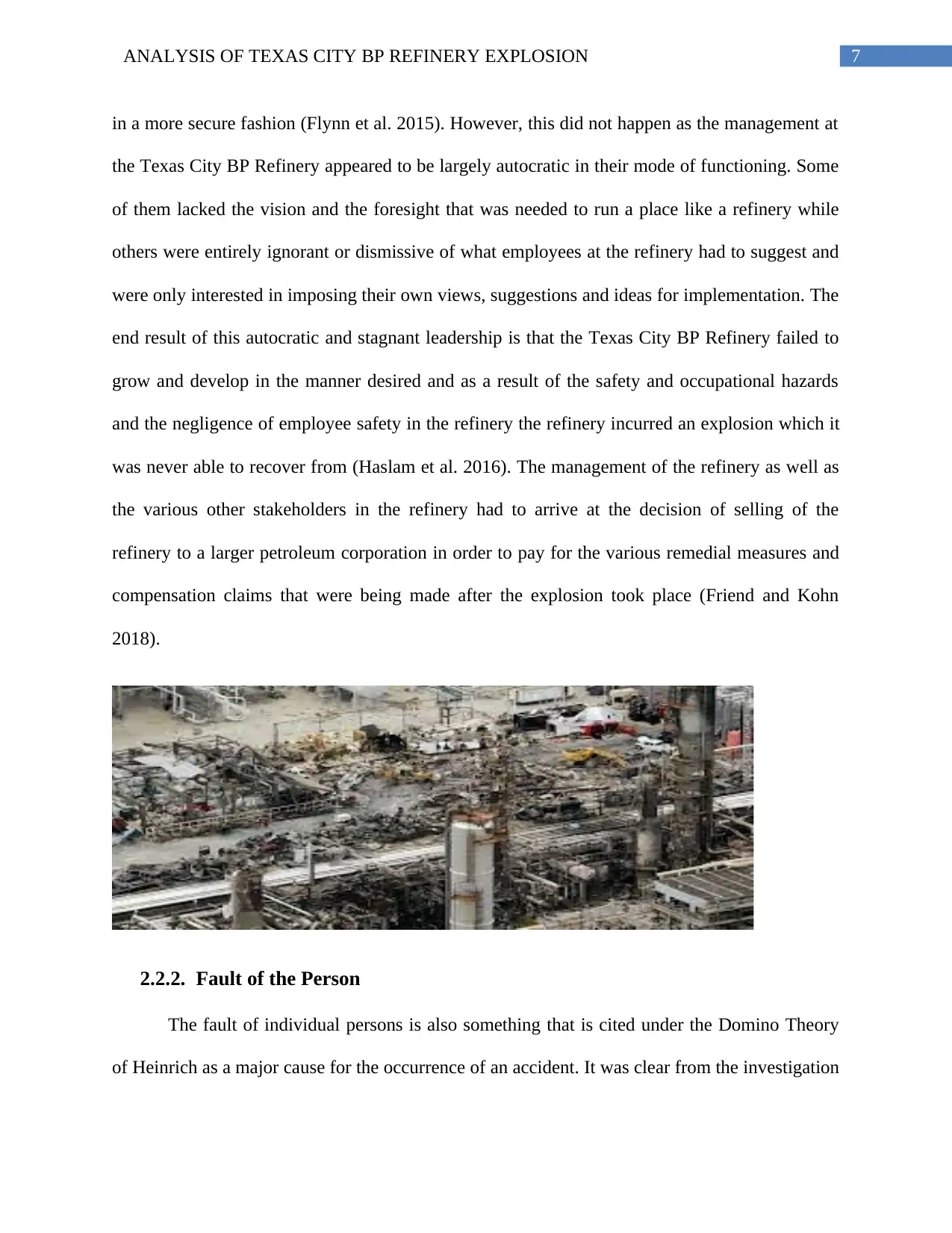
in a more secure fashion (Flynn et al. 2015). However, this did not happen as the management at
the Texas City BP Refinery appeared to be largely autocratic in their mode of functioning. Some
of them lacked the vision and the foresight that was needed to run a place like a refinery while
others were entirely ignorant or dismissive of what employees at the refinery had to suggest and
were only interested in imposing their own views, suggestions and ideas for implementation. The
end result of this autocratic and stagnant leadership is that the Texas City BP Refinery failed to
grow and develop in the manner desired and as a result of the safety and occupational hazards
and the negligence of employee safety in the refinery the refinery incurred an explosion which it
was never able to recover from (Haslam et al. 2016). The management of the refinery as well as
the various other stakeholders in the refinery had to arrive at the decision of selling of the
refinery to a larger petroleum corporation in order to pay for the various remedial measures and
compensation claims that were being made after the explosion took place (Friend and Kohn
2018).
2.2.2. Fault of the Person
The fault of individual persons is also something that is cited under the Domino Theory
of Heinrich as a major cause for the occurrence of an accident. It was clear from the investigation
in a more secure fashion (Flynn et al. 2015). However, this did not happen as the management at
the Texas City BP Refinery appeared to be largely autocratic in their mode of functioning. Some
of them lacked the vision and the foresight that was needed to run a place like a refinery while
others were entirely ignorant or dismissive of what employees at the refinery had to suggest and
were only interested in imposing their own views, suggestions and ideas for implementation. The
end result of this autocratic and stagnant leadership is that the Texas City BP Refinery failed to
grow and develop in the manner desired and as a result of the safety and occupational hazards
and the negligence of employee safety in the refinery the refinery incurred an explosion which it
was never able to recover from (Haslam et al. 2016). The management of the refinery as well as
the various other stakeholders in the refinery had to arrive at the decision of selling of the
refinery to a larger petroleum corporation in order to pay for the various remedial measures and
compensation claims that were being made after the explosion took place (Friend and Kohn
2018).
2.2.2. Fault of the Person
The fault of individual persons is also something that is cited under the Domino Theory
of Heinrich as a major cause for the occurrence of an accident. It was clear from the investigation
8ANALYSIS OF TEXAS CITY BP REFINERY EXPLOSION
that was carried out by the TELOS Consulting Firm and later by the Chemical Safety Board of
the United States of America that the refinery was a place that had been very badly maintained
with chunks or parts of the refinery falling off when touched or stepped on. This implies that the
management and the employees at the refinery were not taking sufficient care to run the refinery
in the manner that was desired. The management as well as the people who were functioning as
employees at the refinery were content only on achieving the business goals and aims and
objectives of the refinery and were not too worried about maintenance issues in spite of knowing
that unless such issues were looked into a physical danger could arise that would jeopardize the
lives of one and all (Hofmann et al. 2017). No doubt the refinery had been in existence for a very
long time and there were many parts of the building that were dated and which required heavy
investment in repair if these were to look bright and beautiful once again in addition to being
safe to work in. However, the management and the employees of the refinery appear to have
been content to work in dilapidated conditions, even though many parts of the refinery had
literally been falling off. The danger of an explosion or a physical hazard is one that had been
present in the refinery for a very long span of time. The leadership of the refinery was not doing
anything about raising the funds or acquiring the investment that was needed in order to repair
the refinery and make it look and seem like a brand new place of work. A lot of repair and
reconstruction at the refinery had been due for a long period of time. Many of the employees
working at the refinery were aware of the fact that the circumstances in which they were working
were circumstances that posed a serious threat to their lives and they did nothing about it,
possibly because they had made their concerns known to the senior management and no decision
was taken to refurbish the refinery even after that (Isimite and Rubini 2016). The fact that the
refinery ultimately incurred something as unfortunate as an explosion is not very difficult to
that was carried out by the TELOS Consulting Firm and later by the Chemical Safety Board of
the United States of America that the refinery was a place that had been very badly maintained
with chunks or parts of the refinery falling off when touched or stepped on. This implies that the
management and the employees at the refinery were not taking sufficient care to run the refinery
in the manner that was desired. The management as well as the people who were functioning as
employees at the refinery were content only on achieving the business goals and aims and
objectives of the refinery and were not too worried about maintenance issues in spite of knowing
that unless such issues were looked into a physical danger could arise that would jeopardize the
lives of one and all (Hofmann et al. 2017). No doubt the refinery had been in existence for a very
long time and there were many parts of the building that were dated and which required heavy
investment in repair if these were to look bright and beautiful once again in addition to being
safe to work in. However, the management and the employees of the refinery appear to have
been content to work in dilapidated conditions, even though many parts of the refinery had
literally been falling off. The danger of an explosion or a physical hazard is one that had been
present in the refinery for a very long span of time. The leadership of the refinery was not doing
anything about raising the funds or acquiring the investment that was needed in order to repair
the refinery and make it look and seem like a brand new place of work. A lot of repair and
reconstruction at the refinery had been due for a long period of time. Many of the employees
working at the refinery were aware of the fact that the circumstances in which they were working
were circumstances that posed a serious threat to their lives and they did nothing about it,
possibly because they had made their concerns known to the senior management and no decision
was taken to refurbish the refinery even after that (Isimite and Rubini 2016). The fact that the
refinery ultimately incurred something as unfortunate as an explosion is not very difficult to
⊘ This is a preview!⊘
Do you want full access?
Subscribe today to unlock all pages.
Trusted by 1+ million students worldwide
9ANALYSIS OF TEXAS CITY BP REFINERY EXPLOSION
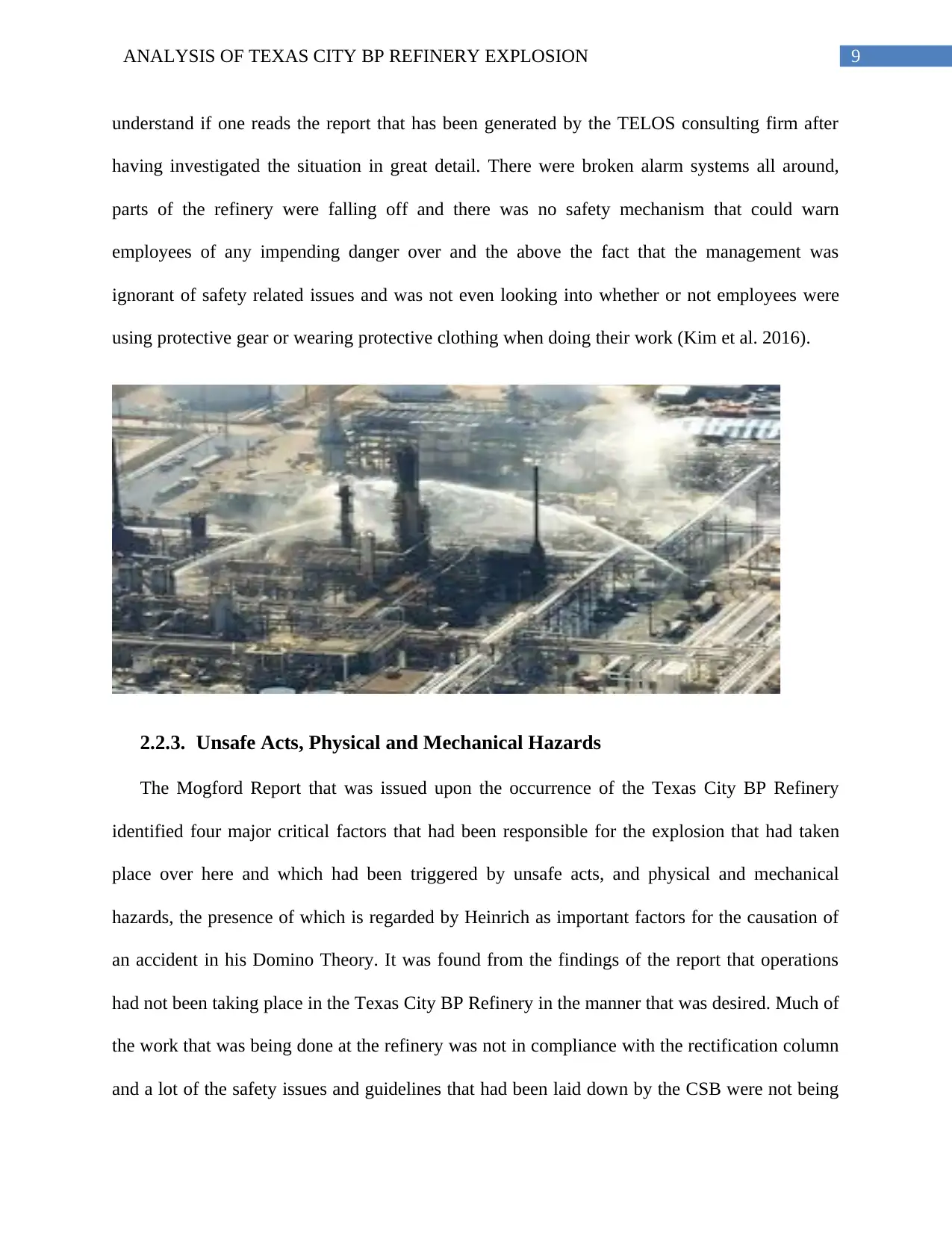
understand if one reads the report that has been generated by the TELOS consulting firm after
having investigated the situation in great detail. There were broken alarm systems all around,
parts of the refinery were falling off and there was no safety mechanism that could warn
employees of any impending danger over and the above the fact that the management was
ignorant of safety related issues and was not even looking into whether or not employees were
using protective gear or wearing protective clothing when doing their work (Kim et al. 2016).
2.2.3. Unsafe Acts, Physical and Mechanical Hazards
The Mogford Report that was issued upon the occurrence of the Texas City BP Refinery
identified four major critical factors that had been responsible for the explosion that had taken
place over here and which had been triggered by unsafe acts, and physical and mechanical
hazards, the presence of which is regarded by Heinrich as important factors for the causation of
an accident in his Domino Theory. It was found from the findings of the report that operations
had not been taking place in the Texas City BP Refinery in the manner that was desired. Much of
the work that was being done at the refinery was not in compliance with the rectification column
and a lot of the safety issues and guidelines that had been laid down by the CSB were not being
understand if one reads the report that has been generated by the TELOS consulting firm after
having investigated the situation in great detail. There were broken alarm systems all around,
parts of the refinery were falling off and there was no safety mechanism that could warn
employees of any impending danger over and the above the fact that the management was
ignorant of safety related issues and was not even looking into whether or not employees were
using protective gear or wearing protective clothing when doing their work (Kim et al. 2016).
2.2.3. Unsafe Acts, Physical and Mechanical Hazards
The Mogford Report that was issued upon the occurrence of the Texas City BP Refinery
identified four major critical factors that had been responsible for the explosion that had taken
place over here and which had been triggered by unsafe acts, and physical and mechanical
hazards, the presence of which is regarded by Heinrich as important factors for the causation of
an accident in his Domino Theory. It was found from the findings of the report that operations
had not been taking place in the Texas City BP Refinery in the manner that was desired. Much of
the work that was being done at the refinery was not in compliance with the rectification column
and a lot of the safety issues and guidelines that had been laid down by the CSB were not being
Paraphrase This Document
Need a fresh take? Get an instant paraphrase of this document with our AI Paraphraser
10ANALYSIS OF TEXAS CITY BP REFINERY EXPLOSION
paid heed to at all by the employees or by the management of the refinery, which is why the
accident occurred over here eventually. One of the most unsafe acts at the Texas City BP
Refinery was discovered in the Mogford Report, that had triggered the explosion was the
unintentional release of substances. Over and above this, the blow-out vessels at the refinery
were those that were improperly designed and the trailers in use at the plantation were
inadequately structured, leading ultimately to the combustion of hydrocarbon vapors taking
place. The work control policies that were in place at the Texas City BP Refinery clearly had a
vital role to play in failing to avert the explosion (Scheberle 2018). The management did not look
into the fact that so much of the different equipment that was in use at the refinery lacked the
organization, the structure and the elements that were needed in order for operations to take place
in a safe and secure manner. The fact that the trailers were not sufficiently well designed, and the
fact that the vessels were not properly designed and structured implies that the lives of the
employees who were working at the Texas City BP Refinery were in danger for a long period of
time (Van Eerd et al. 2018). Their lives were in threat for a long time and there appears to have
been little communication between the employees at the refinery and the higher management on
this particular matter. Had such matters been looked into, the explosion may not have been fully
avoided but the dangerous aftermath of the explosion could have been of a lower intensity than
what it was. Both the TELOS consulting firm report and the Mogford Report clearly demonstrate
through the investigation undertaken that maintenance was a serious issue as far as the Texas
City BP Refinery was concerned, that the management was ignorant and autocratic in many
instances and that the work control policies and operational standards being followed at the
refinery were not at all in compliance with the standards laid down by the CSB (Maceachen et al.
2016).
paid heed to at all by the employees or by the management of the refinery, which is why the
accident occurred over here eventually. One of the most unsafe acts at the Texas City BP
Refinery was discovered in the Mogford Report, that had triggered the explosion was the
unintentional release of substances. Over and above this, the blow-out vessels at the refinery
were those that were improperly designed and the trailers in use at the plantation were
inadequately structured, leading ultimately to the combustion of hydrocarbon vapors taking
place. The work control policies that were in place at the Texas City BP Refinery clearly had a
vital role to play in failing to avert the explosion (Scheberle 2018). The management did not look
into the fact that so much of the different equipment that was in use at the refinery lacked the
organization, the structure and the elements that were needed in order for operations to take place
in a safe and secure manner. The fact that the trailers were not sufficiently well designed, and the
fact that the vessels were not properly designed and structured implies that the lives of the
employees who were working at the Texas City BP Refinery were in danger for a long period of
time (Van Eerd et al. 2018). Their lives were in threat for a long time and there appears to have
been little communication between the employees at the refinery and the higher management on
this particular matter. Had such matters been looked into, the explosion may not have been fully
avoided but the dangerous aftermath of the explosion could have been of a lower intensity than
what it was. Both the TELOS consulting firm report and the Mogford Report clearly demonstrate
through the investigation undertaken that maintenance was a serious issue as far as the Texas
City BP Refinery was concerned, that the management was ignorant and autocratic in many
instances and that the work control policies and operational standards being followed at the
refinery were not at all in compliance with the standards laid down by the CSB (Maceachen et al.
2016).
11ANALYSIS OF TEXAS CITY BP REFINERY EXPLOSION
2.2.4. Accident
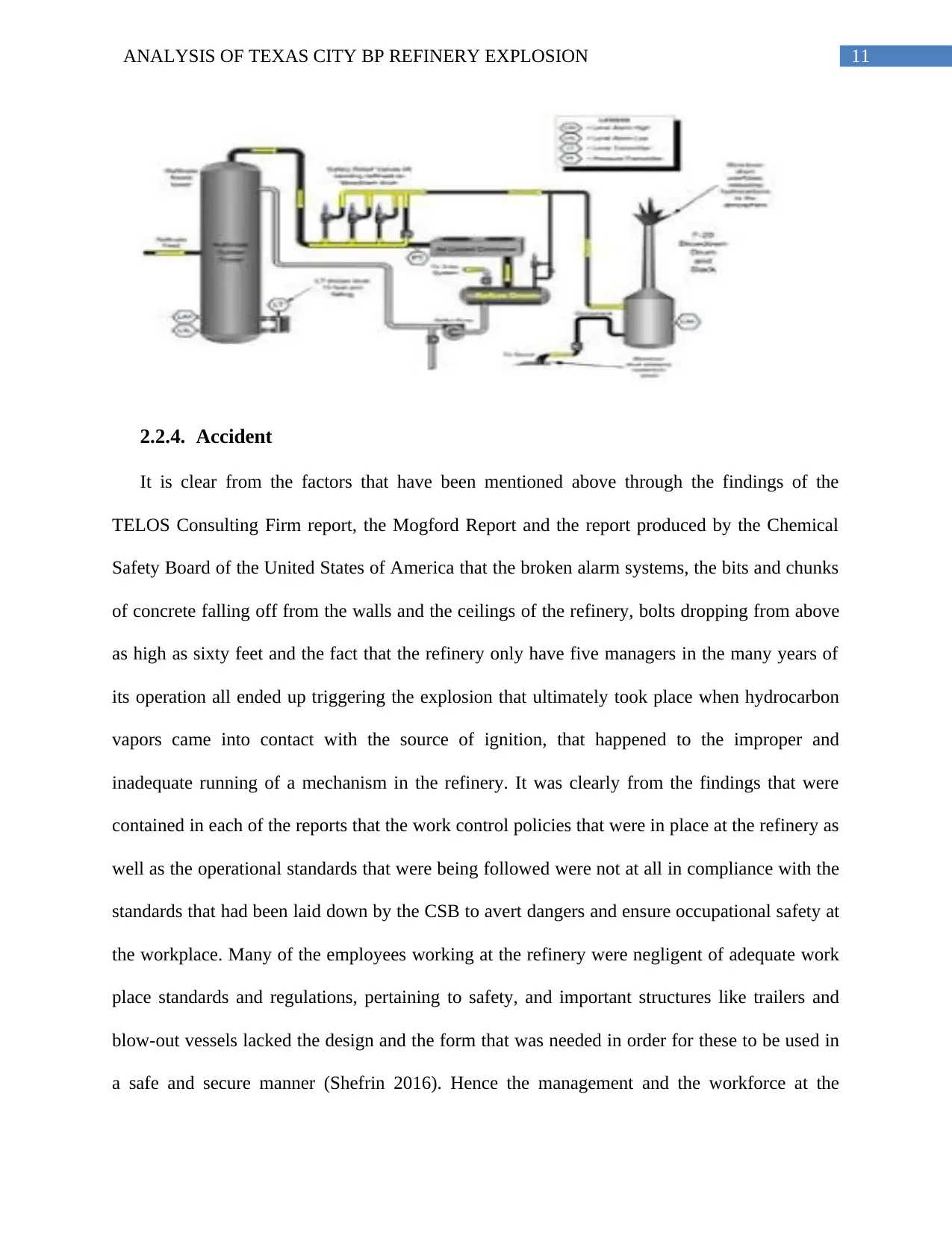
It is clear from the factors that have been mentioned above through the findings of the
TELOS Consulting Firm report, the Mogford Report and the report produced by the Chemical
Safety Board of the United States of America that the broken alarm systems, the bits and chunks
of concrete falling off from the walls and the ceilings of the refinery, bolts dropping from above
as high as sixty feet and the fact that the refinery only have five managers in the many years of
its operation all ended up triggering the explosion that ultimately took place when hydrocarbon
vapors came into contact with the source of ignition, that happened to the improper and
inadequate running of a mechanism in the refinery. It was clearly from the findings that were
contained in each of the reports that the work control policies that were in place at the refinery as
well as the operational standards that were being followed were not at all in compliance with the
standards that had been laid down by the CSB to avert dangers and ensure occupational safety at
the workplace. Many of the employees working at the refinery were negligent of adequate work
place standards and regulations, pertaining to safety, and important structures like trailers and
blow-out vessels lacked the design and the form that was needed in order for these to be used in
a safe and secure manner (Shefrin 2016). Hence the management and the workforce at the
2.2.4. Accident
It is clear from the factors that have been mentioned above through the findings of the
TELOS Consulting Firm report, the Mogford Report and the report produced by the Chemical
Safety Board of the United States of America that the broken alarm systems, the bits and chunks
of concrete falling off from the walls and the ceilings of the refinery, bolts dropping from above
as high as sixty feet and the fact that the refinery only have five managers in the many years of
its operation all ended up triggering the explosion that ultimately took place when hydrocarbon
vapors came into contact with the source of ignition, that happened to the improper and
inadequate running of a mechanism in the refinery. It was clearly from the findings that were
contained in each of the reports that the work control policies that were in place at the refinery as
well as the operational standards that were being followed were not at all in compliance with the
standards that had been laid down by the CSB to avert dangers and ensure occupational safety at
the workplace. Many of the employees working at the refinery were negligent of adequate work
place standards and regulations, pertaining to safety, and important structures like trailers and
blow-out vessels lacked the design and the form that was needed in order for these to be used in
a safe and secure manner (Shefrin 2016). Hence the management and the workforce at the
⊘ This is a preview!⊘
Do you want full access?
Subscribe today to unlock all pages.
Trusted by 1+ million students worldwide

1 out of 17


Your All-in-One AI-Powered Toolkit for Academic Success.
+13062052269
info@desklib.com
Available 24*7 on WhatsApp / Email
![[object Object]](/_next/static/media/star-bottom.7253800d.svg)
Unlock your academic potential
Copyright © 2020–2026 A2Z Services. All Rights Reserved. Developed and managed by ZUCOL.