Information System Aid for Infants and Toddlers in Texas: 2008-2016
VerifiedAdded on 2020/04/21
|61
|13933
|87
Report
AI Summary
This report investigates the application of information systems to assist infants and toddlers in Texas who experience learning difficulties, focusing on the period from 2008 to 2016. It explores the problem statement, which highlights the gap between existing information systems and the needs of children with learning disabilities, as well as the research questions concerning the reasons behind these difficulties and potential IT solutions. The theoretical framework encompasses the Neuropsychological Theory of Learning Disability, emphasizing neurological aspects. The study's significance lies in its potential to identify effective treatment methods and assess the adherence to guidelines for helping children with learning disabilities in Texas. The report also addresses ethical considerations, delimitations, and limitations, and includes a literature review that examines the need for early detection, different types of learning difficulties, and the use of information technology for children. The methodology outlines the research worldview, design, strategy, data analysis, population, sample, and design science employed. The report aims to determine how information systems can help children overcome learning difficulties and provide recommendations for improvement.

1Running head: INFORMATION SYSTEM AID TO INFANTS AND TODDLERS
Information System Aid to Infants and Toddlers in Texas with Learning Difficulties from 2008
to 2016
Name of the student:
Name of the university:
Author note:
Information System Aid to Infants and Toddlers in Texas with Learning Difficulties from 2008
to 2016
Name of the student:
Name of the university:
Author note:

Paraphrase This Document
Need a fresh take? Get an instant paraphrase of this document with our AI Paraphraser
2Running head: INFORMATION SYSTEM AID TO INFANTS AND TODDLERS
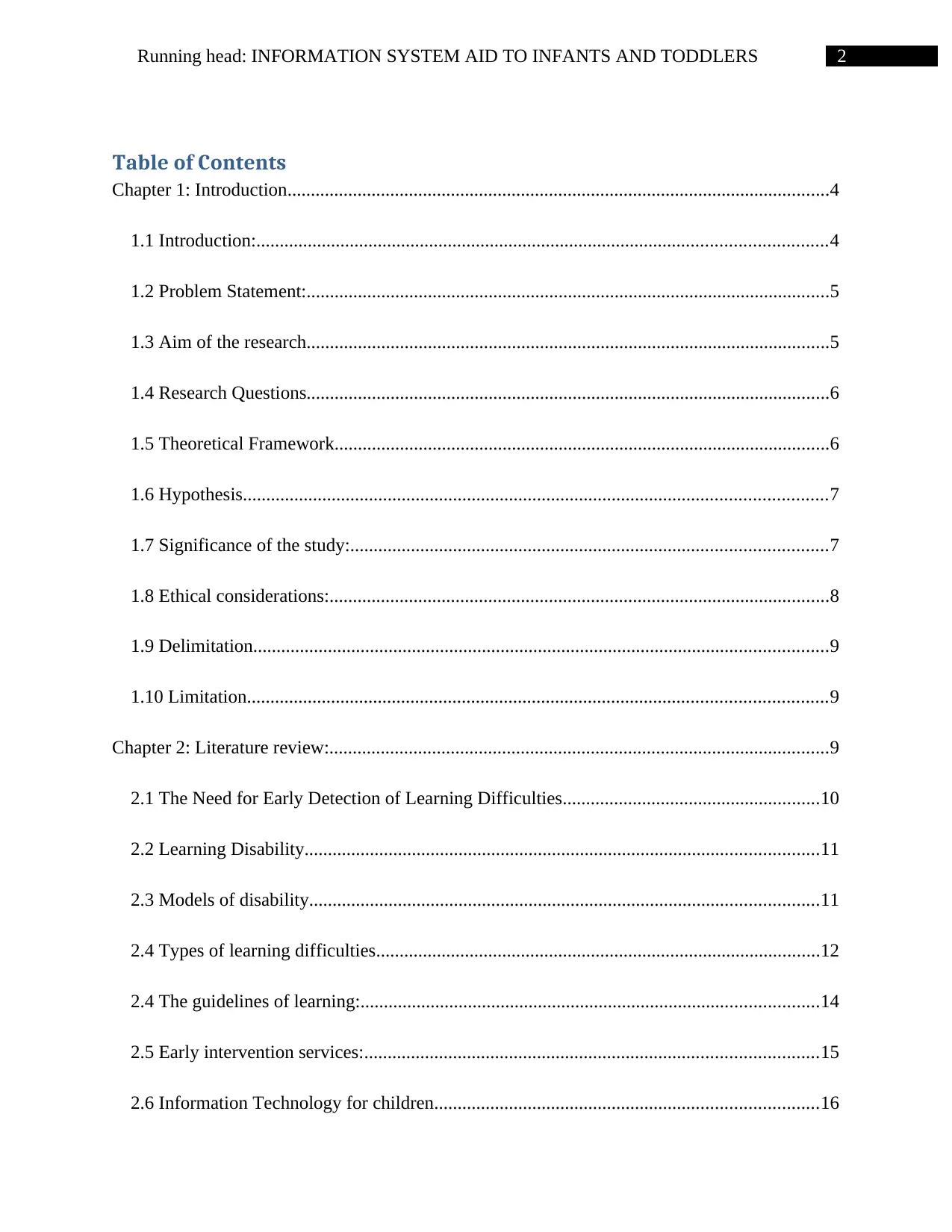
Table of Contents
Chapter 1: Introduction....................................................................................................................4
1.1 Introduction:..........................................................................................................................4
1.2 Problem Statement:................................................................................................................5
1.3 Aim of the research................................................................................................................5
1.4 Research Questions................................................................................................................6
1.5 Theoretical Framework..........................................................................................................6
1.6 Hypothesis.............................................................................................................................7
1.7 Significance of the study:......................................................................................................7
1.8 Ethical considerations:...........................................................................................................8
1.9 Delimitation...........................................................................................................................9
1.10 Limitation............................................................................................................................9
Chapter 2: Literature review:...........................................................................................................9
2.1 The Need for Early Detection of Learning Difficulties.......................................................10
2.2 Learning Disability..............................................................................................................11
2.3 Models of disability.............................................................................................................11
2.4 Types of learning difficulties...............................................................................................12
2.4 The guidelines of learning:..................................................................................................14
2.5 Early intervention services:.................................................................................................15
2.6 Information Technology for children..................................................................................16
Table of Contents
Chapter 1: Introduction....................................................................................................................4
1.1 Introduction:..........................................................................................................................4
1.2 Problem Statement:................................................................................................................5
1.3 Aim of the research................................................................................................................5
1.4 Research Questions................................................................................................................6
1.5 Theoretical Framework..........................................................................................................6
1.6 Hypothesis.............................................................................................................................7
1.7 Significance of the study:......................................................................................................7
1.8 Ethical considerations:...........................................................................................................8
1.9 Delimitation...........................................................................................................................9
1.10 Limitation............................................................................................................................9
Chapter 2: Literature review:...........................................................................................................9
2.1 The Need for Early Detection of Learning Difficulties.......................................................10
2.2 Learning Disability..............................................................................................................11
2.3 Models of disability.............................................................................................................11
2.4 Types of learning difficulties...............................................................................................12
2.4 The guidelines of learning:..................................................................................................14
2.5 Early intervention services:.................................................................................................15
2.6 Information Technology for children..................................................................................16
3Running head: INFORMATION SYSTEM AID TO INFANTS AND TODDLERS
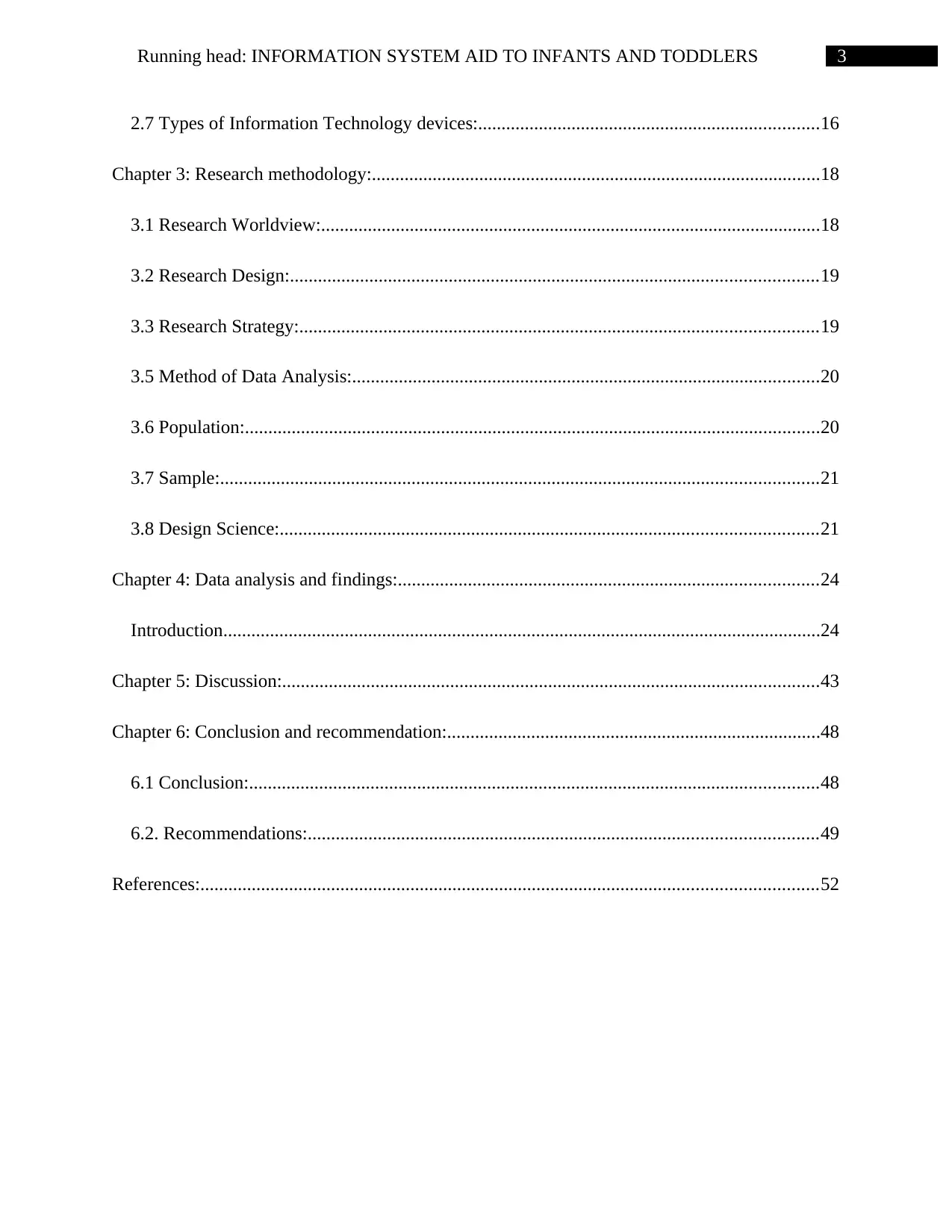
2.7 Types of Information Technology devices:.........................................................................16
Chapter 3: Research methodology:................................................................................................18
3.1 Research Worldview:...........................................................................................................18
3.2 Research Design:.................................................................................................................19
3.3 Research Strategy:...............................................................................................................19
3.5 Method of Data Analysis:....................................................................................................20
3.6 Population:...........................................................................................................................20
3.7 Sample:................................................................................................................................21
3.8 Design Science:...................................................................................................................21
Chapter 4: Data analysis and findings:..........................................................................................24
Introduction................................................................................................................................24
Chapter 5: Discussion:...................................................................................................................43
Chapter 6: Conclusion and recommendation:................................................................................48
6.1 Conclusion:..........................................................................................................................48
6.2. Recommendations:.............................................................................................................49
References:....................................................................................................................................52
2.7 Types of Information Technology devices:.........................................................................16
Chapter 3: Research methodology:................................................................................................18
3.1 Research Worldview:...........................................................................................................18
3.2 Research Design:.................................................................................................................19
3.3 Research Strategy:...............................................................................................................19
3.5 Method of Data Analysis:....................................................................................................20
3.6 Population:...........................................................................................................................20
3.7 Sample:................................................................................................................................21
3.8 Design Science:...................................................................................................................21
Chapter 4: Data analysis and findings:..........................................................................................24
Introduction................................................................................................................................24
Chapter 5: Discussion:...................................................................................................................43
Chapter 6: Conclusion and recommendation:................................................................................48
6.1 Conclusion:..........................................................................................................................48
6.2. Recommendations:.............................................................................................................49
References:....................................................................................................................................52
⊘ This is a preview!⊘
Do you want full access?
Subscribe today to unlock all pages.

Trusted by 1+ million students worldwide
4Running head: INFORMATION SYSTEM AID TO INFANTS AND TODDLERS
Chapter 1: Introduction
1.1 Introduction:
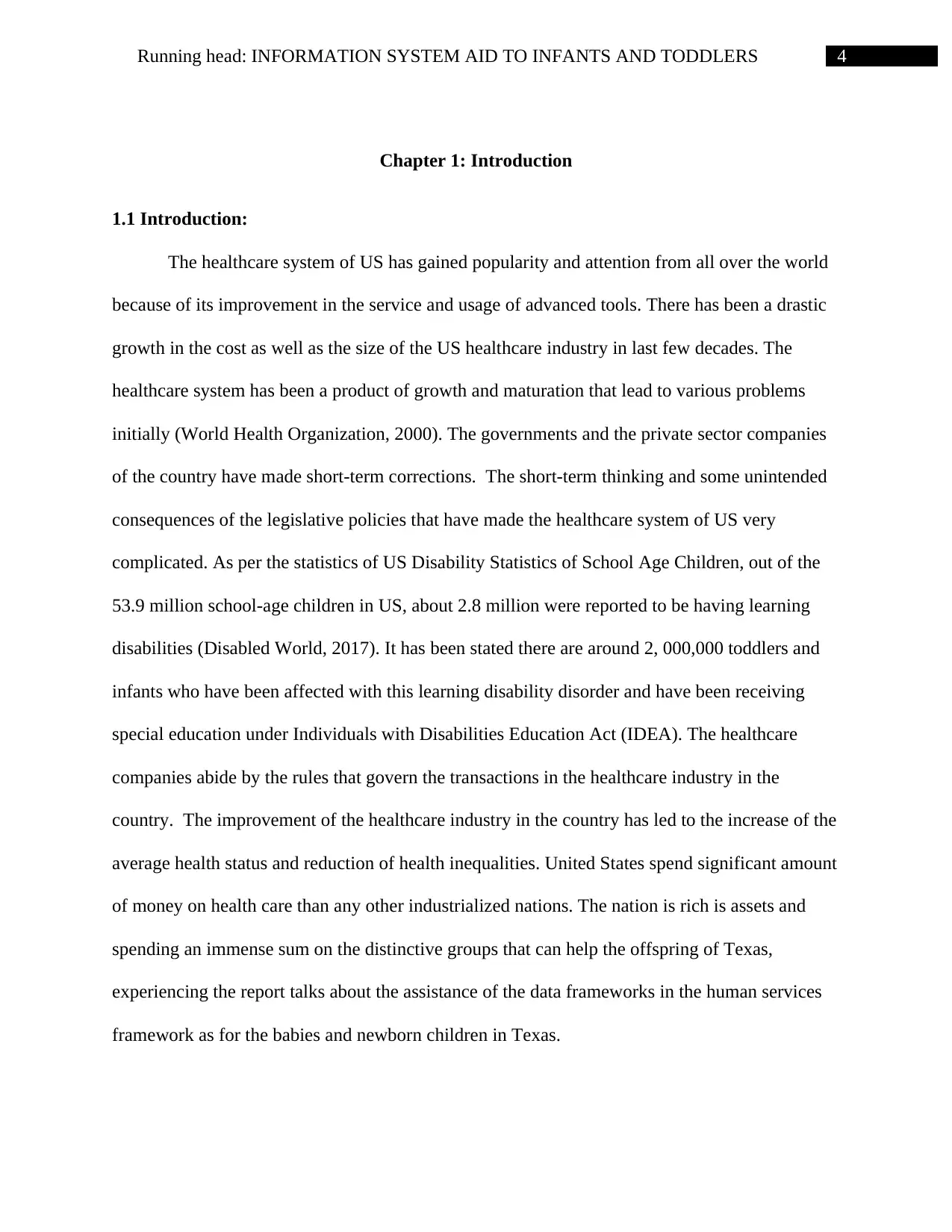
The healthcare system of US has gained popularity and attention from all over the world
because of its improvement in the service and usage of advanced tools. There has been a drastic
growth in the cost as well as the size of the US healthcare industry in last few decades. The
healthcare system has been a product of growth and maturation that lead to various problems
initially (World Health Organization, 2000). The governments and the private sector companies
of the country have made short-term corrections. The short-term thinking and some unintended
consequences of the legislative policies that have made the healthcare system of US very
complicated. As per the statistics of US Disability Statistics of School Age Children, out of the
53.9 million school-age children in US, about 2.8 million were reported to be having learning
disabilities (Disabled World, 2017). It has been stated there are around 2, 000,000 toddlers and
infants who have been affected with this learning disability disorder and have been receiving
special education under Individuals with Disabilities Education Act (IDEA). The healthcare
companies abide by the rules that govern the transactions in the healthcare industry in the
country. The improvement of the healthcare industry in the country has led to the increase of the
average health status and reduction of health inequalities. United States spend significant amount
of money on health care than any other industrialized nations. The nation is rich is assets and
spending an immense sum on the distinctive groups that can help the offspring of Texas,
experiencing the report talks about the assistance of the data frameworks in the human services
framework as for the babies and newborn children in Texas.
Chapter 1: Introduction
1.1 Introduction:
The healthcare system of US has gained popularity and attention from all over the world
because of its improvement in the service and usage of advanced tools. There has been a drastic
growth in the cost as well as the size of the US healthcare industry in last few decades. The
healthcare system has been a product of growth and maturation that lead to various problems
initially (World Health Organization, 2000). The governments and the private sector companies
of the country have made short-term corrections. The short-term thinking and some unintended
consequences of the legislative policies that have made the healthcare system of US very
complicated. As per the statistics of US Disability Statistics of School Age Children, out of the
53.9 million school-age children in US, about 2.8 million were reported to be having learning
disabilities (Disabled World, 2017). It has been stated there are around 2, 000,000 toddlers and
infants who have been affected with this learning disability disorder and have been receiving
special education under Individuals with Disabilities Education Act (IDEA). The healthcare
companies abide by the rules that govern the transactions in the healthcare industry in the
country. The improvement of the healthcare industry in the country has led to the increase of the
average health status and reduction of health inequalities. United States spend significant amount
of money on health care than any other industrialized nations. The nation is rich is assets and
spending an immense sum on the distinctive groups that can help the offspring of Texas,
experiencing the report talks about the assistance of the data frameworks in the human services
framework as for the babies and newborn children in Texas.
Paraphrase This Document
Need a fresh take? Get an instant paraphrase of this document with our AI Paraphraser
5Running head: INFORMATION SYSTEM AID TO INFANTS AND TODDLERS
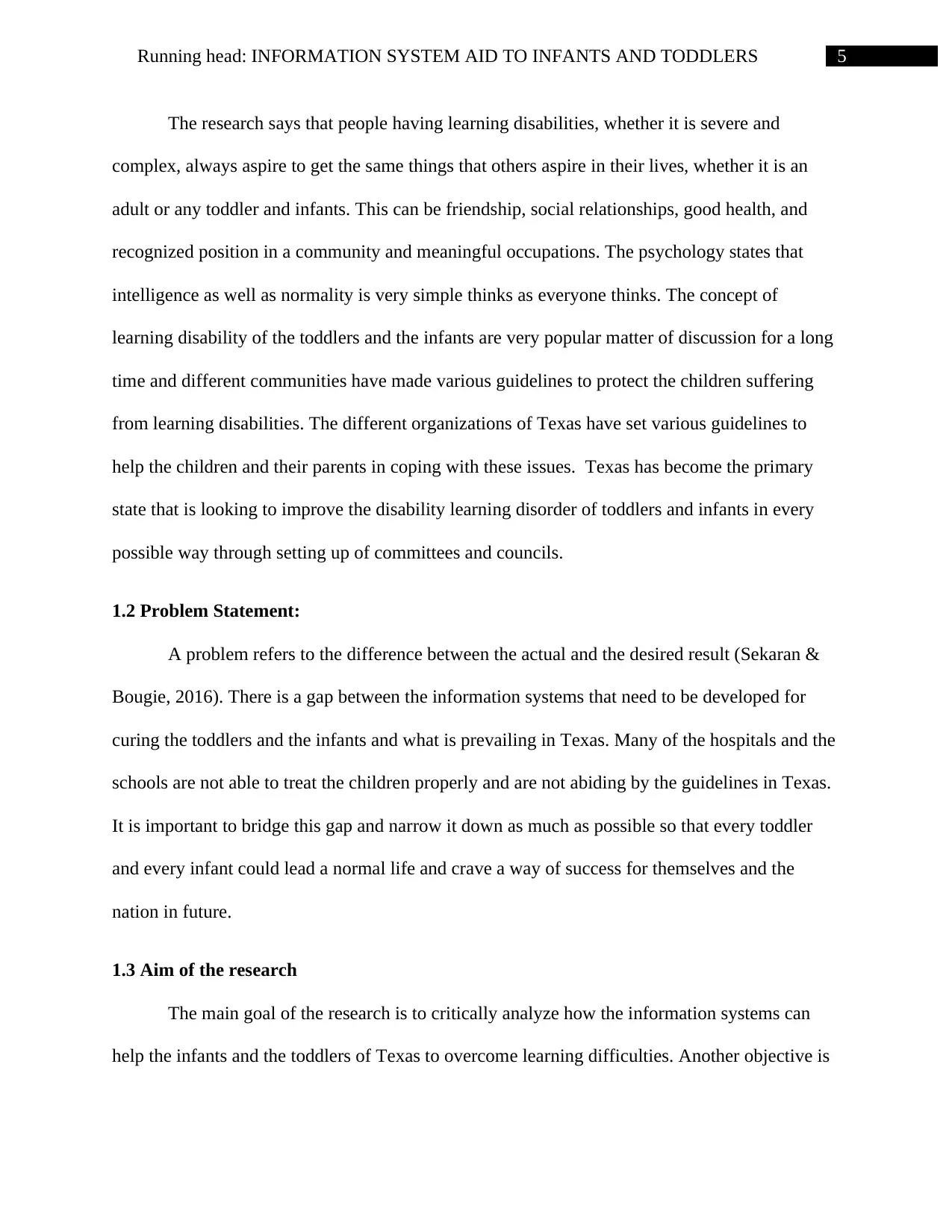
The research says that people having learning disabilities, whether it is severe and
complex, always aspire to get the same things that others aspire in their lives, whether it is an
adult or any toddler and infants. This can be friendship, social relationships, good health, and
recognized position in a community and meaningful occupations. The psychology states that
intelligence as well as normality is very simple thinks as everyone thinks. The concept of
learning disability of the toddlers and the infants are very popular matter of discussion for a long
time and different communities have made various guidelines to protect the children suffering
from learning disabilities. The different organizations of Texas have set various guidelines to
help the children and their parents in coping with these issues. Texas has become the primary
state that is looking to improve the disability learning disorder of toddlers and infants in every
possible way through setting up of committees and councils.
1.2 Problem Statement:
A problem refers to the difference between the actual and the desired result (Sekaran &
Bougie, 2016). There is a gap between the information systems that need to be developed for
curing the toddlers and the infants and what is prevailing in Texas. Many of the hospitals and the
schools are not able to treat the children properly and are not abiding by the guidelines in Texas.
It is important to bridge this gap and narrow it down as much as possible so that every toddler
and every infant could lead a normal life and crave a way of success for themselves and the
nation in future.
1.3 Aim of the research
The main goal of the research is to critically analyze how the information systems can
help the infants and the toddlers of Texas to overcome learning difficulties. Another objective is
The research says that people having learning disabilities, whether it is severe and
complex, always aspire to get the same things that others aspire in their lives, whether it is an
adult or any toddler and infants. This can be friendship, social relationships, good health, and
recognized position in a community and meaningful occupations. The psychology states that
intelligence as well as normality is very simple thinks as everyone thinks. The concept of
learning disability of the toddlers and the infants are very popular matter of discussion for a long
time and different communities have made various guidelines to protect the children suffering
from learning disabilities. The different organizations of Texas have set various guidelines to
help the children and their parents in coping with these issues. Texas has become the primary
state that is looking to improve the disability learning disorder of toddlers and infants in every
possible way through setting up of committees and councils.
1.2 Problem Statement:
A problem refers to the difference between the actual and the desired result (Sekaran &
Bougie, 2016). There is a gap between the information systems that need to be developed for
curing the toddlers and the infants and what is prevailing in Texas. Many of the hospitals and the
schools are not able to treat the children properly and are not abiding by the guidelines in Texas.
It is important to bridge this gap and narrow it down as much as possible so that every toddler
and every infant could lead a normal life and crave a way of success for themselves and the
nation in future.
1.3 Aim of the research
The main goal of the research is to critically analyze how the information systems can
help the infants and the toddlers of Texas to overcome learning difficulties. Another objective is
6Running head: INFORMATION SYSTEM AID TO INFANTS AND TODDLERS
to find out whether the various information systems can help the children in getting rid of the
learning disabilities.
1.4 Research Questions
The questions of the study are as follows:
What are the key reasons for the difficulties in learning of the toddlers and the infants of
Texas?
What are the different information systems that will help the children suffering from
learning disabilities?
What are the possible recommendations or ideas to improve the well-being of these
toddlers and infants in Texas through further monitoring the information system?
The below are the research questions that needs to get the answers for:
How must use of Information Technology will be utilized in the improvement of learning
disabilities of the toddlers and the infants of Texas?
How can the new technologies can be useful in solving the learning difficulties of the
toddlers and the infants?
How can we be able to make a supportable hand by utilizing IT as an instrument?
1.5 Theoretical Framework
The theoretical framework deals with how the variables interact with each other.
Learning disability is considered as a generic classification that helps to represent a
heterogeneous group of disorders. The Neuropsychological Theory of Learning Disability has
identified this trend that has already been incorporated to define the phenomenon where the
emphasis is placed on the suspected or known neurological aspects (Shute & Hogan, 2017). The
to find out whether the various information systems can help the children in getting rid of the
learning disabilities.
1.4 Research Questions
The questions of the study are as follows:
What are the key reasons for the difficulties in learning of the toddlers and the infants of
Texas?
What are the different information systems that will help the children suffering from
learning disabilities?
What are the possible recommendations or ideas to improve the well-being of these
toddlers and infants in Texas through further monitoring the information system?
The below are the research questions that needs to get the answers for:
How must use of Information Technology will be utilized in the improvement of learning
disabilities of the toddlers and the infants of Texas?
How can the new technologies can be useful in solving the learning difficulties of the
toddlers and the infants?
How can we be able to make a supportable hand by utilizing IT as an instrument?
1.5 Theoretical Framework
The theoretical framework deals with how the variables interact with each other.
Learning disability is considered as a generic classification that helps to represent a
heterogeneous group of disorders. The Neuropsychological Theory of Learning Disability has
identified this trend that has already been incorporated to define the phenomenon where the
emphasis is placed on the suspected or known neurological aspects (Shute & Hogan, 2017). The
⊘ This is a preview!⊘
Do you want full access?
Subscribe today to unlock all pages.
Trusted by 1+ million students worldwide
7Running head: INFORMATION SYSTEM AID TO INFANTS AND TODDLERS
empirical and conceptual neuropsychological basis of learning disabilities helps in the
facilitation of productive contemporary thought about the group of disorders.
The evolution of the psychological theories of intelligence and learning has immense
impacts on the conceptions of development delay. The specific and general learning disabilities
have paralleled the biases as well as the assumptions of the psychological theories. The problem
for assessment is the dependability across the time of measures of the basic efficiency of the
memory. There is a question about the potentiality of transfer of the training memory
components with respect to significant improvement in the performances in the schools. As per
the theory, it is possible for the identification of the specific components that a child is having
difficulties in mastering. Thus, the metaphor changes from the memory of the child to a domain
specific task component that demands extra attention and care. Another significant change in the
metaphor is from the diagnosis that is implicitly regarded as the static and permanent in
comparison to the dynamic and transient. The transient gives rise to a point where the child is
having problems with the understanding the place value notation in arithmetic. These changes
define different approaches for the diagnosis and instructions of learning disabilities.
1.6 Hypothesis
H1: The information systems help to cure the infants and the toddlers having learning
disabilities.
H0: The information systems are not able to cure the infants and the toddlers having
learning disabilities.
empirical and conceptual neuropsychological basis of learning disabilities helps in the
facilitation of productive contemporary thought about the group of disorders.
The evolution of the psychological theories of intelligence and learning has immense
impacts on the conceptions of development delay. The specific and general learning disabilities
have paralleled the biases as well as the assumptions of the psychological theories. The problem
for assessment is the dependability across the time of measures of the basic efficiency of the
memory. There is a question about the potentiality of transfer of the training memory
components with respect to significant improvement in the performances in the schools. As per
the theory, it is possible for the identification of the specific components that a child is having
difficulties in mastering. Thus, the metaphor changes from the memory of the child to a domain
specific task component that demands extra attention and care. Another significant change in the
metaphor is from the diagnosis that is implicitly regarded as the static and permanent in
comparison to the dynamic and transient. The transient gives rise to a point where the child is
having problems with the understanding the place value notation in arithmetic. These changes
define different approaches for the diagnosis and instructions of learning disabilities.
1.6 Hypothesis
H1: The information systems help to cure the infants and the toddlers having learning
disabilities.
H0: The information systems are not able to cure the infants and the toddlers having
learning disabilities.
Paraphrase This Document
Need a fresh take? Get an instant paraphrase of this document with our AI Paraphraser
8Running head: INFORMATION SYSTEM AID TO INFANTS AND TODDLERS
1.7 Significance of the study:
The research study has a great significance in getting to know about how the toddlers and
the infants of Texas having learning disabilities are being treated. The data and the suggestions
of the respondents would help to find ways to treat the children having disabilities, properly and
help them in getting cured. It will also help in knowing whether the different guidelines
regarding helping the children with learning disabilities, are being followed properly in Texas.
This research would enable the reader in understanding the issues on the topic and what the state
of Texas has been doing to overcome the issue related to toddlers and infants with learning
disability.
“The future of healthcare is on your computer, your phone, your tablet, your network and
the World Wide Web,” says Dr. Harris (2017). Information Technology will make human
services more reasonable for everybody and odds of missteps will lessen. It will upset the social
insurance industry in next couple of years. Along these lines, academic group must keep doing
research on this theme to comprehend the connection amongst IT and medicinal services too.
1.8 Ethical considerations:
Some ethical contemplations previously made by the specialist are been taken into
consideration. It is the onus of the researcher to maintain a privacy of all the data that will be
collected for the research and must not publish them in the public. Privacy of the participants
must be maintained. The researcher should not force the respondents in giving their opinions
about the topic. The failure of the researcher in maintaining the privacy of the respondents may
lead to the researcher being help held for the breach of ethical issues.
1.7 Significance of the study:
The research study has a great significance in getting to know about how the toddlers and
the infants of Texas having learning disabilities are being treated. The data and the suggestions
of the respondents would help to find ways to treat the children having disabilities, properly and
help them in getting cured. It will also help in knowing whether the different guidelines
regarding helping the children with learning disabilities, are being followed properly in Texas.
This research would enable the reader in understanding the issues on the topic and what the state
of Texas has been doing to overcome the issue related to toddlers and infants with learning
disability.
“The future of healthcare is on your computer, your phone, your tablet, your network and
the World Wide Web,” says Dr. Harris (2017). Information Technology will make human
services more reasonable for everybody and odds of missteps will lessen. It will upset the social
insurance industry in next couple of years. Along these lines, academic group must keep doing
research on this theme to comprehend the connection amongst IT and medicinal services too.
1.8 Ethical considerations:
Some ethical contemplations previously made by the specialist are been taken into
consideration. It is the onus of the researcher to maintain a privacy of all the data that will be
collected for the research and must not publish them in the public. Privacy of the participants
must be maintained. The researcher should not force the respondents in giving their opinions
about the topic. The failure of the researcher in maintaining the privacy of the respondents may
lead to the researcher being help held for the breach of ethical issues.
9Running head: INFORMATION SYSTEM AID TO INFANTS AND TODDLERS
1.9 Delimitation
The delimitation will take into consideration the demographic boundaries in conducting
the research (Cristina-Elena, 2017). The research will be conducted in Texas only as per the
research topic. Other states of US will not be considered and here lies the delimitation of the
research.
1.10 Limitation
The limitations of the research study take into consideration the time, financial and other
constraints regarding the research. The researcher may not have enough time to conduct the
research. So, a small number of respondent’s representative of the large population will be
studied. The financial constraint is another limitation for the researcher as any research involves
a huge amount of expenditure (Riff, Lacy & Fico, 2014). Other limitations are the collection of
proper data from the respondents and the unwillingness of the respondents in giving proper
feedback about the topic.
The researcher has the possibilities of facing challenges while conducting the research.
This challenge can be regarding the collection of data in relation with the topic. It is very hard to
make the respondents convince to give their views and opinions related to the topic. Another
challenge is the authenticity of the data to be collected as the respondents are not always correct.
Chapter 2: Literature review:
In this section, existing literature on information system aid in learning difficulties are
critically examined. This will help this proposal to be built on a wider context, to expose gap in
existing literature, methodologies, and theories.
1.9 Delimitation
The delimitation will take into consideration the demographic boundaries in conducting
the research (Cristina-Elena, 2017). The research will be conducted in Texas only as per the
research topic. Other states of US will not be considered and here lies the delimitation of the
research.
1.10 Limitation
The limitations of the research study take into consideration the time, financial and other
constraints regarding the research. The researcher may not have enough time to conduct the
research. So, a small number of respondent’s representative of the large population will be
studied. The financial constraint is another limitation for the researcher as any research involves
a huge amount of expenditure (Riff, Lacy & Fico, 2014). Other limitations are the collection of
proper data from the respondents and the unwillingness of the respondents in giving proper
feedback about the topic.
The researcher has the possibilities of facing challenges while conducting the research.
This challenge can be regarding the collection of data in relation with the topic. It is very hard to
make the respondents convince to give their views and opinions related to the topic. Another
challenge is the authenticity of the data to be collected as the respondents are not always correct.
Chapter 2: Literature review:
In this section, existing literature on information system aid in learning difficulties are
critically examined. This will help this proposal to be built on a wider context, to expose gap in
existing literature, methodologies, and theories.
⊘ This is a preview!⊘
Do you want full access?
Subscribe today to unlock all pages.
Trusted by 1+ million students worldwide
10Running head: INFORMATION SYSTEM AID TO INFANTS AND TODDLERS
2.1 The Need for Early Detection of Learning Difficulties
Toddlers and infants need to undergo an array of clinical as well as preventive services
that are designed to give an optimal start to a healthy life. The health care and the health of the
children including the toddlers and the infants may be improved through the process of timely
delivery of accurate and complete information. Klin, Shultz and Jones (2015), discovered that a
biological system framework helps to bridge any gaps between the genes of children and toddlers
and the symptoms. This framework puts the focus on the basic socialization mechanisms that are
emerging with respect to development and highly conservative regarding evolution. Green et al.
(2014) showed, that Early Head Start (EHS), one of the largest programs funded by the U.S.
Federal Government, is a dual generational program that helps to serve the low-income families
having toddlers and infants up to the age of three years. The children in the EHS are less likely to
have physical problems compared to those who belong to the control group. However, Phillips
(2015) opined that the proper functioning of the civil registration and vital statistics (CRVS)
system have strong associations with the improved outcomes of the health of the entire
population including the infants and the toddlers to help them learn new things.
Cortiella & Horowitz (2014) discovered that, learning disabilities are not caused by
hearing, visual or motor disabilities, emotional disturbance, limited proficiency for English,
environmental and economic disadvantages, inadequate instruction and cultural factors. They
have also stated that learning disabilities are real as well as permanent. It has also been
discovered that some people are able to find out the learning disabilities of the children,
especially the toddlers and the infants. However, Berninger. et al., (2017) found out that the
parental ratings of inattention are correlated with the measures of written language and not the
oral language.
2.1 The Need for Early Detection of Learning Difficulties
Toddlers and infants need to undergo an array of clinical as well as preventive services
that are designed to give an optimal start to a healthy life. The health care and the health of the
children including the toddlers and the infants may be improved through the process of timely
delivery of accurate and complete information. Klin, Shultz and Jones (2015), discovered that a
biological system framework helps to bridge any gaps between the genes of children and toddlers
and the symptoms. This framework puts the focus on the basic socialization mechanisms that are
emerging with respect to development and highly conservative regarding evolution. Green et al.
(2014) showed, that Early Head Start (EHS), one of the largest programs funded by the U.S.
Federal Government, is a dual generational program that helps to serve the low-income families
having toddlers and infants up to the age of three years. The children in the EHS are less likely to
have physical problems compared to those who belong to the control group. However, Phillips
(2015) opined that the proper functioning of the civil registration and vital statistics (CRVS)
system have strong associations with the improved outcomes of the health of the entire
population including the infants and the toddlers to help them learn new things.
Cortiella & Horowitz (2014) discovered that, learning disabilities are not caused by
hearing, visual or motor disabilities, emotional disturbance, limited proficiency for English,
environmental and economic disadvantages, inadequate instruction and cultural factors. They
have also stated that learning disabilities are real as well as permanent. It has also been
discovered that some people are able to find out the learning disabilities of the children,
especially the toddlers and the infants. However, Berninger. et al., (2017) found out that the
parental ratings of inattention are correlated with the measures of written language and not the
oral language.
Paraphrase This Document
Need a fresh take? Get an instant paraphrase of this document with our AI Paraphraser
11Running head: INFORMATION SYSTEM AID TO INFANTS AND TODDLERS
The children mainly the toddlers and the infants are facing difficulties related to learning.
They try to use their strengths to hide the difficulties. This can be the usage of phenomenal
auditory memory to avoid the problems of reading or taking any notes. The signs of learning
difficulties appear before the infants or the toddlers learn to read or write. There are various
types of learning difficulties and a child might be having more than one learning difficulty. There
can be some indications that a toddler or an infant is having some learning difficulties. These are
mispronunciations of words, poor spelling, reversals of letter and word, word substitutions and
difficulties in copying of letters, words and shapes.
2.2 Learning Disability
A child who is having a disability in learning is not able to process information properly
in the same manner that a developing child of similar ages wills. The processing means the
hearing, touching, seeing, reading and smelling of anything that is able to send messages to the
brains. The infants and the toddlers can have a sense of what is going on and are able to take
actions accordingly. The information may not flow properly to the brain and from the brain to
the different parts of the body.
2.3 Models of disability
There are two contrasting approaches to disability, popularly known as opposing models
(Haegele & Hodge, 2016). These models are medical and social. The medical model treats a
disability as a mental or physical impairment of an individual and its social as well as personal
consequences (Burr, 2015). This model treats the constraints looked by the general population
with incapacities as the outcomes exclusively for their disability. On the contrary, the social
model treats disability as a relation between a person and his social environment. The exclusion
of an individual with some specific physical and mental characteristics from the major domains
The children mainly the toddlers and the infants are facing difficulties related to learning.
They try to use their strengths to hide the difficulties. This can be the usage of phenomenal
auditory memory to avoid the problems of reading or taking any notes. The signs of learning
difficulties appear before the infants or the toddlers learn to read or write. There are various
types of learning difficulties and a child might be having more than one learning difficulty. There
can be some indications that a toddler or an infant is having some learning difficulties. These are
mispronunciations of words, poor spelling, reversals of letter and word, word substitutions and
difficulties in copying of letters, words and shapes.
2.2 Learning Disability
A child who is having a disability in learning is not able to process information properly
in the same manner that a developing child of similar ages wills. The processing means the
hearing, touching, seeing, reading and smelling of anything that is able to send messages to the
brains. The infants and the toddlers can have a sense of what is going on and are able to take
actions accordingly. The information may not flow properly to the brain and from the brain to
the different parts of the body.
2.3 Models of disability
There are two contrasting approaches to disability, popularly known as opposing models
(Haegele & Hodge, 2016). These models are medical and social. The medical model treats a
disability as a mental or physical impairment of an individual and its social as well as personal
consequences (Burr, 2015). This model treats the constraints looked by the general population
with incapacities as the outcomes exclusively for their disability. On the contrary, the social
model treats disability as a relation between a person and his social environment. The exclusion
of an individual with some specific physical and mental characteristics from the major domains
12Running head: INFORMATION SYSTEM AID TO INFANTS AND TODDLERS
of the social life is manifested in deliberate segregation as well as in an organized social activity
that restricts the participation of the individual having disabilities (Barnes, C., 2010).
2.4 Types of learning difficulties
There are various types of learning difficulties that infants and toddlers face. They
include the following: (1) Dyslexia (2) Dyscalculia (3) Dysgraphia (4) Dyspraxia (5) Auditory
Processing Disorder (6) Sensory Processing Disorder, and (7) Visual Processing Disorder.
Dyslexia. Dyslexia is a disorder regarding language (Nijakowska & Kormos, 2016). This causes
the children to reverse the letters. A direct relationship exists between the ability of a student to
read as well as to spell and the spoken language. Children having dyslexia face challenges
regarding reading, writing and spelling along with the challenges of understanding and
expressing languages (Ellis, 2016). It has been estimated that around 80% of all disabilities are
related to reading.
Dyscalculia. This refers to the difficulties regarding mathematics such as remembering various
computing facts, learning concepts of time and money and computing (Ulfarsson. et al., 2017).
The symptoms change over time. The young children face problems regarding counting and have
tendencies to misalign columns and reverse numbers. These affect the functional skills such as
counting money, measuring things or playing board games.
Dysgraphia. This refers to the difficulties in writing. Handwriting is a very complicated process
involving processing of information and expressing the thoughts on the paper. Children having
dysgraphia struggle to organize numbers, letters and words (Berninger. et al., 2015).
Dyspraxia. Dyspraxia refers to the difficulties like grasping scissors, hand-eye coordination and
controlling a pencil (Macintyre, 2015). Parents can observe these signs of dyspraxia in a toddler
of the social life is manifested in deliberate segregation as well as in an organized social activity
that restricts the participation of the individual having disabilities (Barnes, C., 2010).
2.4 Types of learning difficulties
There are various types of learning difficulties that infants and toddlers face. They
include the following: (1) Dyslexia (2) Dyscalculia (3) Dysgraphia (4) Dyspraxia (5) Auditory
Processing Disorder (6) Sensory Processing Disorder, and (7) Visual Processing Disorder.
Dyslexia. Dyslexia is a disorder regarding language (Nijakowska & Kormos, 2016). This causes
the children to reverse the letters. A direct relationship exists between the ability of a student to
read as well as to spell and the spoken language. Children having dyslexia face challenges
regarding reading, writing and spelling along with the challenges of understanding and
expressing languages (Ellis, 2016). It has been estimated that around 80% of all disabilities are
related to reading.
Dyscalculia. This refers to the difficulties regarding mathematics such as remembering various
computing facts, learning concepts of time and money and computing (Ulfarsson. et al., 2017).
The symptoms change over time. The young children face problems regarding counting and have
tendencies to misalign columns and reverse numbers. These affect the functional skills such as
counting money, measuring things or playing board games.
Dysgraphia. This refers to the difficulties in writing. Handwriting is a very complicated process
involving processing of information and expressing the thoughts on the paper. Children having
dysgraphia struggle to organize numbers, letters and words (Berninger. et al., 2015).
Dyspraxia. Dyspraxia refers to the difficulties like grasping scissors, hand-eye coordination and
controlling a pencil (Macintyre, 2015). Parents can observe these signs of dyspraxia in a toddler
⊘ This is a preview!⊘
Do you want full access?
Subscribe today to unlock all pages.
Trusted by 1+ million students worldwide

1 out of 61


Related Documents


Your All-in-One AI-Powered Toolkit for Academic Success.
+13062052269
info@desklib.com
Available 24*7 on WhatsApp / Email
![[object Object]](/_next/static/media/star-bottom.7253800d.svg)
Unlock your academic potential
Copyright © 2020–2026 A2Z Services. All Rights Reserved. Developed and managed by ZUCOL.