Analysis of Dyeing, Printing, and Finishing in Textiles
VerifiedAdded on 2023/05/27
|9
|2450
|238
Report
AI Summary
This report provides a detailed analysis of various textile printing, dyeing, and finishing techniques. It explores the use of laser technology for printing on polyester, including the application of different grid patterns and dyes to achieve specific tonal effects. The report also covers the finishing of winter coats, focusing on stain resistance and the properties of different types of stains, including water-based and oil-based stains. Furthermore, it details the preparation of cotton material before dyeing, including desizing, scouring, and bleaching processes. Finally, the report discusses modern finishing techniques that aim to reduce energy and water consumption, as well as surface treatment methods for relief-dyed skirts to ensure good cake discharge. The report references various studies and research papers to support its findings, providing a comprehensive overview of the textile production process.

FIBRES AND TEXTILES
By Name
Course
Instructor
Institution
Location
Date
By Name
Course
Instructor
Institution
Location
Date

Paraphrase This Document
Need a fresh take? Get an instant paraphrase of this document with our AI Paraphraser

Introduction
The modern textile printing involves application of a wide range of the technologies and
colorants that are used in the production of the printed products. The production process takes
place in various stages. In the present set up, the commonly used technique is the rotary screen
printing. This technique actually account for the majority of the printed cotton clothes. It is
important to note that there has been emergence of the other technologies like digital printing
that attract the attention as well. This attraction is a result of the reduced environmental impact.
Part A (printing and dyeing techniques)
In order to have proper design on the material of the polyester, a laser technique may be
considered very crucial. The possible approach that can be used in this kind of the system can be
a T-shaped practioner.The property of the crossing over from the specific area of the design into
other disciples like the chemistry. According to Harris (4) making pattern will call for the use of
the combination of the hand drawn material and the methods of the CAD. This combination
assists in the formulation of the digital pattern towards the final design. The Adobe Photoshop
and the adobe illustrator software’s are very crucial in this development. The interpretation of the
computer graphics is done via the spot or the laser beam hence enabling the formation of the
dyes. According to Tram et al(9) of interest in this kind of the development is the capacity to
create as well as change through digital means pictures like maker of the material who
specializes within the printing alongside the designing stage of the surface.
The modern textile printing involves application of a wide range of the technologies and
colorants that are used in the production of the printed products. The production process takes
place in various stages. In the present set up, the commonly used technique is the rotary screen
printing. This technique actually account for the majority of the printed cotton clothes. It is
important to note that there has been emergence of the other technologies like digital printing
that attract the attention as well. This attraction is a result of the reduced environmental impact.
Part A (printing and dyeing techniques)
In order to have proper design on the material of the polyester, a laser technique may be
considered very crucial. The possible approach that can be used in this kind of the system can be
a T-shaped practioner.The property of the crossing over from the specific area of the design into
other disciples like the chemistry. According to Harris (4) making pattern will call for the use of
the combination of the hand drawn material and the methods of the CAD. This combination
assists in the formulation of the digital pattern towards the final design. The Adobe Photoshop
and the adobe illustrator software’s are very crucial in this development. The interpretation of the
computer graphics is done via the spot or the laser beam hence enabling the formation of the
dyes. According to Tram et al(9) of interest in this kind of the development is the capacity to
create as well as change through digital means pictures like maker of the material who
specializes within the printing alongside the designing stage of the surface.
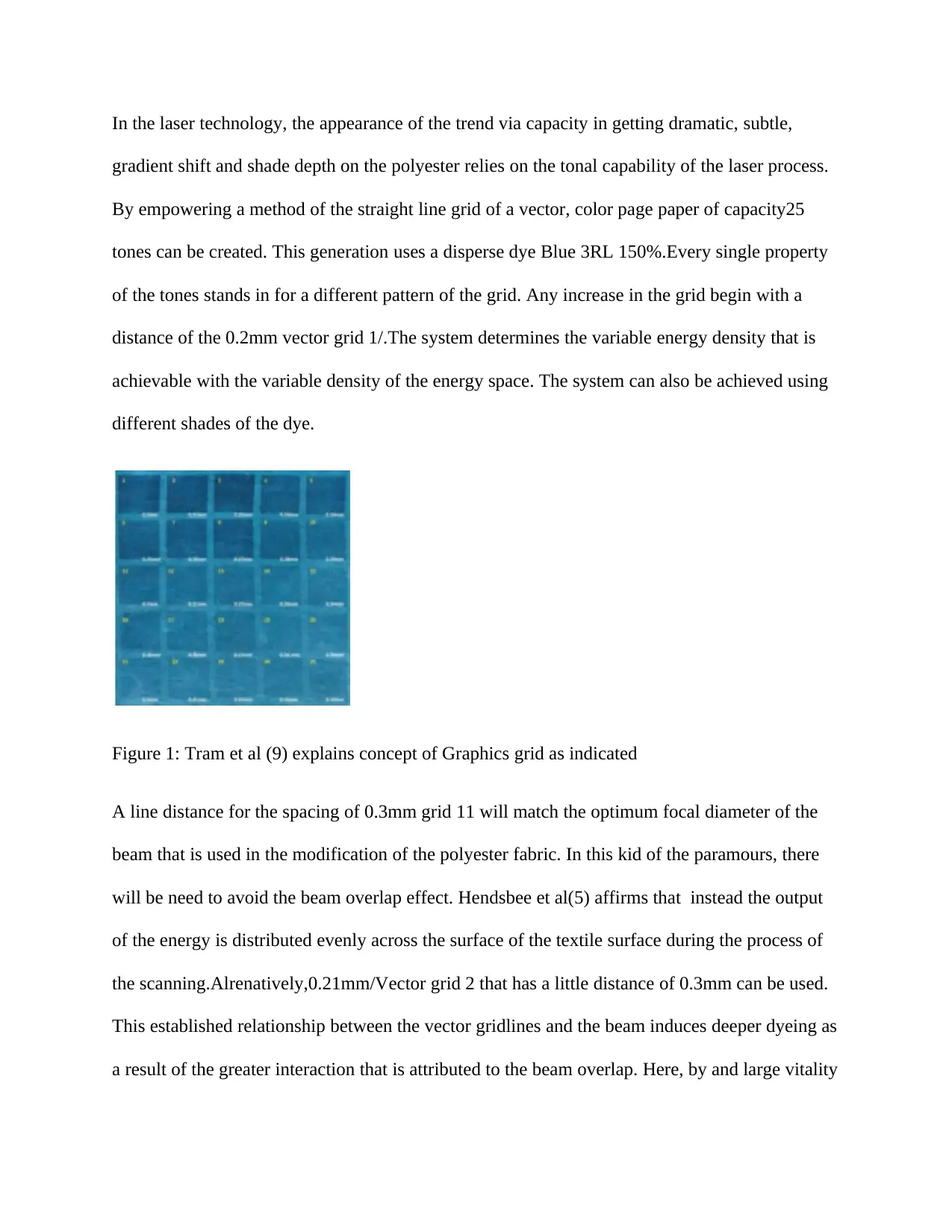
In the laser technology, the appearance of the trend via capacity in getting dramatic, subtle,
gradient shift and shade depth on the polyester relies on the tonal capability of the laser process.
By empowering a method of the straight line grid of a vector, color page paper of capacity25
tones can be created. This generation uses a disperse dye Blue 3RL 150%.Every single property
of the tones stands in for a different pattern of the grid. Any increase in the grid begin with a
distance of the 0.2mm vector grid 1/.The system determines the variable energy density that is
achievable with the variable density of the energy space. The system can also be achieved using
different shades of the dye.
Figure 1: Tram et al (9) explains concept of Graphics grid as indicated
A line distance for the spacing of 0.3mm grid 11 will match the optimum focal diameter of the
beam that is used in the modification of the polyester fabric. In this kid of the paramours, there
will be need to avoid the beam overlap effect. Hendsbee et al(5) affirms that instead the output
of the energy is distributed evenly across the surface of the textile surface during the process of
the scanning.Alrenatively,0.21mm/Vector grid 2 that has a little distance of 0.3mm can be used.
This established relationship between the vector gridlines and the beam induces deeper dyeing as
a result of the greater interaction that is attributed to the beam overlap. Here, by and large vitality
gradient shift and shade depth on the polyester relies on the tonal capability of the laser process.
By empowering a method of the straight line grid of a vector, color page paper of capacity25
tones can be created. This generation uses a disperse dye Blue 3RL 150%.Every single property
of the tones stands in for a different pattern of the grid. Any increase in the grid begin with a
distance of the 0.2mm vector grid 1/.The system determines the variable energy density that is
achievable with the variable density of the energy space. The system can also be achieved using
different shades of the dye.
Figure 1: Tram et al (9) explains concept of Graphics grid as indicated
A line distance for the spacing of 0.3mm grid 11 will match the optimum focal diameter of the
beam that is used in the modification of the polyester fabric. In this kid of the paramours, there
will be need to avoid the beam overlap effect. Hendsbee et al(5) affirms that instead the output
of the energy is distributed evenly across the surface of the textile surface during the process of
the scanning.Alrenatively,0.21mm/Vector grid 2 that has a little distance of 0.3mm can be used.
This established relationship between the vector gridlines and the beam induces deeper dyeing as
a result of the greater interaction that is attributed to the beam overlap. Here, by and large vitality
⊘ This is a preview!⊘
Do you want full access?
Subscribe today to unlock all pages.

Trusted by 1+ million students worldwide

thickness was lessened; delivering subtler surface impacts connected to constrained adjustment
and therefore lessened color take-up.
Part A (Finishing of Winter Coating)
There are two principal kinds of stains: those that are water-based and those that are oil-based.
Espresso or tea embodies water-based stains. Paint, lipstick, glue stains are delegated dissolvable
based stains, so are latex type paints or Elmer's paste, which contain water at first, and solidify to
an alternate, non-fluid compound. Water-based stains, including most nourishment stains, are
acidic and will require acid mixture to expel them. Oil type stains will require non-fluid or "dry"
synthetic chemical (subsequently the expression "dry-cleaning") in many occurrences. Numerous
stains, similar to sebum ("ring around the neckline"), and smoke harm, are mind boggling blends
of slick kind segments with water-based salts, acids or bases and particulate issue (carbon, earth).
Inks particularly ball-point and felt-tip pens contain complex blends, alongside shades (hued
particles) and colors (water solvent, fiber assimilated colorants). Sweat might be acidic or
essential relying upon the individual. The build -up is confounded by the arrangement of the
antiperspirant or fragrance utilized. Pet stains are likewise factor and complex. Regurgitation
blends bile from the tract related process with the foodstuffs themselves. Different sorts of stains
that require exceptional substance reagents are: dried matured blood, and sustenance colorings
Stain resistance alludes to a materials' capacity to withstand discolorations caused by contact
with fluids, including grease and oil, or potentially strong surfaces. Ordinarily a fluid stain
happens because of a fiber being Hydrophilic. Gardetti et al (3) explains that where the fluid gets
consumed by the fiber and on drying the fiber turns out to be inadvertently stained i.e. recolored.
With any texture structure pores are made amid the interweaving of the yarns; yarns likewise
and therefore lessened color take-up.
Part A (Finishing of Winter Coating)
There are two principal kinds of stains: those that are water-based and those that are oil-based.
Espresso or tea embodies water-based stains. Paint, lipstick, glue stains are delegated dissolvable
based stains, so are latex type paints or Elmer's paste, which contain water at first, and solidify to
an alternate, non-fluid compound. Water-based stains, including most nourishment stains, are
acidic and will require acid mixture to expel them. Oil type stains will require non-fluid or "dry"
synthetic chemical (subsequently the expression "dry-cleaning") in many occurrences. Numerous
stains, similar to sebum ("ring around the neckline"), and smoke harm, are mind boggling blends
of slick kind segments with water-based salts, acids or bases and particulate issue (carbon, earth).
Inks particularly ball-point and felt-tip pens contain complex blends, alongside shades (hued
particles) and colors (water solvent, fiber assimilated colorants). Sweat might be acidic or
essential relying upon the individual. The build -up is confounded by the arrangement of the
antiperspirant or fragrance utilized. Pet stains are likewise factor and complex. Regurgitation
blends bile from the tract related process with the foodstuffs themselves. Different sorts of stains
that require exceptional substance reagents are: dried matured blood, and sustenance colorings
Stain resistance alludes to a materials' capacity to withstand discolorations caused by contact
with fluids, including grease and oil, or potentially strong surfaces. Ordinarily a fluid stain
happens because of a fiber being Hydrophilic. Gardetti et al (3) explains that where the fluid gets
consumed by the fiber and on drying the fiber turns out to be inadvertently stained i.e. recolored.
With any texture structure pores are made amid the interweaving of the yarns; yarns likewise
Paraphrase This Document
Need a fresh take? Get an instant paraphrase of this document with our AI Paraphraser

have between fiber spaces. These permeable holes can trap potential stains because of Capillary
Forces are dependable to drive the fluid in narrow spaces. (Snap here for more
information)">capillary wicking, contingent on the thickness of the contact fluid.
Furthermore, fine particles from contact with strong materials can hold fast to the fiber and
texture surfaces or wind up installed into the yarn as well as texture interstices, which
additionally result in stains. Simad et al (8) suggests that stain resistance on the coat is
specifically identified with oleo phobic and hydrophobic functionalities. The essential goal of
stain resistance is in this manner to forestall fluid retention and fine particles adherence to both
fiber and texture surfaces which the coat is made from. This goal can be by using the
characteristic properties of specific strands or by applying stain opposes (i.e. certain added
substances, coatings or completions) to texture surfaces. Contingent upon the sort of stain
opposition treatment utilized, contact and entrance of the texture or fiber can be totally hindered,
guaranteeing the counteractive action of contact recoloring.
Part (C) Preparation of the cotton material before dyeing
Dim fabric as it originates from the linger arrange is ugly and contains normal and additionally
included debasements, which thwarts the effective tasks of coloring by decreasing the sponginess
of the texture. That is the reason behind the importance of making texture water spongy, in
creating the texture that is not having any regular and additionally added contaminations so as to
accomplish fruitful coloring process. Preparation of the cotton fabric contains following
advances efficiently. The preparation of the cotton material include the following steps before
dyeing
Desizing
Forces are dependable to drive the fluid in narrow spaces. (Snap here for more
information)">capillary wicking, contingent on the thickness of the contact fluid.
Furthermore, fine particles from contact with strong materials can hold fast to the fiber and
texture surfaces or wind up installed into the yarn as well as texture interstices, which
additionally result in stains. Simad et al (8) suggests that stain resistance on the coat is
specifically identified with oleo phobic and hydrophobic functionalities. The essential goal of
stain resistance is in this manner to forestall fluid retention and fine particles adherence to both
fiber and texture surfaces which the coat is made from. This goal can be by using the
characteristic properties of specific strands or by applying stain opposes (i.e. certain added
substances, coatings or completions) to texture surfaces. Contingent upon the sort of stain
opposition treatment utilized, contact and entrance of the texture or fiber can be totally hindered,
guaranteeing the counteractive action of contact recoloring.
Part (C) Preparation of the cotton material before dyeing
Dim fabric as it originates from the linger arrange is ugly and contains normal and additionally
included debasements, which thwarts the effective tasks of coloring by decreasing the sponginess
of the texture. That is the reason behind the importance of making texture water spongy, in
creating the texture that is not having any regular and additionally added contaminations so as to
accomplish fruitful coloring process. Preparation of the cotton fabric contains following
advances efficiently. The preparation of the cotton material include the following steps before
dyeing
Desizing

Scouring
Bleaching
Desizing
It is a procedure by which greasy issues are expelled from the dim material i.e. starch and so on.
which connected to the twist and weft yarns amid weaving so as to with stand the pressure or
strain.
• Process of desizing should be possible either by hydrolytic desizing or by oxidative desizing.
• The topic of desizing process is just to change over the insoluble starch into dissolvable frame.
Starch can be hydrolyzed under the following steps:
Starch → Dextrin → Dextrin → Maltose → Glucose • (Insoluble) (Insoluble)
(Soluble) (Soluble) (Soluble)
Scouring
Best (2) illustrates that it is the procedure by which oils, fats, waxes and different nitrogenous
issues are expelled. Process is completed by including 2g/l acidic soft drink, 1g/l soft drink fiery
debris and 1 g/l T.R.O. furthermore, at that point the temperature is raised to bubble and process
proceeded for 3‐4 hours under the pH 10‐ 11.5.
Bleaching
The strategy for dyeing texture via washing and trucking against a stone, in order to expel as a
great part of the measuring as could be expected under the circumstances. Matsuoka(7)explains
that spreading out of the watering is done to ensure there is maximum exposure so that sun dying
Bleaching
Desizing
It is a procedure by which greasy issues are expelled from the dim material i.e. starch and so on.
which connected to the twist and weft yarns amid weaving so as to with stand the pressure or
strain.
• Process of desizing should be possible either by hydrolytic desizing or by oxidative desizing.
• The topic of desizing process is just to change over the insoluble starch into dissolvable frame.
Starch can be hydrolyzed under the following steps:
Starch → Dextrin → Dextrin → Maltose → Glucose • (Insoluble) (Insoluble)
(Soluble) (Soluble) (Soluble)
Scouring
Best (2) illustrates that it is the procedure by which oils, fats, waxes and different nitrogenous
issues are expelled. Process is completed by including 2g/l acidic soft drink, 1g/l soft drink fiery
debris and 1 g/l T.R.O. furthermore, at that point the temperature is raised to bubble and process
proceeded for 3‐4 hours under the pH 10‐ 11.5.
Bleaching
The strategy for dyeing texture via washing and trucking against a stone, in order to expel as a
great part of the measuring as could be expected under the circumstances. Matsuoka(7)explains
that spreading out of the watering is done to ensure there is maximum exposure so that sun dying
⊘ This is a preview!⊘
Do you want full access?
Subscribe today to unlock all pages.
Trusted by 1+ million students worldwide

can be achieved .This process is accompanied by use of the water which is sprinkled on the
material within the shortest period of time. At that point it is at long last washed and dried.
Subsequent to evacuating the debasement of texture then it is treated with 4% (owf) arrangement
of tannic corrosive in water. The texture ought to be dunked in tannic corrosive answer for in any
event 4‐5 hours. It is crushed and dried. Subsequent to mordanting this texture is utilized for
coloring and coloring would depend upon the kind of mordanting that must be thusly continued.
Part (D)
Ordinary texture finishing procedures require tremendous measures of energy and water. New
completing procedures are created utilizing a restricted sum or no water and diminishing the
energy utilization. Li et al(6) consider it outstanding that most engineered strands and constant
fiber yarns will to a more noteworthy or lesser degree recoil when uncovered (in over the top
state) to high temperatures. Likewise, because of pressures forced on strands and yarns amid
handling, further shrinkage is to be relied upon because of unwinding impacts. At the
temperatures to which the material segments are probably going to be uncovered amid use,
texture shrinkage can result in channel sleeves ending up excessively tight on channel confines,
prompting wasteful cleaning, and in outrageous cases can even produce such power as to lift the
pens out of the cell plates into which they have been found. So as to diminish these impacts, the
textures are all around exposed to a warm unwinding or warmth setting process.
Here the typical practice is to raise the temperature of the material some 30– 40°C degrees
higher than what it might be relied upon to experience amid use, in a perfect world in
unreasonable frame as on a warmed barrel, or 'overloaded' on a stenter. For instance, on account
of polyester sleeves, which have a most extreme working point of confinement of ostensibly
material within the shortest period of time. At that point it is at long last washed and dried.
Subsequent to evacuating the debasement of texture then it is treated with 4% (owf) arrangement
of tannic corrosive in water. The texture ought to be dunked in tannic corrosive answer for in any
event 4‐5 hours. It is crushed and dried. Subsequent to mordanting this texture is utilized for
coloring and coloring would depend upon the kind of mordanting that must be thusly continued.
Part (D)
Ordinary texture finishing procedures require tremendous measures of energy and water. New
completing procedures are created utilizing a restricted sum or no water and diminishing the
energy utilization. Li et al(6) consider it outstanding that most engineered strands and constant
fiber yarns will to a more noteworthy or lesser degree recoil when uncovered (in over the top
state) to high temperatures. Likewise, because of pressures forced on strands and yarns amid
handling, further shrinkage is to be relied upon because of unwinding impacts. At the
temperatures to which the material segments are probably going to be uncovered amid use,
texture shrinkage can result in channel sleeves ending up excessively tight on channel confines,
prompting wasteful cleaning, and in outrageous cases can even produce such power as to lift the
pens out of the cell plates into which they have been found. So as to diminish these impacts, the
textures are all around exposed to a warm unwinding or warmth setting process.
Here the typical practice is to raise the temperature of the material some 30– 40°C degrees
higher than what it might be relied upon to experience amid use, in a perfect world in
unreasonable frame as on a warmed barrel, or 'overloaded' on a stenter. For instance, on account
of polyester sleeves, which have a most extreme working point of confinement of ostensibly
Paraphrase This Document
Need a fresh take? Get an instant paraphrase of this document with our AI Paraphraser

150°C, with conceivable floods up to state 170°C, the warmth setting temperature is probably
going to be of the request 200°C.
Batmaz et al (1) indicates that surface treatment for the relief dyed skirt in this setting are
pointed fundamentally at guaranteeing great cake discharge, either by evacuating any deterrents
to the discharge procedure or by limiting residue to the surface of the material. For instance, if
the surface of the texture were of a sinewy or bristly nature, compelling cake release might be
blocked through physical connection to the jutting filaments. This issue is just overwhelmed by
methods for a searing procedure in which the texture is passed at velocities of 10– 50 m min− 1
over a gas fire. With thermoplastic filaments, for example, polyester, the warmth of the fire
makes the strands shrink into liquid dabs, which rapidly cool to leave a moderately unforgiving
surface, however one that is without distending filaments.
Conclusion
It is evident that the innovation in the area of printing and dyeing is focused on the automation,
sustainability and efficiency. The other developments that are considered new include the laser
assisted systems of the screen alignments. This has actually assisted in the reduction of the issues
of the registration. The other forms of the development are interested on the improvement of the
system for the orienting from the screen all the way to the fabrics.
REFERENCES
(1) Batmaz, R., Mohammed, N., Zaman, M., Minhas, G., Berry, R.M. and Tam, K.C.,
Cellulose nanocrystals as promising adsorbents for the removal of cationic
dyes. Cellulose, 2014 21(3), pp.1655-1665.
(2) Best, J. ed.. Colour design: theories and applications. Woodhead Publishing; 2017.
going to be of the request 200°C.
Batmaz et al (1) indicates that surface treatment for the relief dyed skirt in this setting are
pointed fundamentally at guaranteeing great cake discharge, either by evacuating any deterrents
to the discharge procedure or by limiting residue to the surface of the material. For instance, if
the surface of the texture were of a sinewy or bristly nature, compelling cake release might be
blocked through physical connection to the jutting filaments. This issue is just overwhelmed by
methods for a searing procedure in which the texture is passed at velocities of 10– 50 m min− 1
over a gas fire. With thermoplastic filaments, for example, polyester, the warmth of the fire
makes the strands shrink into liquid dabs, which rapidly cool to leave a moderately unforgiving
surface, however one that is without distending filaments.
Conclusion
It is evident that the innovation in the area of printing and dyeing is focused on the automation,
sustainability and efficiency. The other developments that are considered new include the laser
assisted systems of the screen alignments. This has actually assisted in the reduction of the issues
of the registration. The other forms of the development are interested on the improvement of the
system for the orienting from the screen all the way to the fabrics.
REFERENCES
(1) Batmaz, R., Mohammed, N., Zaman, M., Minhas, G., Berry, R.M. and Tam, K.C.,
Cellulose nanocrystals as promising adsorbents for the removal of cationic
dyes. Cellulose, 2014 21(3), pp.1655-1665.
(2) Best, J. ed.. Colour design: theories and applications. Woodhead Publishing; 2017.

(3) Gardetti, M.A. and Torres, A.L., . Sustainability in fashion and textiles: values, design,
production and consumption. Routledge 2017.
(4) Harris, J.M. ed., Poly (ethylene glycol) chemistry: biotechnical and biomedical
applications. Springer Science & Business Media ; 2013
(5) Hendsbee, A.D., Sun, J.P., Rutledge, L.R., Hill, I.G. and Welch, G.C., 2014. Electron
deficient diketopyrrolopyrrole dyes for organic electronics: synthesis by direct arylation,
optoelectronic characterization, and charge carrier mobility. Journal of Materials
Chemistry; 2014 , A2(12), pp.4198-4207.
(6) Li, F., Zhang, H., Lai, C., Li, X.F. and Le, X.C., A Molecular Translator that Acts by
Binding‐Induced DNA Strand Displacement for a Homogeneous Protein
Assay. Angewandte Chemie International Edition, 2012; 51(37), pp.9317-9320.
(7) Matsuoka, M. ed.. Infrared absorbing dyes. Springer Science & Business Media; 2013..
(8) Simard, B., Tomanek, B., van Veggel, F.C. and Abulrob, A., 2013. Optimal dye-
quencher pairs for the design of an “activatable” nanoprobe for optical
imaging. Photochemical & Photobiological Sciences, 2013;12(10), pp.1824-1829.
(9) Tram, K., Kanda, P., Salena, B.J., Huan, S. and Li, Y.,. Translating bacterial detection by
DNAzymes into a litmus test. Angewandte Chemie, 2014;126(47), pp.13013-13016.
production and consumption. Routledge 2017.
(4) Harris, J.M. ed., Poly (ethylene glycol) chemistry: biotechnical and biomedical
applications. Springer Science & Business Media ; 2013
(5) Hendsbee, A.D., Sun, J.P., Rutledge, L.R., Hill, I.G. and Welch, G.C., 2014. Electron
deficient diketopyrrolopyrrole dyes for organic electronics: synthesis by direct arylation,
optoelectronic characterization, and charge carrier mobility. Journal of Materials
Chemistry; 2014 , A2(12), pp.4198-4207.
(6) Li, F., Zhang, H., Lai, C., Li, X.F. and Le, X.C., A Molecular Translator that Acts by
Binding‐Induced DNA Strand Displacement for a Homogeneous Protein
Assay. Angewandte Chemie International Edition, 2012; 51(37), pp.9317-9320.
(7) Matsuoka, M. ed.. Infrared absorbing dyes. Springer Science & Business Media; 2013..
(8) Simard, B., Tomanek, B., van Veggel, F.C. and Abulrob, A., 2013. Optimal dye-
quencher pairs for the design of an “activatable” nanoprobe for optical
imaging. Photochemical & Photobiological Sciences, 2013;12(10), pp.1824-1829.
(9) Tram, K., Kanda, P., Salena, B.J., Huan, S. and Li, Y.,. Translating bacterial detection by
DNAzymes into a litmus test. Angewandte Chemie, 2014;126(47), pp.13013-13016.
⊘ This is a preview!⊘
Do you want full access?
Subscribe today to unlock all pages.
Trusted by 1+ million students worldwide

1 out of 9


Your All-in-One AI-Powered Toolkit for Academic Success.
+13062052269
info@desklib.com
Available 24*7 on WhatsApp / Email
![[object Object]](/_next/static/media/star-bottom.7253800d.svg)
Unlock your academic potential
Copyright © 2020–2026 A2Z Services. All Rights Reserved. Developed and managed by ZUCOL.