Ethical Decision-Making and Theological Study Skills Assignment
VerifiedAdded on 2021/06/15
|24
|6862
|24
Homework Assignment
AI Summary
This homework assignment delves into ethical decision-making within a theological context. The student explores three methods: the See-Judge-Act method, Philip Wogaman's model, and Julia Caron's model, providing detailed explanations and examples. A case study applies the See-Judge-Act method to a scenario involving plagiarism, analyzing the ethical problem, potential options, and consequences. The assignment further discusses the impact of unethical behavior by church leaders, specifically plagiarism and cheating, on their ability to fulfill their duties and guide their congregations. It identifies situations that may tempt students to plagiarize, such as poor time management and the commodification of education, and concludes that there are no ethically acceptable situations for cheating. The student emphasizes the importance of integrity, honesty, and proper preparation in academic and religious contexts.
ASSIGNMENT TWO: INTRODUCTION TO THEOLOGICAL STUDY SKILLS: 1
Assignment Two: Introduction to Theological Study Skills.
Student
Institution
Professor
Assignment Two: Introduction to Theological Study Skills.
Student
Institution
Professor

Paraphrase This Document
Need a fresh take? Get an instant paraphrase of this document with our AI Paraphraser
ASSIGNMENT TWO: INTRODUCTION TO THEOLOGICAL STUDY SKILLS: 2
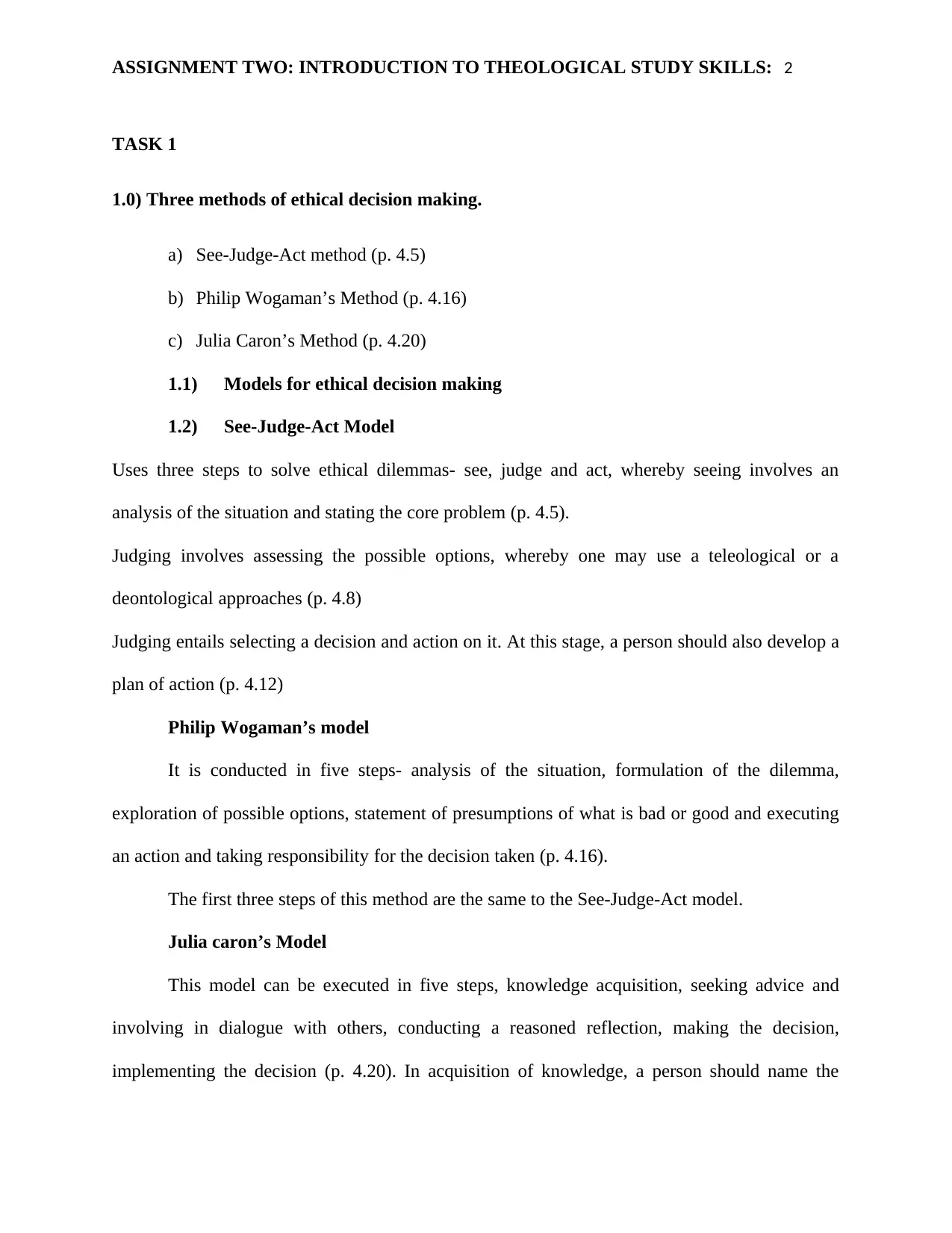
TASK 1
1.0) Three methods of ethical decision making.
a) See-Judge-Act method (p. 4.5)
b) Philip Wogaman’s Method (p. 4.16)
c) Julia Caron’s Method (p. 4.20)
1.1) Models for ethical decision making
1.2) See-Judge-Act Model
Uses three steps to solve ethical dilemmas- see, judge and act, whereby seeing involves an
analysis of the situation and stating the core problem (p. 4.5).
Judging involves assessing the possible options, whereby one may use a teleological or a
deontological approaches (p. 4.8)
Judging entails selecting a decision and action on it. At this stage, a person should also develop a
plan of action (p. 4.12)
Philip Wogaman’s model
It is conducted in five steps- analysis of the situation, formulation of the dilemma,
exploration of possible options, statement of presumptions of what is bad or good and executing
an action and taking responsibility for the decision taken (p. 4.16).
The first three steps of this method are the same to the See-Judge-Act model.
Julia caron’s Model
This model can be executed in five steps, knowledge acquisition, seeking advice and
involving in dialogue with others, conducting a reasoned reflection, making the decision,
implementing the decision (p. 4.20). In acquisition of knowledge, a person should name the
TASK 1
1.0) Three methods of ethical decision making.
a) See-Judge-Act method (p. 4.5)
b) Philip Wogaman’s Method (p. 4.16)
c) Julia Caron’s Method (p. 4.20)
1.1) Models for ethical decision making
1.2) See-Judge-Act Model
Uses three steps to solve ethical dilemmas- see, judge and act, whereby seeing involves an
analysis of the situation and stating the core problem (p. 4.5).
Judging involves assessing the possible options, whereby one may use a teleological or a
deontological approaches (p. 4.8)
Judging entails selecting a decision and action on it. At this stage, a person should also develop a
plan of action (p. 4.12)
Philip Wogaman’s model
It is conducted in five steps- analysis of the situation, formulation of the dilemma,
exploration of possible options, statement of presumptions of what is bad or good and executing
an action and taking responsibility for the decision taken (p. 4.16).
The first three steps of this method are the same to the See-Judge-Act model.
Julia caron’s Model
This model can be executed in five steps, knowledge acquisition, seeking advice and
involving in dialogue with others, conducting a reasoned reflection, making the decision,
implementing the decision (p. 4.20). In acquisition of knowledge, a person should name the

ASSIGNMENT TWO: INTRODUCTION TO THEOLOGICAL STUDY SKILLS: 3
ethical problem, gather the relevant facts about the problem, determine the motives and align the
values and evaluate the alternative options (p. 4.20)
1.3) Case study
1.3) a) See-Judge-Act Method
b) Summary
This method can be carried out in three primary steps- seeing, judging and acting on a
specific ethical dilemma (Carlson, 2016, p. 21). Seeing the problem entails analyzing the
situation and pinpointing the problem. At this stage, the problem-solver should begin by stating
the ethical problem and any other issues related to the problem, then find all the facts and
feelings relating to the issue and any other ethical norms and values (Mackin, 2012, p. 333). This
leads on to the second step- the Judge step where the problem-solver begins to assess the
different possible alternatives. At the Judge stage, a person should look at the advantages and
disadvantages of the available alternative options. The person should then reflect on the options
in light of the scriptures, church traditions experience and reason. The person may adopt
different ethical approaches like deontological or teleological approaches (West, 2013, p. 43).
The final step is Act. At this stage, the person should take a conscious decision and make a
decision on the course of action to take. Furthermore, the person needs to evaluate whether the
course of action is justified and able to work.
1.4) Solving the Problem Using See-Judge-Act model
Step 1: SEE
The central ethical problem: Should the student copy the information from the webpage
and send it to the marker as his/her own work or avoid copying it?
Other issues
ethical problem, gather the relevant facts about the problem, determine the motives and align the
values and evaluate the alternative options (p. 4.20)
1.3) Case study
1.3) a) See-Judge-Act Method
b) Summary
This method can be carried out in three primary steps- seeing, judging and acting on a
specific ethical dilemma (Carlson, 2016, p. 21). Seeing the problem entails analyzing the
situation and pinpointing the problem. At this stage, the problem-solver should begin by stating
the ethical problem and any other issues related to the problem, then find all the facts and
feelings relating to the issue and any other ethical norms and values (Mackin, 2012, p. 333). This
leads on to the second step- the Judge step where the problem-solver begins to assess the
different possible alternatives. At the Judge stage, a person should look at the advantages and
disadvantages of the available alternative options. The person should then reflect on the options
in light of the scriptures, church traditions experience and reason. The person may adopt
different ethical approaches like deontological or teleological approaches (West, 2013, p. 43).
The final step is Act. At this stage, the person should take a conscious decision and make a
decision on the course of action to take. Furthermore, the person needs to evaluate whether the
course of action is justified and able to work.
1.4) Solving the Problem Using See-Judge-Act model
Step 1: SEE
The central ethical problem: Should the student copy the information from the webpage
and send it to the marker as his/her own work or avoid copying it?
Other issues
⊘ This is a preview!⊘
Do you want full access?
Subscribe today to unlock all pages.

Trusted by 1+ million students worldwide
ASSIGNMENT TWO: INTRODUCTION TO THEOLOGICAL STUDY SKILLS: 4
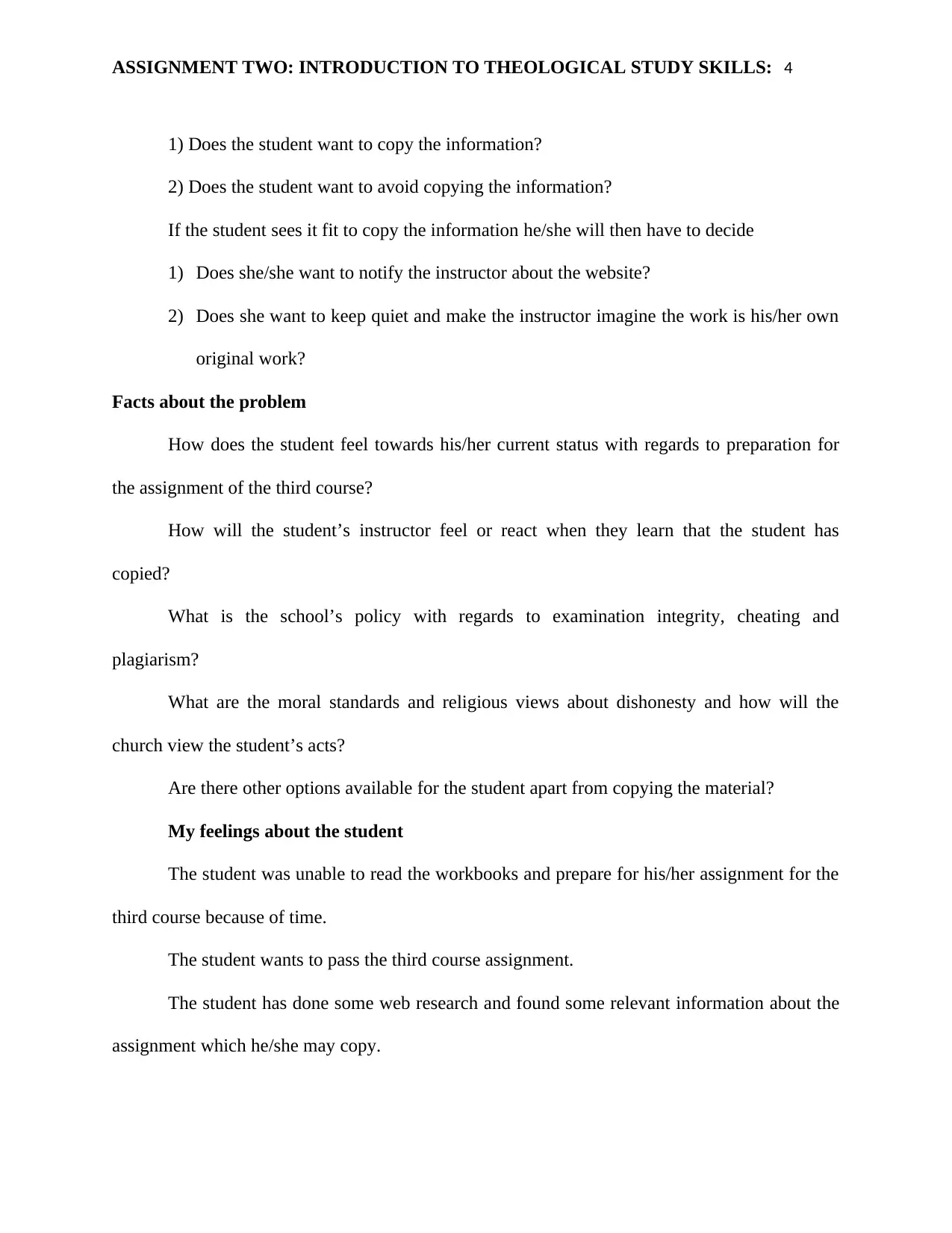
1) Does the student want to copy the information?
2) Does the student want to avoid copying the information?
If the student sees it fit to copy the information he/she will then have to decide
1) Does she/she want to notify the instructor about the website?
2) Does she want to keep quiet and make the instructor imagine the work is his/her own
original work?
Facts about the problem
How does the student feel towards his/her current status with regards to preparation for
the assignment of the third course?
How will the student’s instructor feel or react when they learn that the student has
copied?
What is the school’s policy with regards to examination integrity, cheating and
plagiarism?
What are the moral standards and religious views about dishonesty and how will the
church view the student’s acts?
Are there other options available for the student apart from copying the material?
My feelings about the student
The student was unable to read the workbooks and prepare for his/her assignment for the
third course because of time.
The student wants to pass the third course assignment.
The student has done some web research and found some relevant information about the
assignment which he/she may copy.
1) Does the student want to copy the information?
2) Does the student want to avoid copying the information?
If the student sees it fit to copy the information he/she will then have to decide
1) Does she/she want to notify the instructor about the website?
2) Does she want to keep quiet and make the instructor imagine the work is his/her own
original work?
Facts about the problem
How does the student feel towards his/her current status with regards to preparation for
the assignment of the third course?
How will the student’s instructor feel or react when they learn that the student has
copied?
What is the school’s policy with regards to examination integrity, cheating and
plagiarism?
What are the moral standards and religious views about dishonesty and how will the
church view the student’s acts?
Are there other options available for the student apart from copying the material?
My feelings about the student
The student was unable to read the workbooks and prepare for his/her assignment for the
third course because of time.
The student wants to pass the third course assignment.
The student has done some web research and found some relevant information about the
assignment which he/she may copy.
Paraphrase This Document
Need a fresh take? Get an instant paraphrase of this document with our AI Paraphraser
ASSIGNMENT TWO: INTRODUCTION TO THEOLOGICAL STUDY SKILLS: 5
What I do not know is how the teacher would react on learning that the student copied.
Perhaps, the teacher will be frustrated and take an action to punish the student.
Power dynamics in the situation
The student has power to control the situation by either copying or not copying the
material. The instructor also has power to punish the student upon realizing that he/she copied.
Possible options
To copy the material
To leave the material
If the student decides to copy the material, then:
1) The teacher may discover the activity and punish the student.
2) The teacher may not realize and the student passes the assignment.
If the student decides to leave the material then the student my:
1) Fail the assignment due to lack of preparation
2) Get low marks.
Step 2: JUDGE
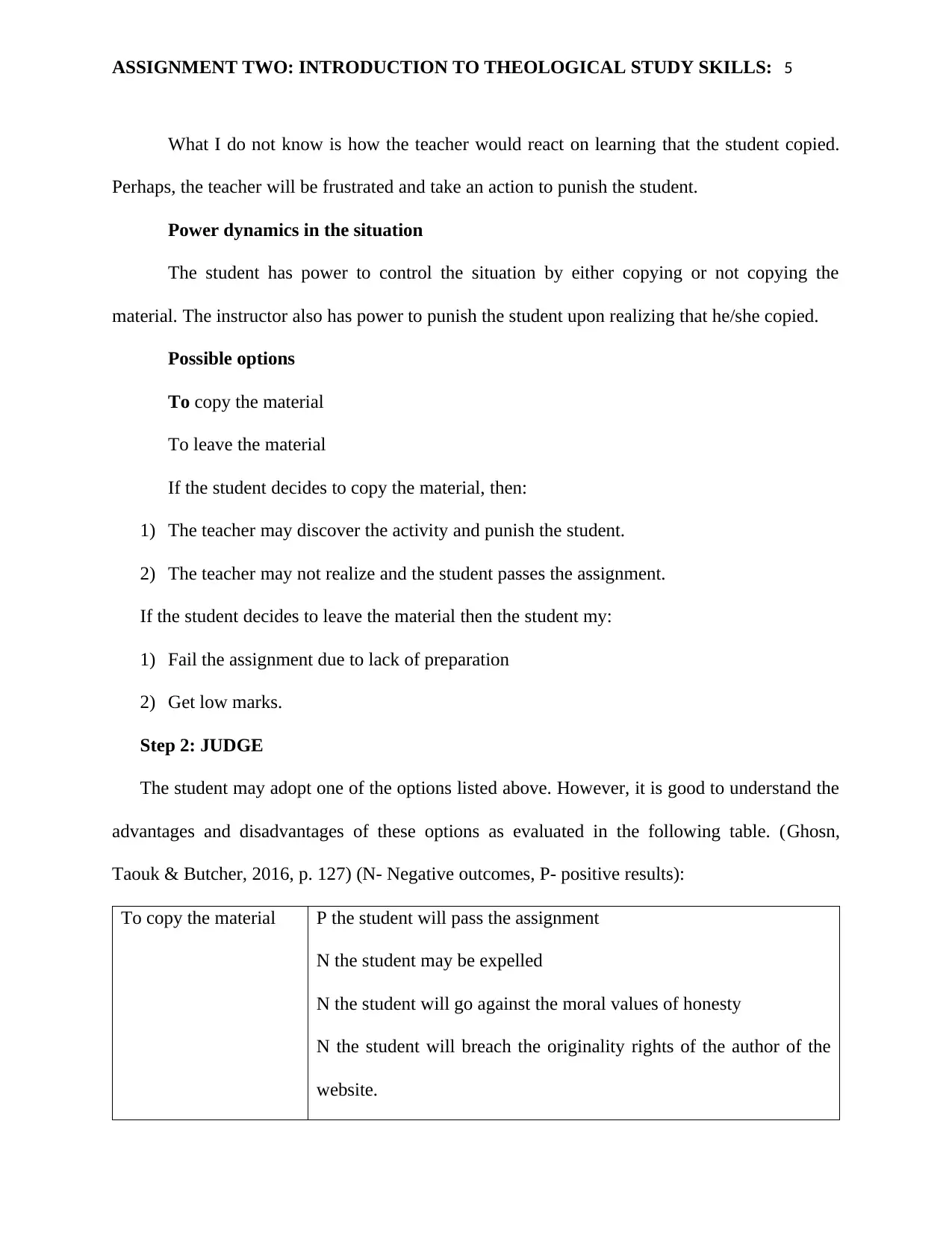
The student may adopt one of the options listed above. However, it is good to understand the
advantages and disadvantages of these options as evaluated in the following table. (Ghosn,
Taouk & Butcher, 2016, p. 127) (N- Negative outcomes, P- positive results):
To copy the material P the student will pass the assignment
N the student may be expelled
N the student will go against the moral values of honesty
N the student will breach the originality rights of the author of the
website.
What I do not know is how the teacher would react on learning that the student copied.
Perhaps, the teacher will be frustrated and take an action to punish the student.
Power dynamics in the situation
The student has power to control the situation by either copying or not copying the
material. The instructor also has power to punish the student upon realizing that he/she copied.
Possible options
To copy the material
To leave the material
If the student decides to copy the material, then:
1) The teacher may discover the activity and punish the student.
2) The teacher may not realize and the student passes the assignment.
If the student decides to leave the material then the student my:
1) Fail the assignment due to lack of preparation
2) Get low marks.
Step 2: JUDGE
The student may adopt one of the options listed above. However, it is good to understand the
advantages and disadvantages of these options as evaluated in the following table. (Ghosn,
Taouk & Butcher, 2016, p. 127) (N- Negative outcomes, P- positive results):
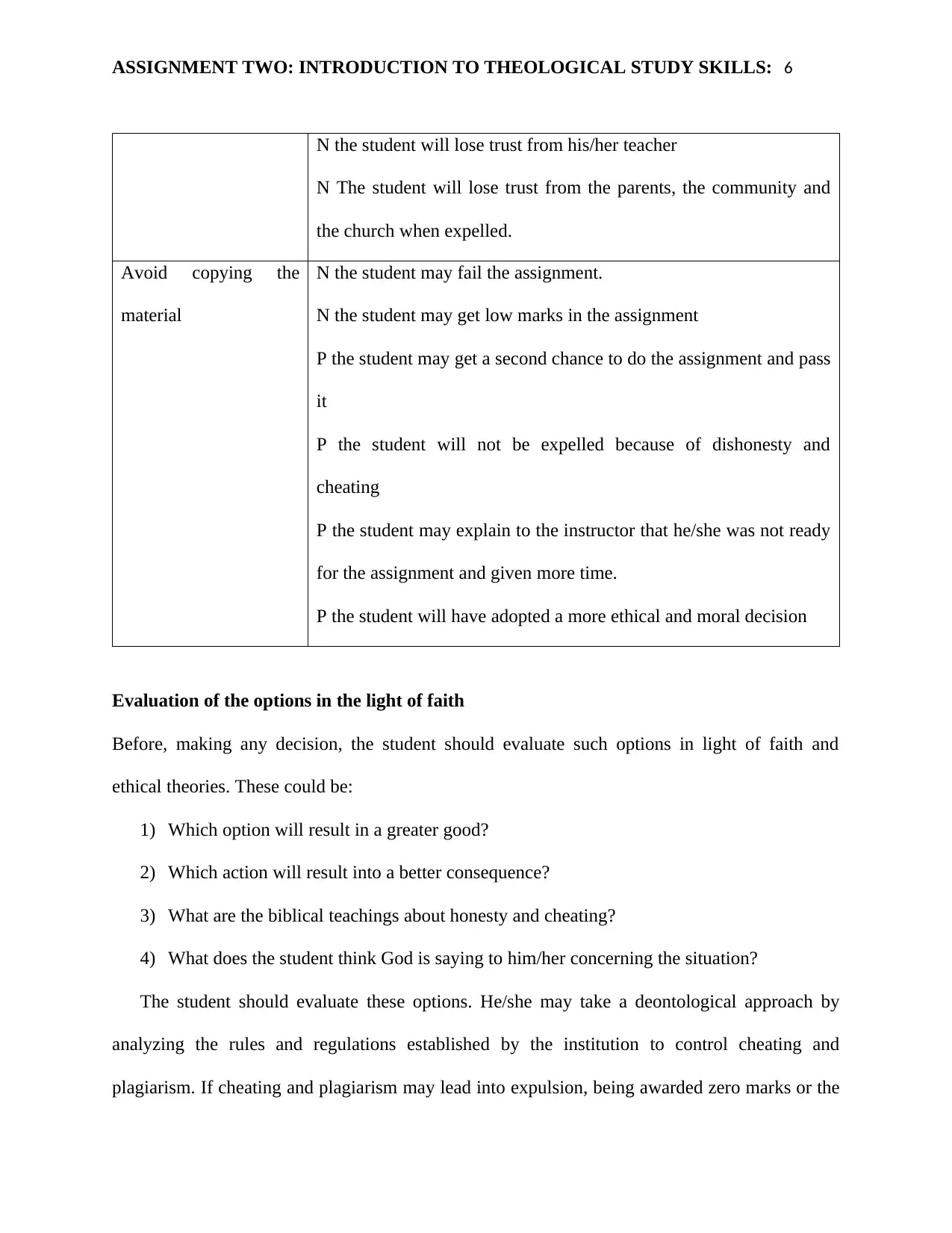
To copy the material P the student will pass the assignment
N the student may be expelled
N the student will go against the moral values of honesty
N the student will breach the originality rights of the author of the
website.
ASSIGNMENT TWO: INTRODUCTION TO THEOLOGICAL STUDY SKILLS: 6
N the student will lose trust from his/her teacher
N The student will lose trust from the parents, the community and
the church when expelled.
Avoid copying the
material
N the student may fail the assignment.
N the student may get low marks in the assignment
P the student may get a second chance to do the assignment and pass
it
P the student will not be expelled because of dishonesty and
cheating
P the student may explain to the instructor that he/she was not ready
for the assignment and given more time.
P the student will have adopted a more ethical and moral decision
Evaluation of the options in the light of faith
Before, making any decision, the student should evaluate such options in light of faith and
ethical theories. These could be:
1) Which option will result in a greater good?
2) Which action will result into a better consequence?
3) What are the biblical teachings about honesty and cheating?
4) What does the student think God is saying to him/her concerning the situation?
The student should evaluate these options. He/she may take a deontological approach by
analyzing the rules and regulations established by the institution to control cheating and
plagiarism. If cheating and plagiarism may lead into expulsion, being awarded zero marks or the
N the student will lose trust from his/her teacher
N The student will lose trust from the parents, the community and
the church when expelled.
Avoid copying the
material
N the student may fail the assignment.
N the student may get low marks in the assignment
P the student may get a second chance to do the assignment and pass
it
P the student will not be expelled because of dishonesty and
cheating
P the student may explain to the instructor that he/she was not ready
for the assignment and given more time.
P the student will have adopted a more ethical and moral decision
Evaluation of the options in the light of faith
Before, making any decision, the student should evaluate such options in light of faith and
ethical theories. These could be:
1) Which option will result in a greater good?
2) Which action will result into a better consequence?
3) What are the biblical teachings about honesty and cheating?
4) What does the student think God is saying to him/her concerning the situation?
The student should evaluate these options. He/she may take a deontological approach by
analyzing the rules and regulations established by the institution to control cheating and
plagiarism. If cheating and plagiarism may lead into expulsion, being awarded zero marks or the
⊘ This is a preview!⊘
Do you want full access?
Subscribe today to unlock all pages.
Trusted by 1+ million students worldwide
ASSIGNMENT TWO: INTRODUCTION TO THEOLOGICAL STUDY SKILLS: 7
assignment being cancelled, then she should avoid it in this light. She may also adopt a
teleological approach by looking at the consequences. If the consequences are negative, then
he/she should consider avoiding it.
When the student takes a teleological approach, then plagiarism and cheating in the
assignment may lead to his/her assignment being cancelled, getting zero or being expelled from
the institution. When the student takes a deontological approach, then dishonesty goes against
the requirements of the church and his/her religion. Therefore, the best option for the student is
to avoid copying the material.
Step 3: ACT
From the above step, the student decided to avoid copying from the webpage. He/she has
scored low marks in the assignment three and therefore, has not achieved the cut-off marks to
proceed to the next level. The parents are unhappy and the teacher feels annoyed. The student
feels traumatized as he/she sees his/her fellow students go to the next level.
In order to handle this situation, the student told his/her parents about failing in the
assignment and his/her inability to proceed to the next level. The student then went to school and
told his/her teacher about his/her willingness to repeat the unit. The student’s parents paid the
right fees for the student to repeat the unit. The student then registered for the unit, did all
assignments and qualified to proceed to the next level.
1.5) how the church would be like when the leaders consist of people who plagiarized,
cheated or copied exams.
When pastors and other spiritual leaders cheat in exams to obtain their academic
qualifications, then they may not be able to prepare sermons and conduct an organized worship
process in the church. Ideally, learning is not all about obtaining the certificates, but rather to
assignment being cancelled, then she should avoid it in this light. She may also adopt a
teleological approach by looking at the consequences. If the consequences are negative, then
he/she should consider avoiding it.
When the student takes a teleological approach, then plagiarism and cheating in the
assignment may lead to his/her assignment being cancelled, getting zero or being expelled from
the institution. When the student takes a deontological approach, then dishonesty goes against
the requirements of the church and his/her religion. Therefore, the best option for the student is
to avoid copying the material.
Step 3: ACT
From the above step, the student decided to avoid copying from the webpage. He/she has
scored low marks in the assignment three and therefore, has not achieved the cut-off marks to
proceed to the next level. The parents are unhappy and the teacher feels annoyed. The student
feels traumatized as he/she sees his/her fellow students go to the next level.
In order to handle this situation, the student told his/her parents about failing in the
assignment and his/her inability to proceed to the next level. The student then went to school and
told his/her teacher about his/her willingness to repeat the unit. The student’s parents paid the
right fees for the student to repeat the unit. The student then registered for the unit, did all
assignments and qualified to proceed to the next level.
1.5) how the church would be like when the leaders consist of people who plagiarized,
cheated or copied exams.
When pastors and other spiritual leaders cheat in exams to obtain their academic
qualifications, then they may not be able to prepare sermons and conduct an organized worship
process in the church. Ideally, learning is not all about obtaining the certificates, but rather to
Paraphrase This Document
Need a fresh take? Get an instant paraphrase of this document with our AI Paraphraser
ASSIGNMENT TWO: INTRODUCTION TO THEOLOGICAL STUDY SKILLS: 8
obtain the relevant competence to conduct religious duties. Therefore, the pastors who cheat in
exams will not be able to competently conduct their duties.
Furthermore, the religious leaders are responsible for offering counselling services to the
church members. Sometimes, a church member may experience a traumatizing situation which
may necessitate counselling. When the religious leaders have no genuine qualifications on
counseling’s matters, then they will not be able to offer such services. This may make them offer
inadequate services which may not have positive impacts on the members of the church.
Also, the church members and leaders should be aware of the moral and ethical
requirements regarding spiritual cleanliness. If the church leaders obtain their qualifications
unfairly, then they will have breached the biblical teachings about morality, ethics, and honesty.
Therefore, such pastors will not be able to teach their congregations concerning the moral
principles such as integrity, honesty, justice or fairness.
Last, through training, church leaders obtain primary leadership and church management
skills. If pastors and other church leaders do not focus on these trainings but instead involve in
corrupt means to get certificates, then they will be incompetent an unable guide the church
members, control the finances of the church, coordinate ministries and ensuring that the church
facilities are safe and in proper working conditions. This may lead to church failure, with some
members migrating to other churches. Therefore, it is critical that pastors and other church
leaders learn and fairly obtain their qualifications to properly lead and manage the church.
1.6) situations that may make me to be tempted to copy or plagiarize someone’s
work.
obtain the relevant competence to conduct religious duties. Therefore, the pastors who cheat in
exams will not be able to competently conduct their duties.
Furthermore, the religious leaders are responsible for offering counselling services to the
church members. Sometimes, a church member may experience a traumatizing situation which
may necessitate counselling. When the religious leaders have no genuine qualifications on
counseling’s matters, then they will not be able to offer such services. This may make them offer
inadequate services which may not have positive impacts on the members of the church.
Also, the church members and leaders should be aware of the moral and ethical
requirements regarding spiritual cleanliness. If the church leaders obtain their qualifications
unfairly, then they will have breached the biblical teachings about morality, ethics, and honesty.
Therefore, such pastors will not be able to teach their congregations concerning the moral
principles such as integrity, honesty, justice or fairness.
Last, through training, church leaders obtain primary leadership and church management
skills. If pastors and other church leaders do not focus on these trainings but instead involve in
corrupt means to get certificates, then they will be incompetent an unable guide the church
members, control the finances of the church, coordinate ministries and ensuring that the church
facilities are safe and in proper working conditions. This may lead to church failure, with some
members migrating to other churches. Therefore, it is critical that pastors and other church
leaders learn and fairly obtain their qualifications to properly lead and manage the church.
1.6) situations that may make me to be tempted to copy or plagiarize someone’s
work.
ASSIGNMENT TWO: INTRODUCTION TO THEOLOGICAL STUDY SKILLS: 9
Plagiarism may be defined as a situation whereby a student deliberately or unwillingly
copies someone’s work and publishes it as his/her own. Some situations that may necessitate
plagiarism may include:
Poor time management and organizational skills: Some students may lack time
management and organizational skills required to complete a research paper that may seem large.
They can therefore become overwhelmed with the task and start procrastinating, which may lead
to panicking and copy-pasting in the last minute.
Student’s ethics and relationship with the learning institution: Some students regard
getting high grades as the ultimate goal of education. Therefore, any behavior which may result
into good grades may be viewed by them as appropriate. Hence, they may resort to cheating in
exams as one of the strategies to get high grades in exams.
Commodification and education and knowledge: The market and business models, as
well as the consumer mentality, may make the students view education as a commodity. Ideally,
there has been a migration from viewing education as a way of learning to view education as a
way of fulfilling career aspirations. Therefore, some student s expect to pay their fees and
navigate through post-secondary learning using unfair means like cheating and copy-pasting in
an attempt to gain professional qualifications in different fields
1.7) whether there will be a situation which will make it ethically acceptable to
cheat.
According to me, there is no single situation whereby it can be ethically acceptable to
cheat. From the case study, it can be derived that the student did not prepare well for the
assignment and that is why he/she searched the internet for information. Also, before any exams
are given, students are usually given enough time to learn and revise. At the beginning of every
Plagiarism may be defined as a situation whereby a student deliberately or unwillingly
copies someone’s work and publishes it as his/her own. Some situations that may necessitate
plagiarism may include:
Poor time management and organizational skills: Some students may lack time
management and organizational skills required to complete a research paper that may seem large.
They can therefore become overwhelmed with the task and start procrastinating, which may lead
to panicking and copy-pasting in the last minute.
Student’s ethics and relationship with the learning institution: Some students regard
getting high grades as the ultimate goal of education. Therefore, any behavior which may result
into good grades may be viewed by them as appropriate. Hence, they may resort to cheating in
exams as one of the strategies to get high grades in exams.
Commodification and education and knowledge: The market and business models, as
well as the consumer mentality, may make the students view education as a commodity. Ideally,
there has been a migration from viewing education as a way of learning to view education as a
way of fulfilling career aspirations. Therefore, some student s expect to pay their fees and
navigate through post-secondary learning using unfair means like cheating and copy-pasting in
an attempt to gain professional qualifications in different fields
1.7) whether there will be a situation which will make it ethically acceptable to
cheat.
According to me, there is no single situation whereby it can be ethically acceptable to
cheat. From the case study, it can be derived that the student did not prepare well for the
assignment and that is why he/she searched the internet for information. Also, before any exams
are given, students are usually given enough time to learn and revise. At the beginning of every
⊘ This is a preview!⊘
Do you want full access?
Subscribe today to unlock all pages.
Trusted by 1+ million students worldwide
ASSIGNMENT TWO: INTRODUCTION TO THEOLOGICAL STUDY SKILLS: 10
semester, the students are always supplied with course outlines and the course requirements so
that they can prepare well for the assignments.
To evaluate whether it may be acceptable to cheat in exams in some situations, one could
use a deontological or teleological approach (Dierksmeier, 2013, p. 497). Using the
deontological approach, there are always rules and regulations given that control plagiarism and
cheating in exams. Therefore, when a student cheats, then he/she would go against these rules.
Using teleological approach, cheating may make the student incompetent in the job market, get
expelled from school or get low marks due to plagiarism.
According to the study text, a person should also ask what God says about his/her actions
before doing them (p. 4.12). For example before cheating, one should know what the scriptures
says about honesty, integrity and justice. By cheating and passing exams, it would be unjust to
other students who will not have cheated. Cheating is not only immoral, but also unethical and
therefore, should totally be avoided regardless of the circumstances.
TASK 2
2.1) six thinking Hats: Colors
Blue, White, Red, Black, Yellow, and Green
2.2) summary
Blue Hat
This is coordinating hat. Most of the times, it is won by the chairpersons in meetings to
think of a situation, organize it and plan for an appropriate action. (Gregory & Masters, 2012, p.
15). At the end of an analysis, a person also needs to put back a blue hat to reflect whether the
solution was appropriate.
semester, the students are always supplied with course outlines and the course requirements so
that they can prepare well for the assignments.
To evaluate whether it may be acceptable to cheat in exams in some situations, one could
use a deontological or teleological approach (Dierksmeier, 2013, p. 497). Using the
deontological approach, there are always rules and regulations given that control plagiarism and
cheating in exams. Therefore, when a student cheats, then he/she would go against these rules.
Using teleological approach, cheating may make the student incompetent in the job market, get
expelled from school or get low marks due to plagiarism.
According to the study text, a person should also ask what God says about his/her actions
before doing them (p. 4.12). For example before cheating, one should know what the scriptures
says about honesty, integrity and justice. By cheating and passing exams, it would be unjust to
other students who will not have cheated. Cheating is not only immoral, but also unethical and
therefore, should totally be avoided regardless of the circumstances.
TASK 2
2.1) six thinking Hats: Colors
Blue, White, Red, Black, Yellow, and Green
2.2) summary
Blue Hat
This is coordinating hat. Most of the times, it is won by the chairpersons in meetings to
think of a situation, organize it and plan for an appropriate action. (Gregory & Masters, 2012, p.
15). At the end of an analysis, a person also needs to put back a blue hat to reflect whether the
solution was appropriate.
Paraphrase This Document
Need a fresh take? Get an instant paraphrase of this document with our AI Paraphraser
ASSIGNMENT TWO: INTRODUCTION TO THEOLOGICAL STUDY SKILLS: 11
White Hat
This is an unemotional hat. A person who wears this hat focuses on the facts and
knowledge of a situation only and not any presumptions (Vernon & Hocking, 2014, p. 41). It
enables one to be neutral and objective and analyze a situation based on the historical data and
current information available.
Red Hat
This is the instinctive and emotional hat. A person who wears this hat looks at a problem
with gut reaction, emotion and intuition (Kivunja, 2015, p. 380). A red hat does not look into the
details of a situation, but rather may focus on the key points then evaluate how a situation makes
somebody feel.
Black Hat
This is the hat of caution and judgment. It is usually a logical hat which focuses on
safety. Furthermore, it can spot risks, dangers and difficulties associated with some specific
decisions, policies and objectives and caution the people involved (Dierksmeier, 2013, p. 5).
Therefore, it is regarded as the most precious hat.
Yellow Hat
This hat is usually bright and sunny. It helps people in thinking positively about
situations. A person with a yellow hat concentrates on the positives, rather than the negatives of a
situation, and is able to give logical reasons on why an idea may be considered useful (Smith &
Cook, 2012, p. 8).
Green Hat
This is the creativity hat. It focuses on developing a creative solution to a problem.
Wearing this hat enables a person to avoid questioning the advantages and disadvantages of a
White Hat
This is an unemotional hat. A person who wears this hat focuses on the facts and
knowledge of a situation only and not any presumptions (Vernon & Hocking, 2014, p. 41). It
enables one to be neutral and objective and analyze a situation based on the historical data and
current information available.
Red Hat
This is the instinctive and emotional hat. A person who wears this hat looks at a problem
with gut reaction, emotion and intuition (Kivunja, 2015, p. 380). A red hat does not look into the
details of a situation, but rather may focus on the key points then evaluate how a situation makes
somebody feel.
Black Hat
This is the hat of caution and judgment. It is usually a logical hat which focuses on
safety. Furthermore, it can spot risks, dangers and difficulties associated with some specific
decisions, policies and objectives and caution the people involved (Dierksmeier, 2013, p. 5).
Therefore, it is regarded as the most precious hat.
Yellow Hat
This hat is usually bright and sunny. It helps people in thinking positively about
situations. A person with a yellow hat concentrates on the positives, rather than the negatives of a
situation, and is able to give logical reasons on why an idea may be considered useful (Smith &
Cook, 2012, p. 8).
Green Hat
This is the creativity hat. It focuses on developing a creative solution to a problem.
Wearing this hat enables a person to avoid questioning the advantages and disadvantages of a
ASSIGNMENT TWO: INTRODUCTION TO THEOLOGICAL STUDY SKILLS: 12
decision, but develop an innovative and creative solution for that specific problem by evaluating
the alternative possibilities (Serrat, 2017, p. 615). It provides solutions to the Black Hat
problems.
2.3) how the Six Thinking Hats can be used to process new information.
In an organization, leaders are often prompted to make several decisions which may be
operational, competitive or strategic. To make such decisions, the six thinking Hats, created by
Edward de Bono may serve as useful tools (Burciu & Hapenciuc, 2010, p. 152). This essay seeks
to evaluate the role of each of the six thinking hats developed by Bono in information
processing:
In information processing, the blue hat outlines and defines the problem in question. It
works to gather more information about the problem and then guides other five hats throughout
the decision-making process (Cassim, 2013, p. 190). Besides, the white hat gathers all the
statistics and data regarding the problem or information being processed. It then utilizes the
information gathered to derive several logical solutions to the problem in question.
Sheth (2012, p. 449) explains that the red hat then uses intuition to reflect on the
information processed or on the solutions arrived at. After evaluating the solution, it selects the
most appropriate course of action to be adopted. On the other hand, the black hat quickly
identifies the dangers, flaws, limitations or the wholes of a proposed plan.
The yellow hat challenges the pessimism of the black hat by developing logical solutions
and contingency plans to address the dangers pinpointed (Kohls, 2012, p. 3). Lastly, the green
hat takes the developed ideas and improves them using its creative and out-of-the-box thinking
capability. After all the thinking hats have been explored, the blue hat then continues to
transition between the five hats in a formalized order.
decision, but develop an innovative and creative solution for that specific problem by evaluating
the alternative possibilities (Serrat, 2017, p. 615). It provides solutions to the Black Hat
problems.
2.3) how the Six Thinking Hats can be used to process new information.
In an organization, leaders are often prompted to make several decisions which may be
operational, competitive or strategic. To make such decisions, the six thinking Hats, created by
Edward de Bono may serve as useful tools (Burciu & Hapenciuc, 2010, p. 152). This essay seeks
to evaluate the role of each of the six thinking hats developed by Bono in information
processing:
In information processing, the blue hat outlines and defines the problem in question. It
works to gather more information about the problem and then guides other five hats throughout
the decision-making process (Cassim, 2013, p. 190). Besides, the white hat gathers all the
statistics and data regarding the problem or information being processed. It then utilizes the
information gathered to derive several logical solutions to the problem in question.
Sheth (2012, p. 449) explains that the red hat then uses intuition to reflect on the
information processed or on the solutions arrived at. After evaluating the solution, it selects the
most appropriate course of action to be adopted. On the other hand, the black hat quickly
identifies the dangers, flaws, limitations or the wholes of a proposed plan.
The yellow hat challenges the pessimism of the black hat by developing logical solutions
and contingency plans to address the dangers pinpointed (Kohls, 2012, p. 3). Lastly, the green
hat takes the developed ideas and improves them using its creative and out-of-the-box thinking
capability. After all the thinking hats have been explored, the blue hat then continues to
transition between the five hats in a formalized order.
⊘ This is a preview!⊘
Do you want full access?
Subscribe today to unlock all pages.
Trusted by 1+ million students worldwide

1 out of 24


Your All-in-One AI-Powered Toolkit for Academic Success.
+13062052269
info@desklib.com
Available 24*7 on WhatsApp / Email
![[object Object]](/_next/static/media/star-bottom.7253800d.svg)
Unlock your academic potential
Copyright © 2020–2026 A2Z Services. All Rights Reserved. Developed and managed by ZUCOL.