Mental Health Nursing: Analysis of Bundy's Psychiatric Basis

Verified

Added on  2022/09/12

|3
|657
|31
Report
AI Summary
This report provides a comprehensive analysis of Theodore Robert Bundy's case within the context of psychiatric nursing. The analysis begins with an examination of Bundy's biographical note, highlighting his criminal activities and the author's portrayal of his actions. It then explores the application of two key theoretical frameworks: Social Attachment Theory and Spiritual Theory, to understand Bundy's psychological development and potential contributing factors to his behavior. The report further identifies ten psychiatric nursing problems, based on NANDA references, prioritizing them based on the potential risk to the patient or others. The report delves into a detailed exploration of Bundy's case, applying psychiatric nursing theories and NANDA diagnoses, offering valuable insights into the complexities of his psychological profile and the implications for nursing practice.
Document Page
Running head: MENTAL HEALTH NURSING 1
Theoretical Basis of Psychiatric Nursing Practice
Name of Student
Institution
tabler-icon-diamond-filled.svg

Paraphrase This Document

Need a fresh take? Get an instant paraphrase of this document with our AI Paraphraser
Document Page
MENTAL HEALTH NURSING 2
Theoretical Basis of Psychiatric Nursing Practice
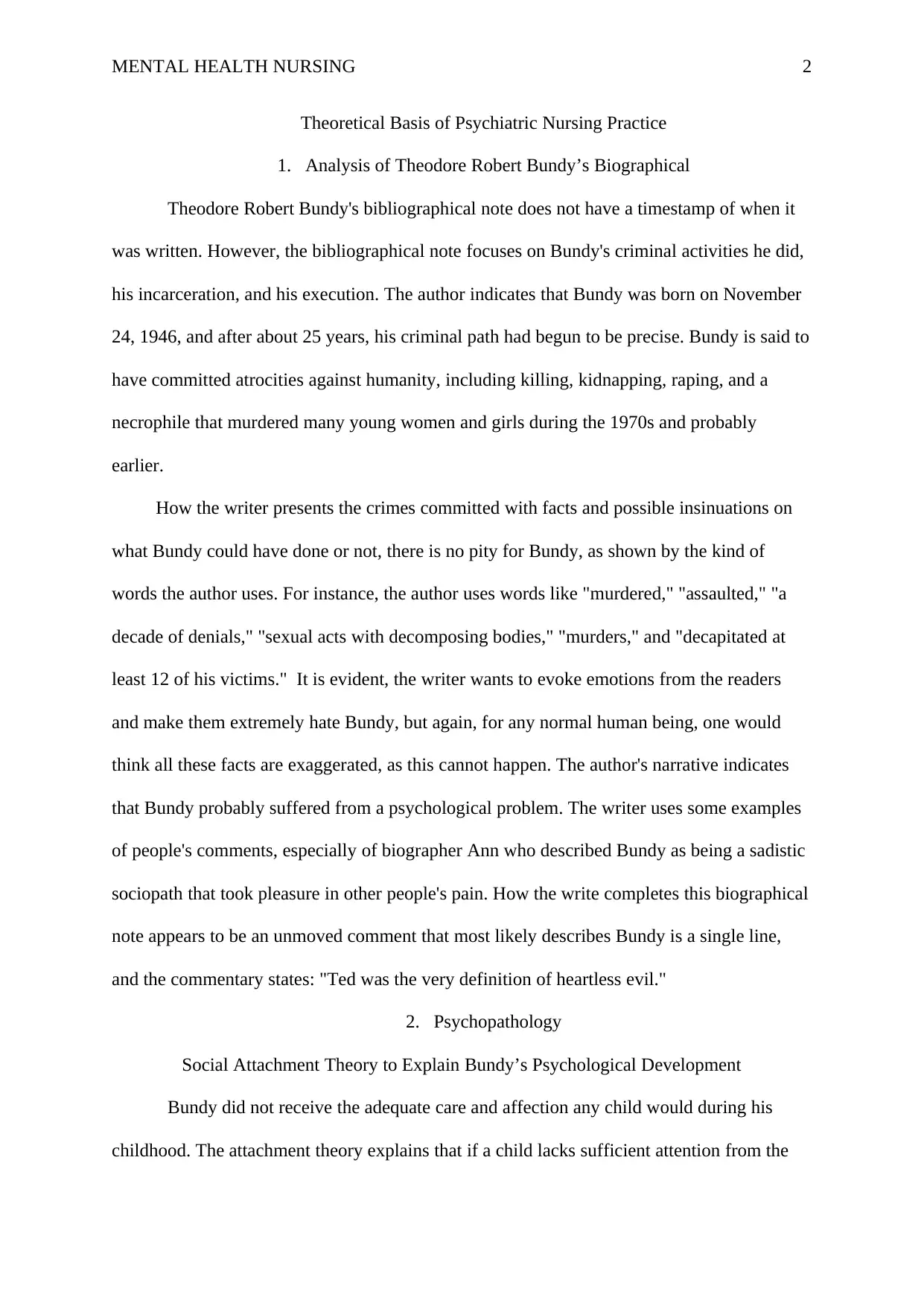
1. Analysis of Theodore Robert Bundy’s Biographical
Theodore Robert Bundy's bibliographical note does not have a timestamp of when it
was written. However, the bibliographical note focuses on Bundy's criminal activities he did,
his incarceration, and his execution. The author indicates that Bundy was born on November
24, 1946, and after about 25 years, his criminal path had begun to be precise. Bundy is said to
have committed atrocities against humanity, including killing, kidnapping, raping, and a
necrophile that murdered many young women and girls during the 1970s and probably
earlier.
How the writer presents the crimes committed with facts and possible insinuations on
what Bundy could have done or not, there is no pity for Bundy, as shown by the kind of
words the author uses. For instance, the author uses words like "murdered," "assaulted," "a
decade of denials," "sexual acts with decomposing bodies," "murders," and "decapitated at
least 12 of his victims." It is evident, the writer wants to evoke emotions from the readers
and make them extremely hate Bundy, but again, for any normal human being, one would
think all these facts are exaggerated, as this cannot happen. The author's narrative indicates
that Bundy probably suffered from a psychological problem. The writer uses some examples
of people's comments, especially of biographer Ann who described Bundy as being a sadistic
sociopath that took pleasure in other people's pain. How the write completes this biographical
note appears to be an unmoved comment that most likely describes Bundy is a single line,
and the commentary states: "Ted was the very definition of heartless evil."
2. Psychopathology
Social Attachment Theory to Explain Bundy’s Psychological Development
Bundy did not receive the adequate care and affection any child would during his
childhood. The attachment theory explains that if a child lacks sufficient attention from the
Document Page
MENTAL HEALTH NURSING 3
parents, the child is likely to have a difficult time interacting with others. He must have
developed personality deficiencies, and a negative attachment depiction that made him lack
empathy has to mistrust, have superficial charm and avoid intimate situations. For example,
he seemed to be social with people, but this association was a camouflage to lure his victims.
He might have developed an anti-social personality disorder that made him a sex offender.
Spiritual Theory to Explain Bundy’s Psychological Development
Spiritual understandings of Bundy’s behavior can apply, had there been no other way
to explain crime. Each time Ted wanted to commit a crime; he would take alcohol to shut off
his conscience as well as humanity within him. He was described as the very definition of a
heartless evil. This description, somehow, delineates his inhumane acts.
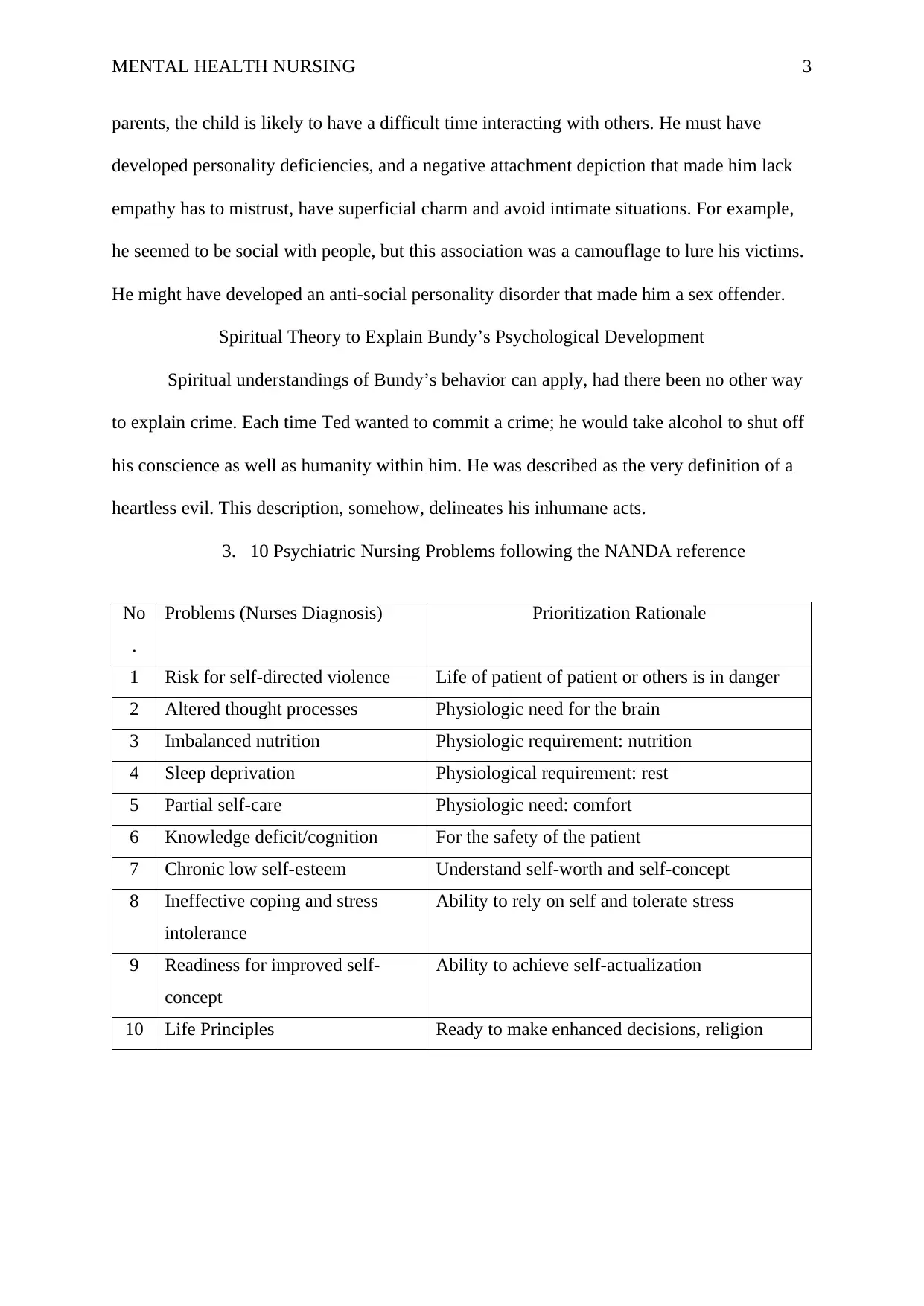
3. 10 Psychiatric Nursing Problems following the NANDA reference
No
.
Problems (Nurses Diagnosis) Prioritization Rationale
1 Risk for self-directed violence Life of patient of patient or others is in danger
2 Altered thought processes Physiologic need for the brain
3 Imbalanced nutrition Physiologic requirement: nutrition
4 Sleep deprivation Physiological requirement: rest
5 Partial self-care Physiologic need: comfort
6 Knowledge deficit/cognition For the safety of the patient
7 Chronic low self-esteem Understand self-worth and self-concept
8 Ineffective coping and stress
intolerance
Ability to rely on self and tolerate stress
9 Readiness for improved self-
concept
Ability to achieve self-actualization
10 Life Principles Ready to make enhanced decisions, religion
chevron_up_icon
1 out of 3
circle_padding
hide_on_mobile
zoom_out_icon
[object Object]