Analysis of Theories, Principles, and Models in E&T: A Report
VerifiedAdded on 2020/01/23
|30
|10562
|324
Report
AI Summary
This report delves into the application of various theories, principles, and models within the realm of education and training. It commences with an analysis of reflective models, particularly focusing on Gibbs' reflective model, and explores how these models can be utilized to review and enhance teaching practices. The report then transitions to a discussion of learning theories, models of learning preferences, and methods to apply these theories to create inclusive teaching strategies and assessment techniques. Further, it includes an analysis of communication theories, curriculum development, and theories and models of assessment, with examples of completed student assessments. The report also includes an evaluation of the author's personal experiences in assessing and teaching, alongside an action plan for future improvements. Overall, the report aims to provide a comprehensive understanding of the theoretical underpinnings of effective education and training methodologies.
Theories, Principles and
Models in E & T
Models in E & T

Paraphrase This Document
Need a fresh take? Get an instant paraphrase of this document with our AI Paraphraser
TABLE OF CONTENTS
INTRODUCTION ..........................................................................................................................3
TASK 1............................................................................................................................................3
A. Analysis of theories and models of reflection and evaluation................................................3
B. Theories and model of reflection can be applied to reviewing of own practice.....................5
Task 2 ..............................................................................................................................................7
LO1.1 Theories, principles and Models of learning ...................................................................7
Models of learning.....................................................................................................................10
LO1.3 Models of learning preferences by various types of learners.........................................10
LO1.2 Methods to apply theories, principles and models.........................................................11
LO1.4 Learning preferences enabling Inclusive Teaching Strategies and assessment..............13
Task 3: ...........................................................................................................................................16
A. This part is covered in PowerPoint presentation ..................................................................16
B. Analysis of theories principles and models of communication.............................................16
TASK 4..........................................................................................................................................19
A. Investigating theories, principles and models of assessment ...............................................19
B. Providing 3 completed student assessment...........................................................................21
C. Evaluation what is learnt from own experience of assessing...............................................22
TASK 5..........................................................................................................................................22
A. Analysis of theories and models of curriculum development ..............................................22
B. Manner in which theories as well as models of curriculum development can be employed 27
CONCLUSION .............................................................................................................................28
REFERENCES .............................................................................................................................29
INTRODUCTION ..........................................................................................................................3
TASK 1............................................................................................................................................3
A. Analysis of theories and models of reflection and evaluation................................................3
B. Theories and model of reflection can be applied to reviewing of own practice.....................5
Task 2 ..............................................................................................................................................7
LO1.1 Theories, principles and Models of learning ...................................................................7
Models of learning.....................................................................................................................10
LO1.3 Models of learning preferences by various types of learners.........................................10
LO1.2 Methods to apply theories, principles and models.........................................................11
LO1.4 Learning preferences enabling Inclusive Teaching Strategies and assessment..............13
Task 3: ...........................................................................................................................................16
A. This part is covered in PowerPoint presentation ..................................................................16
B. Analysis of theories principles and models of communication.............................................16
TASK 4..........................................................................................................................................19
A. Investigating theories, principles and models of assessment ...............................................19
B. Providing 3 completed student assessment...........................................................................21
C. Evaluation what is learnt from own experience of assessing...............................................22
TASK 5..........................................................................................................................................22
A. Analysis of theories and models of curriculum development ..............................................22
B. Manner in which theories as well as models of curriculum development can be employed 27
CONCLUSION .............................................................................................................................28
REFERENCES .............................................................................................................................29
INTRODUCTION
In the present era in order to develop greater understanding understanding among the
students with respect to particular subject the role of teaching models and theories is of greater
importance. With the implementation of such students can be provided with quality knowledge
that can assist them in building their future to a greater extent. With the assessment of teaching
methodology the performance of the teachers can be enhanced. Further there is importance of
curriculum development and also various aspect needs to be considered. The present study
reflects the theories, principles and models in Education and Training.
TASK 1
A. Analysis of theories and models of reflection and evaluation
Gibbs' reflective model:-
Gibbs reflective model is a popular model of reflection. 6 steps of this model reflection is
below
Description:- According this model you need to explain what you are reflecting on to
your reader or followers. including your background information, most important fact is
what you are reflect on and express reader who was involved in the process. It is
important to keep correct information and relevant to the reader. Only use valuable words
or about details that are required for the subjects and reduce the invaluable writing in the
description for minimal marks.
Feelings:-Describe your feeling and thought about your experience. Discuss such
question about your Experience for the interest of the reader like how did you feel at the
time ? What you think at the time? . Discus all the emotions and honesty or real fact
reduce and reduce the negative think for reader. Make sure at all the time this is an
academic piece of writing, o not us the chat and abuse language.
Evaluation:- Evaluation is the very important part of any situation think thing went.
Possibly think about how did you react about the situation and also analysis how did
other people react ? Think about the experience good or bad a per the reaction of other
people. Also thing about you are writing if any difficulties than the situation was resolved
afterwards. This section of Gibbs model include other author experience and share other
In the present era in order to develop greater understanding understanding among the
students with respect to particular subject the role of teaching models and theories is of greater
importance. With the implementation of such students can be provided with quality knowledge
that can assist them in building their future to a greater extent. With the assessment of teaching
methodology the performance of the teachers can be enhanced. Further there is importance of
curriculum development and also various aspect needs to be considered. The present study
reflects the theories, principles and models in Education and Training.
TASK 1
A. Analysis of theories and models of reflection and evaluation
Gibbs' reflective model:-
Gibbs reflective model is a popular model of reflection. 6 steps of this model reflection is
below
Description:- According this model you need to explain what you are reflecting on to
your reader or followers. including your background information, most important fact is
what you are reflect on and express reader who was involved in the process. It is
important to keep correct information and relevant to the reader. Only use valuable words
or about details that are required for the subjects and reduce the invaluable writing in the
description for minimal marks.
Feelings:-Describe your feeling and thought about your experience. Discuss such
question about your Experience for the interest of the reader like how did you feel at the
time ? What you think at the time? . Discus all the emotions and honesty or real fact
reduce and reduce the negative think for reader. Make sure at all the time this is an
academic piece of writing, o not us the chat and abuse language.
Evaluation:- Evaluation is the very important part of any situation think thing went.
Possibly think about how did you react about the situation and also analysis how did
other people react ? Think about the experience good or bad a per the reaction of other
people. Also thing about you are writing if any difficulties than the situation was resolved
afterwards. This section of Gibbs model include other author experience and share other
⊘ This is a preview!⊘
Do you want full access?
Subscribe today to unlock all pages.

Trusted by 1+ million students worldwide
author experience. Remembers it is important to include reference in reflecting writing.
Evaluation is important tools of every models and through evaluation define all the
thought and experience to reader and clear the mistakes.
Analysis:- In analysis consider what might have helped or hindered the event. According
analysis author compare between Experience with the literature you have read. This
section of Gibbs models is very important particularly for higher level writing. Many
student received minimum marks for reflective assignments for gaining knowledge about
the theory and models together.
Conclusion:-in your conclusion it is very important to acknowledge what you done and
which types of correction you find in the reflection. What you have learned from the
experience. Discus you about your positive experience than again to ensure a positive out
also consider. Anything change to improve the things even further. If any negative things
than tell to your reader how you could have avoided it happening a also how you could
make sure it does not happen in the future. How you manage all things clear and mention
how you react on all the things of there mistakes and solution.
Action plan:- Action plan is the analysis or forecasting of the future changes or
improvement for next time. In other Action plan is real practices of finding the solution
of a specific problems and learn how to solve the problem more specific about something
or attend some training . What can you do which means you will be better equipment to
make the correspondent event. Various other factor you find in the event for the
improvement and reduce the problem for next time and improve the event with minimum
mistakes.
Theory of Reflection:-
The ABC model of reflection, this model identify and define three ways of the student
can reflect on their service experience. All three model of Reflection are below:-
Affective:- Student express their thought and emotion and put into their experience.
General thing of student are '' I think ….'' and '' I feel that they are the general thing of the
student. Example:- last time in visit in west I feel much more welcome than the first.
Means that the affective nature or behaviour is good for every place and time for the
Evaluation is important tools of every models and through evaluation define all the
thought and experience to reader and clear the mistakes.
Analysis:- In analysis consider what might have helped or hindered the event. According
analysis author compare between Experience with the literature you have read. This
section of Gibbs models is very important particularly for higher level writing. Many
student received minimum marks for reflective assignments for gaining knowledge about
the theory and models together.
Conclusion:-in your conclusion it is very important to acknowledge what you done and
which types of correction you find in the reflection. What you have learned from the
experience. Discus you about your positive experience than again to ensure a positive out
also consider. Anything change to improve the things even further. If any negative things
than tell to your reader how you could have avoided it happening a also how you could
make sure it does not happen in the future. How you manage all things clear and mention
how you react on all the things of there mistakes and solution.
Action plan:- Action plan is the analysis or forecasting of the future changes or
improvement for next time. In other Action plan is real practices of finding the solution
of a specific problems and learn how to solve the problem more specific about something
or attend some training . What can you do which means you will be better equipment to
make the correspondent event. Various other factor you find in the event for the
improvement and reduce the problem for next time and improve the event with minimum
mistakes.
Theory of Reflection:-
The ABC model of reflection, this model identify and define three ways of the student
can reflect on their service experience. All three model of Reflection are below:-
Affective:- Student express their thought and emotion and put into their experience.
General thing of student are '' I think ….'' and '' I feel that they are the general thing of the
student. Example:- last time in visit in west I feel much more welcome than the first.
Means that the affective nature or behaviour is good for every place and time for the
Paraphrase This Document
Need a fresh take? Get an instant paraphrase of this document with our AI Paraphraser
relationship between the student and the faculty for better understanding of
communication.
Behavioural:- student examine their behaviour is very impor9tant thing for success in
life and also for growing in future for gaining knowledge and experience . Behavioural
reflection will generally include phrases like'' I feel that responded that way because ''
and'' I was nervous because. Example:-last time behavioural analysis with student for
respondents and justification the research on behalf of the wok identification and others
factor also consider for perception of student behaviour for the research and reduce the
mistakes of students. Behavioural are considered for every aspect of life cycle of human
being.
Cognitive:- Student link their education to course content and design bring up back to
theories or text example when discus their service. Implement and reduce various
reflection in a cognitive context will generally include the real fact and sources of the
work for Behavior analysis. The ABC of reflection is a model for the student interesting
to implement written reflection in experience and service.
B. Theories and model of reflection can be applied to reviewing of own practice
Description:- I am currently on a teaching practice in an primary school for improving
the levels of the school and improvement in maths results . Learning how to teach CBSC
maths to various group of student. I am assisting the class work and have just start
planing and delivering a small part of each lesson to students . For good maths
knowledge and improvement in their results and my task was to continue wit this
instruction looking specifically at how to multiply two fraction .when I was due to teach
the session , I got to the whiteboard and become so nervous that I conflict to speak to the
group . I felt my self visibly shaking and was unable to fluent my first sentence
coherently. All the student are asking question and how to interpret the value in the
question for finding the answer of the particular question. I am new in the school ti
teaching and am nervous , but the student who are aware that the topic or lesion. I left the
session an soon as the class was over and did not speak to anyone. So I feel nervousness
and I think more prepare about lesson than going into school for teaching with the more
preparation and increase the level of confidence and reduce the stage fear.
communication.
Behavioural:- student examine their behaviour is very impor9tant thing for success in
life and also for growing in future for gaining knowledge and experience . Behavioural
reflection will generally include phrases like'' I feel that responded that way because ''
and'' I was nervous because. Example:-last time behavioural analysis with student for
respondents and justification the research on behalf of the wok identification and others
factor also consider for perception of student behaviour for the research and reduce the
mistakes of students. Behavioural are considered for every aspect of life cycle of human
being.
Cognitive:- Student link their education to course content and design bring up back to
theories or text example when discus their service. Implement and reduce various
reflection in a cognitive context will generally include the real fact and sources of the
work for Behavior analysis. The ABC of reflection is a model for the student interesting
to implement written reflection in experience and service.
B. Theories and model of reflection can be applied to reviewing of own practice
Description:- I am currently on a teaching practice in an primary school for improving
the levels of the school and improvement in maths results . Learning how to teach CBSC
maths to various group of student. I am assisting the class work and have just start
planing and delivering a small part of each lesson to students . For good maths
knowledge and improvement in their results and my task was to continue wit this
instruction looking specifically at how to multiply two fraction .when I was due to teach
the session , I got to the whiteboard and become so nervous that I conflict to speak to the
group . I felt my self visibly shaking and was unable to fluent my first sentence
coherently. All the student are asking question and how to interpret the value in the
question for finding the answer of the particular question. I am new in the school ti
teaching and am nervous , but the student who are aware that the topic or lesion. I left the
session an soon as the class was over and did not speak to anyone. So I feel nervousness
and I think more prepare about lesson than going into school for teaching with the more
preparation and increase the level of confidence and reduce the stage fear.
Feelings:-I feel extremely miserable at the time and even considered leaving my teacher
training course. I was also upset by own inability to speak in front of the students in the
class. I was highly angry with the principle of the school because the principle response
in the presence of the leasers . I aware afterwards that he had not given me time to
comprise my self and address to my nerves, the situation left me very distressed and I
rang in sick the following weeks or work on my self by give me from the school. Than I
decide to speak
in front of student and improve my self for teaching and get good result to school for
improvement. I also realized later that feeling nervous is a natural reaction to speaking in
public. Its beneficial for me and my careers and also my teaching knowledge or giving
good result to school. Feeling are given more beneficial words for improvement in our
self or reduce the all over factors for earning in the various sectors go through for
implementing own self for the improvement for career opportunities and growth in
career.
Evaluation:- At the time did not feel that the situation had been resolved at all. I feel
nervous at the class room for teaching with student and speaking with students and
students are aware about my situation at the I dot no what to do or what no with the class
session. How ever after speaking to a fellow trainee about his own experience. I feel
much more positive an I realized that everyone feels nervous before their first few
classes. This is clear in the relevant literature. I feel nervousness but I decide and make
plan for the improvement in skills and reduce the low confidence level of speaking at the
stage for better improvement in my skills. Plan how to manage the student in te class and
assign the home work for better preparation for the main exam are during the period of
exam. Giving extra time for better understanding for complete the course at the time and
improve the student result with school results.
Analysis:- the situation was made worse by both my own actions and those of the class
teachers. I feel that I should have stood up to her, rather than letting her take control of
the lesson, all the student have good knowledge about the other subject as compare to
maths because students are more focus on other subject. Other subject content is easily
for reading and find the solution of the problems and teacher are easily teach them to for
training course. I was also upset by own inability to speak in front of the students in the
class. I was highly angry with the principle of the school because the principle response
in the presence of the leasers . I aware afterwards that he had not given me time to
comprise my self and address to my nerves, the situation left me very distressed and I
rang in sick the following weeks or work on my self by give me from the school. Than I
decide to speak
in front of student and improve my self for teaching and get good result to school for
improvement. I also realized later that feeling nervous is a natural reaction to speaking in
public. Its beneficial for me and my careers and also my teaching knowledge or giving
good result to school. Feeling are given more beneficial words for improvement in our
self or reduce the all over factors for earning in the various sectors go through for
implementing own self for the improvement for career opportunities and growth in
career.
Evaluation:- At the time did not feel that the situation had been resolved at all. I feel
nervous at the class room for teaching with student and speaking with students and
students are aware about my situation at the I dot no what to do or what no with the class
session. How ever after speaking to a fellow trainee about his own experience. I feel
much more positive an I realized that everyone feels nervous before their first few
classes. This is clear in the relevant literature. I feel nervousness but I decide and make
plan for the improvement in skills and reduce the low confidence level of speaking at the
stage for better improvement in my skills. Plan how to manage the student in te class and
assign the home work for better preparation for the main exam are during the period of
exam. Giving extra time for better understanding for complete the course at the time and
improve the student result with school results.
Analysis:- the situation was made worse by both my own actions and those of the class
teachers. I feel that I should have stood up to her, rather than letting her take control of
the lesson, all the student have good knowledge about the other subject as compare to
maths because students are more focus on other subject. Other subject content is easily
for reading and find the solution of the problems and teacher are easily teach them to for
⊘ This is a preview!⊘
Do you want full access?
Subscribe today to unlock all pages.
Trusted by 1+ million students worldwide
fight with the exam and I also more prepare about my subject and student are also co
prate with me for more marks earn in the exam and more understanding about the
subject. Many other student are not focus on the on the study and they are decrease the
results of overall the class but many time I asking to the student you are not interested for
the study but they no response of the question. After that I analysis many changes in the
student study and catching power of the subject. So I feel good because many student get
more marks as compare to other subject
and their student knowledge about the subject is good.
Conclusion:-After handle all the situation the result get to know about the clear picture
abo maths subject results of the school and student levels. The incident give me the
opportunities for more improvement and realized the importance of building up a
relationship with the students and the staff members of the school. A skills that stresses as
fundamental to a successful growth in the future and basic information to implementing
our self into a practical world.
Action plan:- In future ,I will ensure that I build up a relationship with school. I am
working with my experience and knowledge to develop, student good subjective
knowledge and improvement in the student results for the purpose of build their student
knowledge and increasing the students visibility in our school for through better facilities
provide in study and other activity of students prefers in student life and school more
focus should on the fess actors and reduce many types of the barriers between the student
and the teachers. This experience has made me realize tat I need to gain more confidence
with presenting and I feel addressing my presentation skills will helps me to do this at the
levels of the presentation to improve my self in the various filed to recovers most of the
factors.
TASK 2
LO1.1 Theories, principles and Models of learning
Learning means acquiring knowledge through teachings, experience, behaviour and
study. Learning is a continuous process and is build based on the previous learning experiences.
It doesn't happen at once. When the knowledge progress with time it follow a learning curve.
prate with me for more marks earn in the exam and more understanding about the
subject. Many other student are not focus on the on the study and they are decrease the
results of overall the class but many time I asking to the student you are not interested for
the study but they no response of the question. After that I analysis many changes in the
student study and catching power of the subject. So I feel good because many student get
more marks as compare to other subject
and their student knowledge about the subject is good.
Conclusion:-After handle all the situation the result get to know about the clear picture
abo maths subject results of the school and student levels. The incident give me the
opportunities for more improvement and realized the importance of building up a
relationship with the students and the staff members of the school. A skills that stresses as
fundamental to a successful growth in the future and basic information to implementing
our self into a practical world.
Action plan:- In future ,I will ensure that I build up a relationship with school. I am
working with my experience and knowledge to develop, student good subjective
knowledge and improvement in the student results for the purpose of build their student
knowledge and increasing the students visibility in our school for through better facilities
provide in study and other activity of students prefers in student life and school more
focus should on the fess actors and reduce many types of the barriers between the student
and the teachers. This experience has made me realize tat I need to gain more confidence
with presenting and I feel addressing my presentation skills will helps me to do this at the
levels of the presentation to improve my self in the various filed to recovers most of the
factors.
TASK 2
LO1.1 Theories, principles and Models of learning
Learning means acquiring knowledge through teachings, experience, behaviour and
study. Learning is a continuous process and is build based on the previous learning experiences.
It doesn't happen at once. When the knowledge progress with time it follow a learning curve.
Paraphrase This Document
Need a fresh take? Get an instant paraphrase of this document with our AI Paraphraser
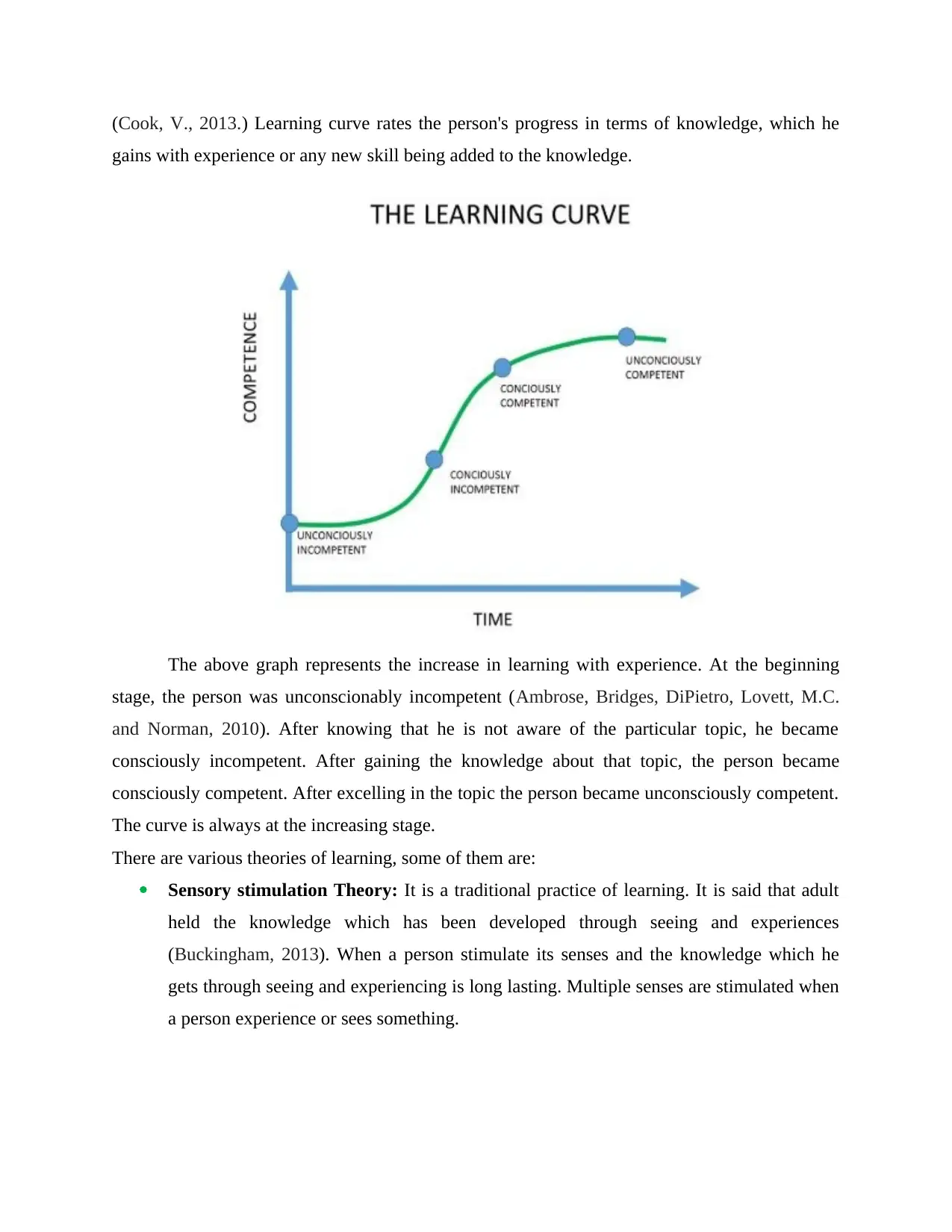
(Cook, V., 2013.) Learning curve rates the person's progress in terms of knowledge, which he
gains with experience or any new skill being added to the knowledge.
The above graph represents the increase in learning with experience. At the beginning
stage, the person was unconscionably incompetent (Ambrose, Bridges, DiPietro, Lovett, M.C.
and Norman, 2010). After knowing that he is not aware of the particular topic, he became
consciously incompetent. After gaining the knowledge about that topic, the person became
consciously competent. After excelling in the topic the person became unconsciously competent.
The curve is always at the increasing stage.
There are various theories of learning, some of them are:
Sensory stimulation Theory: It is a traditional practice of learning. It is said that adult
held the knowledge which has been developed through seeing and experiences
(Buckingham, 2013). When a person stimulate its senses and the knowledge which he
gets through seeing and experiencing is long lasting. Multiple senses are stimulated when
a person experience or sees something.
gains with experience or any new skill being added to the knowledge.
The above graph represents the increase in learning with experience. At the beginning
stage, the person was unconscionably incompetent (Ambrose, Bridges, DiPietro, Lovett, M.C.
and Norman, 2010). After knowing that he is not aware of the particular topic, he became
consciously incompetent. After gaining the knowledge about that topic, the person became
consciously competent. After excelling in the topic the person became unconsciously competent.
The curve is always at the increasing stage.
There are various theories of learning, some of them are:
Sensory stimulation Theory: It is a traditional practice of learning. It is said that adult
held the knowledge which has been developed through seeing and experiences
(Buckingham, 2013). When a person stimulate its senses and the knowledge which he
gets through seeing and experiencing is long lasting. Multiple senses are stimulated when
a person experience or sees something.
Holistic learning Theory: In order to make learning more effective, it is important to use
all the elements of an individual's personality. Various elements are: intellect, emotions,
desire, intuition and imagination. When these elements are used by a teacher, the learning
experience become more effective. A children needs to know the meaning, he should be
able to imagine and he should have desire to learn new things.
Facilitation Theory: According to this theory, a teacher should perform as a facilitator,
that is, a teacher should be able to make the things easier for the kids. It is very important
for a teacher to make the environment of a classroom comfortable for kids (Jones and
Sallis, 2013). An environment where kids can freely learn and ask queries from the
teacher. A kid can develop new ideas if the surroundings allow him to do that.
The basic principles of learning are:
Readiness: It is important for the kid have the desire to learn. The eagerness and
concentration level make a student to learn in an effective manner.
Exercise: In order to keep the learning intact. The things need to be repeated very often
in order to learn and retain the information for a longer period.
Effect: Emotional reaction of a student after learning something new is the effect of
learning. It is also directly related to motivation for learning more.
Primacy: What is learn first retain for the longest time. The first learning creates the
strong impression on a kid.
Recency: Most recent things learned are best remembered. However, after a period of
time, it gets removed from the memory if not repeated often.
Intensity: Intensity decide whether matter can be retained for a longer period of time or
not. Clear, dramatic and excited learning helps to retain the experience for a longer period
of time.
Freedom: A kid is able to learn more in a free environment. A kid must be given with
the freedom of choice, action and also to even bear the results of the action he has
performed (Kremer, Brannen and Glennerster, 2013).
Requirement: It is required to have something to get something. Teachers require
ability, instruments and tremendous knowledge according to the grade in which he is
teaching.
all the elements of an individual's personality. Various elements are: intellect, emotions,
desire, intuition and imagination. When these elements are used by a teacher, the learning
experience become more effective. A children needs to know the meaning, he should be
able to imagine and he should have desire to learn new things.
Facilitation Theory: According to this theory, a teacher should perform as a facilitator,
that is, a teacher should be able to make the things easier for the kids. It is very important
for a teacher to make the environment of a classroom comfortable for kids (Jones and
Sallis, 2013). An environment where kids can freely learn and ask queries from the
teacher. A kid can develop new ideas if the surroundings allow him to do that.
The basic principles of learning are:
Readiness: It is important for the kid have the desire to learn. The eagerness and
concentration level make a student to learn in an effective manner.
Exercise: In order to keep the learning intact. The things need to be repeated very often
in order to learn and retain the information for a longer period.
Effect: Emotional reaction of a student after learning something new is the effect of
learning. It is also directly related to motivation for learning more.
Primacy: What is learn first retain for the longest time. The first learning creates the
strong impression on a kid.
Recency: Most recent things learned are best remembered. However, after a period of
time, it gets removed from the memory if not repeated often.
Intensity: Intensity decide whether matter can be retained for a longer period of time or
not. Clear, dramatic and excited learning helps to retain the experience for a longer period
of time.
Freedom: A kid is able to learn more in a free environment. A kid must be given with
the freedom of choice, action and also to even bear the results of the action he has
performed (Kremer, Brannen and Glennerster, 2013).
Requirement: It is required to have something to get something. Teachers require
ability, instruments and tremendous knowledge according to the grade in which he is
teaching.
⊘ This is a preview!⊘
Do you want full access?
Subscribe today to unlock all pages.
Trusted by 1+ million students worldwide
Models of learning
Various theorists have given numerous models in order to make the learning session easy
and productive. The models serve the purpose of developing educational activities and making a
suitable environment for kids to learn.
The common features of models are:
To find out the purpose of learning and area of concentration
Various assumption based on the age and characteristics of learner
definite pattern required to conduct the activity of learning (Buckingham and Willett,
2013)
Surrounding for the kids plays an important role in effective learning
Method to evaluate their learning
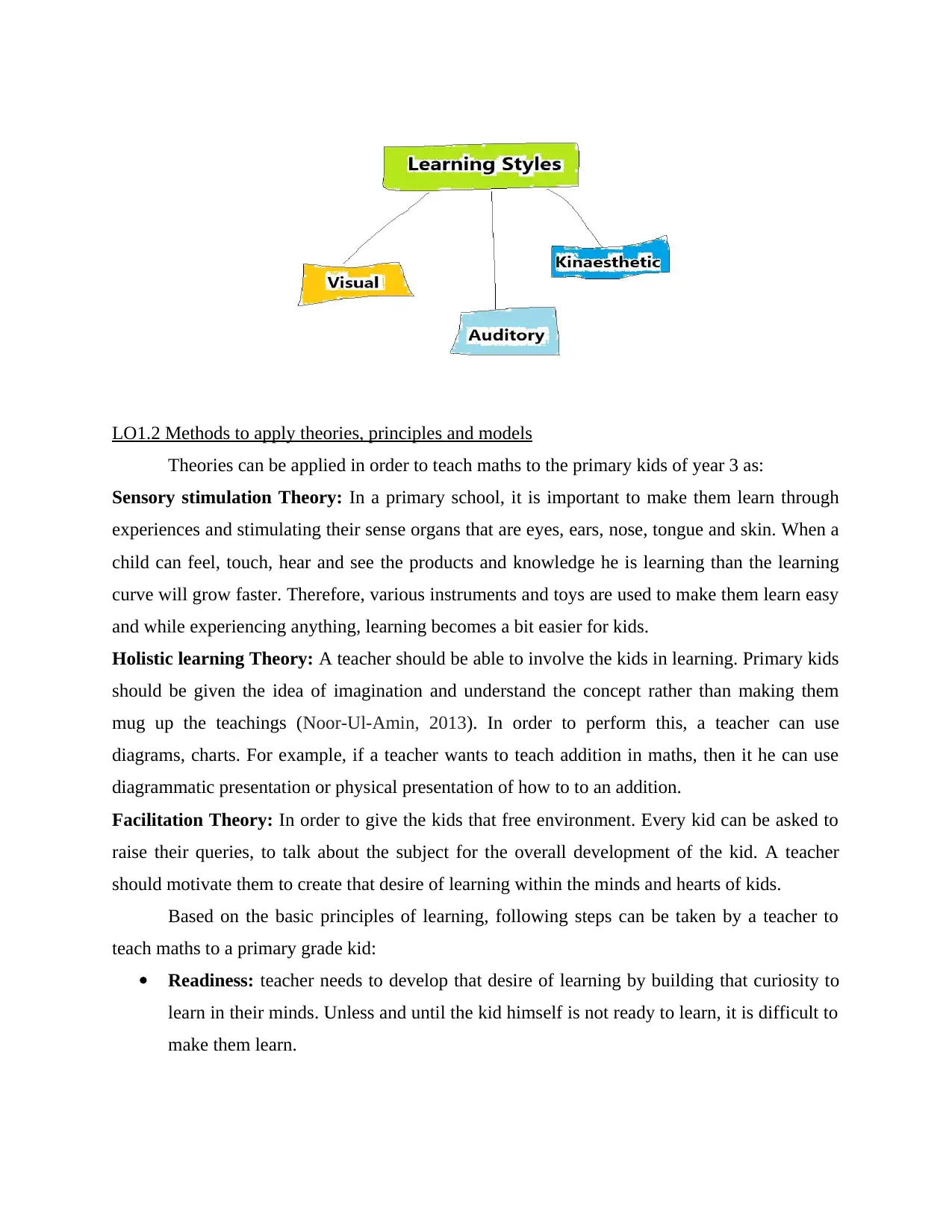
VARK Model: The models says states that there are four sensory to learn:
Visual
Auditory
Read / write learning
Kinesthetic learning
LO1.3 Models of learning preferences by various types of learners
The preferable way of learning are:
Visual: These type of learners draw a picture of everything in their mind. However, if
they are not able to imagine any situation or information then they miss out he learning.
Therefore it is important to have charts, diagrams and map in order to help the visual
learners to grab the knowledge.
Auditory: These type of learners are able to get and retain the information after hearing.
They may not be able to learn via reading but it is easy for them to learn via hearing .
Kinaesthetic: These types of learners are able to learn when they act or perform the
activities (Laurillard, 2013). For them, it gets difficult to get the information by only text
and hearing.
Various theorists have given numerous models in order to make the learning session easy
and productive. The models serve the purpose of developing educational activities and making a
suitable environment for kids to learn.
The common features of models are:
To find out the purpose of learning and area of concentration
Various assumption based on the age and characteristics of learner
definite pattern required to conduct the activity of learning (Buckingham and Willett,
2013)
Surrounding for the kids plays an important role in effective learning
Method to evaluate their learning
VARK Model: The models says states that there are four sensory to learn:
Visual
Auditory
Read / write learning
Kinesthetic learning
LO1.3 Models of learning preferences by various types of learners
The preferable way of learning are:
Visual: These type of learners draw a picture of everything in their mind. However, if
they are not able to imagine any situation or information then they miss out he learning.
Therefore it is important to have charts, diagrams and map in order to help the visual
learners to grab the knowledge.
Auditory: These type of learners are able to get and retain the information after hearing.
They may not be able to learn via reading but it is easy for them to learn via hearing .
Kinaesthetic: These types of learners are able to learn when they act or perform the
activities (Laurillard, 2013). For them, it gets difficult to get the information by only text
and hearing.
Paraphrase This Document
Need a fresh take? Get an instant paraphrase of this document with our AI Paraphraser
LO1.2 Methods to apply theories, principles and models
Theories can be applied in order to teach maths to the primary kids of year 3 as:
Sensory stimulation Theory: In a primary school, it is important to make them learn through
experiences and stimulating their sense organs that are eyes, ears, nose, tongue and skin. When a
child can feel, touch, hear and see the products and knowledge he is learning than the learning
curve will grow faster. Therefore, various instruments and toys are used to make them learn easy
and while experiencing anything, learning becomes a bit easier for kids.
Holistic learning Theory: A teacher should be able to involve the kids in learning. Primary kids
should be given the idea of imagination and understand the concept rather than making them
mug up the teachings (Noor-Ul-Amin, 2013). In order to perform this, a teacher can use
diagrams, charts. For example, if a teacher wants to teach addition in maths, then it he can use
diagrammatic presentation or physical presentation of how to to an addition.
Facilitation Theory: In order to give the kids that free environment. Every kid can be asked to
raise their queries, to talk about the subject for the overall development of the kid. A teacher
should motivate them to create that desire of learning within the minds and hearts of kids.
Based on the basic principles of learning, following steps can be taken by a teacher to
teach maths to a primary grade kid:
Readiness: teacher needs to develop that desire of learning by building that curiosity to
learn in their minds. Unless and until the kid himself is not ready to learn, it is difficult to
make them learn.
Theories can be applied in order to teach maths to the primary kids of year 3 as:
Sensory stimulation Theory: In a primary school, it is important to make them learn through
experiences and stimulating their sense organs that are eyes, ears, nose, tongue and skin. When a
child can feel, touch, hear and see the products and knowledge he is learning than the learning
curve will grow faster. Therefore, various instruments and toys are used to make them learn easy
and while experiencing anything, learning becomes a bit easier for kids.
Holistic learning Theory: A teacher should be able to involve the kids in learning. Primary kids
should be given the idea of imagination and understand the concept rather than making them
mug up the teachings (Noor-Ul-Amin, 2013). In order to perform this, a teacher can use
diagrams, charts. For example, if a teacher wants to teach addition in maths, then it he can use
diagrammatic presentation or physical presentation of how to to an addition.
Facilitation Theory: In order to give the kids that free environment. Every kid can be asked to
raise their queries, to talk about the subject for the overall development of the kid. A teacher
should motivate them to create that desire of learning within the minds and hearts of kids.
Based on the basic principles of learning, following steps can be taken by a teacher to
teach maths to a primary grade kid:
Readiness: teacher needs to develop that desire of learning by building that curiosity to
learn in their minds. Unless and until the kid himself is not ready to learn, it is difficult to
make them learn.
Exercise: the teacher can repeat the teachings to make them retain the information. A
child may not be able to learn the table of 2 in one go. It will require constant repetitions
of the teachings.
Effect: A teacher can motivate after every correct assignment being done by the student.
It act as a motivational factor for the student to learn more and perform better. He can
also give prizes (Hardy and Tolhurst, 2014).
Intensity: By performing various tasks, plays and games with the children, the
effectiveness of the learning can be increased. When a kid himself is involved in the kind
of activities of learning, it gets easy for them to retain for longer period of time.
Freedom: After teaching every topic, encourage the kids to ask question. A teacher can
give a free environment by doing this.
Requirement: Teacher himself should be well qualified and trained to give proper
training to the kids. He should be aware of how to behave with the kids and how to treat
them.
Based on the Models of learning following qualities a teacher should possess:
A teacher of primary grade should have the quality to generate the curiosity of learning in
the kids.
He should be aware of the characteristics a kid possess at such a small age. The learning
lesson should not hamper this fact. Also, every kid have different characteristic, some
may be a quick learner and some may be take some time to grasp the content. Based on
each student's characteristic, teacher should design his teaching method.
He can go for model based education, it helps to get effective results from the kids and
this is the easiest method to teach any topic (Liu, Wu and Chen, 2013).
The surroundings and code of conduct of the classroom should be designed in such a way
that it can help the kids to learn. For instance, various charts can be pasted on the walls of
the classroom. It can help in repetition of the content which further helps to retain the
information.
He should be aware of different types of activities which be performed in the class to
promote learning. Mind games, odd one out, puzzles, find the appropriate answer, are
some of the games that can be played by the teacher in the classroom study.
child may not be able to learn the table of 2 in one go. It will require constant repetitions
of the teachings.
Effect: A teacher can motivate after every correct assignment being done by the student.
It act as a motivational factor for the student to learn more and perform better. He can
also give prizes (Hardy and Tolhurst, 2014).
Intensity: By performing various tasks, plays and games with the children, the
effectiveness of the learning can be increased. When a kid himself is involved in the kind
of activities of learning, it gets easy for them to retain for longer period of time.
Freedom: After teaching every topic, encourage the kids to ask question. A teacher can
give a free environment by doing this.
Requirement: Teacher himself should be well qualified and trained to give proper
training to the kids. He should be aware of how to behave with the kids and how to treat
them.
Based on the Models of learning following qualities a teacher should possess:
A teacher of primary grade should have the quality to generate the curiosity of learning in
the kids.
He should be aware of the characteristics a kid possess at such a small age. The learning
lesson should not hamper this fact. Also, every kid have different characteristic, some
may be a quick learner and some may be take some time to grasp the content. Based on
each student's characteristic, teacher should design his teaching method.
He can go for model based education, it helps to get effective results from the kids and
this is the easiest method to teach any topic (Liu, Wu and Chen, 2013).
The surroundings and code of conduct of the classroom should be designed in such a way
that it can help the kids to learn. For instance, various charts can be pasted on the walls of
the classroom. It can help in repetition of the content which further helps to retain the
information.
He should be aware of different types of activities which be performed in the class to
promote learning. Mind games, odd one out, puzzles, find the appropriate answer, are
some of the games that can be played by the teacher in the classroom study.
⊘ This is a preview!⊘
Do you want full access?
Subscribe today to unlock all pages.
Trusted by 1+ million students worldwide

1 out of 30


Related Documents


Your All-in-One AI-Powered Toolkit for Academic Success.
+13062052269
info@desklib.com
Available 24*7 on WhatsApp / Email
![[object Object]](/_next/static/media/star-bottom.7253800d.svg)
Unlock your academic potential
Copyright © 2020–2026 A2Z Services. All Rights Reserved. Developed and managed by ZUCOL.