A Detailed Analysis of Child Development Theories and Influences
VerifiedAdded on 2023/06/13
|20
|5833
|179
Report
AI Summary
This report provides a comprehensive overview of child development, exploring various theories such as Cognitive Developmental Theory by Jean Piaget, Psychosocial Development Theory by Erik Erikson, Social Learning Theory, Attachment Theory by John Bowlby, and Psychosexual Development Theory by Sigmund Freud. It analyses how these theories and philosophical approaches influence practices in supporting learning and development, including observation, planning, communication, behaviour analysis, and environmental considerations. The report also details the expected patterns of children’s development from birth to 7 years across cognitive, speech, language, literacy, and numeracy domains, along with the influence of personal and external factors. Furthermore, it addresses the identification of individual children's needs and the planning of subsequent developmental steps, while also explaining terms related to speech, language, and communication needs, highlighting potential indicators, and discussing the impact of unaddressed needs and available support.

Unit 1

Paraphrase This Document
Need a fresh take? Get an instant paraphrase of this document with our AI Paraphraser
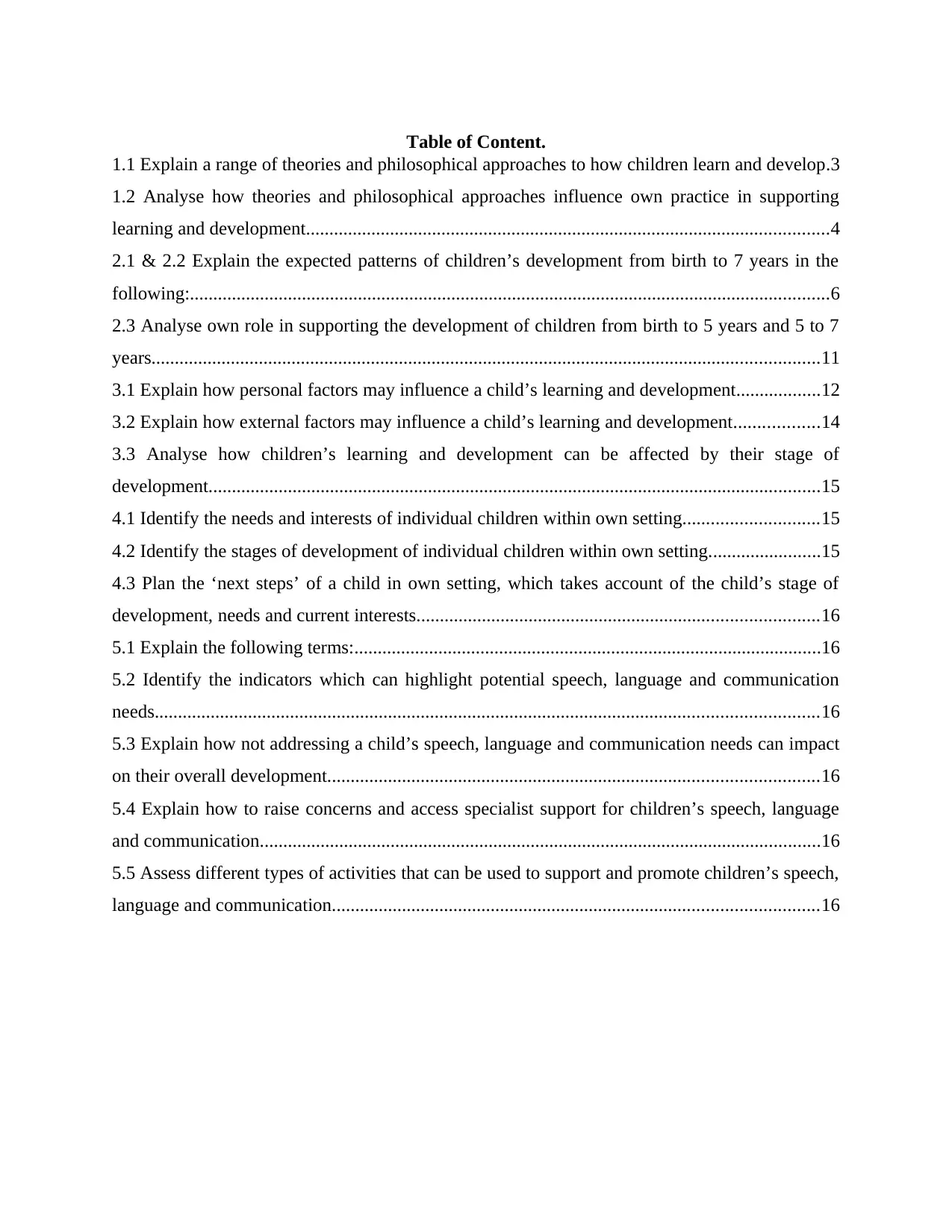
Table of Content.
1.1 Explain a range of theories and philosophical approaches to how children learn and develop.3
1.2 Analyse how theories and philosophical approaches influence own practice in supporting
learning and development................................................................................................................4
2.1 & 2.2 Explain the expected patterns of children’s development from birth to 7 years in the
following:.........................................................................................................................................6
2.3 Analyse own role in supporting the development of children from birth to 5 years and 5 to 7
years...............................................................................................................................................11
3.1 Explain how personal factors may influence a child’s learning and development..................12
3.2 Explain how external factors may influence a child’s learning and development..................14
3.3 Analyse how children’s learning and development can be affected by their stage of
development...................................................................................................................................15
4.1 Identify the needs and interests of individual children within own setting.............................15
4.2 Identify the stages of development of individual children within own setting........................15
4.3 Plan the ‘next steps’ of a child in own setting, which takes account of the child’s stage of
development, needs and current interests......................................................................................16
5.1 Explain the following terms:....................................................................................................16
5.2 Identify the indicators which can highlight potential speech, language and communication
needs..............................................................................................................................................16
5.3 Explain how not addressing a child’s speech, language and communication needs can impact
on their overall development.........................................................................................................16
5.4 Explain how to raise concerns and access specialist support for children’s speech, language
and communication........................................................................................................................16
5.5 Assess different types of activities that can be used to support and promote children’s speech,
language and communication........................................................................................................16
1.1 Explain a range of theories and philosophical approaches to how children learn and develop.3
1.2 Analyse how theories and philosophical approaches influence own practice in supporting
learning and development................................................................................................................4
2.1 & 2.2 Explain the expected patterns of children’s development from birth to 7 years in the
following:.........................................................................................................................................6
2.3 Analyse own role in supporting the development of children from birth to 5 years and 5 to 7
years...............................................................................................................................................11
3.1 Explain how personal factors may influence a child’s learning and development..................12
3.2 Explain how external factors may influence a child’s learning and development..................14
3.3 Analyse how children’s learning and development can be affected by their stage of
development...................................................................................................................................15
4.1 Identify the needs and interests of individual children within own setting.............................15
4.2 Identify the stages of development of individual children within own setting........................15
4.3 Plan the ‘next steps’ of a child in own setting, which takes account of the child’s stage of
development, needs and current interests......................................................................................16
5.1 Explain the following terms:....................................................................................................16
5.2 Identify the indicators which can highlight potential speech, language and communication
needs..............................................................................................................................................16
5.3 Explain how not addressing a child’s speech, language and communication needs can impact
on their overall development.........................................................................................................16
5.4 Explain how to raise concerns and access specialist support for children’s speech, language
and communication........................................................................................................................16
5.5 Assess different types of activities that can be used to support and promote children’s speech,
language and communication........................................................................................................16
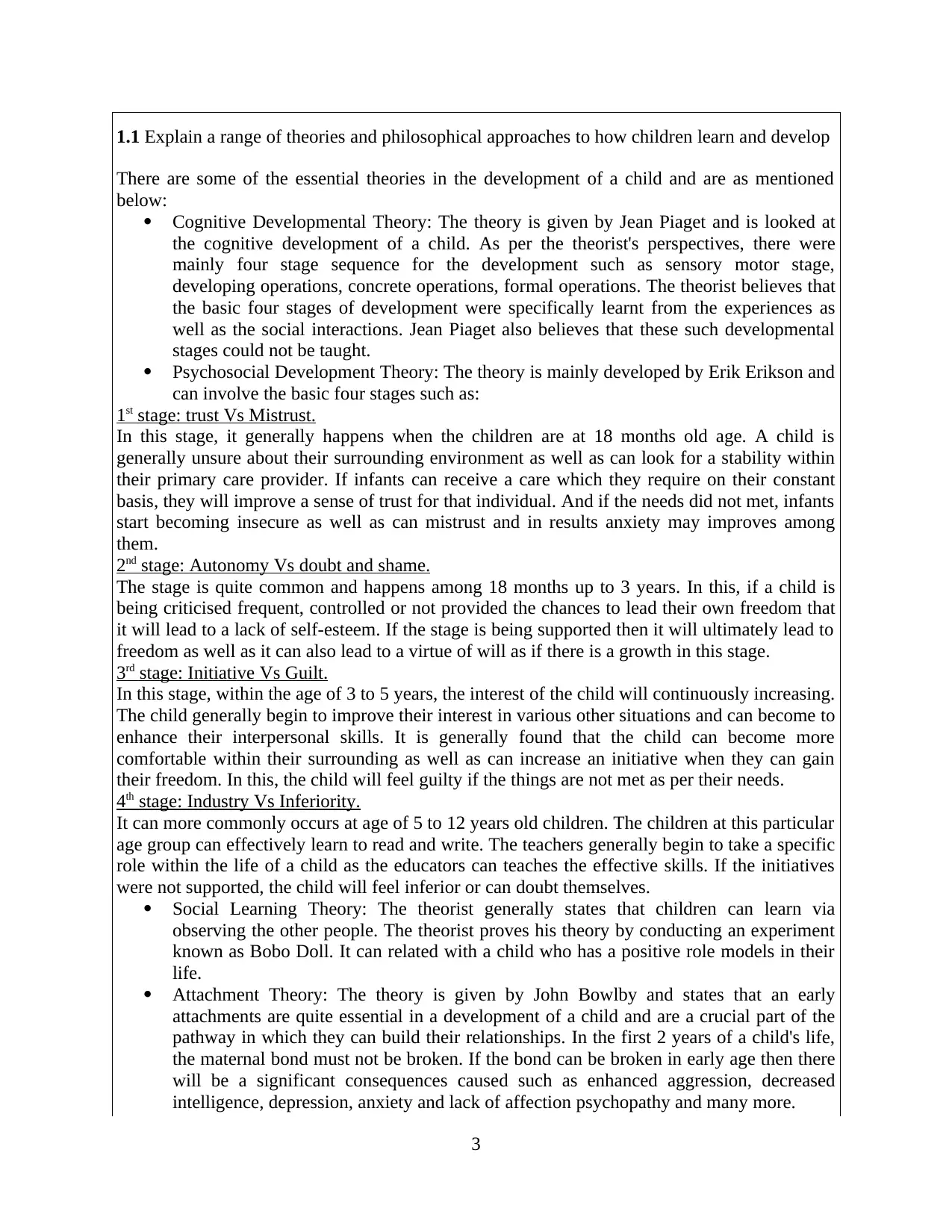
1.1 Explain a range of theories and philosophical approaches to how children learn and develop
There are some of the essential theories in the development of a child and are as mentioned
below:
Cognitive Developmental Theory: The theory is given by Jean Piaget and is looked at
the cognitive development of a child. As per the theorist's perspectives, there were
mainly four stage sequence for the development such as sensory motor stage,
developing operations, concrete operations, formal operations. The theorist believes that
the basic four stages of development were specifically learnt from the experiences as
well as the social interactions. Jean Piaget also believes that these such developmental
stages could not be taught.
Psychosocial Development Theory: The theory is mainly developed by Erik Erikson and
can involve the basic four stages such as:
1st stage: trust Vs Mistrust.
In this stage, it generally happens when the children are at 18 months old age. A child is
generally unsure about their surrounding environment as well as can look for a stability within
their primary care provider. If infants can receive a care which they require on their constant
basis, they will improve a sense of trust for that individual. And if the needs did not met, infants
start becoming insecure as well as can mistrust and in results anxiety may improves among
them.
2nd stage: Autonomy Vs doubt and shame.
The stage is quite common and happens among 18 months up to 3 years. In this, if a child is
being criticised frequent, controlled or not provided the chances to lead their own freedom that
it will lead to a lack of self-esteem. If the stage is being supported then it will ultimately lead to
freedom as well as it can also lead to a virtue of will as if there is a growth in this stage.
3rd stage: Initiative Vs Guilt.
In this stage, within the age of 3 to 5 years, the interest of the child will continuously increasing.
The child generally begin to improve their interest in various other situations and can become to
enhance their interpersonal skills. It is generally found that the child can become more
comfortable within their surrounding as well as can increase an initiative when they can gain
their freedom. In this, the child will feel guilty if the things are not met as per their needs.
4th stage: Industry Vs Inferiority.
It can more commonly occurs at age of 5 to 12 years old children. The children at this particular
age group can effectively learn to read and write. The teachers generally begin to take a specific
role within the life of a child as the educators can teaches the effective skills. If the initiatives
were not supported, the child will feel inferior or can doubt themselves.
Social Learning Theory: The theorist generally states that children can learn via
observing the other people. The theorist proves his theory by conducting an experiment
known as Bobo Doll. It can related with a child who has a positive role models in their
life.
Attachment Theory: The theory is given by John Bowlby and states that an early
attachments are quite essential in a development of a child and are a crucial part of the
pathway in which they can build their relationships. In the first 2 years of a child's life,
the maternal bond must not be broken. If the bond can be broken in early age then there
will be a significant consequences caused such as enhanced aggression, decreased
intelligence, depression, anxiety and lack of affection psychopathy and many more.
3
There are some of the essential theories in the development of a child and are as mentioned
below:
Cognitive Developmental Theory: The theory is given by Jean Piaget and is looked at
the cognitive development of a child. As per the theorist's perspectives, there were
mainly four stage sequence for the development such as sensory motor stage,
developing operations, concrete operations, formal operations. The theorist believes that
the basic four stages of development were specifically learnt from the experiences as
well as the social interactions. Jean Piaget also believes that these such developmental
stages could not be taught.
Psychosocial Development Theory: The theory is mainly developed by Erik Erikson and
can involve the basic four stages such as:
1st stage: trust Vs Mistrust.
In this stage, it generally happens when the children are at 18 months old age. A child is
generally unsure about their surrounding environment as well as can look for a stability within
their primary care provider. If infants can receive a care which they require on their constant
basis, they will improve a sense of trust for that individual. And if the needs did not met, infants
start becoming insecure as well as can mistrust and in results anxiety may improves among
them.
2nd stage: Autonomy Vs doubt and shame.
The stage is quite common and happens among 18 months up to 3 years. In this, if a child is
being criticised frequent, controlled or not provided the chances to lead their own freedom that
it will lead to a lack of self-esteem. If the stage is being supported then it will ultimately lead to
freedom as well as it can also lead to a virtue of will as if there is a growth in this stage.
3rd stage: Initiative Vs Guilt.
In this stage, within the age of 3 to 5 years, the interest of the child will continuously increasing.
The child generally begin to improve their interest in various other situations and can become to
enhance their interpersonal skills. It is generally found that the child can become more
comfortable within their surrounding as well as can increase an initiative when they can gain
their freedom. In this, the child will feel guilty if the things are not met as per their needs.
4th stage: Industry Vs Inferiority.
It can more commonly occurs at age of 5 to 12 years old children. The children at this particular
age group can effectively learn to read and write. The teachers generally begin to take a specific
role within the life of a child as the educators can teaches the effective skills. If the initiatives
were not supported, the child will feel inferior or can doubt themselves.
Social Learning Theory: The theorist generally states that children can learn via
observing the other people. The theorist proves his theory by conducting an experiment
known as Bobo Doll. It can related with a child who has a positive role models in their
life.
Attachment Theory: The theory is given by John Bowlby and states that an early
attachments are quite essential in a development of a child and are a crucial part of the
pathway in which they can build their relationships. In the first 2 years of a child's life,
the maternal bond must not be broken. If the bond can be broken in early age then there
will be a significant consequences caused such as enhanced aggression, decreased
intelligence, depression, anxiety and lack of affection psychopathy and many more.
3
⊘ This is a preview!⊘
Do you want full access?
Subscribe today to unlock all pages.

Trusted by 1+ million students worldwide
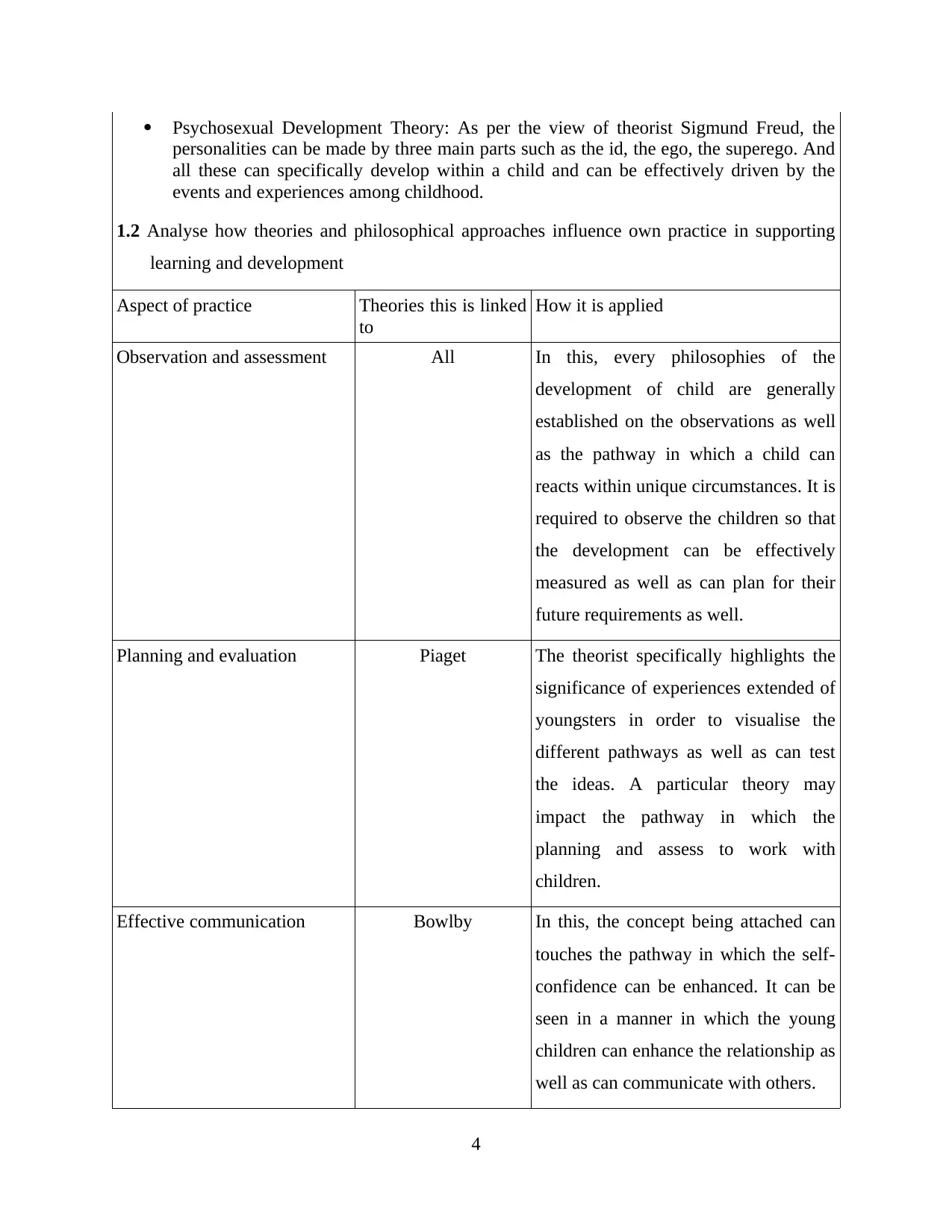
Psychosexual Development Theory: As per the view of theorist Sigmund Freud, the
personalities can be made by three main parts such as the id, the ego, the superego. And
all these can specifically develop within a child and can be effectively driven by the
events and experiences among childhood.
1.2 Analyse how theories and philosophical approaches influence own practice in supporting
learning and development
Aspect of practice Theories this is linked
to
How it is applied
Observation and assessment All In this, every philosophies of the
development of child are generally
established on the observations as well
as the pathway in which a child can
reacts within unique circumstances. It is
required to observe the children so that
the development can be effectively
measured as well as can plan for their
future requirements as well.
Planning and evaluation Piaget The theorist specifically highlights the
significance of experiences extended of
youngsters in order to visualise the
different pathways as well as can test
the ideas. A particular theory may
impact the pathway in which the
planning and assess to work with
children.
Effective communication Bowlby In this, the concept being attached can
touches the pathway in which the self-
confidence can be enhanced. It can be
seen in a manner in which the young
children can enhance the relationship as
well as can communicate with others.
4
personalities can be made by three main parts such as the id, the ego, the superego. And
all these can specifically develop within a child and can be effectively driven by the
events and experiences among childhood.
1.2 Analyse how theories and philosophical approaches influence own practice in supporting
learning and development
Aspect of practice Theories this is linked
to
How it is applied
Observation and assessment All In this, every philosophies of the
development of child are generally
established on the observations as well
as the pathway in which a child can
reacts within unique circumstances. It is
required to observe the children so that
the development can be effectively
measured as well as can plan for their
future requirements as well.
Planning and evaluation Piaget The theorist specifically highlights the
significance of experiences extended of
youngsters in order to visualise the
different pathways as well as can test
the ideas. A particular theory may
impact the pathway in which the
planning and assess to work with
children.
Effective communication Bowlby In this, the concept being attached can
touches the pathway in which the self-
confidence can be enhanced. It can be
seen in a manner in which the young
children can enhance the relationship as
well as can communicate with others.
4
Paraphrase This Document
Need a fresh take? Get an instant paraphrase of this document with our AI Paraphraser
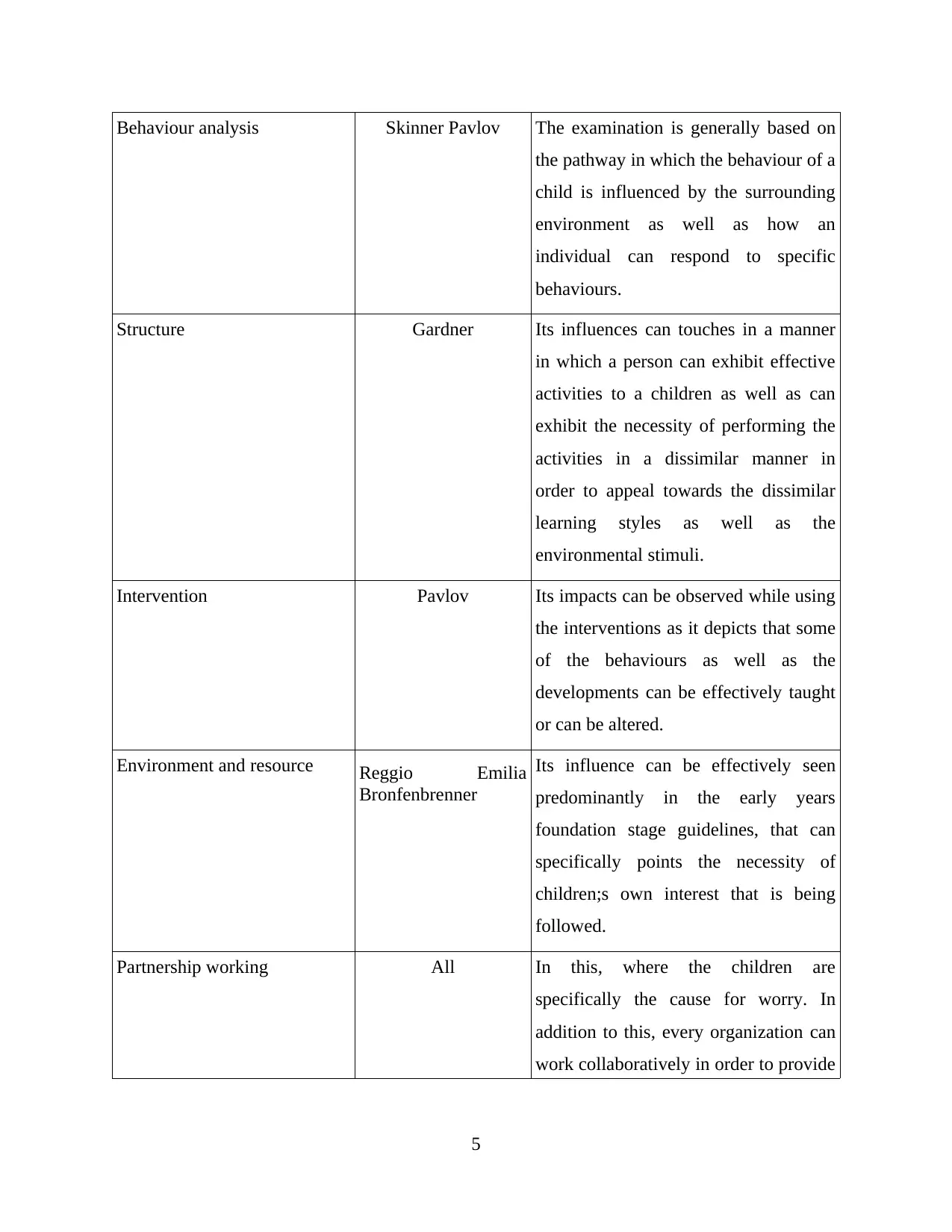
Behaviour analysis Skinner Pavlov The examination is generally based on
the pathway in which the behaviour of a
child is influenced by the surrounding
environment as well as how an
individual can respond to specific
behaviours.
Structure Gardner Its influences can touches in a manner
in which a person can exhibit effective
activities to a children as well as can
exhibit the necessity of performing the
activities in a dissimilar manner in
order to appeal towards the dissimilar
learning styles as well as the
environmental stimuli.
Intervention Pavlov Its impacts can be observed while using
the interventions as it depicts that some
of the behaviours as well as the
developments can be effectively taught
or can be altered.
Environment and resource Reggio Emilia
Bronfenbrenner
Its influence can be effectively seen
predominantly in the early years
foundation stage guidelines, that can
specifically points the necessity of
children;s own interest that is being
followed.
Partnership working All In this, where the children are
specifically the cause for worry. In
addition to this, every organization can
work collaboratively in order to provide
5
the pathway in which the behaviour of a
child is influenced by the surrounding
environment as well as how an
individual can respond to specific
behaviours.
Structure Gardner Its influences can touches in a manner
in which a person can exhibit effective
activities to a children as well as can
exhibit the necessity of performing the
activities in a dissimilar manner in
order to appeal towards the dissimilar
learning styles as well as the
environmental stimuli.
Intervention Pavlov Its impacts can be observed while using
the interventions as it depicts that some
of the behaviours as well as the
developments can be effectively taught
or can be altered.
Environment and resource Reggio Emilia
Bronfenbrenner
Its influence can be effectively seen
predominantly in the early years
foundation stage guidelines, that can
specifically points the necessity of
children;s own interest that is being
followed.
Partnership working All In this, where the children are
specifically the cause for worry. In
addition to this, every organization can
work collaboratively in order to provide
5
support to them.
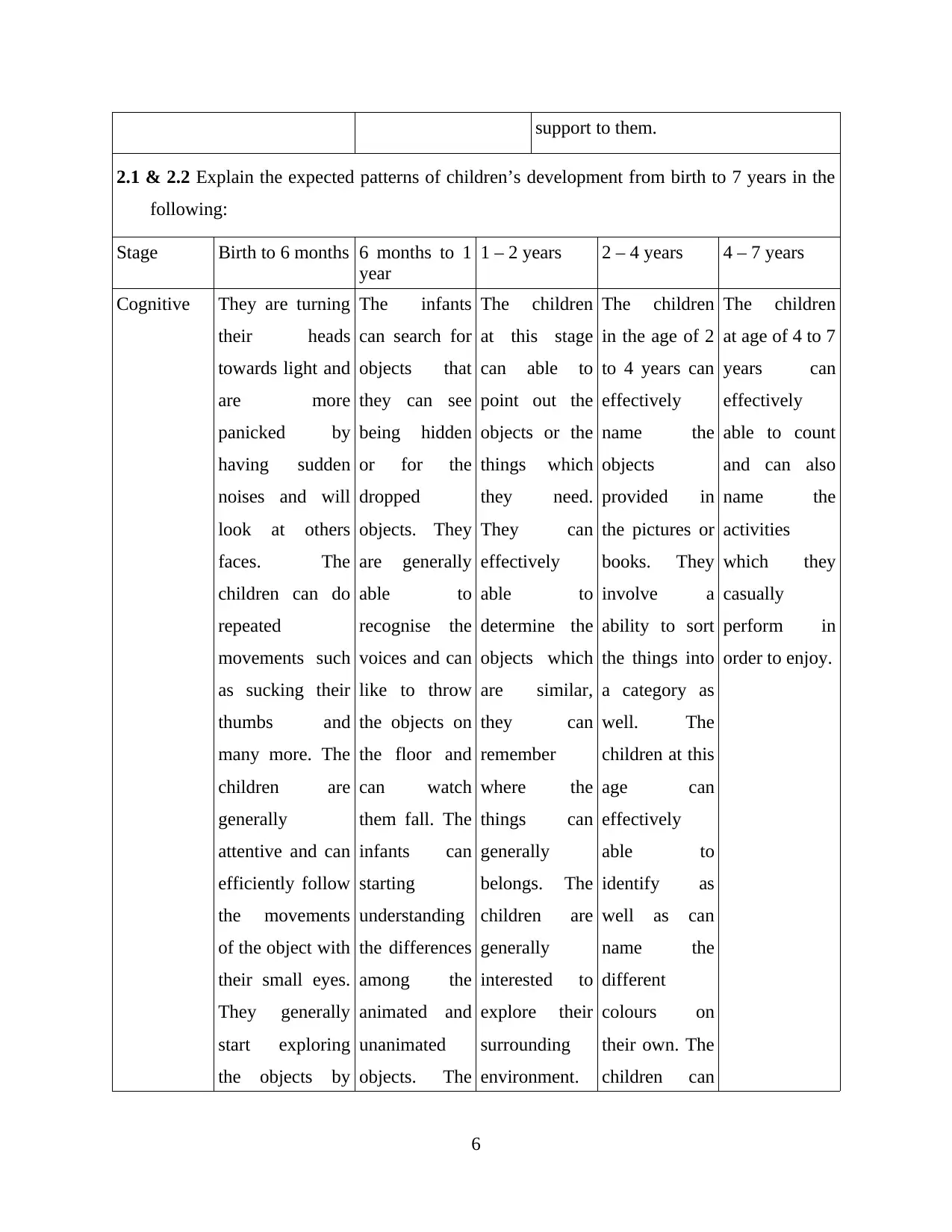
2.1 & 2.2 Explain the expected patterns of children’s development from birth to 7 years in the
following:
Stage Birth to 6 months 6 months to 1
year
1 – 2 years 2 – 4 years 4 – 7 years
Cognitive They are turning
their heads
towards light and
are more
panicked by
having sudden
noises and will
look at others
faces. The
children can do
repeated
movements such
as sucking their
thumbs and
many more. The
children are
generally
attentive and can
efficiently follow
the movements
of the object with
their small eyes.
They generally
start exploring
the objects by
The infants
can search for
objects that
they can see
being hidden
or for the
dropped
objects. They
are generally
able to
recognise the
voices and can
like to throw
the objects on
the floor and
can watch
them fall. The
infants can
starting
understanding
the differences
among the
animated and
unanimated
objects. The
The children
at this stage
can able to
point out the
objects or the
things which
they need.
They can
effectively
able to
determine the
objects which
are similar,
they can
remember
where the
things can
generally
belongs. The
children are
generally
interested to
explore their
surrounding
environment.
The children
in the age of 2
to 4 years can
effectively
name the
objects
provided in
the pictures or
books. They
involve a
ability to sort
the things into
a category as
well. The
children at this
age can
effectively
able to
identify as
well as can
name the
different
colours on
their own. The
children can
The children
at age of 4 to 7
years can
effectively
able to count
and can also
name the
activities
which they
casually
perform in
order to enjoy.
6
2.1 & 2.2 Explain the expected patterns of children’s development from birth to 7 years in the
following:
Stage Birth to 6 months 6 months to 1
year
1 – 2 years 2 – 4 years 4 – 7 years
Cognitive They are turning
their heads
towards light and
are more
panicked by
having sudden
noises and will
look at others
faces. The
children can do
repeated
movements such
as sucking their
thumbs and
many more. The
children are
generally
attentive and can
efficiently follow
the movements
of the object with
their small eyes.
They generally
start exploring
the objects by
The infants
can search for
objects that
they can see
being hidden
or for the
dropped
objects. They
are generally
able to
recognise the
voices and can
like to throw
the objects on
the floor and
can watch
them fall. The
infants can
starting
understanding
the differences
among the
animated and
unanimated
objects. The
The children
at this stage
can able to
point out the
objects or the
things which
they need.
They can
effectively
able to
determine the
objects which
are similar,
they can
remember
where the
things can
generally
belongs. The
children are
generally
interested to
explore their
surrounding
environment.
The children
in the age of 2
to 4 years can
effectively
name the
objects
provided in
the pictures or
books. They
involve a
ability to sort
the things into
a category as
well. The
children at this
age can
effectively
able to
identify as
well as can
name the
different
colours on
their own. The
children can
The children
at age of 4 to 7
years can
effectively
able to count
and can also
name the
activities
which they
casually
perform in
order to enjoy.
6
⊘ This is a preview!⊘
Do you want full access?
Subscribe today to unlock all pages.
Trusted by 1+ million students worldwide
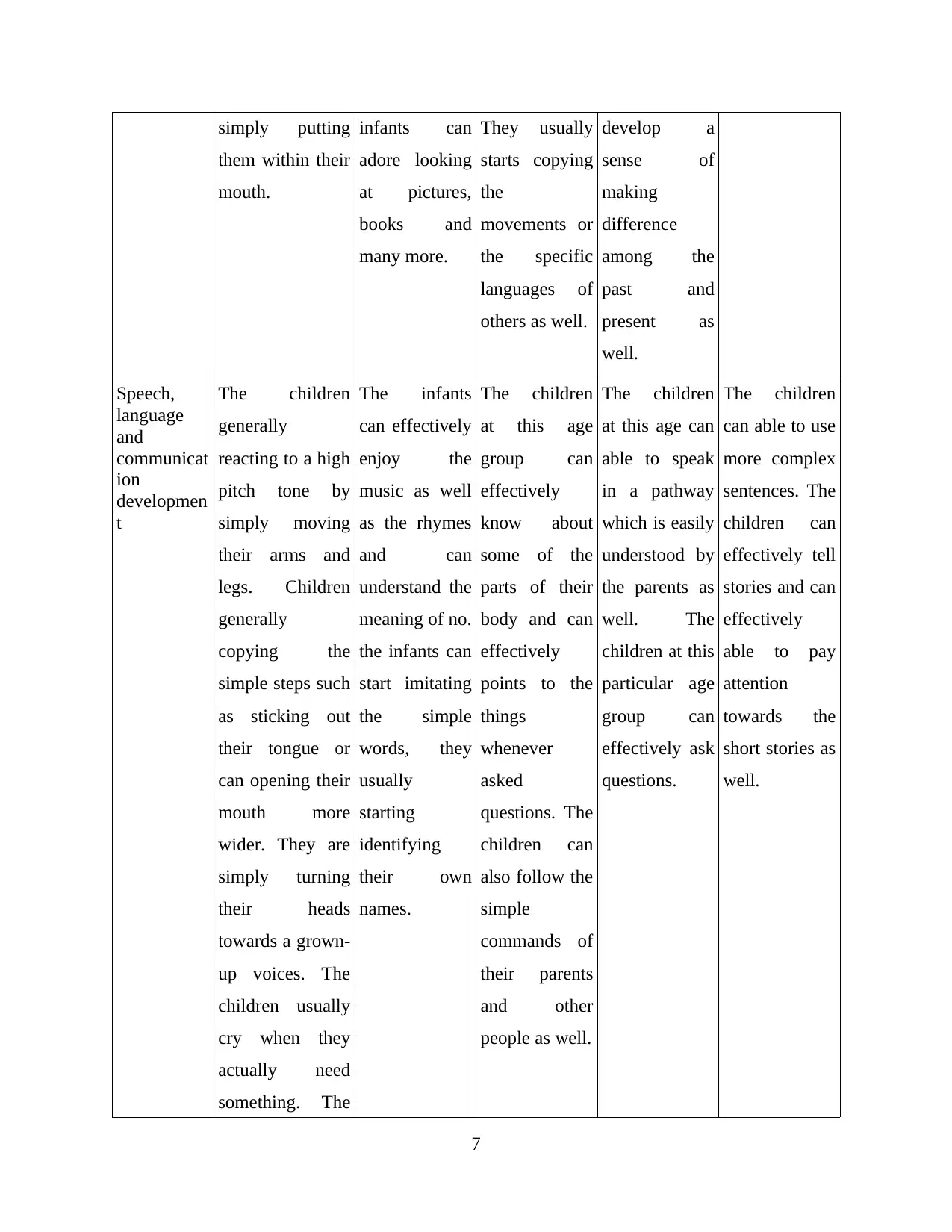
simply putting
them within their
mouth.
infants can
adore looking
at pictures,
books and
many more.
They usually
starts copying
the
movements or
the specific
languages of
others as well.
develop a
sense of
making
difference
among the
past and
present as
well.
Speech,
language
and
communicat
ion
developmen
t
The children
generally
reacting to a high
pitch tone by
simply moving
their arms and
legs. Children
generally
copying the
simple steps such
as sticking out
their tongue or
can opening their
mouth more
wider. They are
simply turning
their heads
towards a grown-
up voices. The
children usually
cry when they
actually need
something. The
The infants
can effectively
enjoy the
music as well
as the rhymes
and can
understand the
meaning of no.
the infants can
start imitating
the simple
words, they
usually
starting
identifying
their own
names.
The children
at this age
group can
effectively
know about
some of the
parts of their
body and can
effectively
points to the
things
whenever
asked
questions. The
children can
also follow the
simple
commands of
their parents
and other
people as well.
The children
at this age can
able to speak
in a pathway
which is easily
understood by
the parents as
well. The
children at this
particular age
group can
effectively ask
questions.
The children
can able to use
more complex
sentences. The
children can
effectively tell
stories and can
effectively
able to pay
attention
towards the
short stories as
well.
7
them within their
mouth.
infants can
adore looking
at pictures,
books and
many more.
They usually
starts copying
the
movements or
the specific
languages of
others as well.
develop a
sense of
making
difference
among the
past and
present as
well.
Speech,
language
and
communicat
ion
developmen
t
The children
generally
reacting to a high
pitch tone by
simply moving
their arms and
legs. Children
generally
copying the
simple steps such
as sticking out
their tongue or
can opening their
mouth more
wider. They are
simply turning
their heads
towards a grown-
up voices. The
children usually
cry when they
actually need
something. The
The infants
can effectively
enjoy the
music as well
as the rhymes
and can
understand the
meaning of no.
the infants can
start imitating
the simple
words, they
usually
starting
identifying
their own
names.
The children
at this age
group can
effectively
know about
some of the
parts of their
body and can
effectively
points to the
things
whenever
asked
questions. The
children can
also follow the
simple
commands of
their parents
and other
people as well.
The children
at this age can
able to speak
in a pathway
which is easily
understood by
the parents as
well. The
children at this
particular age
group can
effectively ask
questions.
The children
can able to use
more complex
sentences. The
children can
effectively tell
stories and can
effectively
able to pay
attention
towards the
short stories as
well.
7
Paraphrase This Document
Need a fresh take? Get an instant paraphrase of this document with our AI Paraphraser
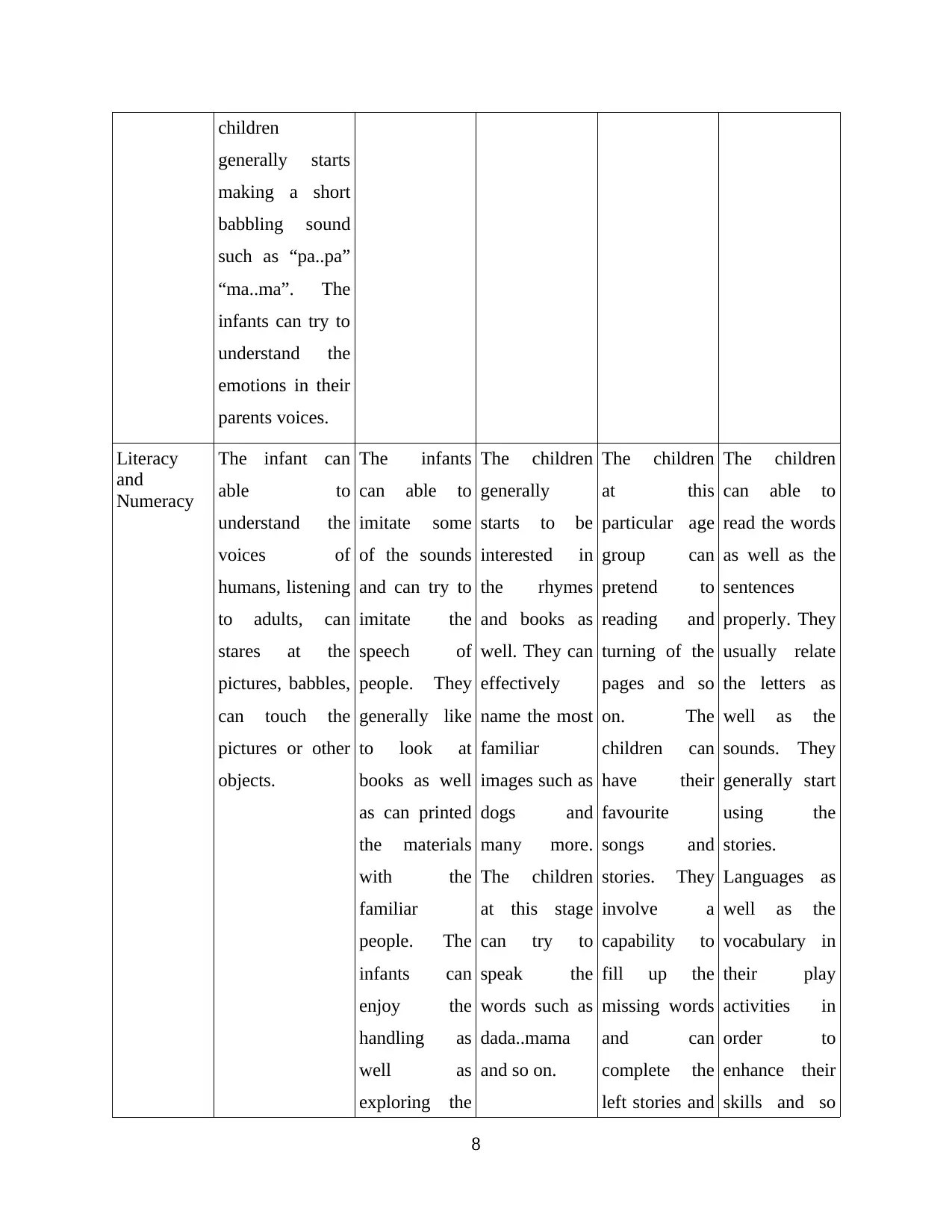
children
generally starts
making a short
babbling sound
such as “pa..pa”
“ma..ma”. The
infants can try to
understand the
emotions in their
parents voices.
Literacy
and
Numeracy
The infant can
able to
understand the
voices of
humans, listening
to adults, can
stares at the
pictures, babbles,
can touch the
pictures or other
objects.
The infants
can able to
imitate some
of the sounds
and can try to
imitate the
speech of
people. They
generally like
to look at
books as well
as can printed
the materials
with the
familiar
people. The
infants can
enjoy the
handling as
well as
exploring the
The children
generally
starts to be
interested in
the rhymes
and books as
well. They can
effectively
name the most
familiar
images such as
dogs and
many more.
The children
at this stage
can try to
speak the
words such as
dada..mama
and so on.
The children
at this
particular age
group can
pretend to
reading and
turning of the
pages and so
on. The
children can
have their
favourite
songs and
stories. They
involve a
capability to
fill up the
missing words
and can
complete the
left stories and
The children
can able to
read the words
as well as the
sentences
properly. They
usually relate
the letters as
well as the
sounds. They
generally start
using the
stories.
Languages as
well as the
vocabulary in
their play
activities in
order to
enhance their
skills and so
8
generally starts
making a short
babbling sound
such as “pa..pa”
“ma..ma”. The
infants can try to
understand the
emotions in their
parents voices.
Literacy
and
Numeracy
The infant can
able to
understand the
voices of
humans, listening
to adults, can
stares at the
pictures, babbles,
can touch the
pictures or other
objects.
The infants
can able to
imitate some
of the sounds
and can try to
imitate the
speech of
people. They
generally like
to look at
books as well
as can printed
the materials
with the
familiar
people. The
infants can
enjoy the
handling as
well as
exploring the
The children
generally
starts to be
interested in
the rhymes
and books as
well. They can
effectively
name the most
familiar
images such as
dogs and
many more.
The children
at this stage
can try to
speak the
words such as
dada..mama
and so on.
The children
at this
particular age
group can
pretend to
reading and
turning of the
pages and so
on. The
children can
have their
favourite
songs and
stories. They
involve a
capability to
fill up the
missing words
and can
complete the
left stories and
The children
can able to
read the words
as well as the
sentences
properly. They
usually relate
the letters as
well as the
sounds. They
generally start
using the
stories.
Languages as
well as the
vocabulary in
their play
activities in
order to
enhance their
skills and so
8
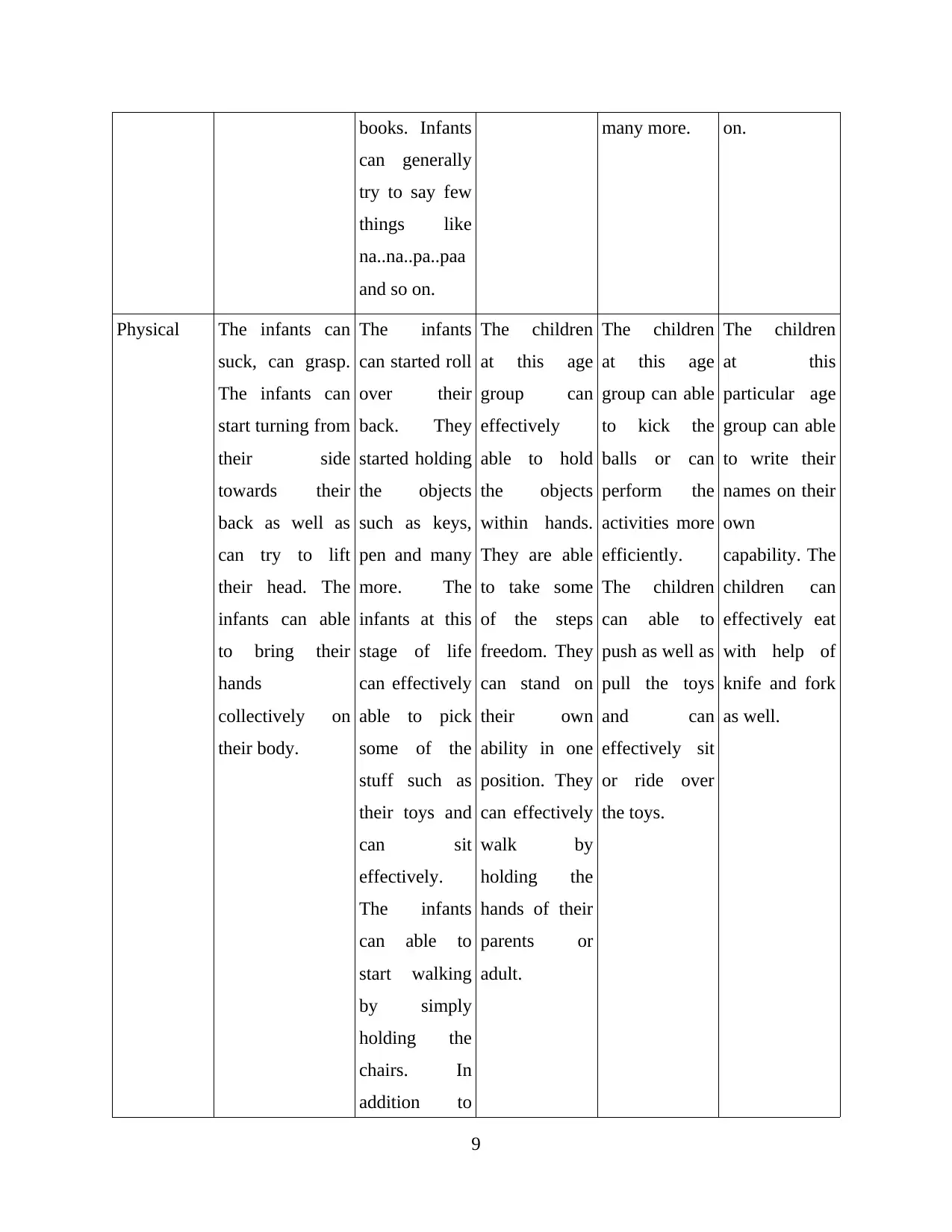
books. Infants
can generally
try to say few
things like
na..na..pa..paa
and so on.
many more. on.
Physical The infants can
suck, can grasp.
The infants can
start turning from
their side
towards their
back as well as
can try to lift
their head. The
infants can able
to bring their
hands
collectively on
their body.
The infants
can started roll
over their
back. They
started holding
the objects
such as keys,
pen and many
more. The
infants at this
stage of life
can effectively
able to pick
some of the
stuff such as
their toys and
can sit
effectively.
The infants
can able to
start walking
by simply
holding the
chairs. In
addition to
The children
at this age
group can
effectively
able to hold
the objects
within hands.
They are able
to take some
of the steps
freedom. They
can stand on
their own
ability in one
position. They
can effectively
walk by
holding the
hands of their
parents or
adult.
The children
at this age
group can able
to kick the
balls or can
perform the
activities more
efficiently.
The children
can able to
push as well as
pull the toys
and can
effectively sit
or ride over
the toys.
The children
at this
particular age
group can able
to write their
names on their
own
capability. The
children can
effectively eat
with help of
knife and fork
as well.
9
can generally
try to say few
things like
na..na..pa..paa
and so on.
many more. on.
Physical The infants can
suck, can grasp.
The infants can
start turning from
their side
towards their
back as well as
can try to lift
their head. The
infants can able
to bring their
hands
collectively on
their body.
The infants
can started roll
over their
back. They
started holding
the objects
such as keys,
pen and many
more. The
infants at this
stage of life
can effectively
able to pick
some of the
stuff such as
their toys and
can sit
effectively.
The infants
can able to
start walking
by simply
holding the
chairs. In
addition to
The children
at this age
group can
effectively
able to hold
the objects
within hands.
They are able
to take some
of the steps
freedom. They
can stand on
their own
ability in one
position. They
can effectively
walk by
holding the
hands of their
parents or
adult.
The children
at this age
group can able
to kick the
balls or can
perform the
activities more
efficiently.
The children
can able to
push as well as
pull the toys
and can
effectively sit
or ride over
the toys.
The children
at this
particular age
group can able
to write their
names on their
own
capability. The
children can
effectively eat
with help of
knife and fork
as well.
9
⊘ This is a preview!⊘
Do you want full access?
Subscribe today to unlock all pages.
Trusted by 1+ million students worldwide
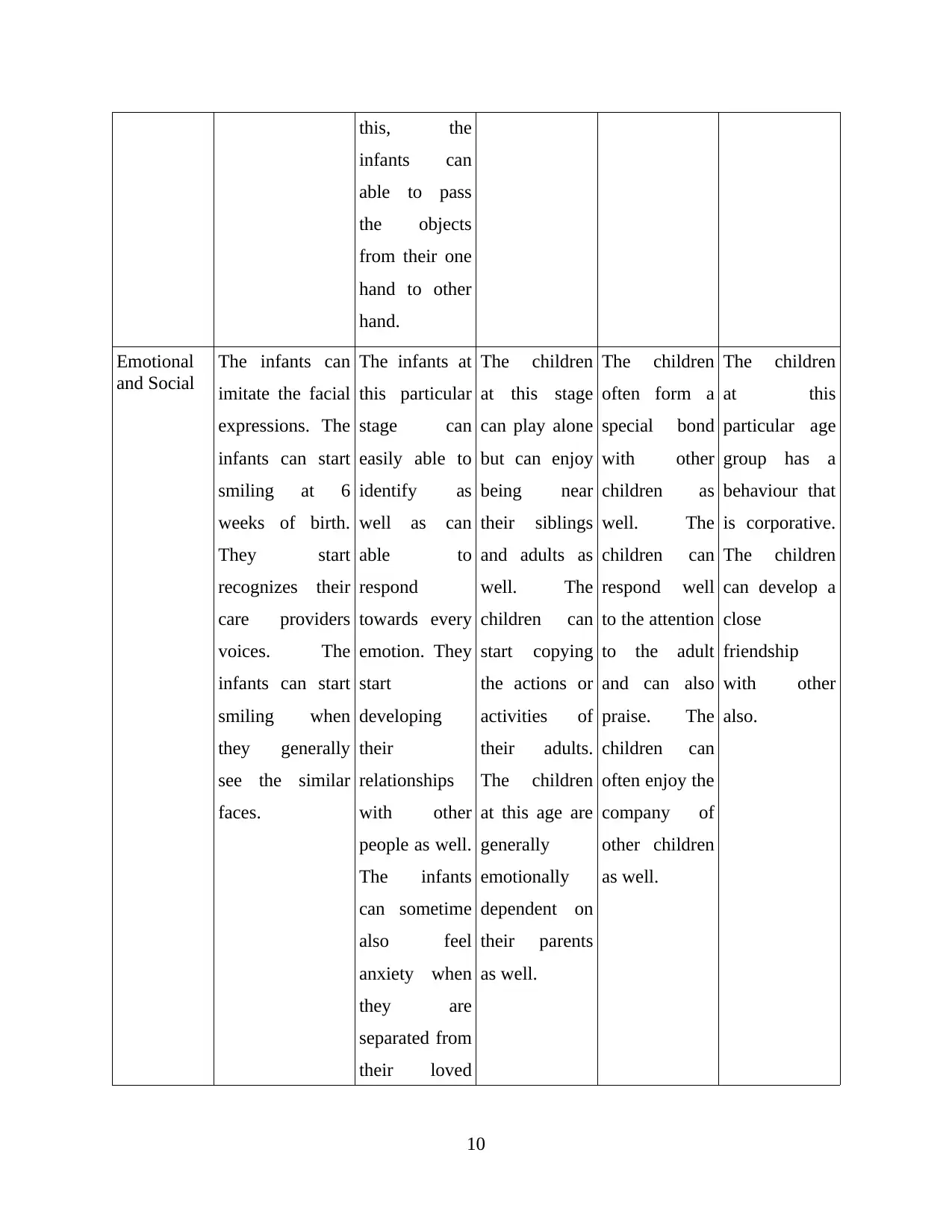
this, the
infants can
able to pass
the objects
from their one
hand to other
hand.
Emotional
and Social
The infants can
imitate the facial
expressions. The
infants can start
smiling at 6
weeks of birth.
They start
recognizes their
care providers
voices. The
infants can start
smiling when
they generally
see the similar
faces.
The infants at
this particular
stage can
easily able to
identify as
well as can
able to
respond
towards every
emotion. They
start
developing
their
relationships
with other
people as well.
The infants
can sometime
also feel
anxiety when
they are
separated from
their loved
The children
at this stage
can play alone
but can enjoy
being near
their siblings
and adults as
well. The
children can
start copying
the actions or
activities of
their adults.
The children
at this age are
generally
emotionally
dependent on
their parents
as well.
The children
often form a
special bond
with other
children as
well. The
children can
respond well
to the attention
to the adult
and can also
praise. The
children can
often enjoy the
company of
other children
as well.
The children
at this
particular age
group has a
behaviour that
is corporative.
The children
can develop a
close
friendship
with other
also.
10
infants can
able to pass
the objects
from their one
hand to other
hand.
Emotional
and Social
The infants can
imitate the facial
expressions. The
infants can start
smiling at 6
weeks of birth.
They start
recognizes their
care providers
voices. The
infants can start
smiling when
they generally
see the similar
faces.
The infants at
this particular
stage can
easily able to
identify as
well as can
able to
respond
towards every
emotion. They
start
developing
their
relationships
with other
people as well.
The infants
can sometime
also feel
anxiety when
they are
separated from
their loved
The children
at this stage
can play alone
but can enjoy
being near
their siblings
and adults as
well. The
children can
start copying
the actions or
activities of
their adults.
The children
at this age are
generally
emotionally
dependent on
their parents
as well.
The children
often form a
special bond
with other
children as
well. The
children can
respond well
to the attention
to the adult
and can also
praise. The
children can
often enjoy the
company of
other children
as well.
The children
at this
particular age
group has a
behaviour that
is corporative.
The children
can develop a
close
friendship
with other
also.
10
Paraphrase This Document
Need a fresh take? Get an instant paraphrase of this document with our AI Paraphraser
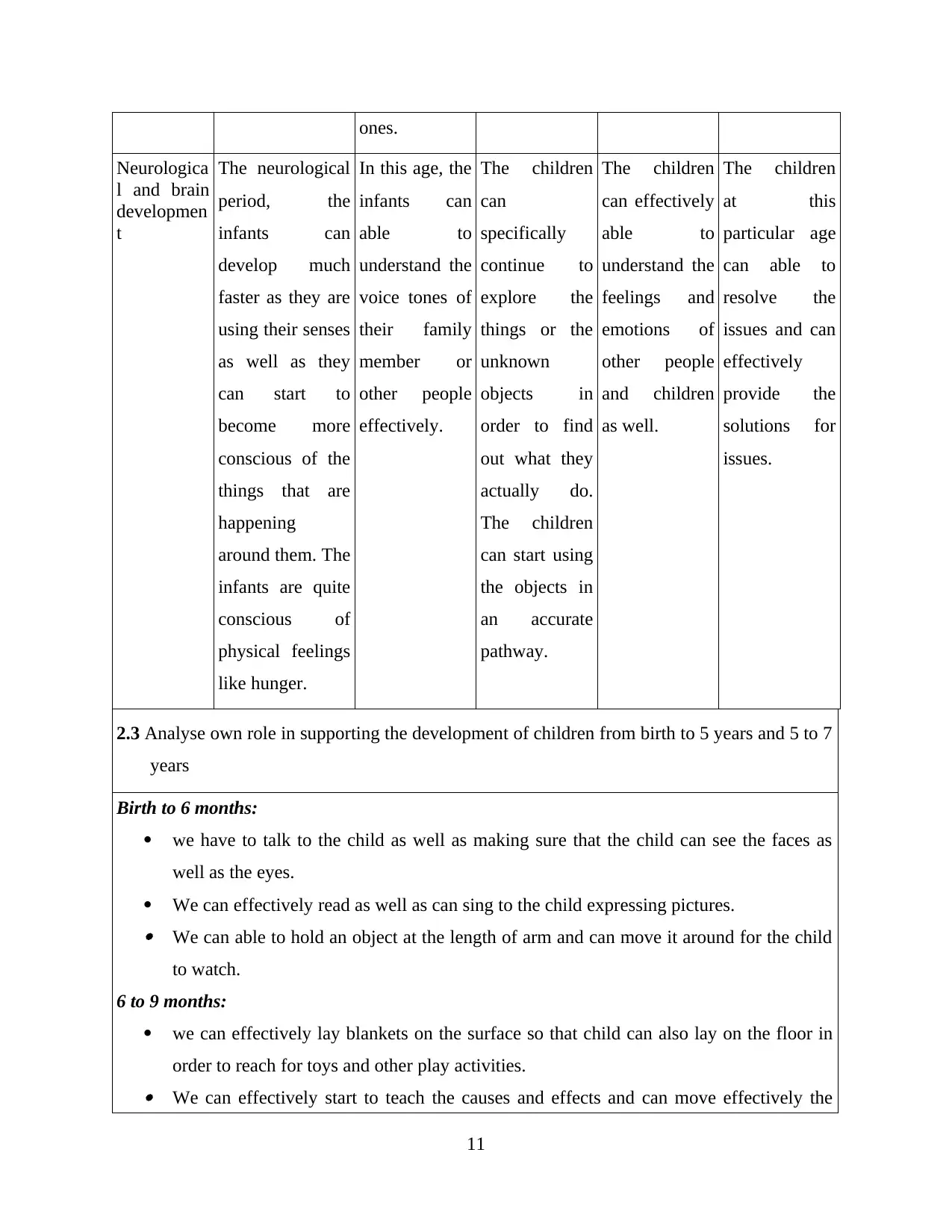
ones.
Neurologica
l and brain
developmen
t
The neurological
period, the
infants can
develop much
faster as they are
using their senses
as well as they
can start to
become more
conscious of the
things that are
happening
around them. The
infants are quite
conscious of
physical feelings
like hunger.
In this age, the
infants can
able to
understand the
voice tones of
their family
member or
other people
effectively.
The children
can
specifically
continue to
explore the
things or the
unknown
objects in
order to find
out what they
actually do.
The children
can start using
the objects in
an accurate
pathway.
The children
can effectively
able to
understand the
feelings and
emotions of
other people
and children
as well.
The children
at this
particular age
can able to
resolve the
issues and can
effectively
provide the
solutions for
issues.
2.3 Analyse own role in supporting the development of children from birth to 5 years and 5 to 7
years
Birth to 6 months:
we have to talk to the child as well as making sure that the child can see the faces as
well as the eyes.
We can effectively read as well as can sing to the child expressing pictures. We can able to hold an object at the length of arm and can move it around for the child
to watch.
6 to 9 months:
we can effectively lay blankets on the surface so that child can also lay on the floor in
order to reach for toys and other play activities. We can effectively start to teach the causes and effects and can move effectively the
11
Neurologica
l and brain
developmen
t
The neurological
period, the
infants can
develop much
faster as they are
using their senses
as well as they
can start to
become more
conscious of the
things that are
happening
around them. The
infants are quite
conscious of
physical feelings
like hunger.
In this age, the
infants can
able to
understand the
voice tones of
their family
member or
other people
effectively.
The children
can
specifically
continue to
explore the
things or the
unknown
objects in
order to find
out what they
actually do.
The children
can start using
the objects in
an accurate
pathway.
The children
can effectively
able to
understand the
feelings and
emotions of
other people
and children
as well.
The children
at this
particular age
can able to
resolve the
issues and can
effectively
provide the
solutions for
issues.
2.3 Analyse own role in supporting the development of children from birth to 5 years and 5 to 7
years
Birth to 6 months:
we have to talk to the child as well as making sure that the child can see the faces as
well as the eyes.
We can effectively read as well as can sing to the child expressing pictures. We can able to hold an object at the length of arm and can move it around for the child
to watch.
6 to 9 months:
we can effectively lay blankets on the surface so that child can also lay on the floor in
order to reach for toys and other play activities. We can effectively start to teach the causes and effects and can move effectively the
11
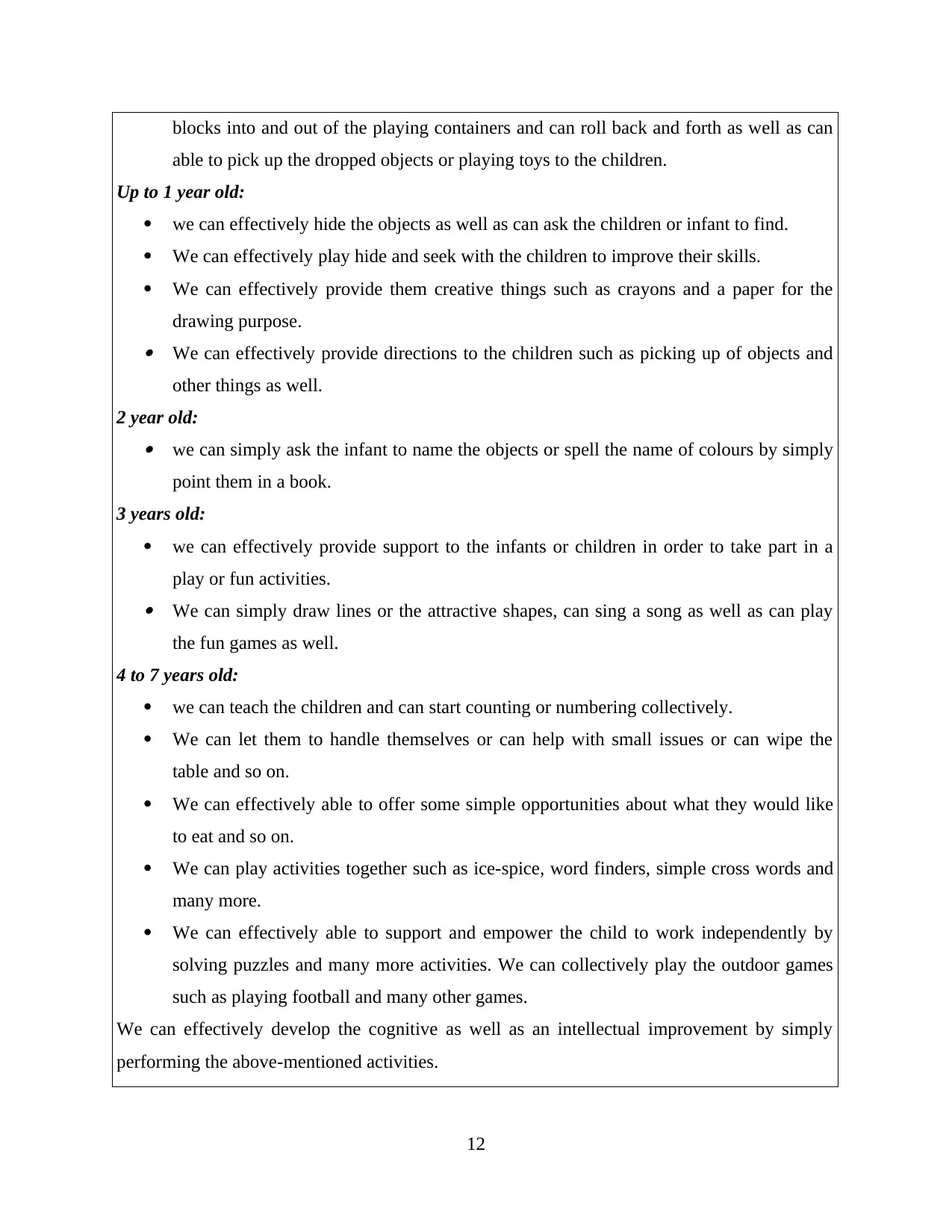
blocks into and out of the playing containers and can roll back and forth as well as can
able to pick up the dropped objects or playing toys to the children.
Up to 1 year old:
we can effectively hide the objects as well as can ask the children or infant to find.
We can effectively play hide and seek with the children to improve their skills.
We can effectively provide them creative things such as crayons and a paper for the
drawing purpose. We can effectively provide directions to the children such as picking up of objects and
other things as well.
2 year old: we can simply ask the infant to name the objects or spell the name of colours by simply
point them in a book.
3 years old:
we can effectively provide support to the infants or children in order to take part in a
play or fun activities. We can simply draw lines or the attractive shapes, can sing a song as well as can play
the fun games as well.
4 to 7 years old:
we can teach the children and can start counting or numbering collectively.
We can let them to handle themselves or can help with small issues or can wipe the
table and so on.
We can effectively able to offer some simple opportunities about what they would like
to eat and so on.
We can play activities together such as ice-spice, word finders, simple cross words and
many more.
We can effectively able to support and empower the child to work independently by
solving puzzles and many more activities. We can collectively play the outdoor games
such as playing football and many other games.
We can effectively develop the cognitive as well as an intellectual improvement by simply
performing the above-mentioned activities.
12
able to pick up the dropped objects or playing toys to the children.
Up to 1 year old:
we can effectively hide the objects as well as can ask the children or infant to find.
We can effectively play hide and seek with the children to improve their skills.
We can effectively provide them creative things such as crayons and a paper for the
drawing purpose. We can effectively provide directions to the children such as picking up of objects and
other things as well.
2 year old: we can simply ask the infant to name the objects or spell the name of colours by simply
point them in a book.
3 years old:
we can effectively provide support to the infants or children in order to take part in a
play or fun activities. We can simply draw lines or the attractive shapes, can sing a song as well as can play
the fun games as well.
4 to 7 years old:
we can teach the children and can start counting or numbering collectively.
We can let them to handle themselves or can help with small issues or can wipe the
table and so on.
We can effectively able to offer some simple opportunities about what they would like
to eat and so on.
We can play activities together such as ice-spice, word finders, simple cross words and
many more.
We can effectively able to support and empower the child to work independently by
solving puzzles and many more activities. We can collectively play the outdoor games
such as playing football and many other games.
We can effectively develop the cognitive as well as an intellectual improvement by simply
performing the above-mentioned activities.
12
⊘ This is a preview!⊘
Do you want full access?
Subscribe today to unlock all pages.
Trusted by 1+ million students worldwide

1 out of 20


Related Documents


Your All-in-One AI-Powered Toolkit for Academic Success.
+13062052269
info@desklib.com
Available 24*7 on WhatsApp / Email
![[object Object]](/_next/static/media/star-bottom.7253800d.svg)
Unlock your academic potential
Copyright © 2020–2026 A2Z Services. All Rights Reserved. Developed and managed by ZUCOL.