Theorizing/Resisting McDonaldization: A Multiperspectivist Approach
VerifiedAdded on 2022/01/20
|19
|10899
|247
Essay
AI Summary
This essay critically examines George Ritzer's theory of McDonaldization, exploring its strengths and weaknesses while offering alternative perspectives. The author argues that Ritzer's analysis, while insightful, inadequately addresses the cultural dimensions of McDonaldization and fails to distinguish between McDonald's as a company and the broader societal phenomenon. The essay draws on cultural studies to supplement Ritzer's analysis, questioning whether McDonaldization is a product of modernity or postmodernity. It critiques Ritzer's standpoint of critique and proposes a multiperspectivist approach to better evaluate the complex aspects and effects of McDonald's and McDonaldization. The analysis incorporates Weberian concepts, discusses the rationalization of production and consumption, and highlights the ideological and cultural dimensions often overlooked by Ritzer, such as advertising and consumer practices. The essay suggests a need for a more nuanced understanding of McDonaldization, considering its subjective aspects and the various ways individuals and groups utilize it, proposing a "plastic fun house" metaphor to capture the cultural side more effectively. The author emphasizes the importance of considering the diversity of consumer experiences and practices across different regions and demographics to gain a comprehensive understanding of the phenomenon.
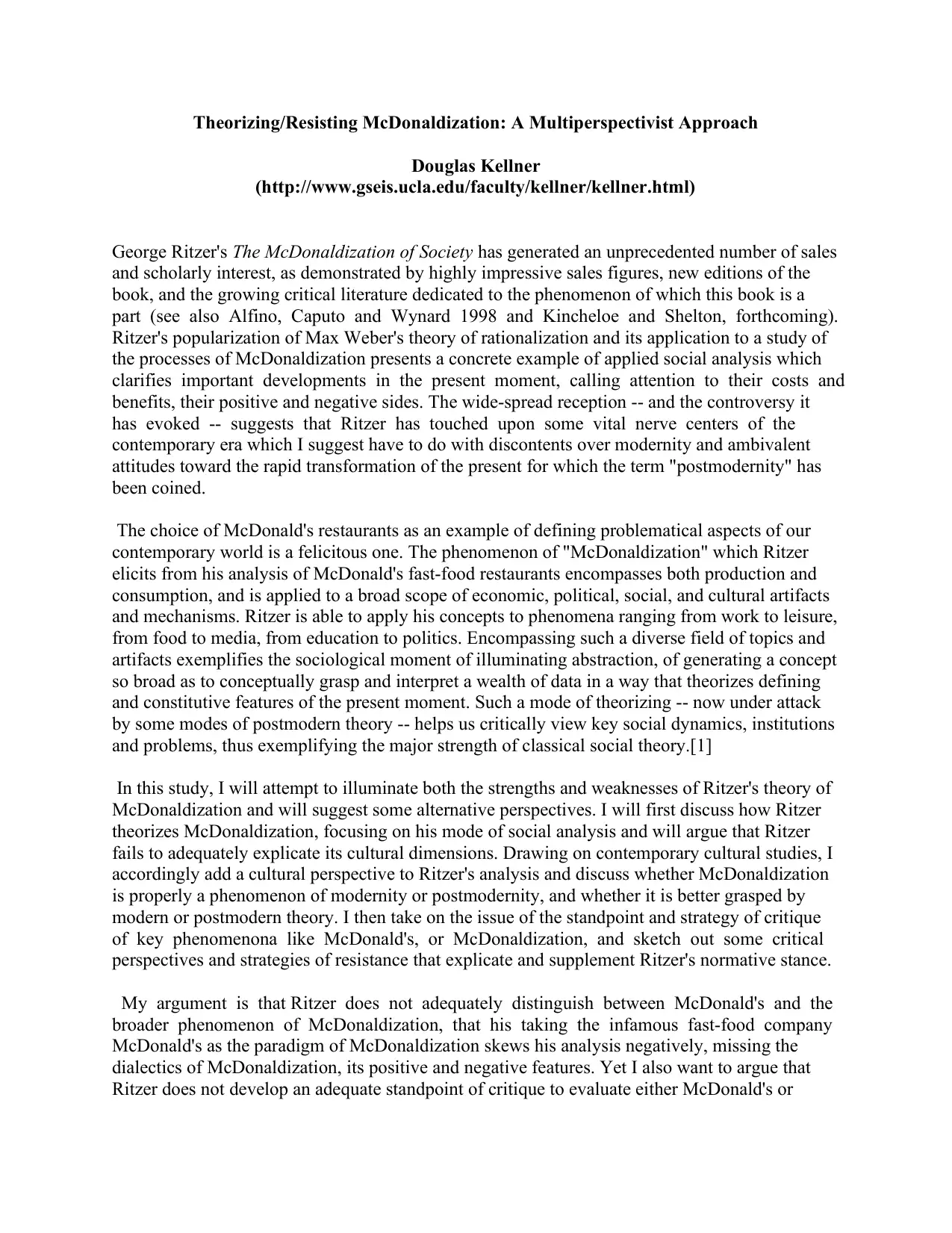
Theorizing/Resisting McDonaldization: A Multiperspectivist Approach
Douglas Kellner
(http://www.gseis.ucla.edu/faculty/kellner/kellner.html)
George Ritzer's The McDonaldization of Society has generated an unprecedented number of sales
and scholarly interest, as demonstrated by highly impressive sales figures, new editions of the
book, and the growing critical literature dedicated to the phenomenon of which this book is a
part (see also Alfino, Caputo and Wynard 1998 and Kincheloe and Shelton, forthcoming).
Ritzer's popularization of Max Weber's theory of rationalization and its application to a study of
the processes of McDonaldization presents a concrete example of applied social analysis which
clarifies important developments in the present moment, calling attention to their costs and
benefits, their positive and negative sides. The wide-spread reception -- and the controversy it
has evoked -- suggests that Ritzer has touched upon some vital nerve centers of the
contemporary era which I suggest have to do with discontents over modernity and ambivalent
attitudes toward the rapid transformation of the present for which the term "postmodernity" has
been coined.
The choice of McDonald's restaurants as an example of defining problematical aspects of our
contemporary world is a felicitous one. The phenomenon of "McDonaldization" which Ritzer
elicits from his analysis of McDonald's fast-food restaurants encompasses both production and
consumption, and is applied to a broad scope of economic, political, social, and cultural artifacts
and mechanisms. Ritzer is able to apply his concepts to phenomena ranging from work to leisure,
from food to media, from education to politics. Encompassing such a diverse field of topics and
artifacts exemplifies the sociological moment of illuminating abstraction, of generating a concept
so broad as to conceptually grasp and interpret a wealth of data in a way that theorizes defining
and constitutive features of the present moment. Such a mode of theorizing -- now under attack
by some modes of postmodern theory -- helps us critically view key social dynamics, institutions
and problems, thus exemplifying the major strength of classical social theory.[1]
In this study, I will attempt to illuminate both the strengths and weaknesses of Ritzer's theory of
McDonaldization and will suggest some alternative perspectives. I will first discuss how Ritzer
theorizes McDonaldization, focusing on his mode of social analysis and will argue that Ritzer
fails to adequately explicate its cultural dimensions. Drawing on contemporary cultural studies, I
accordingly add a cultural perspective to Ritzer's analysis and discuss whether McDonaldization
is properly a phenomenon of modernity or postmodernity, and whether it is better grasped by
modern or postmodern theory. I then take on the issue of the standpoint and strategy of critique
of key phenomenona like McDonald's, or McDonaldization, and sketch out some critical
perspectives and strategies of resistance that explicate and supplement Ritzer's normative stance.
My argument is that Ritzer does not adequately distinguish between McDonald's and the
broader phenomenon of McDonaldization, that his taking the infamous fast-food company
McDonald's as the paradigm of McDonaldization skews his analysis negatively, missing the
dialectics of McDonaldization, its positive and negative features. Yet I also want to argue that
Ritzer does not develop an adequate standpoint of critique to evaluate either McDonald's or
Douglas Kellner
(http://www.gseis.ucla.edu/faculty/kellner/kellner.html)
George Ritzer's The McDonaldization of Society has generated an unprecedented number of sales
and scholarly interest, as demonstrated by highly impressive sales figures, new editions of the
book, and the growing critical literature dedicated to the phenomenon of which this book is a
part (see also Alfino, Caputo and Wynard 1998 and Kincheloe and Shelton, forthcoming).
Ritzer's popularization of Max Weber's theory of rationalization and its application to a study of
the processes of McDonaldization presents a concrete example of applied social analysis which
clarifies important developments in the present moment, calling attention to their costs and
benefits, their positive and negative sides. The wide-spread reception -- and the controversy it
has evoked -- suggests that Ritzer has touched upon some vital nerve centers of the
contemporary era which I suggest have to do with discontents over modernity and ambivalent
attitudes toward the rapid transformation of the present for which the term "postmodernity" has
been coined.
The choice of McDonald's restaurants as an example of defining problematical aspects of our
contemporary world is a felicitous one. The phenomenon of "McDonaldization" which Ritzer
elicits from his analysis of McDonald's fast-food restaurants encompasses both production and
consumption, and is applied to a broad scope of economic, political, social, and cultural artifacts
and mechanisms. Ritzer is able to apply his concepts to phenomena ranging from work to leisure,
from food to media, from education to politics. Encompassing such a diverse field of topics and
artifacts exemplifies the sociological moment of illuminating abstraction, of generating a concept
so broad as to conceptually grasp and interpret a wealth of data in a way that theorizes defining
and constitutive features of the present moment. Such a mode of theorizing -- now under attack
by some modes of postmodern theory -- helps us critically view key social dynamics, institutions
and problems, thus exemplifying the major strength of classical social theory.[1]
In this study, I will attempt to illuminate both the strengths and weaknesses of Ritzer's theory of
McDonaldization and will suggest some alternative perspectives. I will first discuss how Ritzer
theorizes McDonaldization, focusing on his mode of social analysis and will argue that Ritzer
fails to adequately explicate its cultural dimensions. Drawing on contemporary cultural studies, I
accordingly add a cultural perspective to Ritzer's analysis and discuss whether McDonaldization
is properly a phenomenon of modernity or postmodernity, and whether it is better grasped by
modern or postmodern theory. I then take on the issue of the standpoint and strategy of critique
of key phenomenona like McDonald's, or McDonaldization, and sketch out some critical
perspectives and strategies of resistance that explicate and supplement Ritzer's normative stance.
My argument is that Ritzer does not adequately distinguish between McDonald's and the
broader phenomenon of McDonaldization, that his taking the infamous fast-food company
McDonald's as the paradigm of McDonaldization skews his analysis negatively, missing the
dialectics of McDonaldization, its positive and negative features. Yet I also want to argue that
Ritzer does not develop an adequate standpoint of critique to evaluate either McDonald's or

Paraphrase This Document
Need a fresh take? Get an instant paraphrase of this document with our AI Paraphraser
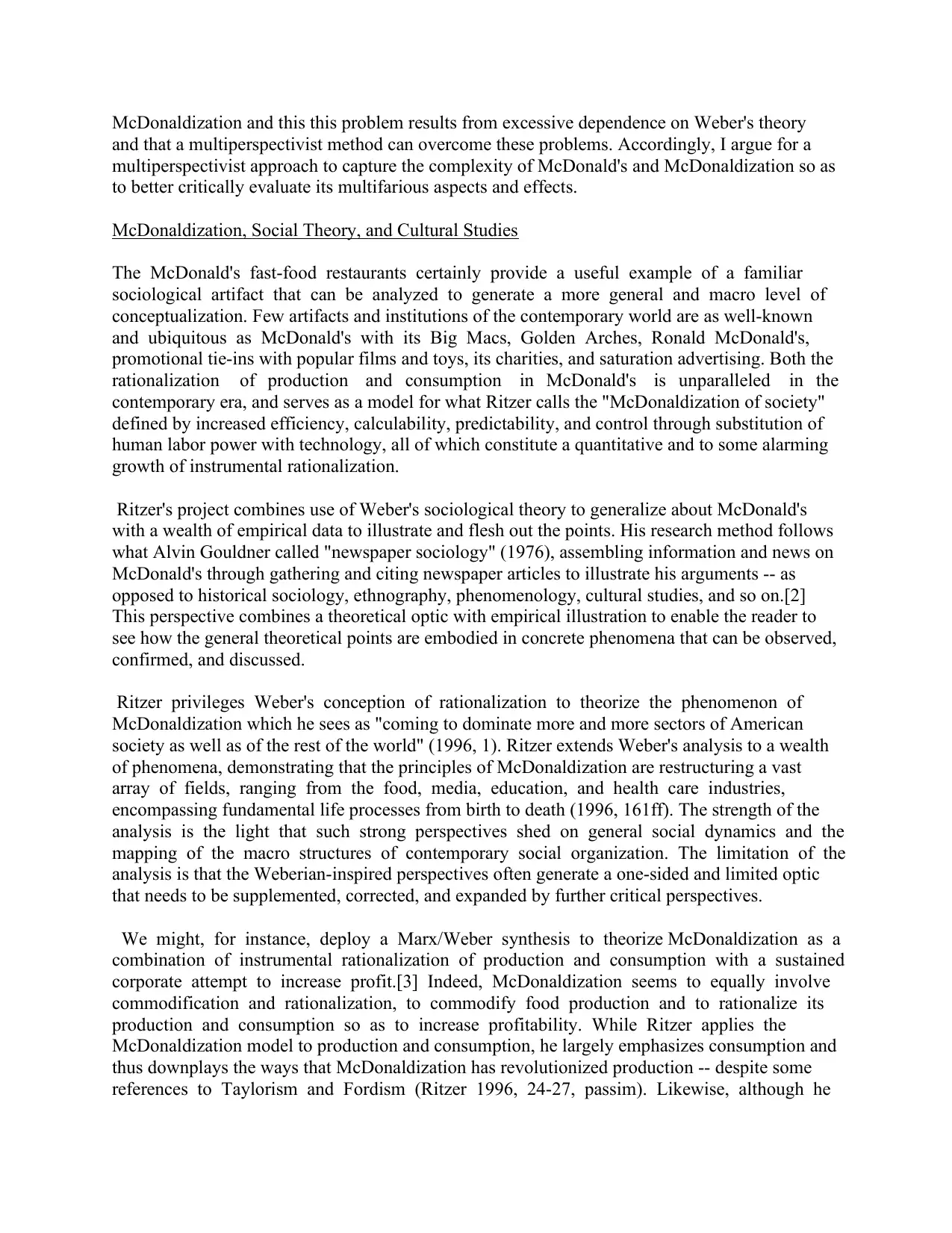
McDonaldization and this this problem results from excessive dependence on Weber's theory
and that a multiperspectivist method can overcome these problems. Accordingly, I argue for a
multiperspectivist approach to capture the complexity of McDonald's and McDonaldization so as
to better critically evaluate its multifarious aspects and effects.
McDonaldization, Social Theory, and Cultural Studies
The McDonald's fast-food restaurants certainly provide a useful example of a familiar
sociological artifact that can be analyzed to generate a more general and macro level of
conceptualization. Few artifacts and institutions of the contemporary world are as well-known
and ubiquitous as McDonald's with its Big Macs, Golden Arches, Ronald McDonald's,
promotional tie-ins with popular films and toys, its charities, and saturation advertising. Both the
rationalization of production and consumption in McDonald's is unparalleled in the
contemporary era, and serves as a model for what Ritzer calls the "McDonaldization of society"
defined by increased efficiency, calculability, predictability, and control through substitution of
human labor power with technology, all of which constitute a quantitative and to some alarming
growth of instrumental rationalization.
Ritzer's project combines use of Weber's sociological theory to generalize about McDonald's
with a wealth of empirical data to illustrate and flesh out the points. His research method follows
what Alvin Gouldner called "newspaper sociology" (1976), assembling information and news on
McDonald's through gathering and citing newspaper articles to illustrate his arguments -- as
opposed to historical sociology, ethnography, phenomenology, cultural studies, and so on.[2]
This perspective combines a theoretical optic with empirical illustration to enable the reader to
see how the general theoretical points are embodied in concrete phenomena that can be observed,
confirmed, and discussed.
Ritzer privileges Weber's conception of rationalization to theorize the phenomenon of
McDonaldization which he sees as "coming to dominate more and more sectors of American
society as well as of the rest of the world" (1996, 1). Ritzer extends Weber's analysis to a wealth
of phenomena, demonstrating that the principles of McDonaldization are restructuring a vast
array of fields, ranging from the food, media, education, and health care industries,
encompassing fundamental life processes from birth to death (1996, 161ff). The strength of the
analysis is the light that such strong perspectives shed on general social dynamics and the
mapping of the macro structures of contemporary social organization. The limitation of the
analysis is that the Weberian-inspired perspectives often generate a one-sided and limited optic
that needs to be supplemented, corrected, and expanded by further critical perspectives.
We might, for instance, deploy a Marx/Weber synthesis to theorize McDonaldization as a
combination of instrumental rationalization of production and consumption with a sustained
corporate attempt to increase profit.[3] Indeed, McDonaldization seems to equally involve
commodification and rationalization, to commodify food production and to rationalize its
production and consumption so as to increase profitability. While Ritzer applies the
McDonaldization model to production and consumption, he largely emphasizes consumption and
thus downplays the ways that McDonaldization has revolutionized production -- despite some
references to Taylorism and Fordism (Ritzer 1996, 24-27, passim). Likewise, although he
and that a multiperspectivist method can overcome these problems. Accordingly, I argue for a
multiperspectivist approach to capture the complexity of McDonald's and McDonaldization so as
to better critically evaluate its multifarious aspects and effects.
McDonaldization, Social Theory, and Cultural Studies
The McDonald's fast-food restaurants certainly provide a useful example of a familiar
sociological artifact that can be analyzed to generate a more general and macro level of
conceptualization. Few artifacts and institutions of the contemporary world are as well-known
and ubiquitous as McDonald's with its Big Macs, Golden Arches, Ronald McDonald's,
promotional tie-ins with popular films and toys, its charities, and saturation advertising. Both the
rationalization of production and consumption in McDonald's is unparalleled in the
contemporary era, and serves as a model for what Ritzer calls the "McDonaldization of society"
defined by increased efficiency, calculability, predictability, and control through substitution of
human labor power with technology, all of which constitute a quantitative and to some alarming
growth of instrumental rationalization.
Ritzer's project combines use of Weber's sociological theory to generalize about McDonald's
with a wealth of empirical data to illustrate and flesh out the points. His research method follows
what Alvin Gouldner called "newspaper sociology" (1976), assembling information and news on
McDonald's through gathering and citing newspaper articles to illustrate his arguments -- as
opposed to historical sociology, ethnography, phenomenology, cultural studies, and so on.[2]
This perspective combines a theoretical optic with empirical illustration to enable the reader to
see how the general theoretical points are embodied in concrete phenomena that can be observed,
confirmed, and discussed.
Ritzer privileges Weber's conception of rationalization to theorize the phenomenon of
McDonaldization which he sees as "coming to dominate more and more sectors of American
society as well as of the rest of the world" (1996, 1). Ritzer extends Weber's analysis to a wealth
of phenomena, demonstrating that the principles of McDonaldization are restructuring a vast
array of fields, ranging from the food, media, education, and health care industries,
encompassing fundamental life processes from birth to death (1996, 161ff). The strength of the
analysis is the light that such strong perspectives shed on general social dynamics and the
mapping of the macro structures of contemporary social organization. The limitation of the
analysis is that the Weberian-inspired perspectives often generate a one-sided and limited optic
that needs to be supplemented, corrected, and expanded by further critical perspectives.
We might, for instance, deploy a Marx/Weber synthesis to theorize McDonaldization as a
combination of instrumental rationalization of production and consumption with a sustained
corporate attempt to increase profit.[3] Indeed, McDonaldization seems to equally involve
commodification and rationalization, to commodify food production and to rationalize its
production and consumption so as to increase profitability. While Ritzer applies the
McDonaldization model to production and consumption, he largely emphasizes consumption and
thus downplays the ways that McDonaldization has revolutionized production -- despite some
references to Taylorism and Fordism (Ritzer 1996, 24-27, passim). Likewise, although he
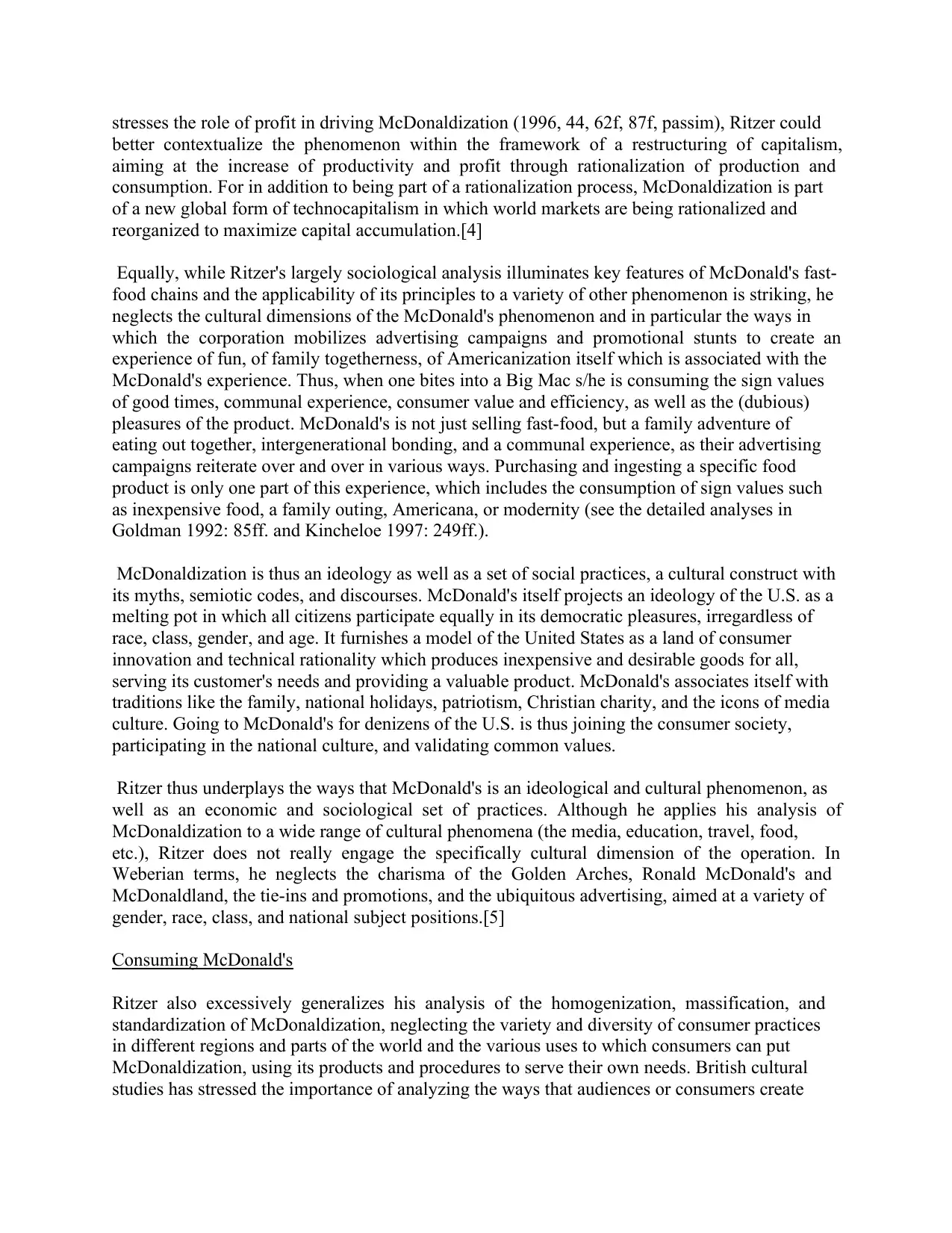
stresses the role of profit in driving McDonaldization (1996, 44, 62f, 87f, passim), Ritzer could
better contextualize the phenomenon within the framework of a restructuring of capitalism,
aiming at the increase of productivity and profit through rationalization of production and
consumption. For in addition to being part of a rationalization process, McDonaldization is part
of a new global form of technocapitalism in which world markets are being rationalized and
reorganized to maximize capital accumulation.[4]
Equally, while Ritzer's largely sociological analysis illuminates key features of McDonald's fast-
food chains and the applicability of its principles to a variety of other phenomenon is striking, he
neglects the cultural dimensions of the McDonald's phenomenon and in particular the ways in
which the corporation mobilizes advertising campaigns and promotional stunts to create an
experience of fun, of family togetherness, of Americanization itself which is associated with the
McDonald's experience. Thus, when one bites into a Big Mac s/he is consuming the sign values
of good times, communal experience, consumer value and efficiency, as well as the (dubious)
pleasures of the product. McDonald's is not just selling fast-food, but a family adventure of
eating out together, intergenerational bonding, and a communal experience, as their advertising
campaigns reiterate over and over in various ways. Purchasing and ingesting a specific food
product is only one part of this experience, which includes the consumption of sign values such
as inexpensive food, a family outing, Americana, or modernity (see the detailed analyses in
Goldman 1992: 85ff. and Kincheloe 1997: 249ff.).
McDonaldization is thus an ideology as well as a set of social practices, a cultural construct with
its myths, semiotic codes, and discourses. McDonald's itself projects an ideology of the U.S. as a
melting pot in which all citizens participate equally in its democratic pleasures, irregardless of
race, class, gender, and age. It furnishes a model of the United States as a land of consumer
innovation and technical rationality which produces inexpensive and desirable goods for all,
serving its customer's needs and providing a valuable product. McDonald's associates itself with
traditions like the family, national holidays, patriotism, Christian charity, and the icons of media
culture. Going to McDonald's for denizens of the U.S. is thus joining the consumer society,
participating in the national culture, and validating common values.
Ritzer thus underplays the ways that McDonald's is an ideological and cultural phenomenon, as
well as an economic and sociological set of practices. Although he applies his analysis of
McDonaldization to a wide range of cultural phenomena (the media, education, travel, food,
etc.), Ritzer does not really engage the specifically cultural dimension of the operation. In
Weberian terms, he neglects the charisma of the Golden Arches, Ronald McDonald's and
McDonaldland, the tie-ins and promotions, and the ubiquitous advertising, aimed at a variety of
gender, race, class, and national subject positions.[5]
Consuming McDonald's
Ritzer also excessively generalizes his analysis of the homogenization, massification, and
standardization of McDonaldization, neglecting the variety and diversity of consumer practices
in different regions and parts of the world and the various uses to which consumers can put
McDonaldization, using its products and procedures to serve their own needs. British cultural
studies has stressed the importance of analyzing the ways that audiences or consumers create
better contextualize the phenomenon within the framework of a restructuring of capitalism,
aiming at the increase of productivity and profit through rationalization of production and
consumption. For in addition to being part of a rationalization process, McDonaldization is part
of a new global form of technocapitalism in which world markets are being rationalized and
reorganized to maximize capital accumulation.[4]
Equally, while Ritzer's largely sociological analysis illuminates key features of McDonald's fast-
food chains and the applicability of its principles to a variety of other phenomenon is striking, he
neglects the cultural dimensions of the McDonald's phenomenon and in particular the ways in
which the corporation mobilizes advertising campaigns and promotional stunts to create an
experience of fun, of family togetherness, of Americanization itself which is associated with the
McDonald's experience. Thus, when one bites into a Big Mac s/he is consuming the sign values
of good times, communal experience, consumer value and efficiency, as well as the (dubious)
pleasures of the product. McDonald's is not just selling fast-food, but a family adventure of
eating out together, intergenerational bonding, and a communal experience, as their advertising
campaigns reiterate over and over in various ways. Purchasing and ingesting a specific food
product is only one part of this experience, which includes the consumption of sign values such
as inexpensive food, a family outing, Americana, or modernity (see the detailed analyses in
Goldman 1992: 85ff. and Kincheloe 1997: 249ff.).
McDonaldization is thus an ideology as well as a set of social practices, a cultural construct with
its myths, semiotic codes, and discourses. McDonald's itself projects an ideology of the U.S. as a
melting pot in which all citizens participate equally in its democratic pleasures, irregardless of
race, class, gender, and age. It furnishes a model of the United States as a land of consumer
innovation and technical rationality which produces inexpensive and desirable goods for all,
serving its customer's needs and providing a valuable product. McDonald's associates itself with
traditions like the family, national holidays, patriotism, Christian charity, and the icons of media
culture. Going to McDonald's for denizens of the U.S. is thus joining the consumer society,
participating in the national culture, and validating common values.
Ritzer thus underplays the ways that McDonald's is an ideological and cultural phenomenon, as
well as an economic and sociological set of practices. Although he applies his analysis of
McDonaldization to a wide range of cultural phenomena (the media, education, travel, food,
etc.), Ritzer does not really engage the specifically cultural dimension of the operation. In
Weberian terms, he neglects the charisma of the Golden Arches, Ronald McDonald's and
McDonaldland, the tie-ins and promotions, and the ubiquitous advertising, aimed at a variety of
gender, race, class, and national subject positions.[5]
Consuming McDonald's
Ritzer also excessively generalizes his analysis of the homogenization, massification, and
standardization of McDonaldization, neglecting the variety and diversity of consumer practices
in different regions and parts of the world and the various uses to which consumers can put
McDonaldization, using its products and procedures to serve their own needs. British cultural
studies has stressed the importance of analyzing the ways that audiences or consumers create
⊘ This is a preview!⊘
Do you want full access?
Subscribe today to unlock all pages.

Trusted by 1+ million students worldwide
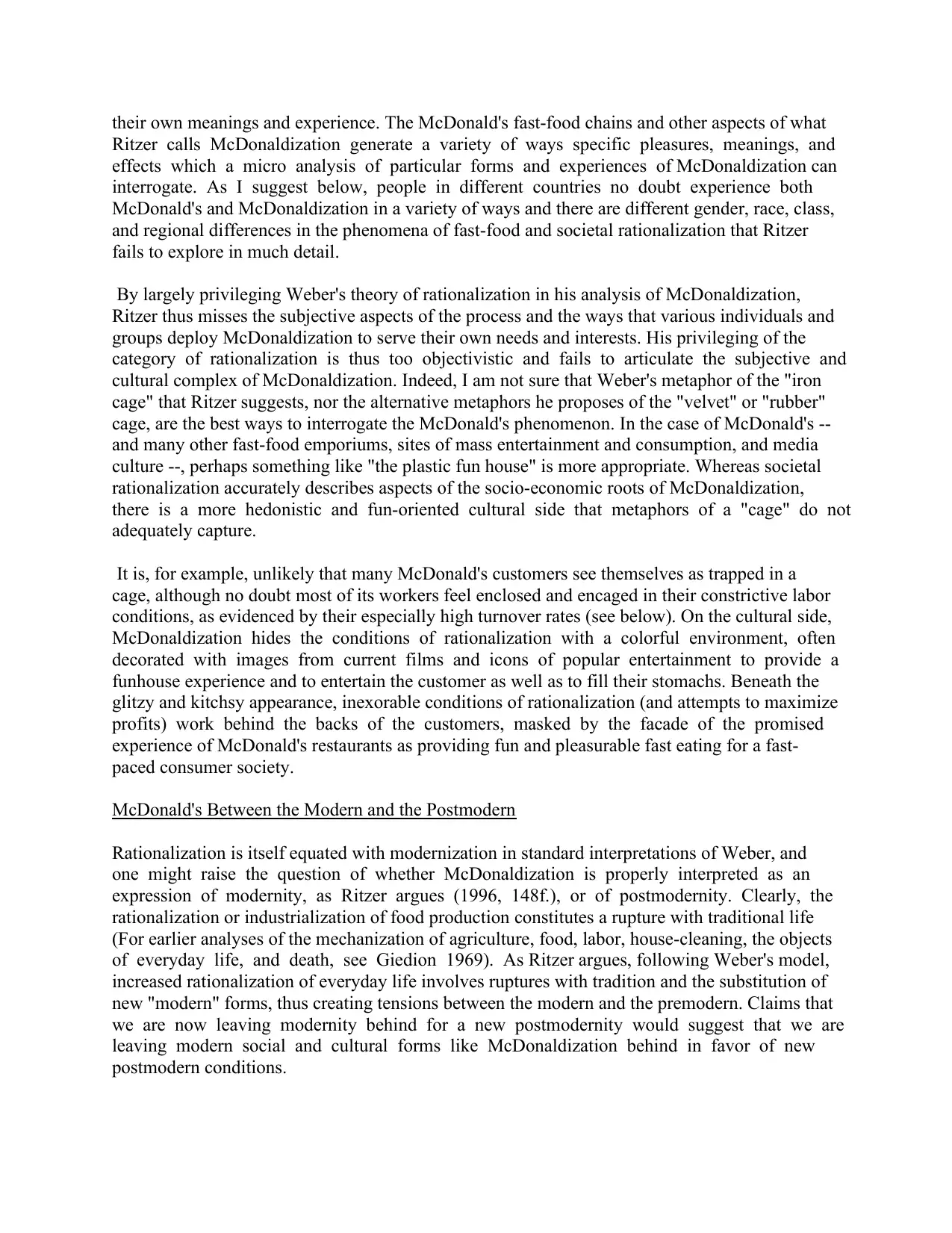
their own meanings and experience. The McDonald's fast-food chains and other aspects of what
Ritzer calls McDonaldization generate a variety of ways specific pleasures, meanings, and
effects which a micro analysis of particular forms and experiences of McDonaldization can
interrogate. As I suggest below, people in different countries no doubt experience both
McDonald's and McDonaldization in a variety of ways and there are different gender, race, class,
and regional differences in the phenomena of fast-food and societal rationalization that Ritzer
fails to explore in much detail.
By largely privileging Weber's theory of rationalization in his analysis of McDonaldization,
Ritzer thus misses the subjective aspects of the process and the ways that various individuals and
groups deploy McDonaldization to serve their own needs and interests. His privileging of the
category of rationalization is thus too objectivistic and fails to articulate the subjective and
cultural complex of McDonaldization. Indeed, I am not sure that Weber's metaphor of the "iron
cage" that Ritzer suggests, nor the alternative metaphors he proposes of the "velvet" or "rubber"
cage, are the best ways to interrogate the McDonald's phenomenon. In the case of McDonald's --
and many other fast-food emporiums, sites of mass entertainment and consumption, and media
culture --, perhaps something like "the plastic fun house" is more appropriate. Whereas societal
rationalization accurately describes aspects of the socio-economic roots of McDonaldization,
there is a more hedonistic and fun-oriented cultural side that metaphors of a "cage" do not
adequately capture.
It is, for example, unlikely that many McDonald's customers see themselves as trapped in a
cage, although no doubt most of its workers feel enclosed and encaged in their constrictive labor
conditions, as evidenced by their especially high turnover rates (see below). On the cultural side,
McDonaldization hides the conditions of rationalization with a colorful environment, often
decorated with images from current films and icons of popular entertainment to provide a
funhouse experience and to entertain the customer as well as to fill their stomachs. Beneath the
glitzy and kitchsy appearance, inexorable conditions of rationalization (and attempts to maximize
profits) work behind the backs of the customers, masked by the facade of the promised
experience of McDonald's restaurants as providing fun and pleasurable fast eating for a fast-
paced consumer society.
McDonald's Between the Modern and the Postmodern
Rationalization is itself equated with modernization in standard interpretations of Weber, and
one might raise the question of whether McDonaldization is properly interpreted as an
expression of modernity, as Ritzer argues (1996, 148f.), or of postmodernity. Clearly, the
rationalization or industrialization of food production constitutes a rupture with traditional life
(For earlier analyses of the mechanization of agriculture, food, labor, house-cleaning, the objects
of everyday life, and death, see Giedion 1969). As Ritzer argues, following Weber's model,
increased rationalization of everyday life involves ruptures with tradition and the substitution of
new "modern" forms, thus creating tensions between the modern and the premodern. Claims that
we are now leaving modernity behind for a new postmodernity would suggest that we are
leaving modern social and cultural forms like McDonaldization behind in favor of new
postmodern conditions.
Ritzer calls McDonaldization generate a variety of ways specific pleasures, meanings, and
effects which a micro analysis of particular forms and experiences of McDonaldization can
interrogate. As I suggest below, people in different countries no doubt experience both
McDonald's and McDonaldization in a variety of ways and there are different gender, race, class,
and regional differences in the phenomena of fast-food and societal rationalization that Ritzer
fails to explore in much detail.
By largely privileging Weber's theory of rationalization in his analysis of McDonaldization,
Ritzer thus misses the subjective aspects of the process and the ways that various individuals and
groups deploy McDonaldization to serve their own needs and interests. His privileging of the
category of rationalization is thus too objectivistic and fails to articulate the subjective and
cultural complex of McDonaldization. Indeed, I am not sure that Weber's metaphor of the "iron
cage" that Ritzer suggests, nor the alternative metaphors he proposes of the "velvet" or "rubber"
cage, are the best ways to interrogate the McDonald's phenomenon. In the case of McDonald's --
and many other fast-food emporiums, sites of mass entertainment and consumption, and media
culture --, perhaps something like "the plastic fun house" is more appropriate. Whereas societal
rationalization accurately describes aspects of the socio-economic roots of McDonaldization,
there is a more hedonistic and fun-oriented cultural side that metaphors of a "cage" do not
adequately capture.
It is, for example, unlikely that many McDonald's customers see themselves as trapped in a
cage, although no doubt most of its workers feel enclosed and encaged in their constrictive labor
conditions, as evidenced by their especially high turnover rates (see below). On the cultural side,
McDonaldization hides the conditions of rationalization with a colorful environment, often
decorated with images from current films and icons of popular entertainment to provide a
funhouse experience and to entertain the customer as well as to fill their stomachs. Beneath the
glitzy and kitchsy appearance, inexorable conditions of rationalization (and attempts to maximize
profits) work behind the backs of the customers, masked by the facade of the promised
experience of McDonald's restaurants as providing fun and pleasurable fast eating for a fast-
paced consumer society.
McDonald's Between the Modern and the Postmodern
Rationalization is itself equated with modernization in standard interpretations of Weber, and
one might raise the question of whether McDonaldization is properly interpreted as an
expression of modernity, as Ritzer argues (1996, 148f.), or of postmodernity. Clearly, the
rationalization or industrialization of food production constitutes a rupture with traditional life
(For earlier analyses of the mechanization of agriculture, food, labor, house-cleaning, the objects
of everyday life, and death, see Giedion 1969). As Ritzer argues, following Weber's model,
increased rationalization of everyday life involves ruptures with tradition and the substitution of
new "modern" forms, thus creating tensions between the modern and the premodern. Claims that
we are now leaving modernity behind for a new postmodernity would suggest that we are
leaving modern social and cultural forms like McDonaldization behind in favor of new
postmodern conditions.
Paraphrase This Document
Need a fresh take? Get an instant paraphrase of this document with our AI Paraphraser
Against extreme binary either/or positions which would hold that we are either within modernity
or a new postmodernity, I would argue that we are currently between the modern and the
postmodern, in a borderline space between two cultural and social paradigms (Kellner 1995; Best
and Kellner 1997), and that there are identifiable features of both the modern and the postmodern
involved in McDonaldization. In particular, McDonaldization as a rationalization of production
and consumption is clearly modern in inspiration and form, whereas the proliferation of sign
value in the McDonald's experience through advertising and publicity stunts has postmodern
ramifications, as its consumers enter a quasi-mythical hyperreal world of Americana, family fun,
and good times.[6]
In other words, I would argue that whereas initially McDonaldization was preeminently an
expression of modernity in its mass production and consumption of food, it crossed the
postmodern divide through its phantasmagoric advertising and commodity spectacle, drawing its
customers into a world of simulation, hyperreality, and the implosion of boundaries, especially as
it became globalized and part of postmodern hybridization that synthesizes signs of modernity
with local traditions and culture. Thus, it seems to me a mistake to either insist that
McDonaldization is primarily an expression of modernity or of postmodernity, for it is arguably
both. Indeed, McDonaldization relates not only to both Weber's analysis of rationalization and
Marx's theory of commodification, but also postmodern conceptions are involved in it. Thus,
Baudrillard's investigations of implosion, hyperreality, and simulation, as well as analyses of
postFordist globalization, the hybridization of identity, and semiotic practices that some see as
central to the postmodern condition can usefully be deployed to analyze McDonaldization.
Interpreted from a Baudrillardian postmodern perspective, McDonald's cuisine can be seen as a
simulation of food, since its artificial products, tastes, and pleasures simulate such familiar
products as burgers, fries, and shakes. The products themselves are heavily dependent on
chemical additives and artificial substances for their flavor, texture, and materiality, and can thus
serve as examples of artificially-produced food stuffs. McDonald's products thus constitute a
technological model of fast-food production and consumption reconstituting food itself, using
food technologies to produce novel substances, tastes, and substitutions, and hence anticipating
the artificial technofoods of the future.
The McDonald's experience is a hyperreal one, in which its model of fast-food consumption
replaces the traditional model of home-prepared food with commodified food, which then
becomes a model for food production, replicated through frozen and prepared food and the
spinoff of countless other chain fastfood restaurant businesses. In other words, McDonald's
provides a new hyperreal model of what food and eating are, mediated by its food technologies
and organization of food production and consumption. As suggested earlier, the McDonald's
customer is also made to feel that they are especially virtuous and smart to take out their family,
or to treat themselves or their friends to a fast, inexpensive, and ready-made meal. And the
advertising and promotion enables the McDonald's customer to participate in the hyperreal
ideologies of Americana, family togetherness, and social bonding. McDonald's also implodes
boundaries between tradition and the contemporary, coding their ads with traditional images of
Americana and family ideology, as it undermines family eating practices and redefines diet and
culinary value, familial togetherness, and communal experience.
or a new postmodernity, I would argue that we are currently between the modern and the
postmodern, in a borderline space between two cultural and social paradigms (Kellner 1995; Best
and Kellner 1997), and that there are identifiable features of both the modern and the postmodern
involved in McDonaldization. In particular, McDonaldization as a rationalization of production
and consumption is clearly modern in inspiration and form, whereas the proliferation of sign
value in the McDonald's experience through advertising and publicity stunts has postmodern
ramifications, as its consumers enter a quasi-mythical hyperreal world of Americana, family fun,
and good times.[6]
In other words, I would argue that whereas initially McDonaldization was preeminently an
expression of modernity in its mass production and consumption of food, it crossed the
postmodern divide through its phantasmagoric advertising and commodity spectacle, drawing its
customers into a world of simulation, hyperreality, and the implosion of boundaries, especially as
it became globalized and part of postmodern hybridization that synthesizes signs of modernity
with local traditions and culture. Thus, it seems to me a mistake to either insist that
McDonaldization is primarily an expression of modernity or of postmodernity, for it is arguably
both. Indeed, McDonaldization relates not only to both Weber's analysis of rationalization and
Marx's theory of commodification, but also postmodern conceptions are involved in it. Thus,
Baudrillard's investigations of implosion, hyperreality, and simulation, as well as analyses of
postFordist globalization, the hybridization of identity, and semiotic practices that some see as
central to the postmodern condition can usefully be deployed to analyze McDonaldization.
Interpreted from a Baudrillardian postmodern perspective, McDonald's cuisine can be seen as a
simulation of food, since its artificial products, tastes, and pleasures simulate such familiar
products as burgers, fries, and shakes. The products themselves are heavily dependent on
chemical additives and artificial substances for their flavor, texture, and materiality, and can thus
serve as examples of artificially-produced food stuffs. McDonald's products thus constitute a
technological model of fast-food production and consumption reconstituting food itself, using
food technologies to produce novel substances, tastes, and substitutions, and hence anticipating
the artificial technofoods of the future.
The McDonald's experience is a hyperreal one, in which its model of fast-food consumption
replaces the traditional model of home-prepared food with commodified food, which then
becomes a model for food production, replicated through frozen and prepared food and the
spinoff of countless other chain fastfood restaurant businesses. In other words, McDonald's
provides a new hyperreal model of what food and eating are, mediated by its food technologies
and organization of food production and consumption. As suggested earlier, the McDonald's
customer is also made to feel that they are especially virtuous and smart to take out their family,
or to treat themselves or their friends to a fast, inexpensive, and ready-made meal. And the
advertising and promotion enables the McDonald's customer to participate in the hyperreal
ideologies of Americana, family togetherness, and social bonding. McDonald's also implodes
boundaries between tradition and the contemporary, coding their ads with traditional images of
Americana and family ideology, as it undermines family eating practices and redefines diet and
culinary value, familial togetherness, and communal experience.
Ritzer is thus probably mistaken to distance his analysis of McDonaldization from postmodern
theory (1996, 153ff), though he is certainly correct to see and emphasize the links with
modernity and modernization. Ritzer's downgrading of the postmodern elements of
McDonaldization are related to his failure to adequately theorize the cultural dimension of
McDonaldization. And yet Ritzer does see how there is something like a McDonaldization of
culture in the culture industry's rapacious lust for audiences and profits and rationalized cultural
production. Likewise, it is clear that McDonaldization can be linked with globalization,
including its postmodern elements. Part of a postmodern globalized culture is the way that
transnational cultural forms help produce a global culture, but one that is inflected by local
conditions and practices (see the studies in Cvetovitch and Kellner 1996 for examples of the
dialectic between global and local).
McDonald's Between the Global and the Local
There is no doubt that McDonaldization is spreading as an international phenomenon. As the
London Economist notes, "McDonald's reported that in 1996 and 1997 they intended to open
around 32,000 new restaurants (compared to 1,787 in 1994 and 2,430 in 1995) of which around
two-thirds would be outside of the USA.... [Whereas] in 1985, some 22% of units were located
overseas accounting for $2.2 billion (20% of total) sales and 18% of operating profit: by 1996
these figures were $14 billion (47% of total)" (xx, 1996). Ritzer is aware of the globalization of
McDonald's and notes how it varies its product, architecture, and atmosphere to local conditions,
but does not adequately analyze the different meanings, social functions, and experiences
McDonald's generates in a variety of local conditions.
For instance, I experienced its varied dynamics myself one night in Taichung, Taiwan, as I
sought a restroom in the midst of the city. While wandering through the space of the local
McDonald's -- a three-story building within a densely populated urban region --, I noticed that
the place was packed with students studying, young people talking, and couples coupling. My
host said that in a crowded city, McDonald's was a good site for study and socializing, and the
locals were taking advantage of this. Obviously, the social purposes and functions were quite
different in Taiwan than in the U.S. which neither encouraged, nor in some cases did they even
allow, hanging out and using the site as a study den, or make-out pit. The point is that
McDonald's, or any global artifact, has very different meanings and functions in different regions
and parts of the world, and a concrete analysis should interrogate local conditions in which
consumers provide their own narratives of their site-specific and particular experiences to
capture the variety and diversity of meanings of the McDonald's effect.
My Taiwanese host told me that it was especially young children who sought the McDonald's
eating experience, demanding of their parents to take them to McDonald's for special treats or
celebrations. For people in non-Western societies, McDonald's seems to signify Western
modernity and to offer alternatives in terms of cuisine and social experience. Yet no doubt it is
also advertising and promotion that helps produce these meanings, providing a postmodern
hyperreal and hybrid consumer experience for denizens of the many corners and crevices of the
globe who consume Western modernity when they ingest a Big Mac. Moreover, McDonald's
adapts to local cultures and cuisines, serving noodle dishes in Asian countries, along with the Big
Macs, and allows local owners to vary the menu according to local tastes. Thus, while on one
theory (1996, 153ff), though he is certainly correct to see and emphasize the links with
modernity and modernization. Ritzer's downgrading of the postmodern elements of
McDonaldization are related to his failure to adequately theorize the cultural dimension of
McDonaldization. And yet Ritzer does see how there is something like a McDonaldization of
culture in the culture industry's rapacious lust for audiences and profits and rationalized cultural
production. Likewise, it is clear that McDonaldization can be linked with globalization,
including its postmodern elements. Part of a postmodern globalized culture is the way that
transnational cultural forms help produce a global culture, but one that is inflected by local
conditions and practices (see the studies in Cvetovitch and Kellner 1996 for examples of the
dialectic between global and local).
McDonald's Between the Global and the Local
There is no doubt that McDonaldization is spreading as an international phenomenon. As the
London Economist notes, "McDonald's reported that in 1996 and 1997 they intended to open
around 32,000 new restaurants (compared to 1,787 in 1994 and 2,430 in 1995) of which around
two-thirds would be outside of the USA.... [Whereas] in 1985, some 22% of units were located
overseas accounting for $2.2 billion (20% of total) sales and 18% of operating profit: by 1996
these figures were $14 billion (47% of total)" (xx, 1996). Ritzer is aware of the globalization of
McDonald's and notes how it varies its product, architecture, and atmosphere to local conditions,
but does not adequately analyze the different meanings, social functions, and experiences
McDonald's generates in a variety of local conditions.
For instance, I experienced its varied dynamics myself one night in Taichung, Taiwan, as I
sought a restroom in the midst of the city. While wandering through the space of the local
McDonald's -- a three-story building within a densely populated urban region --, I noticed that
the place was packed with students studying, young people talking, and couples coupling. My
host said that in a crowded city, McDonald's was a good site for study and socializing, and the
locals were taking advantage of this. Obviously, the social purposes and functions were quite
different in Taiwan than in the U.S. which neither encouraged, nor in some cases did they even
allow, hanging out and using the site as a study den, or make-out pit. The point is that
McDonald's, or any global artifact, has very different meanings and functions in different regions
and parts of the world, and a concrete analysis should interrogate local conditions in which
consumers provide their own narratives of their site-specific and particular experiences to
capture the variety and diversity of meanings of the McDonald's effect.
My Taiwanese host told me that it was especially young children who sought the McDonald's
eating experience, demanding of their parents to take them to McDonald's for special treats or
celebrations. For people in non-Western societies, McDonald's seems to signify Western
modernity and to offer alternatives in terms of cuisine and social experience. Yet no doubt it is
also advertising and promotion that helps produce these meanings, providing a postmodern
hyperreal and hybrid consumer experience for denizens of the many corners and crevices of the
globe who consume Western modernity when they ingest a Big Mac. Moreover, McDonald's
adapts to local cultures and cuisines, serving noodle dishes in Asian countries, along with the Big
Macs, and allows local owners to vary the menu according to local tastes. Thus, while on one
⊘ This is a preview!⊘
Do you want full access?
Subscribe today to unlock all pages.
Trusted by 1+ million students worldwide
level, McDonald's helps standardize and homogenize a global consumer culture, on another level
it brings variety, diversity, and novelty to many parts of the world, thus contributing to the
creation of a hybridized postmodern global popular.
There are consequently both modern and postmodern aspects to the phenomenon of
McDonaldization and the perspectives of both modern and postmodern theory can illuminate the
phenomenon. In analyzing a complex phenomenon like McDonaldization, it is important to focus
on both production and consumption, grasping both the modern dimension of rationalized
production and consumption, and the postmodern cultural dimension of hyperreal and hybridized
consumption. Some of Ritzer's critics focus too exclusively on the domain of consumption,
which often leads them to defend McDonaldization on the grounds that Ritzer overlooks the
variety and diversity of consumer practices and the varied meanings and effects
McDonaldization can have on different types of consumers (see Parker 1998 and Miles 1998).
While there is some validity in this criticism, it overlooks the extent to which McDonaldization
constitutes a standardization and homogenization of production and consumption that is often
highly dehumanizing and degrading to workers and consumers.
Thus, in my reading, McDonaldization is linked to the problematics of global capitalism and the
project of rationalization of the labor process, markets, and consumption to increase capitalist
profitability and power. McDonaldization thus encompasses, from this perspective, both the
forces of instrumental rationality and efficiency and a postmodern realm of hyperreality,
simulation, implosion, and hybridity. While it is perhaps the intensity and the relentlessness of
his application of the Weberian optic that lends Ritzer's analysis both its power and limitations,
other modes of interpreting McDonaldization could be deployed to supplement, complement,
and correct Ritzer's perspectives.
I would thus argue for what I call a multiperspectivist social theory (Best and Kellner 1991 and
1997; Kellner 1995) to engage the phenomenon of McDonaldization and to provide a more
contextual and multidimensional paradigm for analyzing the multiplicity of economic, socio-
political, and cultural aspects of McDonaldization. This requires mobilizing the resources of both
modern and postmodern theory, using both Marx and Weber, and Baudrillard and postmodern
theory, as well as the resources of cultural studies and a critical multiculturalism, to theorize the
full-range of the phenomenon of the global hybridization of McDonaldization, its cultural and
ideological construction, and its complex effects. McDonaldization is a many-sided phenomenon
and the more perspectives that one can bring to its analysis and critique, the better grasp of the
phenomenon one will have and the better one will be able to develop alternative readings and
generate oppositional practices.
Criticizing/Resisting McDonaldization
Ritzer's critics often complain that he is too pessimistic, does not adequately articulate resistance
to McDonaldization, and/or is too totalizing in his criticism (Parker 1998; Rinehart 1998; and
Taylor, Smith and Lyon 1998). While Ritzer adds a list of the positive features of
McDonaldization to the most recent edition of his book (1996, 12f), on the whole his
interpretation is primarily negative, although, as I argue, he fails to develop adequately a critical
standpoint to take on his target. For the most part, Ritzer uses Weber's conception of the
it brings variety, diversity, and novelty to many parts of the world, thus contributing to the
creation of a hybridized postmodern global popular.
There are consequently both modern and postmodern aspects to the phenomenon of
McDonaldization and the perspectives of both modern and postmodern theory can illuminate the
phenomenon. In analyzing a complex phenomenon like McDonaldization, it is important to focus
on both production and consumption, grasping both the modern dimension of rationalized
production and consumption, and the postmodern cultural dimension of hyperreal and hybridized
consumption. Some of Ritzer's critics focus too exclusively on the domain of consumption,
which often leads them to defend McDonaldization on the grounds that Ritzer overlooks the
variety and diversity of consumer practices and the varied meanings and effects
McDonaldization can have on different types of consumers (see Parker 1998 and Miles 1998).
While there is some validity in this criticism, it overlooks the extent to which McDonaldization
constitutes a standardization and homogenization of production and consumption that is often
highly dehumanizing and degrading to workers and consumers.
Thus, in my reading, McDonaldization is linked to the problematics of global capitalism and the
project of rationalization of the labor process, markets, and consumption to increase capitalist
profitability and power. McDonaldization thus encompasses, from this perspective, both the
forces of instrumental rationality and efficiency and a postmodern realm of hyperreality,
simulation, implosion, and hybridity. While it is perhaps the intensity and the relentlessness of
his application of the Weberian optic that lends Ritzer's analysis both its power and limitations,
other modes of interpreting McDonaldization could be deployed to supplement, complement,
and correct Ritzer's perspectives.
I would thus argue for what I call a multiperspectivist social theory (Best and Kellner 1991 and
1997; Kellner 1995) to engage the phenomenon of McDonaldization and to provide a more
contextual and multidimensional paradigm for analyzing the multiplicity of economic, socio-
political, and cultural aspects of McDonaldization. This requires mobilizing the resources of both
modern and postmodern theory, using both Marx and Weber, and Baudrillard and postmodern
theory, as well as the resources of cultural studies and a critical multiculturalism, to theorize the
full-range of the phenomenon of the global hybridization of McDonaldization, its cultural and
ideological construction, and its complex effects. McDonaldization is a many-sided phenomenon
and the more perspectives that one can bring to its analysis and critique, the better grasp of the
phenomenon one will have and the better one will be able to develop alternative readings and
generate oppositional practices.
Criticizing/Resisting McDonaldization
Ritzer's critics often complain that he is too pessimistic, does not adequately articulate resistance
to McDonaldization, and/or is too totalizing in his criticism (Parker 1998; Rinehart 1998; and
Taylor, Smith and Lyon 1998). While Ritzer adds a list of the positive features of
McDonaldization to the most recent edition of his book (1996, 12f), on the whole his
interpretation is primarily negative, although, as I argue, he fails to develop adequately a critical
standpoint to take on his target. For the most part, Ritzer uses Weber's conception of the
Paraphrase This Document
Need a fresh take? Get an instant paraphrase of this document with our AI Paraphraser
irrationality of rationalization, of the ways that it comes to contradict its own goals, to reprimand
McDonaldization, thus developing an immanent critique of the irrationalities that are produced
by McDonaldization. In this section, by contrast, I will develop a multiperspectivist normative
position to develop a more systematic and contextual critique.
Ritzer's critical optic is similar to some extent to the Frankfurt School critique of mass society
that expands homogenization, standardization, commodification, and instrumental rationality in
such ways that produce a decline of individuality, freedom, and, in Habermas' terminology,
create a colonization of the life world by the social system.[7] These critical perspectives on
modernity and rationalization articulate people's fears of increased conformity, loss of freedom
and diversity, and domination by external societal forces bound up with the evolution of modern
societies. McDonald's encapsulates in a provocative way these concerns and itself can thus serve
as a target for the discontents with modernity and its problematical aspects.
On the whole, it is the merit of Ritzer's study to raise the question of from what standpoint one
can critique a popular phenomenon like McDonald's and how one can justify one's critique
without falling prey to charges of elitism. Ritzer is to be commended for taking on a popular part
of American and now global culture like McDonald's and generating a critical discussion.
Ritzer's critics often accuse him of elitism (Parker 1998; Rinehart 1998; Taylor, Smith and Lyon
1998), but themselves often fall prey to an uncritical populism (Parker 1998; Taylor, Smith and
Lyon 1998), or fail to offer adequate responses or to articulate in more detail how one resists
McDonaldization (Rinehart 1998). Many of Ritzer's critics thus create apologetics and
celebration of the mass culture he criticizes, thereby uncritically replicating a position
increasingly widespread in cultural studies that puts all the weight of praxis and production of
meaning on the side of the subject, thus effectively erasing the problematics of domination,
manipulation, and oppression from critical social theory (see the critique of this position in
Kellner 1995). Such positions put a positive gloss on McDonaldization, mass culture, or
consumerism in which moments of resistance and the construction of meaning are highlighted, as
if these phenomena merely furnished resources to empower individuals and to resist dominant
meanings or practices.
In general, it is a mistake to be overly abstract and one-sided in relation to a complex
phenomenon like McDonaldization, or, for that matter, such things as mass culture,
consumerism, or the consumer society itself. Contemporary positions often are skewed into one-
sided optics that primarily celebrate or denigrate the phenomenon under scrutiny, rather than
providing a more contextual and dialectical approach that evaluates specific phenomena,
articulates negative and/or positive dimensions, and then makes nuanced judgments. Perhaps
Ritzer does not adequately appreciate or valorize the positive features of McDonaldization, but
often his critics do not acknowledge the negative side, and are all too eager to defend mass
culture, consumption, or McDonaldization against Ritzer's often scathing criticisms.
In my own view, Ritzer's book is valuable for provoking a theoretical and practical debate
concerning key novel and defining features of our contemporary world and forcing us to define
our response to crucial aspects of our everyday life. Although many of Ritzer's critics chide him
for being too pessimistic and negative, this dose of critical negativity is salutary in an age of
positive thinking only too eager to embrace and celebrate the joys of consumer capitalism.
McDonaldization, thus developing an immanent critique of the irrationalities that are produced
by McDonaldization. In this section, by contrast, I will develop a multiperspectivist normative
position to develop a more systematic and contextual critique.
Ritzer's critical optic is similar to some extent to the Frankfurt School critique of mass society
that expands homogenization, standardization, commodification, and instrumental rationality in
such ways that produce a decline of individuality, freedom, and, in Habermas' terminology,
create a colonization of the life world by the social system.[7] These critical perspectives on
modernity and rationalization articulate people's fears of increased conformity, loss of freedom
and diversity, and domination by external societal forces bound up with the evolution of modern
societies. McDonald's encapsulates in a provocative way these concerns and itself can thus serve
as a target for the discontents with modernity and its problematical aspects.
On the whole, it is the merit of Ritzer's study to raise the question of from what standpoint one
can critique a popular phenomenon like McDonald's and how one can justify one's critique
without falling prey to charges of elitism. Ritzer is to be commended for taking on a popular part
of American and now global culture like McDonald's and generating a critical discussion.
Ritzer's critics often accuse him of elitism (Parker 1998; Rinehart 1998; Taylor, Smith and Lyon
1998), but themselves often fall prey to an uncritical populism (Parker 1998; Taylor, Smith and
Lyon 1998), or fail to offer adequate responses or to articulate in more detail how one resists
McDonaldization (Rinehart 1998). Many of Ritzer's critics thus create apologetics and
celebration of the mass culture he criticizes, thereby uncritically replicating a position
increasingly widespread in cultural studies that puts all the weight of praxis and production of
meaning on the side of the subject, thus effectively erasing the problematics of domination,
manipulation, and oppression from critical social theory (see the critique of this position in
Kellner 1995). Such positions put a positive gloss on McDonaldization, mass culture, or
consumerism in which moments of resistance and the construction of meaning are highlighted, as
if these phenomena merely furnished resources to empower individuals and to resist dominant
meanings or practices.
In general, it is a mistake to be overly abstract and one-sided in relation to a complex
phenomenon like McDonaldization, or, for that matter, such things as mass culture,
consumerism, or the consumer society itself. Contemporary positions often are skewed into one-
sided optics that primarily celebrate or denigrate the phenomenon under scrutiny, rather than
providing a more contextual and dialectical approach that evaluates specific phenomena,
articulates negative and/or positive dimensions, and then makes nuanced judgments. Perhaps
Ritzer does not adequately appreciate or valorize the positive features of McDonaldization, but
often his critics do not acknowledge the negative side, and are all too eager to defend mass
culture, consumption, or McDonaldization against Ritzer's often scathing criticisms.
In my own view, Ritzer's book is valuable for provoking a theoretical and practical debate
concerning key novel and defining features of our contemporary world and forcing us to define
our response to crucial aspects of our everyday life. Although many of Ritzer's critics chide him
for being too pessimistic and negative, this dose of critical negativity is salutary in an age of
positive thinking only too eager to embrace and celebrate the joys of consumer capitalism.
Ritzer's analysis of McDonaldization is thus valuable for articulating discontents of critical
individuals with relentless rationalization and accordant standardization, homogenization, and
massification of experience.
Indeed, in response to his many critics who argue that Ritzer is too hard on McDonaldization
and rationalized consumer practices, I would argue that at least his sharp critique of McDonald's
itself is perfectly justified and that there is little good which one can say of this particularly
noxious institution.[8] Yet neither Ritzer himself nor many of his critics always adequately
distinguish between McDonald's and the broader phenomenon of McDonaldization. Failure to
make this differentiation often skews normative judgements and evaluations of the respective
phenomena. In other words, one should distinguish between specific concrete examples of
McDonaldization such as the McDonald's corporation and the more general societal dynamics
associated with rationalization and the application of instrumental rationality to social
phenomena, relations, and institutions.
For instance, I would not hesitate to develop the most sharp negative critique of McDonald's as
a corporation and junk food emporium, while at another level, I would propose a more nuanced
evaluation of McDonaldization as a social phenomenon. In the following analysis, I will
accordingly articulate a multiperspectivist approach to criticize and resist McDonald's and
McDonaldization, offering separate criticisms of these two phenomena. While I draw on Ritzer's
appropriation of Weber's notion of the irrationality of rationalization in my critique, I argue that
it does not provide an adequate standpoint to criticize either McDonald's nor McDonaldization.
Moreover, as my drawing on and expanding specific criticisms made by Ritzer of McDonald's
suggests, he himself contributes aspects of a stronger evaluative position, which he does not,
however, adequately articulate.
The Case Against McDonald's
I want to mobilize a variety of perspectives in this section to criticize the McDonald's
corporation and its product. This process is facilitated by the existence of an extremely
impressive website which furnishes a vast amount of information about McDonald's and offers
ample material for a substantive critique.[9] This site was developed by two British activists who
were sued by McDonald's for distributing leaflets denouncing the corporation's low wages,
advertising practices, involvement in deforestization, harvesting of animals, and promotion of
junk food and an unhealthy diet. The activists counterattacked, organized a McLibel campaign,
assembled a McSpotlight website with a tremendous amount of information criticizing the
corporation, and assembled experts to testify and confirm their criticisms. The five-year civil
trial, Britain's longest ever, ended ambiguously on June 19, 1997, with the Judge defending some
of McDonald's claims against the activists, while substantiating other of their criticisms. The
case created unprecedented bad publicity for McDonald's and was circulated throughout the
world via Internet websites, mailing lists, and discussion groups. The McLibel/McSpotlight
group claims that their website was accessed over twelve million times and the Guardian
reported that the site "claimed to be the most comprehensive source of information on a
multinational corporation ever assembled" and was part of one of the more successful
anticorporate campaigns (February 22, 1996; the website is at: http://www.mcspotlight.org).
individuals with relentless rationalization and accordant standardization, homogenization, and
massification of experience.
Indeed, in response to his many critics who argue that Ritzer is too hard on McDonaldization
and rationalized consumer practices, I would argue that at least his sharp critique of McDonald's
itself is perfectly justified and that there is little good which one can say of this particularly
noxious institution.[8] Yet neither Ritzer himself nor many of his critics always adequately
distinguish between McDonald's and the broader phenomenon of McDonaldization. Failure to
make this differentiation often skews normative judgements and evaluations of the respective
phenomena. In other words, one should distinguish between specific concrete examples of
McDonaldization such as the McDonald's corporation and the more general societal dynamics
associated with rationalization and the application of instrumental rationality to social
phenomena, relations, and institutions.
For instance, I would not hesitate to develop the most sharp negative critique of McDonald's as
a corporation and junk food emporium, while at another level, I would propose a more nuanced
evaluation of McDonaldization as a social phenomenon. In the following analysis, I will
accordingly articulate a multiperspectivist approach to criticize and resist McDonald's and
McDonaldization, offering separate criticisms of these two phenomena. While I draw on Ritzer's
appropriation of Weber's notion of the irrationality of rationalization in my critique, I argue that
it does not provide an adequate standpoint to criticize either McDonald's nor McDonaldization.
Moreover, as my drawing on and expanding specific criticisms made by Ritzer of McDonald's
suggests, he himself contributes aspects of a stronger evaluative position, which he does not,
however, adequately articulate.
The Case Against McDonald's
I want to mobilize a variety of perspectives in this section to criticize the McDonald's
corporation and its product. This process is facilitated by the existence of an extremely
impressive website which furnishes a vast amount of information about McDonald's and offers
ample material for a substantive critique.[9] This site was developed by two British activists who
were sued by McDonald's for distributing leaflets denouncing the corporation's low wages,
advertising practices, involvement in deforestization, harvesting of animals, and promotion of
junk food and an unhealthy diet. The activists counterattacked, organized a McLibel campaign,
assembled a McSpotlight website with a tremendous amount of information criticizing the
corporation, and assembled experts to testify and confirm their criticisms. The five-year civil
trial, Britain's longest ever, ended ambiguously on June 19, 1997, with the Judge defending some
of McDonald's claims against the activists, while substantiating other of their criticisms. The
case created unprecedented bad publicity for McDonald's and was circulated throughout the
world via Internet websites, mailing lists, and discussion groups. The McLibel/McSpotlight
group claims that their website was accessed over twelve million times and the Guardian
reported that the site "claimed to be the most comprehensive source of information on a
multinational corporation ever assembled" and was part of one of the more successful
anticorporate campaigns (February 22, 1996; the website is at: http://www.mcspotlight.org).
⊘ This is a preview!⊘
Do you want full access?
Subscribe today to unlock all pages.
Trusted by 1+ million students worldwide
Building on material assembled in this site, one can construct a very strong case against
McDonald's. To begin, from a nutritional point of view, I think it is fair to say that McDonald's
food is simply junk -- as indeed the popular term "junk food" denotes. As Ritzer himself notes
(1996, 126ff and 179f), McDonald's food is overly saturated with salt, sugar, and fats, producing
high cholesterol and dubious nutrients. It is standardized and homogenized fare, providing
predictably bland and unexciting taste. As Joel Kovel remarks, the label "junk food" is perfectly
appropriate in light of the fact that nutritional experts almost universally agree that the kind of
food sold by McDonald's is bad for you. With 28 grams of fat, 12.6 of which are saturated, in a
Big Mac, and 22 more grams in an order of French fries, along with 52 additives being used in
its various food products, it is scarcely surprising that an internal company memorandum would
state that: "we can't really address or defend nutrition. We don't sell nutrition and people don't
come to McDonald's for nutrition." When the company's cancer expert, Dr. Sydney Arnott, was
asked his opinion of the statement that "a diet high in fat, sugar, animal products and salt and low
in fibre, vitamins and minerals is linked with cancer of the breast and bowl and heart disease," he
replied: "If it is being directed to the public then I would say it is a very reasonable thing to say."
Although the McDonald's corporation defends their products as forming part of an overall
"balanced diet," Professor Michael Crawford, a consultant to the World Health Organization,
testified at a public hearing: "Not only are McDonald's encouraging the use of a style of food
which is closely associated with risk of cancer and heart disease, whilst health professionals are
trying to reduce the risks to Western populations, but they are actively promoting the same
cultures where at present these diseases are not a problem" (McLibel Support Campaign, 1994).
In addition, in relation to the challenge of more health-conscious parents seeking better diets for
their children, McDonald's is now targeting more advertising at children, aggressively using tie-
ins with popular films and pop culture artifacts, their Ronald McDonald clowns, and heavy
advertising to children in order to attract younger customers who presumably will persuade their
parents to take them to eat at McDonald's.
Moreover, from the perspective of culinary taste, one could argue that McDonald's is regressive,
even in terms of hamburgers and fast-food. I remember going to my first drive-in hamburger
stand in Virginia in the 1950s and discovering the pleasures of a juicy cheeseburger with all the
trimmings, a thick milk shake, and crunchy french fries. I remember the introduction of
McDonald's from this same era and how bland and boring its fare was in comparison with the
rich and succulent burgers and shakes from the local hamburger joint. From my current
perspective of concern with health and nutrition, I would not without guilt eat any fatty burger,
but would argue that even within the range of possible burgers McDonald's is among the most
mediocre and over priced. And from the perspective of choosing from the possible range of
health and gourmet foods open to us, I would say that from the standpoints of culinary taste and
nutrition, McDonald's offers an obviously inferior option.
Ritzer uses Weber's theory of rationalization and argues that even from the standpoint of
economic rationality, McDonald's does not provide the value that it promises. He suggests that
there is a tremendous mark-up of profit in the fries, drinks, burgers and other products sold
(1996, 60f.) and the multi-billion dollar profit margin every year would confirm that consumers
are not getting a good value from the product, but are enriching the corporation at their own
expense. This is obviously true and McDonald's decline in sales over the past year may in part be
McDonald's. To begin, from a nutritional point of view, I think it is fair to say that McDonald's
food is simply junk -- as indeed the popular term "junk food" denotes. As Ritzer himself notes
(1996, 126ff and 179f), McDonald's food is overly saturated with salt, sugar, and fats, producing
high cholesterol and dubious nutrients. It is standardized and homogenized fare, providing
predictably bland and unexciting taste. As Joel Kovel remarks, the label "junk food" is perfectly
appropriate in light of the fact that nutritional experts almost universally agree that the kind of
food sold by McDonald's is bad for you. With 28 grams of fat, 12.6 of which are saturated, in a
Big Mac, and 22 more grams in an order of French fries, along with 52 additives being used in
its various food products, it is scarcely surprising that an internal company memorandum would
state that: "we can't really address or defend nutrition. We don't sell nutrition and people don't
come to McDonald's for nutrition." When the company's cancer expert, Dr. Sydney Arnott, was
asked his opinion of the statement that "a diet high in fat, sugar, animal products and salt and low
in fibre, vitamins and minerals is linked with cancer of the breast and bowl and heart disease," he
replied: "If it is being directed to the public then I would say it is a very reasonable thing to say."
Although the McDonald's corporation defends their products as forming part of an overall
"balanced diet," Professor Michael Crawford, a consultant to the World Health Organization,
testified at a public hearing: "Not only are McDonald's encouraging the use of a style of food
which is closely associated with risk of cancer and heart disease, whilst health professionals are
trying to reduce the risks to Western populations, but they are actively promoting the same
cultures where at present these diseases are not a problem" (McLibel Support Campaign, 1994).
In addition, in relation to the challenge of more health-conscious parents seeking better diets for
their children, McDonald's is now targeting more advertising at children, aggressively using tie-
ins with popular films and pop culture artifacts, their Ronald McDonald clowns, and heavy
advertising to children in order to attract younger customers who presumably will persuade their
parents to take them to eat at McDonald's.
Moreover, from the perspective of culinary taste, one could argue that McDonald's is regressive,
even in terms of hamburgers and fast-food. I remember going to my first drive-in hamburger
stand in Virginia in the 1950s and discovering the pleasures of a juicy cheeseburger with all the
trimmings, a thick milk shake, and crunchy french fries. I remember the introduction of
McDonald's from this same era and how bland and boring its fare was in comparison with the
rich and succulent burgers and shakes from the local hamburger joint. From my current
perspective of concern with health and nutrition, I would not without guilt eat any fatty burger,
but would argue that even within the range of possible burgers McDonald's is among the most
mediocre and over priced. And from the perspective of choosing from the possible range of
health and gourmet foods open to us, I would say that from the standpoints of culinary taste and
nutrition, McDonald's offers an obviously inferior option.
Ritzer uses Weber's theory of rationalization and argues that even from the standpoint of
economic rationality, McDonald's does not provide the value that it promises. He suggests that
there is a tremendous mark-up of profit in the fries, drinks, burgers and other products sold
(1996, 60f.) and the multi-billion dollar profit margin every year would confirm that consumers
are not getting a good value from the product, but are enriching the corporation at their own
expense. This is obviously true and McDonald's decline in sales over the past year may in part be
Paraphrase This Document
Need a fresh take? Get an instant paraphrase of this document with our AI Paraphraser
consumer recognition that they were getting ripped off, that McDonald's did not give good food
value.
In addition, the McDonald's experience in eating is an example of assembly-line consumption
that is hardly conducive to conversation and social interaction, and is thus rarely a quality family
social experience or communal eating experience. The McDonald's goal is to guarantee a ten-
minute eating experience (Love 1986), and the production and consumption operation is geared
to getting customers in and out of the restaurant as quickly as possible. As a corporation,
McDonald's ads which celebrate traditional and family values, as well as good value, are thus
highly misleading and as Ritzer points out, its practices often contradict the imperatives of value,
efficiency, and wholesomeness that its ads and corporate propaganda proclaim (1996, 121ff).
From the standpoint of the production and consumption of food, McDonaldization articulates
the tendencies toward conformity and massification noted by social theorists of the 1950s. The
whole McDonald's experience forces one into the mold of preformed sameness and
homogenization; one orders from a small range of choices and one must fit their taste to the
corporate experience. Whereas standard multipage menus address consumers as individual
subjects, with their own complex likes and taste, in which one can privately contemplate the
range of choices, the McDonald marquee illustrates the product in a public space, fitting the
individual into the slot of homogenized consumer subject. McDonaldization in this sense is
essentially a phenomenon of modernization, part and parcel of the mass society with its frenzied
pace and standardized consumption and production.
But McDonald's homogenization of food consumption went so far that it appears now as a
caricature, a joke, the ultimate in kitchiness and trash. From a postmodern perspective that
valorizes difference, otherness, and variety, McDonald's is the paradigm of mass homogeneity,
sameness, and standardization, which erases individuality, specificity, and difference. In this
sense, McDonald's is thus profoundly out of synch with the postmodern turn and if it survives, it
is because of the weight of nostalgia, tradition, and habit that will drive those previous
consumers back to the site of earlier pleasant experiences. McDonald's ads indeed stress the
continuity, stability, and tradition guaranteed by the corporation, with one ad picturing a man
returning to his town after many years away and finding that everything has changed, that much
has disappeared, except for the good old McDonald's, still serving the same fare in the same
place after all these years (see the detailed analysis in Goldman 1992: 97f).
Curiously enough, those who defend McDonald's, who are still attached to it, are nostalgic for
those very institutions of modernity that destroyed tradition. Indeed, the paradox of McDonald's
longevity is that an institution which destroyed tradition (i.e. home cooking, individualized
family restaurants, a balanced and healthy diet) has itself become tradition that accrues nostalgia
and the aura of Americana -- in part the result of McDonald's advertising campaigns. Yet
nostalgia for McDonald's, continuing loyalty to its product and institution is in part the result of
its longevity, of the fact that it has by now accumulated billions of consumers who return to the
site of pleasant remembrances of when one was younger.
Architecturally, the McDonald's environment is a sterile and dehumanizing site of standardized
and banalized design and structure signifying sameness, corporate homogeneity, and artificial
value.
In addition, the McDonald's experience in eating is an example of assembly-line consumption
that is hardly conducive to conversation and social interaction, and is thus rarely a quality family
social experience or communal eating experience. The McDonald's goal is to guarantee a ten-
minute eating experience (Love 1986), and the production and consumption operation is geared
to getting customers in and out of the restaurant as quickly as possible. As a corporation,
McDonald's ads which celebrate traditional and family values, as well as good value, are thus
highly misleading and as Ritzer points out, its practices often contradict the imperatives of value,
efficiency, and wholesomeness that its ads and corporate propaganda proclaim (1996, 121ff).
From the standpoint of the production and consumption of food, McDonaldization articulates
the tendencies toward conformity and massification noted by social theorists of the 1950s. The
whole McDonald's experience forces one into the mold of preformed sameness and
homogenization; one orders from a small range of choices and one must fit their taste to the
corporate experience. Whereas standard multipage menus address consumers as individual
subjects, with their own complex likes and taste, in which one can privately contemplate the
range of choices, the McDonald marquee illustrates the product in a public space, fitting the
individual into the slot of homogenized consumer subject. McDonaldization in this sense is
essentially a phenomenon of modernization, part and parcel of the mass society with its frenzied
pace and standardized consumption and production.
But McDonald's homogenization of food consumption went so far that it appears now as a
caricature, a joke, the ultimate in kitchiness and trash. From a postmodern perspective that
valorizes difference, otherness, and variety, McDonald's is the paradigm of mass homogeneity,
sameness, and standardization, which erases individuality, specificity, and difference. In this
sense, McDonald's is thus profoundly out of synch with the postmodern turn and if it survives, it
is because of the weight of nostalgia, tradition, and habit that will drive those previous
consumers back to the site of earlier pleasant experiences. McDonald's ads indeed stress the
continuity, stability, and tradition guaranteed by the corporation, with one ad picturing a man
returning to his town after many years away and finding that everything has changed, that much
has disappeared, except for the good old McDonald's, still serving the same fare in the same
place after all these years (see the detailed analysis in Goldman 1992: 97f).
Curiously enough, those who defend McDonald's, who are still attached to it, are nostalgic for
those very institutions of modernity that destroyed tradition. Indeed, the paradox of McDonald's
longevity is that an institution which destroyed tradition (i.e. home cooking, individualized
family restaurants, a balanced and healthy diet) has itself become tradition that accrues nostalgia
and the aura of Americana -- in part the result of McDonald's advertising campaigns. Yet
nostalgia for McDonald's, continuing loyalty to its product and institution is in part the result of
its longevity, of the fact that it has by now accumulated billions of consumers who return to the
site of pleasant remembrances of when one was younger.
Architecturally, the McDonald's environment is a sterile and dehumanizing site of standardized
and banalized design and structure signifying sameness, corporate homogeneity, and artificial
standardized space. As for its workers and conditions of labor, the McDonald's production
mechanism is an extremely blatant and degrading form of low-paid and alienated labor which is
a career dead-end, "minimum wage from cradle to grave," generating extremely high turnover
rates. McDonald's is notorious in resisting unionization and firing workers who try to create a
union. While writing this article, I received the following bulletin concerning workers who
produce products for McDonald's:
Urgent action alert! Disney & McDonald's Linked to $0.06/Hour Sweatshop in
Vietnam
Summary: Seventeen year old women are forced to work 9 to 10 hours a day,
seven days a week, earning as little as six cents an hour in the Keyhinge factory in
Vietnam making the popular giveaway promotional toys, many of which are
Disney characters, for McDonald's Happy Meals. After working a 70 hour week,
some of the teenage women take home a salary of only $4.20! In February, 200
workers fell ill, 25 collapsed and three were hospitalized as a result of chemical
exposure.
Background: Included in the Happy Meals sold at McDonald's are small toys
based on characters from Disney films. According to McDonald's senior vice
president Brad Ball, the Happy Meals characters from the "101 Dalmatians"
movie were the most successful in McDonald's history. Ball adds, "As we embark
on our new global alliance, we anticipate ten great years of unbeatable family fun
as customers enjoy 'the magic of Disney' only at McDonald's" (PR Newswire
Associates, March 19, 1997).
Located in Da Nang City, Vietnam, the Keyhinge Toys Co. Factory employs
approximately 1,000 people, 90 percent of whom are young women 17 to 20
years old.
Overtime is mandatory: shifts of 9 to 10 hours a day, seven days a week. Wage
rates average between six cents and eight cents an hour--well below subsistence
levels. Overcome by fatigue and poor ventilation in late February, 200 women fell
ill, 25 collapsed and three were hospitalized as a result of exposure to acetone.
Acute or prolonged exposure to acetone, a chemical solvent, can cause dizziness,
unconsciousness, damage to the liver and kidneys and chronic eye, nose, throat
and skin irritation. All appeals from local human and labor rights groups continue
to be rejected by Keyhinge management which refuses to improve the ventilation
system in the factory or remedy other unsafe working conditions. Along with
demanding forced overtime, Keyhinge management has not made legally
mandated payments for health insurance coverage for its employees, who now
receive no compensation for injury or sickness. Many of the young women at the
Keyhinge factory making McDonald's/Disney toys earn just 60 cents after a 10
hour shift. The most basic meal in Vietnam--rice, vegetables, and tofu--costs 70
cents. Three meals would cost $2.10. Wages do not even cover 20 per cent of the
daily food and travel costs for a single worker, let alone her family
(clr2@igc.apc.org" [3-May-1997 07:19:40.99]).
mechanism is an extremely blatant and degrading form of low-paid and alienated labor which is
a career dead-end, "minimum wage from cradle to grave," generating extremely high turnover
rates. McDonald's is notorious in resisting unionization and firing workers who try to create a
union. While writing this article, I received the following bulletin concerning workers who
produce products for McDonald's:
Urgent action alert! Disney & McDonald's Linked to $0.06/Hour Sweatshop in
Vietnam
Summary: Seventeen year old women are forced to work 9 to 10 hours a day,
seven days a week, earning as little as six cents an hour in the Keyhinge factory in
Vietnam making the popular giveaway promotional toys, many of which are
Disney characters, for McDonald's Happy Meals. After working a 70 hour week,
some of the teenage women take home a salary of only $4.20! In February, 200
workers fell ill, 25 collapsed and three were hospitalized as a result of chemical
exposure.
Background: Included in the Happy Meals sold at McDonald's are small toys
based on characters from Disney films. According to McDonald's senior vice
president Brad Ball, the Happy Meals characters from the "101 Dalmatians"
movie were the most successful in McDonald's history. Ball adds, "As we embark
on our new global alliance, we anticipate ten great years of unbeatable family fun
as customers enjoy 'the magic of Disney' only at McDonald's" (PR Newswire
Associates, March 19, 1997).
Located in Da Nang City, Vietnam, the Keyhinge Toys Co. Factory employs
approximately 1,000 people, 90 percent of whom are young women 17 to 20
years old.
Overtime is mandatory: shifts of 9 to 10 hours a day, seven days a week. Wage
rates average between six cents and eight cents an hour--well below subsistence
levels. Overcome by fatigue and poor ventilation in late February, 200 women fell
ill, 25 collapsed and three were hospitalized as a result of exposure to acetone.
Acute or prolonged exposure to acetone, a chemical solvent, can cause dizziness,
unconsciousness, damage to the liver and kidneys and chronic eye, nose, throat
and skin irritation. All appeals from local human and labor rights groups continue
to be rejected by Keyhinge management which refuses to improve the ventilation
system in the factory or remedy other unsafe working conditions. Along with
demanding forced overtime, Keyhinge management has not made legally
mandated payments for health insurance coverage for its employees, who now
receive no compensation for injury or sickness. Many of the young women at the
Keyhinge factory making McDonald's/Disney toys earn just 60 cents after a 10
hour shift. The most basic meal in Vietnam--rice, vegetables, and tofu--costs 70
cents. Three meals would cost $2.10. Wages do not even cover 20 per cent of the
daily food and travel costs for a single worker, let alone her family
(clr2@igc.apc.org" [3-May-1997 07:19:40.99]).
⊘ This is a preview!⊘
Do you want full access?
Subscribe today to unlock all pages.
Trusted by 1+ million students worldwide

1 out of 19


Your All-in-One AI-Powered Toolkit for Academic Success.
+13062052269
info@desklib.com
Available 24*7 on WhatsApp / Email
![[object Object]](/_next/static/media/star-bottom.7253800d.svg)
Unlock your academic potential
Copyright © 2020–2026 A2Z Services. All Rights Reserved. Developed and managed by ZUCOL.