A Report on Revolutionizing Packaging with Thin Film Token Tech
VerifiedAdded on 2023/06/05
|6
|3044
|272
Report
AI Summary
This report outlines the potential of Thin Film Token Technology in revolutionizing the packaging industry by addressing issues such as counterfeiting and lack of product authenticity. It emphasizes how this technology enables customers to verify product legitimacy and expiry dates, thereby enhancing trust and security. The report further explores individual and group insights, considering factors like human nature, culture, and knowledge to tailor communication strategies effectively. It also acknowledges limitations in structure, information availability, and budgetary constraints. The central theme promotes Thin Film Token Technology as a transformative solution for the packaging sector, aiming to provide a clear, motivating, and positive outlook on its applications.
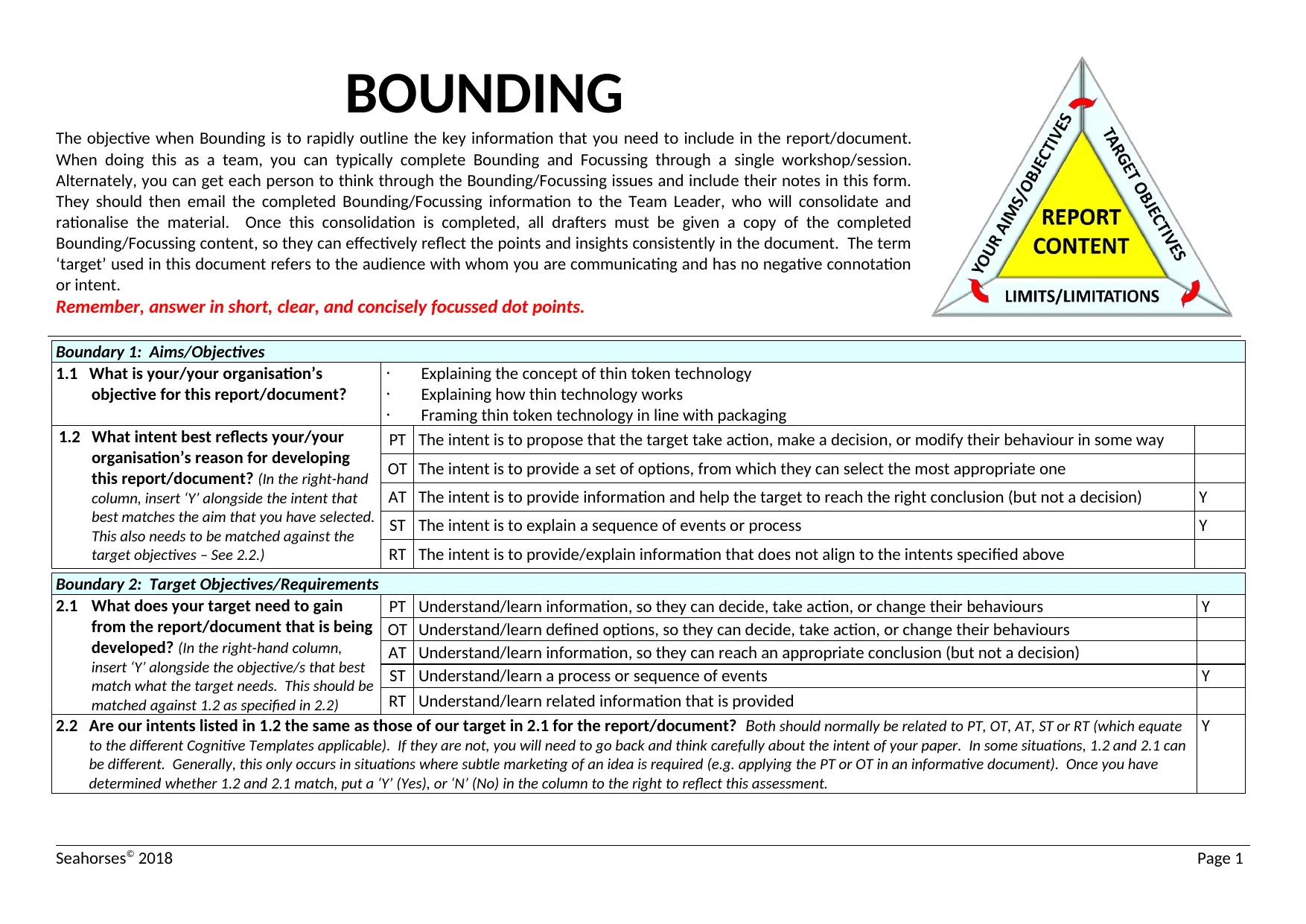
BOUNDING
The objective when Bounding is to rapidly outline the key information that you need to include in the report/document.
When doing this as a team, you can typically complete Bounding and Focussing through a single workshop/session.
Alternately, you can get each person to think through the Bounding/Focussing issues and include their notes in this form.
They should then email the completed Bounding/Focussing information to the Team Leader, who will consolidate and
rationalise the material. Once this consolidation is completed, all drafters must be given a copy of the completed
Bounding/Focussing content, so they can effectively reflect the points and insights consistently in the document. The term
‘target’ used in this document refers to the audience with whom you are communicating and has no negative connotation
or intent.
Remember, answer in short, clear, and concisely focussed dot points.
Boundary 1: Aims/Objectives
1.1 What is your/your organisation’s
objective for this report/document?
Explaining the concept of thin token technology
Explaining how thin technology works
Framing thin token technology in line with packaging
1.2 What intent best reflects your/your
organisation’s reason for developing
this report/document? (In the right-hand
column, insert ‘Y’ alongside the intent that
best matches the aim that you have selected.
This also needs to be matched against the
target objectives – See 2.2.)
PT The intent is to propose that the target take action, make a decision, or modify their behaviour in some way
OT The intent is to provide a set of options, from which they can select the most appropriate one
AT The intent is to provide information and help the target to reach the right conclusion (but not a decision) Y
ST The intent is to explain a sequence of events or process Y
RT The intent is to provide/explain information that does not align to the intents specified above
Boundary 2: Target Objectives/Requirements
2.1 What does your target need to gain
from the report/document that is being
developed? (In the right-hand column,
insert ‘Y’ alongside the objective/s that best
match what the target needs. This should be
matched against 1.2 as specified in 2.2)
PT Understand/learn information, so they can decide, take action, or change their behaviours Y
OT Understand/learn defined options, so they can decide, take action, or change their behaviours
AT Understand/learn information, so they can reach an appropriate conclusion (but not a decision)
ST Understand/learn a process or sequence of events Y
RT Understand/learn related information that is provided
2.2 Are our intents listed in 1.2 the same as those of our target in 2.1 for the report/document? Both should normally be related to PT, OT, AT, ST or RT (which equate
to the different Cognitive Templates applicable). If they are not, you will need to go back and think carefully about the intent of your paper. In some situations, 1.2 and 2.1 can
be different. Generally, this only occurs in situations where subtle marketing of an idea is required (e.g. applying the PT or OT in an informative document). Once you have
determined whether 1.2 and 2.1 match, put a ‘Y’ (Yes), or ‘N’ (No) in the column to the right to reflect this assessment.
Y
Seahorses© 2018 Page 1
The objective when Bounding is to rapidly outline the key information that you need to include in the report/document.
When doing this as a team, you can typically complete Bounding and Focussing through a single workshop/session.
Alternately, you can get each person to think through the Bounding/Focussing issues and include their notes in this form.
They should then email the completed Bounding/Focussing information to the Team Leader, who will consolidate and
rationalise the material. Once this consolidation is completed, all drafters must be given a copy of the completed
Bounding/Focussing content, so they can effectively reflect the points and insights consistently in the document. The term
‘target’ used in this document refers to the audience with whom you are communicating and has no negative connotation
or intent.
Remember, answer in short, clear, and concisely focussed dot points.
Boundary 1: Aims/Objectives
1.1 What is your/your organisation’s
objective for this report/document?
Explaining the concept of thin token technology
Explaining how thin technology works
Framing thin token technology in line with packaging
1.2 What intent best reflects your/your
organisation’s reason for developing
this report/document? (In the right-hand
column, insert ‘Y’ alongside the intent that
best matches the aim that you have selected.
This also needs to be matched against the
target objectives – See 2.2.)
PT The intent is to propose that the target take action, make a decision, or modify their behaviour in some way
OT The intent is to provide a set of options, from which they can select the most appropriate one
AT The intent is to provide information and help the target to reach the right conclusion (but not a decision) Y
ST The intent is to explain a sequence of events or process Y
RT The intent is to provide/explain information that does not align to the intents specified above
Boundary 2: Target Objectives/Requirements
2.1 What does your target need to gain
from the report/document that is being
developed? (In the right-hand column,
insert ‘Y’ alongside the objective/s that best
match what the target needs. This should be
matched against 1.2 as specified in 2.2)
PT Understand/learn information, so they can decide, take action, or change their behaviours Y
OT Understand/learn defined options, so they can decide, take action, or change their behaviours
AT Understand/learn information, so they can reach an appropriate conclusion (but not a decision)
ST Understand/learn a process or sequence of events Y
RT Understand/learn related information that is provided
2.2 Are our intents listed in 1.2 the same as those of our target in 2.1 for the report/document? Both should normally be related to PT, OT, AT, ST or RT (which equate
to the different Cognitive Templates applicable). If they are not, you will need to go back and think carefully about the intent of your paper. In some situations, 1.2 and 2.1 can
be different. Generally, this only occurs in situations where subtle marketing of an idea is required (e.g. applying the PT or OT in an informative document). Once you have
determined whether 1.2 and 2.1 match, put a ‘Y’ (Yes), or ‘N’ (No) in the column to the right to reflect this assessment.
Y
Seahorses© 2018 Page 1

Paraphrase This Document
Need a fresh take? Get an instant paraphrase of this document with our AI Paraphraser
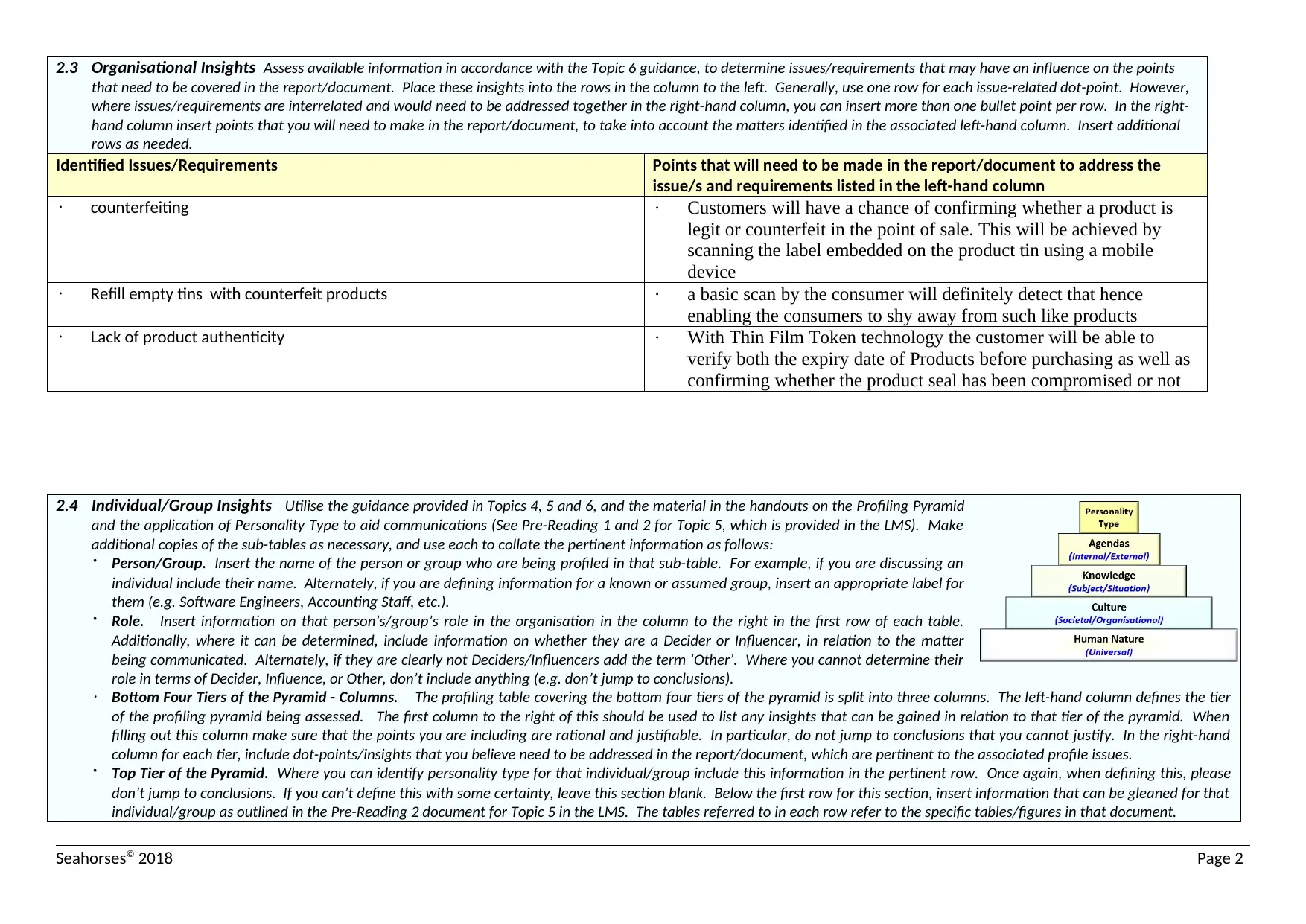
2.3 Organisational Insights Assess available information in accordance with the Topic 6 guidance, to determine issues/requirements that may have an influence on the points
that need to be covered in the report/document. Place these insights into the rows in the column to the left. Generally, use one row for each issue-related dot-point. However,
where issues/requirements are interrelated and would need to be addressed together in the right-hand column, you can insert more than one bullet point per row. In the right-
hand column insert points that you will need to make in the report/document, to take into account the matters identified in the associated left-hand column. Insert additional
rows as needed.
Identified Issues/Requirements Points that will need to be made in the report/document to address the
issue/s and requirements listed in the left-hand column
counterfeiting Customers will have a chance of confirming whether a product is
legit or counterfeit in the point of sale. This will be achieved by
scanning the label embedded on the product tin using a mobile
device
Refill empty tins with counterfeit products a basic scan by the consumer will definitely detect that hence
enabling the consumers to shy away from such like products
Lack of product authenticity With Thin Film Token technology the customer will be able to
verify both the expiry date of Products before purchasing as well as
confirming whether the product seal has been compromised or not
2.4 Individual/Group Insights Utilise the guidance provided in Topics 4, 5 and 6, and the material in the handouts on the Profiling Pyramid
and the application of Personality Type to aid communications (See Pre-Reading 1 and 2 for Topic 5, which is provided in the LMS). Make
additional copies of the sub-tables as necessary, and use each to collate the pertinent information as follows:
Person/Group. Insert the name of the person or group who are being profiled in that sub-table. For example, if you are discussing an
individual include their name. Alternately, if you are defining information for a known or assumed group, insert an appropriate label for
them (e.g. Software Engineers, Accounting Staff, etc.).
Role. Insert information on that person’s/group’s role in the organisation in the column to the right in the first row of each table.
Additionally, where it can be determined, include information on whether they are a Decider or Influencer, in relation to the matter
being communicated. Alternately, if they are clearly not Deciders/Influencers add the term ‘Other’. Where you cannot determine their
role in terms of Decider, Influence, or Other, don’t include anything (e.g. don’t jump to conclusions). Bottom Four Tiers of the Pyramid - Columns. The profiling table covering the bottom four tiers of the pyramid is split into three columns. The left-hand column defines the tier
of the profiling pyramid being assessed. The first column to the right of this should be used to list any insights that can be gained in relation to that tier of the pyramid. When
filling out this column make sure that the points you are including are rational and justifiable. In particular, do not jump to conclusions that you cannot justify. In the right-hand
column for each tier, include dot-points/insights that you believe need to be addressed in the report/document, which are pertinent to the associated profile issues.
Top Tier of the Pyramid. Where you can identify personality type for that individual/group include this information in the pertinent row. Once again, when defining this, please
don’t jump to conclusions. If you can’t define this with some certainty, leave this section blank. Below the first row for this section, insert information that can be gleaned for that
individual/group as outlined in the Pre-Reading 2 document for Topic 5 in the LMS. The tables referred to in each row refer to the specific tables/figures in that document.
Seahorses© 2018 Page 2
that need to be covered in the report/document. Place these insights into the rows in the column to the left. Generally, use one row for each issue-related dot-point. However,
where issues/requirements are interrelated and would need to be addressed together in the right-hand column, you can insert more than one bullet point per row. In the right-
hand column insert points that you will need to make in the report/document, to take into account the matters identified in the associated left-hand column. Insert additional
rows as needed.
Identified Issues/Requirements Points that will need to be made in the report/document to address the
issue/s and requirements listed in the left-hand column
counterfeiting Customers will have a chance of confirming whether a product is
legit or counterfeit in the point of sale. This will be achieved by
scanning the label embedded on the product tin using a mobile
device
Refill empty tins with counterfeit products a basic scan by the consumer will definitely detect that hence
enabling the consumers to shy away from such like products
Lack of product authenticity With Thin Film Token technology the customer will be able to
verify both the expiry date of Products before purchasing as well as
confirming whether the product seal has been compromised or not
2.4 Individual/Group Insights Utilise the guidance provided in Topics 4, 5 and 6, and the material in the handouts on the Profiling Pyramid
and the application of Personality Type to aid communications (See Pre-Reading 1 and 2 for Topic 5, which is provided in the LMS). Make
additional copies of the sub-tables as necessary, and use each to collate the pertinent information as follows:
Person/Group. Insert the name of the person or group who are being profiled in that sub-table. For example, if you are discussing an
individual include their name. Alternately, if you are defining information for a known or assumed group, insert an appropriate label for
them (e.g. Software Engineers, Accounting Staff, etc.).
Role. Insert information on that person’s/group’s role in the organisation in the column to the right in the first row of each table.
Additionally, where it can be determined, include information on whether they are a Decider or Influencer, in relation to the matter
being communicated. Alternately, if they are clearly not Deciders/Influencers add the term ‘Other’. Where you cannot determine their
role in terms of Decider, Influence, or Other, don’t include anything (e.g. don’t jump to conclusions). Bottom Four Tiers of the Pyramid - Columns. The profiling table covering the bottom four tiers of the pyramid is split into three columns. The left-hand column defines the tier
of the profiling pyramid being assessed. The first column to the right of this should be used to list any insights that can be gained in relation to that tier of the pyramid. When
filling out this column make sure that the points you are including are rational and justifiable. In particular, do not jump to conclusions that you cannot justify. In the right-hand
column for each tier, include dot-points/insights that you believe need to be addressed in the report/document, which are pertinent to the associated profile issues.
Top Tier of the Pyramid. Where you can identify personality type for that individual/group include this information in the pertinent row. Once again, when defining this, please
don’t jump to conclusions. If you can’t define this with some certainty, leave this section blank. Below the first row for this section, insert information that can be gleaned for that
individual/group as outlined in the Pre-Reading 2 document for Topic 5 in the LMS. The tables referred to in each row refer to the specific tables/figures in that document.
Seahorses© 2018 Page 2
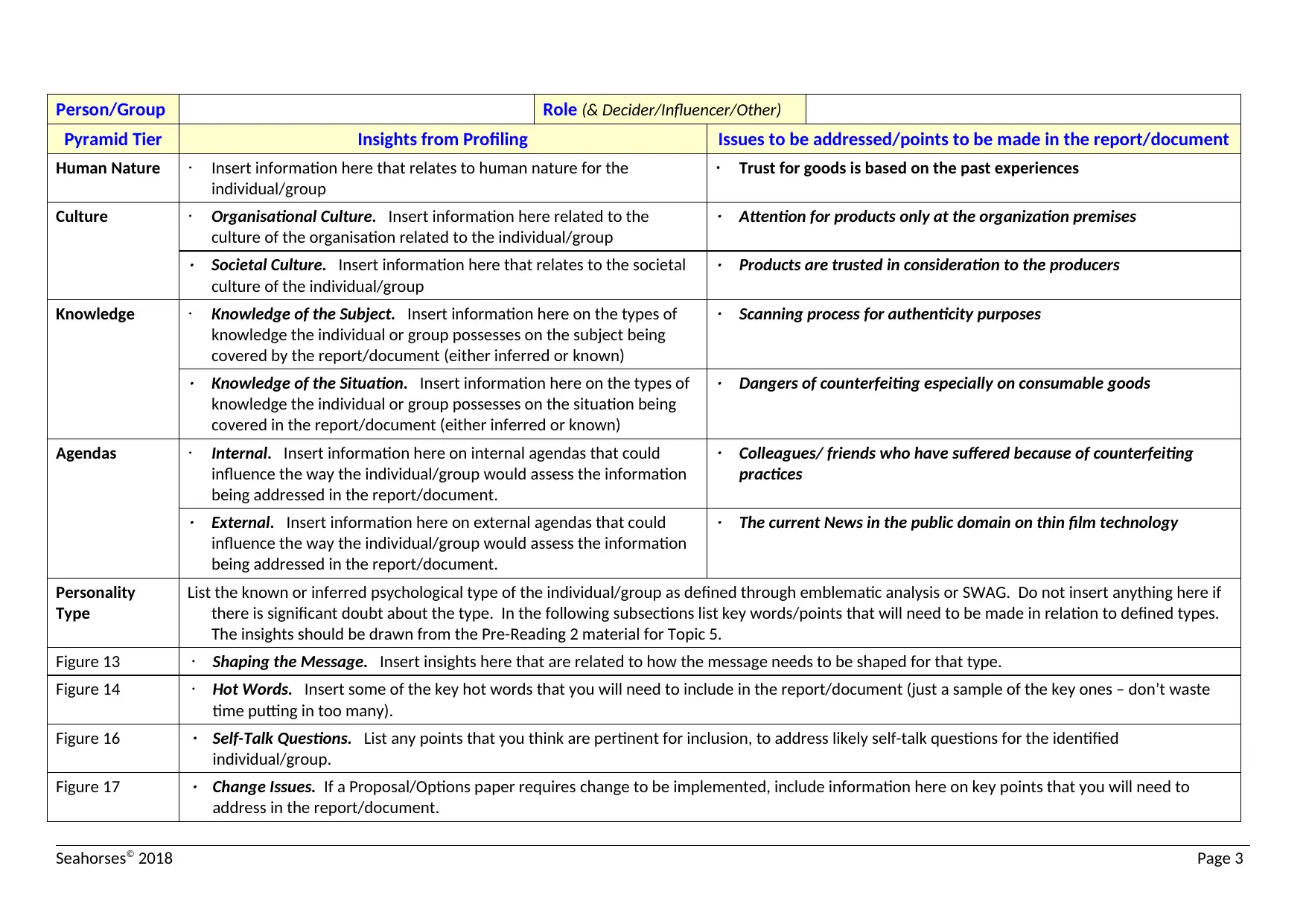
Person/Group Role (& Decider/Influencer/Other)
Pyramid Tier Insights from Profiling Issues to be addressed/points to be made in the report/document
Human Nature Insert information here that relates to human nature for the
individual/group
Trust for goods is based on the past experiences
Culture Organisational Culture. Insert information here related to the
culture of the organisation related to the individual/group
Attention for products only at the organization premises Societal Culture. Insert information here that relates to the societal
culture of the individual/group
Products are trusted in consideration to the producers
Knowledge Knowledge of the Subject. Insert information here on the types of
knowledge the individual or group possesses on the subject being
covered by the report/document (either inferred or known)
Scanning process for authenticity purposes
Knowledge of the Situation. Insert information here on the types of
knowledge the individual or group possesses on the situation being
covered in the report/document (either inferred or known)
Dangers of counterfeiting especially on consumable goods
Agendas Internal. Insert information here on internal agendas that could
influence the way the individual/group would assess the information
being addressed in the report/document.
Colleagues/ friends who have suffered because of counterfeiting
practices External. Insert information here on external agendas that could
influence the way the individual/group would assess the information
being addressed in the report/document.
The current News in the public domain on thin film technology
Personality
Type
List the known or inferred psychological type of the individual/group as defined through emblematic analysis or SWAG. Do not insert anything here if
there is significant doubt about the type. In the following subsections list key words/points that will need to be made in relation to defined types.
The insights should be drawn from the Pre-Reading 2 material for Topic 5.
Figure 13 Shaping the Message. Insert insights here that are related to how the message needs to be shaped for that type.
Figure 14 Hot Words. Insert some of the key hot words that you will need to include in the report/document (just a sample of the key ones – don’t waste
time putting in too many).
Figure 16
Self-Talk Questions. List any points that you think are pertinent for inclusion, to address likely self-talk questions for the identified
individual/group.
Figure 17
Change Issues. If a Proposal/Options paper requires change to be implemented, include information here on key points that you will need to
address in the report/document.
Seahorses© 2018 Page 3
Pyramid Tier Insights from Profiling Issues to be addressed/points to be made in the report/document
Human Nature Insert information here that relates to human nature for the
individual/group
Trust for goods is based on the past experiences
Culture Organisational Culture. Insert information here related to the
culture of the organisation related to the individual/group
Attention for products only at the organization premises Societal Culture. Insert information here that relates to the societal
culture of the individual/group
Products are trusted in consideration to the producers
Knowledge Knowledge of the Subject. Insert information here on the types of
knowledge the individual or group possesses on the subject being
covered by the report/document (either inferred or known)
Scanning process for authenticity purposes
Knowledge of the Situation. Insert information here on the types of
knowledge the individual or group possesses on the situation being
covered in the report/document (either inferred or known)
Dangers of counterfeiting especially on consumable goods
Agendas Internal. Insert information here on internal agendas that could
influence the way the individual/group would assess the information
being addressed in the report/document.
Colleagues/ friends who have suffered because of counterfeiting
practices External. Insert information here on external agendas that could
influence the way the individual/group would assess the information
being addressed in the report/document.
The current News in the public domain on thin film technology
Personality
Type
List the known or inferred psychological type of the individual/group as defined through emblematic analysis or SWAG. Do not insert anything here if
there is significant doubt about the type. In the following subsections list key words/points that will need to be made in relation to defined types.
The insights should be drawn from the Pre-Reading 2 material for Topic 5.
Figure 13 Shaping the Message. Insert insights here that are related to how the message needs to be shaped for that type.
Figure 14 Hot Words. Insert some of the key hot words that you will need to include in the report/document (just a sample of the key ones – don’t waste
time putting in too many).
Figure 16
Self-Talk Questions. List any points that you think are pertinent for inclusion, to address likely self-talk questions for the identified
individual/group.
Figure 17
Change Issues. If a Proposal/Options paper requires change to be implemented, include information here on key points that you will need to
address in the report/document.
Seahorses© 2018 Page 3
⊘ This is a preview!⊘
Do you want full access?
Subscribe today to unlock all pages.

Trusted by 1+ million students worldwide
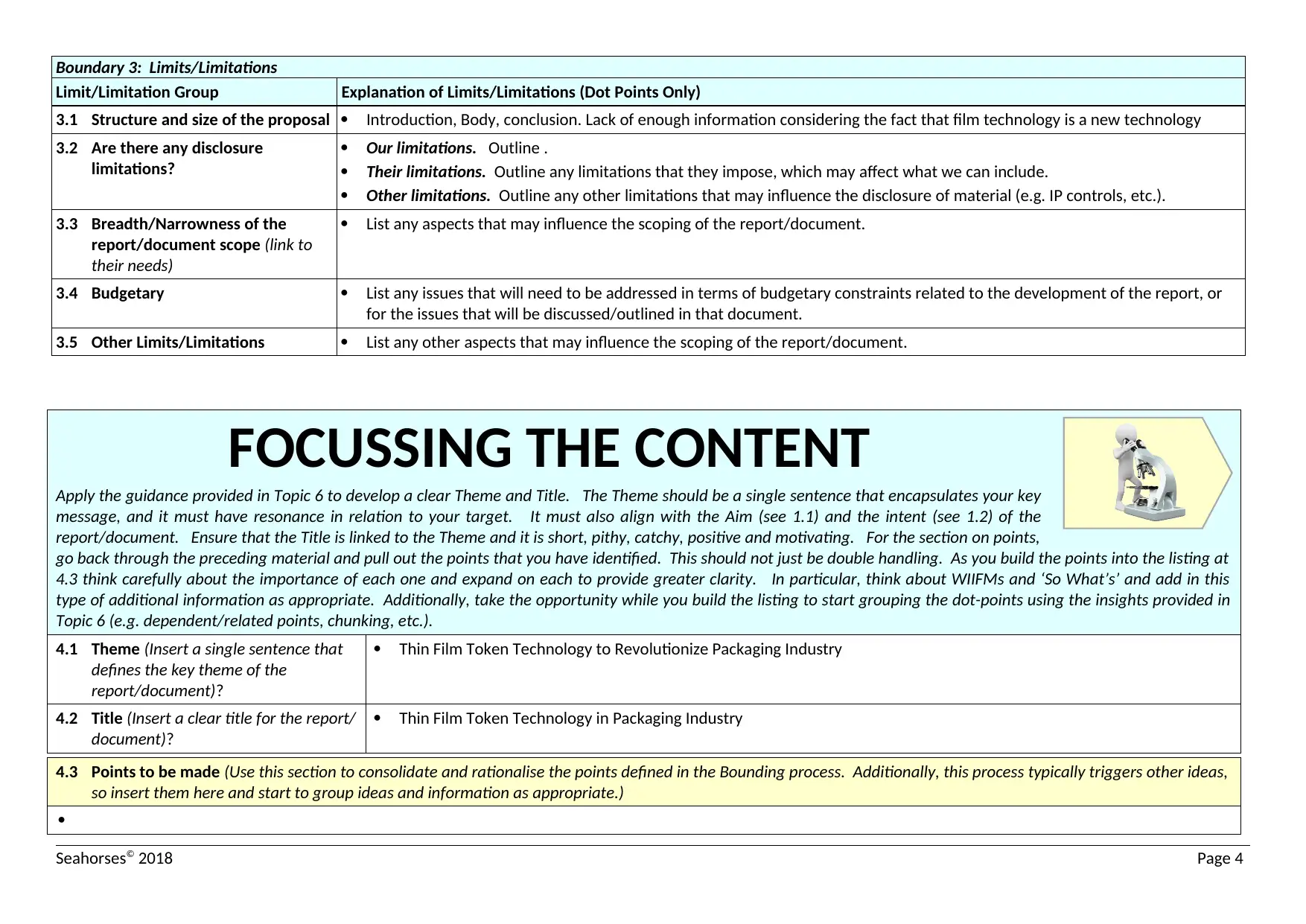
Boundary 3: Limits/Limitations
Limit/Limitation Group Explanation of Limits/Limitations (Dot Points Only)
3.1 Structure and size of the proposal Introduction, Body, conclusion. Lack of enough information considering the fact that film technology is a new technology
3.2 Are there any disclosure
limitations?
Our limitations. Outline .
Their limitations. Outline any limitations that they impose, which may affect what we can include.
Other limitations. Outline any other limitations that may influence the disclosure of material (e.g. IP controls, etc.).
3.3 Breadth/Narrowness of the
report/document scope (link to
their needs)
List any aspects that may influence the scoping of the report/document.
3.4 Budgetary List any issues that will need to be addressed in terms of budgetary constraints related to the development of the report, or
for the issues that will be discussed/outlined in that document.
3.5 Other Limits/Limitations List any other aspects that may influence the scoping of the report/document.
FOCUSSING THE CONTENT
Apply the guidance provided in Topic 6 to develop a clear Theme and Title. The Theme should be a single sentence that encapsulates your key
message, and it must have resonance in relation to your target. It must also align with the Aim (see 1.1) and the intent (see 1.2) of the
report/document. Ensure that the Title is linked to the Theme and it is short, pithy, catchy, positive and motivating. For the section on points,
go back through the preceding material and pull out the points that you have identified. This should not just be double handling. As you build the points into the listing at
4.3 think carefully about the importance of each one and expand on each to provide greater clarity. In particular, think about WIIFMs and ‘So What’s’ and add in this
type of additional information as appropriate. Additionally, take the opportunity while you build the listing to start grouping the dot-points using the insights provided in
Topic 6 (e.g. dependent/related points, chunking, etc.).
4.1 Theme (Insert a single sentence that
defines the key theme of the
report/document)?
Thin Film Token Technology to Revolutionize Packaging Industry
4.2 Title (Insert a clear title for the report/
document)?
Thin Film Token Technology in Packaging Industry
4.3 Points to be made (Use this section to consolidate and rationalise the points defined in the Bounding process. Additionally, this process typically triggers other ideas,
so insert them here and start to group ideas and information as appropriate.)
Seahorses© 2018 Page 4
Limit/Limitation Group Explanation of Limits/Limitations (Dot Points Only)
3.1 Structure and size of the proposal Introduction, Body, conclusion. Lack of enough information considering the fact that film technology is a new technology
3.2 Are there any disclosure
limitations?
Our limitations. Outline .
Their limitations. Outline any limitations that they impose, which may affect what we can include.
Other limitations. Outline any other limitations that may influence the disclosure of material (e.g. IP controls, etc.).
3.3 Breadth/Narrowness of the
report/document scope (link to
their needs)
List any aspects that may influence the scoping of the report/document.
3.4 Budgetary List any issues that will need to be addressed in terms of budgetary constraints related to the development of the report, or
for the issues that will be discussed/outlined in that document.
3.5 Other Limits/Limitations List any other aspects that may influence the scoping of the report/document.
FOCUSSING THE CONTENT
Apply the guidance provided in Topic 6 to develop a clear Theme and Title. The Theme should be a single sentence that encapsulates your key
message, and it must have resonance in relation to your target. It must also align with the Aim (see 1.1) and the intent (see 1.2) of the
report/document. Ensure that the Title is linked to the Theme and it is short, pithy, catchy, positive and motivating. For the section on points,
go back through the preceding material and pull out the points that you have identified. This should not just be double handling. As you build the points into the listing at
4.3 think carefully about the importance of each one and expand on each to provide greater clarity. In particular, think about WIIFMs and ‘So What’s’ and add in this
type of additional information as appropriate. Additionally, take the opportunity while you build the listing to start grouping the dot-points using the insights provided in
Topic 6 (e.g. dependent/related points, chunking, etc.).
4.1 Theme (Insert a single sentence that
defines the key theme of the
report/document)?
Thin Film Token Technology to Revolutionize Packaging Industry
4.2 Title (Insert a clear title for the report/
document)?
Thin Film Token Technology in Packaging Industry
4.3 Points to be made (Use this section to consolidate and rationalise the points defined in the Bounding process. Additionally, this process typically triggers other ideas,
so insert them here and start to group ideas and information as appropriate.)
Seahorses© 2018 Page 4
Paraphrase This Document
Need a fresh take? Get an instant paraphrase of this document with our AI Paraphraser
LAYING OUT THE CONTENT
Apply the guidance provided in Topic 6 to further develop the content. This includes: Develop Draft Graphics. In terms of the graphics, begin by roughing them out on paper and use these to refine the logic of your
message/points. It is often useful to do this in parallel with defining the points (see 4.3). By doing this you typically end up resolving a
significant number of grouping issues and help to define points that you might have otherwise missed. Once you have settled on a rough diagram, test this with
other members of the group (or other stakeholders), to check that the diagram can be understood intuitively. If the diagram can be understood intuitively and your
intent is to use the diagram in the document, then develop it in an electronic format. For most situations in the ICT industry, it is worthwhile to develop them in
PowerPoint. This means that you can readily reuse the graphic when you need to develop any associated presentation, so doing them in PowerPoint from the start
can be a major time saver. In terms of design for the graphics, you can apply the insights provided in the Topic 5 Links material provided in the LMS (in particular,
Colour and Array). Content Outline. Begin by setting the structure of the body of the report/document by selecting the most appropriate Dominant Cognitive Template. This should
align with the Aim (see 1.1) and the Intent (see 1.2). Typically, this should also align with the target objectives, as specified in Section 2.1. However, where it does
not, you will need to use the appropriate Cognitive Template to meet your intent, but you will also need to be subtle about the approach, so the target can still
achieve their objective within the framework that you provide. In either case, set the overall structure for the body of the document as either PT (Proposal
Template), OT (Options Template), AT (Analytical Template), ST (Sequential Template), or RT (Relational Template) as specified in 1.2. Insert appropriate headings
associated with the Cognitive Template into the Word template into which you will be drafting. You can initially just start with the headings as they apply to that
Cognitive Template. However, remember you will need to change these to more meaningful headings as you start to refine the document. Once the headings are in
place, start moving the points you defined in 4.3 into the structure in your Word template, so they align to the required elements. Typically, as you do this, you will
find that you will think of additional points that need to be included, so just add these as necessary. Additionally, if you are intending to add graphics into the
document, add them during this phase. At the end of this process you will have the structure for the body of the message defined, and a series of graphics and dot
points that you can now use to draft the content during the Fleshing Out phase. Draft Abstract/Executive Summary. By the time you complete the Content Outline, you will typically have a good understanding of your message. This is, therefore,
the opportune time to draft the Executive Summary or Abstract. To do this follow the guidance provided in Topic 6.
Seahorses© 2018 Page 5
Key
Points
Apply the guidance provided in Topic 6 to further develop the content. This includes: Develop Draft Graphics. In terms of the graphics, begin by roughing them out on paper and use these to refine the logic of your
message/points. It is often useful to do this in parallel with defining the points (see 4.3). By doing this you typically end up resolving a
significant number of grouping issues and help to define points that you might have otherwise missed. Once you have settled on a rough diagram, test this with
other members of the group (or other stakeholders), to check that the diagram can be understood intuitively. If the diagram can be understood intuitively and your
intent is to use the diagram in the document, then develop it in an electronic format. For most situations in the ICT industry, it is worthwhile to develop them in
PowerPoint. This means that you can readily reuse the graphic when you need to develop any associated presentation, so doing them in PowerPoint from the start
can be a major time saver. In terms of design for the graphics, you can apply the insights provided in the Topic 5 Links material provided in the LMS (in particular,
Colour and Array). Content Outline. Begin by setting the structure of the body of the report/document by selecting the most appropriate Dominant Cognitive Template. This should
align with the Aim (see 1.1) and the Intent (see 1.2). Typically, this should also align with the target objectives, as specified in Section 2.1. However, where it does
not, you will need to use the appropriate Cognitive Template to meet your intent, but you will also need to be subtle about the approach, so the target can still
achieve their objective within the framework that you provide. In either case, set the overall structure for the body of the document as either PT (Proposal
Template), OT (Options Template), AT (Analytical Template), ST (Sequential Template), or RT (Relational Template) as specified in 1.2. Insert appropriate headings
associated with the Cognitive Template into the Word template into which you will be drafting. You can initially just start with the headings as they apply to that
Cognitive Template. However, remember you will need to change these to more meaningful headings as you start to refine the document. Once the headings are in
place, start moving the points you defined in 4.3 into the structure in your Word template, so they align to the required elements. Typically, as you do this, you will
find that you will think of additional points that need to be included, so just add these as necessary. Additionally, if you are intending to add graphics into the
document, add them during this phase. At the end of this process you will have the structure for the body of the message defined, and a series of graphics and dot
points that you can now use to draft the content during the Fleshing Out phase. Draft Abstract/Executive Summary. By the time you complete the Content Outline, you will typically have a good understanding of your message. This is, therefore,
the opportune time to draft the Executive Summary or Abstract. To do this follow the guidance provided in Topic 6.
Seahorses© 2018 Page 5
Key
Points
What is typically checked during the Green Review?
Typically, the Green Reviewers will assess:
The Bounding and Focussing information in a document such as this.
The Draft Graphics that have been developed in either hand-drawn or electronic format (e.g. in the Word drafting template as a part of the Content Outline, or in a
separate file – e.g. PowerPoint slides).
The Content Outline in the Word drafting template (this should still just be dot points that provide enough information, so the reader can understand the intent of
each point (e.g. typically not just single words, but simple sentences).
The Abstract/Executive Summary in the Word drafting template (this is the only section that should be written as text and not just dot-points).
Seahorses© 2018 Page 6
Typically, the Green Reviewers will assess:
The Bounding and Focussing information in a document such as this.
The Draft Graphics that have been developed in either hand-drawn or electronic format (e.g. in the Word drafting template as a part of the Content Outline, or in a
separate file – e.g. PowerPoint slides).
The Content Outline in the Word drafting template (this should still just be dot points that provide enough information, so the reader can understand the intent of
each point (e.g. typically not just single words, but simple sentences).
The Abstract/Executive Summary in the Word drafting template (this is the only section that should be written as text and not just dot-points).
Seahorses© 2018 Page 6
⊘ This is a preview!⊘
Do you want full access?
Subscribe today to unlock all pages.
Trusted by 1+ million students worldwide

1 out of 6


Your All-in-One AI-Powered Toolkit for Academic Success.
+13062052269
info@desklib.com
Available 24*7 on WhatsApp / Email
![[object Object]](/_next/static/media/star-bottom.7253800d.svg)
Unlock your academic potential
Copyright © 2020–2026 A2Z Services. All Rights Reserved. Developed and managed by ZUCOL.