Travel and Tourism Business Toolkit: Thomas Cook Revenue Analysis
VerifiedAdded on 2020/11/23
|20
|5543
|290
Report
AI Summary
This report provides a comprehensive analysis of revenue management principles and their application within the context of Thomas Cook & Sons, a major player in the UK travel and tourism industry. It delves into the rationale behind revenue management, exploring its significance in maximizing profit through strategies like market segmentation and pricing policies. The report investigates the tools of revenue management, including pricing and non-pricing strategies such as dynamic pricing, price discrimination, channel management, and overbooking. Furthermore, it examines the impact of differentiated pricing strategies on Thomas Cook's revenue, evaluating the use of discount offers and festival promotions. The report also critically assesses the principles of revenue management and their practical application, acknowledging both the benefits and challenges. In addition, it explores the various types of financial statements and reporting mechanisms employed by Thomas Cook, including income statements, and their importance in evaluating the company's financial performance. The report also covers the significance of budgets in controlling business performance and identifying variances. Additionally, the report addresses HR life cycle stages and their importance in talent management. Finally, it examines the implications of legislation and ethical principles on decision-making within the travel and tourism industry.

TRAVEL AND TOURISM
BUSINESS TOOLKIT
BUSINESS TOOLKIT

Paraphrase This Document
Need a fresh take? Get an instant paraphrase of this document with our AI Paraphraser
Table of Contents
INTRODUCTION...........................................................................................................................1
PART 1............................................................................................................................................1
P.1.Discuss the rationale and principles of revenue management for the travel and tourism
industry........................................................................................................................................1
P.2.Investigate the tools of revenue management and its implementation to generate and
maximise profit of Thomas Cook Company...............................................................................2
M.1.Analyse the impact of differentiated pricing strategies on revenue management in
Thomas Cook Company..............................................................................................................3
D.1.Critical of principles of revenue management and its application in Thomas Cooks
company......................................................................................................................................3
P.7.&M.4.Exploring and interpreting the different types of financial statements and reporting
mechanism for Thomas Cook Company.....................................................................................4
P.8.The importance and value of budgets for controlling business performance and identifying
variances......................................................................................................................................6
D.4.Evaluating the performance of business that is based on financial statements reports for
Thomas Cook company...............................................................................................................7
PART 2............................................................................................................................................8
P.3.&M.2.Reviewing and Evaluating Different stages of the HR life cycle and their
importance for retaining and developing talent..........................................................................8
P.4.Develop a performance management plan............................................................................9
D.2.Make valid judgement and recommendations on HR processes and documents can be
improved for effective talent planning throughout the HR life cycle.......................................10
PART 3..........................................................................................................................................11
P.5.&M.3.Explore specific legislation that Thomas Cook in the travel and tourism industry
have to adhere to as well as its implication of laws on decision making of company. ............11
P.6 Illustrate how company, employment and contract law has a potential impact on business
decision-making in the travel and tourism industry..................................................................11
D.3.Critically reflect on the potential impacts of regulations, legislation and ethical principles
on decision-making in the travel and tourism industry.............................................................12
INTRODUCTION...........................................................................................................................1
PART 1............................................................................................................................................1
P.1.Discuss the rationale and principles of revenue management for the travel and tourism
industry........................................................................................................................................1
P.2.Investigate the tools of revenue management and its implementation to generate and
maximise profit of Thomas Cook Company...............................................................................2
M.1.Analyse the impact of differentiated pricing strategies on revenue management in
Thomas Cook Company..............................................................................................................3
D.1.Critical of principles of revenue management and its application in Thomas Cooks
company......................................................................................................................................3
P.7.&M.4.Exploring and interpreting the different types of financial statements and reporting
mechanism for Thomas Cook Company.....................................................................................4
P.8.The importance and value of budgets for controlling business performance and identifying
variances......................................................................................................................................6
D.4.Evaluating the performance of business that is based on financial statements reports for
Thomas Cook company...............................................................................................................7
PART 2............................................................................................................................................8
P.3.&M.2.Reviewing and Evaluating Different stages of the HR life cycle and their
importance for retaining and developing talent..........................................................................8
P.4.Develop a performance management plan............................................................................9
D.2.Make valid judgement and recommendations on HR processes and documents can be
improved for effective talent planning throughout the HR life cycle.......................................10
PART 3..........................................................................................................................................11
P.5.&M.3.Explore specific legislation that Thomas Cook in the travel and tourism industry
have to adhere to as well as its implication of laws on decision making of company. ............11
P.6 Illustrate how company, employment and contract law has a potential impact on business
decision-making in the travel and tourism industry..................................................................11
D.3.Critically reflect on the potential impacts of regulations, legislation and ethical principles
on decision-making in the travel and tourism industry.............................................................12

CONCLUSION..............................................................................................................................12
REFERENCES..............................................................................................................................13
REFERENCES..............................................................................................................................13
⊘ This is a preview!⊘
Do you want full access?
Subscribe today to unlock all pages.

Trusted by 1+ million students worldwide
INTRODUCTION
Travel and tourism industry is the heart of the any economy and plays an important role
in the United Kingdom. In UK it is one of the largest revenue generated industry in the world.
The contribution of travel and tourism industry is approximately 217 billion pounds to GDP in
United Kingdom. This present report is context to Thomas Crooks & Sons company of United
Kingdom. It is a private limited company which was founded in 1841 by Thomas Cook. Its
headquarters are located in London, England and UK. This report will cover examine the key
principles of revenue management for travel and tourism industry as well as also explain to
mange budget and maintain statistical financial records. Furthermore, this report also include HR
Life Cycle and Human Resource strategy as well as it management in organisation. In addition to
this, legislation and ethics in travel and tourism industry is also understood in this assignment.
PART 1
P.1.Discuss the rationale and principles of revenue management for the travel and tourism
industry.
Revenue management in hotel is about becoming the architect of the future. Revenue
management is very important in travel and tourism industry as well as in Thomas Cook & Sons.
It is the application of disciplined analytics that predict the behaviour of consumer at the micro
market level as well as increase the availability of product and price to maximize the revenue
growth. Revenue management leads to creation as well as innovation of new products and
services as well as there pricing (Tsui and et.al., 2018). It is very essential in Thomas Cook
organisation as it maintain the right balance between revenue manager and general manager as
well as in tour operating manager.
There are some principles of revenue management which are as follows-
Segmentation of market- This is the first and the most important principle of revenue
management. When company want to increase the revenue or to manage the revenue, it is very
essential to divide the customers into small groups or into various categories. With the help of
this division, Thomas Cook can apply different marketing strategies as well as different policies
of pricing. The main intention of this principle to reach the maximum customers.
Price Policy- This is another most important principle of revenue management. Revenue
management is the essential part of service company. Thomas Cook company is practising
revenue management so they have to control the price policy. Pricing of the services is different
1
Travel and tourism industry is the heart of the any economy and plays an important role
in the United Kingdom. In UK it is one of the largest revenue generated industry in the world.
The contribution of travel and tourism industry is approximately 217 billion pounds to GDP in
United Kingdom. This present report is context to Thomas Crooks & Sons company of United
Kingdom. It is a private limited company which was founded in 1841 by Thomas Cook. Its
headquarters are located in London, England and UK. This report will cover examine the key
principles of revenue management for travel and tourism industry as well as also explain to
mange budget and maintain statistical financial records. Furthermore, this report also include HR
Life Cycle and Human Resource strategy as well as it management in organisation. In addition to
this, legislation and ethics in travel and tourism industry is also understood in this assignment.
PART 1
P.1.Discuss the rationale and principles of revenue management for the travel and tourism
industry.
Revenue management in hotel is about becoming the architect of the future. Revenue
management is very important in travel and tourism industry as well as in Thomas Cook & Sons.
It is the application of disciplined analytics that predict the behaviour of consumer at the micro
market level as well as increase the availability of product and price to maximize the revenue
growth. Revenue management leads to creation as well as innovation of new products and
services as well as there pricing (Tsui and et.al., 2018). It is very essential in Thomas Cook
organisation as it maintain the right balance between revenue manager and general manager as
well as in tour operating manager.
There are some principles of revenue management which are as follows-
Segmentation of market- This is the first and the most important principle of revenue
management. When company want to increase the revenue or to manage the revenue, it is very
essential to divide the customers into small groups or into various categories. With the help of
this division, Thomas Cook can apply different marketing strategies as well as different policies
of pricing. The main intention of this principle to reach the maximum customers.
Price Policy- This is another most important principle of revenue management. Revenue
management is the essential part of service company. Thomas Cook company is practising
revenue management so they have to control the price policy. Pricing of the services is different
1
Paraphrase This Document
Need a fresh take? Get an instant paraphrase of this document with our AI Paraphraser
for different segments so it is important that efficient pricing policy in order to manage revenue
and earn profit.
Forecasting the demand- This is principle that is based on the concept of future demand
of customers. Thomas Cooks company is also used to predict its future sales based on several
factors as the result of previous years, seasonality of the goods or services. Thomas Cook
company offers discount to customer on season in order to maximum the profit.
Principle of Seasonality- This is the principle which is based on the seasonality factor. In
hospitality industry the impact of seasonality is very high. According to this principle, seasonal
pattern occurs when a time series is affected by seasonal factors such as the time of the year or
the day of the week. A cycle occurs when the data exhibit rises and falls that are not of a fixed
period. These fluctuations are usually due to economic conditions and are often related to the
cycle of the hospitality business.
Principles of Capabilities- According to this principle capability it is very important that
hospitality industry or business should have capability to deal with the external factors,
seasonality factors and all other factors that affect the business.
Principles of Operational- According to the principle of operational organisation should
have capacity to operate the business in the business environment and should have to operate as
per the laws and legislations.
P.2.Investigate the tools of revenue management and its implementation to generate and
maximise profit of Thomas Cook Company.
In order to generate revenue of tour and travel company it is very important to use the
tools and techniques of revenue management in order to generate as well as maximize profit of
Thomas Cook company. There are mainly two tools that are used by company which are Pricing
revenue management tools and Non-pricing revenue management tools. These both the two tools
are applied by Thomas Cook in order to increase the profit of company.
Pricing Revenue Management Tools- This is one the most important tool of revenue
management that company is using in setting strategic price of the services. In this tool there are
two main instruments which are discrimination and dynamic pricing. These tools are depended in
the willingness of customers to pay. As per this tool, it is very essential for company to pay lot of
attention to price as customers are very price sensitive. It is important that price of the product or
services should value money. Customers does not use the services of too much high prices as
2
and earn profit.
Forecasting the demand- This is principle that is based on the concept of future demand
of customers. Thomas Cooks company is also used to predict its future sales based on several
factors as the result of previous years, seasonality of the goods or services. Thomas Cook
company offers discount to customer on season in order to maximum the profit.
Principle of Seasonality- This is the principle which is based on the seasonality factor. In
hospitality industry the impact of seasonality is very high. According to this principle, seasonal
pattern occurs when a time series is affected by seasonal factors such as the time of the year or
the day of the week. A cycle occurs when the data exhibit rises and falls that are not of a fixed
period. These fluctuations are usually due to economic conditions and are often related to the
cycle of the hospitality business.
Principles of Capabilities- According to this principle capability it is very important that
hospitality industry or business should have capability to deal with the external factors,
seasonality factors and all other factors that affect the business.
Principles of Operational- According to the principle of operational organisation should
have capacity to operate the business in the business environment and should have to operate as
per the laws and legislations.
P.2.Investigate the tools of revenue management and its implementation to generate and
maximise profit of Thomas Cook Company.
In order to generate revenue of tour and travel company it is very important to use the
tools and techniques of revenue management in order to generate as well as maximize profit of
Thomas Cook company. There are mainly two tools that are used by company which are Pricing
revenue management tools and Non-pricing revenue management tools. These both the two tools
are applied by Thomas Cook in order to increase the profit of company.
Pricing Revenue Management Tools- This is one the most important tool of revenue
management that company is using in setting strategic price of the services. In this tool there are
two main instruments which are discrimination and dynamic pricing. These tools are depended in
the willingness of customers to pay. As per this tool, it is very essential for company to pay lot of
attention to price as customers are very price sensitive. It is important that price of the product or
services should value money. Customers does not use the services of too much high prices as
2
they think it does not value there money while very low pricing is also not good. Thus, price
should be according to the customer's willingness to pay and it should value the money (Budeanu
and et.al., 2016). Price discrimination is also very important in tour operators as it is mostly used
in tour and travel industry because they have to divide the customers on some basis like income,
age, living standard etc. Dynamic pricing tool is used as the instrument of quality revenue
management.
Non-pricing Revenue Management Tool- This is another tool that is used by tour and
travel companies for efficient revenue management. In this tool there are two main instruments
which are channel management and Overbooking. According to this tool, pricing of the product
is not depended on the willingness of customers to pay but it is depended on the management of
company that how they manage there operations and functions in efficient way. This tool is
criticised by many people but it is fact that price of the products and services are influenced by
non-pricing revenue management. Overbooking is the instrument that is mainly used in Thomas
Cook company for revenue management. Thus, managers of company have to manage all the
bookings of customers without showing any problems to customers. In addition to this, channel
management is also one of the most essential instrument that is also used by Thomas Cook
company in order to catch maximum customers on the basis of particular segments. For example,
online customers and offline customers.
Capacity of planning – This is the best management tool that defines the Capacity
planning is the process of determining the production capacity needed by an organization to meet
changing demands for its products. In the context of capacity planning, design capacity is the
maximum amount of work that an organization is capable of completing in a given period.
Demand Forecasting- This is management tool that is based on the concept of future
demand of customers. Thomas Cooks company is also used to predict its future sales based on
several factors as the result of previous years, seasonality of the goods or services. Thomas Cook
company offers discount to customer on season in order to maximum the profit.
Discount Allocation- Discounts can be a fixed amount that the customer receives for
entering into the contract or a variable amount based on the customer meeting specific
requirements. This tool also used in Thomas Cook.
3
should be according to the customer's willingness to pay and it should value the money (Budeanu
and et.al., 2016). Price discrimination is also very important in tour operators as it is mostly used
in tour and travel industry because they have to divide the customers on some basis like income,
age, living standard etc. Dynamic pricing tool is used as the instrument of quality revenue
management.
Non-pricing Revenue Management Tool- This is another tool that is used by tour and
travel companies for efficient revenue management. In this tool there are two main instruments
which are channel management and Overbooking. According to this tool, pricing of the product
is not depended on the willingness of customers to pay but it is depended on the management of
company that how they manage there operations and functions in efficient way. This tool is
criticised by many people but it is fact that price of the products and services are influenced by
non-pricing revenue management. Overbooking is the instrument that is mainly used in Thomas
Cook company for revenue management. Thus, managers of company have to manage all the
bookings of customers without showing any problems to customers. In addition to this, channel
management is also one of the most essential instrument that is also used by Thomas Cook
company in order to catch maximum customers on the basis of particular segments. For example,
online customers and offline customers.
Capacity of planning – This is the best management tool that defines the Capacity
planning is the process of determining the production capacity needed by an organization to meet
changing demands for its products. In the context of capacity planning, design capacity is the
maximum amount of work that an organization is capable of completing in a given period.
Demand Forecasting- This is management tool that is based on the concept of future
demand of customers. Thomas Cooks company is also used to predict its future sales based on
several factors as the result of previous years, seasonality of the goods or services. Thomas Cook
company offers discount to customer on season in order to maximum the profit.
Discount Allocation- Discounts can be a fixed amount that the customer receives for
entering into the contract or a variable amount based on the customer meeting specific
requirements. This tool also used in Thomas Cook.
3
⊘ This is a preview!⊘
Do you want full access?
Subscribe today to unlock all pages.
Trusted by 1+ million students worldwide
M.1.Analyse the impact of differentiated pricing strategies on revenue management in Thomas
Cook Company.
Pricing strategy are the major factor of the marketing plan. There is great impact of
pricing strategies on revenue management in Thomas Cook company as well as on entire travel
and tourism industry. Price is the major parameter that influence the entire revenue of company
significantly. There are various strategy of pricing that is used by Thomas Cook such as discount
offers, price skimming, festival offers, revenue management are developed. Thomas Cooks used
dynamic pricing as well as discrimination pricing strategies while selling there services to
customers (Queckenstedt and et.al., 2017). These strategies increase the profit of company as
well as raise the satisfaction of customers. The prices of Thomas Cook company' services are
according to the customer's willingness to pay and it values the money of customers. Price
discrimination strategy is also very important and it is used by company to raise the sales of
company by dividing the customers on some basis like income, age, living standard etc.
Dynamic pricing tool is used as the instrument of quality revenue management as they offer high
quality of services consistently to customer's for long time. These pricing strategies increases the
profit as well as market share of company.
D.1.Critical of principles of revenue management and its application in Thomas Cooks company.
According to Höpken, (2015) principles of revenue management are very essential as it
raises the profit of company. Revenue management leads to creation and innovation of new
products and services as well as there pricing. It is very essential in Thomas Cook company as it
maintain the right balance between revenue manager and general manager and in tour operating
manager. But According to Crouch, Huybers and Oppewal (2016), it is not possible for company
to follow all the principles in the functions and operation's of company because it is not easy to
forecast the demand of customers. It requires high market research for identifying the demand
and understand the perceptions of customers.
P.7.&M.4.Exploring and interpreting the different types of financial statements and reporting
mechanism for Thomas Cook Company.
There are different types of financial statements that are prepared by Thomas Cook
company in order to identify the performance of company as well as financial position and cash
flows of company. These financial statements are utilized by the investment leaders, community,
4
Cook Company.
Pricing strategy are the major factor of the marketing plan. There is great impact of
pricing strategies on revenue management in Thomas Cook company as well as on entire travel
and tourism industry. Price is the major parameter that influence the entire revenue of company
significantly. There are various strategy of pricing that is used by Thomas Cook such as discount
offers, price skimming, festival offers, revenue management are developed. Thomas Cooks used
dynamic pricing as well as discrimination pricing strategies while selling there services to
customers (Queckenstedt and et.al., 2017). These strategies increase the profit of company as
well as raise the satisfaction of customers. The prices of Thomas Cook company' services are
according to the customer's willingness to pay and it values the money of customers. Price
discrimination strategy is also very important and it is used by company to raise the sales of
company by dividing the customers on some basis like income, age, living standard etc.
Dynamic pricing tool is used as the instrument of quality revenue management as they offer high
quality of services consistently to customer's for long time. These pricing strategies increases the
profit as well as market share of company.
D.1.Critical of principles of revenue management and its application in Thomas Cooks company.
According to Höpken, (2015) principles of revenue management are very essential as it
raises the profit of company. Revenue management leads to creation and innovation of new
products and services as well as there pricing. It is very essential in Thomas Cook company as it
maintain the right balance between revenue manager and general manager and in tour operating
manager. But According to Crouch, Huybers and Oppewal (2016), it is not possible for company
to follow all the principles in the functions and operation's of company because it is not easy to
forecast the demand of customers. It requires high market research for identifying the demand
and understand the perceptions of customers.
P.7.&M.4.Exploring and interpreting the different types of financial statements and reporting
mechanism for Thomas Cook Company.
There are different types of financial statements that are prepared by Thomas Cook
company in order to identify the performance of company as well as financial position and cash
flows of company. These financial statements are utilized by the investment leaders, community,
4
Paraphrase This Document
Need a fresh take? Get an instant paraphrase of this document with our AI Paraphraser
creditors as well as management to measure the organisation. Here are financial statements
prepared by Thomas Cooks are as follows-
Income statements- This is the statements that shows that actual and entire financial
performance of company for the whole reporting period. It is evaluated by calculating the entire
sales of company and then it is subtracted by the expenses incurred during the period to get at net
profit or loss. Income statements is also known as Profit and Loss statements as it is one of the
most essential statement as compare to others because it shows the performance of company
(EPS of Thomas Cook Company, 2017). Thomas Cook use Job costing report mechanism to
track the cost as well as revenues by job (Fuchs, Höpken and Lexhagen, 2015). It is a report of
overall profit and loss of company but it is particular to each and every job number.
Balance Sheet- This is the statements that shows the financial positions of company for
the whole reporting period. All the asserts and liabilities are presented in this statement. This is
key document of company. Thomas Cook also prepared there balance sheet in order to analyse
the financial position of company. Company use accounts receivable ageing report mechanism
that give the list of unpaid customers as well as unused credit memos by data ranges. This is very
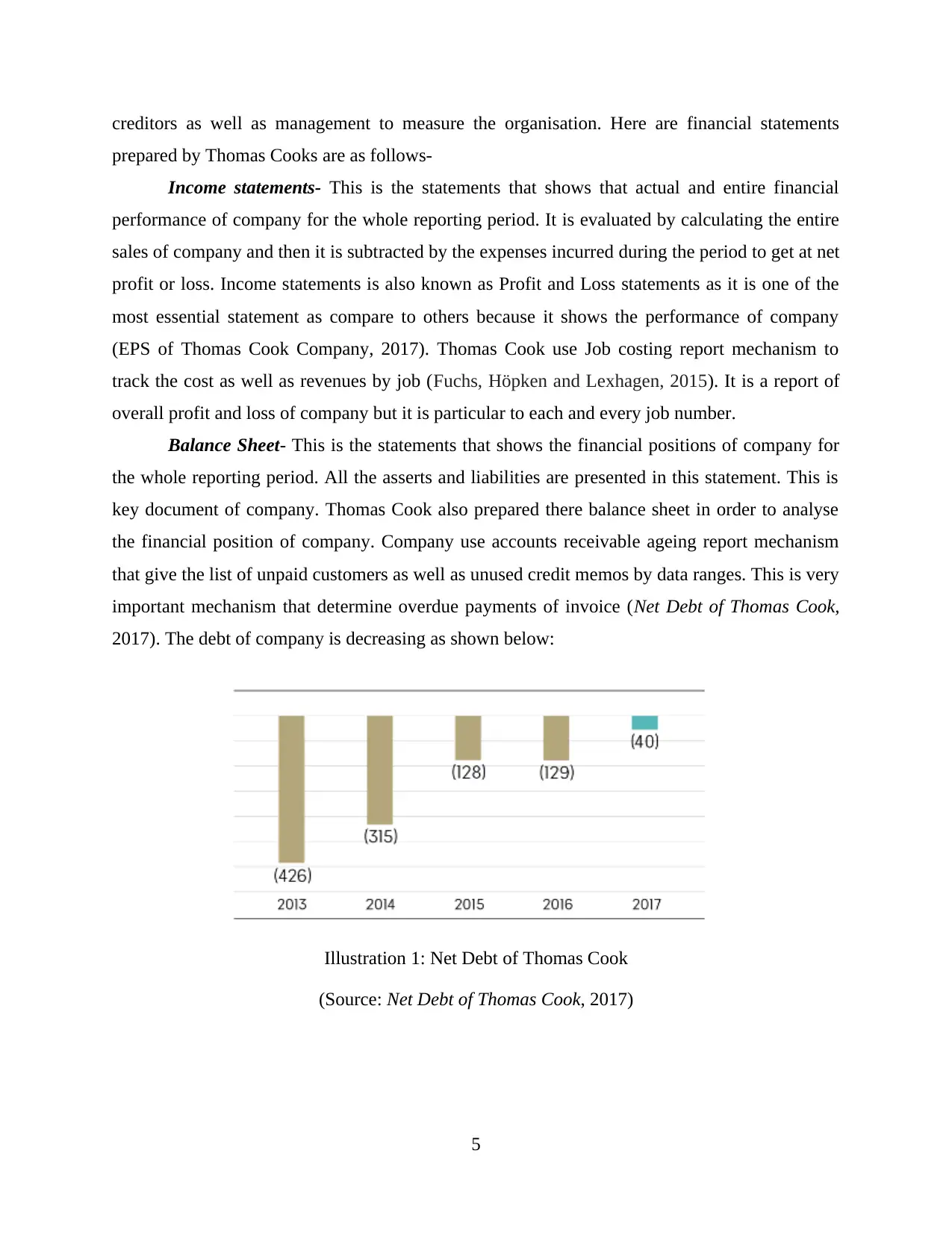
important mechanism that determine overdue payments of invoice (Net Debt of Thomas Cook,
2017). The debt of company is decreasing as shown below:
5
Illustration 1: Net Debt of Thomas Cook
(Source: Net Debt of Thomas Cook, 2017)
prepared by Thomas Cooks are as follows-
Income statements- This is the statements that shows that actual and entire financial
performance of company for the whole reporting period. It is evaluated by calculating the entire
sales of company and then it is subtracted by the expenses incurred during the period to get at net
profit or loss. Income statements is also known as Profit and Loss statements as it is one of the
most essential statement as compare to others because it shows the performance of company
(EPS of Thomas Cook Company, 2017). Thomas Cook use Job costing report mechanism to
track the cost as well as revenues by job (Fuchs, Höpken and Lexhagen, 2015). It is a report of
overall profit and loss of company but it is particular to each and every job number.
Balance Sheet- This is the statements that shows the financial positions of company for
the whole reporting period. All the asserts and liabilities are presented in this statement. This is
key document of company. Thomas Cook also prepared there balance sheet in order to analyse
the financial position of company. Company use accounts receivable ageing report mechanism
that give the list of unpaid customers as well as unused credit memos by data ranges. This is very
important mechanism that determine overdue payments of invoice (Net Debt of Thomas Cook,
2017). The debt of company is decreasing as shown below:
5
Illustration 1: Net Debt of Thomas Cook
(Source: Net Debt of Thomas Cook, 2017)
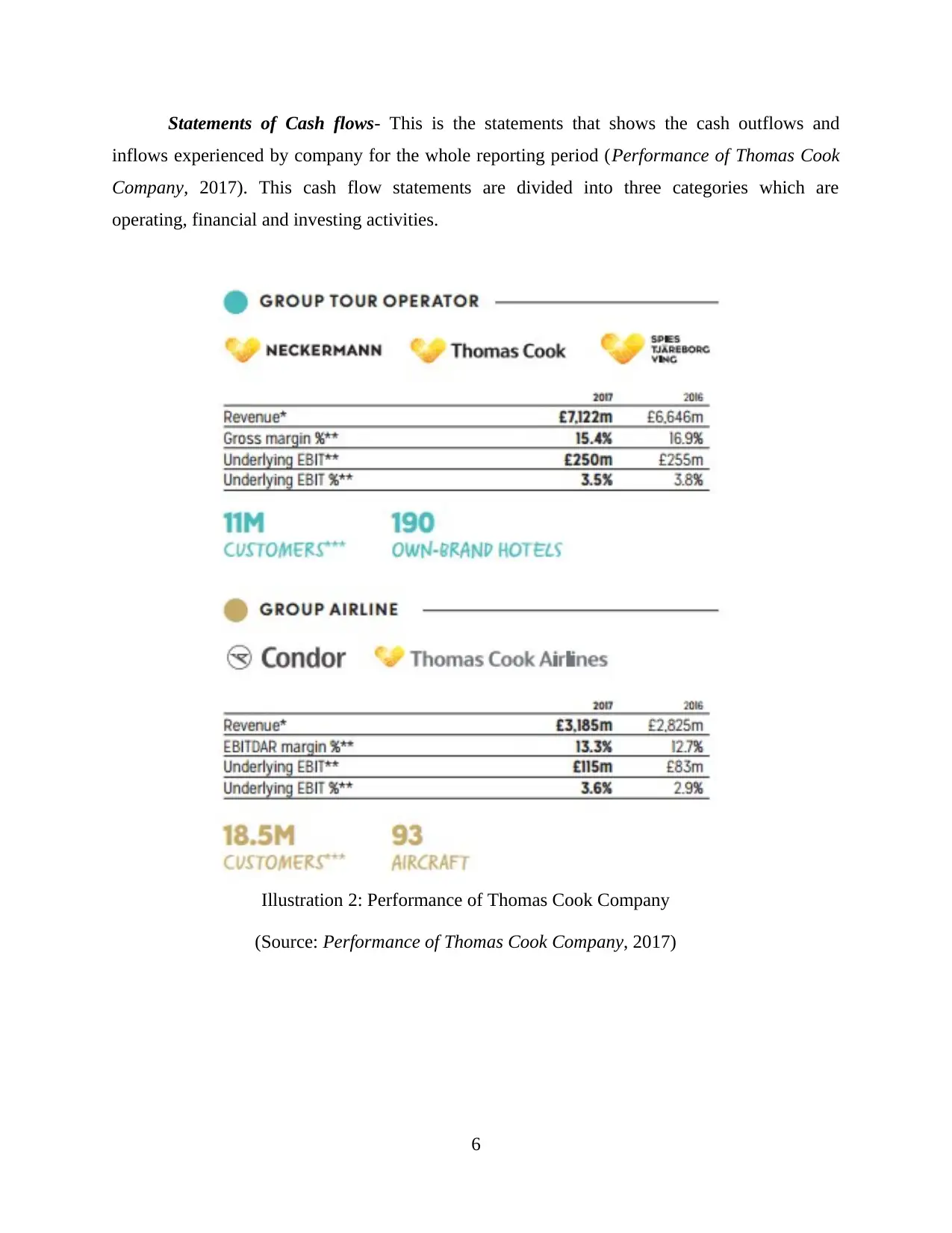
Statements of Cash flows- This is the statements that shows the cash outflows and
inflows experienced by company for the whole reporting period (Performance of Thomas Cook
Company, 2017). This cash flow statements are divided into three categories which are
operating, financial and investing activities.
6
Illustration 2: Performance of Thomas Cook Company
(Source: Performance of Thomas Cook Company, 2017)
inflows experienced by company for the whole reporting period (Performance of Thomas Cook
Company, 2017). This cash flow statements are divided into three categories which are
operating, financial and investing activities.
6
Illustration 2: Performance of Thomas Cook Company
(Source: Performance of Thomas Cook Company, 2017)
⊘ This is a preview!⊘
Do you want full access?
Subscribe today to unlock all pages.
Trusted by 1+ million students worldwide
P.8.The importance and value of budgets for controlling business performance and identifying
variances.
Budgeting – Budgeting is the process of creating a plan to spend your money. This spending
plan is called a budget. Creating this spending plan allows you to determine in advance whether
you will have enough money to do the things you need to do or would like to do.
Types of Budget- Master Budget, Cash Flow Budget, Financial Budget, Static Budget.
In order to spend money in the organisation, budget is prepared. It is defined as balancing
of expenses with the income of company. Dis-balance leads to create a big problem for the
company. Thomas Cook company also prepare there budget which is very important for them
(Swart and et.al.,2018). Here are the importance of value of the budget for controlling business
performance and identifying variances-
Clearly defined goals- Budget is a goal setting exercise as it helps to defined clearly what
company is to achieve in available resources. It is important for company's financial goal need to
be defined at the starting of the procedure. It provides detailed information about the revenues
and expenses for each and every units.
It controls the debt of company- This is also one of the most important benefits of
company as it make sure that management should stop spend money that they don't have.
Increasing creditors is not good for company, so by planning budget company at the beginning
illustrate all the resources that they have.
Optimum utilization of resources- Budget also help in optimum utilization of resources.
By planning the budget, management knows that they have this much of resources and they have
to achieve the goals by using these resources. Thus, budget enable he fuller utilization of
resources.
It identifies bottlenecks and constraints- Budget also helps in identify the bottlenecks
and constraints. The managers who are responsible for planing the budget can understand in
advance of looming, bottlenecks of production as well as distribution and it keeps the company
on a god financial track (Page and et.al., 2017).
7
variances.
Budgeting – Budgeting is the process of creating a plan to spend your money. This spending
plan is called a budget. Creating this spending plan allows you to determine in advance whether
you will have enough money to do the things you need to do or would like to do.
Types of Budget- Master Budget, Cash Flow Budget, Financial Budget, Static Budget.
In order to spend money in the organisation, budget is prepared. It is defined as balancing
of expenses with the income of company. Dis-balance leads to create a big problem for the
company. Thomas Cook company also prepare there budget which is very important for them
(Swart and et.al.,2018). Here are the importance of value of the budget for controlling business
performance and identifying variances-
Clearly defined goals- Budget is a goal setting exercise as it helps to defined clearly what
company is to achieve in available resources. It is important for company's financial goal need to
be defined at the starting of the procedure. It provides detailed information about the revenues
and expenses for each and every units.
It controls the debt of company- This is also one of the most important benefits of
company as it make sure that management should stop spend money that they don't have.
Increasing creditors is not good for company, so by planning budget company at the beginning
illustrate all the resources that they have.
Optimum utilization of resources- Budget also help in optimum utilization of resources.
By planning the budget, management knows that they have this much of resources and they have
to achieve the goals by using these resources. Thus, budget enable he fuller utilization of
resources.
It identifies bottlenecks and constraints- Budget also helps in identify the bottlenecks
and constraints. The managers who are responsible for planing the budget can understand in
advance of looming, bottlenecks of production as well as distribution and it keeps the company
on a god financial track (Page and et.al., 2017).
7
Paraphrase This Document
Need a fresh take? Get an instant paraphrase of this document with our AI Paraphraser
D.4.Evaluating the performance of business that is based on financial statements reports for
Thomas Cook company.
Financial statements are identified the performance of company as well as financial
position and cash flows of company. It is very important for company to prepare all the financial
statements so that company can identifies there performance and make improvement if it is not
going well. The performance of Thomas Cook company is increasing as in 2016 the core index
of firm is from 64% which was enhanced at 68% in 2017. In addition to this, company can
identified there results as well as operations, cash flows, financial positions. This information are
utilized by the investors, creditors to make decision to allocate there resources in the company.
Moreover, the by preparing balance sheet, it is identified that debt of Thomas Cook is also
deceasing which also shows that companies performance is raising (Kasemsap, 2017).
PART 2
P.3.&M.2.Reviewing and Evaluating Different stages of the HR life cycle and their importance
for retaining and developing talent.
HR life-cycle is also called as employee life-cycle. It is a concept in the management of
human resource that explains the stages of employees time with the particular organisation as
well as the role played by human resource at each stage. Each stages in the life-cycle has their
own challenges, opportunities and advantages. Here are stages of HR life-cycle-
Recruitment- This is one of the most important stage of human resource of each
company or Thomas Cook. This is the fundamental function that is played by HR of Thomas
Cook. In order to grow the company, HR plays the role of Hiring the candidates and it is very
critical decision in turnover, growth and productivity. HR department needs to fill the vacant
position in the organisation. HR manager at Thomas Cook use various techniques for recruiting
candidate such as interview, written test, computer test etc.
Education- This is next stage after the selection of candidate. It is the duty of HR
department that a candidate who is selected should know and understand there role, expectation
and all the philosophies of organisation from the first day.
Motivation- This is the most important stage of product life-cycle as the turnover of
employees as well as company is depended on motivation. Lack of motivation is the biggest
reason for employee turnover. It is the responsibility of HR department to make them engage,
8
Thomas Cook company.
Financial statements are identified the performance of company as well as financial
position and cash flows of company. It is very important for company to prepare all the financial
statements so that company can identifies there performance and make improvement if it is not
going well. The performance of Thomas Cook company is increasing as in 2016 the core index
of firm is from 64% which was enhanced at 68% in 2017. In addition to this, company can
identified there results as well as operations, cash flows, financial positions. This information are
utilized by the investors, creditors to make decision to allocate there resources in the company.
Moreover, the by preparing balance sheet, it is identified that debt of Thomas Cook is also
deceasing which also shows that companies performance is raising (Kasemsap, 2017).
PART 2
P.3.&M.2.Reviewing and Evaluating Different stages of the HR life cycle and their importance
for retaining and developing talent.
HR life-cycle is also called as employee life-cycle. It is a concept in the management of
human resource that explains the stages of employees time with the particular organisation as
well as the role played by human resource at each stage. Each stages in the life-cycle has their
own challenges, opportunities and advantages. Here are stages of HR life-cycle-
Recruitment- This is one of the most important stage of human resource of each
company or Thomas Cook. This is the fundamental function that is played by HR of Thomas
Cook. In order to grow the company, HR plays the role of Hiring the candidates and it is very
critical decision in turnover, growth and productivity. HR department needs to fill the vacant
position in the organisation. HR manager at Thomas Cook use various techniques for recruiting
candidate such as interview, written test, computer test etc.
Education- This is next stage after the selection of candidate. It is the duty of HR
department that a candidate who is selected should know and understand there role, expectation
and all the philosophies of organisation from the first day.
Motivation- This is the most important stage of product life-cycle as the turnover of
employees as well as company is depended on motivation. Lack of motivation is the biggest
reason for employee turnover. It is the responsibility of HR department to make them engage,
8
offer reasons to stay motivates such as incentives, compensation and benefits (O’Regan and
Choe, 2017).
Evaluation- This is also one the most important role played by HR department of
company as they have to give managers as well as employees a particular metrics to hit. It is very
essential to evaluate yearly as it serves as the benchmark to growth as well as satisfaction.
Celebration- This is last stage of HR life-cycle as it is the best way to reenergize the
entire staff or employees for there contribution for company in achievement of goals. Thomas
Crook company organize appraisal party and appraise them according to there performance
during the year.
Attraction- The HR practices should be attractive as well as effective. It is very essential
to have the best attractive functions as well as practices.
Induction- It is the process of introducing a new employee to the company culture and
processes with the aim of bringing them up to speed as quickly as possible as well as making
them feel socially comfortable and aware of their professional responsibilities. Thomas Crook
will typically have an induction programme in place and follow the same processes for all new
hires.
Retention- Employee retention refers to the ability of an organization to retain its
employees. Employee retention can be represented by a simple statistic. However, Thomas Cook
consider employee retention as relating to the efforts by which employers attempt to retain the
employees in their workforce.
Importance of Development (education)
HR life-cycle is very important for retaining and developing talented employees within
organisation. It gives consistent series of al the steps through their careers in the organisation and
enables employees to examine the data like what workers disclose during off-boarding that can
lead to the improvement in HR. HR also provided training and development opportunities to
employees which also help company in retention as employees feel valued for organisation.
Training also raise the skills and knowledge of employees (EPS of Thomas Cook Company,
2017). HR at Thomas Cook also motivate employees which also help company in reducing
employee turnover. Employees are highly satisfied with the company and it is only because of
HR department.
9
Choe, 2017).
Evaluation- This is also one the most important role played by HR department of
company as they have to give managers as well as employees a particular metrics to hit. It is very
essential to evaluate yearly as it serves as the benchmark to growth as well as satisfaction.
Celebration- This is last stage of HR life-cycle as it is the best way to reenergize the
entire staff or employees for there contribution for company in achievement of goals. Thomas
Crook company organize appraisal party and appraise them according to there performance
during the year.
Attraction- The HR practices should be attractive as well as effective. It is very essential
to have the best attractive functions as well as practices.
Induction- It is the process of introducing a new employee to the company culture and
processes with the aim of bringing them up to speed as quickly as possible as well as making
them feel socially comfortable and aware of their professional responsibilities. Thomas Crook
will typically have an induction programme in place and follow the same processes for all new
hires.
Retention- Employee retention refers to the ability of an organization to retain its
employees. Employee retention can be represented by a simple statistic. However, Thomas Cook
consider employee retention as relating to the efforts by which employers attempt to retain the
employees in their workforce.
Importance of Development (education)
HR life-cycle is very important for retaining and developing talented employees within
organisation. It gives consistent series of al the steps through their careers in the organisation and
enables employees to examine the data like what workers disclose during off-boarding that can
lead to the improvement in HR. HR also provided training and development opportunities to
employees which also help company in retention as employees feel valued for organisation.
Training also raise the skills and knowledge of employees (EPS of Thomas Cook Company,
2017). HR at Thomas Cook also motivate employees which also help company in reducing
employee turnover. Employees are highly satisfied with the company and it is only because of
HR department.
9
⊘ This is a preview!⊘
Do you want full access?
Subscribe today to unlock all pages.
Trusted by 1+ million students worldwide

1 out of 20


Related Documents


Your All-in-One AI-Powered Toolkit for Academic Success.
+13062052269
info@desklib.com
Available 24*7 on WhatsApp / Email
![[object Object]](/_next/static/media/star-bottom.7253800d.svg)
Unlock your academic potential
Copyright © 2020–2026 A2Z Services. All Rights Reserved. Developed and managed by ZUCOL.