Developing Manager Report: Management and Career Development
VerifiedAdded on 2020/01/07
|14
|4534
|49
Report
AI Summary
This report delves into the multifaceted aspects of developing managers, focusing on management styles, leadership characteristics, and effective communication strategies within a business context. The report examines various management styles, including bureaucratic, administrative, and scientific approaches, and their application within organizations. It explores leadership characteristics such as confidence, transparency, and passion, alongside different leadership styles like democratic, autocratic, transactional, and transformational leadership. The report also analyzes the communication process, emphasizing the importance of lateral and horizontal communication, and highlights potential barriers to effective communication, such as physical, cultural, and emotional distractions. Furthermore, the report addresses the importance of team motivation, decision-making, and career development within the context of managerial roles, using the example of Thomas Cook to illustrate the practical application of these concepts. It provides insights into managerial and personal skills that support career development and the creation of development plans based on current and future needs. The report concludes with a comprehensive overview of the key elements that contribute to the successful development of managers and their ability to achieve organizational goals.
The Developing Manager

Paraphrase This Document
Need a fresh take? Get an instant paraphrase of this document with our AI Paraphraser
Table of Contents
INTRODUCTION..........................................................................................................................................................3
1.1 Different Management Styles..............................................................................................................................3
1.2 Leadership Characteristics...................................................................................................................................4
1.3 Communication process in business....................................................................................................................5
1.4 Organization culture and change in business......................................................................................................8
TASK2............................................................................................................................................................................8
Covered in ppt...........................................................................................................................................................8
TASK3............................................................................................................................................................................9
3.1 Leading and motivating a team to achieve goals and objectives .......................................................................9
3.2 Managerial decision made for the achievement of goals and objectives..........................................................10
TASK4..........................................................................................................................................................................10
4.1 Managerial and personal skills that support career developments....................................................................10
4.2 Career and Personal development needs, current performance and future needs which can help to produce
development plan.....................................................................................................................................................11
CONCLUSION ............................................................................................................................................................11
REFERENCES..............................................................................................................................................................12
Books and Journals.......................................................................................................................................................12
INTRODUCTION..........................................................................................................................................................3
1.1 Different Management Styles..............................................................................................................................3
1.2 Leadership Characteristics...................................................................................................................................4
1.3 Communication process in business....................................................................................................................5
1.4 Organization culture and change in business......................................................................................................8
TASK2............................................................................................................................................................................8
Covered in ppt...........................................................................................................................................................8
TASK3............................................................................................................................................................................9
3.1 Leading and motivating a team to achieve goals and objectives .......................................................................9
3.2 Managerial decision made for the achievement of goals and objectives..........................................................10
TASK4..........................................................................................................................................................................10
4.1 Managerial and personal skills that support career developments....................................................................10
4.2 Career and Personal development needs, current performance and future needs which can help to produce
development plan.....................................................................................................................................................11
CONCLUSION ............................................................................................................................................................11
REFERENCES..............................................................................................................................................................12
Books and Journals.......................................................................................................................................................12
INTRODUCTION
Once the management of any company is formed and ready to function and discharge its
duties, it is very important to have an efficient manger along with proper leadership skills so that
the respective teams should be directed in the correct manager so that they dispose their part in
the correct manner in the process of achieving the organization objectives. Further in order to fill
up the gap between the organization and the developing economies, it is very necessary to have
flexible management abilities in a particular person so that he/she can makes the necessary
changes in order to go in line with the present environment (Wu and Lee, 2007)
In the present context of the report the importance of developing managers and different
management styles that can be practised in Thomas Cook which is a big tour operator company
in UK is researched into.
TASK 1
1.1 Different Management Styles
Management theory help the manager to manage overall organisation by various management
styles that help in achieving goals and objectives of a firm. There are various types of
management are bureaucratic, administrative and scientific management. In bureaucratic
management in which there is formal system through which employee achieve firm's goals by
create picture of organisation policy and role of employees. Whereas in a scientific management
is develop by Taylor that is used by an organisation to improve productivity, economies of scale
and labour efficiency etc. Along with this, Administrative management is used by large
organisation in which there is a different roles of people work in a firm that is manage by
information by employees.
According to the priority of satisfaction various hierarchical needs of an individual of an
organization related to its physiological, safety belongingness, esteem and self-actualization
different management styles are practised by the individual that helps them to conduct the
various functions of the organization smoothly. The various contributors who decides that which
and how various management style should be adopted and followed in the organization can be
chief executive officers and other people concern with the top management and the team leaders
which heads various departments. The various management style followed in and organization
are:
Once the management of any company is formed and ready to function and discharge its
duties, it is very important to have an efficient manger along with proper leadership skills so that
the respective teams should be directed in the correct manager so that they dispose their part in
the correct manner in the process of achieving the organization objectives. Further in order to fill
up the gap between the organization and the developing economies, it is very necessary to have
flexible management abilities in a particular person so that he/she can makes the necessary
changes in order to go in line with the present environment (Wu and Lee, 2007)
In the present context of the report the importance of developing managers and different
management styles that can be practised in Thomas Cook which is a big tour operator company
in UK is researched into.
TASK 1
1.1 Different Management Styles
Management theory help the manager to manage overall organisation by various management
styles that help in achieving goals and objectives of a firm. There are various types of
management are bureaucratic, administrative and scientific management. In bureaucratic
management in which there is formal system through which employee achieve firm's goals by
create picture of organisation policy and role of employees. Whereas in a scientific management
is develop by Taylor that is used by an organisation to improve productivity, economies of scale
and labour efficiency etc. Along with this, Administrative management is used by large
organisation in which there is a different roles of people work in a firm that is manage by
information by employees.
According to the priority of satisfaction various hierarchical needs of an individual of an
organization related to its physiological, safety belongingness, esteem and self-actualization
different management styles are practised by the individual that helps them to conduct the
various functions of the organization smoothly. The various contributors who decides that which
and how various management style should be adopted and followed in the organization can be
chief executive officers and other people concern with the top management and the team leaders
which heads various departments. The various management style followed in and organization
are:
⊘ This is a preview!⊘
Do you want full access?
Subscribe today to unlock all pages.

Trusted by 1+ million students worldwide
System Approach to management: In this approach the organization is treated as a system
which interacts with its internal and external environment through its various subsystem in the
form of different departments which continuously interact with each other so that they can
achieve the goal of the organization as a whole (Li and Scullion, 2010).Further the goal of one
department considered as a subsystem is of lower importance than the goal of a system as a
whole. In the present context of Thomas Cook it can be seen that the goal of the company is of
greater importance than the goal of food household or personal care department. This approach
considers that every subsystem receives input from its other sub system and they cannot act in
vacuum. This approach can be followed in both general and specialized way where in general
sense the sociology, psychology and philosophy of various departments are studied while the
specific management practice are carried after studying organizational structure, system of
communication, planning and job design. This style is very useful while planning, organizing
and controlling various functions of management(Maurer and Liu, 2007)
However contingency is totally different from system management which states that there is no
set pattern of management style that can be applied on an organization, it depends from
organization to organization and the way they respond to various contingency factors. The
contingency approach is followed by having a proper leader member relations by having a clear
understanding of the task structure and how the manager should exercise his power by rewarding
or by punishing(Stewart, 2009).
Thomas cook and American Express company have there different management styles to
manage work in an organisation. Thomas cook leaders use transformational leadership style in
that he encourage its people to achieve firm's goals. Leaders gives power to its members to make
decision on each matter of business after they properly trained. They inspire their peoples to find
a new ways to achieve objectives in a better way that helps them in resolving conflict. Whereas,
American express company use autocratic leadership style in which leaders have full control and
command over its members. It gives direction to its employees what they have to be done and
when. It is effective for the business when they have to make quick decisions that directly
enhance productivity and efficiency.
which interacts with its internal and external environment through its various subsystem in the
form of different departments which continuously interact with each other so that they can
achieve the goal of the organization as a whole (Li and Scullion, 2010).Further the goal of one
department considered as a subsystem is of lower importance than the goal of a system as a
whole. In the present context of Thomas Cook it can be seen that the goal of the company is of
greater importance than the goal of food household or personal care department. This approach
considers that every subsystem receives input from its other sub system and they cannot act in
vacuum. This approach can be followed in both general and specialized way where in general
sense the sociology, psychology and philosophy of various departments are studied while the
specific management practice are carried after studying organizational structure, system of
communication, planning and job design. This style is very useful while planning, organizing
and controlling various functions of management(Maurer and Liu, 2007)
However contingency is totally different from system management which states that there is no
set pattern of management style that can be applied on an organization, it depends from
organization to organization and the way they respond to various contingency factors. The
contingency approach is followed by having a proper leader member relations by having a clear
understanding of the task structure and how the manager should exercise his power by rewarding
or by punishing(Stewart, 2009).
Thomas cook and American Express company have there different management styles to
manage work in an organisation. Thomas cook leaders use transformational leadership style in
that he encourage its people to achieve firm's goals. Leaders gives power to its members to make
decision on each matter of business after they properly trained. They inspire their peoples to find
a new ways to achieve objectives in a better way that helps them in resolving conflict. Whereas,
American express company use autocratic leadership style in which leaders have full control and
command over its members. It gives direction to its employees what they have to be done and
when. It is effective for the business when they have to make quick decisions that directly
enhance productivity and efficiency.
Paraphrase This Document
Need a fresh take? Get an instant paraphrase of this document with our AI Paraphraser
1.2 Leadership Characteristics
Apart from deciding the management functions, it is very necessary to be a efficient leader so
that not only the objectives are achieved but the people working under the leaders are satisfied.
The various qualities of a leader are :
A leader should be confident in undertaking unpopular tasks which are not generally faced by the
organization before. This statement implies having of immense confidence in the leader no
matter what that is he/she does not loose its calm during hasty and during deadlines. By having
confidence a leader shows the clear vision he/she has regarding the functions to be performed.
Confidence can be accompanied with sympathy, generosity and kindness thereby gaining respect
all over the team members(Proudlove, Boaden and Jorgensen, 2007)
A leader should be transparent in order to gain trust of his/her team members. When a leader is
transparent it ensures that there are no surprises in terms of the work or his/her personality to its
team mates which allows them to discharge their part of work in a consistent manner as being
transparent also involves sharing the flaws of the employees and encouraging them to overcome
the same and perform in a consistent manner. Being transparent further accompanied by honestly
which as he/she is the person to look up to by team members as the benchmark to behave in the
organization(Higgins and Aspinall, 2011)
Being passionate about his/her work should be a core important point that should be present in
the leader. When the leader shows love and interest in his/her work he/she does not only deliver
work but ensures discharge of quality work. The passion towards the work should not be
effected with the growth in business that is whether a business is a small organization passion
should be there to make it further successful and if it is a large established organization like
Thomas Cook passion should be there to maintain the same position(Wu and Lee, 2007)
In order to maintain interest in the monotonous work a good leader should promote the culture
of innovations in the organization by encouraging different members to participate in the
decision making process and providing different alternatives to perform the task.
And lastly he/she should be patience to the different needs of his/her group members and the
time period which a particular task is taking to reach its final destination.
There are various leadership style that are used by leaders to motivate their employee in
an organisation and adopt motivational theories. Democratic leadership style in which a leader
encourage their employees to participate in the decision making process and share their views
Apart from deciding the management functions, it is very necessary to be a efficient leader so
that not only the objectives are achieved but the people working under the leaders are satisfied.
The various qualities of a leader are :
A leader should be confident in undertaking unpopular tasks which are not generally faced by the
organization before. This statement implies having of immense confidence in the leader no
matter what that is he/she does not loose its calm during hasty and during deadlines. By having
confidence a leader shows the clear vision he/she has regarding the functions to be performed.
Confidence can be accompanied with sympathy, generosity and kindness thereby gaining respect
all over the team members(Proudlove, Boaden and Jorgensen, 2007)
A leader should be transparent in order to gain trust of his/her team members. When a leader is
transparent it ensures that there are no surprises in terms of the work or his/her personality to its
team mates which allows them to discharge their part of work in a consistent manner as being
transparent also involves sharing the flaws of the employees and encouraging them to overcome
the same and perform in a consistent manner. Being transparent further accompanied by honestly
which as he/she is the person to look up to by team members as the benchmark to behave in the
organization(Higgins and Aspinall, 2011)
Being passionate about his/her work should be a core important point that should be present in
the leader. When the leader shows love and interest in his/her work he/she does not only deliver
work but ensures discharge of quality work. The passion towards the work should not be
effected with the growth in business that is whether a business is a small organization passion
should be there to make it further successful and if it is a large established organization like
Thomas Cook passion should be there to maintain the same position(Wu and Lee, 2007)
In order to maintain interest in the monotonous work a good leader should promote the culture
of innovations in the organization by encouraging different members to participate in the
decision making process and providing different alternatives to perform the task.
And lastly he/she should be patience to the different needs of his/her group members and the
time period which a particular task is taking to reach its final destination.
There are various leadership style that are used by leaders to motivate their employee in
an organisation and adopt motivational theories. Democratic leadership style in which a leader
encourage their employees to participate in the decision making process and share their views
and opinion regarding any matter. Whereas, Autocratic leadership style is that in which leader
cannot involve their member to share their opinions there is full control over leader.
Transactional leadership in which leaders work according to the process and procedures there is
no involvement of member it is also known as managerial leadership style in which there is
supervision . Transformational leadership style in which leader push the member to participate in
various task by reward and punishment. Along with this, there is a Maslow 's hierarchy needs in
which firm satisfy their employee by satisfy employee lower needs such as physcological needs
and safety needs and after higher needs are to be satisfied by fulfil esteem needs and self-
actualization needs. Thomas cook transformational leader have different qualities that make an
organisation successfully achieved. The main quality of leader is that inspiration through this
they inspire its member to take new challenges that enhance their qualities and knowledge
improved. On the other side, American express company have autocratic leader so the main
quality of it is that it make decision very fast and immediate that help in a difficult situation that
make the firm to survive for a long time.
1.3 Communication process in business
Apart from having a good intellectual skills in individual it is very necessary to have a
good communication flow and process in the organization so that different activities are
coordinated with each other and there are no delays in the carry out of the activities and
achieving the targets.
In the selected organization for a communication process to be effective sender should be
identified at every location, there is a proper system of encoding the message by selecting
various channels available for communication so that it is properly decoded by the receiver in the
original form in which it is received(Stewart, 2009.)
As the size of Thomas Cook is comparatively very large therefore lateral communication
should be adopted as it involves sharing ideas and exchanging information among various peer
groups which are in the same level of hierarchy. Further in order to promote teamwork and
coordination among the group horizontal communication should be followed which is more
informal and less structured than vertical communication. This process can take place through
telephones, emails having informal discussions , teleconferencing and videoconferencing among
various groups. This type of communication mainly helps in maintaining the position in the
market with the scope of growth and improvement, as with the rising operation and size of the
cannot involve their member to share their opinions there is full control over leader.
Transactional leadership in which leaders work according to the process and procedures there is
no involvement of member it is also known as managerial leadership style in which there is
supervision . Transformational leadership style in which leader push the member to participate in
various task by reward and punishment. Along with this, there is a Maslow 's hierarchy needs in
which firm satisfy their employee by satisfy employee lower needs such as physcological needs
and safety needs and after higher needs are to be satisfied by fulfil esteem needs and self-
actualization needs. Thomas cook transformational leader have different qualities that make an
organisation successfully achieved. The main quality of leader is that inspiration through this
they inspire its member to take new challenges that enhance their qualities and knowledge
improved. On the other side, American express company have autocratic leader so the main
quality of it is that it make decision very fast and immediate that help in a difficult situation that
make the firm to survive for a long time.
1.3 Communication process in business
Apart from having a good intellectual skills in individual it is very necessary to have a
good communication flow and process in the organization so that different activities are
coordinated with each other and there are no delays in the carry out of the activities and
achieving the targets.
In the selected organization for a communication process to be effective sender should be
identified at every location, there is a proper system of encoding the message by selecting
various channels available for communication so that it is properly decoded by the receiver in the
original form in which it is received(Stewart, 2009.)
As the size of Thomas Cook is comparatively very large therefore lateral communication
should be adopted as it involves sharing ideas and exchanging information among various peer
groups which are in the same level of hierarchy. Further in order to promote teamwork and
coordination among the group horizontal communication should be followed which is more
informal and less structured than vertical communication. This process can take place through
telephones, emails having informal discussions , teleconferencing and videoconferencing among
various groups. This type of communication mainly helps in maintaining the position in the
market with the scope of growth and improvement, as with the rising operation and size of the
⊘ This is a preview!⊘
Do you want full access?
Subscribe today to unlock all pages.
Trusted by 1+ million students worldwide
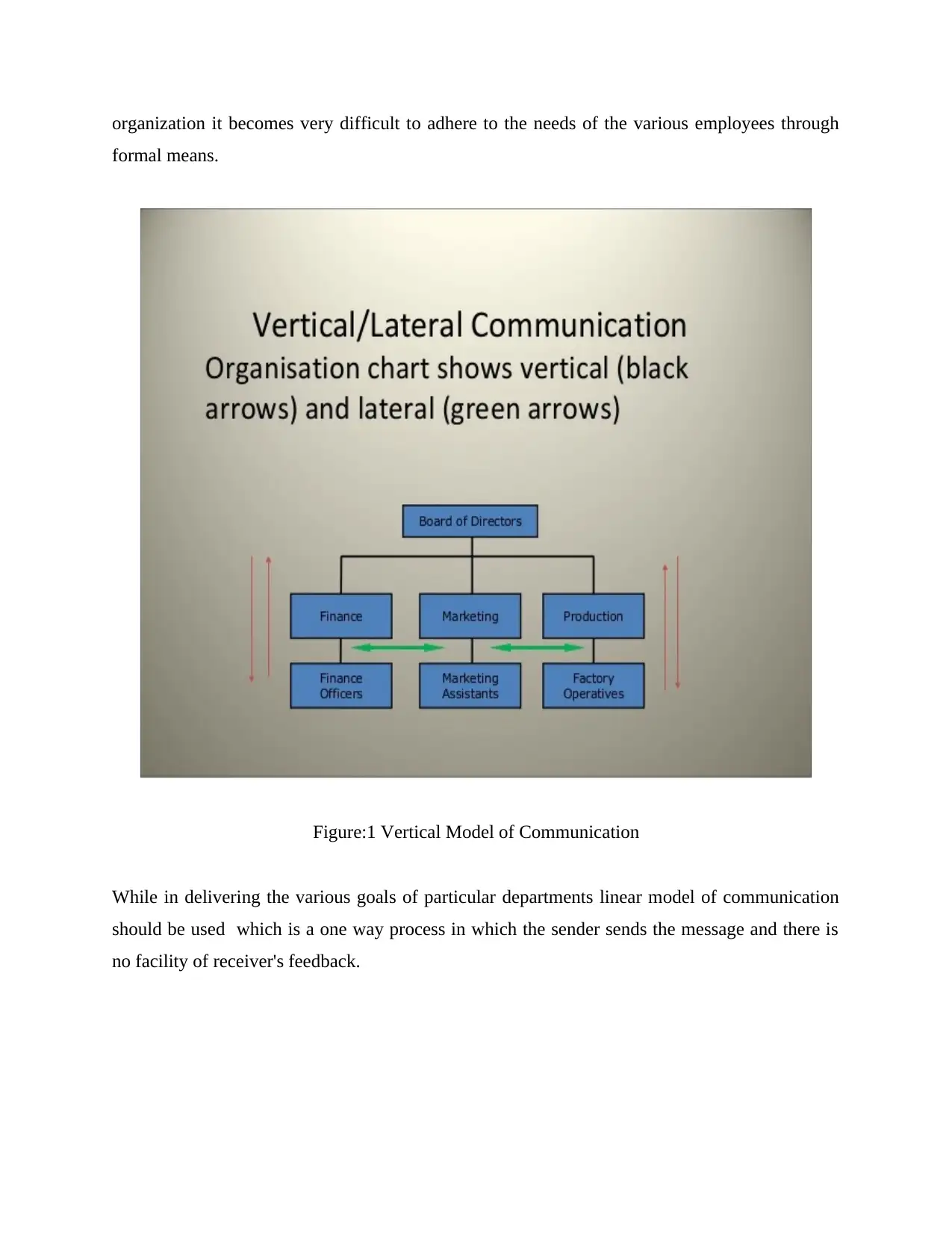
organization it becomes very difficult to adhere to the needs of the various employees through
formal means.
Figure:1 Vertical Model of Communication
While in delivering the various goals of particular departments linear model of communication
should be used which is a one way process in which the sender sends the message and there is
no facility of receiver's feedback.
formal means.
Figure:1 Vertical Model of Communication
While in delivering the various goals of particular departments linear model of communication
should be used which is a one way process in which the sender sends the message and there is
no facility of receiver's feedback.
Paraphrase This Document
Need a fresh take? Get an instant paraphrase of this document with our AI Paraphraser
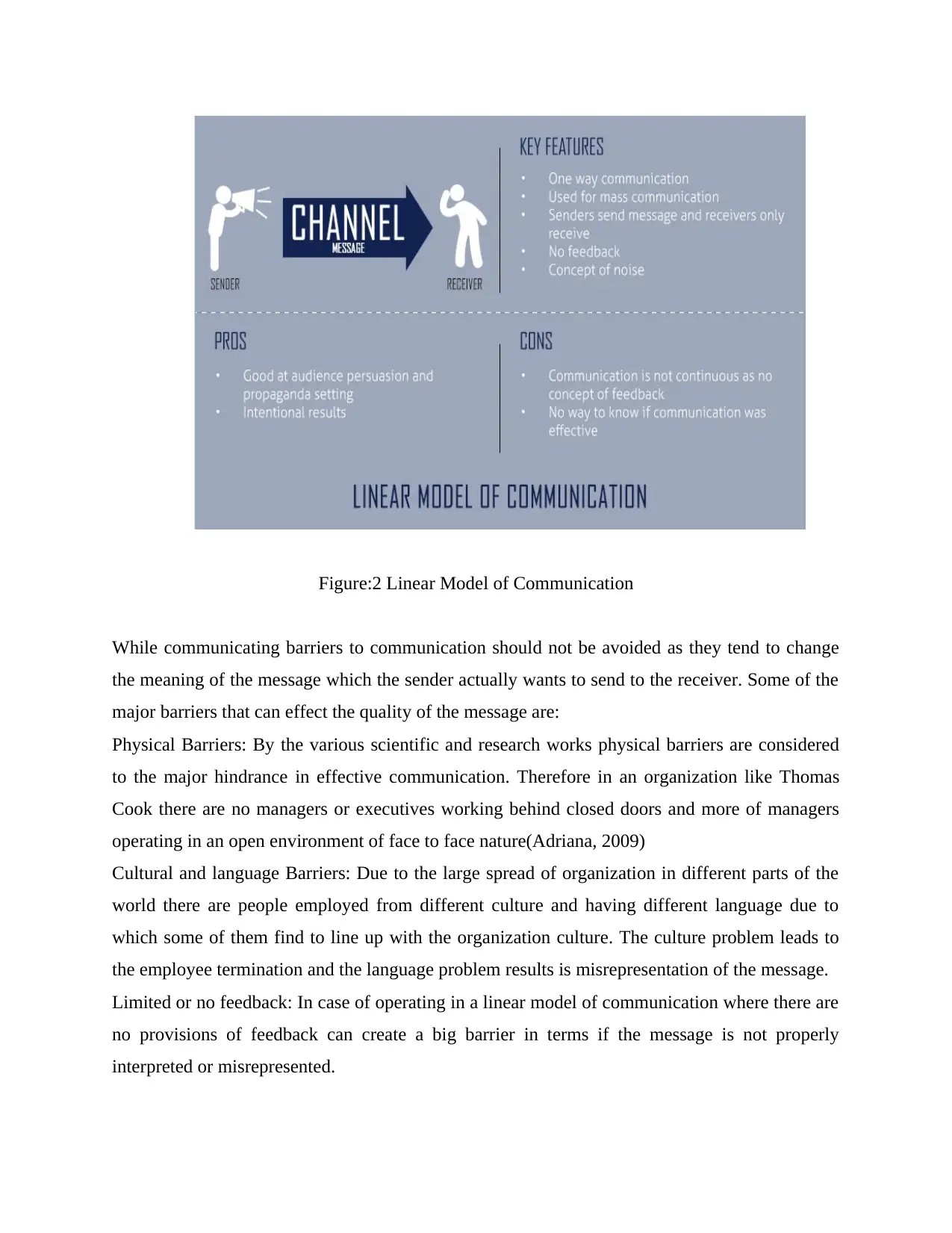
Figure:2 Linear Model of Communication
While communicating barriers to communication should not be avoided as they tend to change
the meaning of the message which the sender actually wants to send to the receiver. Some of the
major barriers that can effect the quality of the message are:
Physical Barriers: By the various scientific and research works physical barriers are considered
to the major hindrance in effective communication. Therefore in an organization like Thomas
Cook there are no managers or executives working behind closed doors and more of managers
operating in an open environment of face to face nature(Adriana, 2009)
Cultural and language Barriers: Due to the large spread of organization in different parts of the
world there are people employed from different culture and having different language due to
which some of them find to line up with the organization culture. The culture problem leads to
the employee termination and the language problem results is misrepresentation of the message.
Limited or no feedback: In case of operating in a linear model of communication where there are
no provisions of feedback can create a big barrier in terms if the message is not properly
interpreted or misrepresented.
While communicating barriers to communication should not be avoided as they tend to change
the meaning of the message which the sender actually wants to send to the receiver. Some of the
major barriers that can effect the quality of the message are:
Physical Barriers: By the various scientific and research works physical barriers are considered
to the major hindrance in effective communication. Therefore in an organization like Thomas
Cook there are no managers or executives working behind closed doors and more of managers
operating in an open environment of face to face nature(Adriana, 2009)
Cultural and language Barriers: Due to the large spread of organization in different parts of the
world there are people employed from different culture and having different language due to
which some of them find to line up with the organization culture. The culture problem leads to
the employee termination and the language problem results is misrepresentation of the message.
Limited or no feedback: In case of operating in a linear model of communication where there are
no provisions of feedback can create a big barrier in terms if the message is not properly
interpreted or misrepresented.
Emotional Distractions: When people are shy and are unable to present their views, or apart from
being a good listener unable to intercept the message because of the tone in which the message is
conveyed.
There are various forms of communication while communicating a understandable
message in various forms that is written, verbal, formal and informal communication. In written
communication in which firm transfer their message in email, documentation and social media
like Facebook and Twitter etc. while verbal communication in which a firms can transfer it
message to its audience through conducting seminars, conferences and meeting. Formal
communication in which employee should follow the rules and regulation while communicate to
its employees any message in a formal way. Whereas informal communication in which
employee can share there feeling and emotion in a firm. Thomas cook use written
communication so they can transfer message to its receiver in an appropriate manner. They
transfer its travel services by email and faxes that can be transferred accurately that increase the
customer satisfaction.
1.4 Organization culture and change in business
Apart from being the greatest global leader Thomas Cook has its operations and resources spread
all over the world. The main reason of its success is the organization culture which includes the
leadership abilities and all other human resources. If any major change occurred in any of its area
it leads to the introduction of the changes all over the organization thereby integrating success
leadership and human resource as a whole. Some of the major characteristics of this organization
are:
The company focus on performance whether it is a organization performance or individual. It
believes in integrating individual performance with the organization so that its objectives are
achieved as per the planned framework(Zhang, Song and Huang, 2009)
Apart from focussing on performance it believes in focussing on quality of work produced it
does not only believe in completing the task but also meeting the quality specifications required
for the same. In this way it maintains its global position.
It believes in incorporating all the major changes in the economy so that it can deliver efficient
work with the help of new tools. For that it has a separate division which advices and introduce
them to the latest technological developments taking place and introducing as soon as possible in
the organization in order to maintain its efficiency.
being a good listener unable to intercept the message because of the tone in which the message is
conveyed.
There are various forms of communication while communicating a understandable
message in various forms that is written, verbal, formal and informal communication. In written
communication in which firm transfer their message in email, documentation and social media
like Facebook and Twitter etc. while verbal communication in which a firms can transfer it
message to its audience through conducting seminars, conferences and meeting. Formal
communication in which employee should follow the rules and regulation while communicate to
its employees any message in a formal way. Whereas informal communication in which
employee can share there feeling and emotion in a firm. Thomas cook use written
communication so they can transfer message to its receiver in an appropriate manner. They
transfer its travel services by email and faxes that can be transferred accurately that increase the
customer satisfaction.
1.4 Organization culture and change in business
Apart from being the greatest global leader Thomas Cook has its operations and resources spread
all over the world. The main reason of its success is the organization culture which includes the
leadership abilities and all other human resources. If any major change occurred in any of its area
it leads to the introduction of the changes all over the organization thereby integrating success
leadership and human resource as a whole. Some of the major characteristics of this organization
are:
The company focus on performance whether it is a organization performance or individual. It
believes in integrating individual performance with the organization so that its objectives are
achieved as per the planned framework(Zhang, Song and Huang, 2009)
Apart from focussing on performance it believes in focussing on quality of work produced it
does not only believe in completing the task but also meeting the quality specifications required
for the same. In this way it maintains its global position.
It believes in incorporating all the major changes in the economy so that it can deliver efficient
work with the help of new tools. For that it has a separate division which advices and introduce
them to the latest technological developments taking place and introducing as soon as possible in
the organization in order to maintain its efficiency.
⊘ This is a preview!⊘
Do you want full access?
Subscribe today to unlock all pages.
Trusted by 1+ million students worldwide
Further through the collaborative efforts of different departments managers it is able to maintain
its large customer base and to support its various lines of business it can further implement
information technology tools so that it can benefit employees in all areas of business including
market research, customer relation and communication between them(Frey and George, 2010).
There are various types of organisation structure that a firm adopt that according their
nature of a firms in order to attain goals are functional, divisional, matrix and product structure.
There are mainly four types of culture are power, role,person and task culture. Role culture is
used by big firms that will help in increasing overall production and efficiency that reduce
confusion. Whereas, person culture is not very much popular because few firms achieve their
goals and objectives in an environment it can be successful mainly in consulting firms. Task
culture is adopt by firms only when the project are not be completed that helps them in bringing
right people at right time. Power culture there is no or little rules and regulation it because
individuals performance can be measured by only judgement it is usually strong for the firm.
Thomas cook have a role culture in that he assigned specific job to its individuals that helps them
to ensure that the main task done without overlapping that leads to achieve goals and objectives
in a desired manner.
TASK2
Covered in ppt
TASK3
3.1 Leading and motivating a team to achieve goals and objectives
In order to achieve goals and objectives of a particular organization it is very necessary to work
in a team as team efforts are more coordinated and timely achieved than working individually.
Therefore as per the present case of working with the famous chef Jamie Oliver as a lead
in the new restaurant venture in Covent Garden, London the major practices than can be
followed in leading and motivating the team to achieve goals and objectives of the organization
as a whole are:
By being respectful to every member of the team and not considering them just the waiters for
the restaurants can imbibe the feeling of motivation in them as they feel the part of the
organization as a whole and they work in the same manner and efforts as they do for their
organization(Ramsaran-Fowdar, 2007)
its large customer base and to support its various lines of business it can further implement
information technology tools so that it can benefit employees in all areas of business including
market research, customer relation and communication between them(Frey and George, 2010).
There are various types of organisation structure that a firm adopt that according their
nature of a firms in order to attain goals are functional, divisional, matrix and product structure.
There are mainly four types of culture are power, role,person and task culture. Role culture is
used by big firms that will help in increasing overall production and efficiency that reduce
confusion. Whereas, person culture is not very much popular because few firms achieve their
goals and objectives in an environment it can be successful mainly in consulting firms. Task
culture is adopt by firms only when the project are not be completed that helps them in bringing
right people at right time. Power culture there is no or little rules and regulation it because
individuals performance can be measured by only judgement it is usually strong for the firm.
Thomas cook have a role culture in that he assigned specific job to its individuals that helps them
to ensure that the main task done without overlapping that leads to achieve goals and objectives
in a desired manner.
TASK2
Covered in ppt
TASK3
3.1 Leading and motivating a team to achieve goals and objectives
In order to achieve goals and objectives of a particular organization it is very necessary to work
in a team as team efforts are more coordinated and timely achieved than working individually.
Therefore as per the present case of working with the famous chef Jamie Oliver as a lead
in the new restaurant venture in Covent Garden, London the major practices than can be
followed in leading and motivating the team to achieve goals and objectives of the organization
as a whole are:
By being respectful to every member of the team and not considering them just the waiters for
the restaurants can imbibe the feeling of motivation in them as they feel the part of the
organization as a whole and they work in the same manner and efforts as they do for their
organization(Ramsaran-Fowdar, 2007)
Paraphrase This Document
Need a fresh take? Get an instant paraphrase of this document with our AI Paraphraser
Trusting on the team and does not micromanaging them: If I am confident regarding the choice
of my decision regarding employing the best team I need to be confident in their way of doing
the work and their potential, in this way I can inspire them to take their own decision in small
situations.(Akbaba, 2006)
Setting right example for people by myself maintaining the habit of punctuality, not extending
the lunch hours. In this way they contribute maximum towards achieving the goals and
objectives of the restaurant that they are working in.
Will keep on interacting with team personally in regular intervals so that they are continuously
reminded about the purpose for which they are here in the restaurant, to imbibe in them the lost
motivation because of the monotonous nature of work and to solve their problems faced
personally.
Timely providing them the awareness session on how to work more efficiently and achieve
targets on time and offer opportunities to learn new skills by providing them the necessary
training.
Rewarding them on various occasional so that the wish of getting provoke them to perform
better which ultimately leads to achieving the goals and objectives of the organization as a whole
and not punishing failures instead providing the guidelines to overcome the shortcomings and
perform better in future.
Encouraging them to stay positive in days when there are no customers or very less customers so
that their productivity is maintained and not hampered because of the lame days of work.
3.2 Managerial decision made for the achievement of goals and objectives
The major goal of any hotel industry is to develop and maintain a large customer base
through its quality of services and food that its provides. This will help the company in creating a
well defined impact on business growth and development within the market. Making managerial
decision involves taking decision in operations, human resources, marketing as well as the
financial matters as per the goals and objectives of the restaurant so that they does not provide
hindrance in discharging duties efficiently. The major managerial decision can be framing proper
policies for employee remuneration, their working hours, the number of people to be employed
and the various modes to be adopted for distributing their products and offering their services.
This business decision of the organization will help in monitoring employee performance while
creating high productivity for the organization. Along with this the development of the service
of my decision regarding employing the best team I need to be confident in their way of doing
the work and their potential, in this way I can inspire them to take their own decision in small
situations.(Akbaba, 2006)
Setting right example for people by myself maintaining the habit of punctuality, not extending
the lunch hours. In this way they contribute maximum towards achieving the goals and
objectives of the restaurant that they are working in.
Will keep on interacting with team personally in regular intervals so that they are continuously
reminded about the purpose for which they are here in the restaurant, to imbibe in them the lost
motivation because of the monotonous nature of work and to solve their problems faced
personally.
Timely providing them the awareness session on how to work more efficiently and achieve
targets on time and offer opportunities to learn new skills by providing them the necessary
training.
Rewarding them on various occasional so that the wish of getting provoke them to perform
better which ultimately leads to achieving the goals and objectives of the organization as a whole
and not punishing failures instead providing the guidelines to overcome the shortcomings and
perform better in future.
Encouraging them to stay positive in days when there are no customers or very less customers so
that their productivity is maintained and not hampered because of the lame days of work.
3.2 Managerial decision made for the achievement of goals and objectives
The major goal of any hotel industry is to develop and maintain a large customer base
through its quality of services and food that its provides. This will help the company in creating a
well defined impact on business growth and development within the market. Making managerial
decision involves taking decision in operations, human resources, marketing as well as the
financial matters as per the goals and objectives of the restaurant so that they does not provide
hindrance in discharging duties efficiently. The major managerial decision can be framing proper
policies for employee remuneration, their working hours, the number of people to be employed
and the various modes to be adopted for distributing their products and offering their services.
This business decision of the organization will help in monitoring employee performance while
creating high productivity for the organization. Along with this the development of the service
standards of the business will also be ensured by the same which will help the firm in developing
an effective and well defined consumer base within the market. The present market condition of
hospitality industry demands significant and well defined development measures within the
economy to ensure trust and consumer loyalty along with wide success aspects within the
market.
TASK4
4.1 Managerial and personal skills that support career developments
In order to grow in a career particularly hotel or hospitality industry various managerial
and personal skills that can help in career development are :
Ability to deal with the finances: Major dealing of the hotel is in cash or through the
management of payment through cards. Ability of a person to properly maintain a record of them
can provide a good managerial position in that industry.
Managerial abilities also includes having deep knowledge regarding the various scope of
expansion in the hotel industry and having the required qualification for the same.
An individual ability to work in a team and manage the team efforts is another point as
hospitality industry involves performing of functions in a group and coordinating with them
continuously(Proudlove, Boaden and Jorgensen, 2007)
Ability to handle various customers: anybody cannot decide about a particular type of customer
that an employee can face in the hospitality industry, therefore if an individual has the ability to
solve the customer grievances without hampering the future prospects of business from them is a
strong point that can support career development in a hotel industry.
4.2 Career and Personal development needs, current performance and future needs which can
help to produce development plan
In order to maintain a effective career development plan in hotel industry the major skills that
should be included are:
Maintain strong leadership qualities: This can be done through the examples of different
people in the same industry and applying their practices in the present situation or having a
mentor which a person sees as a ideal in reaching to a desired location. In order to discharge this
effectively a person should review its current position in the hospitality industry and the position
he/she desires to achieve(Nasution and Mavondo, 2008.)
an effective and well defined consumer base within the market. The present market condition of
hospitality industry demands significant and well defined development measures within the
economy to ensure trust and consumer loyalty along with wide success aspects within the
market.
TASK4
4.1 Managerial and personal skills that support career developments
In order to grow in a career particularly hotel or hospitality industry various managerial
and personal skills that can help in career development are :
Ability to deal with the finances: Major dealing of the hotel is in cash or through the
management of payment through cards. Ability of a person to properly maintain a record of them
can provide a good managerial position in that industry.
Managerial abilities also includes having deep knowledge regarding the various scope of
expansion in the hotel industry and having the required qualification for the same.
An individual ability to work in a team and manage the team efforts is another point as
hospitality industry involves performing of functions in a group and coordinating with them
continuously(Proudlove, Boaden and Jorgensen, 2007)
Ability to handle various customers: anybody cannot decide about a particular type of customer
that an employee can face in the hospitality industry, therefore if an individual has the ability to
solve the customer grievances without hampering the future prospects of business from them is a
strong point that can support career development in a hotel industry.
4.2 Career and Personal development needs, current performance and future needs which can
help to produce development plan
In order to maintain a effective career development plan in hotel industry the major skills that
should be included are:
Maintain strong leadership qualities: This can be done through the examples of different
people in the same industry and applying their practices in the present situation or having a
mentor which a person sees as a ideal in reaching to a desired location. In order to discharge this
effectively a person should review its current position in the hospitality industry and the position
he/she desires to achieve(Nasution and Mavondo, 2008.)
⊘ This is a preview!⊘
Do you want full access?
Subscribe today to unlock all pages.
Trusted by 1+ million students worldwide

1 out of 14


Related Documents


Your All-in-One AI-Powered Toolkit for Academic Success.
+13062052269
info@desklib.com
Available 24*7 on WhatsApp / Email
![[object Object]](/_next/static/media/star-bottom.7253800d.svg)
Unlock your academic potential
Copyright © 2020–2026 A2Z Services. All Rights Reserved. Developed and managed by ZUCOL.