Winter 2020: Thomson Reuters Annual Report Analysis, ACCT 3410
VerifiedAdded on 2022/08/21
|16
|3377
|11
Report
AI Summary
This report provides a detailed analysis of Thomson Reuters' financial performance for the year ending December 31, 2018. It begins with an executive summary, covering the company's history, market position, competitors, and key personnel. The report then identifies and discusses the major components of the annual report, emphasizing their significance to investors. A comprehensive ratio analysis is performed, evaluating profitability, liquidity, and efficiency trends over multiple years and comparing them to industry averages. The analysis includes discussion of the company's risk management strategies, accounting policies, and the impact of Canadian accounting standards. Furthermore, it addresses the application of IAS 10 (Events After the Reporting Period) and their influence on the company's financial outlook. The report concludes with an assessment of the organization's future financial performance, incorporating all the analytical findings and considering the impacts of any relevant current events.
Running head: Intermediate Accounting
Intermediate Accounting
Name of the Student
Name of the University
Author Note
Intermediate Accounting
Name of the Student
Name of the University
Author Note

Paraphrase This Document
Need a fresh take? Get an instant paraphrase of this document with our AI Paraphraser
1
Intermediate Accounting
Executive summary
Thomson Reuters was founded in Toronto, Ontario, Canada by Roy Thomson in 1934. It is
one of the world’s largest provider related to news and other information based tools to
experts and professionals. Headquarter of Thomson Reuters is situated in Toronto, Canada.
Creating a particular focus on regulations and tax changes they aim to hold customers along
with speed on developments at a global basis by having worldwide network of journalists and
specialist editors. The shares of “Thomson Reuters” are listed on the “Toronto and New York
Stock Exchanges.” There are some of the competitors of Thomson Reuters which hold a
strong position such as S&P Global Market Intelligence, Bloomberg, Market Watch, Fact Set,
Dun & Bradstreet. Steve Hasker is the current President and Chief Executive Officer and a
director of Thomson Reuters.
Intermediate Accounting
Executive summary
Thomson Reuters was founded in Toronto, Ontario, Canada by Roy Thomson in 1934. It is
one of the world’s largest provider related to news and other information based tools to
experts and professionals. Headquarter of Thomson Reuters is situated in Toronto, Canada.
Creating a particular focus on regulations and tax changes they aim to hold customers along
with speed on developments at a global basis by having worldwide network of journalists and
specialist editors. The shares of “Thomson Reuters” are listed on the “Toronto and New York
Stock Exchanges.” There are some of the competitors of Thomson Reuters which hold a
strong position such as S&P Global Market Intelligence, Bloomberg, Market Watch, Fact Set,
Dun & Bradstreet. Steve Hasker is the current President and Chief Executive Officer and a
director of Thomson Reuters.
2
Intermediate Accounting
Table of Contents
Major Components of Annual Report........................................................................................3
Ratio analysis.............................................................................................................................4
Risk management strategy of Thomson Reuters........................................................................7
Accounting policy and its impact...............................................................................................8
Impact of the application of the Canadian accounting standards.............................................10
‘Events after the Reporting Period’ (IAS 10)..........................................................................10
Impact of the Organization and future financial performance.................................................12
References................................................................................................................................13
Intermediate Accounting
Table of Contents
Major Components of Annual Report........................................................................................3
Ratio analysis.............................................................................................................................4
Risk management strategy of Thomson Reuters........................................................................7
Accounting policy and its impact...............................................................................................8
Impact of the application of the Canadian accounting standards.............................................10
‘Events after the Reporting Period’ (IAS 10)..........................................................................10
Impact of the Organization and future financial performance.................................................12
References................................................................................................................................13
⊘ This is a preview!⊘
Do you want full access?
Subscribe today to unlock all pages.

Trusted by 1+ million students worldwide
3
Intermediate Accounting
Major Components of Annual Report
An annual report is a complete report of a company which establishes its financial
health on presenting information on every financial year. It also focuses on presenting history
of the company along with its achievements and recognitions made in the past. It helps the
shareholders, investors, stakeholders, government, and media by giving accurate information
and all those details from the annual report helps the potential users in their decisions making
(Symes, Sharma & Davey, 2017). The major components of the annual report are as
following:
1. Letter from the Chairman- The performance of the company during a particular year
is mentioned here.
2. Director’s report- Crucial events happened during a particular year in a company are
included in this (Shaw et al., 2017).
3. Auditor’s report- An auditor conducts the audit on the accounts and presents the
report to the shareholders of the company.
4. Balance Sheet- Financial position is presented stating what the company is having and
what the obligations are.
5. Profit and loss Account- Net profit of a company that is earned during the current
financial year.
6. Cash flow Statement- How much cash is earned by the company and are used during
a particular period is stated here.
7. Schedules- Operational performance of a company during the reporting period are
included in this.
Intermediate Accounting
Major Components of Annual Report
An annual report is a complete report of a company which establishes its financial
health on presenting information on every financial year. It also focuses on presenting history
of the company along with its achievements and recognitions made in the past. It helps the
shareholders, investors, stakeholders, government, and media by giving accurate information
and all those details from the annual report helps the potential users in their decisions making
(Symes, Sharma & Davey, 2017). The major components of the annual report are as
following:
1. Letter from the Chairman- The performance of the company during a particular year
is mentioned here.
2. Director’s report- Crucial events happened during a particular year in a company are
included in this (Shaw et al., 2017).
3. Auditor’s report- An auditor conducts the audit on the accounts and presents the
report to the shareholders of the company.
4. Balance Sheet- Financial position is presented stating what the company is having and
what the obligations are.
5. Profit and loss Account- Net profit of a company that is earned during the current
financial year.
6. Cash flow Statement- How much cash is earned by the company and are used during
a particular period is stated here.
7. Schedules- Operational performance of a company during the reporting period are
included in this.
Paraphrase This Document
Need a fresh take? Get an instant paraphrase of this document with our AI Paraphraser
4
Intermediate Accounting
8. Accounts of subsidiary- The information related to the geographical location of the
company and contact is given.
9. Corporate governance- Directors and management information of the company,
including their remuneration, is discussed here.
10. Accounting policies- Regulations and policies being followed by the company while
preparing their financial statement are included in this.
Ratio analysis
2016 2017 2018 2019
0.00%
5.00%
10.00%
15.00%
20.00%
25.00%
Gross Profit Margin
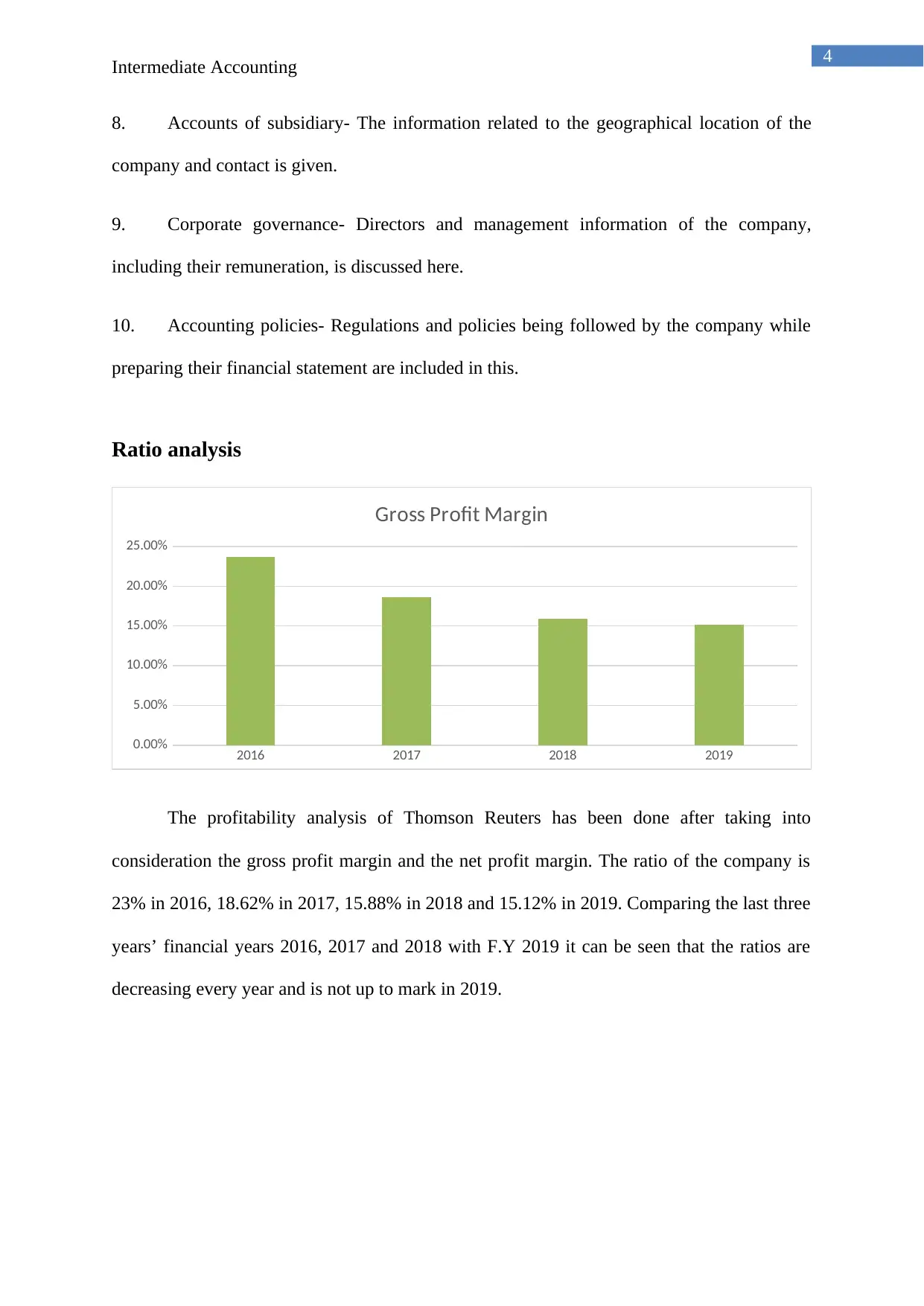
The profitability analysis of Thomson Reuters has been done after taking into
consideration the gross profit margin and the net profit margin. The ratio of the company is
23% in 2016, 18.62% in 2017, 15.88% in 2018 and 15.12% in 2019. Comparing the last three
years’ financial years 2016, 2017 and 2018 with F.Y 2019 it can be seen that the ratios are
decreasing every year and is not up to mark in 2019.
Intermediate Accounting
8. Accounts of subsidiary- The information related to the geographical location of the
company and contact is given.
9. Corporate governance- Directors and management information of the company,
including their remuneration, is discussed here.
10. Accounting policies- Regulations and policies being followed by the company while
preparing their financial statement are included in this.
Ratio analysis
2016 2017 2018 2019
0.00%
5.00%
10.00%
15.00%
20.00%
25.00%
Gross Profit Margin
The profitability analysis of Thomson Reuters has been done after taking into
consideration the gross profit margin and the net profit margin. The ratio of the company is
23% in 2016, 18.62% in 2017, 15.88% in 2018 and 15.12% in 2019. Comparing the last three
years’ financial years 2016, 2017 and 2018 with F.Y 2019 it can be seen that the ratios are
decreasing every year and is not up to mark in 2019.
5
Intermediate Accounting
2016 2017 2018 2019
0.00%
5.00%
10.00%
15.00%
20.00%
25.00%
30.00%
NetProfit Margin
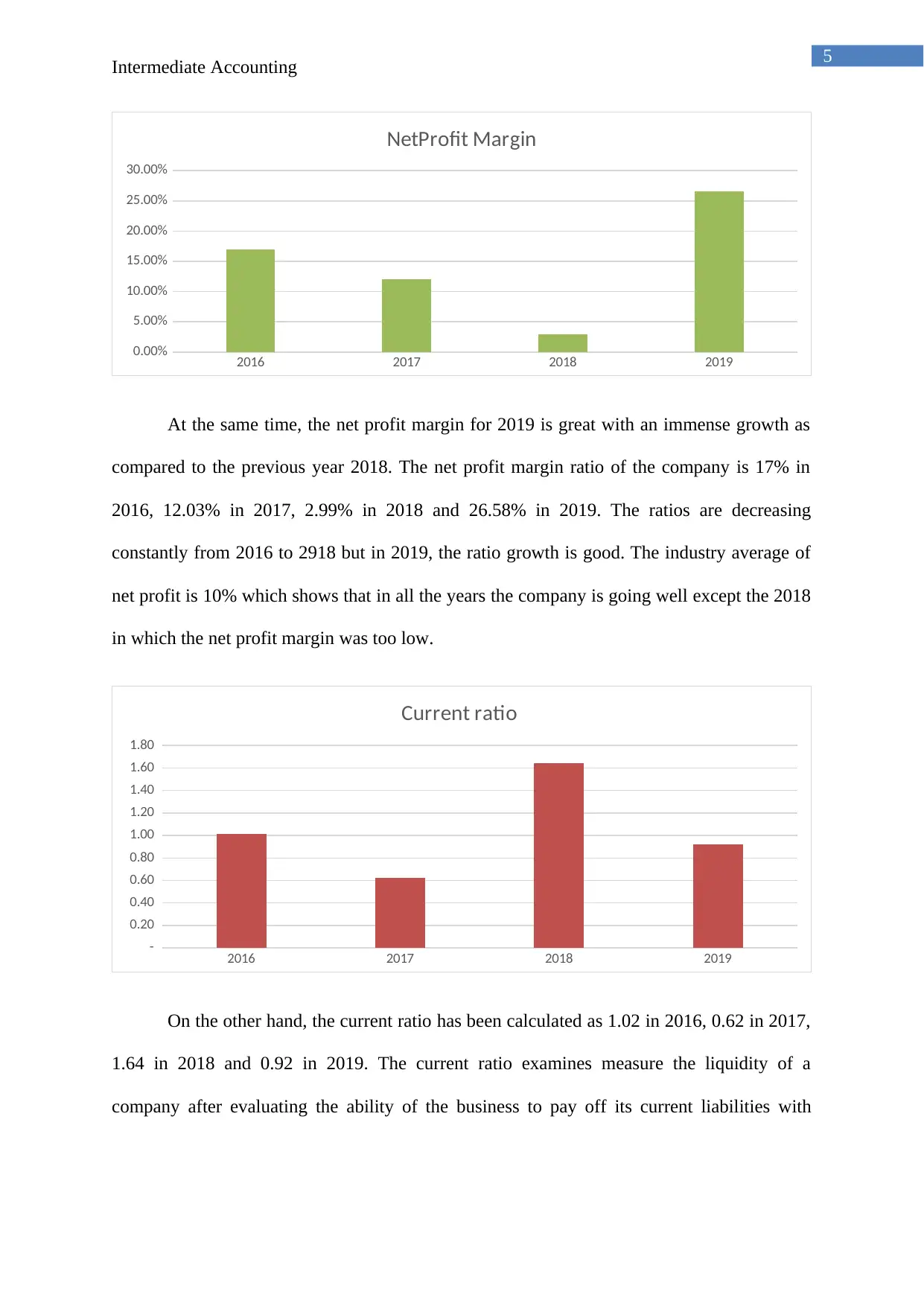
At the same time, the net profit margin for 2019 is great with an immense growth as
compared to the previous year 2018. The net profit margin ratio of the company is 17% in
2016, 12.03% in 2017, 2.99% in 2018 and 26.58% in 2019. The ratios are decreasing
constantly from 2016 to 2918 but in 2019, the ratio growth is good. The industry average of
net profit is 10% which shows that in all the years the company is going well except the 2018
in which the net profit margin was too low.
2016 2017 2018 2019
-
0.20
0.40
0.60
0.80
1.00
1.20
1.40
1.60
1.80
Current ratio
On the other hand, the current ratio has been calculated as 1.02 in 2016, 0.62 in 2017,
1.64 in 2018 and 0.92 in 2019. The current ratio examines measure the liquidity of a
company after evaluating the ability of the business to pay off its current liabilities with
Intermediate Accounting
2016 2017 2018 2019
0.00%
5.00%
10.00%
15.00%
20.00%
25.00%
30.00%
NetProfit Margin
At the same time, the net profit margin for 2019 is great with an immense growth as
compared to the previous year 2018. The net profit margin ratio of the company is 17% in
2016, 12.03% in 2017, 2.99% in 2018 and 26.58% in 2019. The ratios are decreasing
constantly from 2016 to 2918 but in 2019, the ratio growth is good. The industry average of
net profit is 10% which shows that in all the years the company is going well except the 2018
in which the net profit margin was too low.
2016 2017 2018 2019
-
0.20
0.40
0.60
0.80
1.00
1.20
1.40
1.60
1.80
Current ratio
On the other hand, the current ratio has been calculated as 1.02 in 2016, 0.62 in 2017,
1.64 in 2018 and 0.92 in 2019. The current ratio examines measure the liquidity of a
company after evaluating the ability of the business to pay off its current liabilities with
⊘ This is a preview!⊘
Do you want full access?
Subscribe today to unlock all pages.
Trusted by 1+ million students worldwide
6
Intermediate Accounting
current assets (Mathuva, 2015). Here the ratio is not meeting the standard ratio which is 2:1
which means the company is not paying attention towards its obligation to pay the debt.
2016 2017 2018 2019
-
0.20
0.40
0.60
0.80
1.00
1.20
1.40
1.60
1.80
Quick ratio
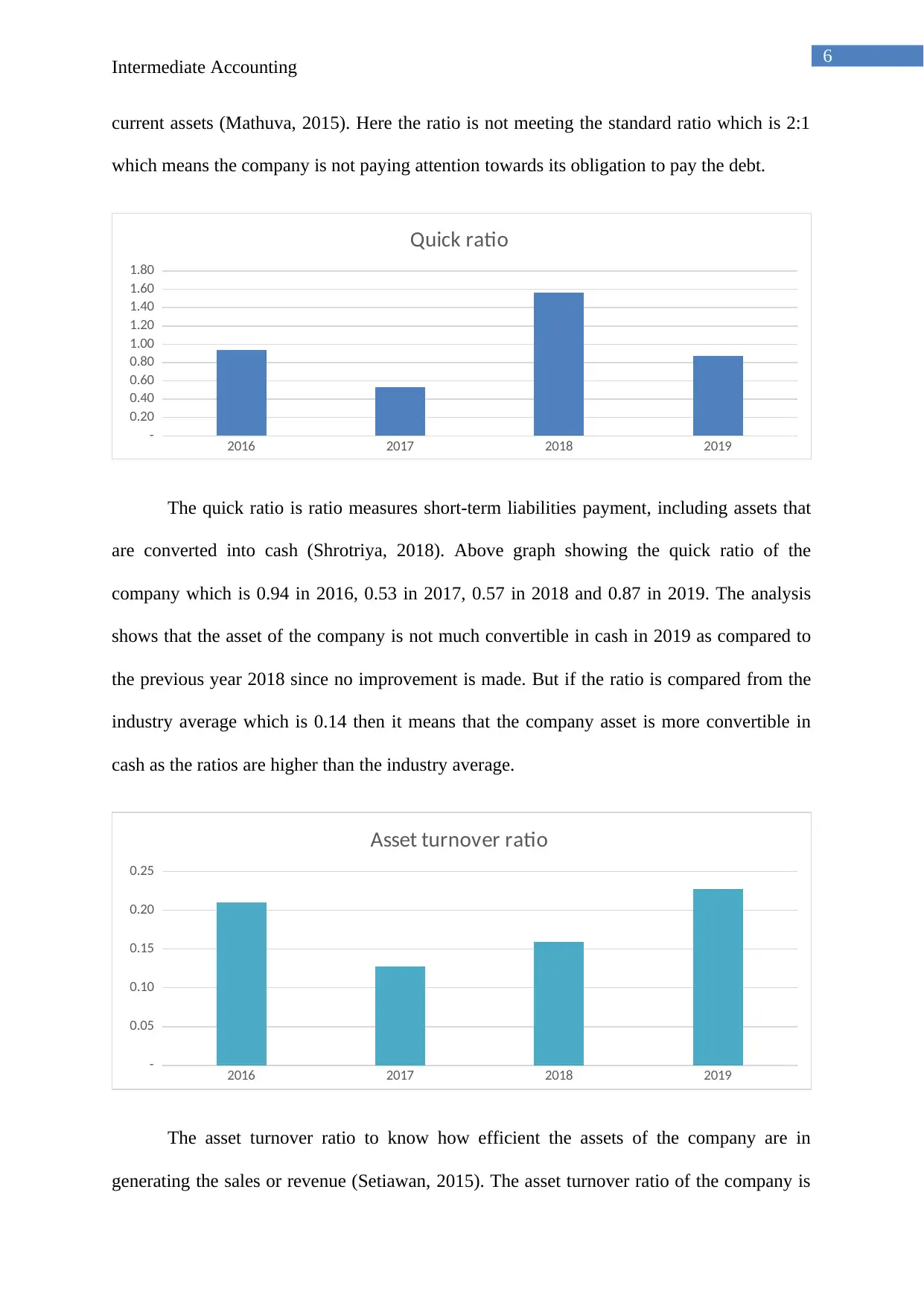
The quick ratio is ratio measures short-term liabilities payment, including assets that
are converted into cash (Shrotriya, 2018). Above graph showing the quick ratio of the
company which is 0.94 in 2016, 0.53 in 2017, 0.57 in 2018 and 0.87 in 2019. The analysis
shows that the asset of the company is not much convertible in cash in 2019 as compared to
the previous year 2018 since no improvement is made. But if the ratio is compared from the
industry average which is 0.14 then it means that the company asset is more convertible in
cash as the ratios are higher than the industry average.
2016 2017 2018 2019
-
0.05
0.10
0.15
0.20
0.25
Asset turnover ratio
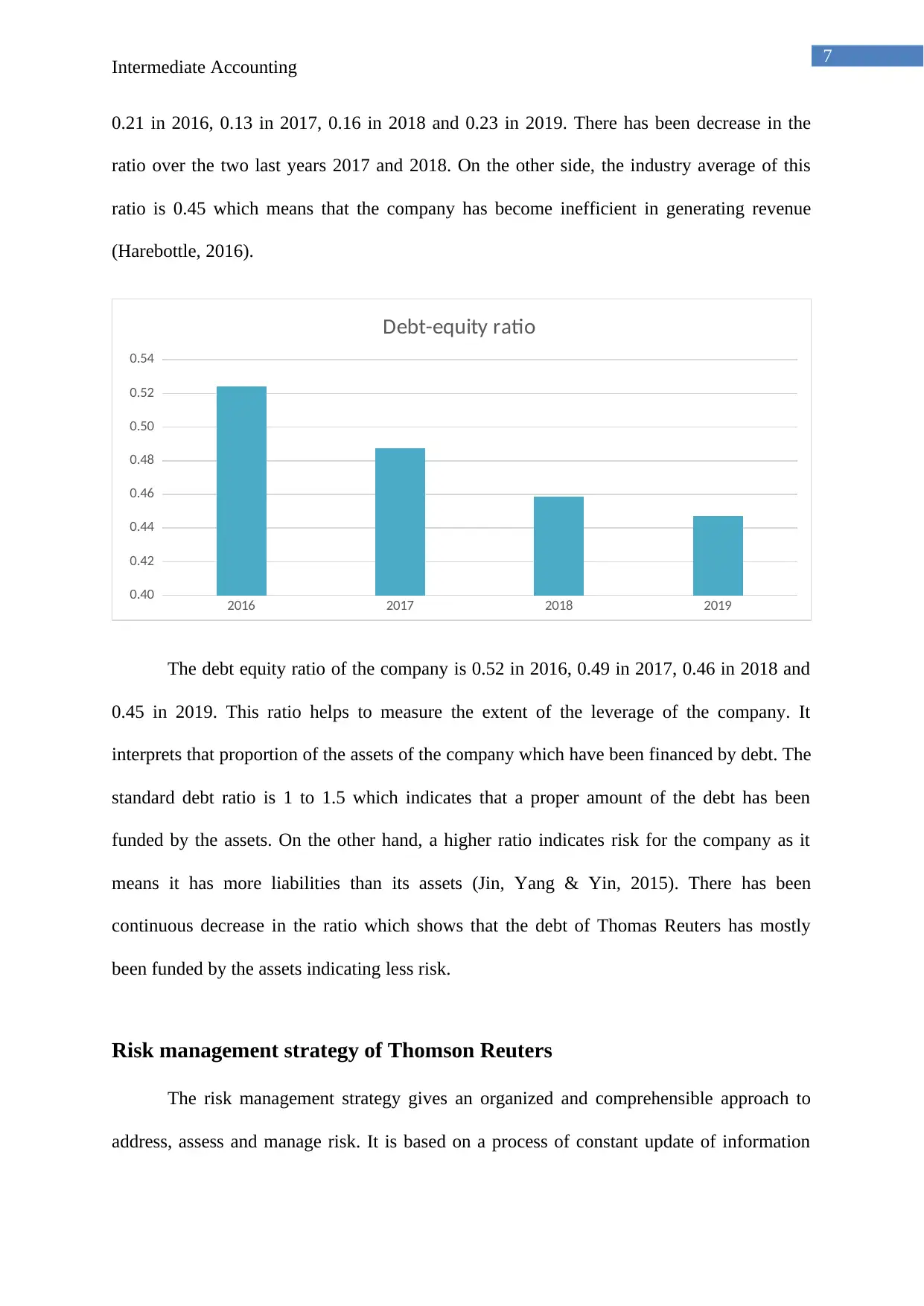
The asset turnover ratio to know how efficient the assets of the company are in
generating the sales or revenue (Setiawan, 2015). The asset turnover ratio of the company is
Intermediate Accounting
current assets (Mathuva, 2015). Here the ratio is not meeting the standard ratio which is 2:1
which means the company is not paying attention towards its obligation to pay the debt.
2016 2017 2018 2019
-
0.20
0.40
0.60
0.80
1.00
1.20
1.40
1.60
1.80
Quick ratio
The quick ratio is ratio measures short-term liabilities payment, including assets that
are converted into cash (Shrotriya, 2018). Above graph showing the quick ratio of the
company which is 0.94 in 2016, 0.53 in 2017, 0.57 in 2018 and 0.87 in 2019. The analysis
shows that the asset of the company is not much convertible in cash in 2019 as compared to
the previous year 2018 since no improvement is made. But if the ratio is compared from the
industry average which is 0.14 then it means that the company asset is more convertible in
cash as the ratios are higher than the industry average.
2016 2017 2018 2019
-
0.05
0.10
0.15
0.20
0.25
Asset turnover ratio
The asset turnover ratio to know how efficient the assets of the company are in
generating the sales or revenue (Setiawan, 2015). The asset turnover ratio of the company is
Paraphrase This Document
Need a fresh take? Get an instant paraphrase of this document with our AI Paraphraser
7
Intermediate Accounting
0.21 in 2016, 0.13 in 2017, 0.16 in 2018 and 0.23 in 2019. There has been decrease in the
ratio over the two last years 2017 and 2018. On the other side, the industry average of this
ratio is 0.45 which means that the company has become inefficient in generating revenue
(Harebottle, 2016).
2016 2017 2018 2019
0.40
0.42
0.44
0.46
0.48
0.50
0.52
0.54
Debt-equity ratio
The debt equity ratio of the company is 0.52 in 2016, 0.49 in 2017, 0.46 in 2018 and
0.45 in 2019. This ratio helps to measure the extent of the leverage of the company. It
interprets that proportion of the assets of the company which have been financed by debt. The
standard debt ratio is 1 to 1.5 which indicates that a proper amount of the debt has been
funded by the assets. On the other hand, a higher ratio indicates risk for the company as it
means it has more liabilities than its assets (Jin, Yang & Yin, 2015). There has been
continuous decrease in the ratio which shows that the debt of Thomas Reuters has mostly
been funded by the assets indicating less risk.
Risk management strategy of Thomson Reuters
The risk management strategy gives an organized and comprehensible approach to
address, assess and manage risk. It is based on a process of constant update of information
Intermediate Accounting
0.21 in 2016, 0.13 in 2017, 0.16 in 2018 and 0.23 in 2019. There has been decrease in the
ratio over the two last years 2017 and 2018. On the other side, the industry average of this
ratio is 0.45 which means that the company has become inefficient in generating revenue
(Harebottle, 2016).
2016 2017 2018 2019
0.40
0.42
0.44
0.46
0.48
0.50
0.52
0.54
Debt-equity ratio
The debt equity ratio of the company is 0.52 in 2016, 0.49 in 2017, 0.46 in 2018 and
0.45 in 2019. This ratio helps to measure the extent of the leverage of the company. It
interprets that proportion of the assets of the company which have been financed by debt. The
standard debt ratio is 1 to 1.5 which indicates that a proper amount of the debt has been
funded by the assets. On the other hand, a higher ratio indicates risk for the company as it
means it has more liabilities than its assets (Jin, Yang & Yin, 2015). There has been
continuous decrease in the ratio which shows that the debt of Thomas Reuters has mostly
been funded by the assets indicating less risk.
Risk management strategy of Thomson Reuters
The risk management strategy gives an organized and comprehensible approach to
address, assess and manage risk. It is based on a process of constant update of information
8
Intermediate Accounting
and checking of the assessment process on the basis of innovative actions taken by the
organization.
The risk management strategy of Thomson Reuters is supported by its strong
corporate governance strategy, which address the risk and make sure the compliances
required for the organization (Wressell, Rasmussen & Driscoll, 2018). The risk management
strategy consists of authentic information, effective management tools and software, and
skillful human resources which can help the company to manage risk effectively and to
enhance the growth rate effectively.
With the combination of these strategies the management of the company can
confidently predict the risk factors and take necessary actions effectively, which includes
effective management of customers, suppliers, compliance related issues and financial risks
while promoting the corporate governance and imposing better control system in the
organization (Okafor, Anderson & Warsame, 2016).
The risk management strategy of Thomas Reuters consists a supervisory intelligence
portal that provides a complete information to the investors so that they can get all the
relevant information which can help them to take investment decisions (Korableva, Gorelov
& Shulha, 2017). The risk management strategy also includes a shared categorization of all
the risk and compliance related matters that will directly influence the investors.
In addition to that the enterprise risk management feature is used to assess and
evaluate the risk, it tracks the events that may cause the occurrence of risk and help in
tracking and mitigating the potential risk that may occur due to the occurrence of any future
events.
Intermediate Accounting
and checking of the assessment process on the basis of innovative actions taken by the
organization.
The risk management strategy of Thomson Reuters is supported by its strong
corporate governance strategy, which address the risk and make sure the compliances
required for the organization (Wressell, Rasmussen & Driscoll, 2018). The risk management
strategy consists of authentic information, effective management tools and software, and
skillful human resources which can help the company to manage risk effectively and to
enhance the growth rate effectively.
With the combination of these strategies the management of the company can
confidently predict the risk factors and take necessary actions effectively, which includes
effective management of customers, suppliers, compliance related issues and financial risks
while promoting the corporate governance and imposing better control system in the
organization (Okafor, Anderson & Warsame, 2016).
The risk management strategy of Thomas Reuters consists a supervisory intelligence
portal that provides a complete information to the investors so that they can get all the
relevant information which can help them to take investment decisions (Korableva, Gorelov
& Shulha, 2017). The risk management strategy also includes a shared categorization of all
the risk and compliance related matters that will directly influence the investors.
In addition to that the enterprise risk management feature is used to assess and
evaluate the risk, it tracks the events that may cause the occurrence of risk and help in
tracking and mitigating the potential risk that may occur due to the occurrence of any future
events.
⊘ This is a preview!⊘
Do you want full access?
Subscribe today to unlock all pages.
Trusted by 1+ million students worldwide
9
Intermediate Accounting
Accounting policy and its impact
The different accounting policy option that is available to the companies are stated below
Subsidiaries (section 1590)
• Consolidation method
• Equity method
• Cost method
Significantly influenced investees (section 3051)
• Equity method
• Cost method
• Joint ventures
Proportionate consolidation method
• Equity method
• Cost method
Internally generated intangible assets (section 3064)
• Capitalization of development costs
• Expenses incurred during the phase of development
Income taxes (section 3465)
• Taxes payable method
• Future income tax methods
Intermediate Accounting
Accounting policy and its impact
The different accounting policy option that is available to the companies are stated below
Subsidiaries (section 1590)
• Consolidation method
• Equity method
• Cost method
Significantly influenced investees (section 3051)
• Equity method
• Cost method
• Joint ventures
Proportionate consolidation method
• Equity method
• Cost method
Internally generated intangible assets (section 3064)
• Capitalization of development costs
• Expenses incurred during the phase of development
Income taxes (section 3465)
• Taxes payable method
• Future income tax methods
Paraphrase This Document
Need a fresh take? Get an instant paraphrase of this document with our AI Paraphraser
10
Intermediate Accounting
Financial instruments
• Measurement of financial assets at fair value
• Measurements of financial assets and liabilities at amortized value (other than equity
and derivative instruments)
The organizations have the choices to select among these methods but they have to
select the best method among all these alternatives so that their financial statements can
reflect the true and fair view of the financial position of the organization (Lestari & Riyadi,
2018).
Impact of the application of the Canadian accounting standards
If Thomas Reuters get the opportunity to make a choice in the accounting policy, then
it will affect the financial statements and the retained earnings of the company (Jackson et al.,
2018). If the accounting policy is made as per the Canadian accounting policy, it will increase
the depreciation expenses which will make direct impact on the profit but at the same time it
will give tax benefit to the organization. Beside that Thomas Reuters also have to make more
changes in the valuation of the various financial instruments like equity and derivatives (Saqib
et al., 2016). The company will choose the specific policy over the other alternatives as it will
enhance the earning maximization capacity of the organization. This will bring a
comprehensive impact on the analysis process as from the accounting policies it will be
possible to get a transparent view of the financial statements of the company and from that
the actual financial position of Thomas Reuters can be easily assessed.
Intermediate Accounting
Financial instruments
• Measurement of financial assets at fair value
• Measurements of financial assets and liabilities at amortized value (other than equity
and derivative instruments)
The organizations have the choices to select among these methods but they have to
select the best method among all these alternatives so that their financial statements can
reflect the true and fair view of the financial position of the organization (Lestari & Riyadi,
2018).
Impact of the application of the Canadian accounting standards
If Thomas Reuters get the opportunity to make a choice in the accounting policy, then
it will affect the financial statements and the retained earnings of the company (Jackson et al.,
2018). If the accounting policy is made as per the Canadian accounting policy, it will increase
the depreciation expenses which will make direct impact on the profit but at the same time it
will give tax benefit to the organization. Beside that Thomas Reuters also have to make more
changes in the valuation of the various financial instruments like equity and derivatives (Saqib
et al., 2016). The company will choose the specific policy over the other alternatives as it will
enhance the earning maximization capacity of the organization. This will bring a
comprehensive impact on the analysis process as from the accounting policies it will be
possible to get a transparent view of the financial statements of the company and from that
the actual financial position of Thomas Reuters can be easily assessed.
11
Intermediate Accounting
‘Events after the Reporting Period’ (IAS 10)
The IAS 10 “Events After the Reporting Period” does contain the requirements which
are for the events occurring post the reporting period, and which can be adjusted in the
financial statements of the organization. The events that are adjusted, does provide evidence
that is upon the conditions which are existing on the last day of accounting period (Tebbens
& Thompson, 2017). The non-adjusting events are indicative of the circumstances, which
arise after the reporting period (Vasilenko & Titova, 2019). The IAS 10 was issued again in
the year 2003, December and does it gradually applied by every organization to their annual
periods and in the beginning on or after the 1st January, 2005.
The objective of the IAS 10, does discloses that an entity should be given related to
the date, and when the financial report are authorized for the issue and there are several
events after the reporting entity (Hisrich & Ramadani, 2017). As per this standard, the
organization should adjust the financial statements and for the events taking place afterwards.
The standard also implies that it does require the organization which does not make the
financial statements upon the ongoing basis and if the events after the reporting period does
indicate that the going concern is not inappropriate (van et al., 2016). The Scope in IAS 10, is
applied for the disclosure of transactions which is occurring after the reporting period. The
events that may occur after the reporting period can be favorable and unfavorable, which will
occur between the statement of financial position date and the date when the financial
statements are being authorized for the issue (Len & Glivenko, 2019).
The process that are involved in approving the financial statements is for the issue
which will be varying upon the financial decision, management decision, statutory
requirements, and several procedures that will be followed for preparation of accounts and
finalization of the same (Tan, 2018). For adjusting the events after the reporting period, the
Intermediate Accounting
‘Events after the Reporting Period’ (IAS 10)
The IAS 10 “Events After the Reporting Period” does contain the requirements which
are for the events occurring post the reporting period, and which can be adjusted in the
financial statements of the organization. The events that are adjusted, does provide evidence
that is upon the conditions which are existing on the last day of accounting period (Tebbens
& Thompson, 2017). The non-adjusting events are indicative of the circumstances, which
arise after the reporting period (Vasilenko & Titova, 2019). The IAS 10 was issued again in
the year 2003, December and does it gradually applied by every organization to their annual
periods and in the beginning on or after the 1st January, 2005.
The objective of the IAS 10, does discloses that an entity should be given related to
the date, and when the financial report are authorized for the issue and there are several
events after the reporting entity (Hisrich & Ramadani, 2017). As per this standard, the
organization should adjust the financial statements and for the events taking place afterwards.
The standard also implies that it does require the organization which does not make the
financial statements upon the ongoing basis and if the events after the reporting period does
indicate that the going concern is not inappropriate (van et al., 2016). The Scope in IAS 10, is
applied for the disclosure of transactions which is occurring after the reporting period. The
events that may occur after the reporting period can be favorable and unfavorable, which will
occur between the statement of financial position date and the date when the financial
statements are being authorized for the issue (Len & Glivenko, 2019).
The process that are involved in approving the financial statements is for the issue
which will be varying upon the financial decision, management decision, statutory
requirements, and several procedures that will be followed for preparation of accounts and
finalization of the same (Tan, 2018). For adjusting the events after the reporting period, the
⊘ This is a preview!⊘
Do you want full access?
Subscribe today to unlock all pages.
Trusted by 1+ million students worldwide

1 out of 16


Related Documents


Your All-in-One AI-Powered Toolkit for Academic Success.
+13062052269
info@desklib.com
Available 24*7 on WhatsApp / Email
![[object Object]](/_next/static/media/star-bottom.7253800d.svg)
Unlock your academic potential
Copyright © 2020–2026 A2Z Services. All Rights Reserved. Developed and managed by ZUCOL.