Detailed Marketing Plan: Tim Hortons Pre-packaged Salads Strategy
VerifiedAdded on 2021/11/17
|48
|11324
|300
Report
AI Summary
This report presents a comprehensive marketing plan developed for Tim Hortons to launch pre-packaged salads, targeting the lunch daypart market. The plan begins with an executive summary, followed by a detailed situation analysis that includes internal and external factors, company objectives, resources, target market, and the current marketing mix. The report analyzes the Quick Serve Restaurant (QSR) industry, market size, competition, and consumer behavior. It includes a SWOT analysis, competitor analysis focusing on key rivals like McDonald's, and proposes a marketing mix with strategies for product, price, promotion, and place. The plan outlines implementation and control measures, action and contingency plans, market and sales forecasts, and a pro-forma analysis. Appendices provide supporting data, including financial statements, store locations, and industry analysis, offering a thorough examination of the market and a strategic approach for Tim Hortons' success.
Running Head: MARKETING PLAN: TIM HORTONS PRE-PACKAGED SALADS
Marketing Plan: Tim Hortons Pre-Packaged Salads
Date: November 28, 2012
Authors:
Mitchell Reisler - 0662093
Taylor Warren – 0678774
Brett Davis - 0636525
Sofia Pacione - 0627118
Stefano Incardona – 0719309
To: Tim Hortons Marketing and Advertising Executive Team and Professor O’leary
Executive Summary
Marketing Plan: Tim Hortons Pre-Packaged Salads
Date: November 28, 2012
Authors:
Mitchell Reisler - 0662093
Taylor Warren – 0678774
Brett Davis - 0636525
Sofia Pacione - 0627118
Stefano Incardona – 0719309
To: Tim Hortons Marketing and Advertising Executive Team and Professor O’leary
Executive Summary

Paraphrase This Document
Need a fresh take? Get an instant paraphrase of this document with our AI Paraphraser
Marketing Plan: Tim Hortons – Pre-packaged Salads
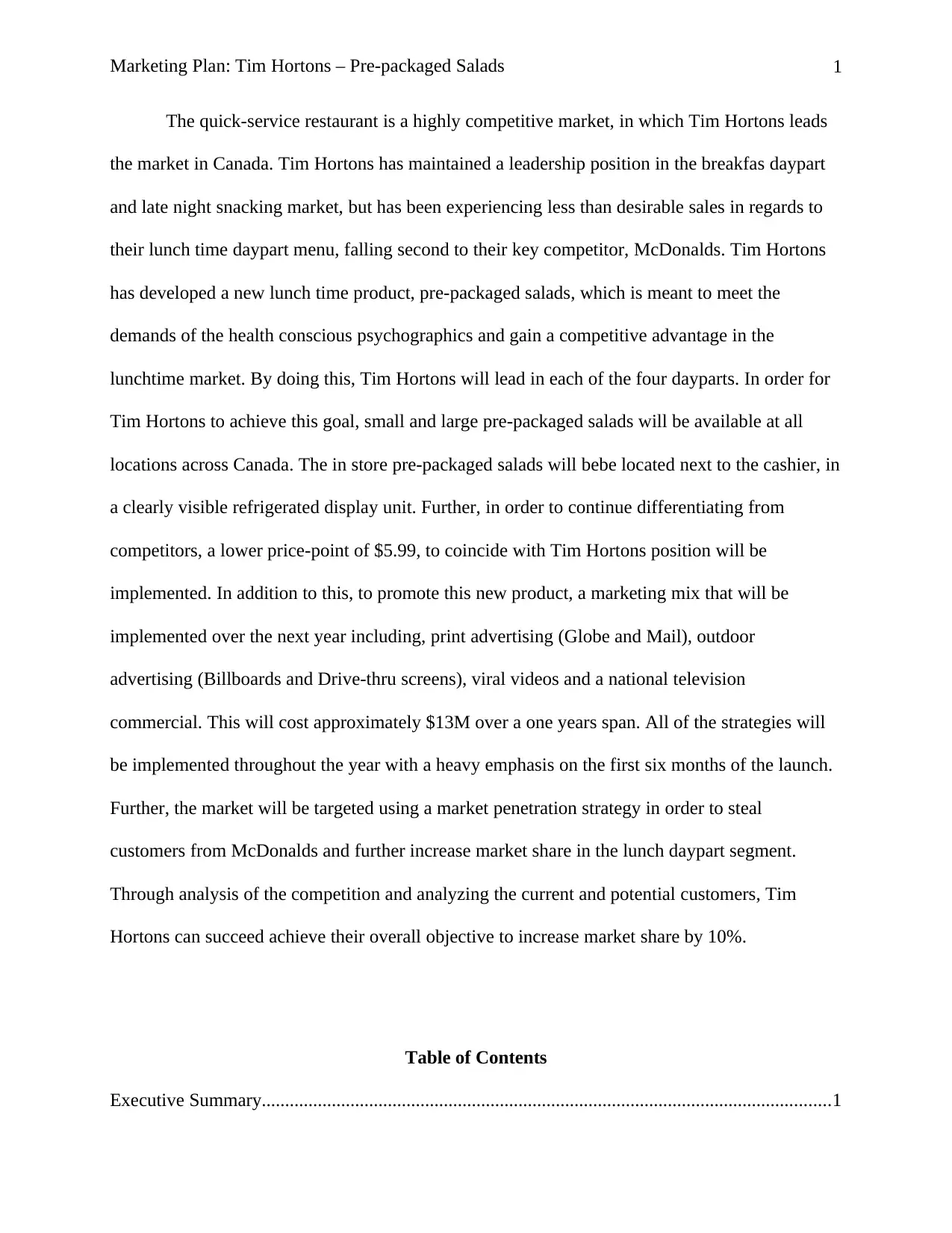
The quick-service restaurant is a highly competitive market, in which Tim Hortons leads
the market in Canada. Tim Hortons has maintained a leadership position in the breakfas daypart
and late night snacking market, but has been experiencing less than desirable sales in regards to
their lunch time daypart menu, falling second to their key competitor, McDonalds. Tim Hortons
has developed a new lunch time product, pre-packaged salads, which is meant to meet the
demands of the health conscious psychographics and gain a competitive advantage in the
lunchtime market. By doing this, Tim Hortons will lead in each of the four dayparts. In order for
Tim Hortons to achieve this goal, small and large pre-packaged salads will be available at all
locations across Canada. The in store pre-packaged salads will bebe located next to the cashier, in
a clearly visible refrigerated display unit. Further, in order to continue differentiating from
competitors, a lower price-point of $5.99, to coincide with Tim Hortons position will be
implemented. In addition to this, to promote this new product, a marketing mix that will be
implemented over the next year including, print advertising (Globe and Mail), outdoor
advertising (Billboards and Drive-thru screens), viral videos and a national television
commercial. This will cost approximately $13M over a one years span. All of the strategies will
be implemented throughout the year with a heavy emphasis on the first six months of the launch.
Further, the market will be targeted using a market penetration strategy in order to steal
customers from McDonalds and further increase market share in the lunch daypart segment.
Through analysis of the competition and analyzing the current and potential customers, Tim
Hortons can succeed achieve their overall objective to increase market share by 10%.
Table of Contents
Executive Summary..........................................................................................................................1
1
The quick-service restaurant is a highly competitive market, in which Tim Hortons leads
the market in Canada. Tim Hortons has maintained a leadership position in the breakfas daypart
and late night snacking market, but has been experiencing less than desirable sales in regards to
their lunch time daypart menu, falling second to their key competitor, McDonalds. Tim Hortons
has developed a new lunch time product, pre-packaged salads, which is meant to meet the
demands of the health conscious psychographics and gain a competitive advantage in the
lunchtime market. By doing this, Tim Hortons will lead in each of the four dayparts. In order for
Tim Hortons to achieve this goal, small and large pre-packaged salads will be available at all
locations across Canada. The in store pre-packaged salads will bebe located next to the cashier, in
a clearly visible refrigerated display unit. Further, in order to continue differentiating from
competitors, a lower price-point of $5.99, to coincide with Tim Hortons position will be
implemented. In addition to this, to promote this new product, a marketing mix that will be
implemented over the next year including, print advertising (Globe and Mail), outdoor
advertising (Billboards and Drive-thru screens), viral videos and a national television
commercial. This will cost approximately $13M over a one years span. All of the strategies will
be implemented throughout the year with a heavy emphasis on the first six months of the launch.
Further, the market will be targeted using a market penetration strategy in order to steal
customers from McDonalds and further increase market share in the lunch daypart segment.
Through analysis of the competition and analyzing the current and potential customers, Tim
Hortons can succeed achieve their overall objective to increase market share by 10%.
Table of Contents
Executive Summary..........................................................................................................................1
1
Marketing Plan: Tim Hortons – Pre-packaged Salads
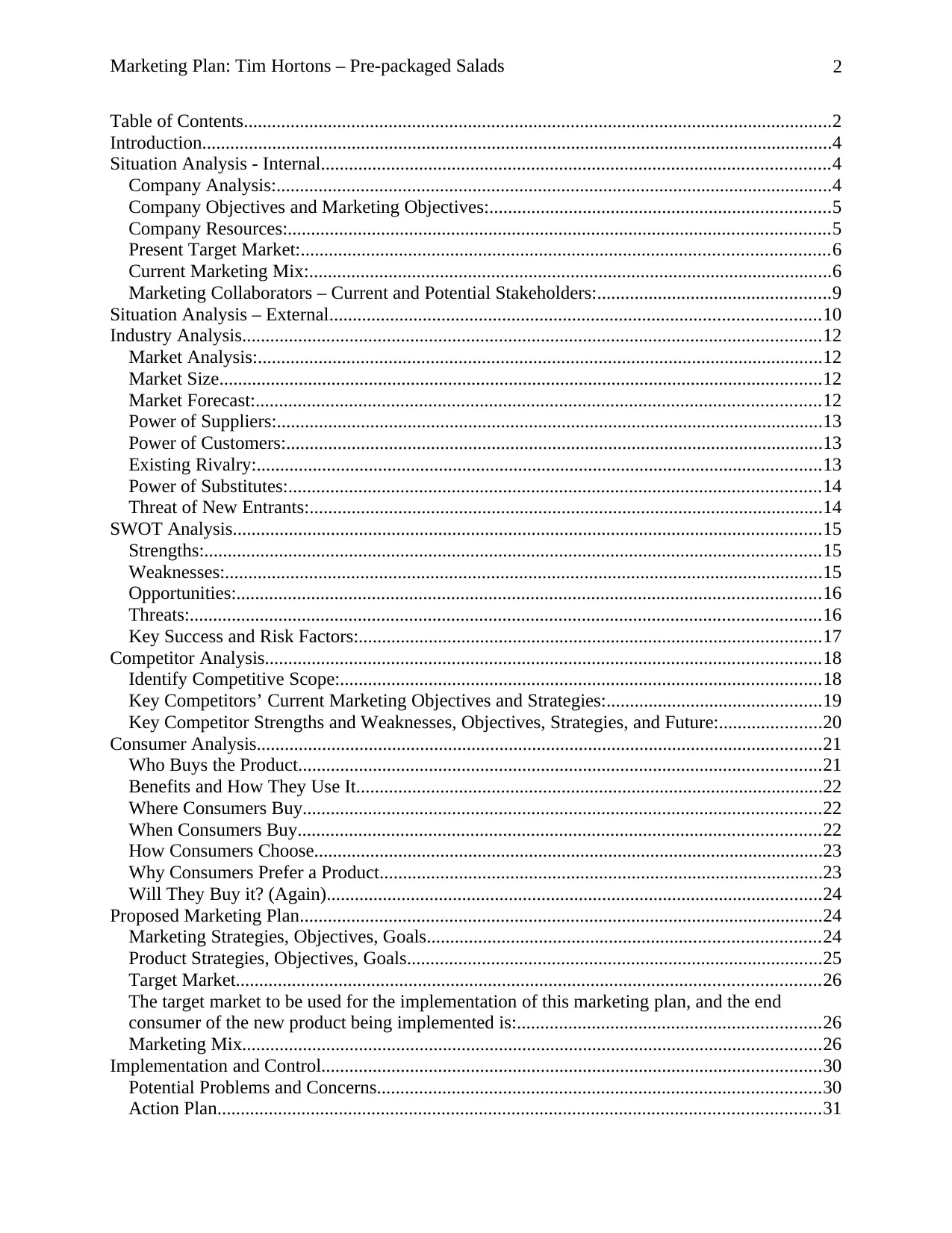
Table of Contents..............................................................................................................................2
Introduction.......................................................................................................................................4
Situation Analysis - Internal.............................................................................................................4
Company Analysis:.......................................................................................................................4
Company Objectives and Marketing Objectives:.........................................................................5
Company Resources:....................................................................................................................5
Present Target Market:.................................................................................................................6
Current Marketing Mix:................................................................................................................6
Marketing Collaborators – Current and Potential Stakeholders:..................................................9
Situation Analysis – External.........................................................................................................10
Industry Analysis............................................................................................................................12
Market Analysis:.........................................................................................................................12
Market Size.................................................................................................................................12
Market Forecast:.........................................................................................................................12
Power of Suppliers:.....................................................................................................................13
Power of Customers:...................................................................................................................13
Existing Rivalry:.........................................................................................................................13
Power of Substitutes:..................................................................................................................14
Threat of New Entrants:..............................................................................................................14
SWOT Analysis..............................................................................................................................15
Strengths:....................................................................................................................................15
Weaknesses:................................................................................................................................15
Opportunities:.............................................................................................................................16
Threats:.......................................................................................................................................16
Key Success and Risk Factors:...................................................................................................17
Competitor Analysis.......................................................................................................................18
Identify Competitive Scope:.......................................................................................................18
Key Competitors’ Current Marketing Objectives and Strategies:..............................................19
Key Competitor Strengths and Weaknesses, Objectives, Strategies, and Future:......................20
Consumer Analysis.........................................................................................................................21
Who Buys the Product................................................................................................................21
Benefits and How They Use It....................................................................................................22
Where Consumers Buy...............................................................................................................22
When Consumers Buy................................................................................................................22
How Consumers Choose.............................................................................................................23
Why Consumers Prefer a Product...............................................................................................23
Will They Buy it? (Again)..........................................................................................................24
Proposed Marketing Plan................................................................................................................24
Marketing Strategies, Objectives, Goals....................................................................................24
Product Strategies, Objectives, Goals.........................................................................................25
Target Market.............................................................................................................................26
The target market to be used for the implementation of this marketing plan, and the end
consumer of the new product being implemented is:.................................................................26
Marketing Mix............................................................................................................................26
Implementation and Control...........................................................................................................30
Potential Problems and Concerns...............................................................................................30
Action Plan.................................................................................................................................31
2
Table of Contents..............................................................................................................................2
Introduction.......................................................................................................................................4
Situation Analysis - Internal.............................................................................................................4
Company Analysis:.......................................................................................................................4
Company Objectives and Marketing Objectives:.........................................................................5
Company Resources:....................................................................................................................5
Present Target Market:.................................................................................................................6
Current Marketing Mix:................................................................................................................6
Marketing Collaborators – Current and Potential Stakeholders:..................................................9
Situation Analysis – External.........................................................................................................10
Industry Analysis............................................................................................................................12
Market Analysis:.........................................................................................................................12
Market Size.................................................................................................................................12
Market Forecast:.........................................................................................................................12
Power of Suppliers:.....................................................................................................................13
Power of Customers:...................................................................................................................13
Existing Rivalry:.........................................................................................................................13
Power of Substitutes:..................................................................................................................14
Threat of New Entrants:..............................................................................................................14
SWOT Analysis..............................................................................................................................15
Strengths:....................................................................................................................................15
Weaknesses:................................................................................................................................15
Opportunities:.............................................................................................................................16
Threats:.......................................................................................................................................16
Key Success and Risk Factors:...................................................................................................17
Competitor Analysis.......................................................................................................................18
Identify Competitive Scope:.......................................................................................................18
Key Competitors’ Current Marketing Objectives and Strategies:..............................................19
Key Competitor Strengths and Weaknesses, Objectives, Strategies, and Future:......................20
Consumer Analysis.........................................................................................................................21
Who Buys the Product................................................................................................................21
Benefits and How They Use It....................................................................................................22
Where Consumers Buy...............................................................................................................22
When Consumers Buy................................................................................................................22
How Consumers Choose.............................................................................................................23
Why Consumers Prefer a Product...............................................................................................23
Will They Buy it? (Again)..........................................................................................................24
Proposed Marketing Plan................................................................................................................24
Marketing Strategies, Objectives, Goals....................................................................................24
Product Strategies, Objectives, Goals.........................................................................................25
Target Market.............................................................................................................................26
The target market to be used for the implementation of this marketing plan, and the end
consumer of the new product being implemented is:.................................................................26
Marketing Mix............................................................................................................................26
Implementation and Control...........................................................................................................30
Potential Problems and Concerns...............................................................................................30
Action Plan.................................................................................................................................31
2
⊘ This is a preview!⊘
Do you want full access?
Subscribe today to unlock all pages.

Trusted by 1+ million students worldwide
Marketing Plan: Tim Hortons – Pre-packaged Salads
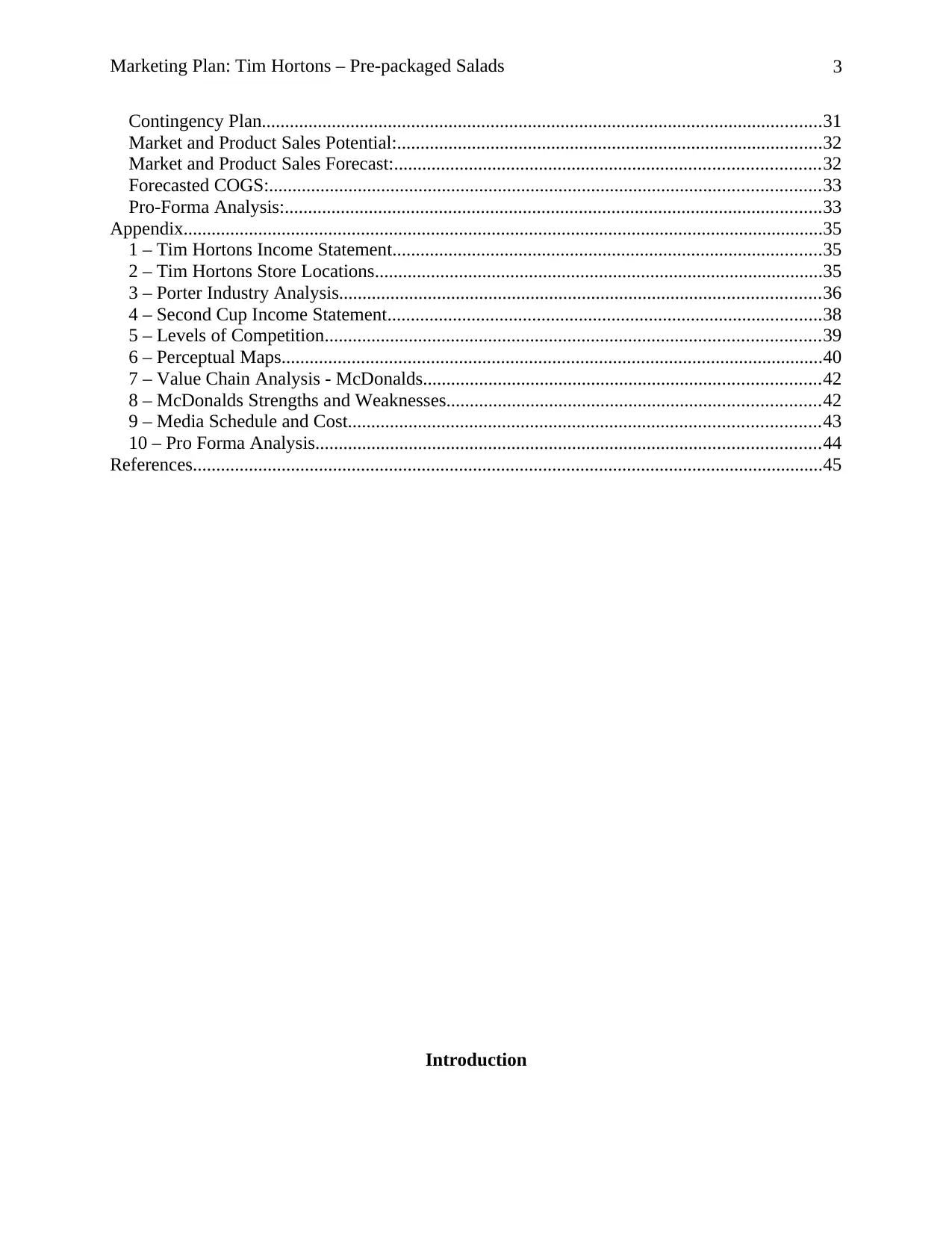
Contingency Plan........................................................................................................................31
Market and Product Sales Potential:...........................................................................................32
Market and Product Sales Forecast:...........................................................................................32
Forecasted COGS:......................................................................................................................33
Pro-Forma Analysis:...................................................................................................................33
Appendix.........................................................................................................................................35
1 – Tim Hortons Income Statement............................................................................................35
2 – Tim Hortons Store Locations................................................................................................35
3 – Porter Industry Analysis.......................................................................................................36
4 – Second Cup Income Statement.............................................................................................38
5 – Levels of Competition..........................................................................................................39
6 – Perceptual Maps....................................................................................................................40
7 – Value Chain Analysis - McDonalds.....................................................................................42
8 – McDonalds Strengths and Weaknesses................................................................................42
9 – Media Schedule and Cost.....................................................................................................43
10 – Pro Forma Analysis............................................................................................................44
References.......................................................................................................................................45
Introduction
3
Contingency Plan........................................................................................................................31
Market and Product Sales Potential:...........................................................................................32
Market and Product Sales Forecast:...........................................................................................32
Forecasted COGS:......................................................................................................................33
Pro-Forma Analysis:...................................................................................................................33
Appendix.........................................................................................................................................35
1 – Tim Hortons Income Statement............................................................................................35
2 – Tim Hortons Store Locations................................................................................................35
3 – Porter Industry Analysis.......................................................................................................36
4 – Second Cup Income Statement.............................................................................................38
5 – Levels of Competition..........................................................................................................39
6 – Perceptual Maps....................................................................................................................40
7 – Value Chain Analysis - McDonalds.....................................................................................42
8 – McDonalds Strengths and Weaknesses................................................................................42
9 – Media Schedule and Cost.....................................................................................................43
10 – Pro Forma Analysis............................................................................................................44
References.......................................................................................................................................45
Introduction
3
Paraphrase This Document
Need a fresh take? Get an instant paraphrase of this document with our AI Paraphraser
Marketing Plan: Tim Hortons – Pre-packaged Salads
Throughout this report, a marketing plan will be developed for the implementation of a
new Tim Hortons lunchtime product, pre-packaged salads. This plan will be based on analysis
prepared in regards to all influential components affecting the success of the marketing plan. This
includes an internal and external analysis, analysis of the industry Tim Hortons is in, the Quick
Serve Restaurant industry, a review of competitors, and an analysis of current and potential
consumers.
Situation Analysis - Internal
Company Analysis:
Tim Hortons has several organizational challenges they are faced with, including
maintaining their dominant presence in the Canadian market, competition in the QSR market, and
the challenges associated with expansion into the US. Tim Hortons will focus on growing their
lunchtime daypart share, expand into new markets, and provide new products for potential, and
current customers. With the combination of the growing trends, Tim Hortons can effectively
maintain their dominant presence, and brand recognition in Canada, while continuing to use their
strong brand name to become a leading competitor in the American market. The historical
operating performance of the leading quick-service restaurant, Tim Hortons, shows that from
2009 to 2010 revenue increased from $2,438.9million to $2,536.5m with a total net revenue
increase of 4.0%. 1From 2010 to 2011 the revenue increased to $2,835.0million2 This shows that
1 Tim Hortons inc.. (01 J). Retrieved from http://annualreport.timhortons.com/downloads/full-ar.pdf
2 Company., t. (n.d.). Form 10-K. Tim Hortons 2011 Annual Report. Retrieved October 27, 2012,
from http://annualreport.timhortons.com/downloads/xmrl/form-10K.htm#tx269152_20
4
Throughout this report, a marketing plan will be developed for the implementation of a
new Tim Hortons lunchtime product, pre-packaged salads. This plan will be based on analysis
prepared in regards to all influential components affecting the success of the marketing plan. This
includes an internal and external analysis, analysis of the industry Tim Hortons is in, the Quick
Serve Restaurant industry, a review of competitors, and an analysis of current and potential
consumers.
Situation Analysis - Internal
Company Analysis:
Tim Hortons has several organizational challenges they are faced with, including
maintaining their dominant presence in the Canadian market, competition in the QSR market, and
the challenges associated with expansion into the US. Tim Hortons will focus on growing their
lunchtime daypart share, expand into new markets, and provide new products for potential, and
current customers. With the combination of the growing trends, Tim Hortons can effectively
maintain their dominant presence, and brand recognition in Canada, while continuing to use their
strong brand name to become a leading competitor in the American market. The historical
operating performance of the leading quick-service restaurant, Tim Hortons, shows that from
2009 to 2010 revenue increased from $2,438.9million to $2,536.5m with a total net revenue
increase of 4.0%. 1From 2010 to 2011 the revenue increased to $2,835.0million2 This shows that
1 Tim Hortons inc.. (01 J). Retrieved from http://annualreport.timhortons.com/downloads/full-ar.pdf
2 Company., t. (n.d.). Form 10-K. Tim Hortons 2011 Annual Report. Retrieved October 27, 2012,
from http://annualreport.timhortons.com/downloads/xmrl/form-10K.htm#tx269152_20
4
Marketing Plan: Tim Hortons – Pre-packaged Salads
although there is current global economic instability, Tim Hortons has been able to maintain a
growing profit, and market share. Refer to exhibit 1 in the appendix for further details.
Company Objectives and Marketing Objectives:
Tim Hortons overall mission and vision is to be a leader in everything they do. This
includes providing superior quality, products, and services to all of their stakeholders, including
consumers, communities, partners, and employees3. Tim Hortons corporate goals moving in the
near future include attacking the daypart segment, investing to grow the brand in new and
existing markets, and leveraging core business strengths4. They currently use a growth objective
in that they are always looking to be leaders in the market, and thus are always looking to grow
their market share.
Company Resources:
Tim Hortons can be broken down into several functioning departments that contribute to
the success: construction and restaurant design; distribution; finance and taxation; information
technology; legal; marketing and corporate, public and Government affairs; operations; real estate
and research and development. The combined efforts of the individual departments allows Tim
Hortons to continuously increase their revenue and maintain their highly recognized brand. Tim
Hortons has integrated “Tim Hortons University” to train all staff, and owners about the business.
Tim Hortons University is a seven-week intensive program that includes subjects on how to
properly and efficiently manage a franchise location.
3 Tim Hortons inc.. (01 J). Retrieved from http://annualreport.timhortons.com/downloads/full-ar.pdf
4 (2010). Investor conference . More than a great brand, Retrieved from
http://www.timhortons.com/ca/pdf/2010_Investor_Conference_FINAL.pdf
5
although there is current global economic instability, Tim Hortons has been able to maintain a
growing profit, and market share. Refer to exhibit 1 in the appendix for further details.
Company Objectives and Marketing Objectives:
Tim Hortons overall mission and vision is to be a leader in everything they do. This
includes providing superior quality, products, and services to all of their stakeholders, including
consumers, communities, partners, and employees3. Tim Hortons corporate goals moving in the
near future include attacking the daypart segment, investing to grow the brand in new and
existing markets, and leveraging core business strengths4. They currently use a growth objective
in that they are always looking to be leaders in the market, and thus are always looking to grow
their market share.
Company Resources:
Tim Hortons can be broken down into several functioning departments that contribute to
the success: construction and restaurant design; distribution; finance and taxation; information
technology; legal; marketing and corporate, public and Government affairs; operations; real estate
and research and development. The combined efforts of the individual departments allows Tim
Hortons to continuously increase their revenue and maintain their highly recognized brand. Tim
Hortons has integrated “Tim Hortons University” to train all staff, and owners about the business.
Tim Hortons University is a seven-week intensive program that includes subjects on how to
properly and efficiently manage a franchise location.
3 Tim Hortons inc.. (01 J). Retrieved from http://annualreport.timhortons.com/downloads/full-ar.pdf
4 (2010). Investor conference . More than a great brand, Retrieved from
http://www.timhortons.com/ca/pdf/2010_Investor_Conference_FINAL.pdf
5
⊘ This is a preview!⊘
Do you want full access?
Subscribe today to unlock all pages.
Trusted by 1+ million students worldwide
Marketing Plan: Tim Hortons – Pre-packaged Salads
Present Target Market:
Tim Hortons mass markets across all demographics, psychographics, and geographic
locations across Canada. They do this because of the low price, convenient products they offer.
To be more specific, however, their demographics can be broken down per percentage of sales.
This includes 18% ages 25-34, 20% ages 35-44 and 18% 45-54. Further, studies have found that
Generation Y and Generation X demographics tend to spend more money per meal at quick-serve
restaurants. 5The target psychographic are from a smaller household and empty nesters, as When
an individual they will typically spend more money per visit than those from a larger household.
Another psychographic characteristic used to define their demographic is being a worker, or
being short on time. This is because of the convenience factor that Tim Hortons is known for, and
provides. The geographic target market is nation-wide and spans across cities of all sizes. 6
Current Marketing Mix:
Price
The average cheque size of a Tim Hortons order in Canada and the U.S.A is between
$2.75 to $3.50, with no 2-hour period of any day accounting for more than 20% of total daily
sales1. Tim Hortons provides an every-day value pricing strategy, which means their prices fall
below the average price offered from main competitors, McDonald’s, and Starbucks2. This
pricing strategy provides Tim Hortons the opportunity to maximize customer satisfaction by
providing an equal quality product, in comparison to competitors, for a lower price. Further, by
5 Frisch, E. (n.d.). Restaurant Equipment and Supplies. Demographics for Restaurants . Retrieved
October 27, 2012, from www.foodservicewarehouse.com/restaurant-equipment-supply-marketing-
articles/restaurant-marketing/demographics-for-restaurants/c28060.aspx
6 Company., t. (n.d.). Form 10-K. Tim Hortons 2011 Annual Report. Retrieved October 27, 2012,
from http://annualreport.timhortons.com/downloads/xmrl/form-10K.htm#tx269152_20
6
Present Target Market:
Tim Hortons mass markets across all demographics, psychographics, and geographic
locations across Canada. They do this because of the low price, convenient products they offer.
To be more specific, however, their demographics can be broken down per percentage of sales.
This includes 18% ages 25-34, 20% ages 35-44 and 18% 45-54. Further, studies have found that
Generation Y and Generation X demographics tend to spend more money per meal at quick-serve
restaurants. 5The target psychographic are from a smaller household and empty nesters, as When
an individual they will typically spend more money per visit than those from a larger household.
Another psychographic characteristic used to define their demographic is being a worker, or
being short on time. This is because of the convenience factor that Tim Hortons is known for, and
provides. The geographic target market is nation-wide and spans across cities of all sizes. 6
Current Marketing Mix:
Price
The average cheque size of a Tim Hortons order in Canada and the U.S.A is between
$2.75 to $3.50, with no 2-hour period of any day accounting for more than 20% of total daily
sales1. Tim Hortons provides an every-day value pricing strategy, which means their prices fall
below the average price offered from main competitors, McDonald’s, and Starbucks2. This
pricing strategy provides Tim Hortons the opportunity to maximize customer satisfaction by
providing an equal quality product, in comparison to competitors, for a lower price. Further, by
5 Frisch, E. (n.d.). Restaurant Equipment and Supplies. Demographics for Restaurants . Retrieved
October 27, 2012, from www.foodservicewarehouse.com/restaurant-equipment-supply-marketing-
articles/restaurant-marketing/demographics-for-restaurants/c28060.aspx
6 Company., t. (n.d.). Form 10-K. Tim Hortons 2011 Annual Report. Retrieved October 27, 2012,
from http://annualreport.timhortons.com/downloads/xmrl/form-10K.htm#tx269152_20
6
Paraphrase This Document
Need a fresh take? Get an instant paraphrase of this document with our AI Paraphraser
Marketing Plan: Tim Hortons – Pre-packaged Salads
attracting customers covering all demographics, based on the price and quality offered, they are
able to maximize profits maintain loyalty.
Promotion
Tim Hortons uses a promotion strategy that result in an increase in brand loyalty, and
repeat purchases. Tim Horton’s achieves this by implementing promotions that focus on
advertising specific products, combinations, or by offering free products at next purchase.
Further, the central theme behind their promotion strategy is also their differentiating aspects, an
organization that offers high quality products, at reasonable prices. With the integrated use of
radio, television, online advertising, and event sponsorship, as well as highly visible community
care programs, Tim’s is able to build their brand image, and market their promotions effectively.
Tim Hortons spends approximately 3.5% of Canadian restaurant sales on their advertising
budget7. One of their biggest expenditures is roll-up-the-Rim, in which Tim’s makes around
285,000,000 cups, distributed evenly through all Canadian provinces and territories, and 13
States, starting in February, and ending in March8. The prizes that are available in this promotion
require repeat purchases, such as a free coffee, or donut upon next order. On top of singular
promotions, Tim Hortons also schedules their promotion strategy within certain seasons or major
events, such as using Sidney Crosby as an endorsement during the winter Olympics.
Product
Tim Hortons menu consists of a variety of products including premium coffee, hot and
cold beverages, breakfast sandwiches, value snacks, and home-style soups, sandwiches, and
wraps. Each restaurant contains a standardized menu, which includes a broad range of products
7 Company., t. (n.d.). Form 10-K. Tim Hortons 2011 Annual Report. Retrieved October 27, 2012,
from http://annualreport.timhortons.com/downloads/xmrl/form-10K.htm#tx269152_20
8 Liu, K. (2012, February 23). Coffe Shop - Contest Index. The Grid, p. 1. Retrieved November 23, 2012,
from http://www.thegridto.com/life/food-drink/coffee-shop%E2%80%93contest-index/
7
attracting customers covering all demographics, based on the price and quality offered, they are
able to maximize profits maintain loyalty.
Promotion
Tim Hortons uses a promotion strategy that result in an increase in brand loyalty, and
repeat purchases. Tim Horton’s achieves this by implementing promotions that focus on
advertising specific products, combinations, or by offering free products at next purchase.
Further, the central theme behind their promotion strategy is also their differentiating aspects, an
organization that offers high quality products, at reasonable prices. With the integrated use of
radio, television, online advertising, and event sponsorship, as well as highly visible community
care programs, Tim’s is able to build their brand image, and market their promotions effectively.
Tim Hortons spends approximately 3.5% of Canadian restaurant sales on their advertising
budget7. One of their biggest expenditures is roll-up-the-Rim, in which Tim’s makes around
285,000,000 cups, distributed evenly through all Canadian provinces and territories, and 13
States, starting in February, and ending in March8. The prizes that are available in this promotion
require repeat purchases, such as a free coffee, or donut upon next order. On top of singular
promotions, Tim Hortons also schedules their promotion strategy within certain seasons or major
events, such as using Sidney Crosby as an endorsement during the winter Olympics.
Product
Tim Hortons menu consists of a variety of products including premium coffee, hot and
cold beverages, breakfast sandwiches, value snacks, and home-style soups, sandwiches, and
wraps. Each restaurant contains a standardized menu, which includes a broad range of products
7 Company., t. (n.d.). Form 10-K. Tim Hortons 2011 Annual Report. Retrieved October 27, 2012,
from http://annualreport.timhortons.com/downloads/xmrl/form-10K.htm#tx269152_20
8 Liu, K. (2012, February 23). Coffe Shop - Contest Index. The Grid, p. 1. Retrieved November 23, 2012,
from http://www.thegridto.com/life/food-drink/coffee-shop%E2%80%93contest-index/
7
Marketing Plan: Tim Hortons – Pre-packaged Salads
for various times throughout the day in order to appeal to customers all day long. In order to
remind customer’s of the variety, and freshness of their products, Tim Hortons has recently
undergone a layout transformation in which their bagels, and donuts moved from the behind the
cashier, to the front, beside, the cashier. All product packages contain the Tim Hortons logo, and
slogan, which is “Always Fresh” to further remind customers of their quality products. In
addition, the packaging they use for their products are easy and convenient, which supplements
the position they want to hold in their customers mind, a high-quality, reasonably priced store,
that offers convenience and fast, efficient, service. In 2012, Tim Hortons Canadian advertising
fund will invest up to $100 million to expand the use of digital menu boards, and drive-through
rotating menu boards, in order to display the value the products provide, and the variety of
products provided.9
Place
Tim Hortons distributes their products to their customers through three channels:
Standard, non-standard, and co-branded restaurants. Standard restaurants represent approximately
72% of Tim Hortons restaurants across Canada and are the stand-alone Tim Hortons restaurants
majority of consumers picture when they think imagine Tim Hortons. Non-standard restaurants
include small full service restaurants, and/or, self-serve kiosks, and drive-thru restaurants. Co-
branded restaurants are restaurants which include a partnership, such as their new partnership
with ColdStone Creamery, and their past partnership with Wendy’s. With the increasing
integration of ColdStone Creamery into Tim Hortons restaurants, Tim Hortons opened 44 co-
9 Company., t. (n.d.). Form 10-K. Tim Hortons 2011 Annual Report. Retrieved October 27, 2012,
from http://annualreport.timhortons.com/downloads/xmrl/form-10K.htm#tx269152_20
8
for various times throughout the day in order to appeal to customers all day long. In order to
remind customer’s of the variety, and freshness of their products, Tim Hortons has recently
undergone a layout transformation in which their bagels, and donuts moved from the behind the
cashier, to the front, beside, the cashier. All product packages contain the Tim Hortons logo, and
slogan, which is “Always Fresh” to further remind customers of their quality products. In
addition, the packaging they use for their products are easy and convenient, which supplements
the position they want to hold in their customers mind, a high-quality, reasonably priced store,
that offers convenience and fast, efficient, service. In 2012, Tim Hortons Canadian advertising
fund will invest up to $100 million to expand the use of digital menu boards, and drive-through
rotating menu boards, in order to display the value the products provide, and the variety of
products provided.9
Place
Tim Hortons distributes their products to their customers through three channels:
Standard, non-standard, and co-branded restaurants. Standard restaurants represent approximately
72% of Tim Hortons restaurants across Canada and are the stand-alone Tim Hortons restaurants
majority of consumers picture when they think imagine Tim Hortons. Non-standard restaurants
include small full service restaurants, and/or, self-serve kiosks, and drive-thru restaurants. Co-
branded restaurants are restaurants which include a partnership, such as their new partnership
with ColdStone Creamery, and their past partnership with Wendy’s. With the increasing
integration of ColdStone Creamery into Tim Hortons restaurants, Tim Hortons opened 44 co-
9 Company., t. (n.d.). Form 10-K. Tim Hortons 2011 Annual Report. Retrieved October 27, 2012,
from http://annualreport.timhortons.com/downloads/xmrl/form-10K.htm#tx269152_20
8
⊘ This is a preview!⊘
Do you want full access?
Subscribe today to unlock all pages.
Trusted by 1+ million students worldwide
Marketing Plan: Tim Hortons – Pre-packaged Salads
branded restaurants, while only closing 2 in Canada, in 2011.10 Refer to exhibit 2 to review store
types in Canada per province in 2010.
Tim Hortons uses five distribution channels: two in Ontario, and one in British Columbia,
Alberta, and Nova Scotia.
Marketing Collaborators – Current and Potential Stakeholders:
There are two different types of stakeholders which Tim Hortons operations directly or
indirectly affect: Market stakeholders, and non-market stakeholders. Tim Hortons market
stakeholders consist of those that engage in economic transactions with the company. This
includes their consumers, shareholders, employees, owners, suppliers, industry associations
(human resources, Research and development, ect.), and their partner’s associated in the
collaboration of their operations, such as ColdStone Creamery. Tim Hortons non-market
stakeholders are those indirectly affected by Tim Hortons decisions, which consist of the
communities in which they operate, the government, the environment, and the children who are
able to attend Tim Hortons camps for kids.
Tim Hortons needs to take an interactive approach and maintain their stakeholder
relations in order to prove that they are aware of the impact they have on each stakeholder, and
not just their profitability. For the future, Tim Hortons needs to continually provide their guests
with balanced menu choices as well provide them with high standard and hospitable experience.
Their employee culture needs to include a positive environment, and opportunities for
advancement. Further, they need to match their stakeholder’s expectations by providing, open,
honest, and transparent communication. They should also continue to incorporate the
10 Company., t. (n.d.). Form 10-K. Tim Hortons 2011 Annual Report. Retrieved October 27, 2012,
from http://annualreport.timhortons.com/downloads/xmrl/form-10K.htm#tx269152_20
9
branded restaurants, while only closing 2 in Canada, in 2011.10 Refer to exhibit 2 to review store
types in Canada per province in 2010.
Tim Hortons uses five distribution channels: two in Ontario, and one in British Columbia,
Alberta, and Nova Scotia.
Marketing Collaborators – Current and Potential Stakeholders:
There are two different types of stakeholders which Tim Hortons operations directly or
indirectly affect: Market stakeholders, and non-market stakeholders. Tim Hortons market
stakeholders consist of those that engage in economic transactions with the company. This
includes their consumers, shareholders, employees, owners, suppliers, industry associations
(human resources, Research and development, ect.), and their partner’s associated in the
collaboration of their operations, such as ColdStone Creamery. Tim Hortons non-market
stakeholders are those indirectly affected by Tim Hortons decisions, which consist of the
communities in which they operate, the government, the environment, and the children who are
able to attend Tim Hortons camps for kids.
Tim Hortons needs to take an interactive approach and maintain their stakeholder
relations in order to prove that they are aware of the impact they have on each stakeholder, and
not just their profitability. For the future, Tim Hortons needs to continually provide their guests
with balanced menu choices as well provide them with high standard and hospitable experience.
Their employee culture needs to include a positive environment, and opportunities for
advancement. Further, they need to match their stakeholder’s expectations by providing, open,
honest, and transparent communication. They should also continue to incorporate the
10 Company., t. (n.d.). Form 10-K. Tim Hortons 2011 Annual Report. Retrieved October 27, 2012,
from http://annualreport.timhortons.com/downloads/xmrl/form-10K.htm#tx269152_20
9
Paraphrase This Document
Need a fresh take? Get an instant paraphrase of this document with our AI Paraphraser
Marketing Plan: Tim Hortons – Pre-packaged Salads
communities in which they operate in, in their future plans in order to increase awareness, and
perceptions held.
Situation Analysis – External
Economic Environment
The Economic environment looks at the factors that affect the business within the
economy’s current trends. Tim Hortons must capitalize on the ability to allocate scarce resources
and flourish when the economy is growing. Individual’s living standards play a large role in their
success. Currently, with the economy globally being unstable, competitive companies such as
McDonalds has seen a dip in profit, which proves that no matter the price of the products being
offered, if the economy is not stable, individuals will not purchase the products.Tim Hortons
needs to operate based on current economic trends by offering products that customers need, at
differentiated cheap prices. Tim Hortons must further adapt to the promotions that competitors
are implementing in order to sustain growth during poor economic times. An example of this
would be the ability to adapt to McDonalds ‘free coffee’ day. Further, the challenging economic
conditions has led to an intensified competitive environment, with companies working to
reinforce value positioning and increasing promotional activities. This is due to the decrease in
consumer spending, and therefore smaller target market.
Technological Environment
The technological market is growing, with new technology to make every day life easier
for individuals being invented every day. For example, smart phones have created apps to stay in
touch with the quick serve restaurant of your choice, and even the ability to pay through scanning
your phone. Further, with the continual growth of the Internet, less and less consumers are
10
communities in which they operate in, in their future plans in order to increase awareness, and
perceptions held.
Situation Analysis – External
Economic Environment
The Economic environment looks at the factors that affect the business within the
economy’s current trends. Tim Hortons must capitalize on the ability to allocate scarce resources
and flourish when the economy is growing. Individual’s living standards play a large role in their
success. Currently, with the economy globally being unstable, competitive companies such as
McDonalds has seen a dip in profit, which proves that no matter the price of the products being
offered, if the economy is not stable, individuals will not purchase the products.Tim Hortons
needs to operate based on current economic trends by offering products that customers need, at
differentiated cheap prices. Tim Hortons must further adapt to the promotions that competitors
are implementing in order to sustain growth during poor economic times. An example of this
would be the ability to adapt to McDonalds ‘free coffee’ day. Further, the challenging economic
conditions has led to an intensified competitive environment, with companies working to
reinforce value positioning and increasing promotional activities. This is due to the decrease in
consumer spending, and therefore smaller target market.
Technological Environment
The technological market is growing, with new technology to make every day life easier
for individuals being invented every day. For example, smart phones have created apps to stay in
touch with the quick serve restaurant of your choice, and even the ability to pay through scanning
your phone. Further, with the continual growth of the Internet, less and less consumers are
10
Marketing Plan: Tim Hortons – Pre-packaged Salads
watching TV and in correlation, commercials, every day. Tim Hortons must continue to adapt to
changing technological trends in order to assure the efficiency, and convenience that they claim
to offer.
Political/Legal Environment
Factors affected by the political/legal environment that have a direct correlation with the
way Tim Hortons operates include wage laws, and tax policies. With inflation increasing,
employees must receive a larger wage in order to continue the standard of living they are used to.
Further, there is a current trend towards increase in minimum wage which in turn diminishes the
retained earnings Tim Hortons can make, unless they make the necessary changes to price of
products or COGS, are made to maintain a net profit margin they believe qualifies them as
successful.
Cultural and Social Environment
Trends in demographics, lifestyles, attitudes and personal values among the general
population can be of some concern to Tim Hortons.11 The most important trend in Canada to be
noted is the growing trend towards a healthier lifestyle, including increased knowledge and
perceptions about the affect a healthy diet can have. It is evident that consumers, in Canada, are
paying closer attention to the label of foods in order to ensure what they are eating is a healthy
alternative.12 Currently a perception within the market is that Tim Hortons products are high in fat
and sugar, and thus this trend could prove to decrease sales, and future profitability.
11 Lehmann, D., & Winer, R. (2008). Analysis for Marketing Planning (7 ed.). New York: McGraw Hill.
12 Health and Wellness Trends for Canada and the World. (n.d.). Agri-Food Trade Service. Retrieved
November 26, 2012, from http://www.ats-sea.agr.gc.ca/inter/4367-eng.htm#f
11
watching TV and in correlation, commercials, every day. Tim Hortons must continue to adapt to
changing technological trends in order to assure the efficiency, and convenience that they claim
to offer.
Political/Legal Environment
Factors affected by the political/legal environment that have a direct correlation with the
way Tim Hortons operates include wage laws, and tax policies. With inflation increasing,
employees must receive a larger wage in order to continue the standard of living they are used to.
Further, there is a current trend towards increase in minimum wage which in turn diminishes the
retained earnings Tim Hortons can make, unless they make the necessary changes to price of
products or COGS, are made to maintain a net profit margin they believe qualifies them as
successful.
Cultural and Social Environment
Trends in demographics, lifestyles, attitudes and personal values among the general
population can be of some concern to Tim Hortons.11 The most important trend in Canada to be
noted is the growing trend towards a healthier lifestyle, including increased knowledge and
perceptions about the affect a healthy diet can have. It is evident that consumers, in Canada, are
paying closer attention to the label of foods in order to ensure what they are eating is a healthy
alternative.12 Currently a perception within the market is that Tim Hortons products are high in fat
and sugar, and thus this trend could prove to decrease sales, and future profitability.
11 Lehmann, D., & Winer, R. (2008). Analysis for Marketing Planning (7 ed.). New York: McGraw Hill.
12 Health and Wellness Trends for Canada and the World. (n.d.). Agri-Food Trade Service. Retrieved
November 26, 2012, from http://www.ats-sea.agr.gc.ca/inter/4367-eng.htm#f
11
⊘ This is a preview!⊘
Do you want full access?
Subscribe today to unlock all pages.
Trusted by 1+ million students worldwide

1 out of 48


Related Documents


Your All-in-One AI-Powered Toolkit for Academic Success.
+13062052269
info@desklib.com
Available 24*7 on WhatsApp / Email
![[object Object]](/_next/static/media/star-bottom.7253800d.svg)
Unlock your academic potential
Copyright © 2020–2026 A2Z Services. All Rights Reserved. Developed and managed by ZUCOL.