Sustainability Assessment Report for Timberwell Constructions (MBA402)
VerifiedAdded on 2023/01/20
|11
|3355
|79
Report
AI Summary
This report presents a sustainability assessment of Timberwell Constructions, adhering to the GRI Sustainability Reporting Standards 2016, as requested in the assignment brief. The assessment comprehensively examines economic, environmental, and social sustainability aspects. The economic analysis investigates financial implications related to climate change, confirmed incidents of corruption, and legal actions concerning anti-competitive behavior. The environmental section evaluates energy consumption, impacts on biodiversity, and non-compliance with environmental regulations. Finally, the social sustainability section assesses new employee hires and turnover, and incidents of discrimination. The report draws on the provided case study of Timberwell Constructions and relevant GRI disclosures to offer a detailed and insightful analysis of the company's sustainability performance.
Running head: GOVERNANCE, ETHICS AND SUSTAINABILITY
Governance, Ethics and Sustainability
Page 1
Governance, Ethics and Sustainability
Page 1

Paraphrase This Document
Need a fresh take? Get an instant paraphrase of this document with our AI Paraphraser
GOVERNANCE, ETHICS AND SUSTAINABILITY
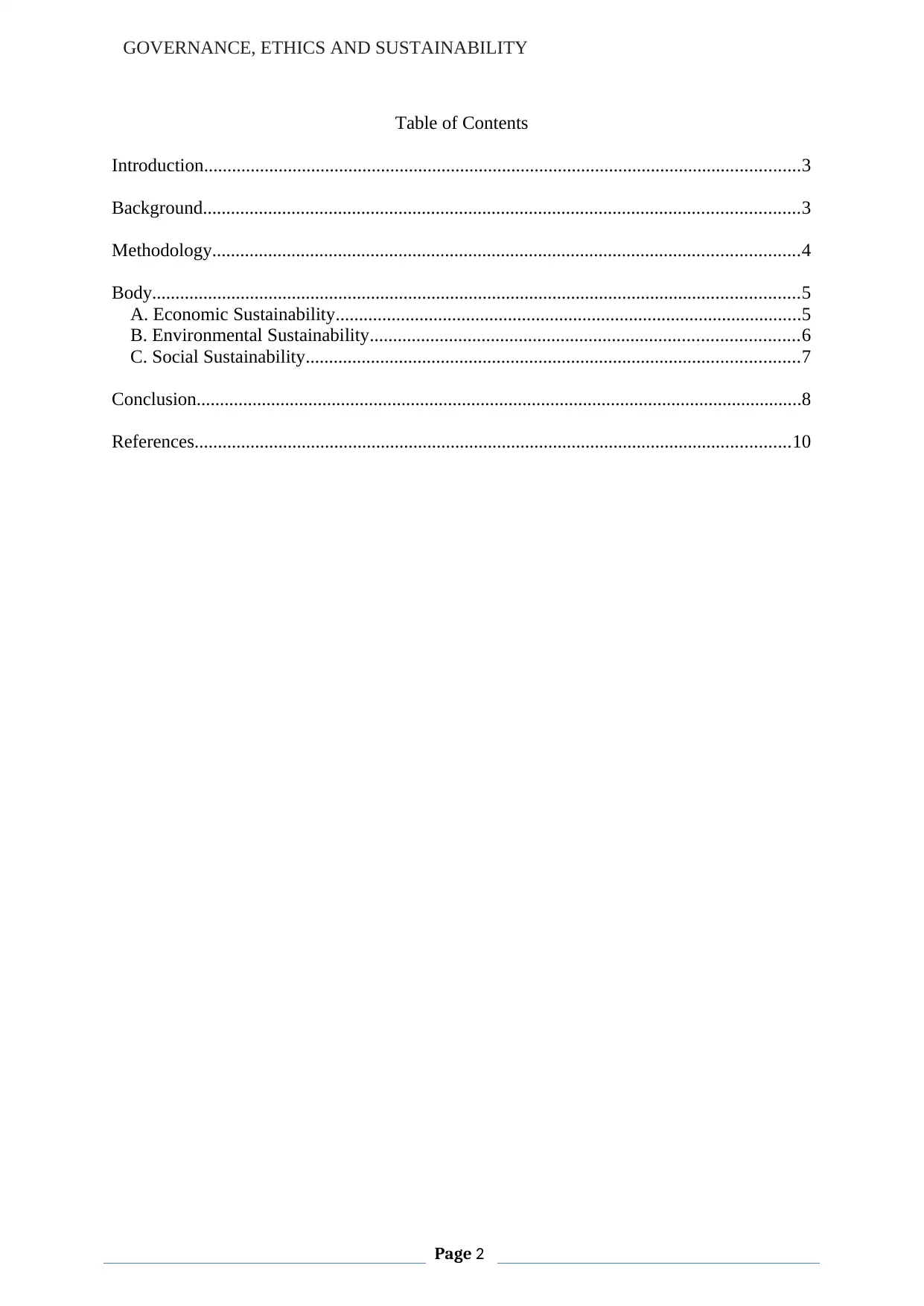
Table of Contents
Introduction................................................................................................................................3
Background................................................................................................................................3
Methodology..............................................................................................................................4
Body...........................................................................................................................................5
A. Economic Sustainability....................................................................................................5
B. Environmental Sustainability............................................................................................6
C. Social Sustainability..........................................................................................................7
Conclusion..................................................................................................................................8
References................................................................................................................................10
Page 2
Table of Contents
Introduction................................................................................................................................3
Background................................................................................................................................3
Methodology..............................................................................................................................4
Body...........................................................................................................................................5
A. Economic Sustainability....................................................................................................5
B. Environmental Sustainability............................................................................................6
C. Social Sustainability..........................................................................................................7
Conclusion..................................................................................................................................8
References................................................................................................................................10
Page 2
GOVERNANCE, ETHICS AND SUSTAINABILITY
Introduction
This report mainly aims at developing a report relating to sustainability assessment with
respect to Timberwell Constructions referring to the consolidations of GRI sustainability
reporting standards 2016. Under this report, especially economic as well as environmental
and social sustainability will be greatly focused upon while referring to the GRI standards
2016. Timberwell Constructions is recognised as a company, which is engaged in building
residential apartment and complexes as well as within the legal boundaries of Stanwell
Council district.
Background
Economic sustainability delivers a positive impact on a company’s business by improving the
marketing operations along with the competitiveness against other companies in the market.
Even trading activities as well as the flow of investments is sustained through it. Increasing
operating costs and poor business conduct can lead to having a negative effect on the
company’s overall business. The business problem becomes a burden for the administrator of
the company, which is bound to affect the business as well. Besides, environmental
sustainability has a negative impact on a company’s business due to lack of job standard
quality. Increase in the rate of waste production gradually affects the working environmental
quality and lead to health risks for the workers at the same time. In addition, the increase in
the use of energy resources along with the increasing rate of transportation activities further
results in the emission of harmful gases. Thus, it becomes difficult for the workers to engage
in the working environment. Referring to social sustainability, it helps in ensuring that
employment opportunities and protection of workers, especially handicapped workers, social
inclusion, and gender equality among the business workers (Pearce & Moran 2013).
Page 3
Introduction
This report mainly aims at developing a report relating to sustainability assessment with
respect to Timberwell Constructions referring to the consolidations of GRI sustainability
reporting standards 2016. Under this report, especially economic as well as environmental
and social sustainability will be greatly focused upon while referring to the GRI standards
2016. Timberwell Constructions is recognised as a company, which is engaged in building
residential apartment and complexes as well as within the legal boundaries of Stanwell
Council district.
Background
Economic sustainability delivers a positive impact on a company’s business by improving the
marketing operations along with the competitiveness against other companies in the market.
Even trading activities as well as the flow of investments is sustained through it. Increasing
operating costs and poor business conduct can lead to having a negative effect on the
company’s overall business. The business problem becomes a burden for the administrator of
the company, which is bound to affect the business as well. Besides, environmental
sustainability has a negative impact on a company’s business due to lack of job standard
quality. Increase in the rate of waste production gradually affects the working environmental
quality and lead to health risks for the workers at the same time. In addition, the increase in
the use of energy resources along with the increasing rate of transportation activities further
results in the emission of harmful gases. Thus, it becomes difficult for the workers to engage
in the working environment. Referring to social sustainability, it helps in ensuring that
employment opportunities and protection of workers, especially handicapped workers, social
inclusion, and gender equality among the business workers (Pearce & Moran 2013).
Page 3
⊘ This is a preview!⊘
Do you want full access?
Subscribe today to unlock all pages.

Trusted by 1+ million students worldwide
GOVERNANCE, ETHICS AND SUSTAINABILITY
The positive and negative impacts tend to affect the sustainability of a company’s business so
that respective companies must be aware of these effects. Contingency plan with effective
sustainable practices must be developed for the purpose of defending against the negative
impact upon the company’s business and its workers. This will also help in avoiding business
sustainability consequences, which are to be faced by a company (Baumgartner 2014).
Methodology
The Global Reporting Initiative (GRI) standard is a set of design, which is mostly
implemented by different organizations, especially for the purpose of making a report on how
they have been affecting the surrounding environment, economy, and society as well. Thus,
Attaining sustainability between these three aspects can be considered to be one of the major
aims of GRI (GRI, 2018). GRI standards approached in the sustainability report of
Timberwell Construction Company are identified as ‘GRI sustainability reporting standards
2016’. This helps in analysing the sustainability status of a Timberwell Construction
Company’s economy, environment, and society. However, the new and emerging company
must provide its sustainability report, as it ensures its growth in many ways. Since challenges
and risks in businesses are inevitable, sustainability report will help newer companies to
identify accurate issues and develop effective sustainable strategies, which further enhances
brand loyalty and public image. It will create awareness among the company’s stakeholders
to identify the actual value of the existing business and different types of assets i.e. tangible
and non-tangible. Hence, developing a sustainable report can favour newer companies to
attain competitive advantage thereby achieving growth (GRI n.d.).
Page 4
The positive and negative impacts tend to affect the sustainability of a company’s business so
that respective companies must be aware of these effects. Contingency plan with effective
sustainable practices must be developed for the purpose of defending against the negative
impact upon the company’s business and its workers. This will also help in avoiding business
sustainability consequences, which are to be faced by a company (Baumgartner 2014).
Methodology
The Global Reporting Initiative (GRI) standard is a set of design, which is mostly
implemented by different organizations, especially for the purpose of making a report on how
they have been affecting the surrounding environment, economy, and society as well. Thus,
Attaining sustainability between these three aspects can be considered to be one of the major
aims of GRI (GRI, 2018). GRI standards approached in the sustainability report of
Timberwell Construction Company are identified as ‘GRI sustainability reporting standards
2016’. This helps in analysing the sustainability status of a Timberwell Construction
Company’s economy, environment, and society. However, the new and emerging company
must provide its sustainability report, as it ensures its growth in many ways. Since challenges
and risks in businesses are inevitable, sustainability report will help newer companies to
identify accurate issues and develop effective sustainable strategies, which further enhances
brand loyalty and public image. It will create awareness among the company’s stakeholders
to identify the actual value of the existing business and different types of assets i.e. tangible
and non-tangible. Hence, developing a sustainable report can favour newer companies to
attain competitive advantage thereby achieving growth (GRI n.d.).
Page 4
Paraphrase This Document
Need a fresh take? Get an instant paraphrase of this document with our AI Paraphraser
GOVERNANCE, ETHICS AND SUSTAINABILITY
Body
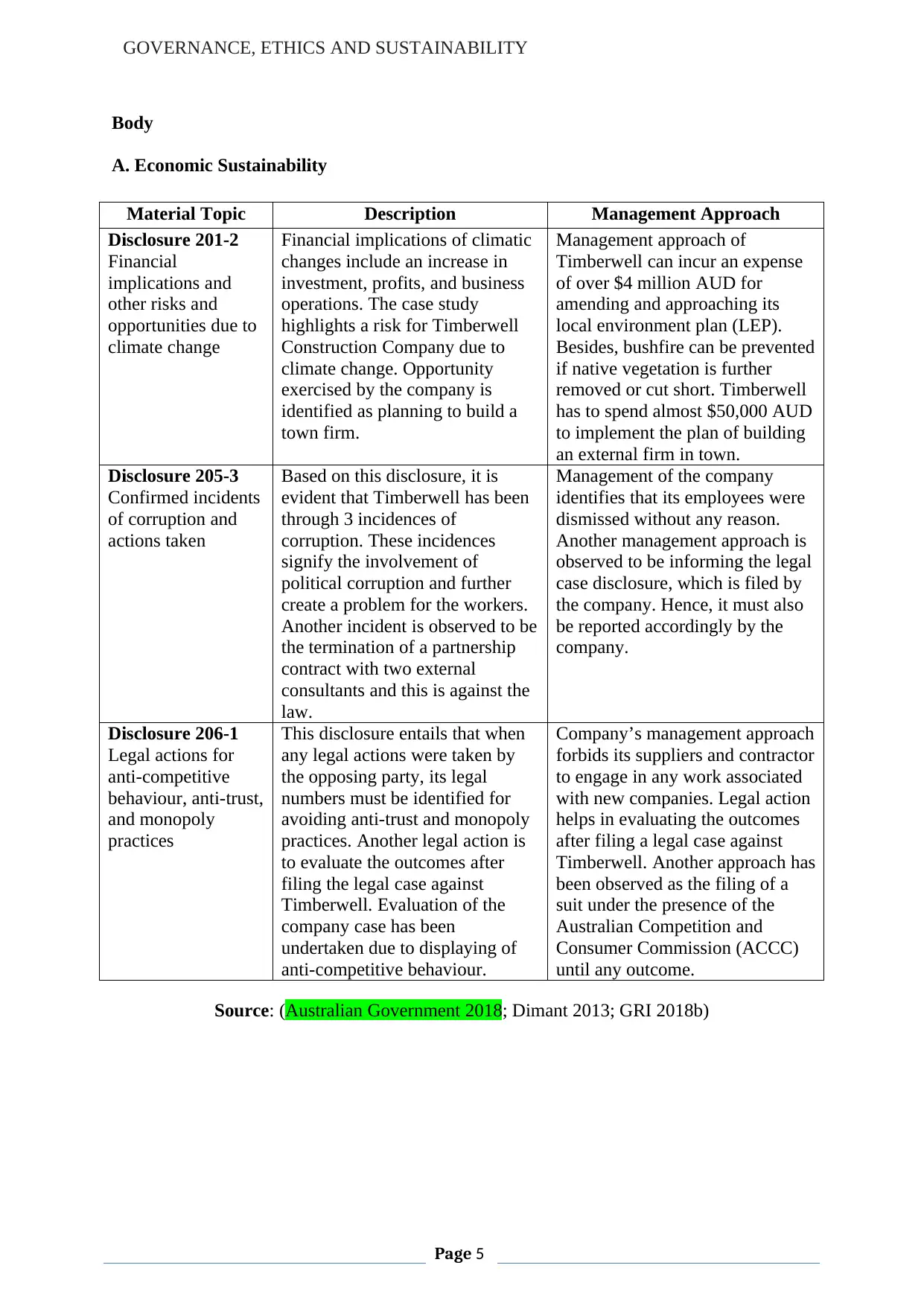
A. Economic Sustainability
Material Topic Description Management Approach
Disclosure 201-2
Financial
implications and
other risks and
opportunities due to
climate change
Financial implications of climatic
changes include an increase in
investment, profits, and business
operations. The case study
highlights a risk for Timberwell
Construction Company due to
climate change. Opportunity
exercised by the company is
identified as planning to build a
town firm.
Management approach of
Timberwell can incur an expense
of over $4 million AUD for
amending and approaching its
local environment plan (LEP).
Besides, bushfire can be prevented
if native vegetation is further
removed or cut short. Timberwell
has to spend almost $50,000 AUD
to implement the plan of building
an external firm in town.
Disclosure 205-3
Confirmed incidents
of corruption and
actions taken
Based on this disclosure, it is
evident that Timberwell has been
through 3 incidences of
corruption. These incidences
signify the involvement of
political corruption and further
create a problem for the workers.
Another incident is observed to be
the termination of a partnership
contract with two external
consultants and this is against the
law.
Management of the company
identifies that its employees were
dismissed without any reason.
Another management approach is
observed to be informing the legal
case disclosure, which is filed by
the company. Hence, it must also
be reported accordingly by the
company.
Disclosure 206-1
Legal actions for
anti-competitive
behaviour, anti-trust,
and monopoly
practices
This disclosure entails that when
any legal actions were taken by
the opposing party, its legal
numbers must be identified for
avoiding anti-trust and monopoly
practices. Another legal action is
to evaluate the outcomes after
filing the legal case against
Timberwell. Evaluation of the
company case has been
undertaken due to displaying of
anti-competitive behaviour.
Company’s management approach
forbids its suppliers and contractor
to engage in any work associated
with new companies. Legal action
helps in evaluating the outcomes
after filing a legal case against
Timberwell. Another approach has
been observed as the filing of a
suit under the presence of the
Australian Competition and
Consumer Commission (ACCC)
until any outcome.
Source: (Australian Government 2018; Dimant 2013; GRI 2018b)
Page 5
Body
A. Economic Sustainability
Material Topic Description Management Approach
Disclosure 201-2
Financial
implications and
other risks and
opportunities due to
climate change
Financial implications of climatic
changes include an increase in
investment, profits, and business
operations. The case study
highlights a risk for Timberwell
Construction Company due to
climate change. Opportunity
exercised by the company is
identified as planning to build a
town firm.
Management approach of
Timberwell can incur an expense
of over $4 million AUD for
amending and approaching its
local environment plan (LEP).
Besides, bushfire can be prevented
if native vegetation is further
removed or cut short. Timberwell
has to spend almost $50,000 AUD
to implement the plan of building
an external firm in town.
Disclosure 205-3
Confirmed incidents
of corruption and
actions taken
Based on this disclosure, it is
evident that Timberwell has been
through 3 incidences of
corruption. These incidences
signify the involvement of
political corruption and further
create a problem for the workers.
Another incident is observed to be
the termination of a partnership
contract with two external
consultants and this is against the
law.
Management of the company
identifies that its employees were
dismissed without any reason.
Another management approach is
observed to be informing the legal
case disclosure, which is filed by
the company. Hence, it must also
be reported accordingly by the
company.
Disclosure 206-1
Legal actions for
anti-competitive
behaviour, anti-trust,
and monopoly
practices
This disclosure entails that when
any legal actions were taken by
the opposing party, its legal
numbers must be identified for
avoiding anti-trust and monopoly
practices. Another legal action is
to evaluate the outcomes after
filing the legal case against
Timberwell. Evaluation of the
company case has been
undertaken due to displaying of
anti-competitive behaviour.
Company’s management approach
forbids its suppliers and contractor
to engage in any work associated
with new companies. Legal action
helps in evaluating the outcomes
after filing a legal case against
Timberwell. Another approach has
been observed as the filing of a
suit under the presence of the
Australian Competition and
Consumer Commission (ACCC)
until any outcome.
Source: (Australian Government 2018; Dimant 2013; GRI 2018b)
Page 5
GOVERNANCE, ETHICS AND SUSTAINABILITY
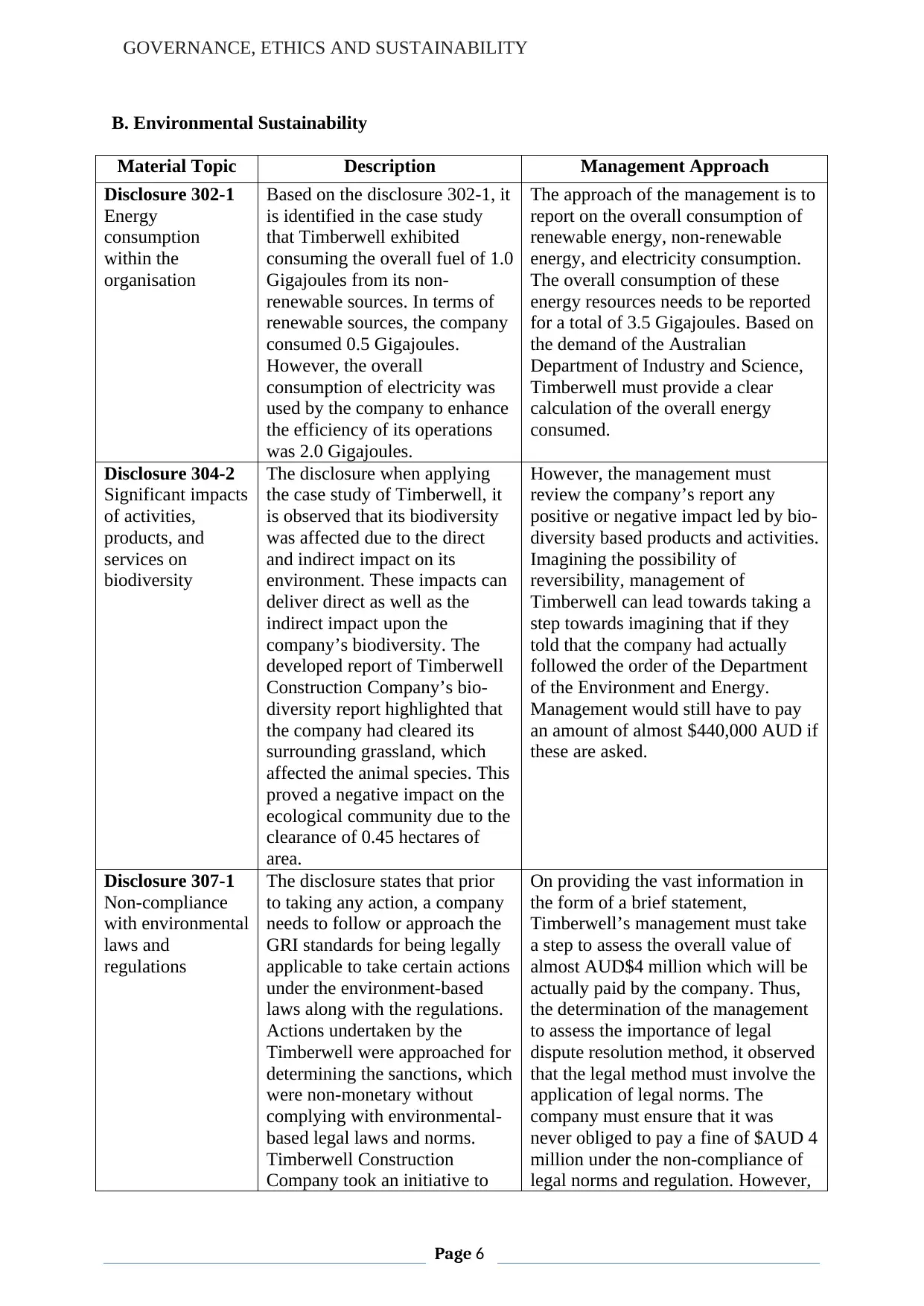
B. Environmental Sustainability
Material Topic Description Management Approach
Disclosure 302-1
Energy
consumption
within the
organisation
Based on the disclosure 302-1, it
is identified in the case study
that Timberwell exhibited
consuming the overall fuel of 1.0
Gigajoules from its non-
renewable sources. In terms of
renewable sources, the company
consumed 0.5 Gigajoules.
However, the overall
consumption of electricity was
used by the company to enhance
the efficiency of its operations
was 2.0 Gigajoules.
The approach of the management is to
report on the overall consumption of
renewable energy, non-renewable
energy, and electricity consumption.
The overall consumption of these
energy resources needs to be reported
for a total of 3.5 Gigajoules. Based on
the demand of the Australian
Department of Industry and Science,
Timberwell must provide a clear
calculation of the overall energy
consumed.
Disclosure 304-2
Significant impacts
of activities,
products, and
services on
biodiversity
The disclosure when applying
the case study of Timberwell, it
is observed that its biodiversity
was affected due to the direct
and indirect impact on its
environment. These impacts can
deliver direct as well as the
indirect impact upon the
company’s biodiversity. The
developed report of Timberwell
Construction Company’s bio-
diversity report highlighted that
the company had cleared its
surrounding grassland, which
affected the animal species. This
proved a negative impact on the
ecological community due to the
clearance of 0.45 hectares of
area.
However, the management must
review the company’s report any
positive or negative impact led by bio-
diversity based products and activities.
Imagining the possibility of
reversibility, management of
Timberwell can lead towards taking a
step towards imagining that if they
told that the company had actually
followed the order of the Department
of the Environment and Energy.
Management would still have to pay
an amount of almost $440,000 AUD if
these are asked.
Disclosure 307-1
Non-compliance
with environmental
laws and
regulations
The disclosure states that prior
to taking any action, a company
needs to follow or approach the
GRI standards for being legally
applicable to take certain actions
under the environment-based
laws along with the regulations.
Actions undertaken by the
Timberwell were approached for
determining the sanctions, which
were non-monetary without
complying with environmental-
based legal laws and norms.
Timberwell Construction
Company took an initiative to
On providing the vast information in
the form of a brief statement,
Timberwell’s management must take
a step to assess the overall value of
almost AUD$4 million which will be
actually paid by the company. Thus,
the determination of the management
to assess the importance of legal
dispute resolution method, it observed
that the legal method must involve the
application of legal norms. The
company must ensure that it was
never obliged to pay a fine of $AUD 4
million under the non-compliance of
legal norms and regulation. However,
Page 6
B. Environmental Sustainability
Material Topic Description Management Approach
Disclosure 302-1
Energy
consumption
within the
organisation
Based on the disclosure 302-1, it
is identified in the case study
that Timberwell exhibited
consuming the overall fuel of 1.0
Gigajoules from its non-
renewable sources. In terms of
renewable sources, the company
consumed 0.5 Gigajoules.
However, the overall
consumption of electricity was
used by the company to enhance
the efficiency of its operations
was 2.0 Gigajoules.
The approach of the management is to
report on the overall consumption of
renewable energy, non-renewable
energy, and electricity consumption.
The overall consumption of these
energy resources needs to be reported
for a total of 3.5 Gigajoules. Based on
the demand of the Australian
Department of Industry and Science,
Timberwell must provide a clear
calculation of the overall energy
consumed.
Disclosure 304-2
Significant impacts
of activities,
products, and
services on
biodiversity
The disclosure when applying
the case study of Timberwell, it
is observed that its biodiversity
was affected due to the direct
and indirect impact on its
environment. These impacts can
deliver direct as well as the
indirect impact upon the
company’s biodiversity. The
developed report of Timberwell
Construction Company’s bio-
diversity report highlighted that
the company had cleared its
surrounding grassland, which
affected the animal species. This
proved a negative impact on the
ecological community due to the
clearance of 0.45 hectares of
area.
However, the management must
review the company’s report any
positive or negative impact led by bio-
diversity based products and activities.
Imagining the possibility of
reversibility, management of
Timberwell can lead towards taking a
step towards imagining that if they
told that the company had actually
followed the order of the Department
of the Environment and Energy.
Management would still have to pay
an amount of almost $440,000 AUD if
these are asked.
Disclosure 307-1
Non-compliance
with environmental
laws and
regulations
The disclosure states that prior
to taking any action, a company
needs to follow or approach the
GRI standards for being legally
applicable to take certain actions
under the environment-based
laws along with the regulations.
Actions undertaken by the
Timberwell were approached for
determining the sanctions, which
were non-monetary without
complying with environmental-
based legal laws and norms.
Timberwell Construction
Company took an initiative to
On providing the vast information in
the form of a brief statement,
Timberwell’s management must take
a step to assess the overall value of
almost AUD$4 million which will be
actually paid by the company. Thus,
the determination of the management
to assess the importance of legal
dispute resolution method, it observed
that the legal method must involve the
application of legal norms. The
company must ensure that it was
never obliged to pay a fine of $AUD 4
million under the non-compliance of
legal norms and regulation. However,
Page 6
⊘ This is a preview!⊘
Do you want full access?
Subscribe today to unlock all pages.
Trusted by 1+ million students worldwide
GOVERNANCE, ETHICS AND SUSTAINABILITY
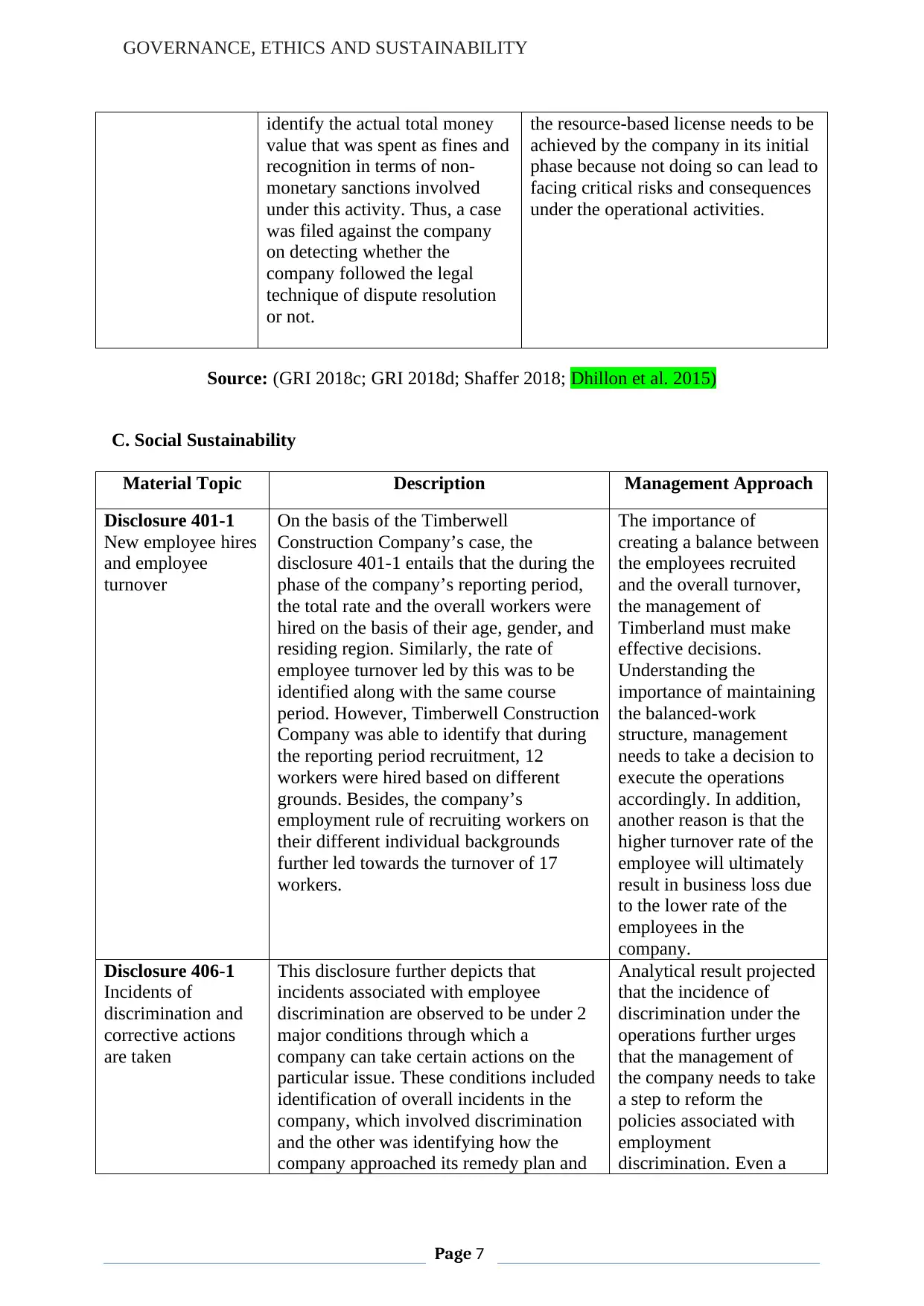
identify the actual total money
value that was spent as fines and
recognition in terms of non-
monetary sanctions involved
under this activity. Thus, a case
was filed against the company
on detecting whether the
company followed the legal
technique of dispute resolution
or not.
the resource-based license needs to be
achieved by the company in its initial
phase because not doing so can lead to
facing critical risks and consequences
under the operational activities.
Source: (GRI 2018c; GRI 2018d; Shaffer 2018; Dhillon et al. 2015)
C. Social Sustainability
Material Topic Description Management Approach
Disclosure 401-1
New employee hires
and employee
turnover
On the basis of the Timberwell
Construction Company’s case, the
disclosure 401-1 entails that the during the
phase of the company’s reporting period,
the total rate and the overall workers were
hired on the basis of their age, gender, and
residing region. Similarly, the rate of
employee turnover led by this was to be
identified along with the same course
period. However, Timberwell Construction
Company was able to identify that during
the reporting period recruitment, 12
workers were hired based on different
grounds. Besides, the company’s
employment rule of recruiting workers on
their different individual backgrounds
further led towards the turnover of 17
workers.
The importance of
creating a balance between
the employees recruited
and the overall turnover,
the management of
Timberland must make
effective decisions.
Understanding the
importance of maintaining
the balanced-work
structure, management
needs to take a decision to
execute the operations
accordingly. In addition,
another reason is that the
higher turnover rate of the
employee will ultimately
result in business loss due
to the lower rate of the
employees in the
company.
Disclosure 406-1
Incidents of
discrimination and
corrective actions
are taken
This disclosure further depicts that
incidents associated with employee
discrimination are observed to be under 2
major conditions through which a
company can take certain actions on the
particular issue. These conditions included
identification of overall incidents in the
company, which involved discrimination
and the other was identifying how the
company approached its remedy plan and
Analytical result projected
that the incidence of
discrimination under the
operations further urges
that the management of
the company needs to take
a step to reform the
policies associated with
employment
discrimination. Even a
Page 7
identify the actual total money
value that was spent as fines and
recognition in terms of non-
monetary sanctions involved
under this activity. Thus, a case
was filed against the company
on detecting whether the
company followed the legal
technique of dispute resolution
or not.
the resource-based license needs to be
achieved by the company in its initial
phase because not doing so can lead to
facing critical risks and consequences
under the operational activities.
Source: (GRI 2018c; GRI 2018d; Shaffer 2018; Dhillon et al. 2015)
C. Social Sustainability
Material Topic Description Management Approach
Disclosure 401-1
New employee hires
and employee
turnover
On the basis of the Timberwell
Construction Company’s case, the
disclosure 401-1 entails that the during the
phase of the company’s reporting period,
the total rate and the overall workers were
hired on the basis of their age, gender, and
residing region. Similarly, the rate of
employee turnover led by this was to be
identified along with the same course
period. However, Timberwell Construction
Company was able to identify that during
the reporting period recruitment, 12
workers were hired based on different
grounds. Besides, the company’s
employment rule of recruiting workers on
their different individual backgrounds
further led towards the turnover of 17
workers.
The importance of
creating a balance between
the employees recruited
and the overall turnover,
the management of
Timberland must make
effective decisions.
Understanding the
importance of maintaining
the balanced-work
structure, management
needs to take a decision to
execute the operations
accordingly. In addition,
another reason is that the
higher turnover rate of the
employee will ultimately
result in business loss due
to the lower rate of the
employees in the
company.
Disclosure 406-1
Incidents of
discrimination and
corrective actions
are taken
This disclosure further depicts that
incidents associated with employee
discrimination are observed to be under 2
major conditions through which a
company can take certain actions on the
particular issue. These conditions included
identification of overall incidents in the
company, which involved discrimination
and the other was identifying how the
company approached its remedy plan and
Analytical result projected
that the incidence of
discrimination under the
operations further urges
that the management of
the company needs to take
a step to reform the
policies associated with
employment
discrimination. Even a
Page 7
Paraphrase This Document
Need a fresh take? Get an instant paraphrase of this document with our AI Paraphraser
GOVERNANCE, ETHICS AND SUSTAINABILITY
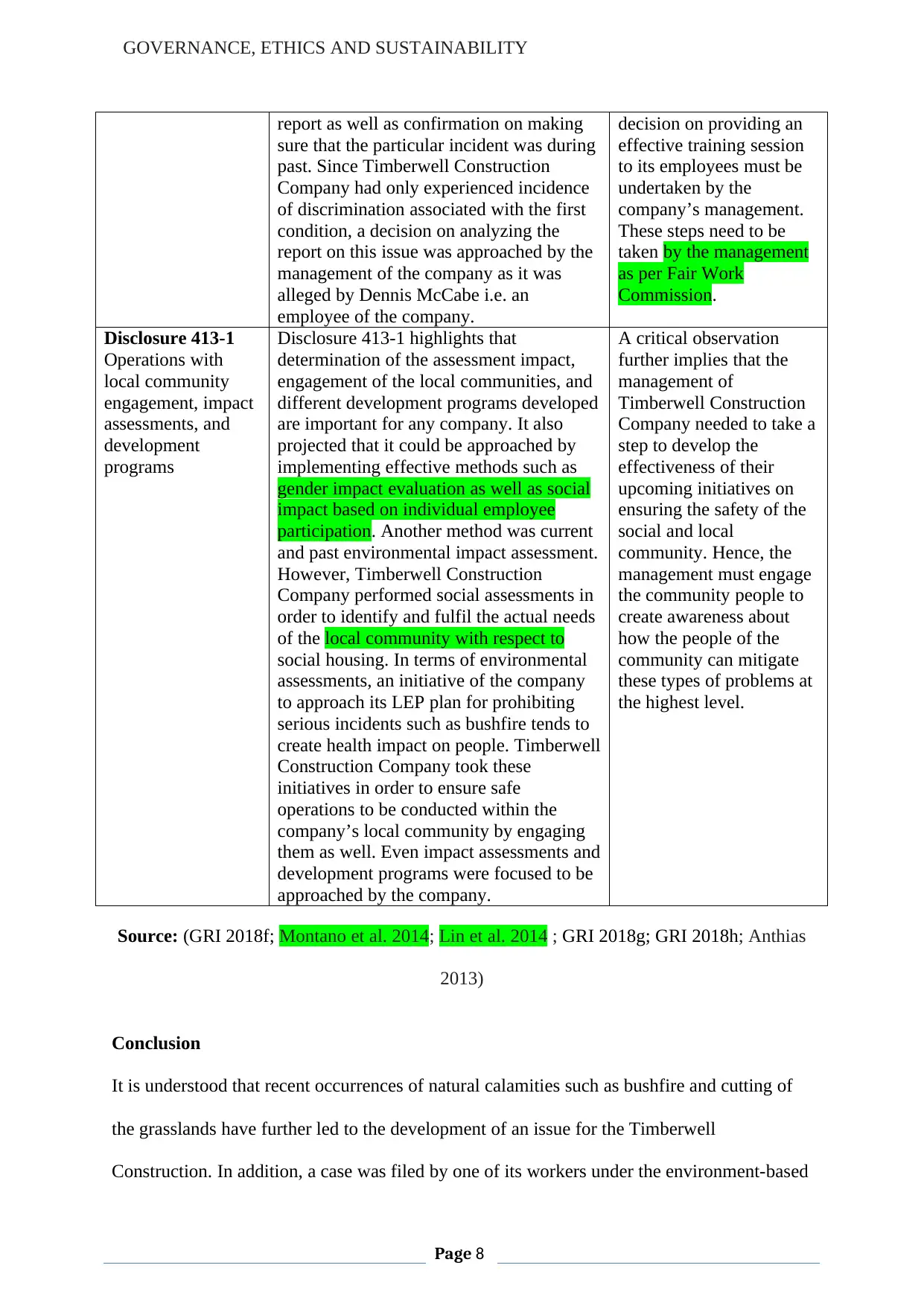
report as well as confirmation on making
sure that the particular incident was during
past. Since Timberwell Construction
Company had only experienced incidence
of discrimination associated with the first
condition, a decision on analyzing the
report on this issue was approached by the
management of the company as it was
alleged by Dennis McCabe i.e. an
employee of the company.
decision on providing an
effective training session
to its employees must be
undertaken by the
company’s management.
These steps need to be
taken by the management
as per Fair Work
Commission.
Disclosure 413-1
Operations with
local community
engagement, impact
assessments, and
development
programs
Disclosure 413-1 highlights that
determination of the assessment impact,
engagement of the local communities, and
different development programs developed
are important for any company. It also
projected that it could be approached by
implementing effective methods such as
gender impact evaluation as well as social
impact based on individual employee
participation. Another method was current
and past environmental impact assessment.
However, Timberwell Construction
Company performed social assessments in
order to identify and fulfil the actual needs
of the local community with respect to
social housing. In terms of environmental
assessments, an initiative of the company
to approach its LEP plan for prohibiting
serious incidents such as bushfire tends to
create health impact on people. Timberwell
Construction Company took these
initiatives in order to ensure safe
operations to be conducted within the
company’s local community by engaging
them as well. Even impact assessments and
development programs were focused to be
approached by the company.
A critical observation
further implies that the
management of
Timberwell Construction
Company needed to take a
step to develop the
effectiveness of their
upcoming initiatives on
ensuring the safety of the
social and local
community. Hence, the
management must engage
the community people to
create awareness about
how the people of the
community can mitigate
these types of problems at
the highest level.
Source: (GRI 2018f; Montano et al. 2014; Lin et al. 2014 ; GRI 2018g; GRI 2018h; Anthias
2013)
Conclusion
It is understood that recent occurrences of natural calamities such as bushfire and cutting of
the grasslands have further led to the development of an issue for the Timberwell
Construction. In addition, a case was filed by one of its workers under the environment-based
Page 8
report as well as confirmation on making
sure that the particular incident was during
past. Since Timberwell Construction
Company had only experienced incidence
of discrimination associated with the first
condition, a decision on analyzing the
report on this issue was approached by the
management of the company as it was
alleged by Dennis McCabe i.e. an
employee of the company.
decision on providing an
effective training session
to its employees must be
undertaken by the
company’s management.
These steps need to be
taken by the management
as per Fair Work
Commission.
Disclosure 413-1
Operations with
local community
engagement, impact
assessments, and
development
programs
Disclosure 413-1 highlights that
determination of the assessment impact,
engagement of the local communities, and
different development programs developed
are important for any company. It also
projected that it could be approached by
implementing effective methods such as
gender impact evaluation as well as social
impact based on individual employee
participation. Another method was current
and past environmental impact assessment.
However, Timberwell Construction
Company performed social assessments in
order to identify and fulfil the actual needs
of the local community with respect to
social housing. In terms of environmental
assessments, an initiative of the company
to approach its LEP plan for prohibiting
serious incidents such as bushfire tends to
create health impact on people. Timberwell
Construction Company took these
initiatives in order to ensure safe
operations to be conducted within the
company’s local community by engaging
them as well. Even impact assessments and
development programs were focused to be
approached by the company.
A critical observation
further implies that the
management of
Timberwell Construction
Company needed to take a
step to develop the
effectiveness of their
upcoming initiatives on
ensuring the safety of the
social and local
community. Hence, the
management must engage
the community people to
create awareness about
how the people of the
community can mitigate
these types of problems at
the highest level.
Source: (GRI 2018f; Montano et al. 2014; Lin et al. 2014 ; GRI 2018g; GRI 2018h; Anthias
2013)
Conclusion
It is understood that recent occurrences of natural calamities such as bushfire and cutting of
the grasslands have further led to the development of an issue for the Timberwell
Construction. In addition, a case was filed by one of its workers under the environment-based
Page 8
GOVERNANCE, ETHICS AND SUSTAINABILITY
legal laws. In addition, the legislation has further created a huge barrier for the company at
the same time. Going through this critical phase, Timberwell Construction Company is set to
take legal actions for reducing the effects of the occurrences, which may be through the
initiative of the management, overall members, and the local community people of the
company. Additionally, the legal action indicates identifying and developing effective
approaches by providing its sustainability report to the council by fulfilling every criteria and
requirements as the sustainability reporting standards of GRI initiated in 2016.
Page 9
legal laws. In addition, the legislation has further created a huge barrier for the company at
the same time. Going through this critical phase, Timberwell Construction Company is set to
take legal actions for reducing the effects of the occurrences, which may be through the
initiative of the management, overall members, and the local community people of the
company. Additionally, the legal action indicates identifying and developing effective
approaches by providing its sustainability report to the council by fulfilling every criteria and
requirements as the sustainability reporting standards of GRI initiated in 2016.
Page 9
⊘ This is a preview!⊘
Do you want full access?
Subscribe today to unlock all pages.
Trusted by 1+ million students worldwide
GOVERNANCE, ETHICS AND SUSTAINABILITY
References
Anthias, F 2013, ‘Intersectional what? Social divisions, intersectionality and levels of
analysis’, Ethnicities, vol. 13, no. 1, pp. 3-19.
Australian Government 2018, ‘Environmental legislation guidelines’, Geoscience Australia,
pp. 1-19.
Baumgartner, RJ 2014, ‘Managing corporate sustainability and CSR: A conceptual
framework combining values, strategies and instruments contributing to sustainable
development’, Corporate Social Responsibility and Environmental Management, vol. 21, no.
5, pp. 258-271.
Benefits of reporting n.d., viewed 05 June 2019,
<https://www.globalreporting.org/information/sustainability-reporting/pages/reporting-
benefits.aspx>.
Dhillon, G, Kaur, S, Pulicharla, R., Brar, S, Cledón, M, Verma, M., & Surampalli, R 2015,
‘Triclosan: Current status, occurrence, environmental risks and bioaccumulation potential’,
International Journal of Environmental Research and Public Health, vol. 12, no. 5, pp.
5657-5684.
Dimant, E 2013, ‘The nature of corruption: an interdisciplinary perspective’, Economics, pp.
2-47.
GRI 2016, ‘Consolidated set of GRI sustainability reporting standards 2016’, Global
Reporting, pp. 004-416.
GRI 2018, ‘GRI 201: Economic performance 2016’, Global Reporting, pp. 3-12.
Page
10
References
Anthias, F 2013, ‘Intersectional what? Social divisions, intersectionality and levels of
analysis’, Ethnicities, vol. 13, no. 1, pp. 3-19.
Australian Government 2018, ‘Environmental legislation guidelines’, Geoscience Australia,
pp. 1-19.
Baumgartner, RJ 2014, ‘Managing corporate sustainability and CSR: A conceptual
framework combining values, strategies and instruments contributing to sustainable
development’, Corporate Social Responsibility and Environmental Management, vol. 21, no.
5, pp. 258-271.
Benefits of reporting n.d., viewed 05 June 2019,
<https://www.globalreporting.org/information/sustainability-reporting/pages/reporting-
benefits.aspx>.
Dhillon, G, Kaur, S, Pulicharla, R., Brar, S, Cledón, M, Verma, M., & Surampalli, R 2015,
‘Triclosan: Current status, occurrence, environmental risks and bioaccumulation potential’,
International Journal of Environmental Research and Public Health, vol. 12, no. 5, pp.
5657-5684.
Dimant, E 2013, ‘The nature of corruption: an interdisciplinary perspective’, Economics, pp.
2-47.
GRI 2016, ‘Consolidated set of GRI sustainability reporting standards 2016’, Global
Reporting, pp. 004-416.
GRI 2018, ‘GRI 201: Economic performance 2016’, Global Reporting, pp. 3-12.
Page
10
Paraphrase This Document
Need a fresh take? Get an instant paraphrase of this document with our AI Paraphraser
GOVERNANCE, ETHICS AND SUSTAINABILITY
GRI 2018, ‘GRI 201: Economic performance 2016’, GRI Standards, GSSB, pp. 1-16.
GRI 2018a, ‘GRI 205: Anti-corruption 2016’, Global Reporting, pp. 3-9.
GRI 2018b, ‘GRI 206: Anti-competitive behavior 2016’, Global Reporting, pp. 3-6.
GRI 2018c, ‘GRI 302: Energy 2016’, Global Reporting, GSSB, pp.3-12.
GRI 2018d, ‘GRI 304: Biodiversity 2016’, Global Reporting, GSSB, pp.3-10.
GRI 2018e, ‘GRI 307: Environmental compliance 2016’, Global Reporting, pp.3-6.
Lin, BB, Khoo, YB, Inman, M, Wang, CH., Tapsuwan, S. & Wang, X 2014, ‘Assessing
inundation damage and timing of adaptation: Sea level rise and the complexities of land use
in coastal communities’, Mitigation and Adaptation Strategies for Global Change, vol. 19,
no. 5, pp. 551-568.
Montano, D, Hoven, H., & Siegrist, J 2014, ‘Effects of organisational-level interventions at
work on employees’ health: a systematic review’, BMC Public Health, vol. 14, no. 1, pp. 1-9.
Pearce, D & Moran, D 2013, ‘The economic value of biodiversity’, IUCN — The World
Conservation Union, pp. 1-104.
Shaffer, GL 2018, Creating the sustainable public library: the triple bottom line approach,
ABC-CLIO, California.
Page
11
GRI 2018, ‘GRI 201: Economic performance 2016’, GRI Standards, GSSB, pp. 1-16.
GRI 2018a, ‘GRI 205: Anti-corruption 2016’, Global Reporting, pp. 3-9.
GRI 2018b, ‘GRI 206: Anti-competitive behavior 2016’, Global Reporting, pp. 3-6.
GRI 2018c, ‘GRI 302: Energy 2016’, Global Reporting, GSSB, pp.3-12.
GRI 2018d, ‘GRI 304: Biodiversity 2016’, Global Reporting, GSSB, pp.3-10.
GRI 2018e, ‘GRI 307: Environmental compliance 2016’, Global Reporting, pp.3-6.
Lin, BB, Khoo, YB, Inman, M, Wang, CH., Tapsuwan, S. & Wang, X 2014, ‘Assessing
inundation damage and timing of adaptation: Sea level rise and the complexities of land use
in coastal communities’, Mitigation and Adaptation Strategies for Global Change, vol. 19,
no. 5, pp. 551-568.
Montano, D, Hoven, H., & Siegrist, J 2014, ‘Effects of organisational-level interventions at
work on employees’ health: a systematic review’, BMC Public Health, vol. 14, no. 1, pp. 1-9.
Pearce, D & Moran, D 2013, ‘The economic value of biodiversity’, IUCN — The World
Conservation Union, pp. 1-104.
Shaffer, GL 2018, Creating the sustainable public library: the triple bottom line approach,
ABC-CLIO, California.
Page
11

1 out of 11


Related Documents


Your All-in-One AI-Powered Toolkit for Academic Success.
+13062052269
info@desklib.com
Available 24*7 on WhatsApp / Email
![[object Object]](/_next/static/media/star-bottom.7253800d.svg)
Unlock your academic potential
Copyright © 2020–2026 A2Z Services. All Rights Reserved. Developed and managed by ZUCOL.