Operations Management: Time-Based Competition & Toyota's Supply Chain
VerifiedAdded on 2023/04/21
|15
|3218
|395
Report
AI Summary
This report examines the role of operations management and supply chain in the context of increasing competition, focusing on time-based competition (TBC). It highlights the importance of speed in service, instant information access, and rapid delivery in today's business environment. The report reviews the evolution of TBC, drawing on various authors' perspectives and examples, including the application of TBC to Toyota's supply chain. It critically evaluates the effectiveness of industries using TBC, emphasizing elements like fast-to-market and fast-to-produce strategies, and concludes with insights into how companies can improve their processes to meet customer demands efficiently. Desklib offers students access to similar solved assignments and resources.
Operation management and supply chain
1 / 1 7 / 2 0 1 9
1 / 1 7 / 2 0 1 9

Paraphrase This Document
Need a fresh take? Get an instant paraphrase of this document with our AI Paraphraser
Supply chain 1
Executive summary
The aim of the report is to talk about the operations management and supply chain role for the
organisations in the evolving world where competition is increasing. This has been found that
distribution of the products and services is one of the factors that contribute to competitiveness.
Today, the company needs to maintain the speed of service, instant access to information, fast or
rapid internet-based order transactions with the quick and effective delivery of goods and
services. The report includes the time-based competition and the way it has evolved the supply
chain. Further, the opinions of different authors have been discussed on the time-based
competition with the support of different facts and examples. In the report, the time-based
competition to an organisation is also applied to evaluate the approach and effective business
operations. In the end, the critical evaluation of the effectiveness of industries has been
discussed.
Executive summary
The aim of the report is to talk about the operations management and supply chain role for the
organisations in the evolving world where competition is increasing. This has been found that
distribution of the products and services is one of the factors that contribute to competitiveness.
Today, the company needs to maintain the speed of service, instant access to information, fast or
rapid internet-based order transactions with the quick and effective delivery of goods and
services. The report includes the time-based competition and the way it has evolved the supply
chain. Further, the opinions of different authors have been discussed on the time-based
competition with the support of different facts and examples. In the report, the time-based
competition to an organisation is also applied to evaluate the approach and effective business
operations. In the end, the critical evaluation of the effectiveness of industries has been
discussed.
Supply chain 2
Contents
Introduction......................................................................................................................................3
Time based competition...............................................................................................................3
Literature Search..............................................................................................................................3
Scenario Development.....................................................................................................................7
Critical Evaluation...........................................................................................................................8
Conclusion.....................................................................................................................................10
References......................................................................................................................................11
Contents
Introduction......................................................................................................................................3
Time based competition...............................................................................................................3
Literature Search..............................................................................................................................3
Scenario Development.....................................................................................................................7
Critical Evaluation...........................................................................................................................8
Conclusion.....................................................................................................................................10
References......................................................................................................................................11
⊘ This is a preview!⊘
Do you want full access?
Subscribe today to unlock all pages.

Trusted by 1+ million students worldwide
Supply chain 3
Introduction
This report includes the study of operations management and supply chain in relation to the time-
based competition. This section of the report includes an overview of the Time based
competition and the way it has evolved the companies.
Time-based competition
Time-based competition is a broad-based competitive strategy which majorly focuses on the time
as one of the dominant factors for accomplishing and maintaining a sustainable competitive
advantage. The concept is formed with the motive to compress the time that is required to
propose, develop, manufacture, market and delivers its products. This has been found that this
term of time-based competition came in the use in 1988 in the article of Harvard Business
Review with the name of "Time-The Next Source of Competitive Advantage" by George Stalk,
Jr. This has been found that the approaches of time-based competition generally appears in two
different forms which include proposing, manufacture, develop, market and deliver its products
(Godinho Filho and Saes, 2013). Further, the time-based competition appears in two different
forms which include fast to market and fast to produce. The time-based competition concept has
made organisation capable enough to evolve effectively that make their supply chain to process
faster and to make the products easily available to end users (Oláh, Popp and Antal, 2018). The
time-based competition has started correcting the techniques of manufacturing by fixing the
distribution and sales. This makes the supply chain faster as compared to earlier because issues
get eliminated.
Introduction
This report includes the study of operations management and supply chain in relation to the time-
based competition. This section of the report includes an overview of the Time based
competition and the way it has evolved the companies.
Time-based competition
Time-based competition is a broad-based competitive strategy which majorly focuses on the time
as one of the dominant factors for accomplishing and maintaining a sustainable competitive
advantage. The concept is formed with the motive to compress the time that is required to
propose, develop, manufacture, market and delivers its products. This has been found that this
term of time-based competition came in the use in 1988 in the article of Harvard Business
Review with the name of "Time-The Next Source of Competitive Advantage" by George Stalk,
Jr. This has been found that the approaches of time-based competition generally appears in two
different forms which include proposing, manufacture, develop, market and deliver its products
(Godinho Filho and Saes, 2013). Further, the time-based competition appears in two different
forms which include fast to market and fast to produce. The time-based competition concept has
made organisation capable enough to evolve effectively that make their supply chain to process
faster and to make the products easily available to end users (Oláh, Popp and Antal, 2018). The
time-based competition has started correcting the techniques of manufacturing by fixing the
distribution and sales. This makes the supply chain faster as compared to earlier because issues
get eliminated.
Paraphrase This Document
Need a fresh take? Get an instant paraphrase of this document with our AI Paraphraser
Supply chain 4
Literature Search
This section of the report includes a review of the literature with the development of the concept
of Time based competition and to analyse the factors that are essential for achieving success.
According to Yang, De Vericourt and Sun, 2013, speed is considered as the competitive factor
that is essential for achieving maximum importance for the companies that are involved in the
global market competition. Most of the companies tend to achieve competition in terms of
reaction time which describes the concept of time-based competition. Further, the author says
that the concept of TBC needs a holistic attitude towards the time-based management that would
combine an effective deal of the various concepts, tools and methods related to the management
theory. Contradicting same, another Alarcón, (2014) said that time-based competition is used
majorly with the motive of production control systems, cost accounting systems with time and
the performance measurement systems with the support of the time perspective. Moreover, the
research helped in determining the fact that the JIT (Just-in-time) approach is the first
manifestation of the time-based competition. In other words, this can be said that Time based
competition is considered as the extension of JIT into every facet of the product delivery cycle
which include the journey from research and development to the distribution and marketing of
the final product. The time-based competition concept helps the company change its current
processes and alter the structure of decisions which are used with the motive to design, produce
and deliver to customers. This concept is majorly used by the manufacturing companies but at
the present time, it has been used by the service companies so that they deliver the right quality
in time-sensitive operations.
Considering the view of Nagurney, Yu, Floden, and Nagurney, (2014), Time-based competition
appears majorly in two different forms which include fast to market and fast to produce. These
Literature Search
This section of the report includes a review of the literature with the development of the concept
of Time based competition and to analyse the factors that are essential for achieving success.
According to Yang, De Vericourt and Sun, 2013, speed is considered as the competitive factor
that is essential for achieving maximum importance for the companies that are involved in the
global market competition. Most of the companies tend to achieve competition in terms of
reaction time which describes the concept of time-based competition. Further, the author says
that the concept of TBC needs a holistic attitude towards the time-based management that would
combine an effective deal of the various concepts, tools and methods related to the management
theory. Contradicting same, another Alarcón, (2014) said that time-based competition is used
majorly with the motive of production control systems, cost accounting systems with time and
the performance measurement systems with the support of the time perspective. Moreover, the
research helped in determining the fact that the JIT (Just-in-time) approach is the first
manifestation of the time-based competition. In other words, this can be said that Time based
competition is considered as the extension of JIT into every facet of the product delivery cycle
which include the journey from research and development to the distribution and marketing of
the final product. The time-based competition concept helps the company change its current
processes and alter the structure of decisions which are used with the motive to design, produce
and deliver to customers. This concept is majorly used by the manufacturing companies but at
the present time, it has been used by the service companies so that they deliver the right quality
in time-sensitive operations.
Considering the view of Nagurney, Yu, Floden, and Nagurney, (2014), Time-based competition
appears majorly in two different forms which include fast to market and fast to produce. These
Supply chain 5
two forms include different types of elements which help the company to achieve the quality in
the given time framework that is must to meet the needs of customers. The researcher found that
the companies who compete with to-market speed majorly emphasize on reduction in the time
taken for the design. This shows that the reduction in timeframe is one of the elements which
leads to success by producing quality new products or rapid changes in design. Further, this
helps the company to become effective enough in offering the improved products with the
customization in the market. In the end, this can be said that this form of Time based competition
results in the market domination advanced learning curve which leads to the barriers to entry.
Contradiction this, Rohsto and Liu, (2011) researched and believe that fast-to-product is one of
the essential elements that contribute in successful in delivering the great quality in time-
sensitive operations. This form helps the firm who want to improve their supply chain with the
motive to focus on speed while responding to the needs of the customers for the existing
products. This is evident with the help of the example of Wal-Mart Company. The company is
considered as the dominating company within its industry by replenishing its store twice as fast
as its competitors. This shows that the speed of the company is driving because they want to be
speedy enough to respond to the demand of the customers present in the market. Similar to this,
Ikea company ensure that they are able to effectively distribute their products in the market as
the company is operating a holistic view of the whole supply chain from the suppliers to the
customers (Rohsto, and Liu, 2011. The company need to manage their operations at the different
place due to which they reduce the total delivery cost of the products with this they secure the
quality. Thus, this has been found that key elements that are required to be successful in
delivering great quality in time-sensitive operations include the quality control measures which
two forms include different types of elements which help the company to achieve the quality in
the given time framework that is must to meet the needs of customers. The researcher found that
the companies who compete with to-market speed majorly emphasize on reduction in the time
taken for the design. This shows that the reduction in timeframe is one of the elements which
leads to success by producing quality new products or rapid changes in design. Further, this
helps the company to become effective enough in offering the improved products with the
customization in the market. In the end, this can be said that this form of Time based competition
results in the market domination advanced learning curve which leads to the barriers to entry.
Contradiction this, Rohsto and Liu, (2011) researched and believe that fast-to-product is one of
the essential elements that contribute in successful in delivering the great quality in time-
sensitive operations. This form helps the firm who want to improve their supply chain with the
motive to focus on speed while responding to the needs of the customers for the existing
products. This is evident with the help of the example of Wal-Mart Company. The company is
considered as the dominating company within its industry by replenishing its store twice as fast
as its competitors. This shows that the speed of the company is driving because they want to be
speedy enough to respond to the demand of the customers present in the market. Similar to this,
Ikea company ensure that they are able to effectively distribute their products in the market as
the company is operating a holistic view of the whole supply chain from the suppliers to the
customers (Rohsto, and Liu, 2011. The company need to manage their operations at the different
place due to which they reduce the total delivery cost of the products with this they secure the
quality. Thus, this has been found that key elements that are required to be successful in
delivering great quality in time-sensitive operations include the quality control measures which
⊘ This is a preview!⊘
Do you want full access?
Subscribe today to unlock all pages.
Trusted by 1+ million students worldwide
Supply chain 6
are adopted by the company for ensuring that they are able to meet the standard of the quality of
product that they offer in the market.
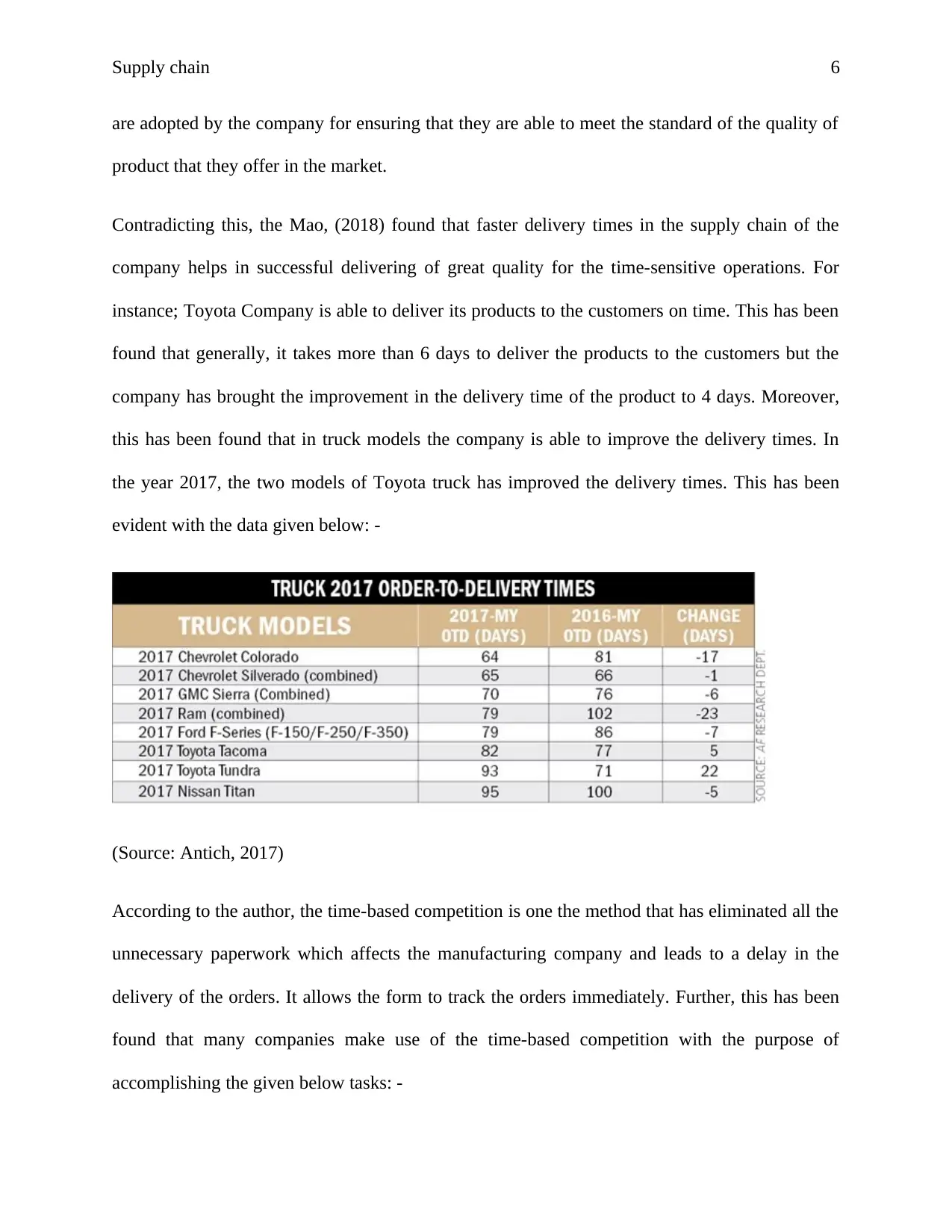
Contradicting this, the Mao, (2018) found that faster delivery times in the supply chain of the
company helps in successful delivering of great quality for the time-sensitive operations. For
instance; Toyota Company is able to deliver its products to the customers on time. This has been
found that generally, it takes more than 6 days to deliver the products to the customers but the
company has brought the improvement in the delivery time of the product to 4 days. Moreover,
this has been found that in truck models the company is able to improve the delivery times. In
the year 2017, the two models of Toyota truck has improved the delivery times. This has been
evident with the data given below: -
(Source: Antich, 2017)
According to the author, the time-based competition is one the method that has eliminated all the
unnecessary paperwork which affects the manufacturing company and leads to a delay in the
delivery of the orders. It allows the form to track the orders immediately. Further, this has been
found that many companies make use of the time-based competition with the purpose of
accomplishing the given below tasks: -
are adopted by the company for ensuring that they are able to meet the standard of the quality of
product that they offer in the market.
Contradicting this, the Mao, (2018) found that faster delivery times in the supply chain of the
company helps in successful delivering of great quality for the time-sensitive operations. For
instance; Toyota Company is able to deliver its products to the customers on time. This has been
found that generally, it takes more than 6 days to deliver the products to the customers but the
company has brought the improvement in the delivery time of the product to 4 days. Moreover,
this has been found that in truck models the company is able to improve the delivery times. In
the year 2017, the two models of Toyota truck has improved the delivery times. This has been
evident with the data given below: -
(Source: Antich, 2017)
According to the author, the time-based competition is one the method that has eliminated all the
unnecessary paperwork which affects the manufacturing company and leads to a delay in the
delivery of the orders. It allows the form to track the orders immediately. Further, this has been
found that many companies make use of the time-based competition with the purpose of
accomplishing the given below tasks: -
Paraphrase This Document
Need a fresh take? Get an instant paraphrase of this document with our AI Paraphraser
Supply chain 7
Understanding the rules of response
Making value delivery systems that include two to three times as flexible and responsible
like its competitors.
Implementing strategy for the time-based advantages.
Pricing which shows how customers value these capabilities.
Scenario Development
This section includes the implementation of the time-base competition concept by the company
in the real world with the motive to bring the improvement. Further, the discussions for the
industry and environment constraints that influence their approach are discussed (Mao, 2018).
The company on which the approach of Time based competition is applied is the Toyota
Company. The company is considered as one of the well-known automobile company who
manufactures and distribute its products in the market. Toyota Industries Corporation gets
engage in the wide variety of the businesses which majorly include vehicles, engines, car, air-
condition, compressors and car electronics. Along with this, the company is effective enough in
handing the equipment and textile machinery (Toyota, 2018). The effective management of all
these operations is required to the company and it is supposed to be done on time.
Toyota Company implements the time-based competition concepts because the company faced
the dissatisfaction with the response time of the suppliers of the company. This is one of the
reason due to which the Toyota Company decided to apply time-based competition (Mao, 2018).
Toyota Company took 15 suppliers to turn out a component after the arrival of the raw material
as its factory. The company gets involve in the time-based competition to decrease the amount of
time that is devoted at every stage of the general cycle by eliminating the non-value adding
Understanding the rules of response
Making value delivery systems that include two to three times as flexible and responsible
like its competitors.
Implementing strategy for the time-based advantages.
Pricing which shows how customers value these capabilities.
Scenario Development
This section includes the implementation of the time-base competition concept by the company
in the real world with the motive to bring the improvement. Further, the discussions for the
industry and environment constraints that influence their approach are discussed (Mao, 2018).
The company on which the approach of Time based competition is applied is the Toyota
Company. The company is considered as one of the well-known automobile company who
manufactures and distribute its products in the market. Toyota Industries Corporation gets
engage in the wide variety of the businesses which majorly include vehicles, engines, car, air-
condition, compressors and car electronics. Along with this, the company is effective enough in
handing the equipment and textile machinery (Toyota, 2018). The effective management of all
these operations is required to the company and it is supposed to be done on time.
Toyota Company implements the time-based competition concepts because the company faced
the dissatisfaction with the response time of the suppliers of the company. This is one of the
reason due to which the Toyota Company decided to apply time-based competition (Mao, 2018).
Toyota Company took 15 suppliers to turn out a component after the arrival of the raw material
as its factory. The company gets involve in the time-based competition to decrease the amount of
time that is devoted at every stage of the general cycle by eliminating the non-value adding
Supply chain 8
activities, reducing or shorting the time with the efficiently coordination related to the value
adding activities. This approach is applied by the company which helps them in offering the
products to the customers who demanded on time (Sapkauskiene and Leitoniene, 2010). The
time management is possible with the help of this approach. If in case the company is not able to
supply the products on time then the customers will switch to the other company for making the
purchase of the products. Thus, this will create the impact on the customer loyalty of the
company.
To deal with the issues the company follow different steps: -
The initial step of the company was to cut the lot sizes which reduce the response time to
the 6 days. This means that generally the company supply their products in the market in
6 days minimum which they want to reduce so that they can offer more products in the
market for meeting the demand of customers.
Toyota Company streamlined the layout of the factory which contributed in reducing the
number of inventory holding points. This is possible with the help of the time-based
competition which reduce 3 days in the response time.
In the end, the company eliminated all work-in-progress inventories at the supplier's
plant. This brought the new response time that is 1 day only.
Finally, the Toyota Company found the reduction in time helped the company to deliver
the manufactured cars to their customers in 4 days or less than that.
It is must for the Toyota Company to ensure that they are offering quality products on time for
which they make use of Total quality management along with the Time-based competition which
helps them in managing the quality with time (Ross, 2017).
activities, reducing or shorting the time with the efficiently coordination related to the value
adding activities. This approach is applied by the company which helps them in offering the
products to the customers who demanded on time (Sapkauskiene and Leitoniene, 2010). The
time management is possible with the help of this approach. If in case the company is not able to
supply the products on time then the customers will switch to the other company for making the
purchase of the products. Thus, this will create the impact on the customer loyalty of the
company.
To deal with the issues the company follow different steps: -
The initial step of the company was to cut the lot sizes which reduce the response time to
the 6 days. This means that generally the company supply their products in the market in
6 days minimum which they want to reduce so that they can offer more products in the
market for meeting the demand of customers.
Toyota Company streamlined the layout of the factory which contributed in reducing the
number of inventory holding points. This is possible with the help of the time-based
competition which reduce 3 days in the response time.
In the end, the company eliminated all work-in-progress inventories at the supplier's
plant. This brought the new response time that is 1 day only.
Finally, the Toyota Company found the reduction in time helped the company to deliver
the manufactured cars to their customers in 4 days or less than that.
It is must for the Toyota Company to ensure that they are offering quality products on time for
which they make use of Total quality management along with the Time-based competition which
helps them in managing the quality with time (Ross, 2017).
⊘ This is a preview!⊘
Do you want full access?
Subscribe today to unlock all pages.
Trusted by 1+ million students worldwide
Supply chain 9
This shows that the time-based competition is used in the automobile industry and shows the
environmental constraints that affect or influence their approach of the time-based competition.
Business activities are constrained by the environment mainly in which the organisation operates
their business operations. Different business constraints are discussed below: -
Competition: - The rise in the competition will make the other companies use different
strategies that can contribute effectively in improving the delivery time of products (Ding, Zhao,
An and Tang, 2016). Thus, the rise in competition is influencing the approach to get modify
according to the companies. Moreover, there is a rise in the use of the approach because every
company wants to ensure that they are able to deliver the products on time.
Technological constraints: - The technology rise is one of the factors that influence the
approach of time-based competition for the efficient delivery of products. The technology
advancement and up gradation are bringing the new software and system which can be used by
the company for the effective management of the time-based delivery of products with quality in
the market (Eppner, et al 2015). This shows that it influence the implementation of approach in
the market by the organisation. Moreover, technology is improving the quality which is evident
as Toyota Company makes use of computer-controlled production processes that help to produce
the quality (Toyota, 2018).
Critical Evaluation
This section includes the effectiveness of the selected company that is Toyota comparing it to the
industry standards and their prospects going forward. The industry in which the company is
operating their business operations is the automotive industry. The standard of the business
includes maintaining and enhancing the quality which is one of the most important
This shows that the time-based competition is used in the automobile industry and shows the
environmental constraints that affect or influence their approach of the time-based competition.
Business activities are constrained by the environment mainly in which the organisation operates
their business operations. Different business constraints are discussed below: -
Competition: - The rise in the competition will make the other companies use different
strategies that can contribute effectively in improving the delivery time of products (Ding, Zhao,
An and Tang, 2016). Thus, the rise in competition is influencing the approach to get modify
according to the companies. Moreover, there is a rise in the use of the approach because every
company wants to ensure that they are able to deliver the products on time.
Technological constraints: - The technology rise is one of the factors that influence the
approach of time-based competition for the efficient delivery of products. The technology
advancement and up gradation are bringing the new software and system which can be used by
the company for the effective management of the time-based delivery of products with quality in
the market (Eppner, et al 2015). This shows that it influence the implementation of approach in
the market by the organisation. Moreover, technology is improving the quality which is evident
as Toyota Company makes use of computer-controlled production processes that help to produce
the quality (Toyota, 2018).
Critical Evaluation
This section includes the effectiveness of the selected company that is Toyota comparing it to the
industry standards and their prospects going forward. The industry in which the company is
operating their business operations is the automotive industry. The standard of the business
includes maintaining and enhancing the quality which is one of the most important
Paraphrase This Document
Need a fresh take? Get an instant paraphrase of this document with our AI Paraphraser
Supply chain 10
responsibilities to the customers. The company works effectively due to which the Toyota
industries devote the numerous efforts to research and development of the new functions and
other features. In the area of the sales and service, Toyota Company ensures that all the times,
customers can make use of the products in the excellent conditions and free of material defects.
Though, the company is dealing with the issues of quality when they try to deliver the products
on time (Toyota, 2018). Toyota company ensure that they identify the errors to take the quick
steps in which they inform the customers about the direct mail and carries out repairs and many
other measures. Toyota Company ensures that they follow the global quality standard while
offering the products on time comparing it with the other companies present in the industry.
responsibilities to the customers. The company works effectively due to which the Toyota
industries devote the numerous efforts to research and development of the new functions and
other features. In the area of the sales and service, Toyota Company ensures that all the times,
customers can make use of the products in the excellent conditions and free of material defects.
Though, the company is dealing with the issues of quality when they try to deliver the products
on time (Toyota, 2018). Toyota company ensure that they identify the errors to take the quick
steps in which they inform the customers about the direct mail and carries out repairs and many
other measures. Toyota Company ensures that they follow the global quality standard while
offering the products on time comparing it with the other companies present in the industry.
Supply chain 11
Conclusion
In the end, this can be concluded that time-based competition is one of the effective concepts that
is used by the company for the effective distribution of the products to the customers. The report
finds the different reviews of the author on the time-based competition and its different forms.
Further, review on the concept of time-based competition is discussed with the support of the
different examples and facts. In the report, this has been found that the Toyota company apply
the approach of time-based competition in their business for delivering the products on time with
quality. In addition, it includes the constraints of the environment that affect the working of the
company. The effectiveness of the Toyota Company in the approach is discussed comparing it
with industrial standards.
Conclusion
In the end, this can be concluded that time-based competition is one of the effective concepts that
is used by the company for the effective distribution of the products to the customers. The report
finds the different reviews of the author on the time-based competition and its different forms.
Further, review on the concept of time-based competition is discussed with the support of the
different examples and facts. In the report, this has been found that the Toyota company apply
the approach of time-based competition in their business for delivering the products on time with
quality. In addition, it includes the constraints of the environment that affect the working of the
company. The effectiveness of the Toyota Company in the approach is discussed comparing it
with industrial standards.
⊘ This is a preview!⊘
Do you want full access?
Subscribe today to unlock all pages.
Trusted by 1+ million students worldwide

1 out of 15


Related Documents


Your All-in-One AI-Powered Toolkit for Academic Success.
+13062052269
info@desklib.com
Available 24*7 on WhatsApp / Email
![[object Object]](/_next/static/media/star-bottom.7253800d.svg)
Unlock your academic potential
Copyright © 2020–2026 A2Z Services. All Rights Reserved. Developed and managed by ZUCOL.