Railway Timetable Application Project - Group Assignment, Semester 1
VerifiedAdded on 2019/10/18
|12
|2225
|458
Project
AI Summary
This project report details the development of a Railway Timetable Application, encompassing the scope of the system, team effectiveness, and project management methodologies. The application's scope includes providing rail timetable data in a tabular format, filtering options, journey time calculation, and a live departure board. The team utilized agile software development practices, including sprint planning, scrum meetings, and retrospective sessions. Key aspects covered include functional and non-functional requirements, use case diagrams, and class diagrams. The project emphasizes team collaboration, with strategies like group working agreements and the use of JIRA for assignment management. The report also reflects on the team's experiences, successes, and challenges, highlighting the importance of design and effective communication within the team. The project successfully implemented all the required features, including user interface design and behavior design, demonstrating a strong understanding of software engineering principles. Furthermore, the project was based on high task and high relationship in the team, which made the project successful. The project also included the use of agile methodology for development and followed the scrum framework to ensure timely delivery of the project.
Railway Timetable
Scope of the system
Scope of the system is to provide rail time table data
Following are the scope of Railway Timetable application:
I. The system provide the rail time table data, the application display the data for given
route in a tabular format, the layout of column shows the time of day, and rows
indicate station or spot name, (if the entire time table is not fit on the screen,
application allow scrolling for time and destination).
II. The application also allows filtering the timetable such as it shows only rows for a
specified origin and destination station.
III. The application can calculate the journey destination, when user given the known start
and end times, when filtered timetable is shown, application calculate the and display
the journey time.
IV. The application is able to present a Live departure Board for the selected departure
station
Team effectiveness
It is a group project and to work effectively in the group, we need to develop strategies and
tactics to efficiently complete this project. And for this we creating the Group Working
Agreement and follow the rules we set in this agreement.
Furthermore, we have made use of the online collaboration service JIRA for assignment
management.
For the development of railway timetable application we used systemic software
development practices, and worked to keep as much communication as we could.
1 | P a g e
Scope of the system
Scope of the system is to provide rail time table data
Following are the scope of Railway Timetable application:
I. The system provide the rail time table data, the application display the data for given
route in a tabular format, the layout of column shows the time of day, and rows
indicate station or spot name, (if the entire time table is not fit on the screen,
application allow scrolling for time and destination).
II. The application also allows filtering the timetable such as it shows only rows for a
specified origin and destination station.
III. The application can calculate the journey destination, when user given the known start
and end times, when filtered timetable is shown, application calculate the and display
the journey time.
IV. The application is able to present a Live departure Board for the selected departure
station
Team effectiveness
It is a group project and to work effectively in the group, we need to develop strategies and
tactics to efficiently complete this project. And for this we creating the Group Working
Agreement and follow the rules we set in this agreement.
Furthermore, we have made use of the online collaboration service JIRA for assignment
management.
For the development of railway timetable application we used systemic software
development practices, and worked to keep as much communication as we could.
1 | P a g e

Paraphrase This Document
Need a fresh take? Get an instant paraphrase of this document with our AI Paraphraser
Railway Timetable
Followings steps for effectiveness of team:
Identify the team:
The composition of team may vary on the basis of size; the team must include a member well
versed in console java programming, a member well versed in functionality testing, a
member well versed in software engineering principle.
Meet regularly and “on the clock”:
We set the time for meeting or “on-the-clock” we all team member meet for one hour twice a
week. In the meeting we talk about the progress of our application, difficulties we face during
the development, and how to tackle the problem.
Group Working Agreement:
We establish some ground rule for the application development from beginning the project;
we set the ground rule together and also all members agreeing on the ground rule.
Followings are some ground rule for our team:
Be present:
Each team member will be available on schedule meetings and all group sessions, if they are
absent due to any reason the team member should inform the other member and plan to
reschedule the meeting.
Agenda:
All the details of to be discussed in each meeting is recorded into the document, and it is used
as referred document on start of the meeting.
Ad-hoc:
Team member will use the collaboration tools (JIRA and google drive).
2 | P a g e
Followings steps for effectiveness of team:
Identify the team:
The composition of team may vary on the basis of size; the team must include a member well
versed in console java programming, a member well versed in functionality testing, a
member well versed in software engineering principle.
Meet regularly and “on the clock”:
We set the time for meeting or “on-the-clock” we all team member meet for one hour twice a
week. In the meeting we talk about the progress of our application, difficulties we face during
the development, and how to tackle the problem.
Group Working Agreement:
We establish some ground rule for the application development from beginning the project;
we set the ground rule together and also all members agreeing on the ground rule.
Followings are some ground rule for our team:
Be present:
Each team member will be available on schedule meetings and all group sessions, if they are
absent due to any reason the team member should inform the other member and plan to
reschedule the meeting.
Agenda:
All the details of to be discussed in each meeting is recorded into the document, and it is used
as referred document on start of the meeting.
Ad-hoc:
Team member will use the collaboration tools (JIRA and google drive).
2 | P a g e
Railway Timetable
Stay on topic:
Always stay on topic in the meeting, if the discussion wanders, the other member should say
“Let’s take that offline”.
Focus on the issue:
Always focus on issue, not blame the other team member.
Project management / SDLC effectiveness
Sprint Planning
For railway timetable application development we use agile software development
methodology, during a real time project the product manager and customer change their mind
about what they need, and it the unpredicted challenges for the team member, for this reason
scrum uses the flexible approach (define scrum role).
Scrum roles:
Team member will take on the following defined role:
Product Owner:
A product owner is the person who clearly defined the product, they translate the customer
requirement into the user stories, prioritise the backlogs etc.
Scrum master:
We can say the mentor of all team, its scrum master duties to remove all the roadblock of the
projects, scrum master is very well versed in the scrum practice.
Team Member:
A team member is cross functional, with full of required technical skillset.
Our team is not fully structure as much because the capabilities difference in some aspect of
the project.
3 | P a g e
Stay on topic:
Always stay on topic in the meeting, if the discussion wanders, the other member should say
“Let’s take that offline”.
Focus on the issue:
Always focus on issue, not blame the other team member.
Project management / SDLC effectiveness
Sprint Planning
For railway timetable application development we use agile software development
methodology, during a real time project the product manager and customer change their mind
about what they need, and it the unpredicted challenges for the team member, for this reason
scrum uses the flexible approach (define scrum role).
Scrum roles:
Team member will take on the following defined role:
Product Owner:
A product owner is the person who clearly defined the product, they translate the customer
requirement into the user stories, prioritise the backlogs etc.
Scrum master:
We can say the mentor of all team, its scrum master duties to remove all the roadblock of the
projects, scrum master is very well versed in the scrum practice.
Team Member:
A team member is cross functional, with full of required technical skillset.
Our team is not fully structure as much because the capabilities difference in some aspect of
the project.
3 | P a g e
⊘ This is a preview!⊘
Do you want full access?
Subscribe today to unlock all pages.

Trusted by 1+ million students worldwide
Railway Timetable
It is the scrum fundamental to work in the cycle, the team member needs to complete the
assigned work in a time bound cycle which is called sprint cycle. Followings are the sprint
cycle format:
Sprint Meeting:
In the sprint meeting the team member commits to set of deliverables and also identifies the
tasks that must be completed.
Followings are our sprint Meeting log for Railway Timetable application:
Sprint Meeting Log
Numbe
r
Location Date Start
Time
End
Time
Members
Present
1 Meeting place1 06/08/18 10:30 am 12:30 pm All
2 Meeting place1 13/08/18 10:30 am 12:30 pm All
3 Meeting place2 20/08/18 11:00 am 12:00 pm All
4 Meeting place2 27/08/18 11:00 am 12:00 pm All
5 Meeting place2 03/09/18 11:30 am 12:30 pm All
Scrum or Stand-up Meeting:
It is a short stand up meeting here all team member share the task has been completed, the
task they work next, discuss about the issue they face and also how they come up of these
issues.
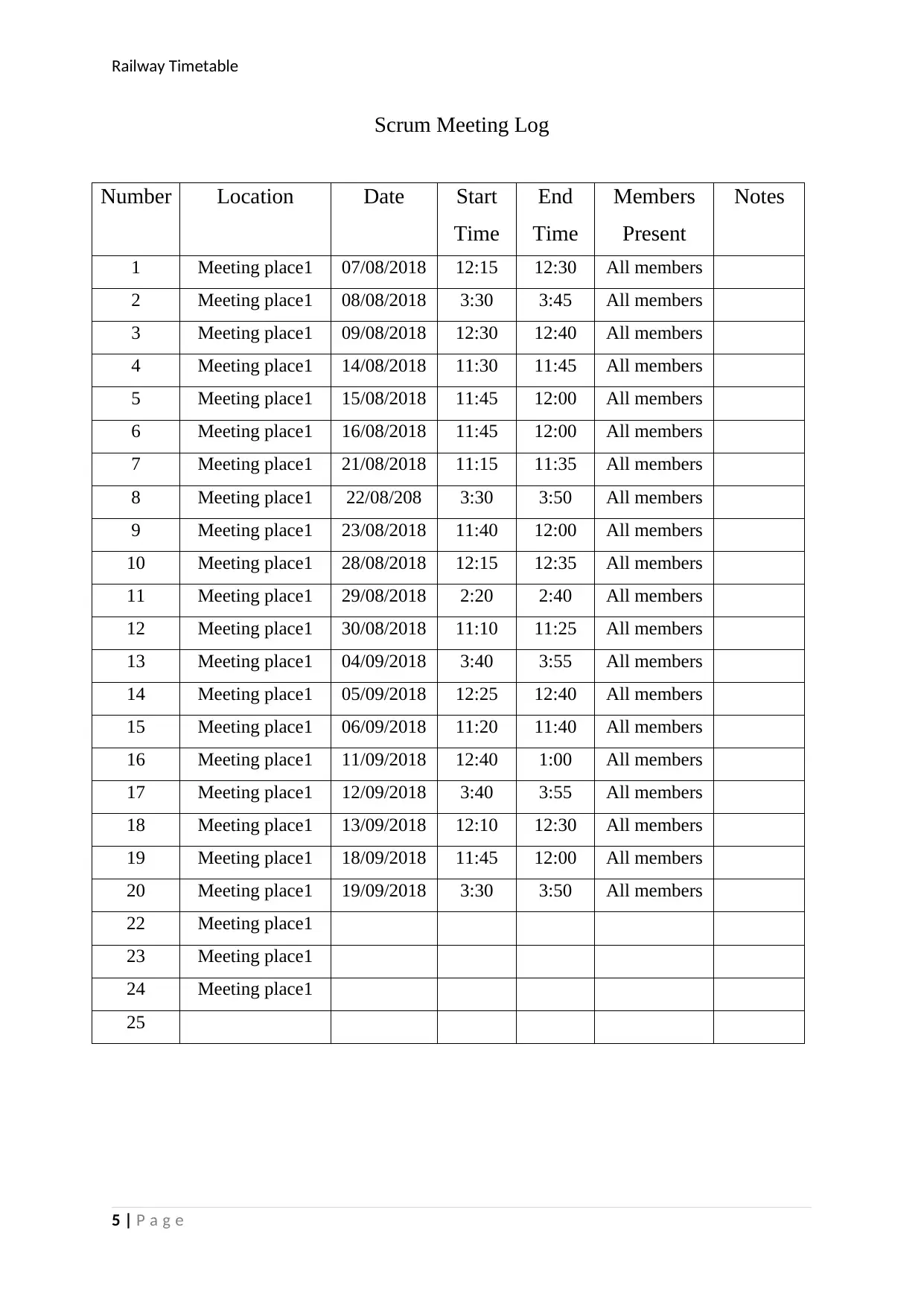
We plan the scrum meeting on every Tuesday, Wednesday, Thursday of every week,
Followings are our scrum Meeting log for Railway Timetable application:
4 | P a g e
It is the scrum fundamental to work in the cycle, the team member needs to complete the
assigned work in a time bound cycle which is called sprint cycle. Followings are the sprint
cycle format:
Sprint Meeting:
In the sprint meeting the team member commits to set of deliverables and also identifies the
tasks that must be completed.
Followings are our sprint Meeting log for Railway Timetable application:
Sprint Meeting Log
Numbe
r
Location Date Start
Time
End
Time
Members
Present
1 Meeting place1 06/08/18 10:30 am 12:30 pm All
2 Meeting place1 13/08/18 10:30 am 12:30 pm All
3 Meeting place2 20/08/18 11:00 am 12:00 pm All
4 Meeting place2 27/08/18 11:00 am 12:00 pm All
5 Meeting place2 03/09/18 11:30 am 12:30 pm All
Scrum or Stand-up Meeting:
It is a short stand up meeting here all team member share the task has been completed, the
task they work next, discuss about the issue they face and also how they come up of these
issues.
We plan the scrum meeting on every Tuesday, Wednesday, Thursday of every week,
Followings are our scrum Meeting log for Railway Timetable application:
4 | P a g e
Paraphrase This Document
Need a fresh take? Get an instant paraphrase of this document with our AI Paraphraser
Railway Timetable
Scrum Meeting Log
Number Location Date Start
Time
End
Time
Members
Present
Notes
1 Meeting place1 07/08/2018 12:15 12:30 All members
2 Meeting place1 08/08/2018 3:30 3:45 All members
3 Meeting place1 09/08/2018 12:30 12:40 All members
4 Meeting place1 14/08/2018 11:30 11:45 All members
5 Meeting place1 15/08/2018 11:45 12:00 All members
6 Meeting place1 16/08/2018 11:45 12:00 All members
7 Meeting place1 21/08/2018 11:15 11:35 All members
8 Meeting place1 22/08/208 3:30 3:50 All members
9 Meeting place1 23/08/2018 11:40 12:00 All members
10 Meeting place1 28/08/2018 12:15 12:35 All members
11 Meeting place1 29/08/2018 2:20 2:40 All members
12 Meeting place1 30/08/2018 11:10 11:25 All members
13 Meeting place1 04/09/2018 3:40 3:55 All members
14 Meeting place1 05/09/2018 12:25 12:40 All members
15 Meeting place1 06/09/2018 11:20 11:40 All members
16 Meeting place1 11/09/2018 12:40 1:00 All members
17 Meeting place1 12/09/2018 3:40 3:55 All members
18 Meeting place1 13/09/2018 12:10 12:30 All members
19 Meeting place1 18/09/2018 11:45 12:00 All members
20 Meeting place1 19/09/2018 3:30 3:50 All members
22 Meeting place1
23 Meeting place1
24 Meeting place1
25
5 | P a g e
Scrum Meeting Log
Number Location Date Start
Time
End
Time
Members
Present
Notes
1 Meeting place1 07/08/2018 12:15 12:30 All members
2 Meeting place1 08/08/2018 3:30 3:45 All members
3 Meeting place1 09/08/2018 12:30 12:40 All members
4 Meeting place1 14/08/2018 11:30 11:45 All members
5 Meeting place1 15/08/2018 11:45 12:00 All members
6 Meeting place1 16/08/2018 11:45 12:00 All members
7 Meeting place1 21/08/2018 11:15 11:35 All members
8 Meeting place1 22/08/208 3:30 3:50 All members
9 Meeting place1 23/08/2018 11:40 12:00 All members
10 Meeting place1 28/08/2018 12:15 12:35 All members
11 Meeting place1 29/08/2018 2:20 2:40 All members
12 Meeting place1 30/08/2018 11:10 11:25 All members
13 Meeting place1 04/09/2018 3:40 3:55 All members
14 Meeting place1 05/09/2018 12:25 12:40 All members
15 Meeting place1 06/09/2018 11:20 11:40 All members
16 Meeting place1 11/09/2018 12:40 1:00 All members
17 Meeting place1 12/09/2018 3:40 3:55 All members
18 Meeting place1 13/09/2018 12:10 12:30 All members
19 Meeting place1 18/09/2018 11:45 12:00 All members
20 Meeting place1 19/09/2018 3:30 3:50 All members
22 Meeting place1
23 Meeting place1
24 Meeting place1
25
5 | P a g e
Railway Timetable
Sprint Review:
After completed the stories, the team member share the stories and feedback is gathered from
the stockholders which is very useful for the next iteration.
Retrospective:
In the retrospective meeting we review the previously completed sprint and share the
experience which could make the coming sprint more efficient.
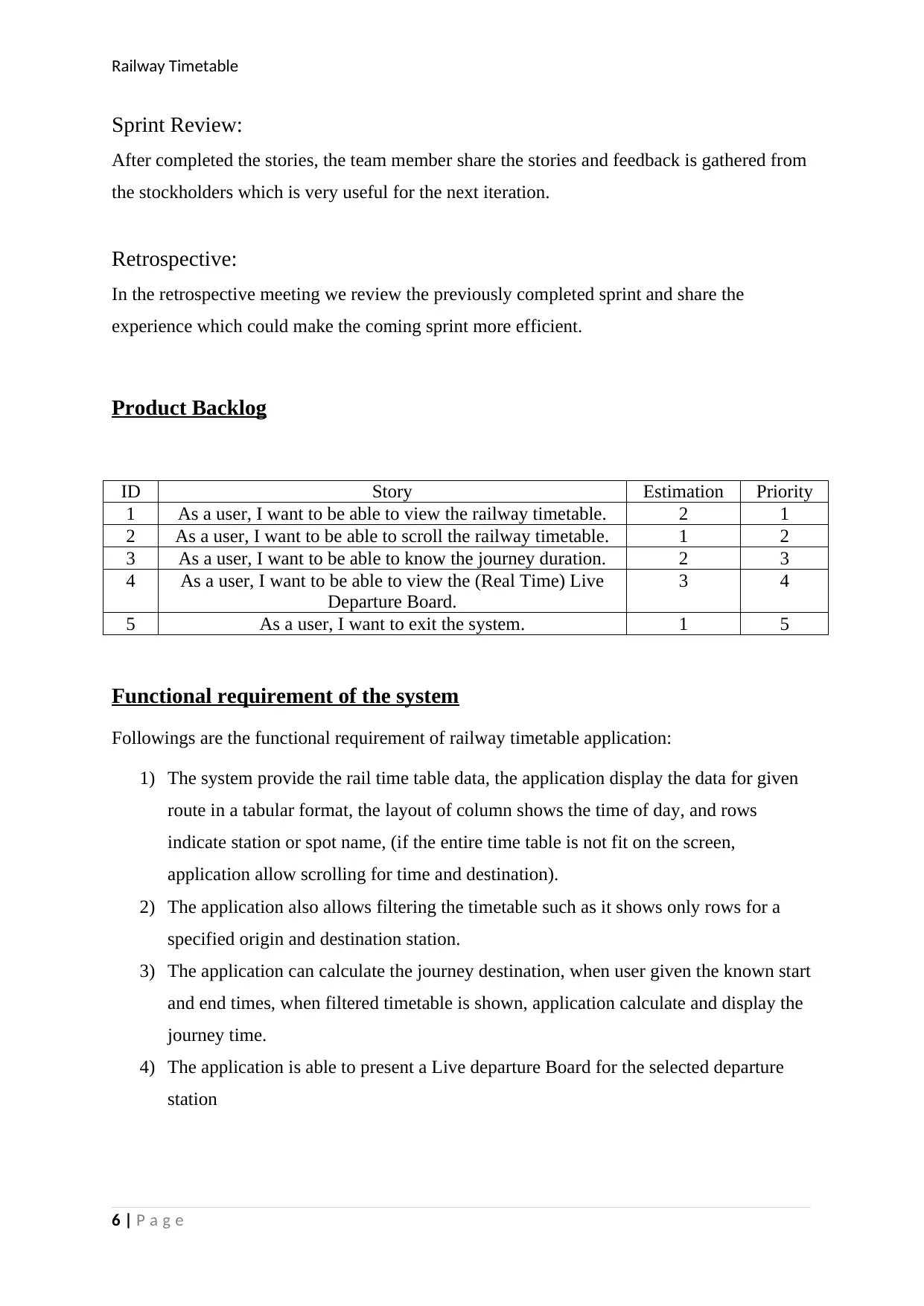
Product Backlog
ID Story Estimation Priority
1 As a user, I want to be able to view the railway timetable. 2 1
2 As a user, I want to be able to scroll the railway timetable. 1 2
3 As a user, I want to be able to know the journey duration. 2 3
4 As a user, I want to be able to view the (Real Time) Live
Departure Board.
3 4
5 As a user, I want to exit the system. 1 5
Functional requirement of the system
Followings are the functional requirement of railway timetable application:
1) The system provide the rail time table data, the application display the data for given
route in a tabular format, the layout of column shows the time of day, and rows
indicate station or spot name, (if the entire time table is not fit on the screen,
application allow scrolling for time and destination).
2) The application also allows filtering the timetable such as it shows only rows for a
specified origin and destination station.
3) The application can calculate the journey destination, when user given the known start
and end times, when filtered timetable is shown, application calculate and display the
journey time.
4) The application is able to present a Live departure Board for the selected departure
station
6 | P a g e
Sprint Review:
After completed the stories, the team member share the stories and feedback is gathered from
the stockholders which is very useful for the next iteration.
Retrospective:
In the retrospective meeting we review the previously completed sprint and share the
experience which could make the coming sprint more efficient.
Product Backlog
ID Story Estimation Priority
1 As a user, I want to be able to view the railway timetable. 2 1
2 As a user, I want to be able to scroll the railway timetable. 1 2
3 As a user, I want to be able to know the journey duration. 2 3
4 As a user, I want to be able to view the (Real Time) Live
Departure Board.
3 4
5 As a user, I want to exit the system. 1 5
Functional requirement of the system
Followings are the functional requirement of railway timetable application:
1) The system provide the rail time table data, the application display the data for given
route in a tabular format, the layout of column shows the time of day, and rows
indicate station or spot name, (if the entire time table is not fit on the screen,
application allow scrolling for time and destination).
2) The application also allows filtering the timetable such as it shows only rows for a
specified origin and destination station.
3) The application can calculate the journey destination, when user given the known start
and end times, when filtered timetable is shown, application calculate and display the
journey time.
4) The application is able to present a Live departure Board for the selected departure
station
6 | P a g e
⊘ This is a preview!⊘
Do you want full access?
Subscribe today to unlock all pages.
Trusted by 1+ million students worldwide
Railway Timetable
Non-functional requirement of the system
Followings are the Non-Functional requirement of railway timetable application:
1) External Interface:
a. User (Passenger operated enquiry system)
b. Interactive response system
2) Performance Requirements:
a. It will be available 24/7.
b. It offered all train details.
3) Reliable:
a. It should give the accurate information, so user will believe on the application
(provide expected result).
4) Secure:
a. It should be secure so no one can modify the application.
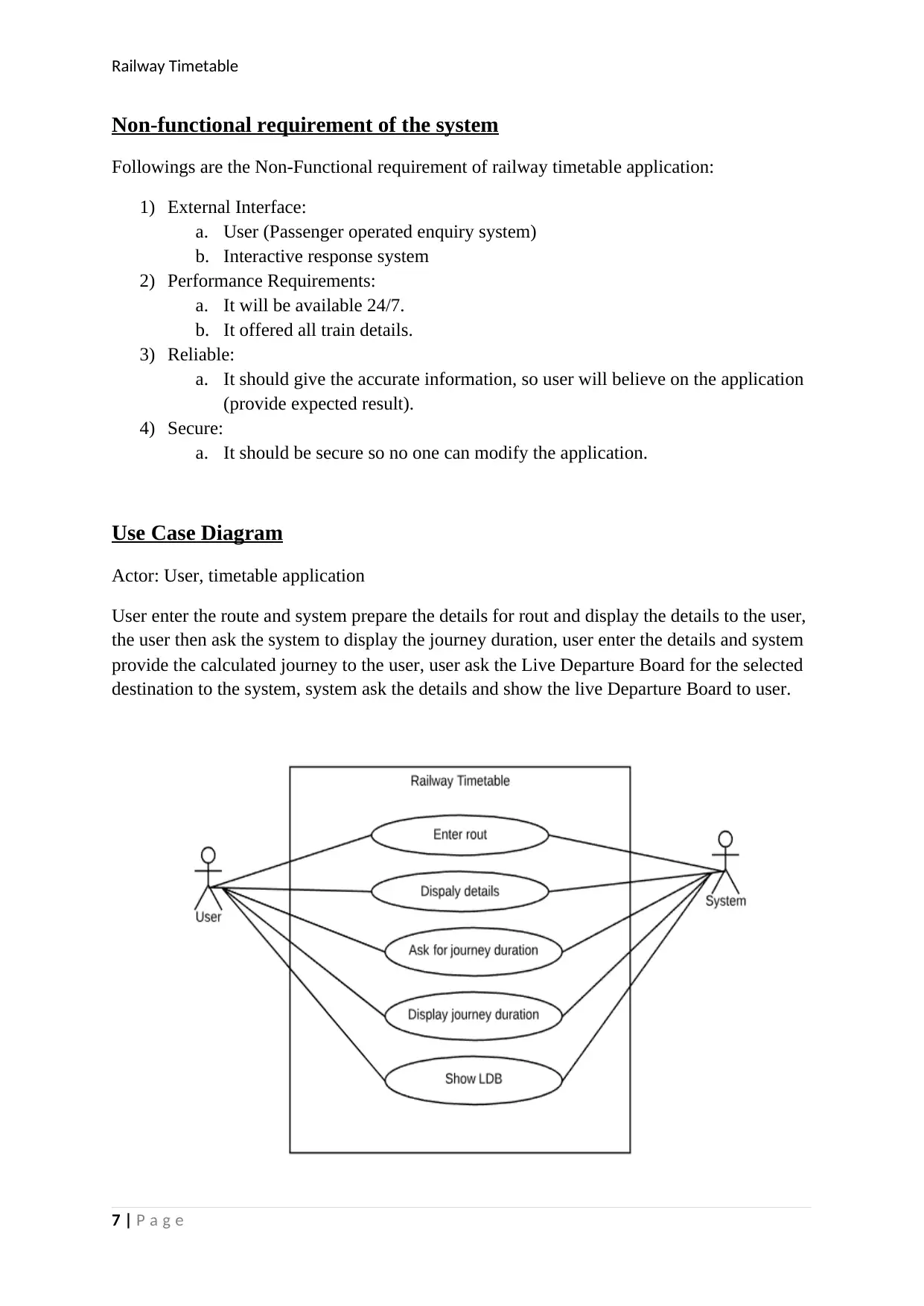
Use Case Diagram
Actor: User, timetable application
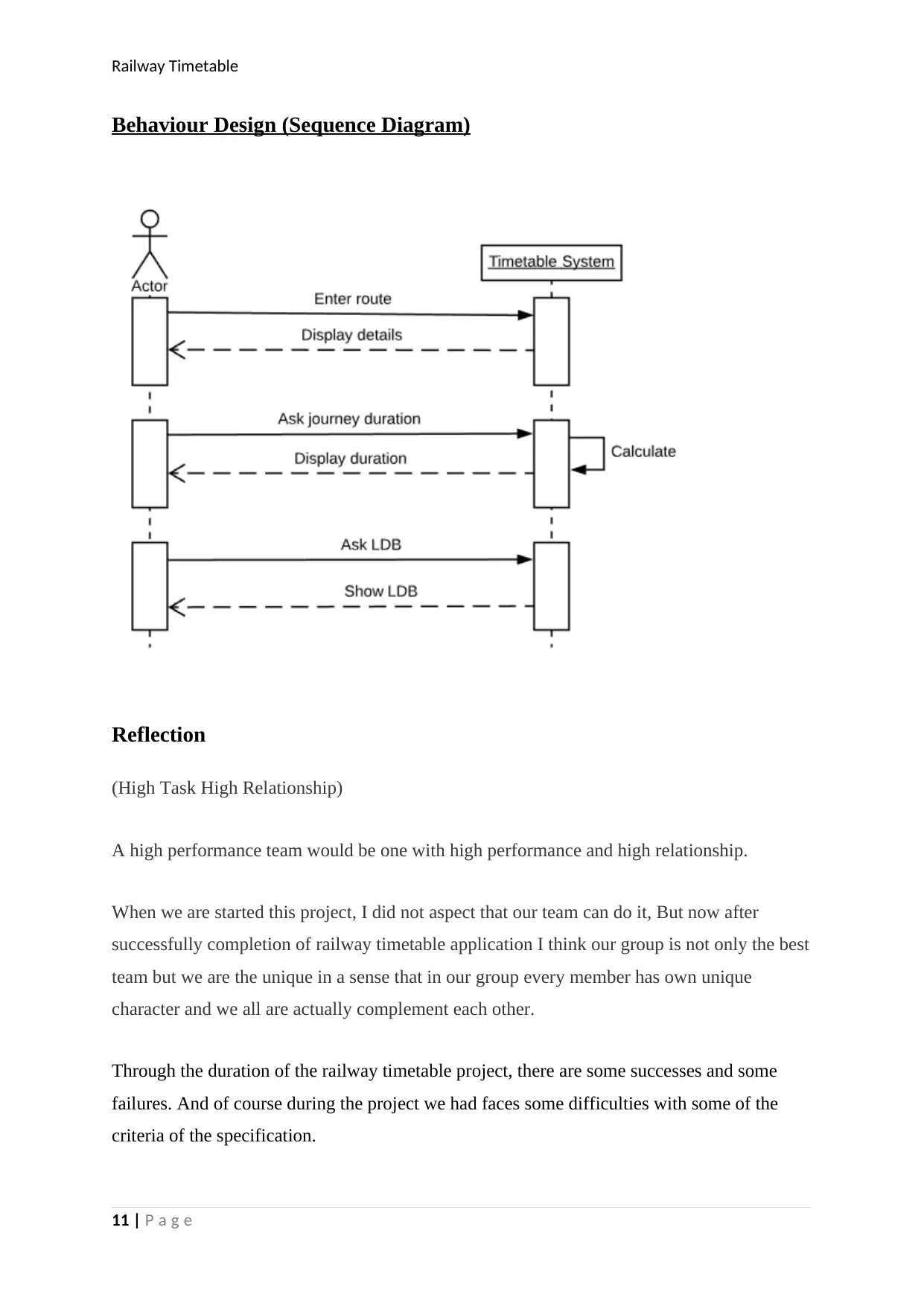
User enter the route and system prepare the details for rout and display the details to the user,
the user then ask the system to display the journey duration, user enter the details and system
provide the calculated journey to the user, user ask the Live Departure Board for the selected
destination to the system, system ask the details and show the live Departure Board to user.
7 | P a g e
Non-functional requirement of the system
Followings are the Non-Functional requirement of railway timetable application:
1) External Interface:
a. User (Passenger operated enquiry system)
b. Interactive response system
2) Performance Requirements:
a. It will be available 24/7.
b. It offered all train details.
3) Reliable:
a. It should give the accurate information, so user will believe on the application
(provide expected result).
4) Secure:
a. It should be secure so no one can modify the application.
Use Case Diagram
Actor: User, timetable application
User enter the route and system prepare the details for rout and display the details to the user,
the user then ask the system to display the journey duration, user enter the details and system
provide the calculated journey to the user, user ask the Live Departure Board for the selected
destination to the system, system ask the details and show the live Departure Board to user.
7 | P a g e
Paraphrase This Document
Need a fresh take? Get an instant paraphrase of this document with our AI Paraphraser
Railway Timetable
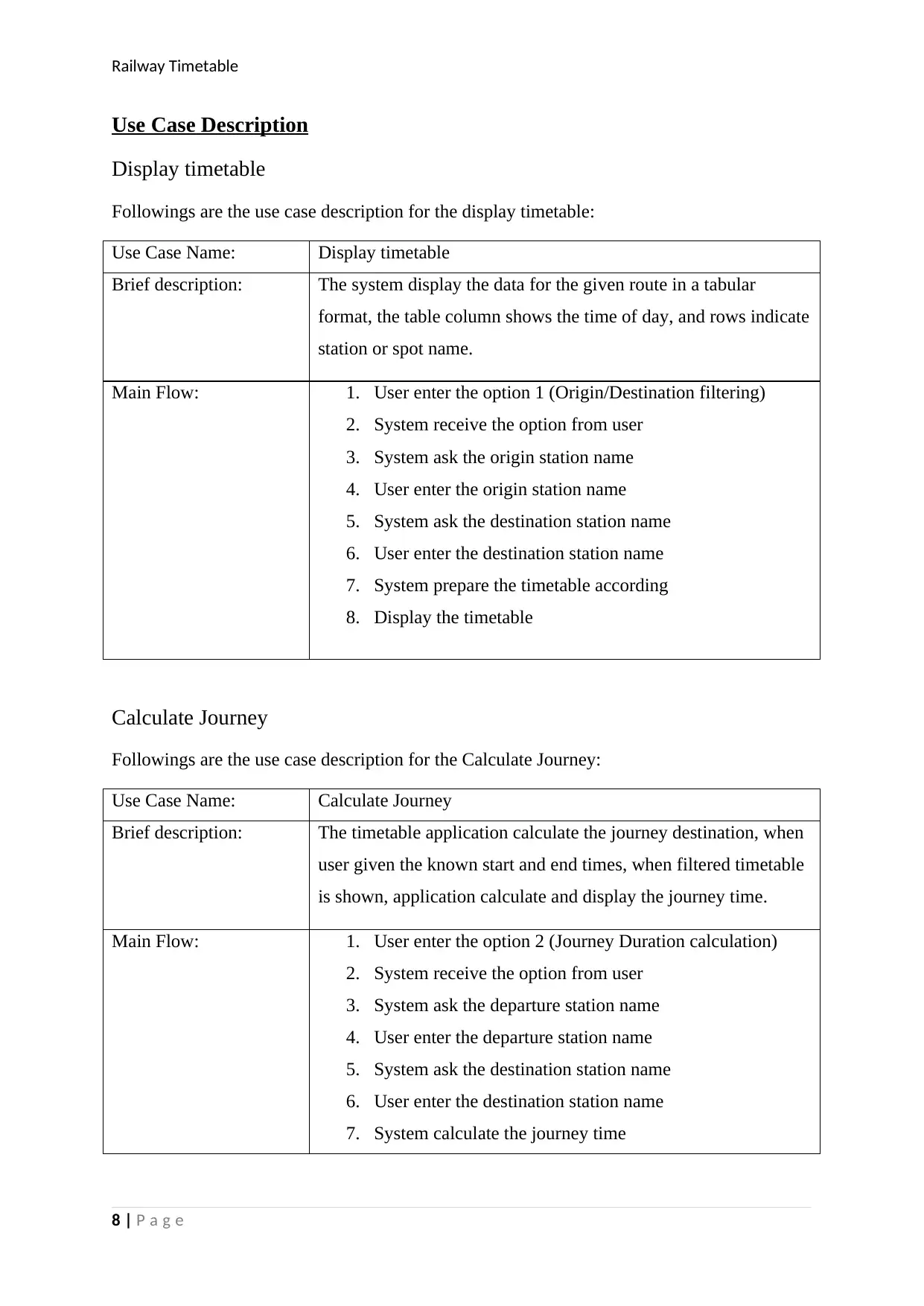
Use Case Description
Display timetable
Followings are the use case description for the display timetable:
Use Case Name: Display timetable
Brief description: The system display the data for the given route in a tabular
format, the table column shows the time of day, and rows indicate
station or spot name.
Main Flow: 1. User enter the option 1 (Origin/Destination filtering)
2. System receive the option from user
3. System ask the origin station name
4. User enter the origin station name
5. System ask the destination station name
6. User enter the destination station name
7. System prepare the timetable according
8. Display the timetable
Calculate Journey
Followings are the use case description for the Calculate Journey:
Use Case Name: Calculate Journey
Brief description: The timetable application calculate the journey destination, when
user given the known start and end times, when filtered timetable
is shown, application calculate and display the journey time.
Main Flow: 1. User enter the option 2 (Journey Duration calculation)
2. System receive the option from user
3. System ask the departure station name
4. User enter the departure station name
5. System ask the destination station name
6. User enter the destination station name
7. System calculate the journey time
8 | P a g e
Use Case Description
Display timetable
Followings are the use case description for the display timetable:
Use Case Name: Display timetable
Brief description: The system display the data for the given route in a tabular
format, the table column shows the time of day, and rows indicate
station or spot name.
Main Flow: 1. User enter the option 1 (Origin/Destination filtering)
2. System receive the option from user
3. System ask the origin station name
4. User enter the origin station name
5. System ask the destination station name
6. User enter the destination station name
7. System prepare the timetable according
8. Display the timetable
Calculate Journey
Followings are the use case description for the Calculate Journey:
Use Case Name: Calculate Journey
Brief description: The timetable application calculate the journey destination, when
user given the known start and end times, when filtered timetable
is shown, application calculate and display the journey time.
Main Flow: 1. User enter the option 2 (Journey Duration calculation)
2. System receive the option from user
3. System ask the departure station name
4. User enter the departure station name
5. System ask the destination station name
6. User enter the destination station name
7. System calculate the journey time
8 | P a g e
Railway Timetable
8. System display the journey time
Live departure Board
Followings are the use case description for the live departure Board:
Use Case Name: Live departure Board
Brief description: The application is able to present a Live departure Board for the
selected departure station
Main Flow: 1. User enter the option 3 (Real-Time LDBs (Live Departure
Boards)
2. System receive the option from user
3. System ask the departure station name
4. User enter the departure station name
5. System ask the destination station name
6. User enter the destination station name
7. System prepare the timetable according
8. Display the timetable
Class Diagram
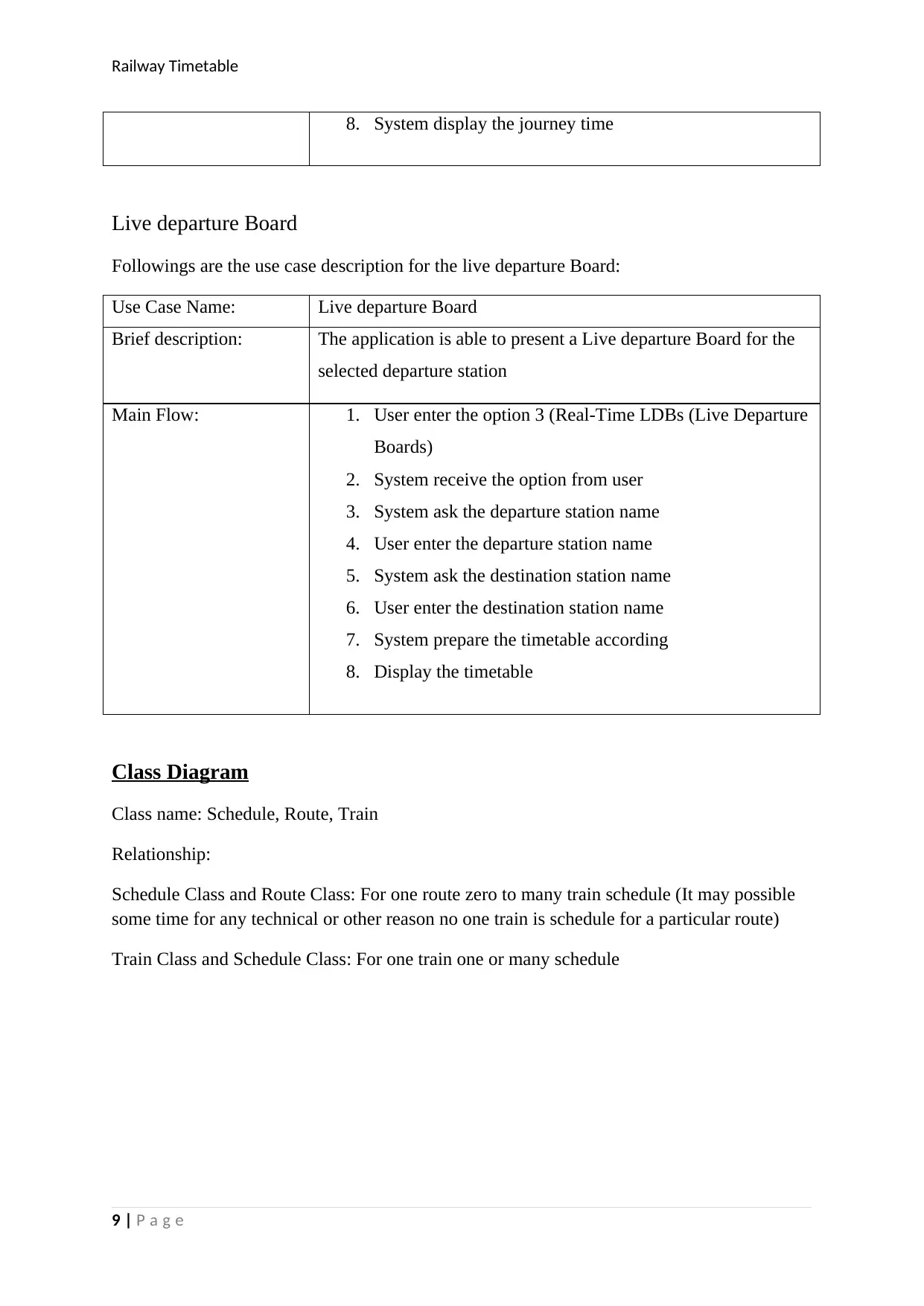
Class name: Schedule, Route, Train
Relationship:
Schedule Class and Route Class: For one route zero to many train schedule (It may possible
some time for any technical or other reason no one train is schedule for a particular route)
Train Class and Schedule Class: For one train one or many schedule
9 | P a g e
8. System display the journey time
Live departure Board
Followings are the use case description for the live departure Board:
Use Case Name: Live departure Board
Brief description: The application is able to present a Live departure Board for the
selected departure station
Main Flow: 1. User enter the option 3 (Real-Time LDBs (Live Departure
Boards)
2. System receive the option from user
3. System ask the departure station name
4. User enter the departure station name
5. System ask the destination station name
6. User enter the destination station name
7. System prepare the timetable according
8. Display the timetable
Class Diagram
Class name: Schedule, Route, Train
Relationship:
Schedule Class and Route Class: For one route zero to many train schedule (It may possible
some time for any technical or other reason no one train is schedule for a particular route)
Train Class and Schedule Class: For one train one or many schedule
9 | P a g e
⊘ This is a preview!⊘
Do you want full access?
Subscribe today to unlock all pages.
Trusted by 1+ million students worldwide
Railway Timetable
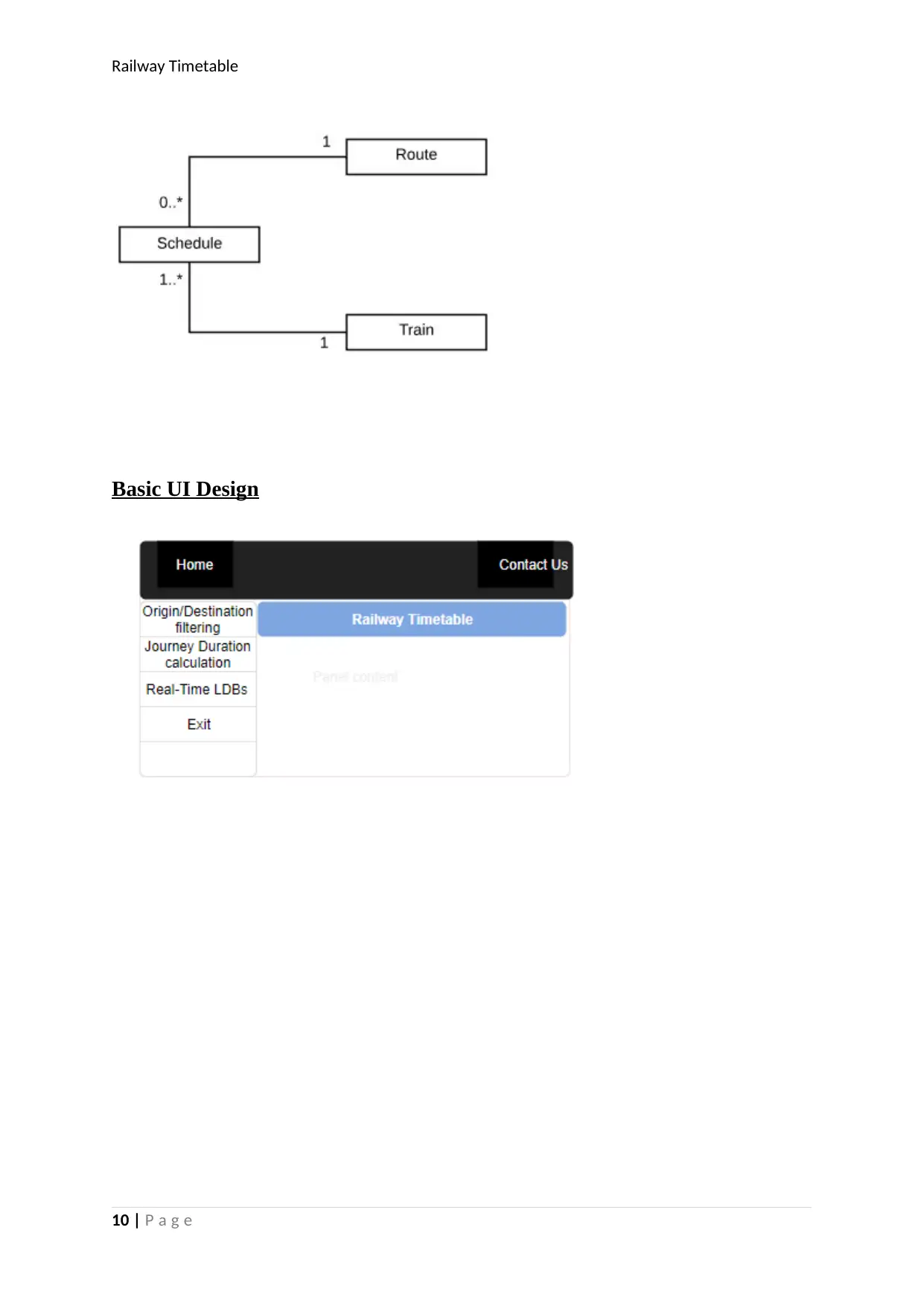
Basic UI Design
10 | P a g e
Basic UI Design
10 | P a g e
Paraphrase This Document
Need a fresh take? Get an instant paraphrase of this document with our AI Paraphraser
Railway Timetable
Behaviour Design (Sequence Diagram)
Reflection
(High Task High Relationship)
A high performance team would be one with high performance and high relationship.
When we are started this project, I did not aspect that our team can do it, But now after
successfully completion of railway timetable application I think our group is not only the best
team but we are the unique in a sense that in our group every member has own unique
character and we all are actually complement each other.
Through the duration of the railway timetable project, there are some successes and some
failures. And of course during the project we had faces some difficulties with some of the
criteria of the specification.
11 | P a g e
Behaviour Design (Sequence Diagram)
Reflection
(High Task High Relationship)
A high performance team would be one with high performance and high relationship.
When we are started this project, I did not aspect that our team can do it, But now after
successfully completion of railway timetable application I think our group is not only the best
team but we are the unique in a sense that in our group every member has own unique
character and we all are actually complement each other.
Through the duration of the railway timetable project, there are some successes and some
failures. And of course during the project we had faces some difficulties with some of the
criteria of the specification.
11 | P a g e
Railway Timetable
As a reflection we are happy with what we did, we did the entire requirement that is needed
for application, but we might put some more effort in this application, we can add some extra
feature in this application like List of available train, Check the timetable using the train
number or train name etc. We all team member learned a lot from this project.
The most challenging part is the design part of this project; it needs to be on high level
because the coding part (implementation section) is dependent upon the design section.
In the coding section we face some difficulties during the coding to calculate the journey time
between the two stations but finally we resolve this.
And in the last, it’s not easy to work with people for the first time as a group but we quickly
matched and put all of our efforts and work together to do a good coursework.
12 | P a g e
As a reflection we are happy with what we did, we did the entire requirement that is needed
for application, but we might put some more effort in this application, we can add some extra
feature in this application like List of available train, Check the timetable using the train
number or train name etc. We all team member learned a lot from this project.
The most challenging part is the design part of this project; it needs to be on high level
because the coding part (implementation section) is dependent upon the design section.
In the coding section we face some difficulties during the coding to calculate the journey time
between the two stations but finally we resolve this.
And in the last, it’s not easy to work with people for the first time as a group but we quickly
matched and put all of our efforts and work together to do a good coursework.
12 | P a g e
⊘ This is a preview!⊘
Do you want full access?
Subscribe today to unlock all pages.
Trusted by 1+ million students worldwide

1 out of 12


Your All-in-One AI-Powered Toolkit for Academic Success.
+13062052269
info@desklib.com
Available 24*7 on WhatsApp / Email
![[object Object]](/_next/static/media/star-bottom.7253800d.svg)
Unlock your academic potential
Copyright © 2020–2026 A2Z Services. All Rights Reserved. Developed and managed by ZUCOL.