Impact of CSR Activities on TJ Morris: Project Analysis and Evaluation
VerifiedAdded on 2020/01/07
|20
|4854
|294
Project
AI Summary
This project is a comprehensive analysis of the corporate social responsibility (CSR) activities of TJ Morris, a retail company. The project begins with an introduction to CSR and its importance, followed by an examination of TJ Morris's current CSR practices. Part 1 outlines the project's aims, objectives, and plan, including a timeline and work breakdown structure. Part 2 details the minor research conducted, encompassing research philosophies, approaches, design, and data collection methods, including both qualitative and quantitative approaches such as surveys and interviews. Part 3 focuses on research and data analysis, including the use of various tools and techniques to evaluate the impact of CSR on TJ Morris's performance. The project concludes with recommendations for the company to enhance its CSR efforts and improve its overall performance. The project's success criteria, assumptions, and the processes involved in data collection and analysis are also discussed. The project uses a Gantt chart to show the timeline, and a work breakdown structure to visualize the project phases and requirements. The project utilizes both primary and secondary research methods, including surveys and interviews, to gather data and provide insights into TJ Morris's CSR activities and their impact. The goal is to assess the company's current CSR initiatives, evaluate their effectiveness, and suggest improvements. The project also includes a discussion on the ethical considerations and risks involved in the project.

MANAGING SUCCESSFUL BUSINESS PROJECT
STUDENT NAME
STUDENT ID:
SUPERVISOR:
1
STUDENT NAME
STUDENT ID:
SUPERVISOR:
1
Paraphrase This Document
Need a fresh take? Get an instant paraphrase of this document with our AI Paraphraser

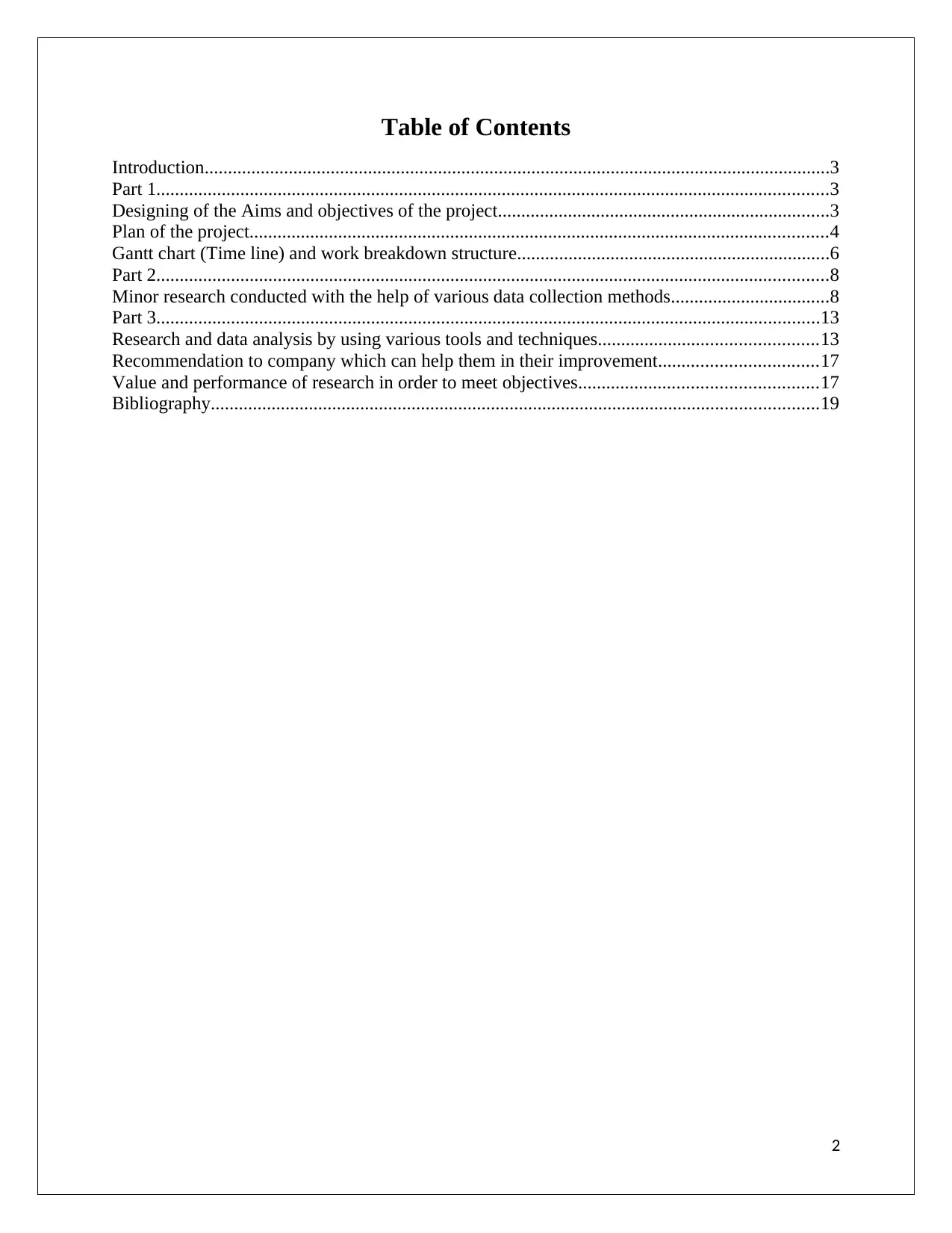
Table of Contents
Introduction......................................................................................................................................3
Part 1................................................................................................................................................3
Designing of the Aims and objectives of the project.......................................................................3
Plan of the project............................................................................................................................4
Gantt chart (Time line) and work breakdown structure...................................................................6
Part 2................................................................................................................................................8
Minor research conducted with the help of various data collection methods..................................8
Part 3..............................................................................................................................................13
Research and data analysis by using various tools and techniques...............................................13
Recommendation to company which can help them in their improvement..................................17
Value and performance of research in order to meet objectives...................................................17
Bibliography..................................................................................................................................19
2
Introduction......................................................................................................................................3
Part 1................................................................................................................................................3
Designing of the Aims and objectives of the project.......................................................................3
Plan of the project............................................................................................................................4
Gantt chart (Time line) and work breakdown structure...................................................................6
Part 2................................................................................................................................................8
Minor research conducted with the help of various data collection methods..................................8
Part 3..............................................................................................................................................13
Research and data analysis by using various tools and techniques...............................................13
Recommendation to company which can help them in their improvement..................................17
Value and performance of research in order to meet objectives...................................................17
Bibliography..................................................................................................................................19
2

Introduction
Corporate Social responsibility mostly known as CSR is an initiative of the corporate to take up
the responsibilities of assessing and controlling the effects of their company on the environment
as well the society. All companies make use of some or the other resources which are likely to
create a negative impact on the environment. It is essential for these organizations to understand
that they need to take measures to protect the environment they live in. In this paper, a research
will be carried out on the CSR activities of an organization and its effects on the society. For this
purpose, the company TJ Morris will be chosen and a study will be conducted to assess the CSR
involvement of this company. This company is a retailer which has witnessed a fast growth due
to its unique approach towards the customers. It provides a larger discount on its products which
attracts a large number of customers.
Figure 1: Logo of TJ Morris
(Source: Tjmorris.co.uk. 2017)
Part 1
Designing of the Aims and objectives of the project
Problem statement
The company TJ Morris is a retail company and is a large business with a large number of
customers and a wide range of products (Tjmorris.co.uk. 2017). However, recently it has been
found that some other companies are getting ahead of this firm due to their activities in the CSR.
Therefore, the organization has realized the need to enhance their activities in this field.
Project strategy
The basic strategy of the project is to bring about an enhancement in the CSR activities in order
to get a competitive advantage in the market.
Aim and objectives
The aim of this project is to evaluate the impact of CSR activities on the performance of the
chosen firm and the effect of the same on the customers and their response. The main objectives
of this project are as follows:
● To identify the CSR activities of the company TJ Morris
● To evaluate the effectiveness of these activities
● To evaluate the impact of these activities on TJ Morris
3
Corporate Social responsibility mostly known as CSR is an initiative of the corporate to take up
the responsibilities of assessing and controlling the effects of their company on the environment
as well the society. All companies make use of some or the other resources which are likely to
create a negative impact on the environment. It is essential for these organizations to understand
that they need to take measures to protect the environment they live in. In this paper, a research
will be carried out on the CSR activities of an organization and its effects on the society. For this
purpose, the company TJ Morris will be chosen and a study will be conducted to assess the CSR
involvement of this company. This company is a retailer which has witnessed a fast growth due
to its unique approach towards the customers. It provides a larger discount on its products which
attracts a large number of customers.
Figure 1: Logo of TJ Morris
(Source: Tjmorris.co.uk. 2017)
Part 1
Designing of the Aims and objectives of the project
Problem statement
The company TJ Morris is a retail company and is a large business with a large number of
customers and a wide range of products (Tjmorris.co.uk. 2017). However, recently it has been
found that some other companies are getting ahead of this firm due to their activities in the CSR.
Therefore, the organization has realized the need to enhance their activities in this field.
Project strategy
The basic strategy of the project is to bring about an enhancement in the CSR activities in order
to get a competitive advantage in the market.
Aim and objectives
The aim of this project is to evaluate the impact of CSR activities on the performance of the
chosen firm and the effect of the same on the customers and their response. The main objectives
of this project are as follows:
● To identify the CSR activities of the company TJ Morris
● To evaluate the effectiveness of these activities
● To evaluate the impact of these activities on TJ Morris
3
⊘ This is a preview!⊘
Do you want full access?
Subscribe today to unlock all pages.

Trusted by 1+ million students worldwide

● To provide recommendations in this context
Plan of the project
Objectives including cost, time and performance
The tome and cost of this project needs to be decided judiciously so that all the tasks can be
conveniently completed within this duration. The project will be accomplished in time duration
of 20 weeks. The surveys as well as the interviews will be conducted and all results will be
analyzed within this allocated time period.
Quality
Maintaining the quality of the project is essential in order to make the project successful. This
can be achieved by carrying out all the tasks in the decided process. This should have no adverse
effect on the employees as well. This research is involved in improving the quality of the
performance.
Results
On the successful completion of this project, the company will be able to understand the
importance of CSR activities and will be able to design the plans for enhancing these activities so
that the reputation of the company can become better.
4
Plan of the project
Objectives including cost, time and performance
The tome and cost of this project needs to be decided judiciously so that all the tasks can be
conveniently completed within this duration. The project will be accomplished in time duration
of 20 weeks. The surveys as well as the interviews will be conducted and all results will be
analyzed within this allocated time period.
Quality
Maintaining the quality of the project is essential in order to make the project successful. This
can be achieved by carrying out all the tasks in the decided process. This should have no adverse
effect on the employees as well. This research is involved in improving the quality of the
performance.
Results
On the successful completion of this project, the company will be able to understand the
importance of CSR activities and will be able to design the plans for enhancing these activities so
that the reputation of the company can become better.
4
Paraphrase This Document
Need a fresh take? Get an instant paraphrase of this document with our AI Paraphraser

Plan of communication
Every project needs to plan properly communication plan with managers and employees. This
help in gaining more knowledge about work process of TJ Morris. According to Servaes and
Tamayo (2013, p.1059), this will bring more success and clarity in this particular project. It is
crucial to know about different ethical considerations so that project can yield improved results.
Researchers should have proper communication with top managers in order to have accurate
information about work process and company.
Risks Involved in project
Various risks need to be indentified at initial stages of project. This will help in completing
project successfully. In addition to this, risks are transformed to profits if they can be identified
accurately at earlier stages (El-Garaihy et al.2014, p.108).
Resources Required
Money and time are common resources which are required in any project. Allocation of these
resources needs to be planned carefully so that project can be completed with allocated timeline
(Pai et al.2015,p.108). Other resources which are required to complete this particular project are
past papers related to this type of research and articles which can link company performance and
CSR activities.
Project Scope
Scope of this project involves various skills of CSR which will give proper contribution in
different process of TJ Morris. On the other hand, close scrutiny is removed from scope of
project.
Included scope of Project
Various factors which have been involved in this project are time and cost which are required for
this project and risk identification which will help in completing project successfully. If these
factors are identified in initial stages of project then it can bring success to company (Zhu et
al.2014,p.929). Information about company can be recorded as it can help in accomplishing aim
of this study.
Excluded scope of Project
Close scrutiny of employees have been removed from scope of this study. This is because there
is more focus on improvement of various activities related to CSR which can help achieving
competitive advantage.
Criteria of success of this research
Success of this research can be assessed or measured by evaluating level of satisfaction level of
stakeholders. Success of project can depend on achievement of aims and objective. If project
results in constructive or positive outcomes, it can be said that project is successful.
Different assumptions of this study
5
Every project needs to plan properly communication plan with managers and employees. This
help in gaining more knowledge about work process of TJ Morris. According to Servaes and
Tamayo (2013, p.1059), this will bring more success and clarity in this particular project. It is
crucial to know about different ethical considerations so that project can yield improved results.
Researchers should have proper communication with top managers in order to have accurate
information about work process and company.
Risks Involved in project
Various risks need to be indentified at initial stages of project. This will help in completing
project successfully. In addition to this, risks are transformed to profits if they can be identified
accurately at earlier stages (El-Garaihy et al.2014, p.108).
Resources Required
Money and time are common resources which are required in any project. Allocation of these
resources needs to be planned carefully so that project can be completed with allocated timeline
(Pai et al.2015,p.108). Other resources which are required to complete this particular project are
past papers related to this type of research and articles which can link company performance and
CSR activities.
Project Scope
Scope of this project involves various skills of CSR which will give proper contribution in
different process of TJ Morris. On the other hand, close scrutiny is removed from scope of
project.
Included scope of Project
Various factors which have been involved in this project are time and cost which are required for
this project and risk identification which will help in completing project successfully. If these
factors are identified in initial stages of project then it can bring success to company (Zhu et
al.2014,p.929). Information about company can be recorded as it can help in accomplishing aim
of this study.
Excluded scope of Project
Close scrutiny of employees have been removed from scope of this study. This is because there
is more focus on improvement of various activities related to CSR which can help achieving
competitive advantage.
Criteria of success of this research
Success of this research can be assessed or measured by evaluating level of satisfaction level of
stakeholders. Success of project can depend on achievement of aims and objective. If project
results in constructive or positive outcomes, it can be said that project is successful.
Different assumptions of this study
5

Few assumptions in this study are CSR activities of TJ Morris are satisfactory and help in
progress of company. It has also been assumed that completion of this project will help in getting
more profits for this particular company.
Processes involved in this project
Processes which are involved in completing project are collection of data, gathering information
about company and data analysis of data collected which is used to reach conclusion.
Gantt chart (Time line) and work breakdown structure
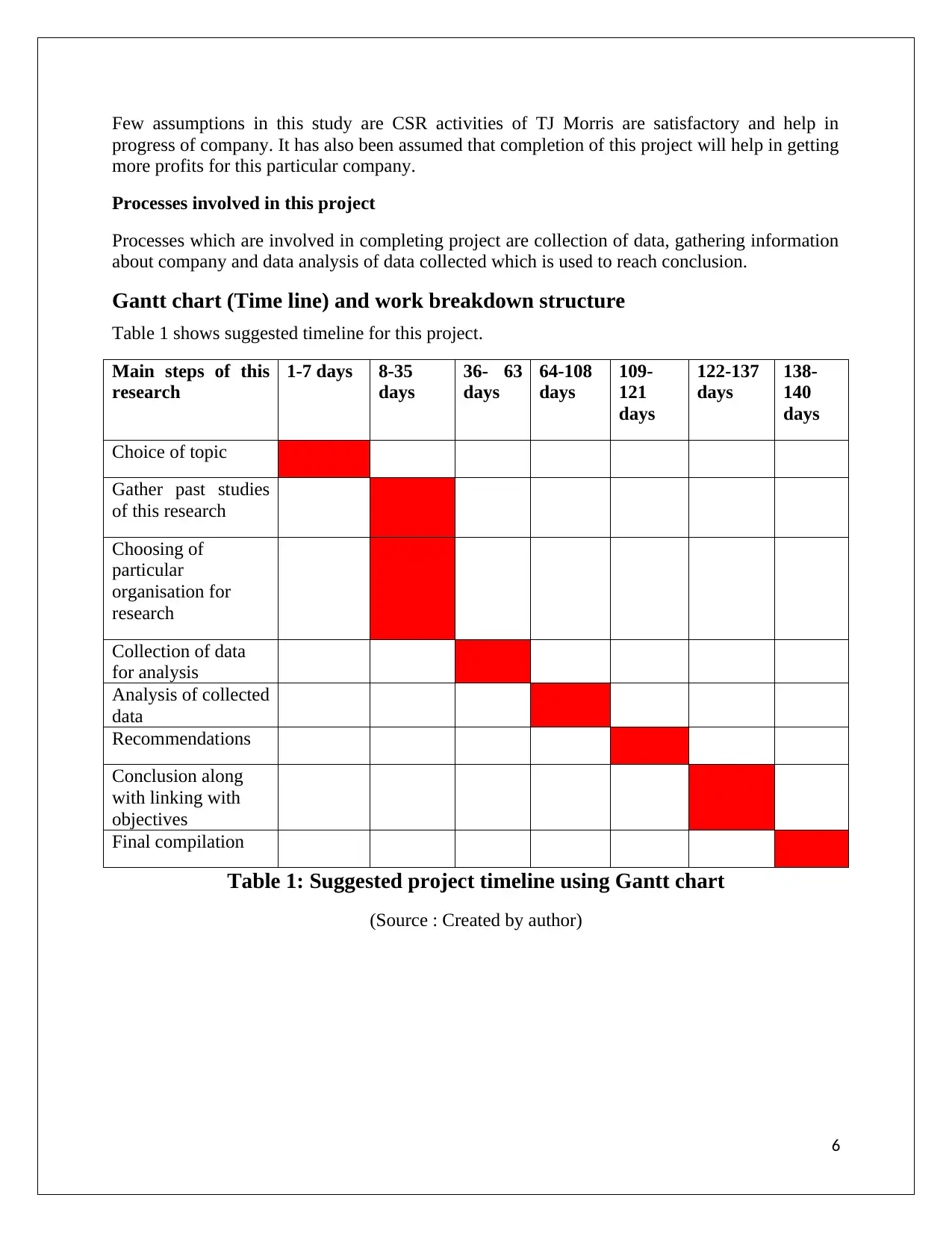
Table 1 shows suggested timeline for this project.
Main steps of this
research
1-7 days 8-35
days
36- 63
days
64-108
days
109-
121
days
122-137
days
138-
140
days
Choice of topic
Gather past studies
of this research
Choosing of
particular
organisation for
research
Collection of data
for analysis
Analysis of collected
data
Recommendations
Conclusion along
with linking with
objectives
Final compilation
Table 1: Suggested project timeline using Gantt chart
(Source : Created by author)
6
progress of company. It has also been assumed that completion of this project will help in getting
more profits for this particular company.
Processes involved in this project
Processes which are involved in completing project are collection of data, gathering information
about company and data analysis of data collected which is used to reach conclusion.
Gantt chart (Time line) and work breakdown structure
Table 1 shows suggested timeline for this project.
Main steps of this
research
1-7 days 8-35
days
36- 63
days
64-108
days
109-
121
days
122-137
days
138-
140
days
Choice of topic
Gather past studies
of this research
Choosing of
particular
organisation for
research
Collection of data
for analysis
Analysis of collected
data
Recommendations
Conclusion along
with linking with
objectives
Final compilation
Table 1: Suggested project timeline using Gantt chart
(Source : Created by author)
6
⊘ This is a preview!⊘
Do you want full access?
Subscribe today to unlock all pages.

Trusted by 1+ million students worldwide

2nd phase
Analysis
of data
Compilation
of Project
CSR Project
1st phase 3rd phase
Requirements of
Project
Identification
and Costing
Project
Designing
Methodology
Research
Approaches
Collection of
data
Work Breakdown Structure
7
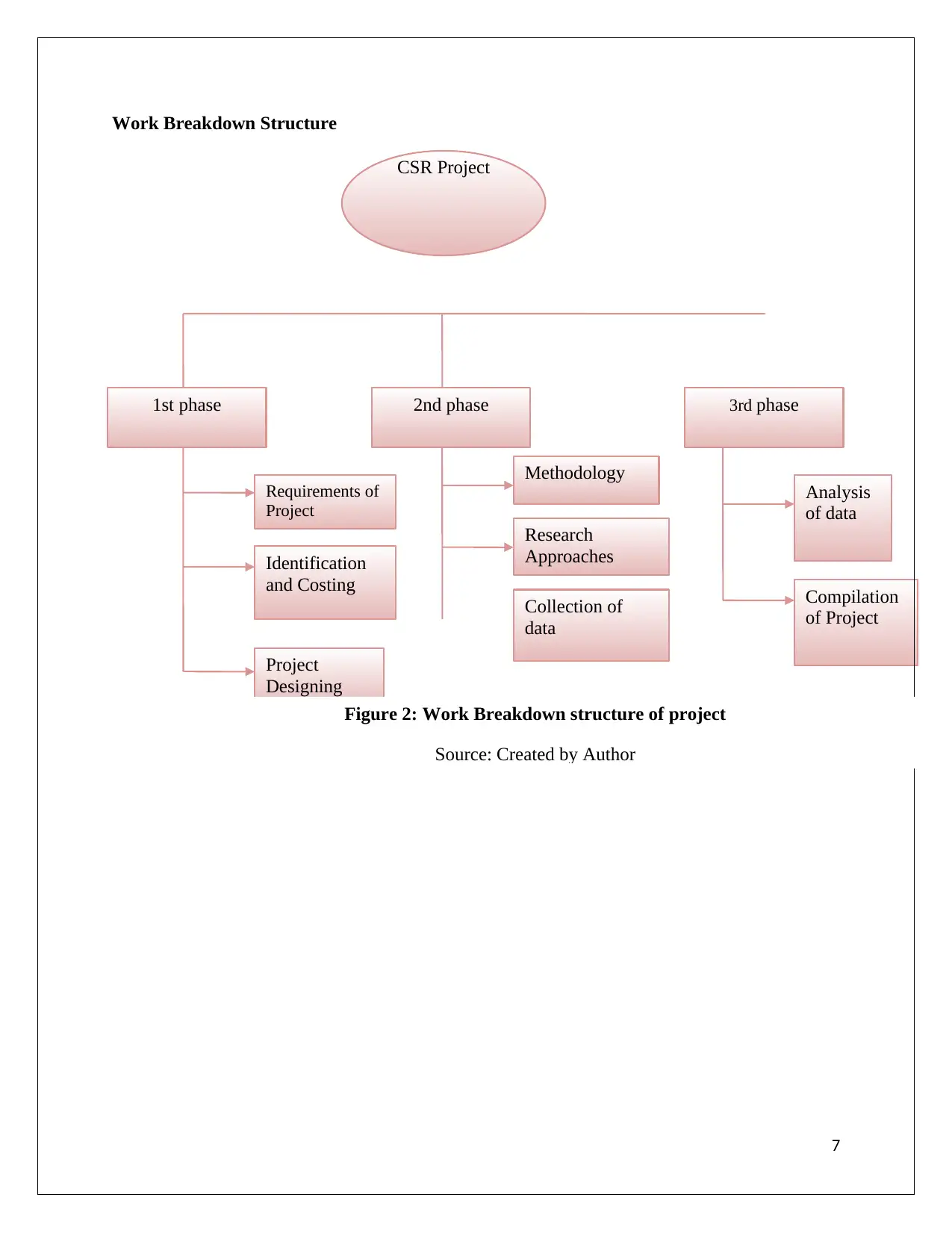
Figure 2: Work Breakdown structure of project
Source: Created by Author
Analysis
of data
Compilation
of Project
CSR Project
1st phase 3rd phase
Requirements of
Project
Identification
and Costing
Project
Designing
Methodology
Research
Approaches
Collection of
data
Work Breakdown Structure
7
Figure 2: Work Breakdown structure of project
Source: Created by Author
Paraphrase This Document
Need a fresh take? Get an instant paraphrase of this document with our AI Paraphraser

Part 2
Minor research conducted with the help of various data collection methods
A research was conducted in order to link corporate social responsibility with gaining of
competitive along with increase of reputation. In order to conduct a research, there are certain
specifications which need to be followed. As mentioned by Torugsa et al. (2013, p. 389), if
research is not done is not performed according to specifications then there are high chances of
failure of that research. Some of specifications which are included in this study are approach,
design and philosophy of research.
Philosophy of research
There are three types of research philosophies which are positivism, realism and interpretivism.
In philosophy of realism, researcher judges obtained data based on different aspects of reality
and not on concepts. Interpretivism means that obtained data can be analysed using perception of
researcher. However, philosophy behind positivism is that data can be analysed based on facts
existing on that topic. In this study, positivism can be helpful as interpretivism and realism will
not use facts and literature to analyse data.
Figure 3: Philosophies of research
(Source: Hack et al. 2014,p. 47 )
Approach towards research
There are two main approaches which can be used in research. They are inductive and deductive
approaches. Inductive approach is used to create novel theories based on observation. This type
of approach does not include any hypothesis. However, in deductive approach, hypothesis is
stated based on research gap. Data are collected in order to prove that hypothesis true or false.
He tries to validate existing theories based on that topic. In this research, deductive approach has
been used as it involves studying of existing theories and models of topic.
8
PositivismRealismInterpretivism
Minor research conducted with the help of various data collection methods
A research was conducted in order to link corporate social responsibility with gaining of
competitive along with increase of reputation. In order to conduct a research, there are certain
specifications which need to be followed. As mentioned by Torugsa et al. (2013, p. 389), if
research is not done is not performed according to specifications then there are high chances of
failure of that research. Some of specifications which are included in this study are approach,
design and philosophy of research.
Philosophy of research
There are three types of research philosophies which are positivism, realism and interpretivism.
In philosophy of realism, researcher judges obtained data based on different aspects of reality
and not on concepts. Interpretivism means that obtained data can be analysed using perception of
researcher. However, philosophy behind positivism is that data can be analysed based on facts
existing on that topic. In this study, positivism can be helpful as interpretivism and realism will
not use facts and literature to analyse data.
Figure 3: Philosophies of research
(Source: Hack et al. 2014,p. 47 )
Approach towards research
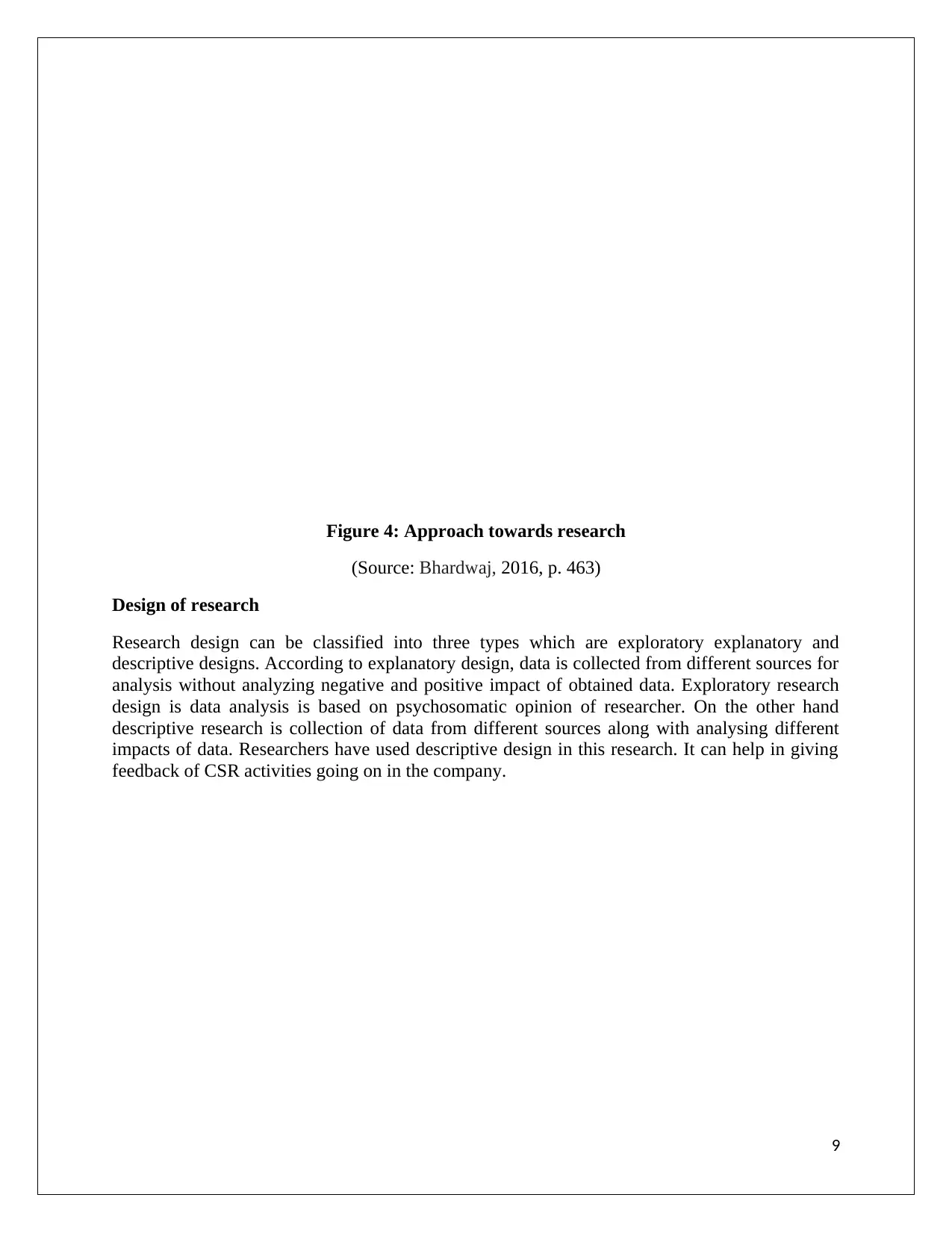
There are two main approaches which can be used in research. They are inductive and deductive
approaches. Inductive approach is used to create novel theories based on observation. This type
of approach does not include any hypothesis. However, in deductive approach, hypothesis is
stated based on research gap. Data are collected in order to prove that hypothesis true or false.
He tries to validate existing theories based on that topic. In this research, deductive approach has
been used as it involves studying of existing theories and models of topic.
8
PositivismRealismInterpretivism

Figure 4: Approach towards research
(Source: Bhardwaj, 2016, p. 463)
Design of research
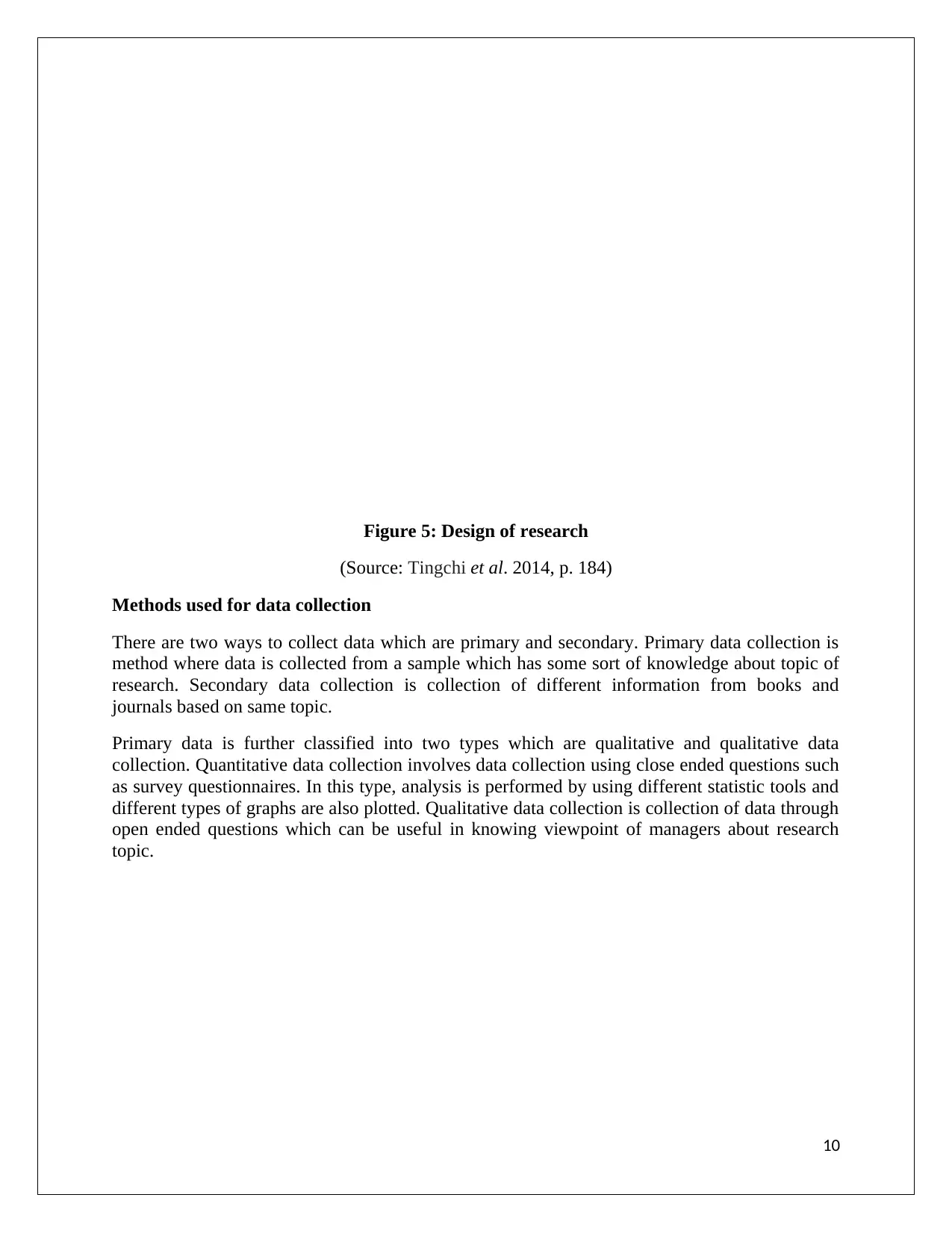
Research design can be classified into three types which are exploratory explanatory and
descriptive designs. According to explanatory design, data is collected from different sources for
analysis without analyzing negative and positive impact of obtained data. Exploratory research
design is data analysis is based on psychosomatic opinion of researcher. On the other hand
descriptive research is collection of data from different sources along with analysing different
impacts of data. Researchers have used descriptive design in this research. It can help in giving
feedback of CSR activities going on in the company.
9
ResearchApproachInductiveDeductive
(Source: Bhardwaj, 2016, p. 463)
Design of research
Research design can be classified into three types which are exploratory explanatory and
descriptive designs. According to explanatory design, data is collected from different sources for
analysis without analyzing negative and positive impact of obtained data. Exploratory research
design is data analysis is based on psychosomatic opinion of researcher. On the other hand
descriptive research is collection of data from different sources along with analysing different
impacts of data. Researchers have used descriptive design in this research. It can help in giving
feedback of CSR activities going on in the company.
9
ResearchApproachInductiveDeductive
⊘ This is a preview!⊘
Do you want full access?
Subscribe today to unlock all pages.

Trusted by 1+ million students worldwide

Figure 5: Design of research
(Source: Tingchi et al. 2014, p. 184)
Methods used for data collection
There are two ways to collect data which are primary and secondary. Primary data collection is
method where data is collected from a sample which has some sort of knowledge about topic of
research. Secondary data collection is collection of different information from books and
journals based on same topic.
Primary data is further classified into two types which are qualitative and qualitative data
collection. Quantitative data collection involves data collection using close ended questions such
as survey questionnaires. In this type, analysis is performed by using different statistic tools and
different types of graphs are also plotted. Qualitative data collection is collection of data through
open ended questions which can be useful in knowing viewpoint of managers about research
topic.
10
ExplanatoryDescriptiveExploratory
(Source: Tingchi et al. 2014, p. 184)
Methods used for data collection
There are two ways to collect data which are primary and secondary. Primary data collection is
method where data is collected from a sample which has some sort of knowledge about topic of
research. Secondary data collection is collection of different information from books and
journals based on same topic.
Primary data is further classified into two types which are qualitative and qualitative data
collection. Quantitative data collection involves data collection using close ended questions such
as survey questionnaires. In this type, analysis is performed by using different statistic tools and
different types of graphs are also plotted. Qualitative data collection is collection of data through
open ended questions which can be useful in knowing viewpoint of managers about research
topic.
10
ExplanatoryDescriptiveExploratory
Paraphrase This Document
Need a fresh take? Get an instant paraphrase of this document with our AI Paraphraser

Figure 6: Methods used for data collection
(Source : Shaukat et al. 2016, p.573)
In this project based on CSR, researcher will be using both qualitative and quantitative data
analysis. According to researcher, there would be a survey among customers who are linked to
TJ Morris and interview of top management. Main aim of conducted survey would be analysing
effect of inclusion and improvement of CSR activities in an enterprise. Surveys and interviews
help in authentication of obtained results and help in searching of novel findings.
Criteria to include research papers and journals in this study are:
Should belong to a famous journal
Research paper should be from current edition of journal
Journal should be related to topic of research.
Journal or paper should have a high impact.
Criteria which are used to exclude research papers
Old or outdated papers cannot be used
Old editions of journals cannot be referred
paper which has vague discussion cannot be included
Tools used for data collection
As mentioned earlier, surveys which are close ended questions and interviews which are open
ended questions are used for collecting data.
Sampling techniques used in research
11
DataCollectionPrimaryQualitativeQuantitativeSecondaryThematic
(Source : Shaukat et al. 2016, p.573)
In this project based on CSR, researcher will be using both qualitative and quantitative data
analysis. According to researcher, there would be a survey among customers who are linked to
TJ Morris and interview of top management. Main aim of conducted survey would be analysing
effect of inclusion and improvement of CSR activities in an enterprise. Surveys and interviews
help in authentication of obtained results and help in searching of novel findings.
Criteria to include research papers and journals in this study are:
Should belong to a famous journal
Research paper should be from current edition of journal
Journal should be related to topic of research.
Journal or paper should have a high impact.
Criteria which are used to exclude research papers
Old or outdated papers cannot be used
Old editions of journals cannot be referred
paper which has vague discussion cannot be included
Tools used for data collection
As mentioned earlier, surveys which are close ended questions and interviews which are open
ended questions are used for collecting data.
Sampling techniques used in research
11
DataCollectionPrimaryQualitativeQuantitativeSecondaryThematic

Sampling techniques are classified into two types which are probability and non probability
sampling. Probability sample is where sampling is conducted on a random basis. In non-
probability sampling, selection of sample is based on certain criteria. If the criteria are fulfilled
then they can be included in their sample. In this study, they have used probability sampling in
order to avoid any bias which can affect quality of outcomes of this research.
Sample Size of study
Sample is component of population on which study has been conducted. It is important to choose
sample in such a way that it will represent all characteristics of population. This will increase
confidence on data obtained. Main advantage of sampling is that it can provide results in an
economic way. Sampling is important to carry out a particular research. Researcher aims to
conduct survey on 37 employees and interview of 3 managers.
Figure 7: Categories of Sampling
(Source : Jizi et al.2014,p.607)
Accuracy of data obtained
Data collected from authentic sources will be accurate as well as reliable. According to Hack et
al. ( 2014,p. 47), data collection using qualitative and quantitative data analysis will get precise
results which can be used later.
Ethical consideration
It is important to follow certain ethical consideration while conducting research. For example,
researchers cannot force any participants to participate in research forcefully. In addition to this,
questions cannot be framed which can hurt sentiments of employees.
Part 3
Research and data analysis by using various tools and techniques
Quantitative as well as qualitative data analysis has been carried out to check sustainability of
company based on improvement on CSR policies. Responses provided are recorded in order get
proper conclusion based on their answers. For quantitative data analysis, total 37 respondents
12
sampling. Probability sample is where sampling is conducted on a random basis. In non-
probability sampling, selection of sample is based on certain criteria. If the criteria are fulfilled
then they can be included in their sample. In this study, they have used probability sampling in
order to avoid any bias which can affect quality of outcomes of this research.
Sample Size of study
Sample is component of population on which study has been conducted. It is important to choose
sample in such a way that it will represent all characteristics of population. This will increase
confidence on data obtained. Main advantage of sampling is that it can provide results in an
economic way. Sampling is important to carry out a particular research. Researcher aims to
conduct survey on 37 employees and interview of 3 managers.
Figure 7: Categories of Sampling
(Source : Jizi et al.2014,p.607)
Accuracy of data obtained
Data collected from authentic sources will be accurate as well as reliable. According to Hack et
al. ( 2014,p. 47), data collection using qualitative and quantitative data analysis will get precise
results which can be used later.
Ethical consideration
It is important to follow certain ethical consideration while conducting research. For example,
researchers cannot force any participants to participate in research forcefully. In addition to this,
questions cannot be framed which can hurt sentiments of employees.
Part 3
Research and data analysis by using various tools and techniques
Quantitative as well as qualitative data analysis has been carried out to check sustainability of
company based on improvement on CSR policies. Responses provided are recorded in order get
proper conclusion based on their answers. For quantitative data analysis, total 37 respondents
12
⊘ This is a preview!⊘
Do you want full access?
Subscribe today to unlock all pages.

Trusted by 1+ million students worldwide
1 out of 20
Related Documents
Your All-in-One AI-Powered Toolkit for Academic Success.
+13062052269
info@desklib.com
Available 24*7 on WhatsApp / Email
Unlock your academic potential
Copyright © 2020–2026 A2Z Services. All Rights Reserved. Developed and managed by ZUCOL.