PHE 630: Designing an Evaluation Plan for a Tobacco Control Program

Verified

Added on  2023/06/18

|16
|1977
|288
Project
AI Summary
This document presents an evaluation plan for a public health grant proposal aimed at reducing tobacco consumption across various age groups to mitigate tobacco-related illnesses. The plan incorporates strategies such as nicotine substitution therapy and trigger avoidance, targeting different age groups with tailored interventions. Data sources include surveys, health agencies, and online libraries to assess the effectiveness of these strategies. The evaluation plan also addresses the importance of government and organizational awareness programs, as well as the role of parents and teachers in discouraging tobacco use among young people. Objectives include reducing tobacco use among young people, creating awareness about the harmful effects of tobacco, and preventing substance abuse. The plan uses both qualitative and quantitative data to measure the process, outcome, and impact of the proposed interventions, with timelines and responsible individuals specified for each strategy.
Document Page
Public Health
Grant Proposal
for [Insert program title.]
Prepared by
[Insert name.]
tabler-icon-diamond-filled.svg

Paraphrase This Document

Need a fresh take? Get an instant paraphrase of this document with our AI Paraphraser
Document Page
Table of Contents
Evaluation Plan
Appendix D—Evaluation Plan
Document Page
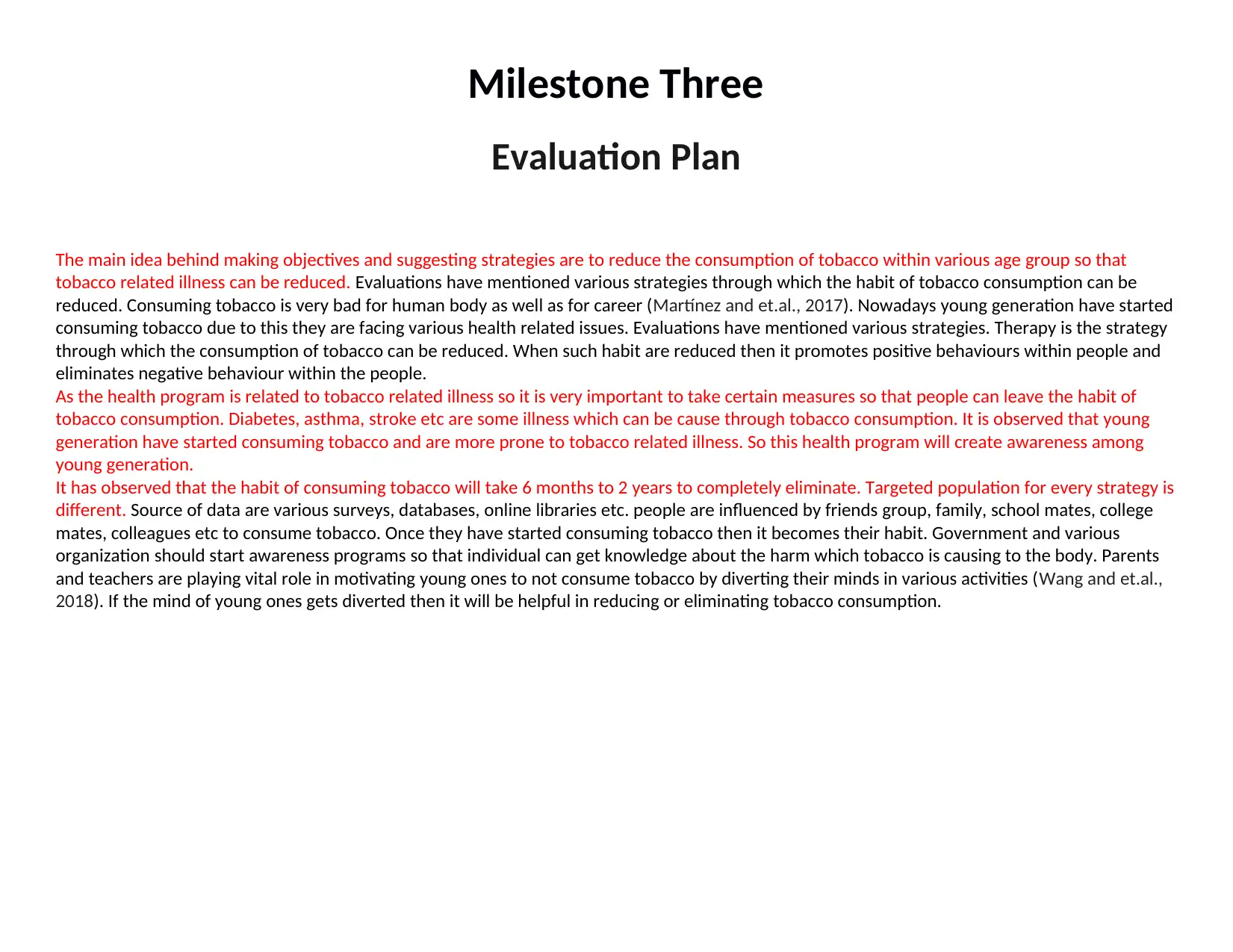
Milestone Three
Evaluation Plan
The main idea behind making objectives and suggesting strategies are to reduce the consumption of tobacco within various age group so that
tobacco related illness can be reduced. Evaluations have mentioned various strategies through which the habit of tobacco consumption can be
reduced. Consuming tobacco is very bad for human body as well as for career (Martínez and et.al., 2017). Nowadays young generation have started
consuming tobacco due to this they are facing various health related issues. Evaluations have mentioned various strategies. Therapy is the strategy
through which the consumption of tobacco can be reduced. When such habit are reduced then it promotes positive behaviours within people and
eliminates negative behaviour within the people.
As the health program is related to tobacco related illness so it is very important to take certain measures so that people can leave the habit of
tobacco consumption. Diabetes, asthma, stroke etc are some illness which can be cause through tobacco consumption. It is observed that young
generation have started consuming tobacco and are more prone to tobacco related illness. So this health program will create awareness among
young generation.
It has observed that the habit of consuming tobacco will take 6 months to 2 years to completely eliminate. Targeted population for every strategy is
different. Source of data are various surveys, databases, online libraries etc. people are influenced by friends group, family, school mates, college
mates, colleagues etc to consume tobacco. Once they have started consuming tobacco then it becomes their habit. Government and various
organization should start awareness programs so that individual can get knowledge about the harm which tobacco is causing to the body. Parents
and teachers are playing vital role in motivating young ones to not consume tobacco by diverting their minds in various activities (Wang and et.al.,
2018). If the mind of young ones gets diverted then it will be helpful in reducing or eliminating tobacco consumption.
Document Page
References
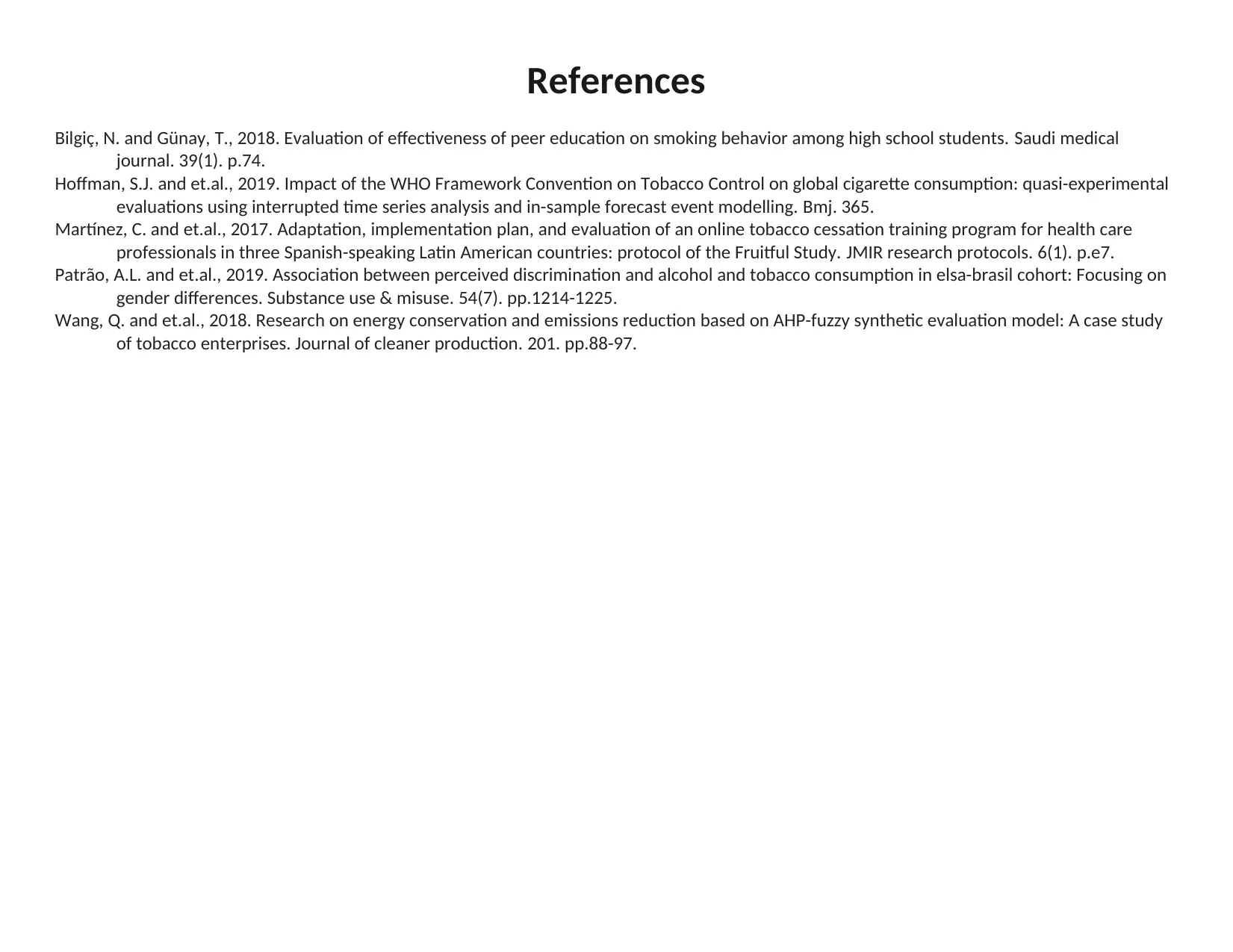
Bilgiç, N. and Günay, T., 2018. Evaluation of effectiveness of peer education on smoking behavior among high school students. Saudi medical
journal. 39(1). p.74.
Hoffman, S.J. and et.al., 2019. Impact of the WHO Framework Convention on Tobacco Control on global cigarette consumption: quasi-experimental
evaluations using interrupted time series analysis and in-sample forecast event modelling. Bmj. 365.
Martínez, C. and et.al., 2017. Adaptation, implementation plan, and evaluation of an online tobacco cessation training program for health care
professionals in three Spanish-speaking Latin American countries: protocol of the Fruitful Study. JMIR research protocols. 6(1). p.e7.
Patrão, A.L. and et.al., 2019. Association between perceived discrimination and alcohol and tobacco consumption in elsa-brasil cohort: Focusing on
gender differences. Substance use & misuse. 54(7). pp.1214-1225.
Wang, Q. and et.al., 2018. Research on energy conservation and emissions reduction based on AHP-fuzzy synthetic evaluation model: A case study
of tobacco enterprises. Journal of cleaner production. 201. pp.88-97.
tabler-icon-diamond-filled.svg

Paraphrase This Document

Need a fresh take? Get an instant paraphrase of this document with our AI Paraphraser
Document Page
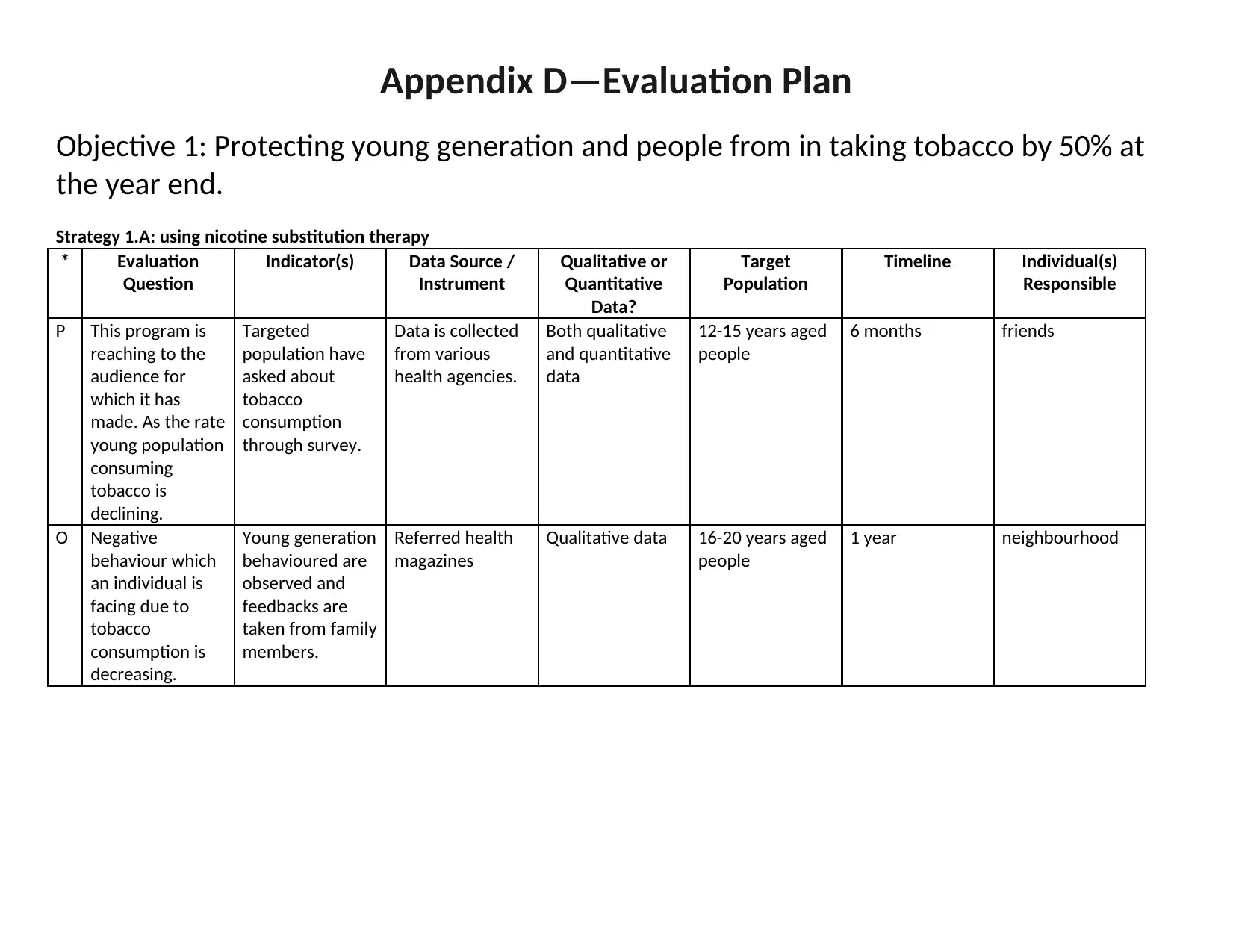
Appendix D—Evaluation Plan
Objective 1: Protecting young generation and people from in taking tobacco by 50% at
the year end.
Strategy 1.A: using nicotine substitution therapy
* Evaluation
Question
Indicator(s) Data Source /
Instrument
Qualitative or
Quantitative
Data?
Target
Population
Timeline Individual(s)
Responsible
P This program is
reaching to the
audience for
which it has
made. As the rate
young population
consuming
tobacco is
declining.
Targeted
population have
asked about
tobacco
consumption
through survey.
Data is collected
from various
health agencies.
Both qualitative
and quantitative
data
12-15 years aged
people
6 months friends
O Negative
behaviour which
an individual is
facing due to
tobacco
consumption is
decreasing.
Young generation
behavioured are
observed and
feedbacks are
taken from family
members.
Referred health
magazines
Qualitative data 16-20 years aged
people
1 year neighbourhood
Document Page
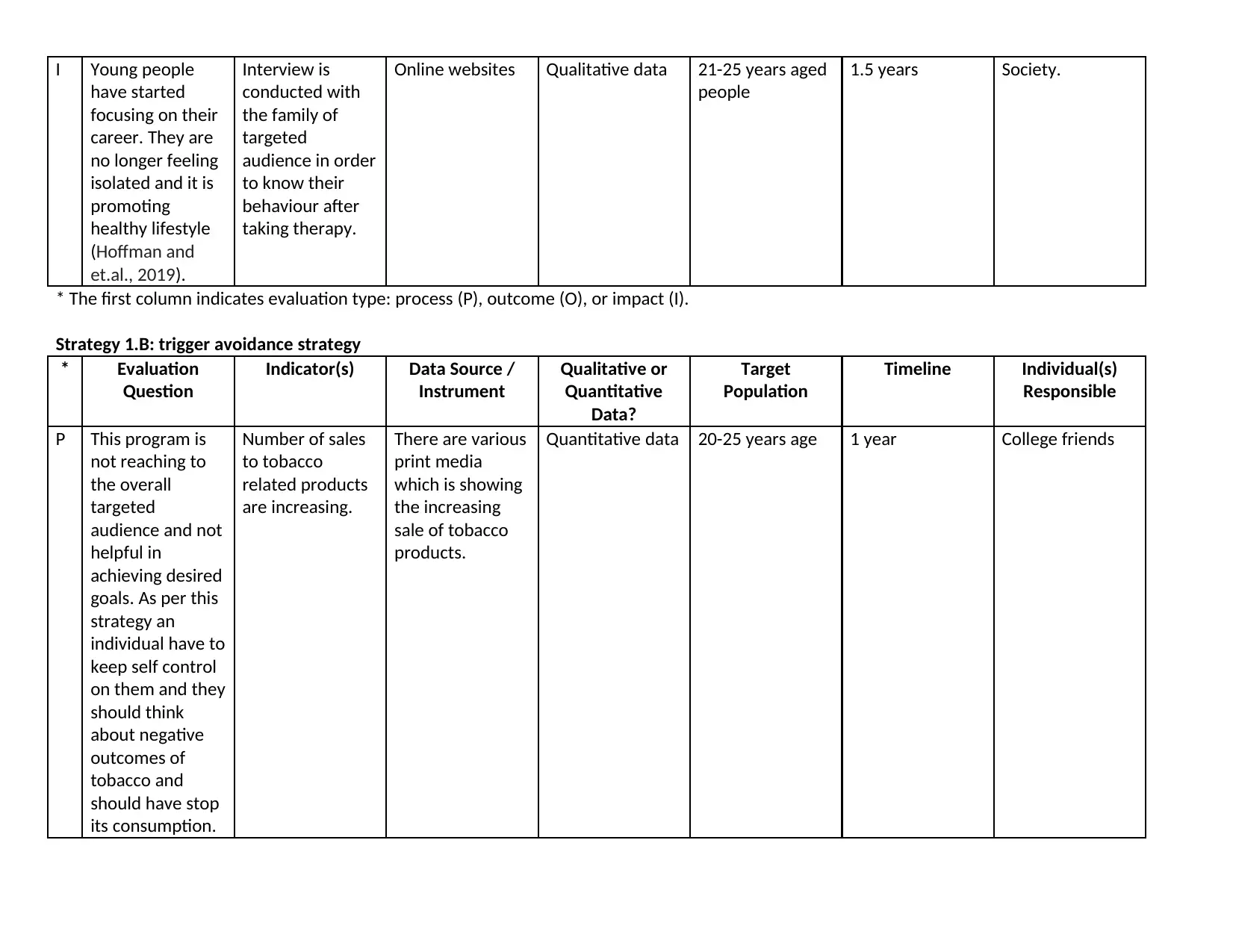
I Young people
have started
focusing on their
career. They are
no longer feeling
isolated and it is
promoting
healthy lifestyle
(Hoffman and
et.al., 2019).
Interview is
conducted with
the family of
targeted
audience in order
to know their
behaviour after
taking therapy.
Online websites Qualitative data 21-25 years aged
people
1.5 years Society.
* The first column indicates evaluation type: process (P), outcome (O), or impact (I).
Strategy 1.B: trigger avoidance strategy
* Evaluation
Question
Indicator(s) Data Source /
Instrument
Qualitative or
Quantitative
Data?
Target
Population
Timeline Individual(s)
Responsible
P This program is
not reaching to
the overall
targeted
audience and not
helpful in
achieving desired
goals. As per this
strategy an
individual have to
keep self control
on them and they
should think
about negative
outcomes of
tobacco and
should have stop
its consumption.
Number of sales
to tobacco
related products
are increasing.
There are various
print media
which is showing
the increasing
sale of tobacco
products.
Quantitative data 20-25 years age 1 year College friends
Document Page
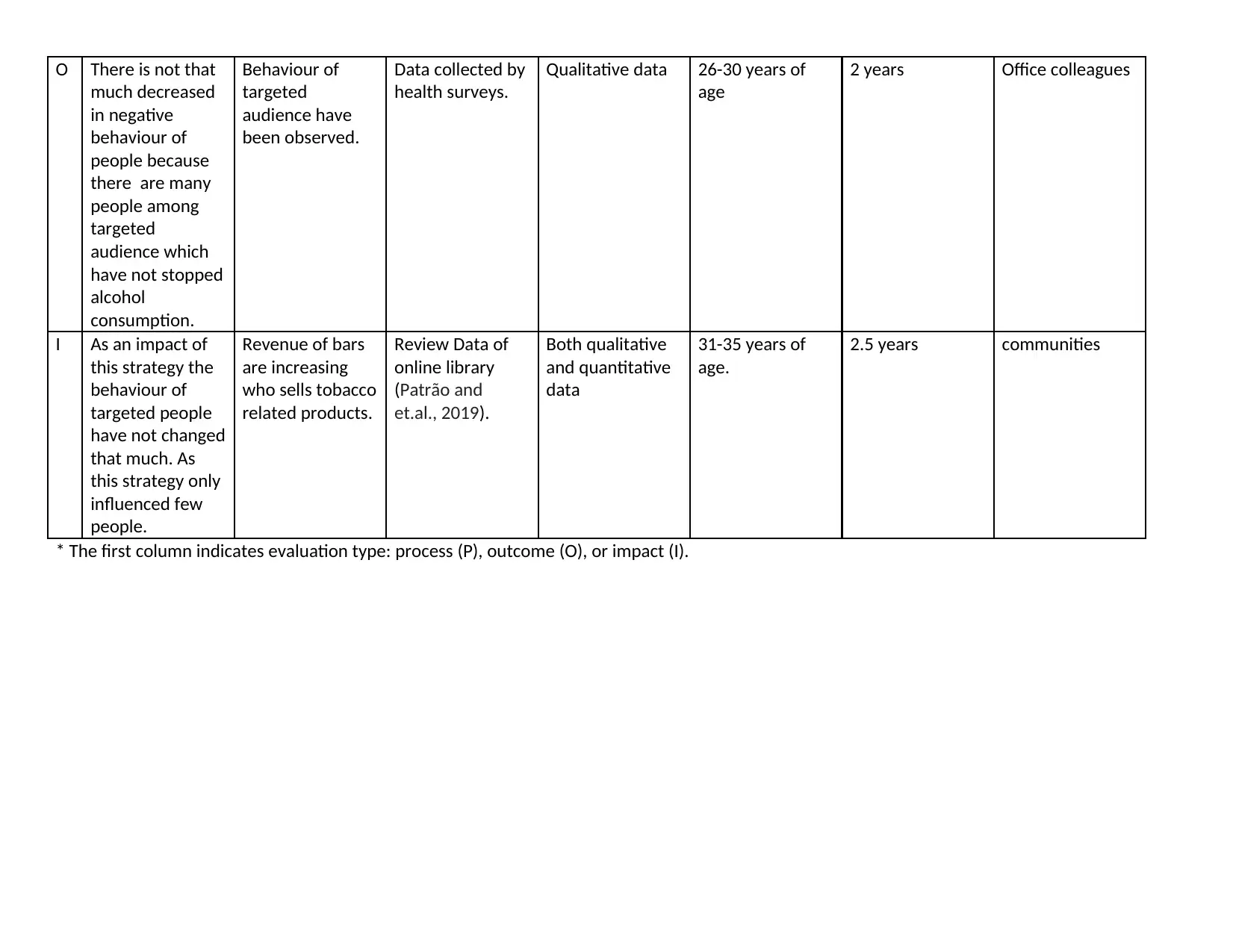
O There is not that
much decreased
in negative
behaviour of
people because
there are many
people among
targeted
audience which
have not stopped
alcohol
consumption.
Behaviour of
targeted
audience have
been observed.
Data collected by
health surveys.
Qualitative data 26-30 years of
age
2 years Office colleagues
I As an impact of
this strategy the
behaviour of
targeted people
have not changed
that much. As
this strategy only
influenced few
people.
Revenue of bars
are increasing
who sells tobacco
related products.
Review Data of
online library
(Patrão and
et.al., 2019).
Both qualitative
and quantitative
data
31-35 years of
age.
2.5 years communities
* The first column indicates evaluation type: process (P), outcome (O), or impact (I).
tabler-icon-diamond-filled.svg

Paraphrase This Document

Need a fresh take? Get an instant paraphrase of this document with our AI Paraphraser
Document Page
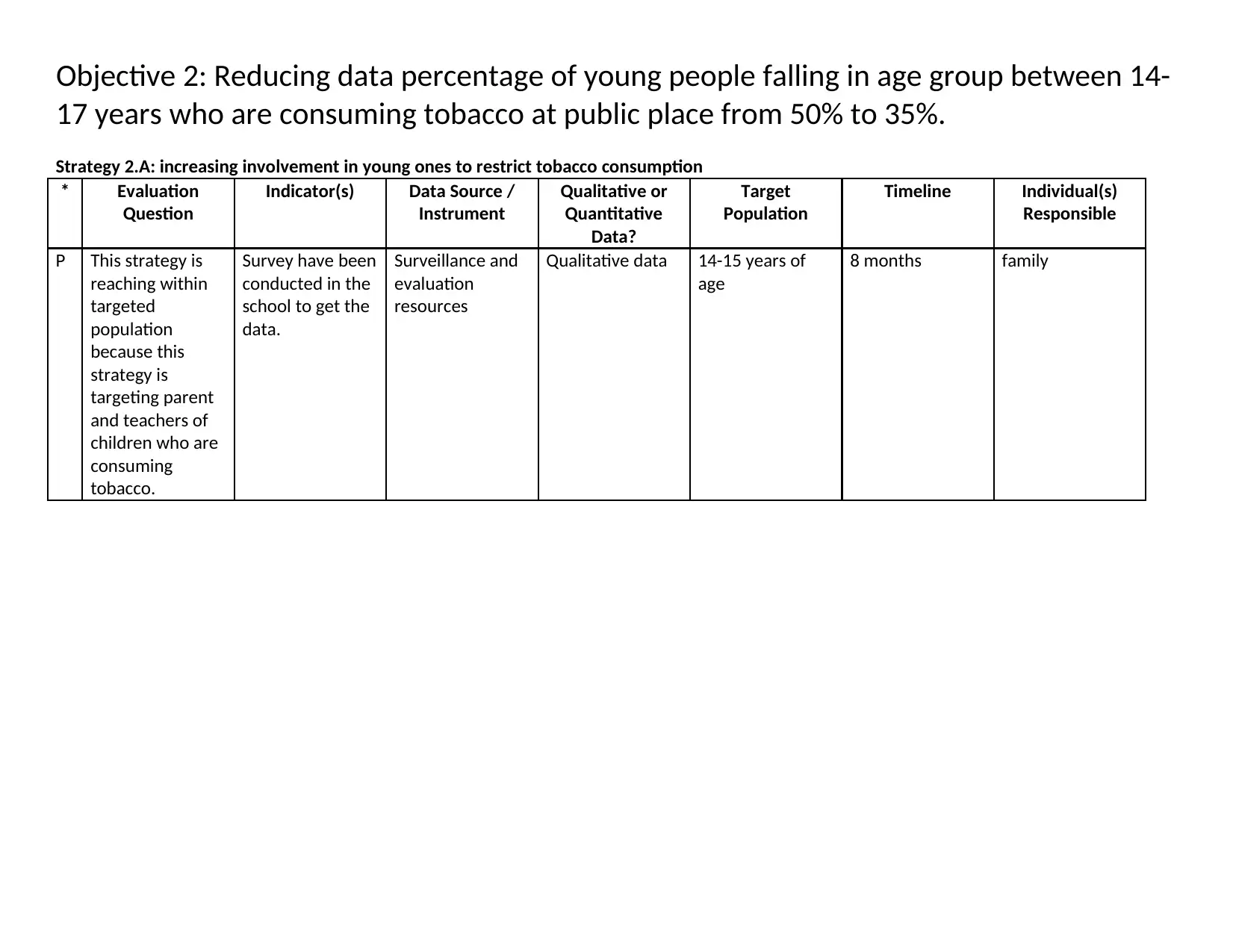
Objective 2: Reducing data percentage of young people falling in age group between 14-
17 years who are consuming tobacco at public place from 50% to 35%.
Strategy 2.A: increasing involvement in young ones to restrict tobacco consumption
* Evaluation
Question
Indicator(s) Data Source /
Instrument
Qualitative or
Quantitative
Data?
Target
Population
Timeline Individual(s)
Responsible
P This strategy is
reaching within
targeted
population
because this
strategy is
targeting parent
and teachers of
children who are
consuming
tobacco.
Survey have been
conducted in the
school to get the
data.
Surveillance and
evaluation
resources
Qualitative data 14-15 years of
age
8 months family
Document Page
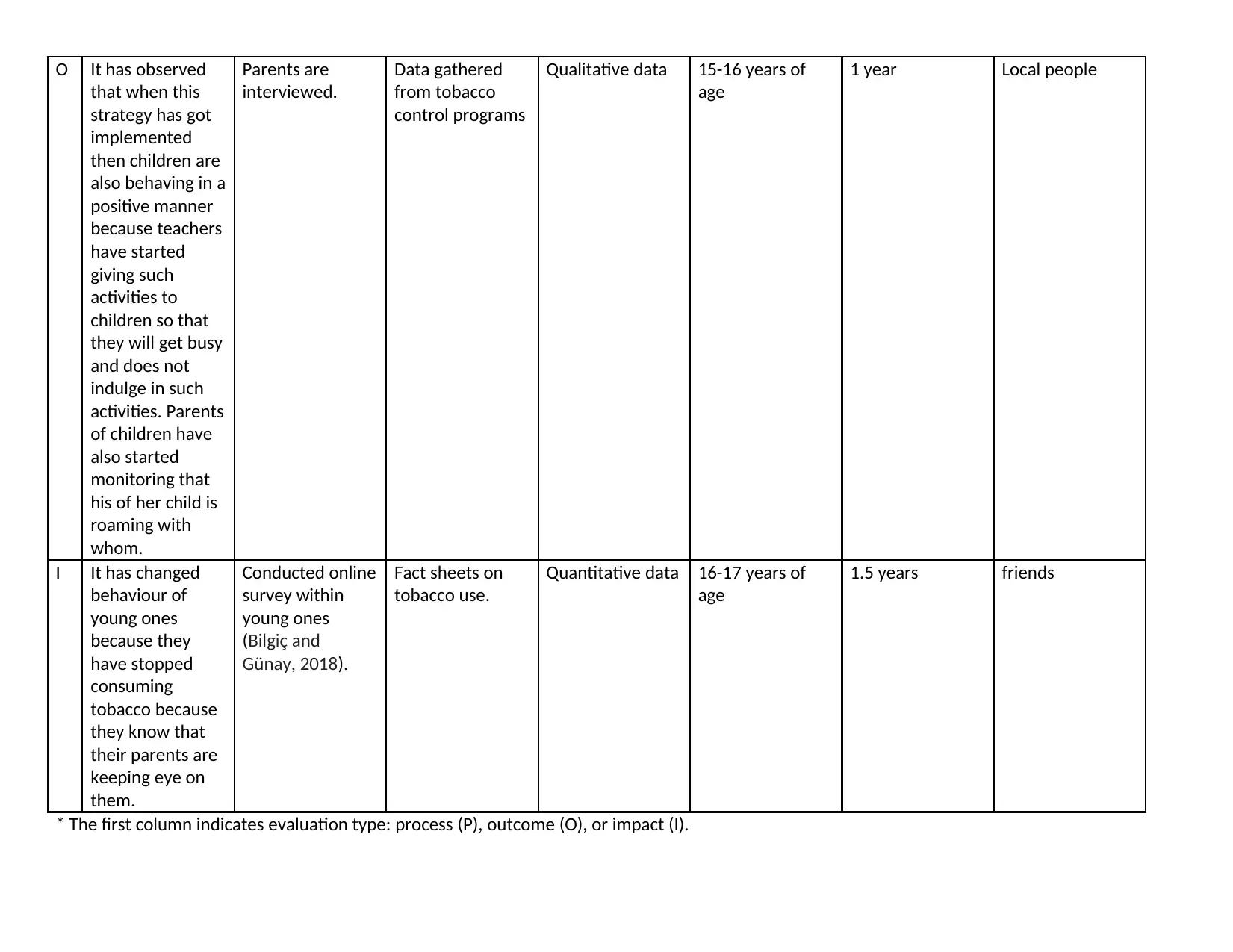
O It has observed
that when this
strategy has got
implemented
then children are
also behaving in a
positive manner
because teachers
have started
giving such
activities to
children so that
they will get busy
and does not
indulge in such
activities. Parents
of children have
also started
monitoring that
his of her child is
roaming with
whom.
Parents are
interviewed.
Data gathered
from tobacco
control programs
Qualitative data 15-16 years of
age
1 year Local people
I It has changed
behaviour of
young ones
because they
have stopped
consuming
tobacco because
they know that
their parents are
keeping eye on
them.
Conducted online
survey within
young ones
(Bilgiç and
Günay, 2018).
Fact sheets on
tobacco use.
Quantitative data 16-17 years of
age
1.5 years friends
* The first column indicates evaluation type: process (P), outcome (O), or impact (I).
Document Page
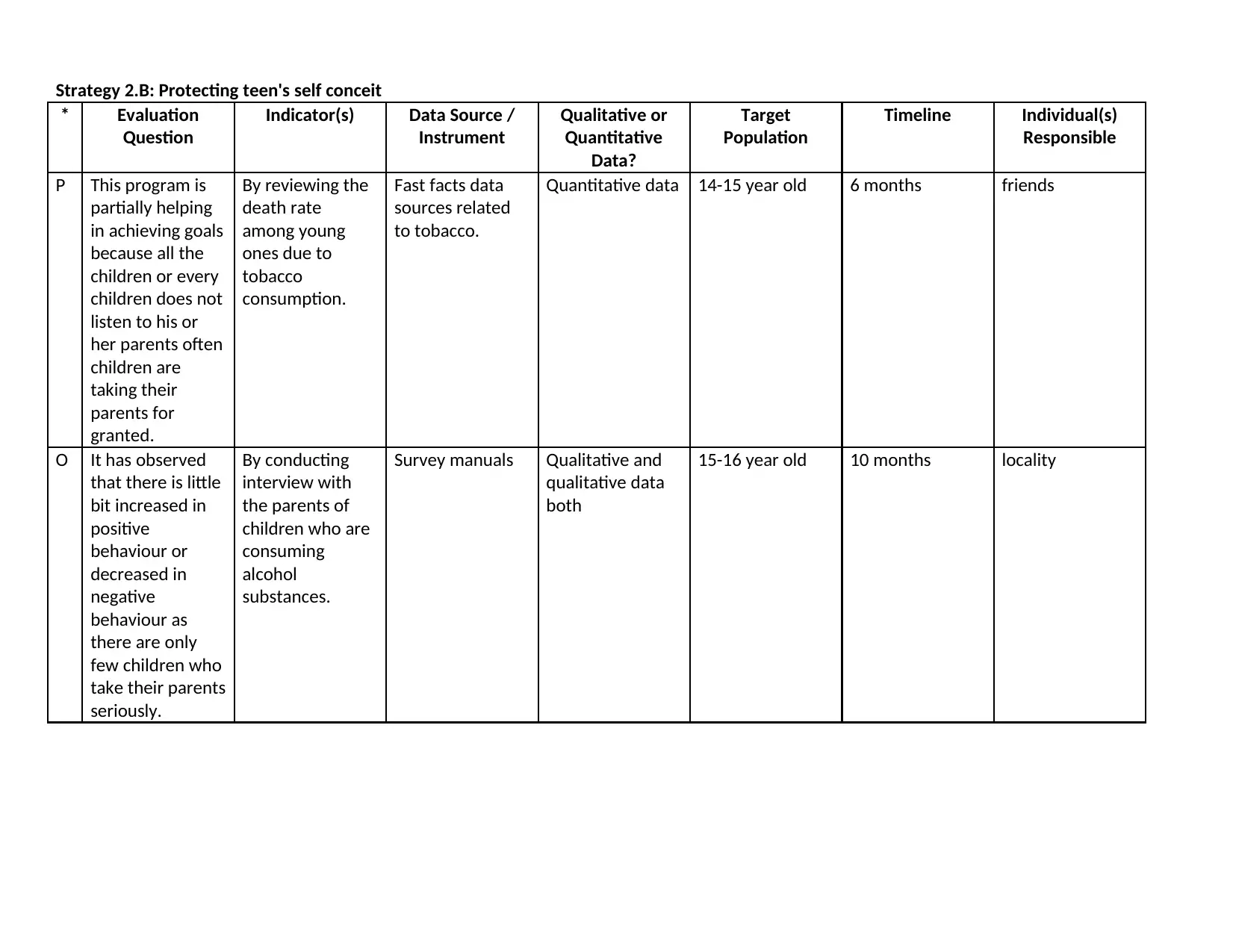
Strategy 2.B: Protecting teen's self conceit
* Evaluation
Question
Indicator(s) Data Source /
Instrument
Qualitative or
Quantitative
Data?
Target
Population
Timeline Individual(s)
Responsible
P This program is
partially helping
in achieving goals
because all the
children or every
children does not
listen to his or
her parents often
children are
taking their
parents for
granted.
By reviewing the
death rate
among young
ones due to
tobacco
consumption.
Fast facts data
sources related
to tobacco.
Quantitative data 14-15 year old 6 months friends
O It has observed
that there is little
bit increased in
positive
behaviour or
decreased in
negative
behaviour as
there are only
few children who
take their parents
seriously.
By conducting
interview with
the parents of
children who are
consuming
alcohol
substances.
Survey manuals Qualitative and
qualitative data
both
15-16 year old 10 months locality
tabler-icon-diamond-filled.svg

Paraphrase This Document

Need a fresh take? Get an instant paraphrase of this document with our AI Paraphraser
Document Page
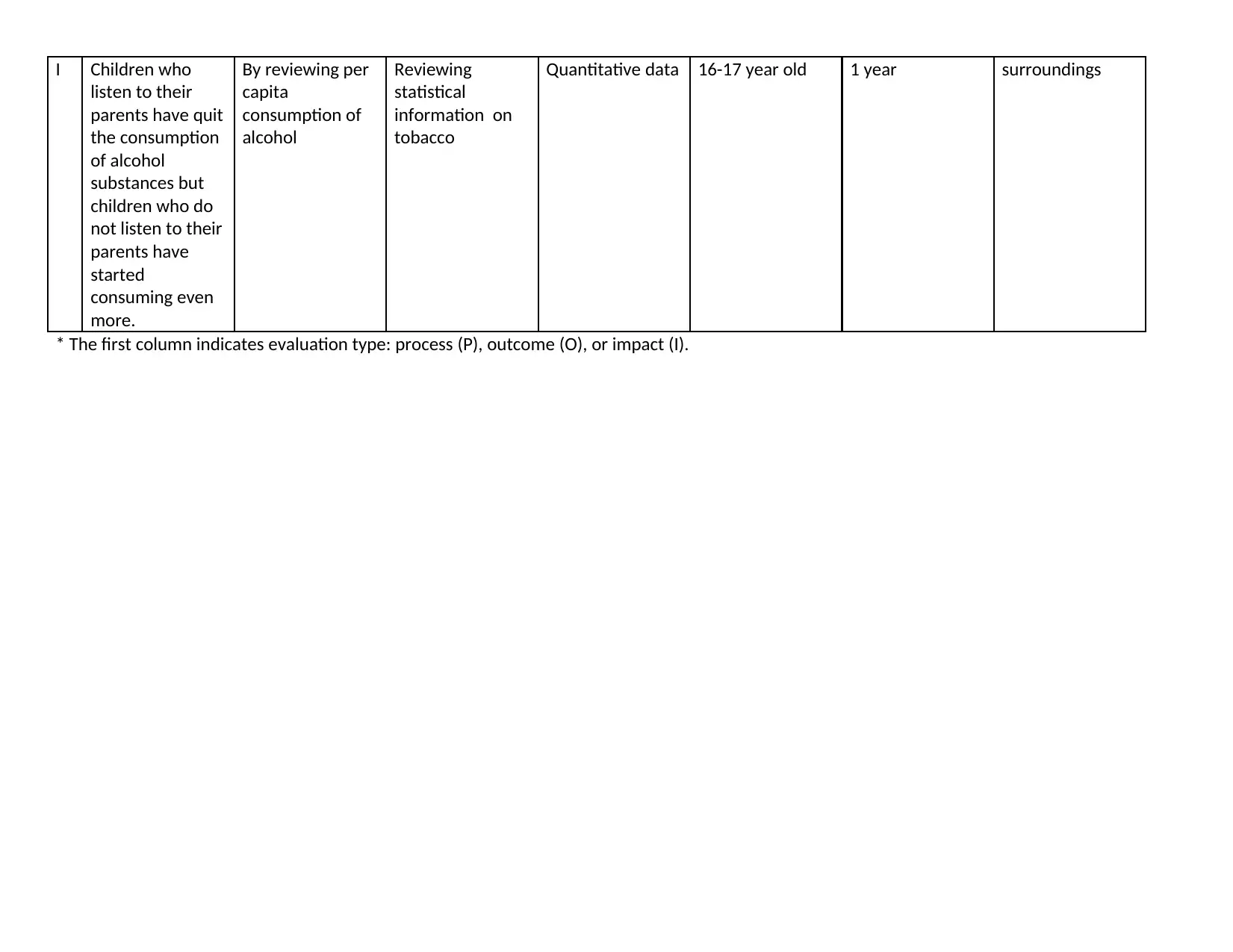
I Children who
listen to their
parents have quit
the consumption
of alcohol
substances but
children who do
not listen to their
parents have
started
consuming even
more.
By reviewing per
capita
consumption of
alcohol
Reviewing
statistical
information on
tobacco
Quantitative data 16-17 year old 1 year surroundings
* The first column indicates evaluation type: process (P), outcome (O), or impact (I).
Document Page
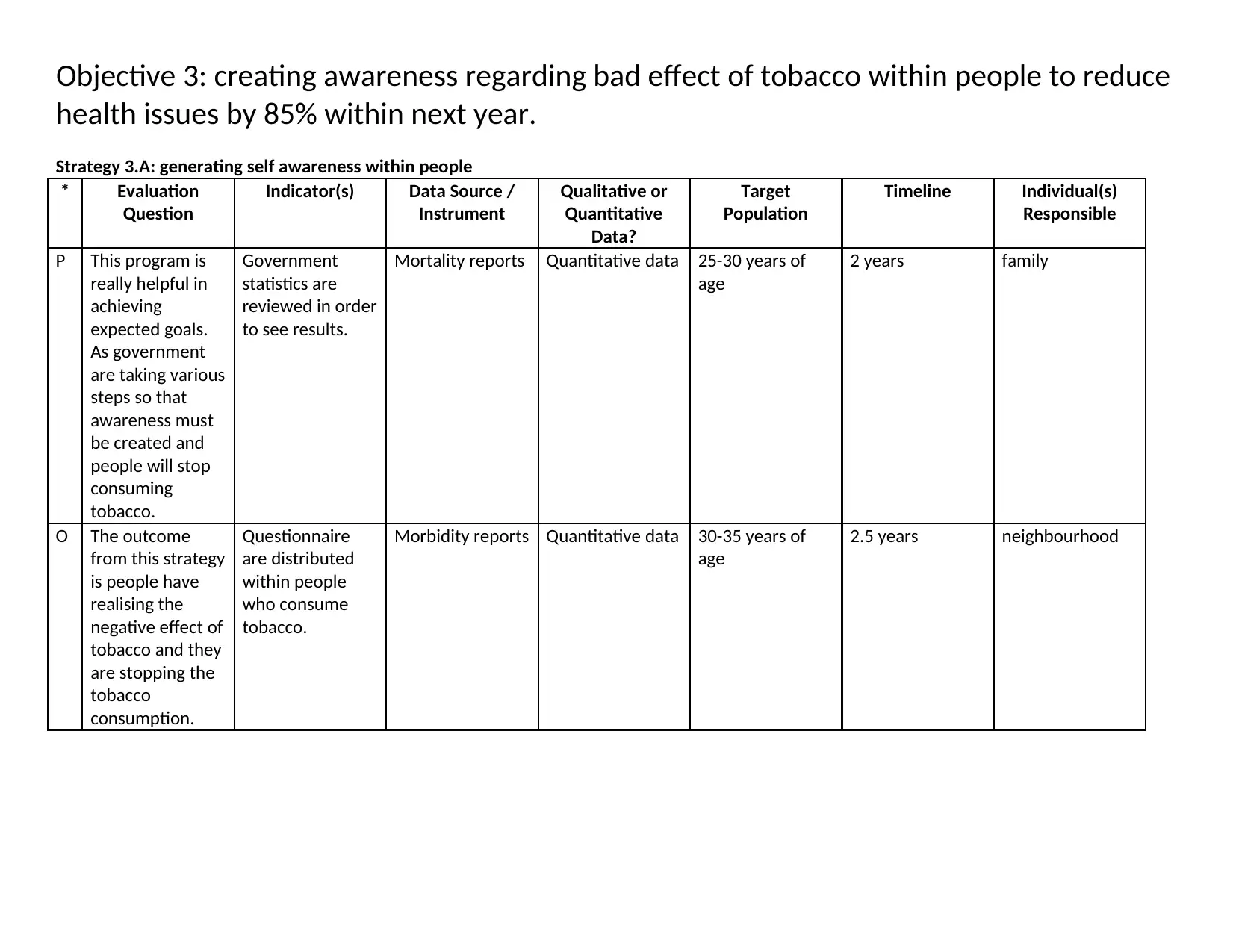
Objective 3: creating awareness regarding bad effect of tobacco within people to reduce
health issues by 85% within next year.
Strategy 3.A: generating self awareness within people
* Evaluation
Question
Indicator(s) Data Source /
Instrument
Qualitative or
Quantitative
Data?
Target
Population
Timeline Individual(s)
Responsible
P This program is
really helpful in
achieving
expected goals.
As government
are taking various
steps so that
awareness must
be created and
people will stop
consuming
tobacco.
Government
statistics are
reviewed in order
to see results.
Mortality reports Quantitative data 25-30 years of
age
2 years family
O The outcome
from this strategy
is people have
realising the
negative effect of
tobacco and they
are stopping the
tobacco
consumption.
Questionnaire
are distributed
within people
who consume
tobacco.
Morbidity reports Quantitative data 30-35 years of
age
2.5 years neighbourhood
chevron_up_icon
1 out of 16
circle_padding
hide_on_mobile
zoom_out_icon
[object Object]