Tort Law Assignment: Salient Features and Duty of Care in Novel Cases
VerifiedAdded on 2022/07/27
|5
|1218
|36
Essay
AI Summary
This essay delves into the intricacies of Tort Law, specifically focusing on the concept of duty of care and the application of salient features in novel relationships where a direct relationship between parties is absent. It examines how courts, through landmark cases such as "Makawe Pty Limited v Randwick City Council", "Perre v Apand Pty Ltd", "Tame v New South Wales", and "Caltex Refineries (Queensland) Pty Limited v Stavar", have established and refined these features. The essay highlights the evolution of these principles from common law to statutory provisions, particularly the "Civil Liability Act", and underscores the importance of factors like foreseeability of harm, the defendant's control, the plaintiff's reliance, and the proximity between parties. It emphasizes that the application of these salient features is case-specific, with "foreseeability" often being a key factor, but not always sufficient on its own, and that the High Court of Australia has consistently emphasized the need for a comprehensive approach in determining the existence of a duty of care. The essay concludes by summarizing the role of these features in establishing a general principle for determining duty of care.
Running Head: BUSINESS AND CORPORATION LAW 0
Civil Law
Tort Law
4/16/2020
Student’s Name
Civil Law
Tort Law
4/16/2020
Student’s Name
Paraphrase This Document
Need a fresh take? Get an instant paraphrase of this document with our AI Paraphraser

Tort Law
1
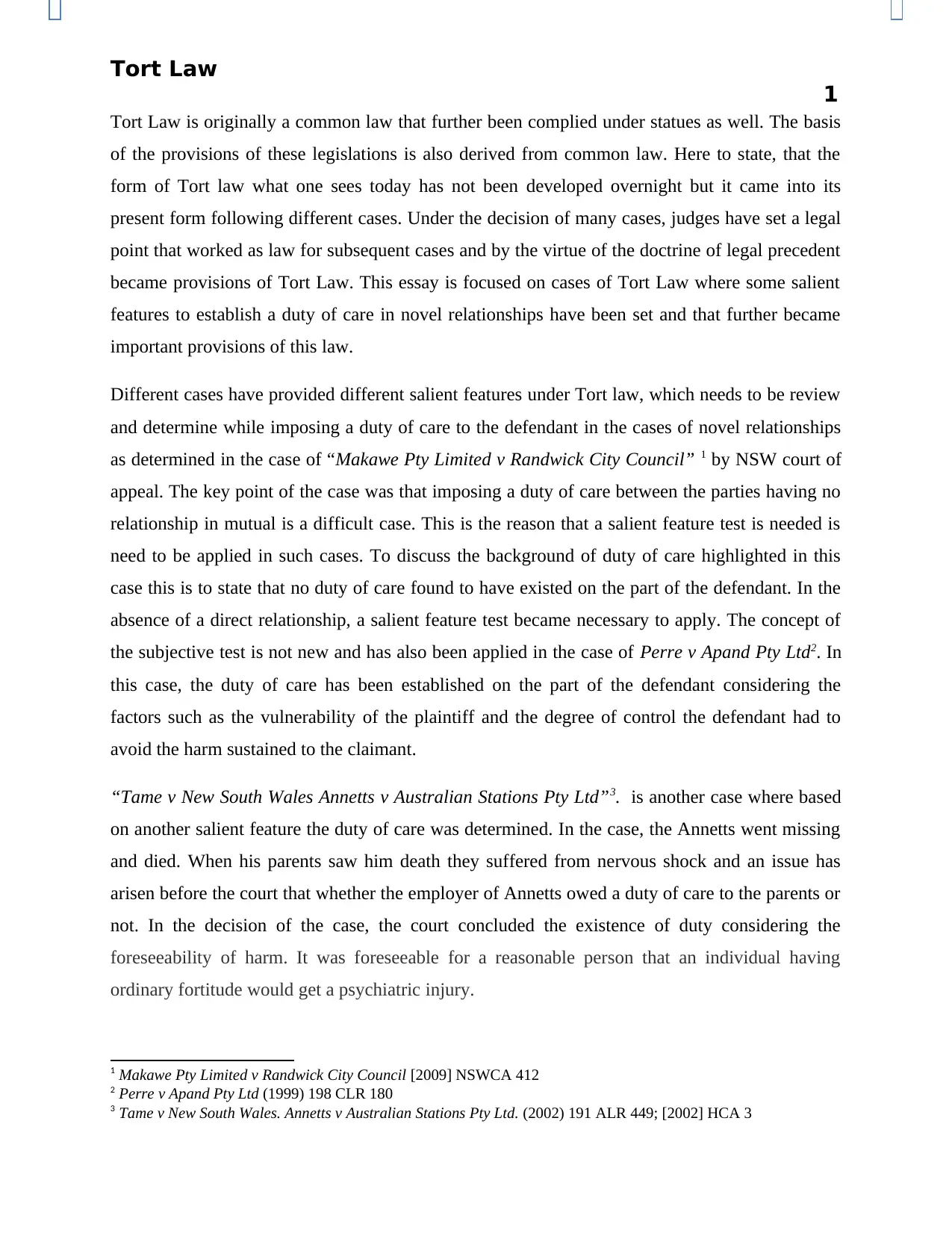
Tort Law is originally a common law that further been complied under statues as well. The basis
of the provisions of these legislations is also derived from common law. Here to state, that the
form of Tort law what one sees today has not been developed overnight but it came into its
present form following different cases. Under the decision of many cases, judges have set a legal
point that worked as law for subsequent cases and by the virtue of the doctrine of legal precedent
became provisions of Tort Law. This essay is focused on cases of Tort Law where some salient
features to establish a duty of care in novel relationships have been set and that further became
important provisions of this law.
Different cases have provided different salient features under Tort law, which needs to be review
and determine while imposing a duty of care to the defendant in the cases of novel relationships
as determined in the case of “Makawe Pty Limited v Randwick City Council” 1 by NSW court of
appeal. The key point of the case was that imposing a duty of care between the parties having no
relationship in mutual is a difficult case. This is the reason that a salient feature test is needed is
need to be applied in such cases. To discuss the background of duty of care highlighted in this
case this is to state that no duty of care found to have existed on the part of the defendant. In the
absence of a direct relationship, a salient feature test became necessary to apply. The concept of
the subjective test is not new and has also been applied in the case of Perre v Apand Pty Ltd2. In
this case, the duty of care has been established on the part of the defendant considering the
factors such as the vulnerability of the plaintiff and the degree of control the defendant had to
avoid the harm sustained to the claimant.
“Tame v New South Wales Annetts v Australian Stations Pty Ltd”3. is another case where based
on another salient feature the duty of care was determined. In the case, the Annetts went missing
and died. When his parents saw him death they suffered from nervous shock and an issue has
arisen before the court that whether the employer of Annetts owed a duty of care to the parents or
not. In the decision of the case, the court concluded the existence of duty considering the
foreseeability of harm. It was foreseeable for a reasonable person that an individual having
ordinary fortitude would get a psychiatric injury.
1 Makawe Pty Limited v Randwick City Council [2009] NSWCA 412
2 Perre v Apand Pty Ltd (1999) 198 CLR 180
3 Tame v New South Wales. Annetts v Australian Stations Pty Ltd. (2002) 191 ALR 449; [2002] HCA 3
1
Tort Law is originally a common law that further been complied under statues as well. The basis
of the provisions of these legislations is also derived from common law. Here to state, that the
form of Tort law what one sees today has not been developed overnight but it came into its
present form following different cases. Under the decision of many cases, judges have set a legal
point that worked as law for subsequent cases and by the virtue of the doctrine of legal precedent
became provisions of Tort Law. This essay is focused on cases of Tort Law where some salient
features to establish a duty of care in novel relationships have been set and that further became
important provisions of this law.
Different cases have provided different salient features under Tort law, which needs to be review
and determine while imposing a duty of care to the defendant in the cases of novel relationships
as determined in the case of “Makawe Pty Limited v Randwick City Council” 1 by NSW court of
appeal. The key point of the case was that imposing a duty of care between the parties having no
relationship in mutual is a difficult case. This is the reason that a salient feature test is needed is
need to be applied in such cases. To discuss the background of duty of care highlighted in this
case this is to state that no duty of care found to have existed on the part of the defendant. In the
absence of a direct relationship, a salient feature test became necessary to apply. The concept of
the subjective test is not new and has also been applied in the case of Perre v Apand Pty Ltd2. In
this case, the duty of care has been established on the part of the defendant considering the
factors such as the vulnerability of the plaintiff and the degree of control the defendant had to
avoid the harm sustained to the claimant.
“Tame v New South Wales Annetts v Australian Stations Pty Ltd”3. is another case where based
on another salient feature the duty of care was determined. In the case, the Annetts went missing
and died. When his parents saw him death they suffered from nervous shock and an issue has
arisen before the court that whether the employer of Annetts owed a duty of care to the parents or
not. In the decision of the case, the court concluded the existence of duty considering the
foreseeability of harm. It was foreseeable for a reasonable person that an individual having
ordinary fortitude would get a psychiatric injury.
1 Makawe Pty Limited v Randwick City Council [2009] NSWCA 412
2 Perre v Apand Pty Ltd (1999) 198 CLR 180
3 Tame v New South Wales. Annetts v Australian Stations Pty Ltd. (2002) 191 ALR 449; [2002] HCA 3

Tort Law
2
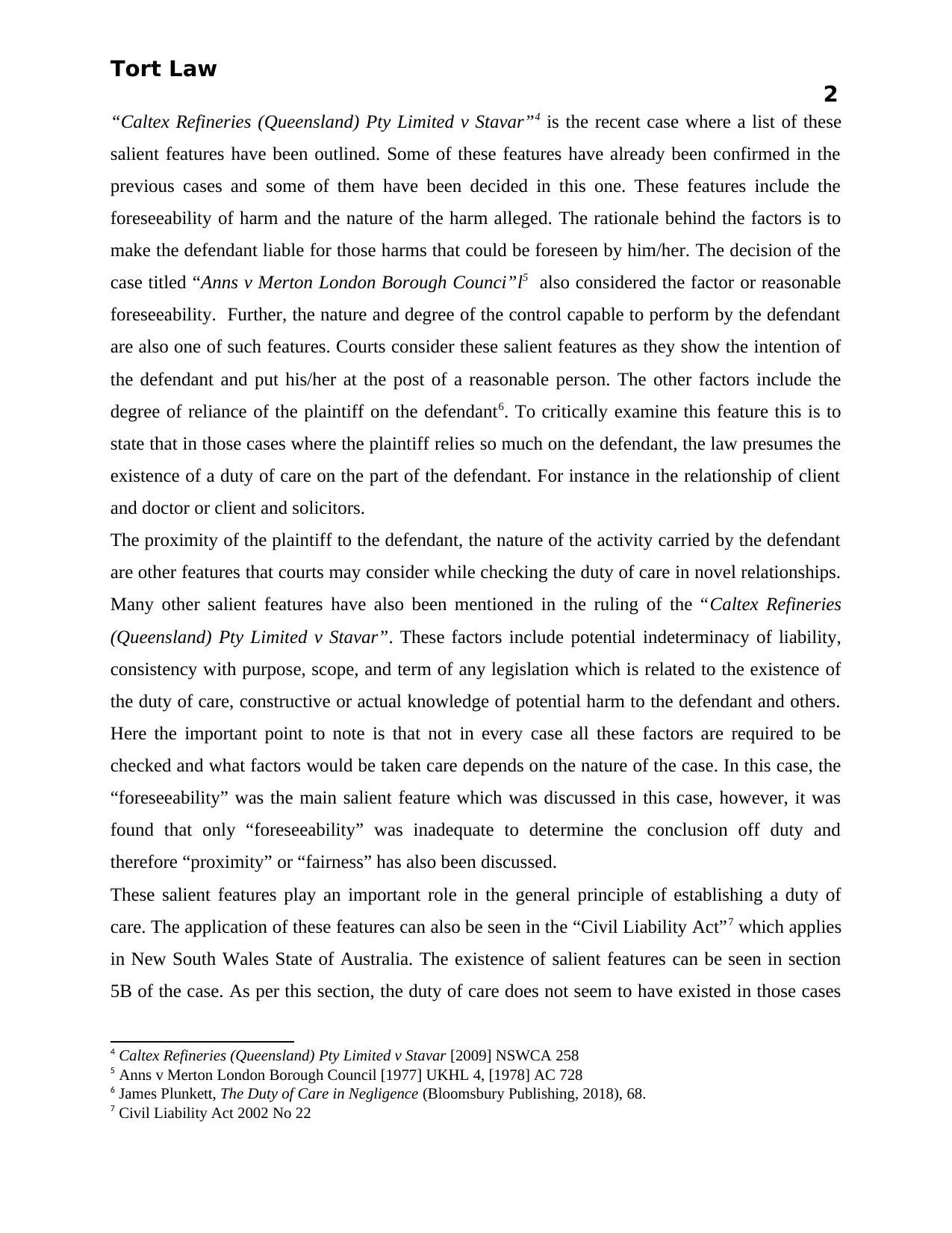
“Caltex Refineries (Queensland) Pty Limited v Stavar”4 is the recent case where a list of these
salient features have been outlined. Some of these features have already been confirmed in the
previous cases and some of them have been decided in this one. These features include the
foreseeability of harm and the nature of the harm alleged. The rationale behind the factors is to
make the defendant liable for those harms that could be foreseen by him/her. The decision of the
case titled “Anns v Merton London Borough Counci”l5 also considered the factor or reasonable
foreseeability. Further, the nature and degree of the control capable to perform by the defendant
are also one of such features. Courts consider these salient features as they show the intention of
the defendant and put his/her at the post of a reasonable person. The other factors include the
degree of reliance of the plaintiff on the defendant6. To critically examine this feature this is to
state that in those cases where the plaintiff relies so much on the defendant, the law presumes the
existence of a duty of care on the part of the defendant. For instance in the relationship of client
and doctor or client and solicitors.
The proximity of the plaintiff to the defendant, the nature of the activity carried by the defendant
are other features that courts may consider while checking the duty of care in novel relationships.
Many other salient features have also been mentioned in the ruling of the “Caltex Refineries
(Queensland) Pty Limited v Stavar”. These factors include potential indeterminacy of liability,
consistency with purpose, scope, and term of any legislation which is related to the existence of
the duty of care, constructive or actual knowledge of potential harm to the defendant and others.
Here the important point to note is that not in every case all these factors are required to be
checked and what factors would be taken care depends on the nature of the case. In this case, the
“foreseeability” was the main salient feature which was discussed in this case, however, it was
found that only “foreseeability” was inadequate to determine the conclusion off duty and
therefore “proximity” or “fairness” has also been discussed.
These salient features play an important role in the general principle of establishing a duty of
care. The application of these features can also be seen in the “Civil Liability Act”7 which applies
in New South Wales State of Australia. The existence of salient features can be seen in section
5B of the case. As per this section, the duty of care does not seem to have existed in those cases
4 Caltex Refineries (Queensland) Pty Limited v Stavar [2009] NSWCA 258
5 Anns v Merton London Borough Council [1977] UKHL 4, [1978] AC 728
6 James Plunkett, The Duty of Care in Negligence (Bloomsbury Publishing, 2018), 68.
7 Civil Liability Act 2002 No 22
2
“Caltex Refineries (Queensland) Pty Limited v Stavar”4 is the recent case where a list of these
salient features have been outlined. Some of these features have already been confirmed in the
previous cases and some of them have been decided in this one. These features include the
foreseeability of harm and the nature of the harm alleged. The rationale behind the factors is to
make the defendant liable for those harms that could be foreseen by him/her. The decision of the
case titled “Anns v Merton London Borough Counci”l5 also considered the factor or reasonable
foreseeability. Further, the nature and degree of the control capable to perform by the defendant
are also one of such features. Courts consider these salient features as they show the intention of
the defendant and put his/her at the post of a reasonable person. The other factors include the
degree of reliance of the plaintiff on the defendant6. To critically examine this feature this is to
state that in those cases where the plaintiff relies so much on the defendant, the law presumes the
existence of a duty of care on the part of the defendant. For instance in the relationship of client
and doctor or client and solicitors.
The proximity of the plaintiff to the defendant, the nature of the activity carried by the defendant
are other features that courts may consider while checking the duty of care in novel relationships.
Many other salient features have also been mentioned in the ruling of the “Caltex Refineries
(Queensland) Pty Limited v Stavar”. These factors include potential indeterminacy of liability,
consistency with purpose, scope, and term of any legislation which is related to the existence of
the duty of care, constructive or actual knowledge of potential harm to the defendant and others.
Here the important point to note is that not in every case all these factors are required to be
checked and what factors would be taken care depends on the nature of the case. In this case, the
“foreseeability” was the main salient feature which was discussed in this case, however, it was
found that only “foreseeability” was inadequate to determine the conclusion off duty and
therefore “proximity” or “fairness” has also been discussed.
These salient features play an important role in the general principle of establishing a duty of
care. The application of these features can also be seen in the “Civil Liability Act”7 which applies
in New South Wales State of Australia. The existence of salient features can be seen in section
5B of the case. As per this section, the duty of care does not seem to have existed in those cases
4 Caltex Refineries (Queensland) Pty Limited v Stavar [2009] NSWCA 258
5 Anns v Merton London Borough Council [1977] UKHL 4, [1978] AC 728
6 James Plunkett, The Duty of Care in Negligence (Bloomsbury Publishing, 2018), 68.
7 Civil Liability Act 2002 No 22
⊘ This is a preview!⊘
Do you want full access?
Subscribe today to unlock all pages.

Trusted by 1+ million students worldwide

Tort Law
3
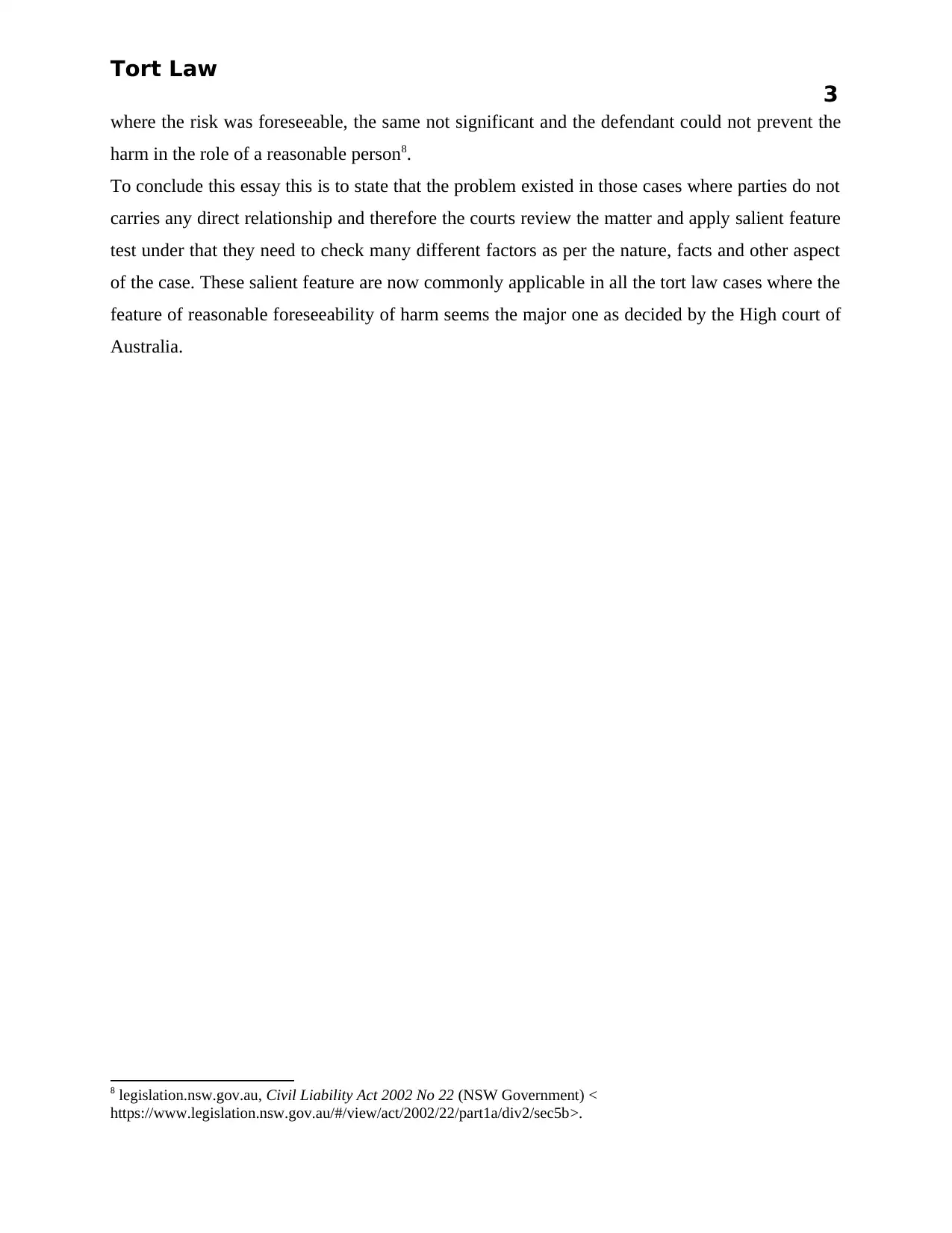
where the risk was foreseeable, the same not significant and the defendant could not prevent the
harm in the role of a reasonable person8.
To conclude this essay this is to state that the problem existed in those cases where parties do not
carries any direct relationship and therefore the courts review the matter and apply salient feature
test under that they need to check many different factors as per the nature, facts and other aspect
of the case. These salient feature are now commonly applicable in all the tort law cases where the
feature of reasonable foreseeability of harm seems the major one as decided by the High court of
Australia.
8 legislation.nsw.gov.au, Civil Liability Act 2002 No 22 (NSW Government) <
https://www.legislation.nsw.gov.au/#/view/act/2002/22/part1a/div2/sec5b>.
3
where the risk was foreseeable, the same not significant and the defendant could not prevent the
harm in the role of a reasonable person8.
To conclude this essay this is to state that the problem existed in those cases where parties do not
carries any direct relationship and therefore the courts review the matter and apply salient feature
test under that they need to check many different factors as per the nature, facts and other aspect
of the case. These salient feature are now commonly applicable in all the tort law cases where the
feature of reasonable foreseeability of harm seems the major one as decided by the High court of
Australia.
8 legislation.nsw.gov.au, Civil Liability Act 2002 No 22 (NSW Government) <
https://www.legislation.nsw.gov.au/#/view/act/2002/22/part1a/div2/sec5b>.
Paraphrase This Document
Need a fresh take? Get an instant paraphrase of this document with our AI Paraphraser

Tort Law
4
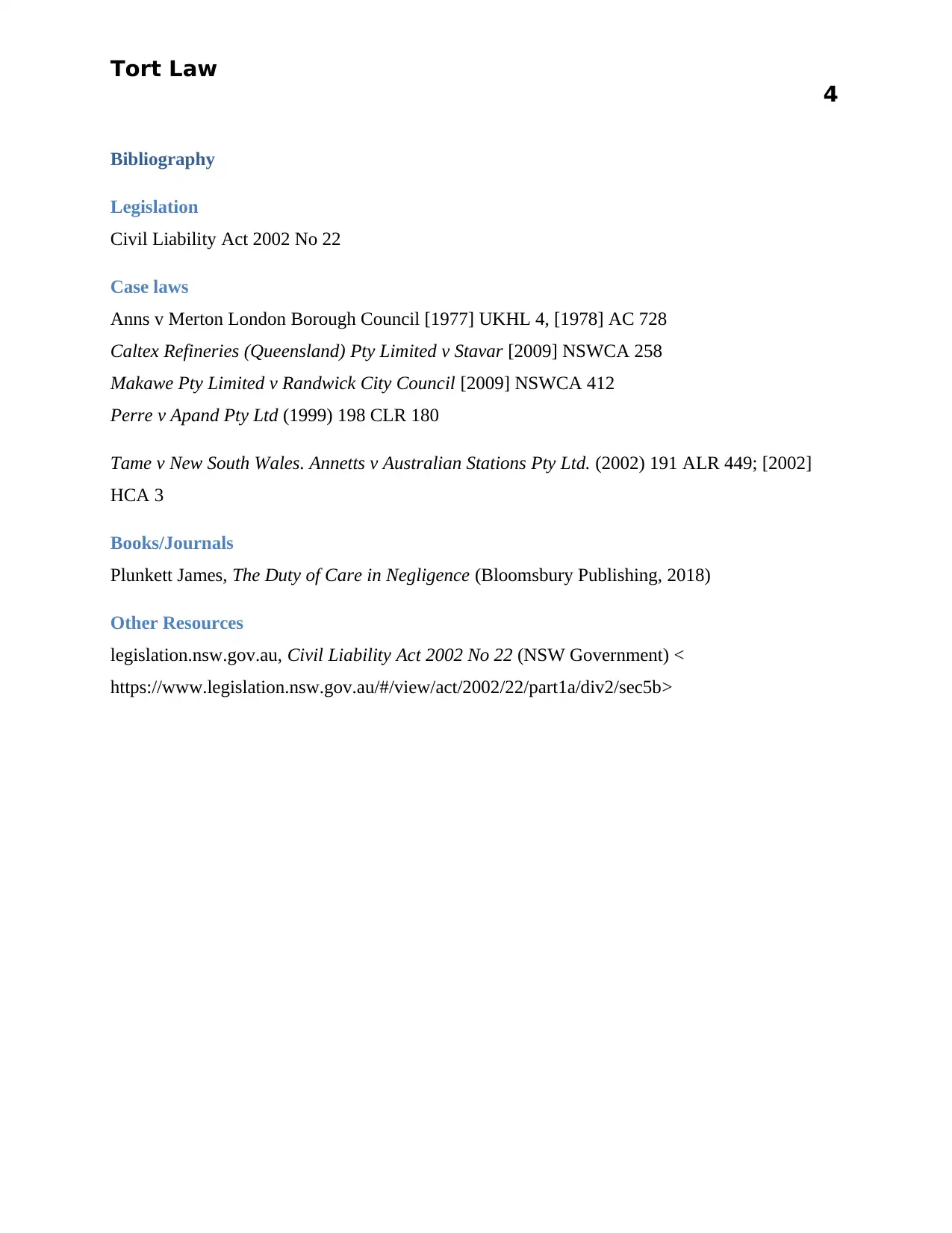
Bibliography
Legislation
Civil Liability Act 2002 No 22
Case laws
Anns v Merton London Borough Council [1977] UKHL 4, [1978] AC 728
Caltex Refineries (Queensland) Pty Limited v Stavar [2009] NSWCA 258
Makawe Pty Limited v Randwick City Council [2009] NSWCA 412
Perre v Apand Pty Ltd (1999) 198 CLR 180
Tame v New South Wales. Annetts v Australian Stations Pty Ltd. (2002) 191 ALR 449; [2002]
HCA 3
Books/Journals
Plunkett James, The Duty of Care in Negligence (Bloomsbury Publishing, 2018)
Other Resources
legislation.nsw.gov.au, Civil Liability Act 2002 No 22 (NSW Government) <
https://www.legislation.nsw.gov.au/#/view/act/2002/22/part1a/div2/sec5b>
4
Bibliography
Legislation
Civil Liability Act 2002 No 22
Case laws
Anns v Merton London Borough Council [1977] UKHL 4, [1978] AC 728
Caltex Refineries (Queensland) Pty Limited v Stavar [2009] NSWCA 258
Makawe Pty Limited v Randwick City Council [2009] NSWCA 412
Perre v Apand Pty Ltd (1999) 198 CLR 180
Tame v New South Wales. Annetts v Australian Stations Pty Ltd. (2002) 191 ALR 449; [2002]
HCA 3
Books/Journals
Plunkett James, The Duty of Care in Negligence (Bloomsbury Publishing, 2018)
Other Resources
legislation.nsw.gov.au, Civil Liability Act 2002 No 22 (NSW Government) <
https://www.legislation.nsw.gov.au/#/view/act/2002/22/part1a/div2/sec5b>
1 out of 5
Related Documents
Your All-in-One AI-Powered Toolkit for Academic Success.
+13062052269
info@desklib.com
Available 24*7 on WhatsApp / Email
Unlock your academic potential
Copyright © 2020–2025 A2Z Services. All Rights Reserved. Developed and managed by ZUCOL.