Tort Law Assignment: Negligence, Punitive Damages and Legal Concepts

Verified

Added on  2021/06/14

|3
|371
|341
Report
AI Summary
This report delves into the intricacies of tort law, specifically examining the concepts of negligence and punitive damages. It highlights the importance of the burden of proof in legal proceedings, particularly in cases involving punitive damages, and the differences between compensatory and punitive damages. The document references relevant case law and emphasizes the higher standard of proof required for punitive damages due to the need to demonstrate a higher level of wrongdoing. It concludes by underscoring the role of the plaintiff in proving the outrageous negligence required to receive punitive damages. This report is a valuable resource for understanding these critical aspects of tort law, offering insights into legal principles and their practical applications.
Document Page
Running head: TORT LAW
Tort Law
Name of the student
Name of the University
Author Note
tabler-icon-diamond-filled.svg

Paraphrase This Document

Need a fresh take? Get an instant paraphrase of this document with our AI Paraphraser
Document Page
1TORT LAW
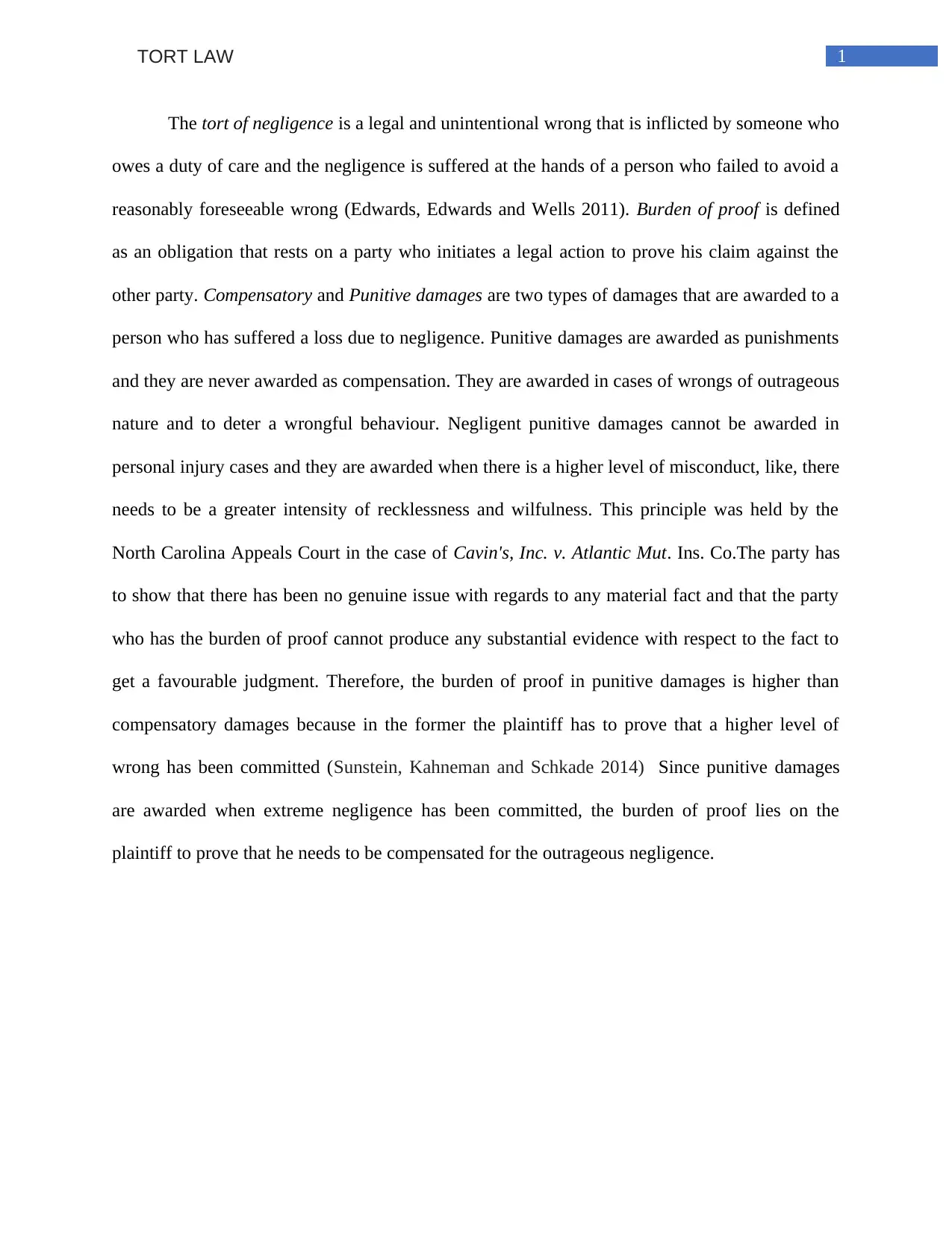
The tort of negligence is a legal and unintentional wrong that is inflicted by someone who
owes a duty of care and the negligence is suffered at the hands of a person who failed to avoid a
reasonably foreseeable wrong (Edwards, Edwards and Wells 2011). Burden of proof is defined
as an obligation that rests on a party who initiates a legal action to prove his claim against the
other party. Compensatory and Punitive damages are two types of damages that are awarded to a
person who has suffered a loss due to negligence. Punitive damages are awarded as punishments
and they are never awarded as compensation. They are awarded in cases of wrongs of outrageous
nature and to deter a wrongful behaviour. Negligent punitive damages cannot be awarded in
personal injury cases and they are awarded when there is a higher level of misconduct, like, there
needs to be a greater intensity of recklessness and wilfulness. This principle was held by the
North Carolina Appeals Court in the case of Cavin's, Inc. v. Atlantic Mut. Ins. Co.The party has
to show that there has been no genuine issue with regards to any material fact and that the party
who has the burden of proof cannot produce any substantial evidence with respect to the fact to
get a favourable judgment. Therefore, the burden of proof in punitive damages is higher than
compensatory damages because in the former the plaintiff has to prove that a higher level of
wrong has been committed (Sunstein, Kahneman and Schkade 2014) Since punitive damages
are awarded when extreme negligence has been committed, the burden of proof lies on the
plaintiff to prove that he needs to be compensated for the outrageous negligence.
Document Page
2TORT LAW
Reference
Edwards, L.L., Edwards, J.S. and Wells, P.K., 2011. Tort law. Nelson Education.
Sunstein, C.R., Kahneman, D. and Schkade, D., 2014. Assessing Punitive Damages.
chevron_up_icon
1 out of 3
circle_padding
hide_on_mobile
zoom_out_icon
[object Object]